rules_zh_叠人塔_3334.md

CASTELL
Castell (疊人塔) 是在 Catalonia 非常有名的傳統習俗,人們在這個節日期間,努力的創造出高達8-10層的人塔!
在遊戲中,玩家將創造出屬於自己的隊伍,挑戰這個重要節日。需要在 Catalonia 各區旅行,並招募更多的疊羅漢加入;好好的培訓新技能,為了在大賽中搭建出令人印象深刻的人塔。
好好地在區域大賽間取捨,讓自己在疊人塔中一舉成名吧!
遊戲配件
遊戲圖板 1塊

玩家圖板 4塊

技能輪 1塊
雙面(標準、進階)

特殊行動圓片 28片




技能認證 20片
(分5類)



任務板塊 32片


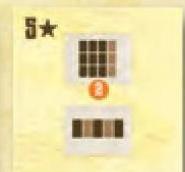
回合Token 1顆

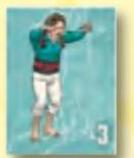
(10種Size)


Size圓片 30片



玩家幫助卡 4張


(獎牌、獎牌、獎章)


起始玩家國旗1片

玩家Token 4枚
遊戲配件


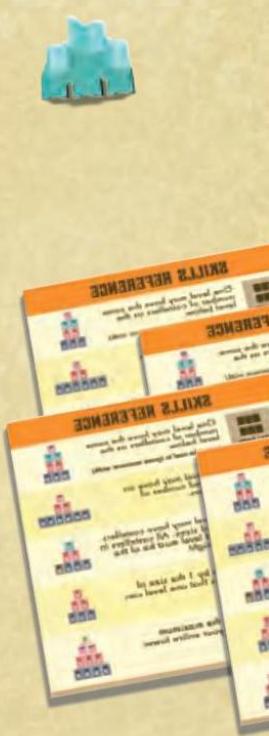
技能片 8片


(分I、II兩類)


得分Token 4枚


布袋1個

起始設置
A. 分配疊羅漢
-
將所有的疊羅漢(150片)放入布袋中,請搖一搖、攪一攪,讓隨機性提升。
-
請依照玩家人數,抽出對應數量的疊羅漢,放置於遊戲圖版上的7個區域之中。
4名玩家 - 每個區域抽取疊羅漢5片
3名玩家 - 每個區域抽取疊羅漢4片
2名玩家 - 每個區域抽取疊羅漢3片
B. 設置技能輪
- 技能輪請依照遊戲模式,選擇設置的方式。
➢ 標準模式: 請將 "All Regions" 面朝上組裝於遊戲圖板上。
➢ 進階模式: 請將 "No Regions" 面朝上組裝於遊戲圖板上。
請將"All Regions",或"No Regions"之區域,往12點鐘方向設置。(朝遊戲圖板最上方)
- 將8片技能片面朝下,隨機設置於遊戲圖板上(技能輪旁的圓圈位置),然後全數翻開。
C. 設置區域大賽
-
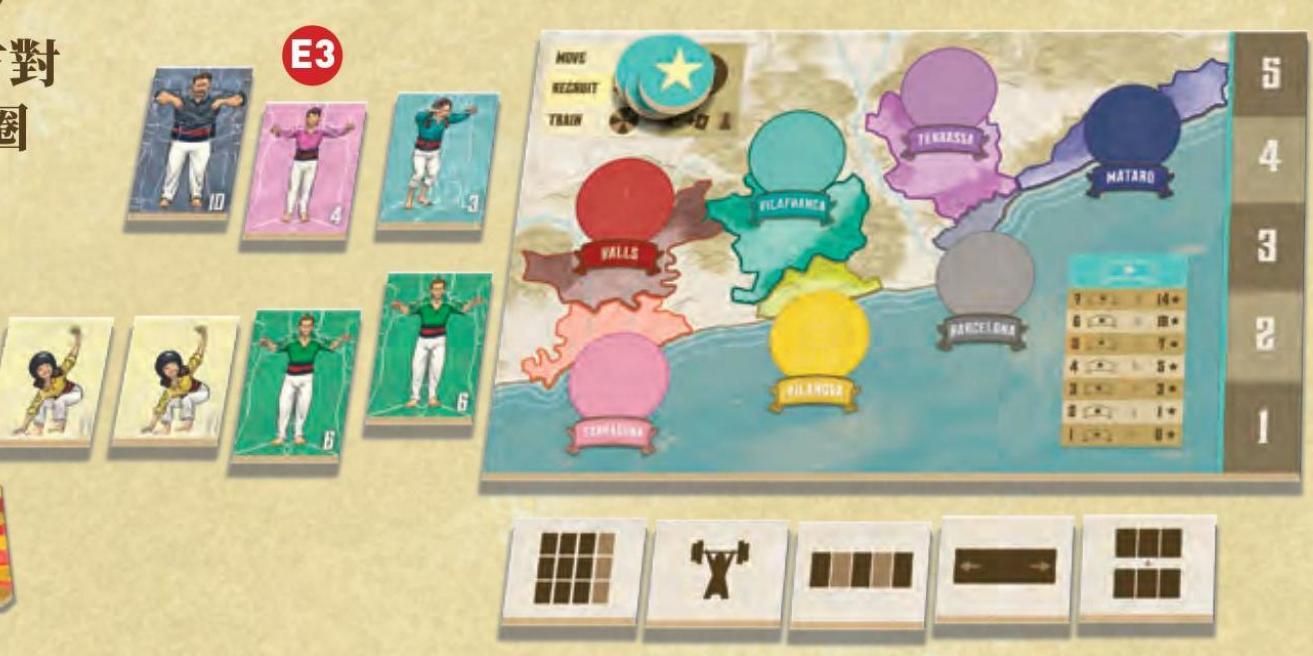
將大賽圖板分成"I"與"II"兩堆(圖板上有標示),面朝下個別混洗。
-
將"I"與"II"大賽圖板,放置於遊戲圖板上方之對應位置,然後全數面朝上顯示。
-
請將30片Size圓片混洗後,面朝上放置於遊戲圖板上方對應位置。(大賽圖板下方圓圈處)



注意!
如果是2\~3名玩家同樂,請依照遊戲圖板上方的標示,擺放大賽圖板。而其他未用到的大賽圖板,請全數放回遊戲盒中,它們並不會在此次遊戲中被使用。


D. 設置區域任務
- 將32片任務板塊,面朝下混洗後成堆擺放。
2.每個區域抽取2片任務板塊,面朝上放置。
3.沒有被設置到的18片任務板塊,請全數放回遊戲盒中,它們並不會在此次遊戲中被使用。
E.設置玩家區域
-
每名玩家拿取玩家圖板一塊、幫助卡一張、玩家Token、特殊行動圓片7片、各類技能認證5片,以及得分Token一枚。
-
將得分Token,放置於圖板上方的得分軌0分位置。
3.每名玩家從布袋中抽取7片疊羅漢,面朝上公開。
F.最後設置
-
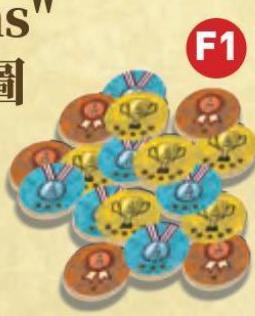
將40片大賽獎勵放置於一旁,等會兒遊戲中會使用到。
-
將回合Token放置於遊戲圖板上的第一回合位置。
3.最近去過Catalonia的玩家,請拿取起始玩家國旗。


如何進行遊戲
在 Castell (疊人塔)的遊戲中,分為10個回合。
玩家將創造出屬於自己的隊伍,挑戰這個重要節日。需要在 Catalonia 各區旅行,並招募更多的疊羅漢加入;好好的培訓新技能,為了在大賽中搭建出令人印象深刻的人塔。好好地在區域大賽間取捨,讓自己在疊人塔中一舉成名吧!
回合進行
每回合都依循下列模式進行遊戲。
- 補充新的疊羅漢: 這僅在第3、5、7和9回合會發生。(當回合Token行進於此標誌時,請記得補充!)
請依照玩家人數,抽出對應數量的疊羅漢,放置於遊戲圖版上的7個區域之中。
4名玩家 - 每個區域補充疊羅漢5片
3名玩家 - 每個區域補充疊羅漢4片
2名玩家 - 每個區域補充疊羅漢3片
-
轉動技能輪: 請將技能輪以順時針方向,往前轉一格。(第1回合不轉動)
-
玩家行動: 由起始玩家開始進行玩家行動。當行動結束後,以順時針方向輪替進行。
(行動請見下文) -
大賽評比: 第3輪後,將會開始舉辦區域大賽。(疊人塔大賽請見第10頁)
-
回合結束: 以順時針方向,傳遞起始玩家國旗。
-
回合Token在遊戲圖板上,往前一個位置。(如果是第10回合,請計算最終得分)
玩家行動
輪到玩家時,請從下列4個行動中,自由選擇是否執行,順序也可自由調整。
每個行動每回合只能執行1次。
Move 移動: 請將玩家Token移動1格到相鄰區域(虛線連接或實線連接)。
第一回合時,此動作為空降於任一區域內。
Recruit 招募: 在玩家所在之地區,任意拿取疊羅漢2片。
Train 訓練: 查看技能輪上的對應區域技能後,請將玩家圖板旁的對應技能認證往上提升1級。如果對應的技能認證未放置於玩家圖板旁,請加入並擺放於等級1的位置。
· 標準模式:玩家可以選擇所在的區域技能升級,也可以選擇"All Regions"區域的技能升級。
(有關於技能的解說,請參閱第7頁。)
Special Action 特殊行動: 選擇此行動時,玩家都必須放置1枚特殊行動圖片至該區域內。請從下列3個選項中執行1個:
-
Single Recruit 單人招募: 在玩家所在之地區,拿取疊羅漢1片。
-
Move 移動: 將玩家Token移動1格到相鄰區域(虛線連接或實線連接)。
-
Local Performance 區域任務: 選擇玩家所在區域之任務板塊1塊,並疊建一座相同圖形的人塔,或達成指定條件,將可成功拿取該任務板塊。將特殊行動圓片放置於任務區旁之圓圈處。
(有關於任務的解說,請參閱第9頁)
疊人塔
疊人塔時,請務必遵循以下3條基本規則。

1: 每一層需要由單種Size的疊羅漢排列。
2: 較高一層的疊羅漢Size(數字)必需小於較低一層,且數量也需小於較低一層。
3: 最大寬度為3名疊羅漢所排列。
為了配合區域中的大賽與任務,人塔是隨時可以改變排列的,不會永遠的被定型成某種形式。
上面所敘述的只是基本規則。
但是通過培訓後,將擁有新的技能改變這些規則,請發揮想像力與策略,疊建出令人印象深刻的人塔吧!
(有關於技能的解說,請參閱第7頁)
技能解說
每個技能都分成 0-5 級,並在玩家圖板上的技能軌上表示。
技能的等級,表示為玩家在疊人塔時,可應用的次數。

Balance 平衡 → 每一個等級,可以使玩家多疊建一層寬度相同的人塔。
Example A:
玩家Fernanda的平衡技能為等級2,這使她可以多疊建2層寬度相同的人塔,所以總層數可到達5層。
(在基本規則裡,玩家可以建造最高3層,且最大寬度為3的人塔。)
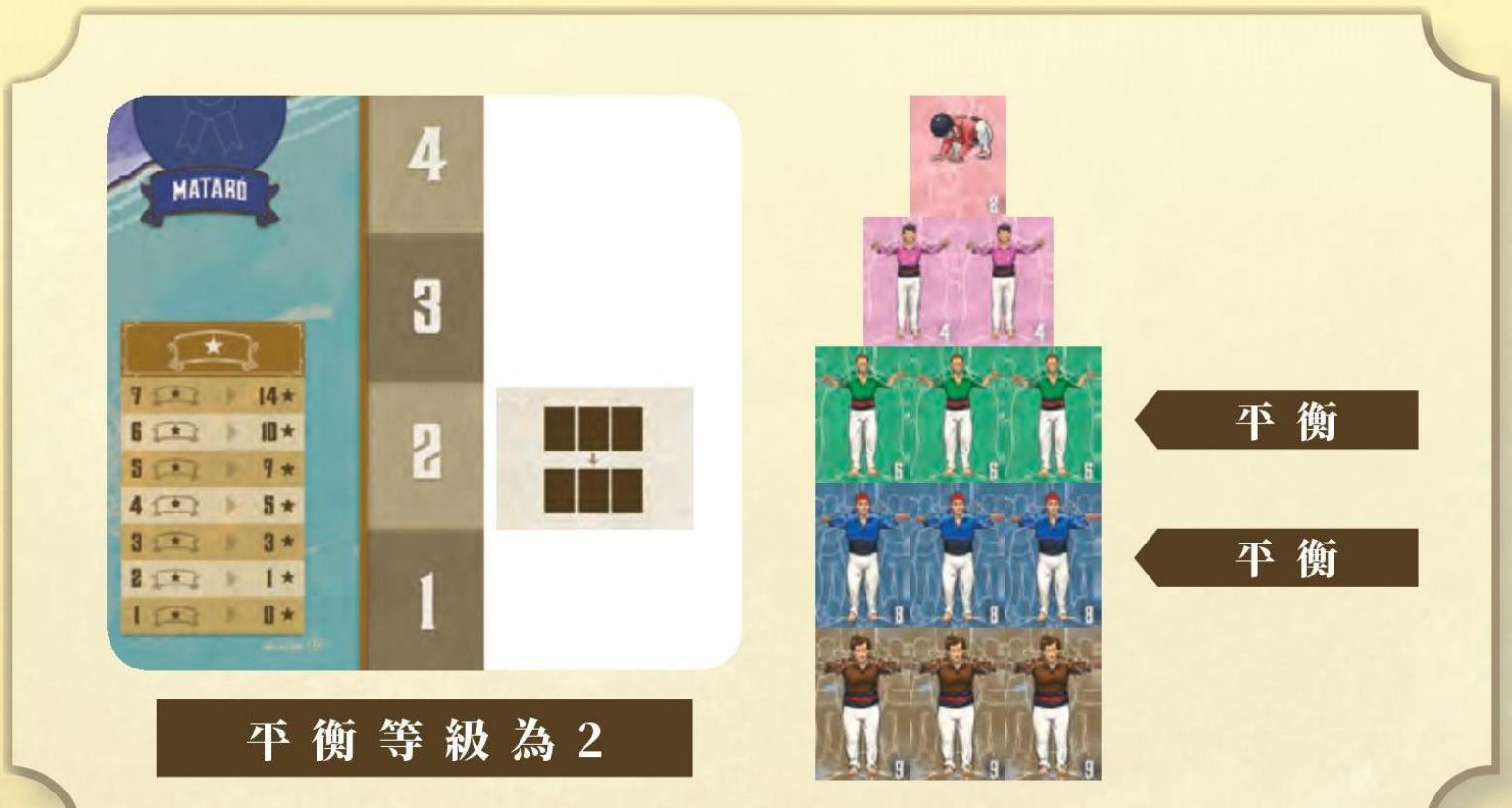
平衡等級為2

Base 無限底層 → 每一個等級,可以使玩家疊人塔時的最底層寬度(使用過該技能的最底層,不算在內)為無限寬;但其他層還是需要遵守基本規則。
Example B:
玩家Arno的無限底層技能為等級1,所以他的最低層可以忽略最大寬度限制。

無限底層等級為1
Mix 混合 → 每一個等級,可以使玩家疊人塔時,有規矩的使Size互相交織。(1與2、3與4、5與6、7與8、9與10)
Example C:
玩家Jordan沒有足夠的Size 9疊羅漢,但他想要用Size 9來當最底層,所以他升級了混合技能。
這使他可以將Size10加入Size9,一同疊建最底層。
然而他還有一個等級1的平衡技能,所以可以添疊1層寬度相同的人塔。

混合等級為1
平衡等級為1
平衡
混合

Strength 強度 → 每一個等級,可以使玩家疊人塔時,使較低(小)1階Size的疊羅漢,舉起高(大)1階(或同)Size的疊羅漢。
如果玩家的強度技能等級高於1,將可以應用於不同的等級,或是疊建在同1等級。
Example D:
玩家Ramani擁有的Size 5疊羅漢太多了,他不想要浪費這些人才,所以他將強度技能升級到2。
這使他可以將同Size的疊羅漢互相堆疊。且因為他的平衡技能等級有2,所以可以疊出下圖的人塔。

強度等級為2
平衡等級為2
平衡與強度
平衡與強度


Width 寬度 → 每一個等級,可以使玩家疊人塔時,每一層的寬度多加1人。
Example E:
玩家Fernanda招募了許多Size 9與 10的疊羅漢,所以她升級了寬度技能到達等級4,這使她能讓每一層人塔都多+4名疊羅漢。

寬度等級為4
在技能輪上,還有2種技能(Practice 操練 和 Special 特殊),這兩種技能是立即性的效果,而非提升該技能等級。
Practice 操練 → 立即提升1項已修得的技能。(等級1以上的技能才可以升級)

Special 特殊 → 立即執行一次特別行動,且此技能無須消耗特殊行動圖片。
(這個是技能,而非行動,所以不算是重複使用特殊行動。)
區域任務
玩家Token所在的區域,可以選擇特殊行動來解決區域任務。
只要成功符合任務板塊上的條件,則可以拿回該任務板塊。
拿取板塊後,須將1枚特殊行動圖片,放置於對應區域(任務區旁的圓圈位置)。
任務版塊分為2類: 特殊人塔,技能展示。
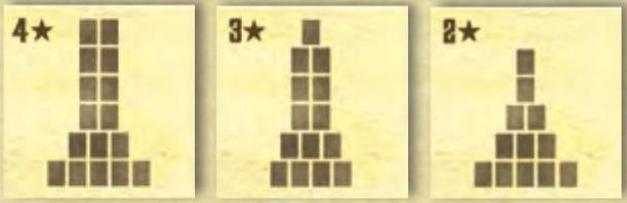
特殊人塔
玩家需要疊出,與任務板塊相同寬度,與高度的人塔形狀。
| 6★ | |
| 4★ | |
| 7★ |
技能展示
需要滿足下列2種需求,才算是成功解決任務。
-
叠建出的人塔層數,需要高於星星數。
-
叠建出的人塔,需要用到指定的技能與技能次數(等級)。
Example F:
輪到Jordan時,她決定解決區域任務。
她的玩家Token正在Terrassa,所以她選擇技能輪上Terrassa區域的技能升級。
為了解決Terrassa的區域任務,Jordan必須疊建出一座至少6層的人塔,並在疊建時使用強度技能1次(等級1),無限底層技能次(等級1),和混合技能2次(等級2)。
成功的解決Terrassa的區域任務後,請將任務板塊放置於玩家圖板旁。(露出空格的任務區,不會補充任務板塊)
此外,將Terrassa區域中(遊戲圖板上)的所有特殊行動圓片(包括自己的),放置於玩家圖板上的Terrassa區域內。
注意:區域任務是一種特殊行動,在玩家成功解決區域任務後,請把玩家自己的特殊行動圓片1枚,放入對應區域(任務區旁的圓圈)。

大賽評分
區域大賽將從第3回合開始競技,如果遇到雙區域大賽,兩區域是個別競技的,玩家請選擇有利於自己的區域參賽。大賽不是強制參加的,就算玩家在該區域內,可以也選擇不參與競爭。計算得分後,將頒發大賽獎勵。
Participation Requirements 參賽要求
參加大賽必須滿足下列3個需求:
· 玩家Token必須在舉辦大賽的區域內。
· 玩家的人塔中,疊羅漢的Size必須完全對應Size圓片。
(疊羅漢必須參與在其中,而不僅僅只是招募到玩家的團隊內。)
· 玩家的人塔必須要有4層以上。

Example G:
現在正準備結束第5回合,Vilanova區域將舉辦大賽。
玩家Ramani的玩家Tokem正在該區域上。
此次大賽規定,人塔中必須由Size 6和 Size 8的疊羅漢於其中。
雖然玩家Ramani有招募這兩個Size的疊羅漢,但Size 8的疊羅漢不足夠,這樣是無法加入人塔中的。
參與大賽時,需要疊出4層以上,所以以上2點讓玩家Ramani無法參賽。
Calculating Tower Scores 計算人塔分數人塔的分數高低,請將下列2類分數計算後加總。
· 人塔的層數,每1層1分。
· 與對應Size圓片相同的疊羅漢,每1片+1分。
包含
不足4層 ×

計算出來的分數,如果高過現在得分Token在分數軌上的位置,請立即調整到對應位置。重要:分數軌上的分數,並非每次大賽後的分數加總,而是某次大賽的最佳得分。
Example H:
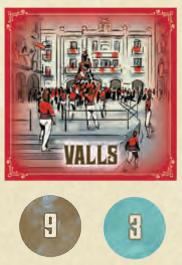
Fernanda參加Valls的區域大賽,觀眾指定Size圓片為3跟9。
她疊建出的人塔層數為6層,有Size 3的疊羅漢2片,和Size 9的疊羅漢4片。
計算出的分數為 $6+4+2=12$ 分。
這正是Fernanda的最佳得分,所以她將得分Token移動到得分軌上的“12”位置。
Earning Prizes 頒發獎勵
所有參與大賽的玩家,分數全部計算完畢後,排列出此次大賽名次,對應下表領取獎勵:
| 參與大賽的玩家人數 | Prize Earned |
| 3名玩家以上 | 第1名: 奖盃(5分) |
| 第2名: 奖牌(3分) | |
| 第3名: 奖章(1分) | |
| 2名玩家以上 | 第1名: 奖牌(3分) |
| 第2名: 奖章(1分) | |
| 1名玩家以上 | 第1名: 奖章(1分) |
如果有2名以上的玩家得分相同,那將會領取低一等的獎勵。
Example I:
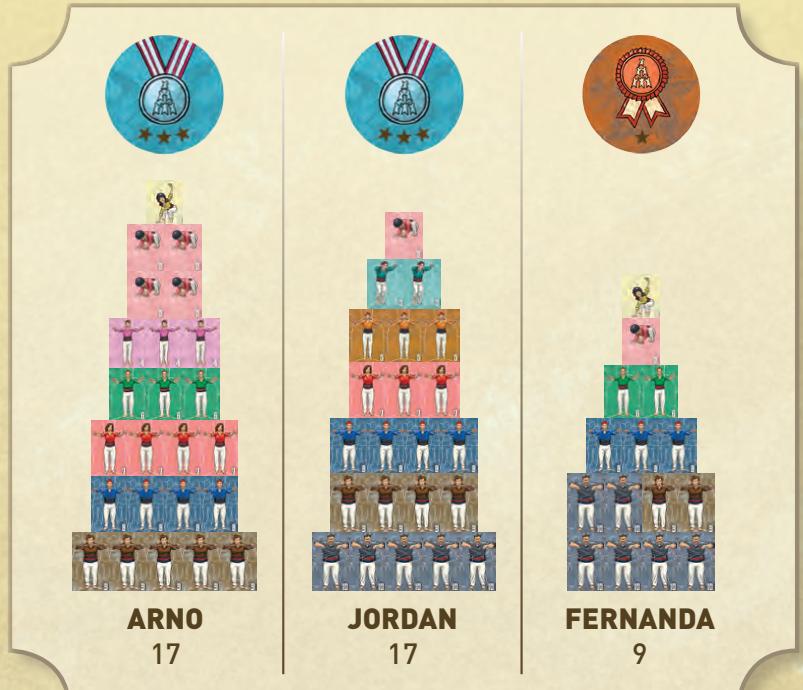
Arno、Fernanda與Jordan一同參加區域大賽。
Arno和Jordan都得到了17分,而Fernanda僅得到9分。
因為有兩名玩家分數相同而平手,所以都拿到了第2名的獎勵。
這使得Fernanda只得到第3名的獎勵。
ARNO
17

JORDAN
17
FERNANDA
9
Claiming Size Tokens 指定 Size 圓片
每個區域大賽,都將指定出1\~3種Size的疊羅漢,這是觀眾們的期望。
參賽玩家的疊人塔中,如果對應的某類疊羅漢Size是本場大賽中最多的,玩家將可以拿取該Size圓片。
如果平手,則無人拿取。
領取到的Size圓片,請立即放置於玩家圖板上的所在區域(獲得區域)。


Example J:
Mataró與Jordan參與了此次大賽,對應Size圓片分別是2、7和10。
Jordan的人塔中,Size 10的疊羅漢多過Mataró,所以立即拿取Size 10的Size圓片。
同理,Mataró立即拿取Size 2的Size 圓片。
因為雙方Size 7的疊羅漢數量相同,則無人拿取Size 7的Size圓片。

遊戲結束
回合10結束後,進入最終計分。
最終分數高低,請將下列5類分數計算後加總。
- Best Tower Score 最佳得分
得分軌上分數Token所最在位置。
記住:分數軌上的分數,並非每次大賽後的分數加總,而是某次大賽的最佳得分。
- Region Variety Bonus 區域得分
計算在玩家圖板上有獲得大賽獎勵、Size圓片,和特殊行動圓片的所在區域。請根據下表得取對應分數:
| 區域 | 1 | 2 | 3 | 4 | 5 | 6 | 7 |
| 分數 | 0 | 1 | 3 | 5 | 7 | 10 | 14 |
- Earned Prizes 大賽獎勵
所有的大賽獎勵總和。獎盃: 5分,獎牌: 3分,獎章: 1分。
- Size Tokens Size 圓片
每一種Size 得2分,如果Size 重複,重複的那一枚圓片得1分。
- Local Performances 區域任務
將所有完成的任務板塊星星數加總,1顆星星為1分。。
Example K:
玩家Arno列出4人遊戲時的總得分。
他的最佳得分為18分。
他的玩家圖板上,有4個區域擁有大賽獎勵、Size圓片,和特殊行動圓片,對應表格後,獲得5分。
他將所有的大賽獎勵轉換後,獲得16分。(5+5+3+1+1+1)
他拿取到5個不同的Size圓片,與2個重複的Size圓片,可以獲得12分。(2 +1+2+1+2+2+2)
最後,他所獲得的任務圖板總星數為14,所以獲得14分。(4+5+5)
玩家Arno最終得分為65分。

分數
將5個類別的分數加總後,總得分最高的玩家,就是今年的疊人塔冠軍!!!如果總得分相同,將並列冠軍。
Game Designer: Aaron Vanderbeek
Illustrator: Ossi Hiekkala
Graphic Designer: Jeanne Torres
Production Artist: Paul Tseng & Dan Wagner
Editor: Dustin Schwartz
Credits
— Renegade Game Studios —
President & Publisher: Scott Gaeta
Controller: Robyn Gaeta
Director of Operations: Leisha Cummins
Director of Sales & Marketing: Sara Erickson
Creative Director: Anita Osburn
Customer Service: Jenni Kingma
Renegade Game Studios would like to thank Protospiel San Jose and the Cardboard Edison Awards for their part in helping to bring this game to life.
— Special Thanks —
The designer would like to thank Víctor Vilca i Méndez for the inspiration, Marià Pitarque for the thematic development, Francisco Souki, Andrew Federspiel, Brian Schneider, Paul Sottosanti, Teale Fristoe, Jim McCollum, Annette Villa, Mitchell Lopez, Suzanne Kabrt-Zinsli, Chris Zinsli for the support and playtesting. And finally, the San Francisco board gaming community and all of the playtesters at local game stores, cafés, and conventions.
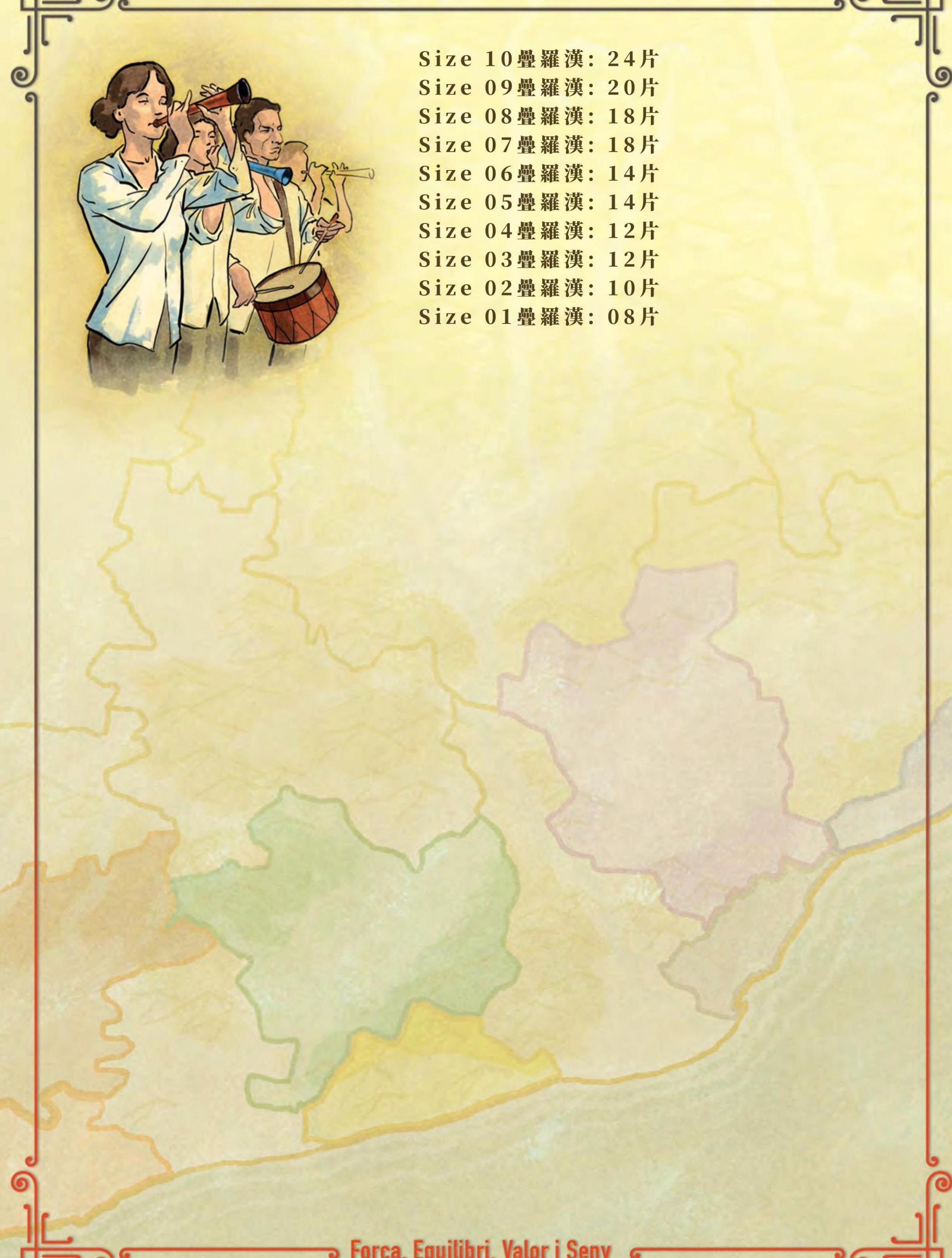
Size 10疊羅漢:24片
Size 09疊羅漢:20片
Size 08疊羅漢:18片
Size 07疊羅漢:18片
Size 06疊羅漢:14片
Size 05疊羅漢:14片
Size 04疊羅漢:12片
Size 03疊羅漢:12片
Size 02疊羅漢:10片
Size 01疊羅漢:08片
Castell Rulebook_Final_low_RGS.md

CASTELL
Castell is a rich folk tradition in Catalonia, for which people gather at festivals to build human towers up to 8–10 people high! In the game, you run a castell team and are traveling around the various regions of Catalonia, recruiting castellers to your team, training new skills to build more impressive towers, and performing at festivals in the Catalan villages and towns. Do you have what it takes to be the best colla, or castell team, in the land?
COMPONENTS
1 Skill Wheel

150 Castellers




28 Special Action Tokens


20 Player Skill Tiles
30 Size Tokens

4 Player Aids


40 Prize Tokens
32 Local Performance Tiles


1 First Player Marker


1 Round Marker
COMPONENTS

4 Player Pawns


8 Board Skill Tiles
14 Festival Location Tiles


4 Score Markers


1 Cloth Bag

SETTING UP THE GAME
A. DISTRIBUTE THE CASTELLERS
-
Put all 150 castellers into the cloth bag, and shake the bag to ensure they are thoroughly randomized within the bag.
-
From the bag, draw castellers randomly and place the appropriate number of them in each of the board's 7 regions. The number varies according to player count:
4 players: 5 castellers per region
3 players: 4 castellers per region
2 players: 3 castellers per region
B. SET THE SKILL WHEEL
- Set the skill wheel in its designated spot on the right half of the game board. Which side to use depends on your difficulty preference:
Standard Game: place with the “All Regions” side face up
Advanced Game: place with the “No Regions” side face up
Place the wheel so that the “All Regions” or “No Regions' is facing north.
- Shuffle the 8 board skill tiles and place them randomly in the 8 slots surrounding the skill wheel, face up.
C. CREATE THE FESTIVAL CALENDAR
-
Sort the festival location tiles into 2 types, according to their backs: “I" and "II.'
-
Shuffle all of the "I" tiles face down, then deal 1 face up to each “I" space of the game board's festival calendar. Then do the same with the “II" tiles, dealing 1 to each “Il" space of the festival calendar.
-
Shuffle the 30 size tokens face down, then deal 1 face up to each space below a festival location tile.


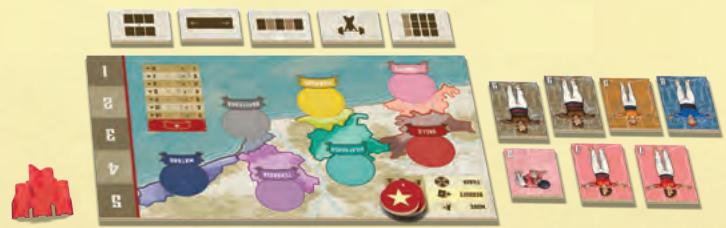
IMPORTANT! Certain spaces of the festival calendar are only used at higher player counts. If playing with 2 or 3 players, you will have extra festival location tiles and size tokens. Return these extras to the game box; they will not be needed.

D. SCHEDULE THE LOCAL PERFORMANCES
-
Shuffle the 32 local performance tiles face down, then deal 2 face up to each row of the local performance area, along the left edge of the game board.
-
Return the 18 unused local performance tiles to the game box; they will not be needed.
E. PREPARE THE PLAYER AREAS
-
Give each player a player board and player aid, and the following game pieces in the color of their choice: 1 player pawn, 1 score marker, 7 special action tokens, and 5 player skill tiles. Stack the special action tokens on the corresponding icon of the player board.
-
Place all players' score markers on the “" space of the game board's score track.
-
Each player takes 7 castellers randomly from the bag.
F. FINAL STEPS
-
Set aside the 40 prize tokens for now. They will come into play during the game.
-
Place the round marker on the “1" space of the game board's round track.
-
Give the first player marker to whoever has most recently visited Catalonia.
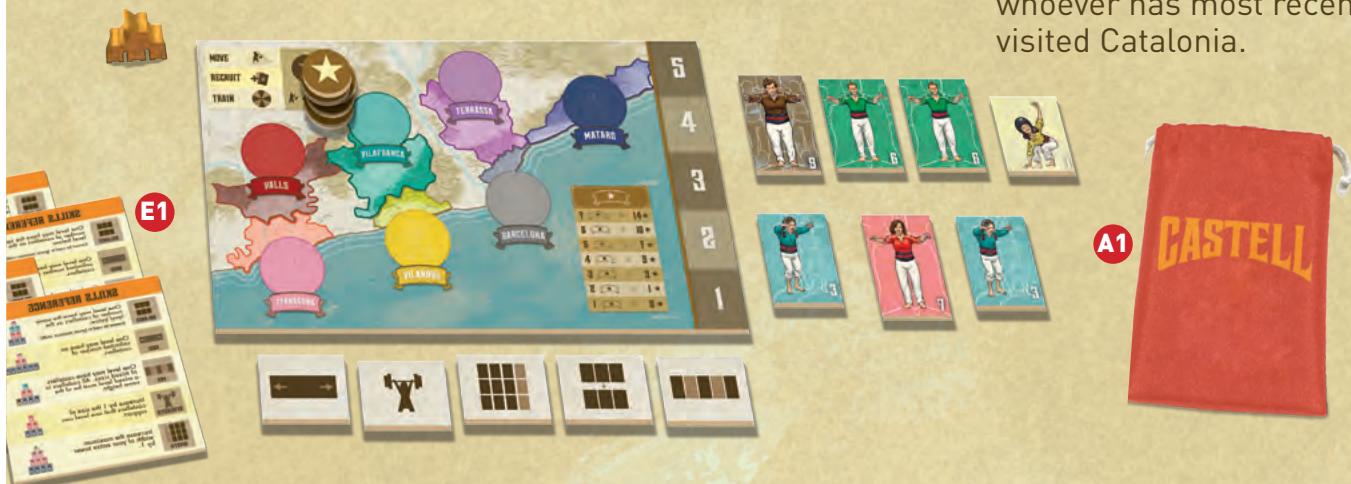
HOW TO PLAY
A game of Castell takes place over the course of 10 rounds. Your goal is to recruit castellers from the regions of Catalonia, then build towers with those castellers to compete in the festivals. You'll need to train your castellers in various skills so that you can build taller, wider, and more creative towers. The more diverse your performances and the better you tailor your towers to each audience, the higher your final score will be.
ROUND STRUCTURE
Each round follows the same basic structure.
- Add New Castellers: This step occurs ONLY in rounds 3, 5, 7, and 9. (There are icons on the round track to remind you of this.) When adding new castellers, draw castellers randomly from the bag to refill each region until it reaches capacity:
4 players: 5 castellers per region
3 players: 4 castellers per region
2 players: 3 castellers per region
-
Rotate the Skill Wheel: Turn the skill wheel exactly 1 space clockwise.
-
Player Turns: Each player takes 1 turn. Whoever has the first player marker goes first, then each other player in clockwise order.
-
Festival Scoring: This step does NOT occur in rounds 1 and 2. There will be 1 or 2 festivals held in each round — the festival calendar indicates this. If there are 2 festivals, score them individually, in either order. (See FESTIVAL SCORING, p. 10 for details.)
-
Round End: Skip this step in round 10. Pass the first player marker to the left. Advance the round marker 1 space on the round track.
TAKING YOUR TURN
On your turn, there are 4 different actions you may (but are not required to) take, in any order you wish. You cannot take the same action more than once per turn.
Move: When you take this action, move your pawn to an adjacent region. A region that is touching another region, or connected by dotted line, is considered adjacent to that region.
(The very first time you take this action in the game, you will instead simply add your pawn to the game board, in a region of your choice.)

Recruit: When you take this action, recruit up to 2 castellers of your choice from the region where your pawn is located, moving them to your player area.

Train: When you take this action, you will increase the rank of 1 of your skills.
Look at the skill wheel to determine which skill(s) are currently available to you.
o Standard Game: You may select either the skill in the slot corresponding to your pawn's current region OR the skill in the “All Regions" slot.
o Advanced Game: You may only select the skill the slot corresponding to your pawn's current region.
To increase your chosen skill, move that skill tile up by 1 space on your player board's skill track. If you do not yet own that skill, add the skill tile to the “1" space of your skill track. (See USING YÓUR SKILLS, p. 7 for a complete list of the skills and their effects.)
Special Action: To take this action, you MUST have 1 special action token available. When you take this action, choose 1 of the 3 options below:
0 Single Recruit: Recruit any 1 casteller from your pawn's current region.
o Move: Move your pawn to an adjacent region.
o Local Performance: Build a tower that matches the requirements of 1 of the local performance tiles for your pawn's current region. (See LOCAL PERFORMANCES, p. 9 for details.)
After taking the special action, you must place 1 of your available special action tokens onto the local performance area of the game board. Be sure to put it in the space that matches your pawn's current region.
BUILDING TOWERS
There are 3 basic rules that you must follow when building towers.

Rule 1: Each level in your tower must be made up of castellers of a single size. Rule 2: Each level built on top of another level must have castellers of a smaller size (i.e., lower number) and must have fewer castellers than the level below it.
Rule 3: The maximum width of a level in your tower is 3 castellers.
You can always tear down your tower in order to build a new one for the next festival or local performance. You are never locked into a specific tower configuration.
These are the basic rules for tower building. However, by training in new skills, you can alter these rules in strategic ways to build much more impressive towers. (See USING YOUR SKILLS, p. 7 for details.)
USING YOUR SKILLS
Each of your player skills has a current rank (0-5), indicated by that skill tile's position on your player board's skill track. Your rank in a skill indicates how many times you can use that skill in a single tower.

Balance → The Balance skill allows you to build 1 level in your tower with the same number of castellers in it as the level just below it.
Example A: In the base
level of Fernanda's tower, she has 3 castellers. Because she is rank 2 in the Balance skill, she is allowed to have up to 3 castellers in each of the next 2 levels also. This makes it possible for her to build a tower 5 levels high.


Base →The Base skill allows you to have 1 level in your tower with an unlimited number of castellers (i.e., ignoring the maximum width restriction for that level). All other levels must adhere to the maximum width restriction, however.
Example B: Because he is rank 1 in the Base skill, Arno can put as many castellers as he wishes in his base level, ignoring the maximum width restriction. This works out well for him because he has a lot of size-8 castellers, which are required for the current festival.

Mix → The Mix skill allows you to have 1 level in your tower in which the castellers can be of mixed sizes. All castellers in a single mixed level must be the same height, which you can determine by comparing the physical height of the castellers. The allowed mixes are 10/9, 8/7, 6/5, 4/3. You can consider a mixed level to be either size (whichever is more advantageous to you) for the sake of building the next level up.
Example C: Jordan doesn't have enough size-9 castellers to build the base she wants. However, because she is rank 1 in the Mix skill, she can ad her lone size-10 casteller to make up the difference. Then, using her Balance skill, she can build a level of size-8 castellers that is the same width, directly above that.

Strength → The Strength skill allows 1 level in your tower to support a level of castellers 1 size larger than normal. If you have multiple ranks of the Strength skill, they may be applied to separate levels or combined for the same level.
Example D: Ramani has more size-5 castellers than he can use in a single level. He is rank 2 in the Strength skill, though, so he is able to split his 6 castellers of that size into 3 different levels of 2 castellers each, stacked on top of one another. This is possible because he is also rank 2 in the Balance skill.


Width → The Width skill increases the tower's maximum width by 1. This increase applies to the entire tower, not just the base.
Example E: Because she has so many size-10 and size-9 castellers, Fernanda trained her Width skill to rank 4. She can now have up to 7 castellers on her base level and up to 6 castellers on the level above that. (This is before taking into account her other skills!)

On the skill wheel, there are 2 more skills (Practice, Special) available for which you cannot increase your rank. Instead, when you take the Train action and choose that skill, you immediately carry out the corresponding ability.

Practice → When you choose the Practice skill, increase the rank of any of your currently owned skills by 1. (You cannot practice a skill that you do not yet own.)

Special → When you choose the Special skill, you immediately take a special action. (See the rules for special actions on page 6.) However, you do NOT place a special action token when taking a special action via the Special skill.
LOCAL PERFORMANCES
Each must be put on in a specific region, indicated by which row that tile occupies on the game board. If your pawn is in that region and you take a special action, you can put on that local performance.
There are 2 different types of local performances: tower shapes and skill exhibitions.

Tower Shapes
To put on a local performance of this type, you must build a tower that makes the shape exactly as pictured on the local performance tile, using your castellers and available skills.


Skill Exhibitions
To put on a local performance of this type, you must build a tower that meets 2 different requirements, indicated by the local performance tile:
-
The tower must have at least as many levels as the tile's point value.
-
The tower's construction must utilize all of the indicated skills.
Example F: On her turn, Jordan decides to put on a local performance. Her pawn is in Terrassa, so she chooses a skill exhibition that is available in that region, To meet the requirements of this local performance, Jordan must build a tower that is at least 6 levels high and that uses the Strength skill (1x), Base skill (1x), and Mix skill (2x).
After proving that you can build the tower required for a local performance, claim that local performance tile by moving it to your player area. In addition, take all special action tokens (including your own!) that are in that region of the game board, moving them to the corresponding region of your player board.
Remember: Because putting on a local performance is a special action, after you have finished claiming the special action tokens from that region, you must then add 1 of your available special action tokens in that region.

FESTIVAL SCORING
There are festivals that occur at the end of rounds 3-10. If there are multiple festivals occurring in a single round, score each festival individually. In each festival, the participating player who builds the best tower will take the top available prize.
Participation Requirements
There are 3 requirements you must meet in order to participate in a festival:
• On the game board, your pawn must be in the region where the festival is occurring, as indicated by the festival location tile.
• Your tower must contain castellers that match all of the size tokens for that festival. (These castellers must be present in your tower, not just recruited to your team.)
• Your tower must have at least 4 levels.
Example G: It's the end of round 5, and there is a festival occurring in Vilanova. Ramani's pawn is in that region. However, the festival requires castellers of sizes 6 and 8. Ramani has some of both, but not enough size-8 castellers to build a legal tower that includes them. Therefore, he cannot participate in the festival.
CONTAINS G✓
CONTAINSB V
4 - HEIGHT X

Calculating Tower Scores
To calculate the score of the tower you built, add together your scores in these 2 categories: • +1 VP for each level in your tower (i.e., your tower's height).
+1 VP for each casteller in your tower that matches a size token for this festival. (If there are multiple of the same size token, score each of them for each matching casteller.)
If this tower score is your best tower score, adjust your score marker on the score track to indicate that score. IMPoRTANT: Do not add your tower score to any previous tower score! During the game, your score marker tracks only your single BEST tower score.
Example H: Fernanda is
participating in a festival in Valls, where the size tokens are 9 and 3. The tower she builds is 6 levels high, with four size-9 castellers and two size-3 castellers. All told, her tower score is 12 (6 + 4 + 2). This is Fernanda's best tower score yet, so she moves her score marker to the "12" space on the score track.

Earning Prizes
After all participating players have calculated their tower scores for a festival, it's time to award prize tokens, based on final placement in that festival. Use the prize chart below:
| Players at the Festival | Prize Earned |
| 3+ players | 1st place: Trophy (5 VPs) |
| 2d place: Medal (3 VPs) | |
| 3rd place: Ribbon (1 VP) | |
| 2 players | 1st place: Medal (3 VPs) |
| 2 place: Ribbon (1 VP) | |
| 1 player | 1st place: Ribbon (1 VP) |
If 2+ players are tied for a place, then they each receive the prize for the next lowest place.
Example I: Arno, Fernanda, and Jordan are all participating in a festival. Arno and Jordan tie with a tower score of 17, while Fernanda manages a tower score of 9. Because they tied for first place at the festival, Arno and Jordan each receive a medal. This pushes Fernanda down to third place, so she receives a ribbon.
Claiming Size Tokens
For each festival, there will be 1-3 size tokens available. These represent the casteller sizes wished for by the audience. Among all players participating in that festival, the player who has the most castellers of that size in their tower claims that size token. (If there is a tie, nobody earns the token and it should be discarded to the box.) When claiming a token, immediately put it on your player board, in the region where that festival took place.
Example J: In this festival in Mataró, the size tokens are 10, 7, and 2. Only Ramani and Jordan are participating in this festival. Jordan claims the 10 token, as she had more size-10 castellers in her tower. Likewise, Ramani claims the 2 token, as he had more size-2 castellers. They tied for the number of size-7 castellers, so neither player claims the 7 token.

END OF THE GAME
After festival scoring has occurred at the end of the 10th round, the game is over, and it is then time to calculate final scores. To do so, each player will separately evaluate 5 categories:
1. Best Tower Score
Your best tower score should be marked already, by the location of your score marker on the score track. Remember: You do not score every tower you build during the course of the game, only your single BEST tower!
2. Region Variety Bonus
Count the total number of regions where you have earned prizes, size tokens, and/or special action tokens. You score bonus victory points according to the chart below:
| Regions | 1 | 2 | 3 | 4 | 5 | 6 | 7 |
| VPs | 0 VP | 1 VP | 3 VPs | 5 VPs | 7 VPs | 10 VPs | 14 VPs |
3. Earned Prizes
Score victory points for all of the prize tokens you earned during festivals. Each trophy you have is worth 5 VPs, each medal you have is worth 3 VPs, and each ribbon you have is worth 1 VP.
4. Size Tokens
Score 2 VPs for each unique size token you have, then 1 VP for each duplicate size token.
5. Local Performances
Count the total number of VPs listed on all of the local performance tiles you have claimed, and add them to your score. Score 1 VP for each special action token that you collected via putting on local performances.
Example K: Arno is calculating
his score at the end of a 4-player game. His best tower score was 18 VPs. He scored a bonus 5 VPs for claiming tokens from 4 different regions. His 2 trophies, 1 medal, and 3 ribbons translate to 16 VPs. He has 5 unique size tokens and 2 duplicates for 12 VPs. Lastly, the 3 local performance tiles he claimed are worth 14 VPs. Arno's final score is 65 VPs.

After player scores across all 5 categories have been added up, the player with the highest total score is named the winner, and their castell team is crowned the champions of Catalonia! (If there is a tie for highest total score, the tied players share the victory.)
Game Designer: Aaron Vanderbeek
Illustrator: Ossi Hiekkala
Graphic Designer: Jeanne Torres
Production Artist: Paul Tseng & Dan Wagner
Editor: Dustin Schwartz
Credits
—Renegade Game Studios —
President & Publisher: Scott Gaeta Controller: Robyn Gaeta Director of Operations: Leisha Cummins Director of Sales & Marketing: Sara Erickson Creative Director: Anita Osburn Customer Service: Jenni Kingma
Renegade Game Studios would like to thank Protospiel San Jose and the Cardboard Edison Awards for their part in helping to bring this game to life.
—Special Thanks —
The designer would like to thank Víctor Vilca i Méndez for the inspiration, Marià Pitarque for the thematic development, Francisco Souki, Andrew Federspiel, Brian Schneider, Paul Sottosanti, Teale Fristoe, Jim McCollum, Annette Villa, Mitchell Lopez, Suzanne Kabrt-Zinsli, Chris Zinsli for the support and playtesting. And finally, the San Francisco board gaming community and all of the playtesters at local game stores, cafés, and conventions.

简繁检索对照.md
239638_238638_castell — 简体/繁体检索对照
本游戏的规则书是繁体中文原文。用户用简体提问时,把关键词按下面这张表转成繁体再去 grep 原文,命中率最高。
回答时用简体或繁体都可以,但引用的原文保持繁体。
简体 → 繁体 对照(按该游戏原文出现频率排序,共 60 字)
| 简体 | 繁体 | 原文出现次数 |
|---|---|---|
| 叠 | 疊 | 78 |
| 区 | 區 | 69 |
| 赛 | 賽 | 50 |
| 罗 | 羅 | 49 |
| 汉 | 漢 | 49 |
| 数 | 數 | 45 |
| 将 | 將 | 42 |
| 级 | 級 | 37 |
| 个 | 個 | 36 |
| 图 | 圖 | 36 |
| 层 | 層 | 35 |
| 请 | 請 | 35 |
| 务 | 務 | 34 |
| 动 | 動 | 33 |
| 游 | 遊 | 31 |
| 戏 | 戲 | 31 |
| 于 | 於 | 31 |
| 为 | 為 | 30 |
| 圆 | 圓 | 30 |
| 与 | 與 | 25 |
| 后 | 後 | 24 |
| 块 | 塊 | 19 |
| 奖 | 獎 | 19 |
| 应 | 應 | 19 |
| 时 | 時 | 18 |
| 这 | 這 | 17 |
| 对 | 對 | 17 |
| 参 | 參 | 17 |
| 设 | 設 | 16 |
| 轮 | 輪 | 15 |
| 励 | 勵 | 13 |
| 宽 | 寬 | 13 |
| 总 | 總 | 13 |
| 并 | 並 | 11 |
| 进 | 進 | 11 |
| 选 | 選 | 11 |
| 择 | 擇 | 10 |
| 计 | 計 | 10 |
| 须 | 須 | 10 |
| 无 | 無 | 10 |
| 类 | 類 | 9 |
| 种 | 種 | 9 |
| 会 | 會 | 9 |
| 则 | 則 | 9 |
| 该 | 該 | 8 |
| 规 | 規 | 8 |
| 强 | 強 | 8 |
| 标 | 標 | 7 |
| 轨 | 軌 | 7 |
| 结 | 結 | 7 |
| 内 | 內 | 7 |
| 决 | 決 | 7 |
| 获 | 獲 | 7 |
| 举 | 舉 | 6 |
| 两 | 兩 | 6 |
| 补 | 補 | 6 |
| 让 | 讓 | 5 |
| 开 | 開 | 5 |
| 别 | 別 | 5 |
| 过 | 過 | 5 |