rules_zh_小人国火车之旅_6026.md
18 LILLIPUT


18LEONHARD ORGLER'S LILLIPUT
致敬 Ferdinand de Cassan (1949–2017)
在18Lilliput中,玩家将通过使用行动牌,来建设最出色的铁路网。
游戏配件
行动牌 x10

公司面板 x8
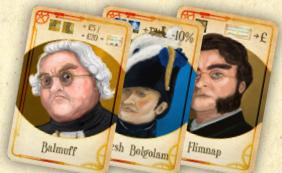
角色卡 x5

被淘汰的火车、火车池、起始玩家及范迪门斯地复制卡
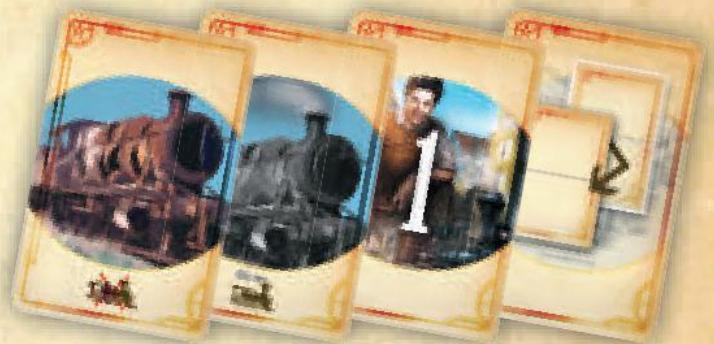
公司股票证 x32

纸币

火车卡 x29


股价指数卡、提示卡、回合卡
铁路板块卡 x114

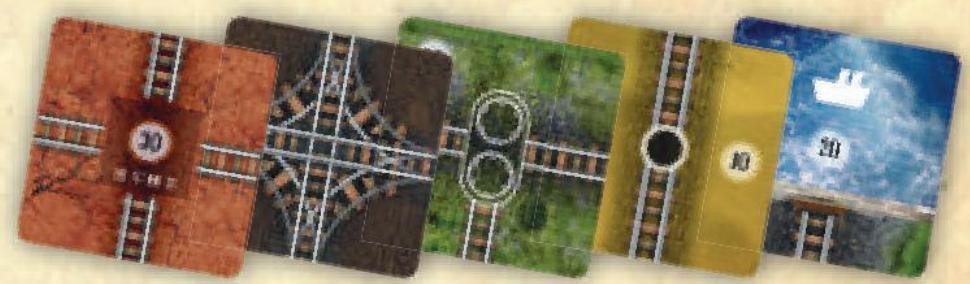
计分本
股价指数板

公司标记 x33


主体规则基于4人游戏进行介绍。少许规则会随着玩家人数的减少而发生变化,1-3人的变体规则请参阅最后的总结部分。
起始设置
-
将红色的初始铁路板块(名称为“密尔顿多”)放置在桌子中央。
-
将火车卡按照距离分类,并叠成一堆:4D-火车卡放在最底下,接着放置3D-火车卡,然后按数字从大到小,依次放上5到2的火车卡,完成后2-火车卡在牌堆顶。将放置好的火车卡牌堆放到银行边上。
-
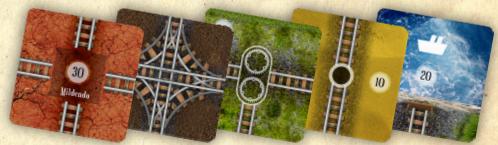
将铁路板块按照颜色和图案进行分类,并将它们放到所有玩家都方便查看的地方。游戏开始时只会用到黄色板块,但是其他的板块会在游戏的后续时期用到,玩家可以提前进行规划。
-
将股票、公司面板、公司标记和现金放在银行边上。
-
将行动卡面朝上,逐一放置在桌上。
-
将 “股价指数板”(或者股价指数卡,由玩家自行选择)放置在桌上,并将回合标记放到回合条的1格上。
-
将五张角色卡面朝上放置在桌上。

-
每位玩家都获得一张“范迪门斯地复制卡”以及 £30 起始资金。
-
决定起始玩家,只要所有玩家都同意,可以按照任意方式进行起始玩家选择。选定的起始玩家获得起始玩家卡。
-
由起始玩家开始,按照顺时针顺序每位玩家选取一张公司卡(有红色、蓝色、绿色和黄色)或者一张角色卡(共五张)。然后按照反向顺序每位玩家进行第二次选择(和第一次不同类型,公司卡或者角色卡)。最后将剩余的一张角色卡移出游戏。
-
四家起始公司在游戏开始都拥有一项特殊能力:

低跟党铁路公司(蓝色):
以Y-城市作为起始站点(价值30)

小人国国家铁路公司(黄色):起始拥有2辆2-火车

格林格伦山谷铁路公司(绿色):拥有者在游戏开始时获得 £60 起始资金,而非 £30。

密尔顿多铁路公司(红色):
该公司起始股价为£55,并获得
£550起始资金。
-
每位玩家将50%的总裁股和公司面板放在自己面前。每家公司的起始资金是£500(密尔顿多铁路公司拥有£550),将起始资金放在公司面板右侧,并将一辆2-火车(如果是小人国国家铁路公司则拥有两辆2-火车)放在下方。每位玩家拿取4个对应颜色的标记:一个放在股价指数50的格子上(第一行第一格;如果是密尔顿多铁路公司则放到55格子中,第一行的左数第二格)。另外三个放到公司面板上。
-
当玩家选择完起始公司后,需要立刻放置一个带有城市(价值20)的黄色铁路板块到红色初始铁路板块“密尔顿多”空余的边上,并将自己的起始车站标记放在上面。低跟党铁路公司的拥有者无须放置常规的城市铁路板块,而是免费放一个黄色的Y铁路板块(价值30)。
-
每家公司都从红色初始铁路板块“密尔顿多”的不同边开始。
-
注意:不允许放置Y铁路板块(即使你支付£ 50)。例外:低跟党铁路公司可以免费放置一个Y铁路板块作为起始城市。
-
当放置铁路板块时,你可以任意选择其朝向。
-
每家公司的资产都必须和别家公司以及玩家自己的资产严格区分开!
游戏设置示例

C
进行游戏
游戏一共进行8个回合。
每个回合包含以下阶段:
- 行动阶段
第一轮从起始玩家开始,以顺时针顺序依次选择一张行动卡,并二选一执行卡上的行动。第二轮每人再以逆序选择一张行动卡。因此第一轮中最后一个玩家会成为第二轮中第一个选择的玩家,即他会连续执行2个行动。
2. 火车运营阶段
所有公司运营它们的火车。
- 管理阶段
详述
- 行动阶段
4人游戏中,共有10张行动卡可供选择(3人8张,2人6张,1人4张)
表1.行动卡
| 行动卡 | 玩家人数 | 行动 | 备选行动 | |||
| 4 | 3 | 2 | 1 | |||
| X | 放置1个任意颜色的铁路板块 | 获得£5的个人资金 | ||||
| X | X | X | X | 以任意顺序放置1个黄色和/或者1个绿色铁路板块 | 放置1个任意颜色的铁路板块 | |
| X | X | X | 放置1个或2个黄色铁路板块 | 获得£5的个人资金 | ||
| X | X | X | 首先你可以卖掉任意数量的股票,接着/或者购买1张股票 | 放置1个任意颜色的铁路板块 | ||
| X | X | X | 首先你可以卖掉任意数量的股票,接着/或者购买1张股票 | 获得£10的个人资金 | ||
| X | 首先你可以卖掉任意数量的股票,接着/或者购买1张股票 | 获得£5的个人资金 | ||||
| X | X | 购买最多1辆火车 | 放置1个任意颜色的铁路板块 | |||
| X | X | X | X | 购买1辆或者2辆火车 | 获得£5的个人资金 | |
| X | X | X | X | 购买并且放置1个车站标记 | 获得£5的个人资金 | |
| X | X | X | 根据游戏所处的时期,获得£50/70/100公司资产 | 获得£20的个人资金 | ||

每位玩家在游戏开始时都拥有一张范迪门斯地复制卡。玩家能够弃置这张卡来发动它的效果,即再次选择一张本回合中已被使用的行动卡。在游戏结束时未被使用的范迪门斯地复制卡价值 £20。
1. 行动详细说明

A) 放置铁路板块:
铁路板块放置时至少要有一条边接触到现有的一个铁路板块。放置的铁路板块必须要有能够连接到该公司车站的铁路路线,且不能被其它公司的车站封锁。
共有4种类型的黄色铁路板块:
- 大型城市(大都会=Y)
城市

·城市
·城镇(来自角色卡或者场景铁路板块;港口视为城镇)
· 普通铁路
城镇

要放置1个黄色大都会板块(Y城市),该公司需支付50£,必须用公司资金支付。
(例外: 低跟党铁路公司的起始Y城市是免费的)。公司在放置铁路板块时必须遵循板块放置规则。所有其它铁路板块都是免费放置的。
板块放置规则
- 城市/大都会铁路板块不允许边对边直接相连到另一个城市/大都会铁路板块。(例外:密尔顿多,所有的起始城市铁路都和密尔顿多直接相连)。
- 城镇/普通铁路板块不允许边对边直接相连到另一个城镇/普通铁路板块。
- 因此,城镇/普通铁路板块和城市/大都市铁路板块是交替放置的。
- 一旦第一辆3-火车被购买(或者在管理阶段被弃置到火车池),绿色铁路板块变为可用。
- 一旦第一辆5-火车被购买(或者在管理阶段被弃置到火车池),棕色铁路板块变为可用。
- 绿色铁路板块可以升级黄色铁路板块。棕色铁路板块可以升级绿色铁路板块。
- 新升级的铁路板块上的铁路路线必须和原有铁路板块的铁路路线保持相同朝向。城市必须升级为城市,大都会必须升级为大都会(升级是免费的),普通铁路板块必须升级为普通铁路板块。
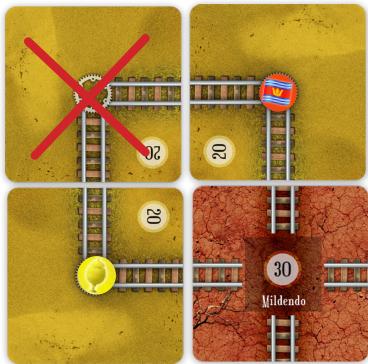
- 铁路板块升级时,原有的车站都仍按之前的位置放置在新的铁路板块上,替换下来的板块可以被再次使用。
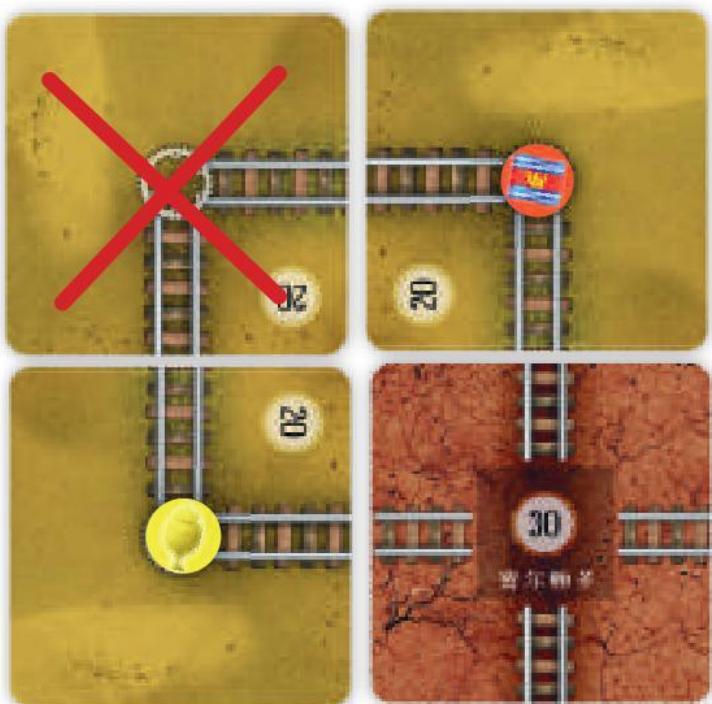
- 板块升级后用于放置车站标记的空位可能会增加。当一
个铁路板块上至少有1个未被占据的车站空位,那么火车就能够通过这个城市,也可以在上面成立新公司。
- 将Y(大都会)板块从黄色升级到绿色,或者从绿色升级到棕色,均无须任何费用。
B) 购买火车
- 当公司需要购买一辆火车时, 可以从银行的火车卡牌堆购买一辆新的火车, 或者向另一家公司购买 (在公司新成立时, 或在火车运营阶段公司选择保留股息时, 可以且只能从火车池中购买火车)。
- 从银行购买新火车的价格印在火车卡上。新的火车必须按照事先排好的顺序进行购买 (首先只能购买2-火车, 接着是3-火车, 以此类推)。
- 公司也可以向其他公司(只要对方总裁同意)购买火车(即使是过时的火车)。价格可以进行协商,但必须公开,且成交价不得低于 £1。
- 过时的火车可以主动弃掉,并将它们放到“火车池”卡片上。
· 并不强制要求一家公司必须拥有一辆火车。如果一家公司没有火车,想要购买但是没有足够的资金,那么公司的总裁可以从他的个人资金中补足差额。购买过后该公司没有剩余资金。
- 行动卡“购买1辆或者2辆火车”:你可以让两家不同的公司各购买1辆火车。
例子:你的第一家公司从银行购买了一辆火车,然后你立即让你的第二家公司以£1的价格从你的第一家公司将这辆火车买走。
购买或弃置(在管理阶段)火车可能会立即触发时期变更:
—时期:从游戏开始起
- 只有黄色铁路板块可用。
- 执行“获得 £50/70/100公司资产”行动时,获得最低值£50。
二时期:从第一辆2火车被购买或弃置后开始
- 火车数量上限:4(每家公司最多拥有4辆火车)
三时期:从第一辆3火车被购买或弃置后开始
- 绿色铁路板块变为可用。
- 执行“获得 £50/70/100公司资产”行动时,获得中间的数值£70。
四时期:从第一辆4火车被购买或弃置后开始
- 火车数量上限:3
- 2-火车变为过时(将2-火车卡翻面)。该火车运营获得的收益减半(每股收益向下取整;90的收益变为40)。
五时期:从第一辆5火车被购买或弃置后开始
- 棕色铁路板块变为可用。
- 执行“获得 £ 50/70/100公司资产”行动时,获得最高值 £ 100。
- 火车数量上限:2
- 2-火车被淘汰(将它们移出游戏)
六时期:从第一辆3D·火车被购买或弃置后开始
- 3-火车变为过时(将3-火车卡翻面)。该火车运营获得的收益减半。
七时期:从第一辆4D·火车被购买或弃置后开始
- 4-火车变为过时(将4-火车卡翻面)。该火车运营获得的收益减半。
- 3-火车被淘汰(将它们移出游戏)
正常的火车不能主动被淘汰或弃置,但是过时的火车(该火车卡被翻面,灰色面朝上)可以主动弃置到火车池中。
火车数量上限
火车池
每一家公司能够拥有的火车数量是有上限的(根据当前游戏的时期)。当一家公司拥有的火车数量已经达到上限,该公司不能够再购买新火车,即便此次购买之后他原有的一些火车会被淘汰,从而使他的火车数量在上限内。一家公司可以在购买火车前主动淘汰一辆过时的火车(灰色火车卡)。将这张被主动淘汰的火车卡放在“火车池”卡片上。
如果由于时期变更导致一家公司的火车超过上限,而必须减少一辆火车时,也将该火车放到“火车池”卡片上。

淘汰的火车移出游戏
当时期变更,那些锈迹斑斑的火车会被淘汰,将它们放到“被淘汰的火车卡”上,代表这些火车已经被移出游戏。淘汰火车时,对火车池的火车也执行相同的操作。
c) 买/卖股票


首先,玩家可以卖掉任意数量的股票。这些股票被放回到银行。玩家先根据当前的股价获得相应的现金放入个人资金中。然后,每卖掉一股,就将该股票的股价标记下降一格(如果股价标记在最上面一行),或者向左上角 $^{注1}$ 移动一格(如果股价标记在最下面一行)。若股价标记移动到的那格,已经有其它股价标记,那么将最后移动进入的那个股价标记放到最底下。注1:向左上角移动指先向左移动1格,再向上移动1格。
总裁股(50%股权)不能被卖掉。
购买一张股票时,玩家可以
- 要么从银行购买一张已成立公司的10%股权的股票,并支付当前股价给银行。允许购买该玩家刚刚卖掉的那家公司股票。
- 或者购买一张总裁股(并成立一家新公司):
新公司成立
·玩家选择一家尚未成立的公司,并拿取50%股权的总裁股。
- 他设置一个初始股价(股市指示表上任何一个价格),将这家公司的一个标记放到该股价格中,然后支付5倍股价的现金给银行。
- 该玩家拿取这家公司面板, 3个车站标记, 以及10倍股价的现金作为公司资产。将起始车站标记放到任意一个空的城市或者大都市格中。如果没有可用的空格, 那么不能成立新公司。
- 该公司可以立即从火车池中任意选择一辆火车(无需是最上面的一辆),并向银行支付火车的购买费用。
- 股票的上限是5。每位玩家最多拥有5张股票,总裁股在计算上限时视为1张股票。
- 每位玩家最多能够拥有2张总裁股。
- 允许一位玩家拥有一家公司的全部股票。
- 注意:每家公司只有80%的股票可用,就是故意这样设定的,另外的20%股票迷失在了前往小人国的路上。
D) 放置一个车站标记
通过行动卡“放置一个车站标记”,一家公司能够在城市圆圈格中放置一个标记来创建车站。必须遵循以下规则:
- 第一个额外的车站标记花费 £40;之后的每个车站花费 £100。
- 铁路公司只能在空的城市圆圈格中放置车站标记。
- 想要放置车站标记,该铁路公司必须能够从他的其他车站,通过一条合法的铁路路线到达该城市。
- 每家公司在每个铁路板块上最多只能放置一个车站标记。
车站标记的作用如下:
·一家公司的每一条运营路线必须至少包含一个该公司的车站标记,无论车站在路线的什么位置。
- 当一个城市板块的所有圆圈格都被车站所占据,那么只有这些车站所属的公司才能通过这个城市。
- 一家公司放置新的铁路板块时,该板块必须能通过一条铁路路线连接到这家公司的其中一个车站标记。
合法铁路路线的定义:
一家公司的铁路路线指的是一条连续的铁路轨道,且至少连接到一个有该公司车站的城市。一条铁路路线不能重复使用同一段轨道。铁路路线不允许在铁路交叉口处掉头,不能够在铁路岔道处更换轨道。铁路路线允许从一条轨道进入一个城市,然后沿着另一条轨道离开。
铁路交叉口


铁路岔道
C
E) 获得£ 5/10/20 个人资金
即获得£ 5/10/20 现金,放入到个人资金。
F) 获得£ 50/70/100公司资金
根据当前游戏时期,将 £ 50/70/100 现金放到该玩家拥有的一家或者两家公司中。你可以按照任意比例将这些现金分配给你的公司。
角色卡
每个角色都会提供给玩家一个特殊能力(适用于他的所有公司)以及一个或两个可供玩家在他的回合额外放置的铁路板块。
表2:角色卡
| 姓名 | 特殊能力 | 特殊铁路板块 | 备注 | |
 | 高尔伯斯脱·莫马兰·爱夫拉姆·戈尔迪洛·舍芬·木利·乌利·古(小人国国王) | 免费放置黄色的Y铁路板块(无需支付£50)。 |  | 国王城堡:必须用于升级黄色城市铁路板块(不能是初始城市铁路板块和Y铁路板块)。在城堡上有车站的公司能够获得更高的那个收入。 |
 | 林托克(将军) | 放置车站标记的费用减少50%。 |  | 加农炮:可以作为黄色城市铁路板块放置,但是无法被升级。 |
 | 巴摩夫(大法官) | 在每回合开始时,获得£5个人资金或者£20公司资金(可以任意分配给自己的公司)。 |  | 城镇:城镇不计入火车的距离。 |
 | 斯开瑞士·鲍尔高兰(海军大将) | 从银行购买的每辆火车费用减少10%。 |  | 港口:铁路板块不允许接入到港口板块的空边。港口视为城镇(不算入火车的距离)。 |
 | 佛林奈浦(财务大臣) | 可以被卖掉,以换取个人资金。资金数量是当前回合数x10。 | 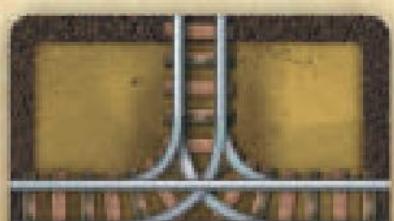  | 拉格奈格:可以作为黄色城市铁路板块放置,但是只能在棕色时期开始后,且不能被升级。 |
 |  |  | |||
| 角色 | 国王 | 将军 | 海军大将 | 大法官 | 财务大臣 |
| 允许开始放置的时期... | 绿色 | 黄色 | 黄色 | 黄色 | 棕色 |
| 能否被升级? | 否 | 否 | 否 | 否 | 否 |
| 放置时遵循哪种板块放置规则 | 城市 | 城市 | 普通 | 普通 | 城市 |
| 是否计入火车的距离? | 是 | 是 | 否 | 否 | 是 |
| 是否必须作为火车路线的起始或者结束? | 否 | 否 | 是 | 否 | 是 |
| 备注 | 在上面有车站的公司能够获得更高的收入。 | 铁路板块不允许接入到港口板块的空边。 |
如果你使用大人国变体规则进行游戏,会使用特定的大人国铁路板块。
2. 火车运营阶段
铁路公司根据股价顺序进行运营。股价最高的首先开始运营。
铁路公司拥有的每辆火车都能够沿着铁路路线运营一次来获得收益。能获得收益的地点包括:大都会、城市、城镇、密尔顿多和港口。
· 每条运营路线必须包含连续的2个或更多的收益地点,这些地点必须通过铁路相连。
铁路可以通向一个没有连接的铁路板块,但是不能通到水域

· 每条运营路线必须至少包含一个该运营公司的车站标记。
- 一个完全被其他公司车站占据的城市/大都会视为被封锁,不能运营通过。运营路线能够从被封锁的城市/大都会开始或者结束。
- 一个没有完全被其他公司车站占据的城市/大都会能够运营通过。
· 每辆火车都有一个距离(印在火车卡上的数字)。这是运营路线上能够包含的站点(城市/大都
市)数量上限。城镇(以及港口)不计入火车距离。
- 运营路线上的收益地点不能被略过。
·一条运营路线不能多次到达同一个收益地点。
· 如果要到达密尔顿多,那么必须作为运营路线的起点或者终点。
- 如果一家公司拥有超过一辆火车,每辆火车必须运营完全不同的铁路路线。如果具有分隔开的铁路轨道,那么运营路线能够在收益地点处交汇。

距离(类型)
每家公司获得的收益都由银行支付。
一家公司的收益是指其所有火车收益之和。所有城市/大都会/城镇(以及港口)/密尔顿多的价值都印在板块上。对于D-火车,所有城市/大都会/城镇(以及港口)/密尔顿多的价值都是双倍。一旦一家铁路公司的所有火车都运营完之后,该公司总裁将所有收益相加,计算出本回合该公司的收益。
C
获得的收益必须是所有可能收益路线中的最高收益。
该公司的总裁从银行获取收益,然后决定如何分配这些收益。它可以被分配给股东(作为股息)或者被分配给公司本身(加入到公司资产中)。
收益示例1
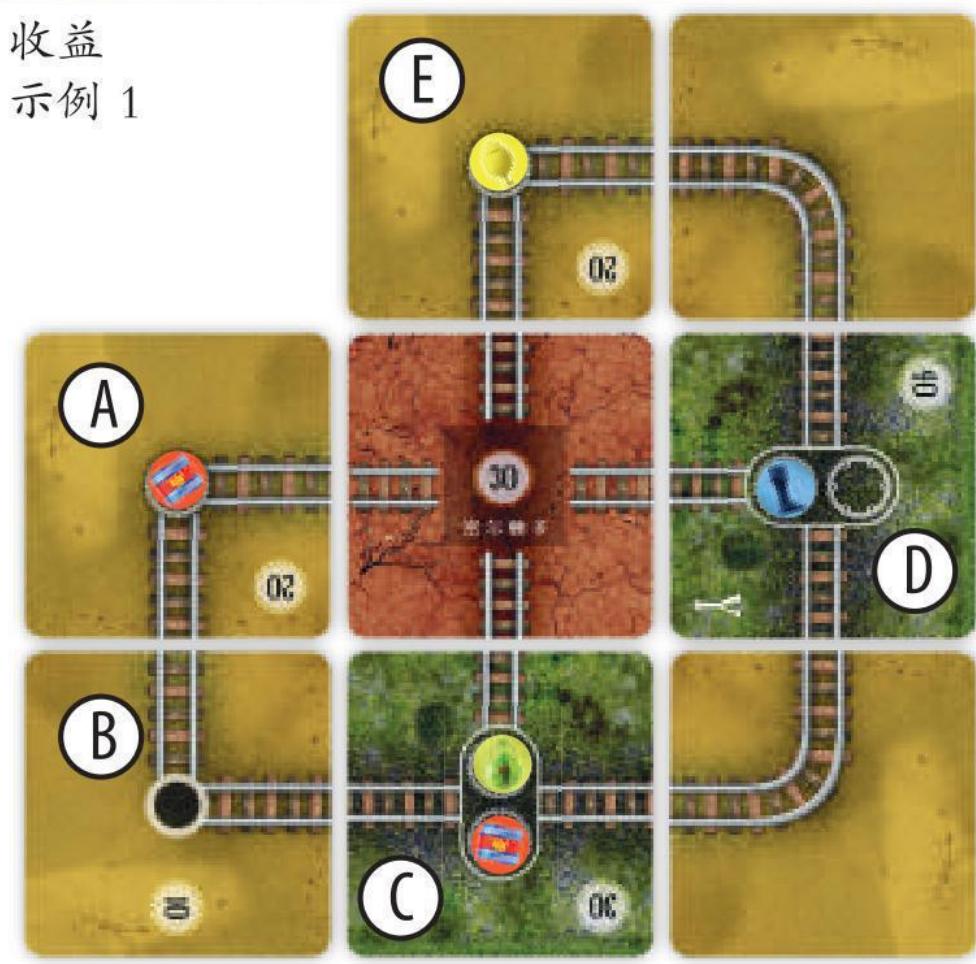
红色公司有一辆2-火车和一辆3-火车。
3-火车运营路线:密尔顿多-D-C-B: 收益110。
2-火车运营路线:密尔顿多-A-B: 收益60。
城镇(B)不计入火车距离。它可以作为火车线路的终点或起点。
蓝色公司有两辆3-火车。
3-火车运营路线:密尔顿多-D-E:收益90。
3-火车运营路线:D-C:收益70。
其中一辆3-火车只能通过2个站点,因为火车线路被其他公司的车站标记封锁了。
绿色公司有两辆2-火车。
2-火车运营路线:密尔顿多-C-B:收益70。
2-火车运营路线:C-D: 收益70。
黄色公司有两辆2-火车。
2-火车运营路线:密尔顿多-E: 收益50。
2-火车运营路线:E-D:收益60。

红色有一辆3D-火车和一辆过时的3-火车。
3D: F-B-C = 100x2 = 200收益。
D火车收益是翻倍的。
3-火车: B-A-C = 90/2 = 45 = 40 收益。
过时的火车收益减半并且每股收益向下取整。
黄色有一辆4-火车。
4: C-B-F-G-H-I = 190 收益。
城镇及港口的收入地点G和I不计入4-火车的距离。城堡F获得50收益,因为有该公司的车站标记。
绿色有两辆4-火车。
4: C-D-E = 110 收益。
4: F-G-H-D = 120 收益。
因为任何铁路都不能被同一家公司的火车重复使用,所以该公司的两辆火车都只能通过3个城市(G不计入火车距离)。
蓝色有一辆过时的3-火车。
3: E-D-H-G = 130/2 = 65 = 60 收益。
R过时的火车收益减半并且向下取整。可以将城镇G作为火车线路的终点。

支付股息
当公司支付股息时,每位玩家都会获得与他们所持有的股份相对应的收益份额。
银行持有的股份则支付给银行。
如果公司支付股息,则公司股票上涨。该公司在股价指数板中的股价标记右移一格。如果股价标记已经在该行的最右边,则向上移动一格。
若股价标记移动到的那格,已经有其它股价标记,那么将最后移动进入的那个股价标记放到最底下。
: 大卫
| 1红 | +25 | 55 | 火车2 | -80 | 420 |
| 买黄 | -55 | 0 | 车站 | -40 | 380 |
| 2红 | +70 | 70 | |||
| 2黄 | +6 | 76 | |||
你可以选择使用计分本,来代替纸币。
1红 - 第1回合获得的红色公司股息
买黄 - 购入一张
黄色公司股票
2红 - 第2回合
获得的红色公司
股息
保留股息
2黄 - 第2回合获得的黄色公司股息
火车2 - 购买2-
火车
车站 - 购买车站
总裁可以决定将所有的收益放入公司资产而不支付股息。如果一家公司没有支付股息,则股价下跌。股价指数板中的该公司的股价标记左移一格,如果股价标记已经在该行的最左边,则向下移动一格。若股价标记移动到的那格,已经有其它股价标记,那么将最后移动进入的那个股价标记放到最底下。公司可以立即从火车池中购买任意火车。
3. 管理阶段
a. 将下一辆可用火车(火车卡牌堆顶的那张火车卡)弃置到火车池中。
b. 将 “起始玩家卡” 顺时针交给下一个玩家。
c. 将所有行动卡放回至桌子中间。
d. 将回合标记向前移动一格。
游戏结束
游戏在8回合后结束。
在最后一回合中,所有的股息变为双倍。也就是说你和之前回合一样计算你的收益(所有运营路线汇总),然后将它乘以2进行分红。在最后一回合你不能保留股息给你的公司。
- 股价指数板中的股价标记向右移动2格。
- 现在所有玩家加总他们的个人现金以及他们持有股票的当前价值。
· 公司资产中的现金不算入玩家的个人现金中。
- 没有使用过的范迪门斯地复制卡在游戏结束时给玩家£20。
现金和股值之和最高的玩家赢得游戏。
2人游戏和3人游戏的规则变化:
3人游戏的特殊规则
· 游戏会进行9个回合。第9回合支付的股息是双倍的(而非第8回合)。
· 当每位玩家都选择完一家起始公司后,将第四家起始公司移出游戏。
· 在起始公司获得它们的火车后,只将2辆2-火车放在火车卡牌堆顶,其它所有的2-火车移出游戏。
- 只有8张行动卡。根据表1. 行动卡决定移除哪些行动卡。
- 根据表6.火车移除火车卡。
2人游戏的特殊规则
- 每位玩家获得2张范迪门斯地复制卡。
- 当每位玩家都选择完一家起始公司后,将剩余的2起家始公司移出游戏。在起始公司获得它们的火车后,只将2辆2-火车放在火车卡牌堆顶,其它所有的2-火车移出游戏。
- 只有6张行动卡。根据表1. 行动卡决定移除哪些行动卡。
- 根据表6.火车移除火车卡。
·2人玩家变体:每位玩家选择2张角色卡。
进阶游戏变体
在“阶段2.火车运营”之前移除火车卡牌堆最上面的一张火车卡。这样一来火车有可能在未曾获得过收益的情况下就被淘汰了。
变体
“托特纳姆快车”
额外内容:
- 将常规的棕色城市板块替换为3块名为托特纳姆、艾伦贝克、普里普斯的棕色城市板块
- 当一辆火车运营到这4个城市(密尔顿多、托特纳姆、艾伦贝克、普里普斯)中的其中3个,可以额外获得+£20奖励。

- 当一辆火车运营到全部的四个城市,可以额外获得+£ 50奖励。
- 这个奖励不会被D-火车翻倍。
“勒皮他岛”
额外内容:
- 将常规的棕色城市板块替换为4块有彩色轨道“勒皮他”的棕色城市铁路板块。
- 只有对应颜色的公司能够放置这些彩色的铁路板块。

- 只有对应颜色的公司能够使用这些彩色的铁路轨道。它的作用和常规的铁路轨道一样,所以它能够作为一个现有铁路轨道的升级去放置。
·2人或者3人游戏中,将那些不在场的对应玩家颜色的“勒皮他”铁路板块移除。
“大人国”
额外内容:
- 30块名为“大人国”的城市板块。
- 用大人国城市板块代替常规板块。
·在大人国变体中, 火车运营的收益在分红时总是支付50%(向上取整10的倍数)给股东, 另外50%给公司。你仍然可以选择保留全部收益。
单人变体规则
在单人变体中,玩家将和名为“格列佛”的虚拟玩家对抗。
提示:当需要你在两种可能中做出选择时, 你可以掷骰子决定 (奇数或者偶数)。
设置
- 首先,为格列佛随机选择一家起始公司,没有角色卡。
·格列佛获得他的起始资金,该公司的总裁股(50%股权)和公司面板。该公司没有起始资金。
- 随机选择一个起始城市铁路板块(有两种可能的情况:直轨铁路的城市板块或者曲轨铁路的城市板块),将它放在红色起始城市铁路板块“密尔顿多”的其中一边,然后将起始车站放到上面。如果是一个曲轨铁路城市板块那么随机决定它的铁路轨道方向。
- 接着玩家从三家剩余的起始公司中选择一家,并且选择一张角色卡。
- 将剩余的起始公司移出游戏。
- 在单人变体中不能使用范迪门斯地复制卡。
- 将下面四张行动卡放到桌上:(详见表1. 行动卡):

进行游戏
游戏进行8回合。
1. 行动
首先玩家选择两张行动卡,并且分别执行每张行动牌上两个行动中的其中一个行动。接着进行格列佛的回合。格列佛按照以下顺序执行他的行动:
A. 建设铁路
B. 建设车站
C. 建设额外的普通铁路板块
D. 购买股票
E. 购买火车
详细说明:
A. 建设铁路:
格列佛放置一个铁路板块。建设规则如下(执行第一个可行的步骤):
1. 将一个绿色城市板块升级为棕色城市板块。
2. 将一个黄色城市板块升级为绿色城市板块。
3. 建设一个黄色城市板块。
4. 建设一个黄色普通铁路板块。
额外铁路板块放置规则:
- 只有放置了格列佛的公司车站的铁路板块会被升级。首先升级起始车站铁路板块。接着升级一个其他的板块(如果出现两种可能,那么随机决定一个)。
- 绿色城市板块:新的铁路板块上的铁路轨道需要通往密尔顿多。
- 黄色城市板块:如果格列佛有多种选择能够放置黄色城市板块,那么他会选择离密尔顿多最近的一个。距离相同时,随机决定。
- 黄色曲轨铁路板块(有或者没有城市):随机决定它们放置的方向。
B. 放置一个车站标记格列佛会在他刚刚建设的黄色城市板块上放置车站标记,直到三个车站标记都被放置。这个行动对于格列佛而言是免费的。
C. 建设额外的普通黄色铁路
如果一个包含格列佛车站的城市有一条没有继续接通的铁路轨道,那么就会放置一个普通铁路板块去连接该轨道。随机决定使用直轨或者曲轨铁路轨道。
D. 购买股票
- 格列佛永远不会出售股票。
- 只要买得起,格列佛会每回合购买一个新的 $10 \%$ 股权的股票。如果有多于一种的选择则随机决定。
- 格列佛不会购买超过3张新的10%股权的股票。
- 他的第五张也就是最后一张股票购买会是一家新公司50%股权的总裁股。一旦他能够买得起他就会购买(至少£250)。并且会以他能够负担的最高股价去购买。
》如果格列佛的第一家公司所在的城市板块上还有空位,则将这家新公司的起始车站放在上面。如果没有则放到最近的一个城市板块上。如果有多于一种选择则随机决定。
》格列佛的第二家公司不会放置任何额外的车站标记。
E. 购买火车
- 管理阶段中下一辆可用火车卡不放入到火车池中,而是将它放到格列佛的其中一家公司中。
- 如果格列佛有两家公司, 那么下一辆可用火车卡会分配给拥有较少火车的那家公司。如果一样多则分配给最低数值火车卡所在的那家公司 (3D-火车比5-火车高, 4D-火车比3D-火车高)。如果仍然相同, 则分配给格列佛的第一家公司。
- 如果格列佛公司的火车达到了上限, 则最低数值的那张火车卡会被淘汰 (移出游戏), 从而为新的火车提供空间。
- 如果因为时期变更,格列佛的一家或者全部公司的火车超过上限,那么数值最低的1张火车卡会被移除(直接移出游戏)。
C
2. 火车运营
和标准游戏的火车运营一样。格利佛的公司总是选择支付股息。玩家(若持有该公司股票)和格列佛都会获得公司的股票分红。
3. 管理阶段
a) 将行动卡全部放回到桌子中间。
b) 将回合标记向前移动一格。
游戏结束
游戏会在8回合后结束。
和标准游戏一样,最后一回合的股票分红会翻倍。拥有最高价值的现金和股票之和的玩家赢得游戏。
场景铁路板块
通过场景铁路板块,你可以在游戏开始前构建出一个场景。它会使后续的铁路建设变得更加困难,或者提供一些特殊功能。你可以自由决定想要使用哪些场景板块。你可以构建自己想要的场景。
下面有一些建议。
在游戏开始前,放置完“密尔顿多”板块后,开始铺设场景板块。为了遵循“板块放置规则”,你需要注意场景板块上的标记:
- 有圆圈标记的板块视为城市板块。你必须按城市板块的规则去放置它们。
- 有方块标记的板块视为普通铁路板块。你必须像放置普通铁路板块一样去放置。
- 同时有方块和圆圈标记的板块可以放在任何地方。

表 4. 场景铁路板块
| 类型 | 说明 | 放置位置 |
 | 矿山:如果一辆火车通过一个矿山,那么该公司获得+10/+20资金。 | 只能作为普通铁路板块放置 |
 | 沙漠:能够被黄色城市版块或者黄色普通铁路板块替换。地形费用30。由在该地铺设板块的公司支付。 | 任何地方 |
 | 河流:能够被黄色城市版块或者黄色普通铁路板块替换。支付地形费用10。由在该地铺设板块的公司支付。 | 任何地方 |
 | 水域:不能再被建设。铁路板块上的轨道不允许连通到水域板块的边缘。 | 任何地方 |
| 类型 | 说明 | 放置位置 |
 | 山脉:不能再被建设,除非使用绿色隧道板块,能够从绿色时期开始花费£50进行建设。由在该地铺设板块的公司支付。将山脉板块替换为隧道板块。 | 任何地方,但是隧道视为普通铁路板块 |
 | 维吉瓦克:必须作为铁路路线的终点。该板块上放置了车站的公司,在该地的运营收入为£60。 | 任何地方,无视板块放置规则(和密尔顿多一样) |
 | 其他:有的有城市,有的没有城市。无法升级。 | 一些视为普通铁路,一些视为城市板块(根据标记来判断) |
场景 2: 深入山地


场景 3: 众城之都






致谢
游戏设计: Leonhard Orgler
排版: David Hanáček
平面设计: Martin Málek
插画: Petr Štich
中文翻译:王晶晶
中文校对:冯瑾瑾
中文出版: 易趣桌游, 2019
表 5. 铁路板块
| 游戏模式 | 板块 | 黄色 | 绿色 | 棕色 | 红色 | 其它 |
| 标准游戏 | Y-城市 | 2 | 2 | 1 | ||
| 城市 | 12 | 6 | 3 | |||
| 普通铁路 | 16 | 3 | 1 | |||
| 起始板块 | 1 | |||||
| 角色铁路板块 | 7 | |||||
| 托特纳姆快车 | 城市 | 3 | ||||
| 勒皮他岛 | 城市 | 4 | ||||
| 大人国 | Y-城市 | 2 | 2 | 1 | ||
| 城市 | 12 | 6 | 3 | |||
| 起始板块 | 1 | |||||
| 角色铁路板块 | 3 | |||||
| 场景 | 其他 | 23 |
表 6. 火车(时期)
| 类型 | 价格 | 玩家人数 | 过时1 | 淘汰 | 时期 | 火车上限 | ||||||
| 4 | 3 | 2 | 1 | |||||||||
 | 80 | $5+2^2$ | $5+2^2$ | $5+2^2$ | 2 | 4 | ||||||
 | 150 | 6 | 5 | 3 | 2 | |||||||
 | 300 | 5 | 4 | 3 | 2 | 2 | 3 | |||||
 | 400 | 4 | 3 | 2 | 2 | 2 | 2 | |||||
 | 500 | 3 | 2 | 2 | 2 | 3 | ||||||
 | 650 | ∞ | ∞ | ∞ | ∞ | 4 | 3 | |||||
1过时的火车获得的收益减半。
2五辆2-火车用于4个起始公司。当起始公司被选完后,无论是几人游戏,都只有2辆2-火车在火车卡牌堆。
18Lilliput Rulebook ENG.md
18LILLIPUT LEONHARD ORGLER'S


[18LILLIPUT] LEONHARD ORGLER'S
Dedicated to Ferdinand de Cassan (1949–2017)
In 18Lilliput, players try to build the best railroad network by using action cards.
Components
10 Action Cards

8 Company Charters
5 Character Cards
Scraped Trains, Train Pool, 1st Player, Copy Cards

32 Company Share Certificates

Banknotes
29 Train Cards


Share Price Index Cards, Help Cards, Turn Card

114 Track Tile Cards
Scoring Notepad
Share Price Index Board

33 Company Counters


These rules present the game as it is played with 4 players. Some rules are altered with lower player counts and the rule changes employed for 1, 2 and 3 player games are found at the conclusion.
Game Set-up
-
The red starting track tile (named "Mildendo") is placed in the middle of the table.
-
The train cards are sorted by range: The 4D train cards are placed at the bottom, followed by the 3D, then 5 thru 2 descending, finishing with the 2-train-cards on the top of the stack. Place this prepared stack of train cards near the bank.
-
Sort the track tiles by type and display them somewhere out of the way so that all players can see them. Only the yellow tiles are needed at first, but the others are relevant to planning for the later stages of the
-
Shares, company charters, tokens, and money are also laid out near the bank.
-
The action cards are put face up, side by side on the table.
-
The "Share price index" board (or the share price index cards – whatever you prefer) is laid on the table. The turn counter marker is placed on space 1 of the turn counter table.
-
The five Character cards are put face up on the table.

-
Each player gets a "Dimen's Land Copy" Card and £30 as starting capital.
-
A starting player is determined by whatever means deemed fair by the group. This player is given the starting player card.
-
In clockwise order each player chooses oņe of the four starting companies (red, blue, green, and yellow) or one of the five character cards. Then in reverse order each player makes his second choice (of the type of card he hasn't chosen before). The remaining character card is out of the game.
-
Each of the four starting companies start with an advantage:

Slamecksan Railway (blue): starts on a Y-city (value 30).

Lilliput National Railway (yellow): starts with two 2-trains.

Glimigrim Valley Railway (green): The owner starts with £60 private starting capital instead of £30.

Mildendo Railway (red): Starts with a share price of £55 and £550 starting capital.
-
Each player puts the 50% director share and the company charter in front of him. The starting capital of each company is £500, (£550 for Mildendo Railway) put this on the right side of the company charter along with one 2-train (two 2-trains for Lilliput National Railway) below of it. He takes the 4 markers of the corresponding colour. One is put on space 50 of the share price index (top left space; for Mildendo Railway it is put on space 55, second left space in the top row). The other three are put on the company charter.
-
Immediately – when a player chooses a starting company – he lays a yellow track tile with a city (value 20) alongside of the red starting track tile "Mildendo" and puts his home station marker on it. The owner of Slamecksan Railway lays a yellow Y-tile (value 30) instead of a normal city tile for free.
-
Each company starts on a different side of the red starting track tile "Mildendo".
-
Caution: You are not allowed to lay a Y-track-tile (even if you pay £50).'Exception: Slamecksan Railway, which lays a Y-tile as home city for free.
-
When laying a track tile, you may lay it in any orientation.
-
The treasury of a company must be kept strictly separate from that of a player or another company!

Gameplay
The game has 8 rounds.
A round consists of the following steps:
1. ACTIONS
Each player chooses an action card and performs one of the two possible actions. In a second turn each player chooses a second action card. The first turn goes in clockwise direction, the second turn counter-clockwise. The player who was last in the first turn is first in the second turn. Therefore he performs two action successively.
2. RUN TRAINS
All companies run their trains.
- BUREAUCRACY
Details
1. ACTIONS
With 4 players you have 10 action cards to choose from. (With 3 players 8, with 2 players 6, with 1 player 4)
TABLE 1. ACTION CARDS
| Card | Number of Players | Action | Alternative Action | |||
| 4 | 3 | 2 | 1 | |||
| W+£5 | X | Place 1 track tile of any colour | Add £5 to private property | |||
| X | X | X | X | Place 1 yellow and/or 1 green tracktile in any order | Place 1 track tile of any colour | |
| +£5 | X | X | X | Place 1 or 2 yellow track tiles | Add £5 to private property | |
| E~EN圈 | X | X | X | First sell as many shares you want andthen/or buy 1 share | Place 1 track tile of any colour | |
| E~EN+ £10 | X | X | X | First sell as many shares you want andthen /or buy 1 share | Add £10 to private property | |
| E~N+£5 | X | First sell as many shares you want andthen /or buy 1 share | Add £5to private property | |||
| + | X | X | Purchase maximum 1 train | Place 1 track tile of any colour | ||
| 圈 | ||||||
| ++ | X | X | X | X | Purchase 1 or 2 trains | Add £5 to private property |
| +£5 | ||||||
| +£5 | X | X | X | X | Buy and place a station marker | Add £5 to private property |
| 国+£20 | X | X | X | Add £50/70/100 to companies treas-ury, depending on game phase | Add £20 to private property | |

Each player begins the game with one Dimen's Land Copy Card. A player may exchange this card for the ability to use an action card previously selected this round. An unused Dimen's Land Copy Card is worth £20 at the end of the game.
Explanations to the actions

A) LAYING TRACK TILE
Track tiles must touch at least one track tile on the table at one side. Tiles laid must be an extension of track connected to a station marker of the company without being blocked by foreign station markers.
There are four types of yellow track tiles:
• Large cities (metropolis = Y)

• Cities
• Towns (Come with Character Cards or Scenario track tiles; harbours are treated like towns) Town
• Plain track

To lay a yellow metropolis (Y-city) it cost one of the players company £50 which is paid out of the company treasury. (Exception: the home city of the Slamecksan Railway, which is free). The company must be able to follow the rules for laying a track tile. All other track tiles are laid for free.
CHECKERBOARD PATTERN RULE
• No city/metropolis may touch another city/metropolis at an edge. (Exception: Mildendo. All home cities touch Mildendo).
• No town/plain track tile may touch another town/plain track tile at an edge.
• Therefore town/plain track tiles and city/metropolis tiles are laid alternatively.
• As soon as the first 3-train is bought (or moves to the train pool during bureaucracy) green tiles become available.
• As soon as the first 5-train is bought (or moves to the train pool during bureaucracy) brown tiles become available.
• A green tile replaces a yellow one. A brown tiles replaces a green one.
• All track segments on the replaced tile must be maintained in the same orientations on the new tile. Cities are replaced by cities, metropolises by metropolises (upgrade is for free), plain track tiles by plain track tiles.
• When a tile is replaced, all stations on the replaced tile mst be placed on the new tile with the same connections as before. The replaced tile may be reused.
• An additional place for a station marker may result from an upgrade. If a tile has at least one free space for a station marker, routes can run through this city and companies caņ build beyond it.
• An upgrade of a Y-city from yellow to green or from green to brown doesn't cost anything.
B) PURCHASE TRAINS
• If a company buys a train, it buys a new onė from the bank or a train from another company. (Only new founded companies and companies which keep dividends may/must buy trains from the train pool).
• New trains are bought from the bank at the purchase price printed on the train card. The new trains must be bought in ascending order (first 2-trains, then 3-trains and so on).
• Companies can also buy trains (even obsolete trains) from other companies (if the director agrees). The price is negotiable, but must be publicly stated. The purchase price must be at least £1.
• Obsolete trains may be returned voluntarily. They are put on the card "Train Pool".
• A company is not required to own a train. If a company doesn't own a train and wants to purchase one and doesn't have enough money to buy one, the director of the company may make up the deficit from his private assets. After the purchase the company has £0 of treasury.
• Action-card "Buy 1 or 2 trains": You may buy one train with two different companies.
Example: One of your companies buys the next available train from the bank then your other company buys it for £1.
The purchase or discard (during Bureaucracy) of a train may trigger an immediate phase change:
PHASE 1: STARTS AT THE BEGINNING OF THE GAME
• Only yellow track tiles available.
• The lowest value of action card “Add £50/70/100 to companies treasury" is valid.
PHASE 2: STARTS WITH THE PURCHASE OF THE FIRST 2-TRAIN
• Train limit 4 (Each company may own up to 4 trains).
PHASE 3: STARTS WITH THE PURCHASE OF THE FIRST 3-TRAIN
• Green track tiles are available.
• The middle value of action card "Add £50/70/100 to companies treasury" is valid.
PHASE 4: STARTS WITH THE PURCHASE OF THE FIRST 4-TRAIN
• Train limit: 3.
• 2-trains become obsolete (the train card is flipped over). The revenue of such a train is divided in half (rounded down; a revenue of 90 becomes a 40).
PHASE 5: STARTS WITH THE PURCHASE OF THE FIRST 5-TRAIN
• Brown track tiles are available.
• The highest value of action card "Add £50/70/100 to companies treasury" is valid.
Train limit: 2.
• 2-trains rust (they are removed from the game).
PHASE 6: STARTS WITH THE PURCHASE OF THE FIRST 3D-TRAIN
• 3-trains become obsolete (the train card is flipped over). The revenue of such a train is divided in half.
PHASE 7: STARTS WITH THE PURCHASE OF THE FIRST 4D-TRAIN
• 4-trains become obsolete (the train card is turned around). The revenue of such a train is divided in half.
• 3-trains rust (they are removed from the game).
Normal Trains can be never rust or return voluntarily, but obsolete trains (= the train card was turned over and shows the grey side) may be be returned to train pool voluntarily.
TRAIN LIMIT
Train Pool
Each company may possess a certain number of trains (depending on game phase). A company that already owns its maximum number of trains may not buy a new train even if by this purchase some of its own trains will rust and the company will be within the permitted train limit. A company may voluntarily return an obsolete train (grey train card) before a train purchase. This voluntarily returned train card is placed on the "Train Pool" card where old trains are stored

If a company has to return a train because the train limit was reduced due to a phase change puts these train on the card "Train Pool".
Rusted Trains Out of the Game
If due to a phase change trains are rusted they are out of the game – you can store these trains on "Rusted Trains Card". This is also valid for trains in the Train Pool.
C) SELLING / BUYING SHARES

First, the player may sell any number of shares he wants. The shares are put back into the bank. First the player receives the actual share price for each share in private cash. Then, the share price marker drops down one space (if the share price marker is in the top row) or one space left and up (if the share price marker is in the bottom row) for each sold share. A marker which moves onto an already occupied space must be put under any markers that are already there.
Director shares (50% shares) can be never sold.
When buying a share the player
• either buys a 10% share of an already founded company from the bank. He pays the actual share price to the bank. It is allowed to buy a share which the player has just sold.
• or buys a Director's certificate (and found new company):
FOUNDATION OF NEW COMPANY
• The player chooses an available 50% share of a company.
• He chooses a starting share price (any available price on the share price chart), puts one of the company's marker on this share price chart space and pays five times the share price to the bank.
• He takes the company charter, the three station markers and ten times the share price as treasury. The home token is laid in any available empty city or metropolis station slot. If there is no empty slot available, no company may be founded.
• Immediately the company may choose any one train out of the train pool (it need not to be the topmost). It pays the printed price to the bank.
• The Share Limit is 5. No player may own more than five shares. A Director's certificate counts as one towards this limit.
• A player may possess no more than 2 Director's certificates.
• A player may possess all shares of a company.
• Note: Only 80% of shares of a company are available. This is on purpose. The other 20% have been lost on their way to Lilliput.
D) PLACE A STATION MARKER
With the action card "Place a station marker”, a company may place one token in a city circle to create a station. The following restrictions apply:
• The first extra station costs £40; each further station costs £100.
• The railroad may only place a token in an empty city circle.
• The railroad must be able to trace a legal train route of any length from one of its other stations to the city in which the token is being placed.
• Each tile can have only one station marker from each company.
Station markers serve the following purposes:
• Each route run by a company must contain one of its station markers somewhere on the route.
• A city fully-occupied by station markers can only berun through by companies owning one of the markers.
• A company can only build if the tile is on a route connected to one of its station markers.
DEFINITION OF A LEGAL ROUTE:
A route for a railroad is a continuous segment of track that connects to at least one city containing one of the railroad's stations. A route may not use the same section of track more than once. A route may not reverse at a junction. A route may not change track at a crossover. A route that enters a city on one track may exit the city on any other track.

E) ADD £5/10/20 TO PRIVATE PROPERTY As it says add £5/10/20 to private cash.
F) ADD £50/70/100 TO COMPANY'S TREASURY
Depending on the game phase £50/70/100 are put into company's treasury of one or two companies in possesion of the player. So you can split the amount between all the companies you possess in any way you choose.
Character Cards
Each character provides a player with a special ability (for all his companies) and one or two track tiles which can be laid additionally to any action during his turn.
TABLE 2. CHARAKTER CARDS
| Name | Special Ability | Special Track Tile(s) | Note | |
 | Golbasto Mo-marem EvlameGurdilo ShefinMully Ully Gue(The Emperor ofLilliput) | Free laying ofyellow Y-tiles(instead of paying£50). |  | Must be an upgrade ofa yellow city tile (but notthe home city and noY-tile). The higher valuecount's for a company witha station marker in thecastle. |
 | Limnoc(the General) | The cost to laya station marker isreduced by 50%. |  | May be laid as a yellowcity tile but must not beupgraded. |
 | Balmuff(the Grand Justi-ciary) | Receives £5 inprivate treasuryor £20 in his com-panies treasury(distributed arbit-rarily) at the startof each round. |  | Towns don't count toa train's range. |
 | Skyresh Bolgolam(High Admiral) | The costs for eachtrain which isbought from thebank are reducedby 10%. |  | No track tile may run to anempty side of an Harbourtile. A Harbour is treatedlike a town (it doesn't countto a train's range). |
 | Flimnap(the Lord HighTreasurer) | May be traded infor private money.The amount isround numbermultiplied by 10. |  | May be laid as yellow citytile, but only after brownphase started. Must not beupgraded. |
 |  |  |  |  | |
| Character | Emperor | General | Admiral | Justiciary | Treasurer |
| May be laid with phase... | green | yellow | yellow | yellow | brown |
| Upgradable? | no | no | no | no | no |
| Counts as ... tile for thecheckerboard pattern rule | city | city | plain | plain | city |
| Counts for the range of atrain? | yes | yes | no | no | yes |
| Must be start or end of aroute? | no | no | yes | no | yes |
| Note | Countshigher valuefor companywith Token. | No trackmay lead toother sidesof harbourtile. |
There are separate tiles if you play with the Brobdingnag variant.
2. Running trains
The railroads act in share price order. The one with the highest share price act first.
Each train owned by a railroad may run once on a route to create revenue. Revenue locations are: metropolises, cities, tòwns, Mildendo, or harbours.
• The route must include of a series of two or more revenue locations that are connected by track.
Track may lead to a track tile with no connection, but not to water

• Each route must contain a station marker of the company.operating.
• A city/metropolis that is completely occupied by station markers of other companies is blocked and cannot be run through. A route can begin or end at a blocked city/metropolis.
• A city/metropolis that is not completely occupied by station markers of other companies can be run through. Price
• Each train has a range (the number printed on the card). This is the number of stations (cities/metropolis) on the route. Towns (and harbours) don't count to the range number.
• No revenue location on the route may be omitted.
• A route may not visit any revenue location more than once.
• The city Mildendo if visited must be the start or end of a route.

Range (Type)
• If a company possesses more than one train, each must run on a completely separate route. At revenue locations the routes can meet each other or cross-over, provided separate tracks are used in each case.
The revenue earned by each company is paid out by the bank.
The revenue of a company is the sum of the revenue from each train. The values of all cities/ metropolis/ towns/Mildendo is printed on the tile. For D-trains the values of all cities/metropolis/towns/Mildendo is doubled.
Once a railroad has run all of its trains, the director adds the totals of all of the runs together to arrive at the revenue for this railroad for the turn.
The revenue claimed must be the highest total revenue that any player can show. The director of the company collects the revenue from the bank and then decides how this total revenue will be paid out. It can either be paid out to the stockholders (as dividends) or to the railroad itself (added to the corporate treasury).

Red Company has one 2-train and one 3-train.
3-train: Mildendo-D-C-B: 110 revenue.
2-train: Mildendo-A-B: 60 revenue.
A town (B) doesn't count to a range of a train. It may be end of a route.
Blue company has two 3-trains.
3-train runs: Mildendo-D-E: 90 revenue.
3-train runs: D-C: 70 revenue.
One 3-train can only visit two stops because the route is blocked with other station tokens.
Green has two 2-trains.
2-train: Mildendo-C-B: 70 revenue.
2-train: C-D: 70 revenue.
Yellow has two 2-trains.
2-train: Mildendo-E: 50 revenue.
2-train: E-D: 60 revenue.

Red has a 3D-train and an obsolete 3-train.
3D: F-B-C = 100x2 = 200 revenue.
Revenue is doubled.
3-Train: B-A-C = 90/2 = 45 = 40 revenue.
Revenue is divided be 2 and rounded down.
Yellow has a 4-train.
4: C-B-F-G-H-I-J = 200 revenue.
The revenue locations G and J don't count for the range of the 4-train. The caste counts 50 because of the token there.
Green has two 4-trains.
4: C-D-E = 110 revenue.
4: F-G-H-D or F-G-H-I-J = 120 revenue.
Both trains run to only three cities (G doesn't count to the range) because no track segment may be used by another train of the company.
Blue has an obsolete 3-train.
3: E-D-H-G = 130/2= 65 = 60 revenue.
Revenue is divided be 2 and rounded down. The town G may be end of the route.

PAYING OUT DIVIDENDS
When companies pay a dividend, each
player receives the share of the revenue corresponding to the shares they own. Shares in the Bank pay out to the bank. If a company pays out a dividend, the share price rises. The marker on the share chart is moved to the right one space. If the marker is at the end of a row, it moves up instead A marker which moves onto an already occupied space must be put under any markers that are already there.
:David
| 8£ 30 | 日f 500 | ||||
| 1Rd | +25 | 55 | TR2 | -80 | 420 |
| SY | -55 | 0 | TK | -40 | 380 |
| 2Rd | +70 | 70 | |||
| 2Y | +6 | 76 | |||
Instead of using banknotes you can optionally use the scoring notepad.
KEEPING DIVIDENDS
1Rd – Income of Red company in 1st round SY - Yellow share 2Rd – Income of Red company in 2ⁿd round 2Y – Income of Yellow company in 2ⁿd round TR2 – 2-Train purchase TK – Token purchase
The director may decide to put all of the revenue into that company's treasury instead. If a company does not pay out a dividend, the stock price falls. The marker on the share chart is moved to the left one space. If the marker is at the end of a row it moves down instead.
A marker which is moved to an already occupied space must be put under any markers that are already there.
The company immediately may buy any train from the train pool.
3) Bureaucracy
a. The next available train (the train card on top of the train card pile) is put into the train pool.
b. The "Starting Player Card" goes to the next player clockwise.
c. The action cards are put back to the middle of the table.
d. The turn counter is moved one space forward.
Game end
The game ends after 8 rounds.
For the last round, all dividends are doubled. This means you count your revenue as in the previous rounds (all routes included) and multiply it by 2. In the last round you must not keep the dividends in your company. • The marker on the share chart moves two spaces to the right.
All players now count their cash and determine the current value of their shares.
• Money in company treasuries does not count for the player.
• A non-used Dimen's Land Copy Card gives the player £20 at the game end.
The player with the highest total value wins the game.
Rules Differences for 2 and 3 players
SPECIAL RULES FOR 3 PLAYERS
• The game goes over 9 rounds. At the end of the 9th round the dividend is doubled (instead of the 8th round)
• After each player has chosen one starting company, the fourth starting company is taken out of the game.
• After the starting companies received their trains only two 2-trains are put on top of the train cards stack, all other 2-trains are removed from game.
• There are only 8 action cards. See Table 1. Action Cards which ones are removed.
• Remove train cards as shown in Table 6. Trains.
SPECIAL RULES FOR 2 PLAYERS
• Both players get 2 Dimen's Land Copy Cards.
• After both players have chosen one starting company, the two other starting companies are taken out of the game. After the starting companies received their trains only two 2-trains are put on top of the train cards stack, all other 2-trains are removed from game.
• There are only 6 action cards. See Table 1. Action Cards which ones are removed.
• Remove train cards as shown in the Table 6. Trains.
• 2-player-game-variant: Each player chooses two character cards.
VARIANT FOR PROFESSIONAL GAMERS
The top most train card from the train cards deck is removed before step 2. Running Trains. Therefore trains could be rusted or removed from game before they could earn revenue.
Variants
"ALLENBECK-TOTTENHAM-EXPRESS"
Additional material:
• 3 brown city tiles with named cities: Tottenham, Allenbeck, Plips instead of the normal brown city tiles.
• If one train runs to three of the four named cities (Mildendo, Tottenham, Allenbeck, Plips) it gets a bonus of +£20.

• If one train runs to all four named cities it gets a bonus of +£50.
• This bonus is not doubled with a D-train.
"LAPUTA"
Additional material:
• 4 brown city.track tiles with coloured track named "Laputa" instead of the normal brown city tiles.
• Only companies with corresponding colour may lay the tracktile.
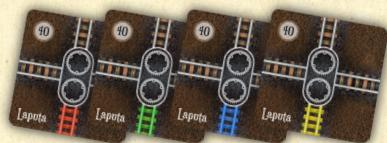
• Only companies with corresponding colour may use the tracks. It functions as a normal track tile in all other ways, so it may be an upgrade of an existing track. functions as a normal track tile in all other ways, so it may be an upgrade of an existing track.
• With 3 or 2 players remove the cards with Laputa track tiles with the colors not in play.
“BROBDINGNAG"
Additional material:
• 30 tiles named "Brob"
• Use the Brob tiles instead of the normal tiles.
• In Brobdingnag the income of the trains is always paid 50% (rounded up to the nearest ten) to the shareholders and 50% to the company. It is still possible to withhold all earnings.
Solo Variant Rules
In the solo variant, the player plays against one dummy player called Gulliver.
Hint: Sometimes you have to decide between two possibilities. You may roll a dice (even and odd numbers).
SETUP
• First, randomly choose one of the four,starting companies for Gulliver, but no character card.
• Gulliver gets his starting capital, the 50% director share of this company and the company charter. The company receives no starting capital.
• Choose randomly one starting city track tile (there are two possibilities: city with straigt track or city with curve) and lay it alongside of the red starting city track tile "Mildendo" and put the home station marker on it. If it is a city tile with a curve choose randomly in which direction it is laid.
• Second the player chooses one of the three remaining starting companies and one character card.
• The other starting companies are out of the game.
• No Dimen's Land Copy Cards are used in the solo variant.
• The following four action cards are laid on the table (see Table 1. Action Cards):

GAMEPLAY
The game has 8 rounds.
1. ACTIONS
First the player chooses two action cards and performs one of the two possible actions of each card. Then it's Gulliver's turn. Gulliver performs his actions in the following order:
A. Track building
B. Station building
C. Additional plain track building
D. Share buying
E. Train buying
DETAILS:
A. Track building:
Gulliver lays one track tile. Building rules (execute the first possible step):
-
Upgrade a green city tile to a brown city tile.
-
Upgrade a yellow city tile to a green city tile.
-
Build a yellow city tile.
-
Build a yellow plain track tile.
Additional track tile laying rules:
• Only tiles with a station token of Gulliver's companies are upgraded. First the home station track tile. Then one of the possibly two other tiles (choose randomly if necessary).
• Green city tiles: The new track segment should point to Mildendo.
• Yellow city tiles: If Gulliver has several choices to place a yellow city tile he chooses the one which is nearer to Mildendo. If there is a tie, choose it randomly.
• Yellow curves (with or without city): Choose randomly which direction they are laid.
B. Laying a station marker
Gulliver lays a station marker in each yellow city he just built until all three station markers are laid. For Gulliver, this action is free.
C. Additional plain track building
If a city with one of Gulliver's station markers has a track segment leading to nowhere a plain track tile is laid to continue the track. Choose randomly if a straight or a curve is laid.
D. Share buying
• Gulliver never sells shares.
• If Gulliver can afford it, he buys one new 10%-share per round. Choose randomly if there is more than one to choose.
• Gulliver buys no more than three new 10% shares.
• His fifth and last share to buy will be the 50% director share of a new company. He buys it as soon as he can - afford it (minimum £250). He buys it at the highest share price he can afford.
» Place the home token of Gulliver's new company on the home track tile of his first company if there is a space available. If not place it on the nearest city tile. If there is more than one choose randomly.
» Gulliver's second company doesn't place any other station marker.
E. Train buying
• Instead of putting the next available train card on the card “Train Pool" during bureacracy it is added to one of Gulliver's companies.
• If Gulliver has two companies the next train card is allocated to the company with fewer trains. If there is a tie it is allocated to the company with the train card of the lowest number (3D is higher than a 5-train, 4D is higher than a 3D). If there is still a tie the train card is allocated to Gulliver's first company.
• If Gulliver's company is at its train limit, the train card with the lowest number is rusted (out of the game) to create space for the new train.
• If, due to a phase change, one or both of Gulliver's companies have too many trains, then the train card with the lowest number is eliminated (out of the game).
2. RUNNING TRAINS
Like in the basic game all companies run their trains. Gulliver's companies always pay out dividends.
Both the player and Gulliver receive dividends for their shares.
3. BUREAUCRACY
a) The action cards are put back to the middle of the table.
b) The turn counter is moved one space forward.
GAME END
The game ends after 8 rounds.
Like in the basic game the dividend of the last round is doubled. The player with the highest total value of cash and stock wins the game.
Scenario Track Tiles
With the scenario track tiles, you can build a landscape before the game starts. It makes track building more difficult or provides special features. It is up to you which scenario tiles you want to use. You can build your own landscape. Some suggestions are displayed below.
Scenario track tiles are placed before the game starts after Mildendo was laid. In order to observe the checkerboard rule, it is for most of the tiles important where the tiles can be played.
• Tiles marked with a circle are treated as city tiles. You must place them where a city tile is usually placed.
• Tiles marked with a square are treated as plain track tiles. You must place them where a plain track tile is usually placed.
• Tiles marked with a square and a circle can be placed anywhere.

TABLE 4. SCENARIO TRACK TILES
| Type | Explanation | Where to lay |
 | If a train runs through a mine thecompany gets +10/+20 into thetreasury. | Only where plain track is planned. |
 | May be replaced by yellow citytile or yellow plain track tile. Payterrain costs of £30. Paid by thecompany which is able to placethe tile. | Anywhere |
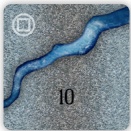 | May be replaced by yellow citytile or yellow plain track tile. Payterrain costs of £10. Paid by thecompany which is able to placethe tile. | Anywhere |
May not be overbuilt at all. Notrack tile may lead to the edge of a sea tile. | Anywhere | |
 | May not be overbuilt except bythe green edged tunnel tile whichmay be built from the green phaseon for the cost of £50. Paid by thecompany which is able to placethe tile. Replace one mountain tileby the tunnel tile. | Anywhere, but tunnel is treated asplain track. |
 | Must be the end of a route. Counts£60 for a company with a tokenin it. | Anywhere. The checkerboard ruleisn't valid for Wiggywack (likeMildendo). |
 | Some come with, some withoutcity. No upgrade. | Some are treated as plain track,some as city tile (as marked). |
Seenarios SCENARIO 1: LET'S START


SCENARIO 2: THE MOUNTAINS


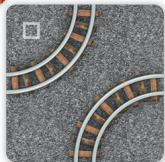
SCENARIO 3: CITY ON CITY


Credits
Game design: Leonhard Orgler Layout: David Hanáček Graphic design: Martin Málek Illustration: Petr Štich
Published by: Fox in the Box, 2018
Many thanks for playtesting and support to:
Ronald Novicky, Sascha Kreindl, Thomas Kranewitter, Matthias Mahr, Uwe Gemming, Mark Morrise, Justin
Rebelo and Tyler McLaughlin and all 1158 Kickstarter backers!
Ferdinand de Cassan dedicated his life to games. He was the founder and organizer of the "Wiener Spielefest", and he supported everything and anyone who had anything to do with games. For example, he personally encouraged me to publish "1837" in the early nineties. I owe him much.
Tables
TABLE 5. TRACK TILES
| Variant | Tile | Yellow | Green | Brown | Red | Misc |
| Basic Game | Y-Cities | 2 | 2 | 1 | ||
| Cities | 12 | 6 | 3 | |||
| Plain Track | 16 | 3 | 1 | |||
| Starting Tiles | 1 | |||||
| Character Tiles | 7 | |||||
| Allenbeck | Cities | 3 | ||||
| Laputa | Cities | 4 | ||||
| Brobdingnag | Y-Cities | 2 | 2 | 1 | ||
| Cities | 12 | 6 | 3 | |||
| Starting Tiles | 1 | |||||
| Character Tiles | 3 | |||||
| Scenario | Misc | 23 |
TABLE 6. TRAINS (PHASES)
| Type | Cost | Number of players | Obsolete1 | Rusted | Phase | Trainlimit | ||||||
| 4 | 3 | 2 | 1 | |||||||||
 | 80 | 5+2² | 5+2² | 5+2² | 2 | 4 | ||||||
 | 150 | 6 | 5 | 3 | 2 | |||||||
 | 300 | 5 | 4 | 3 | 2 | 2 | 3 | |||||
 | 400 | 4 | 3 | 2 | 2 | 2 | 2 | |||||
 | 500 | 3 | 2 | 2 | 2 | 3 | ||||||
 | 650 | ∞ | ∞ | ∞ | ∞ | 4 | 3 | |||||
'Revenue of obsolete trains is divided in half
2Five 2-trains come with the four starting companies. After they were chosen – no matter with how many players you play – only two 2-trains remain on the train card pile.
下载 Markdown