rules_zh_以撒的结合四魂_6408.md
以撒的结合 THE BINDING OF ISRAE 四魂
桌游模拟器版说明书
(根据官网版本修订,所有只适用于桌游模拟器版本的文本会用白底标注)
以撒的结合:四魂是以撒作者Edmund McMillen亲自操刀制作的电玩改编卡牌游戏。
2-4位玩家轮回合与怪物战斗,使用掉落牌和道具牌进行辅助,并获得更多道具和掉落牌,或者是灵魂。第一位获得4只灵魂的玩家获得游戏的最终胜利,尽管通过合作,交易和背叛来达成目标吧。
起始准备
在游戏中,参考下图进行游戏物件的摆放

游戏开始后不再需要的角色牌和初始道具牌可以酌情移出游戏
·从道具牌堆顶摸出两张道具牌,正面朝上置于商店内道具位上,作为当前的商店内道具- 从怪物牌堆顶摸出两张怪物牌,正面朝上置于在场怪物位上,作为当前的在场怪物,如果在此过程中有任何事件牌或诅咒被翻出,将其置于怪物牌堆底,并再抽一张进行替换· 为每位玩家随机分发一张角色牌,正面朝下置于桌面,游戏正式开始时每位玩家将其翻开,并获得相应的初始道具牌
- 每位玩家的角色牌在游戏正式开始时不具有充能(详见 第3页 卡牌解析一道具牌-补充说明),直到该玩家的回合开始
- 每位玩家从掉落牌堆顶摸3张掉落牌,并获得3¢- 游戏默认由角色牌为该隐的玩家先开始第一个回合,如果场上没人抽到该隐的话,由场上玩家里当前心态最崩的人开始游戏...或者你们也可以掷骰啊剪刀石头布啊什么的...反正怎么有用怎么来就是了。
玩家回合
在玩家的回合内,按顺序进行如下行动
充能阶段 为你持有的所有主动道具和角色牌主动效果充能
(详见 第3页 卡牌解析-道具牌-补充说明)
摸牌阶段 从掉落牌堆顶摸1张掉落牌
行动阶段 在行动阶段,你可以进行如下的行动:
- 打出一张掉落牌 此行动可以响应在本回合内进行的任意行动。除特殊情况,打出的掉落牌会被正面朝上置于掉落弃牌堆顶
- 使用角色牌的主动效果,在本回合内额外打出一张掉落牌此行动同样可以在其他玩家的回合进行,响应在本回合内进行的任意行动
行动的详细说明参见 第8页 行动与其结算(后来先行原则)条目
- 花费10¢,购买一张道具牌 在购买道具时,首先决定你所购买的道具,其可以是商店内道具位的一张道具牌或者道具牌堆顶的一张随机道具牌,然后同时花费10¢并获得对应的道具,当任意商店内道具位上没有任何道具牌时,从道具牌堆顶摸出一张新的道具牌替换
- 与一只怪物进行战斗 (详见 第7页 战斗 条目)
以上行动可以以任意顺序进行,你也可以选择不进行任意或者全部行动,在行动阶段结束后,本回合结束
回合结束 回合结束时,按顺序进行如下行动:
- 为所有在场怪物和玩家回复❤ 体力值
将每一位玩家的体力标记归位到等同于其角色总体力值(角色牌面体力值和道具增加的体力值之和)的位置,并将所有在场怪物牌的体力计数器数值归位到其牌面体力值数
- 当你手上持有多于10张掉落牌时,弃置手上部分掉落牌,(将手上的掉落牌正面向上置于掉落弃牌堆顶)直到手上只有10张牌为止
在此之后,由你左手边的玩家开始下一个回合
卡牌解析
道具牌105张 初始道具牌10张 掉落牌103张 怪物牌107张 角色牌11张 额外灵魂牌3张
Kickstarter众筹特供扩展包额外加入:道具牌20张 初始道具牌4张 掉落牌21张 怪物牌20张 角色牌4张
道具牌 你所获得的道具牌被置于你角色牌的右边,所有玩家都可以看到,在游戏中具有干扰各类行动的强大效力
一般道具/初始道具背面
卡牌名字
六面骰
边框-

主动类型——强制一位玩家——牌面效果
重新进行任意一次掷骰
永顿系
此类道具无法被偷走、交换或者摧毁
道具属性:
-永恒系-
所有初始道具牌开局都具有此属性, 此类道具无法被偷走, 交换或者摧毁, 永远留在持有此牌的玩家的道具牌库中
注意: 永恒系道具无法被摧毁, 所以所有牌面效果包含“摧毁此牌”的道具牌在获得永恒系属性后失去所有效力
—诅咒系—
并不是所有道具都会帮到你, 这些则会
对你倒打一耙! 诅咒系道具只给予负面效果,
当你死亡时, 在接受死亡惩罚 (详见第8页 玩家死亡
之前, 将这张牌交给由你选择的另一位玩家
- 嘀屁猫系-*1
以撒亲爱的小猫咪支离破碎,灵魂在世间游荡...嗝屁猫系道具可以触发嗝屁猫之魂的效果,只要持有两张,就可以获得此灵魂
*1 为了方便,本版本四魂为隔屁猫道具额外添加属性提示,在原版并无此属性,本页“掷骰点数”的修改和之后的陷阱系怪物牌同理
基本类型:
被动道具(以银色边框作为标记)
被动道具无需使用,在游戏过程中直接干扰玩家行动的进行,或者自动响应特定行动
主动道具(以♀作为标记)
主动道具在具有充能的情况下可以由你自己选择使用,并对任意进行中的事件进行响应在使用后,此道具失去充能,直到此道具下一次具有充能时,此牌才能被再次使用
条件性主动(以 $\$$ 作为标记)
条件性主动道具需要进行一定行动作为使用条件才能被使用,此行动在其牌面效果执行之前执行,且不属于可被响应行动。此类道具不具有充能,只要可以满足条件就能反复使用
补充说明:*2 在原版排版中, 掷骰点数只由数字标注, 前提条件依然在前面的文字中写明, 只有可以被所有类型的掷骰点数触发的效果才用白字黑圈标注 (仍然包含骰子标记)
主动道具和角色牌的主动效果具有充能一概念,当这类牌竖向置于桌面时,此牌具有充能
在其被使用后, 即使其效果不起作用, 也会被横置, 被横置的卡牌则不具有充能, 此情况下的卡牌的牌面效果无法被使用, 直到其下一次被竖置 (即被充能) 才可以使用
掷骰点数: *2
掷骰点数即任意玩家进行掷骰得到的数字。在牌面效果中以类似③的标记标识,其上面的数字代表会触发此牌效果的掷骰点数当掷骰点数标记下带有血迹时,代表此牌只能由战斗掷骰(详见战斗条目)触发
掷骰点数触发的前提条件在其前面的文字中写明,道具牌中,文字后面标有骰子符号的卡牌效果可以被所有类型的特定掷骰点数触发
卡牌解析
道具牌105张 初始道具牌10张 掉落牌103张 怪物牌107张 角色牌11张 额外灵魂牌3张
Kickstarter众筹特供扩展包额外加入:道具牌20张 初始道具牌4张 掉落牌21张 怪物牌20张 角色牌4张
掉落牌 掉落牌作为你在游戏中的手牌,由你拿在手上,其他人无法看见
掉落牌背面

对任意玩家或者怪物造成1点伤害
牌面效果—

基本类型:
基础掉落(以蓝色背景作为标记)
金币、魂心、炸弹或胶囊一类的掉落牌即为基础掉落,其为玩家提供资源或者战斗辅助
塔罗牌(以棕色背景作为标记)
22张更高级的特殊掉落牌,具有扭转乾坤的强大效果
失落之魂(以教堂背景作为标记)
整个掉落牌堆里只有一张的极稀有掉落,
在你打出后,你直接获得这只灵魂,
饰品(以银色边框作为标记)
为数不多的稀有掉落牌,在你打出后,此牌加入你的道具牌库,在接下来的游戏中此牌也被视为被动道具牌,具有被动效果
饰品固定拥有-饰品-属性, 其他被动道具的属性 (目前只有-嗝屁猫系-) 同样适用于饰品, 详见卡牌解析-道具牌-卡牌属性 条目
补充说明:
所有掉落牌效果都可以被抵消!实际上,一切被打出,并且未被结算的掉落牌效果都可以被可以抵消其效果的行动抵消,这意味着在任意饰品或者“失落之魂”一牌结算结束之前,你可以阻止玩家获得它们,并将其置于掉落弃牌堆顶
卡牌解析
道具牌105张 初始道具牌10张 掉落牌103张 怪物牌107张 角色牌11张 额外灵魂牌3张
Kickstarter众筹特供扩展包额外加入:道具牌20张 初始道具牌4张 掉落牌21张 怪物牌20张 角色牌4张
怪物牌
游戏中的主体牌组,你获得胜利的关键所在,蕴含着机遇与危险,以及更多惊喜
基本类型。
怪物牌背面
卡牌名字
充血怪
体力值
判定点数
攻击力一
牌面效果一
击杀奖励一
❤️: 4 | 📁: 4+ | 🌐: 2
当此怪物对你造成伤害,
其同时对其他所有玩家
造成1点伤害
获得!张道具牌 +1
击杀灵魂奖励——
事件牌
究极贪婪!
卡牌名字
选择场上持有数¢最多的玩家或者几位同等最多的玩家中的其中一位,其弃置手上所有的¢基本类型:
标准怪物牌
基础怪物(以棕色背景作为标记)
容易被击杀的常见怪物,击杀后给予你一定的资源,极少数会给予道具牌
神圣怪物(以白色背景作为标记)
基础怪物牌的变体,在特定掷骰结果下会给予玩家一定的辅助,你是否忍心将其杀害呢?
诅咒怪物(以紫色背景作为标记)
基础怪物牌的变体,在特定掷骰结果下会给予玩家负面效果,先下手为强!但前提是你能...
陷阱系怪物(自带-陷阱系-属性)
无法作为战斗目标,纯干扰与其他怪物的战斗的怪物类型,只有在特定条件下才会被击杀
头目怪物(以黑色背景作为标记)
难以被击杀的怪物牌,击杀后其变为一只灵魂,
由你获得,并且给予你更多资源
总头目怪物(一般以红色背景作为标记)
极其稀有,极难被击杀的怪物,击杀后获得2只灵魂,并有极丰厚的奖励
特殊怪物牌
事件牌(背景有黄色或蓝色火焰)
怪物牌堆中的特殊卡牌,在其被揭示后,由当前回合的玩家执行其牌面效果,可能为你带来财富,也有可能置你于死地...
诅咒牌(背景有紫色火焰)
怪物牌堆中的特殊卡牌,在其被揭示后,由当前回合的玩家进行选择,将其给予任意一位玩家,对其降下负面效果,直至其死亡才会消除
怪物牌的更多相关说明详见第七页 战斗 条目
卡牌解析
道具牌105张 初始道具牌10张 掉落牌103张 怪物牌107张 角色牌11张 额外灵魂牌3张
Kickstarter众筹特供扩展包额外加入:道具牌20张 初始道具牌4张 掉落牌21张 怪物牌20张 角色牌4张


角色牌
玩家在游戏开始时会获得角色牌,每张角色牌都具有特定的体力值、攻击力、特定的初始道具,同时具有主动效果
(体力值与攻击力的运作详见第7页 战斗 条目)
角色牌的主动效果固定为“在本回合内额外打出一张掉落牌”此效果与主动道具运作相同,可以在任意玩家的回合使用,使用后失去充能,直到下一次此牌被充能时才可以再次使用
角色牌无法被以任何方式摧毁,始终属于持有此牌的玩家
注意:游魂(The Lost)一角色初始固定获得1只灵魂,但是此灵魂赋予在角色牌上,故这只灵魂同样无法被摧毁或者偷走
额外灵魂牌
当你对游戏有一定了解之后,你就可以将额外灵魂牌加入游戏
3张额外灵魂牌被分开置于桌面的一边,当任意玩家达成牌面所写的特定条件时,该玩家获得此灵魂
每张额外灵魂牌的效果只能被触发一次,当任意玩家持有的额外灵魂牌被摧毁时,直接将其移出游戏
战斗
每位玩家在其回合内都可以发起一次战斗
发起战斗:
当你发起一场战斗时,你必须宣告你的战斗目标,选择任意一只在场怪物或者是怪物牌堆顶的随机怪物。一旦确定目标,你无法转而对其他目标发起战斗如果选择的目标是怪物牌堆顶的随机怪物牌,由你从怪物牌堆顶翻出一张怪物牌,向场上所有玩家展示此牌,然后将其正面朝上置于任意在场怪物位上,覆盖下面的怪物牌。被覆盖的怪物牌无法被作为战斗目标,其牌面效果随即失效如果在这一过程中有特殊怪物牌被翻出,则由当前回合的玩家执行其牌面效果,除非牌面特殊要求,在执行后将其弃置。如果翻出的是陷阱系怪物的话,则将其置于任意在场怪物位,而战斗不会进行即使你在此过程中翻出来的卡牌无法进行战斗,也算作你已经发起了一次战斗
战斗开始:
在宣告战斗目标的行动结算完毕后,战斗正式开始
当战斗开始时,你需要连续投掷六面骰,进行战斗掷骰判定
每一次战斗掷骰判定都要进行点数结算(查看是否有人对战斗掷骰一行动进行额外行动来进行响应),结算结束后(即无人再对其进行任何额外行动进行响应后),进行点数判定在点数判定时,如果当前玩家的战斗掷骰点数大于或等于与其战斗的怪物的判定点数,怪物受到等同于玩家攻击力的伤害(即失去体力值)
使用八面骰来记录战斗中怪物的体力值: 当怪物受到伤害时, 将八面骰转到等同于战斗中怪物剩余体力值数那一面使用计数器来记录战斗中怪物的体力值: 当怪物受到伤害时, 将计数器的数值调整为战斗中怪物剩余体力值数而如果此战斗掷骰点数小于怪物的判定点数, 玩家受到等同与怪物攻击力的伤害当玩家受到伤害时, 将体力标记移动到等同于玩家剩余体力值数的格数
一次战斗掷骰判定后,紧接着再进行一次战斗掷骰判定。此行动会连续进行,直到战斗中的玩家或者怪物有一方死亡(即体力值归零)为止
战斗结束:
当战斗中的玩家或怪物有一方在战斗中死亡,本场战斗结束
怪物死亡:
当战斗中的怪物死亡时,当前回合的玩家获得牌面上所写的击杀奖励。如果此牌包含击杀灵魂奖励的话,当前玩家获得此牌,将其置于桌面的一边,在接下来的游戏过程中此牌视为一只灵魂。如果没有的话,将此牌正面向上置于怪物弃牌堆顶。在此之后,如果被杀死的怪物下面没有其他怪物牌的话,从怪物牌堆顶再翻出一张怪物牌,正面向上置于空的在场怪物位进行替换
如果在此过程中翻出的是特殊怪物牌的话,同样由当前回合的玩家执行其效果,除牌面特殊要求以外将其弃置,然后再翻出一张进行替换,直到该怪物位有至少一张标准怪物牌为止
玩家死亡时的说明详见下一页...
玩家死亡
玩家在游戏过程中会因为受到伤害导致体力值归零或者被任意效果直接杀死而死亡
玩家死亡:
当玩家死亡时,在确定死亡后,该玩家需要接受死亡惩罚:
玩家在死亡后必须摧毁一张其持有的一张非永恒系道具牌,弃置一张掉落牌,并且失去1¢(如果你不持有其中的一种的话,你就无需进行那一项)同时该玩家所有的主动道具牌和角色主动效果失去充能,如果玩家在其回合内死亡,则在接受死亡惩罚后直接结束当前回合
玩家死亡后,其无法再受到更多的伤害或者再被杀死,所有指定任意目标造成伤害或者击杀目标的效果无法指定已经死亡的玩家,强制对一个目标造成伤害或者将其击杀的效果也不会对已经死亡了的玩家起效,直到其再次恢复体力值为止回合结束时,所有玩家和怪物的体力值都会恢复到其总体力值数,故玩家死亡后仍然可以照常进行游戏
玩家和怪物如果在战斗掷骰结算后同时死亡,优先结算怪物的死亡,再结算玩家的死亡
抵消死亡:
玩家可以响应死亡确定结算,使用对应的效果来抵消死亡
当玩家的死亡在其体力值为0的时候被抵消(受到致死伤害的情况), 其在之后回复1点体力值, 当玩家被任意效果直接杀死, 然后死亡被抵消, 则在之后其体力值保持在其被杀死之前的状态
行动与其结算(“后来先行”原则):
玩家在游戏中进行的各种行为:
开始或结束回合回合(只允许对应的被动效果)、摸掉落牌、获得金币、获得道具、打出掉落牌或使用道具、购买道具或者宣告进行战斗、宣告购买的道具或者战斗目标、从怪物牌堆顶抽出牌、与怪物进行的战斗、怪物或者玩家受到的伤害、掷骰判定、道具获得或者失去充能(每回合开始的充能阶段无法被响应)、玩家或者怪物的死亡、事件牌的效果生效...
都统一在游戏中被称为任意“行动”
在任意行动被执行,而且未结算完毕时,玩家可以做出特定行动(打出掉落牌或使用道具牌)进行响应。而在单个行动中连续有多个行动响应此事件时,在没有其他玩家进行其他行动响应当前行动后,各个行动按照“后来先行”原则进行结算
在结算过程中,从响应单行动的最后一个行动开始执行,再从倒数第二个行动继续执行,反向顺序执行每个行动,直到执行到刚开始的行动为止
行动与其结算(“后来先行”原则):
当多个行动同时进行时....
主动道具和掉落牌的使用具有明确的时间顺序,所以不可能同时进行
当不同玩家持有的多个被动道具的牌面效果因为特定行动在同一时间被触发,其响应顺序按回合顺序依次进行,然后按照“后来先行”原则反向进行结算。当任意一位玩家手上的多个被动道具同时被触发时,由该玩家决定其进行顺序,再按照“后来先行”原则反向进行结算。
当玩家道具牌和怪物的牌面效果因为特定行动在同一时间被触发,其响应顺序从怪物的牌面效果开始(若有多个怪物的牌面效果响应同一事件生效,则由当前回合的玩家决定先后顺序),然后才是玩家道具牌的效果,然后按照“后来先行”原则反向进行结算
阻止行动的结算
部分牌面效果会抵消其响应的行动(伤害,死亡,牌面效果等),同时部分牌面效果会导致其行动链中的其他行动无法被执行,其中包括部分特殊情况:
- 响应战斗掷骰,导致战斗强制结束
如果任意响应战斗掷骰的行动在其结算后导致了战斗强制结束(导致战斗中的玩家或者怪物死亡,中止战斗等), 则在接下来结算战斗掷骰判定及其他响应此行动的行动时, 由于战斗被强制结束, 则战斗掷骰判定及响应其的行动结算无法被执行
-
响应指定目标的行动,导致其指定的目标无法被指定
部分行动要求玩家指定一个目标(造成伤害,选定战斗或者购买目标等等),如果响应此行动的其他行动导致其行动所指定的目标无法再被指定为目标(如目标玩家被击杀,选定的目标不再存在等),则该行动无法被执行 -
响应需要满足特定条件才能进行的行动,导致其条件无法被满足部分行动在满足特定条件(主动道具具有充能,被动道具在特定条件下自动生效等)才能起效,如果响应此行动的其他行动导致其条件无法被满足
(主动道具失去充能, 被动道具响应的事件不再满足对应的生效条件等), 则该行动无法被执行除个别卡牌效果特别说明以外, 强制回合结束的效果并不会对其下效果的结算产生影响当主动道具或者条件性主动的牌面效果被抵消, 其使用的条件 (主动道具的充能, 条件性道具使用所需要执行的行动) 并不会退回
当任意效果导致道具效果正在行动链中的道具被摧毁, 该道具的效果在其被摧毁后仍然会照常结算
“后来先行”原则的运用是游戏中重要的战略部分,要求玩家对卡牌的效果有一定把握,并对使用时机进行安排
“后来先行”原则运用的例子详见下一页...
行动与其结算(“后来先行”原则):
例子(“后来先行原则”下的部分有效行动):
- 掷骰判定改变的反向结算
玩家1(抹大拉)攻击一只判定点数为4+的怪物,战斗掷骰掷出3点,玩家2(犹大)使用恶魔之书为此掷骰增加1点,玩家3(以撒)使用六面骰重新进行本次掷骰。在此之后没人进行其他行动响应事件,则执行顺序由最后一个响应的开始。玩家3掷骰结果为1,玩家2为结果增加1点,结果为2,小于怪物判定点数,玩家1受到1点伤害
-
在玩家摸牌时改变牌堆顺序
玩家1(以撒)摸一张牌,然后玩家2(该隐)使用障眼之手查看掉落牌牌堆,在此之后没人进行其他行动响应事件,则执行顺序由最后一个响应的开始。玩家2查看3张牌,移动牌头的三枚硬币到第三张,移动第二张一枚金币到第一张,然后玩家1摸牌,获得那张一枚金币,真不走运! -
强行中止当前战斗来无效化战斗掷骰判定结果及由判定失败受到的伤害
玩家1(阿萨谢勒)与任意怪物进行战斗,在一次战斗掷骰判定结果失败(1点)受到一点伤害时,玩家2(参孙)使用嗜血为怪物增加一点伤害,随后玩家3的圣遗物响应掷骰结果,然后玩家1使用深渊领主强制结束战斗,在此之后没人进行其他行动响应事件,则执行顺序由最后一个响应的开始。深渊领主响应战斗中未结算完毕的受到伤害一事件,战斗被强制结束,伤害的结算被中止;然后玩家3的圣遗物效果因为战斗被强制中止,战斗掷骰的结果已经无效,所以不获得掉落牌;接下来玩家2增加的伤害由于战斗掷骰结果已经无效故没有任何伤害造成,则此次行动无任何效果,玩家1成功虎口脱身
-
用特殊方法杀死战斗中的怪物来避免受到的伤害
玩家1(骨哥, 1体力)与任意怪物(1体力)进行战斗,在受到一点伤害时,其使用骨头响应在战斗中受到伤害一事件,弃置2枚标记,对怪物造成1点伤害,在此之后没人进行其他行动响应事件,则执行顺序由最后一个响应的开始。骨头响应响应战斗中未结算完毕的受到伤害一事件,怪物受到一点伤害,被击杀,战斗结束,伤害的结算被中止 -
在任意玩家强制你弃置, 偷走或者使特定卡牌失去充能之前提前将其使用玩家1在其回合内使用回旋镖, 玩家2此时角色牌主动效果具有充能, 其使用其效果, 打出该牌对偷走卡牌一事件进行响应, 在此之后没人进行其他行动响应事件, 则执行顺序由最后一个响应的开始。此牌被打出, 玩家2选择杀死了....持有科技X的玩家3, 接下来执行偷走特定卡牌一事件, 此时玩家1在玩家2剩下的卡牌中选择偷走哪一张牌。
玩家2试图杀死玩家3,没有任何人响应此事件,玩家3当场死亡,此时玩家2手上持有暗影,玩家2强制玩家3摧毁科技X。于此同时,玩家3的科技X上面有3个标记,其使用其条件性效果响应摧毁特定道具一事件,非常随便地选择杀死在场怪物位的肥蝙蝠。在此之后没人进行其他行动响应事件,则执行顺序由最后一个响应的开始。科技X的效果被提前使用,接下来此道具被摧毁,玩家3的科技X效果被使用,但是很明显使用的不是个地方...
行动与其结算(“后来先行”原则):
例子(“后来先行原则”下的部分有效行动):
-
当怪物和多位玩家的被动道具效果同时触发时...
玩家1与诅咒裂口怪进行战斗,玩家1掷出4点,触发诅咒裂口怪的牌面效果,于此同时,玩家2的妈妈的首饰盒和玩家3的塔罗牌蒙布被触发,同样响应掷出4点一事件。按照规则,从怪物的行动开始,而玩家1左手边的玩家(即回合结束后下一位开始回合的玩家)是玩家2,接下来是玩家3,则响应顺序是怪物,玩家2,玩家3,在此之后没人进行其他行动响应事件,则执行顺序由最后一个响应的开始。玩家3塔罗牌蒙布效果先从玩家1手上偷走一张牌,玩家2触发妈妈的首饰盒效果,但选择了不执行,然后诅咒裂口怪的效果被触发,场上所有怪物的攻击力+1 -
目标失去,行动无法进行的情况下是否算作你执行过本行动?玩家1宣告购买道具,然后选择了早餐,玩家2响应目标选择事件,使用虚空弃置早餐,在此之后没人进行其他行动响应事件,则执行顺序由最后一个响应的开始。首先虚空被弃置,玩家1选择的目标由于已经不复存在,则此行动无法被执行,不了了之,但由于购买的行动没有完全执行,则没有任何花费,也不算作该玩家执行了购买的行动,故玩家转而购买道具牌堆顶的随机道具牌
更多例子有待今后继续补充...
更多玩法
本页包含官方规则 (包含E群说明书里没写但是多次提到的交易规则) 和部分常见村规 (玩家约定俗成的非官方规则) 将来会酌情补充
双人模式特殊规则(官方):
双人游玩时,开始时正常进行初始准备,当游戏开始时,第一位开始回合的玩家先从道具牌堆顶摸出3张牌展示给双方看,由第一位玩家取走一张加入其道具牌库,再由第二位玩家取走其中另一张,剩下的一张置于道具牌堆底。在此之后,再进行一次相同的行动,但这次由第二位玩家先取走一张,再由第一位玩家取走另一张,然后剩下的一张置于牌堆底。在此之后,正常开始游戏
在此过程中获得的道具牌不会附加任何特殊属性,能被摧毁还是能被摧毁金币交易规则(官方):
在游戏中,允许玩家给予其他玩家一定数量的金币,在此过程中你可以向其提出任意要求,但只限于执行条件允许的行动(不存在交易道具牌或者掉落牌的行为),与其他玩家达成共识,通过金币来索取对方进行行动帮助你的战斗,
借此来获得你的胜利吧(当然,如果你想过河拆桥拿完钱不办事也没人拦着你,被打死别怪我没提醒你就是了)
角色选择 (村规):
游戏开始时,不随机发配角色牌,而是为每一位玩家分发2张角色牌,由玩家选择其中一张作为其角色,并获得相应的初始道具,本规则具有一定的平衡性问题,请三思而后行
开局伊甸(村规):
每位玩家都是伊甸!照常为每位玩家分发随机角色牌,但是角色数值固定是2体力!攻击力,同时每位玩家都从道具牌堆顶抽出3张牌,选择一张牌作为初始道具,并赋予其永恒系效果。手气可好了吧!
桌游模拟器玩家则可以选择复制伊甸一牌,为每位玩家粘贴一张,然后该干嘛干嘛
赌场模式(国外村规):
光头恶霸在线氪金!照常为每位玩家分发随机角色牌,但是角色数值固定是2体力1攻击力,同时每位玩家的初始道具固定视为便携式赌博机一牌,并赋予其永恒系效果。记住,小赌怡情,大赌伤身,强赌...
桌游模拟器玩家则可以选择复制便携式赌博机一牌,为每位玩家粘贴一张,然后该干嘛干嘛
如果有有意思的村规,
欢迎补充!
部分条目的补充说明
因为有些条目占篇幅太大,有些东西写不下去了...
道具“标记”的概念
游戏中存在部分道具利用标记运作(在实际游戏里面因为E胖完全没有考虑到这件事情所以在各种说明里用“标记可以用任何东西代替”敷衍了事。
本版本使用土制电池代币作为标记使用),标记是根据该卡牌牌面效果被放置在该卡牌上面的特殊物件,大多数使用标记的卡牌都会有标记获得的条件,以及牌面效果触发后需要弃置的标记数量例子:
科技X获得标记的条件是使用其主动效果,而其条件性效果的前提条件是弃置3枚标记
嗝屁猫获得标记的条件是在此牌首次加入玩家道具牌库时在牌上放置9枚标记,其被动效果要求玩家固定在受到一定数值的伤害时弃置等同于伤害数的标记,然后直接抵消该伤害
当道具被偷走时...
任意道具在被偷走或者交换后,其牌面的状态仍然保持其被取走时的状态,充能不会因为道具被偷走或者交换而恢复充能,卡牌上面的标记也不会因此减少或者增加
“场上道具”的说法
卡牌中的“场上道具”包括任意玩家道具牌库中的道具,以及商店内道具牌“摧毁”的说法
卡牌中的“摧毁…”指将目标卡牌弃置入对应的牌堆
“反射伤害”的说法
卡牌中的“反射…受到的伤害…”指抵消其所响应的特定点数的伤害,然后转而对另一个效果指定的目标造成等量的伤害
“在场怪物/商店道具”的说法
“在场怪物”单指任意在场怪物位中最顶端的那张怪物牌,若有怪物牌被其他怪物牌盖在下方,则不视其为在场怪物
“商店道具牌”指道具牌堆顶旁边商店道具位展示出来的卡牌。道具牌堆顶本身不算在内
“被使用过”和“失去充能”的区别
“被使用过”的道具牌指的是由于被使用者主动使用掉而被横置的道具,“失去充能”的道具牌可以是被使用过的,也可以是因为玩家死亡或者特定效果被横置的道具
部分条目的补充说明
因为有些条目占篇幅太大,有些东西写不下去了,..
“空白卡牌”的“可数效果”
当你在不确定空白卡牌的效果是否对特定掉落牌效果起效时,请对照下表...此表内仅列入原版游戏/本表作成时已发布的官方扩展包中的掉落牌对应效果,不会受空白卡牌影响的卡牌(个别不具有可数效果的卡牌及所有饰品)不会被列入表内
一枚金币!-获得2¢
空白符文 - 进行掷骰判定:
充能硬币 - 获得2¢,并为场上的一个主动道具充能
两分钱!-获得4¢
1: 所有玩家获得2¢
三分钱!-获得6¢
四分钱!-获得8¢
五分镍币!-获得10¢
2: 所有玩家摸4张掉落牌
十分铸币!-获得20¢
魂心 - 抵消对一位玩家造成的至多2点伤害炸弹!一对一位玩家或者怪物造成2点伤害黄金炸弹!-对一位玩家或者怪物造成6点伤害胶囊(经白)!-进行掷骰判定:
胶囊(组白)! -进行掷骰判定:
1-2: +2, 直到本回合结束
3-4: +2, 直到本回合结束
5-6: 受到2点伤害
胶囊(橘黄)! -进行掷骰判定:
1-2: 获得8¢
3-4: 获得14¢
5-6: 失去8¢
胶囊(蓝白)! -进行掷骰判定:
1-2: 摸2张掉落牌
3: 所有玩家受到6点伤害
3-4: 摸6张掉落牌
5-6: 弃置2张掉落牌
胶囊(紫粉)! -进行掷骰判定:
3-4: 你所有掷骰点数固定+2,直到本回合结束
5-6: 你所有掷骰点数固定-4,直到本回合结束
胶囊(纯黑)! -进行掷骰判定:
1-2: 对一位玩家造成2点伤害
3-4: 对一只在场怪物造成2点伤害
5-6: 你受到2点伤害
胶囊(白点)! -进行掷骰判定:
1-2: 摧毁你持有的2张道具牌,然后从道具牌堆顶抽出等量的道具牌替换它们...
胶囊(纯白)! -进行掷骰判定:
...3-4: 场上所有其他玩家弃置
2张掉落牌...
方块2 - 将一位玩家手上的 $\phi$ 数翻四倍鬼牌 - 查看一位玩家手上的掉落牌,你可以从其中偷走2张牌
收获符文 - 获得等同于你持有的掉落牌数量
两倍的掉落牌
期日符文 -…抵消对一位玩家造成的至多2点伤害
诸神符文 - 查看一个牌堆顶的8张牌...
4: 所有玩家获得8¢
5: 所有玩家摸10张掉落牌
6: 所有玩家获得12¢
黑符文 - 进行掷骰判定:
1-2: 对所有在场怪物造成2点伤害...
5-6: 弃置你手上所有的掉落牌。
然后摸6张掉落牌
II-女祭司 -... 对你所选的目标造成等同于掷骰点数两倍的伤害
III-女皇 - 给予一位玩家+2 $^{2}$ ,并为其所有掷骰结果增加2点,直到回合结束
IV-皇帝 - 查看怪物牌堆顶的10张牌,将其中8张
V-数皇 - 抵消一位玩家或者一只怪物受到的至多4点伤害
VI-恋人 - 给予一位玩家+4♥,直到回合结束
VII-战车 - 给予一位玩家+2 和+2,直到回合结束
IX-隐士 - 查看道具牌堆顶的10张牌,将其中8张
X-命运之轮 -进行掷骰判定:
1: 获得2¢
2: 受到4点伤害
3: 摸6张掉落牌
4: 失去8¢
5: 获得10¢
6: 获得2张道具牌
XI-力量 - 给予一位玩家+2 $^{2}$ ,直到回合结束,并且在本回合内其可以再进行两次战斗
XII-倒吊人-...在此之后,摸4张掉落牌
XIV-塔-进行掷骰判定:
1-2: 所有玩家受到2点伤害
3-4: 所有怪物受到2点伤害
5-6: 所有玩家受到4点伤害
XVI-节制 - 选择其中一项执行:
受到2点伤害:获得8¢
-或者-
受到4点伤害:获得16¢
XVII-星星 -获得2张道具牌
XVIII-月亮-查看掉落牌堆顶的10张牌,将其中8张
置于牌堆底,剩余2张置于牌堆顶
XIX-太阳...在本回合结束后,你开始另外两个回合
XX-审判 -... 该玩家摧毁其持有的两只灵魂
XXI-世界 -... 在此之后,摸4张掉落牌
部分条目的补充说明
因为有些条目占篇幅太大,有些东西写不下去了...
“空白卡牌”及“梅花2”的重复使用“空白卡牌”及“梅花2”及其他类似卡牌效果在被同时使用两次后都不会叠加产生大于两倍的效果
下载 MarkdownComprehensive Rules 1.3.md
THE BINDING OF SAAC TFOUR'SOULS
Comprehensive Rules
by Jon Paull (@jonzo11) Version 1.3
table of contents TABLE OF CONTENTS
Foreword
Components
Game Overview
Game Setup
Basic Layout
Cards
Treasure Cards 2
Loot Cards 2
Monster Cards 2
Monster Card Breakdown 2
How to Play
Playing Effects 3
The Stack 3
P r i o r i t y 3
Responding 3
Timing 3
Resolving The Stack 3
Turn Structure 4
Game Events
Purchasing 4
Dice Rolls 4
Attacking 4
Monster Death 5
R e fi l l i n g 5
Player Death 5
Other Rules
Bartering 5
Fizzling 5
Souls 6
Reference
Glossary 7
Errata 7
Card Rulings 8
Examples 9
Appendix - Blank Card 10
Variants 11
Credits 12
foreword
Hello, my name is Jon (@jonzo11). My goal was to create a comprehensive ruleset for The Binding of Isaac: Four Souls. I researched questions that people asked Ed about the game on Twitter. Those questions often pointed to specific rules that were omitted from the rule sheet included with the game. I built out this ruleset following a logic that conformed to Ed’s answers. I hope that my research and logic stay true. As of this version, Ed is still clarifying rules; if you notice something that you don’t think is right or know of something I’ve missed, message me on Twitter a n d I ’ l l l o o k i n t o i t fo r a fu t u r e v e r s i o n .

It’s clear that Magic: the Gathering serves as a source of inspiration for Four Souls. Ed has stated that certain rules work just like they do in Magic. As such, Magic’s comprehensive rules were used as a guiding principle for particularly murky areas of the rules.
Thanks for looking! I hope this document serves you well. -Jon
components
THE BINOING OF SAAC FOUR SOULS
11 Character Cards
10 Starting Items
104 Loot Cards
105 Treasure Cards
107 Monster Cards
3 Bonus Souls
100 Pennies
1 D6 and 1 D8
KICKSTARTER exclusive
4 Character Cards
4 Starting Items
20 Loot Cards
20 Treasure Cards
20 Monster Cards

SAAC+
4 Character Cards
4 Starting Items
30 Loot Cards
30 Treasure Cards
30 Monster Cards
game overview
Players take turns playing loot cards and using items to kill monsters in order to gain more loot, items, and souls. The first player to have 4 souls is the winner. Cooperation, bartering, and betrayal are all strongly encouraged.
game setup
Shuffle the treasure, loot, and monster decks. Put out 100¢.
Place 2 treasure cards face up next to the treasure deck. These are the current shop items.
Place 2 monster cards face up next to the monster deck. Each occupies a monster slot and both are active monsters (the topmost monster card of a monster slot). Place any non-monster cards revealed during setup on the bottom of the monster deck.
If you are playing with the bonus souls, place them face up next to the play area (see Souls).
Shuffle the character deck and deal out one character card and t h e i r s t a r t i n g i t e m t o a l l p l a y e r s .
All players start with their character card deactivated (turned sideways) and their starting item recharged ( t u r n e d u p r i g h t ) .
All players start with 3 loot cards and 3¢.
C a i n p l a y s fi r s t . I f C a i n i s n o t i n p l a y , t h e n t h e saddest person plays first.


:2:3 WHEN THIS DIES GAINING REWARDS ON A 1 OR 6. P CARD BACK ON THE MONSTER Q: LOOT 3
WHEN REVEALEO CURSE TO ANY ALL MONSTERS ATTACK GAIN +1 THE END OF
WHEN YOU DIE- DISC
cards
treasure cards
Treasure cards are items you acquire. Place your items in front of you visible to everyone. You take ‘treasure’ from the top of the treasure deck. There are two types of treasure:

Active Items
Active items have a gold border and describe effects you can play. There are two ways to use active items to play their effects and each corresponds to a special symbol:
Activated effects
play these effects by activating (turning sideways) the item. You must recharge the item before activating it again either through an effect or during your recharge step.

Paid effects

are preceded by a \$ symbol. You can play these effects by paying the specified cost. You are not required to activate an i t e m t o u s e i t s p a i d e ffe c t , a n d you can use paid effects of an i t e m t h a t i s a c t i v a t e d .
Passive Items
Passive items have a silver border and either modify your abilities or describe triggered effects (effects that are played automatically under certain conditions).
loot cards
You draw loot cards and keep them in your hand until you play or discard them. Loot x means to draw x cards from the loot deck. You can activate your character card to play an additional loot card. There are three different kinds of loot cards:


Basic Loot
Basic loot is used to gain resources, aid in combat, or mess with other players.
Tarot cards
Tarot cards are similar to basic loot, but have unique effects.
Trinkets
Place played trinkets in front of you. They are passive items while i n p l a y .
monster cards
The monster deck is split into monsters and nonmonsters. The active player (the player whose turn i t i s ) g e t s r e w a r d s fr o m m o n s t e r s t h a t a r e k i l l e d and encounters non-monster cards. There are two types of monsters and two types of non-monsters:


CHOOSE ON 1. DISCARD TH 2. LOOT 2. TAKE 1 3. SEARCH THE TR SHONDTAKE
EXPAND THEOF ACTIVE MONBYYOU MAY ATTAADDITIONAL TINTURN.

Basic Monsters Basic monsters are easier to kill and yield smaller rewards.
Bosses
Bosses are harder to kill with bigger rewards that always include at least one soul. When a boss is killed, it becomes a soul card and the active player gains i t .
Bonus Cards
Non-monster cards that may help or hinder the active player.
Curses
Non-monster cards that curse someone of the active player’s choosing. Place curses near your character card. When you die, discard all curses afflicting you.
monster card breakdown


how to play
playing effects
You have a number of tools at your disposal BG to steer the game in your favor: you can play loot cards, activated effects, or paid effects. Doing any of those things is referred to as playing an effect. Additionally, if it is your turn, you can purchase items, or attack monsters. Purchasing and attacking work differently than playing effects and are covered in their own sections.
I t i s a l s o i m p o r t a n t t o k n o w t h a t p l a y e r s r e g u l a r l y i n t e r r u p t o t h e r player’s turns to play their own effects. Two systems determine what will affect the game next and which player can make the next move. These are the stack and priority respectively.
the stack
Effects go on top of the stack so that other players have a chance to react. The stack is the place where effects wait to resolve (affect the game). You choose the mode (for effects that say “choose 1”) and targets for effects as they go on the stack. The following game events also use the stack and some involve multiple steps:

• Purchasing (see Purchasing)
• Rolling a dice (see Dice Rolls)
• Attacking (see Attacking)
• Combat damage (see Attacking)
• Monster death (see Monster Death)
• Refilling slots and decks (see Refilling)
• Encountering non-monster cards (see Attacking/Refilling)
• Player death (see Player Death)
example stack
Below is a visualization of the stack. Butter Bean and Dice Shard (loot cards) are played directly onto the stack, while the other two
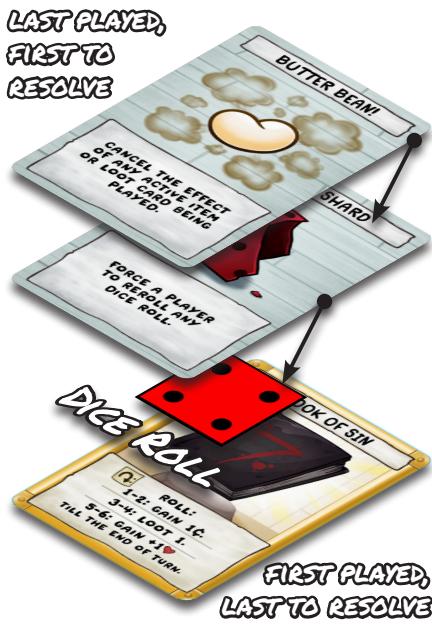
are representations of the dice roll result and Book o f S i n ’ s e ffe c t .
-
Book of Sin was a c t i v a t e d fi r s t , p u t t i n g i t s effect on the stack.
-
As Book of Sin started to resolve, it needed a roll. A roll was made and put on the stack.
-
Dice shard was played in response to the roll t a r g e t i n g t h e r o l l .
-
Butter Bean was played in response to Dice Shard targeting Dice Shard. As it s t a n d s i t w i l l r e s o l v e fi r s t , canceling Dice Shard and keeping the roll of 4.
priority
Generally, at any given point someone has p r i o r i t y . T h e p l a y e r w i t h p r i o r i t y i s t h e only player that can play effects, purchase, or attack. The following rules describe how p r i o r i t y w o r k s :

-
You can only play effects, purchase, or attack while you have p r i o r i t y .
-
While you have priority, you can either play an effect, purchase, or attack, and keep priority, or pass priority to the next player.
There are times when nobody has priority. Players can’t play effects during these times.
responding
You can play loot cards or use activated or paid effects in response to whatever is currently on the stack. Doing so puts your response on top of the stack which will cause it to resolve before whatever is below it. You can also respond while the stack is empty. In fact, this is the only time you can purchase or attack (see Turn Structure).

timing
Triggered effects can be triggered by all kinds of game events. If multiple effects trigger at the same time, they are put onto the stack in the following order:

- Effects from monster cards go on first, including monster death. If there are more than one, the active player chooses t h e r e l a t i v e o r d e r .
2 . A l l o t h e r e ffe c t s g o o n t h e s t a c k i n t u r n o r d e r s t a r t i n g w i t h the active player. If you own multiple effects, you choose their relative order. For the purposes of timing, you own your death.
If the timing is not outlined here, the active player chooses the order of the effects in question.
resolving the stack
When all players pass priority in succession, whatever is on top of the stack resolves. The final part of a loot card or nonmonster card resolving is going to its discard pile. Generally, after anything resolves, and after any triggered effects have been added to the stack, the active player gets priority.
Conceptually, think of each effect on the stack as a physical card. As they are played or triggered, you pile the cards on top of each other. To find out what happens next, you take off the top card of the stack and do what it says. Each time you take something off, players have a chance to put more cards on. This continues until the pile is empty and nobody wants to play any more cards.

turn structure
The flow of a turn is outlined below and includes three phases and the steps involved for each phase. When all players pass priority in succession while the stack is empty, the turn progresses to the next step or phase. “You” in this section refers to the active player. If a step does not mention p r i o r i t y , n o o n e g e t s p r i o r i t y d u r i n g t h a t s t e p .

1. starting phase
- Recharge all of your items and your character card.
2 . S t a r t o f t u r n e ffe c t s t r i g g e r , t h e n y o u g e t p r i o r i t y .
3 . “ L o o t 1 . ” i s p u t o n t h e s t a c k fo r y o u , t h e n y o u g e t p r i o r i t y .
2. action phase
You get priority. During this phase, you may do any or all of the following in any order:
• Play 1 loot card. (Remember: activating your character card lets you play another loot card. It even works on your opponent’s turns.)
• Purchase a shop item or the topmost card of the treasure deck. Purchasing can’t be done in response to anything (see Purchasing).
• Attack an active monster or the topmost card of the monster deck. Attacking can’t be done in response to anything (see Attacking).
3. ending phase
1 . E n d o f t u r n e ffe c t s t r i g g e r , t h e n y o u g e t p r i o r i t y . ( I f a n e ffe c t e n d s t h e t u r n , t h e c u r r e n t t u r n j u m p s t o t h i s s t e p i f n o t already in the Ending Phase. Ending the turn does not cancel anything on the stack.)
-
Heal all players and monsters to full health, then effects that l a s t u n t i l t h e e n d o f t u r n w e a r o ff.
-
If you have more than 10 loot cards in hand, discard down to 10.
4 . P a s s t h e t u r n t o t h e p l a y e r t o y o u r l e ft .
game events
The following sections cover different game events. Many of these have multple steps, and you move through the steps when something resolves or based on some condition. If a step triggers effects, those need to resolve before moving on to the next step. For example, step 5 in Attacking has combat damage resolve. If that combat damage triggers any effects, those must resolve before making another attack roll.
purchasing
You may purchase once a turn during your action phase. You may purchase a shop item or the top card of the treasure deck for 10¢. You can only start a purchase while the stack is empty (i.e. not in response to anything). To purchase, say

what you are purchasing. This declaration goes on the stack, and when it resolves, the purchase happens: you simultaneously give 10¢ to the supply and gain the purchased item. If you purchase a shop item, replace it with the top card of the treasure deck (see R e fi l l i n g ) .
dice rolls
You make dice rolls for some effects or while attacking; rolls made as part of an attack are considered attack rolls. When an effect that needs a r o l l b e g i n s t o r e s o l v e , fi r s t m a k e t h e i n i t i a l r o l l and put it on the stack. Only initial rolls go on the stack; effects that reroll simply modify the result on the stack. When you roll:

- The intial result is added to the stack, then all applicable “+X/-X to dice rolls” effects are added to the stack on top of t h e i n t i a l r e s u l t , t h e n t h e a c t i v e p l a y e r g e t s p r i o r i t y . ( T h i s i s when rerolls and other effects that modify the result can be played.)
2 . T h e r o l l r e s o l v e s : T h e r o l l r e s o l v e s a s t h e c u r r e n t r e s u l t . I f rolling for an effect, the effect becomes defined with the result. If the roll is an attack roll, combat damage is added to t h e s t a c k . E ffe c t s t h a t t r i g g e r o ff o f t h e r e s u l t a r e a d d e d t o the stack immediately on top of the effect or combat damage b e i n g r o l l e d fo r , t h e n t h e a c t i v e p l a y e r g e t s p r i o r i t y . ( I f D a d ’ s Lost Coin, Missing Page, or Sacred Heart change the result here, you must change the effect or combat damage to reflect the new result. These items cause final rerolls: no modifiers can be played and this reroll doesn’t cause effects to trigger.)
You always make rolls with six sided dice. Rolls and monster evasion can’t go above 6 or below 1.

attacking
You may attack once a turn during your action phase. You may attack an active monster or the top card of the monster deck. You can only start an attack while the stack is empty (i.e. not in response to anything). Follow the steps below to at

-
To start an attack, say what you are attacking. Put your declaration on the stack. When it resolves, the attack starts; continue to step 2. If either the player or monster dies at any time during the attack, the attack ends (see Monster Death, Player Death).
-
If you are attacking the top of the monster deck, reveal the c a r d . I f i t i s a m o n s t e r c a r d , p u t i t i n t o a m o n s t e r s l o t a n d continue to step 3. If it is a non-monster card the attack ends; you must play it, then you get priority.
-
Make an attack roll with a six sided dice (see Dice Rolls). If the roll resolves to a number less than the monster’s evasion, the attack misses; combat damage equal to the monster’s attack is put on the stack directed at you. If the roll resolves to a number equal to or greater than the monster’s evasion, the attack hits; combat damage equal to the player’s attack is put on the stack directed at the monster. Continue when damage resolves. You get priority.
-
Either you or the monster take combat damage. Put any effects that trigger off of this damage on the stack. After they resolve, go back to step 3 if both combatants are alive.
You can only attack during your action phase. Some effects can force you to attack; you must make any forced attacks at the next possible time that turn (i.e. the next time you have priority during your action phase while the stack is empty). Effects can give you additional attacks. Killing a monster outside of combat with an e ffe c t i s n o t a n a t t a c k .
monster death
When a monster is reduced to 0 health or killed by an e ffe c t :

-
Put its death on the stack; when it resolves, continue. The active player gets priority.
-
The monster card is moved to the stack, then the reward is put on the stack, then any on-death triggered effects from the monster are put on the stack; when they resolve, continue. The active player gets priority.
-
The active player gains the monster card as a soul card if it is a b o s s , o r d i s c a r d s i t i f i t i s a b a s i c m o n s t e r . I f t h e m o n s t e r s l o t i s e m p t y , t r i g g e r a r e fi l l o f t h a t m o n s t e r s l o t ( s e e R e fi l l i n g ) .
refilling
Monster slots must be filled when empty. Think of each slot as having a triggered ability that reads “When this slot becomes empty, refill it.” Whenever this happens:

-
Put the refill effect on the stack; when it resolves, continue. The active player gets priority.
-
The active player reveals the top card of the monster deck. If i t i s a m o n s t e r c a r d , p u t i t i n t o t h e e m p t y m o n s t e r s l o t . T h e r e fi l l i s d o n e . I f i t i s a n o n - m o n s t e r , t h e a c t i v e p l a y e r p l a y s i t , then gains priority. Once that card resolves, repeat this step.
Shop items also need to be replaced when there is an empty slot. Follow the steps above, ignoring step 2 because there are no cards that are played from the shop deck.
Whenever a deck runs out of cards, instantly shuffle its discard pile and make it the deck. This can happen in the middle of an effect resolving and does not use the stack.

player death
When you are reduced to 0 health or killed by a n e ffe c t :

-
Put your death on the stack; continue when it has resolved. The active player gets priority.
-
Discard any curses afflicting you, then The Death Penalty is put on the stack, then “before paying penalties…” and “when a player dies” effects trigger; The active player gets priority.
To pay The Death Penalty you discard a loot card, lose 1¢, destroy one non-eternal item you control, deactivate (turn sideways without using) your items and character card, and end your turn if you are the active player.
You can only die once per turn, and you will heal to full health at the next ending phase. When your death is prevented, your health is returned to what it was before you took lethal damage or were killed by an effect. A dead player will sometimes need to refill a monster slot and play non-monster cards.

bartering
Players are encouraged to trade for favors or nefarious acts. When bartering, a player can pay another player any amount of ¢ for practically any favor. Player’s can’t trade

items or loot in this fashion. Players can give ¢ away without getting anything in return, but the receiving player must agree to it. Bartering does not use the stack.
Once paid, promises don’t have to be kept. Be warned: if you go back on your promises, it will be hard for others to trust you.
fizzling
Cards like No! and Butter Bean! cancel effects. When something is canceled it is removed from the

stack without resolving then discarded if it is a card. Effects and game events can also be canceled for a variety of reasons due to a change in game state. This is called fizzling. Below are some common fizzles:
Invalid Targets - Players must declare targets when playing effects. If the target leaves play or becomes untargetable for any other reason, the effect fizzles.
Condition Not Met - Some effects require a condition to trigger and/or resolve. The effect will fizzle on resolution if the condition is false. Examples: Eden’s Blessing, Sacred Heart, etc.
Attack Fizzle - If the target of your attack declaration is an active monster and it leaves play, the declaration will fizzle and the attack won’t start. You do not lose your attack (it didn’t happen) and you can simply declare another attack.
Purchase Fizzle - If the target of your purchase declaration leaves play, the declaration will fizzle and the purchase won’t happen. A purchase declaration will fizzle on resolution (be canceled instead of resolving) if you don’t have enough ¢ when your declaration resolves. In either case, you do not lose your purchase (it didn’t happen) and you can simply declare another purchase.
Leaving Combat - If a player or monster leaves an attack for any reason, any attack roll or combat damage on the stack fizzles. This can be from the player or monster dying, an effect canceling the attack, or an effect ending the turn.


winning the game
Any card with the soul symbol can turn into a soul card. The soul symbol says how many souls that soul card is worth.

The first player to have 4 souls wins the game.

bonus souls
Once you have a better understanding of the game’s mechanics, you are encouraged to add the bonus souls to your games. These bonus cards are not added to any deck, but instead lay face up next to the game in view of all the players.
These souls, once gained, act like any other soul card. Bonus souls can only be gained once per game; if these soul cards are ever discarded, they are placed face down next to the game and cannot be gained again.


Soul of Greed
The first player to have 25¢ or more instantly gains the Soul of Greed.

Soul of Gluttony
The first player to have 10 or more loot cards in their hand instantly gains the Soul of Gluttony.

Soul of Guppy
The first player to have 2 or more Guppy items in their possession instantly gains the Soul of Guppy.
guppy items



other souls
There are a number of souls to be gained that aren’t boss souls or bonus souls.

The Lost
The Lost starts the game with 1 soul. This soul can’t be destroyed, stolen, or lost in any other way.

The Bone
Resolving the final paid effect on The B o n e w i l l t u r n i t i n t o a s o u l c a r d . I f i t i s ever discarded after becoming a soul card, i t i s l o s t fo r g o o d s i m i l a r t o a b o n u s s o u l .

Pandora’s Box
Resolving the activated effect on P a n d o r a ’ s B o x w i t h a 6 fo r t h e r o l l t u r n s i t i n t o a s o u l .

The Chest
If you own The Chest and it is destroyed (including by the death penalty), it turns into a soul card for you instead of going to the discard pile.

Lost Soul
You play Lost Soul like any other loot card. When it resolves, it becomes a soul card and you gain it.

Holy Chest
I f H o l y C h e s t r e s o l v e s w i t h a 6 fo r t h e r o l l , i t t u r n s i n t o a s o u l fo r w h o e v e r p l a y e d i t (almost always the active player).


glossary
+ - Gives you additional max health. Think of these as heart containers. The extra health is full when you get it. If you lose this bonus while damaged, you simply lose the “empty” heart container
+/- - Affects how much damage you do with combat damage. Your bonus is checked as combat damage resolves, not when it is put on the stack.
+ / - t o R o l l s - D i c e m o d i fi e r s t h a t a d d o r s u b t r a c t t o a l l o f y o u r d i c e r o l l s a r e a p p l i e d t o a l l o f y o u r r o l l s . T h i s m o d i fi e r i s a p p l i e d when a dice roll would resolve. See Dice Rolls.
Active Player - The player whose turn it is.
Activated - Items turned sideways are considered activated and can’t be activated until recharged. Paid effects are not activated e ffe c t s .
Additional Attacks - If you are forced to attack again, you must declare an attack at the first possible time (during your action phase while the stack is empty). If the effect says “this turn,” the attacks don’t need to happen immediately but does need to happen before leaving the action phase (i.e. you can’t pass priority during your action phase until you’ve made the attack).
¢ - There are only 100¢ available. When these run out, players need to spend or lose ¢ to increase the supply. Used for purchasing, bartering, and to pay the costs of some paid items.
Counters - Counters are markers you place on specific cards that ask for them. They can be represented by anything you’d l i k e ( s t o n e , d i c e , c o i n , e t c . ) . I f a c a r d w i t h c o u n t e r s i s s t o l e n , t h e counters stay on it.
Damage Prevention - Damage prevention is used to prevent incoming damage to a target. You don’t take damage that is prevented. Unused instances of prevention last until the end of the turn, but the entire instance is used on any incoming damage, even if there is more prevention than damage at the time.
Death - Monsters and Players can die when reduced to 0 HP or killed by an effect. If a player or monster is killed by damage, put any effects that trigger on damage on the stack first, followed by the death. Think of the check for damage coming before the check fo r 0 h e a l t h .
Destroy - When a card is destroyed, it is placed in the appropriate discard pile. Destroying an active monster is the same as killing it. Destroying a player is the same as killing them.
Discard - Send to the appropriate discard pile. The final part of a loot card or non-monster card resolving is that card being put into its discard pile. Discarding active monsters yields no rewards. When a shop item or active monster is discarded, replace them if the slot they were in becomes empty (see
Refilling). Unless an effect says otherwise, a player being forced to discard loot or soul cards gets to choose which cards to discard.
Expand - Effects can expand the shop or the number of monster s l o t s . F i l l t h e n e w s l o t s fr o m t h e t o p o f t h e c o r r e c t d e c k .
Healing - Effects that heal cannot put a player’s or monster’s health above its current maximum.
In Play - Items owned by players, items in the shop, and active monsters are all considered in play.
Loot X - Draw X cards from the loot deck.
Next Player - The next player in turn order.
glossary (continued)
Priority - The person with priority is the only person at any given moment who can play effects or take actions like purchasing or attacking. Once everyone has passed priority in succession, the top of the stack resolves.
The Stack - The place where loot cards, effects, and other game events wait to resolve. When something happens and that something uses the stack, it is placed on top of the stack, and the active player gets priority.
Steal/swap - Unless an effect says otherwise, the stealing/ swapping player chooses what to steal/swap. Counters stay on stolen/swapped items.
treasure errata
Flush* - Put all shop items not being purchased on the bottom…
Dad’s Lost Coin - When anyone would roll a 1, you may force t h a t p l a y e r t o r e r o l l i t i n s t e a d .
The Dead Cat - Each time you would take damage…
Guppy’s Collar - Each time you would die, roll…
Jawbone - Steal up to 3¢ from a player.
The Missing Page - When anyone would roll a 5, you may force t h a t p l a y e r t o r e r o l l i t i n s t e a d .
Ouija Board - …You may force the active player to play one non-monster card revealed this way...
Sacred Heart - Each time you would roll a 1, you may turn it into a 6 instead..
Void* - Discard an active monster that is not being attacked or a shop item not being purchased.
loot errata
Broken Ankh - Each time you would die, roll…
Guppy’s Hairball - Each time you would take damage, roll…
monster errata
Curse cards - When revealed, Give this curse to any player...
Duke of Flies - When this would take damage...
We Need To Go Deeper - ...back on top of the monster deck in any order.

*These errata don’t quite fit once the concept of priority is added to the game, but I have included them for completeness.

Character Cards
Eden - The two cards not selected are put on the bottom of the deck. Items with “destroy this: effect” don’t function with Eden because the item gains eternal. Glass Cannon is an exception b e c a u s e d e s t r o y i n g i t i s n o t a c o s t o f i n i t i a l a c t i v a t i o n . A r o l l 1 - 5 w i l l n o t d r a w y o u l o o t .
treasure cards
9 Volt - You can use recharged items before the next turn (When the stack is empty, you can still add effects).
Baby Haunt - Despite being purple this is not a curse. It is an item; it stays in the shop when revealed and can be targeted by e ffe c t s t h a t t a r g e t i t e m s .
Blank Card - See Blank Card in the Appendix.
Bum-bo! - You must put counters on this. The triggered effect that puts counters on Bum-bo! effectively keeps you from gaining ¢ from the supply, but you can still get ¢ from stealing or bartering. The effects can stack; if you have 25 or more counters, you have all three bonuses.
Contract From Below - One of the items destroyed can be itself.
C r y s t a l B a l l - T h i s w i l l fi z z l e i f t h e r e i s a r o l l o n t h e s t a c k . A s w i t h a l l e ffe c t s t h a t t r i g g e r o n d i c e r o l l s , t h i s t r i g g e r s o n a r o l l resolving, which includes any modifications to the roll.
Daddy Haunt - The effect adds 1 to the total damage you take. It isn’t an additional instance of damage. Despite being purple this is not a curse. It is an item; it stays in the shop when revealed and can be targeted by effects that target items.
Diplopia/Modeling Clay - Copying an item with counters on it does not also copy the counters. Counters earned while copying persist after copying ends. Counters are generalized and can be used with any card that interacts with counters. Copying Dead Cat is a special case. If an item copies Dead Cat, the number of counters on it is set to 9. This happens each time you copy Dead Cat. Counters generated by copying Dead Cat are still generalized.
G l a s s C a n n o n - A s w i t h a l l e ffe c t s t h a t r e q u i r e a r o l l , t h e r o l l needs to be resolved before the effect to determine what the effect will be. If you put more than one activation on the stack ( t h r o u g h r e c h a r g e s ) , t h e fi r s t i n s t a n c e o f a 1 - 5 w i l l fi z z l e t h e r e s t because glass cannon can’t be recharged or destroyed.
Lemon Mishap - Lemon Mishap creates a triggered effect that isn’t attached to any card in play. There can be multiple of these triggered effects active at once, and all of them will stop existing a t t h e s a m e t i m e w h e n e ffe c t s t h a t l a s t u n t i l e n d o f t u r n w e a r o ff.
Mom’s Shovel - This will stay deactivated in the shop. This can be recharged while in the shop with an effect. Purchasing this does not recharge it.
Monster Manual - It forces the active player to make an attack against the specified monster at the next possible opportunity following normal attack timing. The forced attack can “use up” t h e p l a y e r s a t t a c h i f i t i s t h e fi r s t a t t a c k o f t h e t u r n . Y o u c a n force an attack against the top of the monster deck. You can force additional attacks. This will fizzle if used against a player in combat. This will fizzle if the active monster targeted is discarded before this resolves.
Remote Detonator - Vote in turn order starting with the active player.
Sacred Heart/Dad’s Lost Coin/The Missing Page - They can fi z z l e i f t h e r o l l i s m o d i fi e d t o a n u m b e r t h a t d o e s n ’ t m e e t t h e i r condition when their effect resolves. See Dice Rolling and Errata.
Shadow - If there are more than one in play, they trigger in turn order, then whichever resolves last gets to choose/receive stuff.
T w o o f C l u b s - M u l t i p l e a c t i v a t i o n s o f t h i s d o n o t fu r t h e r m u l t i p l y a n e ffe c t .
loot cards
Butter Bean! - When you cancel a loot card on the stack, the loot card is discarded first, then Butter Bean. Butter Bean can cancel trinkets and Lost Soul while they are on the stack because they a r e s t i l l l o o t c a r d s ( i . e . , n o t i t e m s / a s o u l c a r d ) u n t i l t h e y r e s o l v e . Butter bean will merely delay the use of an item like Mom’s Shovel because destroying the item is part of the effect.
Counterfeit Penny - This only triggers when ¢ are gained from the supply (not when stealing/bartering). The effect adds 1 to the total ¢ gained; it is not an additional instance of gaining ¢.
O. The Fool - You can play this with your death on the stack to survive. The death effect fizzles and you still move to the ending phase. Fizzling death in this way is the same as preventing it; your health is returned to what it was before you took lethal damage or were killed by an effect.
VIII. Justice - You gain loot and ¢ equal to the difference between what you have and the target has. Imagine you have 2 cards and 3¢, and your opponent has 5 cards and 1¢. You play Justice and loot 3 cards (up to 5) but gain 0¢ (you had more).
monster cards
Ambush - If your first attack is against the top of the deck and you pull Ambush, you only need to make one more attack against t h e t o p t o m a k e a t o t a l o f t w o a t t a c k s fo r t h e t u r n .
Cursed and Holy monsters - Effects on these monsters can trigger outside of combat. Most other monster effects that trigger on dice rolls only trigger when you are attacking them.
Death’s Head - If this is revealed when attacking the top of the m o n s t e r d e c k , y o u s t i l l p u t i t i n t o a s l o t , b u t y o u c a n ’ t a t t a c k i t . You lose your attack.
Devil Deal - For the third option, you can’t use the item before taking 2 damage.
D i n g a - I f y o u k i l l o n a 6 , r o l l o n c e a n d d o u b l e fo r t h e t o t a l ¢ gained.
The Haunt - The effect triggers for every 2 points of cumulative damage it takes in a turn. The damage does not have to be dealt in a single instance.
Ragman - Ragman’s effect can undo getting the soul, potentially keeping a player from winning.
Satan - The active player must kill themself if they are the last player alive.
Stoney - If this is revealed when attacking the top of the monster d e c k , y o u s t i l l p u t i t i n t o a s l o t , b u t y o u c a n ’ t a t t a c k i t . Y o u l o s e your attack.
examples
conventions

In the following examples, the player whose name begins with the letter “a” is the active player, and all players whose name begins with the letter “n” are non-active players.
priority/stack example

Amy has just entered her action phase. Neil (next in turn order) has a Gold Bomb that he play targeting Amy, but he doesn’t have priority yet. Amy chooses to declare a purchase. When she does, she keeps priority. She could do something in response to her purchase before anyone else, but she has no resonses, so she passes priority to Neil. Neil plays the Gold Bomb targeting Amy. Again, he has an opportunity to play something in response first because he retains priority, but he has no other plays, so he passes priority back to Amy. Amy has no response to the Gold Bomb, so she passes priority back to Neil. All players have passed priority in succession, so the top of the stack (Gold Bomb) resolves and kills Amy. This triggers Amy’s death effect and it goes onto the stack above the purchase. Because something resolved, after triggers go on the stack, Amy (the a c t i v e p l a y e r ) w i l l g e t p r i o r i t y .
sequencing example

Abel has an attack roll on the stack. He controls Godhead while Nathan controls The D6. If Abel resolves Godhead first to change his roll to a 6, Nathan could force a reroll to get a random result. If Abel waits until Nathan resolves The D6 first, he can ensure that the random reroll changes into a 6.
dice roll example

Alex owns Dad’s Lost Coin, Meat, and the Relic. He makes an attack roll and rolls a 5 intially. Meat’s +1 bonus goes on the stack right away, and then players get a chance to play stuff. Nola has a Dice Shard. She tactically waits for Meat’s bonus to resolve before playing Dice Shard and forcing Alex to reroll. He r o l l s a 1 . W i t h n o m o r e m o d i fi e r s fr o m e i t h e r p l a y e r , t h e r o l l resolves as a 1. Combat damage diirected at Alex is put onto the stack, followed by The Relic and Dad’s Lost Coin. The Relic’s effect resolves and Alex loots 1, then Dad’s Lost Coin’s effect resolves and he makes a final reroll. It’s a 6, so the combat damage needs to be updated to match the new result.
purchasing example

Ash has put a purchase declaration for the top of the treasure deck on the stack. Ash missed something though: Noah has The Curse recharged and ready to mess up the purchase. In response, Noah activates The Curse to put the top card of the treasure discard pile on top of the treasure deck. When Ash’s declaration to purchase resolves, they must purchase the card that was put on top. Unfortunately for Ash, the card that was put on top was Baby Haunt.
attacking example
Andres declares an attack against the active monster Gurdy. When the declaration resolves, the attack begins. He rolls a 5 ( a h i t ! ) , a 4 ( a h i t ! ) , a n d t h e n t w o 1 ’ s ( m i s s e s ) a n d d i e s , e n d i n g combat. Each roll is resolved before the next. Poor Andres.

monster death example

A v a i s a b o u t t o r e s o l v e a n a t t a c k i n g d i c e r o l l t h a t w i l l k i l l Death. Death’s soul will be the first soul gained by anyone so far this game. Nick has 1 loot card in hand: XX. Judgement. Nick thinks there might be a chance to play Judgement to discard Ava’s new soul card. Death goes to 0 health and dies. W h e n i t d i e s i t i s m o v e d t o t h e s t a c k u n t i l a l l d e a t h r e l a t e d s t u ff i s d e a l t w i t h . I t s r e w a r d i s p u t o n t o t h e s t a c k , a n d t h e n i t ’ s o n - death triggered effect is stacked on top of the rewards. Ava gets priority, but neither player has any plays. The trigger resolves and Ava kills Nick. Nick’s death goes onto the stack, resolves, and he has to pay penalties including discarding Judgement. Next, Ava gets a treasure as a reward. Finally, Death becomes a soul card for Ava. The slot is refilled, and the game continues.
refilling example

Aubrey just killed and got rewards from a monster they k i l l e d . I t w a s t h e l a s t a c t i v e m o n s t e r i n t h e s l o t , s o t h e r e fi l l effect is now on the stack. If, in response, Nash kills Aubrey, they would need to process their death and go to the end of the t u r n . E ffe c t s t h a t t r i g g e r a t t h e e n d o f t h e t u r n w o u l d b e p u t o n the stack on top of the refill effect, but eventually the slot would be refilled before the next player takes their turn.
player death example

Amber has 1¢, 1 loot card, and owns Bloody Penny, Suicide King, and Lazarus’ Rags. Nicole plays and resolves XIII. Death targeting Amber. Their death is put on the stack, and without a way to prevent it, it resolves and they die. The Death Penalty is put on the stack, followed by Bloody penny and Suicide King when they trigger. Amber chooses the order in which they go on the stack. Suicide King’s effect resolves and Amber loots 3, then Bloody Penny’s effect resolves and Amber loots 1. One of the loot cards drawn is O. The Fool. While Amber could play something in response to The Death Penalty, The Fool will not cancel it; The Death Penalty must be paid, similar to refilling monster slots, shop slots, or shuffling the deck. The Death Penalty resolves and Amber discards 1 loot card, loses 1¢, destroys one of their non-eternal items, deactivates their items and character card, and ends their turn because they are the active player. At the beginning of the Ending Phase, Lazaruz’s Rags triggers, along with any other items that trigger at the end of the turn. They are stacked using normal timing rules.
bartering example
T Adam is about to be killed by Fat Bat. Ned offers to use his Yum Heart to prevent the damage for 5¢. Adam says that is too much, and offers 3¢. Ned and Adam eventually agree on 4¢. Adam hands over 4¢, and while Ned thinks about betraying Adam by taking the money and letting Adam die, he decides to follow through and use Yum Heart to save Adam.
blank card
Multiple activations of Blank Card do not further multiply an effect. Blank Card cannot duplicate trinkets or Lost Soul. In general, this card doubles any countable quality of an effect. See below for specific interactions. The doubled effect is listed.
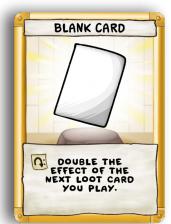
* These cards are from the upcoming expansion and have not been finalized as of now.
basic loot
2 Cents! - Gain 4¢.
3 Cents! - Gain 6¢.
4 Cents! - Gain 8¢.
A D i m e ! ! - G a i n 2 0 ¢ .
A Nickel! - Gain 10¢.
A Penny! - Gain 2¢.
A Sack - Loot 6.
*Ansuz - Look at the top 8 cads of any deck and put them back in any order.
1-2: Deal 2 damage to all active monsters.
3-4: Destroy an item and replace it with the top card of the treasure deck.
5-6: Discard your hand then loot 6.
Blank Rune - Roll:
1: Everyone gains 2¢.
2: Everyone loots 4.
3: Everyone takes 6 damage.
4: Everyone gains 8¢.
5: Everyone loots 10.
6: Everyone gains 12¢.
Bomb! - Deal 2 damage to a monster or player.
Butter Bean! - Doubling has no effect.
Charged Penny - Gain 2¢, then recharge an item.
Credit Card - Doubling has no effect.
Dagaz - Choose one:
Destroy a Curse.
Prevent 2 damage to any player.
Dice Shard - Doubling has no effect.
Ehwaz - Doubling has no effect.
*Get Out of Jail Free Card - Doubling has no effect.
Gold Bomb!! - Deal 6 damage to a monster or player.
*Gold Key - Doubling has no effect.
Holy Card - Doubling has no effect.
Lil Battery - Doubling has no effect.
Jera - Loot 2 times X, where X is equal to the number of loot cards in your hand.
basic loot (continued)
Joker - Look at a player’s hand, you may steal two loot cards fr o m i t .
Mega Battery - Doubling has no effect.
*Perthro - Doubling has no effect.
* P i l l s ! ( b l a c k ) - R o l l : 1-2: Deal 2 damage to a player. 3-4: Deal 2 damage to an active monster. 5-6: Take 2 damage.
P i l l s ! ( b l u e ) - R o l l : 1 - 2 : L o o t 2 .
3 - 4 : L o o t 6 .
5-6: Discard 2 loot. P i l l s ! ( r e d ) - R o l l :
1 - 2 : + 2 a t t a c k t i l l t h e e n d o f t u r n . 3 - 4 : + 2 h e a l t h t i l l t h e e n d o f t u r n . 5-6: Take 2 damage.
P i l l s ! ( y e l l o w ) - R o l l : 1-2: Gain 8¢. 3-4: Gain 14¢. 5-6: Lose 8¢.
P i l l s ! ( p u r p l e ) - R o l l : 1-2: Recharge all of your items. 3 - 4 : + 2 t o y o u r d i c e r o l l s t i l l t h e e n d o f t u r n . 5 - 6 : - 4 t o y o u r d i c e r o l l s t i l l t h e e n d o f t u r n .
* P i l l s ! ( W h i t e ) - R o l l :
1-2: Cancel the effect of any loot card being played.
3-4: All other players discard 2 loot cards.
5-6: Nothing.
* P i l l s ! ( W h i t e w i t h s p o t s ) - R o l l :
(Reroll = destroy an item and replace it with the top card of the treasure deck.)
Soul Heart - Prevent 2 damage to any player.
Two of Diamonds - Quadruple the number of cents a player has.
*? Card - Doubling has no effect.
tarot cards (by numeral)
O. The Fool - Doubling has no effect.
I. The Magician - Doubling has no effect.
II. The High Priestess - Choose a player or monster, then roll: Deal damage to that target equal to 2 times the number rolled.
III. The Empress - A player gains +2 attack and +2 to all dice r o l l s t i l l t h e e n d o f t u r n .
IV. The Emperor - Look at the top 10 cards of the monster deck.
Put 8 on the bottom of the deck and 2 back on top in any order.
V. The Hierophant - Prevent up to 4 damage dealt to a player or monster.
VI. The Lovers - A player gains +4 health till the end of turn.
VII. The Chariot - A player gains +2 attack and +2 health till the end of turn.
V I I I . J u s t i c e - D o u b l i n g h a s n o e ffe c t .
tarot cards (by numeral, continued)
IX. The Hermit - Look at the top 10 cards of the treasure deck.
Put 8 on the bottom of the deck and 2 back on top in any order.
X. Wheel of Fortune - Roll:
1: Gain 2¢.
2: Take 4 damage.
3 : L o o t 6 .
4: Lose 8¢.
5: Gain 10¢.
6: Gain +2 treasure.
XI. Strength - A player gains +2 attack till the end of turn and may attack two additional times.
XII. The Hanged Man - Look at the top card of all decks. You may put those cards on the bottom of their decks, then loot 4.
XIII. Death - Doubling has no effect.
XIV. The Tower - Roll:
1-2: All players take 2 damage.
3-4: All monsters take 2 damage.
5-6: All players take 4 damage.
XV. The Devil - Doubling has no effect.
XVI. Temperance - Choose one: Take 2 damage: gain 8¢. Take 4 damage: gain 16¢.
XVII. The Stars - Gain +2 treasure.
XVIII. The Moon - Look at the top 10 cards of the loot deck. Put 8 on the bottom of the deck and 2 back on top in any order.
X I X . T h e S u n - I f i t i s y o u r t u r n , g a i n t w o a d d i t i o n a l t u r n s a ft e r this one. Put this card on the bottom of the loot deck.
XX. Judgement - Choose the player with the most souls or tied for the most souls. That player discards two soul cards they control.
XXI. The World - Look at all player’s hands, then loot 4.

variants
2 player mini draft
Setup the game as normal. Once a player is chosen to go first, that player takes the top 3 cards of the treasure deck and places them face up on the table so both players can see. The player going first chooses one of the 3 items, then the player going second chooses one out of the 2 remaining items. The 3rd item is placed at the bottom of the treasure deck. Repeat this process, alternating who picks first until both players have taken 2 items each in addition to their starting eternal item. Play the game as normal.
enhanced bartering
Loot cards and Items can be traded as well as ¢. Bartering with items cannot be done while dead or during an attack. You still don’t have to keep your promises and you can’t trade souls.
souls are \$\$\$
Starting items that aren’t being used are shuffled into a deck. During your action phase, you have an additional action: Soul Purchase - You can discard a soul card to gain 5¢, draw 1 loot card, and gain the top card of the starting item deck.
casino mode
Everybody starts with an Eternal copy of Portable Slot Machine. Use an unused character card or starting item card to denote this copy.

selectable characters
Pick your character! Select from all available characters, or deal out two characters to choose from to each player.
rewards for everyone!
When a monster dies all non-active players get the reward, but the active player gets double the reward.
super shop
Whenever a player gains a soul, every other player gains 5¢ and the shop is expanded by 1.
minions die first
You can’t attack a Boss monsters while there is an active Basic monster.
credits
Lead Design & Art Direction Edmund McMillen
Additional Design & Production Danielle McMillen
Additional Design Tyler Glaiel

Layout/Background Art & Illustration @TikaraTheMew

Card Back Design/Box Art & Illustration @KrystalFlamingo
Figure Design & Illustration @Rojen241
Illustration @Wormchild and @Tar_Head
Business Development (Studio71) Javon Frazier and Garima Sharma
Testers
Jackson Moore, Tyler Glaiel, Danielle McMillen, George Fan, Eli Evans, Acacia Evans, Jay Lewis, Graeme Little, Leon Masters, Dan Zaelit, Cole O’Brien, Doug O’Brien, Crystal Evans, Joe Evans, Alex Austin, Caitlyn Yantis, Peach McMillen

English Rule Rewrite and Original Document Design Jon Paull (@jonzo11)
English Rule Rewrite Editing I r i s B u l l ( @ i b u l l )
Rule Consultant Charlie Gill (@YuggyHD)
Version 1.3
4/1/2019
Thanks to the Four Souls community for having lots of questions and feedback.

Magic: The Gathering Comprehensive Rules (2018) was used as a reference.

02.md
Extended Rulebook
Still something that seems unclear? Playing a game and can't work out how the rules apply to a certain interaction? Simply just want to read a more in-depth version of the rules? The rest of this rulebook contains the full extended version of the rules for The Binding of Isaac: Four Souls.
Setup
Shuffle the Treasure, Loot, and Monster Decks. Also shuffle the Room Deck, if you are playing with it. Set aside space for a discard zone next to each of these decks.
Decide on the number of ¢ in the game's ¢ pool. This must be at least 100¢.
Place the top two cards of the treasure deck face up next to it, forming two shop slots. These are the starting shop items.
Place the top two cards of the Monster Deck face up next to it, forming two monster slots. Place any event cards (monster cards without a stat block; see Card Types) put in these slots during setup on the bottom of the deck and replace them with the top card of the Monster Deck. Repeat this until both monster slots have monsters in them.
If you are playing with the Room Deck, place the top card of the Room Deck next to it, forming a room slot. That card will be the starting room.
If you are playing with bonus souls, shuffle them, and pick 3 at random. Those 3 are the active bonus souls for the game and are placed face-up next to the play area.
Deal a random character card to each player, as well as that character's starting item card. Characters start the game deactivated (turned sideways). Starting items start the game charged (turned upright). Abilities that trigger at the start of the game trigger, for example Eden's triggered ability. No one has priority here (see The Stack) and so these abilities will all resolve instantly.
Deal 3 loot cards and 3¢ to each player. Each player puts the loot cards in their hand.
Finally, you must decide on the starting player: the saddest player goes first! You can also each roll a dice (lowest roll goes first!) or use any other fair method of randomization, if you prefer. The game then starts, with the starting player taking the first turn.
Card Types
Treasure Cards
Treasure cards are found in the treasure deck. Whilst in play (see Game Zones), a treasure card is an object referred to as an item. This means items are either controlled by a player or in the shop.
Players will acquire items throughout the game. Items have a wide variety of abilities that can range from modifying gameplay to interacting with other players and monsters (see Abilities). Players place any items they control face up in front of them.
Any time a card instructs a player to gain treasure, they gain that many cards from the top of the treasure deck, putting them into play under their control.
A player's starting item is considered an item. Starting items intrinsically have the starting item quality.
Item Borders. Treasure cards can have either a gold or a silver border. The border color itself has no mechanical meaning, but serves as a reminder of what kind of abilities the card has: a gold-bordered card (an active item) has one or more activated abilities, while a silver-bordered card doesn't have any activated abilities (a passive item).
Shop Items. Items in the shop slots are referred to as shop items. Shop items can be purchased (see Purchasing). Unless otherwise specified, an item's abilities do not function while it is in the shop, with the exception of triggered abilities that trigger when an item enters or leaves play.
Loot Cards
Loot cards are found in the loot deck, and in players' hands. When a player is instructed to loot, they draw that many cards from the top of the loot deck into their hand. Players keep loot cards in their hand until they play or discard them. A player's hand is private, but anyone can count the number of cards in a player's hand.
Players can play loot cards from their hand whenever they have priority (see The Stack) and a loot play available (see Turn Structure). When loot cards are played they are put onto the stack and referred to as loot. When a loot resolves, you perform its loot ability (see Abilities), and then put it into the loot discard.
Some abilities and effects may permit a player to play loot cards from other zones. In these cases normal timing and loot play rules still apply, unless otherwise specified. Some other abilities instead allow players to play loot cards as part of resolution. In these cases timing rules do not apply, unless otherwise specified, but loot play rules do still apply. There are also some abilities that will permit a player to play a loot card without using a loot play. This will be specified in the ability if it is the case.
Monster Cards
Monster cards are found in the monster deck. Whilst in play, monster cards are objects referred to as either a monster (if they have a stat block) or an event (if they don't have a stat block).
If an ability on a monster card doesn't specify a particular player, instead referring to 'you', it means the active player.
Abilities on monster cards only function while in play, unless otherwise specified. Abilities on monster cards don't function while they are a soul, unless otherwise specified.
Monsters. Non-event monster cards that have a stat block become monsters when in play, and exist in monster slots.
Monsters can be attacked, unless otherwise specified (see Attacking).
When a monster is killed, it yields a reward, as indicated in the reward box on the card. The active player (the player whose turn it is) always receives the rewards when a monster dies, regardless of who actually killed it. The same is true for any souls that may be gained when a boss dies.
Boss cards are a type of non-event monster card that have a soul icon. They tend to be harder to kill than other monsters, but tend to yield greater rewards, as well as souls! When a monster with a soul icon dies, the active player gains it as a soul, unless otherwise specified.
Events. Event cards are a type of monster card that have no stat block. They become events when in play, and also exist in monster slots, but they can't be attacked.
All abilities on event cards, unless otherwise specified, are triggered abilities (see Abilities) that trigger when the card enters play. If an event card has multiple abilities they will all trigger when the event enters play, unless otherwise specified.
When each of an event's abilities have resolved or been canceled it is put into the monster discard.
If an event leaves play, its abilities are removed from the stack.
Curse cards are a type of event card, with the keyword ability curse (see Keyworded Abilities). The active player chooses which player receives any revealed curses, and they are placed face up near that player's character. When a player dies, they put all curses they control into discard.
Souls
A number of cards of different types have a soul icon. When a player controls a card with a soul icon as a soul, it provides them with a soul value. The soul value a soul provides is normally indicated by the icon on the card, but can also be indicated by an effect that specifies a value. Souls are quite important - when a player controls a total soul value of 4, they win! Players keep any souls they control face up next to their character to keep track of them. The number of souls a player controls is public information.
There are a number of different ways a player can gain a card with a soul icon as an object called a soul. If the card has a reward box, the active player (unless otherwise specified) gains it as a soul when it dies or is destroyed. Otherwise it is likely an ability on the card will specify what conditions need to be met, or what otherwise needs to happen, before it can be gained as a soul.
Even if a soul has a soul value greater than 1 it is still considered a single object. This means a soul with a soul value of 2 can be destroyed or stolen, for example, just the same as any other soul with a soul value of 1.
There are, however, a number of abilities in the game that look for the number of souls a player controls. These abilities refer to the total soul value a player controls.
Similarly, if an ability looks for a player gaining or being given a soul, it will consider a soul with a soul value of greater than 1 the same as gaining or being given a number of souls equal to that soul value, even though technically just one soul is coming under that player's control.
Bonus Souls. Once you are more familiar with the game's mechanics, you are encouraged to add bonus souls to your games.
When starting a game where you are playing with bonus souls, you shuffle them and pick 3 at random. Those 3 are the active bonus souls for the game. These cards are not added to any deck and are instead put face up next to the play area. Bonus souls, before they are gained, are not considered in play.
Once the conditions of a bonus soul are met it is gained and becomes a soul. This happens as soon as the conditions are met. From this point, it will act like any other soul under the control of a player. Abilities on bonus souls don't function once they have been gained as a soul, unless otherwise specified.
Bonus souls can only be gained once per game. If a bonus soul is ever destroyed, they are placed face down next to the game and cannot be gained again.
Character Cards
Character cards start outside the game. When starting the game, a character card is randomly assigned to a player and put into play under their control (see Setup). While in play, character cards are objects referred to as characters.
A character card may list a starting item. This is a triggered ability that functions when the card enters play and causes the player that controls that character to put that starting item card under their control. Starting item cards also start outside the game. These triggered abilities don't use the stack. While in play, starting item cards are objects referred to as items. Starting items have the keyword ability Eternal which means they can't be destroyed or put into discard.
Character cards have a stat box with a health stat and an attack stat. These define the stats of the player that controls that character.
A character may be worth souls if it has a soul icon on it, or if there is a soul value specified by an effect. For example, The Lost provides a soul value of 1. Characters that have a soul value are not considered a soul.
Room Cards
Room cards were introduced in the Requiem expansion. Room cards are found in the room deck, which is an optional bonus deck that can be added once you feel comfortable with the basic rules of the game. While in play, room cards are objects referred to as rooms. Rooms exist in room slots.
Rooms can have different types of abilities through which they influence the game. Static and triggered abilities on rooms work just the same as anywhere else. Activated abilities on rooms can only be activated by the active player. If a room's ability doesn't specify a particular player, for example instead referring to 'you', it means the active player.
During the end phase (see Turn Structure), if a monster died during the turn, the active player can choose to put a room into discard. If that room slot is empty following this, it will be filled with the top card of the room deck. The active player can of course instead choose to leave any existing rooms in play, if they wish!
Anatomy of a Card
Name Box. Contains a card's name.
Text Box. Contains effect text, gray text, ability tags, and dividing lines.
Effect text details any abilities of a card.
Gray text serves as either flavor text or as a reminder of how a certain keyword or mechanic works, but has no mechanical meaning itself.
Ability tags are used to denote the type of any activated abilities on the card (e.g. ↷ or $). Tags are also used by cards that use levels to indicate which abilities a card has at a given level.
Dividing lines are used to make the layout within a card's text box more clear. Dark gray lines are used to separate different abilities within the text box of a card and to separate abilities from gray text. Lighter gray lines are used to separate the different potential outcomes for an ability involving a dice roll or an ability where the player is given a choice between a number of options. Each choice in such an ability is also indicated with a bullet point.
Stat Box. Contains a card's stats. There are 3 stats: Health, Evasion, and Attack.
The stat box of a character defines the stats of the player that controls it. Character stat boxes only detail a Health and Attack stat; if an ability allows a player to be attacked by another player, it will specify what their evasion is for that attack.
Reward Box. Details the rewards of a card. When an object with a reward box dies or is destroyed, the active player gains any rewards detailed in the reward box, unless otherwise specified.
Soul Icon. Some cards have a soul icon. This indicates the soul value that the card would provide if gained as a soul by a player.
Set Symbol. Cards that are not part of the base game have a symbol here that informs you of the card's origin (i.e. what set it belongs to).
3+ Player Only Symbol. If a card has the 3+ player only symbol, it means it should be removed when playing the game solo or with only 2 players. If you come across a card with this icon whilst playing solo or with 2 players, simply put it to one side and replace it with another card of the same type.
Game Zones
Game Zones are areas of the game where cards and objects exist. Some cards and objects may have certain properties or characteristics that depend on which game zone they are in.
If a card moves from one game zone to another at any point it is considered a new object. Any abilities that would have targeted it before it moved game zone will fizzle as they would no longer be able to find it.
In Play. In play is an important zone, and is made up of the play area between all players. In play includes all objects a player controls (such as characters, items, and souls), and the topmost object in any shop, monster, or room slots. In play is a public zone, and all objects within it are considered public information, unless otherwise specified.
Part of the reason in play is an important zone is that abilities that check for or target objects only check for or target objects that are in play, unless otherwise specified.
When an object enters play, it is considered a separate entity from anything that it may have been previously related to. For example, if a monster is covered and leaves play, then is later uncovered, it isn't considered the same monster from before it was covered.
Decks. There are four deck zones in Four Souls, each corresponding to one of four card types: Treasure, Loot, Monster, and Room. Each deck can only contain cards of the corresponding type. For example, the treasure deck can only contain treasure cards. Some cards, such as the bonus souls, don't have a deck, and those cards therefore can't be put into any deck. Some cards, such as The Harbingers/The Beast, start outside the game. An object that was originally outside of the game, as long as it corresponds to a certain card type, can go into the appropriate deck.
The decks are a hidden zone, and cards in decks are considered hidden information. This means they can't be viewed unless an effect or ability instructs a player to do so. Similarly, the order of cards in a deck can't be changed, unless a player is instructed to by an ability.
In the unlikely event that a deck ever runs out of cards, you immediately shuffle the appropriate discard pile and make that the new deck.
Discard. The game also has four discard zones - one that corresponds to each deck. Similar to the decks, cards that don't correspond to a certain discard can't be put into that discard. For example, a loot card can't be put into the monster discard, even if that loot card is a monster while it is in play.
If a player is instructed to put a card or object into discard, it is put into the appropriate discard. A card put into discard is put on top of that discard. If that card or object doesn't have a discard, it is instead removed from the game. Similarly to with the decks, as long as an object that was originally outside the game does correspond to a card type it can be put into the appropriate discard.
The discards are a public zone, and as such all cards in discard are considered public information, unless otherwise specified. The number of cards in discard is also public information.
The order of cards in discard can't be changed unless a player is instructed to do so by an ability.
Hand. Each player has their own hand zone. The hand only ever consists of loot cards. A player's hand is a hidden zone, and cards in a player's hand are only viewable by that player, unless otherwise specified. The number of cards in a player's hand is public information, however.
If a player is instructed to discard a loot card, a loot card of their choice from their hand is moved into the loot discard. If a player is instructed to gain a loot card, it is moved from its previous zone into that player's hand. As the hand only ever consists of loot cards, if a player is instructed to move a non-loot card into their hand, nothing happens.
Covered in a Slot. There are numerous situations that might result in a card in a slot being covered by another card. This most commonly happens with monster slots. There is no limit to the number of cards that can be covered in any one slot. Being covered in a slot is considered a different game zone, and importantly cards that are covered in a slot aren't considered in play.
When an object that is covering a card in a slot leaves play, the card that is under it enters play and is no longer covered in a slot. Ambushes and Trinkets that are covered in a slot become monsters and items again respectively when they enter play from being uncovered.
Covered in a slot is a public zone. That means all cards covered in a slot are considered public information, unless otherwise specified. The order of cards in a slot can't be changed unless a player is instructed to do so by an ability.
The Stack. The stack is a zone where loot, abilities, dice rolls, and other things go to resolve. Resolving means that the thing on the stack leaves the stack and its effect is carried out by the player or players instructed to do so (see The Stack).
The stack is an important concept that determines the order of effects and allows players to react to each other and to the game.
Each new loot, ability, or dice roll is added to the top of the stack. The stack resolves in a last in, first out order. That means that the last thing put onto the stack will resolve before things put onto the stack before it.
A loot or ability resolves when each player passes priority in succession from the player who put that loot or ability on the stack, with that player also not putting anything else on the stack themselves (see Priority).
If an ability is removed from the stack, it does not resolve. If a loot being played is removed from the stack by an ability, it does not resolve and is moved to whatever zone is determined by the ability. If a loot or ability is canceled, then it is removed from the stack without resolving. Loot cards removed from the stack in this way go to the loot discard.
Outside the Game. Outside the game is a zone that consists of cards that aren't in any of the previously listed zones.
The active bonus souls that have been chosen for the game start outside the game, as does the card "The Harbingers" from the Requiem expansion. Character cards, starting item cards, and bonus souls that aren't being used also exist outside the game.
Unless otherwise specified, cards that are outside the game don't have abilities. The three active bonus souls are an exception to this, and their abilities are active while they are outside the game.
If you don't own a card, aren't playing with a card that would exist outside the game, or no copies of that card are outside the game, then you can't get that card from outside the game if you are instructed to.
If a player is instructed to remove an object or card from the game, the object or card is moved outside the game.
If a player is instructed to put an object or card under an object not in a slot, it is considered outside the game. For example, Friendly Ball's ability puts monsters under it. The cards that are under it are outside the game.
Cards that are outside the game are considered public information, unless otherwise specified. Face-down cards outside the game are considered hidden information. Effects and abilities may give you permission to look at these cards, however.
Abilities
Abilities consist of non-gray colored text, called effect text, that is written in a card's text box. There are different types of abilities that function in certain ways. Abilities only function while an object is in play, unless otherwise specified. If an ability is activated or triggered and put on the stack, and the object that created it subsequently leaves play before that ability resolves, the ability is not removed from the stack and will still take effect when it resolves. Loot abilities are an exception - they are performed when a loot resolves.
Targets of abilities are chosen when that ability is put onto the stack, not when it resolves. If the target is no longer valid when the ability does resolve, then that ability will fizzle (be canceled by the game). For example, an ability that said "Choose a deactivated item. Destroy it." would fizzle if the chosen item isn't still deactivated when it resolves.
Some cards give a player a choice of ability (e.g. 'Choose one-'). This choice is made when that ability is put onto the stack, not when it resolves, and is made simultaneously with any targets being chosen.
It is important to make the distinction between targets chosen when an ability is put on the stack, and choices made later during the resolution of an ability. Targets chosen when an ability is put on the stack are specified after a ↷ or $ symbol, after the trigger of a triggered ability, or in the first line of a loot ability, but before the first period in that ability. Anything after that point will be performed on resolution of the ability.
For example, compare the following two similar abilities: "↷: Steal a non-eternal item from a player" and "↷: Choose a player. Steal a non-eternal item from them". For the first, a specific item will be chosen as a target as the ability is put on the stack. If that item was to be destroyed before the ability resolved, the ability would then fizzle. For the second, a specific player will be chosen as a target as the ability is put on the stack, but the item stolen would be chosen on resolution. The ability would only fizzle if the player in question had no items left by the time it resolved.
Costs. Some abilities have costs. Costs are any effect text that is followed by a colon, except when that text is used as an indicator for a roll ability.
Activated Abilities. Activated abilities can be activated at any time a player has priority and can pay their costs, unless otherwise specified by the ability itself. Activated abilities on characters and items can only be used by the player that controls that item. Activated abilities on rooms can only be used by the active player.
There are two types of activated abilities: ↷ abilities and $ abilities.
↷ abilities are activated abilities that have deactivating (turning sideways 90°) the object as a cost. This is denoted by a tag with "↷" on it. ↷ abilities can only be activated if the object is charged (turned upright).
$ abilities are activated abilities that have a cost that doesn't include a ↷. They are denoted by a tag with "$" on it. These abilities can be activated as long as the cost can be paid, even if the object is deactivated (turned sideways).
Static Abilities. Static abilities are abilities that are always true. Static abilities don't use the stack.
Triggered Abilities. Triggered abilities are abilities that are put onto the stack when a condition or set of conditions are met. Triggered abilities are denoted by the words "when," "whenever," and "at," or timing phrases such as "each time," "every other time," or "the first time".
When a triggered ability's conditions are met, it is put onto the stack the next time any player would receive priority. If multiple triggered abilities are triggered at once, any abilities controlled by the game (such as triggered abilities on monsters) are put on the stack first in an order decided by the active player. Any abilities controlled by players are put onto the stack next. This happens in turn order, starting from the active player. If any one player controls multiple triggered abilities that trigger at the same time, they get to choose the order those abilities are put onto the stack.
Some triggered abilities have circled numbers. This indicates that these abilities trigger whenever any roll resolves as that circled number regardless of the context in which that roll was made. Other triggered abilities without circled numbers have more specific conditions, for example they might only trigger on attack rolls of 5, rather than any roll of 5.
Loot Abilities. Any ability written on a loot card is a loot ability, unless it's a triggered ability, activated ability, or static ability. Loot abilities are performed when the loot resolves.
Keyworded Abilities. Some abilities are represented by a keyword. These keywords carry specific meanings and may fall under any of the ability categories.
Eternal: Eternal is a static ability that means "This object can't be destroyed or put into discard." Eternal only functions on objects in play.
Trinket: Trinket is a triggered ability that appears on loot cards that means "When this loot resolves, it becomes an item. Gain it." Trinket only functions while on the stack. Unless otherwise specified, all other effect text on a trinket only functions while in play.
Ambush: Ambush is a triggered ability that appears on loot cards that means "When this loot resolves, choose a monster slot. This becomes a monster in that slot. The active player must make an additional attack against it this turn." Ambush only functions while on the stack. Unless otherwise specified, all other effect text on an ambush only functions while in play.
Guppy: Guppy is a static ability. It has no function other than to be a marker for other cards to look for.
Curse: Curse represents two triggered abilities. The first is "When this enters play, it becomes a curse. The active player chooses a player. That player gains this." The second is "When you die, put this into discard."
Indomitable: Indomitable represents two static abilities. It appears on monster cards. The first is "If this would be put in a monster slot, instead expand monster slots by 1 and put this in that slot." The second is "This can't be covered."
Roll-: Roll abilities are denoted by the text "roll-". Roll abilities create a dice roll and a triggered ability that checks the result of the dice roll created by the roll ability. Roll abilities are put onto the stack after the ability that created them resolves. The triggered ability is always put onto the stack after the roll is made. Both the dice roll and the triggered ability created are considered to be controlled by the player who makes the dice roll.
Team Up: Team Up is a triggered ability that means "After each attack roll the active player makes against this, each other chosen player makes an attack roll against this in turn order." Unless otherwise specified, this triggered ability lasts until the end of that attack.
Familiar: Familiar represents a static ability that means "This item can be attacked."
Effects
An effect is something that happens due to a loot or ability. When a loot or ability resolves, it may create more effects.
Continuous Effects. Continuous effects change the characteristics of something, either indefinitely, or until an end point.
Some triggered abilities or activated abilities may create a continuous effect. These last until the end point indicated by the ability. For example, "Items you control gain eternal till end of turn," creates a continuous effect that lasts until the end of the current turn. If no end point is specified, the continuous effect will last indefinitely.
Some static abilities create a continuous effect. A continuous effect created in this way stays until the card with the static ability leaves its appropriate game zone. For example, the monster Stoney has a static ability that says "Monsters have +1 DC." The continuous effect created by that ability would only apply while it is in play.
Replacement Effects. Replacement effects are a special kind of continuous effect. These effects modify how things work. Replacement effects most commonly use the word "instead". Replacement effects will often also use "if" to indicate the condition(s) that would cause the replacement effect to be applied. Some replacement effects may instead use a timing phrase that would normally indicate a triggered ability, such as "the next time". In these cases, the use of the word "instead" means that the line functions as a replacement effect with the specified timing, and not as a triggered ability.
Effects that say "prevent" are replacement effects. They replace an indicated event - death or damage - with nothing.
Effects that say "skip" are replacement effects. They replace an indicated event with nothing.
Effects that start with "this enters play" are replacement effects.
Effects that start with "as" are replacement effects.
A replacement effect that starts with "this enters play" or "as" will replace the indicated event with whatever is specified in addition to (rather than instead of) the original event itself. For example, if an item with the ability "This enters play deactivated" would enter play, that item entering play as normal is replaced with that item entering play deactivated. If an ability started with 'As your turn starts, roll-', the start of your turn would be replaced with the start of your turn plus a dice roll.
Replacement effects are not a type of ability in and of themselves, but (like any effect) are rather the result of an ability. For example, the static ability "If you would gain any number of ¢, gain that much +1¢ instead." creates a replacement effect. This means that replacement effects do not use the stack.
Replacement effects only happen once per event. They will not continuously apply to the same event.
If two replacement effects replace the same event, the player affected by the replacement effect (e.g. the active player if it is a part of a turn or phase that is being replaced, the player gaining ¢, loot, or treasure if that is what is being replaced, etc.) gets to choose the order in which they apply. Most of the time, both will still take place. There are some situations where two replacement effects are mutually exclusive. In these situations, whichever one is applied first will change the event to a state where the other replacement effect won't then be applied.
Specific Mechanics
Activate. Players activate ↷ and $ abilities to put them onto the stack. To activate a ↷ ability, the object with that ability is deactivated (turned sideways 90°). To activate a $ ability, the specified cost is paid.
Additional Names. The name of a card is defined by the text within its title box. Some abilities may give an additional name to a card. Abilities that convey an additional name to a card are worded as "This is also named [cardname]" and function in all zones including outside the game.
And vs Then. If an ability uses the word 'and' to link two things, it means that the second part is dependent on the first part. For example, if an ability said 'Discard a loot card and loot 2.', you would only loot 2 if you had been able to discard a loot card. The same is not true if the word 'then' is used. If the ability was instead worded as 'Discard a loot card, then loot 2.' the player would still loot 2 even if they weren't able to discard a loot card. A period (e.g. Discard a loot card. Loot 2.) would function the same way as 'then', with the loot 2 not caring about what has come before it.
Remember as well that colons in effect text, except when that text is used as an indicator for a roll ability, indicate costs. The cost would have to be paid for what comes after the colon to take effect.
Attackable Items and Rooms. Normally, attacks are made against monsters. Some other objects, for example items or rooms, can have abilities that allow them to be attacked, however. These cards will have stat blocks detailing their health, evasion, and attack stats for any attacks made against them. While they are in play, players may choose these attackable objects as a target when they declare an attack. All rules on when a player is able to declare an attack still apply. Once the attack has started, it will proceed exactly the same as if the target was a monster (see Attacking).
If an attackable object is killed during the attack, it is destroyed (see Destroy and Kill). Any rewards, if indicated in a reward box on the card, will go to the active player when that object dies or is destroyed (even if that object is destroyed outside of an attack).
It is important to note that an item or room that can be attacked is not a monster. This means they can't be targeted by any ability or effect that targets a 'monster' specifically.
Attacking Other Players. Some abilities may allow you to attack other players - or indeed allow other players to attack you! These abilities will specify what the targeted player's evasion will be for the attack. If an ability allows you to attack other players, you may choose a player as a target when you declare an attack. All rules on when you are able to declare an attack still apply. Once the attack has started, it will proceed exactly the same as if the target was a monster (see Attacking).
If multiple effects allowing you to attack other players exist at the same time and specify that players have a different evasion stat, the effect that was created most recently takes precedence.
Cancel. Canceling is an action done to things on the stack. If something is canceled, it is removed from the stack before it can resolve and therefore has no effect. If death is canceled, the object that would've died heals until it has at least 1 HP, unless otherwise specified.
Copying. There are a few abilities in the game that can copy something, for example an object in play (most often an item), a loot or loot card, or just an ability.
Copying an Object in Play. When an item becomes a copy of another item, it both copies all of the copiable qualities of the card in question, and loses all of its previous copiable qualities, for the specified duration. Copiable qualities are:
Any abilities the card has
The card's name
A stat block, if the card has one
A reward box, if the card has one
A soul icon, if the card has one
Anything that is tied to a specific instance of an item is not copied, however. It is easy to think of this as anything that the item wouldn't have had when you first obtained it. For example:
Counters
Whether the item is charged or deactivated
Damage taken (if the card has a stat block)
In addition:
If the card being copied had a back face, it is not copied.
If a starting item is copied, the copy does not have the starting item quality.
The above principles would apply for other types of object in play, too. For example, a monster becoming a copy of another monster.
Copying a Loot. When an ability tells you to copy a loot being played, you create a copy of that loot on the stack. When that copy resolves, its loot ability takes effect the same as if it had been put on the stack by the loot card being played.
A copy of a loot can only exist on the stack. If you are told to put a copy of a loot into either a deck or discard zone, nothing happens.
Copying a loot doesn't copy any targets of the original, or the choice of ability on that loot if there is one. Any targets and choices on the copy will be decided as it is put on the stack. If there was a cost to put the loot onto the stack, it is not paid again if that loot is copied.
Copying a Loot Card. Loot cards can also be copied by some abilities, and there is a difference between this and when a loot is copied (remember, loot cards exist in your hand, then become loot once they are played and put on the stack).
The ability in question will likely select a loot card, and then allow you to play a copy of that loot card, either immediately or within a set time window. The selected loot card exists in a temporary holding zone till the end point of that time window. It will cease to exist either when it is played and enters the stack, or when the time window has elapsed.
In contrast to copying a loot, the copy of the loot card still has to be played. This means you would require a loot play (or an ability that lets you play a loot) to do so, unless otherwise specified. It also means that if you copy a loot card that has a cost associated with being played, you would have to pay that cost to play the copy of the loot card.
Copying an Ability. Some abilities also let you copy another ability. When an ability is copied, that ability is simply put on the stack. It is the ability itself that is copied, and no costs associated with activating that ability would have to be paid unless otherwise specified. The ability itself must be copied in full, though.
If a loot ability were to copy an ability on an item that required the item to destroy itself, the ability will simply fizzle as a loot cannot be destroyed.
If a loot ability were to copy an ability on an item that would turn that item into a copy of another item, nothing will happen unless the ability specifically states that the loot becomes an item. Otherwise, the loot card will be moved to discard as soon as it has finished resolving just like normal, having never entered play.
Counters. Some abilities may tell you to put counters on a card. Counters can be represented by anything you like (tokens, coins, dice, etc.), and are simply markers that you place on certain cards. Counters have no inherent effect on any card they are placed on, unless such an effect is defined by an ability, but there may well be an ability that takes effect when a card reaches a certain number of them. They can also serve as the activation cost for $ abilities.
Most abilities that use counters refer to generic counters. If a card says to add a counter, without any further specification, it means to add a generic counter. There are a number of abilities that add specific named counters to cards as well, however. Named counters still count as counters for any abilities that refer to them. For example, if a card has 5 generic counters and 1 named counter, an ability that takes effect when the card has 6 counters would still do so, and if an ability says to 'remove a counter' without further specification, then either a generic or named counter can be removed. Often other abilities will make specific named counters apply effects to a card they are put on, or the named counters will be used as markers that other abilities will interact with. Just like generic counters, named counters have no innate effect - only those which are given to them from elsewhere.
Any counters that are put on an object or card are tied to that object or card. If an object with counters on it is given to another player, or stolen by one, it keeps those counters. If an object with counters on it is copied (see Copying), the copy of the object will not keep those counters, as it is a different object to the original. Some items start with a certain number of counters already on them. If one of these items is copied, then the copy will start with that number of counters on it, as the ability that gives the object those starting counters is copied. Counters are tied to the object itself, not to a specific side of it, and so if an object with counters on it is flipped it keeps any counters it has.
Counters put on a player are tied to that specific player, and will not be removed even if their character changes. Counters put on a player's character, however, are tied specifically to the character, not the player, and would be removed if the character was to change.
Any counters on an object are removed when it leaves play, unless otherwise specified. Remember, if a card becomes covered in a slot, it is considered to have left play.
Special Counters. There are a few special types of counter in Four Souls that convey an ability onto the card they are placed on without that ability having to have been defined by another ability elsewhere.
HP Counters: HP counters are a special type of counter. If an HP counter is placed on an item or character, it gives that item or character the ability "You have +1 HP." If an HP counter is placed on a monster, it gives that monster the ability "This has +1 HP." An object can have more than one HP counter at a time. If an object later loses an HP counter, it also loses the ability that HP counter was giving it.
ATK Counters: ATK counters are a special type of counter. If an ATK counter is placed on an item or character, it gives that item or character the ability "You have +1 ATK." If an ATK counter is placed on a monster, it gives that monster the ability "This has +1 ATK." An object can have more than one ATK counter at a time. If an object later loses an ATK counter, it also loses the ability that ATK counter was giving it.
Eternal Counters: Eternal counters are a special type of counter. If an eternal counter is placed on an object, it gives that object the keyworded ability Eternal. If an object later loses an Eternal counter, it also loses the ability that Eternal counter was giving it.
Damage. Damage is a value applied to an object with an HP stat. Damage causes an object to lose that much HP. Damage is marked on an object when any damage on the stack resolves. For the sake of this section, a player is considered an object with HP equal to what is on their character card.
Objects cannot go below 0HP. If an object with an HP stat has 0HP at any point, its death is put on the stack the next time any player would receive priority. An object with 0HP can still take damage, but that damage won't be marked on the object, and won't make it go below 0.
To deal damage to an object, that much damage is put on the stack targeting that object. When that damage resolves, that much damage is marked on the object (if it has more than 0 HP). The damage source is the object with the ability dealing the damage, or the controller of that same object. The damage source is only considered to have dealt damage when the damage resolves, not simply when it is put on the stack.
An object is considered to take damage whenever damage targeting it on the stack resolves. If an ability or effect says a player or object takes damage (e.g. "Each time a player rolls a 1, this takes 1 damage."), that much damage is put on the stack targeting that object. When that damage resolves, that much damage is marked on the object (if it has more than 0 HP). The damage source in this case is the game. If no object is specified, there is an implicit 'you' at the start of the ability (e.g. "Take 1 damage" means "You take 1 damage").
Any damage marked on a player is tied to the player themself rather than their character card. If that player was to switch character cards, they would retain any marked damage they had before the switch. Similarly, if a player flips their character card, they retain any damage marked on them.
You can't deal or take 0 damage. If you miss an attack roll against a monster that has an attack stat of 0, or an ability says to deal or take 0 damage, no damage is put on the stack, and nothing happens.
If an object's max HP is reduced, if it has any marked damage, an equal amount of damage is also removed. This is not considered healing. For example, if a player has 2 max HP and 1 marked damage (and therefore currently 1 HP remaining), 1 damage is removed if their max HP is reduced to 1 HP. This means that they would still be on 1 HP. If, for the sake of this example, we consider each point of max HP as a 'heart container' that can individually have one damage marked on it and become empty, it is the empty heart container that is lost when the max HP is reduced.
If an object that has damage marked on it stops having an HP stat for any reason, that damage is removed.
Deactivate. Deactivate is an action done to objects. To deactivate an object, it is changed to a deactivated state (turned sideways 90°).
Destroy and Kill. Destroy/Kill is an action that is done to objects in play. Destroy is most commonly used on items, souls, and rooms, while kill is most commonly used on monsters and players.
To destroy/kill, the object being destroyed/killed has its HP set to 0 if it has an HP stat. If the object doesn't die despite having 0 HP, or doesn't have an HP stat, it is moved to discard. Characters and eternal objects are not moved to discard if they are destroyed or killed.
Die is a related action. It means that the game destroys/kills a specified object in play. An object that is destroyed/killed dies.
Discard. Discard is an action done to loot cards in hand. To discard, you move the specified number of loot cards from your hand into the loot discard.
Doubling ¢. If an ability instructs you to double the number of ¢ a player has, that player gains x¢, where x is the number of ¢ they have.
Each. Abilities that affect all players or objects of a certain type use the terminology of 'each' - e.g. "Each player loots 1." or "Reroll each item you control." Some abilities may also specify a more specific group, for example "Each living player" or "Each non-eternal item". Note: The below rules on ordering also apply for any abilities that target e.g. 'all players' or 'all monsters'.
When an ability instructs each player to do something, for example "Each player loots 1.", players would carry out the effect in turn order, starting with the player who controls the ability, or the active player if the ability is controlled by the game.
If an ability targets multiple objects controlled by one player, for example "Reroll each item you control", the player who controls the objects gets to decide the order in which the objects are affected.
If an ability targets every item in play, for example "Reroll each item in play", shop items are rerolled last, after each player rerolls each of their items in turn order, starting with the player who controls the ability, or the active player if the ability is controlled by the game.
If an ability says that "Each player dies" or "Each player takes x damage", the players will still die or take damage in turn order, starting with the player who controls the ability (or the active player if the ability is controlled by the game). This means that the deaths and instances of damage are actually added to the stack in reverse order in this case, so that they then resolve in turn order.
When an ability says that something happens to each monster, for example "Each monster takes 1 damage", it is the player that controls that ability that gets to choose the order. If the ability is controlled by the game, it will be the active player who chooses.
If an ability says "Each player and each monster dies", monsters would die first, followed by players. The ordering of monster and player deaths would be decided as above.
Expand Slots. Expanding is an action done to shop slots, monster slots, or room slots. This is an action the game performs. To expand slots, the number of slots of the specified slot type is increased by the number specified.
Fizzle. Fizzling is when a loot, ability, or dice roll is canceled by the game due to some aspect of the game state being invalid. For example, that loot or ability may have lost all of its targets (e.g. the item it is targeting is destroyed before it resolves), or its targets may have become invalid (e.g. the ability says to 'Choose a deactivated item' but the item targeted has been recharged by the time the ability resolves). Any unresolved attack rolls and combat damage fizzle when an attack is canceled.
Flip. Flip is an action that has two meanings.
If a player is instructed to flip an object, such as an item, it means to flip it onto its back face, if it has one.
If an object doesn't have a back face, then it can't be flipped.
An object is still the same object if it flips. Only characteristics on the visible face apply.
If a player is instructed to flip a dice roll, it means to change the result of a standard D6 roll to 7 minus the current result. On a standard D6, you can physically flip the dice to the opposite face to achieve this.
Gaining and Giving. Gaining and giving are mechanically different. This means that if an ability checks for each time you gain an item, for example, it will only trigger when you gain that item, not if you are given it. Stealing and swapping both fall under the umbrella of giving, and therefore count as giving rather than gaining for the purposes of any abilities that interact with one or the other.
Gain is an action that is used in many contexts:
To gain ¢, you move the specified number of ¢ from the game's ¢ pool into your own ¢ pool.
To gain treasure, you move the specified number of cards from the top of the treasure deck into play under your control.
To gain an object in play (e.g. an item or soul), you move it under your control.
When an object (most likely a monster) with a reward box and soul icon dies or is destroyed, the active player gains it as a soul, unless otherwise specified (see Monster Death).
Give (and therefore steal and swap) is an action that can be done to many things: objects in play, loot cards in hand, and ¢ in a ¢ pool. The following examples refer to Player A and Player B. When dealing with items, the place of either player may also be taken by the shop.
To give:
Player A moves an object of their choice from their control to Player B's control.
Player A moves a loot card of their choice from their hand into Player B's hand.
Player A moves a specified number of ¢ from their ¢ pool to Player B's ¢ pool.
To steal:
Player B gives an object of Player A's choice to Player A.
Player B gives a loot card of Player A's choice to Player A.
Player B gives a specified number of ¢ to Player A.
To swap:
Player A and Player B simultaneously give an object they control to each other.
Player A and Player B simultaneously give a loot card to each other.
Note that both stealing and swapping involve giving, and therefore will count as giving for any abilities that look for it.
Heal. Heal is an action that can be done to objects with an HP stat. An object can either be healed a specified amount, or to full HP. An object cannot be healed past its max HP. An object cannot be healed while its death is on the stack, unless that death is also prevented or canceled.
To heal a specified amount of HP, that much damage is removed from the healed object. To heal to full HP, all damage is removed from the healed object.
If You Do. If an ability uses the phrase 'If you do', it means that the previous part of the ability must take effect for the next part to take effect. For example, if an item said 'Destroy this. If you do, gain 25¢.' you would only gain the 25¢ if the item had been able to be destroyed by its own ability.
Levels. Some objects use levels to determine which abilities they have at any given time. You use level counters (which function just like any other specific named counter (see Counters)) to keep track of the level of an object.
If an object levels up, you put a level counter on that object. If an object levels down, you remove a level counter from that object, if able.
Objects that use levels will have tags that tell you which abilities the object has at a given level. For example, with Bum-bo!, the player that controls the item would get +2 to their first attack roll each turn when there are 1 or more level counters on it. When the item reaches 10 or more level counters, they then get +1 damage in addition to +2 to their first attack roll (as 10+ counters is still 1+ counters!). If they manage to get the item to 25+ counters, they then get the effect of the final ability as well.
Loot. Loot is an action that is done to the loot deck. To loot, you move the specified number of loot cards from the top of the loot deck to your hand.
Lose. Lose is an action done to ¢ in your ¢ pool. To lose a certain number of ¢, you move that many ¢ from your ¢ pool into the game's ¢ pool. If you don't have the specified number of ¢, you just lose as many ¢ as possible.
Note. Some abilities may ask you to note something, like a number. When you are told to note something, you keep track of it however you wish (e.g. you can write it down, keep track of it mentally, use counters in a way that helps you remember - whatever), either indefinitely or to a specified end point. Something that has been noted may also be cleared by an ability, meaning it is no longer noted.
Noting is used to keep track of something relevant to the function of a card. For example, an ability might trigger when a certain number of things are noted, or might check for and interact with something that has been noted (e.g. an ability that deals damage to a player if they roll a number that has been noted).
Anything that is noted is tied to the object that caused it to be noted, unless otherwise specified. For example, if two items both had you note numbers, and the number 6 was noted by Item A, an ability that checked if a 6 was noted by Item B wouldn't find that it was (unless a 6 had also separately been noted by Item B). If an object is destroyed or otherwise put into discard, anything noted by it is cleared.
Pay. Pay is an action that has two meanings. As a general rule, you can't pay what you don't have.
To pay ¢: move that many ¢ from your ¢ pool to the specified ¢ pool. If no ¢ pool is specified, then it is moved to the game's ¢ pool. If you don't have enough ¢ to pay, you can't pay.
To pay HP: you lose that much HP. If you don't have enough HP to pay, you can't pay.
Play. Play is an action done to loot cards. To play means to move a loot card from one zone to the stack. The player who played the loot card controls it.
By default, a player plays loot cards from their hand. However, abilities and effects can allow a player to play a loot card from another zone.
Prevent. Prevent is an action done to death or damage.
If an ability or effect instructs you to prevent damage, that damage is removed from the stack.
If an ability or effect instructs you to prevent death, that death is removed from the stack, and the object that would have died heals until it has at least 1 HP, unless that ability or effect specifies how much HP is healed instead.
Recharge. Recharge is an action done to objects. To recharge an object, it is changed to a charged state (turned upright).
Reroll. Reroll is an action that has two meanings.
To reroll a dice roll, a player simply rolls that dice again. Note that rerolling a dice roll will modify the result of the existing roll rather than creating a second separate roll.
To reroll an item, you destroy it and, if you do, the player who controlled that item gains +1 treasure. If the item was controlled by the shop (i.e. it was a shop item), no player gains treasure. Instead the shop 'gains the treasure' and you put the top card of the treasure deck in the shop slot that the destroyed item was in.
Voting. Some abilities involve voting. An ability that involves a vote will first specify who participates in the vote, for example "each player" or "each living player". Each player involved in the vote will then cast their vote, choosing an option as specified by the ability (e.g. choosing an item in play, a player, between specified options such as right or left, etc.). Players vote in turn order, starting with the player who controls the ability. If no player controls the ability, voting will start with the active player. Once a player has cast their vote, they cannot change it.
Turn Structure (Extended)
Each turn is split into three phases: the Start Phase, the Action Phase, and the End Phase. Players take turns in a clockwise order, and therefore at the end of a player's End Phase, the turn is passed to the player to their left.
The Start Phase.
The Recharge Step. The active player recharges (turns upright) objects they control. Any objects controlled by the game (with the exception of shop items) also recharge.
Abilities that trigger at the start of the turn trigger, then priority passes between all players.
The Loot Step. The active player loots 1. At the end of this step, priority passes between all players, then the action phase begins.
The Action Phase. When the action phase starts, the active player gets one loot play that lasts until the end of the turn. During the action phase, while there is nothing on the stack (i.e. not in response to anything), the active player has priority by default and may choose to:
Declare an attack
Declare a purchase
End the turn
By default, the active player may make a maximum of one attack and one purchase each turn. Players can do as many or as few of the above as they wish on any given turn.
While they have priority, the active player may also activate any activated abilities they control, or play a loot card either by using their loot play for the turn, or by using an ability that lets them play a loot card, such as the ↷ ability of most character cards. Priority will pass if they do activate an ability or play a loot card, as well as after they declare that they are attacking, purchasing, or ending the turn.
When a player declares they are ending the turn, after priority has passed, the end phase starts.
The End Phase.
Abilities that trigger at the end of the turn trigger, then priority passes between all players.
If the active player has more loot cards in their hand than their max hand size (10 by default), they discard loot cards until they have as many cards left in their hand as their max hand size.
If playing with the room deck, and if a monster died during the turn, the active player may put a room into discard.
The turn ends and is passed to the next player. All objects with an HP stat heal to full HP, including any dead players, and abilities and effects that last till end of turn end.
An effect or ability that ends the turn forces the end phase to begin, but will not prevent any of the above from happening. An effect or ability that ends the turn does not remove anything from the stack.
Round. A round lasts from the start of a player's turn until the start of their next one, with each other player having had a turn in between. For each player, and any objects they control, a round is defined relative to their own turn. For the game, and any objects controlled by the game (not controlled by any player), a round is defined relative to the starting player's turn.
Any extra turns added by abilities or rewards do not affect the start or end point of a round. Similarly, skipped turns have no effect on the length of a round - that player is still viewed as having had their turn when it comes to keeping track of a round, even though they didn't actually get to take the turn.
Attacking (Extended)
The active player can declare an attack during their action phase whilst the stack is empty.
When a player declares an attack, before they choose what to attack, priority passes. Once priority has passed, that player can then choose to attack a monster in a monster slot, or the top card of the monster deck.
Some monsters or other objects may create an effect that forces a player to declare an attack on a specific target. This target must then always be chosen as the target of the attack declaration, for as long as the effect still applies (e.g. the effect may only force you to attack that target once each turn, and therefore if a player first attacked the forced target, managed to cancel that attack, and had the ability to declare an additional attack, they could then declare that second attack on a different target). If more than one of these effects are active at once, such that a player would be forced to declare an attack on two different targets, the player declaring the attack may choose which of the forced targets to declare the attack against.
Abilities can be triggered by or otherwise interact with attack declarations. Some abilities are triggered by or interact with the attack declaration itself, before a target is chosen. Others are triggered by or interact with attack declarations against a specific target, and therefore after a target has been chosen. If an ability looks for an attack being declared against a monster specifically, it will not be triggered by or interact with an attack declared against the monster deck, even if the top card becomes a monster once revealed and placed in a slot. If a card has an ability that is triggered by or interacts with an attack being declared against it (e.g. "When an attack is declared on this"), that ability will trigger or otherwise take effect both if the card is already in play in a slot and if it is revealed as the top card when the monster deck is attacked.
By default, the active player may attack once per turn. Effects and abilities may modify the number of attacks the active player can make. Killing a monster outside of an attack (e.g. with an ability or loot card) does not count as a player making an attack.
If you attack the top card of the monster deck, you reveal it, and then put it on top of a monster slot of your choosing, covering the monster in that slot. Any monsters that are covered are no longer in play. If the card put in the monster slot is an event, its abilities trigger upon entering play, and it is put into discard when they have resolved. If a player attacks the top of the deck and it is a monster that can't be attacked, they put that monster in a monster slot and cancel the attack. If the card revealed is a card with a stat block, but has an ability that specifies that it can't be attacked, the attack is canceled.
In some cases, other objects (such as players, items, or rooms) can be attacked. If this is the case, the active player may choose to attack them instead of a monster or the top of the monster deck when they declare an attack.
Each attack consists of multiple attack rolls. Once an attack has started, the attacking player repeatedly rolls a D6 against their chosen target, most commonly a monster. Once you have started an attack, you are committed to the death! The attack will only end when either the attacking player or the target of the attack dies, or if either the attacker or attacked object has 0HP before an attack roll would be made. Players may use the D8 to keep track of the HP of the monster they are attacking.
Dice rolls that are made as part of an attack are called attack rolls. Damage that is done as a result of an attack roll is called combat damage. If the result of the attack roll is equal to or higher than the target's evasion, the attacking player hits and deals combat damage equal to their attack to the target (that much combat damage is put on the stack, directed at the target). If the result of the attack roll is less than the target's evasion, the attacking player misses and combat damage equal to the target's attack is put on the stack, directed at the attacking player (the target deals that much combat damage to the attacking player). Damage is dealt to the appropriate target when this then resolves and leaves the stack. If that damage reduces either the attacking player or attacked object to 0HP, their death is put on the stack. An attack ends when either the player or the target dies, or if either the attacking player or attacked object has 0HP before the next attack roll would be made. An attack can also end by being canceled. This can happen directly by an ability or effect, or through an ability or effect moving the turn to the end phase.
When an attack ends due to a player or monster dying (or an attack being canceled), any unresolved attack rolls and combat damage are removed from the stack. This means you could, for example, respond to an attack roll that would miss if it resolved and play a bomb, killing a monster with only 1 HP left before it would kill you. Similarly, however, be wary - another player might respond to your dice roll, that would hit if it resolved, to kill you and end the attack before you can kill the monster, depriving you of your reward!
In some cases, players can be instructed to make attack rolls by an ability even when they aren't the attacking player. Since they aren't the attacking player, the attack will not end if they die. Dead players cannot make attack rolls, however, even if they aren't the attacking player. As normal, the attack ends if the attacking player dies, and therefore no further attack rolls would be made by any player.
In a few rare cases, a player and a monster can take lethal damage at the exact same time. In these cases, the monster's death would resolve first, followed by the player's.
Purchasing (Extended)
The active player can declare a purchase during their action phase whilst the stack is empty. That means a player couldn't make a purchase during an attack, or while their death is on the stack, for example.
When a player declares a purchase, before they choose what to purchase, priority passes. Players can then choose to purchase a shop item in a shop slot, or the top card of the treasure deck. Abilities can be triggered by or otherwise interact with purchase declarations, either before or after a target is chosen, just the same as attack declarations.
At this point, the cost of what is being purchased is determined. By default, it costs 10¢ to purchase either a shop item or the top of the treasure deck. If a player can't pay the cost at this point, purchasing ends and they fail to purchase an item. If they are able to pay the cost, they gain control of whatever it was they chose to purchase.
By default, the active player may purchase once per turn. Effects and abilities may modify the number of purchases the active player can make.
Refilling Slots (Extended)
Each shop slot, monster slot, and room slot (if you are playing with the room deck) must have at least one card in it at all times. Whenever a slot becomes empty, it is refilled with the top card of its respective deck. This normally happens the next time any player would gain priority. When a monster slot has become empty due to a monster dying, the slot will refill after all steps of the monster's death have taken place and after any triggered abilities that triggered off that monster's death have resolved (see Monster Death).
When refilling a monster slot, it is possible to encounter multiple events in a row. The active player will keep resolving them until a monster ends up in the slot.
The active player will refill any slots and resolve any events that are put into monster slots even if they are dead.
There are a number of abilities that might cause you to expand the number of a certain type of slot during the game. Any new slots added in this way are treated exactly the same as any other, and must also be refilled when empty.
Death (Extended)
If a player or monster has 0HP at any point, and their death is not already on the stack, their death is put on the stack the next time any player would receive priority. If they can't prevent or cancel that death by the time it resolves, they follow the steps for either player or monster death below. If a player or monster has an HP stat that is not a number at any point, that is considered the same as it having 0HP.
The above is also true for any other objects (e.g. attackable items or rooms) that have an HP stat. In those cases, follow the series of steps for Monster Death below, replacing the word 'monster' with the relevant object type. For example, triggered abilities that trigger from a 'monster' dying wouldn't trigger, as it isn't a 'monster' that has died.
Eternal objects can't die. If an Eternal object has 0HP, the game will not attempt to put its death onto the stack.
Monster Death. When a monster dies, the order of steps to take is as follows:
It is moved out of its monster slot to a temporary holding zone.
Abilities that trigger when a monster dies, but not after gaining rewards, trigger here.
The active player gains any rewards from the monster.
Abilities that trigger when a monster dies, after gaining rewards, trigger here.
If the monster has a soul icon, it becomes a soul and the active player gains it. Otherwise, it is moved to discard.
Refill monster slots, if applicable.
Priority will pass if any triggered abilities are added to the stack, as normal, but otherwise none of the above steps use the stack - they simply happen immediately once the step before is complete.
If a monster that can't be put in discard (e.g. due to an ability it has) is killed, it will instead simply be put back in the monster slot it was in during step 6 of the above.
When an attackable object that isn't a monster dies, the steps to follow are the same as the above, but with 'monster' being substituted for the type of object in question.
Player Death. Dying consists of 4 steps. It differs if the player dying is the active player.
When an active player dies, any purchase, attack, or end declarations they make stop, any attacks they are in are cancelled, and they move to the death steps. Abilities that trigger when a player dies will specify whether they trigger before or after the death penalty is paid, where it is relevant. In any other cases, if it isn't specified, abilities that trigger when a player dies will trigger before the death penalty step.
Death Penalty Step: To perform the death penalty, the player who has died:
Chooses a non-eternal item they control (their death penalty item) and destroys it
Discards a loot card
Loses 1¢
Deactivates each object they control with a ↷ ability.
If a player can't afford to pay any part of the death penalty, they simply don't pay that part.
If a non-active player is going through the death steps, they stop after this step. If it is an active player, they move on to the next step.
Cleanup Step: This step doesn't end until everything currently on the stack resolves. Any empty slots must also be refilled.
End Step: The turn is set to the end phase. The end phase itself is then carried out as normal.
A player can only die once per turn. Dead players cannot be healed by abilities or effects. All players, including dead players, heal to full at the end of every turn. If a player died on another player's turn they would heal and be alive again as the turn passes to the next player. This means a player could die multiple times, once per turn, before they next get a turn of their own.
Bartering (Extended)
Four Souls is a social game, and players are encouraged to trade ¢ and favors with each other during the game. Any number of ¢ can be traded for almost any favor, but both players involved always have to agree to the deal. Players can't trade items or loot cards. Bartering doesn't use the stack.
For example, Player 2 could offer to reroll Player 1's dice roll, using one of their loot cards, if Player 1 gives them 4¢. The intention behind a proposed trade doesn't always have to be a noble one, however! For example, as an alternative to the above, Player 2 could threaten to reroll Player 1's dice roll if Player 1 doesn't give them 4¢, in a situation where Player 1 wouldn't want to have to reroll.
You don't need to keep your promises, but be warned: if you go back on your word, you will lose the trust of others, and potentially make yourself a target!
Dice Rolls (Extended)
The Anatomy of a Dice Roll. You will frequently need to roll a dice, either when making attack rolls, or when told to by various abilities and loot cards. All rolls use a D6, unless otherwise specified. A dice roll can never go above 6 or below 1. If you try and add 1 to a roll of 6, it simply stays a 6. If you try and subtract 1 from a roll of 1, it simply stays a 1.
Dice rolls act in a unique way on the stack, which is detailed below:
Step 1: First, when a player is instructed to roll a dice, they roll it before putting it on the stack. If that player is instructed to roll more than one dice, they are rolled at this time.
Step 2: After it is put on the stack, abilities that trigger from a dice being rolled trigger.
Step 3: While it is on the stack abilities and loot can modify the roll.
Step 4: After all players pass priority, the roll will attempt to resolve. Any abilities that trigger when a player would roll a number trigger here. If that ability changes the result of the roll, return to step 3.
Step 5: As the roll resolves, any continuous effects that modify dice rolls change the result of the roll. At this point, the roll is resolved and nothing can be done to it. Any abilities that trigger when a player rolls a number trigger.
Priority (Extended)
Priority determines which player can act at any given time. It means that players can potentially respond to events that are occurring in the game, and to each other, even when it is not their turn.
When the rules say that priority passes, priority is first given to the active player, then passed between all other players in turn order. When a player puts a loot, ability, or roll on the stack, priority passes, starting from that player, and then again proceeding in turn order.
While a player has priority, they can take as many (or as few!) actions (e.g. activating an item or playing a loot card) as they want before passing priority to the next player so they have a chance to respond.
When a player has priority, they can activate abilities or play loot cards. In addition, the active player may declare a purchase, declare an attack, or end the turn if they have priority, there is nothing on the stack, and they are in the action phase.
It is only when each player passes priority in succession (i.e. no one wants to do anything else) that the game progresses: whatever is on top of the stack resolves (its effect is carried out), or the game moves to the next step or phase.
Note: There are times when nobody has priority, for example before the Recharge Step at the start of a player's turn, or after step 1 of the end phase. Players can't play loot or abilities during these times.
Most of the time it is not necessary to religiously keep track of priority. It is only in more complex situations, for example when multiple players want to respond to the same thing at the same time, that you might need to give it more thought.
The Stack (Extended)
Loot, abilities, and rolls don't affect the game right away. Instead, they are put onto a waiting area called the stack. The stack is an important concept that determines the order of effects and allows players to react to each other and to the game.
The stack is a zone where loot, abilities, dice rolls, and other things go to resolve. Resolving means that the thing on the stack leaves the stack and its effect is carried out by the player or players instructed to do so.
Each thing added to the stack is added to the top. This means the stack resolves from the top down, i.e. in a last in, first out order. That means that things on the stack will resolve in the reverse of the order they were added to it.
A loot or ability resolves when each player passes priority in succession from the player who put that loot or ability on the stack, with that player also not putting anything else on the stack themselves (i.e. no one is able to/wants to respond with anything else, see Priority). Priority passes each time something resolves. This means that players can add new things to the stack as things leave it, i.e. everything on the stack does not need to resolve in one go. However, any individual thing cannot be interrupted while it is resolving.
If the stack is empty when all players pass priority, the game progresses to the next step or phase of the turn as appropriate. A player's action phase is an exception to this: the game will only move to the end phase when the active player decides to end their turn, or an ability ends the turn.
The stack may seem complicated at first, but it is actually fairly intuitive and should become much clearer when you start playing the game. It can be helpful to think of the stack as an actual physical pile of cards. As things are added to it, you pile the 'cards' on top of each other. When things start resolving and leaving the stack, to find out what happens next, you take the top card of the stack and do what it says. Each time you take something off, players have a chance to put more cards on. This continues until the pile is empty and nobody wants to play any more cards.
Example: Player 1 had The Relic trigger. In response, Player 2 tried to use Sleight of Hand to put a bad card on top, but Player 1 played Butter Bean on the Sleight of Hand. They resolve in reverse: Butter Bean cancels Sleight of Hand's ability, then Player 1 loots from The Relic.
Targets of abilities are chosen when they are put onto the stack, rather than at resolution. If the target is no longer valid by the time that ability resolves, it will simply fizzle (have no effect). Similarly, if an ability says 'choose one-', you choose one of the options (indicated with a bullet symbol) when the ability is put onto the stack, rather than at resolution. A player would not be able to pick a certain option and then change their mind later on.
If an ability is removed from the stack, it does not resolve. If a loot being played is removed from the stack by an ability, it does not resolve and is moved to whatever zone is determined by the ability. If a loot or ability is cancelled, then it is removed from the stack without resolving. Loot cards removed from the stack in this way go to the loot discard.
Winning the Game (Extended)
By default, a player needs to control a soul value of 4 to win. Winning in this way does not use the stack and is checked between things resolving on the stack. Effects can modify the soul value needed to win.
If a player wins, each other player loses. If more than one player wins at the same time, the game is a tie between those players. A player winning or the game ending in a tie ends the game.
An ability may cause a player to win the game. They win after that ability resolves.
Solitaire/Co-op Mode
To set up the game, you randomly deal out two characters along with their starting items. You then draw two separate hands of three loot cards and 3¢, one for each of these characters. Do not mix the hands, but you can leave the loot cards face-up. Set up the monster, loot, and treasure decks as normal. Place two treasure cards and two monster cards face up beside their respective decks as normal. Set the D8 out in an easily seen area with the 8 side up.
You play as both of these characters, and play proceeds as normal, playing one character at a time. You play one character, then the second character in the same order the whole game. When both character turns are over the D8 ticks down one. If a character dies during their turn, the D8 also ticks down one. You may not trade ¢ between characters in solitaire mode. All other rules for character deaths, effects, responses, and play remain unchanged.
The objective is to collect four souls between the two characters before the D8 reaches zero. You do, you win. You don't, you lose.
Setup. Setup is mostly as normal (see Setup). If you are playing solitaire, you still deal out two character cards during setup.
At the end of setting up, you put out the D8 with the eight side face up. This is the timer.
You don't play with any bonus souls in solitaire or co-op mode, so don't put any out during setup.
Playing the Game. When playing solitaire mode, one person controls both characters. For co-op, each character is controlled by a different person. For the sake of abilities and targeting, each character is considered a separate player, even if they are both controlled by the same person!
Once you have decided on the starting character, play proceeds as normal. In solitaire, each character takes turns just the same as if they were controlled by more than one person. The turn order of the characters will stay the same for the whole game.
At the end of each round, when both character turns are over, the timer ticks down by one. The timer also ticks down by one each time a character dies during their turn. The objective is to reach four souls between the two characters before the timer reaches zero! If the timer ever does reach zero, you lose.
Reaching four souls is the goal for normal difficulty. If you fancy more of a challenge, you can try playing hard or ultra hard difficulty, and reaching 6 or 8 souls, respectively. Another way to up the difficulty is limiting the number of souls each character can control, e.g. to a maximum of 4 on hard or ultra hard, meaning that the souls you obtain have to be spread between the two characters.
Other Rules.
Each character has a separate ¢ pool and hand, even if they are controlled by the same person. Neither the ¢ pool or hand of each character should be mixed, but you can play with the loot cards in each hand face up. This also means you may not trade ¢ between characters in solitaire or co-op mode.
When any souls are gained, each character is considered a separate player, even if controlled by the same person, as above. This means that each character will end up with their own souls, which shouldn't be mixed. There is no limit on the number of souls each can control.
After step 3 of the end phase (when the active player is able to choose to put a room into discard if a monster had died during the turn), if the top card of a room slot hasn't changed for a whole round, put that room into discard.
Cards with the 3+ player icon should be removed. If you come across a card with this icon whilst playing, simply put it to one side and replace it with another card of the same type.
All other rules remain unchanged from standard competitive gameplay.
Four Souls Challenges
A number of Four Souls Challenges can be found and downloaded on the Maestro Media website (maestromedia.com). Four Souls Challenges represent new and engaging ways to play the game in Solitaire and Co-op mode, using your existing cards. They often have a competitive variant too!
Each challenge will have its own specific set of rules, but there are also a few new rules that apply to all challenges.
Final Boss Slot. Final boss slots are a special new type of slot that exist separate to regular monster slots.
A monster in a final boss slot can't be covered and also can't leave the slot for any reason unless it is killed, unless otherwise specified.
A monster in a final boss slot is still considered a monster, just as if it was in a monster slot, and can be targeted by any abilities or loot that target monsters. A monster in a final boss slot is also considered a final boss.
When declaring an attack, the active player may choose to declare an attack on a monster in a final boss slot.
A monster in final boss slots has boss armor. This means that if a monster in a final boss slot would be killed outright by an ability (rather than by taking damage), or if it would take one instance of more than 3 non-combat damage, it instead takes 3 damage.
If a monster in a final boss slot is defeated, it dies as normal. The challenge in question will tell you what happens next - often it will mean you have beaten the challenge!
Minion Slots. Minion slots are a special new type of slot that exist separate to regular monster slots.
A monster in a minion slot can't leave that slot for any reason unless it is killed, unless otherwise specified.
Monsters in a minion slot are still considered monsters, just as if they were in a monster slot, and can be targeted by any abilities or loot that target monsters. A monster in a minion slot is also considered a minion.
When declaring an attack, the active player may choose to declare an attack on a monster in a minion slot.
If you are instructed to put a monster in a minion slot, you expand minion slots by 1 and put that monster in that new minion slot, unless otherwise specified. You may only put a card in a minion slot when specifically instructed to do so.
If a monster in a minion slot is defeated, it dies as normal. Minion slots are temporary, however, and so are not refilled when they are empty.
If an event is put in a minion slot, its abilities trigger and it is put into discard when they have resolved, just the same as if it was put in a monster slot.
The Timer. When playing a challenge, the timer only ticks down at the end of each round, or when you are otherwise instructed to. It does not tick down each time a character dies, like it does in regular solitaire/co-op play (unless the challenge in question tells you it does!).
Beating a Challenge. The goal of a challenge will be listed, and the challenge is only won when this goal is met. If any other ability would choose a player as a winner or otherwise end the game, you simply keep playing until either the goal is achieved or the challenge is lost.
Deck Ratios
The Binding of Isaac: Four Souls can be played using every card you own. Alternatively, however, you can build and play with smaller 100 card decks for each of the Treasure, Loot, and Monster decks. This will allow for the decks to be less unwieldy while playing, as well as ensuring that the balance of each deck is roughly as intended - for example making it so that you can't draw three epic bosses from the Monster deck in a row if you just happened to be extremely unlucky!
How you decide which cards to use if playing with deck ratios is entirely up to you. You can hand select cards of each type if you wish, perhaps even intentionally selecting cards that synergise with each other. Alternatively, you can randomly shuffle the cards of each type in separate groups, selecting the correct number of each and shuffling them all together to form your final deck.
Below is a guide to help you figure out which cards are part of which category. For any edge cases, you can either check out that card's page on the official website, foursouls.com, which will tell you which category that card is considered to be a part of, or simply choose to put it wherever makes most sense to you.
Treasure Deck (100 cards).
Passive Items: items that have no activated abilities. Passive items have silver borders.
Active Items: items that have at least one ↷ ability. Active and paid items both have gold borders.
Paid Items: items that have at least one $ ability. Active and paid items both have gold borders. There are a few cards that have both ↷ and $ abilities. In these edge cases, as is the general rule above, you can simply pick one of the two categories yourself, or refer to that card's page on the website (foursouls.com).
One Use Items: items that need to destroy themselves to take effect, either as part of the ability, or as a cost of activation. For the former, the template used is "↷: Destroy this. If you do,". For the latter, the template used is "$: Destroy this:".
Soul Items: an item that has a soul icon and may yield a soul is a soul item. This takes precedence over anything else - for example a one use item that can become a soul is considered a soul item.
Loot Deck (100 cards).
Pennies: most penny cards simply have the loot ability 'Gain 1¢'. There are a few penny cards that may also have additional effects, however. Loot cards that are included in this category have 'Penny' in their name.
2, 3, and 4 Cents: these cards have loot abilities of 'Gain 2/3/4¢' respectively. These loot cards can be identified by their names, which will include '2 Cents', '3 Cents', and '4 Cents' respectively.
Nickels: most Nickels have the loot ability 'Gain 5¢'. Similar to pennies, there are some that may also have additional effects. Loot cards that are included in this category have 'Nickel' in their name. For the sake of deck ratios, loot cards with 'Dime' in their name are also included in this category.
Butter Beans: can be used to cancel the activated ability of an item or a loot card being played. Loot cards that are included in this category have 'Butter Bean' in their name.
Bombs: can be used to deal damage to monsters or players. Loot cards that are included in this category have 'Bomb' in their name.
Batteries: can be used to recharge items. Loot cards that are included in this category have 'Battery' in their name.
Dice Shards/Soul Hearts: this category is made up of two types of loot card. Dice Shards can be used to reroll dice rolls (name contains 'Dice Shard'). Soul Hearts can be used to prevent damage (name contains 'Soul Heart' or 'Black Heart').
Pills/Runes: this category is made up of two types of loot card. Pills have a variety of different loot abilities, usually involving a dice roll (name contains 'Pills'). Runes also have a variety of different loot abilities and can be identified from their art. If you're unsure, you can always check the website (foursouls.com).
Tarot Cards + Miscellaneous Wild Cards: a catch-all category. Any loot card that is not included in one of the other categories will be included here.
Trinkets: loot cards that become items when their loot ability resolves. Loot cards that are included in this category have the 'Trinket' keyworded ability. Most also have a silver border, matching that of a passive item.
Lost Soul: the Lost Soul is a loot card that can become a soul when played. Loot cards that are included in this category have 'Lost Soul' in their name.
Monster Deck (100 cards).
Basic Enemies: most monster cards with a stat block but without a soul icon are basic enemies. Basic enemies can be attacked and tend to yield rewards when killed.
Cursed Enemies: similar to basic enemies in that they don't have a soul icon. Cursed enemies have abilities that globally effect the game whenever they are in play. Monster cards that are included in this category have 'Cursed' in their name.
Holy/Charmed Enemies: Holy enemies are similar to cursed enemies, except that their abilities tend to be things that are broadly positive for players, rather than negative. Monster cards that are included in this category have 'Holy' in their name. Charmed enemies force players to choose another player to receive a benefit of some kind when they die. Monster cards that are included in this category have 'Charmed' in their name.
Bosses: tend to be harder to kill than other monsters, but yield greater rewards, as well as souls! Boss cards can be identified as they have both a stat block and a soul icon. For the sake of deck ratios, there are also a few cards that are considered 'bosses' despite not having a soul icon. These cards can be found on the website (foursouls.com).
Epic Bosses: tend to be even harder to kill than regular Bosses! They also yield greater rewards than regular bosses, and tend to have game-changing effects when they are defeated. This is often due to having a soul value of 2, but some Epic Bosses have other ways of having a significant effect on the state of play.
Good Events: monster cards without a stat block are known as event cards, and can be further subdivided for the sake of deck ratios. Good events are event cards that broadly have a beneficial outcome for the active player.
Bad Events: event cards that broadly have a negative outcome for the active player. It is worth noting that many events can have either good or bad outcomes, or be good in certain situations but not others. The general rule of simply picking a category, or referring to the website (foursouls.com), applies here for any you are unsure on.
Curses: a specific type of event card that are given to a player of the active player's choice when revealed. Monster cards that are included in this category have the 'Curse' keyworded ability.
Try Your Own! The above represent the standard deck ratios, but you can also experiment and try your own! Perhaps you fancy a game with more wild cards in the loot deck? Or more curses in the monster deck? Simply tweak the above numbers and have fun!
Variants
Two-Player Mini-Draft. It is recommended, if you play a competitive game with two players (i.e. 1v1), that you start the game with a 'mini-draft' of items.
Setup the game as normal, then lay out the top 3 cards of the treasure deck. The first player gains one of the items, then the other player gains one of the remaining items. Put the last card on the bottom of the treasure deck. Repeat this process, alternating who picks first, until both players have 2 items in addition to their starting item, then play as normal.
You can also play the mini-draft variant with more players if you fancy a game with a quicker start! Simply increase the number of treasure cards laid out (to one more than the number of players - e.g. if playing with 4 players you would lay out 5 cards each time). For the first item, Player 1 (the player who has been selected to have the first turn) picks first, followed by each other player in turn order. For the second item, the player who just picked last picks first, followed by each other player in reverse turn order.
Eden Only. In this variant, rather than being dealt a random character card at the start of the game, each player is dealt an Eden. If you have less Eden cards than players, you can use any other character card as a stand-in.
Errata
For some cards, an official errata may be issued after they have been printed. These cards can be found on the Four Souls website, foursouls.com. In these rare cases, the card should function like the corrected version on the site, regardless of what the printed card says.
Similarly, if there is any doubt over how a translated card should function, the English version of the card should be used as a guide to the intended function for the sake of consistency between each version of the game.
Key Terms
Activate: Players activate ↷ and $ abilities to put them onto the stack.
Active Player: The player whose turn it is.
Ambush: When an ambush resolves, it becomes a monster in a monster slot not being attacked. The active player must make an additional attack on it this turn (see Keyworded Abilities).
Attack: Attacking is an action a player can make against a valid attack target, most commonly a monster (see Attacking).
Attack Roll: Dice rolls that are made as part of an attack are attack rolls.
Cancel: Cancelling is an action done to things on the stack. To cancel something, remove it from the stack. That thing has no effect.
Combat Damage: Damage that is done as a result of an attack roll is called combat damage.
Counters: Markers that you place on certain cards. They can be represented by anything you like (tokens, coins, dice, etc.) (see Counters).
Curse: When a curse enters play, the active player gives it to a player. When that player dies, they put it into discard (see Keyworded Abilities).
Deactivate: Turn an object sideways.
Destroy/Kill: Set the HP stat of an object in play to 0, if it has one. Move it to the appropriate discard either way.
Die: The game destroys/kills a specified object in play.
Discard: Move a loot card from your hand into the loot discard.
Eternal: Eternal objects can't be destroyed or put into discard (see Keyworded Abilities).
Expand slots: Increase the number of slots of the specified slot type by the number specified.
Flip: To flip an object, flip it onto its back face, if it has one. To flip a dice roll, change the result of the roll to 7 minus the current result.
Gain: Move an object or resource that is under the game's control to under your own control (see Gaining and Giving).
Give: Move a specified object or resource, chosen by the player giving it away, from one player's control to another player's control.
Guppy: This serves as a marker for some specific abilities.
Heal: The target object recovers that many HP. An object cannot heal beyond its max HP.
Indomitable: Indomitable monsters can't be covered. If they would be put in a monster slot, expand monster slots by 1 and put them in that new slot (see Keyworded Abilities).
Level Up/Down: To level up, put a level counter on that object. To level down, remove a level counter, if able.
Loot: Move the specified number of loot cards from the top of the loot deck to your hand.
Lose ¢: Move the specified number of ¢ from your ¢ pool into the game's ¢ pool. If you don't have the specified number of ¢, you just lose as many ¢ as possible.
Pay: To pay ¢, you move the specified number of ¢ from your ¢ pool to the game's ¢ pool. If you don't have enough ¢ to pay, you can't pay. To pay HP, you lose that many HP. If you don't have enough HP to pay, you can't pay. This doesn't change your max HP.
Play: Move a loot card from your hand to the stack.
Prevent: To prevent damage, remove that damage from the stack. To prevent death, remove that death from the stack and heal until you have at least 1 HP.
Recharge: Return a deactivated object to a charged state (turned upright).
Reroll: To reroll a dice roll, roll that dice again. To reroll an item, you destroy it and, if you do, replace it with the top card of the treasure deck.
Roll-: Roll a dice and put it onto the stack (see Keyworded Abilities).
Round: A round lasts from the start of a player's turn until the start of their next one, with each other player having had a turn in between.
Steal: A target gives you a specified object or resource, chosen by you.
Swap: Two players simultaneously give each other a specified object or resource.
Trinket: When a trinket resolves, it becomes an item under the control of the player who played it (see Keyworded Abilities).
FAQ
Something still unclear? There's a chance the FAQ section on foursouls.com has you covered! Each individual card page will also display FAQs about that particular card, if there are any.
If you still can't find an answer, the site also allows you to submit a question to the Four Souls team directly. You'll get an answer to your question, and it may even appear as a future FAQ on the site!
Credits
Lead Design & Art Direction - Edmund McMillen
Additional Design & Production - Danielle McMillen
Additional Design - Tyler Glaiel
Rules, Additional Design, & Production - Sevenut (@Sevenut)
Rules, Additional Design, & Production - Charlie Gill (@YuggyHD)
Condensed Rules Booklet - Jon Paull (@jonzo11)
Layout/Background Art & Illustration - @TikaraTheMew
Card Back Design & Illustration - @KrystalFlamingo
Figure Design & Illustration - @Rojen241
Illustration - @Wormchild, @Tar_Head, @HamBerry_art, and @orisghost
Rulebook Editors - @egghorse and Cody Underwood
Website (foursouls.com) - Sean Roberts (@kizzycocoa)
Business Development (Maestro Media) - Javon Frazier, Dustin Wessel, Matthew Hoffman, Lucy Martinez, Rachel Weisberg, Wade Piche, Michał Zwierzyński, Charlie Gill, Cody Underwood
Testers - Jackson Moore, Tyler Glaiel, Danielle McMillen, George Fan, Eli Evans, Acacia Evans, Jay Lewis, Graeme Little, Leon Masters, Dan Zaelit, Cole O'Brien, Doug O'Brien, Crystal Evans, Joe Evans, Alex Austin, Caitlyn Yantis, Peach McMillen, & special thanks to the playtesters from the Maestro Media Discord server.
下载 Markdown