TIW-RULES-RETAIL-LD-EN-Compressed.md

achamama (Mother Earth) guides the Quechua people
in their search for fertile lands. This Andean goddess brings prosperity to the families of those who profoundly worship her, and Pachamama paints the landscape with the fruits of their numerous crops.
Lead your people to uncharted territories in search of new lands to farm. You seek to explore these regions, to trace their contours, and to develop agriculture there according to the customs and legends of Pachamama. If you honor her by respecting her core principles of diversity and separation, Nature will reward you. If not, you will suffer her ire. Deduction and a good sense of "timing" should help you succeed...
Overview
Your people arrive in a valley in which humankind has not yet left a single footprint.
Explore its regions and try to divine what Pachamama wishes you to plant in each location.
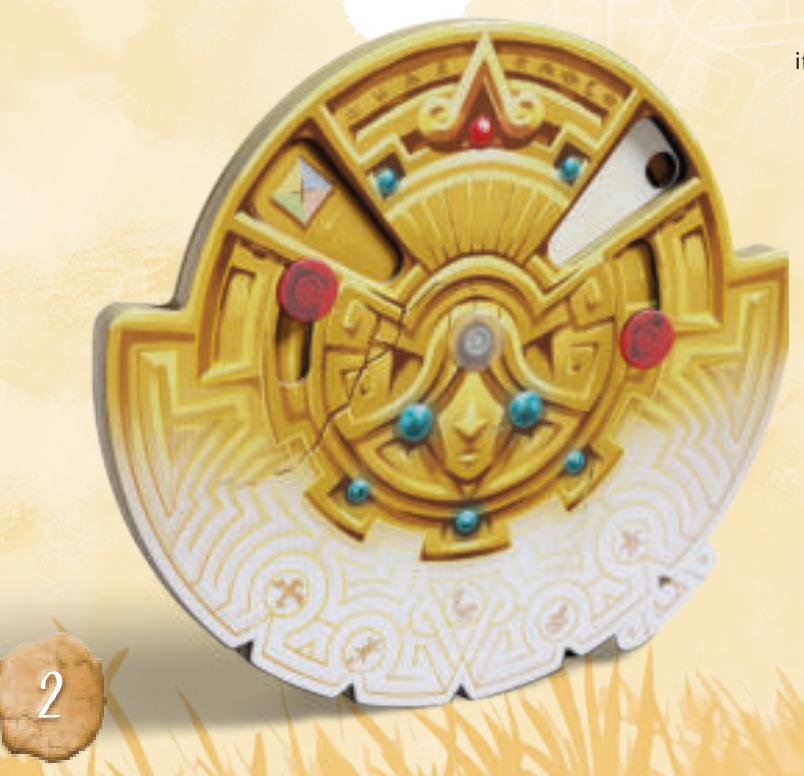
The Pachamama wheel specifies the secret setup of the Terrain tiles, determined by the Scenario disc inserted into it before playing. During the game, it indicates the terrain of the spaces the Quechuas discover, according to the precise location of the space.
You must deduce which types of crops your Quechuas should plant to respect the will of
Pachamama. It will be crucial to respect:
a certain size for regions
a principle of diversity: a region can never contain two identical crops
Pachamama forbids any transgression of these two fundamental rules. For each space on the board, there is only one correct choice!
Honor Pachamama's desire for variety by planting crops on the Terrain spaces you explore, and by progressing your Diversity pawns, all while maintaining equilibrium, lockstep with nature.
TIWANAKU
CONTENTS
62 Terrain tiles (1 side without an arrow /1 side with an arrow [solo & cooperative versions])

15 Dirt tiles

17 Sand tiles
15 Grass tiles

15 Rock tiles

10 Quinoa tiles
57 Crop tiles

10 Corn tiles

12 Chili tiles

12 Coca Leaf tiles

13 Sweet Potato tiles

4 Quinoa tokens
20 Offering tokens


4 Corn tokens

4 Chili tokens
4 Coca Leaf tokens

4 Sweet Potato tokens

20 Quechua meeples


1 Pachamama wheel + 1 plastic axle
16 Diversity pawns



4 Score Marker pawns


1 Rulebook
You hold it in hand.
20 Scenario discs

seal
0381818 MW A C11 Diversity board


64 stickers
4 screens

1 gameboard double sided


SETUP
After choosing a short or long scenario (25 or 45 spaces), place the gameboard in the middle of the table, and the Diversity board next to it.
Each player: Choose a color and collect the following: Your Quechua meeples:
2-player game: 5 meeples.
3-player game: 4 meeples.
4-player game: 3 meeples.
b Your Score marker pawn, which starts on space 10 of the score track.
Your 4 Diversity pawns, which go on the Diversity board, each at the bottom of the column matching its terrain type.
② On the gameboard, in the general supply:
a For each type of Offering token, include 1 per player. 2-player example: 2 each of Quinoa, Corn, Chilis, Coca Leaves, and Sweet Potatoes (10 tokens total).
Stack all the Crop tiles by type.
③ Close the two windows of the Pachamama wheel
ATTENTION!
From this point through the end of setup, no one is allowed to see the front of the Scenario disc; only the back.

Front
Back
Set up the scenario:
a Form a supply of Terrain tiles containing exactly the number and kind of tiles specified on the back of the Scenario disc. Stack these Terrain tiles by type on the Diversity board, as part of the general supply.
b Take the “starting" Terrain tiles (taken from the stacks you just made) and place them on the gameboard as indicated by the back of the Scenario disc.
On each “starting” Terrain tile, place a Crop tile of the type indicated on the back of the Scenario disc for that location.
d Insert the Scenario disc into the Pachamama wheel (pay attention to the orientation!) then fix the central axis.
Randomly select a first player.
Return everything else to the box; you will not be using it during this game.

PLAYING THE GAME
During the game, you will take turns in clockwise order. On your turn, you must Explore or Divine.
Explore
An Explore action always begins with a Movement phase, and may then lead to a Discovery phase.
MOVEMENT
This phase consists of moving one of your Quechua meeples on the gameboard. The movement is never limited to a certain number of spaces.
Your Quechua meeple can only move orthogonally and, if the meeple reaches a space with a Crop tile and/orone of your other Quechua meeples, it can change directions and continue moving, and it can do this as many times as you wish.
Your Quechua meeple cannot enter or traverse a space that has an opponent's Quechua meeple in it.
If your Quechua meeple ever enters a space with neither a Crop tile nor a Quechua meeple of your color (i.e. an empty space, or one with only a Terrain tile), it must end its movement there.
In any case, at the end ofthe movement, there can only be one Quechua meeple per space;
and your Quechua meeple cannot end in the same space from which it started.

The brown Quechua meeple in is in a tight spot, with seemingly no access to an empty space; however, there is a single passage to the right and up that will permit access to either space or space (because brown can traverse spaces with brown meeples).
You can choose whether you move a Quechua meeple already on the board, or take one from your personal supply to put into play (assuming you have any remaining).
If you bring a new one into play, the Quechua meeple begins its movement on any space on the edge of the gameboard, as long as that space has no one else's Quechua meeple in it. The previous rules apply.
REMINDER
If the space is empty or has only a Terrain tile, the Quechua meeple must stop.
If the space has a Crop tile, the Quechua meeple can continue its movement.
If the space has a Quechua meeple of the same color, the new meeple must continue its movement.

In this example, seven spaces are unreachable for a Quechua meeple coming into play from a personal supply. All edge spaces of the (tiny) board are accessible.Spaceis accessible by passing through, whose lone Crop tile permits the meeple to continue its movement. Spaceis accessible by entering via space , which also contains only a Crop tile. Note that in this example, there are no other Quechua meeples in play.
REMINDER
Your Quechua meeple can neither stop in nor pass through a space occupied by an opponent's Quechua meeple. On the other hand, it can pass through a space occupied by a Quechua meeple of the same color; however, it cannot stop there.

This example uses the same setup as the previous example, but this time with Quechua meeples already in play, and this changes everything! It's Blue's turn. Spacehas become inaccessible, because a green Quechua meeple in blocks the path across the Crop tile.is also blocked by a green Quechua meeple. Blue could bring a Quechua meeple into play via space and traverse (which has a blue Quechua meeple in it) to finish its movement in either orAlso note that Blue could have moved the Quechua meeple already in , rather than bringing a new one into play.
Finally, instead of moving one of your Quechua meeples, you can retrieve one ofyour Quechua meeples from the board into your personal supply, no matter where it is.
NOTE
Retrieving one of your Quechua meeples counts as your Explore action, and sometimes it's the only option available!
DISCOVERY
If the Quechua meeple stops on an empty space, it reveals a Terrain tile there.
STEPS TO FOLLOW
- Take the Pachamama wheel, and make sure that both windows are closed.

- On the wheel, align the natural element on a red background and the animal on a white background (coordinates) of the Quechua meeple's final space on the board with the golden arrow and the white cursor.
VERY IMPORTANT!


Be careful not to confuse the Discovery
window!
Open the Discovery window to see which Terrain tile should go at those coordinates, announce it to the other players, then close the window.

-
Take the corresponding type of Terrain tile from the general supply, and place it beneath the Quechua meeple you just moved.
-
Advance your Diversity pawn in the matching terrain type (on the Diversity board) one level; however, it never moves beyond the final level.

- Finally, you score 1 victory point ( for each of your Diversity pawns at this level, including the one you just advanced (+2in the example opposite).
If you were unable to advance

your pawn because it's stuck at the final level, score 1.
Divine
Divination consists of deducing (see Comprehending Pachamama, page 6) which crops should be planted on one or more previously discovered Terrain tiles.
NOTE
A Crop tile always goes on a Terrain tile; never on an empty space!
When you choose to perform the Divine action, each of your Quechua meeples on an empty Terrain tile can divine, in any order you wish. However, you must perform at least one divination.
STEPS TO FOLLOW
-
Another player takes the Pachamama wheel.
-
Choose and point at one of your Quechua meeples, then announce the type of Crop tile you think Pachamama has decided should be grown in the Quechua meeple's space.
-
The player with the Pachamama wheel aligns the coordinates (a natural element on a red background, and an animal on a white background) of the Quechua meeple's space, opens the Divination window, and announces the answer (the type of Crop tile).
-
No matter the result, take the correct Crop tile from the general supply and place it beneath your Quechua meeple.
-
If your divination was correct:
CROP VALUES
You gain a number ofequal to the level of the Crop tile placed (see table right).
You receive an Offering token matching the crop placed, unless you already have one of this type. Each player can only have one of each type of Offering token at a time.
.level 1
Coca Leave.
.level 2
Chili.
.level 3
Corn..
level 4
Quinoa.
.level 5
If you wish and are able, you can perform a new divination with another of your Quechua meeples.
NOTE
In a single Divine action, all of your Quechua meeples on Terrain tiles without Crop tiles potentially could perform divinations.
If your divination was incorrect: You lose a number ofequal to the level of the Crop tile placed. Yourcannot go below zero. You do not receive the Offering token for your wrong answer
IMPORTANT
An incorrect divination immediately ends your turn!
After completing your Explore or Divine action (successfully), you may make an Offering to Pachamama to earn
Choose Offering tokens you have, and offer them to Pachamama by returning them to the general supply.
Offer
The number ofyou earn depends purely on the number of Offering tokens you offer (regardless of their types):
1 Offering token = 0
2 Offering tokens = 1
3 Offering tokens = 3
4 Offering tokens = 6
5 Offering tokens = 10
REMEMBER
At no time can you have more than one Offering token of a single type! Thus the Offering tokens you offer will always be different!

COMPREHENDING PACHAMAMA
For the good of humankind, Pachamama imposes her will upon them. To divine correctly, it is important to understand the rules that allow you to accommodate her desires: the rule of diversity and the rule of separation.
THE RULE OF DIVERSITY
Terrain tiles are grouped into regions. A region is a group of 1 – 5 Terrain tiles of the same type, orthogonally adjacent to each other.
Regions of the same size (number of spaces in them) can have different shapes.

4-space regions could be any of these shapes.
Furthermore, two regions of the same Terrain type are never adjacent to one another, not even diagonally.

Here are two configurations you will never encounter. The red circle indicates two Grass regions that are touching on a corner; this is impossible! The red border highlights two Grass regions touching orthogonally, which effectively forms a 6-space region; this is impossible because regions are always 1 – 5 spaces, never 6.
Each region must contain a series of Crop tiles that are all different from each other and match the region's size. A 1-space region contains 1 level-1 Crop tile. A 2-space region contains 2 Crop tiles: level 1 & level 2. A 3-space region contains 3 Crop tiles: levels 1, 2, & 3... Therefore, level-5 Crop tiles will only appear in 5-space regions.
Regions of the same size may have different shapes, but they will always contain the same Crop tiles, although these could be arranged in different ways.

THE RULE OF SEPARATION
Two identical crops (i.e. of the same level) can never be adjacent to one another, neither orthogonally nor diagonally, no matter what terrain type they're in.

Here are two configurations that you will never see! The two red squares in the middle indicate two Quinoa crops (level 5) that are diagonally adjacent; this is impossible! The red rectangle in the lower-right corner indicates two Chilis crops (level 3) that are orthogonally adjacent; this is impossible!
A 4-space region might be this shape. No matter which type of terrain it comprises, it will always contain a level-1 crop, a level-2 crop, a level-3 crop, and a level-4 crop (never a level-5 crop!), but they will not necessarily be arranged the same way, because they must respect the two rules of Pachamama..
END OF THE GAME
The end of the game is triggered when you place the final Terrain tile (not the final Crop tile!) on the gameboard. Finish your turn as usual.
Then, starting with you, and going clockwise, each player may perform a divination with one of their Quechua meeples. Keep going around the table until everyone has performed all of the divinations they can and wish to.
These endgame divinations earnand Offering tokens just like divinations during the game.
If you cannot or do not want to perform a divination, you must pass. Once you pass, you stop playing; if you still have Quechua meeples on Terrain tiles that have no Crop tiles, those Crop tiles will not be revealed. Once everyone has passed, the game ends.
IMPORTANT
If you make an incorrect divination, you lose the equal to the level of the Crop that goes in that space, and then you must pass (just like during the game).
After everyone has passed (whether they wanted to or not), everyone may make one final offering to Pachamama.
The player with the highest score wins.
If it's a tie, the tied player who has moved the most total spaces on all Terrain tracks (on the Diversity board) wins. If still tied, the tied players share the victory.

EXAMPLE OF A COMPLETE ROUND OF PLAY
IT'S BROWN'S TURN. They
choose to divine, and start with the Quechua meeple in guessing a level-5 crop.
After checking the wheel, it appears that Brown was wrong; Pachamama wants a level-4 crop there. So Brown loses 4 Nonetheless, a level-4 Crop tile goes beneath the Quechua meeple, and Brown's turn ends immediately.
This wasn't exactly well played by Brown! It would have been better to start the divination with the Quechua meeple in, for which the answer was obvious, with no risk of error. Why? Because it is certain that the crop inis level 1, because its region is only a
IT'S WHITE'S TURN. She chooses to explore by bringing her third Quechua meeple into play from her personal supply, entering at Because the space is empty, the Quechua meeple must immediately stop there.
She reveals the Terrain tile for this space: Rock.

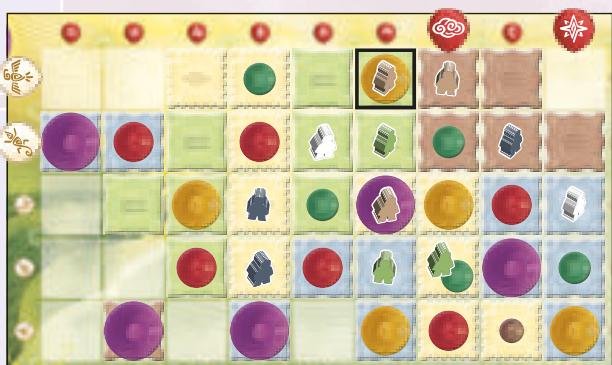
single space! This means that no other level-1 crop can be adjacent to 60 is occupied, so the only remaining space, , in that Dirt region must be level 1. Brown has learned the hard way to announce what is certain first!

Then she advances her Diversity token one space along the gray track, which scores her 2 because she has two at this level.

IT'S GREEN'S TURN. He wants to GkeeN S Tukn. Me warits tO
wait until he has three Quechua meeples in position to divine before divining. His Quechua meeples in andare already well placed for this intent. Only the one atis not; so, he wants to move it, but it cannot reach a cropless Terrain tile because it's completely penned in by opposing Quechua meeples. Thus, Green decides to retrieve the Quechua meeple fromO so he can place it better later.
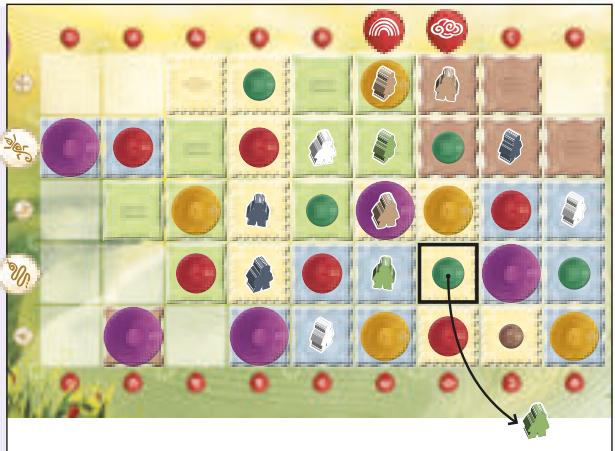
Finally, Green decides to make an offering to Pachamama. He surrenders four Offering tokens (which must all be different!) to receive 6
IT'S BLuE'S TuRN. At the beginning of their turn, they already have four Offering tokens: levels 1, 2, 3, and 4, as it turns out.
They choose to divine, starting with their Quechua meeple inC guessing a level-5 crop. Nailed it! A level-5 Crop tile goes under the Quechua meeple, and Blue receives 5and a purple Offering token (allowed, because they didn't already have one of those).

Blue continues to divine with their Quechua meeple in0, and guesses a level-1 crop. Right again! A level-1 Crop tile goes under the Quechua meeple, and Blue receives 1but not a Sweet Potato Offering token because they already have one.
Blue could continue divining (because they're completely sure of it!*), but wants to wait so they can collect the Offering token.
NOTE
The number of Terrain tiles remaining in the general supply can provide clues..
There are 3 Rock Terrain tiles left. They all must go near, because the level-5 Crop tile in the Rocks there requires a region of 5 Rock terrain tiles. Following this logic, the 4 Dirt Terrain tiles must go around

That leaves only the Grass Terrain tile which will find its place at
So, you can see that, even when the game is not coming to an end, there may be a lot of information you can deduce, and that's without even considering the Crop tiles!
Of course, Blue opts to make an Offering to Pachamama of their 5 (different!) Offering tokens, earning 10

* In the Sand region with two blue Quechua meeples, two Crop tokens are missing: level 4 and level 5. It's easy to deduce which one goes where: The level-4 Crop tile inis adjacent to the blue Quechua meeple in, thus the Crop tile under this meeple cannot be level 4! Therefore, the only possible solution is for the level-4 Crop tile to be in; and the level-5, in!
The nomadic [fictitious] Otoma people are also roaming these unknown territories in search of new lands to cultivate. Their extreme mobility is their greatest asset. You will need tenacity to gain the upper hand over these natural-born explorers.
Setup
IMPORTANT
The short scenarios (25 spaces) are incompatible with solo mode!
Set everything up for a 2-player game, with the following modifications:
The Otoma people are composed from one Quechua meeple from each color (except the one you chose), plus the purple Otoma meeple and the yellow Otoma meeple. For simplicity, all of these will be henceforth called “Otoma meeples".
Use a set of one color of Diversity pawns and score marker for the Otoma people.
The Otoma people never make offerings to Pachamama, so use only one set of Offering tokens (for you to use).
60 Sort the Terrain tiles by type, then shuffle them, and finally, stack them (4 different stacks, arrow side down).
Place the five Otoma meeples according to the setup on the back of the Scenario disc. The Otoma people then earn:
A number ofequal to the level of the Crop tile on which each meeple was placed.
1 step of progress andfor their Diversity pawns having been moved, according to the Terrain tiles on which each meeple was placed. Resolve the Diversity pawns left to right and top to bottom.

After setup, the Otoma advance on the Diversity tracks as follows, in this order: +1 on the Grass track (yellow meeple), +2 on the Rock track (blue meeple, then purple meeple), +1 on the Dirt track (green meeple), and +1 on the Sand track (white meeple).
Playing the Game
Gameplay is identical to a multiplayer competitive game, except as explained below.
You will simply take turn after turn (Explore or Divine action); however, you will eventually be interrupted by the Otoma people after you explore, but never after you divine. Thus, you can divine and then explore immediately thereafter without interruption.
MOVEMENT: BASIC RULES
You cannot retrieve Quechua meeples to your personal supply. Once you have placed a Quechua meeple on the board, it must remain on the board for the rest of the game.
The arrows on the Terrain tiles do not affect Quechua meeple movement.
When you discover a Terrain tile (see Discovery, page 5), reveal one so its arrow is visible, turning it so the small North arrow on the tile is oriented the same way as the wind rose on the gameboard (in the lower right corner), then move it to its destination space without rotating it.

The arrows come in six different colors (see next page), which correspond to the colors of Quechua and Otoma meeples. When a Quechua meeple ends its movement on a Terrain tile (whether the Terrain tile was already there, or freshly placed under the Quechua meeple) without a Crop tile, the color of the arrow indicates the color of Otoma meeple which must immediately be moved:
If the arrow color is the same as the color of the Quechua meeple you just moved, you choose which of the following happens:
Easy: Nothing happens; continue with your next action.
Hard: Your turn ends, and then you move the Otoma meeple of your choice in the direction indicated by the arrow in question (see Movement: Rules of the Otoma People on page 9).
Otherwise, move the Otoma meeple matching the arrow's color in the direction of the arrow (see Movement: Rules of the Otoma People on page 9).
MOVEMENT: RULES OF THE OTOMA PEOPLE
Otoma meeples move along Terrain tiles, no matter what is on them (nothing, a Quechua meeple, an Otoma meeple, a Crop tile), always in a straight line, without changing direction, except when they must use a trail.
Trails are drawn on all four edges of the gameboard. Only the Otoma people can use these. When an Otoma meeple must leave the play area, it follows the trail to the space at the other end of the trail. And the Otoma meeple does not stop there; it continues to move (at two corners of the game board, the trails allow the Otoma meeples to leave a column to enter a row, and vice versa). It's entirely possible for an Otoma meeple to follow several trails in a single movement.

An Otoma meeple stops moving when it lands on an empty space on the gameboard. Then follow these two steps:
- By using the Pachamama wheel, the Otoma meeple automatically (and always correctly) discovers the Terrain and Crop tiles in its space, and their Diversity pawn advances accordingly, resulting in the Otoma gaining Attention: When an Otoma meeple reveals a Terrain tile, ignore the arrow.

- The Otoma people gain a number of equal to the level of the Crop tile placed, but never receive Offering tokens.
The Otoma people's turn ends. Your next turn starts.
DIVINATION
When you divine, you must do so with all of your Quechua meeples on cropless Terrain tiles. If you make a mistake, you lose a number ofequal to the level of the Crop tile placed (as usual), but you must continue your divinations, risking further mistakes! Once all of your divinations are complete, you can make an offering, even if you made mistakes.
End of the Game
There is not a final divination after all of the Terrain tiles are on the board.
You win if you have morethan the Otoma people.
If it's a tie, the Otoma people win.
COOPERATIVE MODE
Faced with the extraordinary exploration capabilities of the Otoma people, you must all join forces if you are to have any hope of sufficiently expanding your cultures. But the Otoma people benefit from every little move you make, as you try to jointly gain the upper hand. Each time one of you moves a Quechua meeple, you could be shutting down your own access to new land, to which the Otoma people have rushed first.
Setup
IMPORTANT
The short scenarios (25 spaces) are incompatible with cooperative mode!
Set everything up the same as for a standard game (competitive mode, see page 3), with the following modifications:
To track your diversity levels and victory points, everyone shares a single color of pawns.
Lay out two sets of Offering tokens on the gameboard.

Refer to the table below to see how many Quechua meeples each player/pair gets. Each player/pair gets meeples of a single color that is different from the other players/pairs.
| Easy mode | Normal mode | Expert mode | |
| 2-player game | 4 per player | 3 per player | |
| 3-player game | 3 per player | 2 per player | |
| 4-player game | 4 per pair | 3 per pair | |
For a 4-player game, form 2 pairs (teams) of 2 players each. Both players of a pair play using the same color of meeples. Even so, all 4 players (both teams) will win or lose together as a group. During the game, the meeple colors must alternate (sit around the table accordingly).
Each player gets a screen.
NOTE
The screens serve to push you to communicate.
Deal out the Terrain tiles that you previously placed on the Diversity board to everyone in as equal a manner as possible (if one player gets fewer tiles of one type, they will receive more of another to compensate); everyone should end up with about the same number of tiles.
Sort your Terrain tiles by type, then shuffle the piles before placing them behind your screen, Arrow side up. Make sure the top tile is always oriented correctly (see page 8).
Only the orientation of the arrows on top of your stacks should be visible;
you are not allowed to look at the tiles beneath them.
THE OTOMA
Set everything up for a 2-player game, with the following modifications:
The Otoma people get a number of meeples of an unused color; the number depends on the mode you are playing (the player count does not matter for this). Refer to the table below to see how many Otoma meeples must be placed in play:
| Easy mode | Normal mode | Expert mode |
| 4 Otoma meeples | 5 Otoma meeples | |
Use the matching Diversity pawns and score marker for the Otoma people.
Place the Otoma meeples according to the setup on the back of the Scenario disc. The Otoma people then earn:
A number ofequal to the level of the Crop tile on which each meeple was placed.
1 step of progress andfor their Diversity pawns having been moved, according to the Terrain tiles on which each meeple was placed. Resolve the Otoma pawns left to right and top to bottom.

After setup, the Otoma advance on the Diversity tracks as follows, in this order: +1 on the Grass track1, +1 on the Rock track2, +1 on the Dirt track and +1 on the Sand track4

Playing the Game
A round of cooperative play is identical to a round of competitive play, with the exceptions explained below.
Take turns (Exploring or Divining) as usual. After you Explore (but never after you Divine), you may be interrupted by the Otoma people.
A ROUND OF PLAY
On your turn, you must spend a Terrain tile at the top of one of your four stacks behind your screen and place it at the top of the matching column on the Diversity board.

NOTE
You cannot swap Terrain tiles with each other, and you cannot swap them with the Diversity board.
You must then take an action: Explore or Divine. The orientation of the arrow on the tile only matters if you are Exploring (see Exploring below).
EXPLORING
MOVING
All of the usual movement rules (see page 4) still apply, with the following exceptions:
Choose one of your Quechua meeples, and start by moving it 1 space in the direction of the arrow on the Terrain tile you just placed on the Diversity board. After that first step, the meeple can optionally continue to move as usual.
During its move, the Quechua meeple cannot pass through the same space twice, and cannot stop on a Crop tile already in play.
You cannot retrieve Quechua meeples to your personal supply. Once you have placed a Quechua meeple on the board, it must remain on the board for the rest of the game.
DISCOVERY
The Discovery phase proceeds as in competitive mode (see page 5), with the following exception: If the Diversity board does not have any of the type of Terrain tile you need to play, everyone must agree which player will supply the tile from the top of one of their stacks. Place the Terrain tile directly on the gameboard, under the Quechua meeple that just made the discovery.
In any case, advance the Diversity pawn accordingly on the Diversity board, and score for your terrain diversity so far (see page 5).

REACTION OF THE OTOMA PEOPLE
Once you have finished exploring, check whether there are any Otoma meeples in the same column and in the same row where your Quechua meeple ended its move. If so, each of those Otoma meeples must be moved; if not, no Otoma meeples move.
Each Otoma meeple that must move does so according to its proximity to the Quechua meeple you just moved, and the Otoma moves away from the Quechua that just moved: The closest moves first, and the furthest moves last. If several are equidistant, everyone agrees on the order in which the tied meeples should move.
The Otoma meeples move just as in solo mode (see page 9).
When an Otoma meeple reveals a Terrain and a Crop tiles, they gain an Offering token according to the basic rules. If the Diversity board does not have any of the type of Terrain tile the Otoma meeple needs to play, everyone must agree which player will supply the tile from the top of one of their stacks. Place the Terrain tile directly on the gameboard, under the Otoma meeple that just made the discovery.
Once all Otoma meeples from the destination row and column have moved, the next player starts their turn.
DIVINING
Perform divinations just as in competitive mode, except that everyone shares their Offering tokens. Regardless of the player count, you can have only one Offering token of each type at the same time.
OFFERING
At the end of your turn, you can make an Offcering and scoreaccordingly.
Each time you make an Offering, the Otoma people also make an Offering spending all their Offering tokens, if they have at least 1.
End of the Game
If at the end of your turn, no one has a tile behind their screen, the game ends. The group and the Otoma people may each make one final Offering. The Otoma people score 1 for each space on the gameboard with no Terrain tile on it. The group wins if you have morethan the Otoma people. If it's a tie, the Otoma people win.
The boxes below make it easy to explain the basic concepts of Tiwanaku to new players.
Explain the possible arrangements of tiles that form regions.

2
Explain the restrictions on how regions can be situated.


Explain that it is forbidden for two identical crops to be adjacent.
Explain the link between region size and the crops that will be in the region, as well as their arrangements.
Finally, invite the new players to deduce the crops that will be at A, B, C, D, and E (hide the answers that are below the illustration!), using only the information available in the illustration (the supply still has 1 Sand, 3 Rock, and 4 Dirt tiles); point out that all “missing” information can be deduced!

A= (L= = = L=


This QR code will take you to a video that thoroughly explains the correct answers.

rues on4 BE0 mms Pho 11
www.sitdown-games.com
info@sitdown-games.com
@SitDownGames
f @SitDown.Jeux
@SitDownGames
A Sit Down ! game published by Megalopole. ©Megalopole (2022). All rights reserved. These materials can only be used for private entertainment. ATTENTION: Not suitable for children under three years old. This game contains small parts that could be ingested or inhaled. Keep this information.• Visuals are non contractual. Shapes and colors may change.• Any reproduction of this game, in whole or in part, in any medium, physical or electronic, is strictly forbidden without written authorization from Megalopole.

DESIGNER
Olivier GRÉGOIRE
ILLUSTRATOR
Raphaël SAMAKH
DEVELOPMENT MANAGER
MichaëI DEROBERTMASURE
ARTISTIC DIRECTOR
Marie OOMS
GRAPHIC ARTIST
Anthony MOULINS
PROMOTION MANAGER Sophie TROYE
PROJECT MANAGER
Didier DELHEZ
ENGLISH TRANSLATION Nathan MORSE
OLIVIER
"Thank you, from the bottom of my heart, to my sister Isabelle, who inspired me with the mechanical concept of this game, and thank you to the people of Latin America, who inspired the theme during a long journey through this incredible continent, rich with History and mysteries. Thank you to the SNCF for enabling me to combine the two while dreaming about this game during a “little” nap on the train ride back from the Cannes International Games Festival. Thank you to the official playtesters ofMardis Ludiques (at the Outpost in Brussels, Belgium) and even more particularly to Al, Fnor, and Eric for the numerous playtests, and to Val for assiduous, continuous, and unwavering support."
SIT DOWN!
thanks the anonymous playtesters and everyone who supported the crowdfunding campaign on Kickstarter!
下载 Markdown