Deranged-rules_web_upd.md


Make yourself at home, Traveler!
The thirst for adventure and the desire to meet the unknown have attracted people for centuries. You could not resist this call. Cities were replaced by villages, broad roads by abandoned paths, which led you to the town called Wutburg
The townspeople were friendly, the women seemed kind, the dinner in the tavern was quite nice, and the bed in the room was so soft that you went out like a light.
But now, at dawn, you look at your hands and clothes in horror: everything is covered in blood, fortunately not yours. Deep inside, a mysterious voice calls out, giving you orders, and you know now that it will be very difficult to get out of Wutburg.
However, in the evening you saw a few more people downstairs in the common room. Judging by their clothes, they are strangers here, just as you are. Shouldn't you join forces in finding a way out ofthis town of the damned?
But be careful, you never know who hears the same voice in their head...
INTRODUCTION
Deranged is a semi-cooperative adventure game in the vein of dark fantasy. The Heroes end up in a small town driven by evil forces, and in order to survive several horrible nights and leave the town at the break of dawn they will have to fight unimaginable monsters, each other, and... their own inner demons.
GAME OVERVIEW
The players will take on the roles of travelers with the mark of a Curse. They should act together to deal with the monsters inundating Wutburg and get rid of the curses — that is their only way to salvation. Each Night will turn one of them into a Deranged monster though: the Deranged is stronger than a usual human, and it has its own path. The only way for them to turn back and escape the town is to kill a once fellow human.
How to use this manual?
If it's your first time playing Deranged, read pages 4–13: which will be enough to play the Intro game and to learn all of the basic mechanics.
Once the Intro game has been played, read the Extended Rules on pages 16–17. You will need them to play the scenarios of Deranged. For the second and all subsequent games, follow the Full Setup instructions listed on page 14.
The Golden Rule
The text on some components (cards and sheets) may contradict the text in this rulebook. In such cases, the text on the component always takes precedence.
COMPONENTS
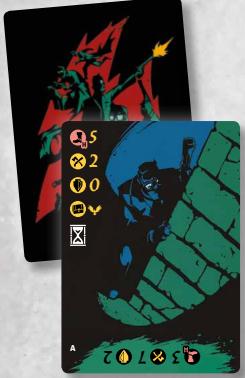
42 Item cards
7 cards per player
14 Apothecary cards 14 Library cards 14 Smithy cards

7 Reward cards

18 Night cards
6 Role cards

42 Curse cards
7 Scenario Effect cards


12 starting Curse cards 30 main Curse cards

6 per night
11 Hero figures
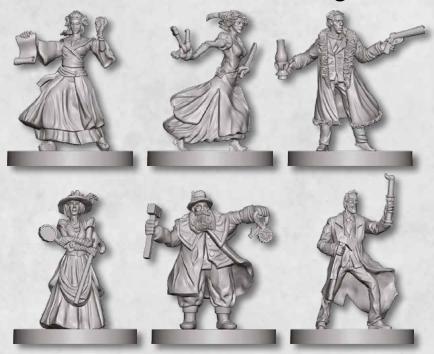

5 Deranged figures

6 Human figures

4 double-sided pieces of the game board (quarters of the town)


6 Reference sheets

6 Monster sheets


18 Scenario sheets

6sheets per Scenario
2 double-sided Time tracks


Before the first game all cardboard components need to be carefully separated from the punch boards.
The Setup for an Intro game is listed below, we recommend you play it first. If it's not your first time playing, follow the full setup instructions on page 14.
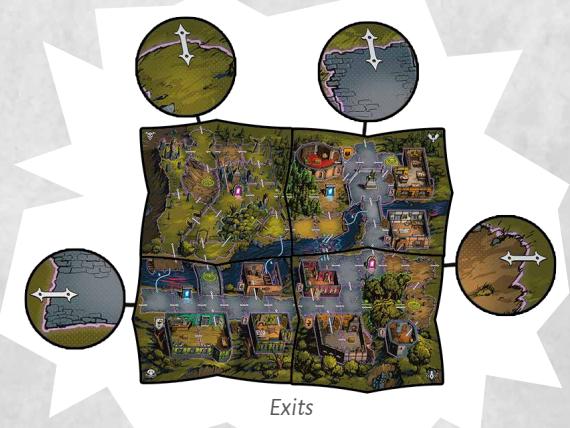
Take 4 QUARTERS OFTHE TOWN and assemble the game board as pictured above. There are symbols,,, in the corners of quarters. For the Intro game, place all quarters with the grey symbols up.
2 Prac cated on the Moon picture) Place the TIME TOKEN on the first space of the Day.


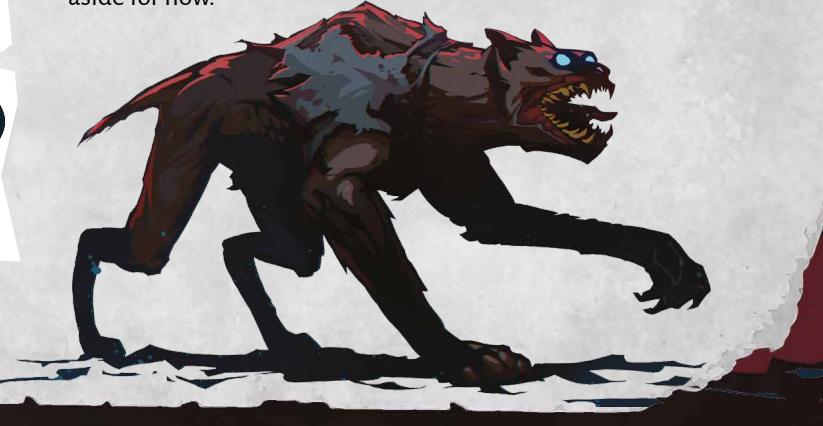
3 FICUREREFERENCESHEET,HEALTHANDSANITYn TRACK, and the BASE. Attach the base to the figure. Set your and0to 5—the maximum value. Set 5 DERANGED FIGURES aside for now.
4 Ah. Sort them by type: there is a letter in the bottom-left corner of each ACTION CARD (from A to F), a symbol of either,, or on each ITEM CARD, and there are no symbols on the REWARD CARDS.


a) Each player receives a set of 7 Action cards with the same letter in the bottom-left corner (A, B, C, D, E, or F). It's their starting deck. Each player shuffles their deck, places it facedown in front of them, and draws the 4 topmost cards. If there are less than 6 players, put all unused Action decks back in the box, you won't need them.
b) Sort the Item cards into 3 decks (14 cards each): THE APOTH-ECARY (), THE SMITHY(), and THE LIBRARY (). Each deck is shuffled separately and placed beside the board, close to the corresponding buildings. These decks contain Items that can be found after searching these buildings.
c) Draw the 2 topmost cards (without looking at them) from each Item deck and shuffle them into a face-down HoUSE DECK. Place this deck close to the board and mark it by placing the HOUSE DECK TOKEN on the top. Place a SEARCH TOKEN on each numbered house on the board. It means that you can find something useful there.
) Put all REWARD CARDS aside. They are not used in the game until a game component tells you to receive a particular reward.
Pt t y ed them
6 aketwnua need them for the Intro game. Also remove all Night cards with a number in their bottom-left corners that is higher than the
number of players in the game. Shuffle the rest of the cards and deal 1 card face-down to each player. The players must not look at the Night cards they've just received.


7 R4,33 b cards by their backs. Deal1 random card with the green back and 1 random card with the purple back face-up (the starting Curses) to each player. Put all unused cards with the green and purple backs back in the box. Shuffle the decks with the red and yellow backs (main Curses) separately and place them in a pile close to the board: the cards with the red backs on the bottom and the cards with the yellow backs on top of them.
8 ChDNTthe first player and going clockwise, place your Hero figures (not the Deranged ones) on any EXITS (see the picture below). There can be more than 1 Hero on the same space.
9 Place the Hungry Ghost Monster sheet face-up close to the board. This type of Monster is used in every game. Without looking, put all other MONSTER SHEETS, SCENARIO SHEETS, and SCENARIO EFFECT CARDS in the box: you won't need them for the Intro game.
10 Prepare all other components:
a) Place the +1 number of Hungry Ghost Number of tokens on the board: A Hungry Ghost is players icon spawned on each PLACE OF POWER, and the rest of them (if any) are spawned, successively, on Apothecary, Library, and Smithy (on the spaces next to the doors). Other Monsters aren't used in the Intro game, put them back to the box.
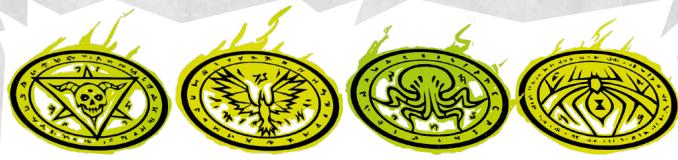
Places of power
b) Take THE ENCHANTED GATE PIECE and attach it to the EXIT of any quarter that the player with the Destiny token chooses. The exit is marked with an arrow pointing to the edge of the board.
You're ready to start the Intro game.
GOAL OF THE GAME
The players start playing as a team, and their common goal is to defeat all monsters, get rid of their Curses and escape the town as soon as they can, so they can possibly win together. However, some of the cards (i. e. Night cards) may give the players other goals during the game, and a cooperative game may turn into a struggle for survival.
To win, at the end of the last Night (the first Night for an Intro game, the third Night for the Scenarios) a Hero must stand on the Enchanted Gate without any Curses or Deranged tokens.
PLAYING THE GAME
The game is played over a series of CHAPTERS. Each Chapter goes on until the token on the Time Track crosses the border between Day and Night. The number of turns in each Chapter may differ. Starting from the first player, the players proceed with their turns. Each turn consists of three phases that are resolved in the following order:
-
(mandatory) Hero Phase — play 1 card from your hand or rest, then draw cards back to 4.
-
(resolved if it's the turn of the player with the Destiny token) Monster Phase —all Monsters on the board are activated in ascending order of their Initiative ().
-
(resolved ifthe Time token crossed the border between Day and Night during this turn) Time of day Change Phase — resolve all steps related to the beginning of another Day or Night.
Then the player to the left takes their turn.
As you can see, only the first Phase is resolved during each turn. The second and the third Phases are resolved only when special conditions are met. As soon as the third Phase is resolved, the current Chapter ends and the next one begins.
There are 2 types of the available actions: actions from the card played and special actions.
Actions on the cards:
—MOVEMENT. The Hero moves up to the indicated number of spaces. (See pages 7–8).
—ATTACK. The Hero attacks another Hero or a Monster standing on their or on an adjacent space. (See page 8).
SEARCH. This action can be resolved only on the space with the. The player draws the topmost card from the corresponding Item deck. (See page 9).
ITEM EFFECT. There are actions available on the Item and Reward cards. To resolve them, follow their text. (See page 9).
Special actions:
The Hero may resolve a SPECIAL ACTION from one of the game components. Special actions may be found on the Curse cards, Scenario Effect cards, or other cards; and they always follow the word Action: (See page 9).
Rest:
Instead of resolving actions the Hero may REST. The Hero restores either 3inside or 2outside of a building. Then they may discard all cards from their hand to advance the Time token 1 space forward (See page 10).
Important:
During your turn you must play a card, even if you're going to resolve a special action from another component.
If you have no cards in your hand at the beginning of your turn, you either rest, or reveal the topmost card of your deck and resolve any action from this card or any special action according to the usual rules.
You may not resolve the same action twice from the same card. For instance, if you already attacked a monster with the action on the card during this turn, you may not resolve the action again.
The Item effects may be the same as the actions on the cards. In this case, you may, for instance, resolve the action from the card, then resolve the Item effect that contains , as they are not considered the same.
1. Hero Phase
During the turn, the player must:
play1 card from their hand OR
rest.
When a card is played, the player resolves 1 of the available actions. Then they may spend1to resolve another action. Thus, a maximum of 2 actions can be resolved during 1 turn.
Important: If it's night time, each action (even the first one) costs 1.
Action Card Overview
All Action, Item, and Reward cards are quite similar.

At the end of a Hero's turn:
If there is asymbol on the resolved card, advance the Time token on the track 1 space forward.
The resolved card goes to the Hero's discard pile (or back in the box if the effect with the symbol has been resolved).
The player draws cards from their deck until they have 4 cards in their hand. (if at this moment they have 4 or more cards in their hand, there is no need to draw or discard them).
Ifa Hero's Action deck is depleted, they shuffle their discard pile and form a new deck, face-down.
Hero's Turn Example
It's Susanne's turn now, and she's in the . It's daytime, so she doesn't spend heron her first action. Susanne wants to perform a special action listed on one of her Curse cards (“Action: Discard this Curse in theor”). But to do
that she still has to play a card from her hand. She plays the Elixir and resolves the Curse's action. Then Susanne would like to search the building she is in, but she can't because she is not standing on the space with thesymbol. So she decides not to stay here any longer and thus resolves her second action for1: after adjusting its value on her Health and Sanity track she resolves the Movement action from the Elixir

card played earlier and goes outside. At the end of her turn, Susanne draws a card and has 4 cards in her hand again. There was no , so the Time track is not advanced at the end of her turn.

See below to know more about all of the available actions.
Movement
The Hero may move up to the indicated number of spaces after the symbol on the card by following the arrows on the board You may not interrupt your movement to perform another action. The movement is affected by the direction and by the type (color) of the arrows.
Spaces and arrows
Each SPACE on the board is outlined. There can be any number of Heroes and Monsters on a space. The ARRowS show if you can move to another space or attack somebody on that space. The double-sided arrows show that you may move
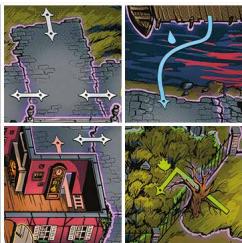
to another space and come back with no restrictions. The single-sided arrows mean that you may move along the arrow and can't come back. Anyone can move along the white arrows. To move along the blue (), green (), or pink () arrows a Hero must play a card with thesymbol of the corresponding color. 1
Portals: there are 2 pairs of PORTALS. A Hero may move between the identical portals as if they were connected with a double-sided white arrow.

Doors: a Hero standing inside a building on the space next to the door may BLOCK THE DOOR to not let another Hero or Monster in. To do that, you need to announce blocking the moment when someone tries to enter. The doors can't be blocked from outside. You can't stop a Hero from going out of a building.
Buildings and the street
All spaces of the game board and its additional pieces surrounded by walls or fences are considered BUILDINGS. There is at least one DooR (highlighted with yellow) in every building. The buildings are: the Apothecary (), the Smithy(), the Library(), houses⑦,,③,4,⑤,⑥, the Abandoned Church, and the Graveyard. All other spaces (including the Enchanted Gate) are considered the STREET.


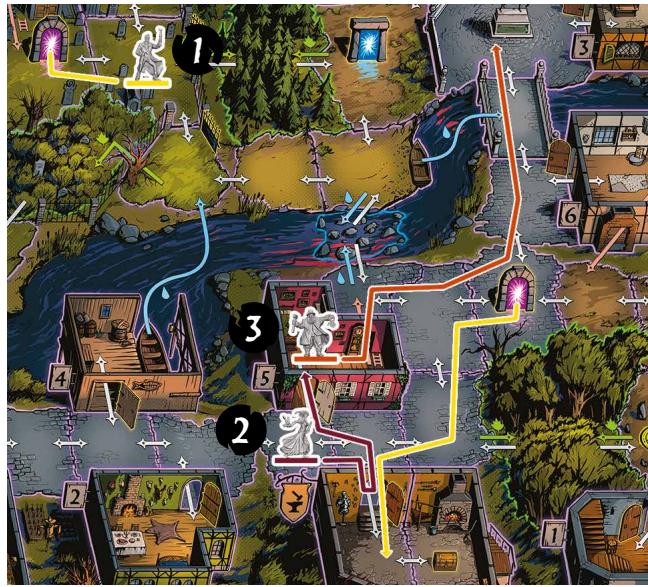
Hero Movement Examples

Alfred wants to get to the Smithy. He plays a card with the6: he enters the portal, then leaves the same portal on the other side of the river and spends his 4 remaining Movement points he has left to get to the Smithy. The color of thedoesn't matter in this case.

Susanne needs to get to the Smithy too. She plays a card with the3: she moves 1 space to the right and then tries to enter the Smithy. However, Alfred decides to announce that he's blocking the door. Susanne still has 2 Movement points left and she decides to enter house. Thomas is standing there, but he's okay with Susanne joining him. The color of thedoesn't matter in this case.

Thomas is about to go to house 3. He plays a card with the6 to leave house⑤via a secret passage to the river— it's possible with the pink only. The shortest route requires going through the ford and taking a boat, so the blue is needed there. Thomas is forced to take a detour and spends all 5 Movement points he has left, but doesn't reach the house and stops on the space with the equestrian statue.
Attack
A Hero may ATTACK another Hero or a Monster standing on their space or on an adjacent one. A space is considered ADJACENT if all 3 conditions are met:
it shares a border with the current Hero's space;
there is an arrow pointing at it from the current Hero's space;
the color of the arrow matches the color of thesymbol on the card played.
Attack Modifiers: The number following the symbol on the card played stands for the current Hero's ATTACK POWER. It may be increased by spending Candle tokens. For each Candle token spent add 1 to your attack power. The player must declare the quantity of Candles they are going to spend on their attack before the attacked player plays a defense card. Moreover, there is a penalty of-2 for the attack through a door (from both sides and it doesn't matter if the door was blocked or not).
Defense: The number following the symbol on a card stands for the Hero's DEFENSE. When a Hero is being attacked, they must play a defense card (even if the attack power is equal to o). Playing a defense card is not considered an action and doesn't advance the Time token. The defense value can't be increased with Candle tokens. Doors don't affect defense either. If the attacked player has no cards in their hand, they reveal the topmost card of their deck and discard it after using it for defense.
Attack a Hero: The value on the defense card is deducted from the value on the attack card played (after applying all modifiers). If the resulting amount is positive, the attacked Hero loses that much Health. If the resulting amount is negative or zero, nobody loses Health. Ifthe attacked Hero loses all oftheir Health, they die, but they are not eliminated from the game (see Death and Insanity on page 13).
Attack a Monster: The value on the Monster sheet is deducted from the value on the attack card played (after applying all modifiers). Most of the Monsters have only 1 Health, so to defeat them it will be enough to have the value at least1 higher than thevalue ofthe Monster. If the Monster's Health is higher than 1, keep track of its wounds by placing Candle tokens from the supply on the Monster sheet. When the Monster is defeated, the Hero receives the reward indicated on the Monster sheet and removes its token from the board (unless the Monster sheet states otherwise).
Attack Example
On her turn, Susanne wants to attack Thomas standing on the adjacent space. He is in the forest, so Susanne plays a card with thesymbol. The attack power listed on this card is 5. Susanne adds 4 Candles to the attack, but there is a penalty of-2 for attacking through the door. Susanne's final attack power is 7. Thomas plays a defense card, and hisvalue is 6. The difference between the attack and defense is 1 — this is the damage taken by Thomas (he adjusts his Health on the track). At the end of her turn, Susanne draws a card, but Thomas doesn't since it was not his turn.
When it's Thomas' turn, he wants to take revenge on Susanne. To attack, he may play a card with the symbol of any color (the outgoing arrow is white). There is still a penalty of-2 for the attack through the door though

Search
A Hero may SEARCH a building if they are standing on the space with the symbol or token. In order to do that, there must be a symbol of the quarter the Hero is in next to the symbol on the card played.
Quarters
The game board consists of 4 quarters. There is a unique symbol at the corner of each quarter: ,,, or Some of the game components (for instance, for the search action) refer to those quarters by their symbols.
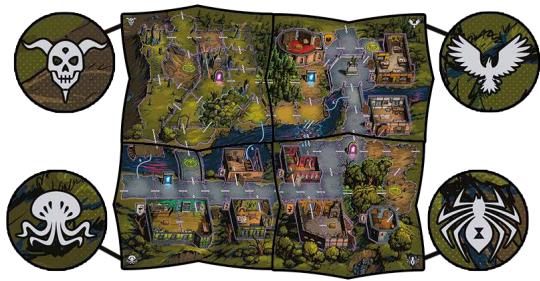
There are 3 buildings which can be searched more than once during the game: —the Apothecary, —the Smithy, and—the Library. There are also 6 numbered houses which can be searched only once. If the numbered house has just been searched, the player removes the search token from it: nobody can search this house anymore.
To perform the search action, the player draws the topmost card from the corresponding deck (either the Library, Apothecary, Smithy or the House deck with the special House token on top of it) and adds it to their hand. From now on this card becomes one of their ACTION CARDS and stays in their deck.
If there is a search symbol in a building, but its Search deck is depleted, you may search it, but you won't receive any cards for that.
Search Example
Thomas wants to search the Smithy. In order to do that, he must stand on the rightmost space of the Smithy (with a search symbol). He plays a card with the(that is the quarter the Smithy is located in) and draws the topmost card from the Smithy deck. At the end of his turn, Thomas doesn't draw a card from his deck since he has 4 cards in his hand already.

Item Effects
The items found in the town are added to your Action deck. These cards are quite similar to the Action cards, but they have an additional ITEM EFFECT which can be resolved as an action. To resolve it, follow the instructions on the card. If there are several parts of the effect, you may (but are not obliged to) resolve them all. However, they must be resolved in the order they are listed on the card. For instance, the Keys effect allows you to move and search twice. You may skip movement or one of the searches, but you may not move after searching.
If you resolve the effect following the symbol on the card, you must remove this card from the game and put it back in the box. If this card is resolved in any other, basic, way (i. e. if resolving a basic Movement, Attack, or Search action), the card goes to your discard pile and is not removed from the game.
Important: After resolving the Item Effect as your first action, you don't immediately remove the card from the game. You may resolve the second action from this card (i. e. Movement or Search) according to the usual rules by spending your Sanity, and only then the Item card is put back in the box.
If the Item Effect allows you to attack, refer to the color of the symbol at the top-left corner of the card. If there are several consequent attacks resolved according to the Item Effect, a Defense card must be played for each of them.
Example of resolving an Item Effect
Susanne is going to use Blunderbuss to defeat 2 Hungry Ghosts on the other side of the river. She resolves the Item's effect: 5 +3 (she may attack via the blue arrow since the Movement symbol on Blunderbuss is blue. Two attacks are enough to overcome their defense (2), so they are both defeated.

Since it was not a usual attack, but a special effect of an Item, Susanne must discard this card and put it back in the box. But before that she may resolve another action from this Item by spending1 Sanity, i. e. attack the third Hungry Ghost with the usual 4 from the same card.

Special Actions
A Hero may perform a SPECIAL ACTION from one of the game components. Special actions can be found on the Curse cards, Scenario Effect cards, and other cards and they always follow the word Action:. Usually, to perform a special action you must stand on the designated space of the game board mentioned in the text.
If during your turn you're going to resolve the special action only, you must still play a card from your hand without resolving any actions from it. During one turn, you may resolve more than 1 special action if they are listed on different game components and are to be resolved within the same space.

Curses
In order to win, the player must discard all of their Curses (both starting and acquired) by the end of the game. To discard a Curse you must come to one of the spaces indicated on the Curse card and resolve the SPECIAL ACTION required to discard the Curse. The discarded Curse card goes to the Curse discard pile.
A Hero receives a Curse:
at the beginning of the game;
when they lose all of theiror;
by the effects of the Night cards and Scenario sheets. The Curse cards are placed face-up in front of the players as a reminder of the spaces they can be discarded on.
If you ever run out of cards in the Curse deck, shuffle the discard pile back together to create a new deck.
Some of the Curses may turn a Hero into a Deranged monster. See more about that on page 12.
Rest
Instead of playing a card and resolving actions, a Hero may REST and restore their Sanity during their turn. A Hero restores either 30in a building or 2on the street. See page 7 to know which spaces are considered buildings. Taking rest is not considered an action, and it does not require spending your Sanity — neither during the Day, nor during the Night.
In addition, while resting, the player may discard all ofthe cards from their hand to advance the Time token 1 space forward. Thesymbols on the discarded cards are not counted.
After resting, the player draws cards from their deck until they have 4 cards in their hand, as usual.
Candles
During your turn, before or after resolving any of the actions or while resting you may discard any number of Candle tokens to restore that much Health or Sanity. The Candles are the main way of healing in the game.

The Candle tokens are unlimited. If you should run out of those, make any suitable substitution.
The color of the Candle token's back doesn't matter (except for one of the scenarios).
2. Monster Phase
The Monster Phase is resolved only ifit's the turn ofthe player with the Destiny token. Otherwise, the Monster Phase is skipped.
The Destiny token
The Destiny token marks the player whose turn triggers the Monster Phase. At the beginning of the game, the player to the right of the first player gets the Destiny
token. During the game, the Destiny token may be handed over when the Time of Day Change Phase will be resolved.
The player with the Destiny token breaks ties during the game.

Monsters don't use cards. Their Movement, Attack and Defense characteristics are constant and are listed on the MONSTER SHEETS. During the Intro game, you'll face Hungry Ghosts only, but there will be more Monsters in the scenarios. The Monster's Initiative () listed on the sheet is not used for the Intro game.
Monster sheet Overview

Monster Movement: When activating a Monster type, move all Monsters ofthat type before initiating the attacks. Thedetermines the maximum number of spaces for the Monster to be moved, and the Monster's Activation effect determines the direction of its movement. The Monster follows the shortest available route according to the usual rules: following the directions and the colors of the arrows (if not said otherwise on its sheet). Usually, the Monster doesn't enter the space with a Hero, but stops on the adjacent one (if not said otherwise on the Monster sheet).
While moving, the Monsters don't use portals. If there are several equidistant Heroes from the Monster, or the Monster can follow several routes, it's up for the current owner of the Destiny token to decide. If a Monster is activated on the space with the Target Hero, it doesn't move, but proceeds with attacking.
Monster Attacks: The Monster attacks the Hero(es) within its reach. See the Monster's Activation effect and follow its instructions. Usually, the Monster attacks Heroes within its space and all adjacent ones. For Monsters, a space is considered ADJACENT in the same way as for Heroes (instead of the on the card played use the on the Monster sheet). The Monster's attack is resolved in the same way as the Hero's attack: the attacked Hero must play a defense card against each attacking monster and compare their value with the value of the Monster.
Spawning new Monsters: Usually, new Monsters are spawned during the Time of Day Change Phase according to the instructions of the Scenario sheets. Ifthere are no Monster tokens left in the supply, you don't place new Monsters of that type until they become available again.
Monster Activation Example
Alfred has the Destiny token. He has just finished his Hero phase, and the Monster Phase begins. There are 2 Hungry Ghosts on the board. First of all, both of them move toward the closest Heroes. Susanne and Alfred are at the same distance from the first Hungry Ghost, but since Alfred has the Destiny token, he decides that the Ghost will go toward Susanne. The Hungry Ghost'svalue is 3, but it moves only 1 space because according to its activation effect it doesn't enter the Hero's space. The closest Hero to the second Hungry Ghost is Alfred (according to its activation effect it may follow the pink arrow). The second Hungry Ghost also moves 1 space only.
Now both Ghosts attack. The first Ghost attacks Susanne (but not Thomas) because it ignores the color, but not the direction of the arrows, so the Thomas' space is not considered adjacent. The second Ghost attacks Alfred (it ignores the color as well, so it can attack by the blue arrow).

3. Cime of Day Change Phase
The Time of Day Change Phase is resolved only if the Time token has just crossed the border between Day and Night on the Time track during the current turn. Otherwise, the Phase is skipped.
The Time of Day Change Phase consists of 3 consequent steps:
a) The Destiny token Handover
b) Resolving the Scenario effects
c) Resolving the Night card effects
After that, if the last effect of the last Scenario sheet has been resolved, see Victory and Defeat on page 13.
For the Intro game only:
At the end of the first Day, place 2 Hungry Ghost tokens on the Enchanted Gate, and each player gains 1 Candle token from the supply.
At the end of the first Night, after resolving step C of the Time of Day Change Phase the game is over: see Victory and Defeat on page 13.
The Destiny token Handover
The Destiny token is handed over to the current player.

Resolving the Scenario effects
The current Scenario sheet says what happens at the end of the current Time of Day (following the words At the end of the Day or At the end ofthe Night). Once all of the effects are resolved, reveal the next Scenario sheet and follow its instructions. For the Intro game, skip this step.
Resolving the Night card effects
At the beginning of the game, players receive Night cards facedown. The information on the cards is secret, even for their owners. You can look at the Night cards only if an effect of any component instructs you to.

When the Day is over: Each player reveals their topmost Night card. If there is a Night Mission card revealed, place it face-up in front of yourself: now you have a mission you have to accomplish before the end of the Night in order to discard it. If there is a You Are Deranged! card revealed, discard it and take a DERANGED TOKEN. From now on, you will be playing according the special rules until the Day comes or until you defeat a Human Hero (see Deranged on page 12).
Then all players with a Deranged token (it doesn't matter which Night card they have just revealed) do the following:
replace their Hero figures with the Deranged figures and attach the bases of their color to them;
restore theirto its maximum value;
rotate the cards in their hand with the Deranged side up.
When the Night is over: Each player who still has the revealed Night card in front of them, resolves its At the end ofthe Night effect. Then all players with a Deranged token do the following:
replace their Deranged figures with the Hero figures and attach the bases of their color to them;
restore theirto its maximum value;
rotate the cards in their hand with the Human side up.
Deranged
During the game a Hero may receive a DERANGED TOKEN. This can happen in two cases:
due to a Night card effect;
due to a Curse card effect.

Receiving a Deranged token
If you receive a Deranged token during the Day
(due to a Curse card), your Hero keeps being a Human until the beginning of the next Night.
If you receive a Deranged token during the Night (due to a Curse or a Night card) OR you have a Deranged token when the Time of Day is changed to the Night, your Hero instantly turns into a DERANGED monster and you resolve the same steps listed in the Time of Day Change Phase:
replace your Hero figure with a Deranged figure and attach the base of your color to it;
restore yourto its maximum value;
Deranged side of an Action card
rotate the cards in your hand with the Deranged side up.
Important: A player may not have more than one Deranged token. Ifyou have a Deranged token and you are instructed to receive another one, you don't receive it and none of the steps are resolved.

A Deranged is stronger and tougher than a Human, but it has its own limitations.
A Deranged may perform only the actions listed at the bottom (“upside-down") of the Actions cards. Item effects (including the effect of the Exorcism card) and all special actions are not available for a Deranged.
a Deranged doesn't spend Sanity to perform its actions during the Night.
a Deranged may not rest.
a Deranged may perform any, or all, of the actions listed on its side of the card. However, all of the actions must be performed in the specific order listed on the card; left to right.
all usual rules of movement, attack and defense are applied to a Deranged, and they can be a Target Hero to any monster.
the actions of a Deranged never advance the Time token.
Stop being Deranged
There are 2 ways to stop being Deranged:
defeat a Human Hero during the Night.
have an Item effect (i.e. an Exorcism card) played on a Deranged by someone else.
If any of those happen, immediately discard your Deranged token, turn back into

a HUMAN again and resolve the same steps listed in the Time of Day Change Phase:
replace your Deranged figure with your Hero figure and attach the base of your color to it;
restore yourto its maximum value;
rotate the cards in your hand with the Human side up.
Ifyou still have a Deranged token at the beginning of the Day, resolve all steps listed above, except for discarding the Deranged token. You temporarily become a Human again until the next Night begins.
Important: Defeating another Human during the Day won't allow you to discard the Deranged token because you are also a Human during the Day.

Example of a Turn of a Deranged
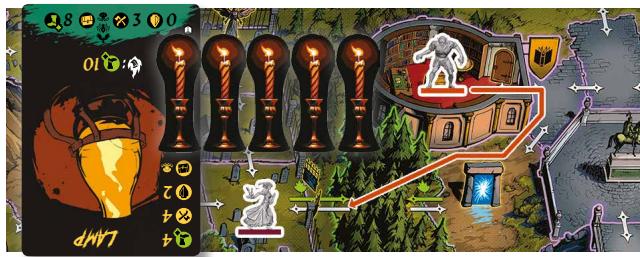
It's nighttime, Thomas is deranged and he wants to become a Human again. On his turn, he plays a Lamp card, upsidedown. He may resolve all 3 actions without spending his Sanity, but he has to perform them in the particular order only. Thomas resolves8 first to get closer to Susanne: the green Movement symbol allows him to move through the forest, but Susanne doesn't let him in by blocking the door.
His next available action is search, but he skips it and proceeds with his last action—attack. 3 is modified by the door (—2) and the candles Thomas has. He adds 5 candles at a time, and his final attack power is 6. Susanne plays a defense card with the 3 and takes 3 damage— it's enough to drop her Health to. Susanne dies, and Thomas turns back into a Human: he discards his Deranged token, replaces his Deranged figure with the Human one, restores all his Sanity and rotates all cards in his hand
A turn of a Deranged never advances the time so the Night goes on. When it's Thomas' turn again, he'll have to spend Sanity on each action.
Death and Insanity
Each Hero has a track of their Health () and Sanity (), and their maximum value is 5 each.

Death: as soon as a Hero's (Human or Deranged) Health drops to , they die. Remove their figure from the game board. Then they draw a card from the Curse deck, place it in front of them face up and, if there is an immediate effect, resolve it right away.
At the beginning of their next turn, the defeated player places their figure (either Human or Deranged, depending on the current Time of Day and on the Deranged token in their possession) on the space with the Angel at the Graveyard and restores all of their. Note: You don't stop being Deranged after you die! If you had a Deranged token before dying, it is not discarded.

Angel at the Graveyard
Insanity: As soon as a Hero's Sanity drops tothey become insane. They draw a card from the Curse deck, place it in front of them face up and, if there is an immediate effect, resolve it right away. While you're insane, you may not spendon Actions until it's restored to the value of1 or higher. It means that you can't perform an additional action during the Day and you can't perform any actions during the Night—you can only rest.
If according to any effect an insane Hero must lose , they draw a card from the Curse deck instead.
Victory and Defeat
A player wins if at the end of the last Night (after all Phase 3: Time of Day Change effects are completely resolved) all of the 3 conditions are met:
they don't have a Deranged token;
they have no Curse cards;
their Hero is on the Enchanted Gate space.
Otherwise, they lose at the end of the last Night.
Important: Each player wins or loses separately. There can be several winners, only one, or even none.
Instant Defeat
If at any point during the Night all Heroes turn into Deranged (even if some of them are not on the game board because of the recent death), all players instantly lose.
Important: If at any point during the Day each player has a Deranged token, they have their last chance to save themselves: find and play an Exorcism card before the Night comes.
STOP!
Now you know all of the rules to proceed with your Intro game. The sections below contain the extended rules and additional clarifications concerning the full game and the scenarios.


Follow the full setup instructions as soon as you get familiar with all of the basic mechanics of the game and are ready to run a Scenario. All different and new paragraphs are highlighted.
Take 4 TOWN QUARTERS and assemble a game board in 1 of the 4 available layouts. All 4 game board pieces are double-sided. The sides with the yellow,,,symbols are considered more difficult. You may assemble the board by using usual sides only, difficult sides only, or by combining them. All 4 available layouts are shown below.

Usual Layout

Difficult Layout

Combined Layout 1
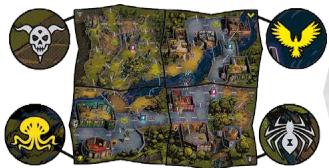
Combined Layout 2
2 Pcd on the Moon picture). Place the TIME TOKEN on the first space of the Day.

3 ingGUREREERENCESHET,HEALTHANDSANTY TRACK, and the BASE. Attach the base to the figure. Set your andto 5— the maximum value. Set 5 DERANGED FIGURES aside for now.
4 A heth. Sort them by type: there is a letter in the bottom-left corner of each ACTION CARD (from A to F), a symbol of either,, or on each ITEM CARD, and there are no symbols on the REWARD CARDS.


a) Each player receives a set of 7 Action cards with the same letter in the bottom-left corner (A, B, C, D, E, or F). It's their starting deck. Each player shuffles their deck, places it facedown in front of them, and draws the 4 topmost cards. If there are less than 6 players, put all unused Action decks back in the box, you won't need them.
b) Sort the Item cards into 3 decks (14 cards each): THE APOTH-ECARY (), THE SMITHY (), and THE LIBRARY (). Each deck is shuffled separately and placed beside the board, close to the corresponding buildings. These decks contain Items that can be found after searching these buildings.
d) Draw the 2 topmost cards (without looking at them) from each Item deck and shuffle them into a face-down HoUSE DECK. Place this deck close to the board and mark it by placing the HOUSE DECK TOKEN on the top. Place a SEARCH TOKEN on each numbered house on the board. It means that you can find something useful there.
)Put all REWARD CARDS aside. They are not used in the game until a game component tells you to receive a particular reward.
Take the ROLE CARDS. If there are 3 players, sort out all of the cards with the 4+ symbol and put them back in the
box. Deal a Role card to each player randomly, face down. Put all
unused cards back to the box. A player may look at their Role card.
Sort out all of the NIGHT CARDS with the number in their 6 bottom-left corner higher than the number of players and put them back in the box (for instance, if there are 4 players, put the Night cards with 5+ and 6+ back in the box). Sort the rest of the Night cards by the number of candles on their backs: with 1, 2, and 3 candles, and shuffle the piles separately. Each player receives a random Night card with 3 candles then receives a random Night card with 2 candles and places it on top of it, and, finally, receives a random Night card with 1 candle and places it on top of them both —all ofthem face down. The players may not look at the Night cards until a special effect instructs them to.
Sort the CURSE CARDS by their backs. Deal 1 random card with the green back and 1 random card with the purple
back face-up (the starting Curses) to each player. Put all unused
cards with the green and purple backs back in the box. Shuffle
the decks with the red and yellow backs (main Curses) separately and place them in a pile close to the board: the cards with the red backs on the bottom and the cards with the yellow backs on top of them.
8 ChNT first player and going clockwise, place your Hero figures (not the Deranged ones) on any EXITS. There can be more than 1 Hero on the same space.
Pick one of the available Scenarios (or try an Open World 9 Game — see page 17). Whichever Scenario you choose, don't look at the face sides of the Scenario sheets, Monster sheets, and Scenario Effect cards until an effect instructs you to. Set up the chosen Scenario by following these steps: Set un the chosen Scenario bv following these stens:
a)Assemble a SCENARIO SHEET PILE and place it face-down near the board. There is the same picture on the back of all sheets belonging to the same Scenario. There will be 6 sheets in a Scenario pile, place them in ascending order: the Chapter 1. The First Day sheet at the top, the Chapter 6. The Third Night sheet at the bottom. Put all unused Scenarios back to the box.
b) Reveal the first Scenario sheet and follow its instructions. Place it near the Scenario sheet pile, face up.
d) Place the Hungry Ghost Monster sheet near the Scenario sheet. This type of Monsters is used in every game.
10 Prepare all other components:
a) Sort the MONSTER TOKENS by type and place them near the game board.
b) Put The Enchanted Gate and The Abandoned Church pieces aside. They will enter the game later.
c) Place a supply of CANDLE TOKENS, FOG TOKENS, DERANGED TOKENS, and BAT TOKENS near the game board.
0) Place THE RUINS EFFECT CARD near the Ruins as a reminder of an additional action available for a Hero standing on that space.
You are ready to start a Scenario.

EXTENDED RULES
The rules listed below are needed for running the Scenarios.
Don't spoil the surprise!
Your game will be way more interesting if you don't know what's going to happen next. Thus we recommend you not to read any text on the Role and Reward cards, Scenario sheets, Monster sheets and Scenario Effect cards until you're instructed to.
Role and Reward Cards
During the setup, each player receives a random ROLE CARD. There is only one role for each player for the whole game: it's their secret mission. Other players don't know your role until you complete and reveal it.
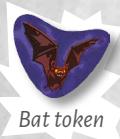
Sometimes you'll need to track the progress of your Role card. Each time you complete a part of your Role card mission, place a Bat token on top of it from the supply.

Role Card
Revealing the Roles: As soon as a player completes the secret mission of their Role card, they declare it, reveal the Role card, discard the Bat tokens from it (if any), draw the indicated REWARD CARD and add it to their hand. This card is a unique Item which can't be obtained in any other way. From now on this card becomes one of their Action cards and stays in their deck.
Scenario Sheets
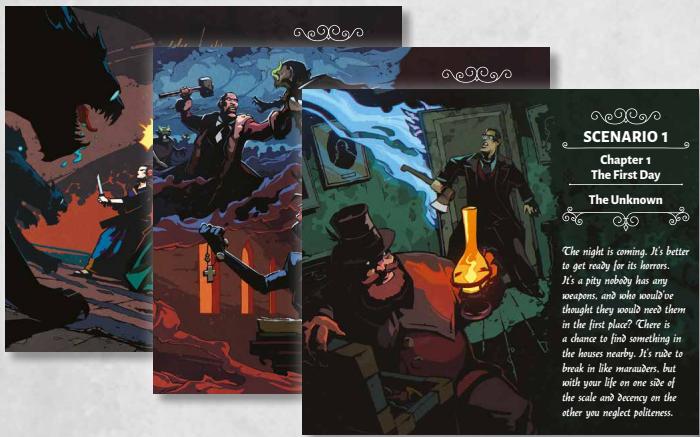
The base game comes with 3 Scenarios consisting of 6 Chapters each. It means that each of your games will last 3 in-game days and nights, and will end after the third Night.
The SCENARIO SHEETS describe the problems, dangers and new possibilities the Heroes will encounter. During the setup you assemble the pile of the Scenario sheets in order from the first
Chapter to the last one, and during the game you will be revealing and resolving them, one by one.
During the step b (Resolving the Scenario effects) of the third turn Phase (Time of Day Change Phase) replace the Scenario sheets as follows:
-
Resolve the final effects of the current Scenario sheet. If the Night is about to come, resolve the At the end of the Day effects. If the Day is coming, resolve the At the end of the Night effects.
-
Draw the next Scenario sheet, read its name and the flavor text on its back. Then reveal it and place it over the sheet with the previous Chapter.
-
Resolve all When you reveal this sheet effects indicated on the new Scenario sheet.
Scenario Effect Cards

Certain Chapters will instruct you to place Scenario Effect cards introducing the new rules. These rules are to be followed until the end of the game or until the Scenario Effect card is removed by another effect.
Some of the Scenario Effect cards will also allow you to perform a new special action which can be resolved on a particular space of the board. This action will be available until the end of the game or until the Scenario Effect card is removed from the game according to any effect.
The Ruins
From the beginning of the game, there is a Scenario Effect card allowing you to perform a special action in the Ruins: secretly look at the topmost Night card of each player (including yours). If you resolve this action during the Day, you look at the cards of the coming Night; if you resolve it during the Night,

you look at the cards of the next Night. This way you will know who will become Deranged soon. You are not allowed to show the Night cards to other players, but you may share the information if you want. Of course, you're not obliged to tell the truth.
The Ruins space is located on the street and is not considered a building.
Additional Game Board Pieces
Certain Chapters of the Scenarios will instruct you to attach new pieces to the board: it's The Abandoned Church and The Enchanted Gate. While attached, those are additional spaces of the board, and they can be entered by both Heroes and Monsters. Note: Unlike in the Intro game, the Enchanted Gate doesn't appear during the setup in the full game.
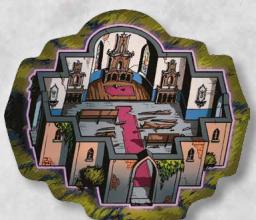
The additional pieces are attached to the EXITS from the quarters. The exit is marked with an arrow on the edge of the board. Additional

pieces may not be attached to the same exit. When the piece is attached, all Heroes and Monsters may move between the exit space and the additional piece as if they are adjacent. The additional piece is not considered a part of the quarter it's attached to.
The Abandoned Church is considered a building, but there is no door. The Enchanted Gate is located on the street and is not considered a building.
Additional Monster Sheets
At the beginning of the game, there is always a Hungry Ghost sheet placed near the board. A Hungry Ghost is a basic Monster in the game and it appears in every Scenario. Certain Chapters will instruct you to place additional Monster sheets next to it— from that moment the indicated type of Monsters is in the game and they can spawn anytime on the board.

Unlike the Hungry Ghosts, new Monsters may have otheractivation rules along with their own Movement, Defense, Attack, and Health characteristics. They can also have some special abilities affecting the game.
If there are several types of Monsters on the game board during the Monster Phase, their order of activation is determined by the INITIATIVE indicated on their sheets. The first to activate (move and attack) are the Monsters with the lowest Initiative value, and then the other Monsters in ascending order of their Initiative.
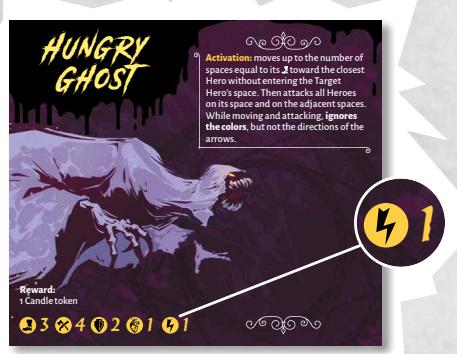
Initiative value
Open World Game
When you're done with all of the Scenarios, you may try an Open World game which makes the game more unpredictable. During step 9 of the setup don't assemble a Scenario sheet pile. Take a random sheet of any first Chapter instead, reveal it and follow the instructions. Place all Monstersheets near the board as a reminder.
When you need to reveal the next Scenario sheet, take a random sheet of a subsequent Chapter, reveal it and follow its instructions (i. e. if it's the Second Night coming, take a random Chapter 4 sheet).
You may play an Open World game in any other way you like: i. e. by combining the Scenario sheets which, you think, will be interesting to play together. The main rule is that they have to follow one another, from the first to the sixth Chapter.
Here you'll find additional clarifications for the game rules and instructions on combining different game components.
Blocking the door
While blocking the door, can I let one Hero in and don't let another one? Yes, you can.
If there are two or more Heroes on one space in the building, who is the one to decide on letting anybody else in?
If at least one of the Heroes decides to block the door, the building can't be entered.
Do Monsters enter the buildings? Do I have to block the door from them? According to the usual Monster activation rules, the Monsters don't enter the Target Hero space, but stop on an adjacent one. So if a Target Hero is standing next to the door, there is no need to block the door. However, if the Target Hero is standing in the back of the building, and there is another Hero next to the door, the later may block the door if they want to not let the Monster in.
Death and Insanity
If my Hero has O Sanity during the day, can I defeat a Monster with my first action, gain a Candle token for it, restore 1and resolve the second action right away for1?
Yes, you can (you will have to resolve the Insanity effects again though). Using a Candle token is not considered an Action and you may spend them at any time during your turn.
All Heroes are dead and there are no figures on the game board. Where should the Monsters go when they are activated? In this exceptional case, they don't move.
I drew a postmortem All Monsters on the board move toward your Hero Curse. Where should the Monsters go and whom they are going to attack?
When you die, you remove your figure from the board first and then receive a Curse. Your figure is not on the board, so the Monsters don't move and don't attack anyone.
May I resolve the Exorcism effect if I only have 3and it will kill me? And may I resolve it if I have less than 3?
If you have 3, you may resolve the Exorcism effect to save another Hero and die heroically afterwards. If you have less than 3, you may not resolve the Exorcism Item effect.
Deranged
If I'm Deranged and I defeat a Human Hero, is it accounted into my mission of a Maniac or a Fanatic?
Yes, you not only stop being Deranged, but also gain a reward for completing your Role mission.
If a Deranged defeats the last Human Hero on the board and that Hero draws a You Are Deranged! Curse, is it an instant endgame?
No, it's not. After defeating a Human Hero the Deranged turns back into a Human, and then the defeated Hero removes their figure from the board and draws a Curse.
What happens if a Deranged dies during the Night, removes its figure from the board, and while it was out of the board, the new Day has begun?
Role cards
Do I have to get rid of the face down Curses I received for completing the Occultist's mission in order to win?
No, the face down Curses are not considered Curses anymore and you can win with them.
Night Cards
What happens ifI can't accomplish my Night Mission (e. g. perform a search action in a quarter that can't be searched anymore)? In this case you keep your Night card until dawn, then discard it and receive a curse.
Monster Movement
What happens if the Monster's Target Hero is standing on a green or a blue space and the Monster can't follow the arrows of these colors? Should the Monster go to another player?
If a Monster can't reach the Target Hero, it ignores that Hero while determining the direction of its movement. Determine the Target Hero among those who can be reached by the Monster following the shortest available route. The Monster moves the maximum available number of spaces toward that Hero and attacks them if it can reach.

CREDITS
Game Designer: German Tikhomirov Creative Content Development: Katerina Reyes Producing and Art Production: Alexander Kiselev Artwork: Anton Kvasovarov and Sergey Dulin Design: Sergey Dulin and Kristina Soozar Technical Writing: Valentin Matyusha Flavor Text: Anna Soldatova
English Translation: Julia Klokova Playtesters: Julia Kolesnikova, Denis Klimov, Alexander Kazantsev, Vera Kazantseva, Vitaly Repin, Oleg Vlasov, Ekaterina Peregudova, Alexey Churilov, Georgy Permilovsky, Konstantin Ponomarev, Dmitry Rudev, Elena Vornoskova, Igor Ganzha, Konstantin Malygin and others
PUBLISHER: HOBBY WORLD
General Manager: Mikhail Akulov
Production Manager: Ivan Popov
Editor-in-Chief: Alexander Kiselev
Editor: Valentin Matyusha
Layout: Kristina Soozar
Prepress: Ivan Sukhovey
Business Development: Sergey Tyagunov
The editorial team thanks James Higgins for proofreading the rules.
Special thanks to llya Karpinsky.
Reprinting and publication of the game's rules, contents, and illustrations without the copyright holder's permission is strictly prohibited.

© 2019 Hobby World
All rights reserved.
international@hobbyworld.ru international.hobbyworld.ru Rules version 1.1

SHORT REFERENCE GUIDE
Turn Overview
1. Hero Phase
a) Play 1 card from your hand and resolve 1 or 2 actions (the first action costs 1only during the Night, the second is always 1). If there is asymbol on the card, advance the Time token on the track one space forward; draw cards until you have 4 of them
OR
b) Rest: Restore either 2if outside or 3if inside a building.
-
Monster Phase (resolved if it's the turn of the player with the Destiny token) All Monsters on the board are activated in ascending order of their4.
-
Time of day Change Phase (resolved if the Time token crosses the border between Day and Night during this turn)
a) The current player receives the Destiny token.
b) Resolve the final effect of the current Scenario sheet, then reveal the next one.
d) If the Night comes, reveal the topmost Night card. If the Night is over, resolve the final effect of the current Night card.
Actions
Move up to the indicated number of spaces ().
Attack () another Hero or a Monster on your space or on an adjacent one.
Search () a building while on the space with in the indicated quarter.
Resolve an Item's effect ().
Resolve a Special action from a game component.
Deranged
At Night, if you receive (or already have) the Deranged token, you become Deranged: replace your human figure with a Deranged one, restore yourand rotate your cards to the Deranged side.
When the Day comes or when you discard the Deranged token during the Night, you become a Human again: replace your Deranged figure with the Human one, restore yourand rotate your cards to the Human side.
The Deranged doesn't spendto perform actions during the Night, can't rest, can't resolve special actions and Item effects, and doesn't advance the Time token.
Discard the Deranged token if you defeated a Human Hero during the Night.
During your turn, you may discard X Candle tokens to restore X1or to add X to your value.
Candles
Death: draw a Curse. On your next turn place your Hero figure on the space with the angel at the Graveyard.
Death and Insanity
Insanity: draw a Curse and you may not spend Sanity on actions until you restore some of it.
A player wins if at the end of the last Night all 3 conditions are met:
Victory and Defeat
they don't have a Deranged token;
their Hero is on the Enchanted Gate space.
If at any moment during the Night all players become Deranged, they instantly lose.
they have no Curse cards;
—Advance the Time token
Remember!
During your turn you must play a card, even if you're going to perform a special action from another component.
There is a -2 penalty for an attack through the door (from any side).
Defense cards and the cards played by a Deranged don't advance the Time token.
While resting, you may discard all of the cards from your hand to advance the Time token 1 space forward.
The player with the Destiny token breaks ties during the game.
Search symbol
If there are no Monster tokens of a needed type left in the supply, new Monsters of that type are not spawned.
—Number of players
—Death symbol
—Movement points
Insanity symbol
—Attack power
0—Sanity value
The Graveyard is considered a building.
- If resolved, remove the card from the game
—Defense value
—Health value
Symbols
Monster's Initiative
香
Quarters of the game board
—The Smithy
—The Apothecary
— Movement through the water
- Movement through the forest
—The Library
目—Movement via a secret passage
下载 Markdown