orient_rulebook_v1.md
東洋
AMN IN
Oríent is Sportcraft's modern version of the ancient game of GO' now over 4,000 years old and still the leading intellectual game of the Far East.
The GO board as used in Japan is α solid block of wood, about 17½ inches long, 16 inches broad and generally about four or five inches thick. It is supported by four feet which make the playing surface about eight inches high, convenient for players who squat on mats. The $O _ { r i e n t }$ board, intended to be placed on α table, is less than one inch thick. (Illustration here of real GO board with stones on it).

On the Orient board, 13 thin black lines are drawn parallel to each edge (A GO board has 19 x 19 lines), These lines, by their crossing, produce 169 points of intersections including the corners and the points along the edge of the field (GO has 361).
The stones are placed on these points of intersection and not in the squares as in Chess or Checkers. These intersections are called "Me" or "Moku" in Japanese, which really means an "eye". In Japan, the white stones are made of α kind of white shell, highly polished and exceedingly pleasant to the touch. The black stones are usually made of stone, generally a kind of slate, and are α shade smaller than the white. Both are α little too large for the space on the board, so that during play they overlap here and there lending α feeling of irregularity to the whole board which is enhanced further by the careless manner in which players place the stones on the points. All this has grown out of the innate artistic sense of the Oriental who is opposed to the monotony entailed in excessive regularity.
When a stone is grasped between the middle and index finger, as the Japanese do, and placed on the board smartly, α cheerful sound results on wood. If this is attempted on cardboard, which has α dead sound as the stones are played, it is surprising how much the pleasure of the game is diminished.
RULES OF THE GAME First Degree Orient (For Beginners)
The object of the game is to get five adjoining stones in α row either vertically or horizontally or diagonally. The winner of each game is that player who first makes "five in α row".
The board is vacant when the game starts. Players take alternate turns each placing one stone at a time on any vacant point of intersection or "Me" on the board. Black always starts the game. This gives him an advantage, as the black stones are always played by the weaker player (or the loser of the preceding game). Each player may place his stone in turn on any intersection he chooses. When each stone is once played, it is never moved again until the game is ended.
Threats
It becomes evident that as soon as α player gets α row of four adjoining stones which is open on either side, he wins the game because his opponent can stop him from forming α five only on one side and he can then complete the five on the other.
Therefore α threat of sure victory exists whenever he has only three men in α row in such α way that he could on the next move, form α four which is open on both ends. It is customary therefore to call "threat" in such α case so that the opponent may not forget to stop the formation of the open four. There is no fun in winning α game owing to α blunder of the adversary; at least there should not be.
The ideα is to win the game in spite of the opponent's seeing every threat. This can be done only if two threats are made simultaneously, for if only one four or one five is threatened, the opponent can always block it. To arrive at α double threat, one would have to form either (1) two fours simultaneously, or (2) two threes which both lead to open fours, or (3) α four and an open three.
Second Degree ríent (For Advanced Players)
In this advanced play, it is mandatory that α plaver call "threat" whenever an open three is formed as previously described. If he does so, and his opponent fails to heed this warning, the player may form an "open four" on his next turn. If he fails to call "threat", his right to use these three stones together in α winning five is thereby forfeited.
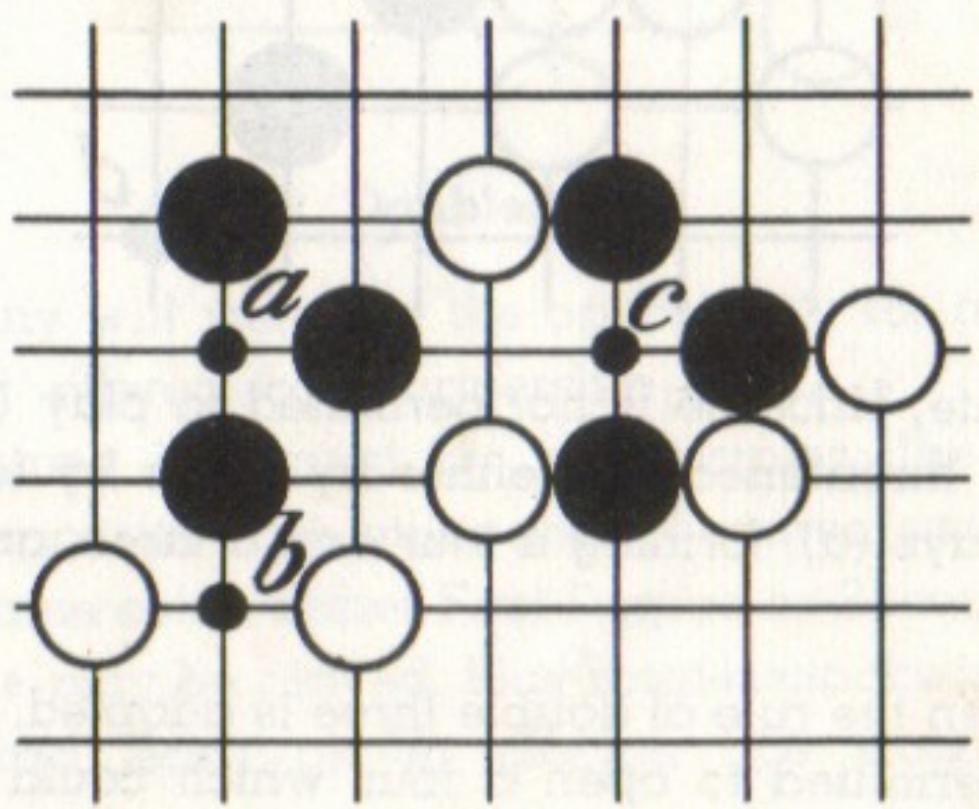
A second rule adhered to in advanced play is the prohibiting of α "double three". The opportunity to form α "double three" arises early in almost every game, but this way of winning is considered too easy. Therefore α "double three" may not be formed if both threes are capable of developing into an "open four". To win α game, the formation of a four and α three or α double four is required.
In the illustration below, for instance, Black would first play (a) threatening (b) and when White answers (b) Black will continue with (c), forming α four and α three and thus winning. The move (α) is permissible because one of the two threes which it forms cannot be developed on the next move into α four which is open at both ends.
This rule of double three will be preferred by advanced players. It leads to curious combinations. In the position below, for instance, neither Black nor White could occupy (α) because two open threes would be formed. Black, on the move, ,would win the game by first playing (b).

White, since he is not permitted to play (a), must stop the threatened four either by (c) or by (d). Then Black plays (α), forming α four and α three, and White is lost.
When the rule of double three is adopted, α player is not permitted to open α four which could only be stopped by the formation of a double three. Thus, in the play shown below, White would not be allowed to play (α) because the only way to stop the five would be by playing (b) which would open two threes.

Doubles Play
Many will welcome the opportunity for added enjoyment offered by partnership $O _ { r i e n t }$ Here the same game is played by two couples, the partners sitting opposite each other and, of course, using stones of the same color. Either First-Degree or Second-Degree $O _ { r i e n t }$ may be played. Play rotates clockwise around the board, each player placing one stone only in each turn.
"Two-Stone" Play
An exceptionally interesting variation which offers added excitement and surprises to the game is "twostone" play. In this version, the game is played in exactly the same way as previously described except that each player is allowed to play two stones (on adjacent intersections) each turn.
Marching
In this variation, two opponents place 26 stones on the board covering the first 2 full rows in front of him. The object is again the same—to place five in α row, while preventing the opponent from doing the same.
On each player's first turn, he moves one stone forward as many spaces as desired. On subsequent moves, he may move α new stone forward, or one already in play forward or backward, left or right, but not diagonally. Each such move may be as many points in one direction as are open.
A player may jump one of the opponent's stones from an adjacent intersection but the stone jumped is not removed from the board. A jump is one complete move—the stone may not be moved any further until his next turn.
When α player can move to fence in or enclose one, two or more of the opponent's stones between two of his own vertically or horizontally, he may remove them from the board. A stone placed voluntarily between two opponent's men is not considered fenced in and is not removed.

4,000 Year History of GO
GO belongs to the class of games of which our Chess is an example. It is played on α board and is α game of pure skill with little room for the element of chance. However, it is an exceedingly difficult game to learn, and no one can expect to acquire the most superficial knowledge without many hours of hard work. It is said in Japan that α player with ordinary aptitude for the game would have to play several thousand games in order to attain professional rank of the lowest degree
It is natural to compare GO with our Chess and, in comparison, we find it presents even more opportunity for fore-sight and analysis. Both are in α sense military games, but GO is not merely α picture of α single battle like Chess. It is instead α whole campaign of α modern kind, in which the strategical movements of the masses in the end decide victory. Battles occur in various parts of the board and sometimes several are going on at the same time. In general, the object is to unite the men first played at various parts of the board into chains or armies, all units of which are connected by lines and which surround as many unoccupied points as possible. The opponent cannot occupy these points with his men without danger of losing them. Strong positions are besieged and captured and whole armies are cut off from their line of communication, and are taken prisoners unless they can fortify themselves in impregnable positions. A far-reaching strategy alone assures victory.
GO, which is today still the leading intellectual game of the Orient, has been played for many centurieswithout any material change in its rules. While we cannot definitely establish whether the ancient game was played like the GO of today, the matchless simplicity of its rules makes it unlikely that it went through several stages of development as did the game of Chess. GO is the oldest game in the world—about four thousand years old. Chess, in its present form, is only about four hundred years old.
There are several versions of the origin of GO, one of which ascribes its invention to the famous Emperor Shun who developed the game in order to strengthen the mental facility of his son Shokin. Since the Emperor reigned from 2255 to 2206 B.C., the game of GO would then be about forty-two hundred years old.
Another version, perhaps more likely, attributes its invention to U, α vassal of Emperor Ketsu, who is said to have invented playing cards also. This account makes the game five hundred years younger or αbout thirty-seven hundred years old.
Many references to GO can be found in ancient history. We can be certain, for example, that it was well known in Chinα during the tenth century B.C., for several Chinese works dating from that period mention the game in poems and allegories. The Japanese historian Miyoski pointed to an interesting phase of the game's history noting that it flourished most whenever the interest in art and literature was at α high point.
In old Chinese books many stories relate the high esteem in which the game was held. Players of outstanding mastery were honored by the title Ki-sei, Ki being the Chinese word for GO while "sei" means "saint". At one time during the Tsin dynasty, the victory in α long cruel war was finally decided by α game of GO played by the two warring princes.
Later, during the Tang dynasy (618-906) when the game flourished in China, the first books devoted entirely to the game were written. It was during this period also (about 750 A.D.) that GO was first introduced into Japan. It was first confined to the nobility and made little progress. Not until 300 years later, when it spread to the wealthy classes, did knowledge of the game extend beyond the court of Kioto.
By the thirteenth century, the game was generally known and enjoyed particular popularity among the military. This was α natural development since GO involves the strategy and maneuvering of armies similar to the tactics of actual warfare. Soldiers carried GO games with them and when a battle was over, they took out the board and continued to fight peacefully.
In the 16th and 17th centuries, many monks, writers and ordinary businessmen became famous through their outstanding ability at this game. They were invited to the courts of ruling princes to play for them and for gathered onlookers. The custom of similar gatherings prevails today in Japan where large groups gather to watch two masters play the game. They follow the play with great patience and absorption. Such gatherings might be compared with our own Chess or
Bridge matches, but in Japan interest in the game extends into wider circles, the knowledge of the game really forming part of α higher education.
In the beginning of the'17th Century, GO attained such α high development that there appeared α number of players who far exceeded any known before. Of these the best and most famous was Honinto Sacha, who was originally α monk. Obtaining great skill at the game, he often played with leading statesmen of his day, accompying them on their travels and even on their battle campaigns.
When one of the statesmen, Tokugawα Iyeyasu, became ruler of Japan, α national GO Academy was founded and Honinbo Sancha was appointed as the head of this institution. At this school men of highest intelligence could dedicate themselves to the education of students and the further development of the game.
Pupils soon outplayed the older players of the country, who lacked the training of the academy, and they became professional players. Many travelled throughout the land playing the game and giving instruction in its mysteries.
Honinbo created the custom of ranking the outstanding players according to their strength, and in fact the custom still survives. The highest rank ever achieved was the ninth, but even α player of the first rank is far above the average and can play the game professionally. Among good GO players, even one who is only slightly stronger will win fairly regularly, so this ranking and the handicap thus granted tends to equalize any match.
During the last three hundred years, only nine players reached the ninth rank, nine reached eighth, but quite α number reached the seventh rank and many the lower ranks. Ranking is, of course, only relative, since today's player of the seventh rank is probably stronger than α player of the ninth rank α hundred years ago.
The players of the higher ranks elevate the younger masters as they develop. Honinbo Sancha himself adopted his best pupil, who was then called Honinbo also and inherited the position of principal at the academy when Sancha died. This manner of adoption continued even after the academy was ended in 1868 and thus the name of Japanese GO champions has always been Honinbo.
After the academy's decline, there ensued α sad time for the game's masters who had until then lived by the practice of their art, and to make things still worse, the Japanese people lost their interest in GO.
As the country opened to the West, foreign things became more prized than native ones, and GO was neglected.
About the year 1880, however, α renascence took place, interest in the old national game was revived, and at the present day it is fostered with as much zeal as in the older times.
Today there are 8 million GO players in Japan; play-by-play accounts of professional games are printed in newspapers, and every week at the Nippon Kiin (Japanese GO Association) lessons are given for housewives, geishas and schoolgirls.
The game has enjoyed popularity in Europe, especially in Germany. Since World War II, knowledge of the game has been spreading over the United States. Today active GO clubs exist in many of our major cities: there is an American Go Association, and an "American Go Journal" is published.
Sporteraft
Archery
Badminton
Banball
Bat Tennis
Bocce
Boomerangs
Bowling
Cricket
Croquet
Darts
Deck Tennis
Fencing
Field Hockey
Golf Accessories
Horseshoes
Lazy Baseball
Olympic Rings
Peteka Rio
Pogo Sticks
Quoits
Rocket Darts
Shuffleboard
Soccer
Spiral Tennis
Spinball
Table Tennis
Takraw
Tether Ball
Volley Ball
Sporteraft mE
COPYRIGHT 1959 BY: GENERAL SPORTCRAFT CO.. LTD
33 NEW BRIDGE ROAD. BERGENFIELD NEW JERSEY
下载 Markdown