rules_zh_哥本哈根骰笔版_16133.md
COPENHAGEN
《哥本哈根》
投骰 & 写翻译 & 排版:陈斌华

游戏背景和目标
丹麦城市哥本哈根以运河和港口横穿而闻名。在其中一个港口坐落着“尼哈文”(新港口)及其五颜六色的山墙房屋。
玩家的任务是完成海滨新建筑的正面。在一个回合中,一个玩家将掷骰子并使用掷来的骰子颜色之一
配件 & 设置
- 玩家表
- 5 颗骰子

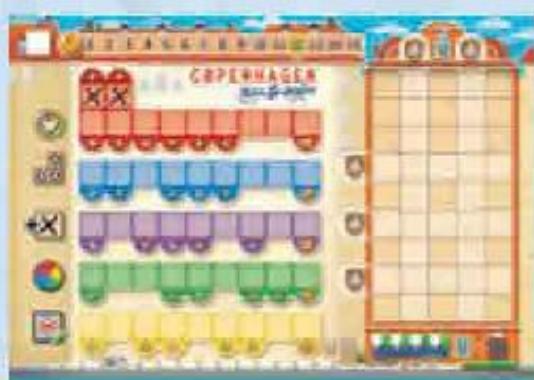
将建筑外观方块表放在桌子中央,骰子放置其旁边。然后每位玩家拿取一张玩家表并将其放到自己面前。每位玩家也需要一支铅笔(游戏不包括)
最年轻的玩家开始游戏并在起始玩家区域标记一个X。
来绘制建筑方块,每当他们完成一行或一列时都会得分。其他玩家可以使用未使用的骰子解锁他们在未来回合中使用的特殊能力。先获得12分的玩家触发游戏最后一轮,最后一轮得分最多的玩家将获胜。
- 建筑外观方块表
·1 本规则书

- 建筑外观表

- 起始玩家区域
·1 玩家表
起始玩家区域——在这里画 X 代表该玩家是此游戏的起始玩家。
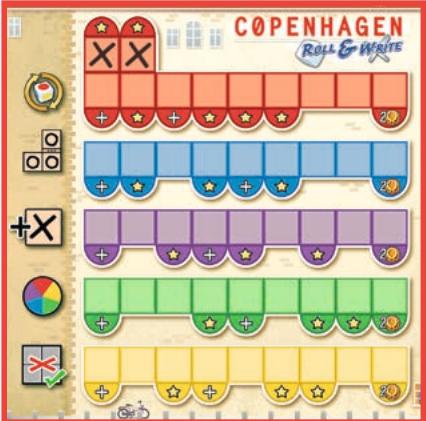
计分轨道——玩家每次完成一行或一列时,通过在方格内画X来标记分数。
能力轨道——轨道的方格从左到右画X填充。一旦X被画在一个奖励(+)或一种能力(★)上方,玩家就能在其回合内使用它。奖励会帮助玩家画更大的建筑外观板块,而能力则改变游戏规则令其对玩家有利。
建筑——玩家将从建筑外观方块中选择将建筑方块画到他们的建筑上。方块的画法必须遵循规则(见第5页),以完成行或者列为目标。每完成一行或一列的玩家将获得分数并且可以解锁盾形纹章。
盾形纹章——通过在建筑内完成描述盾形纹章的一行或一列来解锁。玩家立即选择放置一个1格的建筑方块(一个单独的O)或者圈出一种能力轨道的2个正方形。


- 5 颗骰子
骰子的不同面展示了玩家可用的建筑外观颜色。白色面是百搭面并且可以代表任意其他5种颜色。
·1 建筑外观表
概述——展示了玩家在其建筑内完成一行或一列的奖励以及解锁一个盾形纹章的可能奖励行动。
建筑外观板块——这是玩家可以在其建筑内画的形状,为的是填充行或者列。无限列(∞)的形状可以在任意时刻选择,而X列(×)的形状只能被选择一次,之后将其划掉。


如何进行游戏
《哥本哈根 投骰 & 写》会进行若干轮游戏。被指定的起始玩家开始游戏并一直按照顺时针方向进行下去。
一个回合分为 3 个阶段:
-
投掷骰子并选择一个建筑外观形状
-
画建筑外观形状
-
其他玩家选择一个能力轨道
在玩家的回合中,玩家可以使用任意数量的解锁奖励和能力。
当一位玩家完成时,将骰子顺时针方向传给下一位玩家,此时轮到该玩家的回合。所有玩家将在游戏中进行相同数量的回合。游戏会在至少一位玩家的分数达到12或更高分时的那一轮后结束。最后拥有最多分数的玩家获胜。

回合的细节
1. 投掷骰子并选择建筑外观形状
当前玩家投掷所有的 5 颗骰子并根据骰子的结果从建筑外观方块中选择一个建筑外观形状。
为了选择一个建筑外观形状,玩家必须遵循这些规则:
a. 相同颜色的骰子数量必须匹配方块的数量和所选建筑外观形状。
注意:玩家允许拿取少于匹配骰子颜色数量的方块。
b. 建筑外观板块必须是可用的,这意味着该板块来自无限列(∞)或者来自 X 列(×)内未被划掉板块。
玩家可以将白色骰子视为他想要的骰子颜色。
如果所选形状已从 X 列 (×) 被选取,玩家划掉该形状。这个板块不能再被任何玩家选择。

举例:3 颗骰子是红色的。玩家现在可以选择红色 2 方块或红色 3 方块的建筑外观形状。

2. 画建筑外观形状
遵循以下规则来将所选建筑外观形状画在建筑上。
绘画规则:
a. 绘画形状时可以旋转任意方向,但必须在网格内绘画。
b. 形状必须放置在底部行,或者至少有一个方格位于之前放置的形状上面。只有一个方块需要在旧形状上面(见例子)


c. 在想要的区域绘画完形状后,该形状的其中一格方格必须被标记一个 X。该形状的其他方格被标记为 O。玩家可以选择任意一个方格被标记为 X。

计分和解锁盾牌纹章
如果玩家完成其建筑内的一行或一列,获得以下分数:
行:
该行至少有一个 X 就获得 1 分。


如果该行只由 O 组成则获得 2 分。


该列至少有一个 X 就获得 2 分。
如果该列只由 O 组成则获得 4 分。


解锁盾形纹章
如果玩家将含有盾形纹章的一行或一列完成,则玩家解锁一个盾形纹章。如果他已完成,则划掉这个盾形纹章并立即选择其中一个特殊行动:
a. 玩家在其建筑内绘画一个方格,遵循绘画规则,并标记一个 O。如果完成一行或一列则立即计分。如果解锁了另一个盾形纹章,玩家立即执行另一个特殊行动。
b. 玩家选择圈出一个能力轨道的2格。他不能在2个不同的轨道上标记。

3. 其他玩家选择一个能力轨道
所有其他玩家选择当前玩家未使用的一颗骰子并在对应能力轨道上的下一格标记一个X。非当前玩家可以选择同一颗骰子。如果白色骰子依旧未被使用,每个非当前玩家可以在任意一个能力轨道标记。
如果当前玩家使用了所有骰子,则其他玩家无法在本回合内标记格子。
能力轨道从左到右标记。如果 X 画在一个奖励(+)或一个能力(★)上,则玩家解锁它并且可以在之后的回合中使用它。
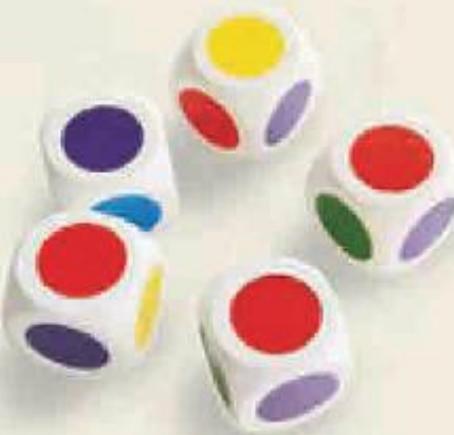
举例:当前玩家使用3颗红色骰子。其他玩家现在可以在黄色和紫色骰子之中选择。

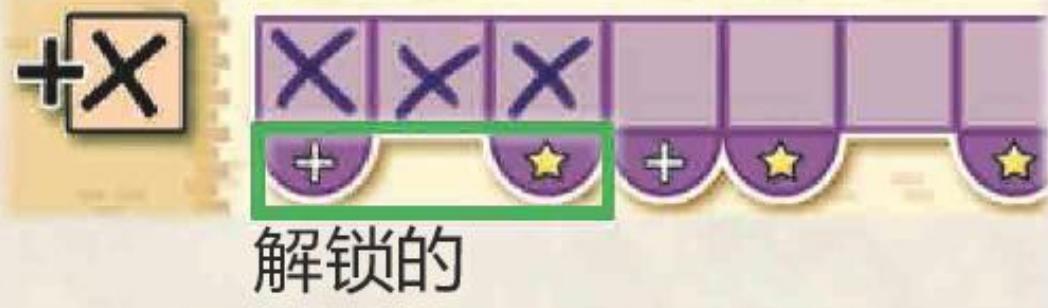


如果一条能力轨道完全被标记,玩家立即获得 2 分。
当一个奖励或能力被使用时,玩家划掉它并且不能再次使用它。
奖励(+)
当划掉奖励时可以将其视为额外一颗对应颜色的骰子,这允许玩家放置更大形状到其建筑上。
注意:玩家在其回合内只能使用同颜色的至多2个解锁奖励。
能力(★)
能力影响游戏规则并会给予当前玩家一定的优势。能力能做什么以及何时使用它们在本规则书的最后一页有详述。
游戏结束
在一位玩家的分数抵达 12 分或更多的那一轮结束时,游戏结束。玩家完成其最后计分,最高分的玩家获胜。




平局时,玩家统计自己建筑内空置方格的数量(没有O或X的方格)。拥有最少空置方格的玩家获胜。如果还是平局,则玩家将共享胜利。
能力只能在玩家自己的回合中使用。如果一个能力被使用,在对应轨道上的一个能力符号会被划掉。玩家可以在一个回合内使用多个能力,比如解锁他们想要使用的所有的所有能力。能力影响的游戏规则如下:

重新投掷——在玩家选择一个建筑外观板块来绘画,他可以选择任意数量的骰子并重新投掷这些骰子一次。重投能力可以在一个回合内被使用多次,但每次重投必须划掉一个星星符号。
每位玩家游戏开始时已经解锁了2次重投,这可以在游戏开始时立即使用。

无 X——当绘画建筑外观板块时,玩家可以使用 O 来填满整个形状(也就是说他无需标记一个 X)。
再次使用——玩家可以选择已经划掉的建筑外观方块上的建筑外观板块在其建筑内绘画(该形状无需被再次划掉)。
颜色转变——玩家可以选择一种颜色的任意数量骰子并将这些骰子转变成他想要的另一种单一颜色。
+X 一个 X —— 在玩家绘画完板块后,他可以放置一个 1 格的板块到任意合规绘画的区域,并标记一个 X。
注意:如果玩家也使用“无X”能力,则本回合放置的1格方块上面标记一个O而不是X。

2颗黄色骰子被转变成红色骰子,因此有4颗红色骰子可用。
2人游戏规则
在设置中的改动:
划掉每种颜色的 4 方块大小的其中一块板块,每位玩家选择划掉一条能力轨道上的前 2 格。
游戏流程的改动:
- 其他玩家选择一个能力轨道非当前玩家可以选择 2 颗未使用骰子并标记对应能力轨道。所选骰子可以是同一种颜色的。

Copenhagen_RW_US_Ansicht.md
COPENHAGEN ROLL&WRITE

Game idea and goal of the game
The Danish city of Copenhagen is famously traversed by canals and harbours. On one of these harbors lies “Nyhavn” (New Harbor) with its colorful gabled houses.
Players are tasked to finish the facades of new buildings on the waterfront. On a turn, one player will roll dice and use one of the colors
Components & Set-up
· Block of Player Sheets
• 5 Dice


Place one sheet from the facade block in the middle of the table and the dice next to it. Then, each player will take one sheet from the player block and place it in front of them. Each player will also need a pen (not included).
rolled to draw building pieces, scoring points whenever they complete a row or column. Other players may use the unused dice to unlock special abilities they can use on future turns. The player who reaches 12 points first triggers the last round and the winner will be the player who has the most points at the end of that last round.
The youngest player starts the game and marks the start player box with an X.
• Block of Facade sheets
• 1 Rules booklet

• Start player box
• 1 Player Sheet
Start player box – An X here marks which player is the starting player of this game.
■ Scoring track – Points are marked by drawing X's in the squares every time the player finishes a row or column.
■Ability tracks – The squares of the tracks are filled from left to right by drawing an X in them. As soon as an X is drawn above a bonus () or an ability (), the player is able to use it on their turn. Bonuses help the player draw larger facade tiles, while abilities alter the rules of the game to the player's advantage.
Building – Players will draw the facade tiles they choose from the facade block here on their building. Blocks must be drawn following the rules (see page 5), with the goal of completing rows and columns. With each finished row or column the player will earn points and may unlock a coat-of-arms.
Coats-of-arms - Unlocked by completing a row or a column in the building showing a coat-of-arms. The player immediately decides to either place a size one facade block (a single O) or mark off two squares of one ability track.



• 5 Dice
The different sides show the corresponding facade colors available to the players. The white side is wild and represents any of the other five colors.
• 1 Facade Sheet
Overview – Shows the points awarded to players for finishing rows and columns in their building and the possible bonus actions for unlocking a coat-of-arms.
Facade tiles – These are the shapes players can draw in their buildings in order to complete rows and columns. The shapes in the infinity column (0) can be chosen any number of times, while the shapes in the X column () can only be chosen once, after which they are crossed out.


How to play
Copenhagen Roll & Write is played over a series of game rounds.
Play starts with the designated start player and continues clockwise.
A turn consists of three phases:
-
Roll dice and choose a facade shape
-
Draw the facade shape
-
Other players choose an ability track
On their turn, a player may use as many unlocked bonuses and abilities as they desire.
When a player is finished, the dice are passed to the next player clockwise and it becomes their turn. All players will take the same number of turns in a game. The game ends after the round in which at least one player reaches 12 or more points on the score track. The player with the most points is the winner.


A Turn in Detail
1. Roll dice and chooe a facade shape
The active player rolls all 5 dice and then, depending on the die results, chooses a facade shape from the facade block.
In order to choose a facade shape the player has to follow these rules:
a. The number of dice that show the same color has to match the number of squares and color of the chosen facade shape.
Note: The player is allowed to take a facade shape with fewer squares than matching colors of the dice.
b. The facade tile must be available, meaning be either a tile from the infinity column () or not be crossed out in the X column (X).
The player may choose which color they would like the die faces that show a white side to be.
If the chosen shape is picked from the X column (), the player crosses out the shape. This tile may no longer be chosen by any player.
2. Draw the facade shape
The chosen facade shape is drawn onto the building using the following rules.
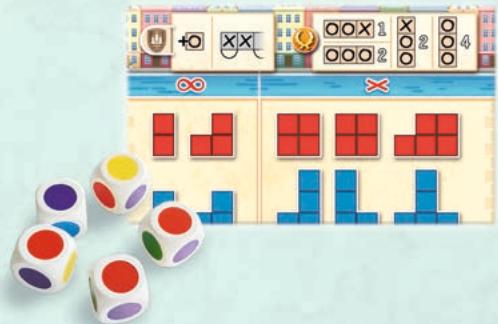
Expample: Three dice show red. The player now may choose either a red 2-square or a red 3-square facade shape.
Drawing rules:
a. The shape may be drawn rotated in any direction, but must able to fit on the grid.
b. A shape must be placed on the bottom row, or such that at least one square is directly above a previously placed shape. Only one square is needed to be above the old shape. (see examples)

c. After drawing the shape in the desired location, one of the squares of the shape has to be marked with an X. The other squares of the shape are marked with an O. The player may choose which square to mark with an X.

Scoring points and unlocking coats-of-arms
If a player completes a row or a column in their building, points are awarded as follows:


Row:


1 point if the row contains at least one X.
2 points if the row is made up of only O's.
Column:
2 points if the column contains at least one X.
4 points if the column is made up of only O's.


Unlocking coats-of-arms:
A player unlocks a coat-of-arms if they have managed to complete a row or column with an attached coat-ofarms. If they have done so, they cross it off and immediately choose one of the two special actions:
a. The player draws one square, following the drawing rules, in their building and marks it with an O. If this completes a row or column score it immediately. If it unlocks another coat-of-arms, the player immediately gets to take another special action.
b. The player marks off two squares on one ability track of their choice. They cannot mark from two different tracks.
3. Other players choose an ability track
All other players choose one unused die of the active player and mark the next square of the corresponding ability track with an X. The nonactive players may choose the same die. If a white die remains unused, each non-active player may mark off an ability track of their choice.
If the active player used all their dice, the other players cannot mark a square this turn.
The ability tracks are marked from left to right. If an X is drawn above a bonus (+) or an ability () the player unlocks it and it may be used on a subsequent turn.


Example: The active player uses the three red dice. The other players may now choose between the yellow and purple dice.

unlocked

unlocked
If an ability track is fully marked the player immediately gains two points.
When a bonus or ability is used, the player crosses it out and it may not be used again.
Bonus (+)
Bonuses act as an extra die of the corresponding color when marked out, thus allowing the player to place the next larger size shape on their building.
Important: A player may only use up to two unlocked bonuses of the same color on their turn.
Ability ()
Abilities alter the rules of the game and give the active player an advantage. What the abilities do and when to use them is explained in detail on the last page of the rules.
End of the game
The game ends at the end of a round in which one player has reached or exceeded 12 points. Players will compare their final scores, and the highest score is the winner.




In case of a tie, the players count the empty squares in their building (squares that do not have an O or X). The player with the fewest empty squares is declared the winner. If the tie still persists then players will share the victory.
Abilities (☆)
Abilities may be used only on a player's own turn. If an ability is used, one ability symbol () on the corresponding track is crossed out. A player may use multiple abilities on a turn, provided they have unlocked all the abilities that they want to use. The abilities alter the rules of the game as follows:

Re-Roll – Before the player choses a facade tile to draw, they may choose any number
of dice and reroll them once. The
reroll ability can be used multiple
times in a turn, but for each roll, a
star symbol has to be crossed out.
Each player starts the game with two rerolls already unlocked, which may be used immediately from the start of the game.


O No X – When drawing the
00 facade tile, the player may fill the entire shape with O's
(i.e. they do not have to mark an X).

Color change – The player may choose as many dice of one color as they like and change the face to a single different color of their choice.
Two player rules

Use Again – The player may choose a facade shape on the facade block already crossed
out to draw in their building (the shape
does not need to be crossed out again).

+x ne Af tr the playerer place a single size one tile anywhere where it may be legally drawn, marking it with an X.
Note: If the player also uses the “No X”: ability, any single tiles placed this turn also receive an O instead of an X.

The two yellow dice are turned into red to have 4 red dice to use.
Changes during Set-up
Cross out one of the size 4 tiles in each color, and each player marks off the first two squares on one ability track of their choice.
Changes during game play
3. Other players choose an ability track
The non-active player may choose two unused dice and mark the corresponding ability tracks. The chosen dice may be of the same color.
