rules_zh_农场三姐妹_24981.md
Ben Pinchback & Matt Riddle's
农场三姐妹
游戏介绍
农场的土地已经犁好,等待耕种。日照愈发充沛,天气也逐渐转暖。你的孩子们从露营活动中归来,迫不及待地要教会你混合栽种的农垦技巧。
一代又一代的本地人将这个技术锻炼得炉火纯青,他们栽种被称为农场三姐妹的三种作物:玉米,豌豆和南瓜。玉米为豌豆搭起了供攀爬的篱,豌豆把空气中的氮转入土壤,然后南瓜创造了天然的庇护所,将杂草和害虫拒之门外。
你的农场中还能找到各类花卉、果树, 甚至是为它们授粉的蜜蜂。你得让棚屋放满工具、让园地布满堆肥, 记得在照料作物的同时经常访问乡间集市, 这样一来你的夏天将会无比充实。你能创造出全镇最棒的农场吗?
配件
·2叠计分纸(每叠50张)
· 1个起始玩家指示物
·1个轮次指示物
· 1个 农夫伊迪斯指示物
·1个游戏版图
·6颗骰子
初始设置
1) 将游戏版图放在桌子中央。
2) 将轮次指示物放在轮次轨道的第一格。
3) 将农夫伊迪斯指示物放到行动区有金色大头针的位置上。
4) 给每位玩家一套计分纸 (每叠各一张) 和一支铅笔。
5) 根据玩家人数创建骰子池。
·2名玩家 = 4颗骰子
·3名玩家 = 5颗骰子
·4名玩家 = 6颗骰子

6) 随机选择一名起始玩家, 该玩家获得起始玩家指示物。

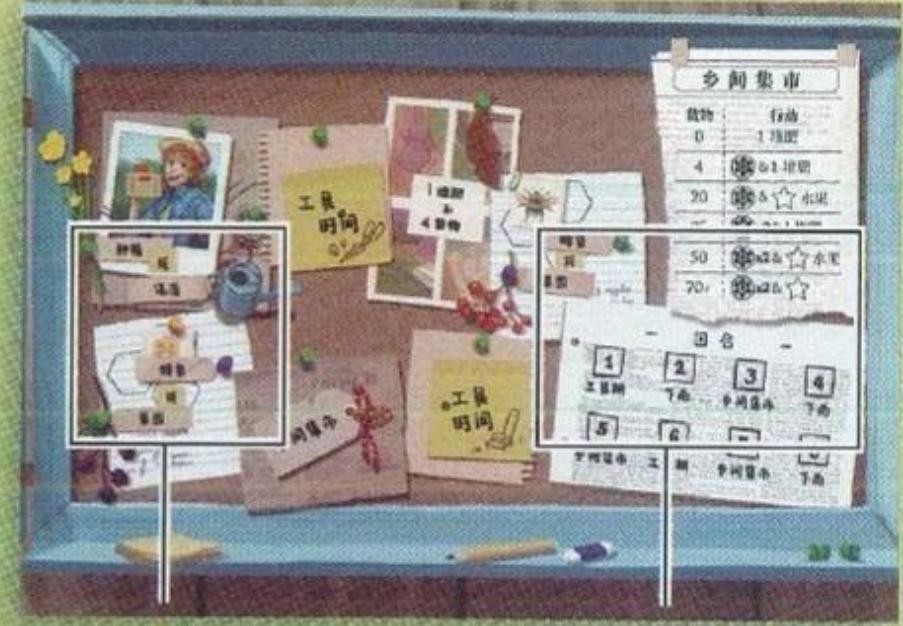


游戏总览
游玩《农场三姐妹》时,你将从行动区选择骰子,再根据骰子执行对应行动。骰子的点数决定你可以在农场的哪里种植或浇灌作物,而骰子所在的位置决定你可以执行哪些区域行动。
当你的作物逐渐成熟,你将收获这些作物,并以此换取货物和分数。工具棚中的工具可以解锁额外奖励,提前为轮末事件做好规划,并和农场中的其他区域产生强力的连锁行动。
在八轮辛勤劳作后,互相比较最终成果,看看谁的收成最为丰厚。
游戏流程
游戏共进行8轮次。每轮分为3个阶段:
1) 计划阶段
2) 农垦阶段
3) 事件阶段
1. 计划阶段
当前起始玩家投掷骰子池中的所有骰子。按照骰子的点数将它们分组(例:1点一组、2点一组、3点一组等等)。
将各组骰子以升序放置到行动区: 点数最小的一组放在农夫伊迪斯指示物所在位置上, 第二小的一组按照顺时针顺序放到下一位置上, 以此类推, 直到所有骰子都被放置。
将农夫伊迪斯指示物放到骰子点数最大的行动区的下一空位上。

示例:在这局四人游戏中,老金投掷了全部6颗骰子,并把它们按照点数分组。最小的一组(2个“1点”)去往农夫伊迪斯所在的“蜂巢或果园”。第二组(2个“2点”)去往“种植或浇灌”。第三组(1个“4点”)去往“工具时间”。最后一组(1个“6点”)去往“1堆肥和4货物”。接着老金让农夫伊迪斯穿过所有位置,来到另一处“蜂巢或果园”。
2. 农垦阶段
每位玩家从行动区中选择一颗可用骰子,并执行对应的农垦行动和区域行动(先后顺序由玩家决定)。当前起始玩家先进行选择并使用骰子,然后由其他玩家按顺时针顺序进行选择。
一旦所有玩家都选择完骰子并执行过对应行动,所有玩家同时使用剩下来的骰子中点数最小的那一颗,并执行对应的农垦行动和区域行动(先后顺序由玩家决定)。
示例:所有四名玩家都选择并使用过骰子后,行动区里还剩下两颗骰子:一颗“2点”位于“种植和浇灌”,还有一颗“6点”位于“1堆肥和4货物”。这颗“2点”是点数最低的骰子,因此四名玩家同时使用它。每位玩家都使用“2点”执行一个农垦行动和一个区域行动。
① 农垦行动
骰子不同的点数对应不同的菜畦(1-6)。注: 园子由1\~6号不同的菜畦组成。
在骰子点数所示的菜畦中,你可以执行以下两种行动之一:
- 种植 - 在所示菜畦种植至多2个作物, 只能涂写那些作物最底部的空格。注意: 除非与其相邻的玉米生长至2格高, 否则你无法种植豌豆。

· 浇灌-浇灌所示菜畦的所有作物, 即为每个已种植的作物涂写下一个空格。
注意:每处玉米高4格。每处豌豆高2格且与一处玉米相邻。南瓜的高度介于1-4格并且分布于菜畦外围。
示例:莉莉选择了一颗“1点”的骰子,而她决定种植作物。她还不能在1号菜畦种植豌豆,所以她种下1个玉米和1个南瓜。阿柯也选择了一颗“1点”的骰子,但他已经在1号菜畦种植了一些作物了,因此他决定浇灌这些作物。他浇灌了所有已种植的作物:2个南瓜、2个玉米和1个豌豆。
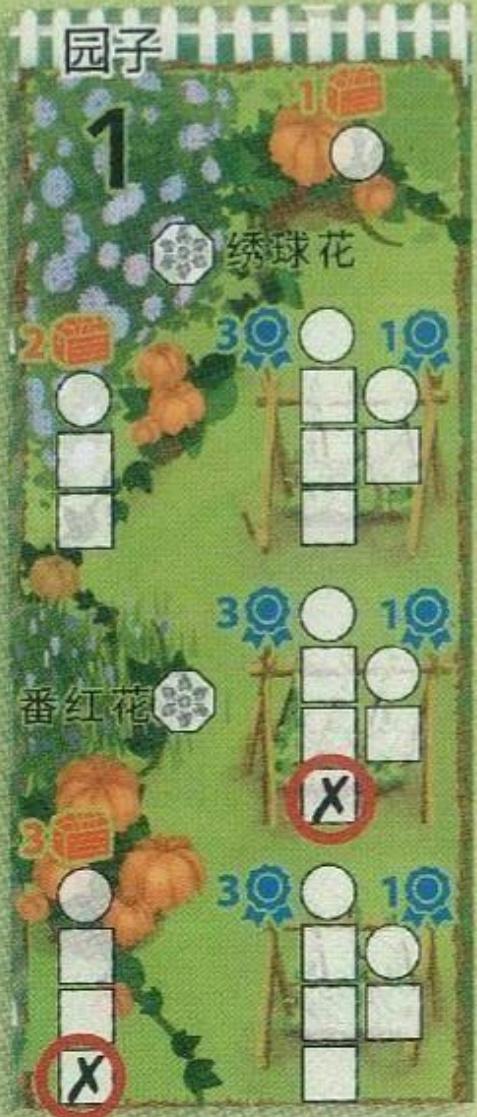
莉莉 - 种植行动

阿柯 - 浇灌行动
② 区域行动
游戏版图中不同位置的行动区域对应着效果不同的区域行动。根据你选择的骰子所在位置,执行该位置所对应的区域行动。

- 种植或浇灌- 在骰子点数对应的菜畦,执行一个种植行动或浇灌行动 (见第4页的农垦行动)。
注意:本次种植行动或浇灌行动是独立于这颗骰子本身具备的农垦行动。
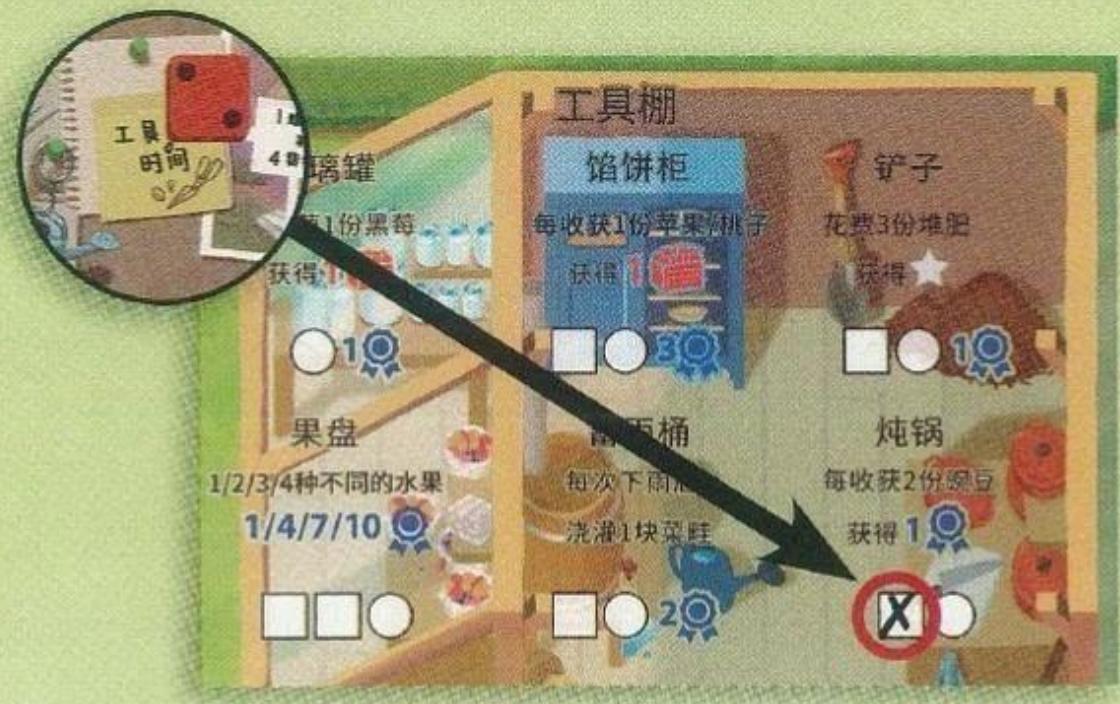
- 工具时间 - 在任何工具上涂写下一个空格。(参考下图)
- 1堆肥和4货物 - 在你的堆肥记录表上涂写下一个空格且在你的货物记录表上涂写下四个空格。
- 蜂巢或果园 - 在你的蜂巢上涂写下一个空格或在你的果园上选择一种水果涂写下一个空格。
· 乡间集市 - 参照乡间集市表, 根据你拥有的货物数量执行表上对应行动。
示例:小艾选择一颗位于“工具时间”的骰子。作为区域行动,她可以涂写任何工具的下一个空格。她涂写炖锅的第一个(共两个)空格。一旦她涂写第二个空格,小艾就将解锁炖锅的游戏终局计分奖励(每收获2份豌豆计1分)
3. 事件阶段
所有玩家同时结算当前事件的效果。每轮发生的事件请参照轮次轨道所示。
- 工具棚 - 执行一次工具棚行动。

- 下雨 - 为你园子中的所有菜畦各执行一次浇灌行动,从1号菜畦开始到6号菜畦结束(见第4页的农垦行动)
· 乡间集市 - 参照乡间集市表, 根据你拥有的货物数量执行表上对应行动。
一旦当前事件结算完毕,该轮结束。将起始玩家指示物向左传递给下一位玩家并向前移动轮次指示物,而后进行下一轮。如果这是第八轮,不传递起始玩家指示物而是直接进行终局计分。
终局计分
一旦8个轮次完成, 游戏立刻结束。现在, 玩家比较最终分数。每位玩家可查看自己的计分纸, 将以下各项计分相加获得玩家最终计分:
· 园子 - 为收获的作物计分。每收获一份玉米价值3分,每收获一份豌豆价值1分。南瓜不计分。
- 花卉 - 根据计分纸, 为已完成的花卉进行计分, 未完成的花卉不计分。为已完成的花卉计分。
- 蜂巢 - 为蜂巢计分。每收获一份蜂蜡价值下列分数 (2/2/5 分) 且每收获一份的蜂蜜价值下列分数 (5/5/8 分)。拥有培育子巢计3分。
- 果园 - 为收获的水果计分。每收获一份苹果价值3分,每收获一份黑莓价值2分,而收获的树莓价值下列分数(1/2/3分)。桃子不计分。
- 工具棚 - 根据计分纸, 为已完成的工具进行计分, 未完成的工具不计分。
得分最高的玩家获胜!如果有玩家打平,平手玩家中拥有最高园子分数的获胜。如果依然有玩家打平,让他们拿起干草叉来上一架……或者就不情不愿地分享下胜利好了。
示例:老金正在加总游戏终局计分。他的园子共计30分,花卉计11分,蜂巢计0分,果园共计15分,最后工具棚带来21分。他的总分为77分。
| 园子 | 30 |
| 花卉 | 11 |
| 蜂巢 | - |
| 果园 | 15 |
| 工具棚 | 21 |
| 合计 | 77 |
乡间集市
不论是通过区域行动还是结算对应事件, 只要你去往乡间集市, 都将你手中的现有货物总数与乡间集市表进行比对, 乡间集市表被印在游戏版图上。
乡间集市表共有6行,每一行都有一个特定的货物数量,且会带来对应的奖励。找到你的货物总数对应哪一行,你的货物总数需大于等于这一行货物数量并小于下一行的货物数量。此时你可以获得这一行对应的奖励。奖励中可能包含多个行动,若有多个行动,你可按任意顺序执行。
- 0+货物 = 获得1堆肥。
- 4+货物 = 执行1次 🌱 花卉行动并获得1堆肥。
- 20+货物 = 执行1次 🌱 花卉行动和1次 ★ 水果行动。
- 35+货物 = 执行2次 🌱 花卉行动并获得1堆肥。
- 50+货物 = 执行2次 🌱 花卉行动和1次 ★ 水果行动。
- 70+货物 = 执行2次 🌱 花卉行动和1次 ★ 奖励行动。
园子
园子里的作物按从下往上的顺序涂写。当你执行一次种植行动时,在对应菜畦中选择至多2个未种植作物,并涂写其最底部的空格。当你执行一次浇灌行动时,为对应菜畦中所有已种植作物涂写其下一个空格。

当你涂写至一个作物的圆圈时,便视为收获该作物。部分作物在收获时会立即为你提供货物,还有部分作物若成功收获则会在游戏终局时提供计分奖励。
· 玉米 - 每个菜畦中有3-5个可供收获的玉米区。每份已收获的玉米在游戏结束时计3分。
- 豌豆 - 每个菜畦里有3-5个可供收获的豌豆区。每份已收获的豌豆在游戏结束时计1分。
注意:除非与其相邻的玉米生长至2格高,否则你无法种植豌豆。
- 南瓜 - 每个菜畦里有1-3个可供收获的南瓜区。当你收获一个南瓜时, 获取所示数量的货物 (1/2/3货物)。当你收获两个相邻的南瓜时, 执行它们之间所示的花卉行动。
示例:当莉莉在此菜畦执行浇灌行动时,她填满了多个不同作物的圆圈并收获它们。已收获的玉米和豌豆会在游戏结束时计分,而已收获的南瓜立即提供货物。此时,因为有两个已收获的南瓜彼此相邻,莉莉可以执行两者之间的花卉行动。这是一个番红花,所以她为花卉区的番红花涂写下一个空格。

✿ 花卉
花卉按从下往上的顺序涂写。当你执行一次花卉行动时,涂写任一花卉的下一个空格。奖励行动也可以用于花卉行动。
当你涂写了特定的空格后,你获得需立即执行的额外行动或持续到游戏结束的奖励。所有完成的花卉在游戏结束时都价值一定分数。
每收获
1份桃子
注意: 鸢尾花和郁金香有持续性增益。若获得的持续奖励优于手中已有的持续性增益, 则将其替换为更优者。

每收获
1份桃子

郁金香
- 执行一次水果行动。
·每收获一份桃子,获得2货物。
- 没有行动或奖励。
· 每收获一份桃子, 获得3货物。
- 没有行动或奖励。
- 游戏结束时每份已收获水果计1分。
绣球花
- 执行一次苹果行动。
- 没有行动或奖励。
- 执行一次黑莓行动。
- 执行一次树莓行动。
- 执行一次桃子行动。
- 游戏结束时计7分。
鸢尾花
- 获得1堆肥。
- 你种植或浇灌时可调整骰子点数, 调整幅度为 +1/-1。
- 没有行动或奖励。
· 你种植或浇灌时可调整骰子点数, 调整幅度为
+2/-2。
- 没有行动或奖励。
- 游戏结束时计12分。
风信子
当你涂写蜂巢的圆圈时,你收获蜂蜡/蜂蜜或立即获得额外行动。所有已收获的蜂蜡/蜂蜜在游戏结束时都获得一定分数。
- 获得2货物。
- 获得2货物。
当你涂写了主蜂巢部分的最后一个空格,你便解锁3个分区。这些新蜂巢依旧从下往上进行涂写,但是你可以在执行养蜂行动时,按照喜欢的方式涂写各个分区。
- 没有行动或奖励。
- 获得2货物。
- 没有行动或奖励。
- 游戏结束时计10分。
番红花
蜂巢按从下往上的顺序涂写。当你执行一次养蜂行动时,涂写蜂巢的下一个空格。奖励行动也可以用于养蜂行动。
- 获得2堆肥。
- 获得1堆肥。
蜂巢
- 获得1堆肥。
- 获得2堆肥。
- 没有行动或奖励。
黄水仙
- 游戏结束时计6分。
- 执行一次工具棚行动。
- 没有行动或奖励。
- 执行一次工具棚行动。
- 执行一次工具棚行动。
- 执行一次工具棚行动。
- 游戏结束时计4分。

- 主蜂巢 - 当你涂写一个圆圈时, 如同所示次数执行1或2次水果行动。
- 蜂蜡 - 共有3份可收获的蜂蜡。当你收获一份蜂蜡时,获得2/4/4货物。已收获的蜂蜡在游戏结束时会根据所示计分(2/2/5分)。
- 蜂蜜 - 共有3份可收获的蜂蜜。已收获的蜂蜜在游戏结束时会根据所示计分(5/5/8分)。
·培育子巢 - 当你涂写一个圆圈时, 获得所示奖励:
- 游戏结束时计3分。
- 在你选择的菜畦执行一次种植行动。
- 执行3次水果行动。
- 在任意所选菜畦执行总共2次种植和/或浇灌行动。可
以在同一菜畦也可以在不同菜畦。
示例:阿柯完成了主蜂巢的搭建,现在他可以让蜂巢发展出三个分区。执行下一个养蜂行动时,他决定涂写蜂蜜区的第一个空格,收获游戏结束时计分的蜂蜜。在他之后的养蜂行动中,他可以再次选择蜂蜜,但也可以选蜂蜡或培育子巢。

果园
水果按从左到右的顺序涂写。当你执行一次水果行动时,涂写任意一排水果的下一个空格。奖励行动也可以用于水果行动。有明确指示时,部分水果行动仅可用于特定水果。
当你涂写至果园中的圆圈时,你就可收获对应水果。部分水果在被收获时会提供额外行动,这些额外行动需立即执行。部分水果立即提供货物,部分水果在收获后会在游戏结束时提供计分奖励。
你也能在收获水果时触发计分纸上其他区的效果,从而获得持续奖励。
- 苹果 – 共有6份可收获的苹果。每份已收获的苹果在游戏结束时计3分。
· 桃子 - 共有4份可收获的桃子。当你收获一份桃子时,在你选择的菜畦执行一次浇灌行动。
- 黑莓 - 共有7份可收获的黑莓。每份已收获的黑莓在游戏结束时计2分。
- 树莓 - 共有9份可收获的黑莓。收获一份树莓,你将获得3货物。特定的黑莓在游戏结束时会根据所示计分(1/2/3分)。

工具棚
工具棚按从左到右的顺序涂写。当你执行一次工具棚行动时,涂写任意一种工具的下一个空格。奖励行动也可以用于工具棚行动。
当你涂写某个工具的圆圈时,你就完成该工具。许多工具在你完成它们之后就提供持续奖励,而且大多数已完成的工具在游戏结束时都价值一定分数。
- 玻璃罐 - 当你收获一份黑莓时, 获得1货物。游戏结束时计1分。
· 馅饼柜 - 当你收获一份苹果或桃子时, 获得1货物。游戏结束时计3分。
·铲子-任何时候,你可以花费3堆肥来执行一次奖励行动。游戏结束时计1分。
- 果盘 – 游戏结束时根据你收获了多少种不同水果来计分: 对于1/2/3/4种不同水果分别计1/4/7/10分。
- 蓄雨桶 - 每次下雨后, 在你选择的菜畦上执行一次浇灌行动。游戏结束时计2分。
- 炖锅 - 游戏结束时每2份已收获的豌豆计1分。
- 华丽标签 - 你前往乡间集市时, 执行一次额外的花卉行动。游戏结束时计2分。
- 蜂巢套装 - 你执行番红花行动时, 同时执行一次养蜂行动。游戏结束时计2分。

·干草叉 - 你执行绣球花行动时, 获得1堆肥。游戏结束时计1分。
- 割草机 - 游戏结束时计6分。
- 独轮车 - 你执行一次工具棚行动时, 获得1货物。游戏结束时计3分。
- 护根土 - 当你执行一次区域行动时, 你可以不执行该行动而选择执行一次花卉行动。游戏结束时计1分。
- 新拖拉机 - 游戏结束时计18分。
- 南瓜刻刀 – 将相连的已收获南瓜视为一条南瓜藤。游戏结束时计算最长的南瓜藤长度,该藤上每个已收获的南瓜计1分。
- 播种机 - 当你执行一次种植行动时,在该菜畦种植至多3个作物(代替2次)。游戏结束时计2分。
货物轨道
游戏开始时你没有货物。当你获得 📁 货物时,在货物轨道上涂写对应数量的空格,涂写顺序为从左到右、从上到下。
当你涂写货物轨道上的星星时,你立即获得一次奖励行动。奖励行动可使你在花卉、蜂巢、果园或工具棚中选取一项涂写其下一个空格。奖励行动不能在园子中使用!
你目前拥有的货物数量决定了你访问乡间集市时会获得哪些行动。

示例:小艾刚收获一份树莓(+3货物),因此她涂写货物轨道接下来的3个空格。其中一个正好是星星!她把这个奖励行动用在蜂巢并收获一份蜂蜡(+4货物),然后涂写货物轨道接下来的4个空格。如果这次又包含另一颗星星,她又能获得另一个奖励行动。
堆肥轨道
你在游戏开始时有1个堆肥。当你获得堆肥时,在堆肥轨道上涂写对应数量的空格。涂写顺序为从左到右、从上到下。
当你种植或浇灌时,你可以花费堆肥调整骰子点数,调整幅度为+1/-1骰子点数。这使得你可在另一个菜畦行动。你可以在单颗骰子上花费多个堆肥。划掉已被花费的堆肥格。
调整时,骰子的点数可以将“6”转到“1”,反之亦然。如果你的区域行动是种植或浇灌,执行两个行动时都要用已调整过的骰子点数。

示例:老金很想在3号菜畦浇灌自己的作物,但是轮到他时只剩下“5点”和“6点”的骰子了。他选择了“5点”的骰子并花费2个堆肥调整该骰子两次。现在,骰子点数已经变为3,老金在可以在3号菜畦浇灌作物了。
单人模式
当你在共享农场努力栽种作物时,可得小心翼翼地避开爱打扰人的农夫伊迪斯。她心肠不坏,但她的多管闲事可能让你的种植大计毁于一旦!
初始设置
照常设置游戏, 但使用游戏版图的单人模式面。用4颗骰子创建骰子池 (与双人游戏相同)。拿取你自己的计分纸, 农夫伊迪斯不需要计分纸。你无需起始玩家指示物。
游戏流程
单人游戏也会进行8轮。以下是针对每一轮中不同阶段的调整。
1. 计划阶段
该阶段与多人游戏规则相同。
2. 农垦阶段

你和伊迪斯交替选择2颗骰子(A、B、A、B)。奇数轮次里你为起始玩家,偶数轮次里伊迪斯为起始玩家。
当伊迪斯拿取自己的第一颗骰子, 若可能, 她总是选择带有金色大头针的蜂巢或果园位置。否则, 她按顺时针方向选择下一颗可用骰子。
无论哪位起始玩家拿取了自己的第二颗骰子时,必须选择剩下的骰子里点数最低的那颗,给另一位玩家剩下一颗的骰子。
3. 事件阶段
你结算当前事件效果,但伊迪斯不结算。
农夫伊迪斯行动
当伊迪斯选择骰子并执行对应行动时, 她总是先执行农垦行动, 然后是区域行动。当她执行行动时, 她在你的计分纸上涂黑, 让那些空格不可用。
“注:伊迪斯的每一次行动都只会按照涂写规则涂黑该行动区的圆形空格,不会涂黑方形空格”
农垦行动
伊迪斯涂黑骰子点数所示菜畦中的一个作物。她根据此优先级系统选择种植的作物:南瓜(从高到低)>玉米(由你选择)>豌豆(由你选择)。她不会在你已种植的作物上涂黑。如果该菜畦的所有作物都已种植,她会跳过此次农垦行动。
“注:伊迪斯每次只会涂黑圆格,例如,伊迪斯在菜畦1中首先涂黑最上方的南瓜,然后下次将会涂黑菜畦1中的中间位置的南瓜,再下次会直接涂黑菜畦1中的下方位置的南瓜。”
说明
- 鸢尾花带来的奖励有着与堆肥一样的运作方式。你可以同时使用两者的效果调整同一颗骰子的点数。
- 当你在单次行动中获得多个额外行动时,你可以按照任意顺序结算这些额外行动。如果你愿意,使用计分纸的“日志”区来记录未花费的行动。
- 在蜂蜡、蜂蜜和树莓区,最后的收获比早期收获收益更高。这些计分是累积的;较高的分数不会替代掉较低的分数。
- 郁金香可以与工具棚的馅饼柜配合,如此一来你收获一份桃子时最多能获得4个货物。
快速参考
1. 计划阶段:
投掷骰子并将它们根据点数分组。按顺时针方向,将骰子组按照升序依次放在行动区域,从农夫伊迪斯指示物所在位置开始。然后,将农夫伊迪斯指示物按顺时针移动到下一个空的位置。
2. 农垦阶段:
根据回合顺序,每位玩家从行动区域选择一颗可用骰子,并执行对应的农垦行动和区域行动。然后,所有玩家同时使用剩余骰子里点数最低的那一颗,执行对应的农垦行动和区域行动。
·农垦行动:
在骰子所示的菜畦,要么种植(涂写两份作物底部的空格),要么浇灌(涂写所有作物的下一个空格)。
·区域行动:
根据你选择的骰子所在位置对应的区域,执行该区域的区域行动。共有五种不同的区域行动。
3.事件阶段:
所有玩家同时结算当前事件。轮次轨道标注每轮会发生的事件。
下载 MarkdownThreeSistersRulesPRINTALT.md
Ben Pinchback & Matt Riddle's
THREE SISTERS
INTRODUCTION
The garden plot in your backyard is tilled and ready. The days are getting longer and the weather warmer. Your kids have come home from camp eager to teach you a gardening method called companion planting.
This technique has been practiced by Indigenous peoples for centuries to grow a trio of crops known as the Three Sisters: corn, beans, and squash. The corn provides a lattice for the beans to climb, the beans transfer nitrogen from the air to the soil, and the squash creates a natural ground cover that reduces weeds and keeps pests away.
Your backyard also includes perennials, an orchard, and even a beehive to pollinate it all. Fill your shed with tools and your garden with compost. Between managing your crops and taking occasional trips to the farmer's market, your summer is going to be packed with activity. Can you grow the best garden in town?
COMPONENTS
• 2 Scoresheet Pads (50x sheets each)
• 1 First Player Marker
• 1 Round Marker
• 1 Farmer Edith Pawn
• 1 Game Board
• 6 Dice
SETUP
1) Position the game board in the center of the table.
2) Place the round marker on the first space of the round track.
3) Place the Farmer Edith pawn on the space of the action rondel that is marked with a golden pushpin.
4) Give each player a complete scoresheet (one sheet from each pad) and a pencil (not provided).
5) Create a pool of dice based on the number of players.
• 2 players = 4 dice

• 3 players = 5 dice

• 4 players = 6 dice

6) Choose a first player at random and give them the first player marker.


OVERVIEW
In Three Sisters, you will select dice from the action rondel in order to take actions in your backyard. The value of the die determines where you can plant or water in your garden, and the location of the die determines which other action you can take.
As your crops grow to maturity, you will harvest them for goods and points. Unlock bonuses from the tools in your shed, plan ahead for round-end events, and trigger delicious action combos in the other parts of your backyard.
After eight rounds of hard work are complete, the end results will be compared to see who can boast the biggest harvest.
GAMEPLAY SEQUENCE
The game is played over eight rounds. Each round has three phases:
1) Planning Phase
2) Gardening Phase
3) Event Phase
1. Planning Phase
The current first player rolls the entire pool of dice. Group the dice by their rolled values (i.e., all 1s, all 2s, all 3s, etc.).
Place the groups of dice on the action rondel in ascending order: the lowest group on the space with the Farmer Edith pawn, the next lowest group on the next space clockwise, and so on, until all groups of dice have been placed.
Advance the Farmer Edith pawn clockwise around the action rondel to the next space after the highest dice group.
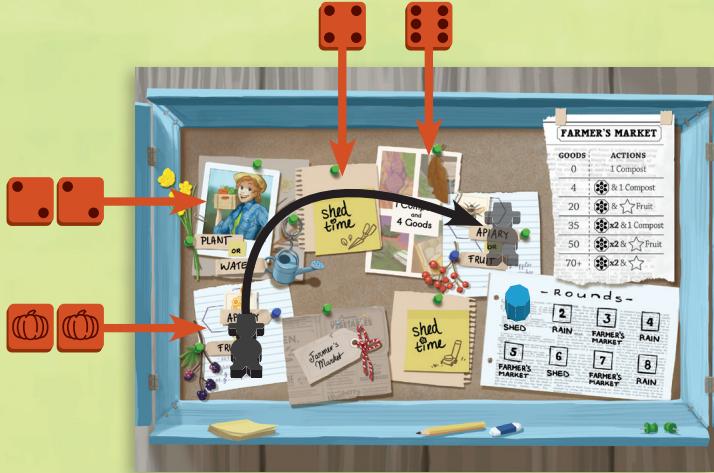
Example: In this four-player game, LJ rolls all six dice and groups them by their values. The lowest group (two “1s”) goes on APIARY OR FRUIT with Farmer Edith. The second group (two “2s”) goes on PLANT OR WATER. The third group (one “4”) goes on SHED TIME. The last group (one “6”) goes on 1 COMPOST AND 4 GOODS. LJ then advances Farmer Edith past all of the groups to the other APIARY OR FRUIT space.
2. Gardening Phase
Each player chooses an available die from the action rondel and takes the corresponding garden action and rondel action (in any order). The current first player chooses first, then each other player in clockwise order.
Once all players have chosen dice and taken the corresponding actions, all players use the lowest remaining die simultaneously, taking both the corresponding garden action and rondel action (in any order).
Example: After all four players have chosen and used their dice, there are two dice remaining on
the action rondel: a $^ { \dprime } 2 ^ { \dprime }$ on PLANT OR WATER and a $^ { \omega } \boldsymbol { 6 } ^ { \prime \prime }$ on 1 COMPOST AND 4 GOODS. The $^ { \dprime } 2 ^ { \dprime }$ is the lowest remaining die, so all four players simultaneously use that die. Each player takes both a garden action and a rondel action with the “2.”
GARDEN ACTIONS
The different die values correspond to different garden zones (1–6). Take a garden action of your choice in the zone indicated by the die.

• Plant – Plant up to two crops in the indicated zone by filling in only the bottom box of each of those crops. Note: Each bean cannot be planted until the neighboring corn is at least two boxes tall.
• Water – Water all crops in the indicated zone by filling in the next empty box of each crop that has already been planted.
NOTE: Each corn is four boxes high. Each bean is 2 boxes high and next to a corn.
Pumpkins vary from 1-4 boxes and are around the outside edge of the garden.
Example: Lilly chooses a “1” die, and she decides to plant crops. She cannot plant any beans in zone 1 yet, so she plants one corn and one pumpkin. Cisco also chooses a “1” die, but he has already planted some crops in zone 1, so he decides to water crops instead. He waters all of the planted crops: two pumpkins, two corn, and one bean.

Lilly- Plant action

Cisco - Water action
RONDEL ACTIONS
The different spaces of the action rondel correspond to different rondel actions. Take the rondel action indicated by the space from which you chose the die.
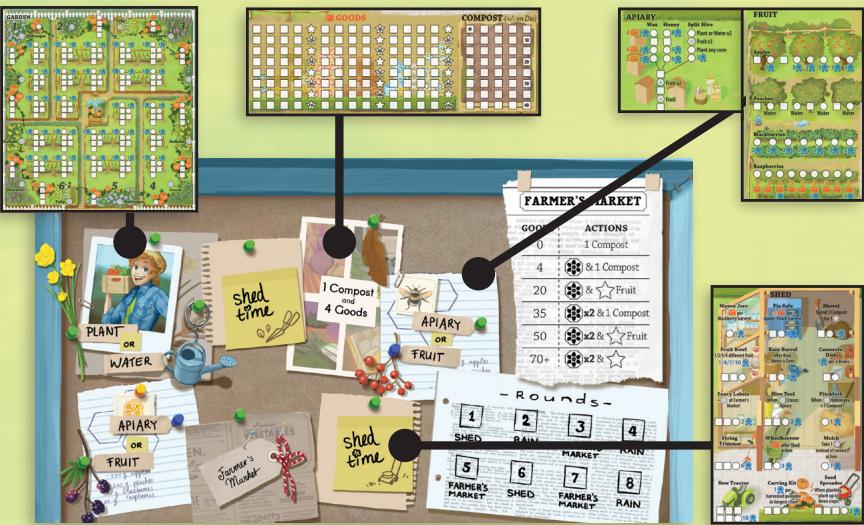
• Plant or Water – Take a plant action -OR- water action in the zone indicated by the value of the die (see GARDEN ACTIONS, pg. 4). Note: This plant or water action is in addition to your garden action for that die.
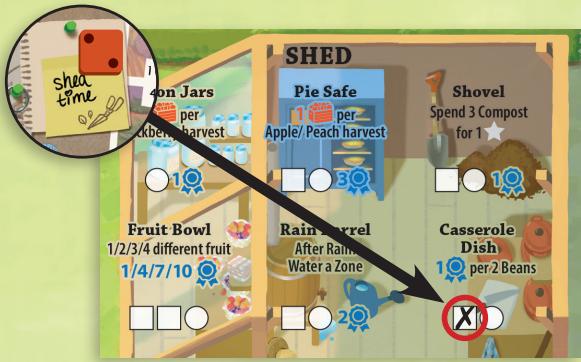
• Shed Time – Fill in the next empty box of any one shed item.
• 1 Compost and 4 Goods – Fill in the next empty box of your compost track -ANDthe next four empty boxes of your goods track.
• Apiary or Fruit – Fill in the next empty box of your apiary -OR- the next empty box of any one fruit.
• Farmer's Market – Consult the farmer's market chart and take actions based on the number of goods you have.
Example: Emma chooses a die from SHED TIME. For her rondel action, she can fill in the next empty box of any shed item. She fills in the first box of the Casserole Dish, which has two boxes total. Once she fills in the second box, Emma will unlock the Casserole Dish scoring bonus for the end of the game (one point per two harvested beans).
3. Event Phase
All players resolve the effects of the current event simultaneously. The event for each round is indicated on the round track.
• Shed – Take a shed action.

• Rain – Take a water action in all zones of your
garden, starting with zone 1 and ending with zone 6 (see GARDEN ACTIONS, pg. 4).
• Farmer's Market – Consult the farmer's market chart and take actions based on the number of goods you have.
Once the event has been resolved, the round is over. Pass the first player marker to the left and advance the round marker. Then proceed to the next round. If this is the eighth round, proceed to the end of the game instead.
END OF THE GAME
Once eight rounds have been completed, the game ends. The players now compare their final scores. To determine final scores, each player reviews their scoresheets and totals their points in the following categories:
• Garden – Score points for harvested crops. Each corn is worth 3 points and each bean is worth 1 point. Pumpkins are not worth any points.
• Perennials – Score points for completed perennials as listed.
• Apiary – Score points for the hive. Each harvested wax is worth points as listed (2/2/5 points) and each harvested honey is worth points as listed (5/5/8 points). Having a split hive is worth 3 points.
• Fruit – Score points for harvested fruits. Each apple is worth 3 points, each blackberry is worth 2 points, and some raspberries are worth points as listed (1/2/3 points). Peaches are not worth any points.
• Shed – Score points for completed shed items as listed.
The player with the most points wins the game! If there is a tie, the tied player with the
| FIN SORE | Garden | 30 |
| Perennials | 11 | |
| Apiary | ||
| Fruit | 15 | |
| Shed | 21 | |
| Total | 77 |
most garden points wins the game. If there is still a tie, the tied players grab pitchforks and fight ... or begrudgingly enjoy their shared victory.
Example: LJ is tallying his final score at the end of the game. He scores 30 points for the garden, 11 points for perennials, 0 points for the apiary, 15 points for fruit, and 21 points for the shed. His final score is 77 points.
FARMER'S MARKET
When you visit the farmer's market, either by taking the corresponding rondel action or by resolving the corresponding event, compare your goods total against the farmer's market chart that is printed on the game board.
The chart has six rows. Each row indicates a certain number of goods and certain actions. Find the highest row that your goods total has reached or passed and take the actions for that row. If there are multiple actions, you may take them in any order.
• 0+ goods = Gain 1 compost.
• 4+ goods = Take 1 perennial action and gain 1 compost.
• 20+ goods = Take 1 perennial action and 1 fruit action.
• 35+ goods = Take 2 perennial actions and gain 1 compost.
• 50+ goods = Take 2perennial actions and 1★fruit action.
• 70+ goods = Take 2 perennial actions and 1 bonus action.
GARDEN
Garden crops are filled in order, from bottom to top. When you take a plant action, fill in the bottom box of up to two unplanted crops in the indicated zone. When you take a water action, fill in the next empty box of all planted crops in the indicated zone.

When you fill in the circle of a crop, you harvest that crop. Some crops provide goods that you gain immediately when you harvest them, and some crops are worth points at the end of the game if harvested.
• Corn – There are 3–5x corn that can be harvested per garden zone. Score 3 points at game end for each harvested corn.
• Beans – There are 3–5x beans that can be harvested per garden zone. Score 1 point at game end for each harvested bean. Each bean cannot be planted until the neighboring corn is at least two boxes tall.
• Pumpkins –There are 1–3x pumpkins that can be harvested per garden zone. When you harvest a pumpkin, gain goods as listed (1/2/3 goods). When you harvest two adjacent pumpkins, take the perennial action shown between them.
Example: When Lilly takes a water action in this zone, she fills in the circles of several different crops, harvesting them. The harvested corn and beans will be scored at game end, while the harvested pumpkins provide goods immediately. Because these two adjacent pumpkins have now been harvested, Lilly takes the perennial action shown between them. It's a crocus perennial, so she fills in the next empty crocus box.

PERENNIALS
Perennials are filled in order, from bottom to top. When you take a perennial action, fill in the next empty box of any perennial. Bonus actions can also be spent on perennials.
When you fll in certain boxes, you gain extra actions that you take immediately or ongoing bonuses that apply for the rest of the game. All perennials are worth points at the end of the game if completed.

NOTE: Iris and Tulip have ongoing bonuses. The higher up bonus replaces the lower bonus when earned.
Tulip
• Take a fruit action.
• When you harvest a peach, gain 2 goods.
• No action or bonus.
• When you harvest a peach, gain 3 goods.
• No action or bonus.
• Score 1 point per harvested fruit at game end.
Hydrangea
• Take an apple action.
• No action or bonus.
• Take a blackberry action.
• Take a raspberry action.
• Take a peach action.
• Score 7 points at game end.
Iris
• Gain 1 compost.
• You may adjust the dice value by +1/-1 when
you plant or water.
• No action or bonus.
• You may adjust the dice value by +2/-2 when
you plant or water.
• No action or bonus.
• Score 12 points at game end.
Hyacinth
• Gain 2 goods.
• Gain 2 goods.
• No action or bonus.
• Gain 2 goods.
• No action or bonus.
• Score 10 points at game end.
Crocus
• Gain 2 compost.
• Gain 1 compost.
• Gain 1 compost.
• Gain 2 compost.
• No action or bonus.
• Score 6 points at game end.
Daffodil
• Take a shed action.
• No action or bonus.
• Take a shed action.
• Take a shed action.
• Take a shed action.
• Score 4 points at game end.
APIARY
The apiary is filled in order, from bottom to top. When you take an apiary action, fll in the next empty box of the apiary. Bonus actions can also be spent in the apiary.

When you fll in the last box of the main hive section, you unlock access to three new sections. These new sections still must be filled from bottom to top, but you may split up your apiary actions among them however you like.
When you fill in circles in the apiary, you harvest wax/honey or gain extra actions that you take immediately. All wax/ honey are worth points at the end of the game if harvested.
• Main Hive – When you fill in a circle, take 1 or 2 fruit actions as listed.
• Wax – There are 3x wax that can be harvested. When you harvest a wax, gain 2/4/4 goods. Score the listed points at game end for each harvested wax (2/2/5 points).
• Honey – There are 3x honey that can be harvested. Score the listed points at game end for each harvested honey (5/5/8 points).
• Split Hive – When you fill in a circle, gain the listed bonus:
- Score 3 points at game end.
- Take a plant action in the zone of your choice.
- Take 3 fruit actions.
- Take 2 plant and/or water actions in zones of your choice.They can be in the same zone or different zones.
Example: Cisco has completed the main hive section of his apiary, so he has access to the three new sections. With his next apiary action, he decides to fill in the first box of the honey section, harvesting honey that will be scored at game end. With his future apiary actions, he can choose honey again or wax or split hive instead.

FRUIT
Fruit rows are filled in order, from left to right. When you take a fruit action, fill in the next empty box of any one fruit row. Some fruit actions must be spent on specific fruit rows when indicated. Bonus actions can also be spent on fruit rows.
When you fill in circles in the fruit rows, you harvest those fruits. Some fruits provide extra actions that you take immediately when you harvest them, some provide goods that you gain immediately, and some fruits are worth points at the end of the game if harvested.
You can also gain ongoing bonuses from other sections of your scoresheet that are triggered by harvesting fruits.
• Apples – There are 6x apples that can be harvested.
Score 3 points at game end for each harvested apple.
• Peaches – There are 4x peaches that can be harvested. When you harvest a peach, take a water action in the zone of your choice.
• Blackberries – There are 7x blackberries that can be harvested. Score 2 points at game end for each harvested blackberry.
• Raspberries – There are 9x raspberries that can be harvested. When you harvest a raspberry, gain 3 goods. Score points at game end for certain harvested raspberries as listed (1/2/3 points).

SHED
Shed items are filled in order, from left to right. When you take a shed action, fill in the next empty box of any one shed item. Bonus actions can also be spent in the shed.
When you fill in the circle of a shed item, you complete that shed item. Many shed items have ongoing bonuses that unlock when you complete them, and most shed items are worth points at the end of the game if completed.
• Mason Jars – When you harvest a blackberry, gain 1 good. Score 1 point at game end.
• Pie Safe – When you harvest an apple or a peach, gain 1 good. Score 3 points at game end.
• Shovel – At any time, you may spend 3 compost to take a bonus action. Score 1 point at game end.
• Fruit Bowl – Score points at game end based on how many different fruits you have harvested: 1/4/7/10 points for 1/2/3/4 different fruits.
• Rain Barrel – After each rain, take 1 water action in the zone of your choice. Score 2 points at game end.

• Casserole Dish – Score 1 point at game end for every 2 harvested beans.
• Fancy Labels – When you visit the farmer's market, take an extra perennial action.
Score 2 points at game end. • Hive Tool – When you take a crocus action, take an apiary action too.
Score 2 points at game end. • Pitchfork – When you take a hydrangea action, gain 1 compost.
Score 1 point at game end.
• String Trimmer – Score 6 points at game end.
• Wheelbarrow – When you take a shed action, gain 1 good.
Score 3 points at game end.
• Mulch – When you take a rondel action, you may forfeit it to take 1 perennial action instead. Score 1 point at game end.
• Shiny New Tractor – Score 18 points at game end.
• Pumpkin Carving Kit – Score 1 point at game end for every pumpkin in your longest consecutive chain of harvested pumpkins.
• Seed Spreader – When you take a plant action, plant up to 3 crops in that zone (instead of 2). Score 2 points at game end.
GOODS TRACK
You start the game with zero goods. When you gain goods, fill in the indicated number of boxes on the goods track. Always fill from left to right and top to bottom.
When you fill in a star on the goods track, you gain a bonus action to spend immediately. Spending a bonus action allows you to fill in the next empty box anywhere in perennials, apiary, fruit, or shed. Bonus actions cannot be spent in the garden!
The current number of goods you have determines which actions you gain when you visit the farmer's market.

Example: Emma just harvested a raspberry (+3 goods), so she fills in the next 3 boxes on her goods track. One of those boxes is a star! She uses this bonus action in her apiary to harvest a wax (+4 goods), so she fills in the next 4 boxes on her goods track. If this had included another star, Emma would gain another bonus action.
COMPOST TRACK
You start the game with one compost. When you gain compost, fill in the indicated number of boxes on the compost track. Always fill from left to right and top to bottom.
When you plant or water, you may spend compost to adjust the die value by +1/-1 in order to target a different garden zone. You may spend multiple compost on a single die. Cross off filled compost boxes when you spend them.
Die values can wrap around from “6” to “1” and vice versa when adjusted. If your rondel action is plant or water, the adjusted die value must be applied to both actions you take with that die.

Example: LJ really wants to water his crops in zone 3, but the only dice available when it is his turn to choose are “5s” and “6s.' Fortunately, he has plenty of compost available. He chooses a “5” and spends two compost to adjust the die value twice. With the die value now adjusted to a “3” instead, LJ is able to water his crops in zone 3.
SOLO MODE
As you work to grow your crops in the local community garden, you must try to avoid the pesky meddling of Farmer Edith. She's a kind-hearted soul, but her interference with your efforts might just cost you your shot at gardening fame!
Setup
Set up the game as normal, but using the solo side of the game board. Create a pool of four dice (as in a two-player game). Give yourself a scoresheet, but Farmer Edith does not need her own scoresheet. You will not need the first player marker.
Gameplay Sequence
The solo game is played over eight rounds as normal. The changes to the various phases of each round are noted below.
1. PLANNING PHASE
Perform this phase exactly as in the multiplayer game.
2. GARDENING PHASE
You and Farmer Edith each choose two dice, in an alternating sequence (A, B, A, B). You are the first player in odd rounds, and Farmer Edith is the first player in even rounds.

When Farmer Edith takes her first die, she always chooses a die from the apiary or fruit space with the golden pushpin (if available). Otherwise, she chooses the next available die in a clockwise direction from there.
When whoever is the first player takes their second die, they must
choose the lowest remaining die, leaving the other player with the lone remaining die.
3. EVENT PHASE
You resolve the effects of the current event, but Farmer Edith does not.
Farmer Edith Actions
When Farmer Edith chooses a die and takes the corresponding actions, she always takes the garden action first and the rondel action second. As she takes actions, she crosses off various things on your scoresheet, which makes them unavailable to you.
GARDEN ACTIONS
Farmer Edith crosses off one crop in the garden zone indicated by the value of the die. The crop she chooses is based on this priority system: Pumpkins (tallest to shortest) > Corn (your choice) > Beans (your choice). She never crosses off a crop that you have already planted. If you have already planted all crops in the entire zone, she passes instead.
RONDEL ACTIONS
Farmer Edith crosses off something in the section of your scoresheet indicated by the space of the action rondel with the die.
• Plant or Water – Farmer Edith crosses off one crop in the garden zone indicated by the value of the die.
Note: This rondel action is in addition to her garden action for that die.
• Shed Time! – Farmer Edith crosses off one shed item. The shed item she chooses is based on the icon (shears or mower) of the action space and the value of the die. She never crosses off a shed item that you have already completed. If you have already completed the chosen shed item or she has already crossed it off, she passes instead.
• Shed A (shears) – Mason Jars (1), Pie Safe (2), Shovel (3), Fruit Bowl (4), Rain Barrel (5), Casserole Dish (6).
• Shed B (mower) – Fancy Labels (1), Hive Tool (2), Pitchfork (3), String Trimmer (4), Wheelbarrow (5), Mulch (6).
• 1 Compost and 4 Goods – Farmer Edith crosses off the next available bonus action on the goods track. You must skip this box entirely when you reach it on the goods track.
• Apiary or Fruit – Farmer Edith chooses one of the two sections and crosses off one empty box in that section. The section she chooses is based on which section is marked with a blue pushpin on the action space. The empty box she chooses is based on the value of the die. If the chosen section has no valid empty boxes, she passes instead.
• Apiary – topmost honey (1–2), topmost wax (3–4), topmost split hive action (5–6).
• Fruit – rightmost apple (1–2), rightmost peach (3), rightmost blackberry (4–5), rightmost raspberry (6).
• Farmer's Market – Farmer Edith crosses off the topmost empty box of one perennial. The perennial she chooses is based on the value of the die: tulip (1), hydrangea (2), iris (3), hyacinth (4), crocus (5), or daffodil (6). If the chosen perennial has no empty boxes, she passes instead.
End of the Game
The game ends after eight rounds as normal. Total your final score and compare it against the chart to determine the outcome of your gardening career!
| Score | Gardening Career |
| 0-39 | You'll have better luck next time! |
| 40-49 | You are ready for the county fair! |
| 50-64 | Your skills have earned you a blue ribbon! |
| 65-79 | You have been crowned a state champ! |
| 80-99 | You have become an internet-famous blogger! |
| 100+ | You have been given your own TV show! |
THE WEATHER EXPANSION
The Weather expansion introduces weather effects that change from one round to the next, adding another layer of tactical decisions. This expansion is available in limited quantities at motorcitygameworks.com.
Setup
Position the weather tile above the game board. Place the weather marker on the foggy space of the weather tile.
Gameplay
The weather tile has six numbered spaces, each corresponding to a different weather effect. The position of the weather marker indicates the current weather effect, which affects all players (see chart below).
At the end of each round, move the weather marker to the space that matches the highest remaining die on the action rondel. NOTE: In solo mode, move the weather marker to the space that matches the last selected die instead.
Example: At the end of the round, there are two remaining dice: a “2” and a “6." Because the highest remaining die is a “6," the weather marker moves to the windy space. During the following round, windy weather will be in effect.

| Weather Type | Weather EffectNo effect. |
| 1) Foggy | |
| 2) Lightning | Players cannot take water actions this round, no matter the sourceThis restriction does not affect rain events. |
| 3) Cold | Players cannot take apiary actions this round, no matter the source. |
| 4) Cloudy | Players take one free perennial action at the start of this round.This effect occurs before the planning phase. |
| 5) Hot | When harvesting fruit this round, players gain one extra good. |
| 6) Windy | When planting crops this round, players must plant one of the cropsin a zone adjacent to the indicated zone. |
ABOUT COMPANION PLANTING
Companion planting – planting certain mutually beneficial crops together – is an agricultural practice that is widely used and praised for its efficiency and productivity in gardens across North America, and it traces its roots back thousands of years to the practices of the Indigenous peoples who first grew crops in this soil. The most wellknown practice of companion planting is the “Three Sisters" method, from which our game takes its name. Maize (corn), beans, and squash (often pumpkins) are the “three sisters” that care for one another as they grow. The corn stalks provide a lattice for the beans to climb, which fix nitrogen into the soil to feed the corn, and the large leafy vines of the squash provide a nice ground cover protecting everything from weeds. This planting method was especially prominent among Mesoamerican nations and was even considered a sacred practice by several Indigenous tribes and First Nations.
While the gameplay in Three Sisters does not focus on the historical roots of companion planting, we are especially thankful for our sensitivity readers who have helped make sure that this game appreciated Indigenous peoples and their influence without appropriating or exploiting their culture. We are so thankful for the two amazing First Nation consultants who helped with this project:
| Ray St. Clair | Beatrice Menase' Kwe Jackson |
| White Earth Chippewa, | Tsimphean/Nicola Anishinaabe |
| Eagle clan, MN | Three Fires Midewewin Lodge |
| Anishinaabe | Bealivetraditions.com |
To learn more about Indigenous peoples and their traditions, practices, and concerns related to food sovereignty, we highly recommend visiting (and supporting) the following organizations:
• First Nations Development Institute, www.firstnations.org
• Partnership With Native Americans, www.nativepartnership.org
• The Anishinaabe Agriculture Institute, www.anishinaabeagriculture.org
CREDITS
Game Design: Ben Pinchback and Matt Riddle
Illustration: Marlies Barends and Beth Sobel
Graphic Design: Chris Kirkman
Editing: Dustin Schwartz
Playtesting: David Studley, Matt Kruse, Dan Cunningham, Andrew Bucholtz, Sarah & Will Reed, Jamie Utley, Brad Bachelor, Don and Kate Liles, Peter McOwen and others we have surely left out due to poor record keeping and we apologize profusely.
Special Thanks: Adam Hill and Corey
“Motor City Gameworks”, the Three Sisters game concept, logo, and all art contained within are © 2021 Motor City Gameworks. All Rights Reserved.

CLARIFICATIONS
• Iris bonuses function the same way that compost does. You may use compost and iris bonuses to adjust the value of the same die.
• When yougain multiple extra actions during a single action, you may resolve those extra actions in any order. If you like, use the “journal" area of your scoresheet to keep track of your unspent actions.
• In the wax, honey, and raspberry sections, the later harvests are worth more than the earlier harvests. The point values for these harvests are cumulative; the higher values do not replace the lower values.
• Tulip can be combined with the Pie Safe in the Shed to gain up to 4 goods when you harvest a peach.
QUICK REFERENCE
1) Planning Phase: Roll the dice and group them by their rolled values. Place the dice groups on the action rondel in ascending order, starting with the space with the Farmer Edith pawn and going clockwise.Advance the Farmer Edith pawn clockwise to the next empty space.
2) Gardening Phase: In turn order, each player chooses an available die from the action rondel and takes the corresponding garden action and rondel action. Then all players simultaneously use the lowest remaining die to take the corresponding garden action and rondel action.
• Garden Action: In the garden zone indicated by the die, either plant (fill in the bottom box of up to two crops) or water (fill in the next empty box of all planted crops).
• Rondel Action: Take the rondel action indicated by the space from which you chose the die. There are five unique rondel actions.
3) Event Phase: All players resolve the effects of the current event simultaneously. The event for each round is indicated on the round track.
下载 Markdown