rules_zh_圣莫妮卡_21041.md

遊戲設計 Josh Wood
支持2-4位玩家, 適合年齡14+
遊戲規則
在《聖莫妮卡》中,玩家們將努力創建一個南加州最具吸引力的海濱城市。是注重自然風光營造一片安逸寧靜的海灘,還是充滿遊客的嬉鬧商業海濱,亦或是介於兩者之間能吸引本地居民的休閒地,一切由你決定。每個回合,你將從展示區選擇一張主題卡牌來構建你的上半部沙灘區或下半部商業區。這些主題的彼此鄰接,會為你獲得勝利分( Mongolia)。遊戲結束時,擁有最多勝利分的玩家贏得遊戲勝利。
遊戲配件
你的《聖莫妮卡》遊戲中包含以下配件。

78張主題卡牌
這些卡牌代表了遊戲中可建造在海濱與街道區域裡的場所。

4張提示卡牌
每位玩家一張提示卡牌,用來提示規則。

6塊初始板塊
每位玩家從一張長條雙面板塊開始規劃自己的城市。

4塊沙錢板塊
這些沙錢板塊代表了在遊戲中,
玩家可以通過支付沙錢來使用的
不同行動。

3塊計分目標板塊
這些板塊列明了每局遊戲的不同計分目標。

30個本地居民
這些藍色標記代表了你城市裡的本地居民。

30個遊客
這些橙色標記代表了前來聖莫妮卡旅遊的遊客。

8個貴賓
這些綠色標記代表了希望造訪特定場所的重要人士。每位玩家在遊戲開始時會獲得1或2個,其列明在各自的初始板塊上。

28枚足跡標記
這些紙板標記用來記錄你貴賓造訪過的地方。

25個沙錢
在遊戲中,可以賺取這些木質標記,並能花費它來執行沙錢板塊上的行動。

4塊錢幣倍數標記
如果沙錢標記即將用盡,則可以使用這些紙板標記來成倍記錄。

1個流動餐車和1個販售小哥標記這些標記會在展示區的下方移動,並給所選擇的卡牌提供特定的獎勵。

1枚起始玩家標記
這枚紙板標記用於提示誰是這局遊戲的起始玩家。遊戲中起始玩家不會改變。

1本計分冊
在遊戲結束時,幫助每位玩家計算得分,並決出遊戲獲勝者。
1份遊戲規則

遊戲設置
-
將主題卡牌充分洗混並形成牌面朝下的牌堆, 然後翻開8張卡牌, 分成兩排, 每排四張。這些後排與前排的卡牌形成主題卡牌展示區, 以供在遊戲中拿取。將剩餘的牌堆放置在展示區後排的上方。
-
隨機選擇2塊沙錢板塊,並將其放置在展示區的左側。這便是在本局遊戲中可供選擇使用的兩個沙錢行動。
-
隨機選擇1塊計分目標板塊,並將其正面朝上放置在展示區的右側。如果是首次遊戲,我們推薦使用藍色的計分目標板塊。
-
將本地居民、遊客、沙錢、錢幣倍數標記以及足跡標記形成供應堆,並放置在展示區的附近,以方便所有玩家取用。
-
最近去過海灘的玩家成為起始玩家, 並給予其起始玩家標記。
-
隨機抽取等同於玩家人數的初始板塊,並放置在桌面中央。按倒序玩家順位(從末尾玩家開始並逆時針輪轉),每位玩家選擇一塊初始板塊。
-
給予每位玩家各自初始板塊上的拼放示獎勵, 以及一張提示卡牌 (如果他們需要)。
-
由末尾玩家選擇, 將流動餐車標記放置到展示區四列中任意一列卡牌的下方, 然後, 販售小哥標記位於兩列外的卡牌下方。
-
現在從起始玩家開始遊戲。
支付4:從前排拿取2張卡牌。
支付2○:
從任意一排拿取1張
2 1

遊戲概覽
玩家的回合將包括為自己的城市選擇並拼放新的主題卡牌,然後執行拼放行動,如:獲得沙錢,吸引新訪客,以及在自己的城市中移動人物。遊戲開始時,所有玩家都會擁有3個公共的計分目標,以及來自於初始板塊的1至2個貴賓。貴賓提供了每位玩家所特有的計分目標,並當你在城市中移動貴賓時,他們會留下足跡標記,並在遊戲結束時給予你得分。另外,每張由玩家選擇的主題卡牌都會拓展得分的可能性,如可供人們進入活動圈的得分,相鄰或連續的場所符號的得分等等。
回合流程
遊戲從起始玩家開始,並按順時針順序輪轉。遊戲一直持續到有一位玩家在自己的城市中拼放了14張主題卡牌,這將觸發最後的一輪。在每位玩家的回合,他們按以下順序執行行動:
-
選擇並拼放主題卡牌
-
執行拼放行動
-
填補展示區
1. 選擇並拼放主題卡牌
你的回合開始時,你可以從展示區中選擇一張主題卡牌,或使用沙錢行動來獲取卡牌。一旦你取得了卡牌,則你需要將其拼放進你的城市。
A1. 從展示區中選擇主題卡牌

展示區有前排和後排之分。你必須從前排中選擇一張卡牌,並拼放進自己的城市。當你填補展示區時,後排展示的卡牌會下移並加入到前排,但除此之外不能選擇。選擇一張主題卡牌,可能會使你獲得來自販售小哥或流動餐車的獎勵。有關這些獎勵的詳細解釋請參閱第7頁。
或 A2. 使用一個沙錢行動
如果你擁有在先前回合中獲得的沙錢, 那麼你可以花費沙錢來使用一個沙錢行動。這一行動將代替常規的選擇, 並且每個回合僅限一次。要激活一個沙錢板塊, (1)支付板塊上所要求的沙錢費用, 然後 (2)根據板塊上所描述的行動執行。如果你使用沙錢行動拿取了販售小哥或流動餐車所在的卡牌, 你不能獲得它們的獎勵, 並且他們不會移動。有關沙錢行動的詳細解釋請參閱第10頁。
如果沙錢行動允許你移動或移除人物,則需要在拼放行動執行完後進行(詳見第6頁和第7頁)。
B. 將主題卡牌拼放進你的城市
遊戲中共有兩種類型的主題卡牌:卡牌上半部繪有海水的海濱卡牌,以及卡牌下半部繪有木板路街道的街市卡牌。
在你的城市中拼放主題卡牌時,有以下兩條規則:

-
海濱卡牌必須被拼放在你城市的上排,而街市卡牌必須被拼放在下排。
-
每張主題卡牌必須與另一張主題卡牌的一邊相鄰, 或與你的初始板塊相鄰。主題卡牌不能彼此斜角相鄰放置, 並且主題卡牌不能疊放覆蓋在另一張主題卡牌上。
有些沙錢行動允許你選擇並放置兩張主題卡牌。只要兩次拼放均滿足規則要求,則可以按任意順序拼放卡牌。
另外有些沙錢行動允許你交換你的兩張主題卡牌。這個交換動作必須在你拼放完你本回合選擇的卡牌後再執行,並且兩次拼放都必須滿足規則要求。如果被交換的主題卡牌上有人物或足跡標記,則它們跟隨主題卡牌一同移動。
主題卡牌詳解
每張主題卡牌根據美術和拼放的符號來決定是海濱卡牌或是街市卡牌。

1. 拼放行動
一旦你拼放了卡牌便能執行該行動,例如獲得沙錢和人物標記,或移動先前已擺放的人物。
2. 計分條件
這些符號指明了每張卡牌在遊戲結束時如何計分。儘管遊戲中有多種類型的計分條件(詳情請參閱第8、9頁),但主要是以下兩種類型:

相鄰分:根據主題卡牌相鄰主題上的場所標籤獲得勝利分。這類計分僅計算一次,即使有多張相鄰的卡牌均符合條件要求。

連續分:根據卡牌所要求的一組相同的場所標籤獲得勝利分。連續分僅在一組標籤中達到最小數字要求後才能計分。有些連續分是按一套計分,而有些則是每個場所標籤計分,允許你在超過最小標示數量要求時計得更多的勝利分。
3. 場所標籤
這些符號表示卡牌的類型,並且在遊戲結束時,可通過你的貴賓以及計分條件來獲得勝利分。場所的類型如下:

當地地標:這些地點是本地居民生活和喜歡聚集的場所。當然,遊客也能前往這裡,如果他們知曉這些地方的話。

旅遊地標:這些地點是遊客們樂於前往的地方。有些是旅遊雜誌上推薦的網紅地和餐館,而另一些則是本地人絕不會去的宰客點。

商業區:這是一些來訪客樂於花錢購買些小禮品、日用品或美食的地點。你懂的,這就是商業嘛。

文體區:這是一些訪客能夠健身、衝浪或嬉戲的體育場所。有時這個標籤也表示了人們能購買體育用品的地方。

自然景區:這裡是展示你城市中優美風光的地點,或是周邊一些簡單的花卉植物或棕櫚樹。

衝浪勝地:這裡是一些適合游泳、衝浪或欣賞海景的地點。有些地方會有令衝浪者們興奮不已的驚濤巨浪。
4. 活動圈
要獲得指定的勝利分,你必須在遊戲結束時滿足卡牌上活動圈所要求的合適人選。這些符號顯示了場地所能容納的人士類型和確切數量。所有不在活動圈裡的人們被視為閒逛的人士。
5. 足跡得分
每塊初始板塊都有一個針對在遊戲中放置足跡標記的特有計分方式。當你的貴賓造訪過其感興趣的場所時,你會放置一枚足跡標記到該卡牌上。在遊戲結束時,每張具有足跡標記的主題卡牌都能按計分規則計算勝利分。
2. 執行拼放行動
你主題卡牌上的拼放行動會顯示有一些符號,或在你的城市中增加人物,或給予你沙錢,或允許你移動你先前回合中已放置的人物。並非所有的卡牌都有拼放行動,但多數卡牌都會有。
獲得標記

這個符號告訴你從供應堆中拿取一定數量的沙錢。在本例中,你將拿取2個。沙錢可以放在你面前的任何地方,但它們不屬於你城市的一部分;它們是在未來回合中可以花費的貨幣,以用來執行沙錢行動,或在遊戲結束時可能被轉換為勝利分。
沙錢耗盡了怎麼辦?根據你的策略,你可能嘗試收集大量的沙錢。在這種局面時,如果木質沙錢標記耗盡,你能夠使用錢幣倍數標記。如果你擁有5個沙錢,將4個放回供應堆,並將餘下的1個放置到錢幣倍數標記上,以記作5。你可以將沙錢標記疊放在錢幣倍數標記上,以記作10,甚至15。

12個沙錢

這個符號告訴你必須被加入到卡牌上的人物顏色(類型)與數量。這是強制行動。在本例中,你將從供應堆中拿取兩名本地居民,並將他們放置到卡牌上。
移動人物

這個符號告訴你可以移動的人物顏色(類型)、數量以及移動力,表明了你能移動多少人物以及移動多遠。這是可選行動。在本例中,你能夠最多移
動4名不同的遊客,每名遊客最多移動2格。這些人物能獨立移動;他們無需從同一張卡牌出發,或前往同一張卡牌。你不能移動同一個人物多次。

這個彩色符號是“百搭”,允許你移動你城市中任何一種顏色(類型)的人物:本地居民、遊客或貴賓。但是不能被用來移動販售小哥。
當移動人物時,你僅能將他們往上、下、左或右移動,但不允許斜向移動。每張卡牌算作1格,而初始板塊算作2格(海濱區域1格,街市區域1格)。人物不能被移動到空檔區,他們僅能被移動到已被拼放的主題卡牌上。卡牌上的活動圈不視為獨立的一格;如果有人物在卡牌上,其能隨時加入或移出活動圈。

貴賓和足跡
如果你移動貴賓,你可以在你的城市中增加足跡標記。查看你的初始板塊,確認哪些場所是吸引你貴賓前往的地點。如果你的貴賓移動到或經過了其感興趣的主題卡牌,放置1枚足跡標記到該卡牌上。注意,足跡標記會為主題卡牌上的每個感興趣的標籤計分,但每張卡牌僅能放置1枚足跡標記,即使貴賓多次前往。

如果你貴賓感興趣的標籤已在你的初始板
塊上,則你在遊戲開始時便放置一枚足跡標記到你的初始板塊上。
販售小哥與流動餐車

在你的回合中,這是另一種你能獲得並移動標記的方法。在展示區的下方,有兩個木質標記:流動餐車和販售小哥。如果執行的是常規的主題卡牌選擇行動,則你選擇這2個木質標記上方的卡牌,你將會獲得額外的獎勵。如果你使用的是沙錢行動,則不會獲得這些獎勵。
獎勵如下:
流動餐車:流動餐車增加了主題卡牌的價值。從供應堆中拿取1個沙錢。
販售小哥:販售小哥允許你移動任意一個人物(本地居民、遊客或貴賓)一格。
販售小哥與流動餐車:當販售小哥與流動餐車在一起時,便是幸福的一日。你可以獲得一個沙錢並移動一個人物,或者你可以選擇一個行動執行兩次,拿取兩個沙錢,或移動最多兩個人物各一格或一個人物兩格。
當你從販售小哥或流動餐車獲得獎勵時,標記會向右移動一格。如果其在展示區的邊緣,則環繞移動,你將標記放置到展示區最左邊的卡牌下方。如果你選擇的主題卡牌下方同時有販售小哥和流動餐車,則僅將流動餐車向右移動兩格,代替每個標記各向右移動一格。
3. 填補展示區
如果前排留有空位,則立即將其後排的卡牌移入。然後從主題卡牌堆中翻開新的卡牌填補進後排空位中。現在,下一位玩家開始他的回合。

遊戲結束
當一位玩家拼放了自己的第14張主題卡牌(初始板塊除外),則觸發遊戲結束。本輪持續到末位玩家完成自己的回合,然後遊戲結束。
隨後,玩家們為自己的所有人物進行“最終移動”。每名遊客和貴賓能夠各移動一格,而每名本地居民能夠最多各移動三格。當所有的玩家移動完自己的人物後,玩家們計算自己城市的得分並決定遊戲獲勝者。
卡牌計分
這裡共有兩種計分類型,一種是依據你卡牌上的場所標籤和其它符號來計分,而另一種是依據你未花費的沙錢來計分。
相鄰分

相鄰的符號包含兩重信息,一個是勝利分值,另一個是場所標籤。如果有一張或多張具有該標籤的卡牌與本卡牌相鄰,則你獲
得所列明的勝利分。相鄰卡牌上的相同標籤不重複計算。
在本例中,如果與其相鄰的卡牌中至少有一張卡牌具有旅遊地標標籤,則你將獲得2點勝利分。相鄰的獎勵不會累計,即便有兩張相鄰的卡牌具有圖片所示的標籤,你仍然僅能計算一次勝利分。

相鄰不僅局限於場所標籤。有些相鄰會涉及其它屬性,例如沙錢或人物。
因此,這是那些會因相鄰的拼放行動符號而觸發的計分,而並不是實際移動物件。
連續分

與相鄰分類似,一個連續符號內包含了場所標籤和一個數字,以及可獲得的勝利分。如果本卡牌所連續的場所標籤滿
足或超過其左側的數字,則你獲得所示的勝利分。
連續的標籤無需保持一條直線。它可以曲折環繞你的城市,只要每張連續的卡牌至少與另一張具有該標籤的卡牌相鄰。
連續分(接前述)

籤中每有一個對應的標籤獲得相應的勝利分。
某些時候,連續分會有一個持續計分條件。遇到這種情況時,在連續的標獲得相應的勝利分。
在上述的圖例中,要為這張卡牌計分,你至少需要有5個連續的自然景區標籤,並且每個自然景區標籤你獲得1分勝利分,共計5分。如果你有7個連續的自然景區標籤,則獲得7分勝利分。如果你只有4個連續的自然景區標籤,則你不滿足連續的最小需求,因此計得0分勝利分。
未花費的沙錢

具有這種符號的卡牌,會在遊戲結束時,給予你未花費的沙錢勝利分。
在本例中,你每剩餘2個沙錢將獲得1分勝利分。這些能力可以累積計算;你能為每張具有這種能力的卡牌,計算你剩餘的沙錢。因此,例如,如果你4個沙錢,一張2:1卡牌,和一張1:1卡牌,那麼你將因2:1卡牌計得2分,而1:1卡牌計得4分,共計6分勝利分。
其它
聖莫妮卡是一個多彩而熱鬧的地方,有些主題卡牌無法一一列明。主要計分類型中沒有涵蓋的內容,請參閱第10頁的“能力說明”章節。
活動圈的計分


每片場地符號都繪有人物的數量與勝利分。如果在遊戲結束時,場地內包含了圖片所指定數量的人物,則獲得對應的勝利分。活動圈僅能容納圖片所示數量的人物,不可更多。
在本例中,活動圈中的一名遊客會計得3分勝利分。如果是彩色符號,則活動圈內可以容納一名本地居民、遊客或貴賓。
遊戲中有兩張主題卡牌繪有“任意數量人物”的符號。
針對這種卡牌,你必須至少有一名人物才能獲得計分,並且計得3分勝利分。後續,你可以按你所願在本片活動圈內放置任意數量的人物。但是,僅會計得3分勝利分。
足跡計分
1: 街市上造訪過的每個

你的初始板塊允許你計算你的足跡標記勝利分。每張具有足跡標記的卡牌,計算其卡牌上符合要求的標籤數量並計得勝利分。每個標籤都會為你計得勝利分。
因此在本例中,如果你在一張具有2個當地地標標籤的卡牌上放置有足跡標記,則你將獲得2分勝利分,而非1分。
目標計分
在遊戲設置時會選擇一塊計分目標板塊,因此你會知道整局遊戲的目標。每塊目標板塊列明以下三件事:
-
海浪獎勵
-
其它獎勵
-
遊戲結束時, 未在活動圈中的人物懲罰。
詳情請參閱第11頁的“目標計分說明”章節。
計算你的總分
為計分冊上的每一行清算桌面上的得分。然後將每位玩家的勝利分分別加總。具有最多勝利分的玩家贏得遊戲勝利。如果出現平局,剩餘最多沙錢的平局玩家贏得遊戲勝利。如果依舊平局,具有最長連續標籤的平局玩家贏得遊戲勝利。如果還是平局,則下一位在沙灘中寫下“我贏了”的玩家贏得遊戲勝利。
聖莫妮卡行動與能力指南
沙錢行動
支付4:從前排拿取2張卡牌。1→1
支付4:從前排拿取1張卡牌以及它同列的後排卡牌。
支付2:從任意一排拿取1張 1
支付2:從任意一排拿取1張
支付3:從後排拿取1張卡牌。41
支付2:從前排拿取1張卡牌。交換你城市中的2張卡牌。21
支付2:
從前排拿取1張卡牌,
交換你城市中的2張卡牌,
從你城市中移除0-2。
支付1:從前排拿取1張卡牌。31
要使用本行動,你必須支付4個沙錢到供應堆中。從展示區前排拿取2張主題卡牌,並將它們拼放進你的城市。你還可以移動一個任意類型的人物一格。
要使用本行動,你必須支付4個沙錢到供應堆中。從展示區前排拿取1張主題卡牌,以及和它同列的後排主題卡牌,並將它們拼放進你的城市。你還可以移動一個任意類型的人物一格。
要使用本行動,你必須支付2個沙錢到供應堆中。從展示區的任意位置拿取1張主題卡牌,只要其含有當地地標或旅遊地標標籤。然後你可以移動最多兩個任意類型的人物各一格。
要使用本行動,你必須支付2個沙錢到供應堆中。從展示區的任意位置拿取1張主題卡牌,只要其含有商業區、自然景區或文體區標籤。然後你可以移動最多兩個任意類型的人物各一格。
要使用本行動,你必須支付3個沙錢到供應堆中。從展示區後排拿取1張主題卡牌。然後你可以移動最多四個任意類型的人物各一格。
要使用本行動,你必須支付2個沙錢到供應堆中。從展示區前排拿取1張主題卡牌,隨後你可以交換你城市中任意兩張主題卡牌。然後你可以移動最多兩個任意類型的人物各一格。
要使用本行動,你必須支付2個沙錢到供應堆中。從展示區前排拿取1張主題卡牌,隨後你可以交換你城市中任意兩張主題卡牌。最後,你可以從你的城市中歸還最多兩個人物到供應堆中。
要使用本行動,你必須支付1個沙錢到供應堆中。從展示區前排拿取1張主題卡牌。然後你可以移動最多三名遊客各一格。
能力說明
:5
這種連貫的相鄰標籤能力,意味著該卡牌必須相鄰2個或更多該標籤的卡牌。否則,不計分。
:8
本卡牌必須與全部四項標籤相鄰才能計分。如果只相鄰一至三項標籤,則不計分。
←:2←:2
當標籤相鄰分並排印製,其意味著你能分別或同時計得勝利分。本卡牌將允許你因相鄰的自然景區計得2分勝利分和/或因相鄰的旅遊地標計得2分勝利分。
[:3 / :5]
這種計分需求為二選一。如果僅與一個衝浪勝地標籤相鄰,則計得3分勝利分。如果與兩個或多個相鄰,則計得5分勝利分。
:2
如果本卡牌與任何有活動圈的卡牌相鄰,無論活動圈分需求滿足與否,獲得2分勝利分。
:2
如果本卡牌不與有活動圈的卡牌相鄰,則獲得2分勝利分。
:3
本卡牌要計分,其必須與一張在拼放行動中有給予沙錢的卡牌相鄰。
-4
如果本卡牌三邊中的任意一邊與一張在拼放行動中有給予人物的卡牌相鄰,則會獲得負分。
2:1
你的城市中每有兩個旅遊地標標籤,則獲得1分勝利分。
移動最多3 到這裡
你可以移動3個任意類型的人物到本卡牌,無視距離。

本卡牌標示著你的沙灘盡頭,並且必須是位於最左側的海濱卡牌。當拼放本卡牌時,其會視為後續遊戲中的第三條拼放規則。因此,本卡牌永遠無法與其它主題卡牌交換位置。

悠長週末

一張在拼放行動中有給予人物的
遊戲概覽
《悠長週末》為聖莫妮卡增加了許多有趣的活動節目。在主題卡牌牌堆中會增加12張活動節目設置卡牌。在一位玩家的回合,選擇主題卡牌時,如果其中有活動節目設置卡牌,則他們可以改為選擇拿取活動節目設置卡牌。活動節目設置卡牌可以按正常規則從前排拿取,或使用沙錢行動來拿取。如果你從前排拿取活動節目設置卡牌,你依然獲得流動餐車和/或販售小哥的獎勵。活動節目設置卡牌上沒有場所標籤,因此你不能使用需要場所標籤的沙錢行動來拿取活動節目。當玩家拿取活動節目設置卡牌時,其立即將其棄除並從兩張牌面朝上的活動節目卡牌中拿取一張,將其拼放進自己的城市。
活動節目卡牌與常規的主題卡牌運作方式類似,除了它們相當於兩倍寬度的主題卡牌。在人物移動時,活動節目卡牌視為1格。每張活動節目設置卡牌上具有兩種符號獎勵中的一種。這些符號表示了當卡牌被拿取時,其他每位玩家獲得的獎勵:其他每位具有5個或更少沙錢的玩家獲得1沙錢,或者其他每位玩家可以移動最多2個人物各1格。回合結束時,填補活動節目,以確保有2張牌面朝上的活動節目卡牌。
目標計分說明
你最長的群落中,每個,2。

找出你最長的一個標籤群落。在該群落中,每有一個你獲得2分勝利分。一個群落包含連續的1個或多個。如果你有兩個數量相等的最長群落,則你僅為其中之一計分。
你最長的□中,每個標籤2💡。
找出你最長的一個非衝浪勝地標籤群落,並且每個標籤獲得2分勝利分。如果你有兩個或更多平手的最長群落,則僅為其中之一計分。只要具有連續的相同類型的標籤均可算作群落。你無需卡牌上擁有□才得以計算。
具有最多閒逛 🏠 的玩家, 獲得-4 📄, 次位玩家, -2 📄。
閒逛的人士表示在遊戲結束時,不在活動圈內的人物。玩家間相互比較誰具有最多的閒逛人士。最多的玩家失去4。如果有兩位或多位玩家的最多閒逛人士的數量相同,則所有這些玩家同時失去4,並且沒有第二名。
每個獨立的群落,3。

要滿足這個目標,你希望盡可能地分隔你的衝浪勝地,在它們之間拼放其它主題。一個群落包含連續的1個或多個。
你每個具有三個或更多同一標籤的群落,3。
任何時候,你有三個或更多非衝浪勝地的同一標籤相連,獲得3分勝利分。如果你有六個或更多同一標籤相連,其依然僅能算作一次。如同衝浪勝地一樣,分隔開你的標籤以獲得最大勝利分。你無需卡牌上擁有□才得以計算。
每張具有閒逛的卡牌,-1。
任何具有一名或多名不在活動圈內的人士的卡牌,-1分勝利分。與該卡牌上的人數無關,所以盡力將你的閒逛人士聚集在一起。
每個群落,計得1|3|6|10。

一個群落包含連續的1個或多個。計算群落中的數量,並獲得對應的。每個具有1片衝浪勝地的群落,計得1分勝利分。每個具有2片衝浪勝地的群落,計得3分勝利分。每個具有3片衝浪勝地的群落,計得6分勝利分。每個具有4片衝浪勝地的群落,計得10分勝利分。
在你最大的海濱和街市成對群落中, 每有一對, 1。
查看你的城市中,同時具有海濱卡牌和街市卡牌的列。包括你的初始板塊。計算最大且不間斷的成對(同列海濱/街市卡牌視為一對)群落,其中每有一對獲得1分勝利分。
你每有一片滿員的活動圈,1。每有兩名閒逛的,-1。
一片滿員的活動圈代表一個活動圈中正好擁有其繪有的計分需求所需人數的人士。你每有一片這類的活動圈,獲得1分勝利分。計算你城市中所有閒逛的人士數量,每有兩名閒逛人士,失去1分勝利分。位於尚不“滿足”計分條件的活動圈內的人士,不視為閒逛的人士。兩張“任意數量人物”的活動圈,只要有一人在內便被視為滿足需求。
常見問題
如果我是用沙錢能力允許我移動人物(或如果我觸發販售小哥能力),我能移動我本回合放置的人物嗎?
可以。你完成所有卡牌的拼放並獲得所有獎勵後,再開始移動你的人物。你可以移動你當回合獲得的人物。
貴賓從哪個位置開始?
貴賓從初始板塊的下半部分開始出發。
我的初始板塊允許我訪問文體區和自然景區獲得1分。如果我的貴賓訪問的卡牌同時擁有這兩種標籤,我獲得1分還是2分?
2分!每個標籤1分。
遊戲配件
12張活動節目布置卡牌
1塊計分目標板塊
14張活動節目卡牌
1枚樹苗標記
遊戲設置
按常規規則進行遊戲設置,以下設置除外:將12張活動節目布置卡牌洗入主題卡牌牌堆。在選擇計分目標板塊時,將新的計分目標板塊加入其它3塊板塊中。洗混14張大尺寸活動節目卡牌,形成牌面朝下的活動節目牌堆,並放置到所有玩家均能拿取的地方。從活動節目牌堆展示2張卡牌,使其牌面朝上。

活動節目卡牌詳解
衝浪競賽(LW1):如果放置3個本地居民到活動圈中,則你的城市中每個你獲得1(包括本活動節目上的)。
沙灘電影之夜(LW2):如果放置本地居民、遊客和貴賓各1個到活動圈中,獲得7。
救生員訓練日(LW3):如果本卡牌與2個活動圈相鄰獲得3♂;如果與3個活動圈相鄰,獲得6♂;如果與4個活動圈相鄰,獲得9♂。你僅可以使用其中之一計分。計分與活動圈是否滿員無關。
企業團建(LW4):遊戲結束時選擇另一位玩家,並找出其最長的群落。該群落中的一種類型的場所標籤每個1。
奢華婚禮(LW5): 你的城市中每張繪有婚禮場景的卡牌(包括本卡牌), 獲得3。(卡牌1、2、7和19)
沙雕藝術節(LW6):如果不與相鄰,獲得2。本卡牌上有4個獨立的活動圈。如可能你可以滿足其中任意數量的活動圈。
農貿市集(LW7):你的城市中每有2個本地居民,獲得1。
致謝名單
遊戲設計: Josh Wood
美術: Jeremy Nguyen, Josh Wood
項目總監: Nicolas Bongiu
產品:Dave Lepore
開發:Scot Eaton, John Goodenough
美術指導:Josh Wood
圖形設計:Brigette Indelicato
規則:Scot Eaton, John Goodenough
編輯:Andre Chautard
中文翻譯: 譚鈞頤
中文製作:譚鈞頤
中文校對:賈晨
遊戲測試:
Neil Baumgartner, Dane Bjorkman, Nancy Bjorkman, John Borders, Chris Buskirk, Matt Champagne, Andre Chautard, Timothy Daggett, Kristina Eaton, Al Gonzalez, AJ Harris, Brian Henk, Mara Kenyon, Neil Kimball, Jon Perry, Rich Pizann, Taylor Shuss, John Till, Andrew Voigt, Dustin Winebrenner, Ethan York, Gerrod Garcia, Jayson Jewett, Michael Jaslrut, Hideaki Asto, Ivan Coronado, Francisco Aguayo, Jay Vales, Jesse Mark, Jaye R, Seany G., Matt Bahntge, Ta-Te Wu, Samir Shah, Robert Neff, Dustin Dobson
特別感謝加州的聖莫妮卡和威尼斯,那裡美麗的海灘激發了無數藝術家的靈感,並吸引著更多的人們前往。


© 2020 Alderac Entertainment Group版權所有
《聖莫妮卡》中文版經Alderac Entertainment Group授權,由遊人碼頭獨家代理發行。遊人碼頭及遊人碼頭標識是遊人碼頭(上海)玩具有限公司的註冊商標。任何單位及個人未經版權方及代理方的書面許可,不得翻印本產品內的任何內容,違者必究。中國生產。
警告:內有細小配件,有窒息風險!不適合3歲及以下兒童使用。

Josh Wood是《Cat Lady》的遊戲設計師,同時也為AEG開發了眾多遊戲,包括:Ecos: First Continent和Tiny Towns。他居住在加州的洛杉磯。他熱衷於製作遊戲,以及在遊戲大會中與人交流。
我要感謝我的家人, 朋友以及我的女友Kathleen Scott。我要感謝所有《Cat Lady》的粉絲以及所有我在遊戲業內遇到的朋友。感謝所有信任《聖莫妮卡》的朋友: John Zinser, John Clair, Daryl Andrews和Andre Chautard。
最後,我要隆重感謝我的朋友Jeremy Nguyen,當我們為遊戲中構想出有趣的店名與地區時,他也數日與我並肩作戰,揮灑著他的畫筆。

Santa Monica Rulebook.md

A game by Josh Wood for 2-4 players ages 14+
Rules
In Santa Monica, you are trying to create the most appealing oceanfront in Southern California. You can choose to create a calm, quiet beach focusing on nature, a bustling beach full of tourists, or something in between to appeal to the locals. Each turn, you will draft a feature card from the display to build up either your top-row beach or your bottom-row street. These features will work together with chains and adjacencies to gain you victory points ( ). The player with the most points at the end of the game wins.
Components
Your game of Santa Monica should include the following components. If it does not, please contact customerservice@alderac.com for assistance.

78 Feature Cards
These represent the beach and street locations that may be built in the game.
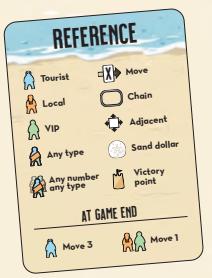
4 Reference Cards
Cards given to each player to remind them of rules.

6 Starting Feature Tiles
Each player will start with one of these double-high tiles in their city.

4 Sand Dollar Tiles
These double-sided tiles feature diferent actions that players may pay sand dollars to use during the game.

3 Scoring Objective Tiles
These tiles list diferent scoring objectives for each game.

30 Locals
These blue tokens represent the local residents of your city.

30 Tourists
These orange tokens represent the visitors that come to Santa Monica.
8 VIPs

These green tokens represent Very Important Persons who want to visit certain types of locations. Each player receives one or two at the beginning of the game, as noted on their Starting Feature Tile.

28 Footprint Tokens
These cardboard tokens are used to mark the places that your VIP has visited.


25 Sand Dollars
These wooden tokens are earned throughout the game and can be spent to carry out the actions on the Sand Dollar Tiles.

4 Sand Dollar Multipliers
These cardboard tokens can be used if the Sand Dollar supply is running low.
1 Food Truck Token and 1 Foodie Token
These tokens move beneath the display and provide bonuses for choosing cards.

1 Start Player Token
This cardboard token is a reminder of which player started the game. It stays with that player.
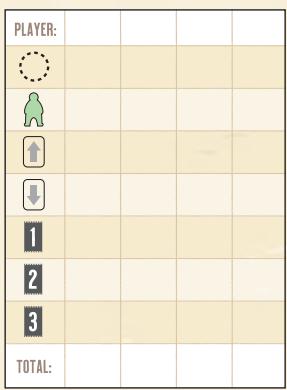
1 Scorepad
This is used at the end of the game to help total each player’s points and determine the winner.
1 Rulebook

Setup
-
Shufle the Feature Cards to form a face-down deck, and deal out 2 rows of 4 cards each face-up. These back and front rows form the display of feature cards that are available to take during the game. Place the remaining deck above the back row of the display.
-
Randomly select and place 2 of the Sand Dollar Tiles to the left of the display. These will be the 2 Sand Dollar Actions available in this game.
-
Randomly select 1 of the 3 Scoring Objective Tiles and place it face-up to the right of the display. For your first game, we recommend using the blue scoring objective card.
-
Place the Locals, Tourists, Sand Dollars, Sand Dollar Multipliers, and Footprint Tokens in piles somewhere near the display so that all players can reach them.
-
The player who has most recently visited a beach becomes the Starting Player. Give them the Start Player Token.
-
Randomly draw Starting Feature Tiles equal to the number of players and place them on the table. In reverse player order (beginning with the last player in the turn order and moving counter-clockwise), each player chooses a starting feature tile.
-
Give each player their starting feature tile’s Placement Bonuses, and a Reference Card if they would like one.
-
The last player in the turn order places the Food Truck Token under any of the 4 display columns of their choice. The Foodie Token begins 2 spaces (cards) away.
-
The starting player can now begin the game.


REFERENCE
Game Overview
Players’ turns will consist of choosing and placing new feature cards for their city, then taking placement actions to gain sand dollars, attract new visitors, and move people around their city. All players will begin the game with 3 common scoring goals, and a starting tile with 1 or 2 VIPs. The VIPs ofer each player a unique scoring objective, and as you move them around the city, they will drop footprint tokens that will grant points at the end of the game. In addition, individual feature cards that are selected by players will expand the range of possibilities for scoring with activity rings for people to move to, points for adjacent and chained location symbols, and more.
Turn Order
Play begins with the starting player, and moves clockwise around the table. The game will continue until one player has placed 14 feature cards in their city, which triggers the final round. On each player’s turn, they will take actions in the following order:
- Select and Place Feature Cards
2. Take Placement Actions
- Refresh the Display
1. Select and Place Feature Cards
To begin your turn, you will either select one feature card from the display or use a sand dollar action to acquire cards in a diferent way. However you acquired the cards, you will place them in your city.
A1. Select a Feature From the Display

The display has a front row and a back row. You must select one card from the front row and place it in your city. The back row shows which card will slide down and be added to the front row when you refresh the display, but is not otherwise selectable. Selecting a feature card may enable you to claim rewards from the foodie or the food truck. An explanation of these rewards is on page 7.
OR A2. Use a Sand Dollar Action
If you have Sand Dollars that you have gained on previous turns, you may spend these to use a Sand Dollar Action. This is done instead of normal selection, and may only be done once per turn. To activate a sand dollar tile, (1) pay the sand dollar cost indicated on the tile, then (2) follow the action that is written on the tile. If you use a sand dollar action to take a card that the foodie or food truck is on, you do not gain their bonuses and they will not move. A detailed explanation of the sand dollar actions is on page 10.
B. Place the Feature card(s) into your City
There are two types of feature cards: beach cards which have the ocean at the top, and street cards, which have a wooden boardwalk and a street at the bottom.
When placing the feature cards in your city, 2 rules apply:
- Beach cards must be placed in the top row of your city, and street cards must be placed in the bottom row.
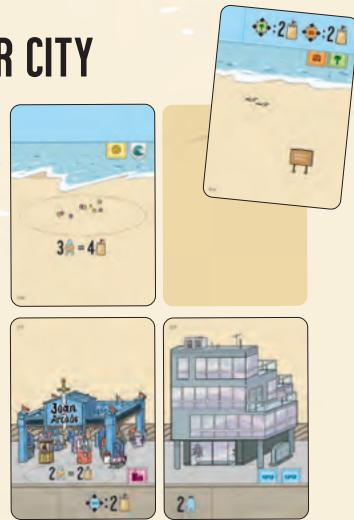
- Every feature card must be placed with one of its sides aligned to another feature or with your starting feature tile. Features placed diagonally are not adjacent to each other, and features cannot be placed on top of other features.
Some sand dollar actions will let you select and place 2 feature cards. As long as the 2 placement rules are obeyed, the cards can be placed in any order.
Some other sand dollar actions give you the option to swap the location of 2 of your feature cards. This must be done after placing the feature cards you selected this turn, and must obey the 2 placement rules. If there are any people or footprints on a feature card that is swapped, they are moved with the feature card.

Feature Card Breakdown
Each feature card is either a Beach Card or a Street Card, indicated by the art and the placement of the icons.

1. Placement Actions
These actions are taken as soon as you place the card, such as gaining sand dollars and people tokens, or moving previously placed people.
2. Scoring Opportunities
These icons indicate how each card scores at the end of the game. Though there are several types of scoring opportunities (which are covered in detail on pages 8 and 9), there are two types that are referenced on most of the cards:
Adjacencies grant points for location tags that are on the features that are adjacent to the feature card. These score only once, even if there are multiple adjacent cards that fit the criteria.

Chains grant points for groups of similar location tags that this card is part of. Chains only score if the minimum number of location tags is met in a single group. Some chains score a set number of points, and some chains score per location tag, allowing you to score more points if you exceed the minimum number of needed tags.
3. Location Tags
These icons indicate the card’s type, and are used for gaining points from your VIP and scoring at the end of the game. The types of locations are:

Local Spots: These are the places where locals live or the places they like to gather. Sure, tourists are allowed in these areas—that is, if they know about them.

Tourist Spots: Locations where tourists like to gather. These sometimes represent the areas and restaurants that are recommended by all the travel books, while others represent the tourist traps that no local would ever go to.

Businesses: Locations where your visitors spend their money on trinkets, equipment, or food. You know, a business.

Sports: Locations where your visitors can work out, surf, or play sports. Sometimes this tag also represents places where people can buy sporting goods .

Nature: Locations that show of the natural beauty of your city or that simply have beautiful plants or palm trees near them.

Waves: These are the locations that are good for swimming, surfing, or just admiring the ocean view. These places get some killer waves that surfers get stoked about.
4. activity Rings
To score the indicated points, you must fill the activity ring on the card with the right combination of people by the end of the game. The symbol shows the type and exact number of people a ring can hold. Any people not in activity rings are considered to be unplaced.
5. Footprint Scoring
Each starting feature tile has a unique way to score points for footprint tokens placed during the game. When your VIP visits a location with the desired attribute(s), you will place a footprint token on that card. At the end of the game, each feature card with a footprint token on it can be scored accordingly.
2. Take Placement Actions
The placement action on your feature card may show symbols that will either add people to your city, give you sand dollars, or allow you to move people that you placed on previous turns. Not every card will have a placement action, but many of them do.
Gaining Tokens

This symbol tells you to take a certain number of sand dollars from the supply. In this example, you would take two. The sand dollars may be placed anywhere in front of you, but they are not actually part of your city; they are currency that you may spend on future turns to take sand dollar actions or possibly turn into points at the end of the game.
Running out of sand dollars? Depending on your strategy, you might be trying to collect a lot of sand dollars. In those games, you can use the Sand Dollar Multiplier tokens if you’re running out of wooden pieces. If you have five sand dollars, return four to the bank and place the remaining one on the multiplier to show that it counts for five. You can keep stacking sand dollar tokens on here to get to 10 or even 15.
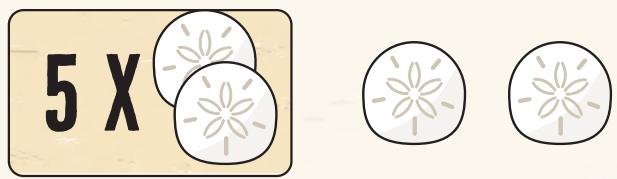
12 sand dollars
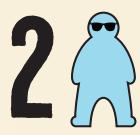
This symbol will show you a color and a number that indicates how many people must be added to the card. This is not optional. In this example, you would take two locals from the supply and place them on the card.
Moving People

This symbol will show you a color, a number, and a movement number, indicating how many people can be moved and how far. This is an optional action. In this example, you would be able to move up to 4 diferent tourists up to two spaces each. These people can be moved independently; they do not need to start or end on the same card. You cannot move the same person twice.

The multi-colored symbol is a wild, and allows you to move any person in your city: local, tourist, or even a VIP. It cannot, however, be used to move the foodie.
When moving people, you can only move them up, down, left, or right— diagonal movement is not allowed. Each card counts as one space, and the starting feature tiles count as two (one beach space and one street space). People cannot be moved onto empty spaces; they can only move onto placed feature cards. Activity rings are not a separate space on the card; if a person is on the card, it can be added to or removed from the activity ring at any time.

VIPs and Footprints
If you moved a VIP, you may be able to add a footprint token to your city. Check your starting feature tile to see which location attributes your VIP is trying to get to. If you moved to or through a feature card with one of those attributes, place a footprint token on the card. Note that a footprint token will score for each attribute on the feature card, but there can only be one footprint token per card, even if the VIPs visit multiple times.

The Foodie and the Food Truck

There is another way that you can gain and move pieces on your turn. Underneath the display, there are two wooden tokens: a Food Truck and a Foodie. If you made a regular feature card selection, and you chose the card above one of these tokens, you will get an additional reward. If you used a sand dollar action, you do not get the reward.
The rewards are as follows:
Food Truck: The food truck increases the value of a feature.
Take one sand dollar from the supply.
Foodie: The foodie allows you to move any one person (local, tourist, or VIP) by one space.
Foodie and Food Truck: When the foodie catches up with the food truck, it is a happy day. You may take one sand dollar and move one person, or you may choose to double either action, taking two sand dollars or moving up to 2 people by one space each or 1 person twice.
When you gain a reward from the foodie or food truck, the token will move one space to the right. If you’re at the edge of the display, the movement wraps around, and you place the token under the leftmost display card. If the feature card you selected was directly above both the foodie and the food truck, instead of moving each token one space to the right, only move the food truck two spaces to the right.
3. Refresh the Display
If the front row has any empty spaces, fill those spaces in with the back row card immediately above it. Then, deal new cards from the feature deck into any blank spaces, starting with the front row cards. The next player may now take their turn.

End of the Game
When one player has placed their 14th feature card, starting feature tile not included, it triggers the end of the game. Continue the round until the last player in turn order has finished their turn, at which point the game will end.
Players will then take the “final movement” on all of their people. Each tourist and VIP will be able to move 1 space, and each local will be able to move up to 3 spaces. When all players are done moving their people, players will score their cities and determine the winner.
Scoring the Cards
There are two scoring types that reference location tags and other icons on your cards, and one that lets you score on unspent sand dollars.
Adjacency

The adjacency symbol shows two things, a point value and a pictured location tag. If there are one or more cards with this tag
next to this card, you gain the number of points listed. Tags on the same card as the adjacency do not count.
In this example, you would gain 2 points if it was adjacent to at least one card with a tourist spot location tag. Adjacencies do not stack—even if two adjacent cards have the pictured tag, you still only score the points once.

Adjacencies are not limited to location tags. Some adjacencies reference other attributes, such as a sand dollar or a person.
For all of these, the scoring trigger is the symbol from the placement actions, and not the physical pieces that can move around.
Chain

Like adjacencies, a chain symbol pictures a location tag inside a box with a number, and how many points it is worth. If this
card is in a chain of tags that meets or exceeds the number on the left, you get the points.
Chains do not need to be in a straight line. They can weave around your city, as long as each card in the chain is adjacent to at least one other card with the tag.
Chain (COntinued)

Sometimes, the chains will have a continuous scoring condition. When this happens, you will gain the number of
points per tag in the chain.
In the example above, you would need this card to be in a chain of at least five nature tags to score, and you would gain 1 point per nature tag, for 5 points. If you had a chain of seven nature tags, it would be worth 7 points. If you had four nature tags, you would not fulfill the minimum chain requirement, and would score 0 points.
Unspent Sand Dollars

Cards that have this symbol will give you points for groups of unspent sand dollars at the end of the game.
In this example, you would gain 1 point for every 2 remaining sand dollars. These abilities stack; you can count your remaining sand dollars for each card that has this ability. So, for example, if you had four sand dollars, one card with 2:1, and one card with 1:1, then you would get 2 points from the 2:1 and 4 points from the 1:1, totaling 6 points.
Miscellaneous
Santa Monica is a colorful, lively place, and some of the feature cards do not easily fit into boxes. Please reference the the “Ability Clarifications” section on page 10 for anything not covered in the main scoring types.
Scoring the activity Rings


Each ring symbol will picture a number of people and victory points. If, at the end of the game, the ring contains exactly the pictured number of people, it will score the points. The ring may only hold the pictured number of people, and no more.
In this example, 1 tourist in the ring will score 3 points. If the icon is multi-colored, then the ring can be filled by a local, tourist, or VIP.
Two cards in the game feature the “Any Number of People” symbol.
For this card, you must have at least 1 person to score, and it will get you 3 points. After that, you may place as many people as you like in this ring. However, it still only scores 3 points.
Scoring the Footprints

Your starting tile will allow you to score on your footprint tokens. For each card with a footprint token, count up the number of matching attributes on that card. You will get points for each attribute.
So in this example, if you placed a footprint on a location with 2 Local Tags, you would gain 2 points for that footprint, not 1.
Scoring the Objectives
The objective card is chosen during setup, so you will know the objectives for the whole game. Each objective card will list 3 things:
-
A wave bonus
-
A miscellaneous bonus
-
A penalty for people that end the game outside of a ring
These are detailed in the “Scoring Objectives Clarification” section on page 11.
Tally Your Scores
Go around the table tallying up each line on the scorepad. Then add each player’s score together. The player with the most victory points is the winner. In the event of a tie, the tied player with the most leftover sand dollars is the winner. If the players are still tied, the player with the longest chain of tags is the winner. If players are still tied, the next player to write “I WIN” into sand is the winner.
Santa Monica Action and Ability Guide
Sand Dollar ACTIONS
Pay 4 :
Take 2 cards from
the front row.
1 1
To use this action you must pay 4 sand dollars to the supply. Take 2 feature cards from the front row and place them into your city. You may also move up to 1 person of any type 1 space.
1 Pay 4 : Take 1 card from the front & the card behind it. 1 1
To use this action you must pay 4 sand dollars to the supply. Take 1 feature card from the front row and the feature card behind it and place them both into your city. You may also move 1 person of any type 1 space.
Pay 2 :Take A /FROM ANYWHERE.2 1
To use this action you must pay 2 sand dollars to the supply. Take a feature card from anywhere in the display as long as it has a Local Spot or Tourist Spot Tag. You then may move up to 2 people of any type 1 space each.
Pay 2 :Take A/ /FROM ANYWHERE.2 1
To use this action you must pay 2 sand dollars to the supply. Take a feature card from anywhere in the display as long as it contains a Buisness, Nature, or Sports tag. You may then move up to 2 people of any type 1 space each.
Pay 3 : Take 1 card from the back. 4 1
To use this action you must pay 3 sand dollars to the supply. Take a feature card from the back row of the display. You may then move up to 4 people of any type 1 space each.
Pay 2 : Take 1 card from the front. Swap 2 cards in your city. 2 1
To use this action you must pay 2 sand dollars to the supply. Take a feature card from the front row of the display then you may swap any 2 feature cards in your city. Then you may swap any 2 feature cards in your city.
1 Pay 2 : Take 1 card from the front. Swap 2 cards in your city. remove 0-2 from your city.
To use this action you must pay 2 sand dollars to the supply. Take a feature card from the front of the display, then swap 2 feature cards in your city, then finally you may return up to 2 people in your city back to the supply.
Pay 1 : Take 1 card from the front. 3 1
To use this action you must pay 1 sand dollar to the supply.
Take a feature card from the front row of the display.
Then you may move up to 3 tourists 1 space each.
Ability Clarifications
: 5
Abilities that show connected adjacency tags mean that the card must be adjacent to 2 or more of that tag. Otherwise, it scores 0 points.
↑ :8
This card must be adjacent to all four attributes in order to score. 0 points are gained for one to three attributes.

When adjacency tags are printed side-by-side, it means you can score for either or both. This card will let you score 2 points for a nature adjacency and/or 2 points for a tourist spot adjacency.
: 3 / : 5
This scoring opportunity is an either/or. Gain 3 points if this is adjacent to only one wave tag. Gain 5 points if it is adjacent to two or more.

If this card is adjacent to any card with a scoring ring, whether it is filled or not, gain 2 points.
: 2
If this card is NOT adjacent to a card with a scoring ring, gain 2 points.
: 3
To score, this card must be adjacent to a card that gives a sand dollar through its placement actions.

This card gives negative points if it is adjacent to a feature card on any of its three sides that gives people through its placement actions.
2 : 1
Gain 1 point for every two Tourist spot location tags anywhere in your city.
move up to 3 here
You may move 3 people of any type(s) onto this space, regardless of distance.

This card signals the end of your beach, and must be the leftmost beach card. When this feature card is placed, this is considered a third placement rule for the rest of the game. Therefore, this card may never be swapped with another feature card.
Scoring Objectives

2 per in your longest group
Find your longest group of tags. You will gain 2 points per in it. A group is a contiguous group of 1 or more . If you have 2 chains of equal size, you only score one of them.
2 per tag in your largest
Find your longest chain of non-wave location tags,
and gain 2 point per tag. If you have 2 or more that are tied for longest chain, only count one of them. A chain is any group of contiguous tags of the same type. You do not need to have a card with the for it to count.
The player with the most unplaced gets -4 , 2nd -2
Unplaced people are people that end the game outside of a ring. Have players compare who had the most unplaced people. That player will lose $4 ^ { 6 }$ If two or more players are tied for most unplaced people, all of those players lose $4 [ 5 ]$ and there is no 2nd place.
| m |
| 3FOR EACH SEPARATE © GROUP |
| 3FOR EACH OF YOUR WITH 3+□ |
| -1PER CARD WITH |
| UNPLACED 六 |
3 for each separate group
For this objective, you want to spread your waves out as far as possible, placing other features between them. A group is a contiguous group of 1 or more .
3 for each of your chains of 3 cards or more Any time you have three or more of a single non-wave
location tag in a chain, gain 3 points. If you have six or more location tags chained together, it still only counts as one chain. Just like the waves, spread out your tags for maximum scoring. You do not need to have a card with the for it to count.
-1 per card with unplaced

Any card that contains one or more people outside of a ring scores -1 point. It doesn’t matter how many people are on the card, so try to group your unplaced people together.
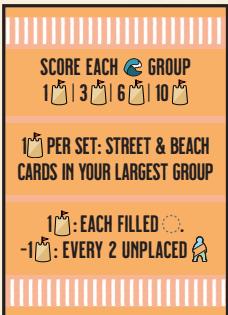
Score each group of 1|3|6|10
A group is a contiguous group of 1 or more . Count up the number of in the group, and get the corresponding $[ ^ { E } ] .$ Each wave group with 1 wave scores 2 point. Each wave group with 2 waves scores 3 points. Each wave group with 3 waves scores 6 points. Each wave group with 4 waves scores 10 points.
1 for each set of street and ocean cards in your largest set
Look in your city for columns that have an ocean card directly above a street card. This includes your starting feature tile. Count your largest unbroken chain of pairs of ocean/street cards and get 1 point for each pair.
1 for each activity ring you fill. -1 for every 2 unplaced
A filled activity ring is one that has the exact number of people as what is pictured for the scoring requirement. Gain 1 point per ring that you filled. Total up the number of unplaced people anywhere in your city, and for every 2 people, lose 1 point. People who are placed in an activity ring but do not “fill” the ring are not considered unplaced. The 2 “all people” rings are considered filled as long as there is 1 person inside.
Game Design: Josh Wood
Artwork: Jeremy Nguyen, Josh Wood
Director of Projects: Nicolas Bongiu
Production: Dave Lepore
Development: Scot Eaton, John Goodenough
Art Direction: Josh Wood
Graphic Design: Brigette Indelicato
Rules: Scot Eaton, John Goodenough
Editing: Andre Chautard
Playtesters:
Neil Baumgartner, Dane Bjorkman, Nancy Bjorkman, John Borders, Chris Buskirk, Matt Champagne, Andre Chautard, Timothy Daggett, Kristina Eaton, Al Gonzalez, AJ Harris, Brian Henk, Mara Kenyon, Neil Kimball, Jon Perry, Rich Pizann, Taylor Shuss, John Till, Andrew Voigt, Dustin Winebrenner, Ethan York, Gerrod Garcia, Jayson Jewett, Michael Jaslrut, Hideaki Asto, Ivan Coronado, Francisco Aguayo, Jay Vales, Jesse Mark, Jaye R, Seany G., Matt Bahntge, Ta-Te Wu, Samir Shah, Robert Nef, Dustin Dobson
Special Thanks to the cities of Santa Monica and Venice, California, whose beautiful beaches have inspired many artists, and many more to come.

© 2020 Alderac Entertainment Group. Santa Monica, and all related marks are and © Alderac Entertainment Group, Inc. 2505 Anthem Village Dr., Suite E-521 Henderson, NV. 89052 USA All rights reserved. Printed in China.
Warning: Choking hazard! Not for use by children under 3 years of age. Visit our website at www.alderac.com/santa-monica Questions? Email: CustomerService@alderac.com

Josh Wood is the game designer of Cat Lady and a developer for AEG who has worked on several games including Ecos: First Continent and Tiny Towns. He resides in Los Angeles, CA. He loves making games and meeting people at conventions and gaming events.
I would personally like to thank my family, friends, and girlfriend, Kathleen Scott. I want to thank all the fans of Cat Lady and all the great people I’ve met in the industry. Thank you for all the people who believed in Santa Monica: John Zinser, John Clair, Daryl Andrews, and Andre Chautard.
Finally, a huge thanks to my friend Jeremy Nguyen, who sat next to me for days as he drew the art in this game while we came up with fun names of stores and areas in the game.

简繁检索对照.md
299065_298065_santa-monica — 简体/繁体检索对照
本游戏的规则书是繁体中文原文。用户用简体提问时,把关键词按下面这张表转成繁体再去 grep 原文,命中率最高。
回答时用简体或繁体都可以,但引用的原文保持繁体。
简体 → 繁体 对照(按该游戏原文出现频率排序,共 60 字)
| 简体 | 繁体 | 原文出现次数 |
|---|---|---|
| 动 | 動 | 168 |
| 标 | 標 | 129 |
| 个 | 個 | 127 |
| 游 | 遊 | 96 |
| 计 | 計 | 92 |
| 张 | 張 | 80 |
| 胜 | 勝 | 71 |
| 戏 | 戲 | 70 |
| 钱 | 錢 | 70 |
| 题 | 題 | 63 |
| 这 | 這 | 60 |
| 获 | 獲 | 59 |
| 块 | 塊 | 54 |
| 记 | 記 | 52 |
| 签 | 籤 | 52 |
| 则 | 則 | 48 |
| 时 | 時 | 48 |
| 并 | 並 | 48 |
| 区 | 區 | 46 |
| 从 | 從 | 41 |
| 两 | 兩 | 40 |
| 将 | 將 | 38 |
| 邻 | 鄰 | 37 |
| 后 | 後 | 35 |
| 选 | 選 | 33 |
| 会 | 會 | 33 |
| 与 | 與 | 33 |
| 数 | 數 | 32 |
| 择 | 擇 | 30 |
| 们 | 們 | 29 |
| 续 | 續 | 26 |
| 节 | 節 | 26 |
| 为 | 為 | 24 |
| 场 | 場 | 24 |
| 连 | 連 | 24 |
| 类 | 類 | 24 |
| 贵 | 貴 | 22 |
| 宾 | 賓 | 22 |
| 来 | 來 | 21 |
| 须 | 須 | 21 |
| 号 | 號 | 20 |
| 迹 | 跡 | 19 |
| 应 | 應 | 19 |
| 当 | 當 | 19 |
| 种 | 種 | 19 |
| 设 | 設 | 18 |
| 规 | 規 | 18 |
| 结 | 結 | 17 |
| 开 | 開 | 17 |
| 奖 | 獎 | 16 |
| 励 | 勵 | 16 |
| 仅 | 僅 | 16 |
| 贩 | 販 | 15 |
| 满 | 滿 | 14 |
| 车 | 車 | 14 |
| 许 | 許 | 14 |
| 冲 | 衝 | 14 |
| 于 | 於 | 13 |
| 内 | 內 | 13 |
| 闲 | 閒 | 12 |