rules_en_flourish_312618.md
来源类型:纯文本规则(非 PDF 源,早期抓取/转换产物)
说明:原文未改动,仅调整存放位置与文件名;非 PDF 扫描件,无对应原书 PDF
Flourish Rulebook | RulesPalRulesPalChatRulebookFlourishFlourish Rulebook Table of Contents Table of Contents Components
Setup
Overview
Card Details
Gameplay Play & Pass
Score the Round
The Fourth and Final Round
End of Game Competitive
Cooperative
Two-Player Rules
Scoring Examples
Garden Show Variant Setup
Gameplay
Solo Rules Setup
Gameplay
Score
Compost Variant
Scoring Reference
Rosa Alba
Solo Medals
Cooperative Medals
Credits
Components
98 Cards - 7 Scoreboards - 7 3D Walls 24 Ribbon tokens - 3 Medal victory tokens - 1 Victory card 3 Rulebooks (multiple languages)
Setup
Give each player a scoreboard set at 0.
Place a Wall piece between each player.
Shuffle the deck and deal 6 cards to each player as their starting hand. Players look at their hand of cards.
Place the deck in the middle of the table.
During the game each player will build a garden in the space in front of them.
Overview
Flourish may be played competitively or cooperatively, using the same rules. Decide which way you will play before beginning the game.
If playing cooperatively, players may talk about any cards that have already been played, but they may not share any information about cards in their hands.
The game is played over 4 rounds. During each round, you will play a total of 3 cards, then score any End of Round abilities played in the current round. At the end of the game, after the 4th round, you will score all cards in your garden with End of Game abilities.
Card Details
Each card in the deck has an End of Round scoring ability (shown at the top of card), and/or an End of Game scoring ability (shown at the bottom of card). Most cards also have 1 or more colored plant symbols shown on the left side of the card.
Cards are worth points according to how many plant and stone symbols are in yours or your neighbor's garden. Your neighbors are only those 2 players directly to your right and left.
Each card shows, from top to bottom: the End of Round Scoring ability, the Plant Symbols it grants, and the Stone Symbol or Plant Name (the plant names on cards are the scientific Latin names) alongside the End of Game Scoring ability.
Gameplay
Each turn of the game is played simultaneously by all players.
Play & Pass
Each turn you will begin with 6 cards in your hand. Choose 1 card to play and 2 cards to pass.
Place the card you are going to play facedown in front of you. Pass 1 card facedown over the Wall to each of your neighbors: the players directly on your right and left.
Once all players have played and passed, all players should reveal their played card. Then draw the 2 cards passed to you and 1 additional card from the top of the deck.
Continue to play and pass until you have played 3 cards. This is the end of the round. Note: For ease of scoring, arrange the cards for each round in their own row, creating a 3 x 3 grid over the course of the first three rounds.
Score the Round
Check to see if any of the cards you played this round have an End of Round scoring ability. If so, score the cards played this round by counting the relevant symbols on all appropriate cards, even if those cards were played on a previous round. End of Round scoring abilities that were played in a previous round do not score again. Keep track of your score on your scoreboard.
The Fourth and Final Round
After scoring the third round, draw the 2 cards passed to you, but do not draw an additional card from the deck.
Each player chooses 3 cards to play facedown and discards the remaining 2 cards facedown.
When all players have chosen their 3 cards to play, reveal the cards and then score any End of Round abilities on those played cards.
End of Game
Finally, all players score all cards in their garden that have an End of Game ability.
Competitive
The player with the highest score wins the game. If tied, the player with the most unique plant symbols wins. If still tied, the player with the most unique stone symbols wins. If still tied, the player with the most end of round abilities wins. If still tied, the players share the victory.
Cooperative
Add all player's scores together, then see which medal you have won as a team! See the Cooperative Medals table for a list of medal requirements.
Two-Player Rules
Follow all rules as normal, except that you will pass 2 cards to your only neighbor.
Scoring of Path cards is altered to count symbols in both your neighbor's garden and your own garden.
For other cards that normally compare to either or both neighbors, compare to your only neighbor.
Scoring Examples
In Round One, you play a Path, Tree, and a Feature.
The Path gives you 2 green symbols, and at the end of the game it will be worth 3 points for each tree in both of your neighbors' gardens.
The Tree gives you 3 green symbols and will score at the end of this round for each green symbol you have (5). At the end of the game, it will be worth 4 points for each green Path you have (currently 1).
The Feature does not give you any symbols. It is worth 9 points at the end of the game if your Garden has at least 1 Tree in it (which it already does).
In Round Two, you play a Lawn, a Hive, and a Plant.
The Lawn does not give you any symbols. At the end of the round, it scores you 1 point for each green symbol you have (5). At the end of the game, it will score 1 point for each Stone symbol you have (currently 5).
The Hive gives you 1 red symbol and will score at the end of this round 2 points for each blue symbol in 1 of your neighbors' gardens. So if a neighbor has 3 blue symbols, it will score you 6 points.
The Plant gives you 1 red symbol and will score at the end of this round 1 point for each green and red symbol you have (5 green, 2 red, for a total of 7 points).
Garden Show Variant
Compete in the Garden Show to win ribbons and be crowned the ultimate champion gardener after three games! This variant is designed for competitive play only.
Setup
Shuffle the Ribbons and give each player three. If a player has a duplicate, deal again until all players have three unique Ribbons. Each player should place these Ribbons faceup beside their scoreboard for all players to see.
Gameplay
You will play three consecutive games, maintaining your score for all games. At the end of each game, check to see if you have won any of your Ribbons. To do so, your garden must have the most symbols shown on the Ribbon compared to all other players in the game (you do not win the Ribbon if you are tied). If so, flip the Ribbon over and score the 7 points for it. Otherwise, leave it faceup; you will have a chance to earn it during the next game. You may win more than one Ribbon in a single game.
The player with the most total points at the end of the third game is the grand winner.
Solo Rules
In the solo game, you will be competing against an opponent named McGregor. Your final score will be your total score minus McGregor's total score.
Setup
Place a scoreboard on the table for yourself, and one beside you for McGregor. Shuffle the deck and draw 6 cards for yourself. Then deal 12 cards in a facedown deck on the opposite side of McGregor's scoreboard from where you are sitting (if his scoreboard is on your right, place his deck on the right of his scoreboard).
Gameplay
On your turn, play 1 card to your garden, and then pass 2 cards to McGregor by placing them in a stack on the side of his scoreboard closest to you.
Then play the top card from McGregor's deck into his garden and draw 2 cards from his deck into your hand, plus 1 more card from the main deck.
Finally, take the 2 cards you passed to McGregor and shuffle them into his deck and then place it back facedown. You are never allowed to look at the cards in McGregor's deck.
Score
Every time you score at the end of the round, also score McGregor's garden; keep track of his score on his scoreboard. Also score his End of Game abilities at the end of the game.
Subtract McGregor's total score from your total score to determine your overall score. Then see which medal you have won! See the Solo Medals table for a list of medal requirements. You may also find it enjoyable to keep a record of your highest score ever for all your solo games.
Compost Variant
This variant offers a way for players to cycle through more cards in the deck.
In addition to passing cards and playing a card, each turn you may choose to discard 1 card facedown from your hand, allowing you to draw 2 cards instead of 1 at the end of the turn. Place discarded cards in a messy pile beside the deck.
If you discard at the end of the third round, draw 1 card to bring your hand back up to 5 cards before choosing the 3 cards to play on the final round.
If the deck ever runs out, shuffle the discard pile to create a new deck.
Note: If using this variant in a cooperative or solo game, increase the required medal scores by 5 points per player.
Scoring Reference
1 rose: Score 1 point for every rose in your garden.
1 rose, 1 flower: Score 1 point for every rose in your garden, and 1 point for every flower in your garden.
1 rose | 1 flower: Score 1 point for either every rose in your garden, or 1 point for every flower in your garden.
1 rose, 1 flower, person | person: Score 1 point for every rose and 1 point for every flower in only one neighbor's garden.
6, rose ≥ person | person: Score 6 points if you have equal to or more roses than either of your neighbors.
9, rose ≥ person & person: Score 9 points if you have equal to or more roses than each of your neighbors.
You must have at least one rose in your garden to qualify.
3, wall: Score 3 points for every wall symbol in your garden (including the wall symbol on the card that you are scoring for).
4, rose+path: Score 4 points for every path with a rose symbol that you have in your garden.
9, tree: Score 9 points if you have one or more trees in your garden.
9, hive x3: Score 9 points if you have three or more hives in your garden.
9, all plant symbols: Score 9 points if you have five or more of at least one plant symbol in your garden.
9, one of each plant symbol: Score 9 points if you have one or more of each plant symbol in your garden.
Rosa Alba
Rosa Alba, the white rose, counts as only 1 copy of any 1 plant symbol, each time it is used for scoring. It can be counted as different symbols within the same round. When comparing for majority scoring, the Rosa Alba must be included.
Stone symbols: Any, Tree, Path, Wall, Hive, Lawn, Feature.
Solo Medals
Cooperative Medals
Credits
Game Design: James A. Wilson, Clarissa A. Wilson Executive Producer: Dan Yarrington Game Development: Dann May, Dan Yarrington Art Direction and Graphic Design: Dann May Illustrations: April Borchelt, Christina Qi, Naomi Robinson, Dann May Proofing: Charlotte Jones, Tim Schuetz, Petra Schlunk Production Management: Tim Schuetz Playtesters: Andrew Albertsen, Christopher Arndt, Kellie Arndt, Erin Baxter, Jonathan Baxter, Julianne Cameron, Ryan Cameron, Joelle Cathala, Avery Freniere, Charlotte Jones, Angela Kneeland, Cory Kneeland, Marie Kneeland, Joe Lattner, Elizabeth Lewis, Jacob Mueller, Brenna Noonan, Andrew Osborne, Jordana Osborne, Tim Schuetz, Karl Schwantes, Reilly Schwantes, Samantha Schwantes, Skye Walker, Anthony Williams, Erin Williams, Kim Williams, Noah Wilson, with special thanks to Chrissy Peske, Tom Peske, Amy Peske, and Alex Peske.
Published by Starling Games. Visit www.Starling.Games
下载 MarkdownFlourish_FriendsandFollies_Rules-Sheet_EN (3).md
Foun'sE Friends & Follies
The Friends and Follies expansions provide fun new ways to play Flourish. You may play with either or both expansions at the same time.
Components:
15 Friend mini cards
35 3D Folly buildings
1 Victory Plaque
3 Rulesheets (English, French, and German)
Friends
Many creatures, such as bees, bats, and even some snakes, can be very beneicial to a garden. Avid gardeners will often try to make a welcoming atmosphere for these animalfriends.
OVERVIEW
Craft your garden to make a welcoming environment for friendly critters!
SETUP
Shuffle the 15 Friend cards and deal 2 to each player. Players may look at these cards, but should keep them secret until the end of the game.
If playing cooperatively, place the 2 Friend cards faceup beside your scoreboard for all players to see.
In a solo game, do not give McGregor any Friend cards.
SCORE
After the end game scoring, all players should reveal their two Friend cards. Then each player gets to score for only one of their Friend cards.
Scoring Reference

Score 5 points for every in your garden.
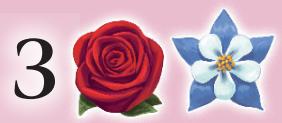
Score 3 points for every pair of and your garden.

Score 5 points for every set of 3 in your garen.
Medals
Cooperative: Increase the required score by 15 for each player.
Solo: Increase the required score by 15.
Follies
A folly is a building or some kind of structure designed primarily for decoration, and usually serves no other purpose than providing visualinterest or whimsy to the surrounding landscape.
OVERVIEW
Build magnificent structures that compliment your garden in beautiful ways! You will play Flourish using the normal scoring rules with the following changes:
SETUP
Give each player 5 Follies, 1 of each color. These Follies may be placed beside each player's scoreboard.
In a solo game, do not give McGregor any Follies.
GAMEPLAY
When playing with Follies, you must play your cards into a 3x3 grid. So you will play the first 3 cards side by side, then the next 3 cards beneath those, and finally the last 3 beneath those.
At the end of each of the first 3 rounds, you may place any of your unplaced Follies on cards in your garden. Because Follies score additional points based on the cards they are adjacent to, you may rearrange the cards you played this round before placing Follies. Follies may only be placed on cards you played during the current round. They can only be placed on cards that have at least 1 plant symbol matching the symbol on the Folly. No more than 1 Folly can be placed on a card.
When playing the final 3 cards in your hand at the end of the game, you may place these cards on the outside of your 3x3 grid, adjacent to any of your played cards.
SCORE
At the end of the game, each Folly in your garden is worth 2 points for each symbol matching its type on the card it was placed on, and on each card adjacent to it (not diagonal). Each adjacent card with no colored symbols is worth 3 points (Walls, Lawns, Features). The Rosa Alba is worth 2 points for each Folly that scores for it. You may place any Folly on the Rosa Alba. Every Folly that you were unable to place is worth minus 5 points.

Medals
Cooperative: Increase the required score by 30 for each player.
Solo: Increase the required score by 30.
下载 Markdown