rules_hamburgum.md
Lamburgum
A Strategy Game for 2-5 Players by Mac Gerdts


CONTENTS
DESCRIPTION
QUICK INTRODUCTION2
GAMEBOARD... 4
GAME MATERIAL5
GAME PREPARATIONS…5
GOAL OF THE GAME / GAME END.6
SEQUENCE OF PLAY7
ACTIONS7
Beer, Sugar, Cloth 7
Trade..... …7
a) Sell goods 7
b) Purchase building material 8
Dockyard8
Church9
1. Make Donations.9
2. Score donation tokens… 10
Guildhall11
TIPS ON STRATEGY12
ADVANCED VARIANTS13
FREQUENTLY ASKED QUESTIONS AQ ..14
THE MAKING OF HAMBURGUM. …14
Text: Mac Gerdts, Peter Dörsam Layout: Peter Dörsam
The view of the city is taken from: Coloured copperplate engraving by Peter Schenk from “Atlas Minor sive Tabulae Geographicae praecipuorum Regnorum Regionum, Insularum, Provinciarum etc. Per Carolum Allard“, Amsterdam around 1696
Peter Schenk was engraver and publisher in Amsterdam

DESCRIPTION
Hamburg in the 17th century! Mighty walls protect the city against the devastations of the Thirty Years War. Thanks to Protestant religious refugees, Hamburg has become the biggest and most prosperous city of Germany. From far away the skyline shows the steeples of huge churches and the masts of mighty trade ships displaying the citizens' pride and prosperity.
The players guide families of Hamburg in the pursuit of wealth and prestige. They produce beer, sugar and cloth and sell these goods with their ships overseas. They compete over the best sites for their buildings and the best berths for their ships in the harbour. But ultimately they vie for the most prestigious church donations, because neither gold nor goods, but only prestige decides the game.
"Hamburgum" is a strategy game for 2 – 5 players without any luck of cards or dice. The actions are selected according to simple rules on a rondel. The reverse of the big doublesided game board offers another city, "Londinium", a different strategic challenge.
There is a quick introduction into the game on the next two pages. Using an example of game play the main mechanics are described. The quick introduction may serve as to
- getting an overview before reading the rules
- facilitating comprehension of the rules after reading them
- starting a game immediately. In this case, the sections mentioned at the end of the quick introduction should be looked at as well.
GAMEBOARD
Depot
The combined price for the total number of purchased units is indicated here.
Rondel
Here players choose their actions.
Scoring Track Here the prestige points are summed up.

Harbour
Ships in harbour are placed in berth “3“, “2“, or “1“.
Church Building Site
Here the church of St. Catharinen is built, its church district is surrounded by a yellow border.


GAME MATERIAL
Supply for the bank:
• 45 units of goods (wooden cubes): 15 beer (yellow), 15 sugar (white) and 15 cloth (green)
• 49 units of building material: 24 timber (brown), 20 bricks (red) and 5 church bells
• 30 donation tokens: 5 per church
• 35 buildings (of which are 7 "blue officals“)
• Money: 32 copper coins of 10 £ each, 15 silver coins of 50 £ each, 19 gold coins of 100 £ each
• 6 churches
• 3 orange ships: “Flying Dutchmen“
Player Pieces:
(in 5 colours red, blue, green, yellow, and grey)
• 90 citizen tokens (male/female): 18 each colour
• 75 round disks: 15 each colour
• 25 ships: 5 each colour
• 5 octagonal game markers for the rondel
• 5 round game markers for the scoring track
Rules and other information:
• 1 rulebook
• 5 summary rules placards
• 1 almanac with historical information
GAME PREPARATIONS
Each player chooses a colour and takes his supply of citizens, ships and game markers. Additionally each player begins with:
• 3 units of goods:
1 unit of beer (yellow)
1 unit of sugar (white)
1 unit of cloth (green)

• 2 units of building materials:
1 unit of timber (brown)
1 unit of brick (red)
Each player places one ship of his colour into the
berth marked with a blue 3 and his octagonal game marker in the middle of the rondel.

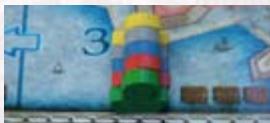
The 6 fields on the church builder bonus chart are each filled with 1 church. One unit of beer, sugar, and cloth are placed on the price chart for goods marking the initial price of 100 £ respectively.
The 30 donation tokens are placed on the 6 church paintings on the game board. Each church painting gets 5 different tokens: The 4 tokens for citizen, building type, ships, and donations are placed first. Then put the 5 prestige point token in the middle on top for each church. Each donation token is placed with the points face up, and the church side face down. The setup for the tokens of St. Catharinen is illustrated here as an example:


GAME PREPARATIONS

The 7 officials buildings without a number on them (the so-called “blue officials“) are taken out of the game, as they are used only with the advanced variants, see page 13.
The other 28 buildings are placed on the right side of the game board. The Officials buildings are stacked in the following order: At the bottom building No. 1 (Lord Mayor), then buildings No. 2-4 (Vicar), and on top buildings No. 5-7 (Councilman).
All of the other units: goods, building materials and coins are placed beside the game board as a supply.
The player who last visited a church becomes the start player. The start player receives 1 prestige point (PP), which is marked with his round game marker on the scoring track, and 10 £ as his starting money. Each subsequent player in clockwise order receives 1 PP and 10 £ more than the former: The second player receives 2 PP and 20 £, the third player 3 PP and 30 £ etc.

Example: Green is start player, the following players in seating order are Blue and Red. Green receives 10 £, Blue 20 £ and Red 30 £. The setup on the scoring track is shown in the illustration.

During play the following has to be observed: Everyone's goods, building materials and money are visible for all players. Trading or lending between players is not possible.
GOAL OF THE GAME / GAME END
Goal of the game
Every player tries to get the most prestige points through church donations.
Players donate building material (bricks, timber, church bells) and money for the construction of the six churches and receive donation tokens as a return. To make money, players produce goods and sell them to the bank. This money is used to purchase building materials, which in turn are used to make donations, construct buildings or build new ships.
While some buildings enlarge the individual production capacity of goods, others give other direct single advantages. Ships are used to sell goods abroad, where prices are considerably higher than through direct sales to the bank.
The first donation to a church always receives the 5 prestige points token. Subsequent donations to a church allow choice from among the other four donation tokens whose prestige point value is variable. Their value can be influenced by building new ships, constructing buildings or making donations. A church is completed when it received 5 donations. The player who completes a church gets bonus points which are shown on the church builder bonus chart.
Game end
The game ends as soon as all 6 churches are completed. At that time all yet un-scored donation tokens are now scored. In addition, every unit of goods and every unit of building material is sold to the bank for 50 £ each. To determine their final score players buy one prestige point for every 100 £. The player with the most prestige wins the game. If there is a tie, the tied player with the most leftover money is the winner.
SEQUENCE OF PLAY
Players proceed in clockwise order beginning with the start player. The action for the player's turn is chosen by moving his game marker to one of the action fields on the rondel. On each player's first turn he may choose whichever action field on the rondel he wants.

In each subsequent turn during the game a player may move his game marker 1, 2 or 3 action fields ahead on the rondel in clockwise order free of cost.
To select an action field more than 3 spaces around the rondel the player has to pay 1 prestige point for every additional field, which is subtracted on the scoring track. No player can have less than zero points. A player must move forward, so in order to choose the same action field twice in a row, the player will have to move 8 fields forward and pay 5 prestige points.
Example: The game marker is on the action field "Sugar“. From here, the fields “Church“, "Trade“ and "Cloth“ may be entered without any cost. But to enter "Guildhall“ in the next turn, the player would have to pay 1 PP, to enter "Beer“ 2 PP's etc. In order to produce sugar twice in a row, the game marker would have to move 8 fields forward, and the player would have to pay 5 PP's.
The meaning of the different actions is explained in the next section.
ACTIONS
The 8 action fields on the rondel are as follows: 3 actions to produce goods: Beer, Sugar, Cloth. 1 action to trade goods or building material (this action field exists twice): Trade. 3 actions to use building material: Dockyard, Church, Guildhall.
BEER, SUGAR, CLOTH
Each player has an innate production capacity of 1 for each good. Every production building (Brewer, Sugar Refiner, and Cloth Maker) enhances the player's production capacity by 1. Production has no cost, the produced units are taken from the bank.
Example: A player owns no Brewer, 3 Sugar Refiners and 1 Cloth Maker.
On the action fields he receives the following:
Beer: 1 unit of beer
Sugar: 1 + 3 = 4 units of sugar
Cloth: 1 + 1 = 2 units of cloth
TRADE
This action allows a player to either sell his goods OR purchase building materials from the bank. The player may not both sell goods and purchase building materials in the same turn.
a) Sell goods
The player may sell his goods (beer, sugar, cloth) abroad by using his own ships. Each ship can carry only one type of goods. In addition, the number of goods each ship can carry to foreign markets depends on its berth: Ships in berth No. 3 can sell up to 3 units of goods of the same type, ships in berth No. 2 up to 2 units of goods of the same type, and ships in berth No. 1 only 1 unit of goods. The sale price of goods is tracked on the price chart for goods on the left side of the game board.
If the capacity of the player's ships is not sufficient to sell all his goods, the player may choose to sell

TRADE - DOCKYARD
any additional goods without using ships for the price of 30 £ each.
All sold goods are returned to the bank, and the player receives his payment from there as well. Selling goods has no influence on the price chart, nor on the position of the ships in harbour.
Example: The green player possesses 3 units
of beer and 2 units of sugar. He moves his game marker onto “Trade“ and wants to sell them. The prices of goods are shown opposite.

The situation in the harbour is illustrated here:
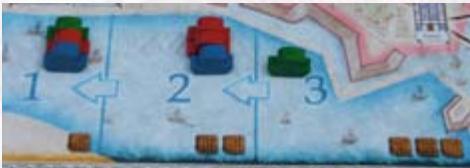
He may sell 3 units of beer with one ship and 1 unit of sugar with the other. The price of beer is 70 £, and the price of sugar 80 £. He gets 3 x 70 £ + 1 x 80 £ = 290 £. However, 1 unit of sugar remains, it could be sold additionally to the bank for 30 £.
b) Purchase building material
This action allows a player to purchase building materials (timber bricks and church bell) from the bank. The combined price for the total number of units is indicated on the depot and ranges from 20 £ (for 1 unit) to 600 £ (for 10 units).
The combination of building materials may be purchased freely with one restriction: a player may never own more than 1 church bell at a time. The bank supply is not a limiting factor. If the bank does not have enough of any material, more may be purchased and the additional materials can be marked with a round disk on the scoring track, until the bank supply has been refilled.

Example: 2 units of timber, 2 units of bricks and 1 church bell are together 5 units of building material. They cost 200 £.
DOCKYARD
This action allows the player to build new ships. Each new ship costs 1 unit of timber paid to the bank. New ships are placed in berth No. 3. There are 3 berths in the harbour. The capacity of each berth is equal to the number of players participating in the game.
Whenever berth No. 3 is full (this is the case at the start of the game!) and a new ship is added to the harbour, all existing ships change their position:
• all ships from berth No. 1 are returned to the player's supply
• all ships from berth No. 2
are moved to berth No. 1
• all ships from berth No. 3
are moved to berth No. 2
• the new ship is now placed in the free berth No. 3.
When building new ships, a player may use his ships which are removed from berth No. 1 in the same turn. However, it is not possible to give up ships deliberately from berth 2 or 1 in order to place them anew in berth No. 3.
Example: In a 4 player game, the situation in harbour is as follows:
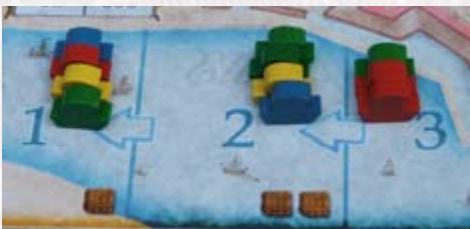
The yellow player moves onto "Dockyard", pays 2 units of timber to the bank and places 2 new yellow ships in the harbour. The first ship can easily be set up in berth No. 3. But now this berth is full and before the second new ship can be added to the berth No. 3, all ships have

DOCKYARD - CHURCH
to move one berth further. All ships from berth 1 are removed from the game board, all ships from berth No. 2 are moved to berth No. 1, all ships from berth No. 3 are moved to berth No. 2, and the second ship can now be placed in berth No. 3. The situation in harbour now is like this:

The yellow player could have built 2 more ships for 2 more units of timber and placed them into berth No. 3 as well.
CHURCH
This action is executed in 2 steps:
1. Make donations
The player may donate building materials and money to one church of his free choice. The player may make several donations to the selected church in the same turn.
The necessary building materials and money for each donation is illustrated on the game board (donation overview):

1st donation to a church: 1 unit of bricks
2nd donation: 1 unit of bricks + 1 unit of timber
3rd donation: 1 brick + 1 timber + 20 £
4th donation: 1 brick + 1 timber + 40 £
5th donation: 1 brick + 1 timber + 1 church bell + 10 £ for every own citizen on the game board.
For every donation made, the player receives a donation token and places a round wooden disk in his colour onto the building site of the church on the game board. For the first donation to a church the player always receives the 5 PP donation token. For each further donation the player may freely choose from the remaining donation tokens. All selected tokens are placed in front of the player with the PP value face up and the church side face down.
Example: The church of St.Michaelis already possesses a donation from the red and the blue player. Yellow wants to make the 3rd

and 4th donation. This will cost him 2 units of
bricks, 2 units of timber, and 20 + 40 = 60 £ to the bank. He places 2 additional yellow round disks onto the already existing red and blue disks.

After 5 donations a church is completed. The player who made the last donation:
• takes the upper church from the bonus chart and places it on its building site in the city, after removing all round wooden disks from there
• scores the bonus points marked on the Church Builder Bonus Chart. The bonus is 8 PP for the first completed church, 7 PP for the second completed church etc.
places a round disk in his own color on the bonus chart thus denoting his status as a Church Builder. This player may from now on construct buildings wherever he chooses without concern for the adjacency rules (see "Guildhall").

Example: Green possesses 5 buildings, he moves onto "Church“ and donates to St. Ni-
colai. Until now St. Nicolai has received 3 donations. He pays for the 4th donation 1 brick, 1 timber and 40 £ and for the 5th donation 1 brick, 1 timber, 1 church bell and 50 £ (5 green buildings). The yellow and red


CHURCH

disks are returned to their owners. The upper church is taken from the Church Builder Bonus Chart
and placed on the building site of St. Nicolai. Because it is the first church completed during the game, the green player receives 8 PP as a bonus.

Finally a green disk is placed on the bonus chart to denote church builder status.
2. Score donation tokens
The player may elect to score any of his collected donation tokens (whether he has made a donation this turn or not). There are five types of donation tokens and each church has one of each type. Using the donation tokens for St. Michaelis (red) as an example:

5 Prestige Points (PP). (Remember, this donation token must always be the first one selected).

1 PP for each of a player's donation tokens scored or un-scored, including the one being scored.

2 PP for each of the player's ships in the harbour at the moment of scoring.

5 or 4 PP for each of a player's buildings of the matching type in any church district.

4 or 3 PP for each of a player's citizens in that church's district. (For the Cathedral 1PP for each citizen in any church district)
When a donation token is scored, the player adds
the earned PP to his score on the scoring track by moving his marker forward that many spaces and turns the donation token face down. A player may score as many of his donation tokens as he wants with

the Church“ action whether he makes a new donation or not.
IMPORTANT: At the end of the player's Church“ action he may have at most only ONE un-scored donation token of each type. If a player has two tokens of the same type he must at least score one of them.
Example: The yellow player makes two donations to St. Michaelis and may therefore select two donation tokens. After his selection he has the following donation tokens in front of him:

One donation token from St. Nicolai has allready been scored in a previous turn (Note: the tokens are colour coded to the churches). The player has 4 ships in the harbor and 3 citizens in the Church District of St. Petri (Green). Because he now has two ship tokens he must at least score one of these tokens for a score of 2 x 4 = 8 PP. He may also choose to score more of his tokens at this time. He could receive another 8 PP for the other ship token or 4 x 3 = 12 PP for the green citizen token or 5 x 1 = 5 for the red "donation“ token because he has five total tokens at this time.
Tip: It could be a good idea to score the second ship token because ships can be easily lost from the Harbour. The other donation types can only rise in value and never lose value and so may be more valuable to score later.

GUILDHALL
GUILDHALL
This action allows the player to construct new buildings.
The city map contains a total of 28 building sites. When a player selects the “Guildhall“ action he may construct new buildings by returning 1 timber and 1 brick building material to the bank for each building he wishes to construct. The player selects the building(s) and places them in front of him and then places one of his citizens on its building site.
For every new building
• he pays 1 timber and 1 brick to the Bank,
• he selects a building and places it in front of him,

• he places a citizen on the building site

Buildings may only be constructed in building sites that are adjacent either to a church where one has a donation marker or next to a previously placed citizen. Adjacency of citizens and churches is marked on the game board with brown lines.
Tip: The adjacency rules prevent a player from constructing any buildings until he has made at least one church donation. Without any church donations he has nothing to build next to on the board.
Any player who has made the fifth (final) donation for a church is now a Church Builder and may ignore the adjacency rules for the rest of the game. Thus this player may construct a building on any open building site.
Tip: Although completed churches no longer have round disks to show adjacency players can continue to use adjacency of churces if they have a donation token for that church (scored or un-scored).
A player constructing more than one building in a turn can use buildings placed in the same turn to satisfy adjacency thus enabling him to build a chain of buildings in the same turn. Each turn a player may construct several new buildings but this may include only ONE Official's building. The Officials buildings are offered in order as specified in the “Game Preparations“ (p.6).
The Production Buildings (Brewer, Sugar Refiner and Cloth Maker) give their benefits throughout the game. In addition, for each Production Building constructed, the marker on the price chart is lowered one space permanently. (More production means more goods available and thus a fall in the price).
Example: A player builds 2 cloth makers and 1 brewer. As a consequence, the price of beer now is 80 £ and the price of cloth 60 £.


The other buildings have the following ONE TIME BENEFIT at the moment they are purchased:
Merchant (3 x): The player receives 100 £ from the Bank.
Captain (3 x): One of the orange "Flying Dutchmen“ is placed in berth 3. A “Flying Dutchman“ is a neutral ship which occupies a place in the harbour. It is moved just like the other ships and once it has left the last berth it is removed from play. If the capacity of the berth No. 3 is exceeded then all of the ships will be moved as described in the section on adding ships to the harbour. The player then places one of his own ships in berth 3.
Officials: There are seven building sites on the gameboard for Officials buildings. Only the building on top of the stack can be constructed:
Councilman (3 x): The player receives 10 £ for every citizen in all church districts. This includes the citizens of all players. The player also counts any citizens he has already placed this turn including the citizen for the Councilman building.
Vicar (3 x): The player receives 10 £ for each donation made to all churches. This counts all of the placed round disks for all players in all churches
GUILDHALL
(counting a completed church as 5 donations). Alternatively one could count all of the donation tokens owned by all players.
Lord Mayor (1 x): The player receives 60 £ for each already completed church. It does not matter who completed the churches.
Example: Yellow moves to "Guildhall“ and pays 1 timber and 1 brick to construct 1 building. The following illustration shows all citizens and donations in the game:
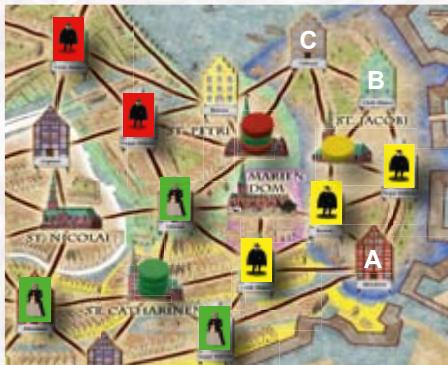
Yellow is adjacent to 3 free building sites (A, B and C) and therefore has the following possibilities:
A) Merchant:
He places his citizen on the building site for the Merchant and takes a Merchant's building from stack as well as 100 £ from the bank.
B) Cloth Maker:
He places his citizen on the building site for the Cloth Maker and takes a Cloth Maker's building from stack. The price for cloth falls by 10 £.
C) Official:
He places his citizen on the building site for the Official and takes the Official's building lying on top of the stack. Depending on the type of Official he receives:
Lord Mayor: 0 £ (no completed church)
Vicar: 70 £
7 donations: 4 (green) + 2 (red) + 1 (yellow)
Councilman: 90 £
9 citizens: 3 (green) + 2 (red) + 3 (yellow)
+ 1 (new yellow citizen)
Tip concerning the Councilman: If yellow had constructed 2 buildings, the Cloth Maker or Merchant before the Councilman, he would have received 100 £. If he would have liked instead to construct the Brewer in St. Petri as his second building, he would have received only 90 £, because in order to get the Brewer, the Councilman has to be constructed first.
TIPS ON STRATEGY
Don't forget to make church donations
Many buildings, many ships and a high production of goods are helpful, but they do not bring prestige on their own. Players who spend too much time to accumulate wealth, may find it difficult to obtain enough donation tokens.
Be efficient on the rondel
Players who often sell only 1 unit per turn on "Trade“, construct only 1 building on “Guildhall", or make only 1 donation on “Church“ waste their turns. Such actions are only useful in a few cases, like e.g. when donating the first time in the game.
ADVANCED VARIANTS
Players may choose from two different advanced variants. In both these variants the 7 “blue officials“ buildings replace the regular officials, which are taken out of the game.
Variant I
The "blue officials“ can be choosen freely from stack (only 1 building per turn).
Variant II
The "blue officials“ are shuffled and stacked in random order. Only 1 "blue official's“ building is visible and may be constructed in this turn. When the turn is over, the next “blue official“ is visible and may be constructed next time on Guildhall. (as ever, only 1 building per turn).
Tip: The advanced variants require good knowledge of the officials and their benefits. Because here the officials reward own achievements, and not the common progress of the city, experienced players are at an advantage. When first learning the game the advanced variants are not recommended. In variant Il players can be lucky to get an especially attractive official during their turn.
The benefits of the "blue officials“ happen immediately and only once. They are the following:
Canon: The player can make 1 donation of his choice for the price of only 1 brick.
Guildmaster: The player receives 30 £ for every unit of goods (beer, sugar, cloth) in his possession at the time.
Harbour Master: The player receives 40 £ for each of his own ships in harbour.
Deacon: The player receives 30 £ for every donation he has made to any church (scored and un-scored tokens).
Sexton: The player receives 50 £ for every church where he has made at least 1 donation (scored and un-scored tokens).
Master Builder: The player receives 20 £ for every own citizen in all church districts (parishes), the counting includes the Master Builder himself.
Civil Servant: The player receives 40 £ for every church district (parish) where he has at least one own citizen (the counting includes the parish with Civil Servant himself).
Example: Red owns 2 ships in harbour and 4 units of goods. All his citizens and donations are illustrated in the following part of the gameboard:

He receives for the
Guild Master: 120 £ (4 units of goods)
Deacon: 90 £ (3 donations)
Sexton: 100 £ (St. Nicolai and St. Petri)
Harbour Master: 80 £ (2 red ships)
Master Builder: 100 (4 + 1 red citizens)
Civil Servant: 120 £ (Red is already represented in the white and green church district, the new citizen in the blue church district is added in this turn)
Tip: If Red would have constructed 2 buildings, first the Cloth Maker in the yellow church district followed by an official, the Master Builder would have given him 120 £ and the Civil Servant 160 £.
FREQUENTLY ASKED QUESTIONS (FAQ)
When exactly are the donation tokens scored?
To score a donation token, the action field "Church“ has to be entered. Only exception: At the end of the game ALL un-scored donation tokens are finally scored.
Can players undo their scoring of donation tokens?
Scoring a donation token is final and cannot be changed in later turns. A scored token remains face down for the rest of the game.
Is it possible during a Trade action to sell and purchase at the same time? No, this is not possible.
Is the game material limited?
The number of ships is limited to 5 per player, and the number of church bells to 1 per player. All other material is not limited and should be available in sufficient quantity with the game. In case of a shortage, the scoring track may be used to mark the missing number of units (combine a round disk and a unit of the missing type on the scoring track).
What difference is there between the two sides of the citizen tokens (male/female)?
During play the side male or female side of the token has no significance other than the player's personal preference.
If you have additional questions, visit us at: www.pd-games.com/hamburgum
THE MAKING OF HAMBURGUM
In the 17th century Hamburg was a very prosperous city, and it was intended to make this era the theme of a strategy game. The pride of Hamburg was its big churches, which in this century were renovated and partly outfitted with new church towers. The main church of St. Michaelis, built from 1649 onwards, was the biggest German church of the 17th century and the Protestant counterpart to the Catholic St. Michael's Church in Munich. Although this church was destroyed during a thunderstorm by lightning in 1750, its baroque successor, known as “Michel“, is today the symbol of Hamburg.
For help with the historical research, my thanks go to Dr. Wiechmann from the Museum for Hamburg History, and to my father, who as a third generation Hamburgian vicar readily opened his old church archives. Thanks also to Peter Eggert, who was once apprenticed as a brewer in Hamburg, and who made the game his project and introduced it at the 2007 “Gathering of Friends“ in the USA. Without my friend and publisher Peter Dörsam “Hamburgum“ would not have been possible. He was merciless in detecting the weak points in earlier prototypes and engaged himself even more in the game's development after that. Matthias Catrein gave his support through his graphical talent which also served well for "Imperial".
Again a game with a rondel? After the publication of “Antike“ and "Imperial“ this question was inevitable. But numerous test rounds showed that this was a good decision. Many playtesters tested wholeheartedly with their playgroups, gave important critical comments, and partly even helped in translating the rules. Among them must particularly be mentioned Stephan Borowski, Ralph Anderson, Peter Hawes, Mark Bigney, Patrick Korner and the Terminal City Gamers, the players of the Rieckhof in Hamburg, and the participants of the regular Hamburg Meeting of Game Designers.
In addition, my wife Kathia tested the game and liked it very much.
Hamburg, September 2007 Mac Gerdts
下载 Markdown