IMP_Rulebook_A_Main_update1-0_BGG.md

A GAME BY
NIGEL BUCKLE AND DÁVID TURCZI
ILLUSTRATED BY
MIHAJLOTHE MICO'DIMITRIEVSKI
RULEBOOK
Formidable adversaries are arrayed against you. Your people stand ready. History beckons.
In your hands lies the destiny of one of the most storied peoples of history. Under constant threat of attack, you must conquer new lands, preside over dramatic scientific and cultural advances, and lead your people into the era of empire. Expand too rapidly and unrest will bring your civilisation to its knees; build up too slowly and you might find yourself a mere footnote in the annals of history.
CLASSICS VS LEGENDS
Whether you are playing Imperium: Classics or Imperium: Legends, the rules are the same.
This rulebook contains all the rules for playing with either box, so there may be references to nations or keywords that don't appear in the box you're using.
If you own both boxes, you can combine them – the only difference is in the setup, as described on page 6.
HISTORICAL NOTE
Imperium is a game that is based heavily in history of nations and empires from all across the world in the time period 3100 BCE – 1066 CE. But while historical accuracy has been a core value throughout development of this game, it has consistently given way to the needs of the game. Indeed, the very mechanic of deck-building is inherently abstract, and the notion of a linear and inexorable rise of nations into empires is a knowing misrepresentation of actual events.
Moreover, some of the game terms used, such as 'barbarian,'‘empire,' and uncivilised,' are very crude for the purposes of historical study, but serve as useful shorthand for the purposes of the game. In particular, the use of the term 'nation' in these rules do not accurately denote real-world nations. Utopians, Atlanteans, and Arthurians are obviously fictitious nations. The Minoans, the Greeks, and the Macedonians all represent different, and sometimes overlapping, subgroups of Ancient Greeks. The Qin covers not only the Qin dynasty of Chinese history, but also the Zhou dynasty and the Warring States Period. Every single deck in this game will fall short of capturing the richness and complexity of the peoples depicted in it.
COMPONENTS
CLASSICS
23 Carthaginians cards
28 Celts cards
23 Greeks cards
23 Macedonians cards
23 Persians cards
23 Romans cards
24 Scythians cards
26 Vikings cards
83 commons cards

LEGENDS
29 Arthurians cards
22 Atlanteans cards
23 Egyptians cards
24 Mauryans cards
23 Minoans cards
26 Olmecs cards
25 Qin cards
21 Utopians cards
83 commons cards


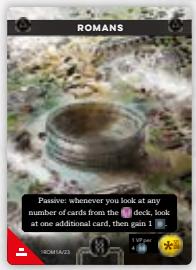

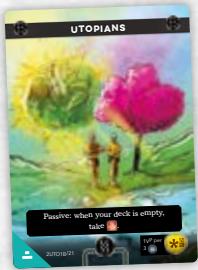
CLASSICS & LEGENDS

4 state cards

1 market board in three parts

1 solstice card

21 exhaustion tokens

18 action tokens

6 slot markers

1 six-sided die

39 materials tokens
39 population tokens
39 progress tokens


1: Classics 2: Legends
FAM: fame cards UNR: unrest cards UNC: uncivilised cards CIV: civilised cards REG: region cards TRI: tributary cards

1CIV6/15
/#: card reference
ART: Arthurians ATL: Atlanteans CAR: Carthaginians CEL: Celts EGY: Egyptians GRE: Greeks MAC: Macedonians MAU: Mauryans
MIN: Minoans OLM: Olmecs PER: Persians QIN: Qin ROM: Romans SCY: Scythians UTO: Utopians VIK: Vikings
CARD BREAKDOWN
-
Card name: the name of the card.
-
Banner: the banner colour indicates the card's suit (also shown at the bottom of the card – see 9). Cards without a suit have a grey banner.
-
Pinned/Attack: pinned cards remain in play. Attackcards affect other players.
-
State: many cards have either a barbarianicon or an empireicon. You cannot play cards showing a different icon from the one on your state card.
-
Card type: some cards have a, 3,, oricon. These have no effect but may be referenced by other cards.
-
Region type: manycards have one or more , oricons. These have no effect but may be referenced by other cards.
-
Effect: indicates what the card does when it is used.
-
Development cost: most development cards have a development cost, which is the number of, ①, and7tokens you have to spend to develop it.
-
Suit: many cards have a,,T,,0, or. These have no effect outside the setup but may be referenced by other cards.
A card's suit is also shown by the colour of its banner.
Some cards have both anand a. These are considered to becards for the purposes of setup. During the game they are considered to be of both suits.
Power: the nation you are playing as.
Region: areas under your nation's control.
Uncivilised: ancient technological and cultural developments.
Civilised: modern technological and cultural developments.
Tributary: peoples under your nation's control.
Fame: memorable deeds of your nation.
Unrest: internal strife and disorder in your nation.
-
Nation: the colour of the corner indicates the nation the card belongs to (if any).
-
Starting location: indicates where the card starts during setup: In play: in your play area (allcards are double-sided) Nation: in the nation deck Accession: at the bottom of the nation deck Development : in the development area Supply : in the unrest pile
-
Player count: cards with a3+ aren't used in a solo or two-player game. Cards with a4 aren't used in a solo game or a two- or three-player game.
-
Card number: a number reference for the card. If the first digit of the reference is a 1, the card is from the Classics box. If it's a 2, it is from the Legends box.
-
Victory points: how many victory points the card is worth at the end of the game, if any. Cards with a X icon are worth X points. Cards with a or icon are worth a variable number of victory points, as specified on the card. Cards with a X icon are worth -X points.
SETUP
COMBINING CLASSICS AND LEGENDS
If you have both Imperium: Classics and Imperium: Legends, make the following changes to setup:
-
You can play as any of the 16 available nations.
-
When you perform the commons setup, use the commons cards from either box. Check if any of thecards have the same name as one of the players' chosen nations. For each card that does, replace it with a randomcard from the commons cards in the other box. If the new card shows a4 or a3+ and you're playing with fewer than the indicated number of players, or if it has the same name as one of the players' chosen nations, draw a different replacement card instead.
PLAYER SETUP

Each player takes the following steps:
- Choose a nation and take all the associated cards, as indicated by the colour in the bottom left corner.
Before choosing a nation, you should look at the Nations' section on page 20 for an overview of the different decks.
- Place yourcard in front of you, to the left of your play area. You can place it either side up, but you cannot change this later in the game. This is your power card.
For new players, we recommend playing with the B side up.
3. Place any other cards below your power card, if you have any.
Only the Arthurians and Utopians have additionalcards.
If you're playing as the Arthurians, place King Arthur's Court face up below your power card.
If you're playing as the Utopians, put Visons of Shangri-La on top of Gates of Shangri-La and place them below your power card. The top card in this pile is your journey card.
4. Place the card face up above the power card.
For most nations, the card is your accession card.
For the Vikings, this is your zenith card.
For the Arthurians, this is your nadir card.
The Atlanteans and Utopians don't have an card.
-
Shuffle the cards into a face-down deck and place it on top of the card, perpendicular to it. This is your nation deck.
-
Place all the cards face up to the left of your nation deck. This is your development area.
For the Arthurians, these are your quest cards. When quest cards are in the development area, they are considered to be your impending quests in your quest area.
The Atlanteans do not have a nation deck.
The Utopians do not have a nation deck or any development cards.
7. Place a state card with theside up to the left of yourcard area.
If you're playing as the Atlanteans, instead place your state card with the side up.
8. Add any cards to the commons cards.
Only the Arthurians, Celts, Olmecs, Qin, Utopians, and Vikings have cards. All cards are cards. Some cards might be removed from the game during step 5 of commons setup.
-
Shuffle all remaining cards into a face down deck and place it to the right of your power card. This is your draw deck.
-
Draw five cards from your draw deck to form your starting hand.

-
Place all the , 0,7,X, andDtokens on the table, easily accessible to all players. This is the supply.
-
Give each player 3 , 2 0, 1Σ, 5X, and 3tokens. Each player should place theirxand tokens on their state card.
If there is a Utopian player, only give them 3Xtokens instead of 5.
-
Place the market board face up in the middle of the table, easily accessible to all players.
-
Sort all the commons cards by suit:,T,Q,,0, and. These can also be distinguished by the colour of their banner.
Some cards have both theandicons. For setup, these count ascards.
-
If you are playing with three players, remove all commons cards with a4 from the game. If you are playing with two players, remove all commons cards with a3+ or a4 from the game.
-
Place all thecards face up, below the icon on the market board. This is the unrest pile.
-
Place thecard King of Kings face up (the A side up), above theicon on the market board.
-
Shuffle the remainingcards into a face-down deck and place it on top of the King of Kings card, perpendicular to it. This is the fame deck.
-
If you are playing with three players, remove the top card of the fame deck from the game (without looking at it). If you are playing with two players, remove the top two cards of the fame deck from the game (without looking at them).
-
Shuffle the cards. Place the appropriate number of cards in a face-down deck above theicon on the market board. This is the region deck.
-
Shuffle thecards. Place the appropriate number of cards in a face-down deck above theicon on the market board. This is the uncivilised deck.
-
Shuffle the cards. Place the appropriate number of cards in a face-down deck above theicon on the market board. This is the civilised deck.
When creating the region deck, uncivilised deck, and civilised deck, the number of cards in each depends on the number of players:
2 players – 6 cards
3 players – 7 cards
4 players – 8 cards
-
Shufle all the remaining,T, andcards together with thecards and place them above where it showsTon the market board. This is the main deck.
-
Draw one card from each of the region, uncivilised, and civilised decks and place each card face up, opposite its respective deck below the market board. Draw two cards from the main deck and place them face up side-by-side opposite it, below the market board. These cards form the market.
-
Tuck ancard from the unrest pile underneath each,T, andcard in the market.
-
Place atoken on eachcard in the market that doesn't have anicon.
-
Randomly place the solstice card between two players. The player to the left of the solstice card is the starting player.
The game is played in a series of rounds. Each round starts with the player to the left of the solstice card taking their turn and then turn order proceeds clockwise. Play continues until either scoring or collapse is triggered, which ends the game.
On each turn, you will:
ACTIVATE
OR
INNOVATE
OR
REVOLT
Once you have finished resolving one of the above, you will clean up. After you have cleaned up, the player to your left takes their turn. If the solstice card is between you and the player to your left, the round ends and all players must resolve the solstice keyword before beginning the next round.
ACTIVATE
When you activate, you can take actions and use exhaust abilities in any order and in any combination. When you cannot or no longer want to take actions or use exhaust abilities, you will move on to clean up.
TAKING ACTIONS
To take an action, first remove antoken from your state card. If you have notokens on your state card, you may not take an action.
Then play a card from your hand into your play area and resolve the effect indicated.
Finally, place the card in your discard pile, unless the card indicates otherwise. If a card has a icon, it remains in your play area after you play it.
If a card has aor an, you can only play it if your state card shows the same icon.
Many cards have keywords. These are explained on pages 14–18.
The effects of all cards played must be resolved as much as possible.
COMMON KEYWORDS
Here are some common keywords that appear on cards to pay attention to as you're playing: abandon, acquire, break through, choose, exhaust, free play, gain, history, passive, and solstice.
USING EXHAUST ABILITIES
To use an exhaust ability, choose a card with the exhaust keyword that does not have an xtoken on it. This can be a card in your play area or it can be your power card. Move an Xtoken from your state card onto that card. If you have noxtokens on your state card, you may not use an exhaust ability.
Then fully resolve the effect indicated after the exhaust keyword. Some exhaust abilities specify a cost. If you cannot pay the specified cost, you may not use the exhaust ability. If a card already has anxtoken on it, you may not use the exhaust ability shown on that card.
You may use an exhaust ability on a card in your play area with a regardless of which icon is showing on your state card.
You can only use an exhaust ability on your own turn and when you activate, unless the card specifies otherwise.
INNOVATE
First, place all the cards in your hand in your discard pile.
Then, break through for, ,or , as described on page 15.
Then move on to clean up.
You cannot take actions or use exhaust abilities if you innovate.
REVOLT
Return any number of cards from your hand to the unrest pile.
Then move on to clean up.
You cannot take actions or use exhaust abilities if you revolt.
CLEAN UP
First, add 1from the supply to any card in the market.
If you're playing as the Carthaginians, add 1 or 2 tokens instead, as indicated on your power card.
If you're playing as the Qin, add 1 token instead, as indicated on your power card.
Once you've placed a token on a card in the market, the next player can start their turn while you complete the rest of the clean-up.
Next, remove allaand×tokens from your state card and from all of the following: all cards in your play area, your nation deck, all cards in your development area and your power card. Then place 3Dtokens and 5Xtokens on your state card.
If you're playing as the Utopians, only place 3Xtokens.
Next, you may discard any number of cards from your hand into your discard pile. Finally, draw cards from your draw deck up to your hand size of five. If you already hold cards equal to or exceeding your hand size, don't draw any cards. Some card effects might increase your hand size.
As cycling through your deck is your main way of gaining access to your nation's ,, and cards and become an empire (see overleaf), it's often a good idea to discard leftover cards at the end of your turn.
RESHUFFLING YOUR DRAW DECK
If your draw deck is empty and you need to draw a card, first check your state card: If your state card shows
- If there are noXtokens on your nation deck and you have one or moreXtokens on your state card, place the top card of your nation deck in your discard pile. Then move anXtoken from your state card to your nation deck.
If there is already an×token on your nation deck, or if you have none on your state card, skip this step.
If you place your card in your discard pile, immediately flip your state card to its side.
-
Shuffle your discard pile into a new draw deck.
-
Keep drawing cards as normal.
If you're playing as the Arthurians, the card is your nadir card. Instead of placing it in your discard pile, immediately place it in your play area. Do not flip your state card.
If you're playing as the Vikings, the card is your zenith card. When you place it in your discard pile, it will trigger the end of the game! Do not flip your state card. If you're playing as the Utopians, you have no nation deck so you must skip step 1.
If your state card shows
- If there are noXtokens in your development area and you have one or more× tokens on your state card, you may pay the development cost shown on one of your development cards to develop it. Place that card in your discard pile. Then move an Xtoken from your state card into your development area. If there is already an× token in your development area, or you have none on your state card, skip this step.
If you are playing as the Utopians, you have no development area so you must skip step 1.
-
Shuffle your discard pile into a new draw deck.
-
Keep drawing cards as normal.
Resolve this immediately when triggered, even on another player's turn.
Some cards state draw the top card of the deck if able'. If your draw deck is empty, do not draw a card and do not reshuffle your deck.
SOLSTICE
The round ends when the player to the right of the solstice card finishes their turn.
Before the next player takes their turn, each player should resolve all solstice keywords in their play area and on their power card. These effects can be resolved simultaneously by all players.
Solstice keywords must be resolved as much as possible unless the card specifies that it is optional.
If you have multiple cards with solstice keywords activate them in the order you choose.
Once all players have resolved all their solstice keywords, the next player takes their turn as normal to start the next round.
GAME END
The game ends when either scoring or collapse is triggered.
Scoring is triggered if one of the following conditions is met:
-
There are no more cards in the main deck
-
A player develops the last card in their development area
This does not trigger if the Arthurians move the last card from their quest area.
-
The King of KingsOcard is flipped face down (see page 19)
-
The Viking player places their Harald Hardrada card into their discard pile
-
The Arthurian player plays their Graal card
-
The Utopian player has at least 24 tokens and triggers the solstice keyword on their Shangri-La journey card.
Collapse is triggered if there are ever no cards left in the unrest pile.
If collapse is triggered after scoring has already been triggered, a collapse is resolved.
SCORING
When scoring is triggered, complete the current round as normal. Then, play one final round, including resolving the solstice keyword after all players have taken their turn. Then, all players add up their victory points
Leave cards where they were when the game ended as you score, as some ?p cards and cards score differently depending on their location.
•Everyin front of you is worth 1 victory point.
Score for every card in your hand, play area, draw deck, discard pile and history (or flooded pile), as well as for your power card. Do not score for cards in your nation deck or your development area.
• A card with an X or X scores victory points equal to the number indicated.
A card with a? scores the number of victory points indicated if the condition specified has been met. Otherwise, it scores no points.
A card with a scores a variable number of victory points, as specified on the card.
You can never score more than 10 points from a card.
If you have multiple cards that score for having certain card types or resources, these can all score for the same cards or resources.
The player with the most victory points wins.
In the case of a tie, the tied players share the victory.
COLLAPSE
When collapse is triggered, the game ends immediately, without even completing the current action.
Count the number of cards in your hand, play area, draw deck, discard pile, and history. The player with the fewest cards wins.
In the case of a tie, the tied players should proceed to scoring.

KEYWORDS
ALL PLAYERS / ALL OTHER PLAYERS
Cards that refer to all players' or ‘each player' include you as well.
Cards that refer to ‘all other players' or ‘each other player' do not include you.
ABANDON
Only cards in play can be abandoned. To abandon a card, place it in your discard pile.
If the card has a garrisoned card underneath it, the garrisoned card is also abandoned.
Some cards let you abandon garrisoned cards. If you do, the garrisoning card remains in play.
ACQUIRE /T//
Select a card from the market of the indicated suit and add it to your hand. Only take one card, even if there are multiple suits indicated, unless specified otherwise. Gain any 0, and V tokens on that card. If there is ancard underneath it, add that card to your hand as well.
Then draw a new card from the appropriate deck (or the main deck, if the appropriate deck is depleted) to replace it and tuck ancard from the unrest pile underneath it if it's an, T, orcard.
If a card allows you to acquire multiple cards, fully resolve the above for each card you acquire. You may acquire newly drawn cards if they are of the indicated suit.
ACTION
When a card effect lets you gain an action, place antoken on your state card, even if that would take you above 3 Dtokens on your state card.
When a card effect requires you to spend a number of actions, remove that many Dtokens from your state card. If you are unable to do so, you cannot resolve that card effect.
ATTACK
When you play a card with anKicon, it will have a detrimental effect on all other players. If you are unable to resolve this effect in full, resolve it as much as possible.
Some cards protect players against Kcards. They let the player choose to ignore some or all of the effects of an Kcard.
BARBARIAN
You can only playcards if your state card is showing theicon.
You can have acard in your play area and use its exhaust ability, even if your state card is showing the川icon.
When a card refers to ‘if’, that effect can only be resolved if your state card is showing theicon.
If you're playing as the Atlanteans your state card starts on itsside, so you can never playcards.
BREAK THROUGH FOR
If more than one suit is listed, first declare which one of them you will break through for. Then do one of the following:
Option 1: Select any card of that suit from the market and add it to your hand. If you choose this option, you will gain all ①, and7tokens on that card. If there is ancard underneath the card you selected, return it to the unrest pile. Then draw a new card from the appropriate deck (or the main deck, if the appropriate deck is depleted) to replace the card you have taken. If it's an T or0card, tuck ancard from the unrest pile underneath it.
Option 2: If breaking through for0, take the top card of the uncivilised deck and add it to your hand.
Option 3: If breaking through forT take the top card of the civilised deck and add it to your hand.
Option 4: If breaking through for take the top card of the region deck and add it to your hand.
Option 5: If breaking through for or for a suit where the appropriate deck is empty, reveal cards one by one from the top of the main deck until you find a card of your declared suit. Take that card and add it to your hand, and then shuffle all the other revealed cards into the main deck. If you do not find a card of the declared suit, gain 2E
CITY
Some cards are cards and may be referenced by other cards.
CHOOSE
Resolve one of the options following this keyword.
DEVELOP
Pay the development cost shown on a card in your development area and add it to your discard pile.
When this keyword appears as a card effect, you may resolve it even if there is an ×token in your development area. Resolving it does not require you to place anXtoken in your development area.
The Arthurians, Utopians, and Vikings have no development area and may never develop.
DISCARD
Place the card in your discard pile.
DRAW CARD(S)
Draw the indicated number of cards from your draw deck. If you need to draw more cards than you have left in your draw deck, draw as many as you can. Then reshuffle your draw deck (following the procedure on page 12) and continue drawing cards.
Some cards state draw the top card of the deck if able' or ‘draw up to X cards if able.'You may not draw more cards than are left in your deck. If your draw deck is empty, do not draw any cards.
EMPIRE
You can only playcards if your state card is showing the icon.
You can acquire and break through forcards, even if your state card is showing theicon.
When a card refers to ‘if’, that effect can only be resolved if your state card is showing the山icon.
If you're playing as the Vikings or the Arthurians, who can never flip their state card, you can use your Combs or Guennuvar card to play Mcards.
EXILE
Choose an eligible card and place it in an exile pile, next to the symbol on the market board.
If you exile a card from the market, return anycards underneath it to the unrest pile. Then draw a new card from the appropriate deck (or the main deck, if the appropriate deck is depleted) to replace it. If it's an T, or card, tuck an card from the unrest pile underneath it.
You may never exile a card with one or more tokens on it unless you are swapping it (see below).
Some cards let you swap cards between the market and the exile pile. To do so, exile a card as normal, but instead of drawing a new card to replace it, use a card from the exile pile. If the replacement is an, T, orcard, tuck an card from the unrest pile underneath it.
If you swap an exiled card with a card that has one or more tokens on it, put those tokens on the card placed in the market.
Some cards let you acquire or break through for cards in the exile pile. If you acquire an,T, orcard in this way, also take ancard from the unrest pile.
FIND
Search, in this order, the following areas for the card(s) specified: your hand, your discard pile, your draw deck, and your nation deck. Some cards may instruct you to search in certain areas only.
If you do not find the specified card, nothing happens. If you find the specified card, stop searching and reveal it. The card will tell you where you should place it.
If the card indicates a choice (for example, 'find a'), you may search all the areas and choose one eligible card to reveal. Return the other cards to the places where you found them.
Whenever you finish searching your draw deck or your nation deck, you must shuffle it. When shuffling your nation deck, leave the card at the bottom of the deck.
FLOODED
Instead of a history, the Atlanteans have a flooded pile. Cards underneath their power card are considered flooded and are out of play. Flooded cards cannot be interacted with unless a card effect specifies otherwise. However, they still score victory points. You may always look at the cards in your flooded pile, but other players may not.
Any card that would have interacted with your history does not interact with your flooded pile. cards that score for being in your history do not score for being in your flooded pile.
Cards are added to the flooded pile through the sink keyword.
FREE PLAY
Do not remove antoken from your state card to play this card.
You can take an action to play this card even if you have noDtokens left on your state card.
GAIN ACTION
Place anDtoken on your state card.
This can take you above 3tokens.
GAINO/O/E
Take the indicated number of tokens of the specified type from the supply.
, , and tokens are not meant to be limited.
GARRISON
Take another card from your hand and place it face up underneath the card with the garrison keyword. The card underneath is now considered garrisoned. A card can have multiple cards garrisoned underneath it. Some cards might specify the type of card that can be garrisoned.
A garrisoned card is not considered to be in your play area, though they will still score you points at the end of the game. You cannot discard or play a garrisoned card, and you cannot use its exhaust or solstice abilities.
If a garrisoned card is underneath a card that is abandoned, recalled, exiled, put into history, or sunk, do the same to the garrisoned card. However, if the garrisoned card is specifically targeted, the garrisoning card remains in play.
Some cards let you garrison them or other cards under cards already in play. To do so, place it underneath that card as normal.
Garrisoned cards are public information.
HISTORY
All cards placed underneath your power card are considered your history.
Cards in your history are out of play, and they cannot be interacted with unless a card effect specifies otherwise. However, they still score victory points. You may always look at the cards in your history, but other players may not.
The Atlanteans and the Vikings do not have a history. If a card would be placed in their history, it is discarded instead.
KNIGHT
Some cards are cards and may be referenced by other cards.
LOOK
Pick up and examine the indicated card or cards without showing other players. Unless instructed otherwise, return the cards you looked at to their original location. If you are instructed to look at multiple cards and there are fewer eligible cards available to look at, look at as many as possible.
If you look at multiple cards, return them to their original location in any order.
If you look atcards, never look at King of Kings unless it's the only card in the fame deck.
MASK O
Some cards are cards and may be referenced by other cards.
METROPOLIS


Some cards arecards and may be referenced by other cards.
NATION DECK
If a card effect lets you in any way manipulate cards in your nation deck, your card will always remain on the bottom. Never place a card underneath your card or shuffle your card into your nation deck.
PASSIVE
As long as a card is in your play area, its passive ability is in effect.
The passive ability of a power card is in effect for the entire game.
PAYO/O/E
Return the indicated number of tokens of the specified type to the supply. If you are unable to do so, you may not take that action or use that exhaust ability. If the action or ability has multiple options, you must choose another option instead.
When paying , you may spend any amount of7as if each were 1 ①
When paying , you may spend any amount of7as if each were 2 . No change is given when you do so.
You cannot convert into or .
PINNED

When you play a card, it stays in your play area until it is removed by another action or an exhaust ability.
REGION TYPES


Somecards have one or more \$, oricons and may be referenced by other cards.

PUT INTO YOUR HISTORY
Place the specified cards underneath your power card. They are now considered to be in your history.
The Atlanteans and the Vikings do not have a history. If a card would have gone into their history, it is discarded instead.
RECALL
Only cards can be recalled. When one of these cards is recalled, return it to your hand.
If the card has a garrisoned card, the garrisoned card is also returned to your hand.
RETURN AN
Take ancard from your hand and add it to the unrest pile.
Some cards allow you to return an card from your discard. To do so, take the card from your discard pile and add it to the unrest pile.
SINK
Place the specified cards underneath your power card. They are now considered to be flooded.
If a player other than the Atlanteans would trigger this keyword, they instead discard the specified cards.
SOLSTICE
At the end of the round, you must resolve all solstice keywords in your play area and on your power card in the order you choose.
SCROLL
Some cards are cards and may be referenced by other cards.
STEALO/O/
Take the indicated number of tokens of the specified type from the specified players.
If you are unable to resolve this effect in full, resolve it as much as possible.
TAKE
Take ancard from the unrest pile and add it to your hand.
CARD-SPECIFICNOTES
ACCLAIMED

When you break through for a card, follow the normal rules for breaking through, but either choose a card from the market or reveal cards from the main deck.
DOMESTICATION
On your turn, you can exhaust this card when acard in play is used to gain0 whether through its own or another card's effect (even if the is not relevant to that effect).
This is most likely to trigger when you use Prosperity, Nomads, or similar cards that generatefrom0cards and one of the cards also has aicon. However, it can also be triggered from cards such as Water Mill or Trading Ships.
EMBALMING
The passive ability is triggered whenever you pay during an action, exhaust ability, or solstice ability, or while developing.
It is not triggered if the cost is entirely paid by spendingEinstead.
GRAND TRUNK ROAD
This card counts as 2cards for the purposes of other card effects, such the Mauryanscard, Glory, and the Macedonians2card.
INDIAN ELEPHANTS
There are two copies of this card.
Only one has theicon.
KING OF KINGS
This card cannot be drawn as long as there is at least one face-down card.
If you would look at morecards than there are face-down cards in the deck, simply look at all the remaining cards.
If you would look at one or more0cards and there are no face-down cards in the deck, resolve King of Kings instead. Once you have resolved it, flip it face down. This triggers the end of the game.
If you would look at or draw one or more 0cards and King of Kings is face down, resolve its face-down effect but leave the card as it is.
You cannot trigger King of Kings (either side) more than once per game.
NOMADS
There are two copies of this card. Only one has theicon.
SHADUF
On your turn, you can exhaust this card when acard in play is used to gain whether through its own or another card's effect (even if theis not relevant to that effect).
This is most likely to trigger when you use Prosperity, Nomads, or similar cards that generate fromcards and one of them also has aicon. However, it can also be triggered from cards such as Boats or Port.
SUMERIANS
At the end of the game, return up to 2 cards from your hand, play area, discard pile, draw deck, or history.
This effect is triggered before determining a winner through scoring or collapse.
If you trigger this ability after a collapse, it does not prevent the game ending.
NATION-SPECIFICNOTES
ARTHURIANS AND THEIR QUESTS
As the Arthurians, you cannot become an empire and start developing cards. Instead, the cards in your development area are your impending quests. By using the solstice keyword on King Arthur's Court, you may garrison an impending quest, which then becomes your active quest. You can only ever have one active quest.
By using Morigena or Myrddin Wyllt, you may gain the active quest into either your hand or your discard pile. When you have done this, it is no longer considered the active quest.
Graal can become the active quest only if there are no other impending quests.
UTOPIANS AND THEIR JOURNEY
As the Utopians, you are not so concerned about becoming an empire and conquering territory. Instead, you are on a journey towards Utopia, represented by your two double-sided journey cards. These are always stacked, and only the face-up side of the topmost card is considered to be in play. Your journey card functions like an additional power card with a potent exhaust or passive ability, as well as a solstice ability that will let you progress on to the next step of your journey. Your journey card cannot leave play except for through its solstice keyword.
The passive ability of the Utopians card is triggered as soon as your draw deck is empty, even if you are not reshuffling. If cards are added to the deck and you empty it again, you must trigger the ability again.
NATIONS
You don't need to read this section to learn how to play, but reading your nation's entry will give you a sense of the key cards in your deck.
When you play with a nation for the first time, take a moment before completing the player setup to look through its pool of cards. Each nation is unique, so it is worth familiarising yourself with the cards that will come up from your nation deck, and the development cards that will become available once you become an empire. You will always have multiple routes to victory, but an awareness of your nation's strengths and weaknesses will help you form a strategy and identify cards in the market that will help your game plan.
Each nation has a difficulty rating, ranging from (straightforward) to★★★★★(very challenging).
Some nations also list specific entries worth reading before playing the game. The number in parentheses is the page reference.
CLASSICS
CARTHAGINIANS
Difficulty: ★★
As the Carthaginians, your main concern is trade and the acquisition of . Use your unique power alongside your caravans and trading ships to manipulate the market in your favour. Once an empire, continue your expansion with your famous elephants led by Hannibal, or dominate trade using a monopoly to export unrest and other unwanted cards to your opponents.
CELTS
Difficulty: ★★
As the Celts, you will want to adopt an aggressive playstyle, concentrating on acquiring cards and spreading unrest through your powerful Druids. Without the prosperity available to other nations, you will need to collect using cattle raids and grow your population with your druids and the Cauldron of Cerridwen.
GREEKS
Difficulty: ★★★★
As the Greeks, your main advantages are your cities and technology, and you will want to lean into those strengths. In the early game, your settlers and Greek mercenaries are powerful cards of expansion, while as an empire science will enable you to continue to advance and the Olympic Games will keep your nation manageable. Your lighthouse will let you manipulate exiled cards, so it may be worth bearing in mind which cards you exile during the game.
MACEDONIANS
Difficulty: ★
The Macedonians, more than any other nation, are focused on expansion, socards are likely to form a central role in your game plan. With Alexander and his companion cavalry you can keep conquering as an empire, and using your new territories to garrison cards and go for glory can be a winning strategy, especially when paired with a powerful Macedonian phalanxes.
As the Persians, you will want to subjugate other nations to your will and use them to your advantage. Conquer as manycards as you can and expand your territories. Once an empire, you can start striking your opponents with your mighty battering ram and spreading unrest with your Persian gold.
ROMANS
Difficulty: ★
As the Romans, your path to dominance will likely be through rapid expansion. Conquer cards and use them to declare your glory and earn fame. With your mighty legion, your conquest can continue well into your accession to empire.
SCYTHIANS
Difficulty: ★★
As the Scythians, you will want to focus on expanding your territory and grabbingcards that you can exploit for their . As nomads, you'll be making use of tents for shelter and mounted archers for protection, but your true glory won't be recognised until you become an empire.
See: Nomads (19)
VIKINGS
Difficulty:★★★
The Vikings never become an empire and have no history, which confers its own advantages and challenges. Your nation deck will keep providing you with cards at no cost, but you won't be able to control the order in which they enter your deck. Use Gothja and other cards to help you adapt, and make full use of your ability to keep playing cards that would normally go into your history. To keep your deck under control, remember to garrison cards using yourcards and your sagas.
See: nation deck (17)
LEGENDS
ARTHURIANS
Difficulty: ★★★★★
The Arthurians never become an empire, instead pursuing quests and chasing after the legendary Graal. Your knights are vital, granting powerful boons as they are garrisoned. Send them on quests for Myrddin Wyllt or take a darker path and use Morigena's powers. Looming over you is the Battle of Camlann, Gwaith Camlan, which will see your knights fall and your kingdom suffer mounting unrest.
See: knight (17), Arthurians and their Quests (19)
ATLANTEANS
Difficulty: ★★★
As the Atlanteans, you begin as an empire, which means you can use the powerful cards from the start of the game. However, it also means you have to ensure a constant supply of , ①, and7to develop further. Atlantis is under the constant threat of floods, and you'll need to prioritise finding newor risk your nation sinking entirely. But with the rising waters come rewards, which if used wisely will see your nation become true myths and legends.
See: flooded (16), sink (18)
As the Egyptians, you are empire builders. With so many opportunities for development, you'll want to consider carefully the best order in which to expand your deck. With your infrastructure located around Egypt's famous river, the frequent flood of the Nile can bring new opportunities for growth, and you'll want to keep an eye out for key cards in the market.
See: Embalming (18)
MAURYANS
Difficulty: ★★
As the Mauryans, you will want to open with aggressive tactics as you expand your nation withandcards, using the mighty Indian elephants you have at your disposal. As you become an empire, you'll need to choose whether to keep expanding and seeking glory, or to follow Ashoka instead and take a peaceful path to victory.
See: Grand Trunk Road (18), Indian Elephants (18)
MINOANS
Difficulty:★★★
As the Minoans, you will probably focus onE, as you will need it to develop. Carefully manage your supply of to create beautiful pottery, but beware of its icon – if you abandon it after you become an empire, you won't be able to play it again. Keep your nation running efficiently with a discerning eye for important cards, and use your writing systems to consign unimportant cards to history.
OLMECS
Difficulty: ★★★★☆
As the Olmecs, your game will look different from that of most of the other players. You won't find any prosperity, conquer, advance, or glory cards in your deck; instead, you'll need to rely on your stone masks. Masks are a tricky resource – they let you draw more cards and power your cards, but they score you points only when they are in your history. Managing them carefully will be key to your success.
QIN
Difficulty: ★★
Playing as the Qin is a game of challenging decisions. Powerful leaders must rule with the mandate of heaven, but is that leadership worth the burden it brings? How will you choose between the competing systems of Confucianism and Legalism? And as an empire, will you invest the time needed to construct long walls or focus on other goals?
UTOPIANS
Difficulty: ★★★★★
The Utopians are unlike any other nation – everything about them is different. You have no nation deck and no development cards, and you won't want to go through your deck quickly. Instead, you will be realising your visions of Shangri-La and spending yourΣ to advance towards the fabled city of Shangri-La itself. Study your cards – and your opponents - carefully, as you'll need to decide which will serve you and which will hinder you on your path to Utopia.
See: Utopians and their Journey (19)
+Ⅱ一
Game Design: Nigel Buckle and Dávid Turczi Game Development: Filip Hartelius and Anthony Howgego Illustration: Mihajlo "The Mico' Dimitrievski Graphic Design: James Hunter
Nigel and Dávid would like to thank for playtesting, advice, and feedback: Andrei Novac; Anthony Howgego; Arwen, Kiefer, and Fiona Buckle; Blazej Kubacki; Charlotte Levy; Colin Beattie; David Pitman; Gary Perrin; Graham Forbes; Ian Vincent; James Bunnett; Jen and Kieran Symington; Jonathan Bobal; Martin Butcher; Nick Shaw, Michael Dollin; Mike Eggleton; Mukel Patel; Neil HK; Paul and Donna Lister; Riccardo Fabris; Rob Darbarn; Rob Fisher; Sami Khan; Stephen Tavener; Tim Fitzmaurice; Tim Smith; Wai-yee Phuah; and the players at the London on Board and Cambridge Grad Pad games clubs.
Special thanks to Martin Butcher for his help throughout this project.
Special thanks also to Kiefer Buckle for campaign mode testing. First published in Great Britain in 2021 by OSPREY GAMES
Bloomsbury Publishing Plc
Kemp House, Chawley Park, Cumnor Hill, Oxford OX2 9PH, UK
1385 Broadway, 5th Floor, New York, NY 10018, USA
Imported into the EEA by Bloomsbury Publishing Ireland Ltd, 29 Earlsfort Terrace, Dublin 2 OSPREY GAMES is a trademark of Osprey Publishing Ltd
© Nigel Buckle and Dávid Turczi, 2021. This edition © 2021 Osprey Publishing Ltd All rights reserved.
www.ospreygames.co.uk
For more information or replacement parts, email info@ospreygames.co.uk
20 21 22 23 24 10 9 8 7 6 5 4 3 2 1
QUICK REFERENCE SHEET
TURN STRUCTURE
ACTIVATE
OR
INNOVATE
OR
REVOLT
THEN
CLEAN UP
Activate: take up to 3 actions and use up to 5 exhaust abilities.
Innovate: discard hand, then break through for, ①. , or .
Revolt: return anycards in hand to unrest pile.

CLEAN UP
-
Add 1>to market
-
ClearaandXtokens
-
Discard any number of cards
-
Draw up to hand size of 5
RESHUFFLING
If: add top card of nation deck to discard pile, then shuffle discard into deck and exhaust nation pile.
If card added is , flip state card to1
If: pay development cost to develop card. Add that card to discard pile, then shuffle discard into deck and exhaust development area.
COLLAPSE
If unrest pile is empty, game ends immediately. Player with fewest wins.
SCORING
Game ends if one of the following is true:
-
Main deck is empty
-
One player's development area is empty
-
King of Kings is flipped face down
-
Vikings take Harald Hardrada

-
Arthurians play Graal
-
Utopians trigger Shangri-La with 24+0
Complete the current round and play one final round.
Player with most points wins:

= 1 victory point

= X victory points

?y= scores victory points as specified if the indicated condition is met
= variable points as specified, up to 10
下载 Markdown