Successors - Rules.md

INTRODUCTION
When Alexander the Great died in 323 BC, he left no clear heir to the vast empire he had conquered.
Soon after his death, his generals went to war over who would become Alexander's successor or the regent
of his realm. By 305 BC, they had given up trying to establish a legitimate successor and begun carving
out kingdoms of their own. Successors is a game based on the Wars of Alexander's Successors, in which each player controls a faction of the once-united Macedonian army. Now it is your turn to claim victory, either by achieving royal legitimacy within Macedonian society, or by controlling the most valuable provinces of Alexander's immense empire.
Hear me, brave generals! Fear not at the sight of these rules! If you are discovering this game on your own, first carefully remove everything from the box and spread out the map. Find the Play Book and go through the Example of Play, following along on the map and Player Aids while looking at the pieces and cards. That's the best way to introduce yourself to Successors.
A better way to learn the game is to have someone teach you. Watch a video or two online if you can. Any time you have questions, please post them at boardgamegeek.com in the Successors Rules forum. They will be answered quickly.
It is possible to learn to play Successors by reading these rules. Please understand that these rules are designed to cover all the specific details and unusual situations that might come up in a game, no matter how rare, instead of explaining just the main concepts and details you need to know to play. Your first resource for answering questions should be the Player Aids. Wait to consult the rules until you encounter unusual or confusing situations, or until you have several hours available to explore the complete details and intriguing possibilities that await you inside this deluxe edition of Successors.
Table of Contents
-
Inventory
-
Board, Map and Key Terms
-
Victory Conditions 3.1 Instant Victory 3.2 Regency Victory 3.3 End Game Victory 3.4 Victory Tie Breaker 3.5 Victory Points 3.6 Legitimacy 3.7 Champions and Successors 3.8 Burying Alexander
-
Generals and Military Units 7.1. Generals 7.2. Combat Units (CUs) 7.3. Fleets 7.4. Independent Armies
-
Royal Family Members
-
Land Interception and Withdrawal
-
Naval Movement and Battles
-
Land Battle 14.1 Attacker and Defender 14.2 Battle and Major Cities 14.3 Battle Cards 14.4 Royal Army CUs 14.5 Local Troops 14.6. Battle Strength 14.7. Battle Score 14.8. Commanding General Loss 14.9. Battle Losses 14.10. Retreat
-
Setup9.4 Movement and Major Cities14.10. Retreat
-
Strategy Phase 6.1. Surrender Segment
9.5 Activation of Independent 15. Sieges Armies 16. Optional Rules

1. INVENTORY
A complete game of Successors contains:


Game Board 5 Player Aids This Rulebook Playbook

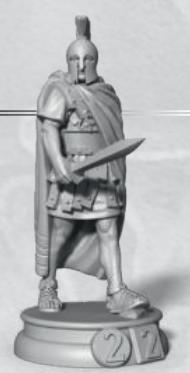
16 General miniatures 20 General stands and 20 General counters (optional)

Funeral Cart and Alexander's Tomb miniatures
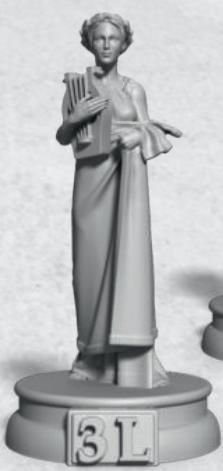
3 Female and 3 Heir miniatures

7 Royal Family counters (optional)
in 5 player colors (optional)


5 large Faction cards

200 Political Control (PC) markers (40 per player)
33 Province cards



10 Faction markers (2 per player)


20 Minor general counters (4 per player)
70 large Tyche cards
1 large Movement allowance card


5 Capital construction marker/2V marker
5 Capital markers/1V marker
45 Independent PC markers


5 Independent Armies

3 Victory markers
44 Mercenaries

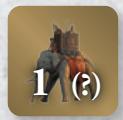
8 Elephants
24 Cavalry

28 Loyal Macedonian


4 Royal Army

1 Silver Shields

1 Helepolis


4 Siege markers

3 Looted markers
1 Game Turn marker

20 General cards

1 First Player marker

1 Usurper marker

12 Legitimacy markers
8 Fleet tokens

8 Popularity markers

5 six sided dice

2 Elephant dice
2. BOARD, MAP AND KEY TERMS

The Board of Successors has these areas:
① The Map: Spaces, Paths, Provinces and Regions
Holding Boxes for Unique Counters
3 Royal Family Membe Independent Armies 5 Legitimacy markers Victory markers Fleet Tokens
8 The Dispersed Box The Turn Track
10 The Legitimacy Track The Victory Track
12 The Tyche Draw Pile and Discard Pile

Spaces: There are 4 kinds of spaces on the map:
Minor Cities

Strongholds

Major Cities

Transit Points
Minor Cities: Most spaces on the map are Minor Cities. Minor Cities controlled by a player are easy to capture. Independent Minor Cities are more difficult to capture, requiring 1 Siege Point.
Strongholds: They represent areas that are dangerous for Macedonian forces. While Independent, these spaces require 2 Siege Points to capture, and Armies passing through them suffer Attrition. However, when a Stronghold space is uncontrolled, or controlled by a player, it is treated in all ways as a Minor City.
Independent Stronghold!
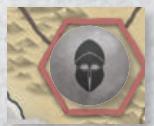

Just a Minor City
Ports: Any space connected by one or more Sea paths is a port. Naval Movement begins and ends in ports.
Major Cities: Major Cities are the most important spaces on the map. A controlled Major City may only be captured by accumulating 3 Siege Points. Major Cities allow players control their surrounding Province and keep nearby Minor Cities from being isolated.
Locations: A location is an area within a space (i.e. a part of a space). Most spaces have just 1 location (a land location), but a space can have 2 or 3 locations:
Every Major City space includes a land location inside the city walls and another land location outside the city. The outside location surrounds the inside location, except where the inside touches the sea. Pieces enter or leave a Major City space through its outside land location using Land Movement.
Every port space includes a sea location. A Port is any space accessible by one or more sea paths. Naval Battles and Naval Movement occur in sea locations. Pieces enter or leave a Major City through its sea location using Naval Movement.

Transit Points represent sparsely settled areas with limited resources. Armies with more than 3 Combat Units on a Transit Point lose one Combat Unit in their Forage Segment.
Paths: Spaces are connected by paths. Pieces use Land Movement to move between spaces over Land, Mountain, and Strait paths, and Naval Movement to move over Sea and Trans-Mediterranean paths.

Adjacent spaces: Two spaces are adjacent if they are connected by a Land, Mountain, or Strait path. Spaces connected only by Sea or Trans-Mediterranean paths are not adjacent.
W
Political Control Markers (PCs): Each player has a set of their own color of Political Control Markers (PCs). Gray PCs represent Independent forces opposed to Macedonian rule.
Each space may contain only 1 PC, and PCs may never be placed on Transit Points.
A space with a player's PC is controlled by that player. A space without a PC is uncontrolled.
A space with an Independent PC is Independent. A space that contains a gray PC symbol begins the game Independent.
Provinces: A Province is a set of spaces grouped on the map by color. Each Province has a name and at most one Major City.

Example: The Minor City space Paphos ① and the Major City space Salamis 2 make up the island Province Kypros. Note that the circle and square around Paphos and Salamis are the same color.
Each Province on the map shows 2 numbers: The larger number on the left in an orange box indicates the Victory Points (VP) you gain while you control the Province.

The smaller number on the right in a white circle is the number of spaces you must control (including its Major City, if it has one) in order to control the Province.
Each Province has its own Province card:

(Major City) (Minor Cities) Control requirement
Province Control: You control a Province if you control its Major City (if it has one) and you control more than half of its spaces, counting its Major City (if it has one), but never Transit Points. Each Province is either controlled by a player, Independent, or uncontrolled. While you control a Province, place its Province card in front of you, off the map. Province cards are intended to help you remember the details of the Provinces you control. You can use them to verify your total number of Victory Points.
Adjacent Provinces: Two Provinces are adjacent if any of their spaces are connected by a Land, Mountain, or Strait Path. Provinces connected only by Sea or Trans-Mediterranean paths are not adjacent.

Example: The Province of Thrake 1 is adjacent to both the Provinces of Mikra Phrygia ② and Bithynia 3 due to the Strait paths
Regions: A Region is a set of Provinces: Africa . . . . . Aigyptos and Libye Europe . . . . . Makedonia, Thessalia, Hellas, Thrake, Skythia, Illyria, and Epeiros Major Islands . Krete, Rhodos, and Kypros Asia . . . . . . All other Provinces

Thebackground colors on the map also indicate Regions. The Province and the Region it falls into are highlighted on each Province card in the Region's color.
Holding Boxes: Holding boxes are where Royal Family Members, Independent Armies, special Combat Units, Legitimacy and VP markers, and Fleet Tokens are stored when they are neither on the map, nor in the Dispersed Box, nor on a Faction card, nor on a General card, nor removed from the game.
SUCCESSORS
Dispersed / Dispersed Box: As the result of Land and Naval Battles, Overruns, and other causes, your Generals, Combat Units, and Fleets will often be rendered temporarily unavailable to you (but not removed from the game). This is called being Dispersed.
Place your Dispersed Major Generals, Combat Units, and Fleets in the Dispersed Box. Mark Combat Units and Fleets in the Dispersed Box with one of your PCs to show they belong to you. Your pieces will return from the Dispersed Box back onto the map in the Reinforcements Phase of the next Game Turn.
Victory Point Track: The VP Track is used to track each player's Victory Points.
| 12 | |||||||||||||||||
| 13 | 14 | 15 | 16 | 17 | 18 | 19 | 20 V• | 21 | 22 | 23 V0 | 24 | 25 | 26V0 | 27 | 282 | >0 | |
Legitimacy Point Track: The Legitimacy Track is used to track each player's Legitimacy.
| 18O | ||||||||||||||||||
| D | 1 | 2 | 3 | 4 | 5 | 6 | 7 | 8 | 9 | 10 | 11 | 12 | 13 | 14 | 15 | 16 | 17 | |
Important: Use each player's Faction markers to record each player's Legitimacy and Victory Points on the Legitimacy Track and the Victory Point Track. Keep these up to date at all times! It is important for all players to know when a player is close to Instant Victory or Regency Victory, and who might become the Usurper in the next Game Turn.
Update the markers on the track when anything changes, and verify the position of the markers on the track as often as needed to keep the Tracks up to date and accurate.

Enemy: An Army, General, Combat Unit, Fleet, PC, or controlled space that belongs to another player, or is Independent, is enemy to a player and to that player's pieces and spaces. Everything belonging to any player is enemy to Independent Armies and spaces with Independent PCs. A space with an enemy PC is an enemy space.
Important: "Enemy" in the Tyche card text means enemy to the player playing the card.
Faction: A Faction is all game pieces and cards that belong to one player. Faction can also simply mean the player. Independent pieces belong to the Independent Faction.
Independent: Gray PCs and Independent Armies are Independent. A space with an Independent PC is an Independent space.
On Map / Off Map: A piece is "on map" if it is in a space on the map. A piece is "off map" when it is in a holding box, the Dispersed Box, on a Faction card, or otherwise physically off the Board but not removed from the game.
You should place your unused Minor Generals, PCs, and available Fleets in front of you, off map, ready for use.
3. VICTORY CONDITIONS
There are three different paths to victory. You can win instantly, if your power or your legitimacy is so great, that you're acclaimed the one and only successor of Alexander the Great. Or an Heir, supported by a powerful Regent, may inherit Alexander's throne, bringing peace to part of the Macedonian empire. You can win at the end of the game, if you manage to gather more power than any other player.
3.1 Instant Victory

Two conditions result in Instant Victory, ending the game, except on Game Turn I:
• You have 18 Legitimacy Congratulations! You are the legitimate successor to Alexander the Great!
• You have a total number of Victory Points that depends on the number of players:

5 players: 20 VP
4 players: 23 VP
3 players: 26 VP
2 players: 29 VP
3.2 Regency Victory
An Heir, supported by a powerful Regent, may inherit Alexander's throne, bringing peace to part of the Macedonian empire. This is called a Regency Victory, and it ends the game.
If you control Alexandros in the Preparations Phase of Game Turn IV and you have the highest total of L + VP at that time, you win! Similarly, if you control Herakles in the Preparations Phase of Game Turn V, and you have the highest total of L + VP at that time, you win! If tied for highest L + VP, you must win the Victory Tie Breaker to win the game.
If you control the correct Heir but do not win the game, that Heir is assassinated and the game continues. If the Heir is alive, but uncontrolled, the player with the highest total of L + VP wins. This is applicable in Turn IV and in Turn V.
3.3 End Game Victory
If no one has won by the end of Game Turn V, the player with the highest VP total wins. If tied for highest VP, the tied player who wins the Victory Tie Breaker wins the game.
Legitimacy does not matter in this situation.
3.4 Victory Tie Breaker
Break any tie for Regency Victory or End Game Victory using these tie breakers in the following order:
1) The tied player who controls Makedonia wins, or,
2) The tied player with the highest combined number of Loyal Macedonian, Royal Army, and Silver Shields CUs wins (CUs in the Dispersed Box count toward this total), or
3) The tied player with the most Senior General (Gener als in the Dispersed Box count toward this) wins.
3.5 Victory Points (VP)
You gain Victory Point (VP) in the following ways:

PROVINCES - You gain VP for each Province you control. While you control a Province, place its Province card in front of you (consider it a VP marker).
Victory Points represent the wealth and influence gained by controlling provinces and trade routes.
LORD OF ASIA - While you control the Provinces of Phrygia, Syria, and Babylonia, you gain 4 VP. Place the 4 VP marker on your Faction card.

3V
LARGEST FLEET - The player with the largest Fleet Strength gains 3 VP, as long as their Fleet Strength is at least 3. Your Fleet Strength is the total of the numbers on the faceup side of the Fleets you control, including Fleets in the Dispersed Box. While you have the Largest Fleet, place the 3 VP marker on your Faction card. If players are tied for highest VP Fleet Strength, no one gains these VP.
2V
HELLESPONT - While you control the five port spaces indicated on the map with a white "H" and
blue background near the Propontis, you gain 2 VP. Place the 2 VP marker on your Faction card.
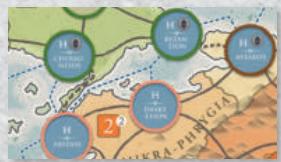
2V
CAPITAL CITY - If using the optional Tyche card Foundation of a Capital, you gain 2 VP while you have a Capital City and 1 VP for each one you have captured. Place Capital VP markers on your Faction card as it is indicated in 16.1.
3.6 Legitimacy
Your Legitimacy is a number measuring how deserving you are, in the eyes of the Macedonian Assembly, to be granted the royal authority and power of Alexander the Great.
Legitimacy applies to your Faction as a whole and can never fall below 0. Update each Faction marker on the Legitimacy Track as soon as it gains or loses L. The Independent Faction has 0 L at all times.
The main source of Legitimacy is the control of a Royal Family Member.
Alexandros (Heir) 5 L
Philippos (Heir) .4L
Herakles (Heir) .2L
Olympias (Female) .3 L
Kleopatra (Female) 3 L
Thessalonike (Female) 2L
Important: Count the L of only one Heir (the highest) you control, but count the L of all Females you control.
Other ways to gain or lose Legitimacy (L) are:
Be a Champion or Successor . . . . . . 3 L / 0 L
Bury Alexander in Pella . ........... 10 L
Control the Tomb's space, if not Pella . . . . . . 2 L
Control Makedonia (be "Strategos of Europe"). . 2 L
Have Perdikkas (alive) in your Faction . . . . . . 1 L
Have Leonnatos (alive) in your Faction . . . . . 1 L
Play the optional Tyche card Oracle . . . . . . .1 L
Play Tyche card Persian Popular Support . . . . . -2 L
Be the target of Tyche Card Condemnation . . . -3 L
When one of the above applies to your Faction, place the corresponding purple 'L’ marker on your Faction card.
3.7 Champions and Successors
To be a Champion means the Generals in your Faction (at least publicly) support the idea of keeping the empire intact and united under one king (or regent). Champions thus support the rightful, legitimate heir to Alexander, whoever that may be.
All players begin the game as Champions. Usually by the end of the game only one player is still a Champion.
Champion or Successor: Each player is either a Champi-
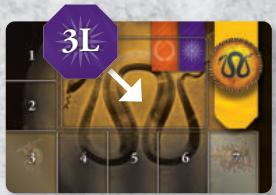
on or Successor. Being a Champion is worth 3 L. Being a Successor is worth 0 L. Show your status by placing your 3L/0L' marker with the correct side up on your Faction card.
BecomingaSuccessor: Champions immediately become
Successors, even in the middle of a Procedure, when they "attack" a CU, Major General, or Major City of a Champion who is not the Usurper. An "attack" for this purpose is defined as any of the following:
Starting a Land Battle as the Attacker
Fighting a Naval Battle as the Interceptor
Conducting a Siege against a Major City they control, regardless of how many Siege Points are gained
Overruning one or more of their CUs
Dispersing their Major General during their own Tyche or Activation Segment
If a player attempts to attack, but the attack does not happen (i.e. something stops the Procedure before the attack actually occurs), then that player's Champion status does not change.
Besieging a Major City (without conducting a Siege), removing Minor City PCs, and capturing Royal Family Members cannot change a Champion to a Successor.
Important: However, loss of Champion status occurs before you calculate and apply the effects of Prestige.
Becoming a Champion Again: A Successor becomes a Champion again if their Victory Point total drops to 0. Flip that player's Champion marker back to its 3L' side.
3.8 Burying Alexander
To earn Legitimacy by creating an honorable final resting place for Alexander, a player controlling the Funeral Cart may bury Alexander; this converts the Funeral Cart into the Tomb. You must meet the following conditions to bury Alexander:
1) You must control the Funeral Cart.
2) The Funeral Cart must be in a Major City space and on land (but can be inside or outside the city walls). You do not need to control the space, and it may be Babylon.
3) There must be no enemy CUs in the Cart's location.
4) It must be done during Game Turn II or III.
5) It must be done during your own Forage Segment or during a Turn End.
If you achieve all of the above conditions, you may build the Tomb and bury Alexander at that Major City. Replace the miniature of the Funeral Cart with the miniature of the Tomb, and/or flip the Funeral Cart counter to its Tomb side. Place the miniature/counter on the map outside the Major City.
Legitimacy of the Tomb: If you bury Alexander at the Major City Pella in Makedonia, you receive 10 L that you can never lose. If you bury Alexander at any other space, the player who controls that space receives 2 L, but only while that player controls the space. That 2L' marker always belongs to the player who controls the space containing the Tomb and may be lost, if that player loses the control of that space.
Expiration Date: If Alexander has not been buried by the Turn Preparation Phase of Game Turn IV, the Funeral Cart is removed from the game (the body has been stolen and lost to history).
4. SETUP
To setup the game for the main scenario, first determine how many players you have and which optional rules you will use (Section 16). Then take everything out of the box and place the board in the center of the table.
4.1 Place Non-Player Pieces
Game Turn Marker - Place the Game Turn marker on the first space of the Turn Track.
Tyche Cards - Add or remove the appropriate optional cards as well as the Tyche card 47B Silver Shields, then place the Tyche card deck on the Tyche Card Draw Pile on the board.
VP and L - Place VP and Legitimacy markers in their matching holding boxes.


Fleets - Place all Fleet Tokens in their matching holding boxes with their lower-numbered side faceup.

Independent PCs - Place an Independent PC in every space on the map that contains a gray PC symbol.
Exception: In a game with 3 or 5 players, Apollonia is the only space in Thrake that receives an Independent PC.
Independent Armies - Place LEOSTHENES in Lamia (Hellas), ARIARATHES in Komana (Kappadokia), and the other three Independent Armies in their holding boxes as shown on the board.
Unique Counters - Place a 4 CU Elephant counter, the Helepolis marker, and the Silver Shields counter in their matching holding boxes.

The other CUs, sorted by type and number of CUs
The remaining Independent PCs
The remaining 1L' markers
The Looted, Siege Point, and Popularity Point markers
The Province cards
The five six-sided dice and two Elephant Dice
The Movement Allowance Table (Movement Card)
The First Player (Throne) marker
The Usurper (Alexander's ring) marker
4.2 Place Royal Family Members
Place the miniature of Olympias in Molossia (Epeiros), or her counter with the gray side up.
Place the miniature of Thessalonike in Pella (Makedonia), or her counter with the gray side up.
Place the miniature of Kleopatra in Sardeis (Lydia), or her counter with the gray side up.
Place the miniature (or counter) of Philippos (4L) in his holding box.
Place the miniature (or counter) of Herakles (2L) in Damaskos (Koile Syria).
Place the miniatures (or counters) of Alexandros (5L) and the Funeral Cart in Babylon (Babylonia).

4.3 Sort Major Generals
Sort the General cards of the Major Generals into the following groups, depending on the number of players.
A. Any Number of Players
Event Generals: Polyperchon, Demetrios, Kassandros, Peukestas
Unavailable Generals: Pleistarchos, Menelaos, Polyarchos
B. Two or Four Players
Starting Generals: Perdikkas, Antipatros, Krateros, Ptolemaios, Leonnatos, Peithon, Antigonos, Eumenes
Reserve Generals: Aristonous, Nearchos, Asandros, Lysimachos, Seleukos
C. Three Players
Starting Generals: Perdikkas, Antipatros, Krateros, Ptolemaios, Leonnatos, Peithon, Antigonos, Eumenes, Lysimachos
Reserve Generals: Aristonous, Nearchos, Asandros, Seleukos
D. Five Players
Starting Generals: Perdikkas, Antipatros, Krateros, Ptolemaios, Leonnatos, Peithon, Antigonos, Eumenes, Lysimachos, Seleukos
Reserve Generals: Aristonous, Nearchos, Asandros
4.4 Distribute Major Generals
Unavailable Generals: Put the General cards, miniatures, and standees of Unavailable Generals back in the game box.
Event and Reserve Generals: Place the General cards, and miniatures (or standees) of Event Generals in a group near the board. Setup a similar area for Reserve Generals.
Starting Generals: Shuffle the General cards of Starting Generals and deal them to players as follows:
2 players 4 Generals to each player
3 players . 3 Generals to each player
4 or 5 players 2 Generals to each player
Five Players: In a five-player game, choose one General card to discard from those you were dealt. Then shuffle the discarded General cards and deal one to each player.
Miniatures, Standees, and Chairs: Give each player the miniatures or standees corresponding to their Major Generals. You can now determine your seating arrangement based on the starting positions of each player's Generals.
4.5 Hand Out Player Pieces
Let each player choose their Faction color, then give them: Their 4 Minor Generals and PCs
Their Faction card and their 3L' Champion marker
Their Faction markers and Player Aid card
Their plastic rings (if using miniatures for Generals or Royal Family Members) or stands (if using standees) (for 2 player games, give each player 2 colors)
Both of their Capital City markers if you are using the optional Tyche card Foundation of a Capital
Place your 3L' marker on your Faction card. Place one of your faction markers at 0 on the VP Track and one of your faction markers at 3 on the Legitimacy Track. Place your other pieces and cards off the map in front of you.

Example: Setup for 5 players (note that color distribution of Generals will be different each time).
4.6 Place Starting Major Generals
Attach a plastic ring of your Faction's color to your Starting Generals' miniatures (or stand for standees).
Beginning with the player who was dealt Perdikkas and proceeding around the table to the left, each player places the Major Generals they were dealt and their corresponding PCs on the map. Then collect your starting CUs, Legitimacy & Popularity markers, Province cards, and Fleet Tokens according to the Generals you were dealt (see below), and finally update your 'V' and 'L' markers on the Tracks.
Perdikkas in Babylon, 6 PCs in Babylonia
On his card 4 Royal Army & 2 Elephant CUs, Funeral Cart, Alexandros, and his '1L' marker Province card Babylonia VP +4 L +6
Antipatros in Pella, 5 PCs in Makedonia
On his card 2 Royal Army & 2 Loyal Macedonian CUs and the 2L' marker for controlling Makedonia Province card Makedonia, Fleet Makedonia VP+3 L+2
Krateros in Tarsos or Issos, 2 PCs in Kilikia On his card 2 Royal Army & 2 Loyal Macedonian CUs and his 2P' marker Province card Kilikia VP +2 L+0
Ptolemaios in Memphis, 5 PCs in Aigyptos
On his card 2 Loyal Macedonian & 2 Mercenary CUs and his 2P' marker
Province card Aigyptos, Fleet Aigyptos VP +6 L +0
Leonnatos in Abydos or Daskyleion, 2 PCs in Mikra Phrygia On his card 2 Loyal Macedonian & 2 Mercenary CUs and his 1L' marker
Province card Mikra Phrygia VP +2 L+1
Peithon in Ekbatana, 6 PCs in Media On his card 2 Loyal Macedonian & 2 Mercenary CUs Province card Media VP +2 L+0
Antigonos in Kelainai, 4 PCs in Phrygia On his card 2 Loyal Macedonian & 2 Mercenary CUs Province card Phrygia VP +3 L+0
Eumenes in any space in Kappadokia except Komana, 5 PCs in Kappadokia
On his card 2 Loyal Macedonian & 2 Mercenary CUs and his -2P' marker
Province card Kappadokia VP +2 L+0
Lysimachos in any space in Thrake, 5 PCs in Thrake On his card 2 Loyal Macedonian & 2 Mercenary CUs Province card Thrake VP +3 L+0
Seleukosin Damaskos, 2 PCs in Koile Syria On his card 2 Loyal Macedonian & 2 Elephant CUs and Herakles (L +0 if in Perdikkas'Faction) Province card Koile Syria VP+1 L 2/0* *if in Perdikkas' Faction, Herakles does not add L as you only count 1 Heir
Only Starting Generals are placed on the map during Setup.

5. SEQUENCE OF PLAY
A game of Successors begins with Game Turn I and proceeds through up to 5 Game Turns. Each Game Turn consists of the following phases completed in the order shown. All players must complete each phase before moving on to the next phase. The game ends when a player wins an Instant Victory, Regency Victory, or End Game Victory.
-
Preparations
-
Reinforcements
-
Drawing Tyche cards
-
Strategy
-
Isolation
-
Turn End
5.1 Preparations Phase
In the Preparations Phase, make players aware of the rules for the current Game Turn and perform these events:
A. Turn Events and Exceptions
Game Turn I
Skip the Reinforcements Phase.
You also cannot move the Funeral Cart, bury Alexander's body, or win an Instant Victory.
Game Turn II
The event on Tyche card Peukestas Satrap of Persis is playable, as noted in the card text.
Game Turn III
If ANTIPATROs has not been killed, give PoLYPERCHON to the player who was dealt ANTIPATROs. That player places PoLYPERCHON in the same location (or Dispersed Box) as Antipatros, then removes Antipatros from the game.
Give DEMETRIOs (the son of ANTIGONOs) to the player who was dealt ANTIGONOs (whether or not Antigonos has been eliminated). That player must now place DEMETRIos on the map as a Reinforcement.
Game Turn IV
Alexandros may inherit Alexander's throne or be assassinated. Check to see if a player wins a Regency Victory.
Reserve Generals may more easily join your Faction. Also, if Alexander has not been buried by now, remove the Funeral Cart from the game.
Game Turn V
Herakles may inherit Alexander's throne or be assassinated. Check to see if a player wins a Regency Victory.

B. Label the Usurper
The player with the most Victory Points receives and keeps the Usurper marker throughout the Game Turn. Break ties for most VP by naming the tied player with the most Senior General the Usurper.
The Usurper is typically the strongest threat to the other players but often behind in the struggle for Legitimacy. Ptolemaios Faction is nearly always the Usurper on the first Game Turn, representing how he quickly emerged as the most disruptive challenger to the more legitimate leadership of Perdikkas.
C. Determine Turn Order

The player with the least VP in the Turn Order Phase decides who is the First Player throughout the Game Turn. Break ties for least VP by lowest die roll. Give the First Player marker to the First Player. The Player with the least VP also decides if the Turn
Order will proceed around the table to the left or to the right for that Game Turn.
5.2 Reinforcements Phase
At the start of each Reinforcements Phase, move all uncontrolled and Independent Fleet Tokens in the Dispersed Box to their holding boxes. Then each player collects:
● Their Dispersed CUs, Major Generals, and Fleets
2 Mercenary CUs (from the unused off map pieces)
In addition:
The player controlling the Province of Makedonia receives 1 Loyal Macedonian CU
The player who has the most Legitimacy receives 1 Loyal Macedonian CU (if tied, the CU goes to the tied player with the most Senior General)
The player with the most Victory Points receives 2 Mercenary CUs (if tied, each tied player receives 1 Mercenary CU)
Placing Reinforcements
In Turn Order, you must place your Reinforcements on the map in spaces:
With your PCs and no enemy CUs or enemy Generals
That contain an Unbesieged General of your Faction who has been on the map since the start of the current Phase (or since the start of the current Segment, for Reinforcements placed during a Tyche or Activation Segment).
2 CUs Per Space: You may place no more than 2 CUs per space unless the space has one of your Major Cities or your Major Generals at the time of placement. The Major General need not have been in the space at the start of the current Phase for the purpose of exceeding the 2 CU limit. He may himself be a Reinforcement; in other words, you may place the Major General on the map at the same time as the CUs.
No Eligible Space: If it is impossible to place all your Reinforcements on the map due to a lack of eligible spaces, you must place your remaining Reinforcements in uncontrolled or Independent spaces that have no enemy CUs or enemy Generals. These spaces cannot be in a Province controlled by another player. You may place no more than 2 CUs per Province in this way, even if the space has a Major City or if a Major General is being placed with them. In this case, a Major or Minor General must be placed with your CUs or the CUs will be immediately Dispersed. In the very rare case that there are no eligible uncontrolled or Independent spaces, Disperse your remaining Reinforcements.
5.3 Shuffle and Deal Tyche Cards Phase
2 players . . . 5 cards to each player, deal 10 cards facedown to the table
In each Game Turn, shuffle the Tyche card deck, including all cards in the discard pile. Leave out cards removed from play and optional cards that were left out of the deck during setup. Then deal Tyche cards facedown to players as follows:
3 players . . . 5 cards to each player, deal 5 cards facedown to the table
4 players . . . 5 cards to each player
5 players . . . 4 cards to each player
Place the remaining deck facedown on the Tyche Card Draw Pile area of the board.
5.4 Strategy Phase
The Strategy Phase is composed of rounds. Each round consists of each player performing the following actions (in Turn Order):
A. Surrender Segment
Remove enemy PCs, place your own PCs, conduct Sieges.
B. Tyche Segment
You must play one non-surprise Tyche card.
C. Activation Segment
You may either move or raise one Mercenary.
D. Forage Segment
In the Isolation Phase, each player in Turn Order determines which of their PCs are isolated and then removes their isolated PCs from the map. Turn Order matters, so remove your isolated PCs before the next player checks for isolation.
You check the stacking of each of your Forces and remove one CU in each stack that exceeds the Forage Limit of one space.
5.5 Isolation Phase
Isolated: Your PC is isolated if you cannot trace a continuous series of connected spaces from the PC's space to either one of your CUs or a Major City you control. Both the Besieging and Besieged players may trace to and through a Besieged space. The spaces in the series may be connected by any kinds of paths, but each space must be:
• Under your control, with or without enemy CUs, or
• Uncontrolled, without enemy CUs, or
• Enemy, with at least one friendly CU.
PCs in spaces with your CUs or your Major Cities are never isolated.
Independent PCs are never isolated.
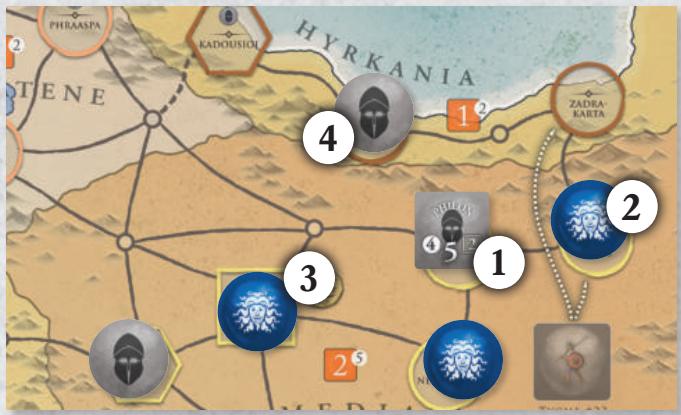
Example: The Independent Army (led by Philon) is heading west. It ended its last move in Rhagai, (1 where there is no PC. The blue PC in Hekatompylos 2 is isolated. It cannot trace to their Major City of Ekbatana (3 because it is blocked by the enemy CUs of Philon's Independent Army at Rhagai (1) and by the Independent PC at Mardoi. 4
5.6 Turn End

In the Turn End of Game Turns II and III, it might be possible to bury Alexander's body. After considering burying Alexander, advance the Game Turn marker one space to the right on the Turn Track and begin the next Game Turn.
Exception: At the end of Game Turn V, determine who wins an End Game Victory.
6. STRATEGY PHASE
Nearly all of the action in Successors takes place in the Strategy Phase. Each Strategy Phase consists of a series of Rounds:
2, 3, or 4 players . . . . 5 Rounds per Strategy Phase
5 players . . . . . . . . 4 Rounds per Strategy Phase
Rounds, Player Turns, and Segments: Each Round is made up of a series of Player Turns, one for each player, completed in Turn Order. You must complete your Player Turn before the next player begins their Player Turn (give them the Movement Allowance Table card).
Each Player Turn is composed of the following Segments completed in the order shown. Complete each Segment before moving on to the next Segment.
-
Surrender Segment
-
Tyche Segment
-
Activation Segment
-
Forage Segment
Two or Three Players: At the end of each Round, reveal cards that were dealt face down as follows:
• 2 players. . . . . . . . . reveal 2 cards per Round
• 3 players. . . . . . . . . reveal 1 card per Round
If any of the following Bonus cards were revealed, resolve their events (not OPs) in the order they were revealed: Unrest, Unrest

Spreads, Plans of Their Own, Migration of Illyrian Tribes, Scythian Invasion, and 23 000 Greek Soldiers (these cards are
marked with a different ornament). The player with the lowest VP resolves each event (break ties for least VP by lowest die roll). Place all revealed cards faceup on the discard pile.
Completing the Round: After completing each Round, either begin the next Round or, after the final Round of the Strategy Phase, move on to the Isolation Phase.
6.1 Surrender Segment
In each of your Surrender Segments, carry out these three steps in the order shown:
-
Remove Enemy Player PCs: You may remove player PCs from any enemy Minor Cities where you have at least 1 CU.
-
Place PCs: You may place one of your PCs in any uncontrolled Minor City, Stronghold, or Major City spaces where you have at least 1 CU, including spaces that became uncontrolled in step 1.
-
Conduct Sieges: You may conduct one Siege per space in any spaces where you have an Army with at least 3 CUs. You may place one of your PCs in each space where you complete a Siege.
6.2 Tyche Segment
In each of your Tyche Segments, you must select exactly one Event or Bonus card from your hand to play. If you do not have any Event or Bonus cards in your hand, you must play or discard Surprise cards (gaining a new card each time) until you have at least one Event or Bonus card in your hand.
Tyche cards come in 3 types: Event, Bonus, and Surprise.

Card Options: Carry out exactly one of the following options for the selected Event or Bonus card:
Play the card for its event,
• Play the card for its Operation Points (OPs),
If it is a Bonus card, play it for its event & then its OPs,
• Upgrade a Fleet,
• Recruit a Major General.

Surprise Cards: You can play Surprise cards at any time during a Strategy Phase, even in your opponent's turn. If two players want to play a Surprise card at the same time, the player earlier in Turn Order plays theirs first.
Right after you play or discard a Surprise card (except Ahura Mazda & Ahriman), draw a card from the top of the Tyche Card Draw Pile to replace it.
A. Resolve an Event
Before playing a card for its event, make sure to read all the text on the card, since many cards have pre-conditions that must be met before playing the event.

You gain control of the Kilikia Fleet. If the Kilikia Fleet Token is in its holding box or in front of another player, place it in front of you on its normal (lower number) side.
Example: Yellow plays Tyche card Kilikia Pirates for its event, gaining control of the Kilikia Fleet.

Remember that “enemy" in Tyche card text means enemy to the player playing the card.
Condemnation
The effect of condemnation if played while a General is
condemned is that that General immediately gains 3L (and can trigger Instant Victory), then may be placed under condemnation again (thus losing 3L)
Unrest / Unrest Spreads
If all spaces in the indicated province(s) already have a CU or Independent PC, place the Independent PC in an eligible space in an adjacent Province. If there are no eligible spaces in any adjacent Province (or no adjacent Provinces), do not place a PC.
B. Spend Operation Points
When you play a card for its Operation Points (OPs), you may spend up to the number of OPs on the card, but you must choose exactly one (and only one) of the following ways to spend the OPs you receive by playing the card:
• Force-March,
• Place PCs,
• Train Troops.
B1. Force-March
Activate one of your Armies or Generals. Follow all the rules for movement and their consequences (pt. 9.2 and further), except the General receives Movement Points equal to the number of OPs you spend.
In this way an Army or General may be activated twice during a single Player Turn: once in the Tyche Segment and once again in the Activation Segment. Armies or Generals may also be activated in their Tyche Segment through play of the events on Tyche cards Major Campaign and Treasure City Looted.
B2. Place PCs
For each OP you spend, place 1 of your PCs in a space that is uncontrolled and has no enemy CUs. The space cannot be a Transit Point, and must be within 2 MPs of one of your PCs that was on the map at the start of the Tyche Segment. You can trace this 2 MPs distance over any type of path(s) except a Trans-Mediterranean path. Important: The 2 MPs distance may not be traced through a space (even using Sea paths) that contains an enemy CU or enemy PC.

Example: Instead of playing Kilikia Pirates for its event, Yellow plays the card for its 3 OPs and places PCs in Ephesos, (1) Halikarnassos, 2 and Xanthos. 3 Yellow can trace the 2 MPs distance from Kelainai 4 through the Transit Point, even though Kelainai is Besieged. Yellow cannot trace through Sardeis 5 to Pergamon 6 (blocked by the Blue PC) or to Lesbos (7) (too far from the nearest Yellow PC).
B3. Train Troops
Troop Types:
Mercenary CU: 3 OPs to train
• Loyal Macedonian CU: 7 OPs to train
No CU in Training: if you do not have a CU on the Training Track of your Faction card, select a Troop Type, place the corresponding CU on a space of your Training Track equal to the OPs on your card.
CU already in Training: if you already have a CU on the Training Track of your Faction card (see example), move that CU up the Track a number of spaces equal to the OPs on your card.
Completing Training: When your Mercenary CU reaches the '3’ space, or your Loyal Macedonian CU reaches the '7' space, immediately place it on the map as a Reinforcement. After placing a CU, if there are "left over" spaces to move, immediately select a a Troop Type, and place the CU on the space equal to the excess OPs.

Example: Yellow does not have a CU on their Training Track. Yellow decides to spend a 4 OPs card to train troops and chooses a Loyal Macedonian unit to train. The player puts the chosen Loyal Macedonian CU on space '4' of their Faction card, (1) indicating 3 more OPs are required for the CU to be placed on the map. With the same 4 OPs Yellow could have placed a Mercenary CU on the map and left another CU on the 1' space of their Training Track.
C. Upgrade a Fleet
By playing a 4 OP Tyche card, you may flip a Fleet you control that is not Dispersed from its lower numbered side to its higher numbered side. See if this changes who has the Largest Fleet.

D. Recruit a Major General
Recruiting Generals is easier than in previous editions of the game to help players remain competitive after losing a Major General.
You may select a Major General from the remaining group of off map Reserve Generals to join your Faction if you play a 3 or 4 OPs card in any of your Tyche Segments and:
You have fewer living Major Generals in your Faction than the number you received during Setup, or
You have exactly the same number of living Major Generals in your Faction as you received during Setup and the current Game Turn is IV or V.
Note: Dispersed Generals count as alive and in a Faction.
Card, Miniature, Standee, Ring, Stand: When you recruit a Reserve General, take his General card and miniature or standee. Attach a plastic ring of your Faction's color to the General's miniature (or stand for his standee).
CUs and Preferred Provinces: Recruited Reserve Generals arrive with CUs and have preferred Provinces as follows:
Lysimachos 1 Loyal & 1 Mercenary CU Thrake Seleukos 1 Loyal & 1 Elephant CU Babylonia Aristonous 1 Loyal & 1 Mercenary CU Makedonia Nearchos 2 Mercenary CUs Any Port Space Asandros 1 Loyal & 1 Mercenary CU Karia You can recruit Asandros only after Antipatros has died.
Placing Recruited Generals: Place the General's CUs on his General card. Then place the General in any space in his preferred Province that has no enemy CUs or enemy Generals. You may place one of your PCs in that space, removing any PC that was there (even if Independent and/or a Major City).
Alternatively, you may place the General as a Reinforcement, but in that case you cannot place or remove a PC.
6.3 Activation Segment
In each of your Activation Segments, you may activate all of your Armies and Generals (one at a time). See Section 9 for details.
Instead of activating Armies and Generals, you may place 1 off map Mercenary CU as a Reinforcement. You must announce your decision before rolling for Movement Points.
6.4 Forage Segment
In each of your Forage Segments, check every space on the map with any of your CUs (do not count enemy Besieged or Besieging CUs) to see if you have more CUs there than the space's Forage Limit:
Forage Limit Transit Point Space 3 CUs Every Other Space 8 CUs
Eliminate 1 CU: If you have more CUs in a space than its Forage Limit, eliminate 1 of your CUs there of your choice.
Example: You have 12 CUs in a Major City, so you move 1 of them to the off board pieces that do not belong to any player.
7. GENERALS & MILITARY UNITS
7.1 Generals
Generals are the most important pieces in the game. During Setup each player receives a scenario-dependent number of Major Generals along with 4 Minor Generals.

Initiative Rating: This number affects how far the General can move, how well he can Intercept, and how easily he can Evade. Lower numbers are better.
Battle Rating: The General uses this to reduce bad luck in Land Battles. You change any individual die roll that is less than the Battle Rating to equal his Battle Rating. Higher numbers are better.
Special Ability: Each Major General has a Special Ability which applies only to the space the General occupies and only while he is a Commanding General.
Popularity Points (P): The Commanding General's P are added to the Faction's Prestige in case of a Land Battle or Siege. Krateros and Ptolemaios were popular with Macedonian soldiers (+2P); Eumenes was unpopular (-2P).
A. Seniority
Generals are rated for Seniority from the highest (20, Perdikkas) to the lowest (0, all Minor Generals). Seniority determines Commanding Generals and breaks ties.
The most Senior General of a Faction in a location is that Faction's Commanding General for that location. Other Generals of that Faction in this location are Subordinates. Place the standee/miniature of Subordinate Major Generals on their Commanding General's card.
B. Major Generals
Major Generals have better ratings than those of Minor Generals, but can be killed (in a Land Battle or by play of the optional Tyche card Price of Failure). You are not out of the game if all your Major Generals are killed - you may recruit new Major Generals, and you cannot lose your 4 Minor Generals.
During Setup, each of the 20 Major Generals is assigned to be a Starting, Reserve, Event, or Unavailable General, depending on the number of players in your game.
Starting Generals: 2 to 4 Starting Generals are dealt to each player during Setup. The 8 most common Starting Generals have a purple background on the top of their card.
Reserve Generals: When certain conditions are met, a Reserve General may join your Faction.
Event Generals: The 4 Event Generals enter play as follows:
KAssANDROs enters the game when a player plays the event on Tyche card Kassandros.
DEMETRIOs joins ANTIGONOs' Faction in the Preparations Phase of Game Turn III.
PoLYPERCHON replaces ANTIPATROS when ANTIPATROS is killed or leaves the game. If ANTIPATROs is killed, give PoLYPERCHON to the player who was dealt ANTIPATROs. That player immediately places PoLYPERCHON in any controlled space. Otherwise, PoLYPERCHON joins ANTIPATROs' Faction when ANTIPATROs dies of old age in the Turn Preparation Phase of Game Turn III.
• PEUKESTAs enters the game when a player plays the event on Tyche card Peukestas Satrap of Persis.
Unavailable Generals: Unavailable Generals cannot be used at all during the game.
Ownership: Use a colored ring (for miniatures) or stand (for standees) to show which player owns each Major General.
C. Minor Generals
Minor Generals are represented by counters. Each Minor General has Initiative Rating 4, Battle Rating 2, and Seniority 0.
Even though the counters of Minor Generals have names, each Minor General can represent multiple individuals in the same turn, giving these pieces surprising flexibility.
In Your Turn: At any time during one of your Player Turns in a Strategy Phase, and as many times as you like, you may place one of your Minor Generals from off map into a location where you have at least 1 Combat Unit, remove one from the map, or reposition one on the map to a location where you have at least 1 Combat Unit, even into or out of a Besieged Major City.
Example: Red places the Minor General PHILoxENos into a Besieged Major City. PHILoXENos leads the Combat Units there in a sortie against the Besieging Army. After the battle, win or lose, PHILoXENos may be repositioned to any other space on the map with one of your Combat Units.
In Your Opponent's Turn: During another player's Player Turn, you may place one of your Minor Generals from off map into a location containing your Army (not CUs without a General) to attempt a Land Interception, but not to attempt to Evade. Also, immediately after one of your Major Generals has been killed in your opponent's Player Turn, you may place one of your Minor Generals from off map (only) into the location where your Major General was killed.
Example: Ptolemaios, with no other Generals in his Army, wins a Land Battle in an enemy space during an opponent's turn. However, he is killed in the battle. His Faction places a Minor General from off map into the battle space to take command of the Combat Units that survived the battle.
Alone in a Space or Subordinate: After every Procedure every Minor General in a location without at least 1 of your Combat Unit, or who is a Subordinate General, must be removed from the map. Exception: Do not remove the Minor General if he or his Commanding General is about to separate and move away from his current location.
Use Minor Generals to show which Combat Units and Royal Family Members you control in uncontrolled or enemy controlled spaces, to move your Combat Units and Royal Family Members when you do not want to (or cannot) use a Major General, and to replace killed Major Generals.
7.2 Combat Units (CUs)
Combat Units (CUs) are the primary military pieces in the game, representing formations of phalangites, hoplites, peltasts, heavy and light cavalry, war elephants, siege equipment and other land forces of the era.

Two Loyal Macedonian CUs

Two Royal Army CUs
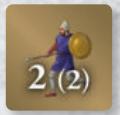
Two Mercenary CUs

Two Elephant CUs
Counters: CUs are represented by CU counters. The number on the left side of a CU counter is the number of
Combat Units represented by the counter. The number on the right in parentheses is the total Combat Strength represented by the counter. Players may 'make change' with CU counters of the same type throughout play as needed. The number of CUs provided is not an exhaustive limit; players may use substitutes if they run out of counters (except the Silver Shields and Royal Army CUs). CUs may return to the game after being eliminated, except the Silver Shields and Royal Army CUs. The number and type of CUs in play is public knowledge, and any player may examine any stack at any time.
Army: An Army is one or more Combat Units and a General that occupy the same location and belong to the same player. Independent Armies are also Armies.
CUs without a General: CUs in a space without a General cannot move, attempt to Intercept or Evade.
A. Indicating Ownership of CUs
Each CU on the map, on a General card, or in the Dispersed Box (except Independent Army CUs) belongs to a player. Identify which player a CU belongs to in these ways:
• Place your CUs that are in the same location or Dispersed Box as your Commanding Major General on his card.
• Place your CUs that are in the same location or Dispersed Box as your Commanding Minor (or Major, if you prefer this method) General under that General.
• CUs in a space or Dispersed Box with your PC after a Procedure belong to you, except CUs Besieging a space.
Important: After each Procedure, if you cannot show that you own some of your CUs by at least one of the above methods, those CUs must be placed in the Dispersed Box.
Example: Continuing the previous example, if a Minor General had not been available off map to place in the battle space after Ptolemaios was killed, all the CUs in Ptolemaios'Army would have had to move to the Dispersed Box (together with a PC to show who owns them)
B. Mercenary CUs

Each Mercenary CU has a Combat Strength of 1. The illustrations on CU counters are not significant; each Mercenary CU is equivalent to every other Mercenary CU. Mercenaries are the easiest type of CU to obtain and to lose.
C. Elephant CUs
Elephant CUs have variable combat strength. They are the least predictable CUs.
Perdikkas and Seleukos begin the game with Elephant CUs. More can enter the game only via Tyche card events. Elephants are vulnerable to destruction in Overruns and battles and when suffering Attrition.
Variable Combat Strength: When determining Battle Strength in a Land Battle, roll an Elephant Die once for each individual participating Elephant CU. The number of Elephant symbols on the roll is the Combat Strength of that particular Elephant CU. Alternately, roll a normal die and subtract 2 from the roll, treating results less than 0 as 0. Elephant CUs cannot have a Combat Strength less than 0.
Example: A player has 3 Elephant CUs in a Land Battle. The player rolls a normal die 3 times, rolling 3, 5, and 1. The Combat Strength of the Elephants is 1, 3, and 0 respectively, making the combined Combat Strength of the Elephant CUs 4.
D. The Silver Shields
The Silver Shields enters the game when a player plays the event on Tyche card 47A Silver Shields. Thereafter, the Silver Shields card 47A is removed from game and replaced by the Tyche card 47B. It is a Surprise card that allows to steal ownership of the Silver Shields and reduces its number of CUs by 1 (which may eliminate it).
The Silver Shields is a force of elite combat veterans. It is the finest fighting unit in the game, but not permanently attached to any Faction.

Counter: This counter enters the game at full strength on its 2 CU side. You may neither split up nor increase the CUs of this counter in any way, even after it is reduced to 1 CU or eliminat-
ed. When eliminated, permanently remove it from the game.
E. Loyal Macedonian CUs

Each Loyal Macedonian CU has a Combat Strength of 2. Loyal Macedonians cost more to train than Mercenaries, but are harder to destroy in Overruns and battles.
F. Royal Army (RA) CUs

Royal Army CUs (or "Royals") have a purple bar on their counter. Each Royal Army CU has a Combat Strength of 2. They represent Macedonian veterans who are not strongly attached to any Faction, but are loyal to whomever they perceive to be the rightful heir to the Macedonian throne.
Eight CU Limit: There are exactly 8 RA CUs, and all of them begin the game on the map (in the Armies of Perdikkas, Krateros, and Antipatros). When an RA CU is eliminated, permanently remove it from the game.
Prestige is a number measuring how willing Royal Army CUs are to fight for a side in a particular Land Battle or to defend a city in a Siege. Prestige also affects the Tyche cards Mutiny and Alexander's Ghost. Prestige applies to particular spaces, can be different for each Land Battle or Siege, and can change during a Procedure. Prestige can never be lower than 0.
Calculating Prestige: A side's Prestige in a determined location is its Faction's current Legitimacy plus any Popularity Points (P) it can use in the determined location.
Note: Loss of Champion status occurs before you calculate and apply the effects of Prestige.
Only Popularity Points that apply to a Commanding General can be used. Ignore Popularity Points of Subordinate Generals.
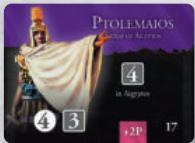
Krateros (+2P), Ptolemaios (+2P), and Eumenes (-2P) have Popularity Points on their General cards.
The Prestige of an Independent Army is always 0.
How to increase your Popularity and Prestige:

Defeat Independent Armies: When a Major General defeats an Independent Army, he gains +1P. He keeps it until he is killed.

Sacred Ground: A General temporarily gains +4P when defending in a Land Battle in the space containing the Funeral Cart or Tomb. His Faction also must control the Funeral Cart or the space with the Tomb.
Gift of Oratory: A General temporarily gains +5P when the event on Tyche card The Gift of Oratory is played on him.
Land Battle: If there are RA CUs on either side of a Land Battle, determine each side's Prestige for the battle space. If Prestige is lower on a side with RA CUs, set apart all RA CUs on that side. Those RA CUs do not contribute to their side's Battle Strength and cannot be eliminated in that battle. If their side loses the battle, RA CUs that were set apart defect to the other side at the end of the battle (i.e. the RA CUs then belong to the winning player).
All Royal Army CUs: If all CUs on either side of a Land Battle are RA CUs, determine each side's Prestige.
If Prestige is lower on a side with only RA CUs, the Land Battle does not occur, and those RA CUs defect to the other side. Disperse any Generals that were on the initial side of the defected RA CUs.
Overruns: RA CUs involved in Overruns, whether Overruning or being Overrun, ignore Prestige, count normally, and never defect. An Army made up of only RA CUs Disperses an enemy General who has no CUs (and who fails to Evade) just like a normal Army, regardless of Prestige.
Besieged: If there are RA CUs inside a Major City when an enemy Army conducts a Siege against it that results in adding at least 1 Siege Point, determine the Prestige of the Besieged and Besieging forces. If Prestige is lower on the Besieged side, the Besieged RA CUs immediately defect to the Besieging Army. Prestige has no other effect on Sieges.
Disbanding: You may disband (voluntarily eliminate) any of your RA CUs during one of your Player Turns in a Strategy Phase before they move. When an RA CU is disbanded, permanently remove it from the game.
7.3 Attrition
A group of non-Independent CUs in the same location can suffer Attrition by losing a Land Battle or Naval Battle, by the event on Tyche card Epidemic, and (only if using the optional rule) by having too many CUs in a space during their Forage Segment. A non-Independent Army also suffers Attrition when passing through (but not stopping in) a Stronghold (i.e. a Stronghold space with an Independent PC).
Normal Attrition: Except for an Army passing through a Stronghold, when CUs suffer Attrition, roll a die and compare it to the number of CUs in the group on the Attrition Table. The result is the number of CUs you must eliminate from your group. Normally you may choose which CUs to lose, but if the result includes an "e", the first loss must be an Elephant CU (if there is one in the group).
Passing Through Strongholds: For a non-Independent Army passing through a Stronghold, roll a die as above, but compare it to the "2" column on the Attrition Table, regardless of the number of CUs in your group. Eliminate CUs in the same way as for normal Attrition.
When passing through a Stronghold you risk being ambushed by that tribe. If you stop on the Stronghold it is assumed your army is moving cautiously enough to avoid being ambushed.
7.4 Fleets

Fleets are represented by two-sided Fleet tokens. They have a normal side (lower number) and an upgraded side (higher number). They help protect your Naval
Movement and hinder your opponents' Naval Movement. They also help your Generals conduct Sieges of Port Major Cities, and the player with the Largest Fleet gains 3 Victory Points. Fleets are not CUs. They are never placed on the map. Fleets can be Dispersed in Naval Battles but cannot be eliminated.

Control: Fleets correspond to specific Provinces (or to the Major City of Athenai) as shown by the fleet symbols on the map and the Fleet Tokens holding box. When
you gain control of the corresponding Province (or Athenai), control of its Fleet passes to you. When you lose control of the Province (or Athenai), you lose control of its Fleet.
Available Fleets and Fleet Tokens: Fleets are "available" if a player controls them and they are not in the Dispersed Box. When a Fleet is available, place its Fleet Token off the map in front of the player. If a Fleet Token is in the Dispersed Box when control of the Fleet changes, it stays in the Dispersed Box. Place uncontrolled and Independent Fleet Tokens in their holding boxes except when they are Dispersed.

Kilikia Fleet: Controlling the Province of Kilikia does not give you control of the Kilikia Fleet. You gain control of the Kilikia Fleet only by playing the event on Tyche card Kilikia Pirates. In this version of Successors, Tyche card The Pontic Fleet does not provide a Fleet. Instead it allows a special Naval Movement in Pontos Euxeinos (i.e. the Black Sea).

Fleet Strength: Fleets begin the game on their normal (lower number) side. You may play a 4 OPs card during your Tyche Segment to flip an available Fleet to its
upgraded (higher number) side. Fleet Strength is important in Naval Battles and for Victory Points. Important: When an upgraded Fleet is Dispersed, or control of the Fleet changes, flip it back to its normal side.
7.5 Independent Armies
The 5 Independent Armies in the game provide both a threat and an opportunity to player Armies near them on the map.

Number of CUs and Combat Strength
Each Independent Army is represented by a gray, square counter combining an Independent General and a constant number of CUs. Independent Armies never gain or lose CUs. The Combat Strength of an Independent Army is equal to its number of CUs.
Independent Armies can attack any player's forces and remove player PCs, but Major Generals who defeat them gain a Popularity Point. They are enemy to all players and friendly to each other, to Independent PCs, and to Independent spaces.
Rules and Card Text: References in the rules and on Tyche cards to Armies, Generals, and CUs apply to Independent Armies unless otherwise specified in the rule or card text. The Initiative Ratings of Independent Generals are used only with optional rule "Independent Army Reactions".
8. ROYAL FAMILY MEMBERS
Successors tells the story not only of military campaigns tearing apart a great empire. It also depicts the dramatic collapse of the empire's royal dynasty, one that ruled for nearly four centuries and became the most powerful family in the known world. Put to the test, Alexander's relatives and companions could not master the destabilizing void left behind by his passing Political and social catastrophe followed, a downfall played out over decades as a larger-than-life Greek tragedy.
The Royal Family Members included in the game are Alexander's Heirs, his Female relatives, and his embalmed body.
8.1 Purpose
Royal Family Members provide Legitimacy to the Faction that controls them. Each family member is rated for the Legitimacy (L) it can provide to a Faction.

Alexandros (Heir) 5 L

Philippos (Heir) 4L

Herakles (Heir) 2L
The Heirs are his illegitimate son, Herakles, his infant son, Alexandros, and his mentally damaged brother, Philippos. Herakles, Alexandros, and the Funeral Cart begin the game on the map. Philippos arrrives on the map when a player plays the event on Tyche card Eurydike Speaks For Philippos.

Olympias (Female) 3L

Kleopatra (Female) 3L

Thessalonike (Female) 2L
The Females are his mother, Olympias, and his sisters, Kleopatra and Thessalonike. They begin the game on the map but are uncontrolled. No rings are attached to their miniatures.

Alexander's body begins the game in the Funeral Cart, later converted to the Tomb.
Royal Family Members are represented by miniatures or counters (your choice). Attach a plastic ring of your Faction's color to the miniature of a Royal Family Member while you control it. Use the gray side of the Female's counter to denote her uncontrolled status and flip whenever the status changes.
Place the miniature or counter of a Royal Family Member on your Commanding General's card while you control the Family Member if it is in the same location as the General.
8.2 Gaining control
Independent Armies and Independent PCs cannot control Royal Family Members.
You control Heirs and the Funeral Cart that are in a location with one of your PCs or Generals after the completion of any Procedure.
Example 1: Herakles is in an otherwise empty Minor City. Yellow places a PC there or moves a General into the Minor City without being Intercepted. Either way, Yellow takes control of Herakles. Example 2: Green has a Minor General, 1 Combat Unit, and Alexandros in a Minor City controlled by Black. Black plays Tyche card Desertions to remove the Combat Unit. Green must then remove his Minor General from the map. Control of Alexandros passes from Green to Black due to Black's PC there.
The Tomb is always uncontrolled.
Females can become controlled only through play of the events on Tyche cards.
You gain control of Olympias if you have your PCs or Generals in the same location after executing the event on Olympias card.
To gain control of Kleopatra or Thessalonike, you must meet all of the following conditions:
• You must play the event on the correct Tyche Card, Kleopatra Offers Marriage or Thessalonike Offers Marriage (place it in front of you as a reminder).
• The bride must be uncontrolled.
• You must have one of your Armies in her location.
• There must be no enemy CUs in the location, unless the enemy player has granted Free Passage.
The marriage must take place during the same Game Turn i.e. not necessarily in the same Segment or Player Turn) in which you play the Tyche card.

THESSALONIKE OFFERS MARRIAGE
If you have at least one of your Armies in the same location as THESSALONIKE at any time the during current Game Turn and no enemy CUs occupy her location (unless they grant you Free Passage), she marries into your Faction. When the marriage takes place, she becomes controlled by you. You gain 2 L. Woman brings to man both the greatest gain and the greatest bane. - Euripides


Example: Yellow plays Tyche card Thessalonike Offers Marriage both for its event, and for its Operation Points to move Kassandros to Pella. Thessalonike marries someone in Kassandros'Faction. Her miniature has a yellow ring attached and moves to Kassandros' General card, and Yellow's Legitimacy marker moves up 2 spaces.
8.3 Losing Control
At the end of a Procedure, if a General and a PC in the same location (not just the same space) belong to different players, and the PC's Faction controls any Royal Family Members there, then the PC's Faction loses control of them.
After that, the General's Faction takes control of Heir or Funeral Cart in that location. Females remain uncontrolled.
Example: Yellow has only a PC in the Major City and controlled Kleopatra outside it. Red moves a General with no CUs into that space. Yellow moves Kleopatra inside the city in the Procedure. Yellow does not lose control of Kleopatra.
If a controlled Royal Family Member is in a location with no General and no player PC after a Procedure, that Royal Family Member becomes uncontrolled.
If a Royal Family Member is inside a Major City when the Royal Family Member becomes uncontrolled, immediately place it outside. An uncontrolled Royal Family Member may never be inside a Major City.
8.4 Movement
Uncontrolled Females may move if a player plays the event on Tyche card Plans of Their Own.
Controlled Royal Family Members can only move on the map when carried by an Army.
The Funeral Cart may not leave Babylon in Game Turn I, and the Tomb never moves.
Moving between locations within a Major City requires moving with a General belonging to the Faction that controls them. They may be picked up and dropped off by an activated Army belonging to the Faction that controls them. If a Royal Family Member is moved by an activated General, it cannot be moved again by a different General of the same Faction in the same Segment.
8.5 Death
There are only 2 ways a Royal Family Member can die:
• Any family member can be killed when a player plays the event on Tyche card Drink the Hemlock (except the Funeral Cart or Tomb - Alexander is already dead!)
• Alexandros (Game Turn IV) and Herakles (Game Turn V) may be assassinated in a Turn Preparation Phase.
When a Royal Family Member dies, remove its counter and miniature from the game. That Royal Family Member no longer provides Legitimacy for any player.
Historically, all of the Royal Family Members except Thessalonike were killed during the time period covered by the game. Soon afterward, Thessalonike was murdered by her own son.
9. ACTIVATION AND MOVEMENT
Armies (or Generals without CUs) are activated to use their available movement points for key actions: movement, sieges and removing enemy PCs.
Before Activation: If you have more than one CU in a location, you may create separate armies before their activation. A Commanding General may already be present at the location or it can be one of your Minor Generals just placed there.
Important: There is no limit to how many CUs or Generals you can have in a space.
9.1 Activation
Activation starts by indicating the Army (General and CUs) or a lone General during the Tyche Segment or Activation Segment. During the Tyche Segment only one Army or General may be activated (two with the Major Campaign Card). In the Activation Segment you may activate all of your Armies and Generals, however they may be activated only one at a time.
Repositioning or placing a Minor General on the map does not count as movement or activation for that Minor General. Minor Generals cannot take other pieces along with them when they reposition.
One Move Per Segment: A General moved (brought along) by an activated Army cannot activate later in the same Segment. A General who activated, and any pieces that were moved by an activated Army, cannot be moved by a different Army of the same Faction in the same Segment. However, if a piece that has moved becomes owned or controlled by a different Faction, it may Intercept or Evade multiple times during that Segment.
Example: Red moves Perdikkas with an Army and Philippos to attack Blue's Army in Red's Activation Segment. Blue wins the resulting Land Battle and captures Philippos. Even though Philippos has already moved in the current Segment, Blue may Intercept or Evade with the Army controlling Philippos as often as he wishes during the rest of Red's Activation Segment.
Generals Lead Movement: Movement involves and requires a General, who may (but does not have to) bring along, pick up, and/or drop off CUs, Generals, and/or Royal Family Members that the General's Faction controls, with the following exceptions:
• Royal Family Members cannot move from one space to another unless they move with an Army belonging to the Faction controlling the Royal Family Member.
• CUs and/or Royal Family Members do not require a General in order to move between the outside and inside of a Major City during a Procedure.
• A Minor General may neither pick up nor move with another General, since one would be Subordinate.
• CUs and controlled Royal Family Members may Retreat from a drawn Land Battle without a General (this can only happen if a General is killed in the Land Battle).
• The Helepolis and the Tomb never move.
Dropping off a CU or Royal Family Member in an enemy or uncontrolled space requires leaving behind a Major or Minor General to mark ownership.
9.2 Determining Movement Points
Tyche Segment MPs: An Army that is activated by playing or revealing an Event card or by Force-March has a number of MPs to spend determined by the event text or OPs of the Tyche card that activated him.
Activation Segment MPs: If you activate Armies or Generals in an Activation Segment, determine how many MPs each of them may spend by rolling a single die. You roll only once. That one die roll applies to every one of your Major and Minor Commanding Generals. If the die roll is lower than the General's Initiative Rating, he has 2 MPs. If the die roll is equal to his Initiative Rating, he has 3 MPs. If the die roll is higher than his Initiative Rating, he has 4 MPs.
The result of your movement roll can also be found on the Movement Allowance Table. Compare each General's Initiative Rating to the roll on the Movement Allowance Table. The result is the number of MPs that General may spend when activated in that Activation Segment.

Example: Seleukos, with an Initiative Rating of 2, and Krateros with an Initiative Rating of (4, are in the same Faction. The player rolls a "3" for movement. Seleukos has 4 MPs to spend, while Krateros has only 2 MPs to spend in that Activation Segment.
Place the die you rolled for movement on your Faction Card so you can refer to it during your Activation Segment.
An Active Army may use the number of MPs determined by its Commanding General. Should the Commanding General change during movement, the available number of MPs for the Army must be immediately adjusted.
The following situations may occur:
A. Army with one General: uses the MPs of that General.
B. Army with a group of Generals: uses the MPs of the Commanding General. Dropping off subordinates or CUs ends their activation in this Segment.
C. Army picking up General with lower Seniority: The picked up General becomes the subordinate and continues movement with the Army. He may not be activated again in this Segment.
D. Change in command:
D1 Army with a group of Generals dropping off the Commanding General: The MP allowance of the Army changes instantly, as the remaining General with the highest Seniority becomes the new Commanding General.
D2 Army picking up General with higher Seniority: Picked up General becomes the new Commanding General. The MP allowance of the Army changes instantly.
The number of MPs for the Army is determined by the new Commanding General. Deduct the MPs already spent by the moving Army to check how many MPs are left for that Army movement (if any).

Example 1: In a Activation Segment, Demetrios in Ephesos 1 has 4 MPs and Krateros in Halikarnassos 2 has 2 MPs. Demetrios activates, spends 1 MP to move to Halikarnassos 2, and picks up Krateros. Krateros (Seniority 18) is then the most Senior General in the group, but Demetrios (Seniority 9) is still activated. Demetrios MP allowance for the Segment instantly changes to Krateros'2 MPs, and Demetrios has already spent 1 of them. The group travels together to Xanthos (3), using the last MP. This Army drops off Krateros in Xanthos, instantly restoring Demetrios' MP allowance to 4 MPs. Since he has only spent 2 MPs and now has 4 MPs, Demetrios may spend his last MPs to move to Aspendos 5 via Phaselis 4.
9.3 Spending Movement Points
Once you have determined which Army (or lone General) to activate and how many MPs it has to spend, you can spend them in the following ways, in any combination and order, as long as the Commanding General has enough unspent MPs and remains activated:
A. Moving Between Connected Spaces
The MP cost to move from a space to another space connected by a path depends on the type of path taken:
● Land path........... 1 MP
• Mountain or Strait path .. . . 2 MPs
● Sea path............ 1 MP
• Trans-Mediterranean path . . . . 2 MPs
The Land Movement procedure is described in Section 10. The Naval Movement procedure is described in Section 13.

Example 1: Yellow's Minor General in Halikarnassos (1 has 3 MPs to spend. He takes 1 CU with him to Ephesos 2 via a Land path, spending 1 MP, and then moves the CU to Sardeis (3) via another Land path, spending his 2nd MP. Yellow then repositions the Minor General to Ikonion (4) (this costs no MPs) and takes the CU that was already there with him to Dana 5 by a Land path, spending the 3rd and last MP of his activation. Note that even though Minor Generals may be repositioned freely, each Minor General is limited by the number of MPs he may spend when activated.

Example 2: Yellow rolls a "2" for movement. The Minor General in Halikarnassos 1 with 2 CUs has 2 MPs. Antigonos in Pisidai 3 with 3 CUs has 3 MPs. The Minor General, leaving 1 CU in Halikarnassos, moves 1 CU from Halikarnassos to the Transit Point ② along the Land path, then to Pisidai 3 via another Land path and ends his activation. Antigonos then activates and moves the 3 CUs that have not yet moved to Aspendos (4) via the Land path, and spends his last 2 MPs to cross the Mountain path into the Transit Point (5), where he ends his activation. If Antigonos had been willing to move by Sea paths, he could have reached Tarsos (6) instead.
B. Moving Between Locations Within a Space
It costs no MPs to move between locations within a space. This kind of movement happens in the following ways:
Moving between the inside and outside of a your Major City,
• Embarking to begin a Naval Movement (or disembarking to end a Naval Movement),
• Picking up pieces to join a Naval Movement (or dropping off pieces to leave a Naval Movement).
Example: Even if it causes multiple Land Battles, a single Minor General can move all of his Faction's pieces from inside to outside of every one of your Major Cities in the same Segment (while the Minor General is activated), since this kind of movement requires spending 0 MPs. Fighting a Land Battle only removes all remaining MPs; it does not by itself end a General's activation.
C. Conducting a Siege
It costs 2 MPs. Conducting a Siege may be performed against another player's Major City or an Independent Space. An Army with at least 3 CUs is required. The 3 CUs may not have been moved by a different General earlier in the same Segment. Three CUs in an Army that conducts a Siege are considered to have been moved by its General.

Example: Kassandros, in the Yellow Faction, has 6 CUs in Lamia ① and 4 MPs to spend. He moves his Army to Larisa ② along a Land path for 1 MP, then to the Major City of Pella (3) via another Land path, spending his 2nd MP. Black moves his 2 Royal Army CUs inside Pella, so there is no Land Battle. Kassandros uses his remaining 2 MPs to conduct a Siege of Pella.
D. Removing Enemy Player PC from a Minor City
It costs 2 MPs. An Army with at least 3 CUs may remove (not replace) an enemy player (not Independent) PC in a Minor City space that the Army occupies (including a player controlled Stronghold). This never affects Champion status. Removing a PC can happen only after completing the Procedure triggered by the General entering the space.

Example: In the same situation as before, Kassandros spends 1 MP to move to the Minor City of Larisa 2), then spends 2 MPs to remove the Black PC there. Black loses control of the Province of Thessalia and so loses 2 VP. Kassandros spends his last MP to reach Pella (3). He ends his activation threatening to conduct a Siege in his next Segment.
9.4 Movement and Major Cities
Into and Out of Major Cities: An Army or General inside a Major City, whether Besieged or Unbesieged, must first move into a different location in the Major City space before leaving the space. This other location could be either the land location outside the city or the sea location (if the Major City is a port). Conversely, when a General enters a Major City space from another space and wants to move to the inside of the city, whether it is Besieged or Unbesieged, the General must first pass through either the land location outside the city or the sea location (if the Major City is a port). The General's movement can be interrupted as he enters the space before he moves to the inside of the city.
It is recommended that CUs, Minor Generals, etc. that are inside a Major City are placed underneath the City's PC, to show they are inside.
Uncontrolled, Independent, Enemy: No piece may ever move to or be placed inside an uncontrolled, Independent, or enemy Major City. Pieces inside a Major City when the Major City becomes Independent suffer as if they were in a Faction that lost a Land Battle (14.9). Pieces outside a Major City when it becomes Independent are unaffected.
2 CU Limit Inside Major Cities: At all times, there can be at most 2 CUs, and any number of Generals and Royal Family Members, inside each Major City.
9.5 Activation of Independent Armies
Activation of Independent Armies: The Independent Armies of LEOSTHENES (Greek Army) and ARIARATHES (Cappadocians) begin the game “active" on the map. Those of PHILON (Greek Colonists), GLAUKIAS (Illyrians), and SEUTHES (Scythians) start the game “inactive" in their holding boxes. Inactive Independent Armies becomes active and can move when a player plays or reveals the event on the appropriate Tyche card (23 000 Greek Soldiers, Migration of Illyrian Tribes, or Scythian Invasion).
When any Independent Army is allowed to move, all active Independent Armies may also move (each completing its movement before another moves).
Independent Armies may neither be picked up by Generals nor can they carry Royal Family Members, Generals, or CUs (besides the Independent Army's own CUs).
An Activated Independent Army has a movement allowance of 3 MPs. It may move but may not conduct sieges.
If an Independent Army begins its movement in a Minor City or Stronghold, the player moving the Army may sacrifice its entire 3 Movement Points and place an Independent PC there.
Movement Restrictions:
When an Independent Army in a holding box becomes active, it must spend its first MP to move onto the board along one of its white dotted paths, then it may move normally.
• Independent Armies may not use Naval Movement, but may cross Strait paths.
Independent Armies may not be inside any Major City, but may be in a location outside any Major City.
• An Independent Army on a player's Major City makes that space Besieged.
• Independent Armies must move separately, but may end their move in a space with other Independent Armies.
• LEOSTHENES may only enter Thessalia or Hellas (but not Kyklades, since that would require Naval Movement).
• PHILON must end each move in a space further west than the space it started its move in (if possible), unless it sacrifices all of its Movement Points to place an Independent PC. If it enters Hellas, remove it from the game.
• ARIARATHES must remain in Kappadokia.
Removing PCs: If an Independent Army occupies a Minor City space (including a player controlled Stronghold) when its activation ends, remove the player PC (if there is one) in that space.
10. LAND MOVEMENT PROCEDURE
A. Announce the path your Army or General takes as he moves from one space to another (target space).
If a player's Army enters and then leaves an Independent Stronghold space during one activation, using at least one Land, Mountain, or Strait path, the Army suffers Attrition using the "2” column on the Attrition Table. Count Evasion, but not Withdrawal or Retreat, for this rule.

Example: Peithon's Army starts in Ekbatana 1and moves through the Transit Point to Elymaioi 2, which is occupied by an Independent PC. Since he decides to push on to Sousa (3) in the same activation, his Army must suffer Attrition.
An Army that begins or ends its movement in an Independent Stronghold, passes through an uncontrolled or player-controlled Stronghold, or passes through Sparta using only Sea paths suffers no Attrition.
B. Unbesieged Occupied Enemy Major City: If the target space contains a Major City that is enemy to the moving player, and the city was Unbesieged before the Activation, the player who controls the Major City may reposition any of their Generals,
CUs, and Royal Family Members they control in the space to inside or outside the city (in any combination, respecting the limit of 2 CUs in the city).
C. Free Passage: If there is at least one CU or General belonging to the non-moving player in the target space, you may ask a non-moving player to grant Free Passage if:
• the target space does not contain a Major City, and
• the Army activated is able to leave the target space (e.g. has enough MPs).
Independent Armies never grant or receive Free Passage.
If the player grants you Free Passage, you are under no obligation to honor it. If Free Passage is honored, the activated Army or General must move away from the target space, taking all your CUs, your Generals, and (optionally) Royal Family Members controlled by you with it. If the Free Passage is granted and not honored, activated Army must stop and battle (or overrun) the non-moving player's forces.
D. Land Interceptions: If any Generals in spaces adjacent to the target space are allowed to (and want to) attempt a Land Interception (Section 11), resolve those now.
At the end of item D, or any later items in the list, if the CUs and Generals in the target space all belong to the same Faction, the procedure is over for that space (skip the rest of the list). If there are remaining MPs, the active Army or General may use them or end its activation.
E. Withdrawal: If at least one Land Interception attempt succeeded, the active Army may now choose to Withdraw (i.e. "back up").
F. Evasion: If any Generals in the target space may and want to attempt to Evade, resolve those Evasion attempts now (Section 12)
G. General vs. General: If there are Generals belonging to more than one player and no CUs in the target space, a General belonging to the moving player must either move out of the location (i.e. continue his movement, if he is already activated and has MPs to spend), or Withdraw, taking all faction's Generals and (optionally, and only if moving into controlled Major City) Royal Family Members controlled by the moving player along with him. In other words, a General may move through a location with an enemy General but may not end his movement there.
H. Champion Status: If the moving player is a Champion (and not moving an Independent Army), and the enemy CUs in the target space are owned by a Champion who is not the Usurper, the moving player becomes a Successor and loses 3 Legitimacy now.
I. Army vs. General: If the target space contains a General, a CU enemy to that General, and no CUs friendly to that General, Disperse the General.
Example: The target space contains Red and Yellow Generals with no CUs and a Blue General with 2 CUs. Red is the moving player. All 3 players are Champions and not the Usurper. The Red and Yellow Generals are Dispersed, and Red remains a Champion.
J. Overrun: If the moving Faction's CUs outnumber the other Faction's CUs in the target space by at least 5 to 1, the moving Faction's CUs Overrun the other Faction's CUs and Generals. Overrun CUs and Generals and any Royal Family Members controlled by the Overrun Faction suffer as if they lost a Land Battle (14.9).
5 CUs Overrun 1 CU, 10 CUs Overrun 2 CUs, and 15 CUs Overrun 3 CUs, etc. Only count the number of CUs, not their Combat Strength. Royal Army CUs count normally for Overruns; they ignore Prestige. The moving player's Army may not be Overrun, even if it is outnumbered 5 to 1 by enemy CUs. Overrunning does not cost any MPs. An Overrun is not a battle, so Surprise cards which refer to Battles may not be played. Independent Armies may Overrun and may be Overrun.
K. Royal Army CUs: If the target space contains any Royal Army CUs, calculate the Prestige of both sides in the target space now. If Prestige is lower on a side with RA CUs, set apart all RA CUs on that side; they will not participate in the battle. If Prestige is lower on a side with no other kind of CUs besides RA CUs, those RA CUs defect to the other side now, any Generals on the RA CUs' previous side are Dispersed, and the procedure is over (there is no Land Battle).
L. Land Battle: Resolve a Land Battle in the target space. The activated Army loses all of its remaining MPs, but does not by itself end the activation.
Important: You can still move pieces from inside to outside of Major Cities, since this kind of movement requires spending 0 MPs.
11. LAND INTERCEPTION AND WITHDRAWAL
Land Interception is performed by non-moving players. It allows a General to block an enemy movement or reinforce your own force in an adjacent space. Although Land Interception occurs in the game after (and in response to) movement, Interception simulates an Army pre-empting the moving force by reaching the space before the moving force gets there. That is why the Intercepting Army is the Defender if the Land Interception leads to a Land Battle.
Independent Armies may not Intercept, unless you are using the optional rule.
11.1 Requirements and Restrictions
Land Interception may occur when an activated enemy Army moves into a land location in a space adjacent to one of your Generals. It may also occur when an enemy General or CU is dropped off in such a location during Naval Movement. An Interception of an Army or General entering a Major City space occurs outside the city.
A. Requirements
There must be a Land path connecting the two spaces, and the target space must either contain your PC, be uncontrolled, or occupied by your CU.
B. Restrictions
Land Interception is NOT allowed if any of the following are true:
• The spaces are connected across Mountain, Strait, Sea, or Trans-Mediterranean paths.
• The target space was occupied by an enemy CU before the movement of the active Army.
• The moving General is Withdrawing, or Retreating.
• Your Intercepting General is Besieged. A Besieged General is considered Besieged until a new movement begins after the Besieging Army leaves the space. So a Besieged General cannot Intercept the Army Besieging him as it leaves his space.
Pieces that successfully Intercept never go inside a Major City.
11.2 Declare and Resolve Interceptions
All Interception attempts must be declared before any are resolved. At most one Land Interception attempt can be made from each space adjacent to the target space.
If more than one player wishes to Intercept at the same time, players must declare all their Interception attempts in Turn Order, and then resolve their Interception attempts in Turn Order.
For each space you want to try to Intercept from, declare which of your Generals will try to Intercept, and which Subordinate Generals, CUs, and controlled Royal Family Members the Intercepting General will bring with him if he succeeds. You do not need to commit all the Generals in a space, for example, you may leave the Commanding General behind. The General you commit with the most Seniority is the Intercepting General, i.e. his Initiative Rating will be used to determine if the Interception succeeds. You are allowed to commit only a part of your Army if you wish. You may place a Minor General from off map either to try to Intercept or to stay behind if the attempt succeeds. You may place such a Minor General in a space only if the space already has at least one of your Generals and one CU.
After all Interception attempts have been declared, roll a die for each Intercepting General to see if his attempt succeeds. If his roll is higher than his Initiative Rating (or at least a "3" if the Intercepting General is Eumenes, due to his Special Ability), the attempt succeeds. If an attempt succeeds, you must move the General and all the pieces that you declared would move with him into that space.
Only one Faction is allowed to succeed, so the first successful attempt cancels the rolls of the other players. The successful player must still roll for every attempt declared by that Faction (potentially converging several Intercepting Generals into that space).

Example 1: Blue's Army in Sardeis 1 is Besieging Red's Army. Blue's entire Army moves to Pergamon 2). Red cannot Intercept, since Red's Army is Besieged during the move. Blue spends 2 MPs to remove Red's PC in Pergamon, then moves to Ephesos (3). Red's formerly Besieged Army cannot attempt a Land Interception in Ephesos.
Example 2: Demetrios (Blue) moves by Sea from Kyklades ④ to Athenai (5) (Besieged by Yellow) and drops off a CU inside Athenai. Kassandros (Yellow) 6cannot Intercept the CU. Demetrios then disembarks outside Athenai; Kassandros can Intercept that landing.
11.3 Withdrawal
If at least one Land Interception attempt succeeded, then the Army moving into the target space may now choose to Withdraw (i.e. "back up"). Dropped off and disembarked pieces Withdraw to the Embarkation Port. Pieces that entered the target space by moving from inside to outside a Major City Withdraw back into the city. Pieces that came from an adjacent space via a Land, Mountain, or Strait path Withdraw across that path to that space. An Independent Army that entered the target space from its holding box Withdraws into its holding box (and becomes inactive). If any pieces Withdraw, all eligible moving pieces must Withdraw. Pieces without MPs can Withdraw, but an activated General who Withdraws loses all of his remaining MPs.
12. EVASION
Evasion allows a non-moving Army to get away from an enemy Army that has entered his location. An Evading General must take all Subordinate Generals, all CUs, and his Faction's controlled Royal Family Members in his location along with him when he Evades and move 1 or 2 spaces away.
12.1 Evasion Requirements
To be eligible to Evade, a General must have an allowed path and destination for his Evasion attempt.
Each space he Evades into must be:
• With his own PC, uncontrolled, or occupied by his own CU,
Not occupied by an enemy CU,
Not occupied by an enemy General unless the Evading General has own CU Evading with him,
• Not connected across Mountain, Strait, Sea, or Trans-Mediterranean paths.
Other Restrictions: A General may not Evade if another General successfully Intercepted into the target space during the same activation. A General that belongs to the moving player may not Evade. A General may not Evade if the moving General is Withdrawing, or Retreating. You may not place a Minor General in a space in order to attempt Evasion.
12.2 Declare and Resolve Evasions
Each eligible General in the target space may attempt to Evade. All Evasion attempts must be declared (state if each eligible General will or will not try to Evade) before any Evasion attempts are resolved.
If two players wish to Evade at the same time, they must declare their Evasion attempts in Turn Order, and then resolve their Evasion attempts in Turn Order.
After all Evasion attempts have been declared, roll a die for each Evading General to see if his attempt succeeds. If a General's roll is higher than his Initiative Rating (or at least "3” if the Evading General is Lysimachos, due to his Special Ability), the attempt succeeds.
A. Successful Evasion
If his attempt succeeds, move your General out of the target space into either 1 or 2 allowed spaces. You do not need to decide exactly where your Evading General will go until after his roll succeeds.
An Evading General must take all Subordinate Generals, all CUs, and Royal Family Members controlled by his Faction in the target space along with him when he Evades. You may not split your Army when Evading, nor pick up or drop off CUs, Generals, or Royal Family Members during the Evasion.
Evasion Restrictions:
An Evading General may not enter:
• A space adjacent to the target space that the activated General entered the target space from, or
• The target space. That is, he cannot leave the target space and then enter it again within one Evasion.
If the moving Army or General has enough MPs, he could continue moving.
A General may Evade multiple times during a Segment.
Army vs. General: If an Army Evades to or through a location occupied by an enemy General with no CUs, the enemy General is Dispersed. This does not cause loss of Champion status, since this “attack" does not occur in the Evading player's turn. The enemy General cannot try to Evade and cannot grant Free Passage; he is automatically Dispersed.

Example: Blue's Minor General is inside Sousa 2 with 2 CUs. Seleukos (Yellow) is outside Sousa with no CUs. Red's Minor General in Larsa (1) with 3 CUs moves to Sousa. Blue's Minor General and 2 CUs move from inside to outside Sousa. Seleukos, first in Turn Order, Evades to Charax 3). Blue's Minor General Evades to Elemais (4) (uncontrolled, contains Peithon (Black) and no CUs), Dispersing Peithon. Blue continues Evading to Ouxioi (5). Blue does not lose Champion status for Dispersing Peithon.
B. Penalty for Failure
If a General rolls to Evade and the roll is not successful, his Faction will not receive any points for Local Troops if the Procedure concludes with a Land Battle.
13. NAVAL MOVEMENT AND BATTLE
Naval Movement is movement to or from the sea location within a space, or movement across Sea or Trans-Mediterranean paths.
13.1 Naval Movement limitations
Several important limitations and characteristics apply to Naval Movement, as follows:
• Players who control no Fleets may use Naval Movement.
• At most 1 Army or General activated per Segment may use Naval Movement.
• A total of up to 8 CUs may be moved by Naval Movement per Segment, as well as any number of Generals and Royal Family Members.
A General may spend MPs on land (to move by Land, Mountain, or Strait paths, conduct Sieges, or remove PCs) before or after Naval Movement, but not both.
• An activated General who reaches a land location after using Naval Movement cannot go back to sea in the same activation, i.e. the Naval Movement ends there.
No piece may end its movement at a sea location. Every piece using Naval Movement must disembark or be dropped off by the end of the activation.
Naval Movement may not be used to Intercept or Evade.
Independent Armies may not use Naval Movement.
13.2 Naval Movement Procedure
-
You must announce which (if any) of your available Fleets are escorting your Naval Movement before it begins. You cannot change your decision later in the movement. You do not have to use all of your available Fleets to escort your Naval Movement - in this case physically separate your available Fleet Tokens to show which will and will not escort your Naval Movement. You may use all of your available Fleets.
-
The Embarkation Port is the space where your activated Army (or General) begins his Naval Movement by moving from a land location to a sea location (costs 0 MPs).
-
Announce the space that activated Army (or General) is moving into using a Sea path or Trans-Mediterranean path.
-
Players in Turn Order may now declare a Naval Battle or play Tyche card Storms at Sea. Each player who declares a Naval Battle (Interceptor) must now state which of their available Fleets they are committing to the Naval Battle. No other pieces can join combat.
-
Resolve a Naval Battle. If the battle is lost by the moving player, the activated Army (or General) returns to the Embarkation Port and its activation ends.
-
The activated Army (or General) may now enter the target space.
It may now pick up or drop off CUs, Generals, and Royal Family Members which are in the same space, but the activated General stays in the sea location - only the pieces being picked up or dropped off move between land and sea locations in the space.
You can pick up pieces from any location, but during Naval Movement you cannot drop off pieces in a location that contains an enemy CU (however, you can disembark there). You can drop off pieces in a Besieged Port Major City that is either your or that the General's Faction is Besieging.
If the Major City is yours, the pieces land inside the city (keeping in mind the 2 CU limit in each Major City). If the General's Faction is Besieging the city, the pieces join the Army outside the city.
Example 1: An Army of 8 CUs embarks from a port and drops off 4 CUs in the next space it reaches. The Army continues moving by sea but may not pick up any CUs for the rest of its Naval Movement, since its General has moved the maximum 8 CUs for the Segment.
-
If there are any MPs remaining, the Naval Movement may be continued (go to pt. 3 above).
-
The Disembarkation Port is the space in which your activated General moves to a land location after being at sea. Disembarking ends a Naval Movement.

Example 2: Demetrios in the Yellow Faction begins his activation in Xanthos 1 with 5 CUs and 4 MPs to spend. No other General has used Naval Movement in the current Segment. Yellow announces "I'm moving Demetrios to Rhodos by sea with all my Fleets. Demetrios embarks (Xanthos is his Embarkation Port) and spends 1 MP to reach Rhodos ②. No one declares a Naval Battle there, so Demetrios disembarks (lands) outside the Major City in Rhodos, then spends 2 MPs to conduct a Siege. Even though he has 1 MP left over, be may not leave Rhodos in the current Segment, since he cannot start another Naval Movement after disembarking. His remaining 1 MP is not enough to conduct another Siege, so he cannot use his last MP.

Example 3: Blue has 2 CUs and a Royal Family Member, Herakles, in Tyros (1), Besieged by a Yellow Army. In Blue's Tyche Segment, Blue places a Minor General, "Alketas", inside Tyros, then plays a 3 OPs Tyche card to Force-March Alketas, giving him 3 OPs to spend Blue says "I'm leaving Tyros by sea with all my Fleets," then moves Alketas, the 2 CUs, and Herakles to Ake (2). Yellow cannot declare a Naval Battle, since all his Fleets are Dispersed. Yellow could only stop this move by playing the Surprise card Storms at Sea. Blue declares he is moving by sea through Gaza (3) (ignoring Antigonos Army) to Pelousion (4), where he disembarks into the relative safety of Ptolemaios'large Army. Blue places Alketas off map and places the 2 CUs and Herakles on Ptolemaios' General card
13.3 Naval Battle
A Naval Battle cannot occur when your Army or General is Withdrawing or Retreating. The Naval Movement allowed by playing the event on Tyche card The Pontic Fleet cannot be interrupted by a Naval Battle.
A. Declaring a Naval Battle: To declare a Naval Battle, a player:
• Must have at least one available Fleet,
Must have a PC within 2 spaces of the activated General measured along Sea paths (not Trans-Mediterranean, Land, Mountain, or Strait paths),
Cannot have declared a Naval Battle earlier in the same Segment (even if it was canceled).
Remember that if you are still a Champion, declaring a Naval Battle against another Champion (except the Usurper) will change your status from Champion to Successor.
B. Canceling Naval Battles: If the moving player is defeated in a Naval Battle, all remaining Naval Battles are canceled. Naval Battles can also be canceled by playing the Tyche cards Fog or Storms at Sea before any dice are rolled for the battle. You can only lose Champion status if a Naval Battle you declared actually occurs.

Example: Red and Blue both declare a Naval Battle in the same space against Yellow. Red is earlier in Turn Order, so Red fights the first Naval Battle (possibly losing Champion status). Red wins the battle, canceling Blue's battle. Blue's Champion status remains unchanged.
C. Fleet Strengths: Each side in a Naval Battle has a Fleet Strength, which is the total of the numbers on the faceup side of the Fleets escorting the Naval Movement or intercepting it. A side with no Fleets has a Fleet Strength of 0.

D. Naval Battle Rolls: After a pause to give players a chance to play Fog, Storms at Sea, or Superior Admiral, each player rolls two dice and cross-references their roll with their Fleet Strength on the Battle Table. The result is their Battle Score.
Draw: If both side's Battle Scores are the same, the moving player's Fleet has slipped by the Interceptor's Fleet after inconclusive skirmishing. Neither player loses Fleets. Resolve the next Naval Battle, or, if there are no more Naval Battles to resolve, the moving player continues their Naval Movement.
Moving Player Victory: If the moving player's Battle Score is higher than the Interceptor's Battle Score, Disperse all of the Interceptor's Fleets that were committed to the interception. The moving player suffers no losses. Resolve the next Naval Battle, or, if there are no more Naval Battles to resolve, the moving player continues their Naval Movement.
Moving Player Defeat and Retreat: If the Interceptor's Battle Score is higher than the moving player's Battle Score, Disperse all of the moving player's escorting Fleets. All CUs participating in the Naval Movement at the point it was intercepted suffer Attrition. Then the activated General Retreats to the Embarkation Port, which costs all of his remaining MPs. Any Generals, CUs, and Royal Family Members traveling with the activated General at the time of the battle join the Retreat to the Embarkation Port, even if they were picked up from different spaces. Pieces that were dropped off prior to the battle remain where they are. The Interceptor suffers no losses. Any remaining Naval Battles are canceled.
Example: Red intercepts Blue's Naval Movement. Blue has a Minor General, 1 Mercenary CU, and Herakles, escorted by the Athenai Fleet on its upgraded side (Fleet Strength 3). Red intercepts with the non-upgraded Fleets of Makedonia and Karia (Fleet Strength 2). Blue rolls 6, giving a Battle Score of 1. Red rolls 10, giving a Battle Score of 3. Blue's Athenai Fleet is flipped to its normal side and placed in the Dispersed Box. Blue rolls a 6 for Attrition, eliminating the CU. Herakles and the Minor General Retreat to the Embarkation Port. If there are no friendly CUs there, the Minor General is removed from the map
14. LAND BATTLE
A Land Battle resolves a clash between two Factions whose CUs are in the same location, if the CUs cannot be Overrun.
14.1 Attacker and Defender
The Faction of the activated Army is the Attacker. The other Faction with CUs in the target space is the Defender.
Example: A Red Army enters a Minor City controlled by Blue. A Blue Army Intercepts into the space. The Red Army is not big enough to Overrun the Blue Army. Red is the Attacker, Blue is the Defender.
The Attacker and Defender may be the same player, but different Factions, if the player is controlling a moving Independent Army (i.e. if the Attacker is the Independent Faction).
14.2 Battle and Major Cities
If the target space contains a Major City, and either Faction has CUs and/or Generals both inside and outside the city, that player must now choose whether to have any or all of their CUs and/or Generals inside the city move out to join the battle. Pieces in the activated Army's Faction that come out of the city are considered to have been moved by the activated General. A General that joins the battle in this way can become his side's Commanding General. Pieces that join the battle are subject to Battle Losses and the effects of Battle Cards; those that stay inside the city are not. If their Army must Retreat, surviving pieces that came from inside the city must Retreat back into the city.
14.3 Battle Cards
Next, players with player CUs in the battle may play battle-related Surprise cards: Mutiny, Anti-Elephant Devices, Silver Shields, and/or the optional card Cavalry Superiority. The Attacker plays their Surpise cards first (if any), then cards are played by the Defender.
14.4 Royal Army CUs
If there are RA CUs on either side of a Land Battle, determine each side's Prestige for the battle space. If Prestige is lower on a side with RA CUs, set apart all RA CUs on that side. Those RA CUs do not contribute to their side's Battle Strength and cannot be eliminated in that battle. Iftheir side loses the battle, RA CUs that were set apart defect to the other side at the end of the battle (i.e. the RA CUs then belong to the winning player).
14.5 Local Troops
Calculate Local Troops points for each Faction:
The Faction gains 1 Local Troops point if it controls the battle space.
• The Faction gains 2 Local Troops points if it controls the Province that contains the battle space.
Local Troops points are cumulative. That is, if a Faction controls both the battle space and its Province, the Faction gains 3 Local Troops points. This applies also to the Independent Faction.
• If PEUKESTAs is the Commanding General on a side and the battle space is in Sousiane, Media, or Persis, double his Faction's Local Troops points.
Exception for Failed Evasion: If a General attempted to Evade and failed in the same Procedure, his Faction's Local Troop points are always 0, even if his Faction controls the battle space and/or its Province.
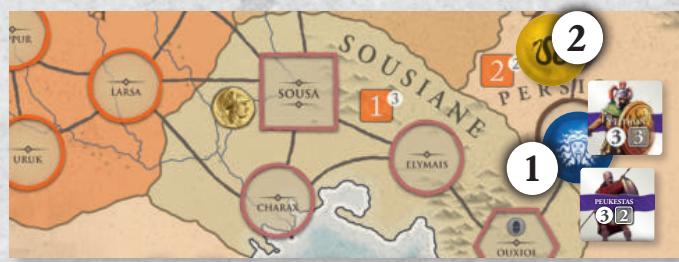
Example: Peukestas is the Commanding General for a side, and the battle space is Persepolis (1). His Faction (Blue) controls Persepolis, but not Parsargadai (2), so Blue does not control the Province of Persis. Peukestas did not fail an Evasion roll in the current Procedure. Peukestas' Faction's Local Troops points are 1 x 2 = 2 (due to Peukestas special ability).
14.6 Battle Strength
Calculate the Battle Strength of each Faction as follows:
• If Elephant CUs are present, roll dice now to determine their Combat Strength.
Find the total Combat Strength (numbers in parentheses) of each Faction's CUs that are participating in the battle. Do not include the Combat Strength of any Royal Army CUs that were set aside.
• Add each Faction's Local Troops points to its total Combat Strength. The result is the Faction's Battle Strength.

Example: Continuing the previous example, Peukestas has 2 Loyal Macedonian CUs and 2 Mercenary CUs. His Faction's Battle Strength is 4 (Loyal CUs) + 2 (Mercenary CUs) + 2 (Local Troop points) = 8. Peithon has 2 Loyal Macedonian CUs and 4 Elephant CUs. Anti-Elephant Devices was played, but was canceled by Cretan Liar. The die rolls on the Elephant Die are 0, 4, 2, 1. Peithon's Faction's Battle Strength is 4 (Loyal CUs) + 7 (Elephant CUs) = 11.
14.7 Battle Score
Each Faction rolls 2 dice (this is its Land Battle roll). Change any individual die roll for a Faction that is less than the Battle Rating of that Faction's Commanding General to equal his Battle Rating. Then if a Faction played the optional Surprise card Cavalry Superiority, add +1 to its roll. Cross-reference each Faction's modified roll with its Battle Strength on the Battle Table. The result is the Faction's Battle Score.
If the Battle Scores are the same, the battle is a draw.
If one Faction's Battle Score is higher than the other's, the Faction with the higher Battle Score wins the battle, and the Faction with the lower Battle Score loses the battle.
Example: Continuing the previous example, Peukestas' Battle Rating is [2]. His Faction rolls 3 and 6. Cross-referencing his roll of 9 with his Battle Strength of 8 gives Peukestas' Faction a Battle Score of 6. Peithon's Battle Rating is [3]. His Faction rolls a 1 and 3. The 1 becomes a 3. Cross-referencing his roll of 6 with his Battle Strength of 11 gives Peithon's Faction a Battle Score of 5. Peukestas' Faction wins.
14.8 Commanding General Loss
If a player Faction's modified Land Battle roll (not Battle Score) is exactly 9, and the Faction's Commanding General is a Major (not Minor) General, roll a die to see if the General survives the battle. If your Faction won or the battle was a draw, your General is killed if the roll is "6". If your Faction lost the battle, your General is killed if the roll is a "5" or "6".
If your General is killed, permanently remove him from the game. Rolls for Commanding General Loss only affect Commanding Major Generals. Your Prestige remains the same during the battle if your General is killed.
If your Commanding General is killed, either your most Senior surviving Major General in the Battle location, or a Minor General you place there, may become your new Commanding General. If no General takes command and you do not control the battle space, any surviving CUs in your Army will be Dispersed after the battle is resolved. These effects happen immediately.
The opposing Faction does not gain control of any Royal Family Members there until after the battle.
Example: Continuing the previous example, Peukestas'Faction rolled a modified 9, so he must roll for Commanding General Loss. The player rolls a 6, so Peukestas is killed. Eumenes was a Subordinate Major General under Peukestas, so Eumenes takes command there. The CUs on Peukestas' General card transfer over to Eumenes'General card.
14.9 Battle Losses
After checking for Commanding General Loss and its consequences, Factions suffer losses in the Battle location:
Draw: If the battle was a draw, each player Faction that participated in the battle loses 1 CU of their choice.
Winning Faction: A player Faction that won a battle loses 1 CU of their choice. Exception: If the winning Faction's Battle Score was at least twice the opposing Faction's Battle Score, the winning Faction does not lose a CU.
If your Battle Score was at least 1 and your opponent's was 0, you do not lose a CU.
Losing Faction: A player Faction that lost a battle suffers losses (only in the battle location):
Eliminate all of its Mercenary and Elephant CUs.
• All of its Macedonian CUs (Loyal, Royal, and Silver Shields) that participated in the battle suffer Attrition as a single group. All of its Macedonian CUs that survive Attrition are Dispersed.
All of its Major Generals are Dispersed.
• It loses control of all Royal Family Members it controls.
Independent Armies: If SEUTHES or GLAUKIAS lost a battle, place it back in its holding box. Other Independent Armies that lost a battle are removed from the game.
RA CUs and Pieces in Major Cities: Royal Army CUs set apart at the start of a Land Battle, and pieces that remained inside a Major City during a Land Battle, do not suffer Attrition and cannot be taken as losses. RA CUs that were set apart join the Faction that won the battle, or their original Faction if the battle was a draw, after Battle Losses are taken, but before Retreat. RA CUs that join the activated General's Faction are considered to have been moved by the activated General.
Example: Continuing the previous example, Eumenes' Faction (the winning Faction) chooses to lose 1 Mercenary CU. Peithon's Faction loses all 4 Elephant CUs. The player rolls a 4 for Attrition and compares that to the "2" column on the Attrition Table. The result is a“ meaning no Macedonian CUs are lost to Attrition; instead, both Loyal CUs and Peithon are Dispersed. Eumenes remains in Persepolis with 2 Loyal CUs and 1 Mercenary CU.
14.10 Retreat
If the battle was a draw, all of the Attacker's Generals, CUs, and Royal Family Members the Attacker controls in the Battle location must Retreat. Dropped off and disembarked pieces that must Retreat go to the Embarkation Port. Pieces that entered the Battle location by moving from inside to outside a Major City Retreat back into the city. Pieces that came from an adjacent space via a Land, Mountain, or Strait path Retreat across that path to that space. An Independent Army that entered the Battle location from its holding box Retreats into its holding box (and becomes inactive).
15. SIEGES
A successfully completed Siege removes the PC from an Independent space or another player's Major City. Generals, CUs, and Royal Family Members inside a captured Major City suffer losses as if they lost a Land Battle.
Remember that, if you are a Champion, conducting a Siege against a Major City controlled by another Champion (except the Usurper) will change your status from Champion to Successor, so you will lose 3 Legitimacy.
15.1 Besieged/Besieging
A controlled Major City or any Independent space is Besieged when an Army, containing any number of CUs that are enemy to the space, is in the space. Being present is enough, the Army need not conduct a Siege (i.e. a roll on the Siege Table), nor does it require having any Siege Point markers there. The Army is said to be Besieging the space. Any pieces inside a Besieged Major City are Besieged. Place the counters of your Besieged Minor Generals, Combat Units, and controlled Royal Family Members (if using counters) under your PC, unless they are on a General's card. Pieces can only be Besieged in player Major Cities. Uncontrolled spaces and Minor Cities controlled by a player cannot be Besieged.
15.2 Conducting a Siege
A. Requirements
To conduct a Siege (i.e. roll on the Siege Table), your Army must Besiege a space and have at least 3 CUs.
At most one Siege may be conducted per space in a Surrender Segment. No MPs are required in a Surrender Segment.
An Army may conduct up to 2 Sieges in the same space during a Tyche or Activation Segment. An Army must be activated and spend 2 MPs to conduct a Siege in a Tyche or Activation Segment. The same Army must conduct both Sieges in one Segment.
No Moved/Battle/Dropped Off: A General or CU that was moved by another General, participated in a Land Battle, or was dropped off in the same Segment, may not conduct or be counted in the 3 CUs required to conduct a Siege.
B. Results:
To conduct a Siege, roll a die and modify it as follows:
-1 If Besieging a Port Major City when you have no available Fleets
-1 If Besieging Rhodos
+1 If Besieging Memphis or Babylon
+1 If Besieging a Major City with The Helepolis
+3 If Besieging a Major City with card Traitor Inside City
+1 If using the Special Ability of Demetrios or Menelaos
-1 If Besieging a Major City with Polyarchos inside
Compare the modified roll to the Siege Table. The result will be two numbers or dashes separated by a "/”. The number on the left is the number of Siege Points to add to the progress of the Siege. Place appropriate Siege Point markers next to the space to track the progress of the Siege. The number on the right is the number of CUs you must immediately eliminate from the Army conducting the Siege (your choice).

Example: Demetrios and his Army of 2 CUs conduct a Siege against Pella in a Activation Segment. A 2 is rolled. A result of 1 / 1'on the Siege Table means 1 Siege Point is placed, and the Army loses 1 CU.
15.3 Lifting a Siege
Whenever you do not have any CUs in a space, remove all Siege Point markers you have accumulated on that space. If a Besieging Army is defeated in a Land Battle, the victorious Army does not keep any of the previous Army's Siege Points.
15.4 Completing a Siege
You successfully complete a Siege when the progress of the Siege in a space your Army is Besieging reaches at least the following number of Siege Points:
| Major City . |
| Independent Stronghold Independent Minor City |
Remove Markers: When you complete a Siege, remove the PC and all Siege Point markers in the space. If it is a Major City, any Generals, CUs, and Royal Family Members inside the city suffer losses as if in a Faction that lost a Land Battle.
PC if Surrender Segment: If (and only if) you complete the Siege during your Surrender Segment, you may immediately place your PC in the space. If you complete a Siege during a Tyche or Activation Segment, you must wait until a later Surrender or Tyche Segment to place your PC there.
16. OPTIONAL RULES
Any of these optional rules may be used independently or together. Before the game begins, all players must agree to the optional rules that will be used in the game.
Optional rules marked with * (asterisk) were optional in Successors 3rd Edition.
GAME PREPARATIOn OPTIONS
16.1 Optional Tyche Cards
You may include some, none, or all of the optional Tyche cards in the Tyche Deck. The card number of the following cards includes an 'O' (e.g. 'O60') to identify them as optional: Cavalry Superiority x2 (not recommended with 16.9), Foundation of a Capital, Diplomatic Marriage, Oracle, Alexander's Ghost, Superior Admiral x2, Price of Failure, and Port Re-supplied.
Foundation of a Capital: Additional rules that apply beyond those included on the Tyche card.
When you place your completed capital marker on the map, the space becomes a Major City. It is treated in all ways as a Major City and must be controlled to control the Province (in addition to controlling any normal Major City in the Province).
Example: Blue has completed construction of his capital in Alexandria. The capital construction marker is removed from the map, flipped to its 2V side and placed on the Faction Card. The completed capital marker is placed in Alexandria.
If you lose control of your Capital City, remove the 2V' marker from your Faction card, reduce your VP by 2, give the Capital marker flipped to its '1V' side to the Faction that removed your control (which could be the Independent Faction), increase their VP by 1 (unless it is the Independent Faction), and the space becomes a Minor City again.

Historical examples: Seleukeia, Lysimacheia, Kassandreia, Antigoneia, and Ptolemais
16.2 Herakles

Herakles begins the game off the map (like Philippos). Place him on the map in Pergamon (in Lydia) when Alexandros is killed (including by assassination).
For most of his life, Alexander's illegitimate and partly Persian son was an ordinary boy living quietly with his mother's family in Pergamon. Only after Philippos and Alexandros had both been killed did he have any influence on the Wars of Alexander's Successors. Had he lived longer and found a stronger champion than Polyperchon, it is conceivable that he might have brought peace to part of the Macedonian empire.
PREPARATIONS OPTIONS
16.3 Faster Funeral Cart Construction

If you control the Funeral Cart, as your card option in a Tyche Segment in Game Turn I, you may discard a 4 OPs card to complete construction of the Funeral Cart. The Funeral Cart may then be moved in Game Turn I, beginning with the Activation Segment of the current Player Turn. Alexander still cannot be buried during Game Turn I.
16.4 Destruction of the Funeral Cart
If an Independent Army (or Independent PC) is ever in a situation where it would take control of the Funeral Cart if it were a player General (or player PC), remove the Funeral Cart from the game (it is destroyed).
SIEGE OPTIONS
16.5 Combat Unit Siege Defense
Each time a 3rd Siege Point is achieved against a Major City, if any CUs are inside the city, remove 1 CU from inside the city instead of adding a Siege Point.
Example: 2 Siege Points have been achieved against Pella, and 2 CUs are inside. The Besieging General conducts another Siege, rolling a modified "6"to add 2 more Siege Points. The two CUs inside the city are eliminated. The progress of the Siege remains at 2 Siege Points.
16.6 Royal Army CUs and Sieges

If Royal Army CUs are part of a Besieging Army that is about to conduct a Siege, determine the Prestige of the Besieged and Besieging forces in that space. If Prestige is lower on the Besieging side, the Besieging RA CUs may not be counted toward the 3 CUs required to conduct that Siege.
COMBAT UNITS AND INDEPENDENT OPTIONS
16.7 Forage Attrition
In your Forage Segment, if you have more CUs in a space than its Forage Limit, instead of losing 1 CU, roll for Attrition. Check the result in the Attrition Table. For this purpose, treat a result of "_” as "1".
16.8 8 CU Movement Limit
There is still no limit to how many CUs you can have in a space, but no more than 8 CUs may move or Intercept from a location together at the same time, except to Evade.
16.9 Cavalry
Each CU in Successors (except Elephant CUs) already represents some cavalry. This rule gives players the chance to place greater emphasis on the role cavalry played in Macedonian strategy and tactics, at the cost of additional rules complexity. No distinction is made between the different types of cavalry forces employed in Macedonian armies.
This optional rule introduces a new type of Combat Unit: the Cavalry CU. Cavalry CUs mainly represent cavalry formations, but they also include elite light infantry forces.

Cavalry CUs (or "Cav") have unique characteristics, but also share similarities with Mercenary CUs. Each Cavalry CU has a Combat Strength of 1. The two types of illustrations on Cavalry CU counters are insignificant.
Independent Armies: 1 CU in each Independent Army is considered to be a Cavalry CU.
Setup: Give each Starting General 1 Cavalry CU in addition to the other CUs he receives in Setup.
Reinforcements Phase: You receive 1 Cavalry CU and 1 Mercenary CU instead of 2 Mercenary CUs in each Reinforcements Phase (starting in Game Turn II) if you control any of the following Provinces: Thessalia, Makedonia, Thrake, Armenia, Kappadokia, Media, Persis, or Sousiane. This does not change the 2 Mercenary CUs received for the most VP.
Tyche Card CUs: When playing one of the following cards for its event, you receive the CUs shown below instead of the CUs listed on the card:
Thracian Mercenaries . 1 Merc + 1 Cav Cappadocian Mercenaries 1 Merc + 1 Cav Greek Mercenaries (if placed in Thessalia) 1 Merc + 1 Cav Persian Popular Support (immediately) . . 1 Merc + 1 Cav Macedonian Reinforcements... . 1 Loyal or 1 Cav Egyptian Military Colonists . 2 Mercs, or 1 Loyal, or 1 Cav Mutiny. 1 Loyal, or 1 Royal, or 1 Cav Peukestas Satrap of Persis 2 Mercs + 1 Cav Neoptolemos Satrap of Armenia 2 Mercs + 1 Cav Kassandros 2 Mercs + 1 Cav Olympias (if placed in Epeiros) 3 Mercs + 1 Cav
Train Cavalry: You may choose the following Troop Type when you Train Troops:
Cavalry: Cavalry CU, 6 OPs to train.
Victory Tie Breaker: Cavalry CUs do not count toward the 2nd condition in the Victory Tie Breaker rule.
Sieges of Minor Cities and Strongholds: If a Cavalry CU is named as one of the 3 CUs used to conduct a Siege of an Independent Minor City or Stronghold, the General spends only 1 MP to conduct the Siege. If the Siege result indicates a CU must be eliminated, Disperse a Cavalry CU instead. Two Sieges are still the maximum number of Sieges allowed per Segment per space. Cavalry CUs may be used to conduct Sieges against Major Cities, but in that case, they have no special effect (they may be eliminated as usual, but not Dispersed).
Removing Player PCs: If a Cavalry CU is named as one of the 3 CUs used to remove an enemy player PC from a Minor City, the General spends only 1 MP to remove the PC.
Movement Through Strongholds: Use the “1" column on the Attrition Table if an Army that passes through an Independent Stronghold includes a Cavalry CU.

Land Interception: If a General is intercepting from a location with a Cavalry CU, modify that General's Land Interception roll by +1.
If one of the moving pieces is a Cavalry CU, modify all Land Interception rolls by -1.
Evasion: If a General with a Cavalry CU is attempting to Evade, modify that General's Evasion roll by +1.
If one of the moving is a Cavalry CU, modify all Evasion rolls by -1.
Land Battle Score: If a side in a Land Battle includes a Cavalry CU, modify its Battle roll by +1 (after adjusting dice due to Battle Ratings), unless the other side includes at least 1 Elephant CU with a Combat Strength greater than 0.
Land Battle Losses: A losing Faction in a Land Battle loses all of its Cavalry CUs in the Battle location.
If, before taking losses, a winning Faction includes a Cavalry CU and the losing Faction does not include a Cavalry CU, modify the losing Faction's Attrition roll for any Macedonian CUs it has by +2.
If not using the Cavalry optional rule, feel free to use Cavalry CU counters as Mercenary CUs.
16.10* Dispersed Player Fleets
Fleets no longer return to a player automatically during the Reinforcements Phase. Instead, as your card option in a Tyche Segment, you may discard any Event or Bonus card to retrieve one Fleet Token you control from the Dispersed Box. Place it off the map in front of you on its normal (lower number) side. A Fleet can become available in this way in the same Game Turn in which it was Dispersed.
Fleets that are uncontrolled or Independent in a Reinforcements Phase still return to their holding boxes at the start of that Reinforcements Phase.
16.11* Independent Army Reactions
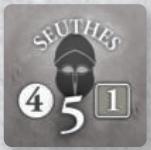
Generals that are part of Independent Armies may attempt Land Interception and/or Evasion. All requirements of Land Interception and Evasion still apply. All CUs in an Independent Army always join their Intercepting or
Evading Independent General (Independent Armies never split apart). If more than one Independent Army is in the same space, only one of them may attempt Land Interception or Evasion at the same time. If an Independent General successfully Intercepts, he brings only his own Independent Army with him. If an Independent General successfully Evades, all Independent Armies in the space Evade with him. An Independent General that tries and fails to Evade suffers the normal penalty for failure (loss of Local Troops).
To declare an Independent Interception or Evasion attempt, a non-moving player must discard a Surprise Tyche card (drawing a replacement card, as usual). Each card discarded allows one attempt. Instead of declaring their own Interception or Evasion attempt, each player may declare Independent Interceptions or Evasions at the normal point they would declare an Interception or Evasion in Turn Order. However, once a player has declared an Independent Interception (or Evasion) and discarded their Surprise card, no other player may declare an Independent Interception (or Evasion) from the same space in the same Procedure. A player who declared an Independent Interception or Evasion resolves it at the normal point that player would resolve an Interception or Evasion attempt in Turn Order.
EnD OF GaME OpTIOns
16.12 Short Game
The game ends at the end of Game Turn IV. Calculate End Game Victory in the normal way (ignore Legitimacy).
Original Successors game design Richard H. Berg & Mark Simonitch
Creative Director Jaro Andruszkiewicz
4th Edition Rules and Cards Waldemar Gumienny, Wojciech Sieroń, Jędrzej Sieroń
"Alexander's Marshalls" Special Capabilities John B. Firer
Artwork Bartłomiej Jędrzejewski, Łukasz Strupiechowski, Rafał Zalewski, Grzegorz Bakera
Kickstarter & Production Agata Jurczyszyn, Michał Ozon, Waldemar Gumienny
Graphic design and DTP Krzysztof Klemiński
Player Aid Inspired by Nathanael Brouhard's player aid ("Crestfallen" on BGG)
Successors miniatures Jakub Kacperski / Hexy Studio
Diadochi Wars Scenarios: Waldemar Gumienny, Justin Vorhis
Example of play: Wojciech Sieroń, Michał Sieroń Playtesters: Jon Murdock, Gene Gibson, Dave Kyukendall, Ed Prem, Tom Stearns, Jonathan Florentino, Steven Sheasby, Chris Trimmer, Agata Jurczyszyn, Mariusz Rosik, Natalia Stanek, Arleta Staniszewska, Adrian Turzański, Martin Wieczorek.
Thanks for your support: Kickstarter Community, Consim World Community, BoardGameGeek.com Community, Backerkit.com Community
I would like to give a special thank you to Jaro Andruszkiewicz for his passion for this project and making it all possible. This version is dedicated to my late friend Richard Berg.
This was the first project we worked together on and at that time I was
a beginner and he was a legend. During the co-design he was extremely easy to work, had a great sense of humor, and was a pleasure to be around.
We finished the project as friends. I am indebted to him for his magnanimity and will always treasure our friendship.
Mark Simonitch August, 2020
PRONUNCIATION GUIDE
Satrp & erals
Perdikkas Antipatros Krateros Ptolemaios Leonnatos Peithon Lysimachos Polyperchon Antigonos Seleukos Peukestas Demetrios Eumenes Kassandros Aristonous Nearchos Asandros Pleistarchos Menelaos Polyarchos Neoptolemos
Alexandros Philippos Herakles Olympias Kleopatra Thessalonike Eurydike
Leosthenes Ariarathes Seuthes Glaukias Philon
Many thanks to Justin Vorhis and Vangelis Bagiartakis for their very patient help in preparing this guide.
Modern Greek
Pehrr-theek-kahss
Ahn-dee-pah-trrohss
Krrah-tay-rohss
pToh-lay-may-ohss
Lay-ohn-nah-tohss
Pee-thawn
Lee-see-mah-hohss
Poh-lee-pehrr-hone
Ahn-dee-goh-nohss
Seh-lef-kohss
Pef-kehs-tahs
Thee-mee-tree-ohss
Ev-meh-neess
Kahs-sahn-drohss
Ah-ree-stoh-nooss
Nay-ahr-hohss
Ah-sahn-drohss
Plee-stahr-hohss
Meh-nay-lah-ohss
Poh-lee-ahr-hohss
Nay-oh-pToh-lay-moh
∏ερδíxxα Aντπατ Kρατε ΠIτoλεμαÍο Λε0vváτo5 ∏εθωv Λvσíμαχos IIoλυπÉρχων Avτíγovoş ΣÉλEUXOS ευxστα ∆ητι Evuévηs Káσαvδρos Aριστóvoυζ Néαoxos 'Aσαvδρos IIλεÍσταχ5 MεvÉλαos oλαχ Nλε
Ah-lehx-ahn-drohss Fih-leep-pohss eer-rah-kleess Oh-leem-pee-ahss Klay-oh-pah-trrah Thehs-sah-loh-nee-kee Ehv-vrree-thee-kee
Lay-ohs-stheh-neess
Ah-ree-ah-rah-theess
Sef-theess
Glahf-kee-ahss
Fee-lawn
AλÉξαvδ0os ΦÍλιππ Hραxλs Oλvμπιáş Kλεπτα Θεσσαλovíxη Evριδíxη
Λε0σθÉvηs Aριαρáθηs Σeθηs Γλαvxíαs ΦÍλων
Ancient Greek*
Pehr-dihk-kahss
Ahn-tih-pah-tross
Krah-teh-ross
pToh-leh-my-oss
Leh-ohn-nah-toss
Pay-thone
Loo-sih-mah-khoss
Poh-luh-pehr-khone
Ahn-tih-goh-noss
Seh-lew-koss
Pew-kehs-tahss
Day-may-trih-oss
Yew-meh-nace
Kahs-sahn-dross
Ah-rih-stoh-nooss
Neh-ahr-khoss
Ah-sahn-dross
Play-stahr-khoss
Meh-neh-lah-oss
Poh-luh-ahr-khoss
Neh-oh-pToh-leh-moss
Ah-leh-xahn-dross Fih-lihp-poss Hay-rah-klace Oh-luhm-pih-ahss Kleh-oh-pah-trah Thehs-sah-loh-nee-kay Yew-ruh-dih-kay
Leh-o-sthay-nace
Ah-rih-ah-rah-thace
Sew-thace
Glau-kih-ahss
Fih-lone
* We have no time machine to verify how Alexander's contemporaries pronounced their words. These pronunciations have been reconstructed by modern scholars.
17. INDEX
Terms are defined best in bold sections.
Activation. .. 9.
Adjacent. . 2.
Africa . . 2.
Army . . . . . . . . . . . .7.2, 7.4, 9.1
Asia. . 2.
Assassinated . . . . . . . . . . .8.5, 3.2
Attrition. . . . .7.3, 10., 2., 13.3 D, 14.9
Battle Cards . . .14.3
Battle Losses. . . . . 14.9, 7.3
Battle Rating . 7.1, 14.7
Battle Score . . . . . . .14.7, 13.3, 14.9
Battle Strength. . . 14.6, 14.7
Besieged / Unbesieged
. . 15.1, 5.2, 6.4, 9.5, 11.1 B
Burying Alexander. . . . . . . .3.8, 5.6
Captured . . . . . . . . . . 2., 3.7, 15.
Card Clarifications .. .6.2
Champions / Champion Status . . .3.7
Combat Units (CUs) . . .. .7.2
Commanding General Loss . . . . 14.8
Cavalry CUs . . . . 16.9
Elephant CUs . . . . . . . .7.2 C, 14.6
Loyal Macedonian CUs . . 7.2 E, 6.2 B3
Mercenary CUs . .7.2 B, 6.2 B3, 6.3, 5.4
Royal Army (RA) CUs 7.2 F, 10. K, 14.9
Silver Shields . . . .7.2 C, 14.9
Disbanding RA CUs. . . . . . . .7.2 F
Discard a Tyche Card . . . . . . . .6.2
Discard Pile . . . 2., 5.3
Disembarkation Port. . . . . . . 13.2.8
Dispersed / Dispersed Box. . . . 2., 5.2
Elephant Die . . . . . . . .7.2 C, 14.6
Embarkation Port . . . . . . . . 13.2.2
Enemy 2.
Europe......
Evasion .. . .12., 10. F
Faction.. 2.
Faction Card 2.
First Player . 5.1 C
Fleets / Fleet Tokens. . . 7.4, 13.2, 13.3
Force-March... .6.2 B1
Free Passage . . . . . . . .10. C, 12.2 B
Funeral Cart. . . . 8.1, 5.1 A, 3.8, 7.2 D
Game End. .... . .. 3.
Game Turn . . 5.
Generals. . .7.1
Commanding Generals 7.1 A
Event Generals. 7.1 B
Major Generals 7.1 B
Minor Generals 7.1 C
Recruit a General 6.2 D
Reserve Generals. 7.1 B
Starting Generals. 7.1 B
Subordinate Generals 7.1 A
Unavailable Generals. 7.1 B
Hand of Tyche Cards .6.2
Heirs . 8.1, 3.2 3.6
Helepolis. 15.2 B
Hellespont ..3.5
Holding Boxes. 2., 4.1
Independent. . .2., 15.4
Independent Armies .
7.5, 8.2, 9.1, 9.5, 14.9
Initiative Rating . . . 7.1, 9.2, 11.2, 12.2
Land Battles . .14.
Land Interception 11., 10. D
Largest Fleet. . 3.5, 6.2 C
Legitimacy (L) 3.6, 3.8, 4.6, 7.2 D, 5.2, 3.1
Local Troops . . . 14.5, 2., 12.2 C, 14.6
Locations.
Looted markers .4.1
Lord of Asia. . .3.5
Major Cities. .2., 9.4, 13.2
Major Islands 2.
Marriage .8.2
Minor Cities. 2.
Movement . 9., 10., 13., 8.4
Movement Points (MPs). .9.2
Naval Battles . 13.3, 3.7
Naval Movement Limitations . . . 13.1
Operation Points (OPs) .6.2
Overrun. 10. J, 2., 3.7
Paths. . 2., 9.3 A, 11.1, 12.1
Phases 5.
Determine Turn Order. . . . 5.1 C
Isolation Phase. ..5.5
Label the Usurper 5.1 B
Reinforcements Phase . .5.2
Shuffle and Deal Tyche Cards Phase 5.3
Strategy Phase 5.4, 6.
Turn Events and Exceptions . 5.1 A
Turn End . . .5.6, 3.8
Place PCs . 6.1, 6.2 B2
Player Turn 6.

PHALANX
PHALANX CO. LTD Craven House, 40-44 Uxbridge Road, London, W5 2BS, United Kingdom www.phalanxgames.co.uk
Political Control markers (PCs)
Popularity / Popularity Points (P)
7.1, 7.2, 7.2 F
Port . . . . .2., 13.2, 13.3, 14.10., 15.2 B
Prestige / Prestige Points
7.2 D, 3.7, 7.4, 10. K, 14.4, 14.8
Procedure (Land Movement). . . . . 10.
Province / Province Card . . 2., 3.5, 7.3
Regions . 2.
Remove PCs. 6.1, 9.3 D, 9.5
Retreat .. 14.10, 13.3, 14.2, 9.1, 11.1
Rounds 6.
Royal Family Members 8., 3.6
Sacred Ground .7.2 F
Segments 6.
Activation Segment .6.3
Forage Segment .6.4
Surrender Segment. .6.1
Tyche Segment.. .6.2
Seniority . . . . 7.1 A, 9.2, 7.1 C, 11.2
Siege Point markers .15.
Sieges . 15.
Spaces. 2
Strongholds
2., 6.1, 7.3, 9.3 D, 9.5, 15.4
Successors . .3.7
The Tomb. 8.1, 3.6, 3.8, 7.2 D
Train Troops. .6.2 B3
Transit Point. 2., 6.4
Turn Order 5.1 C
Tyche Card Draw Pile 2., 5.3, 6.2
Tyche Cards . .6.2, 3.6, 5.3, 7.4
Bonus Cards .6.2
Event Cards. .6.2
Surprise Cards. .6.2
Uncontrolled
2., 5.4, 5.5, 6.1, 8.3, 9.4, 15.1
Unrest and Unrest Spreads
Usurper 5.1 B
Victory 3.
End Game Victory. .3.3
Instant Victory. .3.1
Regency Victory . .3.2
Victory Points (VP) .3.5
Victory Tie Breaker .3.4
VP Fleet Strength .3.5
Withdrawal 11.3, 10. E
03.md
5. Setup
5.1 Place the board on the table.
5.2 Set the Tyche Cards aside in a single deck.
5.3 ROYAL FAMILY. Place each in the following Major City (Province listed in parentheses):
Place the Funeral Cart and Alexandros in Babylon (Babylonia).
Place Herakles in Damaskos (Koile Syria).
Place Kleopatra in Sardeis (Lydia), Inactive.
Place Olympias in Molossia (Epeiros), Inactive.
Place Thessalonike in Pella (Makedonia), Inactive.
Place Philippos in his holding box.
5.4 GENERALS. Setup of Generals depends on the number of players.
5.4.1 Starting Generals' locations and forces
Perdikkas – In Babylonia: 6 PCs. In Babylon: 4 Royal Army CUs, 2 Elephant CUs, Perdikkas.
Antipatros – In Macedonia: 5 PCs. In Pella: 2 Loyal Macedonian CUs, 2 Royal Army CUs, Antipatros.
Krateros – In Kilikia: 2 PCs, 2 Loyal Macedonian CUs, 2 Royal Army CUs, Krateros. Krateros and his CUs may be placed in either space.
Ptolemaios – In Egypt: 5 PCs. In Memphis: 2 Loyal Macedonian CUs, 2 Mercenary CUs, Ptolemaios.
Leonnatus – In Mikra Phrygia: 2 PCs, 2 Loyal Macedonian CUs, 2 Mercenary CUs, Leonnatus. Leonnatus and his CUs may be placed in either space.
Peithon – In Media: 6 PCs. In Ekbatana: 2 Loyal Macedonian CUs, 2 Mercenary CUs, Peithon.
Lysimachos – In Thrake: 5 PCs, 2 Loyal Macedonian CUs, 2 Mercenary CUs, Lysimachos and his CUs must all be placed in the same space.
Antigonos – In Phrygia: 4 PCs. In Kelainai: 2 Loyal Macedonian CUs, 2 Mercenary CUs, Antigonos.
Eumenes Starting Forces: Place PCs in every space in Kappadokia except Komana (Komana will retain its '1' strength Independent PC and Independent Army). PCs placed in this fashion replace the Independent PCs that were there. Eumenes starts in any friendly space in Kappadokia along with 2 Loyal Macedonian CUs and 2 Mercenary CUs.
Seleukos Starting Forces: Place PCs in both spaces in Koile Syria. Seleukos starts in Damaskos with 2 Loyal Macedonian CUs and 2 Mercenary CUs.
5.4.2 Two-player game. Shuffle the 8 starting Major Generals (these cards have a purple horizontal bar across the top of the card) and deal 4 Generals to each player. Each player (starting with the player who was dealt Perdikkas, then alternating) places their four Generals and their starting CUs and PCs on the map as specified in 5.9.1. Place the Eumenes, Seleukos, Demetrios and Kassander General cards near the board.
5.4.3 Three-player game. Shuffle all 8 starting Generals (these cards have a purple horizontal bar across the top of the card) plus Eumenes during Setup and deal 3 to each of the players. Each player (starting with the player who was dealt Perdikkas, then proceeding clockwise) places their three Generals and their starting CUs and PCs on the map as specified in 5.9.1. Place the Seleukos, Demetrios and Kassandros General cards near the board.
5.4.4 Four-player game. Shuffle the 8 starting Major Generals (these cards have a purple horizontal bar across the top of the card) and deal 2 to each player. Each player (starting with the player who was dealt Perdikkas, then proceeding clockwise) places their two Generals and their starting CUs and PCs on the map as specified in 5.9.1. Place the Eumenes, Seleukos, Demetrios and Kassandros General cards near the board.
5.4.5 Five-player game. Shuffle the 8 Generals (these cards have a purple horizontal bar across the top of the card) plus Eumenes and Seleucus during Setup and deal 2 to each player. Players select 1 dealt General and discard the other. The discarded Generals are then shuffled and dealt to the players. Each player (starting with the player who was dealt Perdikkas, then proceeding clockwise) places their two Generals and their starting CUs and PCs on the map as specified in 5.9.1 and below.
5.4 INDEPENDENT MARKERS. Place an Independent PC on its '1' side in each circle area marked with a shield. Place an Independent PC on its '3' side in each square and hexagon marked with a shield.
5.5 Give each player Political Control markers of one color as well as the corresponding Faction card.
5.6 Give each player a Champion Marker. All players begin the game with Champion status (4.5).
5.8 INDEPENDENT ARMIES. Place the five Independent Armies (square counters) in their respective boxes on the map. Leosthenes starts in Lamia and Ariarathes starts in Komana, while the other three start in their holding boxes.
5.9 Place the Game Turn marker on the first space of the Turn Track. Place all other markers in their respective holding boxes on the board. Each player now marks their L (see 15.2) and VP (see 7.4) totals on the Record Track.
6. Sequence of Play
Each Game Turn consists of the following phases:
6.1 Turn Events
6.2 Turn Order
6.3 Label the Usurper
6.4 Reinforcement
6.5 Tyche Cards
6.6 Strategy
6.7 Isolation
6.8 End
6.1 Turn Events Phase
Depending on which Game Turn is beginning, certain effects occur:
6.1.1 Game Turn 1. The Funeral Cart may not be moved and Alexander's body may not be buried. Skip the Reinforcements Phase. Immediate Victory is not allowed (7.1).
6.1.2 Game Turn 2. The Funeral Cart may now be moved and Alexander's body may be buried (16.4). Immediate Victory can now be achieved (7.1).
6.1.3 Game Turn 3. Antipatros is eliminated (he dies) at the start of this Game Turn. Place the Polyperchon marker on his card to indicate this. Antipatros is not Polyperchon, even though they have the same stats (except Seniority). If Antipatros died before Game Turn 3, then he comes back as Polyperchon now and the owning player places him on any friendly controlled space.
DESIGNER NOTE: On his death bed, Antipatros announced that Polyperchon would replace him (much to the chagrin of his son, Kassandros).
General Demetrios arrives. Demetrios is given to the player who controls/controlled Antigonos, even if Antigonos has been eliminated. Deploy Demetrios during the Reinforcement Phase following normal rules (6.4).
DESIGNER NOTE: Demetrios is the son of Antigonos.
6.1.4 Game Turn 4. If Alexander's body has not been buried in a Major City yet, remove the Funeral Cart from the game (16.4.5). The body has been lost to history.
Herakles comes of age and is old enough by Macedonian custom to become king. The player who controls him must compare their total of VPs + L to each other player's. If they have the highest (if tied with another player, they must win the tie breaker, 7.3), then they declare Heracles to be the new King and win the game as Regent (7.2.1). If the controlling player does not have the highest total, they assassinate Heracles instead, removing him from the board, and the game continues.
If Herakles is uncontrolled when he comes of age, he is declared King and the game ends immediately. The player with the highest total of VPs + L wins (for tie breakers, see 7.3).
6.1.5 Game Turn 5. Alexandros comes of age and is old enough by Macedonian custom to become king. The player who controls him must compare their total of VPs + L to each other player's. If they have the highest (if tied with another player, they must win the tie breaker, 7.3), then they declare Alexander IV to be the new King and win the game as Regent (7.2.2). If the controlling player does not have the highest total, they assassinate Alexander IV instead, removing him from the board, and the game continues.
If Alexander IV is uncontrolled when he comes of age, he is declared King and the game ends immediately. The player with the highest total of VPs + LPs wins (for tie breakers, see 7.3).
6.2 Turn Order Phase
The player with the fewest Victory Points (resolve ties with a die roll) chooses which player will go first. As a reminder, they receive the First Player marker.
After the first player, play passes clockwise. This will be the established Turn Order for the remainder of the Game Turn.
6.3 Label the Usurper Phase
DESIGNER NOTE: When one of Alexander's generals became too powerful, he was seen as a threat to the others and declared a Usurper.
6.3.1 The player with the most Victory Points is designated as the Usurper for the rest of the Game Turn. If there is a tie for highest VP, the tied player with the most Senior General (4.26) becomes the Usurper. The Usurper takes the Usurper Card.
6.3.2 Players may freely attack any General, Army or CU(s) and may Siege any Major City belonging to the Usurper without losing their Champion status (4.5).
6.3.3 Being the Usurper does not affect Legitimacy (Section 16). It is possible (albeit difficult) to retain Champion status while being the Usurper.
6.4 Reinforcement Phase
6.4.1 Each player receives all their CUs, Major Generals and Fleets from the Dispersed Box (if any) as well as 2 Mercenary CUs.
In addition, some players may receive bonus units:
If a player controls Makedonia, they receive 1 Loyal Macedonian CU.
The player who has the most Legitimacy Points (ignoring Prestige Points) receives 1 Loyal Macedonian CU. Break ties by highest Seniority (compare each player's most Senior General, 4.26).
The player with the most Victory Points receives 2 Mercenary CUs. If there is a tie, all tied players receive 1 Mercenary CU instead.
6.4.2 In turn order, players place their collected pieces. Each may be played in either:
a) A friendly controlled space that does not contain an enemy Army, CU or General; or b) Any space containing a friendly General. The General must have been on the map at the start of the Reinforcement Phase.
6.4.3 Restrictions:
There is no limit to the number of CUs that may be placed on a friendly controlled Major City or with a friendly Major General (even one being deployed at the same time).
Otherwise, no more than two CUs may be placed in any other eligible space.
Minor Generals may be placed (but not repositioned) into friendly controlled spaces, but the restriction in 6.4.2.b must still be obeyed for further CU deployment.
You may never place CUs into a Besieged Major City. However, if you are the one performing the Siege, you may place CUs into your Besieging Army.
If a player is unable to bring in all their Reinforcements, usually due to not having enough eligible spaces, remaining Reinforcements may be placed in an uncontrolled or Independently controlled space in any Province that is not controlled by another player: up to two CUs per Province. A General must be placed with them or they will be Dispersed (3.3.1).
6.5 Distribute Tyche Cards Phase
6.5.1 Shuffle all Tyche cards (including the discards, but not those removed from play) into a new deck.
6.5.2 Five-player game. Deal four Tyche cards to each player each Game Turn. There are only four Strategy Rounds.
6.5.3 Four-player game. Deal five Tyche cards to each player.
6.5.3 Three-player game. Deal five Tyche cards to each player and then deal 5 Tyche cards facedown to the table. Each time the third player completes their Strategy Round, flip over 1 card. Resolve any Unrest, Unrest Spreads, Plans of Their Own or any of the Independent Armies events. Ignore any other events. Determine randomly who resolves the event.
6.5.3 Two-player game. Deal five Tyche cards to each player and then deal 10 Tyche cards facedown to the table. Each time the second player completes their Strategy Round, flip over 2 cards. Resolve any Unrest, Unrest Spreads, Plans of Their Own or any of the Independent Armies events. Ignore any other events. Determine randomly who resolves each event.
6.6 Strategy Phase
The Strategy Phase is comprised of five Strategy Rounds (four in a 5-player game).
Each round, in Turn Order, players complete four Segments in order.
Each player completes all four Segments before play passes to the next player.
After the last player completes their last Segment, a new Strategy Round begins.
After all Strategy Rounds have been completed, the Strategy Phase is over and play proceeds to the Isolation Phase (6.7).
6.6.1 Strategy Segments: (Explained in greater detail below)
a) SURRENDER: Gain control of certain spaces on the board. b) TYCHE: Player must play 1 non-surprise Tyche card. c) MOVEMENT: Player may either Move or Raise 1 Mercenary. d) FORAGE: Player removes 1 CU from each Army which exceeds the Forage Limit of its space.
6.6.2 Surrender Segment. Perform the following three steps in order:
For each enemy controlled non-Independent Minor City where you have at least 1 CU, you may choose to remove the PC. If you do, you may then choose to place one of your own PCs there. Note that these are optional actions and do not apply to Independently controlled Minor Cities (they must be Subjugated, Section 14).
You may place one of your PCs on any uncontrolled Major City, Minor City and Stronghold space(s) where you have at least 1 CU.
You may conduct one Siege or Subjugation attempt (Section 14) against each enemy Major City or Independently controlled space where you have an Army with at least 3 CUs. If the Siege/Subjugation succeeds and you accumulate enough Siege Points, you may remove the enemy PC and replace it with one of your own immediately. Note that this occurs as part of the Surrender Segment, so it does not cost MPs (8.2).
EXAMPLE: The Yellow player has a Minor General and 1 CU in Halikarnassos and his Major General Antigonos with 3 CU in Sagalassos. Yellow places a PC in Halikarnassos without besieging it. (Although it is a Major City, it had no other PC.) In Sagalassos, Antigonos is allowed to make 1 subjugation attempt (example continued in Section 13).
6.6.3 Tyche Segment. You must play a non-Surprise Tyche card from your hand. If you have only Surprise Tyche cards in your hand you must first play or discard one and draw a new card from the Tyche deck, until you have at least one non-Surprise Tyche card that you can play from your hand. Then perform one of the following 3 options:
A) Activate the Event. Resolve the Event printed on the card. If the card is labelled 'MUST BE PLAYED', then you must choose this option. After resolving the event, if the card is labelled 'REMOVE FROM GAME', it is removed from the game. Otherwise, the played card is discarded.
EXAMPLE: The Yellow player plays the Tyche card Kilikia Pirates as an event and gains control of the Kilika fleet (with strength of 1).
B) Use Operation Points (OPs). You may spend your card's OPs on one (and only one) of the following actions:
6.6.3.1 Forced March. Choose a friendly Army. That Army activates, gains Movement Points equal to the OP of your card, and may spend them now (Section 8).
In this way, an Army may receive multiple activations during a single Strategy Round: during the Tyche Segment and during the Movement Segment.
EXAMPLE: Yellow plays Kilikia Pirates for 3 OPs and moves his Minor General and Mercenary CUs from Halikarnassos to join Antigonos in Salagassos.
6.6.3.2 Place PCs. You may place as many of your own PCs as the OP value of your card. Each PC may be placed in an uncontrolled space within 2 MPs of another friendly PC (the PC(s) must have been on the map at the start of this Tyche Segment). The placement space may not contain enemy CUs. You may use Sea Paths to count spaces, but not Trans-Mediterranean paths. When counting spaces, you may not pass through a space with Enemy Armies, CUs or PCs.
EXAMPLE: The Yellow player plays the Kilikia Pirates card, but instead of applying the event, uses its 3 OPs to place their PCs in Sardeis, Miletos and Ephesos. Note that it is not allowed to place PC in Lesbos, as it is 3 MPs away from closest cities with Yellow PCs or CUs - Halikarnassos or Kelainai.
6.6.3.3 Train Troops. If you are not currently Training Troops, select a Troop type (see below) and add your OP to the Training Track. Otherwise add the OP of your card toward the Troop you are currently Training (it can take multiple Turns and Tyche cards to train a Troop).
When the Training Track reaches its target number, the selected Troop is immediately deployed as a Reinforcement (6.4) and the Training Track is reset. If there is excess OP, a new Troop is selected and the excess OP is applied to the new Troop.
There are 2 Troop Types:
Mercenary: Costs 3 OP before deploying. Gain a Mercenary CU.
Phalangite: Costs 7 OP before deploying. Gain a Loyal Macedonian CU.
DESIGNER NOTE: Known as pantodapoi, non-Macedonian phalangites are non-Greek personnel trained and equipped in the Macedonian style using the 12 to 15 foot sarissa. Often of mixed Macedonian and Asian ancestry, pantodapoi proved effective in supplementing Macedonian personnel in the phalanxes of the Successors, especially for those rulers who were constrained in recruiting native Macedonians for their service.
EXAMPLE: The Blue player has just lost Perdikkas in a land battle near Heliopolis. Now he discards the Traitor Tyche card and takes the Eumenes General Card. Kappadokia Province card is randomly drawn. Komana is occupied by Independent Army, and there is Yellow Minor General and 3 Mercenary CUs in Dana. Blue decides to place the Eumenes miniature in Melitene with 2 Mercenary CUs placed on Eumenes General card. Independent PCs from Melitene, Mazaka, Zela and Amaseja are removed and replaced by Blue PCs.
EXAMPLE: Alternatively, the Yellow player decides to use 3 OPs to train some troops and chooses a Phalangite unit. The player puts the chosen unit on space 3 of the Faction card, indicating that only 4 more OPs are required (total of 7).
6.6.3.4 Bonus Tyche Cards. If you play a Bonus card, you may use the OPs and then resolve the event, in that order. You are not required to do both and may instead play the card normally as above. If the Bonus card is also labelled 'MUST BE PLAYED', then you must Activate the Event at least.
EXAMPLE: The Black player plays the Philippos Breaks From Guardian card, uses its 3 OPs, and then applies the card's event placing the Philippos miniature in Pella, with Antipatros' Army.
Any player who has permanently lost at least one of their Major Generals may hire either of the Generals set aside during setup. To do so, play a 4-OPs card during the Tyche Segment (non-surprise, as usual) and choose the Discard action (6.6.3.C). Then choose one of the available reinforcement Generals and deploy him with 2 Mercenary CUs (following Reinforcement rules and restrictions, 6.4) in any space within a randomly chosen Province not controlled by any other player (shuffle and draw one Province card that does not belong to any other player) that does not contain enemy CUs or an Independent Army. All other spaces within that province which do not contain enemy CUs or an Independent Army are immediately converted into that player's control (remove all enemy PCs if necessary).
C) Discard. You may discard your Tyche card if you do not wish to resolve the Event or use the OPs. If the discarded card had '4' OP, you may upgrade a Fleet you control that is not Dispersed (3.4.1).
6.6.4 Movement Segment. During this Segment, you may move all your Generals. See (Section 8) for Movement. You may also decide to forfeit your entire Movement Segment to instead gain a Mercenary CU and deploy it as if it were a Reinforcement (6.4). You must make this decision before rolling for movement (8.1).
6.6.5 Forage Segment. During this Segment, each of your Armies which is in excess of their space's Forage Limit must lose a single CU (owner's choice). The Forage Limit of Transit Points is 3 CUs; all other spaces have a Forage Limit of 8 CUs. Only consider your own CUs during this segment (i.e. if there is a Siege, don't count the enemy CUs).
EXAMPLE: Antigonos and his large Army (4 Loyal Macedonian CUs, 12 Mercenary CUs and 2 Elephant CUs) end their movement in Kelainai (Phrygia). They must now lose 1 CU, and the chosen unit is a Mercenary CU.
6.7 Isolation Phase
All players (in Turn Order) must remove all their non-Major City PCs that are Isolated.
A PC is isolated if the player cannot trace a continuous path of spaces from the PC to either a Friendly CU or a friendly controlled Major City (Besieged or not). A General without CUs is not enough to prevent isolation. You may trace over any path.
The path can only trace through:
Friendly controlled spaces, even if there are enemy CUs
Uncontrolled spaces that don't have enemy CUs
Enemy controlled spaces with at least 1 friendly CU.
Independent PCs can never be isolated.
EXAMPLE: The Independent Army of 23,000 Greek Colonists (lead by Filon) is heading west. It reached Rhagai in Media and already placed an Independent PC there. The blue PC in Hekatompylos is isolated, since it cannot trace a path to the Major City of Ekbatana (Rhagai in Media and Kadousioi in Hyrkania are occupied by Independent PCs).
6.8 End Phase
Move the Game Turn marker one space to the right and begin a new Game Turn. If this was the last Game Turn, instead the game ends and the winner is determined (7.3).
下载 Markdown04.md
7. End Game & Victory
7.1 Immediate Victory
There are two situations which can result in Immediate Victory:
A) Any player accumulates 18 Legitimacy Points (15.2) B) Any player accumulates a number of Victory Points (7.4) depending on the number of players:
5-player game: 20 VPs,
4-player game: 23 VPs,
3-player game: 26 VPs,
2-player game: 29 VPs.
If any player achieves either of these conditions, the game is over immediately and that player wins.
IMPORTANT: No one may win an Immediate Victory on Game Turn One (6.1.1).
7.2 Regency Victory
7.2.1 At the start of Game Turn 4, Heracles comes of age (6.1.4). The player who controls Heracles wins the game if they also have the highest combined total of L + VPs (if tied for highest, they must win the tie breaker, 7.3). Otherwise, Heracles is assassinated (18.7) and the game continues.
7.2.2 At the start of Game Turn 5, Alexander IV comes of age (6.1.5). The player who controls Alexander IV wins the game if they also have the highest combined total of L + VPs (if tied for highest, they must win the tie breaker, 7.3). Otherwise, Alexander IV is assassinated (18.7) and the game continues.
If Heracles or Alexander IV come of age and no one controls him, the game ends immediately and the player with the highest total of L + VPs wins (tie breakers below).
7.3 Game End Victory
If no one has won the game by the end of Game Turn 5, then the player with the highest VP total wins (L are not counted in this situation).
If there is a tie, use the following tie breakers in order:
Makedonia's controller.
Highest number of Macedonian CUs (Loyal, Royal Army and Silver Shields). Include any in the Dispersed Box.
The player who has the General with highest Seniority.
7.4 Victory Points
You can gain VPs in the following ways:
PROVINCES - When you control a Province (4.22), you gain the VPs for the province (marked on the board).
LARGEST FLEET - The player with the Largest Fleet (do not count the Pontic Fleet) receives 3 VPs. To be eligible, a player must have a minimum of 3 Fleet Points. Dispersed Fleets count. If there is a tie, no player gets the VPs.
HELLESPONT - The player who controls all five spaces bordering the Hellespont (indicated with blue background on the map) receives 2 VPs.
LORD OF ASIA - If a player controls all three of these Provinces, they receive 4 VPs: Babylonia, Phrygia and Syria.
8. Movement
Movement generally occurs via Forced March during the Tyche Segment (6.6.3) and during the Movement Segment (6.6.4). It can also be triggered by an event (6.6.3.A).
8.1 Determining Movement Points (MPs)
When moving via Forced March, MPs are determined by the played Tyche Card's OP value (6.6.3.1).
When moving due to an event, the text will indicate the number of MPs.
When moving during the Movement Segment, you must determine available Movement Points by rolling on the Movement Allowance Card. You only roll once: it will apply to all of your Generals. Each General's MPs are determined by their initiative vs the die roll.
MOVEMENT ALLOWANCE TABLE — cross-reference the General's Initiative Rating against the die roll (1–6):
8.2 Movement Costs
The cost to enter a space depends on the path being used.
Land path costs . . . . . . . . . 1 MP
Mountain or Strait* path . . . . 2 MPs
Sea path . . . . . . . . . . . . . 1 MP (see Naval Movement, 8.4)
Trans-Mediterranean path . . . . 2 MPs (see Naval Movement, 8.4)
*Crossing a Strait is not a Naval Movement.
Other Movement Costs:
Remove an Enemy PC (8.3.9) . . 2 MPs
Siege or Subjugate (8.3.10) . . . 2 MPs
8.3 Land Movement
8.3.1 When a General moves, he may bring along any CUs and any subordinate Generals (4.29). Along the way, he may pick up friendly CUs and drop off friendly CUs for no additional movement cost. Dropping off CUs in non-friendly spaces will require leaving behind a General to mark ownership (3.1.1). Only one General may be activated at a time, and each must finish his activation before another General can be activated (except as below, 8.3.2). CUs and Generals that are moved during a Segment may not be moved again during the same Segment.
EXAMPLE: Yellow rolls 2 for movement. Antigonos (in Salagassos) has 3 MPs and the Minor General in Halikarnassos has 2 MPs. First, the Minor General moves from Halikarnassos to Salagassos. Second, Antigonos leaves 1 Mercenary CU with the said Minor General, and moves the rest of his forces to Aspenendos and using the mountain path to the transit point nearby.
8.3.2 When a General/Army picks up a General with more Seniority, the more senior General immediately takes Command. If you change Commanders, you must immediately begin using the new Commander's MPs as a replacement (so if your Army has now used all its MP, or more, it must stop). Any CUs that were already moving may continue to move with the new Commander. Changing Commanders ends the old commanding General's activation and begins the new one's.
EXAMPLE: Yellow controls both Antigonos and Krateros who are situated in adjacent spaces: Tarsos and Issos. The die roll for movement is a 3, which allows Antigonos to move 4 spaces, but allows Krateros to move only 2 spaces. The player moves Antigonos one space and picks up Krateros (who outranks him and takes command of the Army). Since Krateros can only move two MPs, the Army must stop after moving one more space. It can move only to Chalybon or Myriandos. The Transit Point requires 2 MPs via mountain path and it's too far away for Krateros.
8.3.3 A Major General may move without CUs. When doing so, he may not move into a space with enemy CUs (unless granted Friendly Passage, 8.3.8) and may not stop in a space containing an enemy Major General without CUs (but he may pass through). If an enemy Army moves onto a space with a lone Major General (except if the Major General is safely within a friendly Major City), he is Dispersed (3.1.1).
8.3.4 Each time the active General/Army enters a space via Land Movement, it triggers a Reaction Step (Section 9) which is performed by the other players. Enemy Armies in the space may attempt to Avoid Battle or attempt to Intercept the active Army.
8.3.5 If an Army enters a space occupied by enemy CUs, it must stop and prepare for a Land Battle. Exceptions: You do not need to stop if you Overrun the enemy (8.3.6), or if friendly passage is granted (8.3.8) or if there are no enemy CUs present (either outside a Major city or in the space otherwise) after the Reaction Step (Section 9). PCs do not stop or slow movement. Fighting a Land Battle ends an Army's activation for the current Segment, and no part of the Army will be able to remove PCs or Siege/Subjugate for the remainder of the Segment.
8.3.6 Overrun
When your Army enters a space containing enemy CUs, if your own Army's CUs outnumber them by 5:1 (only compare # of CUs, not Combat Strength), you instantly defeat those CUs and they suffer Battle Losses (13.5). Note that this occurs after the Reaction Step (Section 9), so the enemy CUs may either Avoid Battle (Section 10) or gain reinforcements via Land Interception (Section 11) before checking for an Overrun. CUs inside a Major City cannot be Overrun.
Royal Army CUs will not defect when Overrunning an opponent (3.1.4.4).
If an opponent grants Friendly Passage and you are capable of Overrunning them, you are not required to.
Note: 5:1 means you need 5 CUs to Overrun each 1 enemy CU. So 5 Overruns 1, 10 Overruns 2, 15 Overruns 3, etc. Note that an Overrun is not considered a Battle, so Surprise Tyche Cards which refer to Battles may not be used.
EXAMPLE: 10 Mercenary CUs overrun 2 Silver Shields CUs, although the combat strength ratio is only 1.5:1.
8.3.7 Movement and Major Cities. CUs inside Major Cities do not stop enemy movement and cannot be Overrun (8.3.6). Your General can move friendly CUs and Active Royal Family Members into and out of a friendly Major City in his space for free during his activation. CUs and generals may never move inside an Independent Major City. All pieces inside a Major City must leave immediately if it becomes Independent.
Note this is different from CUs moving in and out of the Major City when an enemy Army enters the space (Reaction Step, Section 9), where a General is not required.
EXAMPLE: Kassandros and his army marches from Athenai to Lamia, but decides to leave 1 Mercenary CU as garrison in Athenai.
8.3.8 Friendly Passage
8.3.8.1 You may enter and pass through a space containing another player's Unbesieged CUs without battling if Friendly Passage is granted. Players may discuss the granting of Friendly Passage at any time, but the moving player must confirm this when they enter the space. If the opponent confirms Friendly Passage, then you may continue moving. If they do not confirm, then you must stop and prepare for a Land Battle after the Reaction Step (you may also Overrun if you are able, 8.3.6). A lone Major General caught in this fashion is Dispersed (4.6, you do not need to make a Leader Loss check if you were previously promised Friendly Passage but then the player refuses to confirm it). You may also decide to initiate a Land Battle or Overrun against CUs belonging to the player who granted you Friendly Passage, but you must then fully resolve the Reaction Step before any Battle begins.
EXAMPLE: Leonnatos intends to join his forces with Antipatros in Lamia and crush the Greek rebellion. He asks White, who controls Thrake, for Friendly Passage in Chersonesos and receives it. He spends 2 MPs (crossing the Strait) moving his Army from Abydos to Chersonesos.
8.3.8.2 This does not allow enemy Armies to exist on the same space for any longer than the time it takes to pass through. If two Enemy Armies are in the same space at the end of one Army's activation (in either the Tyche or Movement Segments), a Land Battle is fought regardless of any promised Passage (the moving player's Army is the one considered to have entered the space when defining the attacker (13.1) and checking Champion status, (4.5)).
8.3.8.3 Independent Armies may neither grant nor receive Friendly Passage.
8.3.9 Removing Control Markers During Movement. An Army with at least 3 CUs can remove a non-Independent enemy PC from a Minor City space by spending 2 MPs. This can only be done if there are no enemy CUs in the space. The Army cannot have fought a Land Battle in the current Segment.
EXAMPLE: Kassandros moves from Lamia to Larisa and spends 2 MP to remove the Black PC from Larisa.
8.3.10 Initiating Sieges and Subjugations. An Army with at least 3 CUs can spend 2 MPs to attempt a Siege against an enemy Major City (14.2) or attempt to Subjugate an Independently controlled space (14.3). The Army cannot have fought a Land Battle in the current Segment.
EXAMPLE: Same as in the example above, but no PC is removed from Larisa. Instead, Kassandros' Army reaches Pella. Black decided to hide the remaining 2 Royal Macedonian Units, along with Olympias and Alexandros, inside the Major City. Kassandros spends his remaining 2 MPs and makes a Siege attempt against Pella.
8.3.11 Moving Through Independently Controlled Strongholds. When your Army moves through an Independently controlled Stronghold without stopping (via Land Movement), you must suffer Attrition using the '2' column of the Attrition Table (instead of Army size, 4.3). This is only when passing through: stopping movement on the space causes no Attrition.
EXAMPLE: Peithon's Army starts in Ekbatana. After spending 2 MPs he moves south to Kossaioi, occupied by an Independent PC. Since he decides to move further to Sousa, he must suffer Attrition.
8.4 Naval Movement
8.4.1 Moving over a Sea Path or Trans-Mediterranean Path is a Naval Movement. Players are restricted to only 1 Naval Movement per Segment, regardless of how many Generals they have. A maximum of 8 CUs and any number of controlled Royal Family Members may be brought along.
8.4.2 The General making the Naval Movement may move by land before or after the Naval Movement, not both. During the Naval Move, they may move over as many Sea and/or Trans-Mediterranean Paths as they can afford (with MPs).
8.4.3 Terms
Embarkation Port: The port where the Naval Move originated.
Debarkation Port: The final port where the Naval Move landed. The Army landing here may be targeted for Land Interception (Section 11).
8.4.4 When making a Naval Movement, the moving player first declares which of their Fleets (if any) will come along as Escort. The player may only choose Fleets they have in front of them (not Dispersed). Fleets are not a prerequisite for Naval Movement: a player may always attempt Naval Movement even if they control no Fleets.
8.4.5 The activated General may pick up and drop off friendly CUs for no additional cost during the move. A General making a Naval Movement does not have to stop when they move into a space containing enemy CUs along the way, but must stop if there are enemy CUs at their Debarkation Port. The General may drop off CUs during his Naval Movement only if there are no enemy CUs in the space, unless there are friendly CUs already there, in which case they join them.
EXAMPLE: Ptolemaios' Army is in Pelousion, and enemy armies are in Giza and besieging Tyros. White feels that confronting Antigonos in Giza on land might be too risky and decides to use a naval move to reach Tyros. He spends 1 MP to move towards Giza, and another 2 MPs to move through Ake and debark in Tyros. Antigonos' Army is too far to Intercept Ptolemaios on land.
8.4.6 A General inside a Port Besieged Major City may move out of the space via Naval Movement. This is susceptible to Naval Interception (8.5) as usual. The inverse is also true: a General with 1 or 2 CUs (as long as the 2 CU limit for Major Cities is obeyed) may move directly into a Port Besieged Major City if that is its Debarking space (8.4.8).
EXAMPLE: Same as in the example above, but instead of moving Ptolemaios, White decides to move his Minor General and 1 CU out from Tyros and join Ptolemaios' Army in Pelousion.
8.4.7 An Army making a Naval Movement may Overrun only in their Debarking space (and if they have the correct CU ratio, see 8.3.6).
8.4.8 Independent Armies cannot use Naval Movement (but may cross Strait paths).
EXAMPLE: The Scythians (lead by Seuthes) can move to Astakos from Byzantion by crossing the Strait.
8.5 Naval Interception
8.5.1 Naval Interception before your General reaches the Debarkation Port. A player may only attempt a Naval Interception if they have a PC within 2 spaces (via Sea paths, not Trans-Mediterranean paths) of one of the spaces the active General is moving into during its Naval Move.
8.5.2 To Intercept, the opponent declares their intention and the number of Fleets they are using. A Naval Battle is immediately resolved before the active player's turn continues. If more than one player wants to declare an Interception, resolve them in Turn Order. Once all desired Naval Interception attempts (and the subsequent Battles) are resolved, the active player continues their move (unless they lost any of the Naval Battles, 9.3).
8.5.3 Naval Interception is automatic once declared (no dice rolls). Successful Interception immediately causes a Naval Battle, which may affect Champion status (4.5). Only Naval Battles which actually occur affect Champion status.
EXAMPLE: 2 players declare a Naval Interception. Red is earlier in the Turn Order, so Red fights the Naval Battle first (possibly losing Champion status). Red wins, so the active player's turn ends (9.3). Thus, Blue's Naval Interception never occurs, so Blue's Champion status is not affected.
8.6 Naval Battle
Naval Battles only occur when an opponent declares a Naval Interception during the active General's Naval Movement (8.5).
8.6.1 Battle Rolls. Each player rolls two dice and cross-references the result against their total Fleet Strength on the Battle Table. This is the player's Battle Score (if the active player does not have any Fleets, their Battle Score is zero). The player with the higher Battle Score wins.
8.6.2 Drawn Battle. If the Battle Scores were the same, then the active player's Fleet has slipped by the enemy's without losses. Neither player loses Fleets.
8.6.3 Losses. The player who had the lower Battle Score Disperses all the Fleets they sent (if they were Upgraded, flip them to the weaker side, 3.4.1). If the active player lost, then their CUs suffer Attrition (4.3), then any surviving CUs, Generals and Royal Family Members immediately return to the Embarkation Port and end their activation.
8.6.4 Additional Battles. If the active player won the Naval Battle or the result was a Draw, they see if any other players would like to declare a Naval Interception (8.5.2). If the active player wins or draws all Naval Battles, they lose no Fleets and successfully land at their Debarkation Port. If the active player loses a Naval Battle, they suffer Losses as above and any additional Naval Interceptions are cancelled.
EXAMPLE: As in the example above, but assuming that Red loses and the active player won. Now Blue would have a chance to fight against the active player.
下载 Markdown