Ancient-Knowledge_Rulebook_EN_Light.md
You are the ancient builders of this world, the last survivors of the civilization before ours. You are now the only holders of this multi-millennial knowledge. Leave your mark on history through stone and traditions, and protect this Ancient Knowledge.
2
CONTENTS
144
BUILDER CARDS
Additional cost

Name + modern country
1
FIRST PLAYER TOKEN


45
TECHNOLOGY CARDS
27 Level I cards
18 Level II cards
Requirement
Type
1
SCOREPAD

40
1-VALUE KNOWLEDGE/LOST KNOWLEDGE TOKENS [GREY]
10
5-VALUE KNOWLEDGE/LOST KNOWLEDGE TOKENS [GOLD]
BUILDER BOARDS [1 PER PLAYER]

3
TECHNOLOGY TILES

4
PLAYER AID CARDS

OVERVIEW & GOAL
ncient Knowledge is a strategy game for 2 to 4 players where you time. Each turn, all your monuments get closer to the inevitable: belonging to the past... It's up to you to find the best synergy so you can pass down your knowledge before the decline of the emblematic monuments you have constructed, and which we still find nowadays in the four corners of the globe. From Mexican pyramids to the Sphinx of Giza, passing through the famous cities of Tiwanaku and Babylon, only the cleverest builder will shine through the ages and seize victory.
In this game, your greatest enemy is time. Monuments you put into play are all accompanied by knowledge (). At the end of each turn, all your monuments must slide to the left, declining little by little, until they reach the Past and make you regret all this lost knowledge. When a player has at least 14 monuments in their Past, the game ends. Will your monuments withstand the trial of time?
GAME ELEMENTS & SETUP
1. EACH PLAYER CHOOSES A BUILDER BOARD AND PLACES IT IN FRONT OF THEM.
Each Builder board has 5 zones:
At the top is the "Timeline." During the game, you will place monument cards (city血, megalith品,pyramid菲) above this Timeline, and you will slide them to the left as the game goes on.
The Past is represented by the zone to the left of your board. You will place all your monument cards that have left your Timeline here. They are always visible to your opponents. The end of L the game is triggered once one player has at least 14 monuments in their Past.
3In the middle of your board, you have 5 spaces to place artifacts ().


One player's playing area.
The zone to the right of your board lets you sort Technology cards by type (ancient $\widehat { \frac { x } { \mu } } ,$ writing $\mathcal { C } ,$ secret ). There is no limit to the number of Technology cards you can place in this zone.
The zone to the bottom left is reserved for lost knowledge. You will place any tokens you receive during the game here.


2. PREPARE THE REST OF THE ELEMENTS AS FOLLOWS:

FIRST GAME?
During your first game, we recommend using starting hands. Ancient Knowledge is a game with simple rules, but very varied card effects.
The game includes 4 starting hands, each with 6 cards. You can identify them by the///symbols in the bottom right of the cards. When you play with this option, before shuffling the Builder cards, ignore step A and separate all the starting cards by symbol.
Each player takes a random deck. Then shuffle the rest of the cards (including any unused starting cards).

Randomly choose the first player. They place the First Player token in front of them and keep the scorepad handy.
2Shuffle all the Builder cards, then continue as follows:
ARandomly deal 10 cards face down to each player. After looking at your cards, discard 4 cards so you only keep 6.
B The 3rd and 4th players each draw 1 extra card. (Ignore this rule in a 2-player game.)
CMake a deck in the center of the table, within reach of all players. Leave space nearby for the discard pile. Builder cards represent the monuments that will last through time thanks to your expertise.
3Place the 3 Technology tiles in the center of the table visible) so there are 2 Level I and 1 Level II.
Shuffle the Level I Technology cards and randomly place 3 face up on each of the 2 Level I Technology tiles.
Shuffle the Level II Technology cards and randomly place 3 face up on to the Level II Technology tile.
▶Make 2 separate decks (I and II) with the remaining cards and place them in the center of the table, within reach of all players. Leave space nearby for discard piles.
Technology cards represent famous figures and technologies that aid in the development of your civilization.
Place thetokens in the center of the table to make a reserve, within reach of all players. You can make change at any time, using tokens of different values.
These tokens represent knowledge () when they are on cards in a player's Timeline, or lost knowledge () when they are in the corresponding zone on a player's board.
A. ACTION PHASE

game of Ancient Knowledge plays over an unlimited number of turns. As soon as a player has 14 or more cards in their Past, the end of the game is triggered. After final scoring, the player with the most victory points wins!
TURN OVERVIEW
On your turn, complete the following 3 phases in order:
A. ACTION PHASE
CREATE / LEARN / EXCAVATE / ARCHIVE / SEARCH.
B. TIMELINE PHASE
ACTIVATE ALL YOUR MONUMENTS AND ARTIFACTS WITH THE TIMELINE SYMBOL.
C. DECLINE PHASE
SLIDE ALL MONUMENTS IN YOUR TIMELINE TO THE LEFT.
uring the Action Phase, you will take 2 actions chosen from the 5 available options. You can take the same action twice on your turn.

CREATE A MONUMENT,or.
Choose a monument card in your hand. Add it to your Timeline, (in the zone above your board), following these steps:
-
If the symbol is shown on the top left of this card, discard as many cards from your hand as indicated in the symbol. If you cannot discard enough cards, you cannot Create this monument.
-
Place the chosen card on its starting space (shown by the symbol).
-
Add as manyto this card as the number shown in the colored band (next to theicon).
-
If the symbol is shown in the colored band, immediately apply the effect. If you cannot apply the full effect, apply as much as possible.


Only while creating a monument, you can play your monument on a different space than the one shown. To do so, discard cards equal to the difference between the 2 spaces.
Choose carefully though, since once a card is played, you cannot move it (by discarding cards again) for the rest of the game. You cannot play a monument directly to your Past in this way.
If this lock symbol is shown in the top left of the played card, you cannot discard cards in this way. Therefore, you can only play the card in the indicated space.
You can play a monument in an unoccupied space by placing one card above the other, respecting the following conditions:
If there are already 2 cards on a space, it is impossible to place a third card.
When a space is empty, always place the first monument just above your Timeline. Therefore any second monument, must be played above the first card.
▶If the monument on top ends up being the only card in the space, always slide it down so it is just above your Timeline.
ADJACENT CARDS
Certain card effects refer to adjacent monuments. Monuments are considered to be adjacent if they are placed in the same space (one above the other) or in the same row in 2 side-by-side spaces. 2 diagonal monuments are not adjacent.
You cannot voluntarily reverse the position of 2 monuments in the same space.

Example: Adrien takes the Creare action. He wants to ad the monument card Heracleion to his Timeline. He discards 2 cards from his hand, as required by the symbol on the card 1. Since he wants the card to enter his Past quickly, he decides to discard 1 extra card from his hand to play
Heracleion on space 1of his Timeline instead of space 2. Finally, he adds 2to this card, as shown in the colored band

A. ACTION PHASE

CREATE AN ARTIFACT.
Choose an card in your hand, then place it on one of the available spaces on your board (5 in the begining). Ancard can never be covered by anothercard. If all 5 of your spaces are occupied, you can no longer play cards of this type.
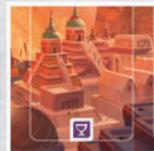
Only certain card effects will let you discard you have played.

LEARN
Choose an available Level I or II Technology card and check its requirements, if it has any, in the box to the right of the title.

If there are no requirements or if you fulfill those on the card, take the card and place it to the right of your Builder board. It is now part of your collection. There are three types of Technology cards: ancient, writing , and secret. Place it in the corresponding row to the right of your board.
Example:
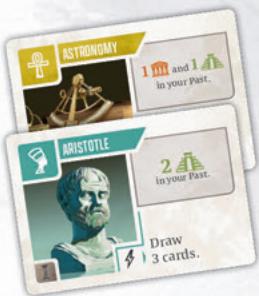
You must have 3 in play to take this card. If the card has the , symbol, immediately apply its effect.
If you cannot apply the full effect, apply as much as possible.
If the card has the symbol, it will provide victory points at the end of the game.
Example: Adrien takes the Learn action. He would like to take the Astronomy card, but he is missing 1 in his Past to fulfill the requirements. He decides to take Aristotle instead, since he has enoughin his Past. He then immediately draws 3 Builder cards and places the Aristotle Technology card in his $\vartheta$ collection.

AVAILABLE TECHNOLOGY CARDS
Do not refill the Technology tiles when you take a card. Wait until it contains only a single card, then discard this card to the pile next to the deck. Draw 3 new Technology cards from the corresponding deck (Level I or Level II). Refill this tile with these of 3 face-up cards, on the tile without any cards.
When a deck of Technology cards is empty, shuffle the discard pile to make a new deck. If there are not enough cards left to refill tile, put the cards and tile back in the box instead.
MIDDLE OF THE GAME
As soon as a player has at least 7 monuments in their Past, flip over one of the Level I Technology tiles to its Level II side (The player chooses which tile). Immediately discard the cards on the corresponding tile and refill it with Level II cards. From now on, this tile must contain only Level II cards. This only happens once per game.
Discard as many cards from your hand as you want. For each card discarded this way, remove 1from a monument in your Timeline. Return removed tokens to the reserve.
You cannot discard cards if you have no tokens in your Timeline.
Example: Adrien takes the Archive action. He discards 4 cards from his hand to discard 3from one monument and 1from a second monument in his Timeline. He returns these tokens to the reserve.

ADVICE

Try to discardtokens from your Timeline regularly, so they don't become during the DECLINE PHASE, which provide negative points at the end of the game. But be careful, since certain cards haveas a requirement. History is made of tough choices...

EXCAVATE
Rotate by 90° as many monument cards in your Past as you would like. For each card rotated this way, draw 2 Builder cards and add them to your hand.
Rotated Monuments in your Past must be straighten by card effects before you can rotate them again.
Example: Adrien takes the Excavare action. He rotates 2 monument cards in his Past to draw 4 new Builder cards.

SEARCH
e S tion lets o ra ard littebylttle.
Draw 1 card from the Builder deck and add it to your hand.

ADVICE
Expert players will almost never use this action, since it only lets you draw 1 card at a time. It's better to make quick use of monuments in your Past so you can draw more cards with the Excavate action.


HAND SIZE LIMIT

You can never have more than 10 cards in your hand. If you should draw cards above this limit, do not draw additional cards above 10.
Example: Adrien LEARNS the card Coptic Alphabet and must draw 3 Builder cards. He already has 8 cards in hand, he only draws 2 cards so he doesn't exceed the 10-card limit.

EMPY BUILDER'S DECK
If the Builder deck is empty, shuffle the discard pile and create a new deck.
After you have taken 2 actions, continue to the TIMELINE PHASE.

B. TIMELINE PHASE
In any order you choose, apply the effects of each of your血,, andcards in your playing area that have the symbol.
Careful: The effects of monument cards in your Past are never active during the game.

Then continue to the DECLINE PHASE.

C. DECLINE PHASE
uring this phase, time takes its toll. If accumulated knowledge was not passed on, it is lost.
Immediately Decline (L) monument cards in the 1 space of your Timeline by following the steps below.

GO INTO DECLINE

When a card goes into Decline, follow these steps in order:
-
If it has the symbol, apply its effect. Otherwise, nothing happens in this step.
-
If it still has on it, immediately move these tokens to the lost knowledge zone on your board. They are now lost knowledge.
-
Move the card to your Past, to the left of your board. It is no longer in play, and its effects are not available for the rest of the game.
If you must Decline 2 cards, choose either card and follow all the steps above, then follow them for the second card.
After Declining all the cards in the space, check your Past:
▶If there are at least 7 cards, flip over 1 of the Level I Technology tiles face up (see MIDDLE OF THE GAME, page 9).
▶If there are at least 14 cards, the end of the game is triggered (see END OF THE GAME, page 13).
Then slide all monuments still in your Timeline, as well as any tokens on them, 1 space to the left (cards on space ② move to those on move to ②,etc). Cards that move to1 will go into Decline on your next turn. Do not slide.
12
C. DECLINE PHASE

Example : During this phase, Adrien has the Yonaguni and Mycenae cards in space of his Timeline. They both go into Decline.
He chooses to resolve Mycenae first. Since it has the , symbol, he applies its effect. He decides to discard 7from Yonaguni.
Mycenae still has 1. He places it on his board and it becomes a . It will be worth -1at the end of the game.

He then moves Mycenae to his Past. He now has 1 in his Past.

Adrien now resolves Yonaguni. It does not have any effect to resolve. He moves the remainingfrom this card to the lost knowledge zone on his board.
He then moves Yonaguni to his Past. He now has 1and 1in his Past.
Adrien has no more cards in Decline (meaning on space 1).

He slides all remaining monument cards in his Timeline to the left 1 space and ends his turn.
Once your DECLINE PHASE is over, the player to your left begins their turn with the ACTION PHASE.

ADVICE

In the beginning, players tend to avoid moving monuments to their Past so they don't gain.
However, monuments in the Past provide victory points () at the end of the game. This is usually worth it, since the difference betweenandis sometimes zero.
For example, Calakmul is on space . It will go into Decline at the end of the turn, giving you 1(-1). However, this pyramid provides 1 at the end of the game. This card might cause you to gain/lose 0, but provides you a nice effect when declining.
On your next turn, having this monument in your Past provides multiple opportunities: draw cards by rotating it with the Excavate action, fulfill certain requirements, etc.
It's sometimes worthwhile to play cards that provideto have even more benefits later on. It's just as possible to win the game with more than 20 as with a limited amount. Find the best strategy and adapt to it.

END OF THE GAME
s soon as a player has at least 14 cards in their Past, the end lof the game is triggered. Continue playing until each player has played the same number of turns (use the First Player token), then proceed to final scoring.

The end of the game is often triggered by a player having 15 cards in their Past. All they need is to have 13 cards in their Past and 2 cards on in the previous turn.
FINAL SCORING
Each player adds up their total victory points () in the following way:

Count the victory points visible in the colored band for each monument card in your Past (rotated or not).

Add victory points from certain monument card effects in your Past.

Add victory points for each of your Level II Technology cards.

Add 1 for each monument left in your Timeline( andon these cards do not count).

Remove 1for eachin the dedicated zone on your board.

The player with the highestis the winner.
In case of a tie for the first place, the player with fewer between the tied players wins. If there is a tie after that, the most ancient player between the tied players wins.

14
CLARIFICATIONS

ICONS
ACTIONS

CREATE

LEARN


ARCHIVE
Megalith
BUILDER CARDS


City
EXCAVATE
SEARCH
MONUMENTS

Pyramid

Artifact

Cost(DISCARD CARDS)
KNOWLEDGE

Knowledge

Lost Knowledge

Victory Points

Required Space

Starting Hands
TECHNOLOGY CARDS

Ancient

Writing

Secret



Immediate

Ongoing (with conditions)

Timeline Phase
Decline Phase

Final Scoring

CREDITS
DESIGNER: Rémi Mathieu.
ILLUSTRATORS: Emilien Rotival, Adrien Rives, Ples.
AGENCY: L'Équipe Ludique.
PROJECT MANAGER: Adrien Fenouillet.
GRAPHIC DESIGNER: Vincent Mougenot.
EDITORS: Adrien Fenouillet, Rémi Mathieu, Xavier Taverne.
PROOFREADERS: Maëva Debieu Rosas, Quentin Schoemacker, Max-Tobias Walter.
TRANSLATOR: Danni Loe.
ENGLISH PROOFREADER: William Niebling.
Thank you to Laura for her expert advice and this inspiring phrase: "Don't write a book, it's boring. Make a game!" Thanks to my family for their support. Thanks to Mathieu from l'Équipe Ludique, who has been involved with this project since the beginning. He paved the way for Ancient Knowledge, making it even bigger, even better. Thanks to Nico who inspired me to finish one of my projects for once. Thanks to Clément who participated in more than 400 playtests, and also just for being a perfect friend. Thanks to everyone who bought the game, a product of 5 years of work and research. Thanks to the Iello team for believing in me, and specifically Adrien; it has been a pleasure working with you.
PLAYTESTERS
Without these playtesters, nothing would have been possible! Thanks to everyone: Laura, Clément, my mom, my bros Yann and Théo, Karine, Kévin, Adrien, Vincent, Lucas, Nico, "Lucky" Charles, Yoel and Héloise from the game bar "Au beau jeu" in Lille, Lisa, Thibaut, Benjamin, Pierre and his friend from "Dernier bar avant la fin du monde" Max, Mathieu and Yann from l'Équipe Ludique, Etienne and Nilesh in Mayotte, Anthelme, Clément from Catch Up Games, Sofiane, Léo, JB, Cédric from Atalia, Jeremy, Arnaud, Marion and Rémi, Pierre and Jordan, Florian from Sylex, Cédric from Ludonaute, Rémi and Côme and their cheerfulness, Clément, Arthur during a forced meeting, Laurent from Ludibreak, Fred from Bad Taste Game, Pauline, Jean-François, and Damien Fort for his expert advice.
ACTIVATION
Builder cards each have one or more active effects when they are in your playing area (in your Timeline -血/品/, or on your board-). Certain effects are only activated at specific moments during your turn. When this happens, you must apply these effects, if possible. If multiple effects are activated at the same time, choose the order of resolution.

Apply the card effect as soon as you play it, during the CREATE or LEARN action.

ditions are met.

Apply the card effect during each of your TIMELINE PHASES if it is in your Timeline or among the Artifacts you've created (but not in your hand or Past).

Apply the card effect only when it goes into DECLINE.

Apply the card effect during FINAL SCORING (only if it is in your Past). The effects of cards in your Timeline do not count.

GOLDEN RULES

The text on certain cards may contradict the game rules. The card text always takes precedence.

Card effects are only active when they're played in your Timeline or on your board (except cards with aactivation).

During the game, cards in your Past are only used to fulfill requirements of Technology cards, satisfy conditions of other monument effects, or be rotated during an Excavare action. Once in your Past, card effects are not active for the rest of the game.

You must always apply all card effects when possible. If you cannot apply the full card effect, apply as much as possible and ignore the rest.

Do not slide Artifacts during the DECLINE PHASE. It is impossible to have more than 5 on your board.

Card effects only affect elements in your own playing area, unless the card specifically mentions something to the contrary. Unless stated otherwise, cards which type is not specified always are Builder cards.

You can never have more than 10 cards in your hand. If you must draw cards above this limit, do not draw additional cards.
下载 Markdown