UnionStockyards_Rulebook_EN.md
UNION STOCKYARDSRULEBOOK
UNION SPIRIT TRACKER
x5
Beef Value
“B” Cards
Year 3
x4
There is over a square mile of space in the yards, and more than half of it is occupied by cattle pens; north and south as far as the eye can reach there stretches a sea of pens. And they were all filled—so many cattle no one had ever dreamed existed in the world. Red cattle, black, white, and yellow cattle; old cattle and young cattle; great bellowing bulls and little calves not an hour born; meek-eyed milch cows and fierce, long-horned Texas steers. The sound of them here was as of all the barnyards of the universe; and as for counting them—it would have taken all day simply to count the pens."
- Upton Sinclair, 1906, in The Jungle
5 PLAYER MATS


IN THIS BOOK
BOARD SETUP .4-5
PLAYER SETUP. 6
FINAL SETUP .
KEY CONCEPTS... .8
WINNING THE GAME. . 9
ANATOMY OF A CARD .. .9
PLAYING THE GAME . . ..10-12
ACTION SPACES.. .13-17
GAME-END & FINAL SCORING ..... .18
HINTS.. .18
APPENDIX . 19
YEAR CARD REFERENCE. .. . BACK COVER
COMPONENTS

20 BUILDING CARDS


5 SPECIALIST CARDS

Year 1 x4


24 YEAR CARDS

Year 2 x4


Year 5 x4
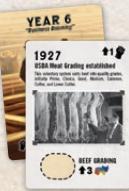
25 PLAYER TRACKERS


FIRST PLAYER TOKEN
ELECTION TOKEN


7 RAILROAD CONNECTION TOKENS

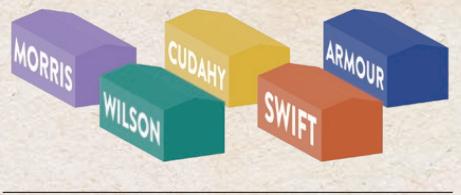
20 BUILDINGS


30 LOW MORALE TOKENS
(Front & Back)
5 SLAUGHTER PLANTS
6 VIADUCTS
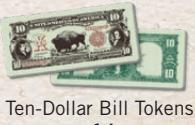
58 MONEY TOKENS


One-Dollar Coins x24

Three-Dollar Coins x20
25 LAND OWNERSHIP CARDS


x5

INTRODUCTION
Opening in 1865, the Union Stockyards became Chicago's largest industry, and one of the city's top tourist attractions – with half a million visitors annually in the early 1900s. From the Civil War through the 1920s, more meat was processed here than anywhere in the world. During its height, 40,000 mostly-immigrant workers labored in "the busiest square mile on earth," where over one million livestock passed monthly, supplying 80% of all U.S. meat. There were over 2,300 livestock pens and 130 miles of railroad within the "Yards."
OVERVIEW
In Union Stockyards you play one of the "Big Five" meat packers, developing technologies to use every part of the animal while battling labor unions and manipulating the market to your advantage. The game is played over 6 Years (rounds), each beginning with a historical event affecting game conditions or adding an additional Action players can take. Actions are selected through worker placement; however, if you don't pay your workers enough, some of them may go on strike! By Slaughtering Livestock (Cattle, Hogs, and Sheep), players earn Cash based on their unique Profit Margins – which can be improved by constructing Buildings, establishing Branch Houses in eastern Markets, and improving your Brand Reputation. But be careful! Demand created by the players for each type of animal will change Livestock costs, affecting everyone's Profit Margins. Will you manage to build the wealthiest meat packing empire in order to win the game? Welcome to the Yards!
GAME OBJECTIVE
After 6 Years (rounds), the winner is the player who has accumulated the most Wealth – a combination of yourCash, Savings, andBonuses. See page 18 for final scoring details.
BOARD SETUP
1
Place the Board in the center of the table on the appropriate side for your player count, as indicated in the lower-right corner. One side is for a 2-player game, and the opposite side is for 3-5 players.
2
Separate the Building Cards into three face-down groups consisting of “A" cards, "B" cards, and "C" cards (indicated by the letter on the back of each card).
• 3-5 Players: You will use all 20 Building Cards
• 2 Players: You will only use 12 Building Cards instead of 20. Keep the 10 cards that show "2P" at the bottom, and also keep 2 additional randomlychosen "C" cards. Return the 8 unused cards to the box. (NOTE: You will use a total of 4 "A" cards, 6 "B" cards, and 2 "C" cards.)
Shuffle each group separately. Place the face-down "B" cards on top of the face-down "A" cards, then place the face-down "C" cards on top of the face-down "B" cards. Finally, flip the entire deck face-up and place it beside the board. The group of "A" cards should now be on top, face-up. Place the top 4 cards face-up on the 4 Building Card offering spaces. In this way, the "A" cards will enter the game first, followed by "B," and then "C."
3
Place the 5 Specialist Cards above the board so each one is visible.
4
Place the Election Token on the Vote space on the board with a randomly chosen side face-up.
5
Packingtown is the large grid of squares where players build Buildings and Viaducts during the game. Mix the 7Railroad Connection Tokens with the train side face-up. Randomly place 1 Token on each of the 7 matchingtrain spaces to the left of Packingtown, then flip the tokens over to reveal the Market icons (图图) on the other side.
6
Sort the 24 Year Cards into 6 face-down piles according to the Year number on the back of each card (there will be 4 cards in each pile). Randomly choose 1 card from each pile, keeping them face-down. Form a deck of these 6 Year Cards in ascending order, with Year 1 on the top and Year 6 on the bottom. Place this 6-card deck to the left of the board. Return the remaining Year Cards to the box without revealing them.

Place the Union Spirit Tracker on the space on the Union Spirit track.
Place the 3 Livestock Price Trackers (Cattle, Hogs, andSheep) in the bottom-left space of their respective price tracks. These 3 Price Trackers will indicate the current Livestock Prices.
Place the appropriate number of starting Livestock )in the Yards according to player count, one animal per Action Space:
| 2-3 PLAYERS | 2 | 2 | 2 |
| 4-5 PLAYERS | 3 | 3一 | 3 |
Beside the board, form a supply of the Money Tokens, known as the "Bank".
Beside the board, form supplies of the Buildings, Viaducts, Low Morale Tokens, and the remaining Cattle, Hogs, and Sheep. Collectively, this will be known as the "general supply."
Remaining steps are continued on the following pages:
PLAYER SETUP (page 6)
FINAL SETUP (page 7)


PLAYER SETUP
12 akes
1 Player Mat
1 Slaughter Plant
5 Land Ownership Cards
13 3
d5 Trackers:Beef,Pork,Lamb,★Brand Rep., Savings
Each player takes the following from the supply: g 1\$ h Low Morale Token
e Branch Houses (according to player count,see table below)
Worers accodn t laye ont eetae below)
| 2-3 PLAYERS | 6円 | 4 |
| 4 PLAYERS | 5円 | 4表 |
| 5 PLAYERS | 4円 | 3表 |
14
Place yourBranch Houses,Workers, andLow Morale Token in the appropriate spaces on your Player Mat. Keep your Cash (Money Tokens) next to your Player Mat in full view of all players, as this is public information. Return any unused Branch Houses and Workers to the box.
In turn order, first player on bottom
EXAMPLE: 5-PLAYER GAME


GAM E Y LLAR Phase I - Start of Year Livestock arrive, quantity depends on Price Flip Year Card , adjust Union Spirit other possible effects ! If Strike: gain 1, lose 1to Picket Line Phase II - Work • Place Workers, one at a time, in turn order Phase III - End of Year Resolve Election : receive First Player Token, choose Party in office Retrieve Workers Adjust Livestock Prices according to inventory
日

BUILD ACTION: Gain Building Card + immediate benefits Place wooden Building, connected to your Plant Pay 1 per square to the Landowner or Bank Gain 1per like-colored adjacent Building Move any adjacent Rail Connections to Markets Possibly gain Specialist Card + immediate benefits Refill the empty Building Card offering space

End-Game Worth =++FinalMargins +★Bonus +(×value) + Card Values -Penalty
Qty. depends on player count; see table above.
FINAL SETUP (See the graphic on pages 4-5 for a 5-player example)
15 The player who most recently ate meat becomes the first player and receives the First Player Token. Turn order will proceed clockwise (to the left) around the table.
16
In turn order, each player places their Savings Tracker on the Savings track. The first player's Tracker will begin on the 1 space, the second player's Tracker will begin on the 2 space, and so on, as indicated on the game board.
17
In turn order, each player places their Brand Reputation Tracker on the 1 space on the Brand Reputation track. 'The first player's Tracker will be at the bottom of the stack, and the last player's Tracker will be on top.
18
Each player places their Meat Value Trackers () on the matching Meat Value tracks as indicated by a on the board: the \$16 space on the Beef Value track, the \$6 space on the Pork Value track, and the \$6 space on the Lamb Value track. (The order of these Trackers is not important.)
19
In reverse turn order, each player now places their Slaughter Plant in the starting location of their choice. The available locations depend on player count (as shown in the graphic to the right).
"They say every Englishman goes to the Chicago stock-yards. You shall find them about six miles from the city; and once having seen them, you will never forget the sight."
- Rudyard Kipling, 1891, in American Notes

Slaughter Plant Starting Locations (Available locations depend on player count)

2 PLAYERS


4 PLAYERS
3 PLAYERS

5 PLAYERS
KEY CONCEPTS
Terminology
• Livestock – farm animals (cattle, hogs, and sheep in this game).
• The Yards – the area of the Union Stockyards where the livestock were located.
• Beef – meat derived from cattle.
• Packingtown – the area beside the Yards where the meat packing plants were located.
• Pork – meat derived from hogs (pigs).
• Lamb – meat derived from sheep (lambs).
Profit Margin from Slaughtering
Your Meat Value (,, )
- Livestock Price(,)
= Profit Margin
The difference between the value you receive for meat (Beef, Pork, Lamb) and the price you pay for that type of Livestock (Cattle, Hogs, Sheep) is your Profit Margin. Livestock prices will be the same for all players, whereas your Meat Values (indicated by the Meat Value Trackers in your player color) may differ among players. Whenever you Slaughter Livestock, you take from the Bank the amount of Cash equal to your Profit Margin. (Or, in the rare event that you choose to Slaughter Livestock when your Margin is negative, you pay that amount to the Bank.)
Important: In order to Slaughter Livestock, you do not need to have Cash to first purchase the Livestock (in the example below, the \$15 for Cattle); you simply receive your Profit Margin from the Bank. In those days, packers often did not pay the farmers until days or weeks after slaughter when they had the cash from selling the meat; therefore, you do not need any Cash on hand in order to Slaughter Livestock.
Profit Margin

Example: Yellow currently has a Profit Margin of +\$4 on Beef (19 minus 15), +\$2 on Pork (11 minus 9), and -\$1 on Lamb (6 minus 7). If Yellow takes the Slaughter Cattle Action, they will gain \$4 Cash from the Bank. (See page 13 for more details on the Slaughter Action.)
Supply and Demand
The meat industry is a very supply-driven market, meaning that the quantity of Livestock available largely determines the Livestock prices. This greatly affects your profitability as a packer. At the end of each Year, Livestock prices will adjust. If there are fewer animals of a given type remaining in the Yards, prices for that animal type will increase. If there are more animals of a given type remaining in the yards, prices for that animal type will decrease. Subsequently, these Livestock prices will affect the quantity of animals the farmers will bring to the yards the following year. If the Livestock price is high for a given animal, more animals of that type will arrive at the yards; if the price is low, fewer animals will arrive. Historical events that may occur during the game could also affect Livestock prices.
Worker Placement
During the game, players take turns selecting and carrying out 1 Action at a time by placing 1 of their Workers onto an Action Space on the game board. Each Worker may take 1 Action per Year (round). Players take turns in clockwise order, placing 1 Worker per turn until all players have placed all of their Workers. At the end of the Year, you will retrieve all of your Workers back to your Player Mat so you can use them again in the following Year.
Savings vs. Cash
Savings is tracked on the Savings track along the edge of the game board. Cash is tracked using the Money Tokens received from the Bank. Both your Savings and Cash count towards your Wealth (final score); however, there is an important distinction: You may never spend your Savings. This means your Savings Tracker can only advance (increase) throughout the game. Instead, you must spend Cash to perform Actions that require money. If you don't have enough Cash to pay for an Action, you may not choose that Action.
End-Game Savings
TheEnd-Game flag icon indicates a bonus amount of Savings that will be added to your total Wealth (final score) at the end of the game. When you see this flag icon, its effects are never immediate. See page 18 for more details about the end of the game and final scoring.
Brand Reputation
Whenever you gain Brand Reputation (usually from the Advertising Action, Building Card effects, or placing Branch Houses in Philadelphia), move your Tracker forward the appropriate number of spaces on the Brand Reputation track. As your Brand Reputation increases, you will pass certain thresholds on the track that will immediately cause one or more of your Meat Values to increase (especially your Beef Value). Several players' Trackers may occupy the same space. If your Brand Reputation Tracker lands on the same space as another player's Tracker, place your Tracker on the top of the stack. At the end of the game, bonuses are awarded to the players with the highest Brand Reputation, with ties broken according to position in the stack (higher position wins the tie). During the game, if you are ever to gain Brand Reputation and your Tracker is already at the maximum value, leave your Tracker at the maximum value but move it to the top of the stack (if applicable).
Minimums and Maximums
Tracks for Livestock Prices, Meat Values, ★ Brand Reputation, and Union Spirit are bound by minimum and maximum values. If an adjustment from a Year Card, Building Card, or other game effect would cause one of these values to go below its minimum or above its maximum, simply stop at the minimum or maximum value respectively. Likewise, the Yards may only hold a maximum number of Livestock, as limited by the number of spaces for each type of animal.
WINNING THE GAME
The player with the most Wealth after 6 Years (rounds) wins the game. Your end-of-game Wealth (final score) is the sum of your: ·血Savings
·Cash
• Final Profit Margins (gain or lose Savings for your Profit Margin on each livestock type)
•Brand Reputation end-game bonus
Branch House values (determined by the number of Railroad Connection Tokens in each city)
•End-Game values on Building Cards and Specialist Cards
• Low Morale Penalty (subtracted from score)
If there is a tie, the player with the highest Brand Reputation is the winner. If still tied, the tied player with the topmost Tracker has the higher Brand Reputation. See page 18 for additional details on final scoring.
Year Cards
ANATOMY OF A CARD


Building Cards

Specialist Cards

Livestock Arrive


Example: Based on the current Livestock Prices (Cattle = 15, Hogs = 9, Sheep = 7), the incoming animals for this Year will be 1 Cattle, 2 Hogs, and 2 Sheep. These incoming animals are taken from the supply and placed into the Yards, one animal per Action Space, regardless of any animals remaining in the Yards from the previous Year. Note that if the Hog Price was 10, three Hogs would be added to the Yards.
Strike
Example:

The Union Spirit has reached 4, causing a Strike. During Phase I, each player places one Worker on the Picket Line and also gains one Low Morale token from the supply, placing it in the designated area on their Player Mat.

PLAYING THE GAME
Union Stockyards is played over 6 Years (rounds) with each Year consisting of 3 Phases, I, II, and III, as shown on your Player Mat. Some individual steps within Phases I and III are also referenced on the Game Board by the letters A, B, C, D, and E. Phase II, the worker placement phase, is the main decisionmaking phase of each Year. Within each Year, all players progress through each of the 3 phases together.
Important: It is critical that the steps outlined on your Player Mat are carried out in the correct order and that no step is omitted. Therefore, it is recommended that one player takes the role of making sure the game is progressing through the phases correctly, to keep the game moving and to avoid errors.
PHASE I - Start of Year
Livestock arrive; quantity depends on Price
- For each type of Livestock (Cattle, Hogs, and Sheep), check the corresponding Livestock Price Tracker on the Game Board. The number of incoming animals is shown along the left edge of each Price track.
Example: On the 3-5 Player side of the board, you will add
+1 Cattle () to the Yards if theCattle Price is \$14 or \$15, or
+2 Cattle () to the Yards if the Cattle Price is \$16 to \$19, or
+3 Cattle () to the Yards if theCattle Price is \$20 or greater.
- From the supply, place the appropriate number of incoming Cattle, Hogs, and Sheep into the Yards, one animal per space. These incoming animals will add to any animals already present (from game setup or from the previous year).
Example: A 3-player game will begin with 3 of each Livestock type for Year 1 (2 of each type from game setup, plus 1 of each type from this step).
Flip Year Card , adjust Union Spirit, other possible effects
-
Flip the top Year Card from the deck and place it face-up on the designated space on the Board.
The first player should read aloud the year, event, and historical details for all players. -
Adjust the Union Spirit Marker on the Union Spirit track as indicated in the upper-right corner of the Year Card.
Note: Some Year Cards have an Action Space on the card. This provides an additional Action that is only available during this Year. Other Year Cards have an ! Event icon with an immediate effect that must be applied. Detailed explanations of all these Actions and Event effects can be found on the back cover of this Rulebook.
If Strike: gain 1, lose 1to Picket Line
-
If the Union Spirit is 3 or less, skip ahead to Phase II.
-
If the Union Spirit is 4 or 5, the union has called for a Strike and the following steps occur:
a. All players gain 1 Low Morale Token from the supply, and...
b. All players lose 1Worker to thePicket Line for this Year.
Note: The Union Spirit does not automatically lower when a Strike occurs. If there is a Strike and the players do nothing to address Union Spirit, another Strike will occur the following year.
PHASE II - Work
Place Workers, one at a time, in turn order
On your turn (beginning with the First Player and continuing clockwise around the table) you will place 1Worker from your Player Mat on an available Action Space, pay any applicable cost, and then immediately carry out the corresponding Action. You will continue taking turns, placing one Worker per turn, until all players have no remaining Workers to place. Remember:
• A player may use each Worker only once per Year.
• A player must place exactly 1 Worker per turn.
• You may not place a Worker at an Action Space without performing its complete Action.
Note: If your Action would cause a tracker to exceed the minimum or maximum on a track, you may still take that Action; however, trackers can never extend beyond the limits of the track.
There are various Action Spaces where you can place Workers:

Most Action Spaces are small ovals. Each of these may hold at most 1 Worker. In other words, if the space is already occupied – whether by another player's Worker or by one of your own – then it is blocked and you may not place a Worker there. This means the number of available Action Spaces will diminish throughout the Year.

Two Action Spaces are long ovals: Build Viaduct and Contract Work. There are no restrictions on how many players or how many Workers may occupy these spaces. In other words, they can never be blocked.
The Action Spaces in the Yards (the Slaughter Action) have special rules:

• Important: Each player may only Slaughter each Livestock type (Cattle, Hogs, Sheep) once per Year. For example, if you already have a Worker in the Cattle Yards because you have already slaughtered Cattle this Year, you may not Slaughter Cattle again this Year - but
you may still Slaughter Hogs or Sheep if you have not already done so this Year.
CATTLE ! PLAPER
• You may only place a Worker where there is an animal present. For example, if there are no Cattle in the Yards, then the Slaughter Cattle Action is not available. In the example to the left, only the top two Action Spaces are available – so up to two different players (other than Blue) may take the Slaughter Cattle Action this Year. Blue already took this Action earlier in the Year and may not do so again.
-
If an Action Space has a cost printed in red within the oval, you must pay this cost from your Cash supply to the Bank when you place your Worker there. If you do not have enough Cash to pay for the cost of an Action Space, you cannot place a Worker there and you must choose a different Action.
-
Immediately perform the associated Action. For detailed explanations of all Actions, see pages 13-17.
- Only after all players have placed all available Workers, proceed to Phase III.
"Hog Butcher for the World." - Carl Sandburg, 1914, in his poem "Chicago"
Workers at the Union Stock Yards


Resolve Election
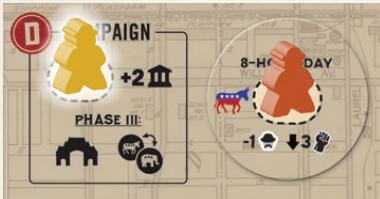
Example: The yellow player has taken the Campaign Action. During Phase III, they will receive the First Player Token and choose the Party in office. In this case, Yellow may choose to leave the Democrat side up, or flip the Election Token to the Republican side. Note that Yellow has already received +2 Savings at the moment they placed their worker on the Campaign Action Space.
Adjust Livestock Prices
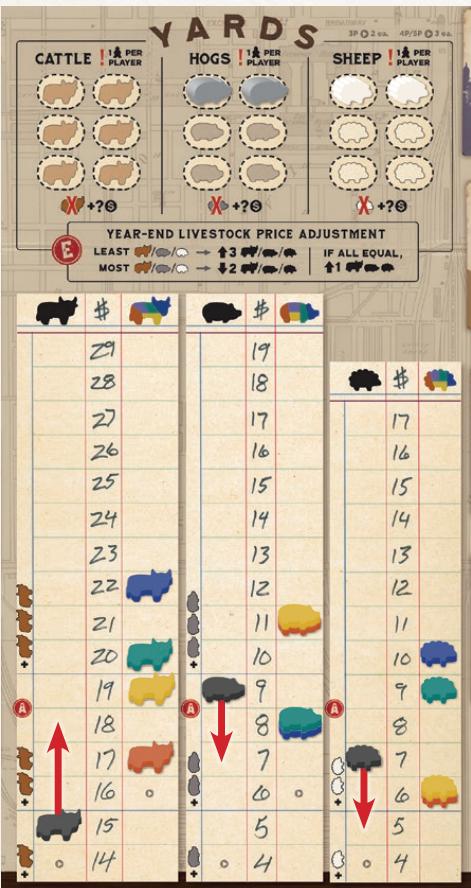
Example A: Of the animals remaining in the Yards during Phase III, there are fewest Cattle (0), causing the Cattle Price Tracker to be raised by 3 spaces. Hogs and Sheep are tied for the most (2 each), causing both the Hog Price Tracker and the Sheep Price Tracker to be lowered by 2 spaces.
PHASE III – End of Year

Resolve Election : receive First Player Token, choose Party in office
-
If there is no Worker on the Campaign Action Space, the current political Party remains in office and you will skip ahead to "Retrieve Workers."
-
The player who placed a Worker on the Campaign Action Space will:
• Receive the First Player Token and become the first player for the next Year.
• Decide which political Party wins the election and place that side of the Election Token face-up for the upcoming year. This Party is "in office."
Note: When the Democratic Party is in office, an Action Space for the 8-Hour Day Action will be available. When the Republican Party is in office, an Action Space for the Establish 2 Branches Action will be available.
Retrieve Workers
All players retrieve all their Workers from the Game Board back to their Player Mats, including any Strikers from the Picket Line.
Adjust Livestock prices according to inventory

- Adjust Livestock prices based on the relative number (quantity) of animals remaining in the Yards. The Livestock type(s) with the fewest animals remaining have their Price Tracker(s) raised by 3 spaces, and the Livestock type(s) with the most animals remaining have their Price Tracker(s) lowered by 2 spaces.
• If all 3 Livestock types have an equal number of animals, all 3 Livestock Price Trackers are raised by 1 space each.
• If 2 Livestock types are tied for the fewest or most animals, then both animal types receive the appropriate price adjustment.
• If there are no ties (i.e., there is a most, a fewest, and an intermediate quantity), then the intermediate does not receive a price adjustment.
- Gameplay returns to Phase I for the start of the next Year.


Example B: In this case, Hogs have the fewest animals in the Yards, causing the Hog Price Tracker to be raised by 3 spaces. Cattle have the most animals, causing the Cattle Price Tracker to be lowered by 2 spaces. Sheep have neither the most nor the fewest, so the Sheep Price Tracker will not move.
Example C: In this case, the quantity remaining of all 3 Livestock types are equal, causing all 3 Livestock Price Trackers to be raised by 1 space each.
ACTION SPACES
Slaughter Cattle / Hogs / Sheep
Place your Worker on an ) Action Space in the Yards with an animal in it. Remove that animal and return it to the general supply, then receive Cash from the Bank equal to your Profit Margin (Meat Value minus Livestock Price).
Important: Each player may only Slaughter each Livestock type (,,) once per Year. In other words, each player may Slaughter up to 3 animals per year, but they must be different types of animals.
Note: Typically, you will not want to Slaughter Livestock if you have a negative Profit Margin (when your Meat Value is less than the Livestock Price). If you do Slaughter Livestock with a negative Margin, you must pay the negative Margin to the Bank.
Buy Land
Pay the designated cost to the Bank (at the start of the game, all the land in Packingtown is owned by the Bank). Then place one of your Land Ownership Cards in an any viable area within Packingtown so it aligns with thegrid printed on the board. Viable areas for land purchases are:
• Completely within the borders of the Packingtown grid, and
• Completely empty land, with no squares occupied by any Building or Viaduct, nor covered by another Land Ownership Card.
Note: You can buy any viable area of land. Unlike Buildings, your Land Ownership Cards do not have to form a connection with your Slaughter Plant.
Important: Your Land Ownership Card does not block your opponents from Building in that location! Other players will still be able to place Buildings on top of your land; however, when doing so they must purchase that land by paying you \$1 for each square of your land occupied by the new Building. (See the Build Action and examples on pages 14-15 for more details.)
You may not perform the Buy Land Action if:
• You cannot afford to pay the cost
• There are no viable land areas available to accommodate a Land Ownership Card
· You have no Land Ownership Cards remaining
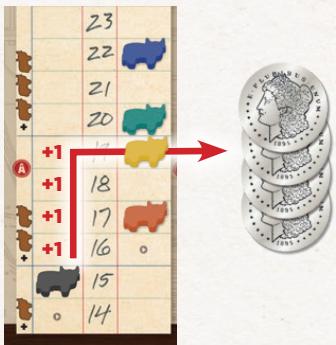
Example: Yellow chooses to take the Slaughter Cattle Action and places a Worker on an Action Space in the Yards containing a Cattle token. The Cattle token is returned to the supply, and Yellow receives \$4 Cash from the Bank because Yellow's current Profit Margin for Cattle is \$4 (19 minus 15). Note that Yellow does not need to have any Cash on hand prior to taking the Slaughter Action.
Slaughter Cattle/Hogs/Sheep


Buy Land

Example: The yellow player decides to place a Worker on the Buy Land Action Space. They pay the Action Space cost and place one of their Land Cards in an empty area of Packingtown. Note that the area they choose does not need to be connected (or adjacent) to anything.
Build

Example A continued:
Blue decides to place the Building mostly on Yellow's Land Card because they want the adjacency bonuses and the "wild" Railroad Connection. This placement is allowed because it connects back through other buildings to their blue Slaughter Plant. Blue pays \$4 to Yellow and \$1 to the Bank for the five squares of land now occupied by the new Building. Blue gains2Pork Value from the Hair Factory card. Blues also gains +2 Savings because the new Building is immediately adjacent to 2 likecolored Buildings. According to the Hair Factory card, Blue will also gain +4Savings at the end of the game.
Build
The Build Action is the most complex Action in the game, and is therefore summarized on your Player Mat for reference. When taking the Build Action, choose one of the available Building Cards from the four Building Card offering spaces (the top card of the Building Card Deck is not yet available, but is a preview of the next Building Card that will become available) and complete the following steps in order:
-
Place the Building Card in your player area next to your Player Mat. From the general supply, take the wooden Building of the shape and color depicted in the upper-right corner of the card.
-
Place the wooden Building in a viable area within Packingtown so that it aligns with thegrid printed on the board. Viable areas for a Building are:
• Completely within the borders of the Packingtown grid, and
• Connected to your Slaughter Plant – either directly, or indirectly through any number of other Buildings (regardless of who placed those Buildings). Connections must be through adjacent Building sections or Viaducts. Meat is transported by large wheelbarrows or carts from your Slaughter Plant through these Buildings and/or Viaducts to your new Building.
Important: "Adjacent" always means orthogonally adjacent (diagonal does not count as adjacent). Buildings touching diagonally at the corners are not adjacent. Note: Opponents' Slaughter Plants count as Buildings.

The new Building was placed adjacent to two Railroad Connection Tokens, so Blue has made two new Railroad Connections. Blue must move thePhiladelphia token to its designated space in the Philadelphia Market, even though it currently only benefits Blue's opponents. Blue may choose which market to place the "wild" token in, and Blue chooses Brooklyn because Blue has two Branch Houses in Brooklyn. These tokens are flipped train-side up. These Railroad Connection Tokens provide no immediate benefit but will increase the value of the Branch Houses in their respective markets at game-end. Finally, Blue refills the empty Building Card offering space with the top card from the Building Card deck.
- Check to see who owns eachsquare of land occupied by your new Building: • For eachsquare that is not part of a Land Ownership Card, pay \$1 to the Bank.
• For eachsquare that is part of another player's Land Ownership Card, pay \$1 to that player. (You may need to pay several different players during a single Build Action.)
• For anysquare that is part of your own Land Ownership Card, there is no cost (you already own this land).
Note: It is possible to perform the Build Action for fre if your Building only occupies spaces on your own Land Ownership Card(s).
-
For each existing Building that is immediately adjacent to your new Building and the same color as your new Building, receive an "Efficiency Bonus" of +1 Savings. This represents operational efficiency; for example, placing all pork Buildings adjacent to one another would reduce product movement costs.
-
If your new Building is adjacent to anyRailroad Connection Tokens, you must move all adjacent Tokens to their appropriate Market(s). Starshaped Railroad Connections are "wild" and may be placed in any available wild Market space – in other words, each Market can have at most one wild token. When moving a Railroad Connection Token (.)into a Market, flip the Token so its train side is face-up.
-
Resolve the immediate effects of the Building Card by adjusting your Tracker(s) on the appropriate track or tracks ( Meat Values and/orBrand Reputation). Remember, End-Game values (shown in the lower-right) are never gained immediately.
-
Check all of your Building Cards (in the lower-left corner) to see if you now have the number and type of icons necessary to obtain a Specialist Card. If you do, take the Specialist Card and resolve its immediate effects by adjusting your Tracker(s) on the appropriate track(s). Remember, End-Game values (shown in the lower-right) are never gained immediately.
-
Refill the empty Building Card offering space with the top face-up card from the Building Card deck. This will also reveal a new Building Card on the top of the deck as a preview of what's coming next.
Important: You cannot construct a Building if you cannot afford the land cost or if there is no viable area to accommodate the size and shape of the Building.


Example B:
The yellow player places their worker on a Build Action Space because they want to build the Canning Factory. They take the Canning Factory card and the wooden Building of the corresponding shape and color.
Yellow places the wooden Building on 2 squares of their own land and 2 squares of Bank land. Yellow pays \$2 to the Bank for the 2 squares of land (Yellow pays nothing for building on their own land). Yellow gains 1Beef Value and1Lamb Value from the Canning Factory card. The new building is not adjacent to any like-colored buildings, so Yellow gains no adjacency Savings bonus.
Because Yellow had previously built the Curing Room, they now have both "can" icons. Yellow now gains the Canned Ham Specialist Card and immediately gains the card's benefit of 1Pork Value.
Advertise

Example: Blue places a Worker on the free Chicago Advertising Action Space and gains +1★Brand Reputation, moving their Brand Reputation Tracker 1 spot higher on the track. Because their Tracker crossed a bonus arrow, Blue gains 2 Beef Value and adjusts their Beef Value Tracker accordingly. If the game were to end after this turn, Green would gain +9 Savings for 1st place, Blue would gain +6 Savings for 2nd place, and Yellow would gain +3 Savings for 3rd place. Even though Yellow and Orange are tied in Brand Reputation, Yellow wins the tie breaker because their Tracker is on top.
Establish Branch House

Advertise
There are 2 different Advertise Actions:
National Advertising: Pay \$2 to the Bank, then move your Brand Reputation Tracker ahead 2 spaces on the Brand Reputation track.
• Chicago Advertising: Move your Brand Reputation Tracker ahead 1 space on the Brand Reputation track.
If you pass a designated threshold on the Brand Reputation track corresponding to any Meat Value increases, adjust yourMeat Value Trackers accordingly.
Establish Branch House
Pay \$1 to the Bank. Take a Branch House from your Player Mat and place it on any available Branch House space in one of the 5 Markets along the right edge of the board: Boston, Bronx, Manhattan, Brooklyn, or Philadelphia. Immediately gain the benefit shown at the bottom-right of that Market. Note that higherpopulation Markets have more spaces available for Branch Houses.
You are permitted to have multiple Branch Houses in a given Market. The same player may even occupy all spaces in a given Market.
Wage Increase
Pay \$2 to the Bank, discard 1Low Morale Token from your Player Mat to the general supply, and lower theUnion Spirit Marker by 2 spaces.
Establish 2 Branches
(only available when the Republican Party is in office)
Pay \$3 to the Bank. Establish 2 Branch Houses according to the normal rules above for the Establish Branch House Action. The 2 Branch Houses may be placed in the same or different Markets.
8-Hour Day(only available when the Democratic Party is in office)
Discard 1Low Morale Token from your Player Mat to the general supply and lower the Union Spirit Marker by 3 spaces.

Example: Green decides to establish a Branch House in Brooklyn, places their Worker on the Establish Branch House Action Space, and pays \$1 to the Bank. Green places a Branch House in the last available space in Brooklyn and gains the immediate reward of 1Lamb Value. If the game were to end in the current state, Branch Houses in Bronx and Brooklyn would be worth +4Savings each (for 2 Railroad Connections), Branch Houses in Boston and Philadelphia would be worth +2Savings each (for 1 Railroad Connection), and the green Branch House in Manhattan would be worth +0 Savings because Manhattan has no Railroad Connections.

Campaign
When you place a Worker on the Campaign Action Space, gain +2 Savings immediately. The remaining benefits are received when the Election is resolved during Phase III. See page 12 for details on resolving the Election during Phase III.
Build Viaduct
-
Take a woodenViaduct from the supply and place it on a viablesquare within Packingtown. See step 2 of the Build Action on page 14 for details on what constitutes "viable" land.
-
Carry out steps 3 and 5 of the Build Action (pay the land owner and check for adjacent Railroad Connections), as described in detail on page 15. Note that step 4 is skipped; there is no like-colored bonus for building adjacent Viaducts.
Note: The primary reasons to build a Viaduct are to either provide an "adjacency route" (path of connected Buildings) to an area in order to build a different Building in the future, or to reach a Railroad Connection Token.
Contract Work
Receive \$1 from the Bank.
Note: You are hiring out your Worker to another Chicago business. You probably only want to do this as a last resort, if you have no better options or if you really need Cash and your Slaughter Margins are less than \$2.
Year Card
Some Year Cards feature an Action Space that will only be available during that Year. All of these Actions are explained in detail on the back cover of this Rulebook.
"There were sleek beeves from Kansas feed-lots, meal-fed steers from Texas, hay-fed cattle from Montana, portly porkers in profusion from every nook and cranny of the corn belt, and an army of whitefaced lambs of New Mexican origin, but made fit for the butcher on the fat lands of Colorado. And over in Packingtown 25,000 workers were waiting impatiently for the slaughter of this lowing, squealing, bleating host, for within a few brief hours 100,000 animal careers would be terminated to satisfy the hunger of the civilized world."
- James E. Poole
"A Day at the Union Stock Yards" in the July 1907 issue of Chicago: The Great Central Market Magazine
Build Viaduct

Example: Blue decides to build a Viaduct in order to make a Railroad Connection to Brooklyn. Blue places their worker on the Build Viaduct Action Space, pays \$1 to the Bank for the 1 square of land required, and places the wooden Viaduct next to an existing building. Blue is allowed to place the Viaduct here because it connects back to the Blue Slaughter Plant through other existing Buildings. Blue then take the Railroad Connection Token, flips it to the train side, and places it in the corresponding space in the Brooklyn market.

GAME-END & FINAL SCORING
The game ends following the conclusion of Year 6. It is recommended that each player's Wealth be tallied using their Savings Tracker on the Savings track, adding the totals from each scoring category below, one at a time. The sum of the following constitutes each player's final Wealth:
·血Savings
• Cash – Tally all your Money Tokens, then discard them and add their value to yourSavings.
• FinalMargins – Each player gains (or loses)Savings for each of their 3 Profit Margins (Beef, Pork, and Lamb) as if you were Slaughtering one more animal of each type. This step is always performed by all players for all animal types – even if there are no animals available in the Yards, and even if the Slaughter Action was already performed during Year 6.
• ★ Brand Reputation Bonus
» 3-5 players: The player with the highest Brand Reputation receives 9血, second-highest receives 6血, and third receives 3血
» 2 players: The player with the highest Brand Reputation receives 5.
Note: If tied, the higher Tracker in the stack is considered to have the higher Brand Reputation.
Branch House Values – The value of each Branch House depends on how manyRailroad Connection Tokens are present in that Market:
Markets with 2Railroad Connections: Each Branch House here is worth +4 to its owner
Markets with 1Railroad Connection: Each Branch House here is worth +2 to its owner
Markets with Railroad Connections: Any Branch House here is worth +0 to its owner
End-Game Card Values – Gain the Savings value shown after the End-Game icon in the lower-right of each of your Building Cards and Specialist Cards.
Low Morale Penalty - Consult the Low Morale Penalty table on your Player Mat and subtract the appropriate Savings penalty corresponding to the number of your remainingLow Morale Tokens.
The player with the highest overall Wealth is the winner! If there is a tie, the player with the highest Brand Reputation is the winner.
If tied in Brand Reputation, the higherTracker in the stack is the winner.
WOMEN IN THE MEAT INDUSTRY
Our desire is that Union Stockyards be enjoyed by both women and men. The founders of the "Big Five" packers were all males, as shown on the Player Mats. This game is based on the history of the Union Stockyards around the turn of the twentieth century, and meat industry leadership was male-dominated during that time. Although still underrepresented today, the influence of women in the meat industry has grown immensely since the days of the Union Stockyards. Today, women leaders in the meat industry have their own association (meatbusinesswomen.org). In 2021, women made up 50% of the graduate student membership in the American Meat Science Association. A few examples of the many meat industry women leaders include:
• Rachel Cullen, president and CEO of Ruiz Foods
• Dr. Temple Grandin, designer of livestock handling systems and humane handling auditing systems used in the majority of U.S. meat packing plants today
• Collette Kaster, Vice President at Premium Standard Farms, Farmland Foods, and Smithfield Foods, and CEO of the American Meat Science Association • Denise Morrison, president and CEO of Campbell Soup Company
• Rosemary Mucklow, 50 years of meat industry leadership, including Executive Director of the Pacific Coast Meat Association, Western States Meat Association, and National Meat Association.
• Shelly Stayer, chairwomen and owner of Johnsonville Sausage


HINTS
• Remember that you are a meat packer. In a typical game, much of your Wealth will be made by slaughtering Livestock. You may choose to Slaughter Livestock:
» Because you need Cash
» To manipulate the market
» Because your Profit Margin is good (after all, the goal is to make the most money!)
• There will probably be fewer Sheep available during the game compared to Cattle and Hogs. Having a high Profit Margin in Lamb is beneficial, but you may only profit from it a few times during the game.
• It does not benefit you to make a Railroad Connection if you do not have any Branch Houses in the corresponding Market. In fact, for this reason you may want to place Buildings in a manner that makes it more difficult for others to connect a railroad.
LEGACY OF THE UNION STOCKYARDS
This game is based on the history of the Union Stockyards. Some undesirable practices occurred here, including dangerous working conditions, pollution, and unsanitary food production, especially during the early years of Packingtown. However, the Stockyards played an integral part in many societal advancements, including the eight-hour workday, modernized food inspection, and technology advancements in food safety, food canning, antibacterial soap, and refrigeration. This game is intended to neither glamorize nor demonize this unique piece of history.
LITERATURE REFERENCES
In the pursuit of historical accuracy, several sources were consulted during game development, including:
Fower, B.B. (1952). Men, Meat and Miracles. Messner, New York.
Grand, W.J. (1901). Illustrated History of the Union Stockyards: Sketchbook of Familiar Faces and Places at the Yards. Thos. Knapp.
Horowitz, R. (2005). Putting Meat on the American Table: Taste, Technology, Transformation. The John Hopkins University Press, Baltimore.
Ogle, M. (2013). In Meat We Trust: An Unexpected History of Carnivore America. Houghton Mifflin Harcourt.
Pacyga, D.A. (2018). Slaughterhouse: Chicago's Union Stock Yard and the World it Made. University of Chicago Press, Chicago.
Reynolds, J.B., and C.P. Neill (1906). Conditions in Chicago Stock Yards: Message from the President of the United States. 59th Congress, U.S. House of Representatives, Document No. 873.
Sinclair, U. (1906). The Jungle. Doubleday, New York City.
Spivey, S. (2017). From Chicago to Louisville: The History of the National Intercollegiate Livestock Judging Contest. North American International Livestock Exposition, Louisville.
Wade, L.C. (2002). Chicago's Pride: The Stockyards Packingtown, and Environs in the Nineteenth Century. University of Illinois Press, Champaign.
Wilding Darst, S., editor (2013). Saddle & Sirloin Portrait Collection Guidebook. Kentucky State Fair Board, Louisville.
Game Design: Duane Wulf Cover Art: Andrew Bosley
CREDITS
Graphic Design: Jason Vulk, Joe Weber Game Development & Rulebook Editing: Joe Weber
Rulebook Proofreading: Jonathan Cox Prototyping: Jon Hasbrouck
A huge thank-you to each of the numerous playtesters that helped improve Union Stockyards through countless design iterations.
Copyright © 2022 Solid Rock Games LLC, 11058 E Roscommon Pl, Tucson, AZ 85747 All rights reserved. No part of this product may be reproduced without specific permission.
YEAR CARD REFERENCE
Year Card Actions and Events – Some Year Cards feature an ) Action Space that will only be available during that Year. Other Year Cards feature an Event icon with immediate effects that will impact the game in various ways. All of these Actions and Event effects are explained below.
YEAR 1
1883 SUPPLIER CONTRACT - Raise your Pork Value Tracker by1 space.
1886 SPREAD RUMORS – Each player, except the player who chose this Action, gains 1Low Morale Token to their Player Mat.
1887 – Remove 2 Cattle () from the Yards and return them to the general supply.
1889 ( ASSIST HULL HOUSE – Discard 1 Low Morale Token from your Player Mat to the general supply.
YEAR 2
1892 () REDUCE WAGES – Receive \$5 from the Bank and gain 1 Low Morale Token to your Player Mat.
1893 ) FAIR EXHIBIT – Pay \$1 to the Bank, then move your ★ Brand Reputation Tracker ahead 2 spaces on the Brand Reputation Track.
1894- Raise all Livestock Price Trackers () by1 space each.
1898 FUTURES TRADING – Pay \$1 to the Bank, then receive Cash from the Bank equal to your Profit Margin (Meat Value minus Livestock Price) for the animal type of your choice. Do not remove an animal (//) from the Yards. In fact, you may even do this if there are no animals in the Yards. You are not Slaughtering an animal; you are earning this money on the futures market. You may still Slaughter this animal type this Year as normal.
YEAR 3
1900- Add 1 animal of each Livestock type () to the Yards. If a Livestock type is already at maximum capacity, do not add an animal of that type.
1902 BEEF TRUST – Raise your Beef Value Tracker by3 spaces. All other players raise their Beef Value Trackers by 1 space.
1904 ) HIRE STRIKEBREAKER - Pay \$1 to the Bank. At the end of Phase II, retrieve your striking Worker from the Picket Line, and also retrieve yourWorker from this Action Space. You will now place these 2 Workers consecutively, subject to the normal placement rules, to perform the final 2 Actions of the Year. NOTE: You are effectively trading away one Action during the round in order to perform two consecutive Actions at the end of the round, after all other players have finished placing all of their Workers. If a Strike did not occur this Year, this Action is useless.
1906 – Move each player's Brand Reputation Tracker back 1 space. If any Trackers are stacked in the same position, retain their order within the stack. If your Tracker crosses backward over a line that previously provided benefits, lose those benefits by decreasing your Meat Value Tracker(s). You can gain these benefits again if you gain Brand Reputation in the future.
YEAR 4
1907 – Move each player's Brand Reputation Tracker ahead 1 space. If any Trackers are stacked in the same position, retain their order within the stack. If your Tracker crosses over a line that gains benefits, immediately gain those benefits by raising your Meat Value Tracker(s).
1908 HOT DOG SALES - Raise your Beef Value Tracker by 2 spaces. If you have the Sausage Kitchen (Building Card) at the time you take this Action, raise yourBeef Value Tracker by 3 spaces instead.
1910– Raise all Livestock Price Trackers () by1 space each.
1912 ) ESTABLISH 2 BRANCH HOUSES in Brooklyn and/or Bronx (gaining as usual) - Pay \$2 to the Bank to Establish exactly 2 Branch Houses. These 2 Branch Houses must be placed both in Brooklyn, or both in Bronx, or 1 in Brooklyn and 1 in Bronx. Gain the immediate benefit for each Branch House. IMPORTANT: You may not use this Action to establish only 1 Branch House. Therefore, if there are fewer than 2 available Branch House spaces between Brooklyn and Bronx (combined), you may not perform this Action.
YEAR 5
1914 – Raise all Livestock Price Trackers () by 1 space each.
1917 ARMY CONTRACT – Raise your Beef Value Tracker by 1 space and raise your Pork Value Tracker by 1 space. If you have the Canning Factory (Building Card) at the time you take this Action, raise yourBeef Value Tracker by an additional 1 space.
1918 – All players lose 1Worker for this Year only. Lay this Worker down on the Year Card to indicate that it is not available to use. If there is also a Strike, you will have a total of 2 fewer Workers this Year. At the end of the Year, retrieve the laid-down Worker to your Player Mat.
1919 – All players lose 1Worker for this year only. Lay this Worker down on the Year Card to indicate that it is not available to use. If there is also a Strike, you will have a total of 2 fewer Workers this Year. At the end of the Year, retrieve the laid-down Worker to your Player Mat.
YEAR 6
1921– Raise all Livestock Price Trackers () by 1 space each.
1922 PROMOTION - Pay \$1 to the Bank, then move your ★ Brand Reputation Tracker ahead 2 spaces on the Brand Reputation track.
1926 () SUPPORT STUDENTS – Pay \$1 to the Bank, then discard 1 Low Morale token from your Player Mat to the general supply.
1927 BEEF GRADING – Raise your Beef Value Tracker by 3 spaces.
下载 Markdown