rules_zh_夺心魔虫初次照面_30952.md
規則參考
觸發時機
打出:當卡牌進場時觸發。若你的對手使用奪心蟲,則由他們生效打出效果,而非你。
攻擊:當卡牌進行攻擊時,且在對手決定是否進行阻擋前觸發。
陣亡:當卡牌從在場卡牌區域被移至棄牌堆時觸發。
關鍵詞
狂暴:若本卡牌在一回合的第一次進攻中存活,則它可以在這個回合中進行第二次攻擊。
獵殺:當你使用具有獵殺關鍵詞的生物進行攻擊時,你可以選擇一個敵方生物來進行阻擋。
劇毒:除正常的戰鬥結算外,本生物始終會擊殺敵方生物,即使該生物的力量值小於敵方生物。
隱匿:本生物僅能被具有隱匿關鍵詞的生物阻擋。
堅韌:若本卡牌將要陣亡且未被橫置,則將其橫置,而非擊殺它。
規則書

“汝現在屈從於吾輩掌控,地球人!汝將作為吾之選民,號令吾之造物前往對抗吾之遠古宿敵。”
奪心魔蟲遊戲規則
遊戲概述
在《奪心魔蟲》中,你將召喚混合獸生物並派遣它們與你對手的生物作戰。但當你召喚生物時要小心:你的對手可能會使用他們的一只奪心蟲來控制它。在一場驚心動魄的戰術對決中智取對手,時刻謹記在錯誤的時機打出最強的卡牌對你來說很可能是致命的!

遊戲配件
《奪心魔蟲》包含以下遊戲配件:
48張生物卡牌

2個生命輪盤

規則書

4張奪心蟲卡牌


核心概念
結算效果:
當結算效果時, 總是盡可能多地結算你能結算的效果, 並忽略所有不能結算的能力部分。
示例:若一個效果要求你棄除兩張卡牌,但你的手牌中僅有一張卡牌,則你棄除那張卡牌並忽略此效果中要求的第二張卡牌。
同時發生的效果:
如果多個效果同時發生(例如,當兩個生物同時陣亡時),由當前玩家決定它們的結算順序。

遊戲設置
步驟1:分發奪心蟲卡牌
給每位玩家分發2張奪心蟲卡牌,並將它們牌面朝上放置在各自面前。
步驟2: 洗混牌庫並分發卡牌
將48張生物卡牌洗混,並向每位玩家分發10張牌面朝下的卡牌作為他們各自的抽牌堆。在抽牌堆旁預留一些空間作為棄牌堆。
步驟3:抽取手牌
每位玩家從自己在步驟2中所創建的個人抽牌堆中抽取5張卡牌作為他們的起始手牌。
步驟4:設置初始生命
每位玩家以3點生命開始遊戲。每位玩家拿取一個生命輪盤。來記錄自己的生命,並將其設置為3。
注意:你也可以使用骰子、標記或三張未使用的卡牌來記錄自己的生命。

設置
玩家1的在場卡牌區域(即打出卡牌的區域)
遊戲流程
遊戲目標
當對手的生命降至0點時,你立即贏得遊戲勝利。
生命
你的初始生命為3點。每當你失去生命時,在你的生命輪盤上減少相應的數字。每當你獲得生命時,在你的生命輪盤上增加相應的數字。你的生命沒有上限。
生物卡牌
每張卡牌代表一個具有名稱和力量值的生物。卡牌可以擁有一個或多個關鍵詞(名稱下方的第一行)以及能力(關鍵詞下方的文本)
力量值

抽取卡牌
每當你的手牌數量小於5張時,你立即從你的抽牌堆中抽取卡牌,直至你有5張手牌。在任何其它效果結算前先執行此動作(例如,在卡牌被奪心蟲控制或其打出效果被觸發前)。若你的抽牌堆已耗盡,則你不再抽取額外的卡牌。你的手牌數量沒有上限。
輪流進行回合
每位玩家從未使用的牌堆中(剩餘28張未分發給玩家的生物卡牌)隨機展示一張卡牌,用以決定起始玩家。比較這些卡牌的力量值,數字較大的玩家成為起始玩家。(若為平局,則重複該過程)。
玩家輪流進行回合。在你的每個回合中,你必須執行以下行動中的一個。如果你無法執行任何行動,則你遊戲失敗。
1. 打出一張卡牌,
或者
- 用一個生物進行攻擊
打出一張卡牌
從你的手牌中挑選任意一張卡牌,並將其牌面朝上放置在桌子上。現在,你的對手有兩個選擇:
選擇1:你的對手拒絕使用奪心蟲
每當你從手牌中打出一張卡牌時,你的對手可以使用其自己的一個奪心蟲來控制該卡牌。若他沒有剩餘的奪心蟲或拒絕使用奪心蟲,則繼續將打出的生物卡牌放入你的在場卡牌區域並結算其打出效果(若有)。然後結束你的回合。接著,你的對手開始行動。
選擇2:你的對手使用奪心蟲
如果你的對手決定使用奪心蟲,則他會代替你打出該卡牌,並失去一張奪心蟲。將奪心蟲翻轉至牌面朝下以表明它已被使用,並將該生物卡牌放入他的在場卡牌區域。
由對手結算該生物的任何打出效果,如同是從他的手牌中打出。
然後結束你的回合並立即進行另一個回合(允許你打出一張卡牌或使用一個生物進行攻擊)。
注意:如果一張卡牌以其它方式進場,而非從手牌中打出進場(例如使用一張卡牌效果),則無法選擇使用奪心蟲來控制它。
注意:你不能使用奪心蟲來控制一張已經在場的卡牌。你也不能使用奪心蟲來控制一張已被你對手使用奪心蟲控制的卡牌。
示例:愛麗絲從她的手牌中打出螓螓醫師,然後抽取卡牌直至擁有5張手牌。鮑勃還剩餘兩張奪心蟲。他選擇使用一張並將螓螓醫師放入他的在場卡牌區域並激活其打出能力(獲得2點生命)。愛麗絲現在結束她的回合,然後立即開始新的一回合。她打出怪異木桶,然後抽取卡牌直至擁有5張手牌。鮑勃還剩餘一張奪心蟲且他可以使用它來奪取怪異木桶。但是他選擇保留他的奪心蟲,然後愛麗絲將怪異木桶放入她的在場卡牌區域。
使用一個生物進行攻擊
選擇你在場的一個生物(己方生物)進行攻擊。你的對手現在可以選擇他在場的一個生物(敵方生物)來阻擋攻擊。若他決定不進行阻擋,則他失去1點生命。若他阻擋攻擊,則力量值較低的生物陣亡,並將其放入該玩家的棄牌堆。
若它們的力量值相同,則兩個生物都將陣亡。
示例:愛麗絲使用力量值為10點的獅猩猩進行攻擊。鮑勃有一張力量值為8點的蜂熊在場。他可以使用蜂熊進行阻擋。在這種情況下,他不會失去生命,但他的蜂熊將陣亡並被放入他的棄牌堆。反之,若他選擇不阻擋攻擊,則會導致他失去1點生命。

關鍵詞
生物卡牌可以擁有一個或多個關鍵詞。關鍵詞是一個可以作為解釋卡牌功能規則文本的縮略詞語。
狂暴:在一回合中,本生物的第一次攻擊後,它可以(若依然在場)在本回合進行第二次攻擊。
玩家1使用吉他
摔角牛頭怪進行
攻擊吉他摔角牛頭怪可以進行第二次攻擊,因為它具有狂暴關鍵詞且在第一次進攻中存活
長牙敲詐者因其力量值較低而陣亡並被放入棄牌堆
玩家2選擇長牙敲
詐者進行阻擋
玩家2失去1點生命,因為他沒有任何生物可進行阻擋
獵殺:當你使用獵殺生物進行攻擊時,你可以代替你的對手選擇一個敵方生物來進行阻擋。
注意:你允許選擇一個原本無法阻擋此攻擊的生物為目標。使用獵殺能力是自願的,但若你選擇使用,則你不能用它來直接攻擊對手。
玩家1使用殺人
蜂進行攻擊

玩家1強迫堆肥神龍進行阻擋堆肥神龍因其力量值較低而陣亡
玩家2不能決定哪個生物進行阻擋
劇毒:在與該生物的戰鬥結算中,敵方生物始終會陣亡。
注意:若敵方生物擁有相同或更高的力量值,則劇毒生物也將陣亡。
玩家1

玩家2
玩家2棄除一張卡牌
隱匿:該生物僅能被隱匿生物阻擋。
注意:它仍可以像普通生物一樣阻擋敵方生物。
玩家1使用長牙敲詐者進行攻擊
玩家2選擇夜梟蜘蛛作為阻擋者
長牙敲詐者因其力量值較高擊殺了夜梟蜘蛛,但它也因夜梟蜘蛛具有劇毒關鍵詞而陣亡。

玩家1

玩家2

玩家1使用隱匿生物進行攻擊(夜梟蜘蛛)
玩家2有兩個生物在場,但僅有松鼠虎可以被選擇作為阻擋者(因為需要隱匿關鍵詞)
堅韌:若這張卡牌將要陣亡且未被橫置,則改為橫置它而非擊殺它。
橫置意味著將卡牌旋轉90度以表明它的堅韌關鍵詞已被觸發。被橫置不會影響該生物可以進行的行動。(它仍可以攻擊、阻擋和使用它的能力)
注意:若較高力量值的劇毒生物與堅韌生物戰鬥,則堅韌生物被橫置,而非陣亡。

能力與觸發時機
在遊戲中,大多數生物都有在特定條件下觸發的特殊能力。在卡牌上會出現以下觸發時機:
打出:本效果在該牌進場時生效。無論卡牌是以何種方式進場,例如,如果另一個效果允許你從你的棄牌堆打出一張卡牌。若你的對手使用奪心蟲來控制你打出的卡牌,則由他們生效打出效果,而非你。
攻擊:本效果在具有該效果的生物進行攻擊時,且在對手決定是否進行阻擋前生效。
陣亡:本效果在具有該效果的生物陣亡時生效。這意味著生物從在場卡牌區移至棄牌堆。生物可以因戰鬥或一張卡牌的效果而陣亡。請注意,當對手控制了該生物而轉場,或該生物被送回你的手牌,或當你從手牌中將其棄至棄牌堆時,不會觸發陣亡效果。
持續能力:若一張卡牌的能力文本中沒有觸發時機(打出,攻擊或陣亡),則該能力為持續能力,只要該卡牌在場並滿足該能力指定的所有條件,它就始終處於激活狀態。

遊戲術語
遊戲術語包含了一些玩家在遊玩時可能遇到的術語。(按拼音順序排列)
己方生物/敵方生物:當卡牌在你的在場卡牌區時,它們被視為己方生物。當它們在對手的在場卡牌區時,它們被稱為敵方生物。若一個效果同時影響己方生物和敵方生物,則直接用生物來指代。在你手牌和棄牌堆中的,則直接被稱之為卡牌。
控制生物:若一張卡牌效果讓你控制一張卡牌,則你將其放入你的在場卡牌區域。如果你控制了一張卡牌,它會保持當前狀態(例如,已橫置的)且不會觸發打出效果。
棄除:棄除卡牌意味著你將其從手牌放入棄牌堆。若一個效果迫使你棄除比你手牌數量更多的卡牌,則盡可能多地棄除卡牌並忽略剩餘的效果。
偷取:若一個效果讓你偷取一張卡牌,則你從對手的手牌中拿取一張卡牌並將其放入你的手牌。

致謝名單
遊戲設計: Christian Kudahl, Marvin Hegen, Richard Garfield, Skaff Elias
插畫設計:
Denis Martynets
www.denism.com.ua美術設計:
Maximilian Gotthold
https://maxgotthold.de
遊戲測試:
Anders Klarskov Knudsen, Andreas Skjellerup Iversen, Bo Stentebjerg-Hansen, Daniela Hegen, Daniel Herbert, Emil Grubak Schmalfeldt, Garrot Kole, Guksung An, Jared Patterson, Jens Balcerek, Jeppe Due Hunsdahl, Jocelyn Mouden, Joshua Raynack, Kasper Meyer, Koni Garfield, Kristoffer Dyrgaard Sørensen, Laura Kudahl, Linus Hegen, Łukasz Włodarczyk, Manuel Smak, Markus Peschina, Max Randall, Nicola Preda, Pascal Bogensperger, Phu Vinh Nguyen, Schuyler Garfield, Sebastian Nickel, Simon Dupuis ,Søren Juul Larsen, Steffen Klein, Stephan Heim
下载 MarkdownMindbug Rules Official V1.md
MIND JBUGU
RULES SHEET
You can also find rules, multiplayer modes and up to date FAQ online at:
http://mindbug.me/rules
器
YOU ARE NOW UNDER MY CONTROL, EARTHLING!I HAVE CHOSEN YOU TO COMMAND MY CREATIONS IN THE FIGHT AGAINST MY ANCIENT FOES."


48 Creature Cards
MINDBUG RULES
OVERVIEW
In MINDBUG you will summon hybrid creatures and send them to battle against the creatures of your opponent. But be careful when you summon a creature: the opponent may use one of their own Mindbugs to take control of it. Outwit your opponent in a fascinating tactical duel, where having the best cards and playing them at the wrong time can be deadly for oneself.
COMPONENTS
MINDBUG consists of the following components:
KEY CONCEPTS
Resolving Effects:
While resolving an effect, always resolve as much of the effect as you can, and ignore any part of the ability that cannot be resolved.
Example: If an effect asks you to discard two cards, but you only have one card in hand, you discard that card and ignore the second one.
Simultaneous Effects:
If more than one effect happens at the same time (e.g. when two creatures are defeated simultaneously), the active player decides the order of resolving them.

GAME SETUP
Step 1: Deal Mindbugs
Deal each player 2 Mindbugs and place them face up in front of them.
Step 2: Shuffle and Deal Decks
Then shuffle the 48 creature cards and deal each player 10 cards face down as their draw pile. Leave a bit of room next to your draw pile for a discard pile.
Step 3: Draw Hands
Then each player draws 5 cards from their personal draw pile you created in step 2 as their starting hand.
Step 4: Set Starting Life Points
Each player starts the game with 3 life points. To track life points, take 3 cards from the remaining pile of unused cards (the pile of 28 cards that have not been dealt to players) and place them face down in front of the player. It is recommended to turn the life point cards sideways.
Note: You can also use dice or tokens you have at hand to track your life points.

PLAYING THE GAME
Goal of the Game
You immediately win the game when the opponent's life total is reduced to zero.
Life Points
You start the game with 3 life points. Whenever you lose a life point, remove one of your life tracking cards from the game. Whenever you gain a life point, take a card from the pile of unused cards and add it to your life tracking pile.
Creature Cards
Each card represents a creature with a name and a power value. Cards can have one or more KEYWORDŚ (the first line below the name) and an ABILITY (the text below the keywords).

Drawing cards
Whenever you remove a card from your hand (e.g. by playing or discarding a card), you immediately draw cards from your draw pile until you have 5 cards in hand. Do this before any other effects occur (e.g. before a card is mindbugged or its play effect is triggered). If your draw pile runs out of cards, you don't draw additional cards.
Taking Turns
To determine the starting player, each player reveals a random card from the pile of unused cards (The remaining 28 creature cards that have not been dealt to players). Compare the power value on those cards. The player with the higher number is the starting player. (On a tie repeat the process).
Players alternate taking turns.
During each of your turns you must take one of the following actions:
1. Play a card
- Attack with a single creature

Play a card
Pick any card from your hand and place it face up on the table. Now your opponent has two options:
Option 1: Your opponent refuses to spend a Mindbug
Whenever you play a card from your hand, your opponent may spend one of their Mindbugs to take control of that card. If they have no Mindbugs left or refuse to use one, proceed by placing the played creature card into your play area and resolve its play effects if it has any. Then end your turn. Your opponent goes next.
Option 2: Your opponent spends a Mindbug
If your opponent decides to use a Mindbug, they immediately get to play that card instead of you and lose one Mindbug. Turn that Mindbug face down to show it has been used and put the creature card into their play area . The opponent resolves any play effects of the creature just if they had played it from their hand.
Then end your turn and immediately get another turn afterwards (allowing you to either play a card or attack. with a creature).
Note: If a card comes into play in some other way than a play from hand action (for example using a card effect), there is no option of spending a Mindbug to take control of it.
Note: You cannot spend a Mindbug to take control of a card that is already in play. And you can also not use a Mindbug on a creature that has been Mindbugged by your opponent.
Example: Alice plays the card Axolotl Healer from her hand and draws a card. Bob has two Mindbugs left. He chooses to spend one and puts Axolotl Healer into his play area and activates its play ability (to gain 2 life). Alice now ends her turn and then starts a new turn. She uses that to play Strange Barrel and draws back to 5. Bob has one Mindbug left and he could spend it to take Strange Barrel. However, he chooses to keep his Mindbug and Alice puts Strange Barrel into her play area.
Attack with a creature
Pick a single creature in your play area (an allied creature) to attack. Your opponent may now pick a creature from their play area (an enemy creature) to block the attack. If they decide not to block, they lose a life. If they block the attack, the unit with the lower power is defeated and sent to that player's discard pile.
If they have the same power both cards are defeated.
Example: Alice attacks with Gorillion which has power 10. Bob has Bee Bear with power 8 in play. He can block with Bee Bear. In that case, he loses no life but his Bee Bear is defeated and sent to his discard pile. He chooses instead not to block the attack. This causes him to lose a life.

Keywords
Creature cards can have one or more keywords. A keyword is a word or set of words that acts as a substitute for rules text that explains what the card does.
Frenzy: If this card survives its first attack during a turn, it can attack a second time this turn.

Player 1 attacks with Luchataur
Luchataur can attack a second time, as it is Frenzy and survived the first attack
Player 1

Extorter is defeated and put to the discard pile as it has a lower power value
Player 2
Player 2 chooses Tusked Extorter as blocker
Player 2 loses a life as they don't have any creature to block
Hunter: When you attack with a Hunter instead of the opponent, you may choose an enemy creature who has to block it.
Note: Using the Hunter ability is voluntary, but if you do, you cannot use it to attack the opponent directly.

Player 1

Player 2
Player 1 attacks with Killer Bee
Player 1 forces Compost Dragon to block
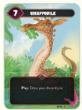
Compost Dragon is defeated as it has a lower power value
Player 2 does not have a block decision
Poisonous: In addition to normal combat resolution, this creature always defeats the enemy creature, even if its power value is less than the enemy's power value.
Note: If the enemy creature's power value is equal or higher it also is defeated.
Player 1

Player 2
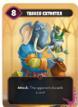
Player 1 attacks with Tusked Extorter
Player 2 discards a card
Player 2 chooses Spider Owl as blocker
Extorter defeats Spider Owl as it has a higher power value, but is also defeated since Spider Owl is poisonous
Sneaky: This creature can only be blocked by sneaky creatures.
Note: It still can block enemy creatures like a normal creature).

Player 1

Player 2
Player 1 attacks with a Sneaky creature (Spider Owl)

Player 2 has two creatures in play, but only Tiger Śquirrel can be chosen as a blocker (as it requires Sneaky)
Tough: If this card would be defeated and isn't exhausted, exhaust it instead of defeating it.
(Exhausting means rotating the card by 90 degrees to highlight that it has used its tough trigger already. Being exhausted doesn't affect what a creature can do (it can still attack, block and use its abilities).)

Abilities & Triggers
Most creatures have a special ability that triggers at a specific moment during the game. The following triggers can be found on cards:
Play: This effect happens when the card comes into play. It happens no matter how the card comes into play, also for example if another effect allows you to play a card from your discard pile. If your opponent spends a Mindbug to take control of a card you played, the play effect happens for them and not for you.
Attack: This effect happens when the creature with this effect attacks, but before the opponent decides if they want to block it.
Defeated: This effect happens when the creature with this effect is defeated. It means the creature is moved from the play area to the discard pile. A creature can be defeated in combat or from another card effect. Notice that it does not trigger if the opponent takes control of. the creature, sends it back to your hand or when you discard it from your hand to the discard pile.
Constant Abilities:
If a card has an ability text without a trigger word (Play, Attack, or Defeated), that.is referred to as a constant.
ability that is always active as long as the card is in play and meets all conditions specified by the ability.

GAME TERMS
The Game Terms include a number of terms players may encounter while playing the game, in alphabetical order.
Allied Creature / Enemy Creature: When cards are in your play area, they are called allied creatures. When they are in the opponent's play area, they are called enemy creatures. If an effect affects both allied creatures and enemy creatures, it simply refers to creatures. In your hand and your discard pile, they are simply called cards.
Discard: Discarding a card means you put it from your hand to your discard pile. If an effect forces you to discard more cards than you have in hand, discard as many cards as possible and ignore the remaining effect.
Steal: If an effect let's you steal a card, you take the card.
from your opponent's hand and put it into your hand.
Take control of a creature: If a card effect lets you take control of a card, you put it into your play area. If you take control of a card it remains in its current state (e.g. exhausted),and doesn't trigger play effects.
器
You can also find rules, multiplayer modes and up to date FAQ online at:
http://mindbug.me/rules
CREDITS
Game Design: Christian Kudahl, Marvin Hegen, Richard Garfield, Skaff Elias
Illustrations: Denis Martynets (www.denism.com.ua)
Graphic Design: Maximilian Gotthold (https://maxgotthold.de/)
Playtesting:
Anders Knudsen, Andreas Skjellerup Iversen, Bo Stentebjerg-Hansen, Daniela Hegen, Daniel Herbet, Emil Grubak Schmalfeldt, Garrot Kole, Jared Patterson, Jens Balcerek, Jeppe Due Hunsdahl, Joshua Raynack, Kasper Meyer, Koni Garfield, Kristoffer Dyrgaard Sørensen, Laura Kudahl, Linus Hegen, Manuel Šmak, Markus Peschina, Pascal Bogensperger, Phu Vinh Nguyen, Schuyler Garfield, Sebastian Nickel, Søren Juul Larsen , Steffen Klein,Stephan Heim
RULES REFERENCE
TRIGGERS
Play: Triggers when the card comes into play. If your opponent spends a Mindbug, the play effect happens for them and not for you.
Attack: Triggers when the card attacks, but before the opponent decides if they want to block it.
Defeated: Triggers when the card is moved from the play area to the discard pile.
KEYWORDS
Frenzy: If this card survives its first attack during a turn, it can attack a second time this turn.
Hunter: When you attack with a Hunter instead of the opponent, you may choose an enemy creature who has to block it.
Poisonous: In addition to normal combat resolution, this creature always defeats the enemy creature, even if the power value is less than the enemies power value.
Sneaky: This creature can only be blocked by sneaky creatures.
Tough: If this card would be defeated and isn't exhausted, exhaust it instead of defeating it.
下载 Markdown简繁检索对照.md
346584_345584_mindbug-first-contact — 简体/繁体检索对照
本游戏的规则书是繁体中文原文。用户用简体提问时,把关键词按下面这张表转成繁体再去 grep 原文,命中率最高。
回答时用简体或繁体都可以,但引用的原文保持繁体。
简体 → 繁体 对照(按该游戏原文出现频率排序,共 60 字)
| 简体 | 繁体 | 原文出现次数 |
|---|---|---|
| 张 | 張 | 44 |
| 进 | 進 | 39 |
| 个 | 個 | 34 |
| 则 | 則 | 33 |
| 时 | 時 | 33 |
| 夺 | 奪 | 31 |
| 击 | 擊 | 31 |
| 虫 | 蟲 | 30 |
| 对 | 對 | 27 |
| 游 | 遊 | 25 |
| 发 | 發 | 24 |
| 场 | 場 | 24 |
| 戏 | 戲 | 24 |
| 将 | 將 | 23 |
| 为 | 為 | 22 |
| 并 | 並 | 21 |
| 挡 | 擋 | 20 |
| 选 | 選 | 20 |
| 当 | 當 | 19 |
| 阵 | 陣 | 18 |
| 弃 | 棄 | 18 |
| 择 | 擇 | 18 |
| 该 | 該 | 18 |
| 从 | 從 | 15 |
| 词 | 詞 | 15 |
| 来 | 來 | 15 |
| 结 | 結 | 15 |
| 触 | 觸 | 14 |
| 关 | 關 | 14 |
| 键 | 鍵 | 14 |
| 们 | 們 | 12 |
| 敌 | 敵 | 12 |
| 区 | 區 | 11 |
| 会 | 會 | 11 |
| 杀 | 殺 | 10 |
| 设 | 設 | 10 |
| 骤 | 驟 | 9 |
| 点 | 點 | 9 |
| 规 | 規 | 8 |
| 机 | 機 | 8 |
| 决 | 決 | 8 |
| 横 | 橫 | 8 |
| 轮 | 輪 | 7 |
| 数 | 數 | 7 |
| 较 | 較 | 7 |
| 后 | 後 | 7 |
| 战 | 戰 | 6 |
| 隐 | 隱 | 6 |
| 动 | 動 | 6 |
| 术 | 術 | 6 |
| 两 | 兩 | 6 |
| 这 | 這 | 5 |
| 猎 | 獵 | 5 |
| 剧 | 劇 | 5 |
| 坚 | 堅 | 5 |
| 韧 | 韌 | 5 |
| 现 | 現 | 5 |
| 与 | 與 | 5 |
| 没 | 沒 | 5 |
| 拥 | 擁 | 5 |