rules_zh_Libert__1333.md

汉化 by Lieber
1. 游戏概览
《自由》以法国大革命为背景,涵盖了1789年最后一次三级会议至1799年拿破仑·波拿巴将军发动雾月政变控制督政府的这段历史时期。
在《自由》游戏中,玩家们将塑造法国革命的政治格局。他们在省级选举中竞争,为温和派(蓝色)、保皇党(白色)和激进派(红色)赢得选票,并根据票数的多少获得胜利点数。通过在战争中成功领导军队,或是赢得重点省的选举,也将获得胜利点数。
游戏在进行四个回合后结束,每个回合包含若干个行动轮。最常见的行动是打出一张牌以在某省叠放派别方块,或打出特殊牌以削弱对手。除此之外,玩家们还可以参与到战争中,招募最好的将军,等等。
与大多数游戏相同,拥有最多胜利点数的玩家将获得游戏胜利。但是有两种特殊情况(激进派选举大胜、保皇党反革命)可能导致游戏提前结束,并采用与众不同的方式判定玩家胜负。法国当下的局势瞬息万变,因此每位玩家都应该保持警惕!
11. 游戏配件 & 背景补充
A. 游戏配件
游戏过程中,除游戏牌以外的所有配件的数量均是有限的。当牌堆耗尽时,将弃牌堆洗混(不再将A组、B组游戏牌分别洗混),组成新的牌堆。
- 1个游戏版图:游戏版图根据颜色被划分为六个地区,每个地区被划分为四或五个省,各省内分别标有名字和数字。某些省另标有鸢尾花图标(),某些省标有一至两个胜利点数图标。除此之外,游戏版图上还标有一些用于记录游戏信息的特殊区域(在本规则书中以蓝色字体标注)。

游戏版图图例
- 地区(绿色)
- 省(#13 & 19)
- 鸢尾花
- 胜利点数- 110张游戏牌:游戏牌被分为A、B两组。A组游戏牌在游戏中首先被使用,倾向于温和派与保皇党;B组游戏牌则倾向于激进派。游戏牌分为三种类型:
人物牌:绘有一幅具有椭圆形边框的重要人物肖像,背景色对应于某个地区。人物牌上标有某种派别颜色的一至三个派别方块,能够将对应的派别方块摆放至游戏版图上。此外,某些人物牌上标有以下特殊符号:
- 大炮:能够在战争区摆放一个控制标记。
- 无套裤汉:允许玩家在个人展示区摆放第五张牌。
- 将军:使一位玩家有资格赢得一场战争。
○ 派别牌:代表法国大革命时期的政治团体。派别牌属于中立(背景色为灰色),标有大炮符号。每张派别牌均能在任何一个省摆放一个派别方块或在战争区摆放一个控制标记。
- 特殊牌:代表某些常见事件,能够从游戏中移除其他牌或派别方块。

人物牌
牌面解析
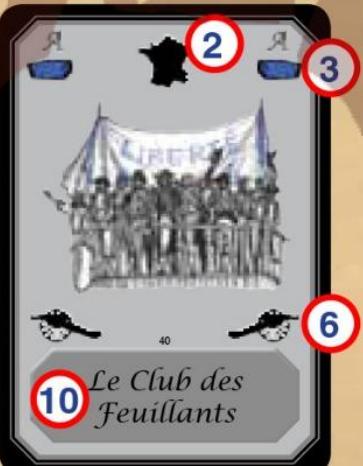
- A组/B组
- 地区
- 派别方块/派别颜色
- 无套裤汉
- 将军
- 大炮
- 背景色
- 人物肖像
- 编号
- 名称
- 特殊效果
派别牌

人物牌
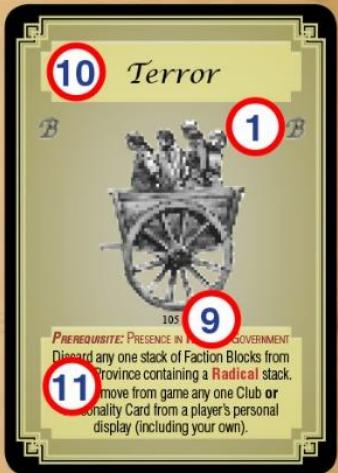
特殊牌
- 82个派别方块(28个蓝色方块、24个白色方块、30个红色方块):用于表示各派别在各省的影响力。也被用于选举后统计票数、标记失败的战争。
- 120个控制标记(6种颜色各20个):用于表示版图上派别方块的所有权。也被用于战争以及记录游戏中的信息。选举结束后,为政府投票的玩家将控制标记摆放至政府区。
- 3个选举标记(蓝色、白色、红色):用于选举时记录票数。票数最高的派别成为新政府,并将其对应的选举标记摆放至政府区。
- 1个回合&行省标记(黑色):用于标记当前回合数与选举进程。
- 6张玩家帮助卡(每种语言各1张):回合流程与核心规则概述。

B. 背景补充
鸢尾花:法兰西王国的国花,是光明和自由的象征。鸢尾花纹章象征法国王室。
无套裤汉:法国大革命时期对城市平民的称呼。无套裤汉的主要成分是小手工业者、小商贩、小店主和其他劳动群众,也包括一些富人。他们是城市革命的主力军,是大革命中几次武装起义的参加者。当时法国贵族男子盛行穿紧身短套裤,膝盖以下穿长统袜;平民则穿长裤,无套裤,故有无套裤汉之称。原是贵族对平民的讥称,但不久成为革命者的同义语。无套裤汉在推翻王政、建立共和国以及推动雅各宾派实行恐怖统治,抗击外国武装干涉等方面发挥了极大作用。无套裤汉在经济上要求限制资产者,打击投机商,有平均主义倾向。在政治上要求实行直接民主制,即由群众用公开唱名或鼓掌进行表决的方式,决定政治大事。
攻占巴士底狱:《自由》封面描绘的历史事件。
· 路易十六在1774年登上王座时,代表法国三个等级的三级会议已经有175年没有召开。
·1789年5月5日,由于财政问题,路易十六在凡尔赛宫召开三级会议,希望在会议中讨论增税、限制新闻出版和民事刑法问题,并且下令不许讨论其他议题。而第三等级代表不同意增税,并且宣布增税非法。
· 1789年6月17日第三等级代表宣布成立国民议会,国王无权否决国民议会的决议。于是路易十六关闭了国民议会,宣布它是非法的,其一切决议无效,命令三个等级的代表分别开会。
· 1789年7月9日国民议会宣布改称制宪议会,要求制定宪法,限制王权。路易十六意识到这危及了自己的统治,调集军队企图解散议会。
·1789年7月12日,巴黎市民举行声势浩大的示威游行支持制宪议会。次日,巴黎教堂响起钟声,市民与来自德国和瑞士的国王雇佣军展开战斗,在当天夜里就控制了巴黎的大部分地区。7月14日群众攻克了象征专制统治的巴士底狱,取得初步胜利。这一天后来成为了法国国庆日。
攻占巴士底狱成了全国革命的信号。各个城市纷纷仿效巴黎人民,武装起来夺取市政管理权,建立了国民自卫军。不久后,由人民组织起来的制宪会议掌握了大权。这一年,制宪会议颁布了“废除一切旧义务”的“八月法令”,紧接着又通过了著名的《人权宣言》,向全世界庄严宣布了“人身自由,权利平等”的原则。
III. 游戏准备
游戏准备示意图请见规则书封底。
- 将游戏版图摆放在桌面中央。
- 每位玩家选择一个颜色,拿取该颜色的控制标记。将未被拿取的控制标记放回盒中。
- 每位玩家将一个控制标记摆放在胜利点数条上数字 “0” 的位置以记录胜利点数。
- 随机选择一位玩家成为起始玩家。起始玩家将一个控制标记摆放在玩家顺位条的第一个空格。然后其他玩家按顺时针的顺序将一个控制标记摆放在下一个空格。
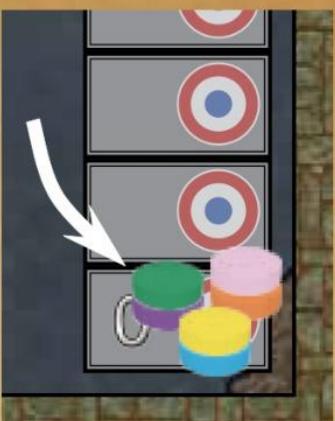

胜利点数条
玩家顺位条
- 将B组游戏牌洗混,正面向下叠放在版图旁。
- 将A组游戏牌洗混,正面向下发给每位玩家各七张。
- 将剩余A组游戏牌叠放在B组游戏牌上。将顶部的三张牌翻面至正面向上并摆放至牌堆旁。
- 将派别方块根据派别颜色分类,组成供应区。将每种派别颜色的各两个派别方块摆放至回合条数字“2”下方的位置(这些方块第2回合开始时被放回供应区)。
- 将蓝色、白色和红色的选举标记摆放至选举条数字“0”的位置。
- 将回合标记摆放至回合条数字“1”的位置。
- 将行省标记摆放至供应区旁。

回合条

选举条
IV. 游戏流程
每个回合分为以下几个阶段:
-
决定玩家顺位 — 第1回合跳过此阶段
-
重整手牌 — 第1回合跳过此阶段
-
行动阶段 — 进行若干个行动轮
-
战争阶段 — 第1回合跳过此阶段
-
选举阶段
每个阶段,所有玩家均按玩家顺位依次操作。仅当所有玩家均操作完毕后,进入下一个阶段。
1. 决定玩家顺位
第1回合的玩家顺位在游戏准备中已被决定了,因此第1回合跳过此阶段。第2回合开始时,将回合条上的六个派别方块放回相应的供应区。
在第2回合至第4回合,玩家顺位由胜利点数决定。胜利点数最多的玩家成为新的起始玩家,胜利点数居第二位的玩家成为下一位玩家,胜利点数最少的玩家成为顺位最靠后的玩家。
若出现平局,采用随机的方式决定平局玩家的顺位。根据新的玩家顺位调整玩家顺位条上各控制标记摆放的位置。
2. 重整手牌
第1回合时,每位玩家在游戏准备中已获得七张手牌,因此第1回合跳过此阶段。
在第2回合至第4回合,每位玩家将其个人展示区中的任意张牌返回其手牌(手牌没有张数限制)。
所有玩家按玩家顺位依次可以弃置任意张牌。然后无论是否弃牌,玩家将手牌补至七张(除非已有不少于七张手牌)。玩家补牌时,可以从牌堆旁正面向上的游戏牌中选择并拿取,或从牌堆中抽取。每当牌堆旁一张正面向上的游戏牌被拿取时,立即将牌堆顶部的一张牌正面向上摆放至牌堆旁。
3. 行动阶段
每个回合包含若干个行动轮。每位玩家均执行一个行动后,一个行动轮即结束。一个行动轮结束时,除非供应区中的某种派别方块耗尽,否则开始一个新的行动轮。
每个行动轮,所有玩家按玩家顺位依次从下列三个行动中选择一个执行:
A. 行动:打出卡牌
- 打出一张派别牌或一张人物牌
II. 打出第二张派别牌或人物牌
III. 打出一张特殊牌
B. 行动:拿取卡牌
- 若手牌不少于九张,弃置两张牌
II. 拿取一张牌
III. 拿取第二张牌
C. 行动:跳过
* 注意:某些玩家可能更喜欢第1版规则。在游戏开始前,若所有玩家均同意,可以在本场游戏中无视“A. II. 打出第二张派别牌或人物牌”和“B. III. 拿取第二张牌”的规则:一个行动轮中仅能打出一张派别牌或人物牌、仅能拿取一张牌。
A. 行动:打出卡牌
- 打出一张派别牌或一张人物牌玩家可以从手牌中打出一张派别牌或人物牌以在省内摆放派别方块或在战争区摆放一个控制标记(后者在第1回合不能被执行)。
a) 在省内摆放派别方块
将游戏牌指定数量、指定颜色的派别方块摆放至游戏版图上。
若打出的牌为派别牌,将一个派别方块摆放至任意一个省。
若打出的牌为人物牌,派别方块可以被摆放至该人物牌背景色(以及白色地区图标)对应地区内的任意省。当某位玩家同时有二或三个派别方块待摆放时,可以摆放至同个地区的多个省。
摆放规则
摆放派别方块时须遵循以下规则:
a) 每个方块堆能且仅能包含一至三个派别方块;
b) 每个方块堆包含的派别方块颜色须相同;
c) 每个省至多有三个方块堆;
d) 每位玩家在每个省仅能控制一个方块堆;
e) 一个方块堆包含的所有派别方块属于一位玩家;玩家不能将派别方块摆放至其他玩家控制的方块堆。
某位玩家摆放派别方块后,在方块堆的顶部摆放控制标记以表示该玩家控制该方块堆。只要符合摆放规则,玩家可以将派别方块摆放至其控制的方块堆。玩家不能移动或移除派别方块,除非某些特殊牌的效果允许他们如此做。
某些情况下(比如供应区耗尽或地区内方块堆的数量已达上限时),玩家可能无法摆放指定数量的派别方块。这种情况下,玩家尽可能摆放派别方块。除这些情况外,玩家不能主动减少摆放派别方块的数量。
b) 在战争区摆放一个控制标记
在第2回合至第4回合,若打出的牌上标有大炮符号,玩家可以在战争区摆放一个控制标记以代替在省内摆放派别方块。不管游戏牌上标有几个派别方块,每个行动均仅能在战争区摆放一个控制标记。每个回合在战争区摆放控制标记的数量不受限制。

战争区
11. 打出第二张派别牌或人物牌
在满足以下条件的前提下,玩家可以打出打出第二张派别/人物牌:
a) 第一张牌在一个省摆放了一个派别标记(而不是在战争区摆放了一个控制标记)。
b) 两张牌均仅标有一个派别方块。
c) 两张牌的背景色相同或其中至少一张牌属于中立(背景色为灰色)。
d) 第二个派别方块必须被摆放至第一个派别方块所在的地区。
III. 打出一张特殊牌
除打出派别牌和人物牌外,玩家可以从手牌中打出一张特殊牌。每位玩家在一个行动轮中仅可以打出一张特殊牌(即使其没有打出派别牌或人物牌)。
打出特殊牌后立即结算其效果。特殊牌可以在打出一张派别牌或人物牌之前或之后被打出(见第6页特殊牌)。
即使玩家已经打出两张派别牌或人物牌,其仍然可以打出特殊牌。玩家可以以任意顺序打出这三张牌。
整理
打出任意牌后,将其弃置。此时派别牌和人物牌可以被摆放至个人展示区以代替被弃置。每位玩家的个人展示区中可以摆放至多四张牌。若某位玩家个人展示区中的至少一张牌标有无套裤汉符号,则其个人展示区中可以摆放至多五张牌。

B. 行动:拿取卡牌
- 若手牌不少于九张,弃置两张牌若玩家的手牌不少于九张,其必须弃置两张手牌。若玩家的手牌少于九张,其不需要弃牌。
11. 拿取一张牌
然后玩家从牌堆旁正面向上的三张游戏牌中选择并拿取一张,或从牌堆中抽取一张牌。每当牌堆旁一张正面向上的游戏牌被拿取时,将牌堆顶部的一张牌正面向上摆放至牌堆旁。
III. 拿取第二张牌
若玩家从牌堆旁正面向上的三张游戏牌中选择并拿取了一张仅标有一个派别方块的牌,其可以从牌堆旁正面向上的三张游戏牌中再拿取一张仅标有一个派别方块的牌,然后将牌堆顶部的一张牌正面向上摆放至牌堆旁。
若玩家从牌堆旁正面向上的三张游戏牌中选择并拿取了一张特殊牌,或从牌堆中抽取了一张牌,则玩家不能拿取第二张牌。玩家被允许在拿取第一张牌后,将新摆放至牌堆旁的牌作为第二张牌拿取。玩家在拿取第二张牌前不进行弃牌,即使其手牌不少于九张。
C. 行动:跳过
某些场合下(虽然不太可能发生),玩家可能不想执行打出卡牌或拿取卡牌的行动,那么其可以选择跳过。本回合后续的行动轮中其仍然可以照常选择并执行行动。
行动阶段结束
当某种派别方块耗尽时,行动阶段结束。玩家照常执行行动直至当前行动轮结束(所有玩家执行行动的次数相同)。

4. 战争阶段
第1回合跳过此阶段。
在第2回合至第4回合,将发生战争。在个人展示区有至少一张标有将军符号的游戏牌,且在战争区有至少一个控制标记的所有玩家均有资格领导革命军。其中在战争区拥有控制标记数目最多的玩家将领导革命军并获得战争胜利点数(见回合条下方的提示)。

若比较控制标记的数目时出现平局,所有平局玩家按玩家顺位依次可以从各自的个人展示区中弃置一张标有将军符号的游戏牌。弃置游戏牌标有的派别方块数量最多的玩家将领导革命军并获得战争胜利点数。
若仍然平局,革命军将无人领导,在这场战争中失败。这种情况发生时,将一个白色派别方块摆放至回合条(若白色派别方块耗尽,则待选举结算后摆放)。每次在战争中失败,均视为新增一个被白色方块堆控制的省(见第6页保皇党反革命)。
最后,所有玩家从战争区将各自的控制标记收回。
例子:在第2回合瓦尔密战役中,克里斯蒂在战争区中有1个控制标记,并在其个人展示区中有一张标有将军符号的游戏牌;约书亚在战争区中有2个控制标记,并在其个人展示区中有两张标有将军符号的游戏牌;马科斯在战争区中有3个控制标记,但在其个人展示区中没有标有将军符号的游戏牌。虽然马科斯拥有最多控制标记,其没有领导革命军的资格。约书亚拥有控制标记数目最多,因此其领导革命军并获得4点胜利点数,且没有弃置其标有将军符号的游戏牌。
5. 选举阶段
选举阶段按以下步骤结算:
A. 省级选举
B. 组成新政府
C. 结算胜利点数
A. 省级选举
移除政府区中的所有控制标记。将三个选举标记摆放至选举条数字 “0” 的位置。从1-诺曼底开始,依次进行27个省的选举结算。进行某个省的选举结算时,将行省标记摆放至该省以记录结算进程。
某个省进行选举结算时,控制该省中最高的方块堆的的玩家被视为赢得选举,从该方块堆拿取一个派别方块并保留至选举阶段结束。剩余的派别方块(如果有的话)保留在游戏版图上。将该方块堆对应的选举标记在选举条上前进一格。
由于每个方块堆至多仅能包含三个派别方块,将很容易出现平局的情况。出现平局的场合,每位平局的玩家按玩家顺位依次可以从各自的个人展示区中弃置一张游戏牌。该牌标有的派别方块的颜色与其方块堆的颜色应相同(对该牌的背景色无要求)。弃置游戏牌标有的派别方块数目最多的玩家赢得选举,从其方块堆拿取一个派别方块,并将对应的选举标记在选举条上前进一格。
若仍然平局,则无人赢得选举,不移动选举标记。
出现平局的场合,无论平局是否被打破,选举结算后,将该省所有剩余的派别方块放回供应区。除平局玩家外的其他玩家亦须将该省中属于他们的派别方块放回供应区。
巴黎
巴黎的选举结算与其他省的选举结算有以下不同:
1) 赢得选举的玩家从该方块堆拿取所有派别方块(而不是通常情况下的一个)。每拿取一个派别方块,将对应的选举标记在选举条上前进一格(至多前进三格)。
2) 若弃置游戏牌后仍然平局,重复弃置游戏牌的过程直至打破平局或所有玩家均不能够或不愿意弃置游戏牌。若仍然平局,则无人赢得选举,不移动选举标记。
重点省
四个省标有1或2个胜利点数符号。在第3回合至第4回合,赢得这些省的选举的玩家获得对应的胜利点数。若无人赢得选举,则无人获得对应的胜利点数。
例子1:进行1-诺曼底的选举结算时,克里斯蒂在诺曼底控制了一个包含三个红色派别方块的方块堆,约书亚在诺曼底控制一个包含两个蓝色派别方块的方块堆,马科斯在诺曼底控制另一个包含两个蓝色派别方块的方块堆。尽管诺曼底中共有四个蓝色派别方块,激进派(红色方块堆)仍赢得诺曼底的选举。克里斯蒂从其红色方块堆中拿取一个派别方块。红色选举标记在选举条上前进一格。
例子2:继续进行至8-巴黎的选举结算时,克里斯蒂在巴黎控制一个包含三个红色派别方块的方块堆,约书亚在巴黎控制另一个包含三个红色派别方块的方块堆,马科斯在巴黎控制一个包含一个白色派别方块的方块堆。出现平局,意味着克里斯蒂和约书亚可以从各自的个人展示区中弃置一张游戏牌。克里斯蒂的玩家顺位在约书亚之前,她弃置了一张标有三个红色派别方块的让·保尔·马拉
(#71)。约书亚决定不弃置游戏牌。克里斯蒂的激进派因此赢得巴黎的选举。克里斯蒂从其红色方块堆中拿取三个派别方块。红色选举标记在选举条上前进一格。由于出现平局,将巴黎中所有剩余的派别方块(包括白色派别方块)放回供应区。
B. 组成新政府
所有省级选举均结算完毕后,获得票数最多的派别(即在选举条上前进距离最远的派别)将组成新政府。将其选举标记摆放至政府区。票数第二多的派别成为反对党,其选举标记保留在选举条上。
1:5
2:2
1:3

16 5 14 13 12
战争区
若出现平局,所有玩家按玩家顺位依次可以从各自的个人展示区中弃置一张游戏牌。平局的派别中,弃置的游戏牌中标有对应颜色的派别方块的数目最多的派别将组成新政府,将其余派别在选举条上的位置后退一格。
若仍然平局,重复弃置游戏牌的过程直至打破平局或所有玩家均不能够或不愿意弃置游戏牌。若仍然平局,激进派(红色)优先组成新政府,其次是温和派(蓝色),最后是保皇党(白色)。
C. 结算胜利点数
所有玩家比较手中与新政府颜色相同的派别方块的数目,数目最多的玩家获得5点胜利点数,数目第二多的玩家获得2分。所有玩家比较手中与反对党颜色相同的派别方块的数目,数目最多的玩家获得3点胜利点数
例子:激进派(红色)以12票赢得选举;温和派(蓝色)有8票,成为反对党。克里斯蒂因手中红色派别方块最多而获得5点胜利点数。约书亚手中红色派别方块为第二多,获得2点胜利点数。同时约书亚因手中的蓝色派别方块最多而获得3点胜利点数。

若出现平局,每位平局的玩家按玩家顺位依次可以从各自的个人展示区中弃置一张游戏牌。弃置游戏牌标有的派别方块颜色与政府或反对党颜色相同且数目最多的玩家获得胜利点数。若仍然平局,重复弃置游戏牌的过程直至打破平局或所有玩家均不能够或不愿意弃置游戏牌。
· 若几位玩家手中与新政府颜色相同的派别方块的数目并列第一,且平局被打破,未在平局中获胜的玩家取代数目第二多的玩家获得2分。
· 若几位玩家手中与新政府颜色相同的派别方块的数目并列第一,且平局未被打破,这些玩家均获得3点胜利点数(数目第二多的玩家仍获得2点胜利点数)。
· 若几位玩家手中与新政府颜色相同的派别方块的数目并列第二,且平局未被打破,这些玩家均获得1点胜利点数。
· 若几位玩家手中与反对党颜色相同的派别方块的数目并列第一,且平局未被打破,这些玩家均获得2点胜利点数。
每位手中有与新政府颜色相同的派别方块的玩家将其一个控制标记摆放至政府区。在政府区中有其控制标记是玩家打出某些特殊牌的前提。
最后,所有玩家将手中的派别方块放回供应区。游戏版图上的派别方块则被保留。将回合标记前进一格,开始一个新回合。
V. 特殊牌

粮食短缺(A组×4)
从任意一个省移除任意一个与政府颜色相同的派别方块。在第1回合,可以移除任意颜色的派别方块。将被移除的派别方块放回供应区。
移民(A组×2)
从任意一位玩家(包括自己)的个人展示区移除任意一张保皇党(白色)人物牌。将被移除的人物牌叠放至弃牌堆。
宗教问题(A组×2)

从任意一个省移除任意一个温和派(蓝色)或激进派(红色)派别方块。在第1回合,可以移除任意颜色的派别方块。将被移除的派别方块放回供应区。
断头台(B组×2)
从任意一位玩家(包括自己)的个人展示区移除任意一张人物牌。将被移除的人物牌移出游戏(放回游戏盒中)。
肃清(B组×4)


前提:在政府区中有你的控制标记从任意一位玩家(包括自己)的个人展示区移除任意一张派别牌或人物牌。将被移除的人物牌叠放至弃牌堆。
恐怖主义(B组×6)
前提:激进派(红色)组成新政府,且在政府区中有你的控制标记
从任意一个至少有一个红色方块堆的省移除任意一个方块堆(被移除的方块堆可以是红色方块堆)。将被移除的派别方块放回供应区。同时可以从任意一位玩家(包括自己)的个人展示区移除任意一张派别牌或人物牌。将被移除的派别牌或人物牌移出游戏(放回游戏盒中)。

注意:某种派别方块耗尽预示着当前行动阶段即将结束,此情况下即使一张特殊牌的效果导致耗尽的派别方块从游戏版图被放回供应区,行动阶段也不会因此得到延长,仍将在当前行动轮结束时结束。
VI. 游戏结束
当满足以下三个条件之一时,游戏结束。
1. 第4回合结束
若激进派选举大胜或保皇党反革命均没有发生,则游戏在第4回合后结束。拥有最多胜利点数的玩家获得游戏胜利。
若出现平局,平局玩家中,个人展示区中所有牌标有的派别方块总数最多的玩家获得游戏胜利。若仍然平局,平局玩家共同获得游戏胜利。
2. 激进派选举大胜
省级选举结束时,若红色派别的票数大于等于17票,则激进派选举大胜,游戏立即结束。激进派选举大胜可能发生在任意回合。
拥有最多红色点数的玩家获得游戏胜利。每位玩家将下列数值相加:
· 手中红色派别方块的数量
· 游戏版图上各自控制的红色派别方块的数量
· 手牌与个人展示区中所有牌标有的红色派别方块的总数
胜利点数不被计入红色点数。若出现平局,平局玩家中,手牌与个人展示区中所有牌标有的红色派别方块总数最多的玩家获得游戏胜利。若仍然平局,平局玩家共同获得游戏胜利。
3. 保皇党反革命
若游戏中的任意时刻,至少七个标有鸢尾花()。的省被白色方块堆控制,则保皇党反革命,游戏立即结束。保皇党反革命可能且仅可能发生在第3至4回合的除选举阶段以外的任意阶段。
每次在战争中失败,均视为新增一个被白色方块堆控制的省,降低达成保皇党反革命所需的被白色方块堆控制的省的数量。
拥有最多白色点数的玩家获得游戏胜利。每位玩家将下列数值相加:游戏版图上各自控制的白色派别方块的数量
· 手牌与个人展示区中所有牌标有的白色派别方块的总数
胜利点数不被计入白色点数。若出现平局,平局玩家中,手牌与个人展示区中所有牌标有的白色派别方块总数最多的玩家获得游戏胜利。若仍然平局,平局玩家共同获得游戏胜利。
VII. CREDITS
Game Designer: Martin Wallace
Artists: Kurt Miller, Mark Poole, & Peter Dennis
2nd Edition Developer: Brian Mola
Executive Producer: Phil Sauer
French Translation: Yann Wenz
German Translation: Ferdinand Köther
Dutch Translation: Peter Kruijt
Italian Translation: Fabrizio Autino
Spanish Translation: Álex Ramos
Special Thanks to Stuart Dagger and John Rodriguez for the variant idea.
Special Thanks to Yann Wenz for his research of French names. 1st Edition Playtesting: Simon Bracegirdle, Rob Mulholland, Richard Spilsbury, Matthew Ellis, Eddie Richards, Geoff Brown, Martin Burroughs, James Hamilton, Chris Boote, Paul Heald and friends, plus members of the Man of War games club. The designer would also like to thank the many people who have played the game and offered comments at various conventions, in particular Baycon, Stabcon, and Ramsdencon.
Without the inspiration of Paddy Griffith this game would not exist. I wish to dedicate this new edition to his memory. - Martin Wallace

© 2010 Valley Games, Inc.
Valley Games and the Valley Games logo are trademarks of Valley Games, Inc.
www.valleygames.ca
LiberteRulesEN.md

TABLE OF CONTENTS
English. ..2 Nederlands.. ..17
Français Italiano . .22
Deutsch. ....12 Español .27
Set Up/Mise en Place/Spielaufbau/Spelopzet/Set Up/Preparación .....32
Club Card

A game for 3-6 players, ages 12 and up
I. OVERVIEW OF THE GAME
LiBErTÉ covers the French Revolution from the meeting of the Estates-General in 1789 to the Directory and General Napoleon Bonaparte's coup d’état in 1799.
In LiBERTÉ, players shape the political landscape of revolutionary France. They compete in provincial elections to gain votes in the government and opposition which in turn award victory points. Successfully leading the army in battle and winning the election in key provinces will also score victory points.
The game is played over four turns with each turn consisting of multiple action rounds. The most common action is to play a card to stack faction blocks in the provinces. Special cards may be played to weaken rivals. Players may also participate in the battle and recruit the best General, among other options.
Players can retain some cards in their personal display. These cards can then be replayed (advanced) to resolve ties. If not used by the end of the turn, they return to the player's hand, available for the next turn.
After the action rounds, the election is resolved in each province. The three factions competing for the new government are the Moderates (blue), the Royalists (white), and the Radicals (red). The player with the largest stack in a province controls that vote. Ties are very common, however, so players may advance their held cards to gain the advantage.
Typically, the player with the most victory points will win. Two sudden-death victory conditions can immediately end the game making victory points worthless. The Radicals can gain a landslide in the election or the Royalists can take back the country by controlling battleground provinces. Everyone must be watchful for the fervor that can quickly change France's future!
II. COMPONENTS & GAME TERMS
A. COMPONENTS
The components in the game are purposely limited. Only the DiscARD pile is reshuffled when the deck runs out.
1 Game Board: The board is divided into six Regions (identified by color) that are each further divided into four or five Provinces (identified by name and number). Some Provinces contain a Fleur-de-lis () and some are worth Victory Points (). The board also features various tracks and boxes (identified by Blue Text throughout the rulebook) to record game information.

Board Features
Personality Card
Special Card
-
Region (Green) 3. Fleur-de-lis
-
Provinces (#13 & 19) 4. Victory Points • 110 Cards (A- & B-sets): The cards are divided into two sets. The A-set, which enters play first, favors the Moderates and Royalists while the B-set favors the Radicals. There are three types of cards:
o Personality Cards show an oval portrait of important individuals and a background color matching a Region. Personality Cards have one to three Faction Blocks in one of three FAcTioN coLoRs that can be placed on the board. Personality Cards may be further marked with unique symbols:
Cannon: may place one Control Token in the Battle Box,
Sans-Culottes: allows a fifth card to be placed in a PERsoNAL DISPLAY, and
▪ General: makes a player eligible to win a Battle.
o Club Cards represent the political groups during the era. Club Cards are wild (neutral background color) and have the Cannon symbol. Every Club card can place a single Faction Block in any Province or place a single Control Token in the Battle Box.
o Special Cards reflect common events used to remove other cards and Faction Blocks from play.
Card Features

-
A-Set/ B-Set
-
Region
-
Faction Blocks / Faction Color
Personality Card

-
Sans-Culottes
-
General
-
Cannon

-
Background Color
-
Personality Portrait
-
Card ID#

-
Card Title
-
Special Effect
82 Faction Blocks (28 Blue, 24 White, & 30 Red): Square blocks marking a faction's influence in the Provinces. Also used to tally votEs after elections and mark Lost Battles.

120 Control Tokens (20 each in 6 Player colors): Round disks showing ownership of the Faction Blocks on the board. Also used in Battle and to track game information. After the elections, Control Tokens are placed in the Presence in Government Box for players that voted for the GOVERNMENT.
• 3 Election Markers (Blue, White, & Red): Cylinders recording voTEs during elections. The faction receiving the most voTes is the new GovERNmENT and its marker is moved to the Presence in Government Box.
• 1 Turn & 1 Province Markers (Black): Cubes marking the current turn and election progress.

• 6 Player Aids (1 per language): Summarize the turn sequence and key rules.
B. GAME TERMS
The following are important game terms and referenced with sMALL CAPs throughout the rulebook.
VaLue: Determined by the quantity of Faction Blocks on either side of the card: one, two, or three. (Special Cards have no vALuE.)
Faction coLor: Determined by the color of Faction Blocks on either side of the card: blue, white, or red. (The background color of Personality Cards determines where Faction Blocks can be placed but has no effect on FACTION COLOR.)
DiscaRd: Once played, cards are typically DIscARDED to a common pile. As soon as the deck is exhausted, shuffle the DiscARD pile to form a fresh deck. The A and B designations no longer apply and the two sets will be mixed together from now on.
ReTuRNED To THE Box: Some Special Cards target players' PERsONAL DisPLAys and permanently remove a card from the game. These cards are RETURNED TO THE BOX and never re-enter the game.
STAck: One to three Faction Blocks of the same FACTiON coLOR placed on top of each other, along with a player's Control Token. Sτacks determine coNTROL of a Province and return voTEs during the Election Phase. Stacks are also discussed under Placement Rules on p. 4.
PERsonAL DisPLAy: During the Action Phase, cards are played directly from a player's hand. He may choose to save up to four cards (five if any show a Sans-Culottes symbol) in his PERsoNAL DISPLAY: an area on the table in front of that player. These cards may then be ADvANcED during the Battle and Election Phases to break τiEs. Any cards remaining in the PERsoNAL DIsPLAY are returned to the player's hand at the start of a new turn, allowing a player to recycle useful cards. Players should consider keeping Generals and high vALuE cards.
Tie: Given the struggle between factions, TiEs occur frequently. Each Phase outlines where a TiE may occur and how to resolve it, typically by ADVANCING Cards frOm a PERSONAL DISPLAY.
Apvance: During the Battle and Election Phases, tied players may push forward (play) a card from their PERsoNAL DISPLAY in order to break the TIE. The card VALUE (and sOmetimes the FACTION COLOR) is important when determining which card to ADvANCE. All ADvANCED cards are DISCARDED whether the TIE is resolved or not.
CoNTRoLLED: A Province is CONTROLLED by a player if his STACK is higher than any other sTAck in that Province, including other sTAcks of the same FACTION cOLOR. CoNTROLLED Provinces are also important during a sudden-death victory (see Royalist Counter-Revolution on p. 6).
Vote: During the Election Phase, each Province may return one voTE for the faction of the matching sTAck. Paris may return up to three voTEs. The player controlling this sTAck holds one Faction Block until the end of the Phase and advances that faction's Election Marker one space. Vores are also important during a sudden-death victory (see Radical Electoral Landslide on p. 6).
GovERNmENt: The faction that receives the most voTEs during the elections forms the GovERNmENT. The player with the most matching voTEs is awarded 5 Victory Points (VPs). The player with the second most voTEs is awarded 2 VPs.
Opposition: The faction that receives the second most voTEs during the elections is the opposiTion. The player with the most matching voTEs is awarded 3 VPs.
PRESENCE: All players holding a VOTE in the FACTION COLOR of the current GOVERNMENT have PRESENCE in that GOVERNMENT. PRESENCE is a prerequisite to playing some Special Cards.
III.SET UP
See back cover of rulebook for a graphical set up.
• Place the board in the middle of the table.
• Each player selects a set of Control Tokens. Unselected sets are returned to the box.
• Each player places one Control Token on the 0-space of the Victory Point Track to record total accrued Victory Points (VPs).
• Randomly determine a start player who places his Control Token on the first space of the Piayer Order Track. Then proceeding clockwise, each player places a Control Token in the next open space.


Victory Point Track
Player Order Track
• Separate and shuffle the B-set cards and place this deck facedown next to the board.
• Shuffle the A-set cards and deal seven cards face-down to each player.
• Place the remaining A-set cards on top of the B-set. Flip over the top three cards and place these face-up next to the deck.
• Separate the Faction Blocks by FAcTioN coLoR and form a supply of each next to the board. Take two of each FACTION coLoR and place them underneath the 2-space of the Turn Track (these Blocks will be returned to the supply at the start of Turn 2).
• Place the blue, white, and red Election Markers on the 0-space of the Election Track.
• Place the Turn Marker on the 1-space of the Turn Track.
• Place the Province Marker next to the Faction Block supplies.


Turn Track
Election Track
IV. GAME TURN
A turn is divided into the following Phases:
-
DeTERMINe PLaYeR OrdER – skip on Turn 1
-
ReFRESh HAND – skip on Turn 1
-
Action Pase – players complete a variable number of Action Rounds
-
BATTLE PHASE – skip on Turn 1
-
ELECTION PHASE
Each Phase is completed by all players in player order before proceeding to the next Phase.
1. DETERMINE PLAYER ORDER
During Turn 1, this Phase is skipped as the player order was determined during Set Up.
At the start of Turn 2, return the six Faction Blocks on the Turn Track to their respective supplies.
In Turns 2-4, the accrued VPs determine player order. The new start player is the player with the most VPs, followed by players with the next most VPs, and ending with the last-place player.
In case of a τiEe, decide randomly among those tied who will take precedence. Control Tokens are arranged on the Player Order Track to show the new player order.
2. REFRESH HAND
During Turn 1, this Phase is skipped as the players' hands were dealt during Set Up.
In Turns 2-4, players return to their hand any cards in their PERsoNAL DISPLAY (there is no hand limit).
In player order, each player may DiscARD as many cards as desired.
Whether DiscARDiNG or not, he then refills his hand to seven cards (unless already at seven or more in hand). Cards may be taken from those face-up next to the deck and/or drawn from the deck itself. Any face-up card taken is immediately replaced with the top card from the deck.
3. ACTION PHASE
Each turn has a variable number of Action Rounds. A Round is completed once each player has taken one Action. Rounds are continued until one supply of Faction Blocks is exhausted and the last player takes the last Action of the Round.
In player order, each player takes one of the following three Actions:
A. ACTION: PLAY CARD(s)
I. PLAY 1 CLUB OR 1 PERSONALITY CARD
II. PLAY SECOND 1-VALUE CARD*
III. PLAY 1 SPECIAL CARD
B. ACTION: TAKE CARD(s)
- 9+ CARDS IN HAND, DISCARD 2
II. TAKE 1 CARD
III. TAKE SECOND 1-VALUE CARD*
C. AcTION: PASs
*NoTE: Some players may prefer the 1st Edition rules. If all players agree before the game, both * options (A.ii & B.iii) are ignored: only one Club/Personality Card can be played (with or without a Special Card) or only one card can be taken for one Action.
A. ACTION: PLAY CARD(s)
The active player may play one Club or Personality Card from his hand to be used in one of two ways:
a) Place Faction Blocks in the Provinces; or
b) Place one Control Token in the Battle Box – skip on Turn 1.
a) Place Faction Blocks in the Provinces
A number of Faction Blocks equal to the card vALUE and FACTION COLOR are placed on the board.
If a Club Card is played, one Block can be placed in any Province.
If a Personality Card is played, the Blocks can be placed in any Province that matches the background color of the card (also represented as a black region within France on the card). When placing two or three Blocks, a player may place them in more than one Province in the same Region.
Placement Rules
Faction Blocks must be placed on the board as follows:
a) A single sTAck can only contain one to three Faction Blocks;
b) A single STACK must be all the same FACTION COLOR;
c) A single Province may only contain up to three sTAcks;
d) A player may conTRoL only one sTAck in a Province; and
e) All the Blocks in a sTAck belong to one player; a player can never add to another player's sTAck.
When placing a sTAck, a player's Control Token is placed on top to show that he controls that sTAck. A player may always add Faction Blocks to his previously placed sTAcks, as long as he follows the Placement Rules. A player cannot move or remove Blocks, except through the play of some Special Cards.
A player may not be able to place all of a card’s Blocks (i.e., the supply is exhausted or no available space in the Region), in which case he places as many as he can. A player may not, however, voluntarily place fewer Blocks than shown on the card.
b) Place 1 Control Token in the Battle Box
In Turns 2-4, if there is a Cannon on
the card, the player may place one of
his Control Tokens in the Battle Box instead of placing Faction Blocks in the Provinces. Regardless of the card vALuE, only one Control Token is placed in the Battle Box per Action. There is no limit to the number of Control Tokens that can be placed in the Battle Box during a turn.

Battle Box
ii. Play Second 1-Value Card*
A player may play a second Club/Personality Card if the following conditions are met:
a) The first Card placed a Faction Block in a Province (not a Control Token in the Battle Box);
b) Both Cards are vALUE-1;
c) Both Cards have the same background color or one/both is a wild Club Card (FACTION cOLOR is irrelevant); and
d) The second Faction Block must be placed in the same Region as the first Block.
iii. Play 1 Special Card
In addition to playing a Club/Personality Card, a player may play one Special Card from his hand. A player may choose to play only a Special Card but cannot play two Special Cards in one Action Round (even if a Club/Personality Card is not played).
The effect of the Special Card is resolved immediately; however, it may be played before or after a Club/Personality Card is played (see Special Cards on p. 6).
A player may still play a Special Card even if playing two Club/ Personality Cards; he may play the three Cards in any order.
Clean-up
After playing any card, it is DISCARDED. Alternatively, a Club/Personality Card may be saved in the active player's PERsoNAL DISPLAY. A player may have up to four cards in his DisPLAY. If at least one card has the Sans-Culottes symbol, he may keep five cards in his DisPLAY.

B. ACTION: TAKE CARD(s)
i. 9+ Cards in Hand, Discard 2
If a player has nine or more cards in hand when refreshing his hand, he must first DiscARD two cards from his hand. If a player has less than nine cards in hand, he does not DiscARD any.
ii. Take 1 Card
The player then takes one of the three face-up cards by the deck or draws from the deck itself. Any face-up card taken is immediately replaced with the top card from the deck.
iii. Take Second 1-Value Card*
If the first card taken was a face-up vALuE-1 card by the deck, then a second face-up vALuE-1 card may be taken as well. The card is immediately replaced with the top card from the deck.
A second card cannot be taken if a Special Card was taken or a card was drawn from the deck. It can, however, be taken if it was revealed after taking the first face-up card. A player does not discARD any cards before drawing this second card even if he would now have nine or more cards in hand.
C. AcTION: PASS
In the unlikely event that a player does not wish to take an Action, he may pass. He may again take Actions if play returns to him during the same turn.
END OF THE ACTION PHASE
The Action Phase ends when one supply of Faction Blocks is exhausted. However, play continues until the last player has completed his Action in the current Round (i.e., all players have the same number of Actions during a turn).

4. BATTLE PHASE
During Turn 1, this Phase is skipped.
In Turns 2-4, there is a Battle. Players with at least one General Card in their PERSONAL DISPLAY and at least one Control Token in the Battle Box are eligible to lead the Revolutionary Army. Of those eligible, the player who has the most Control Tokens in the Battle Box leads the Army and wins that Battle's VPs (as shown under the Turn Track).

In case of a τiE with the number of Control Tokens, each tied player in player order may ADVANCE one General. The player who ADVANCEs the highest vALuE General leads the Army and wins the VPs.
If the τiE remains unbroken, nobody leads the Army; the Battle is considered a Lost Battle. If this happens, place a white Faction Block over the Battle (if none are available, place one after the elections have been resolved). A Lost Battle counts as a conTRoLLED Counter-Revolutionary Province (see Royalist Counter-Revolution on p. 6).
If no General was ADVANCED, no cards are DISCARDED. Finally, all Control Tokens in the Battle Box are returned to their owners.
EXAMPLE: Turn 2 is the “Battle of Valmy.” Christie has 1 control token in the Battle Box and 1 General in her Personal Display; Joshua has 2 tokens and 1 General; and Max has 3 tokens but no General. Although Max has the most control tokens, he is ineligible since he has no General. Between Christie and Joshua, Joshua has the most tokens and leads the army. Joshua scores 4 VPs and keeps his General as it was not advanced.
5. ELECTION PHASE
Elections are resolved as follows:
A. PROVINCIAL ELECTIONS
B. THE NEW GOVERNMENT
C. VICTORY POINTS
A. PROVINCIAL ELECTIONS
Remove all Control Tokens from the Presence in Government Box. Return the three Election Markers to the 0-space of the Election Track. Starting with 1-Normandie, proceed one Province at a time until all 27 elections have been resolved. Place the Province Marker on the Province being resolved to track the progress.
The election in a Province will normally return just one voTE (Exception: Paris) to the faction with the highest single sTAck in a Province. The player controlling this stAck takes one Faction Block from it and holds it until the end of the Election Phase. The rest of the Faction Blocks (if any) remain in the Province. The winning faction's Election Marker advances one space on the Election Track.
With a stacking limit of three Faction Blocks, TiEs will be common. In case of a TiE, each tied player in player order may ADvANcE one card. The FACTION cOLOR of his Card and sTACK must match in the contested Province (background color is irrelevant). The player who ADvANcEs the highest vALue card wins the Provincial election; he takes one Faction Block from his sTack and advances that faction one space on the Election Track.
If the TIE remains unbroken, no voTE is registered.
Whenever there is a TiE, whether it is broken or not, all remaining Faction Blocks in that Province are returned to the supply after the election has been resolved. This includes the Faction Blocks of any player not involved in the TiE.
Paris
The 8-Île-de-France (Paris) election is resolved as normal with the following exceptions:
1) Instead of taking one Faction Block, the election winner takes all of his Blocks from the sTAck. Each Block advances that faction one space on the Election Track (i.e., Paris could return up to three voTEs).
2) If after ADvANCiNG cards there is still a TIE, repeat the process among those tied until the TiE is broken or players are unable or unwilling to ADvAncE a card. If the TiE remains unbroken, no voTEs are registered. All remaining Faction Blocks are removed from the Province as normal.
Victory Point Provinces
Four Provinces contain a 1 VP or 2 VP icon. In Turns 3-4 only, the player who wins the election in these Provinces will also gain the VPs. If nobody wins the election, no VPs are awarded.
EXAMPLE 1: The election starts in 1-Normandie, where Christie controls a stack of 3 red faction blocks, Joshua controls a stack of 2 blues, and Max controls another stack of 2 blues. The red stack wins the election in the province, despite the fact that there is a total of 4 blue faction blocks. Christie takes 1 of the red faction blocks from her stack and holds it for now. The red election marker is moved up 1 space along the Election Track.
EXAMPLE 2: The election continues to 8-Île-de-France (Paris). Christie controls a stack of 3 red faction blocks, Joshua controls another stack of 3 reds, and Max controls 1 white block. There is a tie, which means cards may be advanced. Christie goes before Joshua in player order. She advances Jean-Paul Marat (#71), who is a 3-value red personality. Joshua decides not to advance a card. Christie wins and takes all 3 of her faction blocks and holds them. The red election marker is moved up 3 spaces on the Election Track. As there was a tie, all remaining faction blocks, including the white block, are removed from the province and returned to the supply. Christie discards the advanced Marat.
B. THE NEW GOVERNMENT
Once all Provincial Elections have been resolved, the faction that received the most voTEs (i.e., it is furthest along the Election Track)
Presence in Government Box


will form the new GOVERNMENT. Place its Election Marker in the Presence in Government Box. The faction that received the second most voTEs is the OPPOSITION. Its Election Marker remains on the Election Track.
In case of a TiE on the Election Track, each player in player order may ADvANcE one card. The tied faction that has the highest vALuE matching its FACTION coOLOR wins and any other factions on the same or lower level on the Election Track are moved one space back.
If there is still a TiE, repeat the process until the TıE is broken or players are unable or unwilling to ADvANcE a card. If the τIE remains unbroken, the Radicals win over the Moderates, who in turn win over the Royalists.
C. VICTORY POINTS
Players now claim Victory Points. The player who holds the most voTEs (Faction Blocks) in the same FACTION COLOR as the neW GOVERNMENT wins 5 VPs. The player who holds the second most vOTEs in the neW GOVERNMENT wins 2 VPs. The player who holds the most voTEs in the oPPosITION wins 3 VPs.
EXAMPLE: The Radicals won the election with 12 votes; the Moderates won 8 votes, becoming the Opposition. Christie had the most red votes, which means she wins 5 VPs. Joshua had the second most red votes and wins 2 VPs. Joshua also

had the most blue votes and wins another 3 VPs.
In case of a TIE, each tied player in player order may ADvANcE one card. The player who ADvANCEs the highest vALuE card matching the FACTION COLOR of the GOVERNMENT/OPPOSITION Wins the VPs. If there is still a TiE, repeat the process among those tied until the τiE is broken or players are unable or unwilling to ADVANCE a card.
If the TIE is broken for first place in the GOVERNMENT, the player who lost the TiE wins the second place VPs.
If the TiE remains unbroken, the following occurs in each case:
• for first place in GovERNMENT, each tied player wins 3 VPs (second place VPs are still awarded);
• for second place in GovERNmENT, each tied player wins 1 VP; or
• for first place in oPposITIoN, each tied player wins 2 VPs.
Every player holding any voTEs matching the FACTION cOLOR of the neW GOVERNMENT has a PRESENCE in that GOVERNMENT. Each of these players places one of his unused Control Tokens in the Presence in Government Box. PREsEncE is a prerequisite to playing some Special Cards.
All voTes held by players are now returned to the supply. Faction Blocks on the board remain. The Turn Marker advances one space and a new Game Turn is started.
V. SPECIAL CARDS
Special Cards may target any player, including the one who played the card. There are six types in the game:

Bread Shortage (A-Set x4)
Remove any one Faction Block of the same FAcTioN coLoR as the current GovERNMENT from any one Province. During Turn 1, any Faction Block can be removed. The affected Block is returned to the supply.
Emigration (A-Set x2)
Remove any one Royalist (white) Personality Card from a player's PERSoNAL DISPLAY (including your own). The affected Card is placed on the DiscARD pile.


Religious Problems (A-Set x2)
Remove any one Moderate (blue) or Radical (red) Faction Block from any one Province. The affected Block is returned to the supply.
Guillotine (B-Set x2)
Remove any one Personality Card from a player's PERsoNAL DisPLAY (including your own). The affected Card is “decapitated” and RETURNED TO THE BOX.


Purge (B-Set x4)
Prerequisite: Presence in Government
Remove any one Club or Personality Card from a player's PERSONAL DISPLAY (including your own). The affected Card is placed on the DISCARD pile.
Terror (B-Set x6)
Prerequisite: Presence in Radical (red) Government Remove any one sTAck of Faction Blocks from any one Province containing at least one Radical (red) sTAck. The Radical sTAck that allowed the Action to be taken may be the sTack removed (i.e., Radicals can target themselves). The affected Blocks are returned to the supply.

Any one Club or Personality Card from a player's PERsoNAL DISPLAY (including your own) may also be removed. The affected Card is “disbanded/decapitated” and RETURNED TO THE BOX.
IMPORTANT: Once the end of the Action Phase has been triggered by exhausting one supply of Faction Blocks, the Phase cannot be extended even if a Special Card has returned Blocks from the board to the supply. The Round will still end once the last player has taken his Action.
VI. ENDING THE GAME
The game can end due to one of the following three conditions:
1. END OF 4 TURNS
If a sudden-death victory has not been triggered first, the game ends after Turn 4. The player with the most Victory Points is the winner.
In case of a TiE, the tied player with the highest total vALuE on all the cards in his PERSONAL DISPLAY wins. If there is still a TIE, all tied players share the win.
2. RADICAL ELECTORAL LANDSLIDE
At the end of the Provincial Elections step, if the red faction gained at least 17 voTEs, the game ends immediately with a Radical Electoral Landslide. A Landslide may occur in any turn.
The player with the most Red Points is the winner. Each player adds together the following:
• All red voTes (Faction Blocks) he holds from the elections,
• All red Faction Blocks he controls on the board, and
• All red Faction Blocks shown on the cards in his hand and PERSONAL DISPLAY.
Accrued VPs count for nothing. In case of a τiE, the tied player with the highest total Red Points on all the cards in his hand and pERsoNAL DisPLAY wins. If there is still a TiE, all tied players share the win.
3. ROYALIST COUNTER-REVOLUTION
If at least seven Provinces with a Fleur-de-lis ( ) are CONTROLLED by white sTAcks, the game ends immediately with a Royalist Counter-Revolution. It is up to the players to spot this condition but, if missed, cannot be claimed retroactively. A Counter-Revolution can only occur during Turns 3-4 and in any Phase except the Election Phase.
Each Lost Battle counts as one coNTRoLLED Counter-Revolutionary Province, which reduces the number of Provinces that need to be CONTROLLED on the board.
The player with the most White Points is the winner. Each player adds together the following:
• All white Faction Blocks he controls on the board, and
• All white Faction Blocks shown on the cards in his hand and PERSONAL DISPLAY.
Accrued VPs count for nothing. In case of a τiE, the tied player with the highest total White Points on all the cards in his hand and PERsoNAL DISPLAY wins. If there is still a TIE, all tied players share the win.
VII. CREDITS
Game Designer: Martin Wallace Artists: Kurt Miller, Mark Poole, & Peter Dennis 2nd Edition Developer: Brian Mola Executive Producer: Phil Sauer
French Translation: Yann Wenz German Translation: Ferdinand Köther Dutch Translation: Peter Kruijt Italian Translation: Fabrizio Autino Spanish Translation: Álex Ramos
Special Thanks to Stuart Dagger and John Rodriguez for the variant idea.
Special Thanks to Yann Wenz for his research of French names. 1st Edition Playtesting: Simon Bracegirdle, Rob Mulholland, Richard Spilsbury, Matthew Ellis, Eddie Richards, Geoff Brown, Martin Burroughs, James Hamilton, Chris Boote, Paul Heald and friends, plus members of the Man of War games club. The designer would also like to thank the many people who have played the game and offered comments at various conventions, in particular Baycon, Stabcon, and Ramsdencon.
Without the inspiration of Paddy Griffith this game would not exist. I wish to dedicate this new edition to his memory. - Martin Wallace

© 2010 Valley Games, Inc.
Valley Games and the Valley Games logo are trademarks of Valley Games, Inc.
www.valleygames.ca
Set Up
-
Players' Control Tokens
-
1 Control Token per player (VP Track)
-
Randomly determine player order
-
Shuffle all the B-set cards
-
Shuffle all the A-set cards and deal 7 cards to each player
-
Form deck & Flip over the top 3 cards
-
Separate Blocks by faction color
-
Place the Election Markers
-
Place the Turn Marker
-
Personal Display Area
-
Discard Pile Area
-
Province Marker
Mise en place
-
Plateau de jeu au milieu de la table
-
Jetons de contrôle des joueurs
-
1 jeton de contrôle par joueur (Piste dé score)
-
Déterminer aléatoirement l'ordre du tour
-
Mélanger toutes les cartes du set B Mélanger toutes les cartes du set A et en distribuer 7 à chaque joueur
-
Construire la pioche & retourner les 3 premières cartes
-
Trier les blocs par couleur de faction
-
Placer 2 blocs de chaque couleur de faction sous la case Tour 2
-
Placer les marqueurs d'élection
-
Placer le marqueur de tour
-
Zone de réserve personnelle
-
Zone de défausse
-
Marqueur de province
Spielaufbau
-
Spieplan in der Tischmitte
-
Kontrollmarker der Spieler
3.1 Kontrollmarker pro Spieler (SP)
-
Zufällige Spielerreihenfolge
-
Alle Satz B Karten mischen
-
Alle Satz A Karten mischen und 7 Stück an jeden Spieler verteilen
-
Stapel bilden & 3 Karten aufdecken
-
Steine nach Fraktionsfarbe sortieren
-
2 Steine jeder Fraktionsfarbe unter Feld Runde 2 setzen
-
Wahlmarker platzieren
-
Spielrundenmarker platzieren
-
Bereich für persönliche Auslage
-
Platz für Ablagestapel
-
Provinzmarker

Spelopzet
1.Bord in het midden van de tafel
-
Controleschijfjes van de spelers
-
1 Controleschijfje per speler (scorespoor)
-
Bepaal spelersvolgorde willekeurig
-
Schud alle kaarten uit set B
-
Schud alle kaarten uit set A en deel er aan iedere speler 7 uit
-
Maak een dek en leg de bovenste drie kaarten open
-
Sorteer de blokjes op factiekleur
-
Leg 2 blokjes van elke factiekleur onder het vakje voor beurt 2
-
Zet de Stemmentellers neer
-
Zet de Beurtenteller neer
-
Eigen speelveld van spelers
-
Provinciemarkeerblokje
Set Up
-
Tabellone al centro del tavolo
-
Segnalini Controllo dei giocatori
-
1 Segnalino Controllo per Giocatore (Segna PV)
-
Determina a caso l'ordine del turno
-
Mescola le carte del set B
-
Mescola le carte del set A e distribuiscine 7 ad ogni giocatore
-
Forma un mazzo e scopri le prime 3 carte
-
Separa i Blocchetti per colore fazione
-
Piazza i Segnalini Elezione
-
Piazza il Segna Turno
-
Area Personale del Giocatore
-
Area Scarto
-
Segnalino Provincia
Preparación
1.Tablero en el centro de la mesa
-
Fichas de Control de los jugadores
-
1 Ficha de Control por jugador (Marcador de Puntos de Victoria)
-
Decidir al azar el orden de juego
-
Barajar todas las cartas del mazo B
6.Barajar todas las cartas del mazo A y repartir 7 a cada jugador
7.Formar un solo mazo y descubrir 3 cartas
-
Separar los Bloques por color de facción
-
Poner 2 Bloques de cada color bajo la casilla delTurno 2
-
Colocar la Ficha de Elecciones de cada Facción
-
Colocar la Ficha del Turno
-
Área personal del jugador
-
Zona para la pila de descartes
-
Ficha de Provincia