Rulebook Bamboo ENG v2.md
Germán P. Millán Jonatan Cante 回日
Bamboo has sustained your family for generations and the home you have all built together stands as a testament to your collective determination and sacrifice. Each time you head out to cut and gather bamboo you contribute to your own progress now and the future progress of those that come after you. Each improvement you make is a step towards turning this place into a
retreat of rest and reflection to return to after a hard day’s work. In addition to
seeking balance within your own house, finding a way to coexist harmoniously with the Spirits of the Forest can further contribute to your own happiness.
Honoring the memory of those who have passed on by leaving offerings at the temples contributes to keeping the cycle of life in movement. It is what your ancestors did, just as the children of your children will do the same.
i BOARD SET UP
Place the game board in the middle of the table.1
2 Place all the bamboo pieces so that the printed side is face up on the table. Select the Bamboo Shoot pieces with the icon. Place them at random in the 12 spaces that have that same icon in the area of the game board with the reeds. (make sure that they are placed face up).
Mix up the 4 gift from the forest tiles and place them face down on their space on the board.
Separate the three types of Balance tiles ( , and ) and mix each group up. Place them in their tile dispenser with their backs visible and place it above the board. Reveal 3 tiles and place them face up in the spaces for each type.
5 Divide the home tiles ( and .) Remove the tiles marked with this symbol if there are only 2 players in the game as you will not need them during the game, and mix each stack. Place the tiles in their tile dispenser with their backs visible and place it above the board. Reveal 4 tiles and place them face up in the spaces for them.
6 Mix up the Spirit of the Forest tiles. Form 4 stacks of 4 tiles each (the leftover tiles are removed from the game), and place each stack face up in the 4 temple spaces on the board.


2-PLAYER GAMES: Mix up the 4 temple tiles and place one face up on each temple space on the board. Place as many brown sticks of incense in the temple as is shown on the tile (0, 2 or 3). This incense belongs to a ghost player who will make things a little tougher for you (and will play with the brown color), on the sly. Leave the 4 temple tiles at the side of the board.
Mix all the food counters face down and stack them up next to the game board. Turn over and reveal five of these counters and place them in the corresponding spaces on the board.
Place the coins to one side of the board to create a general 8 reserve.
Decide by chance who will be the Starting Player and give them the Starting Player marker and the phase marker. That player places the phase marker in the first space of the phase track.


iI COMPONENTS
1 Game board (page 3)
4 Personal boards with two game modes each (page 4)
64 Home tiles separated into two categories ( y ) (page 11)
1 Home tile dispenser
68 Balance tiles separated into three categories (24x , 20x y 24x ) (page 12)
1 Balance tile dispenser
21 Spirit of the Forest tiles (3 each of the 7 types of Spirit) (page 15)
4 Temple tiles. These are only used in 2-player games (page 2)
4 Gift from the Forest tiles (page 7)
1 Starting Player Marker (page 6)
1 Phase Marker (page 6)
36 Bamboo Shoot pieces (16 for the players 12 for the starting setup of the board and 8 more pieces without any icon to identify them). (page 10)
36 Coins worth 1 (page 5)
15 Coins worth 3 (page 5)
26 Food counters (6 tea counters worth 1, 12 rice counters worth 2, 8 ramen counters worth 3) (page 16)
4 Happiness Points (HP) (1 per player) (page 6)
4 Action markers (1 per player) (page 4)
29 Sticks of incense (7 per player, plus an extra stick for the brown color) (page 4)
PLAYERS’ SET UPIII
A Everyone chooses a color and takes their own personal board. You must decide at this time whether you will play on the side with the normal version (daytime) or on the advanced side (nighttime, see page 17). Put away the personal boards that are not going to be used.
Give each player:B
1 Action marker to place next to their personal board.
B2 1 Happiness marker that is located in space 5 of the game board’s happiness indicator (page 3).
B3 7 Sticks of incense of their color: 3 of them are placed in their incense reserve on their own board. The rest are placed in each of the board’s 4 round spaces. Note: If you are more than 2 players, the brown player will have 1 extra stick that is not needed - just leave it in the box.
The pieces belonging to colors that are not being used in this game are put away.
Each player is given 1 type balance tile that is taken from the dispenser without looking. The player puts it face up on their own personal board in the space for type balance.
D Each player receives 4 Bamboo Shoot pieces with the icon on the bottom, of the various colors and each of the four types of action on the game. Each one of these is placed on the player’s personal board so that the color of the piece matches the temple in which it is placed. That way each player will have 1 Bamboo Shoot of each color and action type. The remaining Shoots that show this icon are put away.
Mix up the remaining Bamboo Shoots (those without the icon on the bottom part). Randomly place 2 Shoots for

each player on one side of the board. Then, starting with the first player and moving clockwise, each player chooses 1 of these pieces and places it on their own board. Then each player in turn does the same until all of the players have taken 2 shoots, and they each have a total of 6 shoots on their personal board. The Shoots are always placed in spaces that are of the same color.
Each player receives 3 coins, and leaves them on their own personal board.

OPEN INFORMATION AND COINS
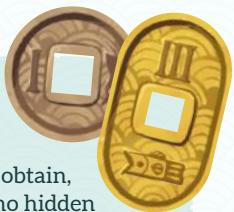
All of the tiles that you get during the game, as well as the coins you obtain, must remain in view of the other participants in the game. There is no hidden information.
With regard to coins, whenever the rules say that you receive or pay “a coin”, it refers to a coin worth 1. At any time during the game, the players may exchange 3 coins worth 1 for a single coin worth 3 or vice versa.
THE GAMEiV
This epic voyage, like the sun’s across the sky, concludes with nightfall.
4 rounds are played, with each one being made up of 4 game phases or seasons, that are resolved in this order:
PHASE 1. SPRING: the players receive incense and gifts from the forest.
PHASE 2. SUMMER: the players take turns performing their actions.
产 PHASE 3. AUTUMN: the players receive favor from the Spirits of the Forest.
PHASE 4. WINTER: the players wake up the Spirits of the Forest, feed their family and update some parts of the board.
After 4 rounds, the game comes to an end and the final score is tallied.
The player with the most happiness points (HP) is the winner.
HAPPINESS POINTS

Happiness points (HP) indicate success in the game. Whoever finishes the game with the most points is the winner.

When a player obtains HP, their happiness marker is advanced as many spaces as the points obtained.

During the game and at the end of the game, it is possible to lose HP. In such a case the player must move their marker back the number of spaces indicated.
THE PHASES OF THE GAME
The first player will have to move the phase marker every time you move onto the next phase:
STARTING PLAYER MARKER AND THE ORDER OF TURNS
The order of turns is determined by the starting player marker.

The player holding that marker is the first player, and the turns progress clockwise around the table. This player will be in charge of the phase marker, and will update it to indicate the current phase of the game.
PHASE 1. SPRING
In this phase, the players receive 1 gift from the forest and 1 stick of incense.
If the four incense spaces are empty at the start of this phase, the game comes to an end and the final score is tallied (page 18).

The stack of gift from the forest tiles is mixed up and as many tiles as there are players are revealed. These are placed face up near the board.
Then, starting with the first player and going in clockwise order, each player is given a stick of incense in their color that is in the incense space on the far left (which is then added to the player’s reserve) and after that the player chooses one of the gift from the forest tiles that is face up. The player executes the action shown on it and returns the chosen tile face down on top of the gift from the forest stack.
When all of the players have been given their stick of incense and a gift from the forest, the game moves on to the next phase: Summer.
The actions (page 10) provided by the gifts from the forest are:

Performing the Fund action

Performing the Cook action

Performing the Balance action

Performing the Improve Your Home action
In this phase, the players make offerings at the temples and use their Bamboo Shoots to carry out actions.
1 · CHECK IF YOU HAVE TO PASS
If a player has no more sticks of incense then that player has no choice but to Pass. That means the player’s actions in the Summer phase are done and they must wait for the rest of the players to Pass. If you have not
Passed, then move on to the next step.
2 · VISIT A TEMPLE
To do this, move your action marker to an empty temple space on your personal board that is different from the one you played in the previous turn (during the first round you are free to choose any of the 4 temples) and that has at least 1 Bamboo Shoot piece. By doing so, the player is indicating which actions they are going to execute later.

The player moves her piece to the red temple, thereby indicating that she will visit this temple and the actions that she will perform with her Shoots.
3 · MAKE AN OFFERING AT THE CHOSEN TEMPLE
Patricia placed her action marker on the red temple space, where there are 3 Bamboo Shoots. She must offer 3 sticks of incense, but there are only 2 left in her personal reserve. She has to offer her 2 sticks of incense to the red temple.
The player places a number of sticks of incense that is equal to the number of Bamboo Shoot pieces they have in the chosen temple (a minimum of 1). If that is not possible, they place as many sticks of incense as they have available.
The sticks of incense are placed in the temple of the same color on the main board, from bottom to top. If there are other sticks of incense (the player’s own or from other players) in the temple, the new ones are placed on top of those present, to show they

She places her sticks of incense on top of the 2 sticks belonging to Samuel, the green player that was already there.
Players may place 1 or more sticks of incense in a temple of a different color by paying 1 coin for each stick of incense that is placed in a temple other than the one where it was supposed to go.
Patricia could place 1 of her 2 sticks in a temple other than the red one by paying 1 coin, or place the 2 sticks in other temples by paying 2 coins.

4 · THE BAMBOO SHOOTS ARE PLACED IN THE STALK FIELD
The player places all the Bamboo Shoots (regardless of how many sticks of incense have been offered) and activates as many of them as the number of sticks of incense that were
presented as an offering to the temple. This is done by carrying out the following steps:
Place all the Bamboo Shoots available by the action marker from your personal board (the temple you’ve just visited) in the reeds on the main game board, on any bamboo stalk with an available space. Each bamboo stalk can receive a maximum of 2 new Shoots in this step.
Carry out the actions of as many Bamboo Shoots as the number of incense offerings you made, resolving them one by one in the order that you prefer. You may have made an offering of up to 4 sticks of incense, so you may activate up to 4 Shoots and the maximum actions is likewise 4.
5 · NEW BAMBOO SHOOTS ARE RECEIVED
As you complete (or decline) each action, push the Bamboo Shoots that you have placed down the bamboo stalks until they are in the shaded area. In this way, if you do that one by one, the same number of shoots will be pushed off. Take these new Shoots and place them on your personal board in the corresponding temple spaces.
If the Shoot cannot be placed in a temple space matching its color because the spaces are all full, you must place it in any other temple you choose and will be considered part of it in all regards.
Once this step has been completed, it is the turn of the next player. You move forward in this manner until all the players have Passed, and then proceed to the next phase: Autumn.

Patricia places the 3 Bamboo Shoots by her action marker: 2 of them in the leftmost stalk and the last in the rightmost one. She activates the actions of only 2 of the 3 Bamboo Shoots placed in the stalk field, since she made an offering of 2 sticks of incense. She decides to activate the Cook and Wildcard Shoots, and declines using the Fund action.

Since she placed 3 Bamboo Shoots, when she pushes them she will receive 3 new Shoots. The blue and red Shoots go into their available empty spaces on her personal board. Since all the green spaces are full, that shoot can be placed in any other available space of any color.
BAMBOO SHOOT ACTIONS
Among the bamboo, the fireflies show the light given by the temple.

The Bamboo Shoots are a very important part of the game. Their color shows the player which temple they belong to and where to place them on their personal board when they are received. The icon printed on the top of each piece shows which action they allow the player to perform when they are activated.

Receive 1 HP OR perform 2 of these actions in the combination you prefer:
BALANCE
Note: it is possible when you activate an action that you are unable or you do not wish to perform it, but you must still place the Shoot on the bamboo stalks on the main game board.
OBTAIN BALANCE. Choose 1 of the face up balance tiles of any of the 3 types from the board and place it in the corresponding upper part of your home: the type are placed on the left, the type in the center, and the type on the right. You cannot have more than 2 tiles of the same type on your personal board. In order to free up space for new ones, you must score the tiles (see below).
Complete this action by moving the tiles that remain on the board down and revealing a new tile from the stack of the same type and placing it face up in the space that was just left empty. If there are no more tiles of a certain type, then the space is left empty.
SCORE BALANCE. Choose 1 balance tile from those you have on your home and show it to the rest of the players to show them that you fulfill the requirements. You are then awarded the happiness points shown on the tile. Turn it over and place it on the scored tile space (the fan on your personal board’s wall). You can stack the balance tiles you have scored in that space. The requirements for the balance tiles are explained in detail on page 12.

Patricia activates a Bamboo Shoot with the Balance action, which allows her to either take 2 tiles from the board, score 2 of the tiles already on her personal board, pick 1 tile and score 1 tile, or do none of those and obtain 1 HP.


IMPROVE YOUR HOME
Receive 1 coin OR choose 1 face up home tile from any market, discard the amount of coins required and obtain the happiness points indicated by the tile.
Place the tile in any empty space in the grid that makes up your home. Congratulations, you have improved your home and your family is happier!
Complete this action by moving the remaining tiles down and revealing a new tile from the dispenser and placing it face up in the space that was just left empty.
If there are no more tiles in the dispenser, the empty space is not filled. This market has exhausted all of its stocks.

FUND
Take 2 coins from the reserve and place them next to your personal board. You need the coins in order to obtain home tiles.

COOK
Take 1 food counter from among those available on the main game board and place it on your personal board. You must have enough food to pass through the Winter phase (see page 16).
The food counters are only replenished once you have used all of those present on the main game board (or during the Winter phase). As soon as this happens, randomly take 5 counters from the pile and place them face up on the main game board. If the pile is all used up, mix up the counters that have been discarded during the game to create a new pile.

WILDCARD
Perform your choice of 1 of the 4 actions above.
HOME TILES

The home tiles provide diversity and quality of life to your home, which leads to greater happiness and comfort.
Each tile falls into one of these 4 types: decoration, faith, garden, and tools. Each of them also bears comfort points in values of 1, 2, or 3. These points are key to obtaining balance in your home.
Their characteristics are linked to the balance tiles, which indicate what type of tile and the comfort points you need to achieve for your home.

DECORATION

FAITH
Type

GARDEN

TOOL
Comfort Points
BALANCE
My home’s four walls protect what is dear to me. Green reeds shelter us.
Following the doctrines of balance within your home will allow you to make the best of the home tiles, which is fundamental to your progress in the game.
In order to score the balance tiles you must perform the balance action (see page 10) and also fulfill the pattern indicated on the tile defining the position and type of home tiles you must obtain during the game.

This balance tile requires a garden type home tile in order to be scored. Once this requirement is fulfilled the player receives 2 HP.
Each tile type is associated with a section of the home. The home is made up of a grid for home tiles that is 5 spaces wide by 3 spaces tall. The sections in it are:


These tiles are associated with the
left part of your home.
In order to score these
tiles you must fulfill the pattern within the 6
spaces on the left side of your home.
These tiles are associated with all of the spaces in your home. In order to score these tiles you can fulfill the pattern in any part of your home.
These tiles are associated with the
right part of your home.
In order to score these
tiles you must fulfill the pattern within the 6
spaces on the right side of your home.

The example tile above is type , so you would have to recreate the pattern in any of the 6 spaces on the right side of your home.
PATTERNS OF TYPE AND POSITION:
Have one home tile of the specified type.

One decoration type tile.
Have adjacent home tiles vertically or horizontally of the type and in the position specified.

One garden type tile and a faith type tile to its right.

One decoration type tile and just below it one faith type tile.

One garden type tile, and just below it a faith type, and below that a decoration type tile.
Have 4 home tiles in diagonally adjacent spaces of the type and in the position specified.

One faith type tile above, a garden type to the right, a decoration type below and a tool type on the left.
Have 5 home tiles horizontally or vertically adjacent of the type and in the position specified.

Two tiles of any type, two garden tiles to their right, followed by any one tile to the right of those.
PATTERNS OF TYPE, POSITION, AND COMFORT POINTS:
Have a minimum number of comfort points belonging to one specific type with any number of home tiles.

Have a minimum of 7 comfort points in various faith tiles.
Have adjacent home tiles vertically and/or horizontally of the type and in the position specified, that together add up to the minimum comfort points.
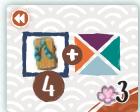
Have a tool type tile, and to its right any other type. Together they must have a minimum of 4 comfort points.

Have 4 tiles horizontally and vertically adjacent of any type, in the position that is shown, that together have a minimum of 9 comfort points.

In this phase, the players obtain the favor of the Spirits of the Forest that are associated with each of the temples, in accordance with the offerings the players have made.
Check each of the 4 temples separately (in any order you like) by performing the following steps in order:

1 · INVOKE THE SPIRITS
The player with the most incense at this temple is granted the Spirit tile that is face up there and places it in the lower part of their personal board.
If there are several tied players, then the one who placed a stick of incense last (the highest position) gets the tile.

Note for 2-player games: If the ghost player is the one who gets the Spirit tile, then the tile is simply removed from the game.
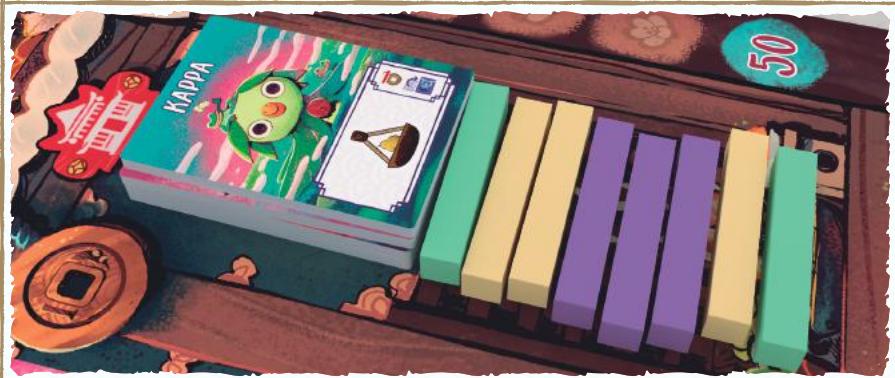
Diana (yellow) and Patricia (purple) have 3 sticks of incense each in this temple. Diana gets the Spirit tile because she placed her stick of incense there later (she visited that temple after Patricia did).
2 · RECOVER INCENSE
All of the players get their sticks of incense back from the board and put them in their incense reserve again.

Note for 2-player games: At this point you must remove the ghost player’s incense and put it back in the temples. To do this, you mix up the 4 temple tiles and reveal one for each temple on the board. Place as many sticks of incense from the ghost player as are indicated on the temple’s tile (always in the lowest position). Leave the 4 temple tiles on one side of the board.
3 · THE NEXT SPIRIT OF THE FOREST MOVES FORWARD
After removing the Spirit of the Forest tile during the invoke the spirits step, the next tile will be revealed. If there are no more tiles it means that it is the last round of the game and there is nothing more that needs to be done.
The Spirit of the Forest tiles allow players to perform different kinds of actions. These actions are explained in the next page.
THE SPIRITS OF THE FOREST
The whistling wind blows. A yokai is in the reeds, waiting to see you.
When the offerings of incense for each temple have been resolved, whoever has made the most in each temple receives the corresponding Spirit of the Forest tile.

At any moment during that player’s turn, they may activate the reward of the Spirit of the Forest tile. To do so, the tile is turned 90º, to make it clear that it has been used (the Spirit falls asleep). Players may wake up any sleeping Spirits during the Winter phase by paying the cost indicated on the tile (page 16).
Below there are the 7 types of Spirits of the Forest and the actions that each allows players to perform:

KAPPA
During the Summer, you can perform a Balance action according to the usual rules (page 10).

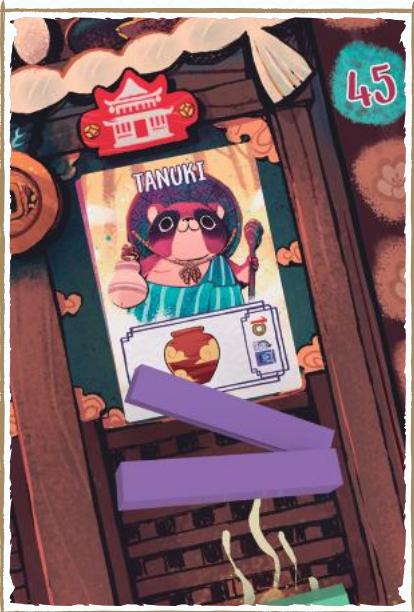
TANUKI
During the Summer, you may perform an Improve your Home action according to the usual rules (page 11).

ROKUROKUBI
During the Summer, you can perform a Fund action according to the usual rules (page 11).

KITSUNE
During the Summer, all of the Bamboo Shoots that you activate during this turn are considered Wildcards (page 11).

OOKAMI
During the feed your family step of Winter (page 16) you are given 4 units of food.

TENGU
During the Summer, if you wish, you can choose to discard all of the food counters and refill the 5 spaces with new ones. You get 1 of the available counters, either before or after resetting the food counters.

BAKENEKO
offering step of the Summer you can choose to place the incense in the temple or temples you prefer without paying any coins for that.
Furthermore, at the end of the game, players receive 2 HP for each different type of Spirit of the Forest they have.
In this phase, the players can wake up the Spirits of the Forest, feed their families and take account of the year.
Carry out the following steps in order:
1 · WAKE UP THE SPIRITS OF THE FOREST

Each player may turn their used Spirit of the Forest tiles back upright by paying the number of coins indicated on the tile.
Note: that waking up the Kitsune doesn’t have a cost in coins.
2 · FEED YOUR FAMILY

This step is resolved in turns. For each home tile that you have in the home section of your personal board, you must pay 1 food unit. If you cannot pay the food units required, you lose 1 happiness point for each food unit below the requirement.
Players are required to play these food counters if they have them. This means it is not possible to lose HP instead of food counters if the player has food in their reserve. If the player pays more food units than are required the excess is lost (no change can be given).
The counters paid provide different levels of nourishment depending on their type:

Tea - 1 food unit

Rice - 2 food units

Ramen - 3 food units
Leave the food counters that have been paid to one side of the board, so that the discarded ones do not get mixed in with those that have not yet been used.

Diana has 4 home tiles in the home grid of their personal board, so 4 units of food are needed to feed their family. They have 1 tea counter and 1 rice counter. Together they make up 3 food units, so 1 is missing. Diana must hand over the tea and rice counters and also loses 1 happiness point.
3 · THE STARTING PLAYER MARKER
And the phase marker are passed on to the next player in clockwise order.
4 · UPDATING THE TILE MARKETS

Place the home tiles in the lowest spaces of each category ( and ) at the end of their rows in the dispenser. Slide the other tiles down and place a new tile in the first space that is empty.

Put the balance tiles that are in the lowest spaces at the end of their stacks in the dispenser ( , and ), move the other tiles down and place the new tile in the first space that is empty.
5 · FILL THE EMPTY FOOD SPACES
If there are any.
ADVANCED GAME MODE
If you want your games to have an extra level of challenge, play using this mode.
During the game setup, the players flip their personal boards over to the nighttime side. This side has spaces with special indications in the home area.
A player may place home tiles of any type in their home spaces, except for those whose indications specify they require a particular type of home tile. In that case, the tile placed on top of the space must match the indications. At the end of the game, players lose 1 HP for each space with special indications that they have not covered.

The player will have to cover this space with a garden home tile or lose 1 HP at the end of the game.
VI END OF THE GAME AND FINAL SCORE
Once the Winter phase of the fourth round has been concluded, the game will have reached its end. Before assigning the victory, the final score must be tallied in which happiness points are won or lost due to various aspects of the game. The happiness markers are adjusted according to the following concepts:

1 2 HP are granted for each different Spirit of the Forest tile the player has obtained during the game (whether they were used or not).

Patricia has gathered 5 Spirits of the Forest, 4 of those are are unique. She gets 8 HP.

2 Each player verifies the harmony of their own home. To do this, they add up the total comfort points of all the home tiles in the 6 spaces on the left side ( ) of their home and compare that to the total comfort points they have in the 6 spaces on the right side ( ). For every point of difference between each side of their home, the player loses 2 HP.

3 Check the balance tiles that have not been scored. If the indicated pattern has been correctly recreated, then half of the indicated HP are granted (rounding up where needed). If the pattern is not fulfilled there are no effects at all.

Patricia has a total of 5 comfort points in the area on the left side of her home, while the tiles on the right side add up to 8 points. She has a 3-point difference between the two sides, so she loses 6 HP. She also has two non-scored but completed balance tiles. She gets 3 points for 1 and 1 point for the other.
4 Only for Advanced mode: The players lose 1 HP for each space with special indications that they have not covered.
The player with the most HP wins the game and ensures a future of balance, happiness, and harmony for their family. If there is a tie, the one who has achieved the most total comfort points on their home tiles wins. If there is still a tie after that, the players share the victory, toasting with a little sake.
KEMUSHI SAGA

The world is ancient, and the race of men has roamed it for only a heartbeat. The Spirits of the Forest, known also as the Yokais, curiously observe these newcomers from a distance. The Bitokus, wise as the deep roots of the oldest trees, fear that the presence of humans will affect the balance of nature. These humans spread through the forest with the childish vigour of a newborn opening their eyes for the first time, subduing both the fauna and the flora under their will.
This is the story of a world, about the struggle between natural chaos and artificial order. A story that stretches over thousands of years.
Discover the Kemushi Saga


CREDITS
AUTHOR: Germán P. Millán
ILLUSTRATOR: Jonatan Cantero
EDITOR: David Esbrí
ENGLISH TRANSLATION: Andy Campbell
PROOFREADERS: Marià Pitarque and William Niebling
LAYOUT: Meeple Foundry
Author’s acknowledgements
For their time, support, and precious advice, I would like to thank Juan Ruiz de la Fuente, Juan Milla, Aida Hernández, Samuel J, Jorge Barboso, Rafael Muñoz, Antonio Fernández Díez, Juanma del Rosal, Israel Reyes, Mikel Zorrilla and Lorena Santaella. I would also like to express my appreciation for Jonatan Cantero for his imagination and David Esbrí for providing the balance needed for this project.
GAME SUMMARY
PHASE 1. SPRING: players get incense and gifts from the forest.
PHASE 2. SUMMER: players take turns performing their actions.
1 · Check if you have to pass
2 · Visit a temple
Move your action marker to a different empty temple space on your personal board in which there is at least 1 Bamboo Shoot piece.
3 · Make an ofering at the chosen temple
Place as many sticks of incense of your color in the corresponding temple on the main board as the number of Bamboo Shoots you have in the temple you just visited on your personal board.
4 · The Bamboo Shoots are placed in the stalk field
Place all the Bamboo Shoots (regardless of how many sticks of incense have been offered) and activate as many of them as the number of sticks of incense that have been presented as an offering to the temple.
Balance Improve your Home
Cook Fund
Wildcard: choose 1 of the other 4 actions
5 · New Bamboo Shoots are received
PHASE 3. AUTUMN: the players receive the favor of the Spirits of the Forest.
1 · Invoke the Spirits
2 · Recover incense
In 2-player games, relocate the ghost player’s sticks of incense.
3 · The next Spirit of the Forest moves forward
PHASE 4. WINTER: players wake up the Spirits, feed their families and update some parts of the board.
1 · Wake up the Spirits of the Forest (optional)
2 · Feed your family
3 · The starting player marker
Is passed on to the next player clockwise, along with the phase marker.
4 · Update the tile markets
5 · Fill the empty food spaces
After 4 rounds, the game comes to an end with the final scoring. The player with the most happiness points (HP) is the winner of the game. If there is a tie, the one who has achieved the most total comfort points on their home tiles wins.
SPIRITS OF THE FOREST
Here we can see the seven types of Spirits of the Forest and the actions that each of those allow:
(1 ) Kappa: during the Summer, you can perform a Balance action according to the usual rules.
(1 ) Tanuki: during the Summer, you may perform an Improve your Home action according to the usual rules.
(1 ) Rokurokubi: during the Summer, you can perform a Fund action according to the usual rules.
(0) Kitsune: all of the Bamboo Shoots that you activate during this turn are considered Wildcards.
(2 ) Ookami: during the feed your family step of Winter you are given 4 units of food.
(1 ) Bakeneko: during the make an offering step of the Summer you can choose to place the incense in the temple or temples you prefer without paying any coins for that.
(1 ) Tengu: during the Summer, if you wish, you can choose to discard all of the food counters and refill the 5 spaces with new ones. You get 1 of the available counters, either before or after resetting the food counters.
下载 Markdown