TM_Rules_EN_11nov2022.md
British mathematician and cryptanalyst Alan Turing made a significant contribution to the advent of computers. We are offering you a chance to use a proto-computer, working without electricity or electronics, to find secret codes.
GOAL
Be the first to find the only code that will pass the test of all Verifiers. The code is made up of 3 numbers between 1 and 5:

a number,
and anumber.
a number,
Each Verifier checks for one CRITERION. For example, “Thenumber is odd." Once you have deduced all the criteria, you can figure out the only code that will satisfy them all.
For solitaire play or coop, see the SOLO AND COOPERATIVE MODES section, p. 8.


SETUP FOR YOUR FIRST GAME

Place the Machine tile in the centre of the table.

Assemble the punch-card support.
Do not take it apart at the end of the game;
store it in the box as is.

Place the punch cards in the support: all cards 1 in the front, followed by all 2 and so on.
Numbers 1 to 16 are introductory problems, perfect for new players. You can also find millions more problems online. We will use problem 1 for our setup example.
5 Pltce the Critera cardsii font
• Verifier A: card 4
• Verifier B: card 9

• Verifier C: card 11
• Verifier D: card 14
SOLO AND COOPERATIVE MODES
To play solo (or cooperatively with other players), read Solo and Cooperative Modes on the last page of this booklet.
Verifier:

In this game, a Verifier is a fictional person’, a form of artificial intelligence. It's not a player!

Place the Verification cards face down in front of their assigned Verifier (next to the Criteria card) A: 447 B: 646 566 D: 322
Note that each Verification card can be used for 4 different numbers and 4 different colours.

To avoid mistakes, tick the corresponding letter on the back of each Verification card (A, B, C or D).


Give a Player Aid (which doubles as a screen) and a note sheet to each player. If you are playing a game from the online app, note down the number of the game.
Draw a line through Verifier columns E and F.
They won't be used in this game.

Difficulty Factor / Luck
PROBLEMS

Verifier


Criteria cards

Verification cards
This booklet contains 20 problems to solve, or 20 games... But you will find literally millions more on the Turing Machine website!!

Scan the QR code here or go to turingmachine.info
For problems that work with the rules as presented here, choose the 'Classic' mode.
You will also find 2 new, more challenging modes of play.
• The first, called ‘Extreme, has 2 cards in front of each Verifier (but only one valid criterion amongst those presented on the 2 cards).
• In the second mode, called 'Nightmare', you do not know which Verifier is associated with which Verification card.
SOLUTIONS

GAMEPLAY
Unlike many deduction games, you won't be questioning the other players, but a machine. This machine consists of 4 to 6 Verifiers, a kind of artificial intelligence. Each verifier checks for one single aspect, one single criterion.
Questioning a Verifier consists of asking them if your proposal passes their test. It's up to you to figure out what you need to do to pass' their test; which criteria you must respect.
Anatomy of a Criteria card
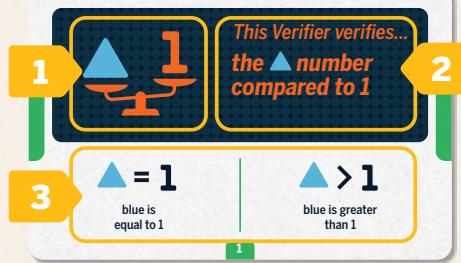

Icon indicating what the Verifier knows.

Written explanation of the precise element the Verifier is checking for.
List of possible criteria this Verifier is checking for. You have to find which is the right one!
ADVANCED STRATEGY:
All the Verifiers are essential to finding the final code. No Verifier will repeat information given by another. After a few games, you will notice that this bit of information will allow you to be more efficient in your deductions. You will understand, right from setup, that there are certain questions you will not need to ask.
ROUND STRUCTURE
The game is played in rounds, each one identical. All players will, individually and simultaneously, do the following steps: 1. Compose your Proposal.
-
Question.
-
Deduce.
-
End of Round.
1. COMPOSE
Compose your 3-digit proposals by overlaying 3 different-coloured cards: a▲ number, al number and anumber.
In the rare case that a particular card you need is being used by another player, simply wait until they are done before taking it.
2. QUESTION
You will question up to 3 Verifiers over the course of a round, without changing your proposal.
Place the Verifier's Verification card under your proposal, making sure it is properly lined up with the punch cards using these symbols in the corners:
Each Verifier willtell you if your proposal passes or fails their test.
The Verifier's Answer
You'll notice that only one hole appears when you overlap the 3 punch cards to make your proposal. It's through this hole that you'll see the Verifier's answer.

If the Verifier answers , your proposal has passed their test.
If the Verifier answers , your proposal has failed their test.
Mark a or a Vin the corresponding space on your note sheet.

Recap
Once you have made your 3-digit proposal, you will decide which Verifiers to question. Questioning a Verifier means asking if your proposal respects their criterion or not; if your proposal passes their test or not. The criteria that each Verifier is checking could be as simple as, “thenumber is even." The criterion that will allow you to pass the Verifier's test is one of those listed on the bottom of each Criteria card.
The answers the Verifier gives you will not give you information about the code, but only about the criteria they are verifying.
Let's imagine that the criteria of Verifier A is "The number is greater than 3." Here are some examples of answers to different proposals:

Only the proposals where the number is GREATER than 3 get a positive answer The other numbers mean nothing in this example; they are not what is being verified.
3. DEDUCE
Put your punch cards back in the support and analyse your answers. Write down your deductions on your note sheet. Determine if you have found the code or not.
4. END OF ROUND
Once all players have asked their questions and completed their deductions, everyone extends their closed fist and counts to 3 simultaneously. On 3, point your thumb either up or down at the same time as everyone else.
• Point upwards if you think you have found the code.
• Point downwards if you have not yet found it.
If nobody has pointed upward, start a new round.
If one or more players has pointed upward, go to the VERIFICATION AND END OF GAME SectiOn.
VERIFICATION AND END OF GAME
If one or more players think they have found the code, they should write it secretly (and clearly!) on their note sheet. Each one then checks, in turn, the soLuTioNS section at the bottom of p. 3 in this booklet, or uses the appropriate button in the application, and verifies if their code is correct.
If more than one person is correct, the one who found the code asking THE FEWEST questions wins. This is why keeping track of all your answers is so important (writing Vor X). If it is still tied, all tied players win. Prove your code is correct by composing it with the punch cards and then making sure it passes the tests of all the Verifiers!
If nobody has found the correct code, the players who were incorrect are eliminated, and the game continues for the other players. If there is only one player remaining, they win by default!
When the game is over, don't forget to erase the Von the back of the Verification cards.
NOTE SHEETS
Learn how to take good notes if you want to win!

Each round, write your proposal on the line of the current round.

Write the answers you got (Vor ) from each Verifier in the proper column. This is obligatory, and keeps track of the number of questions you've asked.

3 Use this section to cross off any numbers you've eliminated.

Use the bottom section to write down all the information you've learned about each.

Write the Verifier's criterion in this space once you have identified it.

EXAMPLE OF PLAY
Show this example to anyone who is learning the game. Here is a problem with 4 criteria:

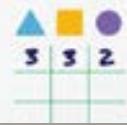
In the first round, you put together this proposal and you write it on your note sheet.

Verifier A verifies one criterion. This criterion could be either "Thenumber is equal to 1" or "Thenumber is greater than 1."
You question A. You take their Verification card and place it under your 3 punch cards You seein the hole. Your proposal has passed their test! So A's criterion is "The number is greater than 1," because thenumber in your proposal (3) is greater than 1, and you passed the test.
This does NOT mean that thenumber is 3! Verifier A doesn't know what the value of is, they just know thatis greater than 1. If you'd put 2, 3, 4, or 5, A would have answered.
Write your answer on your note sheet: write under A, next to your proposal.
Put the Verification card back, face-down. Because you have identified A's criterion, you won't need to question them again; you'll get no new information from them.
You then question Verifier D with the same proposal (which you need to keep for the whole round). They answer. What does that mean?
D verifies one thing only: which of is the smallest. In your proposal, is the smallest, and this does not pass D's test. You can deduce that the smallest is either ▲ or
Finally, you decide to question C.
They verify one of 3 criteria: either
is greater than , or▲ is smaller than , or ▲ is equal to. C answersX
to your proposal. C's criteria is not "the number is greater than the
one." There are therefore 2 remaining
possibilities: EITHER the number is
the same as the number, OR the
number is less than theone.
You can't ask any more questions this round.

REMINDERS AND CLARIFICATIONS
Game Order:

Compose your proposal and question Verifiers at the same time as the other players.
There aren't enough punch cards:
In the rare case that you need an unavailable punch card, simply wait until another player has finished using theirs to take it.
Don't get mixed up:
Put the Verification cards back in front of the correct Verifier immediately after you have finished questioning the Verifiers!
Number of Questions per round:
You can question a maximum of 3 Verifiers per round, but you can always question fewer than 3.
You must keep the same proposal for the entire round:
It is obligatory to write down on your note sheet your proposals and the answer to ALL the questions you ask. This will serve to determine the winner in case of a tie.


Strategy:
You will need the criteria of all the Verifiers to find the code. No criterion is superfluous.
Only one code respects all the criteria.
Public and Secret information:
Your proposal and the Verifiers you question are visible to everyone. Keep your answers and notes secret.
CRITERIA CARD EXPLANATIONS
At the beginning of every game, take the time to discuss and understand the meaning of each Criteria card. To help with this, here are some remarks and clarifications for each card. Cards with very similar structures have been grouped together in this list.
Card 1

To pass the test of this Verifier, you must find if the number is equal to or greater than 1.
Watch out! If the number in your proposal is 3 and you get athis does NOT mean that the number is 3, it only means that it must be greater than 1 (and not equal to it)

Cards 2 to 4
These cards work in a very similar way to Card #1, but there are now 3 possibilities. In Card #2, the number can be either less than, equal to, or greater than the number indicated.
Watch out! If the ▲ number in your proposal is 2 and you get a, this does NOT mean that the ▲ number is 2, it only means that it must be less than 3.

Cards 5 to 7
To pass this test, find if the number has to be even (2 or 4) or odd (1, 3, or 5).
Cards 8 to 10

The Verifier verifies that there is a precise number (that they know) of 1s in your proposal. For example, they can verify that there are two (no more, no less). In this case, the code can be 113, 151, 411, etc.
Cards 11 to 13

These cards work similarly to cards 2 to 4, but instead of comparing a number in your proposal to another specific number, it is comparing two numbers within your proposal For example, the number with thenumber. Watch out! If you getif your proposal is 3▲ and 3 this does NOT mean that the numbers are 3, just that they have to be the same.

Cards 14 to 15
The Verifier verifies that the number of a particular colour (that they know) is smaller than all the other numbers.

Card 16
The Verifier verifies that there are more of either even (e.g.: 454) or odd (e.g.: 341) numbers in the code.

Card 17
The Verifier verifies that there is a precise number (that they know) of even numbers in the code: zero, one, two, or three.
DO YOU THINK THE MACHINE HAS MADE A MISTAKE? If you are playing with the game's more difficult cards (identified by in this list) and you think that the machine has made a mistake in its answers, you are probably a victim of ‘The ‘X' Paradox' Scan this code to find out all about it! turir
?xX


XXY


turingmachine.info



Card 18
The Verifier verifies that the sum of all the numbers in the code is either even or odd.
Card 19
These cards work like cards 2 to 4, but the Verifier compares the sum of the andnumbers to 6. This sum can be less than, equal to, or greater than 6.
Card 20
The Verifier verifies if a number repeats itself, and if it so, how many times. There may be no repetition (e.g.: 125), one number repeats itself once (e.g.: 121), or a number repeats itself twice (e.g.: 222). If a number repeats itself, the Verifier does not know anything about it. They don't know the colour (if it's) or its number (a 2 or a 3, etc,).
Card 21
The Verifier verifies that there is either one pair of identical numbers (e.g.: 313), or no pairs of identical numbers (e.g.: 231, or 333 - which is not exactly a pair). If there is a pair, the Verifier does not know anything about it. They don't know the colour (if it's) or its number (a 2 or a 3, etc,).
Card 22
The Verifier verifies that the three numbers are in either ascending order, descending order, or neither. For example, 223 is not ascending (because the three numbers do not ascend, only two).
Card 23
This card works in the same way as 19, but the Verifier compares the sum of all the numbers with 6.
Card 24
The Verifier verifies that in the code there are consecutive increasing values in either a 2-digit sequence (e.g.: 312), or a 3-digit sequence (e.g.: 345), or none at all (e.g.: 132 - in this example the 1-3 sequence is increasing, but 1 and 3 are not consecutive numbers.).
Card 25
The Verifier verifies that there are either increasing or decreasing values in a 2-digit consecutive sequence (e.g.: 312 or 254), a 3-digit consecutive sequence (e.g.: 345 or 321), or none at all. (e.g.: 135 or 531 - in this example the 1-3 sequence is increasing, but 1 and 3 are not consecutive numbers).
The Verifier does not know if the sequence is increasing or decreasing.

Cards 26 to 27
The Verifier verifies that the number of a particular colour (that they know) is less than 3 (e.g.: the number is less than 3). Watch out! If the criteria is 'the number is less than 3, the other colours' numbers can also be less than 3... the Verifier is just not verifying that.

Cards 28 to 30
The Verifier verifies that the number of a particular colour (that they know) is 1. (e.g.: The number is 1.) Watch out! The other colours' numbers can also be 1... the Verifier is just not verifying that.


Cards 31 to 32
The Verifier verifies that the number of a particular colour (that they know) is greater than 1.


Watch out! The other colours' numbers can also be greater than 1... the Verifier is just not verifying that.

Card 33 △
The Verifier verifies that the number of a particular colour (that they know) is odd or even. (e.g.: The number is even.) Watch out! The other numbers can also be even (or odd, depending).
Cards 34 to 35

The Verifier verifies that the number of a particular colour is less than or equal to all the other numbers. (e.g.: They verify that no other colour is less than
Card 36 △
The Verifier verifies that the sum of all the numbers in the code is a multiple of 3, or a multiple of 4, or a multiple of 5.

Cards 37 to 38
The Verifier verifies that the sum of two particular numbers (that they know) is 4.

Cards 39 to 41

The Verifier verifies that the number of a particular colour (that they know) is less than, equal to, or greater than 1.

Card 42

The Verifier verifies that the number of a particular colour (that they know) is either less than or greater than either of the others (e.g.: The number is greater than the others).



Cards 43 to 44
The Verifier verifies that the number is less than, equal to, or greater than another particular number (that they know).


Cards 45 to 47
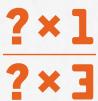
The Verifier verifies that the number of 1s or the number of 3s in the code is equal to a particular number (that they know).

Card 48 △
TAKE ON THE MACHINE!
The Verifier verifies that that the number of a particular colour (that they know) is either less than, equal to, or greater than that of another particular colour (that they know). (e.g.: the number is greater than the number.)
SOLO AND COOPERATIVE MODES
Go to turingmachine.info and select a problem you'd like to solve. On your own or in a team, solve the problem in the fewest rounds (and questions) possible, using only one note sheet.

When you have found the code, click on “Did you beat the MACHINE?"
You will discover how many rounds and questions our artificial intelligence took to find the code. To win, you must have done as well as or better than the Machine.
Watch out! Like in the regular game, you can only ask a maximum of 3 questions per round.
Share your successes on social media with the hashtag #turingmachinegame
HANDICAP SYSTEM
If an experienced player is playing against newer players, we strongly recommend using this system to level the playing field. In the first round (and only the first), the experienced player fills in a number of answer squares. These squares count as questions the player would have asked (leaving fewer for the player to ask in the first round).
Fill in 1 square if the difference in experience/skill is slight, and 2 squares if the difference is greater.
For example, in the latter case, the player could only ask one question in the first round, because there are 2 squares already filled in!
Publisher: Christian Lemay Creative Director: Manuel Sanchez Graphic Design/Illustration: Sébastien Bizos Translation: Matthew Legault

We finance the replanting of all trees used in the production of our games.
