rules_zh_雅典卫城_33250.md
·雅與氹城

[No text]
游戏概览与目标
在地中海的中心,几个新兴城市正为了追求财富和名誉而彼此竞争着。
古希腊最有天赋的建筑师们都在摩拳擦掌,希望为自己的城市争得荣耀。通过兴建住宅、神庙、市集、花园和兵营,玩家能够扩张自己的城市,进而击败对手并获得胜利。利用协调的规划来提升自己城市的知名度,并修建广场以巩固其地位。
请确保你的城市拥有足够的石料供应,因为这是种必不可少的建筑资源。以足够的采石场为基础,建造更高的建筑,让自己的城市直指天空。
1本计分纸

61个城市板块

4个起始板块


4张提示牌
1个起始玩家标记

40个石料方块
[No text detected]
游戏设置
根据城市板块背面的图标,拿取并使用与玩家人数匹配的城市板块,将未使用的城市板块留在游戏盒中。

2人游戏
≥+
3人游戏
2+/3+
4人游戏
2+/3+/4
2人游戏:每堆3个
● 将使用的城市板块混洗后平均分为11堆,面朝下放置,每堆板块数见右图。
注意: 在2人或3人游戏中, 你也可以使用所有城市板块来延长游戏轮次数。如果这么做, 则在2人游戏中改为将城市板块组成19堆, 在3人游戏中改为将城市板块组成14堆。
3人游戏:每堆4个
4人游戏:每堆5个


- 将剩余的城市板块正面朝上排成一行放在桌面中央。② 在游戏过程中,这一行被称为“建造区域”。
● 每位玩家分别扮演一名建筑师,各拿取1个起始板块放在自己面前。
● 最近爬过山的玩家拿取起始玩家标记(或随机选择起始玩家)。

- 从起始玩家开始,按照顺时针方向,每位玩家依次拿取下方所示数量的石料,放在自己面前:⑤
起始玩家

二号位玩家

三号位玩家

四号位玩家

- 将剩余的石料全部放在一旁组成供应堆。

4人游戏的设置示例。
小提示: 在每一轮开始时, 建造区域内的板块数量始终为玩家人数+2。例如, 在4人游戏中会有6个板块。

游戏将总共进行若干轮次(设置时的城市板块堆数+1轮),每一轮都从起始玩家开始,按照顺时针方向进行游戏。
每位玩家依次进行自己的回合,当建造区域内仅剩1个城市板块时一轮结束(详见第7页:刷新建造区域)。
重要: 每一轮结束时建造区域内总是会刚好剩下一个板块。
玩家回合
从起始玩家开始,每位玩家在自己的回合中需要依次执行以下两个步骤:
- 拿取1个城市板块。
- 将拿取的板块加入自己的城市。

拿取1个城市板块
在你的回合内,先从建造区域拿取1个想要加入自己城市的板块。
拿取板块时从最右边的第一个城市板块数起,每跳过一个城市板块就必须支付1个石料。
如果你拿取的是右数第一个城市板块,则无须支付任何石料。
注意: 如果玩家面前没有石料, 则只能拿取建造区域内右数第一个城市板块。
将支付的石料从自己面前放回供应堆中。
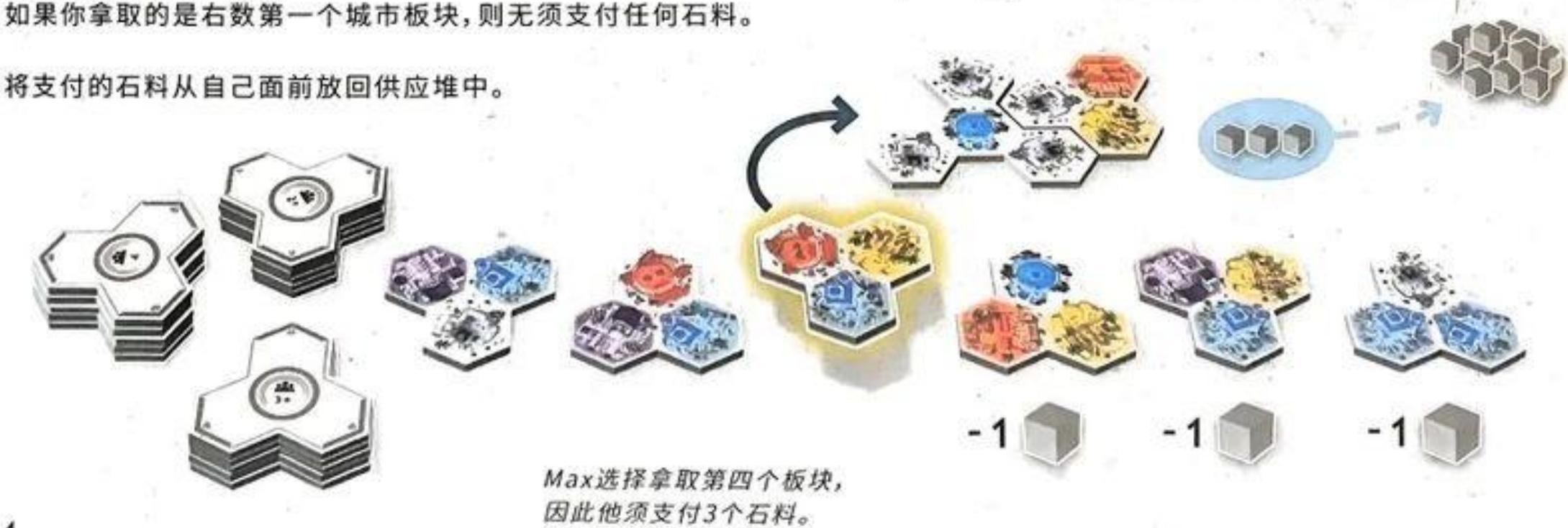
Max选择拿取第四个板块,因此他须支付3个石料。

将拿取的板块加入自己的城市
玩家必须立即将拿取的板块加入自己的城市。你可以将其放置在第一层或者更高层的位置上。
将板块放置在第一层(最低的一层)时,必须将其与自己城市中其他板块的至少一条边相邻。
将板块放置在第二或更高层时,必须将其完整覆盖三个六边格(下方不能有任何部分悬空),且这三格必须属于至少2个不同的板块。
每个城市板块都由三个六边格组成,每个六边格都代表一个建筑。建筑分为以下三类:
采石场:你能够从中获得石料。
- 广场:用于决定你城市中对应类型街区的分数倍率。

街区:如果满足特定规则,就能为你提供分数。
采石场
采石场不会在游戏结束时为你提供分数,但会在游戏过程中为你提供石料。当你用板块覆盖一个采石场时,你立即从供应堆拿取1个石料,放在你面前。

Max将他拿取的城市板块放置在第二层,覆盖了2个采石场。他立即从供应堆拿取2个石料。

注意:格子一旦被覆盖后,其上的任何图案在终局计分时将不会被纳入计算。
小提示:你可以在提示牌上查看到不同人数的游戏中,每种建筑的使用总数。
广场
广场共有五种颜色,分别对应相同颜色的一种街区类型。在终局计分时,广场决定了你城市中对应类型街区的分数倍率。根据广场星形图标的总数来确定这个倍率。如果你拥有多个相同类型的广场,则这些广场上的星形图标数量会相加。
放置广场时,无须将其与对应类型的街区相邻。

X1



X ≥

X3
注意:你的起始板块上已经自带一个住宅广场。
街区
街区按颜色分为以下五种类型。
游戏过程中你可以将街区按照通常规则放置在任意位置,但是只有同时满足以下两个条件的街区,才能在终局计分时计算其分数:
- 满足该类型街区的计分放置规则;
- 你城市中必须存在至少1个对应类型的广场(详见第5页:广场)。

街区的计分放置规则
住宅
城市中的居民们喜欢抱团居住在最大的那个住宅区里。你只会计算自己城市中,彼此相邻且数量最多的一个住宅群。


市集
商人们不喜欢竞争,因此希望独立经营。你只会对不与任何其他市集相邻的市集进行计分。


兵营
士兵们夜以继日地坚守着城市的边界。你只会对位于城市外侧边缘的兵营进行计分。


神庙
牧师们吸引着周围地区的信徒。
你只会对被其他建筑完全包围的神庙进行计分。


花园
公共园林总让你的城市熠熠生辉。
花园总是能进行计分,没有计分放置规则。
街区的分值
位于第二或更高层的街区能够令你获得更多的分数。
满足计分放置规则的每个街区, 其分值由其所在的层数决定: 位于第一层的街区价值1分, 第二层价值2分, 第三层价值3分, 以此类推 (详见第7页: 终局计分)。
重要:广场与街区不同,其分数倍率与所在层数无关。
刷新建造区域
每当建造区域内仅剩1个板块时,依次完成以下操作:
- 将仅剩的那个板块移动至右数第一个城市板块的位置, 然后拿取1个板块堆, 将其中的城市板块依次正面朝上摆放, 补满建造区域中剩余的位置。
- 当前起始玩家将起始玩家标记传递给左手边的玩家。
从新的起始玩家开始,继续进行下一轮游戏。
如果已经没有用于刷新建造区域的城市板块堆,则本局游戏结束。
重要:游戏结束时,建造区域内会剩余1个城市板块。

[No text]
当建造区域内仅剩1个城市板块,且场上没有城市板块堆时游戏结束。

终局计分
按照以下步骤,每位玩家在计分纸上,依次记录下其城市中每种类型的街区得分:
- 将你城市中所有满足计分放置规则的同类型街区分值相加。
- 将你城市中所有同类型广场上星形图标的数量相加。
- 对于每种类型, 分别将以上两个数字相乘, 即为你在该类型街区的得分。
在游戏结束时你每剩余1个石料,就获得1分。
总分最高的玩家获胜。
如果出现平手情况,则平手玩家中剩余石料较多的一方获胜。如果再次平手,则平手玩家共享胜利。

Max首先计算他城市中住宅街区的分数。在最大的住宅群中,有5个住宅街区位于第一层,有2个位于第二层。两者的总分值为 $9(5\times1+2\times2=9)$ 。
住宅广场上共有3个星形图标,因此他的住宅街区总分为3×9=27分。
如果你希望提升游戏难度,可以使用下方的变体规则进行游戏。
游戏设置与游戏流程保持不变。变体规则中为每种类型的街区各增加了一个额外的计分放置规则。满足额外计分放置规则的每个街区,其分值将会改为双倍。如果不满足额外计分放置规则,则仍旧按照标准游戏的规则进行终局计分。
这些额外的计分放置规则并不会替换标准游戏中的计分放置规则。你仍然必须满足原有的计分放置规则,且有至少1个对应类型的广场,才能够计分。
你可以在同一局游戏中使用若干种街区的变体规则。但我们建议你首先只使用一种类型街区的变体,在将每种变体都体验过后,再组合多种变体规则或者同时使用所有变体规则。
住宅

如果你城市中最大的住宅群分值为10分或更多,则改为获得双倍住宅街区得分。
市集
你城市中每个与市集广场相邻的市集,其分值都改为双倍。
你城市中每个有3或4条边处于城市外侧边缘的兵营,其分值都改为双倍。
你城市中每个位于第二或更高层的神庙,其分值都改为双倍。
你城市中每个与湖泊相邻的花园,其分值都改为双倍。完全被建筑包围的一个空白六边格称为一个湖泊。
下载 MarkdownAkropolis Rules Eng.md
AKROPOLIS
Overview and goal of the game
At the heart of the Mediterranean, rival cities seek wealth and glory.
The most talented architects in ancient Greece stand ready to achieve this goal. Build housing,temples, markets, gardens and barracks, so you can grow your city and ensure it triumphs over the others. Raise its prestige with harmonious planning that conforms to specific rules, and enhance it by building plazas.
Stone is an essential resource, so make sure you do not neglect it. You’ll need enough quarries so you can build higher up, making your city stretch towards the sky.
Setup
• Take the City tiles that correspond to the number of players
(refer to the backs of the tiles).
4 players: 2+ / 3+ / 4
3 players: 2+ / 3+
2 players: 2+
• Create 11 equal stacks of tiles, placed face down (1).
2 players: 3 tiles/stack
3 players: 4 tiles/stack
4 players: 5 tiles/stack
Note: For 2- or 3-player games, you can make the game longer by using all the tiles. If so, create 19 stacks (for a 2-player game), or 15 stacks (for a 3-player game).
• Place the rest of the tiles face up in the center of the table, forming a line (2). This line of tiles will be called the ‘Construction Site’ from now on.
• Each player, known as an Architect, takes a starting tile and places it in front of them (3).
• The Architect who most recently climbed a hill takes the Chief Architect marker (4).
• Working around clockwise from the first player, each Architect takes the number of Stones indicated below (5)
1st Player: 1 stone
2nd Player: 2 stones
3rd Player: 3 stones
4th Player: 4 stones
• The remaining Stones are placed nearby (6).
Tip: At the start of each round, there must always be 2 more tiles in the Construction Site than the number of Architects. Here, 6 tiles are laid out for 4 players.
AKROPOLIS
Playing the game
Play continues in a clockwise direction, starting with the Chief Architect. The Architects take turns until there is only one City tile left in the Construction Site (see: Supplying the Construction Site).
Important: The last tile in the Construction Site is not played.
Architect’s Turn
Starting with the Chief Architect, the Architects take turns performing the following two actions:
• Take a tile
• Add a tile to their City
Take a tile
On their turn, the Architect chooses the tile they wish to take and adds it to their City. They must pay 1 Stone for each tile that precedes it in the Construction Site. If you take the first tile, you do not need to pay anything. Spent Stones are returned to the reserve.
Note: If an Architect has run out of Stones, they must take the first tile in the Construction Site.
Add a tile to their City
The selected tile must be added to your City. You can place it either on the 1st level or a higher level. A tile placed on the 1st level must border another of your City tiles along at least one edge. A tile placed on a higher level must be constructed on top of 3 hexes (it cannot be placed above an empty space) and must cover hexes on at least 2 different tiles.
A City tile is made up of 3 Construction hexes. There are 3 types of Construction:
• Quarries, which allow you to gain Stones;
• Plazas, which multiply the value of your Districts;
• Districts, which can give you points if correctly placed.
Note: A hex that is covered by another tile no longer counts towards your City.
Tip: you can find the quantities of each Construction hexes for 2 / 3 / 4 players on the player aid.
AKROPOLIS
Quarries
Quarries do not score any points at the end of the game, but they allow you to gain Stones. When an Architect covers a Quarry with another tile, they take 1 Stone from the reserve.
Plazas
Plazas will multiply the points that you gain for Districts of the same type at the end of the game. The multipliers are represented by the stars. If you have several matching Plazas, their stars are cumulative. A Plaza does not need to border Districts of the same type.
Note: You begin with a Housing Plaza on your starting tile.
Districts
There are 5 different types of District.
A District can be constructed freely but to gain points, each one must meet two conditions:
• The placement condition for its type;
• At least one Plaza of that color in your City (see: Plazas).
Houses (Blue): The citizens of your city like to live together in one large neighborhood.
You only earn points for Houses that are part of your largest group of adjacent Houses.
Markets (Yellow): Merchants don’t like competition, so want to be kept separate from other markets. A Market must not be adjacent to any other Market.
Barracks (Red): Soldiers keep watch over your city’s borders. Barracks must be placed on the edge of your city.
Temples (Purple): Priests attract followers from the surrounding area. Temples must be completely surrounded.
Gardens (Green): Parks always enhance your city. There are no placement conditions on Gardens.
Value of Districts:
A District constructed on a higher level of your City can earn you more points. The value of a District is defined by its construction height: a District built on the 1st level would be worth 1 point, on the 2nd level 2 points, on the 3rd level 3 points, etc. (see: Calculating victory points).
Important: In contrast to the Districts, Plazas constructed on higher levels do not earn you more points.
AKROPOLIS
Supplying the construction site
When there is only one tile left in the Construction Site, complete the following steps:
• Place the remaining tile in the first position, then take one stack of tiles and place the tiles face up next to each other, to replenish the Construction Site.
• The Chief Architect marker passes to the player to the left.
Play continues around, starting with the new Chief Architect. If there are no more stacks for you to replenish the Construction Site, proceed to the End of the game.
Important: The last City tile is not played.
End of the game
The game ends when there is only one tile left in the Construction Site and all the stacks have been used.
Calculating victory points
Using the scorepad, each Architect calculates their victory points for each type of District in the following way:
• add up the Values of all your Districts that respect their placement condition;
• add up the number of stars on the matching Plazas;
• multiply these two numbers together.
You also gain 1 additional victory point for each Stone in your supply at the end of the game.
The player with the most points wins the game. In the event of a tie, the player with the most Stones wins.
Tip: You can use our score calculatoron the Gigamic Adds app.
AKROPOLIS
Variants
If you wish to increase the difficulty level, you can play the variants below.
The setup and gameplay remain unchanged. Each variant adds an additional placement condition to a type of District. If your District meets this additional condition, its points are doubled; if it does not, then it scores normally.
These additional constraints do not replace the usual placement conditions. In order to score points, a District must always respect its original placement condition and your City must have at least one Plaza of that same type.
You can use several of the variants within the same game, but we suggest that you first play each variant separately.
Houses (Blue): If your group of Houses Districts has a value of 10 or more, its points are doubled.
Markets (Yellow): If your Market District is next to a Market Plaza, its points are doubled.
Barracks (Red): If your Barracks has 3 or 4 empty spaces adjacent to it, its points are doubled.
Temples (Purple): If your Temple is built on a higher level, its points are doubled.
Gardens (Green): If your Garden is adjacent to a lake (an empty space that is completely surrounded), its points are doubled.
下载 Markdown