COT_RULES-EN-FINAL_compressed.md
ceether
It is the late 1960s, and a new generation of young people cherish freedom, friendship, and love by creating gatherings where everyone can come together in peace and enjoy the ultimate life experience - music festivals!
Everyone wants to see The Cascadians, Tikki Tooraid, and Great Western Cowboys this summer - but at which festival will they play?
In Come Together, you organize your own festival, using your volunteers to attract audience and the hottest artists, build stages and camps, and gain publicity to make your festival the best of all time!
GeneralCOMPONENTS
1 GAME BOARD

Double-sided (Front: 1-4 players; Back: 5-6 players)
12 LOCATION TILES

Front (example)

Back (4x round I tiles)

Back (4x round 2 tiles)

Back (4x round 3 tiles)
6 NEWSPAPER TILES
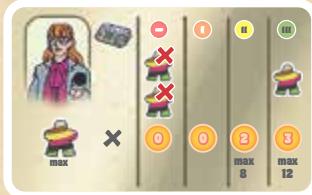

5 double-sided standard newspaper tiles (example)
I double-sided round 3 newspaper tile
16 FRIEND CARDS


Front
Back

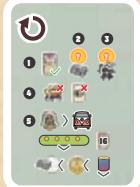

33 STAGE UPGRADE TOKENS


Front


Back


Back

25 stage
7 up-andcomer cards
STAR DECK


Front (example)
Back

30 stage
7 up-andcomer cards
Back
Front (example)


25 camp
7 up-andcomer cards
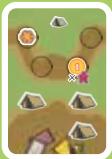
AUDIENCE DECK

Front (example)

Back
audience cards
4 up-andcomer cards


Front (example)
General SETUP
Place the game board in the middle of the table with the side whose top left symbol matches the player count face up.

Place the countdown marker on the leftmost space of the activation track at the upper edge of the game board.

3Sort the location tiles by the color on their backs.Attach a random round I tile face up to each of the indentations at the edges of the game board.
Set the round 2 tiles and round 3 tiles aside for now.They will come into play in later rounds.
5 Place the meeples, flower power tokens, stage upgrade tokens, and the round end card in a common supply near the game board.
Separately shuffle the stage deck, star deck, camp deck, and audience deck, placing each face down at the outside end of their corresponding location. Leave room for a discard pile next to each deck.
(7 From each deck, deal 4 cards face up above each slot of the adjacent location tile, filling them from left to right. If there are more than 2
up-and-comer cardsin a display, discard the rightmost up-and-comer card and deal a new card from the deck. If necessary, repeat this until there are no more than 2 up-and-comer cards in each display.
Example: The 3rd up-and-comer card at the audience location is discarded, and a new card is drawn.
When playing with 3 or more players, return the friend cards to the box. See pages 17–18 for 2-player and solo rules.
Randomly place I standard newspaper tile above each of theand 02 slots at the top of the game board, with a random side face up. Return the leftover standard newspaper tiles to the box.
Place the round 3 newspaper tile above theslot. Use its A-side if there are 4 or less up-and-comer cards in the four displays combined. If not, flip the tile to its B-side.
≤ 4 up-and-comer cards: A-side
≥ 5 up-and-comer cards: B-side


In the example below, there are 4 up-and-comer cards (see the symbol above the displayed cards).Thus, the A-side is used.

EXAMPLE OF GENERAL SETUP


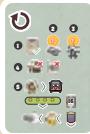
XXXXX


90 meeples
33 stage upgrade tokens
18 flower power tokens
Player COMPONENTS
6 FESTIVAL BOARDS

Double-sided
PLANNING DECK
Back

Front (example)


5 star cards
5 up-andcomer cards

5 stage cards

5 camp cards

5 audience cards

5 bonus cards
6 OVERVIEW CARDS


Front
Back
1 SETUP CARD

3-6-player side
1-2-player side
6 STARTING CAMP CARDS


Front (example)
Back
8 STARTING STAGE CARDS


Front
24 PUBLICITY MARKERS

6 of each color
12 SCORING MARKERS
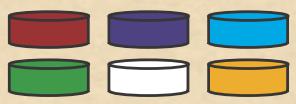
2 of each player color
60 WORKERS

10 of each player color
6 ACTIVATION TOKENS


Bexkmpple)


I of each player color

PlayerSETUP
Each player takes the following in the player color of their choice:
• 2 scoring markers
• 10 workers
• I activation token
Additionally, deal the following to each player:
• I festival board
• 4 publicity markers, one of each color
• I starting stage card
• I random starting camp card
• 5 random cards from the planning deck
Return unused components to the box.
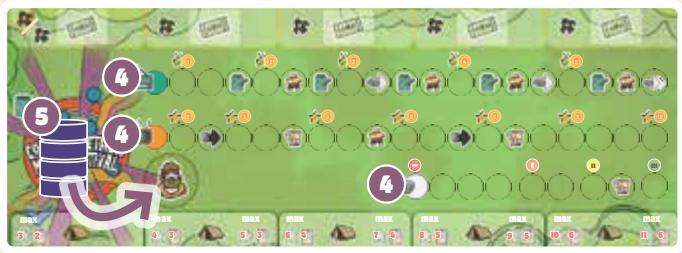
Each player places their scoring markers on the game board as follows: One as a l-point marker on space 0 of the scoring track, and the other as a 50-point marker on the leftmost space of the 50-point track.
Whenever you receive points in the game, advance your l-point marker accordingly. Each time your I-point marker laps the scoring track, advance the 50-point marker one step to the right (first time to 50+, second time to 100+, etc.).

GAINING YOUR STARTING COMPONENTS:
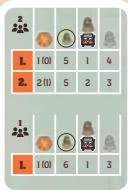
Randomly determine a starting player. Next, flip the setup card to the side corresponding to your player count and take your starting components:The starting player takes the components indicated for position #1, the player to their left takes the components indicated for position #2, etc.
The setup card table:
• Column I (left): Player position
• Column 2:The number of flower power tokens (the number inside the brackets is only used for the SPECIAL POWERS VARIANT on page 19)

• Column 3:The number of active workers

• Column 4:The number of resting workers

• Column 5:The number of reserved workers

ORGANIZING YOUR COMPONENTS:
Place your festival board in your play area with the Come Together Music Festival sign face up.This side of all festival boards is identical. If you want to play on the asymmetric side, see SPECIAL POWERS VARIANT on page 19.
Place your starting stage card with the front face up above the top left

space
of your festival board.
③ Place your starting camp card face up below the bottom left space

Dof your festival board.
Place the publicity markers as follows: On your festival board, place the cyan marker on the cyan space, the orange marker on the orange space, and the white marker on the white space.The black publicity marker is placed on the black space of the starting camp card. Each colored space is the starting space of their respective publicity track.

Example: John is starting player (position #I) in a 4- player game and takes the following (according to the first row of the setup card):
Example: John's starting components

I flower power token

4 active workers (on his festival board)

I resting worker (on the game board)

5 reserved workers (next to the game board)
Place your active workers on the space for active workers your festival board.

Resting workers are placed next to the hippie bus matching your player color on the game board, while reserved workers are placed next to the game board (see John's starting components above).
Place your overview card, activation token, and flower power tokens to the left of your starting camp card.
8 1–4 player game: Choose 4 of the 5 cards you received from the planning deck and place them face up to the left of your festival board (in any order).This is your planning display. Return the unchosen card to the box. 5–6 player game: Choose I of the 5 cards to activate immediately (see CARDS OVERVIEW on page II) and place the remaining 4 cards face up in your planning display. After your first game, we recommend using ADVANCED SETUP on page 16.
EXAMPLE OF PLAYER SETUP (JOHN'S PLAY AREA):


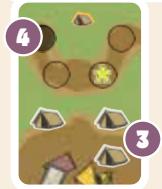
Make room for 2 rows of cards above your festival board.
Make room for I row of cards to the right of your starting camp card.

Overview OFTHEGAME
Come Together is played over 3 rounds (festival days).The goal of the game is to score the most points.There are several ways to score points in the game, but normally you get most points from holding concerts at the end of each round. In order to score points, you must try to gain publicity before the concerts and attract the right audience for your artists. Come Together is a worker placement game, but with a special twist: When placing workers, you do not immediately gain the card you just claimed.You must wait until a player activates that location. Players are
constantly facing important dilemmas: One dilemma is whether to claim a card or activate a location.Timing of the activation can be crucial. Another dilemma is whether to claim the card you really want or claim a less attractive card in order gain more publicity by joining players on another location. You must place your workers on the audience location to gain audience cards; stage location to get stage cards, etc. Up-and-comer cards are mixed into each of the decks and can be gained at any of the four locations (if present in the display).
HOW THE CARDS ARE CONNECTED

You need audience cards to gain meeples, and camp cards to accommodate them.
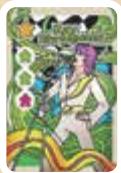
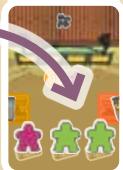
Stage cards allow you to place artist cards which attract meeples (audience) from your camp cards on a festival day (at the end of the round). Each artist card requires meeples with specific preferences.
AUDIENCEPREFERENCES:

Rock

Country

Psychedelia

Soul

Folk
THE ANATOMY OF THE FESTIVAL BOARD

BLACKTRACK (festival magazine publicity)

Advancing on each track grants immediate bonuses and increases the benefits it provides:
Cyan track: Points for each up-and-comer card at the end of each round.
Orange track: Points for each star card at the end of each round.
White track: Points for the multiplier on the newspaper tile at the end of each round. Note: Progress on this track resets each round.
Black track: Meeples and camp cards you can keep for the next round.
Playing THEGAME
Beginning with the starting player and proceeding in clockwise order, each player takes a turn by performing one of the following 3 actions:

Place workers

Activate location

Take back workers
Each action is explained in detail below.
The overview card shows a summary of the 3 potential actions:

Front: The 3 potential actions (A, B, or C)
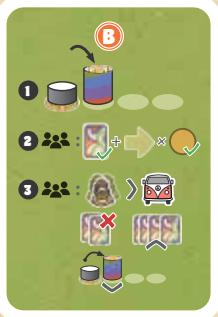
Back:Action B in detail

Place Workers

Stack the required number of active workers from your festival board on any vacant location space. From now on, a stack of l–3 workers on a location space is called a crew.
Gain the location space bonus: A location space requiring 2 or 3 workers grants a bonus.Take this bonus immediately (see BONUS OVERVIEW on page 10).
Note:When placing workers on a location space, you also claim the card in the slot above it. However, you do not take the card until a player activates this location (see ACTIVATE LOCATION on the next page).


Example: Janis (red) cannot place her workers on the left space, since this is occupied by Keith (blue). She places two workers on the right location space and immediately receives a black meeple for the location space bonus. Note that she does not take the Jay Purr card until a player activates this location on a later turn.

Activate Location
O PLACE YOUR ACTIVATION TOKEN
Place your activation token on the space to the right of the countdown marker on the activation track on the game board and immediately gain the bonus shown on this space (see BONUS OVERVIEW on page 10).
② GAIN CARDS AND PUBLICITY
Choose a location (stage location, star location, camp location, or audience location) where you have at least one crew.You activate that location for all players who have at least one crew there.
Simultaneously, each player with a crew on this location performs the following two steps (Take The Card & Advance Your Publicity Markers) in any order:
• Take the card in the slot above each of your crews at this location. For each card, choose to either:
• Activate the card
OR
• Place the card face up in your planning display to the left of your festival board. For both options, see CARDS OVERVIEW on page II.
• Advance your publicity markers up to a number of steps equal to the number of occupied spaces on this location tile:
• You may move your publicity markers on either of the two tracks shown at the bottom of the location tile.
• You may split the steps between the two tracks as you like, even advancing all steps on only one track.
• Whenever you pass or land on a bonus symbol on the track, gain the bonus immediately (see BONUS OVERVIEW on page 10).
• If you reach the end of a track, further steps on this track are forfeited.

Each player on the activated location may additionally return one (and only one) flower power token to the supply to advance one additional step. Advance on either of the two tracks shown on the location tile.
Notes:
• You choose in which order to take cards, advance on tracks, and spend flower power tokens.You may even advance on one track, then take a card, and finally advance on the other track.
• The symbols above each track do not grant any bonuses.They take effect at the end of each round.
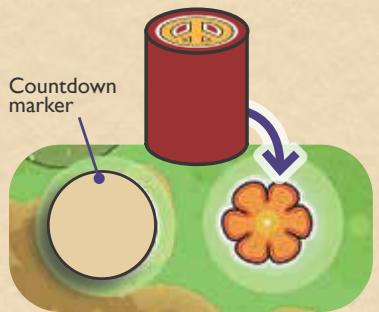
Example: Janis places her activation token on the space to the right of the countdown marker and takes the bonus (flower power token).

Example (continued): Janis (red) activates the star location. Janis takes both Caylus Wispur and Jay Purr, while Keith (blue) takes Doomheaven. For each card, they must decide whether to activate it or place it in their planning display.

Example (continued): Since there are 3 occupied spaces on this location tile, both Janis and Keith may advance up to 3 steps each. They allocate the steps between the cyan and orange track as they like.

Example (continued): Janis advances 2 steps on the cyan track, gaining 2 bonuses, and I step on the orange track.


Example (continued): Keith decides to advance all steps on the orange track, gaining I bonus, and even spend one flower power token to advance one additional step on the orange track.

Example: This point symbol takes effect at the end of each round.
CLEAN UP
Note:The CLEAN UP phase is performed for each activation, except for the last activation at the end of each round (see THE END OFTHE ROUND on page 12).
All crews on the activated location are stacked next to their corresponding hippie buses on the game board and becoming resting workers.
Discard any remaining cards at the activated location and deal 4 cards (from left to right) from the corresponding deck to form a new faceup display. There can be no more than 2 up-and-comer cards in the display, as instructed in GENERAL SETUP on page 3.
Advance the countdown marker one step to the right and return your activation token to your play area.
DISCARDING CARDS:
Whenever you discard cards, discard them face up next to their corresponding deck.
If a draw deck is exhausted, shuffle the discard pile to form a new draw deck.
Starting stage cards and cards that originate from the planning deck are returned to the box (or put aside) when discarded.
Extreme case: If there are not enough cards in the discard pile to replenish the display to 4 cards on a specific location, that location is locked for the remainder of the game. Flip the location tile face down and return any cards in the corresponding deck to the box.

Example (continued from pervious page): Red crews are stacked next to the red hippie bus; blue crew next to the blue hippie bus.

Example (continued): The leftover card at the activated location is discarded.


Example (continued): Janis takes back her activation token, and the countdown marker advances one step.

Take Back Workers
Move all resting workers from your hippie bus area to your space for active workers on your festival board. Additionally, you may perform one (and only one) of the following:
Gain one active worker by moving a reserved worker (from next to the game board) to your space for active workers. Consequently, your number of active workers is increased with one.
OR
Discard one active worker to your stack of reserved workers to immediately perform one full PLACE WORKERS action (see page 7). Consequently, the number of active workers is reduced with one.
OR
Draw three cards from either the stage deck, star deck, camp deck, or audience deck, choosing one to place face up in your planning display (do not activate it) and discarding the other two.
Note:You cannot perform the TAKE BACK WORKERS action if you do not have any resting workers.


Note:You also gain the bonus

Example: John draws from the camp deck and chooses one of the cards to place in his planning display.
BONUS OVERVIEW
Note: All bonuses are voluntary. If you choose not to take (or cannot take) a bonus when you gain it, it is lost

Take a meeple of any color from the supply and place it on a vacant tent on one of your camp cards. There can only be one meeple on each tent. If you do not have a vacant tent, you may replace a meeple you already have with this new meeple, returning the replaced meeple to the supply.
Note: You may reorganize your meeples on the camp cards as you like.
Rare case: If there are no more meeples of a specified color in the supply, use any other item as substitute (make a note about its color, if necessary).

Same as above but take a meeple of the specified color.

Advance any publicity marker one step on its track and gain any bonus from the space it lands on. Note: You cannot use flower power tokens in combination with this bonus.

Same as above but advance the corresponding publicity marker on the specified track.

Same as above but advance two steps on the white track.

Gain a flower power token from the supply. Note: If there are no more tokens in the supply, use any other item as substitute (the supply is unlimited).


Gain one active worker by moving one of your reserved workers to the space for active workers on your festival board.



Score 2 points.
John places workers and gets an orange publicity bonus. He advances on the orange track and gets a black publicity bonus, which grants a yellow meeple bonus. He places the yellow meeple on a vacant tent.


COMBINED EXAMPLE:

Activate I card from your planning display (see CARDS OVER-VIEW on the next page). Note: This bonus is found on the cyan track and two location tiles in round 3.

Example: John activates one of the audience cards in his planning display.

Gain a stage upgrade token from the supply and place it either: • As an extra ticket space (front) on a stage space (including a stage space without a stage card),
OR
• As a completed water booth (back) on two adjacent stage cards, covering any incomplete booth (one half or two different halves). If you later discard or replace one of these two stage cards, return the stage upgrade token to the supply.


Note: You cannot move a stage upgrade token. Rare case: If there are no more stage upgrade tokens in the supply, use any other item as substitute (the supply is unlimited).

Score I or 2 points (depending on the bonus) for each meeple of the specified color on all your camp cards. Note: This bonus is only found on the black track (on camp cards).

Example: Janis advances one step on the black track and scores I point for each of her 3 brown meeples on her camp cards for a total of 3 points.

Score one (and only one) up-and-comer card or star card as instructed in FESTIVAL SCORING on page I4, including any card points, stage points, and publicity points. After scoring, return all used meeples to your camp cards. Note: This bonus is only found on one location space (in round 3).
CARDS OVERVIEW
Whenever you gain a card, you may either activate it immediately or place it in your planning display (for potential later activation). Note: You may have any number of cards in your planning display.
When you choose to activate a card, do the following (depending on its type):

STAGE CARD: Place the card above any of the 5 stage spaces at the top edge of your festival board. If the stage space already contains a stage card (or starting stage card), discard your previous stage card before placing your activated card. Note: Each stage card comes with one or two half booths.You do not have to match booths on adjacent cards, but you will score end game points if you do so (see THE END OF THE GAME on page 16).

CAMP CARD: Place the card to the right of the rightmost camp card below your festival board. If you take more than I camp card during the same activation, place them in the order of your choice.You cannot replace a camp card you have already activated. Note: You may have an unlimited number of camp cards, even exceeding the right edge of your festival board.

ARTIST CARD (star card / up-and-comer card): Place the card above a stage card. If the stage card already contains an artist card, discard your previous artist card before placing the new one.

AUDIENCE CARD: Gain the meeples specified on the card from the supply to your camp cards, as described in the BO-NUS OVERVIEW on previous page.There are three types of cards (illustrations are examples):
-Take one meeple of your choice from the supply and discard the card.
-Take up to two of the three specified meeples from the supply and discard the card.
-Take up to two of the specified meeples from the supply and discard the card (these cards are only in the planning deck).
BONUS CARD (only in the planning deck):Take both specified bonuses and discard the card (see BONUS OVERVIEW on previous page).

Example: Keith gains a star card and can choose to either activate it (above a stage card) or place it face up in his planning display.

Example: Activating an audience card and gaining 2 of the 3 specified meeples.

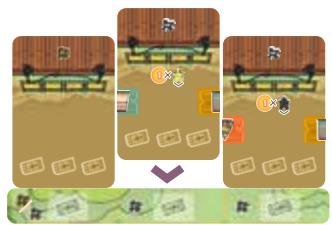

Example: Activating a camp card.

Example: Activating an artist card.
Example: Activating a stage card.

Example: Activating a bonus card by gaining one flower power token and advancing one step on the white track.
TheEndOFTHEROUND
The end of the round is triggered when a player places their activation token on the rightmost space of the activation track (during an ACTIVATE LOCATION action).
Note:The activation track on the front of the game board (l–4 players) is slightly different from the one on the back (5–6 players). Exception: In a 5-player game, the end of the round is triggered when the activation token is placed on the 6th space of the activation track.Tip: Block the rightmost (7th) space with an unused worker. See SOLO GAME on page 18 for solo game exception.
Important: First, the player who triggered the end of the round activates a location in a normal way (see ACTIVATE LOCATION on page 8) but without performing step 3 (CLEAN UP). Instead, follow the steps below (also outlined on the round end card).
O TAKE CLAIMED CARDS
For each remaining crew on all other location tiles, the respective player takes the card in the slot above it, activating it or placing it in their planning display, as normal.
Note: All players get cards for their remaining crews.
Important: For these locations, the players do not gain publicity!
NEWSPAPER SCORING
The newspaper tile above the corresponding round indicator (01, 02, or 03) is now scored. Each player simultaneously resolves the following steps:
I. Check which level your publicity marker has reached on the white track (-, I, Il, or Ill).This is your newspaper scoring level.
-
Take any bonuses/penalties for this scoring level, as shown on the newspaper tile. For bonuses, see BONUS OVERVIEW on page 10. For penalties, see NEWSPAPER TILES OVERVIEW on the next page.
-
Score points by multiplying the shown number of points for this scoring level with the multiplier at the bottom left of the newspaper tile. Note: You cannot score more than the maximum score for this level.
Return the scored newspaper tile to the box.
See NEWSPAPER TILES OVERVIEW on the next page for a detailed description of all newspaper tiles.
Important: Bonuses earned from scoring a newspaper tile can indirectly make you advance further on the white track. This will not change your newspaper scoring level.
Note: If you lose points, your score can go below 0.

Last space in a 2–4-player game (front of the game board).

Last space in a 6-player game (back of the game board).

Last space in a 5-player game (back of the game board). This is the 6th space of the activation track.

Example: Grace (yellow) has a crew left on the camp location. She takes the card but are not allowed to advance on the cyan/orange tracks.

THE ANATOMY OF A NEWSPAPER TILE:

SCORING EXAMPLE:
For the newspaper tile above, the multiplier is the number of meeples on their camp cards.

Keith is on level of the white track. As penalty, he loses 2 meeples of his choice. Keith scores 0 points.

Grace is on level of the white track and gets I meeple as bonus. With now 5 meeples, she scores 2 x 5 = 10 points.
NEWSPAPER TILES OVERVIEW

Multiplier: Number of meeples on your camp cards.
Penalty : Return 2 meeples of your choice to the supply.
Example: You have 5 meeples on your camp cards. You are on level IIl and get another meeple as bonus, making it 6. You score 12 points (6 meeples x 2 points).

Multiplier: Number of stage upgrade tokens on your stage spaces. Note: On level , you lose 2 points for each such stage upgrade token (max -6 points).
Example: You have I stage upgrade token on stage spaces. You are on level III and get another stage upgrade token as bonus. You place it on a stage space and score 6 points (2 tokens on stage spaces x 3 points).

Example: You have 2 complete booths: I pizza booth + I stage upgrade token used as water booth. On level III, you get to activate a card from planning display. You activate a stage card and complete your 3rd booth with this card. You score 12 points (3 booths x 4 points).
Multiplier: Number of complete (matching) booths.
Penalty : Discard any stage card (including starting stage card). Any artist card above this stage card is placed in your planning display.

Example: You have reached 6 points on the orange track. You are on level III and advance 2 steps. The 6-point symbol is still your highest, and you score 12 points (6 points x 2 points).
Multiplier:The highest point symbol (2–10 points) you have reached on the orange track.
Penalty : -2 points for each star card above stage cards.


Multiplier:The highest MAX meeples symbol you have reached on the black track (see also page 14).
Penalty : Move back 2 spaces on the black track (if possible). Receive no bonuses when moving backward.
Example: You have reached the MAX 4 meeples symbol (on the festival board) above the black track. You are on level IIl. First, you move forward one step on the black track. Then, you score 8 points (4 meeples x 2 points).


Multiplier: Number of scored star cards (to the right of your festival board). Note: Newspaper tiles are scored prior to festival scoring, so cards for your upcoming festival do not count. Penalty : Discard any star card from above any of your stage cards.
Example: You have scored 3 star cards so far. You are on level Il and score 6 points (3 star cards x 2 points).

Multiplier: Number of meeples in your most numerous color on your camp cards.
Penalty : Return 2 meeples of your choice to the supply.
Example: You have 3 green meeples (your most numerous color).
You are on level II and score 6 points (3 meeples x 2 points).

Multiplier: Number of reserved workers (next to the game board). Note: On level , you lose I point for each reserved worker.
Example: You have 4 reserved workers. You are on level and lose 4 points (4 reserved workers x -I point).

Example: You have 2 stage cards and 3 camp cards (excluding your starting cards). You are on level II and score 6 points (2 stage cards x 3 points).
Multiplier:The lowest number of your stage or camp cards (excluding starting stage cards and starting camp cards).
Penalty :-I point per meeple of your most numerous color.
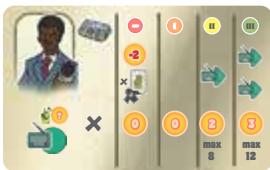
Multiplier:The highest point symbol (1-5 points) you have reached on the cyan track.
Penalty:-2 points for each up-andcomer card above stage cards.
Example: You have reached 4 points on the cyan track. You are on level Il and advance I more step on the track. You score 8 points (4 points x 2 points).

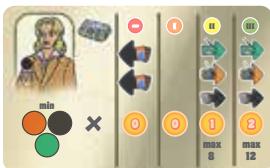
Multiplier:The lowest number of steps you have advanced on the cyan, orange, or black track. Penalty : Move back 2 steps on the black track (if possible). Receive no bonuses when moving backward.
Example: You have moved 3, 5, and 5 steps on the cyan, orange, and black tracks, respectively. You are on level Il. As bonus, you advance I step on each of these tracks. Because of this, 4 steps is now the new minimum (cyan track). You score 4 points (4 steps x I point).

Multiplier: Number of scored up-andcomer cards. Note: Newspaper tiles are scored prior to festival scoring, so cards for your upcoming festival do not count. Penalty: -I point per scored artist card (stars & up-andcomers).
Example: You have scored 5 up-and-comer cards so far. You are on level III and score 15 points (5 up-and-comer cards x 3 points).
FESTIVAL SCORING
Now, the real festival starts.Your artists will play concerts in front of cheering crowds. All players score their artists simultaneously.
Each artist card above a stage card may be scored, provided that the following criteria are met:
• You must have all meeples shown on the applicable artist card.
• If you have a star card requiring 4 meeples, you must have a stage upgrade token (extra ticket space) on the stage space below the adjacent stage card.
Note: At any given time, you may have a star card requiring 4 meeples on a stage without a stage upgrade token, but you cannot score it.
If both criteria above are met, move the required meeples from your camp cards to that stage card (and stage upgrade token) by placing one meeple onto each ticket space.
Note: Each meeple can only be placed on I stage card per round.
Each artist card is scored as follows:
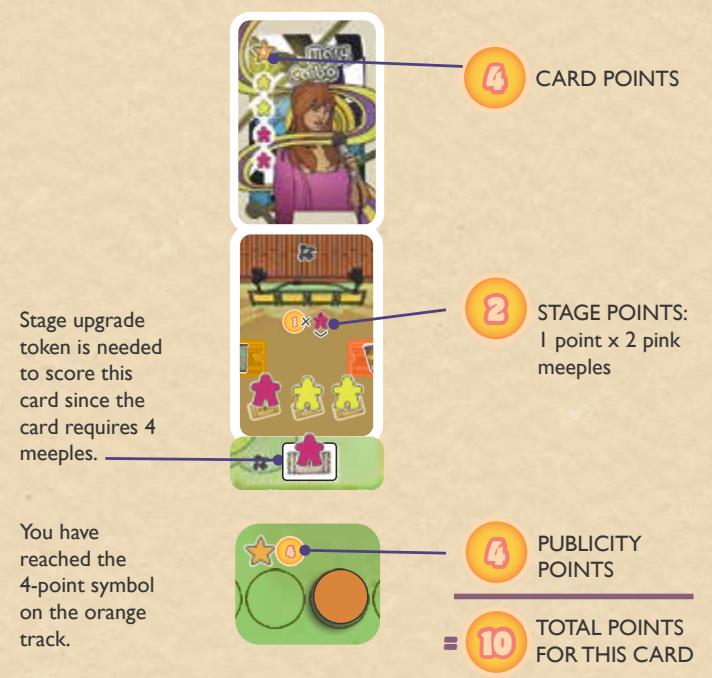
• CARD POINTS: Each star card requiring 4 meeples scores 4 card points (no other artist cards score card points).
• STAGE POINTS: Score I or 2 points (depending on the stage card) for each meeple of the specified color on this stage card (and stage upgrade token).
• PUBLICITY POINTS:
• Up-and-comer card: Score points equal to the highest point symbol (l–5 points) you have reached on the cyan publicity track.
• Star card: Score points equal to the highest point symbol (2–10 points) you have reached on the orange publicity track.
Repeat this for all artist cards you can (and want to) score this round. Place scored cards face down in a deck to the right of your festival board.
Important: Even if you can score an artist card, you do not have to score it. Any artist cards you do not score remain in place and can be scored in later rounds (or replaced by another artist card).
After you have scored the cards, move all meeples from your stage cards back to your camp cards.
SCORING EXAMPLE (UP-AND-COMER CARD):

THE ANATOMY OF AN ARTIST CARD (STAR):

SCORING EXAMPLE (STAR CARD):
DISCARD MEEPLES AND CAMP CARDS
Some fans leave the festival, unfortunately.
The number of meeples and camp cards you can keep are determined by how far you have advanced on the black track (on the camp cards).
The highest MAX meeples and cards symbol (on your festival board above the black track) you have reached indicates how many meeples and camp cards you can keep for the next round (or for end game scoring in round 3).
Discarding meeples: If the number of meeples exceeds the MAX meeple symbol, return the surplus (of your choice) to the supply.
Discarding camp cards: If the number of camp cards exceeds the MAX cards symbol, discard camp cards in excess of this number, from right to left.
Note: The meeples and camp cards you keep may be used in the next round. Remember that you can reorganize your meeples to avoid losing any meeples that happen to be on a camp card you must discard.
Note: New MAX symbols can only be reached in the upper row of the black track (see example to the right).
SET UP NEXT ROUND (ROUNDS 1 & 2 ONLY)
• All crews on all locations are stacked next to their corresponding hippie buses on the game board and becoming resting workers (no crews will be left on any location tile).
• Discard all cards from all four locations and return the current location tiles to the box. Randomly distribute the 4 location tiles from the stack corresponding to the next round number, as instructed in GENERAL SETUP (see page 3).
• Make a display of 4 new cards for each location.There can be no more than 2 up-and-comer cards in each display, as instructed in GENERAL SETUP on page 3.
• Reset each player's white publicity marker by moving it to the leftmost space of the white track. Note:All other publicity markers remain in their current positions.
• Reset the countdown marker by moving it to the first space of the activation track.The player who triggered the end of the round takes back their activation token from the activation track, and the next player in clockwise order takes the first turn in the next round.

Example: The black marker has just reached the max 4/3 symbol (on your festival board). John can keep 4 meeples and 3 camp cards for the next round. Since he has 8 meeples and 4 camp cards, he must discard 4 meeples and I camp card (the rightmost one).

MAX meeples symbol
MAX cards symbol
When does the black publicity marker reach a new symbol?

Keep 3 meeples and 2 cards (starting space)
Keep 5 meeples and 3 cards
Keep 7 meeples and 4 cards


TheEndOFTHEGAME
The end of the game is triggered after Step 4 ofTHE END OFTHE ROUND in round 3 (see previous page). Each player counts their points for remaining meeples and completed booths before the winner is determined (see below).
MEEPLE SCORING:
The player with the most remaining meeples on their camp cards, gains 4 points. The player with the fewest remaining meeples on their camp cards, loses 4 points. In case of a tie for most or fewest meeples, all tied players gain or lose the full points.
BOOTH SCORING:
A complete booth is comprised of two matching half booths on two adjacent stage cards (or a stage upgrade token used as a complete water booth):
• Each complete pizza booth is worth 7 points.

• Each complete beer booth is worth 5 points.

• Each complete water booth is worth 3 points.

• Each incomplete booth (one missing half or two halves of different types) is worth no points.
The players compare their total score.The player with the most points wins the game. In case of tie for first place, the tied player with the most scored up-and-comer cards wins. If there is still a tie, the victory is shared.
Advanced SETUP
We recommend that you use this setup variant after your first game: Deal 5 random cards from the planning deck to each player, as normal. • Each player chooses 2 cards to keep and passes the remaining 3 cards to the player to their left.
• Each player chooses 2 of the 3 cards they received, passing the remaining card to the player to their left.
• I–4-player game: Each player chooses 4 of the 5 cards and places them face up in their planning display to the left of their festival board.The unchosen card is returned to the box (or put aside).
• 5–6-player game: Each player keeps all 5 cards and chooses I of these cards to activate immediately (see CARDS OVERVIEW on page II).The remaining 4 cards are placed in the planning display to the left of their festival board.

All end-game points are also outlined on the game board.

Example: Grace gets 7 points for her complete pizza booth, but 0 points for her incomplete water/beer booth.

2-player GAME
CHANGES TO SETUP:
• Shuffle the friend cards and place them face down next to the player who will be responsible for drawing from this deck (from now on called friend deck) whenever friend is triggered.
• Place 4 workers of an unused color next to the corresponding hippie bus on the game board.These are friend's active workers. Note: Friend does not have any resting workers or reserved workers.
• Use the first (upper) table on the back of the setup card to determine the players' starting components.
GAME FLOW:
• The players alternate taking turns but are sometimes interrupted by a dummy player, called friend. Friend is triggered each time any of the two players places workers on a location space with a heart symbol (at the two middle location spaces on each location tile) and after the player has taken the location space bonus (if any). See below.
WHEN FRIEND IS TRIGGERED:
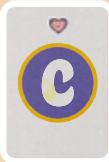
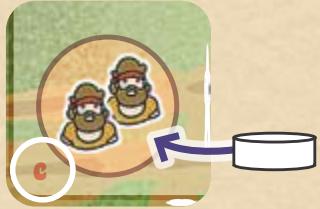
• Reveal the top card from the friend deck.The letter on this card assigns the location.
• Reveal a second card from the deck.The letter on this card assigns the location space.
Each location and location space have their unique ID: A, B, C, or D.
• Take one of friend’s active workers and place it on the assigned location and location space. If the location space is occupied, place it on the next vacant space to the right (for example, if space C is occupied, place it on space D). If all spaces to the right are occupied, place it on the first vacant space to the left.
Note: This worker is now defined as a crew. Friend's crew blocks this space until the location is activated. It will also increase players' publicity on this location when activated.
WHEN FRIEND ACTIVATES A LOCATION: Friend activates a location in one of two ways:
• When the first friend card assigns a location where friend already has a crew.
OR
• When the first friend card assigns a location where all location spaces are occupied.
In both cases, the second card is not drawn, and no workers are placed. Instead, this location is activated in a normal way (see ACTIVATE LOCATION on page 8). Tip: As a reminder of whose turn it was before this activation, active player should place their activation token on the activation track (without gaining the bonus).
OTHER RULES:
• Place drawn friend cards face up on top of each other in a discard pile. The players are only allowed to see the top card of the discard pile.
• Whenever the friend deck is exhausted, shuffle all discarded cards to form a new deck. Note:This can happen in the middle of friend's turn.
• Each time a location is activated, the card attached to friend’s crew is discarded and friend's crew (if present) goes back to their hippie bus. Remember to move the countdown marker. Note: Friend may activate a location where no players' crews are present. Consequently, all 4 cards are discarded.
• Friend will not receive any points, publicity or bonuses.
• All friend's crews are placed next to their hippie bus at the end of each round.
In a 2-player game of Come Together you need "a little help from a friend”. Follow the same rules as in a 3–6-player game, with the following exceptions:

Friend's active workers.

Example: Since there is a heart symbol here, friend is triggered after Janis has taken the location space bonus.

Ist card (location)

Example: Place friend's worker on location B (star location); location space C.
2nd card (location space)


Ist card (location)
Example: On one of friend's turns, the first revealed friend card is B. Since friend already has a crew on location B (star location), the second card is not drawn. Instead, this location is activated. Janis (red) takes Johnny Mad Castle and advances up to 2 steps on the black and/or white tracks. All other cards are discarded, including friend's card.
Solo GAME
A solo game of Come Together works exactly like a 2-player game, with the following exceptions:
• During setup, place 8 workers of an unused color next to their corresponding hippie bus.These workers are friend's active workers.Also, place the corresponding activation token (belonging to friend) next to their hippie bus.
• Use the second (bottom) table on the back of the setup card to determine the solo player's starting components.
• Friend is the starting player: Draw two friend cards and place one of friend's active workers on the corresponding location space.Then, you and friend alternate taking turns (thus, disregard the heart symbol).
• Friend can have a maximum of 2 crews on the same location. When the first friend card matches a location where friend already has 2 crews, or a location that is already full, this location is activated. Place friend's activation token on the activation track.
• Each time friend activates a location, you lose 2 points (your l-point marker can move below 0 points).
• After friend has activated a location, friend's activation token goes back to their hippie bus area (remember to move the countdown marker).
• The end of the round is triggered when an activation token is placed on the 4th space of the activation track.
During final scoring, you gain 4 points if you have at least 10 meeples. If not, you lose 4 points. Compare your final score with the achievement table below. You need at least 100 points to win the game.
ADVANCED SETUP IN A SOLO GAME:
Draw 4 cards from the planning deck and keep 2.Then, draw 4 more cards from the planning deck, and keep 2 of those. Discard the cards you did not choose. Place the 4 chosen cards face up in your planning display.


Example: Since friend (white) can have 2 workers on the same location, a worker is placed on location D; location space A.
Ist card (location)
2nd card (space)

Ist card (location)

Example (continued): On friend's next turn, card D is drawn again. Since friend already has 2 crews on location D, this location is now activated. Keith (blue) loses 2 points. However, he still gains the card in the slot above his crew and may advance up to 3 steps on the cyan and/or black tracks.

The end of the round is triggered after the 4th activation.

| POINTS | ACHIEVEMENT VICTORY? | |
| 0-79 | Dazed and confused | No |
| 80-89 | Can't get no satisfaction | No |
| 90-99 | Getting better | No |
| 100-109 | All right now | YES |
| 110-119 | Respect | YES |
| 120-129 | Dancing in the street | YES |
| 130-139 | What a wonderful world | YES |
| 140-149 | Wild thing | YES |
| 150+ | God only knows... | YES |
SpecialPowers VARIANT
When familiar with the standard version of Come Together, feel free to add the SPECIAL POWERS VARIANT which provides asymmetric disadvantages (on the backs of the festival boards) and special powers (on the backs of the starting stage cards).
CHANGES TO PLAYER SETUP:
• Each player returns I flower power token to the supply.This is indicated inside the brackets in column 2 of the setup card.
Each player takes a random festival board and flips its Come Together Music Festival side face down. Each festival board has its own unique disadvantage to compensate for the special power.
Before Step 8 of PLAYER SETUP: Instead of dealing starting stage cards, shuffle all starting stage cards, and place I more card than the number of players in the common area, with their backs (special power side) face up. Starting with the player to the right of the starting player and continuing counter-clockwise, each player chooses one of the displayed starting stage cards, placing it above their leftmost stage space. Unused starting stage cards are returned to the box.
CHANGES TO GAME PLAY:
Each player can utilize their own special power. As normal, their starting stage card can be replaced or discarded. If they do, they immediately lose their special power.
Note: Other than the special power, this side of the starting stage card works exactly like the front of the card (you may use it as a stage card).
FESTIVAL BOARDS DISADVANTAGES:

2 more spaces at the beginning of the orange track


2 more spaces at the beginning of the cyan track
I more space at the beginning of the white track

No bonuses on the orange track

I fewer stage space

Meeples and camp cards you can keep from round to round are reduced by I
OVERVIEW OF SPECIAL POWERS
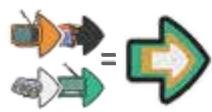
All publicity marker advancements may be applied to any track or tracks. For example, during an ACTIVATE LOCATION action where you receive 4 advancements, you may advance on 4 different tracks.

At any time, you may discard an unscored star card from above your stage cards or from your planning display to advance 3 steps on the orange track.

When performing a PLACE WORKERS (A) action on a space requiring at least 2 workers, you may use one meeple from your camp cards in place of the top worker (example: 2 workers + I meeple instead of 3 workers). If any player later performs an ACTIVATE LOCATION action on this location, return the meeple to your camp cards. However, if you do not have your starting stage card (special power) at that point, the meeple is returned to the supply (is lost).THE END OF THE ROUND: Any meeple on a non-activated location is lost during SET UP NEXT ROUND.

When performing a PLACEWORKERS (A) action on a space requiring at least 2 workers, you may add one extra worker to double the location space bonus.
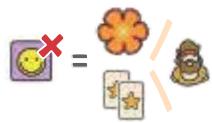

When performing a PLACE WORKERS (A) action with at least 2 workers, you may forfeit the location space bonus to ElTHER gain a flower power token, OR gain an active worker, OR draw 2 cards from the star deck in which I card can be activated immediately. In latter case, discard the card you did not choose.

When performing a TAKE BACK WORKERS (C) action, you may leave behind I resting worker in the hippie bus area to immediately perform a PLACE WORKERS action twice (instead of one of the other 3 options). Note: If you choose to do so, you must place workers on exactly 2 location spaces. 2-player game: If you place workers on at least one location space with a heart symbol, friend is triggered once after the second action, even if you place workers on two heart symbol spaces.

You permanently have I extra tent on each camp card (including starting camp card). The small upper tent icon on the card (above the black track) is used as the extra tent.
Each time you activate an audience card, you may additionally take I meeple in a color of your choice from the supply.
Appendix
ICONS ON SETUP CARD, OVERVIEW CARD & ROUND END CARD :


All players / player count
Number of flower power tokens

For each occupied space, advanceI step on either of the 2 shown tracks.

Number of active workers

Number of resting workers

Move your crews to your hippie bus area
Number of reserved workers

Place workers and gain bonus (if any)

Make a new display of 4 cards from the deck
Activate a location
Take back workers from hippie bus area

Advance countdown marker I step and take back activation token
Gain one active worker (from reserve)

Discard one active worker & perform a place workers action
Newspaper scoring
Draw 3 cards from a deck. Choose I for your planning display

Festival scoring
Place activation token on activation track and gain bonus

Gain the card in the slot above your crew
Discard surplus meeples (above max)

Discard surplus camp cards (above max)

Draw the 4 location tiles for the next round

Replenish all displays (16 new cards)
Reset white publicity marker
Reset countdown marker and take back activation token
GENERAL LOCATION TILES ICONS:


Location space

Occupied location space


Spend a flower power token to advance one additional step
Friend is triggered when placing workers here (2-player game only)
Chilifox Games would like to thank all play testers, and especially Sarah Wennes,Aleksander Lindahl Kronstad, Geir André Wahlqvist, Ronny Eftevåg, Fridtjof Buvarp, and Kristian Elvsveen. Also, thanks tothefollowing play testers (inalphabetical order): Andrea Hanssen Bratås, Andreas Kinserdal, Christian Magnus Fredheim, Espen Oldeman Lund, FredeKristoffer Herstad, Helene Elise Fevolden, Lin Heidi Isaksen, Maija Buvarp, Maria Oldeman Lund,Marius Kongsten Gabrielsen, Pauline Buvarp, and Trond Arvid Røise.
Game design: Vegard Eliassen Stillerud, Eilif Svensson& Åsmund Svensson Art Director and graphic design: Yan Moussu Artworkd ODEgnWupis Chililex

All rights reserved © 2022 Chilifox Games AS
NEWSPAPER TILES ICONS (see page 1 3):
MULTIPLIERS:

Number of meeples

Number of meeples in your most numerous color

Number of reserved workers

Number of stage upgrade tokens on stage spaces

Number of
complete
(matching) booths

The lowest number of your stage or camp cards (excluding starting cards)

The highest point symbol reached on the cyan track

The highest point symbol reached on the orange track

The highest MAX meeple symbol reached on the black track

The lowest number of steps advanced on the cyan, orange, or black tracks
PENALTIES:

Number of scored star cards


Return 2 meeples of your choice to the supply

Move back 2 steps on the black track (if possible). Gain no bonus when moving backward.
-2 points for each star card above stage cards
-2 points for each up-and-comer card above stage cards
-I point per meeple of your most numerous color
Discard any stage card (incl. starting stage card).Any adjacent artist card are placed in your planning display
Discard any star card above any of your stage cards
-I point for each scored star and up-and-comer card

Number of scored up-and-comer cards
BONUS ICONS (see page 1O):

Take any meeple and place it on a tent

Advance any publicity marker one step

Advance the white publicity marker 2 steps

Gain one active worker (from your reserve)

Activate I card from your planning display

Score I or 2 points per meeple of the specified color on all camp cards

Score 2 points

Take a meeple of the specified color and place it on a tent

Advance the corresponding publicity marker one step


Gain a flower power token from the supply
Gain a stage upgrade token and place it as an extra ticket space or as a complete water booth
Score one up-andcomer or star card (like festival scoring)
下载 Markdown