PointCity_Rulebook_web.md
CREDITS
Game Design
Molly Johnson, Robert Melvin, Shawn Stankewich
Development
Molly Johnson, Robert Melvin, Shawn Stankewich
Creative Direction
Molly Johnson, Robert Melvin, Shawn Stankewich
Illustration
Dylan Mangini
Graphic Design
Dylan Mangini and Shawn Stankewich
Editing
Molly Johnson, Robert Melvin, Shawn Stankewich
AEG Director of Projects
Nicolas Bongiu
Production
David Lepore, Adelheid Zimmerman
Special Thanks
Kimberley Bamburak, Haley Shae Brown, Brian Chandler, Joseph Z. Chen, Colin, Madeline, Isaac and Brendan Dams, Randy Flynn, Kevin Grote, Patrick Hayden, David Iezzi, Ashwin Kamath, Anuj Khattar, Charlotte Kyle, Peter McPherson, Robert Newton, Vladimir Orellana, Aaron Russin, Cody Thompson, Alex Uboldi, Josh Williams, Kyndra Williams.Arcane Comics, Blue Highway Games, Old Man Games, Playtest Northwest, Seattle Area Tabletop Designers, and Zephyr Workshop.
©2023 Alderac Entertainment Group.
2505 Anthem Village Drive, Suite E-521, Henderson, NV 89052, USA. Point City and all related marks are ™ or ® and © where indicated Alderac Entertainment Group, Inc. or Flatout Games. All rights reserved. Made in China.

OVERVIEW
POINT CITY is a card-drafting and tableau-building game for 1-4 players. Players take turns collecting resources and building their personal City by constructing Building Cards and competing to score the most points! Constructed buildings help players earn permanent resources for future turns, special bonuses, and points. The player who builds the City worth the most points wins!
COMPONENTS
• 160 Double-sided Resource/Building Cards
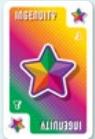
• 4 Ingenuity Starting Cards
• 1 Game Reference Card
• 22 Civic Tokens
• 2 Market Tokens
• 1 Rulebook
RESOURCE CARDS (BACK)


BUILDING CARDS (FRONT)


CIVIC TOKENS

MARKET TOKENS


GAME REF. CARD

INGENUITY STARTING CARDS


SETUP
Sort the Buidling/Resource Cards into 3 decks based on tier (tiers are indicated by the number of dots in the bottom left hand corner of the card on the building side of each card). Shufle each deck and place them in piles with their resource side faceup. Based on the number of players, remove/use the following number of cards from each tier:

| PlayerCount | Tier 1 cardsto remove | Tier 2 cardsto remove | Tier 3 cardsto remove |
| 1-2P | -25 (use 40) | -26 (use 24) | -27 (use 18) |
| 3P | -13 (use 52) | -14 (use 36) | -17 (use 28) |
| 4P | -1 (use 64) | -2 (use 48) | -7 (use 38) |
Return the removed cards to the game box, they will not be used this game.
2 Stack the tier decks on top of one another, with the tier 3 deck on the bottom, the tier 2 deck on top of it, and finally, the tier 1 deck on the top. Place this combined deck of cards in the center of the play area - it will now be referred to as the Draw Pile.
3 Draw 16 cards from the Draw Pile to form the Market. Draw cards oneat-a-time, and place them facedown (resource-side up) into a 4 X 4 grid, starting with the top left-most card and proceeding to fill all spaces until the bottom right-most card is placed.
[Note: In setup, and during the game, the order in which cards are added to the Market will always proceed from top-left, across the row, then down to the left-most card of the next row, and so on, with the bottom-right card being the final card.]
Flip all Civic Tokens facedown and shufle them. Then, select a number of tokens, based on the number of players (2P: 10, 3P: 12, 4P: 14). Flip the selected tokens faceup and arrange them into a supply so that each can easily be seen by all players.
AUISU

TIER 2
5 Take a number of Ingenuity Starting Cards equal to the number of players and be sure to include the card with the starting player symbol ( ).
Each player takes one Ingenuity Starting Card at random and turns it over. The player with the starting player symbol ( ) becomes the starting player.
You are now ready to begin the game!
3 PLAYER SETUP EXAMPLE


TIER 1


TIER 3


DRAW PILE





CIVIC TOKENS






INGENUITY STARTING CARDS





GAMEPLAY
On your turn, draft any 2 orthogonally adjacent cards from the Market, or draft the top two cards of the Draw Pile.
You may always draft a Resource Card. Take the Resource Card and place it in front of you. This card may be used this turn, or on future turns to provide the required

resources to construct a Building Card. Resource Cards with two symbols count as 2 of that resource.
If you have the required resources, you may draft a Building Card. Supply the required resources by discarding Resource Cards or using permanent resources that are provided by your previously constructed buildings.
[Note: If you are not able to construct a building because you do not have the required resources, then you may not draft that Building Card. You must always be able to draft both of the cards you have chosen.]
You may always choose to take the top two cards of the Draw Pile instead of taking two adjacent cards from the Market (the first card will always be known, but the second card will be unknown). You may not select one card from the Draw Pile and one card from the Market. If you choose to draft cards from the Draw Pile, you must draw two cards from the Draw Pile.
Optional Flip Action
If there is a row or column in the Market that contains ALL Resource Cards, you may also, once per turn, before you draft any cards, flip one of the Resource Cards in that row or column to its Building Card side. You may do this in order to provide yourself more options of buildings to potentially construct. This is a free, optional action that you may take as long as the conditions described above are met. You may never flip a Building Card to its resource side.
Constructing a Building
Once you have paid the required resources to construct a building (either from Resource Cards, or permanent resources from your previously constructed buildings), place the Building Card into your City (a tableau of cards in front of you). In order to keep track of which permanent resources you

have at your disposal, it is recommended that your City take the form shown above. This will keep all of your cards organized and minimize the amount of space your City occupies. [Note: if a player constructs two buildings in a single turn that require the same resource, they may only use each of their permanent resources once.]
PERMANENT RESOURCES
Usable on future
turns after
constructing the
building

POINTS Counted at the end of the game.
REQUIRED BUILDING RESOURCES Spend resources from hand, or permanent resources to build

Spent Resource Cards go to the discard pile.
[Note: Ingenuity Resources act as wild resources and may be used in place of any other resource type.]
Constructing a Civic Building


Some buildings have a civic icon in the top right corner ( ). These buildings do not contribute to permanent resources or earn you points directly, but they allow you to select one of the Civic Tokens. Civic Tokens earn you points at the end of the game for different features within your City - primarily for permanent resources on Building Cards you have constructed.


CIVIC BUILDING CARD

TURN END
Once you have drafted two cards, paid the required resources to construct any Building Cards, and selected any Civic Tokens you have earned, your turn ends and the Market
is refilled.
To refill the Market, take 2 cards from the top of the draw pile to refill the spaces in the Market.
[Note: if a player elected to take the top two cards of the draw pile, then this refill step is skipped this turn.]
Refill cards one-at-a-time following the order described in setup (from top-left to bottom-right).

Important: If the card that was drafted from a spot was a Resource Card, flip the card from the draw pile to its building side. If the card that was drafted from a spot was a Building Card, then place the card directly into the Market on its resource side. This creates a dynamic Market of Resource and Building Cards that will evolve based on players’ choices.
Players may elect to use the supplied Market Tokens during play to assist in remembering the orientation of cards drafted from the Market. If you choose to use them, place the Market Tokens down in the empty spaces as soon as cards are drawn as a reminder of which way to flip the replacement card when you are refilling the Market.

Alternatively, one of the Market Tokens may be used in the event that no player is able to remember which side of a refilled card should be faceup. Players may agree to use a Market Token as a randomizer. Flip a Market Token like a coin and whichever side lands faceup determines the side of the card that should be placed faceup in the open Market space.
GAME END
The game ends when the Market is no longer able to be refilled because the Draw Pile has been depleted. [Note: Each player will play exactly 17 turns and the market will have 14 cards remaining in it.]
SCORING
Players add up the points printed on their constructed Building Cards and the points gained by their Civic Tokens, and the player with the most points wins!
Note: Civic Tokens that score points for certain resource types only score points for permanent resources, not resources on unspent cards.
In the event of a tie, the player with the most unspent Resource Cards wins. If the tied players have the same number of unspent Resource Cards, they share the victory!

Points on constructed Building Cards .24
Civic Token 1 (2pts/economy permanent resource)
Civic Token 2 (3pts/set of energy and community permanent resources)
Civic Token 3 (3pts/permanent resource type with 3+ = 3pts for economy + 3 pts for ecology)
Civic Token 4 (2pts/unspent Ingenuity card).
Total Score ............ .24 + 8 + 6 + 6+ 4 = 48 points
SOLO MODE
Setup
Follow the setup rules for a 2-player game, with the following exceptions:
• Only give yourself an Ingenuity Starting Card. You take the first turn.
Line up the 10 chosen Civic Tokens in a single line - their order is important.
Place one token above the top left-most card, and place the other token to the left of the left-most card in the second row, as shown below.
Turn Summary
You take the first turn of the game. Follow a turn as usual, and refill the Market just as you would in a standard multiplayer game. Once you take your turn, the AI opponent takes a turn.
AI opponent turn
The AI opponent will always draft the card at the intersection of the two Market Tokens, as well as the card below it. Once the AI opponent drafts cards, the Market is refilled as usual, and the Market tokens are advanced, according to the following pattern: The top Market token
(the one that tracks the columns) always moves one space from left to right each turn. When the token is in the right-most column, it moves back to the left-most column, and the bottom Market token (the one that tracks the rows is moved to the next row below it). When the bottom Market token is in the bottom row and must be moved, it is moved to the top row. The AI opponent always drafts 2 cards. When a bottom row card is at the intersection of the two Market Tokens, the card ‘below’ it is the card in the corresponding top row.

[Note: this movement is designed such that the AI opponent will always draft cards in a predictable pattern from left to right, top to bottom. This allows you to strategically plan out which cards the AI opponent will receive by drafting cards in their path.]
[Note: the AI opponent is not required to pay any resources to construct Building Cards. Any card that the AI opponent drafts goes directly into a tableau in front of them.]
When the AI opponent constructs a Building Card with a civic icon on it, they take the left-most Civic Token from the line of tokens. Flip the Civic Token over so it is facedown and place it next to the AI opponent’s tableau of cards.
Scoring
Add up your points according to the standard multiplayer scoring.
AI opponent scoring
The AI opponent scores points for the following:
• The points printed on their constructed Building Cards
• Points per permanent resource on their constructed Building Cards
• Points for each Civic Token
• Ingenuity Resource Cards (Hard only)
You can choose the level of AI opponent - start off with Easy and see if you can work your way up to defeating Hard!
Easy: Points printed on cards, 1 pt per permanent resource, 3 pts per Civic Token.
Medium: Points printed on cards, 1|2|3 pts for 1|2|3+ of each type of permanent resource, 5 pts per Civic Token.
Hard: Points printed on cards, 1|3|6 pts for 1|2|3+ of each type of permanent resource, 7 pts per Civic Token, 1 pt per ‘Ingenuity Resource Card.
MARKET
QUICK REFERENCE
Setup
-
Set up the Draw Pile (tier 1 on top).
-
Set up the Market (4x4 of 16 Resource Cards).
-
Draw Civic Tokens.
-
Give each player an Ingenuity Starting Card.
Turn Summary
-
[Optional] Flip a Resource Card if a row or column is all Resource Cards.
-
Select any 2 adjacent cards from the Market - or - the top 2 cards of the Draw Pile.
-
Pay resources if constructing building(s).
-
Select Civic Token (if you constructed a Civic Building).
| PlayerCount | Tier 1 cardsto remove | Tier 2 cardsto remove | Tier 3 cardsto remove | CivicTokens |
| 1-2P | -25 (use 40) | -26 (use 24) | -27 (use 18) | 10 |
| 3P | -13 (use 52) | -14 (use 36) | -17 (use 28) | 12 |
| 4P | -1 (use 64) | -2 (use 48) | -7 (use 38) | 14 |


TIER 1
TIER 2


TIER 3

DRAW PILE


CIVIC TOKENS


INGENUITY STARTING CARDS


- Refill the Market (from top to bottom, left to right).
LOVE POINT CITY?
Please #pointcitygame Follow us @flatoutgames

WWW.FLATOUTGAMES.COM