THE_ART_PROJECT-RULES_EN.md

THE "A.R.T. PROJECT

You are the Art Rescue Team, fighting against "the White Hand", an evil corporation responsible for the theft of countless precious works of art around the globe.
Your team of specialists - the best in their fields - will travel from Japan to Rio, via Polynesia and Scandinavia;
aiming to find the stolen works of art, and hana wuem to their rightful owners. Will you be able to gather enough clues as a team to try to stop this cultural plundering in time?
Game Overview
The A.R.T. Project is a cooperative game: you all play against the game. Each player draws 2 Mission cards at the beginning of each round, then all players discuss which card they want to play and in which order.
Indeed, your resources - Fuel, Guns & Walkie Talkies - are shared and their management is essential. You will need the resources to play Mission cards, find Clues, move, or fight the White Hand. Try & save all the Art Pieces before the end of the Mission deck.
SETUP
The following set up and rules are for the JAPAN Mission map, at the moderate difficulty level. For the other maps, please follow these standard rules and the specific rules for each map. For the difficulty levels, and the complexity level of the different maps, see pages 4-5.
Place the Japan Mission map at the center of the table. Each player takes a Player pawn, a Player card, and a Player die of the same color, as well as 3 Health tokens.
2 Form the Players' Shared supply: place the Van board next to the Mission map and place 3 Fuel tokens, 3 Walkie Talkie tokens and 3 Gun tokens on their dedicated spots.
- Inventory -
| pic | qty | - Name - | |
| 72 | Mission cards | ||
| 1 | End Tile | ||
| 5 | black Ally dice | ||
| 品 | 6 | - Players parts -colored Player dicePlayer pawnsPlayer cards | |
| + 6 MISSION MAPS | |||
| 6 | yellow Fuel tokens | ||
| 6 | green Walkie Talkie tokens | ||
| 6 | grey Gun tokens | ||
| 25 | pink Health tokens | ||
| 40 | white Hand Agent pawns | ||
| 图 | 8 | Art Piece tokens | |
| 3 | Lost City markers | ||
| 0 | 3 | Lost City additionalmarkers for Polynesia | |
| 1 ROUND REFERENCE GUIDE | |||
| A VAN BOARD ! | |||
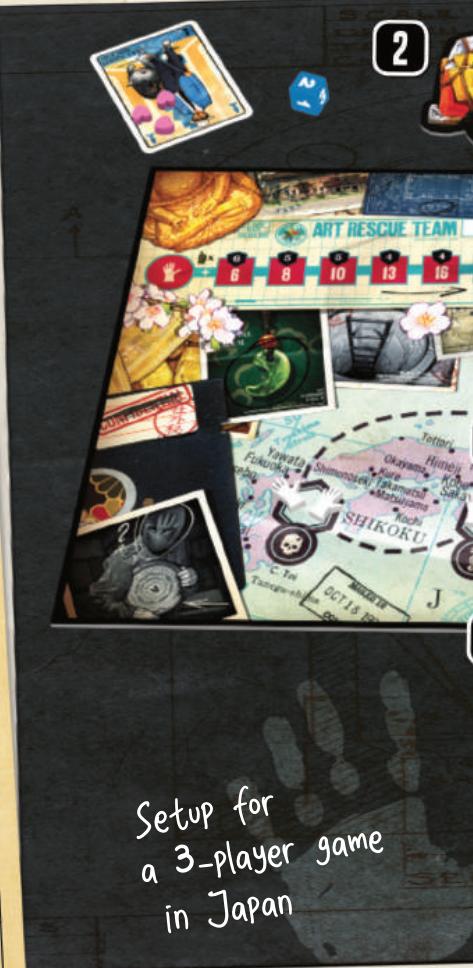
3 Each player places their Player pawn on the starting city of the Mission map (indicated by

Place 2 Agent pawns on each of the cities present on the Mission map (including the starting city).
5 Leave all the other components, and the remaining Health and resource tokens on the table, within reach, it will be the Stock.
0 Shuffle the Mission cards into a single deck and place it face down (only the clues should be visible) next to the Mission map. Remove the last 12 cards and place the End tile on top of them before placing them back under the deck.


DIFFICULTY LEVELS
For more challenges and replayability, the A.R.T. Project is designed to be flexible in both complexity and difficulty. The A.R.T. Project has 4 difficulty levels.
We advise you to start with the moderate difficulty level.
During set up and depending on the selected difficulty level, modify the following:
Easy: start with 4 Health tokens each.
■ Moderate: start with 3 Health tokens each.
Hard: start with 2 Health tokens each.
"They did not know it was impossible so they did it": start with 1 Health token each.
Moreover, since communication and coordination are key in this game, please be aware that playing with 5 or 6 players can be more of a challenge We strongly advise you to discover the A.R.T. Project with a 2- to 4- player game.
Types of Art work
VISUAL ARTS
Use the following chart to record your victories on the different maps played at your chosen difficulty level.
Hall of Fame!
Place an in the corresponding box for each defeat on a map, at a specific difficulty level. Place a if you win!
| 出 | Easy★ | Moderate★★ | Hard⭐⭐⭐ | They did notknow it wasimpossible sothey did it! |
| SET UPHealthtoken(s)per player | : | 六 | ||
| JAPAN | ||||
| EGYPT | ||||
| USA | ||||
| SCANDINAVIA | ||||
| POLYNESIA | ||||
| RIO DE JANEIRO |
The A.R.T. ProJect includes 6 different maps, and each map after Japan adds new rules that change the complexity of the game.. They are not more (or less) difficult per se, but the rule changes can add some complexity for the players. We advise you to start with the Japanese map and then move downwards, following the chart above.
The game designers
GAME ROUND
Each round is composed of 4 main phases, played one after the other:
A - The Mission
B - The Movement
C - The Fight
D - The End of the Round
#KEY INFORMATION
the following information applies to all phases.
RESOURCE MANAGEMENT
The Resources are Fuel, Guns and Walkie Talkies. Health is not considered a resource. There are only SIx resources of each type. You must manage them carefully!
DURING THE GAME:
WHEN A PLAYER SPENDS RESOURCES, they must come from the team's Shared supply, on the Van Board. Discard them back into the Stock.
WHEN YOU SEE THIS LOGO: REMEMBER THE GOLDEN RULE

IF THERE ARE NOT ENOUGH RESOURCES of the required type in the Shared supply, the player may spend one of their own Health tokens for each missing resource. However they cannot spend a Health token instead of another resource if they have the necessary supply. This is the GOLDEN RULE !
WHEN A PLAYER EARNS RESOURCES, they take them from the Stock and place them in the Shared supply. If there isn't any resource left of that type in the Stock, they cannot gain any.
WHEN A PLAYER GAINS HEALTH, they take a Health token from the Stock. Each token can be either placed on their own Player card or given to any other player anywhere on the Mission map. There is no limit to the number of Health tokens a player can have, but for the number of Health tokens in the stock.
WHEN A PLAYER LOSES HEALTH, for any reason, they must put back one of their own Health tokens in the Stock. Other players cannot spend theirs in your stead.
A - The Mission
The Mission phase consists of 2 steps in which players will play Mission cards to further the mission.
>> Plan the Mission
First, each player draws 2 Mission cards from the deck one after the other, in any order you want.
Players then discuss and try to plan the best strategy. Indeed, in the A.R.T. Project, there is no fixed turn order. Each player will play one Mission cardbut first, you have to collectively decide in which order the players will play their Mission card. To decide, players can explain all aspects of their cards but cannot show them. They can only show their back side (with the Clue info on it) to the other players.
For example, players can say "Hey guys, I need a Fuel token to play a very cool card. Can someone do that before I play?" "I need a gun or I'll lose a health token!" "Y'all, if I must play one of my cards, 2 Agents are coming to the starting city, we absolutely need talkies to recruit an Ally!"
VICTORY DEPENDS ON THAT CHOICE. TAKE YOUR TIME TO PICK & SYNCHRONIZE YOUR ACTIONS.

During this phase, any player can spend, once or more, a resource (or one of their own Health token if there is not any resource left: see GOLDEN RULE ) to draw a new Mission card, even after the End tile is revealed.
After you made up your mind, each player will play one of their Mission card. Of course, during the following step, you can keep talking and adjusting your strategy, as long as one card is played by each player.

seal
AE NNN L
>> Play a Mission Card
During this phase, each player must playone Mission card - in its entirety - and then discard the other(s) in a discard pile next to the Mission deck at the end of the phase. To play the Mission card, each player activates the different frames of the Mission card, from top to bottom.
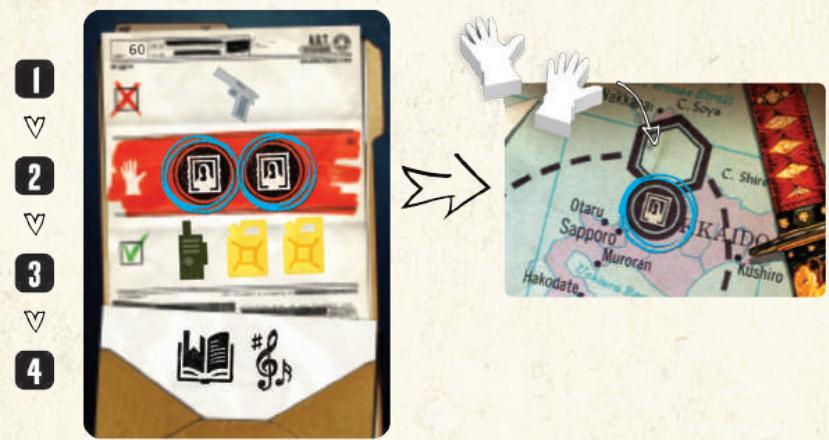
① spend the Resource indicated in the first frame.

2Place the Agent(s) on the indicated cities of the second frame. For each city symbol, place an Agent in the corresponding City. Some Mission cards require you to place 2 or 3 Agents in one city.
If one or more Agent(s) must be placed in a Lost City, place that amount of Agent(s) on the White Hand Spot (see Lost Cities page 14).
Beware, if you run out of Agents to place, you lose the game.
3 Collect the resources or Health tokens indicated in the third frame.


4 Collect Clues indicated in the fourth frame. These Clues are also indicated on the back of the cards. Flip the Mission card and place it next to the Mission map. It becomes a clue card. Place the Clue cards on top of each other, while keeping the Clues visible, in order to form a Clue track.

As soon as there are 3 identical Clues
visible on the Clue cards these Clue
cards are immediately discarded. Thus,
an Art Piece is discovered and an Art Piece token is placed on the city with the corresponding symbol. You have to do it, even though you might not need it.


• You can discover several Art Pieces in a single round but only one at a time, even if the discarded Clue cards could give you more of them.
If you discover an Art Piece that should be placed on a Lost City, or on a City with an Art Piece already there, do not place that Art Piece (but discard the cards anyway). Once an Art Piece has been collected from a city, you may discover Art Pieces in that city again on future turns.
B - The Movement
Once everyone has played their Mission card, then the players must decide, after discussion, if and where they want their Player pawn to move. There is no turn order so you must decide in which order you want to move your pawns.

You can move your Player pawn from one city to another one following the roads. No movement is mandatory. For each movement of your Player pawn from one city to the next one on the road, you must spend one Fuel token(unless a map-specific rule tells you otherwise).


You cannot stop in, or go through, a Lost City (see Lost Cities page 14).
Be careful with the turn order because of this fuel cost. Remember the GOLDEN RULE : you can spend one of your own Health tokens if you want to move and there is no Fuel token available on the Van board; and that you cannot spend a Health token if Fuel is available.
Once everyone has moved their own pawn (or decided to leave them where they were), all Art Pieces in a city with a Player pawn and no Agent pawn are collected and placed on the lowest available space(s) on the Art Piece Track, raising the Threat level of the Agents.
Art Piece Track with 2 Art Pieces

C- The Fight
Then you can decide if you want to fight the Agents located in the cities you are in. There is no turn order as well during this phase so make sure you fight in the best order. There can be only one fight in each city, even if multiple players are in it. You don't have to fight if you don't want to.
IN EACH CITY WHERE YOU DECIDE TO FIGHT:
Choose a Leader between the players involved (with their pawn on this city). This player will have to take responsibility in case of a defeat (see page 13).
2 The Leader rolls their own die and all the unlocked Ally dice (see below). Each other player involved in the fight rolls their own die.
0 Add all the dice results: this will be the Fighting Strength of your team.
ENGTHFIGHTIN
8+日+90=13
>> ALLY DICE
In between phases, during the round, the
players can decide to spend Walkie Talkie
tokens to unlock a new Ally die. This die is
taken from the Stock and placed on the specified
space on the Mission map. Once unlocked, Ally dice
remain in play for the rest of the game. The cost
to unlock an Ally die is shown on the Art Piece track above the space for the next Art Piece. The cost must be paid in Walkie Talkies.Remember that you can spend Health tokens if you ran out of Walkie Talkies, at your own risk...

④ Compare your Team's Fighting Strength to the Agents'. To determine the Agents' Strength, add up:
the number of Agent pawns in the city,
the Threat level of the Agents, indicated on the Art Piece Track, on the space for the next Art Piece to collect,
and, eventually, to the number of Agents pawns on the White Hand Spot (see Lost Cities page 14).

Example of the Agents' strength calculation
3 Agents on the city + 1 on the White Hand Spot + 10 on the Art Piece Track = strength of 14
ARTRSETEAM IA RY GEON CELSTOU 10 13 16 20 25
>> Fight Result!

If your Fighting Strength is higher or equal to the Agents' Strength, you win the fight.
The Agent pawns are discarded back into the Stock.

Be careful, if there is an Art Piece in a City where a fight is won, it is immediately collected and placed on the Art Piece Track, instantly changing the Threat level of the Agents. Keep this in mind when deciding which fight to start with.

If your Fighting Strength is lower than the Agents' strength, you can make any of the following choices:

Track to reroll any die. For each Clue symbol shown on the discarded Clue card, any die can be rerolled (once) by its owner. If two Clue symbols are shown on the card, 2 dice can be rerolled by
their owner(s) (simultaneously). Discard that Clue card after it was used, even if all symbols were not spent.
For example, if you choose to discard a Clue card with 2 Clues on it but only want to reroll a single die, you won't be allowed to reroll it again nor to reroll another die with the remaining Clue symbol. You will have to discard another Clue card to do so.
Spend one Gun token. Any player fighting in the city can discard one Gun token(or one of their Health tokens if you run out of Guns) to increase your Strength by two, as many times as you like.
Admit defeat. The team Leader must then lose a Health token and discard it back into the Stock.

You can make multiple decisions during the fight (spend Guns, then discard a Clue card, and finally admit defeat if you are still below the Agents' strengthand you decide to cut your losses).
Beware! Losing a fight might lead you to lose the whole city (see Lost Cities on page 14).


D - The End of the Round
At the end of each round, after the Fighting phase, if there are 5 or more Agents in a City, they take definitive control of that City. Discard all the Agent pawns from that City and place a Lost City marker on it. Be careful, if you run out of Lost City markers and cannot place one, you immediately lose the game.

>> Lost Cities
Losing Cities can be quite bothersome. In following rounds:
• If a Mission card forces you to place any Agent in a Lost City, you must place them on the WHITE HAND SPOT, on the left of the Art Piece Track, raising the global Strength of the Agents.

X
• If you end up on the Lost City at the end of the round (when the city becomes lost after a lost fight), you MUST move out of the city during the next Movement phase. If no move is possible (because the Player pawn is surrounded by Lost Cities), you lose the game.
Again, if you cannot add a Lost City marker, you immediately lose the game.

END OF THE GAME
The endgame is triggered in 4 different ways:

As soon as one player loses their last Health token, you immediately lose the game.
When the End tile is revealed, discard it and draw the necessary cards for the round, if needed. At the end of that round, if all the required Art Pieces have not been collected, you lose the game.

If you cannot place an Agent or a Lost City marker (because there is none left in the Stock), you immediately lose the game.

As soon as you have placed an Art piece on all the spaces of the Art Piece Track, you immediately win the game and you can hand back these stolen pieces to their rightful owners.
MISSIONS
All the 6 Mission maps - except for Japan - change a few of the standard rules. If a specific rule from a map contradicts the standard rules, please follow the map rule.
We strongly advise you to start with the Japanese Mission map: The other maps are not harder or easier but they present a different challenge in each.


>> Set Up & Game Round
The standard rules apply without exceptions.
EGYPT
>> Set Up

Place 2 Agent pawns in each of the 3 southernmost cities. Place 3 Agents in each of the 4 northernmost cities.
Place the Player pawns on the southernmost city
• Place an Art Piece on the northernmost City.
Do not place any Fuel tokens on the Van board during the set up phase.

Game Round
The standard rules apply with the following exceptions:
When the players are moving southward, the movement costs one Fuel for each road taken.
When the players are moving northward, going down the Nile, the movement is free.


UNITED STATES

>> Set Up

Place 2 Agent pawns in each city at the beginning of the game, except in Dallas, the starting City.
Place the Player pawns on the starting city
>> Game Round
The standard rules apply with the following exceptions:
When a player has played a Mission card, they flip the card and keep it in front of them.
The collection of Clues is personal for this Mission map. You need to have 3 identical Clues in front of you to be able to place an Art Piece on the map. Since Clue cards are personal, so are the rerolls during the Fight phase.
When 2 players (or more) are in the same city at the end of the Fight phase, they can freely exchange any clue card if there is no Agent in the city.
When a player ends their movement in Dallas, the Team gains a Gun token at the end of the Movement phase.


>> Set Up

Place 2 Agent pawns on each city at the beginning of the game.
• Place the Player pawns on the starting city.

Game Round
The standard rules apply with the following exceptions:
The cost of movement depends on the road taken by the players. If the road has a red string, a movement costs 2 Fuel tokens.If the road has a beige string, a movement costs 1 Fuel token.
When a player collects an Art Piece from a City, you must also immediately apply the city effect.
List of the city effects:
Gain:
Lose:

2 Fuel tokens

2 resources of your choice

2 Walkie Talkie tokens

1 Clue card of your choice

2 Gun tokens
Add:

1 Agent on each other city

If a city effect makes you gain a resource but there is not enough of it in the Stock, then you do not gain that resource.
• If a city effect makes you lose a resource but you do not have enough of it in your Shared supply, then one of the players must discard a Health token instead.
• If a city effect makes you lose a Clue card but you do not have any in the Clue track, nothing happens.
• If a city effect makes you place an Agent but there are none left in the Stock, you immediately lose the game.

POLYNESIA ISLANDS

>> Set Up
No Agent is placed on the islands. All Agent pawns remain in the Stock.
• Place the Player pawns on the starting island


Add the 3 additional Polynesian Lost City markers to the 3 regular ones.

>> Game Round
The standard rules apply with the following exceptions:
You can move a Player pawn anywhere on the Mission map with one Fuel token.
• This Mission map has two islands for each Art Symbol.
Each time you must place an Agent on an island matching an Art symbol, place instead an Agent on both Islands of the same Art Symbol (or on the White Hand Spot, for each Island blocked by a Lost City marker).
When you collect 3 identical clue symbols, place the Art Piece on the Island of your choice corresponding to that symbol.
There can be one Art Piece on both islands bearing the same symbol.

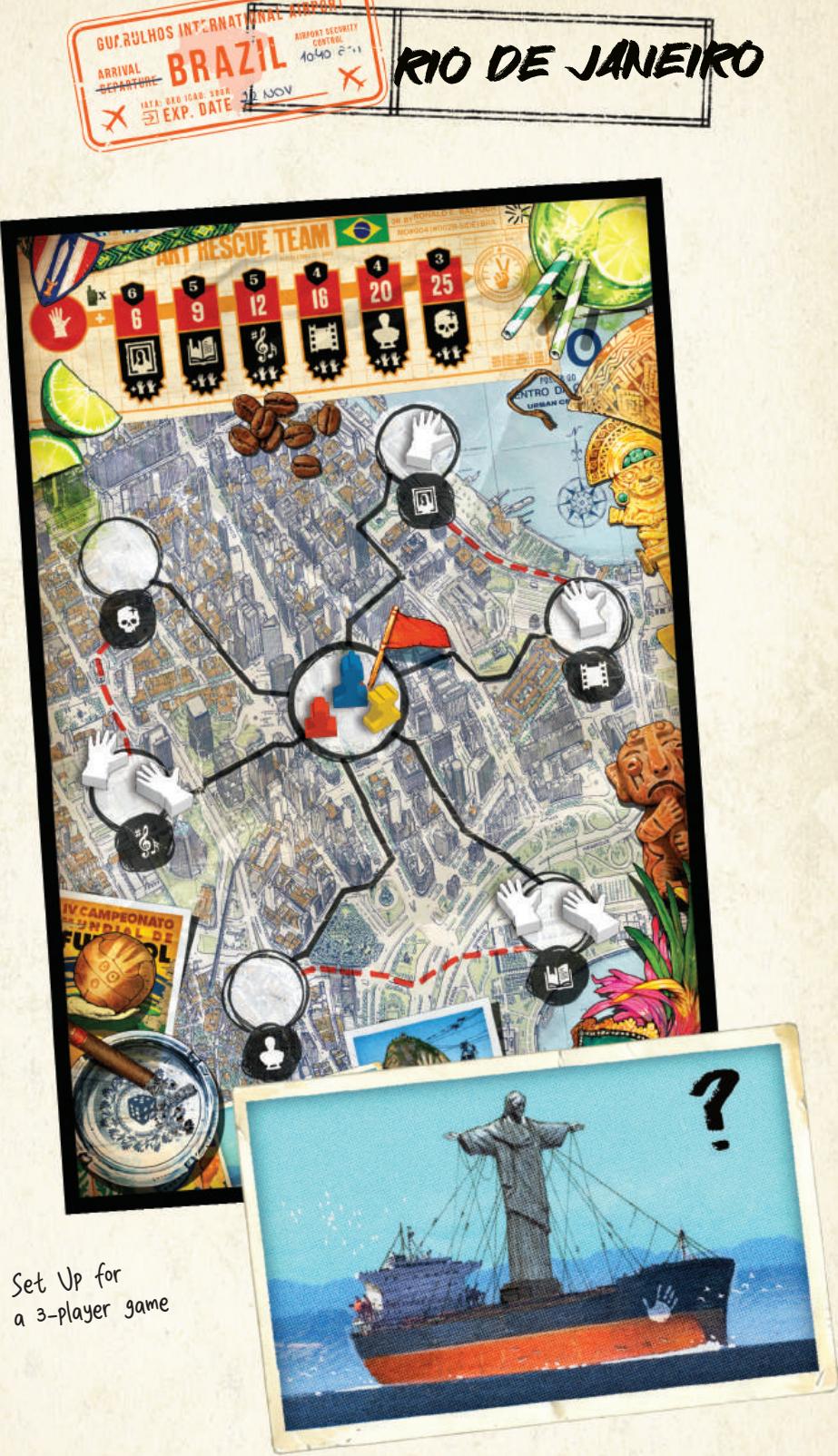
>> Set Up
• Cities are Neighborhoods in this Mission.

Each player places 2 Agent pawns in any Neighborhood(s) at the beginning of the game.
Place the Player pawns on the starting point: the "Central Neighborhood"

Game Round
The standard rules apply with the following exceptions:
•The movements are free along the red dotted roads.
The Art Pieces must be collected in the next Neighborhood indicated by the Art Piece Track, in that particular order, so you will probably have to move Art Pieces that were revealed in another neighborhood to the required one.

As usual, you can only collect an Art Piece from a Neighborhood if there is at least one Player pawn and no Agent in it. But you can freely move one Art Piece alongside your pawn, from place to place, even if there are Agents in them. Each Neighborhood may still only contain one Art Piece.
Each time you collect an Art Piece from a Neighborhood, place 2 Agent pawns on the Starting Area
As usual, if the Starting Area has 5 or more Agents at the end of a round, place a Lost City Marker on it, as with the other Neighborhoods.
When a neighborhood that hasn't yet received its Art Piece on the Art Piece Track becomes Lost, you immediately lose the game.
SOLO MODE
The Solo Mode uses the standard rules, with the following exceptions:
SET UP
• Choose 1 character card and their pawn
Place 6 Health tokens on the character card in moderate difficulty (double the regular amount of a multiplayer game).
Choose another Player pawn to accompany you. They will be your Ally.
Place both pawns on the starting point of the selected Mission map.
Remove 15 cards from the Mission deck and put them back in the box.
Then, place the End tile 12 cards before the end of the deck, as in the multiplayer mode.

Game Round
• Draw 3 Mission cards from the Mission deck.
Pick 2 Mission cards and play them, one after the other, before discarding the other(s) at the end of the round.
•You can move without your Ally, and vice versa.
Moving your Ally pawn costs you the same as moving your Player pawn (depending on the Mission map)
• Only you can be the Leader in a fight.
• Your Ally cannot fight alone.
The Ally pawn gives you their colored die in fights when the Ally pawn is on the same city as your Player pawn. You roll both dice.
The Ally Pawn can collect Art Pieces, in the same manner as the Player pawn.
The King
Turned blind after a robbery gone
wrong, the King knows Art like no one else. The White Hand is rumored to
have been responsible for this tragic event. A great chess player in his
spare time, he created this small team with only one purpose : taking the White Hand down, whatever the cost.

The Queen
As another casualty of the White Hand, it was easy for the King to recruit this young wunderkind during an exhibition in Delhi. Orphaned, the
Queen was the first one to join the Art Rescue Team, putting her talent and incredible intelligence to good use.

The Knight
The King found her in a Cambodian jail,
after she tried to rob the Royal Palace
in Phnom Penh, for the White Hand. This secretive woman has settled down since
then and has joined the Art Rescue Team in their works. Elusive and always in
for a high-wire walk, she has collected many art pieces without the White Hand even realizing it.
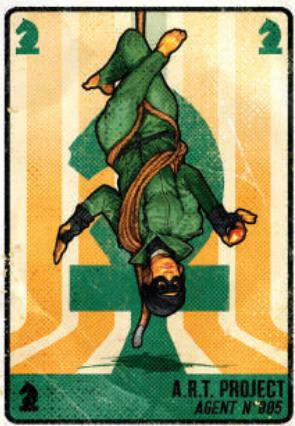

The Bishop
Not much is known about them. Their nickname - «the Bishop» - tells quite the ironical story. Their connections to the Knight are mysterious and some say they are siblings. The Bishop's loyalty to the team depends heavily on her.

The Tower
This headstrong woman doesn't take lessons from anyone. She made her name on the political chessboard by taking a strong stance on the White Hand issue. Quite naturally, the King came to her to invest in her political talents.

The Pawn
Handyman, driver, cook, barman,... Alongside his faithful Bibi (a classic van chock-full of useful - and less useful - stuff), the Pawn brings the Art Rescue Team with him out of all the tight spots. He knows everyone and everyone knows him. His greatest strength is his well-filled address book, and his ability to hold his liquor...

seal
M NNNNNR

- The A.R.T. Project -
Designed by Florian Sirieix and Benoit Turpin. Illustrated by Vincent Dutrait.
Published by the Lumberjacks. FAQ: www.lumberjacks-studio.com/art
The Op and USAOPOLY are trademarks of USAopoly, Inc. © 2023. USAopoly, Inc. AIl Rights Reserved.
Distributed by USAopoly, Inc., 5999 Avenida Encinas, Ste. 150, Carlsbad, CA 92008. MADE IN CHINA. WARNING: Choking Hazard – contains small parts. Not suitable for children under 3 years old.
USAopoly Customer Service Tel: 1-888-876-7659 (toll-free) customerservice@usaopoly.com
TheOpCames.com

When you purchase FSC labelled products, you're helping forests and the people that rely on them. This product is made with a mixture of materials from FSC-certified forests, recycled materials, and/or FSC-controlled wood. While controlled wood doesn't come from FSC-certified forests, it mitigates the risk of the material originating from unacceptable sources.
