foundingfathers_webrules.md

CHRISTIAN LEONHARD & JASON MATTHEWS
FOUNDING FATHERS sovemhs eSwe
PLANNER'S GUIDE TO THE CONSTITUTIONAL CONVENTION
USING THE PLANNER'S GUIDE
Pages 1 to 3 are the History and Overview Sections, not crucial to gameplay but bursting with great historical details about this pivotal era in American history.
Pages 4 to 12 are the rules of the game.
Pages 13 to 19 feature yet more bonus historical reading: biographies of all 55 delegates, and some background on our delegation flags.
Throughout the guide, anything in a blue box (like this one) is a rules-related note. Anything in a brown box (like the quote directly below this box) is a bit of information that doesn't directly affect the game.
“I smelt a rat." \~Patrick Henry's reponse as to why he declined to attend the Convention
“The conception of such an idea, and the deliberate union of so great and various a people in such a plan, is, without all partiality or prejudice, if not the greatest exertion of human understanding, the greatest single effort of national deliberation that the world has ever seen" \~John Adams
A BRIEF HISTORY OF THE CONSTITUTIONAL CONVENTION DISTILLED FROM THE WORK OF PROFESSOR GORDON LLOYD AT TEACHINGAMERICANHISTORY.ORG
RESOLVE TO THE THIRTEEN COLONIES
On May 15, 1776, the Second Continental Congress, meeting in Independence Hall, Philadelphia, issued “A Resolve” to the thirteen colonies: “Adopt such a government as shall, in the opinion of the representatives of the people, best conduce to the safety and happiness of their constituents in particular and America in general." These state constitutions displayed a remarkable uniformity. Seven contained a Declaration of Rights, and all contained the same civil and criminal rights. New York incorporated the entire Declaration of Independence into its constitution.
LIFE, LIBERTY, PROPERTY, AND THE PURSUIT OF HAPPINESS
The primary purpose of these declarations and bills was to outline the objectives of government: to secure the right to life, liberty, property, and the pursuit of happiness. To do so, all of the states except Pennsylvania embraced a two-chamber legislature, and all except Massachusetts installed a weak executive denying the Governor veto power over bills of the legislature. All accepted the notion that the legislative branch should be preeminent, but also realized that the liberty of the people was in danger from the corruption of elected representatives.
The Second Continental Congress also created the first continental-wide system of governance. The Articles of Confederation managed a nation of pre-existing states rather than a government over individuals. At the national level the very idea of a Bill of Rights was irrelevant because the Articles did not entail a government over individuals. The Articles didn't come into operation until the early 1780s because of territorial disputes between two states; all of the states were required to “sign on" before the Articles became operative on any one state and national legislation required approval of all thirteen states to take effect.
WE HAVE ERRORS TO CORRECT
These two directives produced two opposite and rival situations: a robust and healthy state system and a weak continental arrangement. Several statesmen were concerned that the idea of an American mind that had emerged during the war with Britain was about to disappear; the Articles of Confederation were inadequate to foster the development of an American nation. According to Washington, "we have errors to correct." The problems were not small and ranged from difficulties with interstate commerce to overseas representation in England and France Others, especially James Madison, were concerned that the state legislatures were passing laws detrimental to the rights of conscience and private property, and nothing could be done since the Articles left matters of religion and commerce to the states. The solution, concluded Madison, was an extended republic with checks and balances and a framework that endorsed a separation of powers between the branches of the general government.
THE CALL FOR A GRAND CONVENTION
Convincing others of the need took years. Following James Madison's suggestion of January 21, 1786, the Virginia Legislature invited all the states to discuss ways to reduce interstate conflicts at the Annapolis Convention later that year. The convention found no solutions, but led to agreement for a “Grand Convention" of all the states in 1787 to discuss how to improve the Articles of Confederation. The question at hand was: How could they take advantage of the opportunity provided by the Annapolis recommendation? How could such a bold proposal be put into effect?
Madison persuaded the Virginia Legislature to debate the issue and persuaded the Assembly to be the first to elect delegates to the Grand Convention to consider the business “of May next." George Washington was elected as head of delegation. James Madison insisted that he himself be present. Others selected included Governor Randolph and George Mason, though colonial heroes Richard Henry Lee and Patrick Henry refused to attend. Five states followed Virginia's lead: New Jersey, Pennsylvania, North Carolina, Delaware, and Georgia.
SETTING THE STAGE
So, six states acted without waiting for any formal endorsement by the existing government under the Articles of Confederation. Other states were more cautious, and wanted the existing Congress to address the legitimacy of such a gathering. On February 28, 1787, the Confederation Congress endorsed the meeting of the Grand Convention on "the second Monday in May next." Exactly what the Congress authorized was questioned. The recommendatory act of Congress reads: “A convention of delegates should meet for the sole purpose of revising the articles of Confederation and reporting to Congress and the several legislatures such alterations and provisions therein as shall, when agreed to in Congress and confirmed by the States, render the federal Constitution adequate to the exigencies of government and the preservation of the Union.
New York was the first state to act after the congressional endorsement, followed by five more states: South Carolina, Massachusetts, Connecticut, Maryland, and New Hampshire. Only Rhode Island refused to send delegates to the May gathering. The stage was now set.
WITHOUT A DROP OF BLOOD SPILLED
Thomas Jefferson characterized the men who showed up in Philadelphia as "demi-gods." Alexis de Tocqueville marveled at the work of the American Founders: never before in the history of the world had a nation and its leaders declared the existing government to be bankrupt, and calmly elected delegates who proposed a solution—which was in turn debated up and down the country for nearly a year—without a drop of blood spilled. Alexander Hamilton, in Federalist 1, suggested that this was a unique event in the history of the world; nally government was going to be established by reflection and choice rather than by force and fraud. So, like the Declaration ofIndependence, the Constitution was written by delegates immersed in philosophy, science, commerce, and practical politics.
THE CONVENTION BEGINS
Very few delegations were present at the appointed time for the meeting of the Grand Convention in Philadelphia on May 14, 1787. A quorum wasn't secured until the 25th. The frst order of business was to elect a president, and George Washington was the obvious choice. The delegates also agreed that the deliberations should be kept secret, to encourage honest discourse and to permit delegates to speak or change their mind as they saw it. Thus, despite the hot summer weather in Philadelphia, the windows were closed and heavy drapes drawn.
THE VIRGINIA PLAN
Governor Randolph introduced the Virginia Plan at the end of May to “revise the Articles of Confederation." The decisive features of this plan were:
1) the complete structural exclusion of the states in terms of both election and representation; 2) the complete diminution of the powers of the states and the virtual freedom of Congress to act in those areas for which the states are incompetent;
3) the establishment of an extended national republic with institutional separation of powers and the introduction of the possibility that short terms of office and term limits—standard features of traditional republicanism—will be abandoned.
RESISTANCE TO THE PLAN
Madison's Virginia Plan introduced a new understanding of federalism and republicanism. This wholly national republican plan was debated and amended over two weeks, supplanting the state-based New Jersey Plan and the Hamilton Plan (which itself went much further than the Virginia Plan). Far from immediately accepting it, the defenders of the New Jersey Plan—and of the old-style federalism of the Articles—insisted on questioning the validity of the Virginia Plan. They argued that the Convention had exceeded the congressional mandate because the Articles had been scrapped rather than revised. Moreover, the Convention was about to propose a novelty—a large country under one republican form of government—that would never be accepted by the electorate; republican government could only exist in areas of small extent where the people kept close watch over their representatives.
THE CONNECTICUT COMPROMISE
A breakthrough occurred at the end of June when Oliver Ellsworth suggested a mix of national and federal systems. Several delegates echoed this theme and the Gerry Committee was created to explore the ramifications of this suggestion that the people be represented in the House and the states be represented in the Senate. The recommendation became known as the Connecticut Compromise and was accepted in mid-July.
SLAVERY
With the Connecticut Compromise in place, the delegates turned from the question of structure to the question of national and state powers. A Committee was created to draft a Constitution—the Committee of Detail—that would address the division of powers between the central and state governments and also the separation of powers between Congress, the president, and the Supreme Court. A key issue that emerged was slavery. What could Congress do to regulate and/or abolish slavery? In August, a draft forbade Congress from ever regulating the slave trade, but in contrast, the final Constitution limited the prohibition on Congress only until 1808 and permitted Congress to discourage the slave trade immediately.
THE PRESIDENCY
Despite all the progress that had been made on the structural role of the states and the powers of Congress, there was still work to be done on the presidency. The Brearley Committee came up with the idea of an Electoral College as a sensible compromise to the long debates on how to elect the president. It had been clear for four months that until the mode of election was settled, no progress could be made on 1) length of term, 2) the issue of re-eligibility, and 3) the powers of the president. The Electoral College was modeled on the Connecticut Compromise: the president would be elected by a combination of people and states.
"It appears to me,
then, little short of a
miracle, that the
Delegates from so
many different States
(which States you
know are also different
from each other in
their manners,
circumstances and
prejudices) should
unite in forming a
system of national
Government, so little
liable to well founded
objections."
\~George Washington to
the Marquis de
Lafayette
"I have often and often, in the course of the session, and the vicissitudes of my hopes and fears as to its issue, looked at that behind the President, without being able to tell whether it was rising or setting; but now at length I have the happiness to know that it is a rising and not a setting sun. \~Benjamin Franklin commenting on the sun symbol on the back of Washington's chair
REFINEMENTS AND RESERVATIONS
The Committee of Style wrote the final draft of the Constitution. It included a Preamble and an obligation of contracts clause, both written by Gouverneur Morris, and an enumeration of the powers of Congress in Article I, Section 8. During the last week of the Convention the delegates added a few refinements, raised some serious concerns, and discussed what they had agreed to over the four months of deliberations. Mason expressed his wish that "the plan had been prefaced by a Bill of Rights." Elbridge Gerry supported Mason's unsuccessful attempt to attach a Bill of Rights. Randolph joined Mason and Gerry and declared that he too wouldn't sign the Constitution. Despite these concerns, the delegates pressed ahead to form the final document.
A CONSTITUTION AT LAST On the last day of the Convention, September 17, the Constitution was presented and read aloud; several delegates expressed concerns yet restrained their reservations in order to achieve a sense of unity. Finally, the document was signed by all delegates present, with the exception of Randolph, Gerry, and Mason. The business being thus closed, the Members adjourned to the City Tavern, dined together, and shared cordial goodbyes; a serene ending to the impassioned months spent putting to paper the collective ideals of the world's newest nation.
SIGNERS OF THE CONSTITUTION
NEW YORK Alexander Hamilton
SOUTH CAROLINA
John Rutledge
Charles Cotesworth Pinckney
PENNSYLVANIA Benjamin Franklin Thomas Mifflin Robert Morris George Clymer Thomas Fitzsimons Jared Ingersoll James Wilson Gouverneur Morris
GEORGIA William Few Abraham Baldwin
Charles Pinckney
NEW HAMPSHIRE John Langdon Nicholas Gilman
NEW JERSEY William Livingston David Brearley William Paterson Jonathan Dayton
Pierce Butler
VIRGINIA
John Blair
James Madison
George Washington
OVERVIEW
Number of Players: 3 - 5· Recommended Ages: 13+ · Approximate Play Time: 1 - 2 hours
Your goal in Founding Fathers is to emerge from the Philadelphia Convention acknowledged by all as the true Father of the Constitution due to your outstanding contributions to the final document. These contributions are measured by points on the scoring track, so you will want to ensure that you have more of these than anyone else by game's end. You can earn points in a variety of ways, such as by casting state delegations' votes according to your plans in the Assembly Room, or by filling the Committee Room with your own loyal supporters. Points can also be earned by establishing yourself as the most vocal proponent of one of the Convention's powerful political factions, or simply by being the beneficiary of a favorable historical event.
Each turn, you will play one or more cards from your hand. Sometimes, you will play a group of delegates from a particular state in order to persuade their delegation to vote the way you want them to in the Assembly Room. If you can muster enough support for or against a proposal, you can earn significant points in recognition of this influence. Even if the voting goes against you, however, there's no cause for despair -- your embittered supporters might still be able to work out a back room deal in the Committee Room, earning you recognition in a more roundabout manner!
Other times, you might instead play a collection of delegates who share the same political viewpoint and take to the debate floor in support of their cause. The more that the final Constitution ends up favoring that faction, the more points you stand to earn by being that faction's most eloquent spokesman.
On other occasions, you might choose to play a single card featuring an auspicious event. These events can have wide-ranging effects, earning you points immediately or improving your situation in a way which you hope will earn you points later.
As you can see, there are many avenues available for gaining recognition at the Convention and earning the points you need to win the game. The trick is to exploit these more effectively than your rivals, and to frustrate their efforts to do the same!

COMPONENTS
1 GAME BOARD
ASSEMBLY ROOM

SCORING TRACK VOTING TRACKER DRAW POOL
5 PLAYER REFERENCE BOARDS
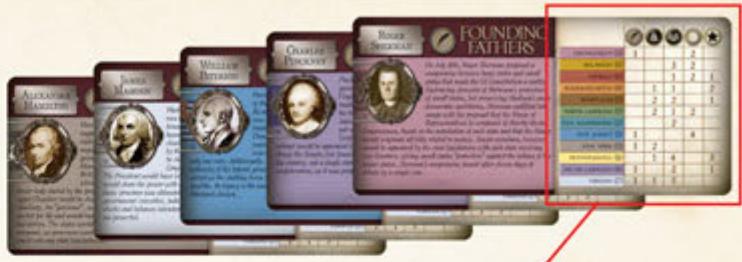
THIS CHART SHOWS THE 12 DELEGATIONS AND THE DISTRIBUTION OF FACTION LOYALTIES FOUND AMONGST THEIR DELEGATES. THE BACK SIDE OF EACH BOARD HAS A RULES SUMMARY FOR QUICK REFERENCE.
12 ARTICLES
AHISTORICAL SIDE (RED-RINGED ICON)
55 DELEGATE CARDS

BACK

FRONT


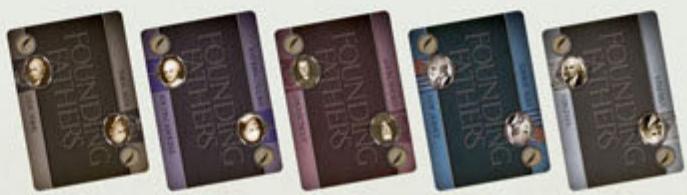
5 OF THE SS DELEGATE CARDS REPRESENT THE DELEGATES KNOWN AS "PLANNERS". THEY ARE DISTINGUISHABLE BY THEIR ORNATE SILVER FRAMES AND QUILL SYMBOL, PLUS THEY HAVE THEIR PLANNER'S PORTRAIT ON THE BACK SIDE.


YEA SIDE


NAY SIDE


40 INFLUENCE MARKERS


(PLEASE APPLY THE PROVIDED LABELS TO THE WOODEN BLOCKS AS SHOWN BELOW BEFORE YOUR FIRST PLAY.)



SETUP
Shuffle the appropriate set of player reference boards based on the number of players and deal one at random to each player to determine which of the Planners they will be playing:

③ Give each player the delegate card and 3 influence markers for their Planner. Place the remaining influence markers in a stockpile near the board. Put each player's scoring marker near the score track. The influence markers, scoring markers, and reference boards for Planners not being represented by any player are returned to the box, as they will not be needed.
Shuffle the remaining delegate cards, including those for any Planners which are not being represented by a player in the current game. The player to the dealer's right should then cut the deck by picking up approximately half the deck from the top, placing it to one side, and then placing the remaining half of the deck on top of that. The deck is then placed near the draw pool.
SHUFFLING THE DECK
Whenever the delegate deck is depleted, the discard pile should be reshuffled to form a new deck.
Any time the deck is shuffled, the player to the dealer's right should cut the deck.
DDeal 4 delegate cards face-down to each player, starting to the dealer's left and proceeding clockwise. Of these, each player should keep 2 cards, discarding the others into a shared face-up discard pile near the draw pool. The 2 cards each player keeps, plus his Planner card, make up that player's 3-card starting hand. Throughout the game, each player's hand is called their caucus.
CAUCUS SEMI-SECRECY
Players may keep the front sides of the delegate cards in their caucus hidden from other players, but the back of each card displays the state and faction icons of that delegate; this information should remain visible to the other players.
Draw 3 cards from the deck and place them face-down in the draw pool where they will be available for selection when players need to refill their hands.
Place the vote chits on the board near the voting tracker.
GShuffle the articles, again allowing the player to the dealer's right to cut. Stack the articles in their reserved spot on the board. Draw 4 articles and place them to one side with their historical side up. (The historical side is the side that does NOT have a red ring around the faction icon.) These articles are considered resolved. Resolved articles should be spread such that the faction icon on each is visible to all players
THE VIRGINIA PLAN VIRGINIA PLAN
The delegates to the Constitutional Convention did not begin their deliberations with a blank slate. Rather, the Virginia delegation presented a plan for the organization ofgovernment drafted largely by James Madison. The four articles resolved at the start of the game simulate the role of the Virginia Plan on the future of the Constitution.

ORIGINAL PAGES OF THE
VIRGINIA PLAN
(HELD AT THE NATIONAL ARCHIVES
AND RECORDS ADMINISTRATION,
RECORDS OF THE CONTINENTAL
AND CONFEDERATION CONGRESSES
AND THE CONSTITUTIONAL
CONVENTION)
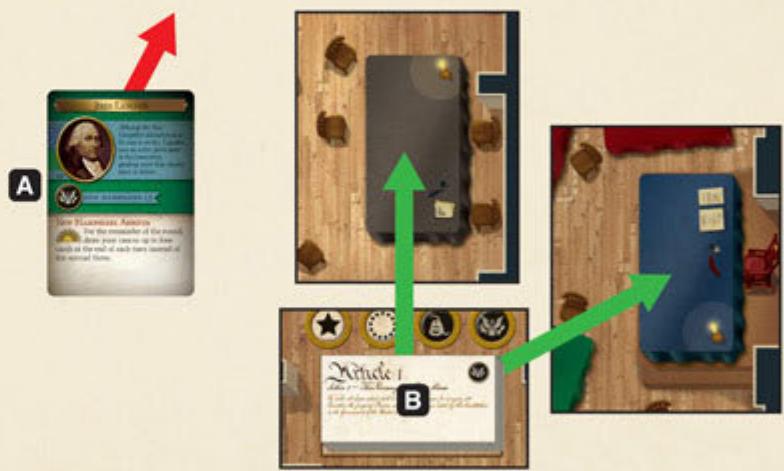
Draw 2 articles, placing the first in the Assembly Room and the second in the Committee Room. Place these articles with their historical side up.
0Separate the debate tokens by faction icon and stack them on their matching spots near the Debate Floor.

THE GAME BOARD
The Founding Fathers game board is modeled after a large cutaway section of Philadelphia's Independence Hall, the building wherein the Declaration of Independence was approved in 1776, and where the Founding Fathers met in 1787 to draft and complete the Constitution of the United States; the latter is the historic setting of our game. We have taken some liberties with the layout and functions of the various areas of the Hall for the benefit of gameplay.
The large Assembly Room has had its tables rearranged and recolored, but keeps its basic layout and décor with two hearths and the dais still bearing Washington's famous Rising Sun chair and silver inkwell.
The long Center Hall has been split into our Committee Room (The real Committee Room is located on the second story of the building) and the Debate Floor. In truth the delegates engaged in lively debate throughout the Hall and offsite as well, often in the nearby Indian Queen Tavern.
At the bottom left, our scoring track is a re-imagined spiral staircase leading up to the legendary Liberty Bell, which did indeed hang in the Hall's second story at the time of the Convention—although it had not yet acquired its famous name. Outside near the draw pool, venerable Ben Franklin's sedan sits on the lawn, indicative of delegates arriving at the Hall to engage in their important work.

SKETCH OF THEHALL'S LAYOUT(FROM ITS WORLDHERITAGE SITENOMINATIONDOCUMENT)

PHOTOOF THEASSEMBLYROOM
SEQUENCE OF PLAY
In the first round of the game, the Madison player begins play by taking the first turn. Play proceeds clockwise in turn until voting causes the Assembly Room to score, ending the round. Subsequent rounds begin with the next player in turn after the one who caused the previous round to end. On his turn, a player performs one of the following actions:
· DECLARE A VOTE
SPEAK IN DEBATE
· ENACT AN EVENT
SNUB DELEGATES
After taking his action the player replenishes his caucus to 3 cards by taking cards of his choice from the draw pool. Once he has done so, new cards are drawn from the deck and placed face-down to bring the draw pool back up to 3 cards.
USING INFLUENCE MARKERS
Each player begins the game with 3 influence markers available to him; additional influence markers may be gained during the game by enacting the event featured on any Planner card. These markers are used in several ways:
• When declaring a vote, to identify a delegation's controlling player.
• When speaking in debate, to advance a player along a faction's debate track.

• At the end of each round, when influence markers are sent to the Committee Room.
If a player wishes to perform an action which requires placing an influence marker, but has no markers available, he may freely remove one which is currently in use, reclaiming it and using it for the new action. If a player removes his influence marker from a state delegation he controls, that delegation's cards remain in place and its vote will count normally at the end of the round; it no longer has a controlling player, however, and no one will score points for it.
Whenever a player's influence markers are removed from play for any reason, they are reclaimed immediately by their owner.
DECLARE A VOTE
A player may declare a vote by selecting one or more delegates of the same state delegation from his caucus and voting them collectively either for or against the article currently under consideration in the Assembly Room, placing these cards on the appropriate side of the Assembly Room to indicate the way they have voted (votes for the article going on the Yea side and votes against on the Nay side) and marking them with one of his influence markers to identify himself as that delegation's controlling player. If multiple cards are played together, they should be spread such that the number of cards played and the faction icon of each is visible, but only one influence marker is placed on them regardless of the number of cards played.
To aid all players in quick assessment of the overall voting, place a vote chit from the supply on the corresponding box of the voting tracker, marking that state's vote with a checkmark if the delegation voted for, or an x if the delegation voted against. Remember to update the voting tracker if any course of events causes a delegation's vote to switch sides or be canceled.
Example: It is Madison's turn and he wants to declare a vote. He has his planner card (which he wants to save for later use) and two delegates from Pennsylvania in his hand: Ingersoll (an Antifederalist) and Mifflin (a Large States supporter). The article in the Assembly Room has an Antifederalist bias, so Madison decides to support the article by declaring Pennsylvania's vote for it. (more on that reasoning in the Faction Bias Restrictions section, below.) He places his two delegates together on a table on the Yea side of the Assembly Room, and marks it with one of his own influence markers. Finally he puts a vote chit from the supply in the Pennsylvania box of the voting tracker, with the checkmark side up.

All delegates played when declaring a vote must be eligible to declare their vote on the intended side of the article. There are two restrictions on how delegates may declare their vote; Faction Bias and Overriding:
1. FACTION BIAS RESTRICTIONS
Every article features a faction icon reflecting that article's bias—the faction which will benefit most should that article be adopted in its current form. Delegates are bound by their own faction loyalties (as indicated by the faction icons featured on their cards) and may not vote against an article of their own faction or for one of the opposing faction.
FACTIONS
The Federalist and Antifederalist factions are opposed, so a Federalist delegate may not vote for an Antifederalist article (or, conversely, against a Federalist one). The reverse is true of an Antifederalist delegate. The same applies equally to the Large States and Small States factions, which are opposed as well. On the other hand, a Federalist or Antifederalist is free to vote on either side of a Large States or Small States article, or vice versa.
Note that the Planner cards do not feature a faction icon (they feature the Planner icon in its place). Planners are therefore free to vote for or against any article regardless of its bias.
Example: It is the same scenario as in the above example; the Madison player wants to declare Pennsylvania's vote. The article in the Assembly Room has an Antifederalist bias. Mifflin (Large States supporter) is free to vote on either side of this article. Ingersoll (an Antifederalist), however, is not permitted to vote against an article featuring his faction's bias.
If he votes Nay, Madison could only play Mifflin to the table and would have to retain Ingersoll in his caucus. If he votes Yea, Madison could play either or both delegates to the table.
There are many reasons why the Madison player might choose one option over the other; in this case (as seen in the above example) he decides to vote Yea and play both delegates to the table.
2. OVERRIDING RESTRICTONS
Once a particular state delegation has declared its vote on an article, that delegation may not have additional delegate cards added to it by any player. 'The only way that state's position can change is if it is overridden by a different player (i.e., not the delegation's controlling player). To override a delegation which has already declared its vote, a player must declare the votes of a larger number of delegate cards from the same state onto the opposite side of the article. In this case, the delegates which had previously declared their votes on the original side of the article are discarded (with their controlling player reclaiming his influence marker), and the new cards are placed on the other side of the article and marked with an influence marker from the overriding player.
Example: Later in the round, it's Paterson's turn and he has managed to gather a caucus featuring three delegates from Pennsylvania that are eligible (by faction bias) to vote Nay to this article. He declares the vote, and Paterson's three delegates override Madison's two. Madison reclaims his influence marker and discards his delegates. Paterson places his three delegates at a table on the Nay side with one of his own influence markers, and flips Pennsylvania's vote chit to reveal the x.
ANTIFEDERALIST
FEDERALIST

PLANNER
LARGE STATES
SMALL STATES


Each state may only have one voting delegation at a time (composed of one or more delegates) in the Assembly Room for each article, either for or against it. While this position may be overridden if enough delegates from the same state can be mustered on the opposing side, it may not be “reinforced” by adding additional delegates after it has already declared its vote.

SPEAK IN DEBATE
A player may speak in debate by discarding one or more delegates of the same faction from his caucus and either placing one of his influence markers on the appropriate space on that faction's debate track to reflect the number of delegates discarded (if this is the first time that player has spoken for that faction in the current round) or advancing his existing influence marker farther along that faction's debate track the corresponding number of spaces (if he has already done so).
Example: It's Sherman's turn and he wants to speak in debate. His caucus is composed of a single Federalist and two Large States supporters. Sherman could do any one of the following:
ADiscard his single Federalist and place an influence marker from his supply on the “1” space of the Federalist debate track.
③Discard one of his Large States supporters (either one) and move his marker that's already on the Large States track up one to the “3” space, stacking it on Madison's marker.
CDiscard both of his Large States supporters and move his marker that's already on the Large States track up two spaces to the “4” space, just ahead of Madison's marker.
ENACT AN EVENT
A player may enact an event by discarding one card from his caucus to resolve that card's event text. A few conditions apply:
• If the event features the rising sun icon, it is a persistent event which remains in effect until the end of the round. The card should be placed face-up in front of the person who played it so that it is visible to all players.
Some events allow a player to declare a delegate's vote as part of the event. 'This is handled in exactly the same way as the standard “declare a vote" action, meaning additional delegates of the same state delegation may be voted along with it, and the normal rules regarding Faction Bias and Overriding are in effect.
•Some events allow a player to discard one or more delegates which have already declared their vote as part of the event. If this results in the last delegate card of a particular delegation being removed from the Assembly Room, the controlling player's influence marker is returned to him and that state becomes eligible to be voted again; remember to clear that state's vote chit off the voting track in that case.

Events often break the game's rules in a variety of ways. In all cases, the text of an event supersedes the normal rules of play.
SNUB DELEGATES
A player may snub delegates by discarding any number of cards from his caucus. These cards are discarded without effect and simply allow the player to replace them with new cards from the draw pool when he replenishes his caucus at the end of his turn.
REPLENISHING THE CAUCUS
After performing one of the above actions (but before moving on to Ending the Round, in the case that the action triggered it), a player replenishes his caucus to 3 cards by taking delegate cards from the draw pool. Once he has done so, new cards are drawn from the delegate deck and placed face-down to fill the draw pool back up to 3 cards. Note that after playing certain events a player may be left with 3 or more cards remaining in his caucus, and would therefore not draw any new cards that turn.

RECLAIMING A PLANNER
Whenever a player's Planner card is revealed at the top of the delegate deck after the deck is cut or a card is drawn, that player may immediately reclaim it and add it back into his caucus, even if it is not currently his turn.
ENDING THE ROUND
A round ends when the article in the Assembly Room passes or fails as a result of the various state delegations declaring their votes. Passing an article requires that a majority of the states (at least 7 out of the 12 present at the Convention) vote in its favor. If at any time 7 different state delegations (not delegates) have declared their votes on the Yea side of the article in the Assembly Room, a majority has been achieved and the article passes. Conversely, if at any time 6 different state delegations have declared their votes on the Nay side, a majority has been blocked and the article has failed. Either outcome ends the round.
When a round ends, the following steps are taken, in order:
-
RESOLVING THE ASSEMBLY ROOM
-
RESOLVING THE COMMITTEE ROOM
-
RESOLVING THE DEBATES
-
RESUMING PLAY
1. RESOLVING THE ASSEMBLY ROOM
If the article in the Assembly Room passed, the delegates who voted for it are on the winning side, while those who voted against it are on the losing side; if it failed, the opposite is true.
Any player who controls (has an influence marker on) one or more state delegations on the winning side gains points for each delegate card in those delegations: 2 points for each delegate whose faction icon matches the currently-showing faction bias of the article, and 1 point for each delegate featuring any other icon. All delegate cards on the winning side may then be discarded, with all influence markers being returned to their players.
Any player who controls one or more state delegations on the losing side removes his influence markers from those delegations and places them in the Committee Room. All delegate cards on the losing side may then be discarded.
If the article in the Assembly Room failed, it should now be flipped over to its reverse side (reversing its faction bias); if it passed, it is left as it is. It is then placed with the other articles which have already been resolved.
Example: A player has just cast the sixth delegation's vote on the Nay side, which blocks the majority and triggers the end of the round by causing the article to fail. Therefore the Nay side is the winning side, and the Yea side is the losing side.
First we look at the winning side. Any delegate whose faction icon matches the article's currently-showing faction bias will score 2 points for its controller. Of course, since this is the Nay side of the room, no delegates can possibly feature that icon. (The 2-point bonus can thus only normally be earned by delegates that voted Yea when the article has passed.) Delegates featuring other icons will each earn 1 point for their controllers. In this case, Sherman earns 1 point for his delegate from New Hampshire, and Paterson earns a total of 4 points for his two from Pennsylvania and his two from North Carolina. (Notice that there are other delegations on the winning side as well, but since they don't have influence markers on them, nobody scores points from them.) Sherman and Paterson both adjust their scores accordingly by moving their scoring tokens on the score track, then reclaim their influence markers from that side of the room. All delegate cards on the Nay side are discarded.
Next we look at the losing side. All of the influence markers there (two from Madison, one from Sherman) are moved to the Committee Room, and all of the delegates there are discarded.
Finally, we look at the article. Since it failed, we flip it over to reveal the other side (so that it now shows the Large States icon), and place it with the other resolved articles near the board.
AFTER SCORING, ALL DELEGATES ON THE WINNING SIDE ARE DISCARDED AND ALL INFLUENCE MARKERS THERE ARE RECLAIMED
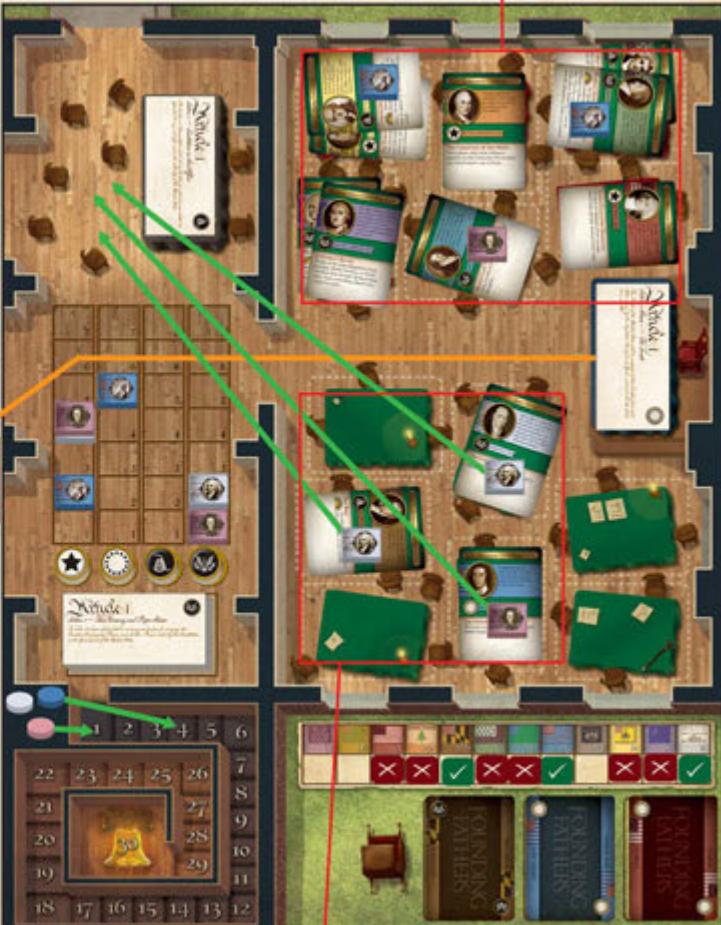
AFTER MOVING INFLUENCE MARKERS TO THE COMMITTEE ROOM, ALL DELEGATES ON THE LOSING SIDE ARE DISCARDED
2. RESOLVING THE COMMITTEE ROOM
Whichever player has the highest number of influence markers in the Committee Room scores points equal to that number and then reclaims all of his markers. No one else scores points for their influence markers in the Committee Room, and these markers remain in place. If multiple players are tied for having the most influence markers in the Committee Room, no one scores points for them and all these markers remain in place.
If anyone scored points for the Committee Room, that player has the option of flipping the article in the Committee Room over to its reverse side (reversing its faction bias) or leaving it as it is; if no one scored points, it is left as it is. It is then placed with the other articles which have already been resolved.

Example: Madison has the highest number of influence markers in the Committee Room, so he scores 2 points (one per marker), adjusts his scoring marker on the score track, and reclaims his two influence markers. Sherman's single marker stays where it is. Madison has won the option to flip the article if he wants, and after weighing his options he decides it will be a good idea to do so. He flips it from the currently-showing Antifederalist side so that is shows the Federalist icon, and places it with the other resolved articles.
3. RESOLVING THE DEBATES
Whichever player has advanced his influence marker the farthest along each faction's debate track receives a debate token for that faction from the stacks near the Debate Floor. If multiple players are tied for having advanced the farthest along a particular debate track (or if no one spoke for that faction), no one receives a debate token for that faction this round. After resolving the debates, all influence markers on the Debate Floor are returned to their owners.
Example: Let's look at the debate tracks one by one from left to right. For the Large States track, Sherman and Madison are tied for highest, so no one gets that token. For the Small States track, Paterson is way out in the lead so he gets the Small States debate token. Nobody debated in favor of the Antifederalists this round, so nobody gets that token. And finally, Madison just edged out Sherman on the Federalist track, so Madison gets the Federalist token. Everyone then gets their influence markers back.
4. RESUMING PLAY
The following actions should be performed before resuming play:
ADiscard any persistent events that are currently in effect.
3Draw 2 articles from the top of the article stack, placing the first in the Assembly Room and the second in the Committee Room. Place both with their historical side up.
Clear all vote chits off the voting tracker, placing them back into the supply.

Play resumes with the next player in turn after the one who caused the previous round to end.


ENDING THE GAME
The game ends after four rounds, at which point all 12 articles will have been resolved, including the 4 initial articles resolved at the start of the game.
At the end of the game, players score bonus points for having the most debate tokens for each faction. If multiple players are tied for having the most debate tokens for a particular faction, all tied players get the full bonus for that faction.
The bonus for each faction depends on how many of the resolved articles display that faction. The faction that appears the most on the resolved articles is the 1st-place faction, the faction that appears next-most is the 2nd-place faction, and so on.
If multiple factions are tied for the number of articles displaying that faction, all tied factions are worth their full bonus. For example, if two factions were tied for 1st place, both would be worth 5 points to whichever player(s) had the most debate tokens of either faction. The next-highest faction would receive the normal 3 point bonus for 3rd place.
Example: At the end of the game, there are five articles showing the Federalist icon, which makes the 1st-place faction Federalist. Both Small States and Large States are showing on three articles, so they both count as the 2nd-place faction. Trailing with only one article, the Antifederalist faction is the 4th-place faction.

So, when we look at the debate tokens owned by each player, we get:
1st-place faction: 5 points
2nd-place faction: 4 points
3rd-place faction: 3 points
4th-place faction: 2 points

1st-place faction (Federalist): Madison owns the most Federalist tokens, so he earns 5 points.


(Tied) 2nd-place faction (Small States): Paterson and Sherman are tied for most Small States tokens, so they each earn 4 points.
(Tied) 2nd-place faction (Large States): Paterson owns the most Large states tokens, so he earns 4 points. 4th-place faction (Antifederalist): Madison and Paterson are tied for most Antifederalist tokens, so they each earn 2 points.


After calculating the bonus points, each player updates their position on the score track accordingly.
THE SCORE TRACK
During the game players will be moving their scoring markers up the track every time they earn points. Points can be earned when the Assembly Room is resolved, when the Committee Room is resolved, when certain Events are enacted, and at the game's end when debate tokens are counted. It is possible that players' scores will pass 30, which is the score track's highest number. In this case, simply start those markers again at the beginning of the track and remember to add 30 when tabulating their nal scores.

WINNING THE GAME
Whichever player has accumulated the most points over the course of the game is the winner! In the event of a tie, all tied players should revel in their successful creation of a more perfect union.
FLAGS OF THE DELEGATIONS
In reality, each state delegation did not have a specific flag to represent itself. There are a number of historical flags associated with each of the states for the broad era leading up to the Convention, so we have selected interesting and distinct flags to help identify the delegations in our game. In some cases we made some shape or color alterations to the originals in order to serve game purposes more effectively, but they are presented here unaltered.
CONNECTICUT

Colors of the 2nd Connecticut Regiment. Given to the Regiment in 1776
upon its entry to the Continental Army. The remaining original specimen is believed to be one of no more than 30 flags that have survived since the Revolutionary War.
DELAWARE
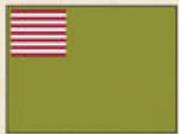
The Delaware Militia Flag. Flown by Samuel Patterson's unit in 1777 during the
Battle of Cooch's Bridge, notable for being the only battle during the Revolutionary War that was fought on Delaware soil.
GEORGIA

The First U.S. National Flag. This arrangement is usually called the Betsy Ross Flag
and was prescribed (among other variants) for national usage by the passing of the Flag Resolution in 1777.
MASSACHUSETTS

Washington's Cruisers Flag. A naval flag designed for easy recognition, flown
NEW HAMPSHIRE
from several floating artillery batteries and other military vessels patrolling Massachusetts Bay and the Charles River in the mid-1770s.
Green Mountain Boys Flag. Used in the 1770s by the Green Mountain Boys of

the New Hampshire Militia, a guerilla unit remembered for its important capture of Fort Ticonderoga. This flag design is still used today by the Vermont National Guard.
NEW JERSEY
the Revolutionary War, and it is possibly the earliest flag used exclusively by American soldiers.

Calvert Arms/ King's Colors. The Maryland Militia fought under this flag in
along the Delaware River to block the approach to Philadelphia. This flag is thought by some to be the earliest flag displayed using the stars-and-stripes motif, despite the reversal of the normal red and blue colors.
Fort Mercer Flag. Flown in 1777 at Fort Mercer, New Jersey. The fort was one of several built
MARYLAND

NEW YORK
Colors of the Third New York Regiment. Presented to the Regiment in 1779
to recognize their service at the seige of Fort Schuyler in 1777. This flag is the only regimental flag of New York of which a physical specimen survives to this day.
NORTH CAROLINA

Guilford

Courthouse Flag. This flag was reportedly flown during the Battle of
Guilford Courthouse in 1781. It is considered to be the oldest surviving example of an American flag featuring eight-pointed stars.
PENNSYLVANIA
Cavalry, which often served as George Washington's personal bodyguard during the Revolution.
SOUTH CAROLINA

Philadelphia Light Horse Flag. Given in 1775 to the First Troop Philadelphia City

Moultrie Flag. Flown by Colonel Moultrie's troops in the 1770s, claimed to be the first
distinctive American flag displayed in the South. Colonel Moultrie had the flag made for his troops, as they displayed silver crescents on their caps with the motto “Liberty or Death”.
VIRGINIA

The Culpeper Flag.
Used during the Revolution by soldiers from
Culpeper County, Virginia. It features Patrick Henry's famous “Liberty or Death” motto, and it uses the rattlesnake as a symbol of colonial America; this custom began with a 1754 political cartoon by Ben Franklin.
THE DELEGATES
ABRAHAM BALDWINGEORGIAAGE AT CONVENTION: 32REVOLUTIONARY WAR VET: YES OCCUPATION: LAWYER, MINISTER,EDUCATOREDUCATION: YALE | The former chaplain of the Continental Army, Baldwin sat on the Committee of Postponed Matters and was involved in theConnecticut Compromise. Initially, he supported representation in the Senate on the basis of property, but was won over to thesmall state position by his friends in the Connecticut delegation. William Pierce opined: “Mr. Baldwin is a Gentleman of superiorabilities and joins in a public debate with great art and eloquence." |
RICHARD BASSETTDELAWAREAGE AT CONVENTION: 42REVOLUTIONARY WAR VET: YES OCCUPATION: LAWYER, INVESTOREDUCATION: READ FOR LAW INPHILADELPHIA | Bassett attended the Convention, but left the bulk of the work to others. While he was present for almost the entire Convention, thereis no record of him giving any speeches. He served on no committees, and was never a deciding vote. While he attended the earlierAnnapolis Convention, that experience does not seem to have given him any particularly strong opinions about the direction of thenew government. William Pierce wrote: "he is a religious enthusiast, lately turned Methodist, and serves his Country because it isthe will of the people." |
GUNNING BEDFORD JRDELAWAREAGE AT CONVENTION: 40REVOLUTIONARY WAR VET: YES OCCUPATION: LAWYEREDUCATION: PRINCETON | While other small-state delegates supported a strong central government as a check upon their more populous and powerfulneighbors, Bedford worried that the small states might be swallowed whole. He famously threatened the Convention with thespectre of foreign alliances, stating: "the small ones would find some foreign ally of more honor and good faith, who will take them bythe hand and do them justice." Bedford ultimately moderated his stance and participated in the committee that drafted the GreatCompromise. William Pierce characterized Bedford as: "warm and impetuous in his temper, and precipitate in his judgment... andvery corpulent." |
JOHN BLAIRVIRGINIAAGE AT CONVENTION: 55REVOLUTIONARY WAR VET: NO OCCUPATION: LAWYEREDUCATION: COLLEGE OF WILLIAM ANDMARY, MIDDLE TEMPLE (LONDON) | Already a judge of considerable note by the time of the Convention, Blair was a quiet member of the Virginia delegation. At theConstitutional Convention, Blair never served on a committee, and most famously split the Virginia delegation over the method forelecting the president. When he realized this had brought progress to a halt, he supported his friends Washington and Madison andbrought the question to a resolution. Thereafter, he faithfully supported the positions of Washington and Madison. After theacceptance of the Constitution, Blair was appointed as an Associate Justice of the US Supreme Court, resigning for health reasonssix years later. In addition to his national service, Blair was a Grand Master of Freemasons. William Pierce remarked: "he is one ofthe Judges of the Supreme Court in Virginia, and acknowledged to have a very extensive knowledge of the Laws. |
WILLIAM BLOUNTNORTH CAROLINAAGE AT CONVENTION: 38REVOLUTIONARY WAR VET: YES OCCUPATION: PLANTER, MERCHANT,EDUCATOREDUCATION: UNKNOWN | Blount was an inactive member of the Convention, splitting his time with the Continental Congress. Though he had reservations, hereluctantly signed the Constitution because he felt that the document represented the will of the people. Later, he strongly supportedthe document during the North Carolina ratification convention. William Pierce wrote of him: “Mr. Blount is a character stronglymarked for integrity and honor. [H]e is plain, honest, and sincere." |
DAVID BREARLEYNEW JERSEYAGE AT CONVENTION: 42REVOLUTIONARY WAR VET: YES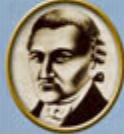 OCCUPATION: LAWYEREDUCATION: PRINCETON | Brearley chaired the Committee on Leftovers, but otherwise followed William Paterson's lead at the Convention. Like Paterson, heargued against proportional representation, preferring a system of one state, one vote. His most substantive contribution wasdeveloping the Electoral College. William Pierce said of him: “[A]s an Orator he has little to boast of, but as a Man he has everyvirtue to recommend him." |
JACOB BROOMDELAWAREAGE AT CONVENTION: 35REVOLUTIONARY WAR VET: YES OCCUPATION: BUSINESSMAN, MERCHANTEDUCATION: NO FORMAL COLLEGE | Broom was a fervent believer in a robust central government. He spoke several times and advocated for nine-year terms for senatorsand a life term for the president. He also advocated for congressional pay to be absorbed by the state legislatures. In turn, hesupported a congressional veto over the acts of state legislatures. William Pierce went further in his impressions of Broom to callhim: “silent in public, but cheerful and conversible in private." |
PIERCE BUTLERSOUTH CAROLINAAGE AT CONVENTION: 43REVOLUTIONARY WAR VET: YES OCCUPATION: PLANTEREDUCATION: UNKNOWN | Butler was typical of southern participation at the Convention. He was a staunch nationalist, but insisted on protections for slaveryto secure his delegation's participation in the new federal system. He was the author of the fugitive slave clause and also sat as amember of the Committee on Postponed Matters. William Pierce stated: “Mr. Butler is a character much respected for the manyexcellent virtues which he possesses, but as a politician or an Orator, he has no pretensions to either." |
DANIEL CARROLLMARYLANDAGE AT CONVENTION: 57REVOLUTIONARY WAR VET: YES OCCUPATION: MERCHANT, PLANTEREDUCATION: COLLEGE OF ST.OMER(NETHERLANDS) | Carroll arrived late in Philadelphia due to illness, but played a decisive role in encouraging Maryland's delegation to support theConstitution. Carroll joined Wilson in advocating the election of a president by “the people” rather than by Congress. William Piercedescribed Carroll as: “A Man of large fortune, and influence in his State. He possesses plain good sense, and is full confidence of hisCountrymen." |
GEORGE CLYMERPENNSYLVANIAAGE AT CONVENTION: 48REVOLUTIONARY WAR VET: NO OCCUPATION: MERCHANT, BANKER,EDUCATOREDUCATION: NO FORMAL COLLEGE | Clymer was one of the five delegates who also signed the Declaration of Independence. As a delegate, Clymer served on theCommittee of Assumption of State Debt and on the Committee of Slave Trade. He was a noted ally of the federalist positionthroughout the convention. William Pierce said of him: “He is a respectable Man, and much esteemed. |
WILLIAM RICHARDSON DAVIENORTH CAROLINAAGE AT CONVENTION: 30REVOLUTIONARY WAR VET: YES OCCUPATION: LAWYER, PLANTEREDUCATOREDUCATION: PRINCETON | Davie supported a stronger central government, and served on the First Committee on Representation. His advocacy moved NorthCarolina in favor of the Great Compromise though he insisted slaves should count for purposes of representation. Davie alsofavored a scheme of electing the president and senators via state legislatures. A colleague described Davie as: "a tall, elegant man inhis person, graceful and commanding in his manners." |
JONATHAN DAYTONNEW JERSEYAGE AT CONVENTION: 26REVOLUTIONARY WAR VET: YES OCCUPATION: LAWYER, BUSINESSMANEDUCATION: PRINCETON | Dayton was the youngest attendee and remained quiet during the proceedings, except for his support of the New Jersey Plan.Afterwards, Dayton pushed for expanding American frontiers westward (Dayton, Ohio is named for him). William Pierceexplained: "there is an impetuosity in his temper that is injurious to him; but there is an honest rectitude about him that makes hima valuable Member of Society." |
JOHN DICKINSONDELAWAREAGE AT CONVENTION: 54REVOLUTIONARY WAR VET: YES OCCUPATION: INVESTOR, LAWYEREDUCATION: MIDDLE TEMPLE (LONDON) | Once the wealthiest man in British North America, Dickinson famously refused the sign the Declaration of Independence. At theConvention, Dickinson turned his support towards a strong central government once the Great Compromise was reached though hethought Madison pushed too hard for democratic representation. While Dickinson is a signatory to the Constitution, the signatureis not his own. He returned home, and had his friend and fellow delegate, George Read, sign for him. William Pierce remembershim: “Mr. Dickinson has been famed through all America, for his Farmer Letters; he is a Scholar, and said to be a Man of veryextensive information. ... I had often heard that he was a great Orator, but I found him an indifferent Speaker." |
OLIVER ELLSWORTHCONNECTICUTAGE AT CONVENTION: 42REVOLUTIONARY WAR VET: NO OCCUPATION: LAWYEREDUCATION: PRINCETON | Ellsworth introduced the resolution which became the “Great Compromise”. He also changed the word “national” to “United States”in a resolution; thereafter, “United States” was the title used in the Convention to designate the government. Ellsworth served on theCommittee of Five that prepared the first draft of the Constitution. Though he left the Convention near the end of August and didnot sign the final document, he urged its adoption upon his return to Connecticut and wrote the Letters of a Landholder to promoteits ratification. William Pierce described Ellsworth as “a Gentleman of a clear, deep, and copious understanding; eloquent andconnected in public debate; and always attentive to his duty." |
WILLIAM FEWGEORGIAAGE AT CONVENTION: 39REVOLUTIONARY WAR VET: YES OCCUPATION: REAL ESTATESPECULATOR, FARMER, LAWYEREDUCATION: NO FORMAL COLLEGE | Few played a minor role at the Convention. He was absent during July to attend the Continental Congress. Nevertheless, he castseveral critical votes for the federalist cause, and shepherded the proposed Constitution through the Continental Congress. WilliamPierce believed “Mr. Few possesses a strong natural Genius, and from application has acquired some knowledge of legal matters." |
THOMAS FITZSIMONSPENNSYLVANIAAGE AT CONVENTION: 46REVOLUTIONARY WAR VET: YES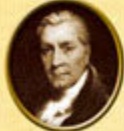 OCCUPATION: MANUFACTURING,SHIPPING, EDUCATOREDUCATION: UNKNOWN | One of several delegates born abroad, Fitzsimons was a dedicated patriot who commanded militia and dedicated considerablepersonal resources to the cause. His role at the Convention was low-key, but he served on the Committee on Trade. He is remem-bered as an ardent federalist. William Pierce remarked: “Mr. Fitzsimons is a Merchant of considerable talents and speaks very wellI am told, in the Legislature of Pennsylvania.' |
BENJAMIN FRANKLINPENNSYLVANIAAGE AT CONVENTION: 81REVOLUTIONARY WAR VET: NO OCCUPATION: INVENTOR, AUTHORPUBLISHEREDUCATION: NO FORMAL COLLEGE | Within the States, Franklin's prestige was paralleled only by George Washington's. As the Convention's oldest delegate, Franklinplayed a lesser role than he did at the Continental Congress which resulted in the Declaration of Independence. His maincontribution was serving as “the grand mediator, soothing passions, counseling consensus, and generally lending his public esteemto advance the Convention's work. Often, he was unable to deliver his own speeches, and relied on other members of Pennsylvania'sdelegation to deliver them instead. Éranklin died in the first year of the new government. His final public act was to memorialize toCongress advocating for the abolition of slavery, a cause he championed from the 1730s onwards. William Pierce said of the greatman: “[T]he very heavens obey him, and the Clouds yield up their Lighting to be imprisoned in his rod. He is, however, a mostextraordinary Man, and tells a story in a style more engaging than anything I ever heard. |
ELBRIDGE GERRYMASSACHUSETTSAGE AT CONVENTION: 43REVOLUTIONARY WAR VET: NO OCCUPATION: MERCHANT, SHIPPER,MANUFACTUREREDUCATION: HARVARD | Gerry represents the classic case of an effective revolutionary who cannot adjust to the compromise and tamer objectives ofgoverning. Gerry chaired the First Committee on Representation, but when it produced the Connecticut Compromise he did notsupport it. Gerry once favored a stronger central government, but by the close of the Convention he refused to sign and arguedagainst the Constitution. Labeling the Constitution “Full of Vices, he objected to the absence of a Bill of Rights and against thethreats that it posed to traditional republicanism. William Pierce remembered him as: “[a] character marked for integrity andperseverance .. Mr. Gerry is very much of a Gentlemen in his principles and manners. |
NICHOLAS GILMANNEW HAMPSHIREAGE AT CONVENTION: 32REVOLUTIONARY WAR VET: YES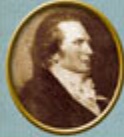 OCCUPATION: MERCHANTEDUCATION: NO FORMAL COLLEGE | Gilman was John Langdon's junior partner, having accepted Langdon's generosity in paying for their travels. Gilman was not givento oratory, and made no speeches during his abbreviated participation in the Convention, although he did participate in theCommittee of Leftovers. As a member of the Continental Congress, he helped secure its endorsement of the Constitution. WilliamPierce recorded: "Mr. Gilman is modest, gentile and sensible. There is nothing brilliant or striking in his character, but there issomething respectable and worthy in the Man." |
NATHANIEL GORHAMMASSACHUSETTSAGE AT CONVENTION: 49REVOLUTIONARY WAR VET: NO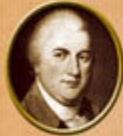 OCCUPATION: MERCHANTEDUCATION: NO FORMAL COLLEGE | Gorham had a distinguished pedigree as a prosperous Boston merchant, and served as president under the Articles of Confedera-tion. He was a supporter of a strong central government and participated frequently in the debates. At the Convention, he chairedthe Committee of the Whole. He was also a member of the influential Committee on Detail. William Pierce explained: “Mr.Gorham is ... high in reputation, and much in the esteem of his countrymen, he is eloquent and easy in public debate, but hasnothing fashionable or eloquent in his style." |
ALEXANDER HAMILTONNEW YORKAGE AT CONVENTION: 30REVOLUTIONARY WAR VET: YES OCCUPATION: LAWYEREDUCATION: COLUMBIA | Hamilton arrived at the Convention brash, but full of ability. His plan was given short shrift by the delegates, but his vision ofcentralized power made the Connecticut Compromise appear a moderate course. He intensely disliked his fellow New Yorkdelegates. Hamilton's decision to sign the final product, despite his personal reservations that much more should have been done tostrengthen the central government, convinced many of his colleagues to do likewise. William Pierce said of him: “[T]here is noskimming over the surface of a subject with him, he must sink to the bottom to see what foundation it rests on." |
WILLIAM HOUSTONNEW JERSEYAGE AT CONVENTION: 41REVOLUTIONARY WAR VET: YES OCCUPATION: EDUCATOREDUCATION: PRINCETON | Houston is one of the few delegates for whom no known image exists. He served at the Annapolis Convention before coming toPhiladelphia. He attended briefly, leaving due to illness. During his brief tenure, he sat on the committee assigning representation inthe lower chamber. While unable to sign the Constitution, he did support it and signed the report to the New Jersey legislature. Hedied in 1788, eulogized with: "Died, in the very vigor of his manhood, though ripe with honors, a man of ability, eminent, of honorunimpeachable, and of inegrity unsullied." |
WILLIAM HOUSTOUNGEORGIAAGE AT CONVENTION: 32REVOLUTIONARY WAR VET: NO OCCUPATION: LAWYER, PLANTEREDUCATION: READ FOR LAW AT INNERTEMPLE (LONDON) | Houstoun hailed from a loyalist family, though Houstoun himself was an ardent patriot. Houstoun was present at the Constitu-tional Convention until early August. Opposed to the Connecticut Compromise, he deadlocked Georgia's vote—and thus the entireConvention's efforts—until his departure. William Pierce wrote of Houstoun: “Nature seems to have done more for his corporealthan mental powers. His Person is striking, but his mind very little improved with useful or eloquent knowledge." |
JARED INGERSOLLPENNSYLVANIAAGE AT CONVENTION: 31REVOLUTIONARY WAR VET: NO OCCUPATION: LAWYER, EDUCATOREDUCATION: YALE, MIDDLE COLLEGE | The son of a prominent loyalist family, Ingersoll was late to the patriot cause. A lawyer of national prominence by the time of theConstitutional Convention, initially he believed that a revision of the Articles of Confederation sufficed. It was only after lengthydebate that he came around to the notion that an entirely new constitution was requried. Despite his reputation and legal training,Ingersoll rarely spoke at the Convention. William Pierce noted: "Mr. Ingersoll speaks well, and comprehends his subject fully." |
DANIEL OF ST.THOMAS JENIFERMARYLANDAGE AT CONVENTION: 64REVOLUTIONARY WAR VET: NO OCCUPATION: PLANTEREDUCATION: UNKNOWN | Jenifer was one of the more senior delegates at the Convention, and performed a role not unlike his friend Benjamin Franklin inencouraging compromise and progress through humor and his own good nature. He was keenly interested in the future of commercein the United States, an interest undoubtably spurred by his own large plantation holdings. These concerns allied Jenifer with thefederalist camp at the Convention, where he favored a strong central government. There, he supported placing the power of taxationinto the hands of a federal legislative body elected by the people, rather than the states. When Luther Martin said he feared beinghanged if the people of Maryland approved the Constitution, Jenifer teased that he should stay in Philadelphia so that he would nothang in his home state. William Pierce said of him: “[H}e sits silent ... and seems to be conscious that he is no politician." |
WILLIAM SAMUEL JOHNSONCONNECTICUTAGE AT CONVENTION: 59REVOLUTIONARY WAR VET: NO OCCUPATION: LAWYER, INVENTOR,INVESTOREDUCATION: YALE, M.A. HARVARD | Johnson was a popular member of the Convention. He lobbied his delegation for the adoption of the Connecticut Compromise andchaired the influential Committee on Style. Furthermore, he worked on four other committees. William Pierce said ofJohnson, “Dr.Johnson is a character much celebrated for his legal knowledge; he is said to be one of the first classics in America, and certainlypossess a very strong and enlightened understanding.' |
RUFUS KINGMASSACHUSETTSAGE AT CONVENTION: 32REVOLUTIONARY WAR VET: NO OCCUPATION: MERCHANT, SHIPPERMANUFACTURER, LAWYEREDUCATION: HARVARD | Rufus King was a distinguished member of the Convention and one of its leading orators. Initially skeptical of the need for a newconstitution, he eventually closed ranks with Madison and became a leading proponent of the document. King served on morecommittees than any other delegate, playing a significant role in the Committee on Postponed Matters and the Committee on Style.William Pierce enthused: "Mr. King is a man much distinguished for his eloquence and his parliamentary talents.... He may withpropriety be ranked among the Luminaries of the present Age. |
JOHN LANGDONNEW HAMPSHIREAGE AT CONVENTION: 46REVOLUTIONARY WAR VET: YES OCCUPATION: SHIP BUILDER, MERCHANTEDUCATION: NO FORMAL COLLEGE | Langdon had the most difficult row to hoe in order to attend the Convention. Not only did he need to travel from New Hampshire,but his home state refused to pay any of his expenses. As a result, from his own purse he paid for himself and colleague NicholasGilman. Langdon sat on the Committee on the Slave Trade, helping to craft the compromise on that matter, as well as theCommittee on the Assumption of State Debt and Committee of Trade. William Pierce wrote of him: “Mr. Langdon possesses aliberal mind, and a good plain understanding." |
JOHN LANSING JR.NEW YORKAGE AT CONVENTION: 33REVOLUTIONARY WAR VET: YES OCCUPATION: LAWYEREDUCATION: NO FORMAL COLLEGE | John Lansing was a skeptic regarding the Convention. He thought that the delegates were operating beyond their charge to amendthe Articles of Confederation, and that a new centralized government would restrict individual liberty. Lansing joined Yates indeparting early. In a letter, they explained “[the new government could not] afford that security to equal and permanent libertywhich we wished to make an invariable object of our pursuit." Lansing was murdered while posting a letter during his tenure asChief Justice for the state of New York. William Pierce said of him: "his legal knowledge I am told is not extensive, nor his educationa good one. He is however a Man of good sense, plain in his manners, and sincere in his friendships. |
WILLIAM LIVINGSTONNEW JERSEYAGE AT CONVENTION: 63REVOLUTIONARY WAR VET: YES OCCUPATION: LAWYEREDUCATION: YALE | Livingston's duties as New Jersey governor required him to miss several sessions, but he participated in key committee slots and seemsto have made most of his contributions in that context. As chairman of the Committee on the Slave Trade, Livingston brokered acompromise on that issue. He also chaired the Committee on the Assumption of State Debts. He favored the New Jersey Plan, butafter the Connecticut Compromise was a firm supporter of the Constitution. William Pierce remarked: "Governor Livingston isconfessedly a Man of the first rate talent, but he appears to me rather to indulge a sportiveness of wit, than a strength of wit." |
JAMES MADISONVIRGINIAAGE AT CONVENTION: 36REVOLUTIONARY WAR VET: NO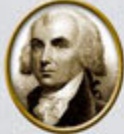 OCCUPATION: PLANTEREDUCATION: PRINCETON | The man destined to be remembered as “Father of the Constitution, Madison was brilliant from start to finish at the Convention.Even among such Virginia luminaries as George Washington and George Mason, Madison's presence stood out. He was the rockupon which a stronger central government was built at the Constitutional Convention—never wavering from that purpose, nomatter the setback—though he was not one to shy away from compromise if it furthered his ultimate purpose. His notes of theConvention are the clearest picture we have available today of the work done in Philadelphia. Afterwards, Madison co-wrote theFederalist Papers and drafted the first twelve amendments to the Constitution (including the first ten, now known as the Bill ofRights). Even William Pierce was impressed, stating: "Mr. Madison is a character who has long been in public life; and what is veryremarkable every Person seems to acknowledge his greatness. He blends together the profound politician, with the Scholar. .. Theaffairs of the United States, he perhaps, has the most correct knowledge of, of any Man in the Union." |
ALEXANDER MARTINNORTH CAROLINAAGE AT CONVENTION: 47REVOLUTIONARY WAR VET: YES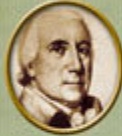 OCCUPATION: LAWYER, PLANTEREDUCATOREDUCATION: PRINCETON | Martin's participation at the Convention was lackluster. The least-committed federalist of the North Carolina contingent, he leftPhiladelphia in August, before the Constitution was signed. While he was present, he seconded several minor motions that had noreal impact on the final document. William Pierce explained: “[H]e is a Man of sense, and undoubtedly is a good politician, but heis not formed to shine in public debate, being no Speaker. |
LUTHER MARTINMARYLANDAGE AT CONVENTION: 39REVOLUTIONARY WAR VET: YES OCCUPATION: PLANTER, LAWYEREDUCATION: PRINCETON | At the Convention, Luther Martin took contrary political positions regularly. He was an ardent opponent of centralizedgovernment, but authored the supremacy clause. He objected to the forebearance given by the Constitution to slavery, yet he himselfwas a slaveholder. Notionally, he should have supported Jeffersonian ideals of limited government, but spent his subsequentpolitical career as a federalist (though he joined other prominent anti-federalists in leaving the Convention in protest). During theConvention, Martin's most infamous moment was for haranguing attendees with a two-day-long diatribe against the Constitution.Ultimately, James Madison said of him: “[He] appears to have reported in angry terms what they observed with jaundiced eyes." |
GEORGE MASONVIRGINIAAGE AT CONVENTION: 46REVOLUTIONARY WAR VET: YES OCCUPATION: MANUFACTURING,SHIPPING, EDUCATOREDUCATION: UNKNOWN | George Mason has been called the “American embodiment of the Englightenment. He was a man of keen reason, and ironically, a strongsupporter of constitutionalism. He was the author of the Virginia Declaration of Rights, elements of which can be found in Jefferson'sDeclaration of Independence, and later the Bill of Rights propounded by Madison. However, at the Convention he was concerned aboutthe extent of centralization of power represented by the new Constitution as well as an absence of a Bill of Rights. Though he was a veryactive participant in debate, and leader of the anti-federalist faction, his participation did not equate with concurrence. In the end, hechose to not sign the Constitution and after the Convention, Mason led the opposition to ratification in Virginia. George Washingtonnever fully forgave his old friend and neighbor for his role in opposing the Constitution. William Pierce declared: "he is able andconvincing in debate, steady and firm in his principles, and undoubtedly one of the best politicians in America." |
JAMES MCCLURGVIRGINIAAGE AT CONVENTION: 41REVOLUTIONARY WAR VET: YES OCCUPATION: DOCTOR, PROFESSOREDUCATION: COLLEGE OF WILLIAM ANDMARY (EDINBURGH M.D.) | One of the most eminent physicians in Virginia, Dr. McClurg was the president of his state's medical society. He was something of areplacement delegate, attending on behalf of Virginia when colonial heroes Richard Henry Lee and Patrick Henry declined themselvesto attend. At the Convention, he was a staunch champion for the federalist cause, going so far as to support Hamilton's notion of lifetenure for the President, as well as a federal veto over state laws. He was compelled to leave the Convention in August and—while hesupported the final document—he did not sign it. William Pierce sneered: “Mr. McClurg ..attempted once or twice to speak, but withno great success." |
JAMES MCHENRYMARYLANDAGE AT CONVENTION: 33REVOLUTIONARY WAR VET: YES OCCUPATION: MERCHANT, SURGEONEDUCATION: CLASSICAL EDUCATION ATDUBLIN, NEWARK ACADEMY | One of three physicians at the Convention, McHenry missed much of the session tending his brother's illness. At the Convention hefavored a stronger central government and sat on the Committee on the Assumption of State Debts. He kept a set of short notes.William Pierce's impression was: “[A]s a politician there is nothing remarkable in him, nor has he any of the graces of the Orator. |
JOHN F. MERCERMARYLANDAGE AT CONVENTION: 28REVOLUTIONARY WAR VET: YES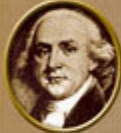 OCCUPATION: LAWYER, PLANTEREDUCATION: COLLEGE OF WILLIAM ANDMARY | Mercer was the second-youngest delegate attending the Constitutional Convention. Since he was also representing Virginia at theContinental Congress, Mercer was not often in attendance, but when present he opposed a strong central government and spokeout against the direction the Convention was taking. He voted against the Constitution, and refused to sign the document. Acolleague at the Continental Congress described him this way: “My colleague Mercer, was one of those afflicted with the morbid rageof debate, of an ardent mind, prompt imagination, and copious flow of words, who heard with impatience any logic which was nothis own." |
THOMAS MIFFLINPENNSYLVANIAAGE AT CONVENTION: 43REVOLUTIONARY WAR VET: YES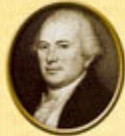 OCCUPATION: MANUFACTURER, SHIPPEREDUCATION: UNIVERSITY OFPENNSYLVANIA | Mifflin served as the quartermaster of the Continental Army, but resigned after extended criticism of his indifferent execution ofthat post. Though he and Washington eventually became friends, Mifflin had been part of a cabal of officers who sought to replaceWashington with Horatio Gates as commander of the continental forces. He served as the 5th president of the Continental Congressunder the Articles of Confederation. In that capacity, he signed the Treaty of Paris, ending the Revolution and conferring formalsovereignty on the thirteen colonies. His experience in dealing with the states during the Revolution and under the Articles left him aproponent for a much stronger central government. William Pierce enthused: "General Mifflin is well known for the activity of hismind, and the brilliancy of his parts. He is ... a very handsome man. |
GOUVERNEUR MORRISPENNSYLVANIAAGE AT CONVENTION: 35REVOLUTIONARY WAR VET: YES OCCUPATION: LAWYER, MANUFACTURER,SHIPPER, EDUCATOREDUCATION: COLUMBIA | Gouverneur Morris was a leading delegate at the Convention. His contributions are both broad and deep. He spoke more often thanany other delegate and chaired the Second Committee of Representation while also serving on several other committees. His mostmemorable contribution to the Constitution is the elegant preamble, “We the people, in order to form a more perfect union . . ." Healso authored the contract clause of Article I of the Constitution and his deft hand is noticeable in much of the final wording of thedocument. As a delegate he had aristocratic notions and thus supported a strong central government. William Pierce stated: "Mr.Gouverneur Morris is one of the Geniuses in whom every species of talents combine to render him conspicuous and flourishing inpublic debate. ... No Man has more wit, nor can anyone engage the attention more than Mr. Morris." |
ROBERT MORRISPENNSYLVANIAAGE AT CONVENTION: 53REVOLUTIONARY WAR VET: NO OCCUPATION: MANUFACTURER, SHIPPER,BANKEREDUCATION: UNKNOWN | One of the foremost financiers of the Revolution, Morris helped keep the Continental Army afloat. He is one of two delegates to havesigned the Declaration of Independence, the Articles of Confederation, and the Constitution. Though a man of some eminence,history records that he spoke only twice at the Convention. His most prominent act at the Convention was nominating GeorgeWashington to serve as its president. William Pierce describe Morris as: “[A] merchant of great eminence and wealth; an ableFinancier and a worthy patriot. |
WILLIAM PATERSONNEW JERSEYAGE AT CONVENTION: 41REVOLUTIONARY WAR VET: YES OCCUPATION: LAWYEREDUCATION: PRINCETON | Paterson played a crucial role at the Convention by defending the Articles of Confederation and the sovereignty of the states. Hisoffering of the New Jersey Plan set in motion the compromise that became our Constitution. While Paterson left the Conventionearly, he returned to sign the final document. While the Constitution did not include the unicameral legislature he had imaginedthe modern day Senate is a nod to Paterson's principles. William Pierce said of him: “Mr. Patterson is one of those kind of Menwhose powers break in upon you, and create wonder and astonishment." |
WILLIAM PIERCEGEORGIAAGE AT CONVENTION: 47REVOLUTIONARY WAR VET: YES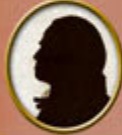 OCCUPATION: MERCHANTEDUCATION: COLLEGE OF WILLIAM ANDMARY | Pierce's role at the Constitutional Convention was limited, but not without influence. He favored the Connecticut Compromise, butrecommended strengthening the federal government so long as the states were not destroyed altogether. Pierce's main contributionwas his sometimes catty—but always intriguing—biographical sketches of the other delegates. Ironically, Pierce is one of the fewdelegates to the Convention for which there is no known image. So, while he painted a picture of many lesser-known delegates for us,no one knows what Pierce himself looked like. |
CHARLES PINCKNEYSOUTH CAROLINAAGE AT CONVENTION: 29REVOLUTIONARY WAR VET: YES OCCUPATION: LAWYER, PLANTEREDUCATION: READ FOR LAW INCHARLESTON, SC | One of the youngest delegates at the Convention, Pinckney joined his cousin as one of the most activist delegates at the Convention,seeking to protect slavery while advocating for a Bill of Rights. In his memoirs, Pinckney stated that large elements of his plan wereadopted into the final Constitution. Madison belittled the idea and—as the keeper of the notes—in some senses had the last say onthe matter. Later, Pinckney led the opposition to the Missouri Compromise. William Pierce remarked: “[H]e is intimatelyacquainted with every species of polite learning, and has a spirit of application and industry beyond most Men." |
CHARLES COTESWORTH PINCKNEYSOUTH CAROLINAAGE AT CONVENTION: 41REVOLUTIONARY WAR VET: YES OCCUPATION: PLANTER, SOLDIERLAWYEREDUCATION: OXFORD, MIDDLE TEMPLE | Pinckney was a distinguished soldier during the Revolutionary War and an active delegate, as was his younger cousin Charles. Atthe Convention, he supported a strong national government and also suggested that members of Congress serve without pay. Whilethat proposal was not adopted, other suggestions Pinckney made, such as Senate ratification of treaties, were incorporated into thefinal document. Later after accepting an appointment as Minister to France, he was involved in the XYZ affair, famouslyproclaiming “No! No! Not a sixpence!"when asked for a bribe. Later, he was nominated twice as the Federalist party's candidate forpresident but was not elected. William Pierce said of Pinckney: "he has received the advantage of a liberal education, and possessesa very extensive degree of legal knowledge." |
EDMOND RANDOLPHVIRGINIAAGE AT CONVENTION: 34REVOLUTIONARY WAR VET: YES OCCUPATION: PLANTEREDUCATION: COLLEGE OF WILLIAM ANDMARY | As governor of Virginia, Randolph brought additional prestige to a delegation already laden with some of the most notable namesat the Convention. In Philadelphia, however, he seems to have vacillated back and forth, leaving most historians to scratch theirheads at Mr. Randolph. He opened the Convention by expounding upon and then defending Madison's Virginia Plan. Later, heseemed to fall under the sway of George Mason's thinking and propounded anti-federalist arguments. In the end, he concluded thathe could not sign the final document. However, by the time of the Virginia ratification debates, he had altered his position yet againand supported ratification of the Constitution. William Pierce wrote: "He came forward with the postulata, or first principles, onwhich the Convention acted, he supported them with a force of eloquence and reasoning that did him great honor." |
GEORGE READDELAWAREAGE AT CONVENTION: 53REVOLUTIONARY WAR VET: NO OCCUPATION: LAWYER. PLANTEREDUCATION: RELIGIOUS ACADEMY | Read, like Dickinson, was present for the Declaration of Independence but—unlike Dickinson—ultimately signed the document. Atthe Convention, he was an early advocate for setting aside the Articles of Confederation, stating that “to amend the Articles wassimply putting old cloth on a new garment." At one point he argued for the abolition of states altogether, concerned that anymaintenance of state boundaries put small states like Delaware at a disadvantage. When this was rejected, he favored theprotections for the small states found in the New Jersey Plan. William Pierce remarked: "his legal abilities are said to be very great,but powers of Oratory are fatiguing and tiresome to the last degree.' |
JOHN RUTLEDGESOUTH CAROLINAAGE AT CONVENTION: 48REVOLUTIONARY WAR VET: NO OCCUPATION: PLANTER, LAWYEREDUCATION: MIDDLE TEMPLE (LONDON) | Rutledge was South Carolina's governor during the Revolution and his property was singled out for destruction by the English. Henever fully recovered the losses he suffered during the war. At the Convention, he was the South's sectional champion serving on allRepresentation committees. He also chaired the Committee of Detail as well as the Committee of State Commitments. WilliamPierce stated: “[H]e is undoubtedly a man of abilities, and a Gentleman of distinction and fortune. |
ROGER SHERMANCONNECTICUTAGE AT CONVENTION: 66REVOLUTIONARY WAR VET: NO OCCUPATION: LAWYER, MERCHANT,COBBLEREDUCATION: NO FORMAL COLLEGE | At the Convention, Sherman propounded the Great Compromise, resolving the single greatest obstacle of the ConstitutionalConvention. He opposed paper money, and is responsible for the limitations placed on states in Article I, Section 10 of theConstitution. Sherman is the only man to have signed all four founding documents: the Declaration of Independence, the Articles ofAssociation, the Articles of Confederation and the US Constitution. William Pierce commented “the oddity of his address, thevulgarisms that accompany his public speaking, and the strange New England Kant which runs through his public as well as hisprivate speaking make everything that is connected to him grotesque and laughable; and yet he deserves infinite praise, no Man hasa better Heart or a clearer Head." |
RICHARD DOBBS SPAIGHTNORTH CAROLINAAGE AT CONVENTION: 29REVOLUTIONARY WAR VET: YES OCCUPATION: PLANTER, EDUCATOREDUCATION: UNIVERSITY OF GLASGOW(SCOTLAND) | While not a frequent speaker, Spaight was scrupulous in attending the Convention's sessions. He was a forceful advocate for equalrepresentation of the states within the Senate. William Pierce said of him: "Mr. Spaight is a worthy Man, of some abilities, andfortune." Spaight was one of two delegates killed in duels (the other was Hamilton); he was shot by John Stanly who had defeatedSpaight in the 1800 congressional election |
CALEB STRONGMASSACHUSETTSAGE AT CONVENTION: 42REVOLUTIONARY WAR VET: NO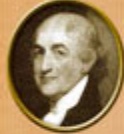 OCCUPATION: LAWYEREDUCATION: HARVARD | Strong supported a stronger central government, and also endorsed the Connecticut Compromise in opposition to his state'sparochial interests. He sat on the drafting committee, and successfully inserted into the Constituion the requirement that the Houseoriginate all money bills. Strong was called home before he could sign the document, but proceeded to defend the Constitutionvociferously during the Massachusetts ratifying convention. William Pierce depicted him as: "[A] lawyer of some eminence .. [but]... as a speaker he is feeble and without confidence.' |
GEORGE WASHINGTONVIRGINIAAGE AT CONVENTION: 55REVOLUTIONARY WAR VET: YES OCCUPATION: SOLDIER, PLANTEREDUCATION: NO FORMAL COLLEGE | “First in war, first in peace and first in the hearts of his countrymen." Washington was the living embodiment of American successduring the Revolutionary War, and his experience after it left him troubled about the future of his country. Serving as Conventionpresident, he spoke formally only once, and then towards the end of the proceedings, but his influence on the Convention wasenormous. Not only was his unsurpassed prestige lent to the final document, Washington accomplished more with a frown or a nodthan many members could with hours of debate. His election as president by the frst Electoral College was unanimous and his twoterms in office gave legitimacy, tradition and meaning to the Constitution. While Madison is the Father of the Constitution, therecan be little doubt that Washington was the Father of his nation. William Pierce extolled: “Having conducted these States toindependence and peace, he now appears to assist in framing a Government to make the People happy. Like Gustavus Vasa, he maybe said to be the deliverer of his Country." |
HUGH WILLIAMSONNORTH CAROLINAAGE AT CONVENTION: 51REVOLUTIONARY WAR VET: NO OCCUPATION: DOCTOR, PROFESSOREDUCATION: COLLEGE OF PHILAPELPHIA,UNIVERSITY OF UTRECHT; NL (M.D.) | Williamson was already a prominent scientist at the time of the Convention. He joined Franklin and Jefferson as a member of theAmerican Philosophical Society. Based on his prestige, Williamson was the de facto leader of the North Carolina delegation and avery active member of the Convention. He participated in multiple committees, including the Third Committee of Representation,Committee of Assumption of State Debt, Committee of Slave Trade, Committee of Trade, and the Committee of Leftovers. Heguided North Carolina's support of the Connecticut Compromise. He was elected to the First Congress as a member of the Houseand served two terms. After his terms, Williamson returned home and devoted himself to his academic pursuits. Williamson wascharacterized by William Pierce as: “[A] Gentleman of education and talents." |
JAMES WILSONPENNSYLVANIAAGE AT CONVENTION: 45REVOLUTIONARY WAR VET: NO OCCUPATION: LAWYER, PROFESSOREDUCATION: UNIVERSITY OF GLASGOW,UNVERSITY OF ST. ANDREWS | James Wilson's performance at the Constitutional Convention was the apex of his political career. Other than Madison, Wilsonhad the most influence on the philosophy and structure of the document. He spoke more than anyone save Gouverneur Morris.Wilson was the Convention's strongest advocate for direct majoritarian elections. His positions at the Convention predated bymore than a century what is now mainstream American political culture. While Wilson was influential on the assembly floor, healso did a great deal of work in committee, serving on the Committee of Detail and the Committee on State Commitments.William Pierce somewhat uncharitably remarked: “[N]o man is more clear than, copious and comprehensive than Mr. Wilson, yethe is no great Orator. |
GEORGE WYTHEVIRGINIAAGE AT CONVENTION: 61REVOLUTIONARY WAR VET: NO OCCUPATION: PLANTER, LAWYER,LAW PROFESSOREDUCATION: NO FORMAL COLLEGE | A signer of the Declaration of Independence and the most distinguished legal scholar in Virginia, Wythe played a limited role at theConvention due to his wife's ill health. At the Convention, he was asked by Washington to join Hamilton and Pinckney in draftingthe rules of procedure for the Constitutional Convention. Wythe supported the ratification at the Virginia Convention but was notpresent to sign the document in Philadelphia. Later, Wythe died at the hands of a jealous nephew contesting Wythe's will. Thenephew, while ultimately disinherited, faced no further punishment, primarily because of a law that forbade the testimony of blackwitnesses—a law Wythe ironically had himself penned. William Pierce stated: “he is confessedly one of the most learned legalCharacters of the present age. ... Yet from his too favorable opinion of Men, he is no great politician." |
ROBERT YATESNEW YORKAGE AT CONVENTION: 49REVOLUTIONARY WAR VET: NO OCCUPATION: LAWYEREDUCATION: NO FORMAL COLLEGE | Yates was related to John Lansing by marriage, and agreed wholeheartedly that the Convention was heading in the wrong direction;he was opposed to centralized government before the Convention. He sat on the First and Third Committees of Representationbefore deciding that further participation in the proceedings would not be worth his time. Ironically, Lansing and Yate's departureleft New York without a vote in the proceedings. While Hamilton was able to attend the convention and signed the Constitution asan individual delegate, he could not cast New York's vote without either Lansing or Yates being present. William Pierce commented:“[S]ome of his Enemies say he is an anti-federal Man, but I discovered no such disposition in him." |
WE THE PEOPLE
FOUNDING FATHERS GAME DESIGN: CHRISTIAN LEONHARD & JASON MATTHEWS
GRAPHIC DESIGN & CONTENT EDITING: JOSHUA CAPPEL
CONTENT EDITING: JIM DIETZ
PROTOTYPE GRAPHICS & GAME DEVELOPMENT: SCOTT ANDERSON
SPECIAL THANKS TO
JULIE ANDERSON, THOMAS ANDERSON, ELIZABETH ANDERSON, JEFF ANDERSON, MICHAEL DENMAN, DOUG PERINI, RAY MULFORD, ANDREW NICHOLS, NEIL BRADLEY, TREY CHAMBERS, MICHAEL CHAPEL, DAN MANFREDINI, ERICK DIETZ, DAVE PIEART, AND GORDON LLOYD AT TEACHINGAMERICANHISTORY.ORG.

PUBLISHED BY JOLLY ROGER GAMES PO BOX 61, SIGEL, IL 62462 USA WWW.JOLLYROGERGAMES.COM
下载 Markdown