Hegemony of Faith_Rulebook.md
HEGEMONY FAITH
Rulebook
Index
- Foreword
- Introduction
2-1 Type
2-2 Components - Objective of the Game
- How to Play 03
4-1 Setup
4-2 Gameplay - End of the Game
5-1 The final scoring
5-2 In case of a draw - Surrendered of Sects Mechanism and Wanderers
6-1 Surrender as a Follower:
6-2 Operation of united sects
6-2.1 Reversal of sect stance
6-2.2 Betrayal and expel from the sect
6-3 Becoming a Wanderer
6-3.1 Wanderer's Turn
6-3.2 How a wanderer re-establishes a sect - Card Introduction
7-1 Introduction to skill card
7-2 Introduction to action card
7-2.1 Type of actions
7-2.2 Attack method with its mechanism:
7-3 Introduction to believer card
7-3.1 Type of believers
7-3.2 Introduction to believer confrontation
7-4 Cards list
08.Q&A - Credits

It was once an era of abundance and goodness, a timewhen people were yet to be enlightened. They lived in harmony with nature, following its ways and coexisting with it. With reverence for all things, they led earnest and down-to-earth lives. The collective embodiment of spiritual reliance, known as "Faith," supported everyone.
However, as times and technology progressed, the pursuit of material wealth brought chaos to the world, leaving people feeling spiritually impoverished. Many forgot the essence of "Faith," desperately spending fortunes to fill the void within. Thus, "Faith" was no longer pure...
One year, as if orchestrated by an indescribable force, several individuals claiming to have received "divine revelations" and possessing supernatural abilities, appeared simultaneously under the banner of saving the world and quelling chaos.
Thus began the ultimate struggle for the hegemony of faith...
02. Introduction
2-1 Type :
Multiplayer card battle game Number of Players : 4-8 (optimal for 6-7 players) Duration : About 40-60 minutes
2-2 Components :
Rulebook x 1
Player aid card x 8
Leader token with different totem x 8

Skill Cards ( Purple-backed)

16 types of skills in total Each with a different usage, totaling 16 cards
Action Cards ( Blue-backed)

15 types of diverse action cards Different quantities for each type,totaling 78 cards
Believer Cards ( Red-backed)

5 different types of believer Cards Fool / Prayer / Missionary / Elder / Fanatic 12 cards for each type, totaling 60 cards
03. Objective of the Game
In the game, each player becomes a sect Leader with unique skills, vying for limited believers. You must use every trick you know to expand your sect. Whether it's aggressively promoting your ideology to recruit believers or other players, or waging wars to destroy your competitors. In any case, if you have the most believers at the end of the game, you emerge as the winner.
04. How to Play
4-1 Setup :
1.Each player selects a Leader token to represent their sect. For deeper immersion, players can also announce their sect's name (e.g., "The Cat Sect") and principles to make others aware.K
2.Each player randomly draws two skill cards, ponders their choice, and places the selected skill face down in front of them, returning the other card.
- When activating a skill, players must reveal their skill card to everyone;
until then, they are not required to reveal their skills.
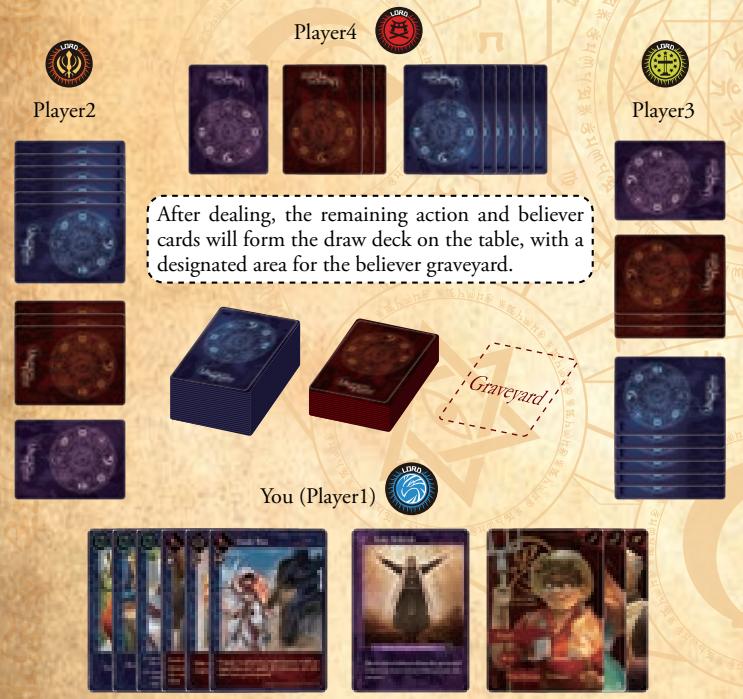
3.The player who shuffles the deck deals each player six action cards and three believer cards, leaving the remaining cards in the center to form the draw deck.
- When the action card deck runs out during the game, all used action cards can be reshuffled back into the deck.
The image below shows the card distribution for a 4 player game.
Each player should start with 1 skill card, 6 action cards, and 3 believer cards in hand.
4.The game starts with the player who most recently participated in a religious-related activity beginning the game round, followed by the other players in clockwise order around the table.
- It is recommended to adjust the initial number of believer cards according to the number of players to avoid prolonging the game. For 4 players, use 30 cards; for 5-6 players, use 45 cards; for 7-8 players, use 60 cards.
4-2 Gameplay :
Beginning with the first player, you alternate taking turns until the end of the game. On your turn, you must take the following phase, which will be explained in detail below:
Draw Phase
Generally, the player's hand limit for action (blue) cards is 6. At the start of the turn, if you have fewer than 6 cards, you must draw from the action deck until 6.
Action Phase
During this phase, you can choose up to two of the following actions in any order, but you cannot repeat the same action.
Play a strategy action card (with icon in thetop left)
Play a physical attack action card (with icon in the top left)
Play a mental attack action card (with iconin the top left)
Discard any numberof action cards from hand
- For the interpretation of action card icons, refer to 7-2 Introduction to action card.)
- Special exception for discarding : If your skill is "Ascend with Me", you may have more action cards in hand than the limit at the end of the turn, then you must discard down to the hand limit.
End ofTurn and Surrender Phase
Declaring the end of your turn and alternate taking turns to the nextplayer. In this phase, if you are without any believer cards in hand, you must enter the Surrender Phase to decide whether to become another player's Follower and continue playing, or discard all your cards and become a Wanderer.
- For details on how to surrender, refer to 6-1 Surrender as Follower.
- For actions related to a wanderer, refer to 6-3 Becoming a Wanderer.
O5. End of the Game
When the believer card deck (excluding the graveyard) runs out and the player whose turn it is declared the end of their actions, the game ends and proceeds to settlement.
- If the believer cards are exhausted as a bonus during a “Faith War" confrontation, the war will still continue, but no further bonus believer cards will be granted, and the game will settle after the war and the player's turn ends.
- If the special victory condition "Impermanence of Life" skill is in play and the leader meets this skill's victory condition, the player with this skill automatically wins.
5-1 The final scoring :
After the game ends, each player counts the number of believer cards in their hand. If a player has become a Follower, they are counted as part of the same sect as their Leader. The sect with the most Followers is identified, or if the sect consists of two or more players, an internal comparison within the sect begins, and the final winner will be the player with the most believer cards in that sect.
There are usually several possible scenarios during settlement, which are explained in order below:
Victory for a single player
This is the simplest condition. If a single player has more believer cards than any other sect, they are declared the winner directly.

Player 1 and 2's sect has a total of 8 followers, which is less than Player 3's.
When multiple players belong to the largest sect:
When a player joins a sect as a Follower, their believer cards are counted together with the other players in the sect. In this case, if the total count is more than any other sect, the sect is considered the largest. (as shown in the image next page)


Players 1 and 2 form a sect, so the total count during settlement is 9.
In addition, when the number of believer cards is the same after settlement, a sect with multiple players has an advantage in the calculation. At this point, Followers within the sect can be included in the count. This sect is also considered the largest.

The sect's total count is considered 10.
When there are multiple players within the largest sect, as there can only be onewinner in the game, allplayers within the sect must undergo an internal comparison.
At this time, regardless of being a Leader or Follower, each player counts their own believer cards. After settlement, the player with the most believer cards in the sect is declared the new leader and becomes the final winner.


Special victory condition - Unification:
If at any time during the game, a player successfully makes all other players to be its Followers, he/she achieves Unification. At this point, the player ends the game immediately and wins, without counting believer cards anymore.2 A2906 ↑ Continue in a clockwise cycle until the combat condition is met
5-2 In case of a draw:
If there are still two or more players with the same number of believer cards after the above settlement, these players must enter a final showdown to determine the ultimate winner. The showdown method varies depending on the number of players, explained in the following two situations:
When two players have drawn
When only two players have drawn, they engage in a “Faith War" (without bonus cards), with the player having more remaining believers after the war declared the winner.


1VS1

When more than three players have drawn
When three or more players have drawn, starting with the last player in clockwise order at the end of the game, each player takes turns performing "Martyrdom", confronting all other candidates. Players will continue the cycle until all their believer cards have been used in confrontation or until one player runs out of cards. The player with the most remaining believer cards is declared the winner.

In any case, there will be only one winner at the end of the game.
06. Surrendered of Sects Mechanism and Wanderers
6-1 Surrender as a Follower:
When a player ends their turn with no believer cards, they are deemed to have temporarily failed and must surrender to another sect Leader, becoming a Follower.
The surrender process is: the sect Leaders declare whether they are willing to accept a Follower or not firstly, then the failed player selects which sect he/she wishes to join.
Once surrendered the Follower player hands over their Leader token to the leader they are surrendering to as a sign of loyalty, and sealing their skill. As part of the new sect, they can continue in the game, with all actions available during their turn unchanged.
- Apart from specific skills, most can only be used when a player is a sect Leader. Thus, if a player becomes a Follower or Wanderer, they must seal their skill, rendering it unusable.
6-2 Operation of united sects :
When a sect leader takes in other players as Followers, the sect can then perform united attacks and defenses against other sects during confrontations, with the Leader having command over their Followers.
When a confrontation occurs, the Leader can designate a Follower of the sect to complete the confrontation, until that player's believers are exhausted.

The sect Leader has the obligation to maintain their Followers' believer cards. Therefore, when taking in a Follower, the Leader must give a believer card to the Follower to formalize the alliance.
Subsequently, if the Follower ends their turn with no believer cards, the Leader must give them a believer card to keep their turn going again.
However, to safeguard the Leader's interests, the Leader has the opportunity to reconsider whether to continue maintaining their Follower before giving a believer card.
If the Leader decides against keeping the Follower, whether due to any other reason, the Follower must then seek another sect Leader to surrender to.
If ultimately no one wants to take in the Follower, the player becomes a Wanderer.
6-2.1 Reversal of sect stance :
In special cases where a sect Leader's believer cards count falls to zero, the Follower with the highest number of believer cards within that sect is designated as the new Leader, taking over the remaining Followers and the Leader token, and decides whether to accept the original Leader.
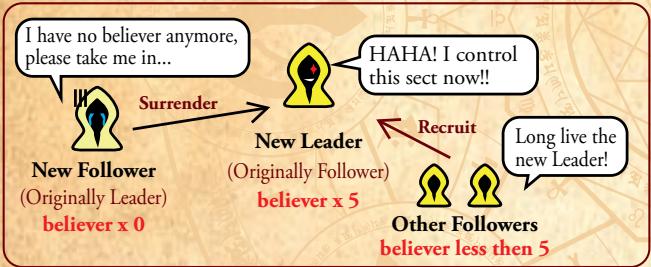
If two or more Followers have the same number of believer cards, the sect dissolves, and Followers retrieve their tokens to become independent Leaders again, while the originalLeader must surrender and decide to join whose sect.

6-2.2 Betrayal and expel from the sect :
Even if a player becomes a Follower, it does not preclude them from winning. The game is designed with mechanisms similar to reality, allowing for plotting and betrayal. Players must constantly strategize for victory, as planning and creating advantages within the game are the sole methods to ensure success.
6-3 Becoming a Wanderer :
If a player ends their turn with no believer cards and no sect Leader is willing to take in them as a Follower, they temporarily become a Wanderer. Upon becoming a Wanderer, players must discard all their action cards and the Leader token, sealing their skill, and act as a temporary lurking saboteur in subsequent turns.
6-3.1 Wanderer's turn:
Once a player becomes a wanderer, during their turn, they can steal onebeliever card from any non-Wanderer player. Until they re-establish a sect, they remainunaffected by other players' actions.
6-3.2 How a Wanderer re-establishes a sect :
Since the Wanderer is merely a temporary lurking saboteur, their ultimate goal remains the same. Thus, after a Wanderer player steals 3 believe cards, they can re-establish a sect and return to being a Leader again immediately. At this point, the Wanderer draws new action cards to 6, retrieves the Leader token, and unseals their skill, resuming action turns in the game.
Friendly Reminder
The concept of Wanderers ensures that every player, regardless of any situation, can continue to participate and enjoy the game, preventing players from being sidelined due to failure. Thus, with patience, there is always a chance for a turnaround and victory.
07. Card Introduction
7-1 Introduction to skill card :
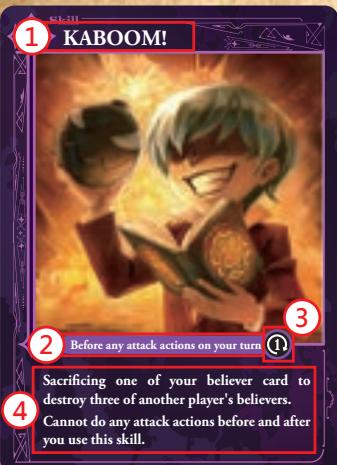
7-2 Introduction to action card :

① Skill name
② Activation conditions
③Number of uses
Each skill has a different number of uses, detailed as follows:
① Can be activated once per game.
③ Can be activated three times per game.
Can be activated once per round; a new round starts on the player's turn.hw
8 Unlimited use throughout the game as long as the activation conditions are met.
④ Skill effect
Each skill has a unique effect; players should read the skill effect carefully before use.
① Action name and type
② Action type icon
Action cards are categorized by their purpose into the following three types:
Strategy action (framed

Attack action(framed

Defense action (framed

③ Attack method icon
Only attack action cards feature this icon, with all icons detailed below.
④ Action effect
The explanation of the action card varies by its type, with different backgrounds for different types.
7-2.1 Type of actions :
Strategy action

The icons framed with are all considered strategy actions.

Mental attack actions
The icons framed withare all considered attack actions. Inside iconmeans physical attacks andmeans mental attacks. The distinction lies in the outcome of confrontations: in physical attacks, both the defeated and drawn believer cards die, entering the graveyard; in mental attacks, the defeated believer card will be taken away by the winner.

Physical and

Mental defense actions
Anytime a player is attacked, they can immediately use the corresponding defense card to defend the confrontations.
7-2.2 Attackmethod with its mechanism:
All attack cards feature a method icon, categorized into three types:
Targeting a sect for elimination or snatch, which does not consume the player's believers and usually has a significant impact on sects formed by multiple players.
The unique one-against-many confrontation mechanism of the game which engages in confrontations with all sects present in the game. This confrontation will use the attacker's believer card as the benchmark for determining the outcomes for other believers, detailed as follows:
Physical attacks in one-against-many confrontation:
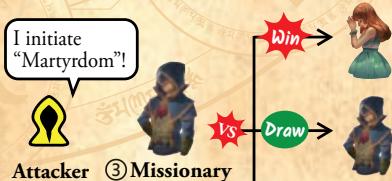
Using the attacker's believers as a benchmark for confrontation, where this believer is guaranteed to die and enter the graveyard.
Player 1 played ② Prayer
Lose to the attacker's believer, it dies and enters the graveyard.
Player 2 played ③ Missionary Draw with the attacker's believer, it also dies and enters the graveyard.
Player 3 played ⑤ Fanatic
Win the attacker's believer, it survives and returns to the hand.

Player 1 played Prayer Lose to the attacker's believer, it is snatched by the attacker.
Mental attacks in one-against-many confrontation:
Player 2 played ③ Missionary
Attacker ③Missionary
Using the attacker's believers as a benchmark for confrontation, which can be taken back after the confrontation.
Draw with the attacker's believer, nothing happened and it returns to the hand.
Player 3 played ⑤ Fanatic
Win the attacker's believer, nothing happened and it returns to the hand.
Challenge a sect with a mass believer confrontation, this confrontation varies rules between physical and mental attacks, for which details should be read in the card.
7-3 Introduction to believer card :
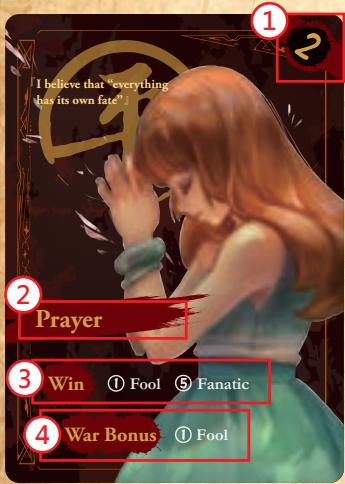
① Believer ID
Used for quick recognition and judgment during confrontations.
② Believer name
③ Win against
Indicates which type of believers this believer can defeat.
④ Bonus when win in“Faith War"
If this believer wins a confrontation in "Faith War" against the type in the card, the winner can get a bonus believer card from the deck.
7-3.1 Type of believers :
There are five types of believers: Fool, Prayer, Missionary, Elder, and Fanatics, with 12 cards of each type.


① Fool
② Prayer

③ Missionary


④Elder
⑤Fanatics
7-3.2 Introduction to believer confrontation :

· Each believer can defeat two other types.
In confrontations where the believer draws, if it's a physics attack, both players' believers will die and enter the graveyard; in a mental attack, nothing happens and players can take their believer back.
Every believer has their unique ID on the top right corner, used for quick recognition and judgment during confrontations. Each ID can defeat the preceding two numbers, and bonus in "Faith War"appear only when defeating the preceding number.

As illustrated: Arrows pointing to numbers indicate win, while double arrows indicate an obtainable bonus card when it wins in "Faith War". (Reminder: the bonus cards cannot be used immediately in the confrontation.
7-4 Cards list :
Skill cards list


Impermanence of Life
Stay hidden throughout the game, not becoming a Follower or Wanderer, and cannot absorb others. Adhere above condition until the end of the game, and have more than 5 believer cards in your hand, you can directly become the winner. Reveal and discard this skill if you fail to meet the condition, then draw a new skill card. Timing: At game end

Everyone is Equal
This skill will consume two actions. Take all believers from players, shuffle, and redistribute them evenly, starting with yourself.
Timing: Before playing any action on your turn
Purple Hermit
Take half of the believer cards from your sect Leader when using this skill.
Before your next turn, if your Leader plays a 'Breaking Faith", nullify its snatch effect and become independent. Otherwise, take half of the believers again and be independent when your next turn starts.

Timing: Your turn after becoming a Follower
Headstronger
Seize half the believer cards from your sect's Followers and expel them upon activation, making them independent. This cannot be countered with "Breaking Faith".

Timing: When you have Followers on your turn
Holy Rebirth

Revive three believers from the graveyard if three or more of your believer cards die at once. Can't be reactivated until your next turn.
Timing: Upon meeting conditions

KABOOM!
Activate a powerful, undefendable attack by sacrificing one of your believer card to destroy three of another player's believers.
Cannot do any attack actions before and after you use this skill.
Timing: Before any attack actions on your turn

Praise of Life

Sacrifice one of your believer for an additional unrestricted and repeatable action once this turn.
Timing: On your turn

Gate of Truth

Copy another player's revealed skill once, and its effects last until your next turn. Each skill can only be copied once.
If the copied skill is "The Prophet", you can predict the type of the second drawn believer card; If copied"Purple Hermit", the "Breaking Faith"-like effect will not be triggered. However, "Impermanence of Life" cannot be copied.
Timing: Depending on the copied skill

Eternal Truth
Sacrifice a believer of yours to make your sect mental attacks until your next turn.
Timing: On your turn

World Peace
Sacrifice a believer of yours to make your sect immune tophysical attacks until your next turn.
Timing: On your turn
Soul-Cutting Sword

Force a player to skip their next turn.


Take all action cards from players, shuffle, and redistribute them evenly, starting with yourself.
Chaos Coming

Timing: On your turn
Zombie Army

Use believers from the graveyard as substitutes in confrontations during a "Faith War' initiated by you. Used graveyard believers are then excluded from the game. Timing: When you initiate a "Faith War"

The Prophet

Predict the type of the first believer card another player recruits. If correct, take it away.@n 紫压hw
The bonus from "Faith Wars" doesn't activate this skill.
Timing: When another player draws believer cards
Karma Reversed
Reverse the outcome of a confrontation's comparison of believer cards before it occurs. For instance, in a "Faith War", the Prayer would win against the Fool and obtain a bonus card. However, after activating this skill, the Fool would win against the Prayer and claim the bonus card.
Timing: Before believers in a confrontation

Ascend with Me

Whenever your Follower draws action cards, you may also draw the exact same number. Increase your action card hand limit by one for each Follower.
Timing: When your Follower draws action cards
Strategy action cards:

Have a Charity (Total of 8 cards)
Draw two believer cards from the deck.

Info-Spy (Total of 3 cards)
View all action and believer cards of one player.

It's a Miracle (Total of 6 cards)
Revive the top three believers from the graveyard.

Divine Inspiration (Total of 4 cards)
Discard any number of action cards to draw an equal number of believer cards. This card does not count towards the total.

Secret Alliance (Total of 3 cards)
Choose a player and exchange one action card with them.

Breaking Faith (Total of 6 cards)
For sect Leader: expel one Follower For Follower: become an independent Leader Snatch half of the target's believers. If countered with the same card, you can only take one believer instead.

Kowtow to Me (Total of 4 cards)
Target a sect with fewer than half your number of believers and forcibly absorb it into your sect.


Mental attack action cards list

Spread Rumors (Total of 7 cards)

Take one believer from each player in a targeted opposing sect.

Faith Debate (Total of 4 cards)

Challenge an opposing sect to up to five mental confrontations. If either side has fewer than five believer cards, the maximum number of confrontations allowed cannot exceed the number of believer cards possessed by that sect. In each confrontation, the winner can snatch the losing side's believer card.

Conspiracy (Total of 6 cards)
Send a believer to mentally confront a believer from each other sect, taking all believers that lose.

Physical Attack Action Cards list

Witch Hunt (Total of 4 cards)

Target a sect and eliminate one type of believer.

Faith War (Total of 6 cards)
Engage in physical confrontation with an opposing sect until all believers of one side have participated.

Martyrdom (Total of 7 cards)

Send a believer to physically confront a believer from each other sect. This believer will die after the confrontation, along with any that lose or draw.

Defense action cards list

Firm Faith (Total of 5 cards)
Defend your sect from one

mental attack.

Great Mercy (Total of 5 cards)
Defend your sect from one

physical attack.
08. Q&A
Q. When can the "Kowtow to Me" card be used?
When the number of believer cards of your sect is twice that of another, "Kowtow to Me" can be used to absorb all players from that sect. The calculation formula is as follows:
Other sect believer cards number ≤ Your sect's / 2 (rounded down)
For instance, whether you have 8 or 9 believer cards, after dividing by two and rounding down, the result is 4. Therefore, you can absorb sects with believer card numbers equal to or less than 4, forcing all of the playerswho are in that sect to join your sect.

- Only count the sect's believer cards, not including the follower.
Q. How many believer cards can be taken when using "Breaking Faith"?
When using "Breaking Faith", if the targeted player does not play the same card for defense, you can take half of the target's believer cards (rounded down). However, if the targeted player also plays "Breaking Faith" for defense, only one believer card can be taken.


Q. Can defense cards be used after failing a confrontation? No. All defense cards must be decided whether to be used or not before the confrontation.
Q. Can the "Faith War" be stopped midway?
No. Once a war is initiated in the game, it cannot be stopped until one sect's believer cards have all participated in the confrontation.
Q. Can I use the skill card after becoming a Follower?
Not always, it depends on the skill description. Usually, after becoming a Follower, you must seal your skills and cannot use them. However, some skills specify they can be activated after surrendering and becoming a Follower, which is an exception.
Q. Can I voluntarily become a Follower while I still have believer cards?
No. A player can only surrender to become a Follower at the end of their turn and when they have no believer cards in hand.
Q. Do I have to play all 5 believer cards in "Faith Debate"?
Not necessarily. The player can decide to play up to five believer cards for the debate, but it is not mandatory. If one sect has fewer than 5 believer cards (maybe only two), they can only play up to that number of believer cards.
Q. If I become a Wanderer, when can I steal believer cards from other players?
Upon becoming a Wanderer, you must discard all action cards on hand and seal skills immediately. In the next round, when it's your turn again, you can start to steal other players' believer cards.
Q. When do I need to show my card information to others?
At the start of the game, players do not need to show any of their three types of card information. During the game, different cards are revealed at different times as specified:
Skill cards: Must be permanently displayed when activating a skill. Action cards: Must be shown when a player plays an action. Believer Cards: At any time, players can ask others about the number of believer cards they have for reference. During a confrontation, believers must berevealed to determine the outcome but can be covered up again afterwards.
Q. What is the purpose of the Leader token?
The Leader token represents the authority of being a sect Leader. When a player surrenders, they must give their Leader token to the opponent, indicating the relinquishment of power and becoming a Follower. As long as a player is a sect Leader, they can have the token to prove their authority; otherwise, they can only give it to some other player or discard it.
Friendly Reminder
Each leader skill is unique, requiring different strategy. Understanding the card combinations and carefully planning your actions can significantly increase your chances of victory.
09. Credits
Yen(Game designer)'s free talk:
This game sprang to life in 2017 from a spark of inspiration. I wanted to create a game that reflected various aspects of religion and belief, drawing on historical events like the Crusades for design inspiration. The journey wasn't smooth, facing hurdles such as team dissolution due to personal commitments and my own study plans, but I didn't give up.
After a long development period, the game finally came together. My hope is that players will thoroughly enjoy immersing themselves in a game that, while unique, mirrors the intricacies of world history. If players find joy and replay value in my creation, all the hard work will have been worth it.
Designer
Yen
Graphic and Visual Design Yen
学工M图类 Illustrations 藤岡春日(@ting16154) Assistant BeiTang & Frankie
Contact : arklantis@hotmail.com
2023 Copyright © Yen. All rights reserved. Unauthorized reproduction or distribution is prohibited.
下载 Markdown