INVINCIBLE_THE_HERO-BUILDING_GAME_Rulebook_24-5-23.md
INVINCIBLE THE HERO-BUILDING GAME
RULEBOOK

Hey kid, Cecil here. Looks like you've fi nally got your powers, which is good, because the Guardians of the Globe are dead, and the world could use your help. Probably feels like a lot, but don't worry: your confi dence will grow, and so will your powers, as you fi gure out what kind of hero you want to be. My job is to make sure you know enough that you don't get too many people killed in the process.
You'll work cooperatively with your friends, using your powers as a team to protect civilians and save the day from increasingly powerful bad guys and their minions.
Your mission is always defi ned by the current episode. Do the job without letting too many civilians die — or getting the crap beaten out of you — and you'll win.
Invincible: The Hero-Building Game is a cooperative bagand tableau-building game where you’ll push your luck by pulling cubes from your bag as you activate your powers to fi ght villains.
You'll have to be careful, because if you pull too many cubes, you'll overexert yourself and crash, putting you out of commission for the round. You'll learn new powers each round, giving you stronger and better options.
For your fi rst time in the fi eld, you should probably start with episode 1, Short-Staffed In the Hero Department. It leaves out a few advanced mechanics so you can focus on learning the ropes. Look for the EPISODE 1 sections to see how things differ in this fi rst mission, and skip over any FULL GAME sections — you won't need those until episode 2.
There's a free companion available in the Dire Wolf Game Room app for your PC, smartphone, or tablet. It will walk you through the start of Episode 1 step by step, explaining the rules as you go.
You can also scan this QR code to learn to play by watching a video.


www.direwolfdigital.com /direwolfdigital @direwolfdigital

skybound.com/tabletop /skyboundtabletop @skyboundtabletp
Published by: Dire Wolf Digital, Inc. and Skybound, LLC © 2024 Dire Wolf Digital, Inc. All rights reserved. Dire Wolf and the Dire Wolf logo are registered trademarks of Dire Wolf Digital, Inc. © 2023 Amazon Content Services LLC and Skybound, LLC © INVINCIBLE 2021 Amazon Content Services LLC and Skybound, LLC
## Internal Memo - Confi dential
To: The Global Defense Agency Senior Board From: Cecil Stedman, Director
I've got bad news. Worse than usual. The Guardians of the Globe are dead.
Something or someone got into their headquarters last night and killed them all. Omni-Man was there too, and he's alive, but in critical condition.
I know what you're all thinking: that we rely on the Guardians to protect the planet, and we're screwed without them. And you're not wrong. But I've been building a bench of young heroes in case something like this ever happened. They're still learning, but I think they've got potential. Here are some of my top candidates.

INVINCIBLE
Real Name: Mark Grayson
Strengths: Hits hard and moves fast. Projected to have enhanced endurance that will help him last longer in fi ghts.
Notes: This is Omni-Man's kid, and Omni-Man is the strongest, fastest, and toughest metahuman we've ever seen. So the potential is off the charts, but he just got his powers, so he's the greenest rookie of the bunch.

ATOM EVE
Real Name: Samantha Eve Wilkins
Strengths: Wields versatile energy constructs that are ideal for protecting civilians and allies, and can pack a real punch when necessary.
Notes: Eve's confi dent, incredibly smart, and able to rewrite matter on a
molecular level. Yeah, you read that right — we're looking at god-like power here. Luckily for now, she mostly uses it to punch bad guys and protect little old ladies, but it's gonna pay to train her up and have her on our side.

REX SPLODE
Real Name: Rex Sloan
Strengths: Blowing stuff up. Capable of handling large numbers of enemies on his own, even if he sometimes hurts himself and others in the process.
Notes: Yeah, I'll say it: this guy's kind of a tool, and he's too reckless by half. But tools can be useful, and I admire his willingness to do whatever it takes to get the job done.
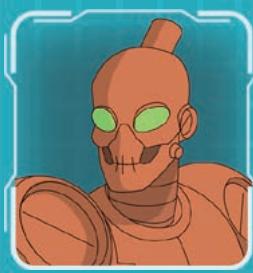
ROBOT
Real Name: Unknown
Strengths: Battlefi eld tactics and coordination. Often engineers solutions to problems on the fl y, and uses them to maximize his team's potential.
Notes: I'm not sure who or what Robot really is, but I'm sure that he's smart as hell. Besides, a cold, calculating automaton is exactly the guy I want leading a team of hormonal teenagers.


3 Zone Boards


4 Hero Boards
HQ Board


4 Hero Standees
7 Episode Cards
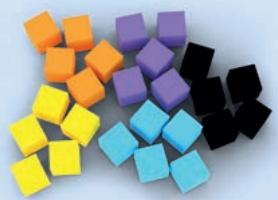
129 Cubes 24 Black and Purple 27 Yellow, Orange, and Blue

4 Bags

Rescue Die

Crash Die

9 Minion Tokens

Robot's Drone Token


62 Damage Tokens valued 1, 3, 5, and 10
6 Helper Cards

6 Challenge Cards

4 Starter Power Cards

4 Learn By Punching Cards

4 Reminder Cards

30 Civilians
Round Marker
3 KO Markers

20 Thwart Tokens

16 Strengthen Tokens

4 Defi ance Tokens
EPISODE 1 DECKS
The following decks are separately wrapped in a fi xed order for your fi rst game. Do Not Shuffl e Them.
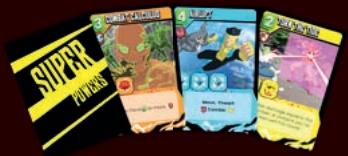
63 Super Power Cards

9 Level I Villain Cards

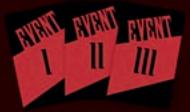
3 Level II Villain Cards
21 Event Cards
FULL GAME COMPONENTS
These aren't used in Episode 1 (but are used in all other games)
EPISODE-SPECIFIC COMPONENTS

36 Ultimate Power Cards
Set these aside unless the Episode Guide tells you to use them.

6 Shovels

6 Bomb Tokens

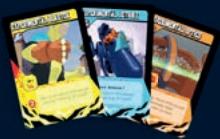
4 Signature Power Cards and 3 Experimental Technology Cards


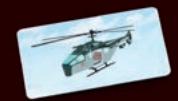
The Choppa
13 Level II Villain Cards
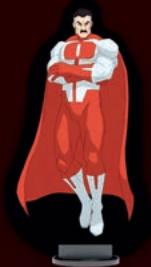
Omni-Man
Eve's Bubble Token

12 Level III Villain Cards
6 Red Cubes


12 Omni-Man Events

SET UP THE BATTLEFIELD

right: , , and .

B Civilians: Place ten civilians in each zone, with three in the safety area, and the other seven in the danger area.

C Guardians HQ Board: Place the Guardians HQ board below the center ( ) zone board.

2 SELECT AN EPISODE AND DIFFICULTY LEVEL
If this is your fi rst game, use Short-Staffed In the Hero Department. After your fi rst game, you may play any of the other episodes on their own, or you may play them in order as a campaign (see "Campaign Mode" on page 21).
Place your chosen episode card above the zone boards, with the correct side face-up based on your hero count (as indicated in the upper-right corner). Put the round marker to the left of the card. Check the Episode Guide for any special setup rules associated with your chosen episode.
Decide whether you're playing on Easy, Normal, or Hardcore diffi culty.
This will affect some remaining steps.

3 SET UP THE DECKS
EPISODE 1
Set up the following decks near the zone boards. DO NOT SHUFFLE THEM. They are packaged in order to match the examples in this book and the app tutorial.
Super Powers
Level I Villains
Level II Villains
Events
If you have shuffl ed them and want to return them to their original order, see page 2 of the Episode Guide.
Leave the Level III villain deck and ultimate powers deck in the box;
they're not used in this episode.
FULL GAME

Use your chosen diffi culty and the table at the right to create your event deck. Separately shuffl e the Level I, II, and III events, then start a face down deck using all the Level III events. Next, deal the indicated number of Level II events on top of that deck. Lastly, deal the indicated number of Level I events on top of the same deck. Depending on your diffi culty, your event deck will have 0 to 3 Level I cards on top, 2 or 3 Level Il cards below that,
Diffi culty
Easy
Normal
Level I Events
Level II Events
Hardcore
Level I cards on top, 2 or 3 Level II cards below that, and all Level III events on the bottom. Return unused Level I and II events to the game box without looking at them.
Shuffl e each of the following decks and place them near the zone boards:
Super Powers
Ultimate Powers
Level I Villains
Level II Villains
Level III Villains (Not used in Episode 2)


CREATE SUPPLIES

A Place damage tokens, thwart tokens, strengthen tokens, and the crash and rescue dice in easy reachof all players.

B Place minion tokens near the villain decks.
C Place the three KO markers near the Guardians HQ board.
D For each hero in the game, place one copy of "Learn By Punching" face up near the super powers deck, then return any unused copies to the box.


5 (OPTIONAL) TAKE HELPER AND/OR CHALLENGE CARDS
Skip this step if either…
…it's your fi rst time playing the game; or
…you're playing the "Campaign Mode" described on page 21. (Those rules determine which helper or challenge cards you will use.)
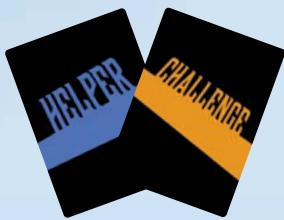
option for these (in the Episode Guide); you may use those or select cards at random. At the end of your game, each helper card you took reduces your score, while each challenge increases it.
For more details on how helper and challenge cards work, see page 20. (You can also see exactly how they affect Scoring on the same page.)
Each player sets up these personal components directly in front of them.
A SELECT AND SET UP HEROES
Each player selects a hero to play. (You can read more about each one on page 3.) Take the hero board for your chosen hero, along with its matching starter power card (as listed at the right) and hero standee.
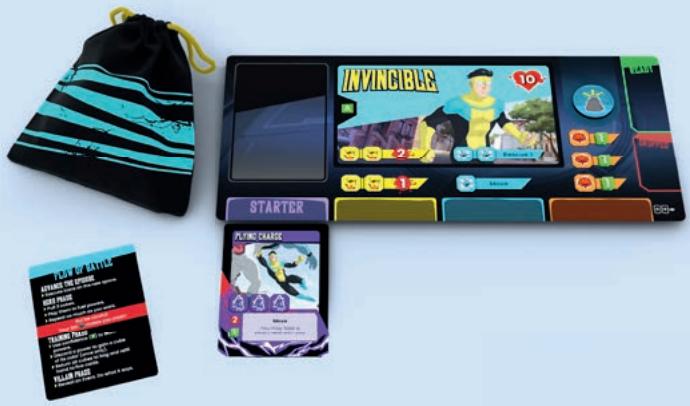
Place your hero board in front of you. Place your starter power below the purple slot outline along the bottom of the hero board. Place your hero standee in the zone indicated on your hero board under the hero's name ( , , or ).
Take a defi ance ( ) token and a reminder card. Place the defi ance token in its spot on your hero board with the bag image face up, and the reminder card next to your hero board.
| Hero | Starter Power | Signature PowerFULL GAME |
| Invincible | Flying Charge | Going to the Limit |
| Atom Eve | ConvenientCreation | Bubble Up (+bubbletoken) |
| Rex Splode | Big 'Splode | Fire Up (+red cubes) |
| Robot | CoordinatedAssault(+drone token) | Technical Genius(+Experimentaltechnology cards:Experimental Blaster,Experimental Jetbike,and Experimental Optics) |
Some powers require additional components, noted above in parentheses; place them near your hero board.
FULL GAME
After Episode 1, players unlock a signature power for each hero. This is effectively a second starter power that is placed in the black slot at the top left of their hero board.
B SET UP BAGS AND CUBES
Each player takes a bag, and fi lls it with the following:
6 black cubes
3 cubes each of yellow, blue, orange, and purple
Return any unused black cubes to the box. Place the remaining yellow, blue, orange, and purple cubes near the zone boards.
The 6 red cubes are used in the FULL GAME by Rex Splode's "Fire Up" signature power. Return them to the box if you're playing Episode 1 or not using Rex.
C DRAW STARTING HANDS
FULL GAME
Each hero draws four cards from the super powers deck and one from the ultimate powers deck.
EPISODE 1
In each game, you'll have an episode card that shows your goal for the game. You win immediately when this is completed. In Episode 1, for example, your goal is to defeat all three Flaxan enemies (all three enemies in the Level II villains deck).
SHORT-STAFFED IN THE HERO DEPARTMENT
Goal: Defeat all three Flaxan villains before time runs out!
Refer to the Episode Guide for details on each episode's win condition.
You lose immediately if any of the following happens:
Heroes are collectively KOed (reduced to 0 health) three times.
15 total civilians die.
All civilians in any one zone die.
You run out of time on the episode card's track.
If you want to know how your performance rates, you can score your game using the rules on page 20.
Round Structure
Each round consists of these four phases, in order:
Advance the Episode – Move the round marker on the episode card's track and execute any icons on the new space.
Hero Phase – Heroes pull and play cubes.
Training Phase – Heroes learn powers and improve their bags.
Villain Phase – Reveal an event card to determine how villains act.

Advance the episode

Move the round marker one space to the right along the track on the episode card. (In round 1, put it on the fi rst space on the card.) Each space shows a number of icons below it. These include:

Place a Villain

Place Minions

Episode Abilities
Placing Villains

When you see a red card back icon on the track, reveal one villain from the matching deck, and refer to the icons in the top right corner of the card to place it and activate its arrive power:
1 Starting Zone
Place the villain in the leftmost open card slot in the zone indicated. In the example at the right, you'd place Killcannon in zone .
If both card slots are fi lled, place the villain in the closest available slot. (For villains who would start in zones and , place them in zone if possible. For zone villains, players may choose which adjacent zone to place them in.) If you have no space anywhere, discard the villain with the least remaining health to make room for the new villain.
In the unlikely event you run out of a certain level of villain, shuffl e defeated villains to reform the deck.


Cecil's Training Tip
You ask me, getting your hands dirty is the best way to learn. Instead of trying to explain the whole game up front, you might as well jump right in. When the game is set up, go ahead and Advance the Episode, deal out the villains for Round 1, and resolve their arrive powers. That way, you and your team can see what you're up against.

After the villain is placed, execute its arrive power (if any) in its zone. In the example above, its power is This means you endanger a civilian — that is, move one civilian from safety to danger. (See "Endangering Civilians" on page 18.)
EPISODE 1 Example
If you're using the stacked Episode 1 decks, the second villain you reveal (after Killcannon) will be Flaxan First Wave. Its arrive power is . This means Flaxan First Wave deals 2 damage to all heroes in its zone (So if someone is playing Invincible, he'll be in that zone. Take 2 damage tokens and place them on his hero board.) If there's no hero in a villain's zone when it deals damage, it instead endangers that many civilians. (So if no one is playing Invincible, move two civilians from safety to danger).
Placing Minions

Minions are 1-health enemies, represented by small rectangular tokens. When you see a Minion Placement icon, for each minion shown, place a minion in each zone indicated. The most common form of this is the example at the left, which means "Place one minion in each zone."

Each zone can hold a maximum of three minions; ignore any additional minions you would place beyond that.
Hardcore Additions
Some icons on the track appear under a symbol. Ignore these unless you're playing on hardcore diffi culty. If you're hardcore, resolve them as normal.

Episode Abilities
Many episodes have special abilities. Each ability has an icon, which also appears on the track to indicate when it happens.

Hero Phase
During this phase, heroes fi ght their enemies by repeatedly pulling cubes from their bags and using them to fi ll their powers — until they either decide to stop, or pull too many black cubes and crash.
Pulling and Playing Cubes
Players make a series of pulls from their bags, each consisting of 3 random cubes.
When you pull cubes, place them in the ready area on your hero board. Then, in any order you choose, use them to cover symbols of the same

Cecil's Training Tip
When you start the Hero Phase, I suggest having everybody pull 3 cubes and play them on matching colored symbols on their hero board. As they do, you can explain what each thing on their hero board does — the stuff covered under "Basic Powers" on the next page. Once everybody's played all 3 cubes — and resolved any powers they fi lled up — everyone can pull again and repeat the process.
color on your powers. Black cubes are wild, and may be played on any symbol.
Each power requires a certain number of cubes to use, indicated by the number of symbols shown. You don't have to cover all of those symbols with a single pull; once a cube is played, it remains where it is for the rest of the round, meaning you'll have a chance to fi nish the power on a future pull.

Cubes are played one at a time. When you play the cube that fi lls a power (that is, covers its last symbol), use that power before playing your next cube. Do not remove cubes from a power after using it; they remain there, preventing additional uses of the power this round.

Example: Invincible pulls a blue cube and 2 yellow cubes. He decides to play the blue one fi rst, fi lling the on his Basic Move to move to zone . Next he plays the yellows to fi ll the two s on his top Basic Attack to deal 2 damage to Killcannon.
If you can't or don't want to play one of your cubes, place it in the dropped area of your hero board. You must play or drop all 3 cubes from one pull before pulling again. Once a cube has been dropped, it cannot be used for the remainder of the round.
Players can pull and play their cubes in any
order they wish. They need not sync up their pulls with their teammates. If two players fi ll a power at the same time, they choose what order they happen in, but must fully resolve one power before doing the next.

Example: Atom Eve's pull includes 2 yellow cubes, but there's no villain in her zone to damage with her basic attack. She sees that Invincible already has 2 of the 3 purple cubes he needs on Flying Charge, which he could use to bring a villain to her. So she leaves the yellows in her ready area and waits while Invincible pulls again.
Cecil's Training Tip
As you get past the fi rst round or two, and become more comfortable with the rules, you’ll want to coordinate with your team members, using each of your powers to complement one another as you save civilians, rescue your teammates, and take out bad guys.
Players repeat this process, pulling 3 cubes at a time, playing them to powers, and using any powers they fi ll, until either they decide to stop or they crash. A player crashes when they pull their fi fth black cube — they've overexerted and must stop everything they're doing immediately. See "Crashing" on page 15 for details.

Defiance
Each hero starts with a face-up defi ance token to help with your cube pulls.
When you pull 3 cubes that you don't like, you can fl ip your defi ance token face down to set them aside, pull 3 more, then put the fi rst 3 back — as long as the original pull didn't cause you to crash. That's worth stating again for emphasis: Defi ance can't prevent crashes.
To recharge your token (turn it face up), you must visit Guardians HQ (see the next page).
Range
ALL powers can only affect your zone, unless otherwise stated. Whatever your powers do, you can normally only do it in the same zone as your hero standee ("here"). The most common exception are powers with the Ranged keyword, which may target things in an adjacent zone instead.
Basic Powers
Here's a rundown of the abilities that heroes start with on their hero boards:
Damage

When you use a power that infl icts some amount of damage, place the indicated number of damage tokens on a single enemy in range (you can't split damage between multiple enemies).
A villain's starting health is indicated in the upper left of the card, with separate totals listed for 2-, 3-, and 4-hero games (from left to right). When a villain has taken damage equal to their starting health, they are defeated; discard them (forming a discard pile if you don't have one already).
Less common cases surrounding damage:

An effect that increases damage (including a token; see page 19) augments any damage icon on a card — even one in its text box. It won't add a damage icon to a power that doesn't deal damage already.
When a power does something extra according to how much damage it deals, you count it all, even it's more than you needed to defeat a villain.
Move
Move your hero standee to an adjacent zone, or to Guardians HQ. Remember, and are not adjacent to one another.

Guardians HQ
Guardians HQ is a place for heroes to rest up. You can use a move power to move from anywhere to HQ, or from HQ to anywhere.
While in HQ, you cannot target anything in any zone, not even with a Ranged power.
If you begin a Hero Phase at Guardians HQ, heal 2 and recharge your defi ance token (see the previous page).
Rescue
Rescue powers can either:
Move a civilian from danger to safety.
Attempt to rescue a crashed hero (See "Crash Rescues" on page 15).
Thwart
Thwart lets you prevent certain bad things from happening. When you thwart, place a token on either a villain in your zone or an episode ability.
When all spaces on a villain or episode ability are fi lled, it is fully thwarted. The next time it would do something, remove the tokens instead. Note that this is the only way thwart tokens are removed. If you didn't fi nish thwarting a villain, or the villain doesn't try to do something during the Villain Phase, the tokens stick around for a future round.
Thwarting Episode Abilities
Below each episode ability, you'll fi nd a tag indicating where a hero must be to thwart it. If an ability says "Global," you can thwart it from any zone. Otherwise, it

will indicate which zone or zones you must be in. Such restrictions (if any) will be explained in the Episode Guide. Episode 1 contains only Global abilities.
Note that some episode abilities also cost additional thwart tokens, depending on the number of heroes in the game. For example, the bottom slot on Adapted to Earth has the icon, indicating it costs one more thwart token if you have four heroes.

Training
Many powers you use will give you confi dence. You'll spend that confi dence later in the round to learn new powers. You don't do anything with confi dence in the Hero Phase; just feel better about yourself.

Hero Phase (CONTINUED)
Power Cards
Players begin the game with a starter power card (and, after Episode 1, a signature power). They will learn more power cards over the course of the game. When you fi ll a power card, you'll use its text, deal any damage shown, and gain any confi dence shown.
When a power lets you do multiple things, you can do them in any order, and can skip any of them you don't want to do (unless otherwise stated). For example, when Invincible uses Flying Charge, he can deal 2 damage before or after moving, and can skip moving if he wants.
You may choose different targets for each action on a card. For example, if a card both deals damage and thwarts, you may damage one villain and thwart another, as long as they are both in your zone. If a power has Ranged, you may choose targets in different zones for each effect.

Type
(only matters if other cards mention it)

Damage
Confi dence gained

Power cards can do a lot of different things. If you see a word or icon on a power that you don't understand, check your reminder card or the Quick Reference on the back of this rulebook.
Types
Most power cards have a Type icon in the upper left corner. There are three types:

Might


Types don't do anything on their own, but some game text may refer to them. (See "Combo" on page 19 for a common example.)
The basic powers on your hero board do not have a type, nor does Learn By Punching.
FULL GAME
Using Ultimate Powers
After Episode 1, you add ultimate powers to the game.
Ultimate powers represent incredible feats that heroes have to work up to. They are always placed below a super power that shares a color with it. (See "Ultimate Power Cards" on page 17.) You cannot play any cubes on an ultimate power unless you've fi lled the super power in the slot above it. Many ultimate powers require more than one color of cube. These symbols can be covered in any order.
Crashing
When a hero pulls their fi fth black cube, they immediately crash. They've pushed themselves too far, and are now in danger. All black cubes on a player's hero board and powers count towards this, including ones in the dropped area.
When you crash, leave the 3 cubes you just pulled in the ready area, and tip your hero standee on its side to let your teammates know you're in trouble.
Your teammates now have until the end of the Hero Phase to rescue you (see below). If they do, you'll be able to use the cubes from the pull that crashed you.

If they don't, you'll have to roll the crash die and take the damage shown. If you roll the "1+" face, take 1 damage and roll again. (This can happen any number of times.)
Crash ≠ KO
Crashing isn't the same thing as being KOed. A hero is only KOed if their health is reduced to 0. (See "Getting KOed" on page 18.) You might wind up getting KOed due to crash damage, but in the meantime you're still in the fi ght, and can still be damaged by villains, healed or moved by your teammates, etc.
Crashed heroes can't pull any more cubes this round, even if they're later rescued. (Though they can benefi t from powers that instruct them to pull cubes.)
Crash Rescues
You can attempt to save another crashed hero by using a Rescue power while in their zone (or a Ranged Rescue power from an adjacent zone). Then you'll roll the rescue die to see if you succeed.
No matter what you roll, neither you nor the crashed hero can pull more cubes this round. (Attempting a crash rescue takes a lot out of you.)
The possible outcomes on the rescue die are:

Epic Rescue or Rescue: If you roll either of these results, you've successfully saved your colleague! Stand up their hero standee. This means:
They won't take crash damage at the end of the Hero Phase.
They can now use the cubes from the pull that crashed them.
If you rolled the Epic Rescue result (with the 1 confi dence icon), then you also gain 1 bonus confi dence (to use in the next Training Phase). You may keep the die in front of you to help you remember this.

Failure: You couldn't help them! The crashed hero is still in danger.
When you use a Rescue power with a value of 2 or more, you may make a crash rescue attempt for each, or split the rescue between civilians and crashed heroes — and you can wait to see how one attempt goes before deciding what to do with the next.
End of Hero Phase
The Hero Phase ends when all players have either decided to stop pulling cubes, or been forced to stop because they crashed or attempted a crash rescue. Players choose to stop pulling independently, meaning one hero can stop while another continues to pull.
At this point, each crashed hero (that hasn't been rescued) rolls the crash die and takes the indicated damage. If this reduces a hero to 0 health, they are KOed (see "Getting KOed" on page 18). Otherwise, stand up their standee — they are no longer crashed.
During this phase, heroes may do any or all of the following:
Learn powers from their hand by paying their confi dence costs OR discard a power from their hand to learn Learn By Punching.
Gain a cube by discarding a power of a matching color from their hand (one time only).
Discard and/or rearrange any powers already learned.
Once they're done, they Reset, returning all cubes to their bags and refi lling their hands.
Learn Powers
Each player adds up any confi dence values on the powers they'vefi lled. This total is how much they have available to spend on powe I filled. This total is how much they have available to spend on powers.
The cost to learn a power is shown in the upper left corner of the card. You may learn as many powers as you can afford. Any unspent confi dence is lost at the end of the phase.
When you learn a super power, place it under the slot of the same color beneath your hero board. On future rounds, you will be able to play cubes on it and use it just like your starter power.
In addition to the colored slots printed on the hero board, each hero has two "fl ex slots" — that is, they may have up to two additional powers of any color. Keep these to the right of (and under) your hero board.
Each slot can hold one super power. If you don't have a free slot for a power, you may discard an existing power to make room. You can also rearrange your powers if you want to change which slots they're in (as long as you obey the color restrictions on your fi rst four slots).

If you don't understand what one of your powers does, check the quick reference on the back of this book, "Keywords and Card Mechanics" on page 19, and/or "Card Clarifi cations" on pages 22 and 23.
Learn By Punching
LEARN BYPUNCHING

During Training, discard this power to learn a power that costs or less for free.
Learn By Punching is a special power that is always available as a fallback option. Instead of learning powers from your hand, you may discard a power card from your hand to take a Learn By Punching and put it in an eligible slot beneath your hero board. (See this card's entry in "Card Clarifi cations," on page 23, for additional rules.)

Once per Training Phase, each hero may discard a power from their hand to take a cube of the same color from the supply and permanently add it to their bag. You may do this in addition to learning powers (or taking Learn By Punching).
If the supply of any cube color runs out, heroes can no longer gain cubes of that color.
I don't like to give too much strategy advice, but it's usually a good idea to discard a card to take a cube. There's gotta be a power you can live without.
Reset
Once you have fi nished learning powers and/or gaining a cube, do the following:
Put all your cubes back in your bag.
Draw power cards until you have fi ve in hand again.
FULL GAME
Ultimate Power Cards
When you learn an ultimate power, it must be associated with (placed below) a super power of the same color — that is, one that shares at least one cube requirement with it. If the ultimate power requires multiple colors of cubes, you may associate it with a super power of either color. (Note: You cannot associate ultimate powers with your signature power — the power that starts in the upper left corner of your hero board.)
You can't learn an ultimate power if you don't have a super power of the same color. You can rearrange your powers during the Training Phase to change which super an ultimate is associated with, but if you end the phase with an ultimate that doesn't have an associated super, discard it.
If you decide to discard a two-color ultimate power from your hand to gain a cube, choose one of the colors it requires to gain (you don't get both).
When you're resetting and drawing new power cards, you may draw at most one card from the ultimate powers deck; the rest must come from the super powers deck. (You can also draw entirely from the super powers deck if you prefer.) Note that there is no limit on how many ultimate powers you can have in hand, just on how many you draw at one time.


Now it's the bad guys' turn. Reveal the top card of the event deck and follow its instructions, from top to bottom.
Minion Area: Most events will have all minions execute an action. If an event card has no minion instructions, minions simply do not act. Ignore this area if there are no minions in play.
Villain Area: The villain area tells you which villains activate, and which of their abilities they use. Find the matching icon or icons on the villain card, and do what it says next to it.
Thwarted Villains: If a villain is fully thwarted, you will remove the thwart tokens instead of executing the fi rst thing they attempt to do. For example, if "Die! Die!" is the event card, you would remove tokens from fully thwarted villains rather than executing their powers ( ), but would still execute their strikes ( ).
If you didn't fully thwart the villain, any tokens on it will have no effect — but they also won't go away, so you can potentially fi nish thwarting it next round.

Endangering Civilians
When a villain endangers civilians, move that many civilians in its zone from safety to danger. If there aren't enough, kill civilians equal to the difference, moving them to the casualties area on the HQ board. For example, if there was one safe civilian in a zone, and a villain power told you to , you would fi rst move the safe civilian to the danger area, then kill two from the danger area.
Enemy Damage
Whenever an enemy deals damage, they hit each hero in their zone. If there are no heroes in their zone, they endanger that many civilians instead.
Getting KOed
When a hero has 10 damage tokens on them, they are KOed. Move them to Guardians HQ, remove all the damage tokens, and place a KO marker in the Hero KOs area on the HQ board. If your team suffers three total KOs, you immediately lose the game.

Less common cases surrounding the Villain Phase:
If a card directs multiple villains to use multiple abilities (like Die! Die!), take it one villain at a time. Start with the leftmost villain indicated, execute all their abilities in the order shown, then move on to the next villain.
Minions and villains are different; effects that target one never apply to the other. However, the term "enemy" applies to both of them. (And also, to the Machine Head and Omni-Man bosses in episodes 4 and 7.)
If you ever need to choose a random zone, roll the rescue die; the background color of each face corresponds to one of the three zones.
If there is ever a tie in what an event, villain power, or episode ability does (for example: two villains are tied for the "Highest-Health Villain"), the players choose from the tied options.
EPISODE 1 Example
If you're using the stacked Episode 1 decks, the fi rst event you draw will be "This Is Only the Beginning!" If both starting villains are still in play—and haven't moved—here's what happens:
Flaxan First Wave is the leftmost villain. It endangers three civilians in its zone and summons a minion in EACH zone (unless you've fully thwarted it; then, remove the thwart tokens instead).
Flaxan First Wave deals 2 damage to all heroes in its zone (even if you fully thwarted it, because you removed the tokens a moment ago to stop its fi rst power).

Killcannon deals 2 damage to all heroes in its zone (unless you've fully thwarted it; then, remove the thwart token instead).
Remember: If there are no heroes in the zone when a villain deals damage, they endanger that number of civilians instead.
Keywords and Card Mechanics
Combo
Combos provide bonuses if you've already fi lled a power of the indicated type this round. Types are indicated by the symbol on the upper left corner of a power card.
For example, if a card says " Combo: Thwart", then when you use that power, you will get to thwart something if you have used another power with the icon during this Hero Phase.
You only get the combo bonus once, no matter how many powers of the indicated type you've used.
You only check the combo power at the time it's used – if you use a power of the indicated type later, the combo text will not trigger retroactively.
The combo power looks at the current state of your hero board. It will not count powers used via special means (like "From the Lab") or that were used but later discarded or cleared with another power (like "Clean Slate.")
Explosive
Powers with "Explosive" deal their indicated damage to all enemies (villains and minions) in the hero's zone.
Gain Cube
When you use a power that shows one of these symbols, immediately take a cube of the color shown from the supply and permanently add it to your bag.

In some cases, a card may write out "Gain a cube" (for example: "Gain a cube of any color"). This works the same way — immediately take the cube from the supply and put it in your bag (unless the card says otherwise).
If there are no cubes of the indicated color in the supply, this has no effect.
Red cubes can only be gained via Rex's Fire Up signature power. Cards that "Gain a cube of any color" can only choose between yellow, blue, orange, and purple.
Heal
Healing removes damage from heroes. This cannot take a hero above their maximum health (usually 10). Like all powers, heal powers can only affect heroes in your zone (unless they also have Ranged).
Ranged
Powers with "Ranged" may target your zone or an adjacent one. Ranged applies to everything on the card, and you may target different zones with different actions on the card.
Example: When activating Robot's "Coordinated Assault" power you could deal the damage in one zone and place the drone in another.


(Strengthen)
When you use a power with this icon, place a token on one of your powers. This permanently increases any damage the power deals by 1.
You cannot strengthen other heroes' powers, only your own.
You cannot strengthen a power that doesn't deal damage.
This bonus will apply to any damage the card deals, even if it is in a text box, but it will not apply to effects that increase damage.
Example: Invincible fi lls Coach Up with Utility Drone and Super Strength in play. If he strengthens Utility Drone, from now on it will deal 3 damage whenever he chooses to deal damage with it. If he strengthens Super Strength, its base 1 damage will increase to 2, but it will still only give +1 to other Might powers. He cannot strengthen Coach Up itself, because it doesn't deal damage.

Modes of Play
Scoring

The game ends immediately when the team completes the victory condition on the episode card, or suffers one of the loss conditions (see page 9). If you want to see how your performance rates, you can score your game as follows:
Score points for winning the game based on diffi culty:
• Easy: 20 Points
• Normal: 30 Points
• Hardcore: 50 Points
Score points for each villain you defeated: 1 point per Level I, 2 points per Level II, and 3 points per Level III.
Lose 1 point per civilian casualty.
Lose 3 points per hero KO.
Score 15 points for each challenge card you faced.
If you're NOT playing Campaign Mode: score 10 points if you took no helper cards, or 5 if you only took one. The Episode Guide also lists a bonus scoring condition for each episode.
Challenge and helper cards
Challenges and helper cards modify the diffi culty of the game.
Challenge cards impose ongoing conditions that make the game harder.
Helper cards give the team a special power that they can use once during the game to make things easier.
Helper cards don't belong to any one hero; the team collectively decides when and how to use them. Unlike powers, helper cards usually aren't restricted to a hero's current location; they can affect any zone.
Unless they specify another timing, helper cards can be used any time you could activate a power.
SOLO Mode

In solo mode you control two heroes, each with their own bag and hero board. Follow the set up instructions for a 2-player game, except when you draw starting hands, draw a single 7-card hand rather than a separate 5-card hand for each hero. ( FULL GAME: After Episode 1, this hand consists of fi ve super powers and two ultimate powers.)
Use the 2-player health total on the villains, and the 2-player side of the episode card.
During the Hero Phase, you may pull cubes for your heroes and use their powers in any order, just as you could if a different player controlled each of them. Each hero can only pull and play cubes from their own bag.
Solo Training Phase
During the Training Phase, heroes share your hand, but do not share their confi dence totals.
Example: If Invincible has 2 confi dence and Atom Eve has 4, you could have either of them learn a 2-cost power from your hand, but only Atom Eve could learn a 3- or 4-cost power.
If you don't have a suitable power for one of your heroes, you may have them learn "Learn By Punching" (discarding a card from your hand for it as normal), even if your other hero learned a power this round.
Each of your heroes may gain one cube. (You must discard one card from your hand for each cube.)
Do not refi ll your hand until both heroes have fi nished the rest of their Training Phase. ( FULL GAME: You may draw up to two ultimate powers when refi lling your hand.)

Campaign mode provides a simple framework for experiencing all the episodes in order with your team. You can score your campaign with the sheet on the back of the Episode Guide, or using the Dire Wolf Game Room app.
You get two attempts to win each episode. When you lose a game, gain a helper card to help you in future games. Gain the helper listed for your episode in the Episode Guide (or, if you already have it, a random one). If it was your fi rst time playing the episode, try again; otherwise, move on to the next episode.
You keep any helpers you gain until you use them to win an episode. This means that if you can win without using them, you can save them for a future episode. It also means that if you use one and still lose, you'll get it back at the end of the episode, in addition to the helper you get for losing.
When you win, score your game and move on to the next episode.
Each episode lists an optional challenge card, which you can take on for bonus points. You can only try a challenge if you won the previous episode (on either attempt).
Campaign Scoring
If you're using the Dire Wolf Game Room app to track your campaign, it will handle scoring for you. Otherwise, score using the campaign sheet as follows:
When you lose a game, mark the loss on the sheet, but do not score the game.
When you win a game, score it using the method on the opposite page, but skip the step where you add points based on how few helper cards you took.
If you won on your fi rst try, score 10 points.
When you've fi nished all seven episodes, total all your scores and refer to page 10 of the Episode Guide to see how you did.
Hero-Time Variant

Invincible: The Hero-Building Game lends itself well to real-time play. If you fi nd your group is prone to excessive deliberation, or just want to challenge yourself to think quickly, set a 10-minute timer at the start of each Hero Phase.
When the timer goes off, the phase ends immediately. Heroes can fi nish resolving any powers they were in the middle of resolving, but treat any cubes still in their ready areas as dropped. Heroes who crashed and weren't rescued roll their crash damage as normal at this point.
For a more relaxed game, try a 15-minute timer. For a truly frantic experience, use a 5-minute timer.

Card Clarifications
Autosave — After using this, the next time another hero in your zone crashes, you may attempt a rescue (regardless of where they were when you fi lled Autosave). This is in addition to the normal Rescue 2 on the card. You still roll the rescue die, and you cannot pull further cubes this round.
Bi-Plane — If he can't move (either because he is in zone , or because there are already two villains in the next zone), he will endanger four civilians in his current zone.
Bubble Up — Atom Eve begins the game with a bubble token. Keep it on this power when no hero has it. When you give it to a hero, place it near the max health icon on their hero board. They keep the bubble until it successfully prevents damage, or until Atom Eve gives it to someone else. (It does not "expire" at end of round.) You can give the bubble to yourself.
The bubble only stops damage from villains. It will not stop damage from minions, crashing, or hero powers. Returning the token is not optional.
Chain Lightning — Black cubes pulled won't cause you to immediately crash. You cannot play a pulled black cube if it would cause you to crash.
You may pull cubes even if you normally couldn't (because you've crashed or attempted to rescue a crashed hero).
Cecil's Contingency — After revealing an event card, you may spend this to prevent any two villain powers ( ) and/or strikes ( ). The abilities you prevent may come from the same villain, or from two different villains. You don't have to have a hero in the villain's zone. You can only prevent two abilities that would occur in the same Villain Phase; you can't "save" one for later.
Clean Slate — Removing cubes from a fi lled power will cause you to forfeit any confi dence from it, and you won't count as having fi lled it for Combo purposes. Black cubes returned to your bag no longer count towards your crash limit (unless you pull them again later).
If you crash, are rescued, and then fi ll Clean Slate, you have still crashed, and can't pull cubes again.
Convenient Creation — Check to see how many civilians are safe in your zone when you fi ll this. You only get one of the three effects. (You can't, for example, Rescue 2, then deal +1 damage because there are now 4+ civilians in safety.)
Coordinated Assault — Robot begins the game with a drone token. Keep it on this power when not on an enemy.
The drone is not removed until either a hero uses it to increase their damage, or Robot places it elsewhere by using the power again. The enemy damaged doesn't have to be the same enemy you put the drone on (or even be in the same zone as that enemy, since this power has Ranged).
Defensive Mastery — Permanently gain a cube of the indicated type and play it to another power (or in your dropped area if you can't or don't want to play it). You must resolve the "Mastery" power before any power the new cube might complete.
Fire Up — Rex begins the game with the supply of red cubes off to the side of his hero board. This is the only power that grants red cubes.
Red cubes can cover symbols of any color. Powers with red cubes get +1 to any damage they deal, as if each cube were a token.
When a hero fi lls a power, they take 1 damage per red cube on it, regardless of what that power does. This damage only happens once, even if something lets you repeat the power.
Flaxan Tank — If Flaxan Tank is in zone , its power will only endanger two civilians there.
Flurry of Blows — Repeat the power for each of your other powers of the indicated type. Only your currently fi lled powers count. (For example, don't count powers played via special means like From the Lab or Relentless Barrage.) For each use, you get the damage and any text (apart from the text telling you to repeat the power).
From the Lab — You will not gain confi dence from powers you discard, nor will they count for Combo effects or other powers that trigger based on how many powers of a specifi c type you've used.
Going to the Limit — Black cubes pulled are returned to the bag before they cause you to crash. Putting back the black cubes is not optional. Other cubes go to a hero's ready area, joining any cubes already there. You may pull cubes even if you normally couldn't (because you've crashed or attempted to rescue a crashed hero). If a hero pulls cubes while crashed, they can't play them until they are rescued.
Guardians, Gather! — You can't gain red or black cubes. If a hero gains a cube while crashed, they can't play it until they are rescued.
Heroic Assembly — Choose any helper card the team doesn't already have (and hasn't used this game) and add it to those available. You don't need to use it right away. If you're playing a campaign, you may keep any unused helper cards gained this way for a future episode.
Home-Cooked Meal — You may use this to automatically rescue any crashed hero. You don't need to roll. You also don't need another hero to be in range, or to give up their future cube pulls — they're being saved solely by Mama Grayson's cooking.
Hurl Into Space — The targeted villain will not strike or use its power during the Villain Phase. It cannot be damaged. It retains any damage and thwart tokens. It holds onto its space in its zone. (For example, if you have another villain in the same zone, you will not be able to move a third villain there.)
Immortality — When you use this, remove it from your hero board and set it aside. It now protects you from being KOed even if that happens on a later round. Return any cubes on it to your bag at the end of the round. If you discard this with From the Lab or Unlikely Ally, set it aside rather than putting it in the discard pile. It has no effect if copied with Relentless Barrage.
Launch the Robots — See Flurry of Blows on page 22.
Learn by Punching — You may only take Learn By Punching if you do not already have one. Like any power, you must fi ll it to use its game text. If you've fi lled it, you get its confi dence whether or not you discard it.
Magmaniac — Magmaniac's power will damage other villains and minions as well as any heroes in his zone. If there are no heroes in his zone, the power will only endanger three, not six, civilians.
Master Gator — If he can't move to the zone with the most civilians in danger (because there are already two villains there), or is already in that zone, he executes the rest of his power where he is.
Mental Mastery — See Defensive Mastery on page 22.
Miracle Grow — See Flurry of Blows on page 22.
Molecule Makeover — You can't gain a red or black cube.
Multi-Paul — Multi-Paul can't be damaged while there are minions in his zone, even if the power has Explosive or would otherwise kill the minions.
New and Improved — If there are any cubes on the power you discard, put them in your dropped area.
You may discard a super power to learn an ultimate power or vice versa, as long as all your ultimates are associated with a matching super when you're done. You may even discard New and Improved itself.
Power Conduit — You can't take more damage than you have health remaining (but you can KO yourself if you really want to). You can heal yourself before taking damage if you have fi lled another power.
Relentless Barrage — You don't gain confi dence from powers you re-use, nor do they count an additional time for effects such as Flurry of Blows, Power Surge, or Launch the Robots.
Resilient Spirit — You only count as having healed a hero if the hero was below their maximum health total.
Still Have a Job — All villains will endanger an extra civilian when they arrive, even if they do not normally have an arrive power.
Such Heroic Nonsense — If there is only one villain, it only uses the "Leftmost and Rightmost Villain" power once.
Technical Genius — At the start of the game, Robot takes the Experimental Blaster, Experimental Jetbike, and Experimental Optics cards and places them off to the side of his hero board.
When Robot uses Technical Genius, he chooses any of the three Experimental powers and gives it to a hero (he may give it to himself). That hero must have a slot open for it, but may discard an existing power to make room. (If there were already cubes on that power, they are dropped.)
When a hero fi lls an Experimental power, they must return it in the Training Phase, placing it to the side of Robot's hero board. If they don't use it, they may keep it for use in a future Hero Phase. If they wish to, they may return the power even if they didn't use it (to make space for another power). A player will only get a free power from Experimental Optics if they fi lled it.
Telekimeanness— If you choose "Move an enemy," move one in your zone to an adjacent one. "Knock" has no special rules meaning; you're just choosing a minion and another enemy in your zone and dealing 1 damage to each of them.
Turn the Tide — This deals 1 damage for each civilian you personally have moved from danger to safety this round. (You may wish to keep such civilians separate from others in the same safety area.)
Two Places at Once — After you've done everything on this power that you want to do (dealt damage, moved, and/or Rescued 2), you may do it all again. Do not repeat the line telling you to repeat the power (but you knew that, right?).
Weapon Mastery — See Defensive Mastery on page 22.
Whirlwind Mode — You must deal the damage after the move, not before.
Wildcard Energy — If you discard a two-color ultimate power, you get both effects.

Quick Reference


Combo: A bonus you receive if you've used another power of the indicated type this round. (page 19)

Confi dence: The total amount of confi dence you have on powers you've fi lled is how much you can spend to play new powers in the Training Phase. (page 16)

Damage: Place the indicated number of damage tokens on the affected target. Heroes can't split damage between multiple enemies. (page 13) Enemies hit each hero in their zone. When a villain deals damage, if there are no heroes in their zone, they endanger that many civilians instead. (page 18)

Endanger: For each icon, move one civilian here from safety to danger. If all civilians here are already in danger, kill one instead. (page 18)
Enemy: A term including both minions and villains.
Explosive: Deals damage to all enemies here. (page 19)

Gain Cube: Permanently gain a cube of the indicated type and put it in your bag. (page 19)

Guardians HQ: When you begin a Hero Phase here, heal 2 and recharge your defi ance token. (page 12-13)

Hardcore: This icon on an episode card's track indicates an effect you ignore unless you are playing on hardcore diffi culty. (page 11)

Health: The amount of damage it takes to defeat a villain (page 13) or KO a hero (page 18).
Add damage tokens when a target takes damage; remove tokens if a target is healed.

Minion: For each minion shown, place a minion in each zone indicated. The most common form of this is the example at the left, which means "Place one minion in each zone." (page 11)
Move: Move your hero standee to an adjacent zone, or to Guardians HQ. (page 13)

Place a Villain: Reveal a villain from the indicated deck and place it. (page 10)
Power Symbols: Place cubes you pull from your bag on the symbols on your cards. When you fi ll a power (cover the last symbol on the card), you use the power. Black cubes are wild, and may be placed on any symbol. (page 12) The other symbols are:

Yellow

Blue

Purple
Ranged: May target adjacent zones. (page 19)
Rescue: Move a civilian to safety or attempt to save a crashed hero. (page 13)
Rescue Die Effects: When you roll to attempt to save a crashed hero (page 15):

Epic Rescue: You save your colleague and gain 1 confi dence for the next Training Phase.

Rescue: You save your colleague.

Failure: The crashed hero is still in danger.

Strengthen: Put a strengthen token on one of your powers. It permanently increases any damage the power deals by 1. (page 19)

Thwart: Place a thwart token on a space on a villain or episode ability. Filling all spaces will block its next use. (page 13)

Villain Power/Strike: When an event card shows either of these symbols, look for that symbol on the indicated villain and carry out the corresponding effect. (page 18)

Zones: The three zone boards; each villain identifi es its starting zone at the top right corner of the card. If both slots in that zone are full, place the villain in the closest available slot. (page 10)
下载 Markdown