AQUA_RULES_7.30.24 Rev.md

Introduction
In AQUA, your starting point is a hot spot that gradually becomes surrounded by expanding coral formations. These corals serve as habitats for small marine animals. By fostering biodiverse habitats, you can then create ideal conditions for attracting the largest marine animals.
At the end of the game the player that succeeded in growing the best coral formations, and attracted the most small and large sea animals, will be the winner.

Components

70 Coral Tiles

72 Small Animal Tiles
15 Large Animal Tiles

24 Ecosystem Tiles

1 Sea Snail Token

4 Hot Spot Tiles

1 Score Pad
Credits
Design: Dan Halstad & Tristan Halstad
Development: Asger Harding Granerud &
Daniel Skjold Pedersen
Illustration: Vincent Dutrait
Graphic Design: Yan Moussu & Arthur Jacques

All rights reserved © 2024, Sidekick Games K/S Prinsesse Charlottes Gade 28, 2 2200 Copenhagen N, Denmark contact@sidekick.games

When you purchase FSC labelled products, you’re helping forests and the people that rely on them. This product is made with a mixture of materials FSC-certified forests, recycled materials, and/or FSC-controlled wood. While controlled wood doesn’t come from FSC-certified forests, it mitigates the risk of the material originating from unacceptable sources.

GAMES
The Op and USAOPOLY are trademarks of USAopoly, Inc. ©2024 USAopoly, Inc. All Rights Reserved.
Distributed by USAopoly, Inc., 5999 Avenida Encinas, Ste. 150, Carlsbad, CA 92008. MADE IN CHINA.
WARNING: Choking Hazard – contains small parts. Not suitable for children under 36 months.
USAopoly Customer Service, Tel: 1-888-876-7659 (toll-free) customerservice@usaopoly.com
Setup
Here are the steps for setting up the core game. To play with the advanced or family variants, please also refer to page 7.
Everyone receives a Hot Spot tile at random and places it on the table in front of them. This tile will serve as your starting point.
-
2 Place the 6 core game Ecosystems ( 1-6) in a line as shown. The advanced Ecosystems (7-18) are only used in the advanced variant and should be returned to the box.
-
3 Sort the Small Animals into their respective stacks and place one at random above each Ecosystem. The Small Animal is now native to that Ecosystem which afects end of game scoring (see page 6).
-
4 Sort the Large Animals into their matching shapes, in descending point value (highest on top), and place them near the Small Animals. If playing with 2 or 3 players remove the Large Animal tiles with the ( ) icon, there is one per shape.
-
5 Shufle all the Coral tiles face down, and place them opposite the Ecosystems with some free space in between. Randomly remove a number of Coral tiles based on player count (35 for 2 players, 18 for 3 players, and 1 for 4 players), and return them to the box. Reveal one more Coral tile than the number of players, and place them face up in the center of the table to prepare the starting market.
-
Randomly assign the Sea Snail token and then the game6 is ready to begin.

Playing a round
AQUA plays over 17 rounds. To start each round, whoever is holding the Sea Snail token prepares the market and completes their first turn, followed by all other players completing their full turns in clockwise order. Each turn consists of three phases as shown below.

GROW CORAL - Take and place a Coral tile from the market.

CREATE HABITATS & REEFS - If you create a Habitat, immediately attract a Small Animal.

ESTABLISH BIODIVERSITY - If you establish biodiversity, you may attract a Large Animal.
The game ends when you run out of Coral tiles and it is no longer possible to prepare a new market.
Preparing the market
Before each round, the player holding the Sea Snail token is responsible for creating the market by revealing one Coral tile per player into the center of the table. If you followed the setup instructions, you already did this for the first round. The Sea Snail token is then returned to the market.

1. Grow coral1
On your turn, take a Coral tile from the market and place it so at least one of its sides connects with a matching color coral - point to point is not considered connected.
If the Sea Snail token is available, instead of proceeding with your turn as normal, you may take this token and place it beside your play area. Play immediately passes to the player on your left, and you will take your full turn once all other players have completed their turn.
If the Sea Snail token has not been claimed, the last player to take a turn automatically receives it.

EXAMPLE 1
At the beginning of each round of a three-player game, the market has four Coral tiles available plus the Sea Snail token. Whoever placed the Sea Snail token in to the market takes the first turn.

EXAMPLE 2
Coral tile 2A has been illegally placed as it does not connect with a matching color coral. Coral tile 2B is placed legally as at least oneside connects with a matching color coral.
Core Concepts
Core Concepts are highlighted for easy reference. These are reminders to assist in learning the game or when consulting the rulebook during future plays.
Market
At the end of a round, there will be one Coral tile remaining in the market. At the beginning of a round, there will always be one more Coral tile available than the number of players.
Coral
A Coral tile consists of three individual corals.
Sea Snail token
This token gives you the last turn in the round it is taken, but the first turn in the following round.
2. CREATE HABITATS & REFS2
Players have two primary objectives when growing corals: creating Habitats and Reefs.
• Habitats are created by forming a hexagon using three corals of the same color (3A and 3B). If you have formed one or more Habitats, immediately place a Small Animal of the same color on top.
• Reefs are created by groups of four or more corals of the same color that are connected with each other and do not form a hexagon (3D).
Habitats earn you points from Small Animals placed on top of them. Reefs earn you points from Small Animals adjacent to them (see Scoring on page 6).
3. ESTABLISH BIODIVERSITY3
To attract a Large Animal, you need to fulfill three requirements:
1.1 Large Animals must be placed on top of at least one Small Animal that you placed this turn.
- Large Animals must rest completely on top2 of Small Animals.
3.3 To maintain biodiversity, each Small Animal beneath a Large Animal must be diferent from one another. No duplicates are allowed.
It is not mandatory to attract a Large Animal. If you attract one, take the most valuable piece in the chosen shape from the supply. Each shape shows two diferent animals on the front and back - pick the one you prefer.
END OF ROUND
The round is over when everyone has claimed a Coral tile. A single Coral tile will remain in the market for the following round.


EXAMPLE 3
A Habitat is created at 3A and 3B and the player must place a matching Small Animal on the Habitat. The Coral tiles at 3C do not create a Habitat because it does not form a perfect hexagon. The Reef at 3D will score points for all adjacent Small Animals at the end of the game.

EXAMPLE 4
The turtle (4A) was just placed, and now the player can choose to attract either of the pictured Large Animals (4B). Biodiversity means that both turtles cannot be covered, hence the only placement options are the shapes indicated by the highlighted colors (4C).
Habitats
A Habitat is three corals of matching color that form a hexagon. A Habitat must always have a Small Animal on top.
Reefs
Reefs are groups of four or more corals of the same color that are connected with each other and do not form a hexagon. Reefs earn points from the Small Animals adjacent to them at game end. Reefs do not score for Large Animals.
Biodiversity
Large Animals cannot cover two or more Small Animals of the same species.
Animal scoring
At the end of the game, all Small and Large Animals score the points shown on them ( ). Small Animals always score, even if covered by a Large Animal. For scoring purposes it never matters which Large Animals covered specific Small Animals.
END OF GAME & SCORING
After 17 rounds, you will no longer be able to refill the market, and the game ends. Use the Score pad to calculate the points for each player. The player with the most points wins. In the case of a tie, the tied player earliest in the final round’s turn order wins.

LARGE ANIMALS
Add up the total points shown on your Large Animals. Then remove them and place them beside your play area.

SMALL ANIMALS2
Add up the total points shown on your Small Animals.

REEFS 3
Add up the total points from all your Reefs. For each Reef you have, score the points shown on all Small Animals adjacent to it (point to point does not count as adjacent). A Small Animal may count for several Reefs.

ECOSYSTEMS4
Score each of the six Ecosystems in play. During setup, six Ecosystems are assigned a Small Animal at random, which is placed immediately above the Ecosystem. The Small Animal is considered native to that Ecosystem.

In order to score the points for an Ecosystem, a criteria must be met. The criteria is shown on the tile, and always requires the native Small Animal to fulfill it in diferent ways. The core ecosystems, which are recommended for new players, are described in the right column. All of the core and advanced ecosystems are described on page 12.
LOCAL/GLOBAL
There are two overall types of Ecosystems called Local ( ) and Global ( ). Local Ecosystems require the native Small Animal to be adjacent to whatever is shown on the Ecosystem. Global Ecosystems do not need adjacency to fulfill their criteria and therefore can score from anywhere.
CORE GAME ECOSYSTEMS
These are recommended for new players. Avanced Ecosystems can be found on page 12.

For every native Small Animal you have, score 1 point per Small Animal adjacent to it (any color, including its own).

For each barracuda/moray eel you have, score 2 points for every native Small Animal you have.

For each bottlenose dolphin/dugong you have, score 3 points for every native Small Animal you have.

For each manta ray/reef octopus you have, score 3 points for every native Small Animal you have.

For each hammerhead shark/blacktip reef shark you have, score 3 points for every native Small Animal you have.

For each humpback whale/whale shark you have, score 4 points for every native Small Animal you have.

VARIANTS
AQUA ofers three variants to select from: Family, Advanced and Solo. The rules for solo play can be found on page 8.
FAMILY
To simplify scoring, do not score for Reefs or Ecosystems. You skip step 2 in the setup, and instead place all the Ecosystems back in the box. This focuses solely on the Large and Small Animals where each animal clearly displays the points, making it easy to count.
ADVANCED
The advanced rules introduce multiple scoring opportunities with new Ecosystems. During setup step 2, shufle all 24 Ecosystems face down, select six at random and place them in a line.
SOLO RULES
Follow the standard rules with the following changes: SETUP
Use the core and/or advanced Ecosystems as you prefer. Do not remove any Large Animals. Remove the Sea Snail token and 19 random Coral tiles from the game. Reveal 3 Coral tiles to prepare the starting market.
PLAYING A ROUND
When preparing the market, reveal three Coral tiles. Take and place one Coral tile.
END OF ROUND
Once you have completed your turn, the round ends. Discard the two remaining Coral tiles from the market.
END OF GAME
The game ends as normal after 17 rounds when you run out of Coral tiles. Score as normal and consult the chart to the right to check how well you did.
ACHIEVEMENTS SCENARIOS, CHALENGES & MODIFICATIONS
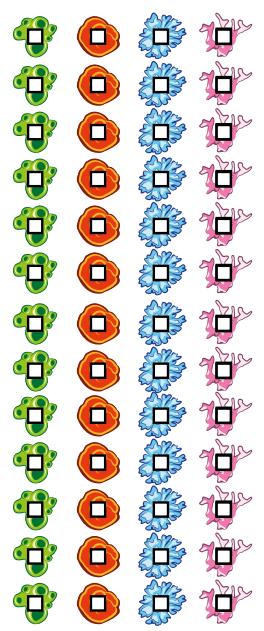
You can expand your AQUA experience by chasing the 50 achievements built into Scenarios (page 9), Challenges (page 10) and Modifications (page 10). Achievements can be added at any player count, and unless you are playing with Modifications you do not need all players to partake in the chase. Up to four players can mark their progress on the progress track below.
For the full solo experience, consider adding achievements (Scenarios, Challenges and Modifications). Achievements are explained on the following pages.

: A great start!

: Well done!

: Outstanding!

: Expert!

: That is satisfying!

Assign your name to a specific row of corals on the progress track, and when completing a Scenario, Challenge or Modification, mark of one of your corals on both the progress track and the achievement. Several players may complete the same achievement at the same time.

SCENARIOS
Scenarios are pre-built scoring setups with extra objectives. You may play them in any order and at any player counts.
Setup: Arrange the Ecosystems in the shown order. To complete a scenario, you need to reach the minimum score and fulfill the objective, if any apply. If you successfully do so, mark of the achievement for yourself, both on this page and on your progress track (page 8).

| # | ECOSYSTEMS | MIN.SCORE | OBJECTIVE | COMPLETED |
| A | 1 2 5 6 | 60 | SYE | |
| B | 7 8 9 10 11 12 | 60 | 心 | |
| C | 16 16 3 5 15 15 | 65 | 2 | |
| D | 3 4 5 6 17 17 | 65 | Min 20 points from Small Animals | 2 |
| E | 13 13 18 18 4 6 | Min 20 points from Large Animals | XYZ 2 | |
| F | 1 2 3 10 11 12 | Min 20 points from Reefs | 2 | |
| G | 7 14 8 14 9 16 | 75 | Min 1 of each Small Animal | 4 2 |
| H | 2 6 17 17 18 18 | 15 | Max 20 points from Small Animals | 8 2 |
| 一 | 15 15 8 11 13 13 | 80 | Score at least four Ecosystems | 2 |
| J | 7 8 11 4 5 6 | 80 | Have all Small Animals coveredby Large Animals | 山 |
| K | 10 13 14 14 13 9 | 85 | Max 20 points from Large Animals | 2 |
| L | 17 17 13 13 2 3 | 85 | Max 20 points from Reefs | 4 2 |
| M | 16 14 16 15 14 15 | 90 | Min 25 points from Small Animals | 2o口 |
| N | 18 12 10 9 7 17 | 95 | Max 2 of each Small Animal | 2 |
| O | 12 13 14 1516 18 | Score at least five Ecosystems | 2 |
CHALENGES
Unlike Scenarios and Modifications, you do not choose a Challenge before the game begins. Instead, after you finish a game, check if you completed any of the Challenges. If you complete multiple Challenges in a single game, you choose one of them. Mark of the achievement for yourself, both on this page and on the progress track (page 8). Challenges can be combined with both Scenarios and Modifications, and can be achieved at any player count.
Score 70+ points1
Score 80+ points2
Score 90+ points3
Score 100+ points4
Score all six Ecosystems5
Score 30+ points from Large Animals6
Score 35+ points from Large Animals7
Score 25+ points from Small Animals8
Score 30+ points from Small Animals9
Score 25+ points from Reefs10
Score 30+ points from Reefs11
Win a game by 10+ points (not solo)12


Win a game by 20+ points (not solo)13
Have 4+ diferent Large Animals14
Have 2+ Humpback Whales/Whale Sharks15
Win with no Large Animals (not solo)16
Have 3+ Large Animals that are not adjacent17 to each other
Have 4+ of a single Small Animal18
Have 2+ of each Small Animal19
Win with the fewest Small Animals (not solo)20
Have 5+ scoring Reefs21
Have a single Small Animal adjacent to 4+ Reefs22
Have 6+ Small Animals adjacent to the same Reef23
Have all Small Animals adjacent to a Reef24
Have 3+ Large Animals adjacent to a Reef25
MODIFICATIONS
Modifications change some of the core rules of the game for all players. Choose one before the game begins. All participating players mark of the Modification here and on the progress track (page 8). Modifications can be used in combination with Scenarios and Challenges at any player count.
The market has one fewer Coral tile each round (remove 1 more in setup, 17 if solo)1
The market has one extra Coral tile each round (remove 1 less in setup, 17 if solo)2
Reefs must be size 5+ corals to score3
Reefs score 2 points per coral in it, instead of scoring for adjacent Small Animals4
Reefs score points from adjacent Large Animals, not for adjacent Small Animals5
End of game: everyone chooses only one color Reef they can score6
Setup: Remove 10/8/6/4 of each Small Animal at 1/2/3/4 players7
You may only create Habitats in 4 colors8
Large Animals must cover 2+ of the same Small Animal (replacing biodiversity)9
You may only attract one of each Large Animal shape10

ANIMALS OF AQUA

HUMPBACK WHALE
A magnificent creature known for its impressive acrobatic displays, including breaching and tail slapping. They are famous for their complex songs that can travel long distances underwater and are believed to be unique to each individual, making them one of the most vocal marine mammals.

MANTA RAY
Manta rays are graceful and majestic creatures that glide through the ocean with their large wingspans, which can reach up to 23 feet. They are filter feeders, using specialized gill plates, called cephalic lobes, to funnel plankton into their mouths.

DUGONG
Dugongs, often referred to as sea cows, are marine mammals closely related to manatees. They are herbivores and spend most of their time grazing on seagrass beds.

BLACKTIP REF SHARK
The blacktip reef shark is a common shark species found in shallow tropical waters, particularly around coral reefs. They are known for their elegant swimming style and the prominent black tips on their dorsal fins and caudal fins.

BARACUDA
Barracudas are predatory fish known for their sleek bodies and sharp teeth. They are incredibly fast swimmers and can reach speeds of up to 27 miles per hour.

LONG-SNOUTED SEAHORSE
The long-snouted seahorse is a unique creature known for its ability to change color and its distinctive upright posture. They are notable for their unusual method of reproduction, where the male carries and incubates the eggs in a pouch until they hatch.

BOX JELYFISH
Box jellyfish are marine invertebrates known for their cubeshaped bodies and long, trailing tentacles. They are among the most venomous creatures in the ocean and their stings can be extremely painful and, in some cases, deadly.

CLOWNFISH
Clownfish are small, brightly colored fish that live in sea anemones. They are protected by the stinging cells of the anemone and, in return, provide food and remove parasites.







WHALE SHARK
The whale shark is the largest fish in the ocean, with a length of up to 40 feet or more. Despite its massive size, it is a gentle giant, feeding primarily on plankton and small fish.
REF OCTOPUS
The reef octopus is a highly intelligent and adaptable creature found in coral reef environments. They have remarkable color-changing abilities, which they use for communication, camouflage, and hunting.
BOTLENOSE DOLPHIN
Bottlenose dolphins are highly intelligent and social animals known for their playful nature and acrobatic behaviors, such as leaping and riding waves. They have a complex communication system that includes whistles, clicks, and body movements.
HAMERHEAD SHARK
Hammerhead sharks have distinctively shaped heads, called cephalofoils, which are believed to enhance their sensory abilities. Their unique head shape provides improved 360-degree vision and electroreception, allowing them to detect prey more eficiently.
MORAY EL
Moray eels are fascinating creatures with elongated bodies and powerful jaws. They are primarily nocturnal, hiding in crevices during the day and actively hunting at night.
TRAPEZIA CRAB
The trapezia crab is a small, brightly colored crab species that lives in symbiosis with certain species of corals. They have a mutualistic relationship, where the crabs protect the corals from coral-eating starfish in exchange for food and shelter.
GREN TURTLE
The green turtle is a large marine reptile known for its distinctive greenish shell and its importance to marine ecosystems. They are herbivores, feeding primarily on seagrass and algae.
CROWN-OF-THORNS STARFISH
The crown-of-thorns starfish is a large and spiky species that can have a negative impact on coral reefs. They feed on coral polyps and, when present in large numbers, can cause significant damage to coral colonies.
core

For every native Small Animal you have, score 1 point per Small Animal adjacent to it (any color, including its own).

For each barracuda/moray eel you have, score 2 points for every native Small Animal you have.

For each bottlenose dolphin/ dugong you have, score 3 points for every native Small Animal you have.
ADVANCED

For each trapezia crab you have, score 3 points for every native Small Animal adjacent to it.

For each clownfish you have, score 3 points for every native Small Animal adjacent to it.

For each green turtle you have, score 3 points for every native Small Animal adjacent to it.

For each Reef you have, score 3 points for every native Small Animal adjacent to it.

For every native Small Animal, score 2 points per Small Animal adjacent to it, that is native to the Ecosystems immediately to the left and right of this Ecosystem.

If you have 3 or more of the native Small Animal, score 7 points.
ECOSYSTEMs

For each manta ray/reef octopus you have, score 3 points for every native Small Animal you have.

For each hammerhead shark/blacktip reef shark you have, score 3 points for every native Small Animal you have.

For each humpback whale/whale shark you have, score 4 points for every native Small Animal you have.

For each box jellyfish you have, score 3 points for every native Small Animal adjacent to it.

For each crown-of-thorns starfish you have, score 3 points for every native Small Animal adjacent to it.

For each long-snouted seahorse you have, score 3 points for every native Small Animal adjacent to it.

The player(s) with most of the native Small Animal, score 7 points. Second most, score 3 points (you must have at least one to score). If tied for first/second, all tied players score the points. Solo: Score 7/3 points if this is the Small Animal you have the most/second most of among all your Small Animals.


For every native Small Animal you have, score 4 points. Important: Large Animals may not be placed on top of the native Small Animal.
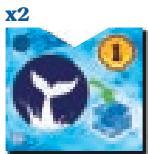
For every native Small Animal you have, score 1 point. Important: Large Animals may be placed on top of multiple of the native Small Animals (ignoring biodiversity).
下载 Markdown