CIT_Rulebook_14-compressed.md

Introduction
Eons ago, a mysterious cosmic signal reached the shores of Fera, a small, undeveloped planet. The enigmatic signal washed over the land's animals, igniting the spark of intelligence and a burst of technological advancement. This event became known as the Transmission, and with its gifts, the enlightened creatures of Fera built a peaceful, egalitarian utopia where nature and technology thrived in harmonious balance.
But that balance now wavers ...
In recent years, the scholars of Fera uncovered a prophecy hidden within the celestial Transmission. It foretells the rise of one settlement that flourishes into a great city, the shining jewel of the planet. All others will fall and crumble to dust, scattering their people.
As the leader of a newly founded city, you must now recruit the strongest allies and most brilliant minds to your home. Employ their unique skills to ensure that your settlement emerges as the prophesized shining jewel of Fera. Utilize your citizens wisely, for only the city with the most cunning leader will escape annihilation and prove itself worthy of the Transmission's blessing.

Overview
Citizens of the Spark is a variable setup card game where players take turns attracting citizens, performing actions, and claiming sparks. The more citizen cards a player has of a specific citizen, the more powerful that citizen's action becomes. The player with the most sparks at the end of the game is the winner!
Components
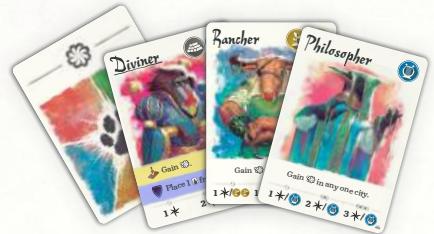
300 CITIZEN CARDS 30 sets / 10 each


1 START PLAYER TOKEN
30 RANDOMIZER CARDS


100 SPARK TOKENS 40x1s / 20x5s / 20x10s /20x25s
30 DIVIDERS
5 REFERENCE CARDS


3 GROUP TOKENS (solo play)
36 SCYNTILLA CARDS (solo play)

1 SOLO REFERENCE CARD


Citizen Name


Agriculture

Guild Icons


3Actions / Abilities
Level 2 Action

Level 3 Action

Level 1 Action


Attack
Gain 2 *. ♀ Gain 米.

Arts

Economics


Military

Politics
Any Guild

Reaction

Ongoing

When Placed

End of Game


Game Setup
Choose a number of citizens to use based on the number of players:
| Players | ||||
| 1-2 | 3 | 4 | 5 | |
| Citizen Sets | 7 | 8 | 9 | 10 |
Either choose a recommended card set from the back page of this rulebook, or use the deck of randomizer cards to select random citizen sets.
Do not use more than four underlined citizens.

UNDERLINED
First Game Suggestion: Choose the citizens listed in the FIRST GAME card set on the back of this rulebook.
Collect all ten citizen cards of each chosen citizen. Leave all unused citizen cards in the game box.
Shuffle the citizen cards together to create the citizen deck. Place the deck face down near the center of the table, leaving space for a discard pile.
Deal four citizen cards to each player from the deck. Each player chooses two and discards two. All players simultaneously reveal and place their chosen cards in front of them. This is their city.
If a player's two chosen cards are identical, place them in a single stack so that the top portion of the bottom card can be seen.
First Game Suggestion: Instead of dealing four cards to each player and choosing, reveal two citizen cards from the deck for each player and place them in their city. Then discard two cards per player from the deck.
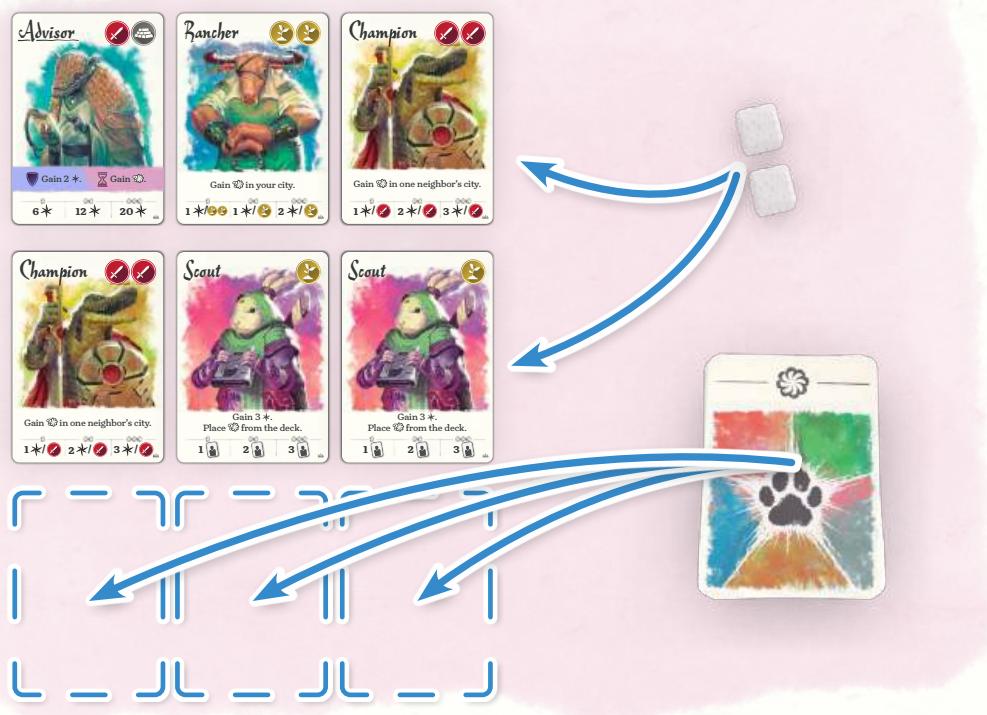
5 Reveal cards from the top of the citizen deck based on the number of players. Place them face up in three groups in the center of the table to create the assembly.
At some player counts, discard cards from the top of the citizen deck.
| Players | ||||
| 1-2 | 3 | 4 | 5 | |
| Cards per Group | 2 | 2 | 3 | 3 |
| Discard | 15 | 15 | 0 | 0 |
Place all spark tokens near the play area to create a supply.
The player born in the largest city takes the start player token and proceeds with the first turn.

Actions and Abilities
Citizens may have actions and/or abilities.
• Actions are performed during the Perform an Action phase and are discarded.
• Abilities activate only under specific circumstances and are not discarded when activated.
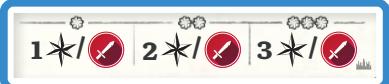
Actions and abilities usually have three strength levels, determined by the number of cards in the citizen's stack. A player may perform actions or abilities up to the strength level.
| Icon | Type | Color |
| Action | White | |
| Attack Action | Orange | |
| Reaction Ability | Purple | |
| Q | Ongoing Ability | Gray |
| When Placed Ability | Yellow | |
| § | End of Game Ability | Pink |
• One card: The player may perform only the level 1 action or activate the level 1 ability ().
• Two cards: The player may perform the level 1 or 2 action or activate the level 1 or 2 ability ( or \$).
• Three or more cards: The player may perform any action or activate any ability on the card (\$ or \$ or ).
: The variable icon refers to the current strength of the citizen card and is used to indicate which level action or ability to use.
Example: A player with two Scout cards in their city may perform the Scout level 2 action, placing two cards from the deck into their city.

Many actions and abilities make use of a slash
(/) to mean “per". When using one of these actions or abilities, count the number of objects or symbols indicated to determine how many spark tokens are awarded.
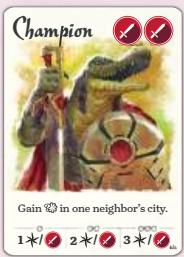
Gain & in one neighbor's city.
Example: A player performs the Champion's action, counting the number of guild icons in one neighbor's city to determine how many spark tokens they receive.
A card that is used to perform an action is considered part of the player's city,
but cannot be discarded or manipulated by actions.
Example: When a player performs the Scientist's action, they may not discard the active card as part of its action.
Gain . Discard 1in your city.
7*
10*
15
How to Play
Citizens of the Spark is played over a series of turns until the citizen deck runs out. Each turn is divided into three phases: Attract Citizens, Perform an Action, and Clean Up.
I. ATTRACT CITIZENS
The active player selects one of the three groups of citizen cards from the assembly and places them in their city, in the order they choose.
Activate any When Placed () abilities on placed citizen cards.
The player also collects any spark tokens next to their selected group from the assembly. At the start of the game, there are no spark tokens in the assembly.

Example: Isaac selects the third group of citizen cards from the assembly and collects the two spark tokens next to the group. He adds the Philosopher to his existing stack and starts a new stack for the two Warriors, since he does not currently have any Warriors in his city.
II. PERFORM AN ACTION (optional)
After attracting citizens, the active player may perform an action from one citizen stack in their city that has an action or attack action (). Then, all other players may follow the active citizen.
Activate:
-
Choose a stack of one or more citizen cards in the player's city.
-
Move the top card from the chosen stack above the player's city. This is the active citizen card and signals which citizen is being activated, and which player is the active player whose action may be followed.
-
Choose an action to perform on the active card based on the strength level of their citizen stack, which includes the active card (See p.6, Actions and Abilities) and perform the action.
The active card is not discarded until the Clean Up phase (see p.10).
Follow:
After the active player performs an action, each opponent, in clockwise order, may follow that action, if able.
To follow, the opponent must have at least one copy of the active citizen in their city (unless otherwise noted, e.g. Performer).
If an opponent chooses to follow, they:
-
Move their top copy of the active citizen card to a space above their city.
-
Choose an action to perform on the follower citizen card based on the strength level of their citizen stack, which includes the follower card and perform the action.
-
Discard the follower card.
Then the next opponent in clockwise order may follow, until all opponents have either followed or passed.

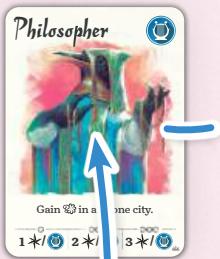

After attracting citizens, Isaac decides to perform a Philosopher action. He moves the top card from his stack of Philosophers above his city to designate it as the active card, and chooses to perform the level 2 action (), since he has two Philosophers. He determines that Claire's city to his left has the most (3) so he gains 6+ (2+ per ).



Claire follows Isaac's action, playing a Philosopher of her own. Since she has only one, she can perform only a level 1 action. She also chooses her own city to count and gains 3+ (1+ per ). She then discards the Philosopher she used to follow.


Finally, Keith decides to also follow Isaac's action. Keith has two Philosophers and performs a level 2 action. Claire already followed before him and discarded her Philosopher, leaving her with two other in her city. Keith determines that all players now have two in their cities, so he chooses his own city and gains 4* (2* per ). He then also discards the Philosopher he used to follow.


III. CLEAN UP
Once all opponents have followed or chosen not to follow, the active player discards their active citizen card to the discard pile.
Then, prepare the assembly for the next player's turn.
- Add one spark token next to each of the remaining groups of citizen cards in the assembly.
There is no limit to the number of spark tokens allowed next to a group.
- Reveal cards from the citizen deck and place them face up in the assembly until there are three groups of cards from which the next player can choose.
The active player's turn is complete. The next player in clockwise order becomes the new active player and takes a turn.
The start player token does NOT move to the next player.
GAME END
When the citizen deck runs out (either as a result of an action or during the Clean Up phase), the end of the game is triggered.
Immediately shuffle the discard pile and place it face down to create a new citizen deck. If the deck ran out during the Perform an Action phase, finish performing any actions with the new deck.
Continue taking turns until the player to the right of the start player completes their turn. This way, all players will take an equal number of turns.
FINAL SCORING
Determine the final score for each player by totaling the spark tokens collected during the game, plus:
• Gain one spark token for each citizen card in their city, including converted citizens. (See p.13, Converted Citizens).
• Gain spark tokens for each End of Game ability in your city.

The player with the most spark tokens has built the greatest city, receives the blessing of the Transmission, and is the winner!
In the case of a tie, the tied player with the most citizen cards in their city is the winner. If players are still tied, the prophecy was misinterpreted, and all tied players share the blessing of the Transmission and the victory.
SCORING EXAMPLE

Core Concepts t Game Terms
Active Citizen Card: The citizen card chosen by the active player during the Perform an Action phase.
Assembly: Groups of citizen cards in the central area of the table.
Attack Action (): Actions that affect opponents' cities. When playing an attack action, opponents resolve all of their abilities before the attack action is resolved.
Citizen Deck: Players may count the number of remaining cards in the citizen deck at any time.
Citizen Stack(): One or more citizen cards placed on top of one another in a player's city, including face-down converted citizens.
City: The area in front of a player where they place citizen cards.
Discard: Any card in a stack may be discarded, including converted citizens.
Discard Pile: Players may look at cards in the discard pile at any time, but may not change their order.
End of Game Ability (♀): Activated during final scoring.
Follow: Perform the same action as the active player, but the following player uses the strength level of their own stack.
Follower Citizen Card: The citizen card chosen by a player to follow during the Perform an Action phase.
Gain *: Take a spark token from the supply, place it in the player's area.
Neighbor: The city immediately to the left or right of a player's city. In a two player game, each city has only one neighbor.
Ongoing Ability (): Activated when a specified condition is met. Each stack's ongoing ability may be activated once per action.
Place: Add a citizen card face up into a player's city. Add the card to a matching stack of citizen cards, or create a new stack if there are no matching cards.
Reaction Ability (): Activated when a player is affected by another player's action. They are resolved before the action and are not discarded.
Spark Tokens (*): Tokens in the supply are unlimited. If the supply runs out, use a suitable replacement.
Take: Remove card(s) or spark token(s) from an opponent's play area and add it to the player's play area.
Trade: Exchange citizen cards from a player's city with citizen cards from a different city or the assembly, as described by the ability. The player taking the action determines which cards are exchanged. A player may not trade their active/follower citizen card or a converted citizen, though they can trade other copies of the active/follower citizen card. If the number of cards in the active citizen's stack is altered as a result of a trade, the strength level of the action does not change.
Variable (&): Some cards use & to refer to the current strength level of a stack. For example, if there are three or more cards in a stack, then this icon means strength level 3 ().
Converted Citizens

Some actions allow players to convert citizen cards. Converted citizens increase the strength level of a stack without having to match the stack's citizen. To convert a citizen card, flip it face-down.
Converted citizen cards:
• Are placed at the bottom of any stack in the player's city.
• Are considered a copy of other citizen cards in the stack, but do not have guild icons.
• Are considered citizen cards for actions, abilities, and final scoring.
• Cannot be used to perform actions, but they increase the strength level of their stack.
• May be taken but not traded.
• Cannot be converted a second time or converted back to its front side.
Citizen cards placed during an action cannot be placed on a stack containing only converted citizens.
If a stack consists of only converted citizen cards, discard the stack after the current action is completed.
When Placed Ability ( ): Activated when a player places a citizen card (including during setup) or receives one as a result of a trade. When placing multiple citizen cards, fully resolve each card's ability before placing additional cards.
Example: Isabel has a stack with two face-down converted citizen cards and one Scholar card. On her turn, she moves her Scholar above her city and performs the level 3 scholar action.

SCHOLAR WITH 2 CONVERTED CITIZEN CARDS
She draws another Scholar card as part of the action. Since her stack of Scholar cards contains only converted citizen cards, she must place the new Scholar card in a new stack.
The converted citizen cards from the active Scholar's stack are moved to the discard pile before other players follow.
Example: Simon has a stack with one face-down converted citizen card and one Scientist. On his turn, he moves the Scientist above his city and performs the

SCIENTIST WITH 1 CONVERTED CITIZEN CARD
level 2 Scientist action. He chooses to discard the converted citizen card from the uncovered stack to resolve the Scientist's action.
Citizen Card Notes
AGITATOR
The Agitator may not trade converted citizens () from either city. The Agitator that is chosen as the active or follower citizen card () may not be traded, though other copies of the Agitator may be. This does not reduce the strength level () of the action.


COLLECTOR
During final scoring, when calculating the Collector's End of Game () ability, count all citizen cards () including converted citizen cards ().
DIVINER
If placed during setup, or when added to a player's city as a result of an action, activate the Diviner's When Placed () ability.


EXECUTIONER
Each opponent chooses which card(s) to discard. Players may discard any card from a stack (), including converted citizen cards ().
MEDIATOR
The Mediator may not trade converted citizens (
The Mediator that is chosen as the active or follower citizen card
() may not be traded, though other copies of the Mediator may be. This does not reduce the strength level () of the action.


MEDIC
If the Medic's action allows a player to place more cards than are remaining in the discard pile, place all cards currently in the discard pile. Any remaining placements are lost.
MENTOR
A player who chooses to convert zero citizen cards still collects spark tokens for the strength level of the action performed. The Mentor that is chosen as the active or follower citizen card ( may not be converted, though other copies of the Mentor may be. This does not reduce the strength level () of the action.


POET
A player may use the Poet's effect only on their own action (either as the active player or while following). Once a player completes their active or follower card's action, the Poet's effect is no longer active. Only one Poet may be discarded per performed action or follow.
PERFORMER
The action's strength level () is determined by how many copies of the Performer a player has. For example, if the active player performs a level 1 Medic action and a player follows with a level 3 Performer, they may perform a level 3 Medic action. When
copying a citizen that discards all copies of itself (e.g. Executioner, Soldier), discard all Performers instead of the indicated card. The Performer may never copy a Poet.

PUPIL

If a player is dealt four Pupil cards during setup, discard all four cards and draw four new citizen cards from the deck. If there are no stacks ()in the player's city when placed, immediately discard the Pupil, gaining no spark tokens. After the Pupil is converted it no longer has the icon. If the Pupil is converted by another card's action or ability, the Pupil's ability does not trigger and no sparks are gained.
RECRUITER
The Recuiter may add the converted citizen card () to the player's Recuiter stack (), but it does not increase the strength level () of the current action.


SABOTEUR
Gain the spark tokens from the supply. Do not discard spark tokens next to the chosen group in the assembly.
SCHOLAR
If the Scholar's action allows a player to draw more cards than are left in the deck, that player draws the last cards from the deck, triggering the end of the game. Then draw the remaining cards from the reshuffled deck.


SCIENTIST
Players may discard any card from a stack (), including converted citizen cards ().
SCOUT
If the Scout's action allows a player to draw more cards than are left in the deck, that player draws the last cards from the deck, triggering the end of the game. Then draw the remaining cards from the reshuffled deck.


TRADER
The Trader may not trade converted citizen cards () from either city. The Trader that is chosen as the active or follower citizen card () may not be traded, though other copies of the Trader may be. This does not reduce the strength level () of the action.
Recommended Card Sets
| 1-2 Players | 3 Players | 4Players | 5Players | |
| FIRST GAME | Advisor, Bandit, Champion,Outcast, Rancher, Scientist,Scout | Merchant | Warrior | Diplomat |
| SHORT GAME | Collector, Executioner, Medic, Performer, Philosopher, Poet, Scout | Diviner | Saboteur | Scholar |
| LOWINTERACTION | Collector, Mediator,Merchant, Rancher, Saboteur,Scientist, Scout | Medic | Diplomat | Scholar |
| HIGHINTERACTION | Executioner, Mediator, Medic,Outcast, Soldier, Trader,Tyrant | Diviner | Agitator | Poet |
| CONVERTFOCUSED | Agitator, Collector, Guardian,Mentor, Performer, Pupil,Recruiter | Judge | Scientist | Trader |
| GUILD ICONFOCUSED | Bandit, Diviner, Philosopher,Poet, Politician, Soldier,Trader | Warrior | Champion | Rancher |
| STRATEGIC | Advisor, Agitator, Champion,Guardian, Scholar, Soldier,Tyrant | Warrior | Mentor | Diplomat |
| TACTICAL | Bandit, Executioner, Judge,Merchant, Politician, Pupil,Recruiter | Saboteur | Performer | Mediator |
| Setup Reminder | Players | 1-2 | 3 | 4 | 5 |
| Citizen Sets | 7 | 8 | 9 | 10 | |
| Cards per Group | 2 | 2 | 3 | 3 | |
| Discard | 15 | 15 | 0 | 0 |
Credits
Game Design: Philip duBarry
Development: Harrison Dunn & Keith Matejka
Illustration: Diego Sá
Graphic Design: Stephen Kerr
UX Design Consultant: Shy Lev-Ari
Writing: Stephen Kerr & Keith Matejka
Editing: Jon Healey & Patrick Porwoll
Tray Design: Dan Cunningham
Special thanks: Matt Bednarik, Paul Berkbigler, Mike Butz, Jess Carrier, Blair Croft, Steven Dast, Kirk Dennison, Isabel duBarry, Lauren Dunn, Simon Ehlers, Jess English, Marc English, Anna Beth Gawarecki, Mark Graczykowski, Alan Grgic, Emily Grgic, Jeff Gum, Andrew Hanson, Dan Harwood, Brian Hausrath, Eric Hyland, Eric Jome, Tim Mattes, Luke Muench, LauraLee Norton, Will Norton, Anthony Rando, Chris Romansky, Jeremy Roper, Joel Sherman, Jess Souder, Greg Stravinski, Eric Tague, Jennifer Tague, Alissa Thompson, Harry Thompson, Seth Van Orden, Alisha Volkman, Andrea Vitagliano, Jeremy Weaver, Jacob White, Marcin Zarycki, and playtesters at Protospiel.
For additional information or support, please visit us at thunderworksgames.com ©2025 Thunderworks Games LLC. All Rights Reserved. 7182 US Hwy 14 Suite #402, Middleton, WI 53562 USA
下载 Markdown