NapWars rules flowchart 1_1.md
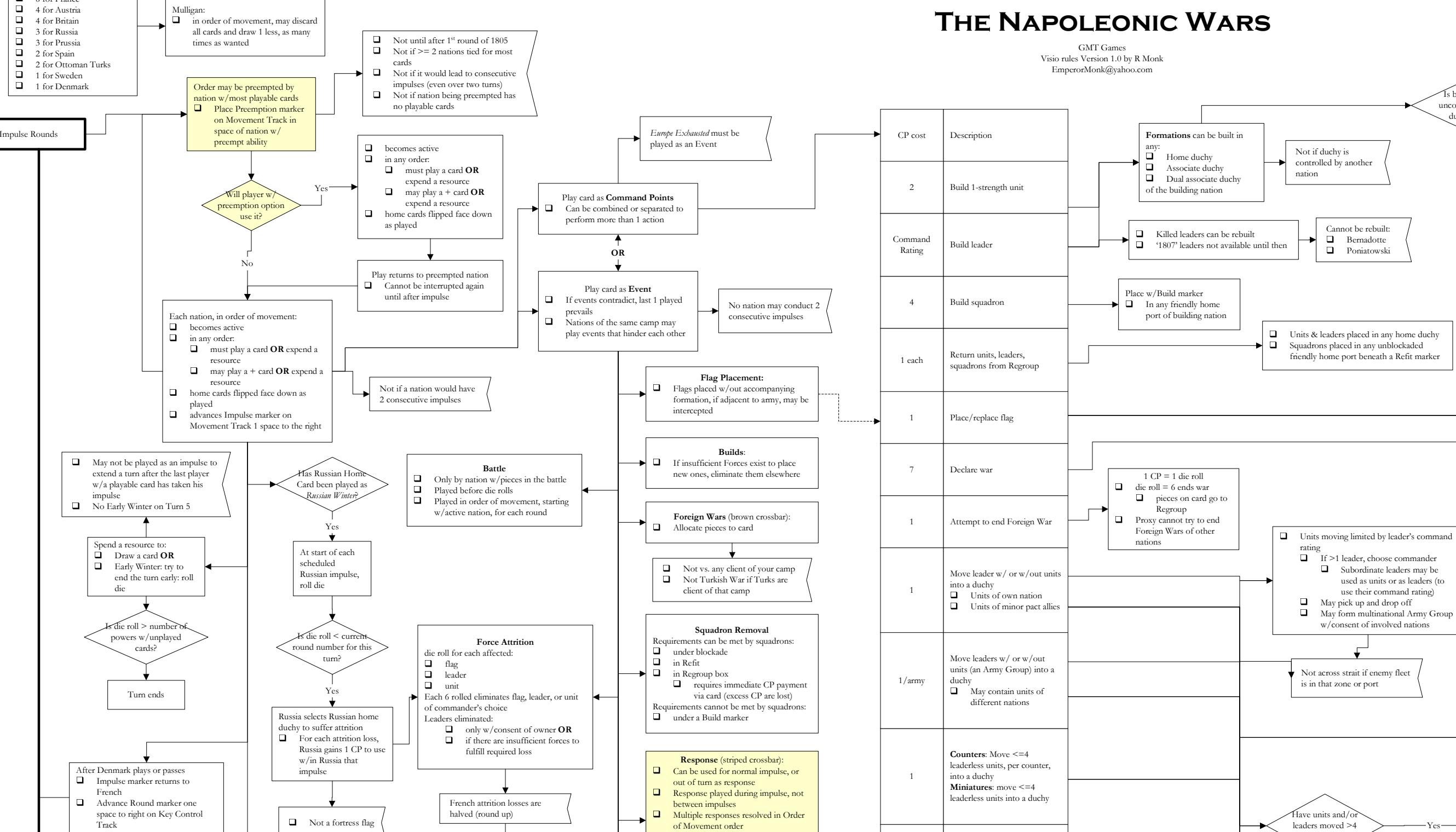


| Number of dice | Battle口 Each player rolls dice | Siege口Besieging army rolls dice |
| +? | Number of undisrupted units &subordinate leaders | Number of undisrupted units &subordinate leaders |
| +? | Commander's battle rating口 +0 if disrupted口 +0 if >1 defending nationtogether not in an ArmyGroup | Commander's battle rating口 +0 if disrupted□ +0 if >1 defending nationtogether not in an ArmyGroup |
| +/-? | Event card effects | Event card effects |
| +1 | Failed enemy evasion attempts 1st round only | |
| +2 | Units/leaders > 50% French | Units/leaders > 50% French |
| +1 | Units/leaders neither > 50%French nor > 50% Minors | Units/leaders neither > 50%French nor > 50% Minors |
| +0 | Units/leaders > 50% minors | Units/leaders > 50% minors |
| +1 to defender | Active formation entered duchythis impulse via rough ANDduchy is friendly to defender口 1st round only口 Not if defender failedevasion | |
| Active formation entered duchythis impulse via pass AND |


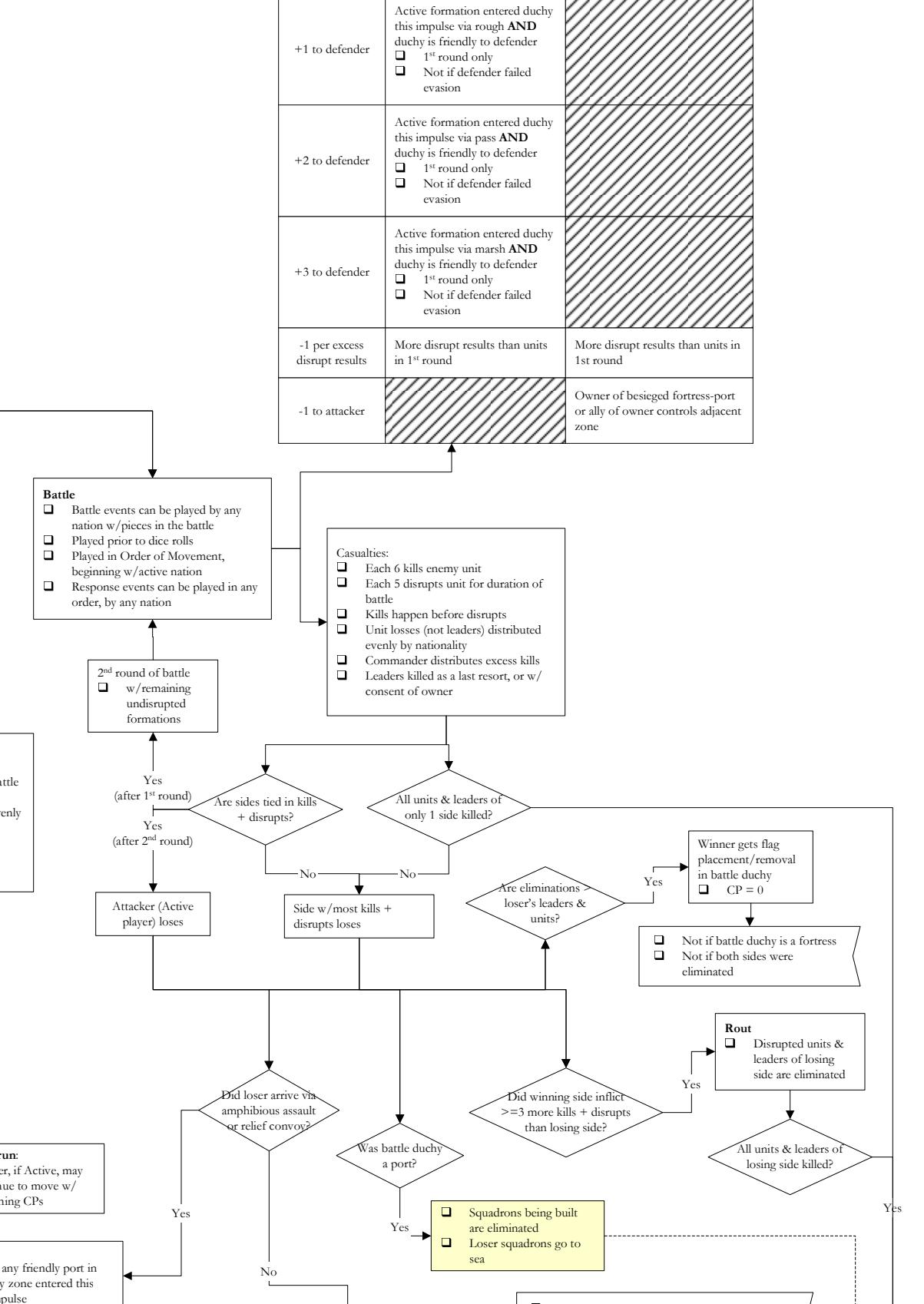
| +1 to defender | Active formation entered duchythis impulse via rough ANDduchy is friendly to defender口 1st round only口 Not if defender failedevasion | |
| +2 to defender | Active formation entered duchythis impulse via pass ANDduchy is friendly to defender□ 1st round only口 Not if defender failedevasion | |
| +3 to defender | Active formation entered duchythis impulse via marsh ANDduchy is friendly to defender口 1st round only口 Not if defender failedevasion | |
| -1 per excessdisrupt results | More disrupt results than unitsin 1st round | More disrupt results than units in1st round |
| -1 to attacker | Owner of besieged fortress-portor ally of owner controls adjacentzone |


01.md
2. Game Components
2.1 Inventory
The game contains:
one 22” x 34” map
four sets of die-cut playing pieces.
one Control Chart/Setup Sheet
one Battleground Chart
nine Headquarters Displays
110 cards
these rules and a Campaign booklet
8 plastic stands and six six-sided dice
2.2 Playing Pieces
UNITS: Each round piece represents one, two or four Units. The illustrations are just another indication of the strength of the piece: infantry indicates 1 Unit, cavalry 2, and artillery 4. Pieces make “change” at any time by substituting smaller denominations or replacing several pieces with a stronger piece of equal Unit strength within the limits of available pieces. There are also a few 6- and 8-strength pieces to ease stacking. These should be added only after removing an equal number of Units from the pool of 1-, 2- and 4-strength pieces. The 6- and 8-strength pieces cannot move or evade without an appropriate leader.
Piece values: 1 Unit (infantry), 2 Units (cavalry), 4 Units (artillery), 6 Units and 8 Units (used only to facilitate stacking; requires appropriate leadership to move).
Those pieces with a name under the illustration start in that named space, although you may substitute any piece of equal value if preferred. Pieces without a name may be built later. The pieces provided are an absolute limit. No more may be created for any purpose.
SQUADRONS: Each oblong, rectangular ship piece is a Squadron. The front side (depicted under sail) is used when at sea. The back side (depicted at anchor) is used when in Port. The cannon number is the amount of dice it throws in combat. The sail number is the modifier to its interception and evasion dice rolls. The name (if any) on the piece is its starting location. If the name is on the front side, the Squadron begins at sea. If it is on the backside, it begins in Port.
A Squadron piece shows: Front (at sea) — the number of dice it throws in combat, and its starting location. Back (in Port) — the modifier to its Patrol, interception, and evasion die rolls.
LEADERS: Each square piece represents a general with the specialized support elements of his Army (there is a matching oblong piece for every leader). A leader who is the Commander of an Army Group is placed on the “Holding Box” of his nation’s Headquarters Display along with all the Armies in his Army Group. His oblong marker is then inserted into a plastic base to stand upright and is placed alone on the map to represent the entire Army Group. Leaders that start on board have their initial locations printed beneath the encased number.
A leader piece shows: the encased number (Command Rating and CP cost), the unencased number (Battle Rating), initial location, turn of availability, and event build requirement.
The back side of all 5/8” leader pieces is a one strength Unit (9.6).
FLAGS: A hexagonal piece is placed on the map to show a nation’s Control of a Duchy it did not own at the start of play. French Flags are on the back of all other nations’ Flags. Note the color-coded abbreviation beneath each French Flag which identifies the nations’ Flag on its reverse side. The number of Flags for each nation is listed below in brackets.
NATIONALITY COLORS: There are nine sets of colored pieces – each representing a different nationality as follows:
France: blue [87]
Britain: red [B 17]
Russia: green [R 15]
Prussia: black [P 14]
Austria: gray [A 17]
Spain: brown [Sp 7]
Denmark: orange [D 5]
Sweden: light blue [Sw 5]
Ottoman Turks: yellow [T 7]
3. Glossary
All Capitalized terms used in the rules are defined here. Initial readers may wish to skim this section for familiarity only, and refer to it as needed when reading the appropriate rules section.
Active: The nation currently taking its Impulse (5.1). A Neutral not controlled by a player which is only making automatic builds (7.5) or event plays (5.31) is not Active.
Adjacent: Duchies directly connected by solid or dashed lines, sea Zones which share the same boundary, sea Zones and Ports which share an Anchor symbol.
Allies: Multiple nations in the same Camp, or a Power and Proxy sharing Pact status (8.2).
Army: A leader with or without additional leaders/Units of the same nationality (or those of a Pact Minor Ally) up to that leader’s Command Rating in the same Duchy. Forces of more than one Allied Power may not be in the same Army. Extra Units in the same Duchy must defend with the Army, but are not an Army and may not attack/move with it (9.1). Example: Assume Prussia is in the Imperial Camp, as is Spain who is a Pact Ally of France. A French leader could form an Army made up of French and/or Spanish (France’s allied Minor Pact) Units, but not Prussian Units. Prussia is France’s ally, but not a Minor. A Prussian leader could not have Spanish Units in its Army, because Spain is not directly tied to Prussia by Pact.
Army Group: Two or more friendly Armies under the same Commander occupying the same Duchy or moving together. An Army Group can be composed of any number of allied Armies and its Commander is the leader of one of those Armies (but see 9.1). The Commander is placed on the map in a plastic stand to represent the entire Army Group. The rest of the pieces (leaders and Units) are placed in an Army Group Holding Box on the Commander’s Headquarters Display.
Attrition: An occurrence requiring a number of die rolls equal to the Unit strength of all affected Forces (Flags are unaffected if the cause of Attrition is movement-induced). Each “6” die roll causes an elimination (9.4 and 6.17; French exception: 9.45). Example: A 4-Unit piece (artillery) rolls four times and loses one of its four Units for each “6” it rolls.
Battle Rating: A leader’s unencased number (1 to 4) which favorably modifies intercept/evade attempts and provides that many battle dice if that leader is the Commander (2.2).
Besieger: Besiegers are Formations occupying an Uncontrolled Fortress Duchy – even if they do not actually engage in a Siege attack (12).
Blockade: The status of a Fleet in Control of a Zone over Ports in that Zone (13.35).
Camp: A group of nations whose members are considered to be mutually Allied. Nations in one Camp are at war with all nations in the other Camp. A Power’s Consul, or a Proxy’s “+1 CP” marker, is placed in the appropriate Camp box on the Control Chart to show membership. A Player Power may only leave a Camp by Conquest or Submission, by voluntarily changing Camps during the Interphase (8.3), or by a 7 CP-Declaration of War during an Impulse (8.33). Proxies leave a Camp only by Conquest, forced Submission (15.42) or play of a Pact-breaking event (8.21).
Client: Any nation whose Consul is in the Friend, Aide, Partner, or Pact space of a Power’s row on the Diplomatic Track is a Client of that Power. A nation whose “+1 Consul” is Unaligned is not a Power’s Client.
Command Points (CPs): The circled number atop a card, spent by the Active nation to build or move Forces and Squadrons, or to affect Consuls on the Diplomatic Track and to end Foreign Wars (6.3).
Command Rating: A Commander’s encased number (4, 6, or 8) is his Army’s maximum total Unit strength (excluding himself or other subordinate Army Commanders) (9.1).
Commander: The leader within a Formation whose ratings are used for battle, interception, evasion, and to co-ordinate the movement of an Army (or Army Group). Only one leader’s ratings may be used per Duchy. A Formation’s Commander can only change during the Impulse of a new Commander’s nation or when another leader enters (or is placed in) the Formation’s Duchy (by any means) (9.7).
Consul: A marker representing a Proxy’s diplomatic corps. The space the Consul occupies on the Control Chart indicates a Proxy’s current status or the Camp of a Player Power (4.2).
Control: A nation’s ownership of a Duchy or Sea Zone. Control is shown as follows:
Duchies: Having its Flag in the Duchy. If not Flagged, the original owner of that Duchy (shown by its color) Controls it. The presence of an Enemy Formation negates Control of a non-fortified Duchy, but the Enemy does not Control it until they Flag it (7.4).
Zones: Having its Fleet at sea in a Zone containing no Enemy Fleet. Allied or Neutral Fleets may also be present (13.35).
Convoy: Naval transport of Formations. No Fleet is required (13.6).
Deployment: Interphase strategic movement of an Army, Convoy or Fleet (14.23).
Diplomatic Track: The display on the Control Chart where the shifting loyalties of Proxy nations are recorded. The space a Consul occupies in a Power’s row identifies the relationship between the Consul’s nation and that Power (8.1).
Duchy: A land space whose type is indicated by its shape and color. All Duchies compose the nation indicated by the color of its bottom half regardless of type (Home, Associate, Ceded, etc.). The different types of Duchies include:
Associate: A Duchy space with two different colored halves. A Duchy that is half-white and half a nation’s color is an Associate of the nation of the non-white color. Control of this Duchy at the start of play is indicated by the color of its bottom half. See also Dual Associate below. Example: Lisbon is a British Associate. Only Britain could build there, and only if it is not currently Flagged by another nation.
Capital: A Home Duchy with a checkered border is a Capital. Control of an Enemy Capital during the Interphase triggers possible conquest (15.1). Example: London is a Capital.
Ceded: A Duchy awarded by Conquest or Submission and so marked by a Flag and side record. A Ceded Duchy belongs to the nation to which it was ceded until it is flagged by a member of the opposing Camp.
Dual Associate: An Associate Duchy with colors of two Powers. Control of this Duchy at the start of play is indicated by the color of its bottom half (7.43). Example: Warsaw is a Prussian and French Associate but starts under Prussian Control. A French Flag must be placed on it before France Controls it.
Enemy (Duchy): A Duchy in enemy color or Flagged by an Enemy Nation not currently occupied by Forces belonging to you or your Allies.
Fortress: A 16-sided Duchy. A Fortress is also a Key. It has an inherent Siege strength (2 or 4) listed beside it (12). Example: Gibraltar is a Fortress with a Siege strength of 4.
Friendly (Duchy): A Duchy Controlled by you (or an Ally) not occupied by enemy Formations. For Fortresses see “Duchy, Uncontrolled”.
Home: A Duchy totally matching the color of its nationality. Example: Gibraltar, London and Kent are all British Home Duchies.
Key: Any non-circular Duchy. Control of Keys earns points (used to assess victory) and the cards with which to begin a new Turn (5.81).
Port: A naval facility in a Duchy, represented by an anchor symbol at sea in a Zone. The Duchy can be occupied by a Fleet and is Adjacent to the Zone containing the anchor symbol. If the anchor symbol straddles a Zone border, its Duchy is Adjacent to both Zones (13.32). Example: Kent has a Port. Cornwall has a two-Zone Port. Corsica has a one-Zone Port. A Port in an Uncontrolled Duchy may be used for Fleets and Convoys by the nation (and its Allies) whose Flag is in the Duchy (13.62).
Uncontrolled (Duchy): A Duchy, the Control of which is negated by the presence of an enemy Formation, but which is not yet Flagged by that enemy. An Uncontrolled Fortress is considered Friendly to a nation whose Flag (or original color if unflagged) is in the Fortress and Uncontrolled to its Besieger (12.1).
Flag: A hexagonal piece representing an inherent garrison placed on the map to show a nation’s Control of a Duchy. No Flag is placed if a Duchy is Controlled by the nation which Controlled it at the start of play, but is considered to be inherently present (although it cannot be used to satisfy Attrition losses). A Flag is placed or removed. It never moves between spaces. A Flag is also used on a nation’s Headquarters Display to signify the availability of its Reserve(s) by covering the “Void until next Turn” box.
Fleet: One or more Squadrons of the same nation (or a Power and its Pact Minor Allies) stacked in the same Port or Zone (13.1).
Forces: Units, leaders and Flags. Squadrons are not Forces.
Foreign War: An event card labeled as such inside the brown title bar atop it (6.13, 7.6, 8.4). Foreign War cards may require the commitment of pieces offboard to that card until such time as the event is ended by conquest (for Ottoman Turkey), or rolling a “6” during an Impulse “end war” attempt.
Formation: One or more Units and/or leaders in one stack. Each Unit not part of an Army, each Army not part of an Army Group, and each Army Group is a separate Formation and should be stacked separately. Flags or Squadrons are not Formations. There may be more than one Formation in the same Duchy. Units not part of an Army may be physically stacked together to save space, but are always treated as if each were a separate Formation. All Formations in the same Duchy may defend together, but may only move, attack, intercept, or evade with the other pieces in their Formation. In general, when an event requires the removal of one Formation you remove a single Unit or Leader – which may be taken from a larger Formation. When an event allows movement of a Formation, you may move a Unit, a Leader, an Army, or an Army Group – a Formation of any size (9.1).
Fractions: French Attrition losses are always rounded up (9.45). Otherwise, round fractions in favor of the player playing the event.
Grace Period: The time during which a Subject Neutral may not declare war on its Conqueror and vice versa (15.24). It is also the time which a Proxy nation is free from influence on the Diplomatic Track after being conquered (15.25).
Grand Fleet: A Grand Fleet is a stack of allied Fleets of different nationalities not tied directly by Pact and commanded by the Squadron of a Power at the top of the stack (13.2). A Grand Fleet will move together only with the consent of the player(s) controlling those Squadrons. Those not consenting will not move. Minor Squadrons may never pay for the movement of a Grand Fleet.
Guerre de Course: A French Reserve event; see Offboard Fleets on the Battleground chart.
Halved: See Fractions above.
Hand: All of the cards a nation drew that it has not yet played (4.4).
Impulse: A nation’s required play of a card as dictated by the Order of Movement on the Movement Track (5.1). A nation with no cards remaining may or may not be Active but still takes a Scheduled Impulse: For example, the nation could make a Siege attempt (5.4), use its Resource to draw (and perhaps play) a card, or to play a Reserve.
Maneuver: Spent by the Active Nation to move Squadrons or Fleets to or from a Port or to an Adjacent Sea Zone, Refit a Squadron, or to Patrol (attempt interception in the same Sea Zone) during its own Impulse. Each CP spent buys two Maneuvers (13).
Maximum Hand Size: The most cards with which a nation may begin a Turn (14.32).
Minor Nations: Ottoman Turks, Spain, Sweden, and Denmark.
Movement Track: A display on the map indicating the sequence (left-to-right) in which nations perform various game functions, most notably Impulses.
Movement Track Order: A sequence in which various game functions are performed – always starting with France and ending with Denmark as per the Movement Track display (from left to right). Note the difference from Order of Movement (5.1).
Mulligan: At the start of every Turn, in Order of Movement, each Nation may discard its entire Hand (excluding those left over from the previous Turn) and replace it, drawing one less card (4.5).
Neutral: A nation not at war with either Camp. A Subject Neutral is a previously conquered or Submitted nation that is currently Neutral (8.8). A nation whose Consul has Unaligned, Friend, Aide, or Partner status on the Diplomatic Track is Neutral (8.1).
Neutral Client: A nation whose Consul has Friend, Aide, or Partner status on a Power’s row of the Diplomatic Track is its Neutral Client (8.32).
Order of Movement: A sequence in which nations take their scheduled Impulses, unless preempted, or perform various game functions – always starting with the next Scheduled Impulse, not necessarily France. Note the difference from Movement Track Order.
Overrun: Complete elimination of either side in a battle or its subsequent retreat (11.6).
Pact: An alliance created when a Proxy’s Consul has reached Pact status on a Power’s row of the Diplomatic Track. The Proxy becomes a Pact Ally of that Power. The Power’s player may play the cards of that Proxy, build and move its pieces, conduct diplomacy for it, and treat its Duchies as Friendly (6.16, 8.2).
Patrol: An attempt to intercept by an Active Fleet (13.3).
Patron: Any Power with a Proxy’s Consul on the Friend, Aide, Partner or Pact space of its row on the Diplomatic Track is that Proxy’s Patron.
Peace: A “sudden death” ending of the game occuring after any Turn with a modified Peace die roll greater than or equal to “6” (5.8).
Player Power: A Power played directly by a player – as opposed to a Proxy played by a Power through diplomatic means (4.3).
Power: France, Britain, Russia, Austria and Prussia (4.3).
Proxy: Any nation not played by its own player at start (5.3). There are three states for a Proxy in terms of Camp status: Unaligned, Neutral Client (Friend, Aide or Partner), and Ally (Pact). Prussia is a Proxy in games with less than five players and is the only Power that can ever be a Proxy.
Refit: The temporary condition of a Squadron rebuilt from Regroup or newly built. Place a Refit marker on the Squadron to note this status. A Squadron under Refit is considered a Squadron for all purposes, except it may not voluntarily sail and has its cannon number reduced by one. A Squadron under Refit may remove the Refit marker in any Friendly Port by spending one Maneuver in an Impulse or Interphase subsequent to the Impulse or Naval Build Phase in which the marker was placed (5.62, 6.13, 7.7).
Regroup: A map display where pieces returning from resolved Foreign War cards or other events are placed pending purchase for return to play at a cost of 1 CP per Unit, leader, or Squadron (7.7).
Reserve: A nation’s inherent cache of strength composed of the non-cards printed on its Headquarters Display (6.2). All nations have one Reserve, except France and Britain which have two.
Resource: A nation’s saved military assets with special capabilities (16).
Round: A rotation of the Movement Track, completed each time Denmark has its Scheduled Impulse (regardless of which nation started the Turn. Battles and Sieges are also resolved in terms of battle Rounds in which each participant rolls battle dice to determine a victor (11.32, 12.3).
Scheduled Impulse: The point in the Order of Movement when a nation becomes Active (excluding preemption). A nation with no cards remaining cannot be preempted and may or may not be Active, but still takes a Scheduled Impulse for purposes of choosing whether or not to Siege or play a Resource or Reserve.
Siege: An attack upon a Fortress. A Siege is required to place a Flag in an Enemy Fortress Duchy. A nation does not spend CPs to Siege (12.2).
Squadron: A single oblong ship piece is a Squadron (2.2). All stacked allied Squadrons in the same Zone or Port form a Fleet or Grand Fleet (13.1, 13.2). A Squadron under Refit is considered a functioning Squadron for most purposes. A Squadron under a Build marker is not considered a Squadron for any purpose, other than being a target for Fire Ships.
Subject Neutral: A nation that has been conquered or Submits (8.8). A Subject Neutral is a form of Neutrality which precludes war between that nation and its conqueror during a one-Turn Grace Period, and allows its conqueror (and the conqueror’s Camp) passage within its borders as long as that nation remains Subject Neutral. Even after the Grace Period expires, a Subject Neutral remains such until it joins a Camp (15.24).
Submit: A negotiated surrender. A Player Power which Submits gains Subject Neutral status (15.4). A Proxy forced to Submit is conquered (15.42).
Turn: A period in which nations receive new Hands and, in Order of Movement, alternate play of their cards during Scheduled or preemptive Impulses. A Turn lasts until the last nation with a card finishes an Impulse (5).
Unaligned: A column on the Diplomatic Track that is considered common to all Powers. A Consul in the Unaligned column is no Power’s Client.
Unit: The measure of strength of a round piece representing troops (2.2). Infantry equals 1 Unit, cavalry 2 Units, and artillery 4 Units. A leader also has a strength of one Unit for purposes of Attrition, Deployment, battle dice (when not using its Battle Rating), calculating nationality bonus (11.21) and fulfilling battle losses (2.2). Flags have a strength of one Unit only for purposes of non-movement-induced Attrition and determination of which nation has more Forces in a nation for Submission purposes (15.4).
Zone: Each of the 15 blue sea areas.
下载 Markdown08.md
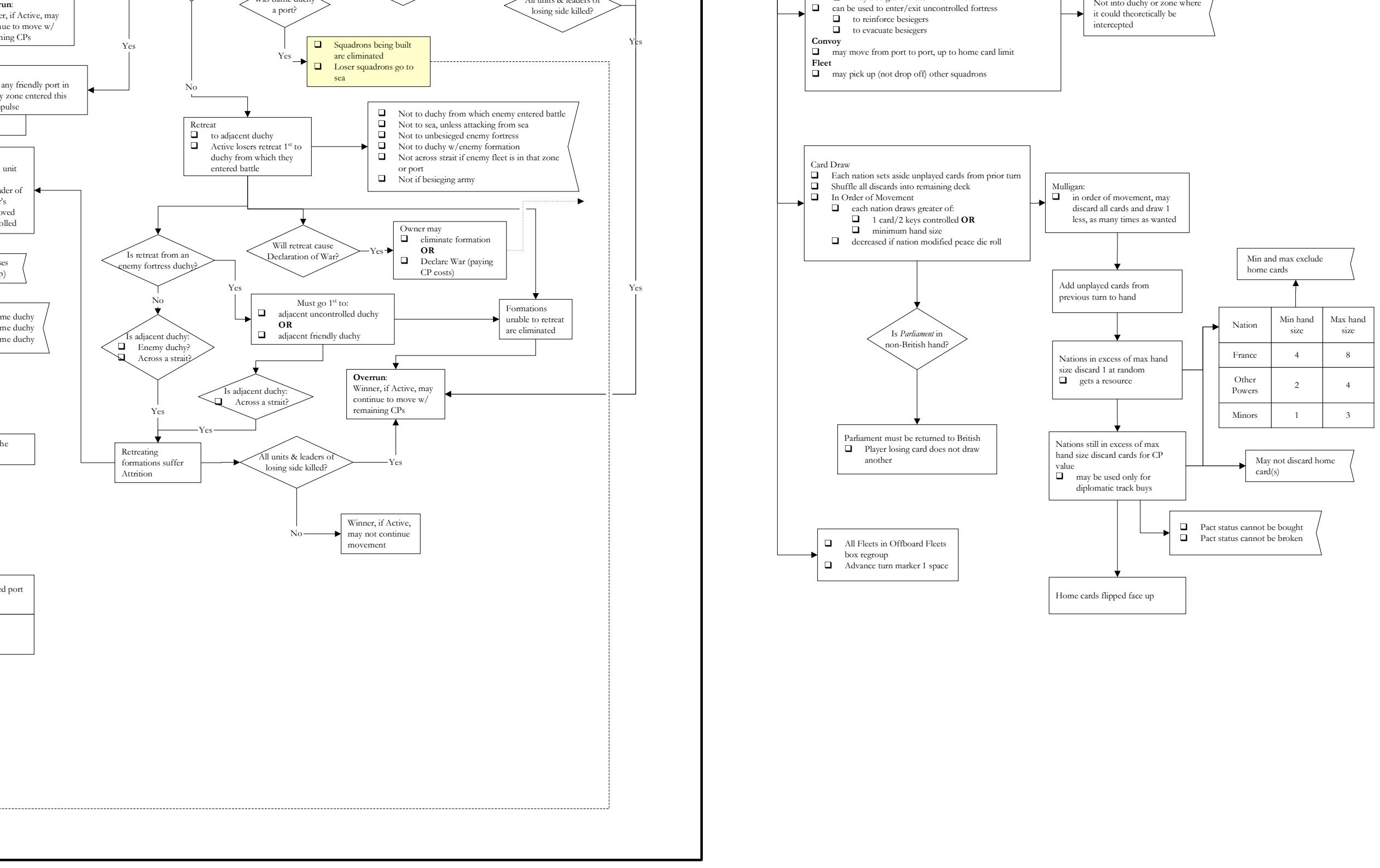
14. Interphase
If Peace (5.8) has not been declared, prepare for the next Turn. Cards/Reserves/Resources may not be played during the Interphase. Each Interphase has three steps:
14.1 Camps
Once in a Camp, a nation remains at war until it becomes a Subject Neutral by Submission or Conquest, (or, in the case of Proxies, by play of a Pact-breaking event).
14.11 SWITCHING: A Power may change Camps during the Interphase, with permission of all players in the Camp it joins. This announcement is free and made in Order of Movement. No Declaration of War is bought, but all other consequences of a Declaration (8.34) apply. However, no Power may both declare war on another nation(s) not in a Camp (Neutral, Subject Neutral, Unaligned Proxy) and change Camps in the same Interphase.
14.12 JOINING: A Neutral Power may join a Camp regardless of permission with a free Declaration of War – whether it attacks a Camp member or is attacked by one. A Subject Neutral entering its Conqueror’s Camp requires the permission of all players in the new Camp.
14.13 FLAG CONSEQUENCES: A nation changing Camps must unflag any Duchies it holds of its new Allies. Its new Allies, for their part, may immediately unflag any Duchies of their new Camp partner that they wish per prior agreement, but must unflag their new ally’s Capital. The retention of any prior existing Flags in their new ally’s Duchies is an exception to the general prohibition against Flagging a current ally’s Duchy. Such Duchies may not be reclaimed by their original owner unless first flagged by a member of an opposing camp, by voluntary Flag removal (7.44), or by event (see also 8.83).
14.14 OFFERS: An offer to change Camps, like an offer to Submit (15.41), must be accepted or rejected without negotiation. If the terms offered by the Power wanting to change Camps are not accepted as presented, the offer must be declined until the next Interphase.
14.2 Reinforcements
Each nation in Order of Movement, builds pieces and deploys. Reinforcements are built from among those previously eliminated, the Regroup Box, or that have not yet entered play.
14.21 CP EXPENDITURES: Players spend their CPs to build Units, leaders or Squadrons, bring pieces out of Regroup (7.7), Refit previously built Squadrons (7.3) for one Maneuver each, or buy an extra Deployment (14.24). Reinforcement CPs cannot buy Diplomatic status, Flags, or Foreign War cessation attempts. Neutral Proxies must follow the Build priorities set out in 7.5 and cannot deploy. Available reinforcement allotments are:
France: 18 CPs
Britain: Six CPs
Austria, Russia, Prussia: Eight CPs each
Spain, Ottoman Turks: Four CPs each
Denmark, Sweden: Two CPs each
14.22 PLACEMENT: Reinforcements are placed either in their respective Capitals (in the case of Units/leaders), any Friendly Home Port (in the case of Squadrons), or an unblockaded Friendly Home Port (in the case of Regrouped Squadrons). If the Capital is enemy Controlled, place its reinforcement Units/leaders in the closest friendly Home Duchy. If all Home Duchies are enemy Controlled, reinforcement Units/leaders are placed in the closest friendly Associate Duchy (including an Uncontrolled Fortress). A nation lacking a friendly Home Port (Duchy) cannot place Squadrons (Units/leaders) with reinforcements CPs. An Adjacent enemy Army does not prevent the placement of reinforcements, nor can that placement be intercepted during the Interphase.
14.23 FREE DEPLOYMENT: One leader may freely move by land through an unlimited number of Friendly Duchies, gathering (but not dropping) a number of Units/leaders (including Pact Minor Allies) up to its Command Rating as it goes. Deployment can be used to enter/exit an Uncontrolled (Besieged) Fortress to reinforce/evacuate the besiegers – but it can only move through Friendly Duchies.
A Deploying Fleet may pick up, but not drop off, other Squadrons.
A Convoy (13.6), with or without a leader, may Deploy from Port to Port (but no further than its Reserve could buy in an Impulse).
A Deploying Army/Convoy/Fleet may not enter a Duchy/Zone in which it could theoretically be intercepted were this an Impulse.
No Unit/leader/Squadron may deploy twice in any Interphase.
14.24 EXTRA DEPLOYMENT: A Power may purchase one additional Army, Convoy or Fleet Deployment with Reinforcement CPs. The cost of a second Army Deployment is one CP per Unit/leader in the Deployed Army (whether by land or Convoy) but must be a different Army, Convoy or Fleet than the one using the normal free deployment. The cost to deploy a Fleet is one Maneuver per Zone/Port entered.
14.3 Resume Play
Shuffle all discards, other than those removed from play, into the remaining deck to prepare for the next Turn.
14.31 DRAW:
All nations in Order of Movement draw one card for every two Keys they control or their minimum Hand (whichever is greater, 14.32). There is no maximum draw – regardless of Maximum Hand Size. A Power which modified the Peace die roll (5.8) draws one less card.
After all initial cards have been drawn, each nation (even those with minimum Hands, 14.32) in Order of Movement, can replace its Hand of newly drawn cards via the Mulligan rules (4.5; possibly resulting in less than a minimum Hand).
Any Subject Neutral nation that did not Mulligan may discard all cards and forfeit its Reserve(s) for the current turn. The Subject Neutral then draws a new Hand equal to its Maximum Hand Size. It also draws an additional card for each Reserve it forfeited which becomes its new Reserve for that Turn only and is placed face down on its HQ Display until used or the Turn ends. That new Reserve ceases to be considered a “card” and is treated in all respects as a Reserve until discarded.
Upon completion of Mulligans and any Subject Neutral draws, any nation with unplayed cards remaining from the prior Turn adds them to its Hand.
Nations in excess of their Maximum Hand Size (14.32) must discard one card at random, but gain a Resource.
Nations still in excess of their Maximum Hand Size select excess cards to discard for their CP value in Diplomatic Track buys (8.1). However, Pact status cannot be obtained or broken during this Phase. CPs in excess of possible Diplomatic buys are forfeit.
14.32 HAND SIZE LIMITS: Each nation is restricted to the following minimum and maximum number of cards for its starting Hand. Hand size is not thus limited once the Turn is underway and can increase beyond “Maximum Hand Size”. Mulligans may reduce Hand size below the minimum shown.
14.33 RESERVES: Reserves are now available to their original nation. Cover their “Void” box on their Headquarters Display with a Flag until used. Play then resumes with the next nation on the Movement Track, although preemption of that nation is a possibility.
15. Conquest & Submission
Conquest occurs during the Conquest phase (5.7) at the end of all Impulses for that Turn. A Player Power may Submit (15.4) before then, but only if the invader agrees.
15.1 Conquest
A nation is conquered if it has lost all of its Keys, or its Capital is enemy Controlled and a mandatory Conquest die roll greater than or equal to “6” is made. The Conquest die roll is modified as follows:
Denmark: + 3
Sweden: + 2
Prussia, Austria, Britain, Russia*: – 1
France, Spain, Ottoman Turks: – 2
+1 for each Key lost from its initial inventory (or, if previously defeated, since its prior Conquest/Submission)
*Conquest of Russia requires both Capitals
15.11 JOINT CONQUEST: Should the terms of conquest be jointly accomplished by several nations, only the one Controlling the Capital is the conqueror. Should two invaders each Control a Russian Capital, only the first in the Order of Movement may attempt Conquest.
15.12 SIMULTANEOUS CONQUEST: It is impossible for two nations to conquer each other simultaneously since the first one in the Order of Movement of the potential conquerors to successfully resolve its conquest prevails.
15.2 Ceded Duchies
The conqueror (and its Allies) removes all of its Flags in the fallen nation’s Home (not Associate) Duchies (except those ceded to it in a previous conquest of the same nation which remain in the conqueror’s control when this latest conquest is resolved). The conqueror then rolls a die to determine a number of Duchies to be ceded to it. The conqueror, followed by the victim (hereafter referred to as the Subject Neutral), then alternate selecting the Subject Neutral’s remaining unflagged Duchies to be Flagged by the Conqueror until that number is met. Proximity to conquering Forces is not relevant. The Capital is never ceded. The conqueror may now (not later) give Control of a Ceded Duchy to any Power in its Camp which will accept it. If the Subject Neutral had previously been conquered, it would have to cede different Duchies than those lost before unless it had regained Control of them.
15.21 CONQUEROR WITHDRAWAL: All conquering Formations and their Allies in the conquered Capital withdraw (without Attrition) from it to an Adjacent Duchy of the conquered nation or Regroup. Other conquering Formations in the Subject Neutral have the option to Regroup or remain in their current Duchy.
15.22 VICTIM WITHDRAWAL: Forces/Squadrons belonging to the Subject Neutral which are not in their own Home or Associate Duchy must Regroup – restoring Control of their Flagged Duchies to their original owner. All former allied Forces/Squadrons of the victim in the Duchies of that Subject Neutral also Regroup. Subject Neutral Formations in a Ceded Duchy must Regroup.
If a Duchy outside of the conquered nation formerly co-occupied by the Subject Neutral and its former Allies becomes uncontrolled as a result of Conquest (i.e., due to the removal of the victim’s Flag) the remaining Formation may either Regroup or Flag the Duchy at no cost.
15.23 FRIENDLY TERRITORY: All Duchies of the Subject Neutral are now friendly to the conqueror and his current Camp as long as the conquered nation remains a Subject Neutral. The conqueror and his current Camp do not require permission of the Subject Neutral to enter any Duchy (including those containing a Subject Neutral Formation) other than its Capital and may Deploy through those Duchies as if they were their own. The Subject Neutral retains Control of such Duchies.
15.24 GRACE PERIOD: The conqueror and its Allies may not declare war on the Subject Neutral before the Interphase of the following Turn or vice versa. This prohibition is absolute and could void potential Camp changes (see 8.8). However, the Subject Neutral can ally with its conqueror before the end of the Grace Period.
Example: If, in a five-player game, Prussia had been a French ally during the conquest of Austria, Prussia could not change Camps until the end of that Grace Period if the Coalition is currently at war with Austria. If Prussia joins the Coalition while Austria remains a Subject Neutral before the end of the Grace Period, no member of the Coalition could declare war on Subject Neutral Austria until the end of that Grace Period as long as Prussia is part of the Coalition.
15.25 DIPLOMATIC EFFECTS: A conquered Player Power is a Subject Neutral and Controls its own cards and Forces as well as any existing Pacts (see 8.8). If a Proxy is conquered, it becomes Unaligned and its Consul cannot be moved, by CP expenditure or event, on the Diplomatic Track until the Interphase of the next Turn.
15.3 Foreign Wars
If any participant in a Foreign War is conquered or Submits, their current Foreign Wars end and all pieces in those Foreign Wars are immediately sent to Regroup. However, new Foreign Wars can be played thereafter.
15.4 Submission
Proxies never voluntarily Submit. A Player Power may offer Submission if, at the end of any Impulse, an invading Nation and his Allies has more Forces occupying the invaded Power’s Duchies than the invaded Power has in play (not counting those in Regroup or on Foreign War cards). Units/leaders Allied to the invaded Power that occupy his Duchies count towards his total Forces. However, a Power can only submit to the invader with the most Forces (including Minor Pact Allies) in his nation. If Submission is accepted, the victim becomes a Subject Neutral and all the terms of the agreement are immediately invoked. Any Duchies to change control are immediately Flagged or unflagged as agreed, and the consequences of a conquest (15.21-15.25) are immediately enforced.
15.41 OFFERS: A player may offer Submission at the end of his or any other player’s Impulse. The terms are whatever he offers and the invader accepts but cannot exceed six Duchies. Such offers may include anything from just the cessation of hostilities to the ceding of specific Duchies (including the unflagging of any specified captured Duchies not to be ceded). Only one offer can be made per Impulse. The offer must be accepted or rejected, without negotiation, with a Yes or a No. If rejected, the submitting player must wait at least until the end of the next Impulse to make a different offer. Such offers are not allowed to halt play for discussion.
Submission is not the same as Conquest. The terms are whatever is agreed to (up to the maximum limits of what could occur in a conquest) and they are invoked “immediately”. The Submitting nation may even get to keep Keys it has gained if the invader agrees to that. There is no ceding of Duchies by die roll as per the Conquest rules per se, although the parties could agree to that if they so choose.
Example: Austria has been invaded by France, Prussia and Turkey. Austria Submits to France which has the most Forces in Austria. Austria demands the return of Austrian Home Duchies currently Controlled and/or occupied by the Prussians since those must be unflagged prior to a conquest anyway. The French need not accept those terms, but if they do, that’s what happens. France can accept such an offer and force Prussia and Turkey to unflag the Austrian Home Duchies they have Flagged. Prussia’s agreement would be necessary only if they were tied with France for most Forces in the Submitting nation. Of course, a France more concerned about keeping his Prussian ally happy might hold out for a better deal for the Prussians, or he might even accept terms more advantageous to the Prussians than to himself. It all depends on how badly he wants to accept Submission. Remember, it is the Submitting nation which sets the terms - the victor just accepts or rejects them. However, Submission terms cannot affect the Flag status of any Duchy that could not be affected by a Conquest situation. Therefore, Associate Austrian Duchies Controlled by the Prussians or Duchies Ceded in a previous Conquest can be kept by the Prussians regardless.
15.42 FORCED SUBMISSION: A nation forced to involuntarily Submit (6.12) is considered Conquered (15.2) by the nation with the most enemy Forces within its original borders (or the next in the Order of Movement if tied) and pays reparations (15.5) but does not cede Duchies. If there are no enemy Forces in its country, the submission is void but the nation loses any +1 Key status it may have and must start the next Turn without any Reserve.
15.5 Reparations
A nation gains a space on the Resource Track every time it conquers a nation or accepts its Submission. The victim loses any Resource(s) and “+1 Key” status it may have. “+1 Key” status is obtained only by play of The Emperor Commands event and has no effect on Conquest resolutions.
下载 Markdown