Wheel of Fate - Rules (English).md

Wheel of Fate
A clever tile laying game for 2 to 5 players aged 8 years and up by Klaus-Jürgen Wrede. The rules for this version of Carcassonne are to a large extent identical to those of the original game. In order to aid experienced Carcassonne players, deviations and new rules have a red background
Contents
• 72 land tiles which show road, cities and field segments and cloisters.
• 40 followers in 5 colours.

Each follower can be used as a knight, thief, farmer or monk.
One of each player’s followers is the players scoring marker.
1 wooden pig from wood which moves around the wheel of fate.

1 Wheel of Fate tile: Serves as starting point and brings new actions into play.
• 1 Scoring track. Used to track player’s scores.
• 1 Rules booklet


field segment

crossings
road segments
Overview
The players place land tiles turn by turn. As they do so, the roads, cities, fields and cloisters emerge and grow. On these, the players can deploy their followers to earn points. Players score points during the game and at the end. The player with the most points after the final scoring is the winner.
Preparation
Place the Wheel of Fate tile in the centre of the table. The pig is placed on the outside edge of the segment labelled “FORTUNA“. This tile serves as the starting point of the map. All features on this tile can be linked to other map tiles and are valued as normal.
Shuffle the remaining land tiles face down and stack them in several face-down stacks so that all the players have easy access to them. Place the scoring track near one edge of the table to leave room for the players to place land tiles in the middle of the table.
Each player takes the 8 followers in his colour and places one as his scoring marker in the large space at the lower left of the scoring track. Each player places his remaining 7 followers before him on the table as his supply. The youngest player decides who will be the starting player.
Playing the Game
Players take turns in clockwise order beginning with the starting player. On a player’s turn, he executes the following actions in the order shown:
1a) The player must draw a new land tile. If a tile showing a Wheel of Fate is drawn, the appropriate action is immediately taken (see page 5).
1b) The player must place the land tile drawn onto the map.
2) The player may deploy one of his followers from his supply to the land tile he just placed
3) If, by placing the land tile, cloisters, roads or cities are completed, they are now scored.
Placing Land Tiles
First a player must draw a land tile from one of the face-down stacks. He looks at it, shows it to his fellow players (so they can advise him on the “best” placement of the tile), and places it on the table using the following rules:
• The new tile (with the red borders in the examples) must be placed with at least one edge abutting one previously placed tile. The new tile may not simply be placed corner to corner with a previous tile.

• The new tile must be placed so that all the field, city and road segments on the new tile continue to field, city and road segments on all abutting tiles (cloisters are always complete within single tiles).

road and field segments are continued

city segment is continued

In the rare circumstance where a drawn tile has no legal placement (and all players agree), the player discards the file from the game (into the box) and draws another tile to place.
on one edge the city segment is continued and on the other edge the feld segment is continued

This is an invalid placement
Deploying Followers
After the player places a land tile he may deploy one of his followers, using the following rules:
• The player may only play 1 follower on a turn.
• The player must take it from his supply
• The player may only deploy it to the tile he just placed.
The player must choose where to deploy the follower on the tile:

in a city segment

on a road segment

in a field segment

in a doister
The player may not deploy a follower on a field, city or road segment if that segment connects to a segment on another tile (no matter how far away) that already has a follower (from any player) on it. See the following examples.
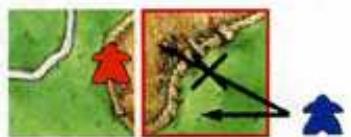
Blue can only deploy a farmer as there is already a knight in a connected city segment


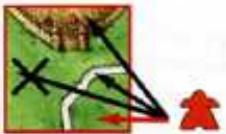
Red can deploy his follower as a knight or a thief, but only as a farmer in the sunall feld where the red arrow points. In the larger feld area, there is already a farmer on a connected field segment.
If the player did not deploy a follower on a land tile during his turn, he can place a follower on any free crown section on the Wheel of Fate. Each crown section can hold one follower.

When a player has deployed all his followers he continues to play land tiles each turn. Although a follower may not be recalled, followers are returned to players when cloisters, roads and cities are scored.
Scoring completed cloisters, roads and cities
If a cloister, road or city is completed by the placement of the land tile, it is now scored.
Completed Road
A road is complete when the road segments on both ends connect to a crossing, a city segment, or a cloister, or when the road forms a complete loop. There may be many road segments between the ends. The player who has a thief on a completed road scores one point for each tile in the completed road (count the number of tiles; separate segments on a tile count just once).

Red earns 4 points.
The player moves his scoring marker on the scoring track a number of spaces equal to the points earned. If you pass 50 on the scoring track, lay your marker down to indicate a score greater than 50 and continue along the track.

Red earns 3 points.
Completed City
A city is complete when the city is completely surrounded by a city wall and there are no gaps in the wall. There may be many city segments in a city.
The player who has a knight in a completed city scores two points for each tile in the city (count the number of tiles; separate segments on a tile count once). Each pennant on segments in the city earns the player 2 points.
Red scores 8 points(3 City tiles and 1 pennant)

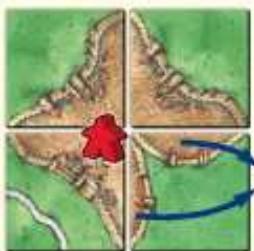
Red scores 8 points (4 city tiles, no pennants
If two segments of the city are on the same tile, they only count once)
What happens when a completed city or road has more than one follower? It is possible through clever placement of land tiles for there to be more than one thief on a road or more than one knight in a city. When this occurs in a completed road or city, the player with the most thieves (on a road) or the most knights (in a city) earns all the points.
When two or more players tie with the most thieves or knights, they each earn
the total points for the road or city.
Completed Cloister
A cloister is complete when the tile it is on is completely surrounded by land tiles. The player with a monk in the cloister earns 9 points (1 for the cloister tile and 1 each for the other tiles).

Red scores 9 points
The new land tile connects separate city segments to complete a city.

Red and blue each score the full 10 points for the city as they tie with 1 knight each in the completed city.
Returning followers to player’s supplies
After a road, a city or a cloister is scores (and only then), the followers involved are returned to the appropriate players’ supplies. The returned followers may be used by the players as any of the possible followers (thief, farmer, knight or monk) in later turns.
It is possible for a player to deploy a follower, score a road, city or cloister, and have the follower returned on the same turn (always in this order).

Red scores 4 points
-
Complete a road or city by placing the new tile.
-
Deploy a knight or thief
-
Score the completed city or road
-
Return the knight or thief.

Red scores 3 points
The Farms
Connected field segments are called farms. Farms are not scored. They exist only as places to deploy farmers. Farmers are only scored in the final scoring.
Farmers remain in the field segments where they are deployed for the entire game and are never returned to the players supplies!
Farms are bordered by roads, cities, and the edge of the area where the land tiles have been played.

All 3 farmers have their own farms. The city and road segments separate the farms from each other.

After the placement of the new land tile, the farms of the 3 farmers are connected. Note: the player who played the new land tile may not deploy a farmer because the connected field segments already have farmers.
If a player plays a land tile which contains a coloured fate wheel symbo
-
The pig moves around the wheel of fate.
-
The action of the Wheel of Fate is derived.
-
Followers on the crowns are scored and taken back.
- The tile is placed, then followers are placed on the map or Wheel of Fate (and the turn continues as normal).

1. Moving the Pig
The player moves the pig around the fate wheel, moving it the number of segments indicated by the icon on the land tile. The pig always moves in a clockwise direction.


2. The action of the Wheel of Fate is derived.
The wheel of fate has 6 segments. Each segment has a different action. Only the segment, on which the pig lands, is activated. The segment marked as “FORTUNA” only applies to the player whose turn it is while all the other segments apply to all players. The actions are:

Fortuna (Fortune)
The player, whose turn it is immediately gains 3 points
Steuern (Taxes)
Each player receives points for each of their knights: for each knight, each player receives as many points, as pennants in the city plus the number their own knights in this city.

Example: Blue receives for each knight 2 (knights) + 2 (coats of arms) = 4 points, altogether thus 2 x 4 = 8 points. Red gets 1 (knight) + 2 (coats of arms) = 3 points.

Hungersnot (Famine)
Each player receives 1 point per complete city, in their farms for each of their farmers (in the same way as during the farmer valuation at the conclusion of the game - see page 6 & 7).
Unwetter (Tempest)
Each player recieves 1 point for each follow still in their supply.

Inquisition
Each player receives 2 points for each of their Monks.
Pest (Plague)
Each player must return 1 follower from the landscape back into their supply. They may not take follower from a crown field. The player whose turn it is removed their follower first, followed by the other players in a clockwise direction.
3. Followers on the Crowns.
000
Now the crowns in the active segment are scored. Followers on crowns in segments, which the pig moved over are not scored and remain where they are.
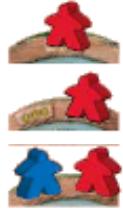
• A Follower who is alone in a segment with a crown gets 3 points.
• A Follower who is alone in a segment with two sets of crowns gets it 6 points.
• If there are two Followers in a segment with two sets of crowns each Follower receives 3 points (even if both Followers belong to the same player).
After the points have been scored, these followers are then returned to the players supply. 4. The Turn Continues
Now the player, whose turn it is, places the tile on the map and can deploy a Follow is they so wish. If they do not deploy a Follower, then they may place a Follower on to the Wheel of Fate.

Game End
At the end of the player’s turn in which the last land tile is placed, the game ends. Then follows the final scoring.
Final Scoring
First, all incomplete cities, roads and cloisters are scored. For each incomplete road and city, the player who has a thief on the road or knight in the city earns 1 point for each road or city segment. Pennants are worth 1 point each. For incomplete roads and cities with more than one follower, use the rules for completed roads and cities to determine who scores. For an incomplete cloister, the player with the monk on the cloister earns 1 point for the cloister and 1 point for each land tile surrounding it.
Scoring Farmers.
Now we account for the farmers in the fields. On each meadow or farm the owner is determined. If only 1 player has farmers on the meadow, then he is the owner. If several players have farmers on the meadow, then it is the player with the most farmers who is the owner. If two or more players have tie with the most farmers, then they both own the meadow. 3 points are scored by the owner of the meadow for each completed city, which borders the meadow or lies within the meadow. If a city borders on several meadows, all the owners of these meadows receive 3 points.
Blue earns 3 points for the unfinished city on the lower right. Green earns 8 points for the unfinished city on the left. Black earns nothing for the large city as green has more knights in it.

Blue gets 6 points. Red gets 3 points. The unfinished city gives no points.


Blue scores 9 points
More information on how to score large meadows can be found on page 7
Red owns the large meadow as it has the majority of farmers. It receives 6 points (3 each for cities A and B). Blue owns the small meadow. It also receives 3 points for city A.
In the large meadow red and yellow both have 2 farmers, so both own this meadow. Both receive 6 points (for 3 points each for cities A and B). Blue gets 3 points for city A.
In this way all cities are scored one by one. When all cities have been scored, the final scoring is complete. The player with the most points is the winner!
Play Carcassonne on-line at www.brettspielwelt.de. You can also find variants, expansions and the authors homepage at: www.carcassonne.de

© 2009 Hans im Glück Verlags-GmbH Haben Sie Anregungen, Fragen oder Kritik? Schreiben Sie an unsere E-Mail-Adresse: info@hans-im-glueck.de oder per Post: Hans im Glück Verlag Birnauer Str. 15 80809 München Fax: 089/302336

Wir danken insbesondere Karen & Andreas Leo" Seyfarth, die wesentlichen Anteil an der Erstellung der Regel hatten und auch sonst mit vielen ldeen und Anregungen zum Gelingen des Sptels beitrugen.
Regellayout: Christof Tisch
Unser weiteres Spieleprogramm finden Sie im Internet auf unserer Homepage: www.hans-im-glueck.de
The space within the rules to describe the final scoring is limited, so here we have a further example on how the farmers on their meadows are scored. Please refer to the rules on page 5 before reading this section.
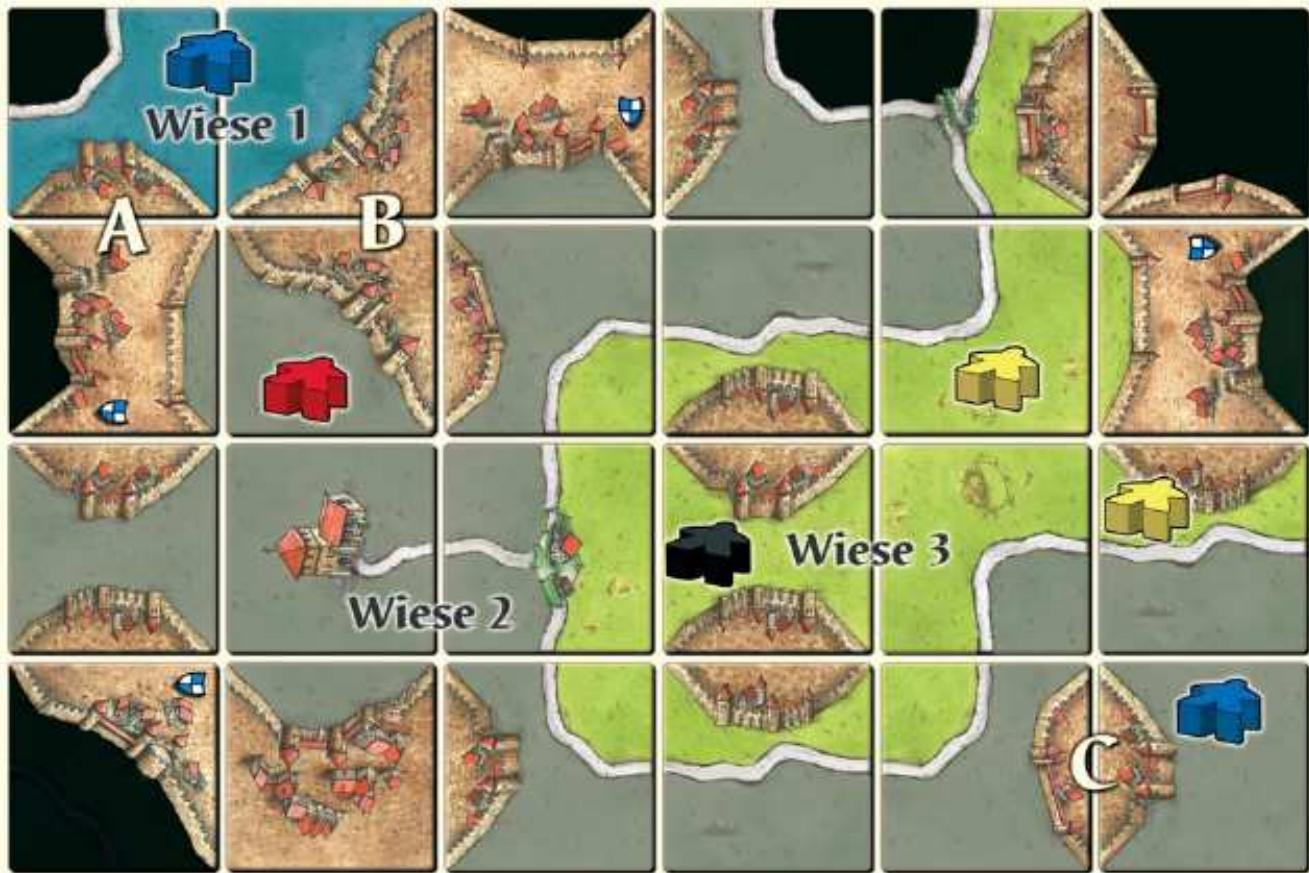
Farm 1: Blue owns this meadow and it borders 2 finished cities (A and B). For each finished city blue receives 3 points (independent of their size). Blue therefore gets 6 points.
Farm 2: Red and blue own this meadow between them and 3 finished cities (A, B and C) border on this meadow or lie within it. Red and blue both receive 9 points each.
Note: Cities A and B both provide 3 points each to blue from meadow 1 and both red and blue from meadow 2, since they border on both meadows. The city at the bottom left is incomplete and as such confers no points.
Farm 3: Yellow owns this meadow, since it has more farmer in there than black. Four finished cities border on meadow 3 or lie within it. This gives yellow 12 points.
Note the demarcation of the meadows: Meadows are separated by roads, cities (if they are not completely surrounded by the farm) and the edges of the map.
How can several farmers stand in a meadow?
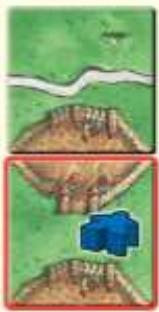
Example 1
The corners the meadows are not connected!
Example 2

Example 3
Example 1: Blue sets a farmer on the meadow. Example 2: Red places the tile at the top right and deploys a farmer on the meadow. It may do this, since the two sections of meadow are not yet connected.
= Order in which the tiles are played.
Example 3: Now the two meadows are connected to form a large meadow. In this way it is possible that several farmers will end up in one meadow. In the same way several thieves can end up on the same road or several knights in the same city.
Tile Distribution

Summary of Scoring
| Features completed play | Incomplete items at the end of the game | ||||
| Road (Thief) | 1 point per tile |  | Road (Thief) | 1 point per tile | |
| City (Knight) | 2 points per tile2 points per pennant |  | City (Knight) | 1 point per tile1 point per pennant | |
| Cloister (Monk) | 9 points |  | Cloister (Monk) | 1 point per tile (Thecloister tile andsurrounding tiles) | |
Wheel of Fate
• 3/6 points for crowns.
Points for Fortune, Taxes, Famine, Tempest, Inquisition and Plague


Farmers are scored at the END of the game. 3 points for each completed city in the meadow or bordering the meadow.