rules_zh_忍者刀_7531.md
忍者刀 NINJATO
十二世纪的日本,源氏与平家互相争夺权力,退位的后白河天皇亦扮演他们彼此的对手。三个派系当中终将只有一个能得到左右未来的社会秩序的胜利。在这些精英权力的背后,却是一连串利用忍者计划来制造混乱。大胆的行动、技能的掌握和微妙的阴谋是建立自己的荣誉时必不可少的。当新时代的来临,一位忍者将像一把被挥舞着的忍者刀,一把统治氏族的无形刀。
1 块游戏图板。游戏图板标示出进行各种行动的不同的场所: 道场(Dojo)、师傅(Sensei, (日)先生)、皇宫、亭阁和 5 个氏族(clan)控制的官邸。

15 个氏族指示物。每个氏族各有 5 个指示物。这些是用来显示那个氏族拥有该官邸,以及该官邸所代表的荣誉等级。

19 张师传技能板块。这些技能以各种方式在争斗中帮助忍者。

90 个宝物指示物。宝物是从战胜官邸内的守卫来获得的,可用于获取人脉(envoy)和散布传闻(rumor)。

30 张传闻卡。这些卡牌可以在游戏结束时获得荣誉的奖励。
1 个袋子。这是一个迷人的袋子,而迷人之处就是无法预测。
1 个回合标志物。用于标记游戏回合。

12个手裹剑(飞镖),12个木制标志物。每位玩家获得3个同一颜色的手裹剑来作为行动标示,另外还可以获得3个标志物:一个作为游戏轮顺序标示,另外两个作为荣誉值标示。
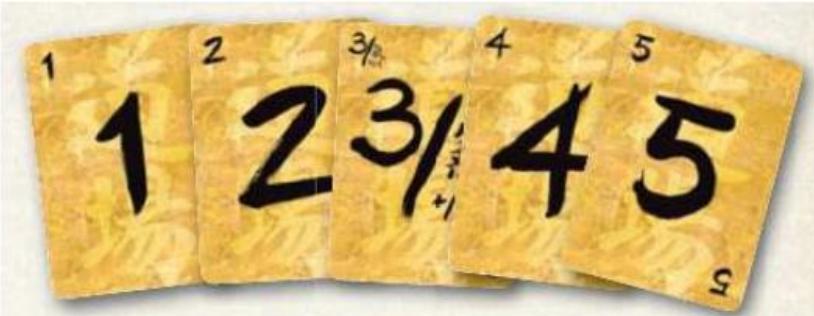
52 张道场卡。这些卡牌是用来闯入官邸和购买技能之用。
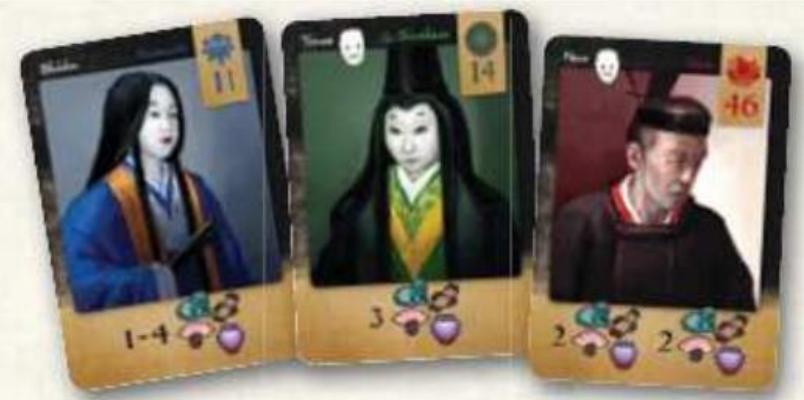
21 张人脉卡。人脉使你可以用宝物来换取荣誉,并取得氏族的爱戴。
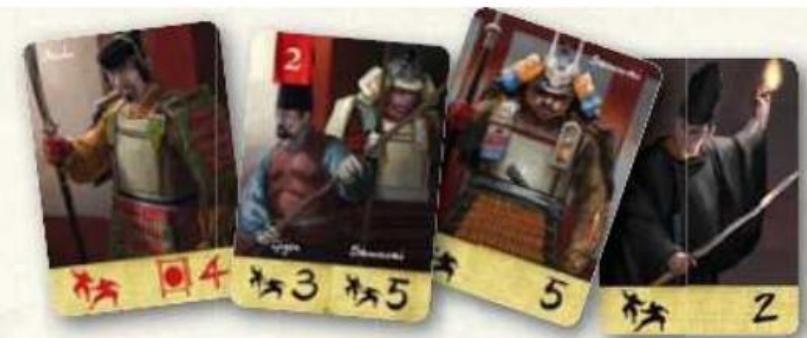
40 张守卫卡和 20 张精锐守卫卡。后卫保护官邸中的宝物。精锐守卫比普通守卫更难应付。
游戏准备 (Game Setup)
把游戏图板放置在桌子中央。每位玩家拿取3个相同颜色的手裹剑及对应的木制标志物。每位玩家将一个自己的标志物放入一个容器中,然后随机一个一个抽取出来,并把它们在依序放到游戏图板中央处的回合轮顺序记录条(1)上。这就是第一个回合所使用的顺序。
每位玩家的另外两个标志物,会放到荣誉记录条(2)最开始我位置。每位玩家将3个手裹剑放到各自的面前。
分别洗匀守卫卡(3)及精锐守卫卡(4),并面朝下分别放成牌堆。每一间官邸(5)都抽取及放置1张守卫卡来作为站哨来保护官邸安全。
将一个荣誉值 2 和一个 4 的「平家」(红色)氏族指示物,分别放到不同的氏族官邸(6)上。「源氏」(蓝色)氏族也同样地进行。放置荣誉值 6 的后白河天皇(绿色)指示物到剩下那间官邸。其余的氏族指示物暂成成堆放在游戏图板旁边备用。在袋中充份洗匀宝物指示物(7),并每个官邸抽出并放置 3 件宝物,普通那一面朝上(红色面朝下)。

游戏流程 (Playing the Game)
为了要成为忍者大师,每位玩家都需要在道场进行训练,从师傅那里学习更深奥的战斗技巧,闯入氏族拥有的官邸去偷取无价之宝,影响人脉,在亭阁那里散布传闻,并最终试图成为当时最富有传奇色彩的忍者。
依游戏轮顺序, 每位玩家放置一个手裹剑到一个场所上, 并立即依循该场所的规则进行行动。一旦所有玩家都把各自的 3 个手裹剑放完时, 回合结束。游戏会持续 7 个回合。在第 3 回合、第 5 回合和第 7 回合结束时, 会有特殊的计分阶段。在游戏结束时, 获得最多荣誉值的玩家获胜。

每个游戏轮中,你可以放置一个手裹剑来立即执行所选择的行动。在这里,你要用实力来攻击官邸。
行动 (Actions)
在游戏轮中,每位玩家置放一个手裹剑到游戏图板上,并采取下列其中一个行动:
道场:拿取以一些道场卡。
师傅:学习一门技能用以闯入官邸。
氏族官邸:打出道场卡来尝试击败守卫,并获取宝物。
皇宫:弃掉宝物并予以计分来获取1位人脉。
亭阁: 弃掉宝物并予以计分来获取 1 张传闻卡。
手裏剣 (Shuriken)
即使在之前放过手裹剑的位置上,再放上另一个手裹剑,仍然是有效的。
道场 (The Dojo)
把手裹剑放置在「道场」这里,可以以任何组合方式那取面朝上的道场卡或牌库里的道场卡。你手上已经有多少道场卡会影响到你可以拿取多少张道场卡。如果你手上连一张道场卡也没有时,可以拿取4张。如果在你手上已经有一张道场卡时,就拿取3张。如果你手上已经有两张或更多张道场卡时,就只可以拿取2张。当你拿取了你应得的卡牌后,从牌库中抽出新的道场卡来填满面朝上的道场卡牌区。如果在牌库中没有足够的卡牌时,将弃牌堆洗匀来形成新的抽牌库。
手牌上限 (Hand Limit)
如果你手上拥有超过 7 张道场卡时,你必须进行弃牌,直到手牌降到 7 张为止。
如果之前就有人放置过手裹剑在道场时,就把你的手裹剑放在它们的上面。在回合结束时,道场中的手裹剑堆就会用来决定下一个回合的玩家顺序了。最上面那个手裹剑的拥有者成为下一个回合的起始玩家,以此类推。(如果一位玩家在道场中放置超过1个手裹剑时,他位于最上面的那个手裹剑才会列入计算)

道场卡的数值范围为1至5。

假设你手上拿的是以下道场卡:

你的手牌对「偷窃」有利,所以你把你的手裹剑放到「偷窃」的位置上。为了打赢数值5的站哨守卫,你打出你的。
然后,你拿取价值最低的普通面宝物\~滚动条

,并且把它放到你的手裹剑上。这时,站哨守卫仍然是留在官邸那里。
你决定要呼叫「万岁」,这代表你宣告请别的玩家从桌上翻开一张新的守卫卡;因为官邸里尚有普通面朝上的宝物存在,所以是翻开一张普通守卫卡。他翻出的是一张数值1的守卫
卡,你必须打出你的 1 加上你的 3/4 作为「出乎意料」来使用才能打赢这名守卫。


你把剩下来的最低价值的普通面宝物,花瓶
拿走。

「出乎意料」
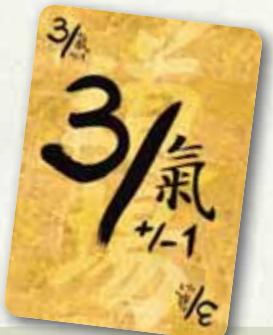
一张数值 3 的道场卡可以当作一般正常的道场卡打出。但它也可以作为「出乎意料」的结果,与其它道场
卡一起打出,它可以使合打的道场卡+1或-1。一张道场卡可以合打多张「出乎意料」用的道场卡。
呼叫「万岁」(Calling Banzai)
让我们花一些时间来讨论一下「万岁」这个决择吧。呼叫「万岁」意思是告诉另一位玩家去翻开一张你要尝试击败的、新的守卫卡。如果你呼叫了「万岁」,但你却不能击败守卫的话,这也是代表你失败了。你只能在你的手裹剑上选择一个宝物拿走,其它在其上的宝物都要全数弃掉。如果你决定「离开」,而不是呼叫「万岁」的话,你可以拿取所有在你手裹剑上的宝物。在两种情况下,没到手过的宝物仍会留在官邸的。

回到刚才的例子, 还有一个普通面朝上的宝物—黄金—在官邸内。这时候你呼叫「万岁」, 翻开了一张拥有警戒符号的守卫卡。
警戒 (Alarm!)
当一名警戒守卫被翻开时,马上从袋子中抽出一件宝物,并把宝物的普通面朝上放到官邸里。然后,在普通面朝上的宝物中,选出最有价值的宝物,并将它翻到红色面。因此,警戒增加了官邸中的宝物数,但它也意味着最好的宝物将会受到一名精锐守卫所保护。
在我们的例子中, 你因为警戒而抽出一件宝物一碧玉。然后, 你把最宝贵的宝物一黄金一翻到其红色面。继续进行游戏, 你打出一张 2 击败了数值 3 的守备, 然后把碧玉放到你的手裹剑上。
黄金仍然在官邸里!面临着另一个「万岁」的决择,你知道如果你继

续下去,你将因为剩下的宝物是红色面朝上的因素,而必面对从精锐牌库而来的一名守卫。
忍者刀 NINJATO

把 3 张変装术(Hensojutsu)(伪装术)的技能板块从其它技能板块中抽离出来,之后把「変装术技能板块板」块洗匀,并把它们以面朝下的方式,成堆放置在「师傅区」(Sensei area)(8)的一旁。现在把其余的技能板块洗匀,并把它们以面朝下的方式,成为一大堆放置在「変装术技能板块板」一旁(9)。有多少位玩家参与游戏就从大板块堆中抽出多少张技能板块,把它们面朝上放在「师傅区」。
把人脉卡(Envoy Cards)洗匀,并以面朝上方式,放置4张到皇宫(Palace)(10)处。把剩下的人脉卡以面朝下方式,成堆放在游戏图板一旁。
把传闻卡(Rumor Cards)洗匀,并以面朝上方式,放置4张到亭阁(Pavilion)(11)处。把剩下的人脉卡以面朝下方式,成堆放在游戏图板一旁。
将道场卡(Dojo Cards)洗匀, 并发给每位玩家 4 张道场卡。并且, 翻开 3 张道场卡到道场处。把道场卡牌库以面朝下方式置于道场(Dojo)旁(12)。
把回合标志物放到回合记录条"1"的位置(13)。
现在你已经准备好进行游戏了!
实例: 假设当前玩家顺序为汤姆、迈克、夏娃、布兰登。在回合中, 布兰登在道场中放置了一个手裹剑。后来, 迈克在布兰登的手裹剑上面放置一个手裹剑。汤姆和夏娃不在道场中放置任何手裹剑。因此, 手裹剑堆的顺序, 从上到下为麦克→布兰顿。所以下一个回合的玩家顺序将会是迈克, 布兰登, 汤姆, 夏娃。
氏族官邸 (The Clan Houses)
你闯入官邸,来获取宝物。每一件宝物都由一名守卫所保护。站哨守卫是你事先知道会知道的那一名面朝上的守卫,但其它在里面的守卫却可能给你意想不到的危险惊喜。每次你击败一名守卫,你可以把一件宝物放到你的手裹剑上。然后,你可以决定是否要离开,还是继续迎战下一名守卫(来试图获得另一件宝物)。如果选择继续对付下一名守卫的话,可以呼叫一声「万岁」来进行。如果你击败一所官邸里全部守卫的话,你将会损害到该官邸氏族的荣誉等级,使其失去了官邸,并帮助将接管官邸的那个氏族的荣誉等级的提升。
宝物的价值为从 2 至 5 点荣誉值。虽然黄金的价值不固定, 但它还是被认为是官邸里最贵重的宝物。一个普通面的宝物指示物是代表由一名普通的守卫所看守, 而红色面的宝物指示物则表示由一名精锐的守卫所保护着。当你击败守卫时, 你先获得的是普通面宝物, 从价值最低的拿起, 普通拿完才可以拿取红色面宝物, 也是一样从价值最低的拿起。
2

扇子

滚动条
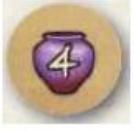
花瓶
5
碧玉

黄金

守卫卡数值由 1 到 5。
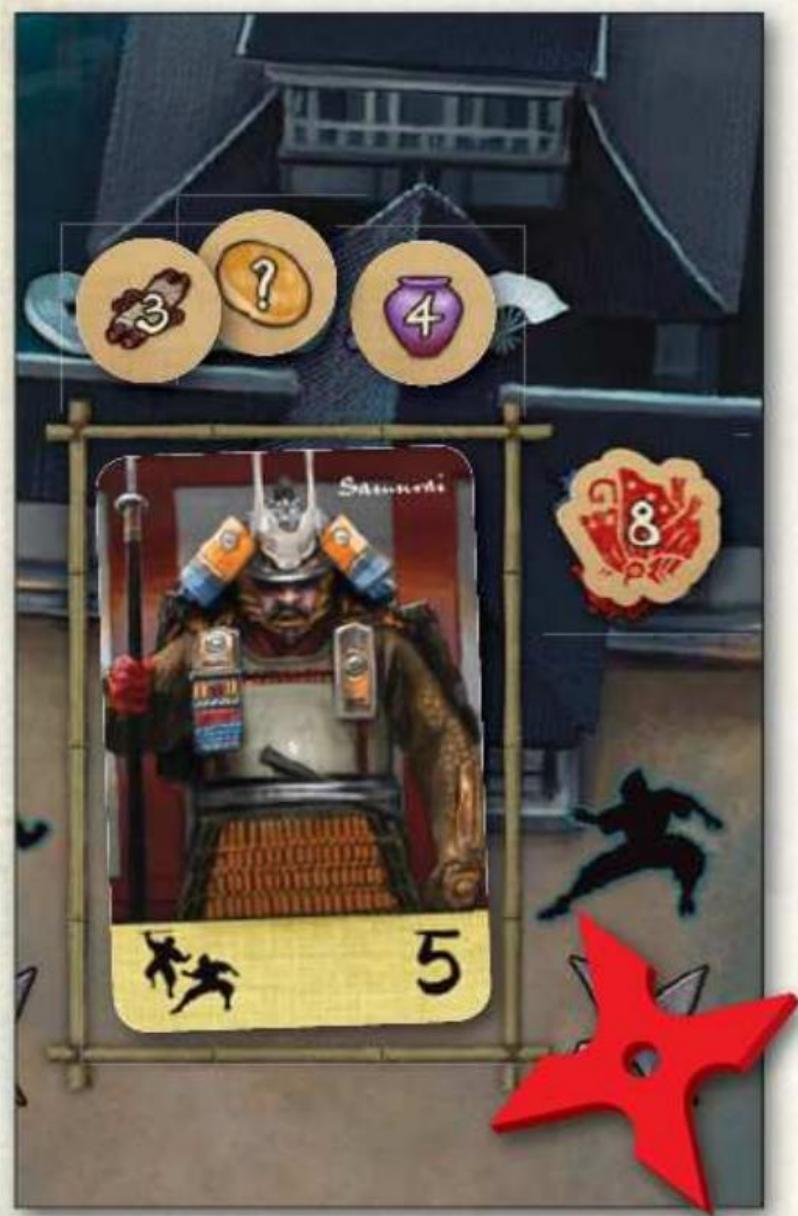
这是一所典型的属于平家官邸。有一名数值5的武士面朝上,作为站哨守卫,来保护画卷(价值最低的普通宝物)。里面每一件宝物(花瓶和黄金)都还有一名未知的守卫保护着。
硬闯还是偷窃?
开始你的攻击时,把你的一个手裹剑放到官邸上的「硬闯」或「用偷」的那一边。

这代表「硬闯」,你必须打出一张数值比守卫卡的数值大的道场卡,才能获胜。

这代表「偷窃」,你必须打出一张数值比守卫卡的数值小的道场卡,才能获胜。
数值平手也不算赢喔!
改变所属氏族 (Changing Clan Control)
每所官邸都有所属的一个氏族及荣誉值 2、4、5、6 或 8。在整个游戏中,当你击败一所官邸的全部守卫时,该官邸所属的氏族可能会由原本的氏族换成另一个氏族。你必须把原来官邸所属氏族的指示物放回指示物堆中,并且用另一个不同的氏族的任何指示物来进行取代。将该官邸空置,暂时不放宝物,直到该回合结束为止。任何玩家都不能将手裹剑放在该官邸上。
人脉会带给你对一个氏族的影响力(详见第11页「皇宫」)。要了解官邸的荣誉值如何给予玩家分数,请详见第13页「计分阶段」。

If you defeat a Minamoto-controlled house, you must replace the Minamoto token with a Taira or Go-Shirakawa token.
平家的氏族家纹是红色扬羽蝶纹。
源氏的氏族家纹是蓝色笹龙胆纹。(规则书误认为竹子)
后白河天皇的氏族家纹是绿色菊纹。
上面例子, 如果你击败一所原本属于源氏的官邸里的所有守卫时, 你必须将源氏的指示物置换成平家的指示物或后白河天皇的指示物。
重新洗牌 (Reshuffling Cards)
当游戏过程中发现道场卡或守卫卡牌库已经抽完时,可以把弃牌重洗成为新的抽牌库。
师傅 (The Sensei)
放置一个手裹剑来拜师可以习得一种技能。根据技能板块上的指示来弃掉道场卡来选择要学习的技能。技能板块上标示一个”?”代表你可以弃掉任何道场卡来习得该技能。你可以学到不同的门派的技能。一旦你学会一门特定门派(蛇、虎、鹤)的技能之后,你就不必再以弃掉一张道场卡的方式来习得该门派的技能了。
实例: 你弃掉一张数值 5 的道场卡来学习技能「剑术」(Kenjutsu),一门虎派的技能。在往后再来拜师时,你便不需要弃掉道场卡就能选择习得虎派的技能了。
每个回合中,一个技能只允许你使用一次。当你使用技能后,必须把技能板块翻成面朝下。如果你习得相同的技能两次,那么你在一个回合里,可以使用该种技能各一次。在回合结束时,再把你的使用过技能回复。
许多技都能帮助你闯入氏族的官邸。「変装术」(Hensojutsu,伪装)技能是比较独特的,它是在计分阶段使用的(详见第13页「计分阶段」)。
授业 (The Teachings)
在第 1 回合至第 4 回合的每个回合中, 从师傅那里可学习到的技能数量等于玩家的人数。
在第 5 回合至第 7 回合的每个回合中, 师傅就只会传授一种技能, 那就是「変装术」(Hensojutsu, 伪装)技能给一位徒弟而已。
35
←击败一位精锐守卫可以在游戏结束时获得的荣誉值,印在这里你决定「离开」。你从你的手裹剑上取走花瓶、滚动条和碧玉,留下黄金,以红色面朝上的方式放在官邸上。你从袋子中抽出另一件宝物,并把它以普通面朝上的方式放在官邸里。站哨卫兵归位,留在官邸内作守卫工作。
警戒守卫 (Alarm Guards)

有些普通守卫会标示有「警戒符号」。站哨守卫可以忽略「警戒」。在同一所官邸中可能会抽到超过一名警戒守卫,所以一位不幸的忍者可能会在一次闯入官邸的行动时,面对好几名优秀的守卫。
善后 (Succeeding)
如果你击败一所官邸里所有守卫的话,你可以拿走所有在该官邸上的宝物。而且,你可以把该官邸上的代表荣誉的氏族指示物,换成其它两个氏族的其中一个氏族代表指示物。在回合中余下的时间,先把该官邸空置,并将站哨守卫弃掉。
失败或离开 (Failing or Leaving)
在你把在你的手裹剑上的宝物的命运处理好之后(见呼叫「万岁」),增加1件普通面朝上的宝物到官邸上。站哨守卫恢复,并留下他在官邸上。在本回合中,该所官邸仍然可以被你或其它玩家再次闯入。

有些精锐守卫会根据你的闯入方式不同(硬闯还是偷窃),而数值也有不同。像上面这一名守卫在面对硬闯时是数值5,而面对偷窃时是数值1。

实际上,有些精锐守卫为双人守卫。像上面的这双人守卫,你必须分别战胜数值3的守卫和数值5的守卫才算成功。
保留被你击败的精锐守卫
(Keep Defeated Elites!)
所有抽出来的守卫卡在遭遇后都会被弃掉,
除了被你击败的精锐守卫—保留在你的身边,作为游戏结束时计分之用。


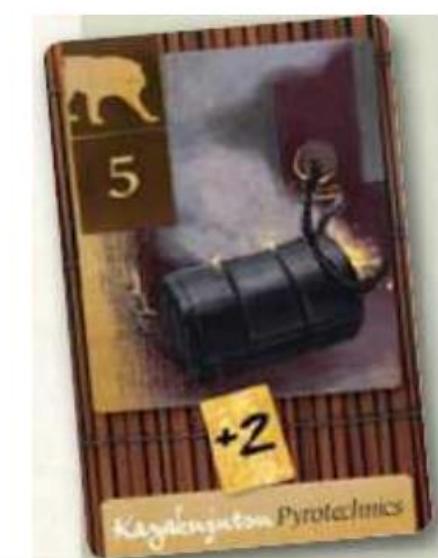
如果你沒學過蛇派的技能時,你必須棄掉一張數值1的道場卡,才能習得这种「潜入」(Shinobi-iri,忍び入り)技能。
潜入(Shinobi-iri,
忍び入り)
(Infiltration)
提供一张道场卡-2
的效果。
「如一抹轻烟,或是
微风般,就绕过一名
守卫了。」
徒手格斗
(Taijutsu, 体术)
(Unarmed Combat)
提供一张道场卡 +1 或 -1 的效果。
「拳头闯天下。」
火药术
(Kayakujutsu, 火藥術) (Pyrotechnics) 提供一张道场卡 +2 的效果。 「分心是把剑。」
忍者刀 NINJATO

隱遁术
(Intonjutsu, Concealment) 把一张已打出的道场卡数值变成 0。
「影子艺术家」

谋略
(Boryaku, Tactics) 可以当成一张数值 2 或 4 的道场卡来使用。 「点子多多的骗子魔鬼」

劍术
(Kenjutsu, Sword Fighting) 把一张已打出的道场卡数值变成6。
「快刀」
实例:你正闯入一所官邸,决定采用「偷窃」来应付一名数值2的站哨守卫。你采用「隐遁术 (Intonjutsu, Concealment)」技能把一张数值5的道场卡变成0而击败站哨守卫。你决定呼叫「万岁」,结果翻出一位数值3的精锐守卫出来对付你的「偷窃」行动。你决定使出你的「谋略 (Boryaku, Tactics)」技能来当作一张数值2道场卡而获胜(使用谋略技能时,你不需要真的打出一张道场卡)。你保留精锐守卫卡作为游戏结束时计分奖励。
Espionage)
谍报 (Choho,
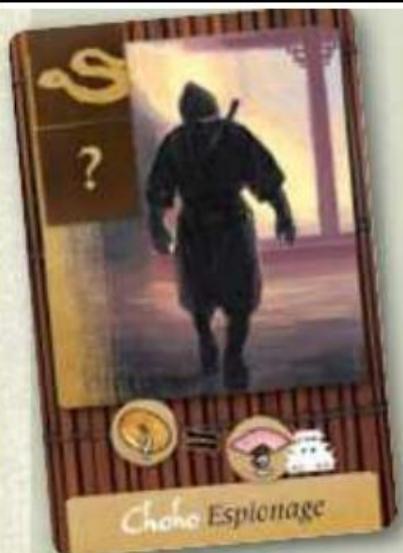
将一件在你的手裹剑上的宝物与官邸内任何一件宝物交换。
这个技能可以在闯入官邸中任何时候使用,即使是闯入失败时也可以。如果是你手裹剑上的一件普通面朝上的宝物与官邸中的一件红色面朝上的宝物进行交换时,那么你必须把仍留在官邸里价值最高的宝物翻成红色面朝上。
「一名很有判断力的斥候。」
实例: 你决定以「硬闯」的方式闯入一所官邸,官邸中只有一件红色面朝上的碧玉存在。你自信地呼叫「万岁」,但不幸的是,抽到的是双人精英守卫卡。你剩余的道场卡只能够打败其中一位,没办法两者兼得。
想来想去最好的是,使用你的「谍报 (Choho, Espionage)」技能把你手裹剑上的一把扇子与官邸里的碧玉交换。由于碧玉是红色面朝上的,所以交换之后唯一留在官邸里的扇子就必须翻到红色面朝上了。因为你继续闯入失败,你只可以保留一个位在你手裹剑上的宝物,但至少这宝物会是一块宝玉。

幽靈 (Gosuto, Spirit)
把任何一张使用过的技能翻到面朝上,可再次在本回合中使用。
(「変装术」(Hensojutsu, 伪装)技能除外)
「灵胜过体。」

心神合一(精神的,
切换你的余下闯入官邸的方式,可以是硬闯改偷窃,或是偷窃改硬闯。在
守卫卡展出来之后再使用本技术人员是允许的。方式改变之后就必须一直维持下去。
例如:在你硬闯时,发现了一名数值 5 的守卫。这时你可以使用「心神合一(精神的,Seishin-teki, Harmony)来改变成偷窃,并且打出一张数值 3 的道场卡顺利击败守卫。
「积极的心必须明确。」

变装术 (Hensojutsu, Disguise)

从你贿赂的一名拥有面具符号的人脉中,获得1个额外的影响力。如果你有一个以上的「变装术」技能,你必须选择不同的人脉来作为使用对象。
「幻境竟成现实。」
忍者刀 NINJATO
皇宮 (The Palace)
放置一个手裹剑在皇宫旁边, 表示你要利用弃掉相对应的宝物来贿赂一名人脉, 弃掉的宝物会立即给你荣誉点。拿取该人脉卡, 并把它面朝上放在你的面前。在每个计分阶段时, 在每个氏族中, 拥有最多及第二多人脉的玩家都可以获得额外的荣誉点或传闻卡。如果出现平手时, 玩家拥有在该氏族比较年长的人脉获胜。(详见第 13 页「计分阶段」)。


面具表示你可以在这名人脉上使用「变装术」技能。

家纹及颜色代表

此人脉需要1件、2件、3件或4件任何同种类的宝物来换取。

此人脉需要1件任何同种类的宝物再加上3件任何同种类的宝物才能换取。

此人脉只能用1个花瓶及1块碧玉来换取。
贿赂人脉 (Bribing Envoys)
当具体的宝物标示在一张人脉卡上时,表示这些宝物是贿赂时所必需的。例如,如果一张人脉卡标示着一把扇子和一块碧玉,那么你就必须弃掉一把扇子和一块碧玉才能拿到该张人脉卡,且马上获得7点荣誉点。
不同的人脉需求也不一样,获得荣誉点也会不一样。例如,一名人脉1件任何同种类的宝物再加上3件任何同种类的宝物才能换取。要贿赂他,你可以利用1个花瓶和3块碧玉(共19点荣誉点),或4把扇子(共8点荣誉点),或1个滚动条和个3个花瓶(共15点荣誉点)等。
黄金是百搭宝物 (Gold is Wild)
黄金可以取代任何你选择的宝物,并以该宝物的形式来计分。在前面的例子,贿赂人脉时,你可以利用1把扇子、2个花瓶及1块黄金来代替1个花瓶。这将获得14点荣誉点。
消耗宝物 (Spent Treasure)
弃掉的宝物把它放到游戏图板一旁的弃物堆中。当袋子的宝物指示物被抽光时,把弃物堆中的宝物重新放入袋中使用。
亭阁 (The Pavilion)
放置一个手裹剑到亭阁的附近, 让你在贵族间散布有利于你的传闻。你弃掉 1 件或 2 件标示在传闻卡上的宝物, 便可取得传闻卡。类似人脉卡那样, 你也会立刻获得弃掉的宝物所提供的荣誉点。有些传闻卡可以用任何宝物来取得, 有些则需要特定的宝物才行。
当传闻背后由更多的话题时,传闻的威力就更大了。例如,当你有一张或更张「伟大武士」的传闻卡时,如果你又能打败很多精锐的守卫的话,那么你将会获得更好的分数。
详见第 14 页「游戏结束时的奖励计算」。

左上方图示:表示你需要收集技能板块来让这张传闻卡为你提供荣誉点的奖励。
本张传闻卡需要1块碧玉才能获得。
隐藏好你的传闻卡 (Hidden Rumors)
在你拿取传闻卡之后,你必须保持其面朝下,直到游戏结束。在游戏中,只有传闻卡和道场卡是玩家需要隐藏的信息。
回合结束 (Ending a round)
在每一个回合结束每时,请进行以下几点:
移动玩家顺序标志物。道场的手裹剑堆决定了下一个回合的玩家顺序。拥有最上面那个手裹剑的玩家成为下一个回合的起始玩家,然后如此类推决定顺位。没有在道场上放置手裹剑的玩家不改变彼此的相对位置。之后,玩家把各自的手裹剑收回。
重置技能板块。玩家把各自全部的技能板块翻到面朝上。
重置师傅区。把任何剩余在师傅区、面朝上的技能板块弃掉。然后,有多少位玩家就从较大的那个板块堆中,抽出多少张技能板块,以面朝上的方式放置在师傅区上。在第4回合之后,任何残留于较大牌堆的技能板块都会被弃掉。在第5回合时,从较小的那个板块堆中,抽出1张「変装术 (Hensojutsu, Disguise)」技能板块,并以面朝上的方式放置在师傅区上。
重置没有宝物的官邸。如果一所官邸已经没有宝物存在的话(所有守卫都被击败),抽出3个宝物,并以普通面朝上方式放在官邸上。接下来,放置新的一名守卫到官邸中成为新的站哨守卫。如果抽出的站哨守卫为一名警戒守卫时,可忽略警戒(不要因为这种情形的「警戒」而添加额外的宝物到官邸里)。
填满皇宫与亭阁。如果在皇宫中人脉少于 4 名时,抽出并翻开人脉卡,直到皇宫中人脉卡有 4 张为止。亭阁中的传闻卡也是同样的缺法。
计分阶段。回合标志物往前推进到下一个回合。在第3回合、第5回合和第7回合结束时,会先执行一个计分阶段(见下述)。第7回合结束,计分阶段之后会进行游戏结束的奖励给予。
计分阶段 (Scoring Phases)
在第 3 回合、第 5 回合和第 7 回合结束时,会先执行一个计分阶段。
对于每个氏族而言, 最有人脉影响力和居次人脉影响力的玩家都可以得到奖赏。氏族中的侍位人脉都算作对所属氏族有 1 点影响力。平手时, 就比较双方谁拥有该氏族中较为年长的人脉。
首先,依照玩家顺序,拥有「变装术(Hensojutsu, Disguise)」技能的玩家宣告哪位人脉成为变装的目标。玩家只能选择有
面具图示的人脉进行变装。

实例:你在后白河天皇的氏族中有2位人脉,其中一位有____面具图示。你决定使用「变
装术 (Hensojutsu, Disguise)」技能在这位人脉身上,这会让你的影响力跃升到3点。
玩家会依据氏族顺序进行奖赏, 氏族顺序标示在回合记录条上。例如, 在第 3 回合计分, 后白河天皇先进行奖赏, 再来是平家, 最后才是源氏。每个氏族依序奖赏在该氏族中最有人脉影响力的玩家之后, 再来才是每个氏族依序奖赏在该氏族中居次人脉影响力的玩家。
氏族中最有人脉影响力的玩家可以选择下面的奖赏其中一个: 获得该氏族所有官邸的荣誉值点数, 或者是从亭阁中获得一张免费的传出卡。免费的传闻卡是不需要支付任何宝物便可取得。首先由在最有人脉影响力的玩家进行选择, 完了之后, 居次人脉影响力的玩家只能选择剩下的那个奖赏选项。
传闻卡暂不进行计分, 是到游戏结束才会进行计分的(详见第 14 页「游戏结束时的奖励计算」)。
实例 (Example)
在第 5 回合结束时,各所官邸如下:

后白河天皇
(氏族奖赏顺序为平家→源氏→后白河天皇)平家最有人脉影响力的玩家先进行选择,他很高兴地选择了官邸的荣誉值点数,增加了他14点的荣誉点数得分。
源氏最有人脉影响力的玩家对源氏官邸只有2点荣誉值有点小不满,所以他选择了获得一张传闻卡来代替。
后白河天皇的最有人脉影响力的玩家选择了14点的荣誉点数得分。
现在轮到氏族中居次人脉影响力的玩家获得选剩的奖赏。平家的必须选取传闻卡,源氏的必须选取2点荣誉值,后白河天皇的必须选取传闻卡。
再次填满亭阁 (Refill Pavilion Again) 计分阶段后,将亭阁的传闻卡填满。
游戏结束时的奖励计算 (End of Game Bonus Scoring)
在最后一个回合结束之后, 最后一个计分阶段进行, 之后再进行游戏结束时的奖励计算。奖励计分是来自是传闻、未使用的宝物及击败的精锐守卫。
传闻奖励计算
大多数传闻卡都是作为你收集到的东西的「倍增器」,满编是3张同样的传闻卡。如果你有1张同一类型的传闻卡时,乘数为x1。如果你有2张同一类型的传闻卡时,乘数为x2。如果你有3张同一类型的传闻卡时,乘数为x4。如果你收集超过3张同一类型的传闻卡时,你开始一个新的编排来计算。
实例:假设你有2张「隐密艺术大师」传闻卡。2张同一类型的传闻卡时,乘数为x2。所以,如果你收集到4张技能板块,你的分数为8点荣誉点。如果你有2张「隐密艺术大师」传闻卡,满编状况,乘数为x4,你可以得到16点荣誉点。
实例:假设你有3张「亲善友好」传闻卡和其它2张谣言卡。这会让你获得20点荣誉点。
「伟大武士」(红)

以上这些传闻卡获得同类3张的奖励会增加。
用精锐守卫卡计分。
「亲善友好」(紫)
用传闻卡来计分。
「有力人士」(绿)
用人脉卡来计分。
「隐密艺术大师」(黄)
用技能板块来计分
卑鄙的对手 ("Dishonorable Opponents")

「卑鄙的对手」传闻卡有特殊的计分机制。
这张传闻卡的计分方式比较独特,不是采用乘数的。如果你是唯一拥有这种类型传闻卡的玩家,每张这种卡牌的分数为6点荣誉点。如果有2位玩家拥有这种类型的传闻卡时,每张这种卡牌可以给予其拥有者4点荣誉点。如果3位个或更多的玩家拥有这种类型的传闻卡时,每张这种卡牌只可以给予其拥有者2点荣誉点。
实例:假设你拥有2张「卑鄙的对手」传闻卡,另一位玩家则拥有1张「卑鄙的对手」传闻卡。你的得分为8点荣誉点和另一位玩家的得分为4点荣誉点。如果没有其它玩家拥有「卑鄙的对手」传闻卡时,你则会得到12点荣誉点。
未使用宝物的奖励计分
你的每个剩余没使用的宝物,不管类型是什么

都会带给你 1 点荣誉点。
击败的精锐守卫奖励计分
在游戏过程中,你所击败的每一名精锐守卫,都可以给你标示其上的1或2点荣誉点。

精锐守卫的荣誉得分标示在他们的旗帜上,这两张的得分,共有3点荣誉点。
赢得游戏 (Winning)
获得最多荣誉点数的玩家赢得游戏!若出现平局,拥有最多人脉的玩家获胜。如果仍然平手,不管氏族,拥有最年长人脉的玩家获胜!
All rights reserved to CrosscutGames and Z-man Games and Designer Adam West and Dan Schnake.
此中文规则书由 cchopman 编译, 仅供同好参考使用, 不作任何商业牟利用途
No Any Commercial Purposes!!
下载 MarkdownNinjatoRules.md

IN 12TH CENTURY JAPAN, the Minamoto and Taira clans vie for power while retired Emperor Go-Shirakawa plays his rivals against one another. One of the three factions will triumph to impose the coming social order. In the shadow of these elite powers, a few ninja scheme to exploit the chaos. Daring raids, skill mastery, and subtle intrigue are essential to establishing one's honor. When the new era dawns, one ninja will flourish as the Ninjato, the Invisible Sword of the ruling family.
1 Game Board. The board shows different locations for actions: the Dojo, the Sensei, the Palace, the Pavilion, and the 5 clan-controlled houses.
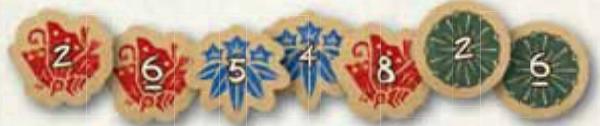
15 Clan tokens. There are 5 tokens for each clan. These are used to show which clan controls a house and the honor level of the house.
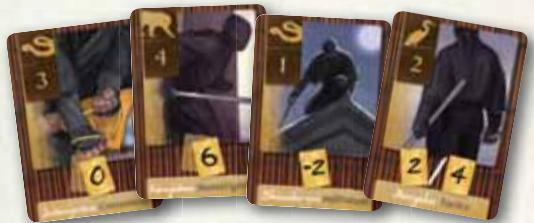
19 Sensei Skill tiles. These skills help ninja in various ways during the struggle.

90 Treasure tokens. Treasures are gained by defeating guards in the houses and are used to gain envoys and spread rumors.

30 Rumor cards. These cards gain bonus honor at the end of the game.
1 Bag. It's an enchanted bag, but the enchantment is undetectable.
1 Round marker. Used to track rounds.

12 Shuriken (Throwing Stars), 12 wooden markers. Each player gets 3 shuriken in a color to indicate actions and 3 markers: one to indicate turn order and two to track honor.
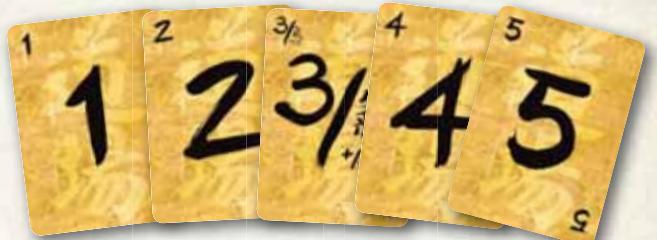
52 Dojo cards. These cards are used to invade the houses and purchase skills.

21 Envoy cards. Envoys enable you to exhange treasure for honor and gain allegiance to clans.

40 Guard and 20 Elite Guard cards. Guards protect the treasures in the houses. Elite guards are more difficult to defeat than regular guards.
Game Setup
PLACE THE BOARD in the center of the table. Each player takes 3 shuriken of the same color and the matching wooden markers. Put one marker from each player in a container, then randomly draw them one by one and place them on the Turn Order Track in the center of the board. This sets the turn order for the first round. The other two markers from each player are placed at the beginning of the Honor Track . Players keep their 3 shuriken in front of them.
Shuffle the Guard Cards and the Elite Guard Cards in separate face down stacks. Draw and place 1 guard card face up on each house ⑤ as the sentry protecting the house.
Take a 2 and a 4 honor value Taira (red) clan token and place them on different Clan Houses. Do the same for the Minamoto (blue) clan. Place the 6 honor value Go-Shirakawa (green) token . Place the remaining clan tokens in a pile off to the side of the board. Mix up the Treasure tokens in the bag and place 3 treasures in each house , plain side up (red side face down).
Separate the 3 Hensojutsu (Disguise) Skill Tiles from the rest, shuffle them, and place them in a face down stack next to the Sensei area 8. Now shuffle the rest of the skill tiles and place them in a large face down stack next to the Hensojutsu tiles . Draw a number of skill tiles equal to the number of players from the large stack and place them face up in the Sensei area.
Shuffle the Envoy Cards and place 4 face up on the Palace Put the remaining envoys in a face down stack near the board.
Shuffle the Rumor Cards and place 4 face up in the Pavilion . Put the remaining rumors in a face down stack near the board.
Shuffle the Dojo Cards and deal 4 to each player. Turn up 3 dojo cards on the dojo and place the deck next to the Dojo face down.
Place the round marker on 1 on the Round Track .
You are now ready to play!

Playing the Game
IN THE ROLE OF A MASTER NINJA, each player practices in the dojo, learns esoteric skills from the sensei, raids clan-controlled houses to steal fabulous treasure, influences envoys, spreads rumors in the pavilion, and ultimately tries to become the most legendary ninja of the age.
In turn order, each player places 1 shuriken on a location and immediately follows the rules for that location. Once all players have placed 3 shuriken, the round is over. The game lasts 7 rounds. Rounds 3, 5, and 7 have special scoring at the end of the round. In the end, the player with the most honor wins.

You place one shuriken each turn to immediately perform the selected action. Here, you are attacking the house with strength.
The Dojo
PLACE A SHURIKEN HERE and take dojo cards in any combination from the face up cards or the draw pile. The number of dojo cards you take depends on how many dojo cards are already in your hand. If you have no dojo cards, take four. If you have one dojo card, take three. If you have two or more dojo cards, take two. After you take all of your cards, replace any face up cards taken with new cards from the draw pile. If there are no more cards in the deck, shuffle the discards and start a new pile.
Hand Limit
If you have over 7 dojo cards in hand, you must discard down to 7.
Always stack your shuriken on top of any previously placed shuriken on the dojo. At the end of the round, the dojo shuriken stack determines the player order in the next round. The player with the topmost shuriken goes first, and so on down through the stack (if a player placed more than 1 shuriken on the dojo, only his top one counts).
Example: Suppose the current player order is Tom, Mike, Eve, and Brandon. During the round, Brandon places a shuriken in the dojo. Later, Mike places one on top of Brandon's. Tom and Eve do not place any shuriken in the dojo. So the stack order, top to bottom, is Mike – Brandon. The player order in the following round will be Mike, Brandon, Tom, Eve.
Actions
In turn, each player places 1 shuriken on the board and takes one of the following actions:
THE DOJO: Take some dojo cards.
THE SENSEI: Learn a skill to use in invading houses.
THE CLAN HOUSES: Play dojo cards to defeat guards and take treasure.
THE PALACE: Discard and score treasure to take l envoy.
THE PAVILION: Discard and score treasure to take 1 rumor card.
Shuriken
Shuriken locations remain valid even with previously-placed shuriken on them.
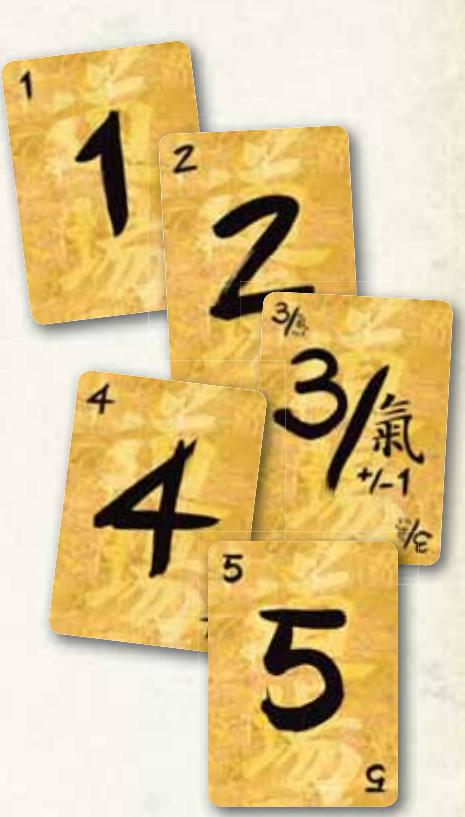
Dojo cards range in value from 1 to 5.


Here's a typical house controlled by the Taira clan. There is a 5 value Samurai turned up as the sentry guard, protecting the scroll (the lowest value plain treasure). There is an unknown guard protecting each of the other treasures—a vase and a gold.
The Clan Houses
YOU INVADE HOUSES TO EARN TREASURE. Each treasure is protected by a guard. The Sentry is the face up guard you know about in advance, the other guards are surprises. Each time you defeat a guard, you put a treasure on your shuriken. Then you decide whether to leave or take on the next guard (and get another treasure). To take on the next guard, call Banzai. If you defeat all guards in a house, you will hurt the honor level of the clan that lost the house, and help the honor of the clan that will take it over.
Treasures range in value from 2-5 honor. Though Gold has variable value, it is considered the most valuable treasure in houses. The plain side of a treasure token indicates it is protected by a normal guard, the red side indicates an elite guard. As you defeat guards, you take the plain treasures first, from least valuable on up, then the red side treasures, from least valuable on up.

Jade
Strength or Stealth?
To start your attack, place a shuriken on the strength or stealth side of a house.

, For strength, you must play a dojo card that is a higher value than the guard card.

Ties do not win!
Suppose you hold this hand of dojo cards:

You have a good “stealthy" hand so you place your shuriken on the stealth spot. To beat the 5 sentry, you play your 4
Then you take the lowest value plain side treasure, the scroll, and put it on your shuriken. You leave the sentry on the house for now.
You decide to call Banzai, which tells another player at the table to flip up a guard—a regular guard because there are plain side up treasures in the house. He turns up a I1 guard—you must play your1 card along with your 3/ card as a -1 kicker to defeat this guard.

You take the least valuable plain side treasure remaining, the vase

The "Kicker” A 3 dojo card may be played like a normal dojo card. But it may also be played along with another dojo card as a kicker—giving + 1 or -1 to the dojo card. You may play multiple kickers on the same dojo card.
Calling Banzai
Let's take a moment to discuss the “Banzai" decisions. Saying Banzai tells another player to turn up a guard card, you're going to attempt to defeat it. If you call Banzai, but you cannot defeat the guard? Failure. You take only one treasure from your shuriken—discard any other treasures on it. If you decide to leave instead of calling Banzai, you take all treasures from your shuriken. In either case, leave any remaining treasures in the house.

Returning to our example, there is one plain side up treasure left in the house—gold. You call Banzai, and a guard with an alarm symbol is turned up!
Alarm!

When an alarm guard is turned up, immediately draw 1 treasure from the bag and place it plain side up in the house. Then select the most valuable plain side up treasure in the house and flip it to the red side. So an alarm increases the treasure in a house, but it also means the best treasure is protected by an elite guard card.
In our example, you draw a treasure for the alarm—a jade. Then you flip the most valuable treasure—gold—to its red side. Continuing play, you defeat the 3 guard by playing a2 and then put the jade on your shuriken.

The gold is still in the house! Facing another Banzai decision, you know that if you go for it, you will face a guard from the elite deck, because the remaining treasure is red side up.
You decide to leave. You take the vase, scroll, and jade from your shuriken and leave the gold, red side up, on the house. You draw another treasure from the bag and place it plain side up in the house. The sentry recovers and stays in the house.


Defeating an elite guard earns honor at the end of the game, shown here.
Some elite guards have different values depending on whether you're invading by stealth or strength. This one is a 5 against strength invasions, and a 1 against stealth invasions.

Some elite guards are actually 2 guards. You must separately defeat both a 3 guard and a 5 guard to defeat this one.
Alarm Guards

Th roi r lar yard.
Alarms are ignored on sentry guards. More than one alarm guard may be drawn in a house, so an unlucky ninja may face several elite guard cards in one invasion.
Succeeding
If you defeat all guards in a house, you take all of the treasure. You also replace the clan honor token on the house with a token from one of the other two clans. The house is left empty for the rest of the round—the Sentry guard is discarded.
Failing or Leaving
After you resolve the treasure on your shuriken (see Calling Banzai), add 1 treasure to the house, plain side up. Leave the Sentry on the house—he recovers. The house may be invaded again this round by you or another player.
Keep Defeated Elites!
All drawn guard cards are discarded after encounters except for beaten elite guards—keep those for end of game scoring.

The Clan Control tokens show the actual mon of the clans. Japanese mon were analogous to European coats of arms, and similarly, were often displayed on banners and clothing.
The mon were a butterfly for Taira, bamboo leaves for Minamoto, and the imperial chrysanthemum for Go-Shirakawa.

The Teachings
During rounds 1-4, there are skills available from the sensei equal to the number of players.
During rounds 5-7, the sensei only teaches one skill—the Hensojutsu (Disguise) skill— to a single student.
Reshuffling Cards
During the game, you may exhaust the supply of dojo or guard cards. Shuffle the discards and start a new deck.
If you have no snake style skills, you must discard a 1 value dojo card to learn Shinobi-iri.
Changing Clan Control
Each house is worth 2, 4, 5, 6 or 8 honor for one clan. Throughout the game, the control of houses changes from one clan to another. Such control changes occur when you defeat all guards in a house. You must return the house's clan token to the pile and replace it with any token of a different clan. The house is left empty of treasure until the end of the round. No one may place shuriken there.
Envoys give you influence with a clan—see The Palace on page 8. To see how honor on houses is awarded to players, see Scoring Phases on page 9.


If you defeat a Minamotocontrolled house, you must replace the Minamoto token with a Taira or Go-Shirakawa token.
The Sensei
PLACE A SHURIKEN TO VISIT THE SENSEI to learn one skill. Select a skill by discarding the dojo card shown on the skill tile. A? means that you may discard any dojo card. You may learn skills from different styles. Once you learn a skill of a certain style (snake, tiger, crane), you do not have to discard a dojo card to buy more skills of that style.
Example: You discard a 5 dojo card to learn the skill Kenjutsu, a Tiger style skill. For future visits to the sensei, you do not have to discard cards to select a Tiger style skill.
You may use a skill only once per round. When you do, turn the tile face down. If you learn the same skill twice, you may use each skill tile once per round. At the end of the round, turn your used skills back up.
Most skills help you invade clan houses. The Hensojutsu (Disguise) skill is unique in that it is used during a scoring phase (see Scoring Phases on page 9).
Gives a -2 to a dojo card.
“A puff of smoke, or a bit of breeze, going past a guard."

Gives a + l or a -l to a dojo card.
“The way of the open hand."

Gives a + 2 to a dojo card.
“Distraction is a sword."

Changes the value of a played dojo card to 0.
“An artist of shadow."

Acts as if you played a 2 or a 4 dojo card.
“Inventive devil of a trickster."

“Speed of the blade."
Changes the value of a played dojo card to 6.
Example: You are attacking a house with a 2 Sentry using stealth. You use your Intonjutsu (Concealment) skill to change a 5 dojo card into a O to defeat the Sentry. You call “Banzai” and an elite Tsuba appears—he is a 3 vs. stealth.
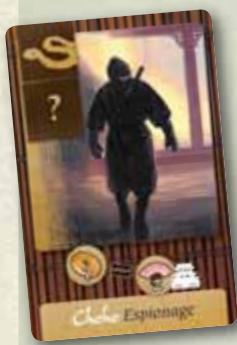
You use your Boryaku (Tactics) skill as a 2 dojo card to win— you don't need to play an actual dojo card. You keep the elite Tsuba card for end of game bonus scoring
Swaps l treasure on your shuriken for any one treasure in the house.
This can be played at any point during a house invasion, even after a failure. If a red side up treasure in the house is exchanged for a plain side up treasure on your shuriken, you must flip the most valuable treasure remaining in the house to red side up.
“The heightened senses of a scout."
Example: You are attacking a house with strength, only a red side up jade treasure is left. You confidently call “Banzai," but unfortunately, a two-guard elite card is drawn. Your remaining dojo card can defeat either one, but not both.

Flip any skill face up except Henojutsu (Disguise). The flipped skill may be re-used this round.
“Mind over body."
Making the best of it, you use your Choho (Espionage) skill to exchange a fan on your shuriken for the jade. Because the jade was red side up, the fan is flipped red side up in the house. Because you failed, you only keep one treasure from your shuriken, but at least it will be a valuable jade.

Switches your attack from stealth to strength, or strength to stealth, for the rest of the house. This can played after a guard card is revealed. The change from stealth to strength or vice versa holds for the rest of the guards in the house.
Example: A 5 guard is revealed and you're attacking with strength. You use Seishin-teki to change to stealth and play a 3 to defeat the guard.
“The active mind must be clear."


Gain 1 additional influence from one of your bribed envoys, who must have the mask symbol. If you have more than one Hensojutsu skill, you must choose different envoys.
“The illusion becomes reality."
The Palace
Bribing Envoys
When specific treasures are shown on an envoy, those treasures are required. For example, if an Envoy card shows a fan and a jade, you must discard a fan and a jade, immediately scoring 7 honor.
Other envoys may take various kinds of treasure and thus score varying honor. For example, an envoy might require 1 of any treasure plus 3 of any treasure of the same kind. You could bribe this envoy with 1 vase and 3 jade (19 honor), or 4 fans (8 honor), or 1 scroll and 3 vases (15 honor), etc.
Gold is Wild
Gold may be substituted as any treasure you choose, scoring as that treasure. In the previous example, you could bribe the envoy with 1 fan, 2 vases, and 1 gold—the gold would have to substitute for a vase. This would score 14 honor.
Spent Treasure
Discarded treasure is kept in a pile off the board. If you exhaust the treasure in the bag, put the discards back in.
Hidden Rumors
After you buy a Rumor card, you may keep it face down until the end of the game. Rumor cards and Dojo cards are the only hidden player information.
PLACE A SHURIKEN NEXT TO THE PALACE to bribe one envoy by discarding the matching treasures and immediately scoring the value of those treasures in honor. Take the envoy and place it face up in front of you. During each scoring phase, the players with the most and second most envoys in each clan earn additional honor or a Rumor card. In case of a tie, the player with the oldest envoy in that clan wins. See Scoring Phases on page 9.
Indicates you can use the Hensojutsu (Disguise) skill on this envoy.

This envoy requires 1, 2, 3 or 4 of any one kind of treasure.

The symbol and color indicate the clan. The number is the age of the envoy.
This envoy requires 1 of any one kind of treasure and 3 of any one kind of treasure.

This envoy requires exactly 1 vase and 1 jade statuette.
The Pavilion
PLACE A SHURIKEN NEAR THE PAVILION to spread one favorable rumor among the nobility. You discard 1 or 2 treasure indicated on the rumor and take the rumor card. As with Envoys, you immediately earn honor from the treasure you spend. Some rumor cards may be bought with any treasure, some require specific treasure.
Rumors work best if there is some substance behind the rumor. For example, if you have one or more “Greatest Warrior” rumor cards, you'll score best if you have a lot of defeated elite guard cards.
See End of Game Bonus Scoring on page 10.
Indicates that you need to collect skill tiles to score bonus honor with this rumor.
This rumor card requires 1 jade statuette.

Ending a Round
AT THE END OF EACH ROUND, do the following:
Move Player Order Markers. The Dojo shuriken stack determines the player order in the next round. The player with the topmost shuriken goes first, and so on down through the stack. Players who didn't place shuriken in the dojo do not change position relative to one another. Afterwards, players gather their shuriken.
Reset Skills. Players turn all their skills tiles face up.
Reset the Sensei. Discard any leftover face up skills. Draw from the large stack a number of skill tiles equal to the number of players and place them face up. Any skills left over in the large stack after round 4 are discarded. Round 5 on, draw and place one Hensojutsu (Disguise) skill tile face up from the small stack.
Reset Cleared Houses. If a house has no treasures (all guards were defeated), draw out and place 3 treasures plain side up on the house. Next, place a new guard on the house who becomes the new Sentry. If the sentry is an alarm guard, ignore the alarm (do not add an additional treasure to the house for that alarm).
Refill Palace and Pavilion. If there are less than 4 Envoys in the Palace, draw and turn up Envoys until there are 4. Do the same for the rumors in the Pavilion.
Scoring Phases Advance the round marker to the next round. After rounds 3, 5, and 7, perform a scoring phase as shown below. After round 7, the end of game bonus scoring follows the scoring phase.

AFTER THE 3RD, 5TH, AND 7TH ROUNDS, there is a scoring phase.
For each clan, the first and second place players in envoy influence receive a reward. Each envoy in a clan counts as 1 influence in that clan. Ties are won by the player with the oldest envoy in that clan.
To begin, in player order, players with the Hensojutsu (Disguise) skill declare which envoy of theirs that they are targeting. Players may only choose envoys with the :icon.
Example: You have 2 Envoys in Go-Shirakawa, one has the icon.
You decide to use Hensojutsu on this envoy, giving you a total of 3 influence.
Players are rewarded in the clan order shown on the round track. For example, in round 3 scoring, Go-Shirakawa is rewarded first, then Taira, and then finally Minamoto. You reward first place for each clan in order, then second place for each clan in order.
The player with the most envoy influence in a clan has a choice—score the total honor on the clan's houses or get a free Rumor card from the Pavilion. No treasure is used or scored for a free rumor. After each first place player chooses, the second place player gets whatever the first player left.
Rumors are not scored until the end of the game (see End of Game Bonus Scoring on page 10).
Example
At the end of round 5, the clan houses look like this:


Taira

Minamoto

Go-Shirakawa
The player with the most envoy influence in Taira has first choice —he happily chooses the house honor and marks 14 honor with his scoring token.
The player with most Minamoto influence is miffed about the paltry 2 house honor, so he selects a rumor card instead.
The first place Go-Shirakawa player takes the 8 house honor.
Now second place players in each clan get the leftover rewards. Taira must take a rumor card, Minamoto must take 2 house honor, and Go-Shirakawa must take a rumor card.
Refill Pavilion Again
Refill the Pavilion with Rumor cards after scoring phases.
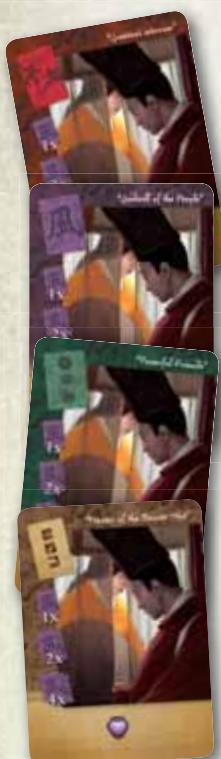
These rumor cards score extra if you have 3 of the same type.
“Greatest Warrior” scores Elite Guard cards.
“Goodwill of the People” scores Rumor cards.
“Powerful Friends” scores Envoy cards.
“Master of the Secret Art" scores Skill tiles.

“Dishonorable Opponents” scores uniquely.

Unspent treasure tokens score 1 honor each.

Elite Guards score the honor on their banner—these two would score a total of 3 honor.
End of Game Bonus Scoring
After the last round ends, following the last Scoring Phase, do the End of Game Bonus Scoring. The bonus scoring is for Rumors, Unused Treasure, and Defeated Elite Guards.
Rumor Bonus Scoring
Most rumor cards act as a “multiplier" for something else you collect—a full “set" is 3. If you have 1 rumor of a type, the multiplier is x1. If you have 2 rumors of the same type, the multiplier is x2. If you have 3 rumors of the same type, the multiplier is x4. If you collect more than 3 rumors of the same type, you're starting a new set.
Example: Suppose you have 2 “Master of the Secret Art" Rumor cards. Two matching rumor cards have a x2 multiplier. So if you collected 4 skill tiles, you score 8 honor. If you had 3 “Master of the Secret Art" Rumor cards—a set— the multiplier would've been x4 and you would have scored 16 honor.
Example: Suppose you have 3 “Goodwill of the People” Rumor cards and two other Rumor cards. This would score 20 honor.
"Dishonorable Opponents"
These score in a unique way—there is no multiplier. If you are the only player with this type of Rumor card, each card scores 6 honor. If two players have this type of Rumor card, each card scores 4 honor for its owner. If three or more players have this type of Rumor card, each card scores 2 honor for its owner.
Example: Suppose you have 2 “Dishonorable Opponents” cards and another player has 1 of them. You score 8 honor and the other player scores 4. If no other player had a “Dishonorable Opponents” card, you would have scored 12.
Unused Treasure Bonus Scoring
You get 1 honor for each remaining treasure you have—no matter the type of treasure.
Defeated Elites Bonus Scoring
For each elite guard you defeated during the game, you receive 1 or 2 honor as indicated on the elite.

THE PLAYER WITH THE MOST HONOR WINS! All other players must bow respectfully to the victor—and put away the game. When you bow, do it with humility! You are in the presence of a superior!
In the event of a tie, the player with the most envoys wins. If there is still a tie, the player with the oldest envoy (in any clan) wins!
Historical Notes
THE HEIAN PERIOD (“Hey-on") from 794-1185 was the last era of classical Japanese history. It was a golden age for Japanese culture, especially in the arts. Influenced by ideas in China, the Japanese blossomed in painting, architecture, poetry, and especially literature. Though the Emperor nominally ruled, power was shared between the emperor and several family clans and enforced with a rising bushi military class.
Perhaps the greatest artistic achievement was the Tale of Genji, written by a woman in the middle levels of the aristocracy, Murasaki Shikibu. This enduring classic has a claim as the first novel ever written. It is certainly the first with such a degree of psychological characterization. Life in the Imperial Court is shown with astonishing insight and detail. The formal social code emphasized grace, rank, manners, and custom. Nobles improvisationally modified short tanka poems to express their views in veiled allusions.
The power struggle that Ninjato plays upon began in 1156, in the wake of the suppressed Hogen Rebellion. Because of their assistance, the Taira and Minamoto clans gained new prominence in the government, and Go-Shirakawa became emperor. This cooperation did not last.
Go-Shirakawa soon “retired” to wield power behind the scenes as a cloistered emperor, more powerful than the series of emperors that followed. In 1159, the leader of the Taira clan, Taira no Kiyamori, went on a pilgrimage and left the Imperial Palace lightly defended. The rival Minamoto clan seized its chance and occupied the palace. Go-Shirakawa was imprisoned.
When Taira no Kiyomori returned, he negotiated his surrender to Minamoto. The Minamoto became careless and Go-Shirakawa escaped, finding refuge
with the Taira. The surrender was a ruse. With permission from
Go-Shirakawa, the Taira clan attacked the Minamoto clan at the Imperial Palace. After some skirmishes, the Taira staged a retreat, and the Minamoto poured out of the palace in pursuit. Another ruse. A second force of Taira swooped in to retake the Palace. Caught between the Taira forces with no place to retreat, the Minamoto were defeated.
During the next 20 years, Taira no Kiyomori consolidated his power with the help of Go-Shirakawa. Increasingly, the Taira ruled in a high handed manner, taking nepotism to new levels and ignoring the concerns of the provinces. The other clans felt slighted.
The foundation eventually cracked, beginning a series of events known as the Genpei War. After another emperor abdicated, Go-Shirakawa supported his son, Prince Mochihito, for the throne, but Taira no Kiyomori named his nephew Emperor Antoku. Relations with Go-Shirakawa soured. Prince Mochihito issued a call to arms against the Taira for their hubris. The Taira response was to chase Mochihito down and execute him.
Heian Gamers
A popular Heian game involved Tanka poetry, which had a meter of 5-7-5-7-7. The 5-7-5 was the upper phrase, and the lower 7-7 phrase often commented upon the upper phrase or took the thought in a new direction.
At a Heian party, there would be appointed judges, the nobles would divide into teams, and the game was on. Clever wordplay involved using puns, riffing from given descriptive words, using beginning and ending syllables that formed a word, etc. Sometimes one side would do the upper phrase, and the other side would answer with an ironic or humorous lower phrase. Being good at Tanka conferred significant status.
Design Notes
Several books influenced the design of Ninjato. One especially inspirational work was Souyri and Roth's wonderful book about medieval Japanese life, The World Turned Upside Down. Many more games could be made about this fascinating and complex historical period.
Conceptual game ideas arose from the flexible spending in Brunnhofer and Tummelhofer's Stone Age, the stress inducing push-your-luck in Faidutti and Moon's Incan Gold, and the critical advance planning in Kramer and Ulrich’s The Princes of Florence.
Not only do we admire these games, but they often come to the table with our family and friends.
Design
Adam West Dan Schnake
Illustrations
Drew Baker (www.drewbaker.com)
Graphic Design
Peter Gifford (www.universalhead.com)
Play Testers
Mark Anderson, Scott Arens, Greg Beilach, Gary Duell, A. C. Harrison, Chuck Jajuga, Don Jennings, Sean Johnson, Steve Labun, Scott McAhren, Jerry Matczack, Hans Messersmith, Carl Pacey, Sheamus Parkes, Daniel Patterson, Jessica Patterson, Kent Raquet, Eric Robbins, Jackie Ross, Charlie Schaefer, Abe Schnake, Izzy Schnake, Kristin Settle, Paul Settle, Peter Settle, Boyd Steere, Noel Stonehouse, Michael Strunk, John Taylor, Chris Weller, Scott Weller, Jason Wendling, Sean Wilson, Sam Zitin
Special Thanks
The denizens of www.BoardGameGeek.com
Questions,,opinions, etc. are wélcóme at
www.CrosscutGames.com

©2010 Z-Man Games, Inc. 6 Alan Drive, Mahopac, NY 10541 www.zmangames.com
However, the fire was lit and Minamoto no Yoritomo took up arms with the support of Go-Shirakawa. The Taira suffered a blow when Kiyomori died of fever in 1181. A series of battles over the next few years culminated in the naval battle of Dan-no-ura, a famous event in Japanese history. Altogether, 1 300 ships fought in the strait between two of Japan's four main islands. There was a series of archery duels, followed by boarding and hand-to-hand fighting, with the changing tides favoring one side, then the other.
The pivotal event occurred when a Taira General switched from the Taira side to the Minamoto. Not only did he bring his forces, but he informed on the location of the ship carrying Emperor Antoku and his regalia. The Minamoto focused their attack and annihilated the Taira. At the very end, Emperor Antoku, Kiyomori's widow Tokiko, and many Taira samurai retainers flung themselves into the waters rather than suffer capture.
Minamoto no Yoritomo became the first true Shogun with national reach in Japan. The Emperor became a mere figurehead, samurai power ascended, and the shogunate system established itself for the next 650 years. The Heian Period had come to an end.

WITH NINJA, ALSO KNOWN AS SHINOBI, it's difficult to ascertain where history ends and legend begins. As a specialized group, ninja did not appear on the scene until the 15th century. However, tales about individual ninja go back much further. The Kojiki, the 8th century “Record of Ancient Matters” for Japan, has an ninja-like account. In it, Yamoto Takeru disguises himself as a charming maiden and assassinates two chiefs of a rival clan.
Ninja have always been associated with stealth and invisibility. Daimyo feared their abilities as assassins, though there is little verifiable evidence of such deeds.
The famous ninja black pajama attire was an invention of the kabuki theater in the late 17th century. Real ninja preferred to disguise themselves as monks, guards, or whatever would let them pass unnoticed. In addition to their ninjato swords, ninja employed a variety of unusual weapons, including shuriken (which were sometimes half-planted in the ground to hinder pursuit).
The historical record on ninja exploits is sparse, consisting mostly of scattered accounts of sabotage and spycraft. Was their prowess merely legend? It must be noted that unlike the idealized samurai, ninja came from the lower classes, and propaganda about a loyal warrior code was far more useful to the ruling elite than underhanded “special ops." Perhaps the final ninja trick was leaving little trace for any of us.
