rules_zh_权力斗争_12605.md
POWER\$ STRUGGLE
IN CASH WE TRUST
POWER STRUGGLE IN CASH WE TRUST
翻译 & 排版:陈斌华
一款适合3-5名愿意冒险的经理的游戏。适合年龄:12岁以上,作者:Bauldric和他的朋友。
游戏概述
欢迎来到权势者的世界,欢迎来到那些在大公司的阴影下适时牵线搭桥的人的世界。每个玩家都将成为这些人中的一员,通过雇佣员工、创建新部门、接手热门的部门主管职位来获取权力和特权,从而提高自己的权力和影响力。部门主管可以辞职加入董事会(当然是希望成为董事长),也可以受聘担任外部顾问。与此同时,玩家还可以投资股票,贿赂其他玩家,从而登上顶峰。
玩得越巧妙,就能越快实现游戏目标:在 6 个可能的胜利分数中获得 4 个。
目录
游戏配件....02
游戏设置....03
游戏目标....03
初始任命轮次....03
轮次....04
I:董事会议....04
II:部门回合....07
行动步骤中的行动....08
游戏结束....12
特权卡....12
常见问题....16
配件
① 1 游戏版图
② 5 个快速指南
③ 26 张事件卡,包括
• 2 个标准事件
• 24 个其他事件
④ 7 张特权卡
⑤ 11 张敌人卡,包括
• 5 张敌人颜色卡
• 6 张敌人能力卡
⑥ 100 张纸币(比纳特),包括
•20 张每张 50,000 比纳特的纸币
•30 张每张 100,000 比纳特的纸币
•30 张每张 200,000 比纳特的纸币
•20 张每张 500,000 比纳特的纸币
⑦ 21 块股票,包括
·3 块 7 股,每股 1,600,000 比纳特
·3 块 6 股,每块 1 200 000 比纳特
·3 块 5 股,每块 900 000 比纳特
·3 组 4 股,每组 600,000 比纳特
·3 块 3 股,每块 400,000 比纳特
·3 块 2 股,每块 200,000 比纳特
·3 组 1 股,每股 100,000 比纳特
⑧ 110名经理人,5种颜色各22名
⑨ 60名员工(灰色方块)
⑩ 5个贿赂文件夹,每种颜色各1个
⑪ 1个激励标记

设置
1. 将游戏版图放在游戏桌上。
-
将激励标记放在激励轨道的 6 号区域。
-
将事件卡和员工(组成供应堆)放在游戏版图旁容易接触的地方。
-
将 “股份块” 根据其代表的 “股份” 数量进行排序,并放在游戏板旁边。如果是 5 人游戏,则使用所有的 “股份块”;如果是 4 人游戏,则从 1 股到 5 股的 “股份块” 中各取出一个;如果是 3 人游戏,则每个 “股份块”(1 到 7)只用两个。注意:“股份块” 是游戏中唯一有数量限制的物品。
-
将钱按其价值排序,放在游戏版图旁边,组成银行。选择一人作为庄家。庄家应给每位玩家 800,000 比纳特作为起始资金。在游戏过程中,每个玩家都可以对自己拥有的钱数保密,除非在某个事件中,他需要支付的钱数超过了他实际拥有的钱数。在这种情况下,该玩家必须向其他玩家透露,并尽可能多地支付。
-
每位玩家应携带:1 个贿赂文件夹、1 个快速指南和 22 个自选颜色的经理人。
-
将参与玩家颜色的敌人颜色牌洗混,然后给给每位玩家正面朝下各发 1 张牌。然后将敌人能力牌洗混(在有 3 或 4 人的游戏中,首先去掉相应标记的 1 或 2 张牌),并将其中 1 张牌面朝下发给每位玩家。玩家可以随时查看自己的 2 张敌人牌,但不能给其他玩家看。将未使用的敌人牌放回游戏盒,但不要看。
-
将所有 7 张特权牌牌面朝下洗牌,然后随机将牌面朝上,尽可能平均地发给所有玩家(一名或多名玩家将比其他玩家多发 1 张特权牌)。收到 Communications(通讯) 特权卡的玩家成为起始玩家。
注意:游戏中经理和员工的数量是无限的。在供应堆用完的极少数情况下,请使用金币或其他任何东西来购买缺少的物品。但是,这不适用于“股份块”,因为它们是有限的!
游戏目标
游戏的目标是成为第一个获得至少 4 个胜利点的玩家。获得胜利点的方法有 6 种:
-
在 “影响力” 轨道上获得至少 7 点、
-
在 “股份” 轨道上获得至少 18 点、
-
在 “主要部门” 轨道上获得至少 4 分、
-
在 “腐败” 轨道上获得至少 9 分、
-
在法律顾问轨道上获得至少 3 个不同部门的至少 1 名顾问、
-
击败你的敌人。
能力轨道
游戏版图上方有 5 条不同的能力轨道。它们分别是:(1)影响力(Influence)、(2)股份(Shares)、(3)主要部门(Main Departments)、(4)腐败(Corruption)和(5)顾问(Counsel)。
在游戏过程中,玩家可以在能力轨道 1-4 中收集胜利分数,并将顾问移动到法律顾问轨道。玩家应使用 “经理” 人物来显示各自在轨道上的得分。在能力轨道上获得的分数不会丢失。只要玩家达到轨道上的第一个绿色区域(或在法律顾问轨道上至少有 3 个不同分区的 1 名顾问),他就获得了该能力的胜利分数。每位玩家在每项能力中只能获得 1 个胜利点。
如果玩家的分数标记达到能力轨道上有黄金区域的最高值,他就不能再为这项能力获得任何分数。不过,他可以继续执行可以获得该能力分数的行动,但这些分数将被忽略。
敌人
每位玩家将获得 2 张“敌人”牌: 1 张颜色卡表示哪位玩家是他们的敌人, 1 张能力卡列出 5 个能力轨道中的 3 个 (注: 经验 = 顾问)。有关玩家何时可以宣布“敌人”胜利点的更多信息, 请参阅第 12 页“游戏结束”。
· 如果玩家持有其他玩家的色卡,那么如果他在能力卡上标明的所有 3 项能力中比色卡上的玩家拥有更多的点数(或在顾问轨道中比顾问拥有更多的点数),那么他就会因击败他的“敌人”而获得“敌人胜利点数”。
· 如果玩家拥有自己的颜色卡,那么如果他在自己能力卡上的 3 项能力中的 2 项上比其他玩家拥有更多分数(或在顾问轨道上比其他玩家拥有更多顾问),他就能获得“敌人胜利点数”。
· 要获得“敌人胜利点数”, 玩家只需在游戏结束时 (a) 或 (b) 宣布拥有 4 点或更多胜利点数时 (见第 12 页 “游戏结束”) 在相应的能力轨道上拥有更多点数即可。他不需要延申任何最低等级。玩家要想在顾问 (经验) 轨道上击败他的 “敌人”, 只需在顾问轨道上拥有更多的顾问总数即可。顾问位于哪个分区并不重要。

注意 关于 “敌人当前胜利点数”,如果玩家的点数标记在有金色区域的能力轨道上达到最高值,则该玩家的点数总是比其他玩家多。例如,如果红方和蓝方都达到黄金区域,则红方被视为比蓝方拥有更多积分。而在计算 “敌人胜利点数” 时,“蓝方” 在该能力方面的点数被视为比 “红方” 多。这不适用于顾问轨道。
首次任命轮次
从起始玩家开始,按顺时针顺序,每个玩家任命一名经理(如下所述)。然后,从起始玩家右边的玩家开始,按逆时针顺序,每个玩家任命一名经理。最后,再次从起始玩家开始,按顺时针顺序,每位玩家任命第三位经理。这一轮任命结束后,每位玩家在游戏版图上将有一共有3位经理。注意:在这轮初始任命中不能使用特权卡。
在这一轮初始任命中,有 2 种任命经理的方式:(1)作为董事会成员或(2)作为部门主管。
-
作为董事会成员在董事会会议室。当经理被安排在董事会会议室时,他应该总是坐在最左边的空位上。如果在初始轮次中的任何时候(或在游戏过程中),董事会室中的 5 张椅子都已被占用,而玩家想在董事会室中增加一名经理,那么所有董事会成员都会被向左移动 1 张椅子。这样,最左边的经理就会被推出董事室,回到相应玩家的供应堆中。董事会会议室最右边的椅子现在可以给董事会的新成员坐了。
-
作为部门主管,在他所选择的分区中担任部门主管。当经理被安排在部门办公室时,他应该总是占据所选分区最上面的空缺办公室(注意:不要将任何经理安排在任何部门主管的办公室)。此外,玩家应从供应堆中为经理所在的部门办公室增加 3 名员工。

举例说明:在一个有四名玩家的游戏中,蓝方是起始玩家,然后按顺时针顺序依次是黄方、绿方和红方。蓝方首先在会议室放置1名经理①。然后,黄方在通讯部最上面的空缺位置放置1名经理②,并从供应堆中增加3名员工。然后,绿色在发展部最上面的空缺职位上安排一名经理③,并从供应堆中获得3名员工。第一回合结束时,红方在会议室安排了一名经理。
现在,第二个回合开始。这次,红方从人力资源部开始⑤。绿色、黄色和蓝色紧随其后。第三回合再次从蓝色开始,然后是黄色、绿色和红色。图示为第一轮任命结束后的游戏版图。
轮次流程
在最初的任命轮次之后,游戏会继续进行几个轮次,每个轮次由2个阶段组成:
第一阶段:董事会议和
第二阶段:部门回合(最少4次,最多7次)。
一:董事会议
每次董事会议都包括以下7个步骤:
1. 解散董事长
2. 任命新董事长
3. 确定新的部门主管
4. 分发特权卡
5. 得分
6. 调整激励标记
7. 整理事件卡片
1. 解散董事长
董事长每轮次解散。将董事长办公室中的经理归还给相应的玩家供应堆。此步骤不适用于游戏的第一轮次。
注:第一轮次后,董事长和 / 或受贿交流特权牌(如果牌面朝上)可在此步骤中使用(见第 12 页 “特权牌”)。
2. 任命新董事长
现任董事会中经理人数最多的玩家担任新董事长。如果出现平局,则由董事会最左边的经理获胜。提供新董事长的玩家将他在会议室最左边的经理人带到董事长办公室。会议室中的其他经理向左移动,直到他们之间没有空位为止。

如果会议室内没有经理,拥有董事长特权牌(牌面朝上或朝下)的玩家将从董事长办公室供应堆中提供新董事长。
举例:董事会成员最多的红方将其最左边的董事会成员移到董事长办公室,然后黄方和红方将其董事会成员移到左边,填补空缺的董事长席位。
提示:将供应堆中的一名员工放在董事长旁边,以帮助记住在下次董事会议开始时使用董事长特权卡。
3. 确定新的分区主管
确定本轮所有 6 个分区的分区主管。从左边的发展部开始,从左到右依次为控制部。在一个分区中拥有最多部门主管的玩家将成为新的分区主管。一个主要部门(有两个经理的部门办公室)算作两个部门主管。目前担任部门主管的经理不计算在内。如果出现平局,则在该部门拥有最多员工的平局者获胜。如果还是平局,则拥有最靠近分区顶端的部门主管的平局者获胜。如果分区中没有部门主管,则由拥有该分区特权牌(牌面朝上或朝下)的玩家担任新的分区主管。可能出现以下 3 种情况:
A) 当前没有分区主管
提供新任分区主管的玩家从其供应堆中抽取一名经理,并将其放置在分区主管办公室中。
B) 现任分区主管和新任分区主管属于同一个玩家
没有其他情况发生。主管继续留在他的办公室。
C) 新分区主管由当前分区主管所有者以外的玩家提供
当前部门主管的所有者必须决定是将该部门主管移至会议室(最左边的空位),还是移至顾问轨道上相应部门的区域(成为顾问)。如果移动到董事会会议室,且没有空缺椅子,则董事会中的所有经理人都会向左移动1把椅子,最左边的经理人会被解职,并回到相应玩家的供应堆中。董事会最右边的椅子现在可以给董事会的新成员使用。然后,提供新任部门主管的玩家从他的供应堆中抽取一名经理,并将其放置在部门主管的位置上。

举例说明:从左到右,绿方在发展部拥有最多的部门主管,他从供应堆中取出一名经理,放到部门主管办公室。红色在人力资源部也这样做。绿方有两个部门主管,而黄方只有一个,因此绿方提供通讯部的部门主管。蓝色提供会计部的部门主管。法律与专利部没有部门主管,但黄色拥有相应的特权卡,因此提供该部门的部门主管。蓝方和黄方在控制分区(部门主管和员工)并列,但黄方在最靠近顶层的部门,因此由黄方担任部门主管。
4. 分发特权卡
任命所有分区主管后,将相应的特权卡分发给担任各分区主管的选手。董事长特权卡发给其经理在董事长办公室的玩家。玩家应将特权牌正面朝上放在面前,分区的一半(灰底)朝向自己。(灰色背景)朝向自己。第12页“特权卡”部分有关于特权卡的详细说明。

举例:在上述示例中,红色得到董事长和人力资源特权卡,绿色得到发展和沟通特权卡,蓝色得到会计特权卡,黄色得到法律和专利以及控制特权卡。他们都将特权卡正面朝上放在面前,灰色分区的一半朝向他们。
5. 影响得分
现在,董事长在“影响力”轨道上可获得2点,董事会中的每位经理在“影响力”轨道上可获得1点。酌情调整玩家在“影响力”轨道上的计分标记。

举例说明:在第 5 页的上述示例中,红色在 “影响” 轨道上得 3 分,蓝色和黄色在 “影响” 轨道上各得 1 分。
6. 调整激励标记
将“激励标记”置于“激励”轨道的第6区域
7. 排序事件卡
传播司主管使用他的特权卡。首先,他拿起所有事件卡牌,从牌堆中取出“标准事件董事会议 Standard Event Directors' Meeting”“牌和“标准事件额外支付 Standard Event Bonus Payment”牌。然后,他将剩余的事件牌牌面朝下洗牌,在不向其他玩家展示的情况下从最上面抽出6张牌,并将它们与“标准事件董事会议 Standard Event Directors' Meeting”牌和“标准事件额外支付 Standard Event Bonus Payment”牌一起排序,按照以下两条规则任意选择排列顺序。这决定了事件牌在第二阶段:部门回合中出现的顺序。
以下两条规则适用于这 8 张卡片的顺序:
-
“标准事件额外支付 Standard Event Bonus Payment ”卡必须出现在 “标准事件董事会议 Standard Event Directors' Meeting ”卡之前;
-
“标准事件董事会议 Standard Event Directors' Meeting” 卡必须作为第 5 张或更后的事件卡出现。
“标准事件董事会议 Standard Event Directors' Meeting" 牌之前的事件牌数量决定了本轮要进行的部门轮次 -- 少则 4 次,多则 7 次。将 8 张排序好的牌面朝下放在事件牌堆中。在 “部门回合” 阶段,设置事件牌顺序的玩家可以随时查看牌堆,但顺序一经设置不得更改。关于事件牌的详细说明,请参见第 7 页 “事件步骤”。
提示:在整理事件牌时,把要先翻开的事件牌放到牌堆的后面,这样当牌面朝下放置时,它就会在事件牌堆的最上面。
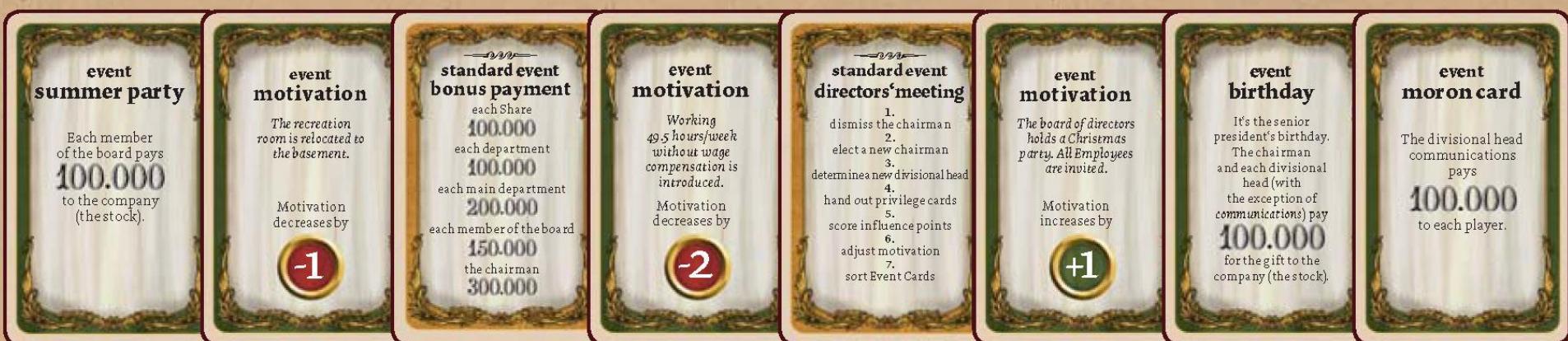
举例说明:绿方作为分区通讯主管,拿着两张标准事件卡片,在洗完所有其他事件卡片后,又拿了6张额外的事件卡片。根据上述规则,绿方按照上图所示的顺序排列卡片。第一个事件是夏季聚会summer party。董事会议牌The directors' meeting 在第5位。
这张牌可以放在右边,但不能放在左边。额外牌在第 3 位,因此会出现在董事会议牌 directors' meeting 之前。
第一阶段:董事会议结束,第二阶段:部门轮换开始。
二:部门回合
一轮次中要进行的部门回合数取决于事件牌“标准事件主任会议”在事件堆中的位置。每轮每轮最少4个,最多7个部门回合。只有分区宣传主管才知道部门回合的确切次数、以及事件的性质和顺序。每个部门回合包括2个步骤:事件步骤和行动步骤。
1. 事件步骤
传播司主管将事件堆中最上面的牌正面朝上。该事件立即发生。下面是一些不同类型事件牌的说明。
提示:将已翻过的事件卡正面朝上摊开,这样每个玩家都能知道发生了多少起事件。
标准事件额外支付事件卡:
这张卡每轮次会出现一次(因为它必须在“董事会议”卡之前出现),结果是向玩家支付如下款项:
每组股份 100,000 比纳特(注意:不是每股!)。
每个部门 100,000 比纳特
每个主要部门 200,000 比纳特
董事会每位经理 150,000 比纳特
董事长 300,000 比纳特
在此事件中,拥有“控制特权卡”的玩家可以根据当前的激励值(见第 13 页,“控制特权卡”),获得更高的部门和主要部门奖金。
注意:在事件堆中,该事件卡必须始终排在事件卡标准事件董事会议之前(见第6页,事件卡排序)。

举例:红方拥有 2 块股票:1 块 1 股和 1 块 4 股。他可以获得 200,000 比纳特。他的 3 个部门可获得 300 000 比纳特,他的 1 个主要部门可额外获得 200 000 比纳特。董事会中的 1 名经理和董事长可获得 150 000 和 300 000 比纳特。总之,红方共获得 1,150,000 比纳特的奖金。
标准事件董事会议事件卡 Standard Event Directors' Meeting Event Card:
当该事件卡牌出现时,本轮次立即结束。不会再有其他行动步骤,新一轮轮次将从另一次“董事会议”开始。董事长特权牌和Bribed Communications(受贿通讯)特权牌(如适用)应在董事会议开始时使用(如果仍然正面朝上)。
注意:该事件卡不得早于事件堆的第5张卡。(见第6页,“事件卡排序”)。
各种激励事件卡:
许多事件卡都会影响激励轨道上的激励标记。根据事件卡上的数值移动“激励”轨道上的“激励标记”:如果是,则向上移动;如果是 ,则向下移动。
注意:大多数事件都会降低激励值。激励值会影响某些特权卡的效果。(见第12页,“特权卡”)。
莫伦 Moron 事件卡:
由于该事件对分区通讯主管不利,他很可能将其放在“标准事件董事会议”事件卡之后,这样就不会被打出。莫伦事件卡的目的是防止所有轮次都由7个部门回合组成。如果这张卡确实被打出,但该部门的通讯主管已经辞职,则不会产生任何影响。仅在此事件中,如果通讯主管没有足够的钱支付其他玩家,其他玩家将从银行获得不足部分。其他事件卡
所有其他事件卡都不言自明。只需按照事件卡上的文字进行行动即可。
注:在事件期间任何玩家如果没有足够资金支付所需款项,只能支付他所拥有的金额。
2. 行动步骤
从控制通讯主管的玩家开始,所有玩家按顺时针顺序轮流执行 1 个行动。
当前执行行动的玩家称为当前玩家。
注意:在第一个部门回合开始时控制通讯主管的玩家在本回合的所有行动步骤中仍然是起始玩家,即使他辞去了通讯主管的职务(参见第9页“辞去主管职务”),或者他的特权牌被贿赂了。
以下是玩家可能采取的 7 种行动:
A) 雇用员工
B) 创建新部门
C) 重组现有部门
D) 辞去部门主管职务
E) 贿赂其他玩家以获得特权卡
F) 在某些能力轨道上获得积分
G) 使用某些特权卡
所有行动的通用规则
· 部门办公室的经理为部门主管。
- 6个部门各有6个部门办公室。
· 在 6 个部门主管办公室(位于部门办公室上方)中的一个办公室任职的经理为部门主管。
· 一个部门有一名部门主管,一个主要部门有两名部门主管。
·一个部门或主要部门的员工不得超过6人。超出部分应归还供应堆。
·一个部门必须至少有1名员工。如果一个部门没有员工,该部门会立即关闭,经理会返回玩家的供应堆。
- 主部门可以在没有员工的情况下存在。
· 在创建新部门或移动部门或主部门时,一定要占据分区最上面的空缺职位。一旦某个部门办公室出现空缺,同一分区中位于其下方的任何现有部门或主要部门都应向上移动。
行动步骤中的行动
A) 雇用员工
当前玩家可以使用 1 个行动从供应堆中抽取 2 名员工,并将他们分别安置在他拥有部门或主部门的任一部门办公室(相同或不同)中。人力资源 Human Resources 特权卡可以从供应堆中提供额外的员工,具体取决于当前的激励值(参见第 15 页,“人力资源特权卡”)。
注意:切记始终遵守上述“所有行动的通用规则”,包括每个部门或主要部门最多6名员工。

举例说明:绿方雇佣了 2 名新员工,将他们从供应堆移动到游戏版图上现有的两个部门。
B) 创建新部门
当前玩家可以使用 1 个行动来(1)用现有员工创建 2 个新部门,或(2)用新员工创建 1 个新部门:
- 创建 2 个新部门,其中员工已经在游戏版图上:
当前玩家可以使用 1 个行动创建 2 个新部门,方法是从任何现有部门和 / 或主要部门中提取任意数量的员工,并将其放入 2 个空缺的部门办公室。他必须在每个新成立的部门至少安排 2 名员工。
然后,当前玩家从他的供应堆中为每个新创建的部门更换 1 名员工和 1 名经理,并将被更换的员工归还给供应堆。
注意:切记始终遵守上述“所有行动的通用规则”,包括每个部门或主要部门最少1名员工,最多6名员工。

举例说明:绿方从现有部门中共抽调 7 名员工,将其中 5 名安排在最上面的空缺会计部办公室,2 名安排在最上面的空缺法律和专利部办公室。然后,他用供应堆中的 1 名经理来替换这些新建部门中的各 1 名员工(将他们归还给供应堆)。由于绿方在发展部的部门办公室没有员工,因此需要关闭该办公室,并将该办公室的经理归还给绿方的供应堆。
2. 用新员工创建一个新部门:
当前玩家可以使用 1 个行动来创建 1 个新部门,方法是从供应堆中抽取 1 名经理和 1 名员工,并将他们都安置在自己选择的 1 个空缺部门办公室中。然后,他可以从现有部门和 / 或主要部门中抽取任意数量的员工,并将他们安置在新创建的部门中。人力资源特权卡可以根据当前的激励值从供应堆中提供额外的员工(见第 15 页,“人力资源特权卡”)。
注意:切记始终遵守上述“所有行动的通用规则”。
C) 重组部门
当前玩家可以使用 1 个行动: (1) 将 1 或 2 个部门或 1 个主要部门移动到另一个分区, 或 (2) 创建 1 个新的主要部门。 1. 将部门或主要部门移动到另一个分区:
当前玩家可以使用一次行动将其控制的 1 个或 2 个现有部门或 1 个主要部门转移到另一个分区,方法是将选定部门办公室中的所有经理和员工转移到他所选择的另一个分区的空缺部门办公室中。任何部门或主要部门的员工人数在移动前后必须保持不变。
注意:切记始终遵守上述“所有行动的通用规则”。
2. 创建一个新的主部:
当前玩家可以使用 1 个行动,通过合并来自相同或两个不同分区的 2 个现有部门来创建 1 个主部门。他可以将 2 个部门移动到新的空缺部门办公室,或将 1 个部门移动到部门主管已占用的部门办公室。搬迁部门时,部门经理和所有员工必须一起搬迁。两个部门的主管都留在新成立的主要部门,并发生以下情况:(a) 新成立的主要部门的 2 名员工被调离并返回供应堆,同时还有超过 6 名的额外员工;(b) 新成立的主要部门的 2 名员工被调离并返回供应堆,同时还有超过 6 名的额外员工。(b) 当前玩家因为创建了一个主部门而在主部门轨道上得到 1 分。主部门可以在没有任何员工的情况下存在,并且在游戏过程中不能关闭。
注意:切记始终遵守上述“所有行动的通用规则”。
由于主部门永远不能关闭,玩家可以随时检查主部门轨道是否显示了他的正确分数。它应始终与每位玩家在版图上拥有的主要部门数量一致。


举例:绿方将其最底层的传播部(1名部门主管和3名员工)迁至发展部。两个部门的主管继续留任,并共同组建一个新的主要部门。主部门解雇2名员工,其他4名员工留任。最后,绿方在主要部门的轨道上得到1分。
D) 辞去分区主管职务
当前玩家可以使用 1 个行动让其控制的 1 位分区主管主动辞职,并成为 (1) 董事会成员或 (2) 其辞职分区顾问轨道上的外聘顾问。
无论哪种情况,该分区的特权牌都将失去效力,直到下一次董事会议的第 4 步中再次派发,并应翻面朝下(即使由通过贿赂获得特权牌的其他玩家持有)。
1. 成为董事会成员:
当前玩家可以使用 1 个行动让他的 1 个分区主管辞职,成为董事会成员。该部门主管和当前玩家在同一部门的所有部门主管都会被转移到董事会会议室。主要部门的部门主管仍留在该分区,但当前玩家在该分区控制的所有员工(包括主要部门的员工)都会被解雇并返回供应堆。其他玩家留在该分区的任何部门或主要部门都应上移,以填补空缺的办公室。
如果在此过程中的任何时候,董事会会议室中没有空位给任何新成员,那么董事会会议室中的所有现任成员都会被移到左边,直到有足够的空位给新成员。任何被“解雇”的董事会成员都将返回玩家供应堆。

↓
例证:绿方辞去传播部门主管的职务,加入董事会。他将部门主管以及该部门的两个部门主管调入董事会。他的两个部门中的所有6名员工都返回供应堆。(注:如果绿方在该分区还有一个主要部门,则该部门的部门主管仍留在主要部门,但该部门的任何员工都将返回供应堆)。
董事会议室只有一把空椅子。为了让绿色公司的三位经理都坐得下,董事会的现任成员必须每人向左移动两把椅子。蓝方的经理和红方最左边的经理都被解散,回到各自的供应堆。之后,绿方的3位经理将占据空出的3把椅子。
2. 成为外聘顾问:
当前玩家可以使用 1 个行动让他的 1 位分区主管辞职成为外聘顾问。将选定的分区主管移动到法律顾问轨道上相应分区的区域。玩家可以在法律顾问轨道的每个区域拥有任意数量的顾问。
主要部门的部门主管仍留在该分区,但属于该分区当前玩家的所有其他部门主管和员工(包括主要部门的部门主管和员工)都会被解雇并返回供应堆。


范例:绿方辞去了部门发展主管的职务,成为一名外聘发展顾问。他将部门主管移至顾问轨道上的发展区域。然后,绿方在发展部的所有员工都将返回供应堆(任何不在主要部门的部门主管也将返回供应堆),但主要部门仍然保留。
E) 向其他玩家贿赂来获得特权卡:
当前玩家可以使用 1 个行动来试图贿赂其他玩家获得特权卡。如果第一次尝试失败,当前玩家可以进行第二次尝试。贿赂对象的特权牌可以是正面朝上或反面朝下,并且可能已经在本轮次中通过贿赂获得。通过贿赂获得的面朝上特权卡比分区主管在董事会议上获得的特权卡效果更强。
通过贿赂获得的面朝上特权卡比分区主管在董事会议上获得的特权卡效果更强。
要尝试贿赂,当前玩家要偷偷地在他的贿赂文件夹中放入 50,000 比纳特或更多,然后交给他想要贿赂的玩家。如果被贿赂的玩家有多张特权卡,则当前玩家需要说明贿赂的是哪张特权卡。被贿赂的玩家可以 (1) 接受提议或 (2) 拒绝。无论哪种情况,当前玩家都会在腐败轨道上得 1 分。
1. 接受贿赂:
被贿赂的玩家 (a) 从贿赂文件夹中拿钱,(b) 在腐败轨道上得 1 分(现在双方都在腐败轨道上得了 1 分)。然后,被贿赂的玩家将贿赂文件夹连同特权卡交还给当前玩家,当前玩家将特权卡摆放在他面前,被贿赂的那一半(金色背景)朝向他。例外:如果特权牌在贿赂之前是正面朝下的,新主人也要将其正面朝下。一旦接受贿赂,行动结束,当前玩家不得再进行任何贿赂尝试。
2. 拒绝贿赂:
拒绝贿赂的玩家将“贿赂文件夹”和贿赂的钱一起归还给当前玩家。如果这是当前玩家的第一次贿赂尝试,现在他可以进行第二次贿赂(可选)。如果进行了第2次贿赂尝试,当前玩家不会在腐败轨道上获得第2点(任何一名玩家在此行动中最多只能获得1点腐败点)。当前玩家可尝试贿赂同一张特权牌,或尝试贿赂同一玩家或其他玩家持有的另一张特权牌。第二次贿赂的规则与第一次相同。如果被贿赂的玩家接受贿赂,则按照上文“接受贿赂”的步骤进行。如果被贿赂的玩家拒绝了第二次贿赂,他应该归还贿赂文件夹和钱。贿赂尝试失败。
注: 如果贿赂被拒绝,请参阅下文“因拒绝贿赂而损失的员工”。
因拒绝贿赂而损失员工:
每个在此行动中拒绝贿赂的玩家都会损失一名员工 - 除非 (a) 他收到了第二次贿赂并接受了贿赂,或者 (2) 他在版图上没有员工,在这种情况下,没有员工会被移除。如果玩家拒绝了 2 次贿赂,他仍然只损失 1 名员工。当前玩家从拒绝贿赂的玩家控制的任何部门或主要部门中选择 1 名员工并将其送回供应堆。
注意:切记始终遵守上述“所有行动的通用规则”,包括在没有员工的情况下关闭任何部门。

例如:绿方想贿赂黄方获得控制特权卡。绿方在贿赂文件夹中放入100,000比纳特,然后交给黄方。绿色在腐败轨道上得1分。黄认为金额太低,拒绝了。绿方现在可以尝试第二次贿赂。绿方决定不再贿赂红方控制特权卡,而是贿赂红方董事长特权卡。绿方将装有350,000比纳特的贿赂文件夹交给红方。红方同意并收下了钱。此外,红方在腐败轨道上得到1分。绿方接过董事长特权卡,将卡放在自己面前,并将受贿的那一半对着自己。
最后,由于黄方拒绝了绿方的贿赂,绿方会从黄方的一个部门撤走一名员工。如果这样做导致某个部门没有任何员工,则需要关闭该部门,并将该部门主管交还给黄方供应堆。
F) 在某些能力轨道上获得点数
当前玩家可以使用 1 个行动来获得能力轨道上的点数(或位置)。注意: 玩家不能使用该行动在“腐败”轨道上获得分数。有以下 4 个选项可供选择:
(1) 在 “影响力” 轨道上获得 1 点:
当前玩家从其控制的任何部门和 / 或主要部门中解雇 3 名员工,并在影响力轨道上获得 1 点。被解雇的员工可以来自相同或不同的部门办公室和分区。没有员工的部门需要关闭。
(2) 购买一个新的主要部门:
当前玩家向银行支付 1,500,000 比纳特,然后从供应堆中抽取 2 名经理,并将他们安置在自己选择的任一部门的空缺部门办公室中。此外,他还会在 “主要部门” 轨道上得到 1 分。
(3) 在顾问轨道上购买 1 个外聘顾问位置:
当前玩家向银行支付 2,000,000 比纳特,然后从供应堆中取出 1 个经理人,并将其放置在自己选择的任何分区区域的顾问轨道上。
(4) 购买 1 块股票:
当前玩家购买 1 块股票,每购买 1 块股票就在股票轨道上得 1 分(见下文示例)。
股票块的价格各不相同,取决于所代表的股票数量:
1 股:100,000 比纳特 5 股:900,000 比纳特
2 股:200,000 比纳特 6 股:1,200,000 比那特
3 股:400,000 比那特 7 股:1,600,000 比那特
4 股:600,000 比纳特
会计特权卡可以让当前玩家获得比他支付的更多的股份,具体取决于当前的激励值(见第12页,“会计特权卡”)。
请注意。整块股票的数量有限。一旦一定数量的整块股票缺货,就不能再购买。
例如:绿方以 400,000 比纳特的价格购买了 1 块 3 股的股票,并在股票轨道上获得 3 分。

G) 使用某些特权卡
当前玩家可以使用 1 个行动来使用 “开发” 或 “法律与专利” 特权卡。特权卡的详细说明如下。
游戏结束
游戏只能在第二阶段“部门回合”中结束(不能在第一阶段“董事会议”中结束)。如果某位玩家在第二阶段的回合中获得了4点或更多胜利点数,他应该立即通知其他玩家,并向其他玩家展示他的“敌人”卡(如果适用)。游戏在该轮次(而不是轮次)继续进行,这样每个玩家都有相同数量的行动,然后游戏结束。一旦某玩家宣布他拥有4点或更多胜利点数,那么该“敌人”的胜利点数(如果适用)以后就不能再失去了(即使该“敌人”在能力轨道上的位置在本回合剩余时间内发生了变化)。如果任何其他玩家在本回合结束时也达到4或更多胜利点数(即使他们在本回合中没有宣布),他们也应发出通知,并在适用的情况下出示他们的“敌人”牌。获得胜利分最多的玩家获胜。如果出现平局事件,则由获得胜利点最多的平局玩家获胜。如果还是平局,则平局玩家分享胜利。
注意:对于较长的游戏,将最低胜利点数从 4 个更改为 5 个。
特权卡牌
每张特权卡都有两半:(1) 组织的一半(灰色背景)和 (2) 受贿的一半(金色背景)。玩家可以使用的那一半取决于他获得特权卡的方法:
- 在董事会议的第 4 步中,每位分区主管都会收到本分区的特权卡,而新任董事长则会收到董事长特权卡。以这种方式领取特权卡时,应始终将特权卡正面朝上放在玩家面前,并将分区的一半(灰色背景)朝向玩家。
- 在 “第二阶段:部门回合” 中,可以通过成功贿赂获得特权牌。通过贿赂行动获得的特权牌应(a)放在玩家面前,被贿赂的那一半(金色背景)朝向玩家,(b)与当前玩家获得特权牌之前的位置相同(面朝上或面朝下)。
特权牌的使用:只有在牌面朝上摆放在当前玩家面前时,当前玩家才能使用特权牌。只有在以下两种情况下,才需要将特权牌正面朝下:(a) 在行动 “D) 辞去部门主管”(见第 9 页)中辞去部门主管,或 (b) 事件卡要求这样做。虽然面朝下的特权牌仍可通过贿赂获得,但在下一次董事会议的第 4 步之前,该牌始终面朝下(无效)。
董事长
Chairman

At the beginning of the directors' meeting found 1 new department with an employee.
Bribed
At the beginning of the directors' meeting found 1 new main department without an employee (and score 1 main department point).
在董事会议开始时,你可以创建一个新部门。从供应堆中抽取1名经理和1名员工,将他们安置在你所选部门的空缺部门办公室中。
此外,你还可以从现有部门和 / 或主要部门中抽取任意数量的员工,将他们安置到新创建的部门中。
注意:该特权不能在游戏的第一轮次中使用。
提示:为了帮助你记住使用此特权,请在收到此卡时,将供应堆中的1名员工放在你的董事长旁边。
在董事会议开始时,你可以创建 1 个新的主要部门。从供应堆中抽取 2 名经理,将他们安置到你所选择的分区的空缺部门办公室中。此外,在主要部门轨道上得 1 分。
小贴士:为了帮助你记住使用这项特权,当你使用贿赂行动收到这张牌时,请将你供应堆中的2位经理放在董事长旁边。
会计

如果你在 “F) 在某些能力轨道上获得点数”(见第 11 页)行动中购买了一个股份组,你可能会获得比你所支付的更大的股份组,这取决于当前的激励值:
激励值为 4-6 时无额外股份,
激励值为 2-3 时,增加 1 股
激励值为 0-1 时,增加 2 股
注意:只有你通过此特权获得的整块股票必须仍然可用。你付费购买的股票区段不一定可用。此外,在使用会计特权卡时,0股块被视为价格为0比纳特,可让当前玩家免费获得1或2股块,具体取决于当前的激励值。
Bribed

4-6 1
2-3 2
如果你在 “F) 获得点数” 行动(见第 11 页)中购买了一个股份组,你可能会获得比你所支付的更多的股份组,这取决于当前的激励值:
激励值为 4-6 时,增加 1 股
激励值为 2-3 时,增加 2 股
激励值为 0-1 时,增加 3 股
注意:只有你获得此特权的整块股票必须仍然可用。你付费购买的股票区段不一定可用。此外,在使用会计特权卡时,0股块被视为价格为0比纳特,可让当前玩家免费获得1、2或3股块,具体取决于当前的激励值。

举例说明:蓝方持有一张会计特权牌,该牌的一半朝向分区。在购买股票时,蓝方收到的股票比他实际支付的价格高2股。他支付400,000比纳特(1块3股的价格),从供应堆中拿走1块5股。这样,他就在“股票”轨道上得到5分。注意:3块股票不一定要有,但5块股票一定要有。
管理
Controlling
More money per department / main department upon bonus payment:
motivation amount
5-6 0
3-4 50.000
0-2 100.000
Bribed
More money per department / main department upon bonus payment:
motivation amount
3-6 100.000
2 150.000
0-1 200.000
在额外支付事件(见第7页)中,你可能会根据当前的激励值为你的每个部门和主要部门领取更多的奖金:
激励为5-6时,不增加资金
激励为3-4时,每个部门/主要部门增加50000比纳特
激励为0-2时,每个部门/主要部门增加100,000比纳特
在额外支付事件(见第7页)中,你可能会根据当前的激励值为你的每个部门和主要部门领取更多的奖金:
激励为 3-6 时,每个部门 / 主要部门增加 100,000 比纳特激励为 2 时,每个部门 / 主要部门增加 150,000 比纳特激励为 0-1 时,每个部门 / 主要部门增加 200,000 比纳特
举例说明:在额外支付事件的示例中(见第7页,“额外支付”),红方获得了1,150,000比纳特。假设他的控制特权卡上有被收买的那一半,并且当前的激励值为1,那么红方的3个部门和1个主要部门将额外获得800,000比纳特,总奖金为1,950,000比纳特。
发展

你可以使用行动 “G) 使用某些特权牌”(见第 12 页)从其他玩家手中诱走 1 名员工。从其他玩家控制的任何部门或主要部门中抽取一名员工,并将其安置在自己的任何部门或主要部门中。或者,你也可以从供应堆中抽取一名员工。如果你没有可以带走该员工的部门或主要部门,则无法执行此行动。
注意:切记始终遵守“所有行动的通用规则”(见第8页)。部门可能必须关闭。
Bribed

Use 1 action to entice 3 employee away (from different players).
你可以使用行动 “G) 使用某些特权牌”(见第 12 页)从其他玩家手中诱走 3 名员工。从其他玩家控制的任意 3 个部门或主要部门中抽取 3 名员工,并将他们分别安置在自己的任意一个部门或主要部门中(相同或不同)。你不得从一名玩家处带走超过一名员工。或者,你也可以从供应堆中抽取员工,使员工总数达到 3 名 -- 这样可以让其他玩家免于损失,或在拥有员工的玩家少于 3 名的情况下。如果你的部门或主要部门没有足够的空间接收这些员工,你只能在你能雇用的范围内诱骗走尽可能多的员工。
注意:切记始终遵守“所有行动的通用规则”(见第8页)。部门可能必须关闭。

举例:红方拥有发展特权卡,受贿的那一半朝向他。他使用1个行动来执行该特权。他从蓝、黄、绿所拥有的部门中各抽取一名员工。他将这些员工放入人力资源部。该部门现在有6名员工(允许的最大人数)。
通讯
Communications
Sort the event cards: directors' meeting (only after the 4th card), bonus payment (before the directors' meeting) + 6 further cards.
董事会议结束时,你将对当前部门回合的8张事件卡片进行分类(参见第6页,“分类事件卡片”)。
Bribed
At the beginning of the directors' meeting carry out 1 additional action after the privilege Chairman has been used.
在董事会议开始时,以及在执行董事长特权卡后(如适用),你可以采取一个额外的行动,就像这是你的行动步骤一样(见第8页,“行动步骤”)。
注意:游戏只能在第二阶段“部门回合”中结束(不能在第一阶段董事会议中结束)(见第12页“游戏结束”)。

人力资源
Human Resources
More personnel upon hiring new employees and founding of new departments through new employees motivation personnel
4-6 0
2-3 1
0-1 2
Bribed
More personnel upon hiring new employees and founding of new departments through new employees motivation personnel
4-6 1

2-3 2
0-1 3
在“A)雇用员工”(见第8页)和“B)创建新部门”(使用新员工,见第9页)行动中,你可以从供应堆中获得额外的员工,具体取决于当前的激励值:
激励为 4-6 时,无新增员工
激励为 2-3 时,新增 1 名员工
激励为0-1时,新增2名员工
在“A)雇用员工”(见第8页)和“B)创建新部门”(使用新员工,见第9页)行动中,你可以从供应堆中获得额外的员工,具体取决于当前的激励值:
激励为 4-6 时,新增 1 名员工
激励为 2-3 时,新增 2 名员工
激励为 0-1 时,新增 3 名员工

举例说明:绿方有一张人力资源特权牌,受贿的那一半朝向他。他使用行动“创建新部门”创建了一个新部门,并增加了新员工。当前的激励值为1,因此绿方又得到了3名新员工。他将供应堆中的1名经理和4名员工转移到会计部最上面的空缺职位。
法律与专利
Legal & Patents
Use 1 action to dismiss 1 employees to score 1 influence point.

你可以使用行动 “G) 使用某些特权卡”(见第 12 页)解雇 1 名员工,以便在影响轨道上得 1 分。从你拥有的任何部门或主要部门中抽出一名员工,并将其放回供应堆。然后,在影响轨道上将你的标记移高 1 点。只有当你有一名员工需要解雇时,你才可以执行此行动。
注意:切记始终遵守“所有行动的通用规则”(见第8页)。部门可能必须关闭。
Bribed
Use 1 action to dismiss 2 employees to score 2 influence point.

你可以使用行动 “G) 使用某些特权卡”(见第 12 页)解雇 2 名员工,以便在影响轨道上得 2 分。从你拥有的任何部门或主要部门(相同或不同)中抽取 2 名员工,并将他们放回供应堆。然后,将你的标记在 “影响力” 轨道上移动 2 点。你只能在有员工可解雇的情况下执行此行动。
注意:切记始终遵守“所有行动的通用规则”(见第8页)。部门可能必须关闭。

举例说明:红方拥有法律与专利特权卡,被收买的那一半朝向他。红方使用 1 个行动来执行这张特权卡。他从版图上的部门中将 2 名员工移至供应堆。然后他在影响轨道上得 2 分。
常见问题解答
问:如果我通过成功贿赂获得了一张分区特权牌,之后控制该分区主管的玩家在行动中辞职,我还能在本轮剩余时间内使用特权牌被贿赂的一面吗?
答:不可以。在相关分区主管辞职后,分区特权牌将立即翻转面朝下,直到下一次董事会议的第4阶段才会翻转回来。
问:如果我在法律顾问轨道上的 3 个不同分区中有 1 名顾问,那么如果我的敌方在法律顾问轨道上的一个分区中有 3 名顾问,我是否算是在法律顾问轨道上击败了他们?
答:不是。要在法律顾问轨道上击败你的对手,你需要比他们拥有更多的顾问。他在法律顾问轨道上所在的分区无关紧要。
问:在游戏过程中,我什么时候可以将员工从一个部门移动到另一个部门?
答: 已在版图上的员工只有在下列情况下才允许移动到新创建的部门: (a) 行动 “B 创建新部门” (见第 8 页) 或 (b) 部门半张董事长特权卡 (见第 12 页, “董事长特权卡”)。
(见第 8 页) 或 (b) 董事长特权卡 (见第 12 页, “董事长特权卡”) 的 “部门” 部分。
问:游戏在某人宣布获得 4 点胜利点数的部门回合结束时结束。如果我在本回合行动后获得了第 4 点胜利点数,例如在接受贿赂时在贪污轨道上获得了一点胜利点数,会发生什么情况?我在本回合结束时是否仍有机会获胜,还是需要等到下一回合的下一个行动时才能宣布我的 4 点胜利点数?
答:你在本回合结束时获胜的唯一方法是,在其他玩家的回合中,其他玩家在同一部门回合中申报了 4 点胜利点数。如果出现这种情况,游戏就会在该回合结束时结束,所有拥有 4 点或更多胜利点数的玩家(包括宣布获得 4 点胜利点数的玩家)都有机会赢得游戏(见第 12 页,“游戏结束”)。但是,如果在这个游戏回合中没有玩家宣布获得 4 点胜利点数,那么你就必须等到下一个回合才能宣布获得 4 点胜利点数并触发游戏结束。这可能是在接下来的第二阶段,如果你在本回合没有得到另一个回合的话。
Thanks goes to......
..... the */friends of bauldric/*, without their intercontinental experiences the game wouldn't be created.
Further: Stefan Schlößer, Robin Clemens, Martin Bickel, Nicole & Tommy Schulze, Holger Lamm, Roland Caspari, Jörg Wagner, Martina & Roman Thielemann, Daniela & Réné Seifert, Sylvia & Michael Ziegler, Muriel Hautefeuille, Torsten Richter, Sebastian Joussen, Irmi aus Starnberg, Annette & Sebastian Kirch, Natalie Hammerich & Wolfgang Hatzack, Andi Gassmann, Jens Dreiling, Sandra & Andreas Spörl, Ives Müller aka Sven Glückspilz, Gabriela & Helmut Grundei, Paula & Frank Bleckmann & Söhne, Pasquale Innominato, Simon Schutz, Uli Nigl, the Thiel-Bande, the Obermayer-Clan and my Sausemaus :-)
Thanks to all the play testers: Sabine Wendler, Steffen König, Thomas Papendieck, Jan van der Burg, Ignacio Garro, Marc Espenhain, Björn Heumann, Christian Schulze, Mirko Radowitz, Ina & Jan-Hendrik Frerichs, Alexander Mann-Wahrenberg, David Zeman, Paula & Olli Vogel, Elias Anderson, Volker Schwägerl, Detlev Beiderbeck, Irene Müller, Christa & Danyel Jaquet, Thomas Hoche, Nico Steiner, Marion & Nico & Lukas Bogatzki, Thor aus Augsburg, Martin Guddat, Sandra & Thomas Falke, Lukas Barucha, Matthias Wiendl, Michael Hilbert, Robert Müller, the Spieleclub Hoechst and many more.
Special Thanks to Helmut Fennel, Norbert Ehmer, Helge Landgraf, Roland Lehmer, Armin Vogt, Udo Judaschke, Robert Gutwein, Peter Schubert, Thomas Knapp, Torsten Kerz, Martin Griesser, Bernd Schneebauer, Alexander Schlick and Cyrus Kerkekhah.
Last but not least thanks to the "Gaming-Pros" Alexander Zbiek of Brettspielwelt, Frank Deutschendorf & Michael Matuszczak of Hippodice Spieleclub e.V., Bernadette Becker & Andreas Buhlmann of Cliquenabend.de, Klaus Ottmaier from Köln, Ralph Querfurth from Stuttgart, Heike & Michael López- Pelke from Essen, Friedemann Friese & Maura Kalusky from Bremen and of course Martina & Peter Eggert, Philipp El Alaoui, Wolf Wittenstein & Tobias Stapelfeldt of Eggertspiele.

Impressum
Author: Bauldric & Friends
Illustrations: Frédéric Bertrand
Layout: Maura Kalusky
Editors: Anthony Linforth & Kent Neumann
© eggertspiele GmbH & Co KG, Hamburg 2009
www.eggertspiele.com
下载 MarkdownPower Struggle English Rules 2.0.1.md
POWER TRUGGLE
| Game Components | 02 | |
| Set Up | 03 | |
| 03 | ||
| Object of the Game Initial Appointment Round 03 | ||
| Round Sequence | ||
| 04 | ||
| I: Directors' Meeting 04 | ||
| II: Department Turns 07 | ||
| Actions During the Action Step 08 End of the Game | ||
| 12 12 | ||
| Privilege Cards Frequently Asked Questions 16 |
POWER TRUGGLE
A game for 3-5 managers who are willing to take risks. Ages 12+ by Bauldric & Friends
Game Overview
Welcome to the world of the powerful, of those who pull the right strings at the right time from the shadows of the big companies. Each player becomes one of these people, trying to increase their power and influence by hiring Employees, creating New Departments and taking over the sought-after positions of Divisional Heads to procure influence and privileges. Divisional Heads can resign to join the Board of Directors (in the hopes of becoming the Chairman, of course) or get hired as an External Consultant. All the while, players are investing in stocks and bribing other players to make their way to the top.
The more cleverly you go about it, the sooner you will achieve the object of the game: scoring 4 out of 6 possible Victory Points.
Table of Contents
Game Components
③ 26 Event cards consisting of: • 2 standard events • 24 other events
⑤ 11.Archenemy cards consisting of: • 5 Archenemy Color cards • 6 Archenemy Competence cards
⑥ 100 notes of money (Pinats) consisting of: • 20 notes of 50,000 Pinats each • 30 notes of 100,000 Pinats each • 30 notes of 200,000 Pinats each • 20 notes of 500,000 Pinats each
⑦ 21 Blocks of Shares consisting of:
• 3 Blocks of 7 Shares costing 1,600,000 Pinats each • 3 Blocks of 6 Shares costing 1,200,000 Pinats each • 3 Blocks of 5 Shares costing 900,000 Pinats each • 3 Blocks of 4 Shares costing 600,000 Pinats each • 3 Blocks of 3 Shares costing 400,000 Pinats each • 3 Blocks of 2 Shares costing 200,000 Pinats each • 3 Blocks of 1 Share costing 100,000 Pinats each
⑧ 110 managers, 22 of each of the 5 player colors
⑨ 60 Employees (gray cubes)
⑩ 5 Bribe Folders, 1 in each player color
11 1 Motivation Marker

Set Up.
-
Place the game board on the playing surface.
-
Place the Motivation Marker on space 6 of the Motivation track.
-
Place the Event cards and Employees (forming the supply) within easy reach next to the game board.
-
Sort the Blocks of Shares according to the number of Shares they represent and place them next to the game board. f playing with 5 players use all the Blocks of Shares, with 4 players remove one of each of the 1 Share to 5 Share Blocks and with 3 players use only two of each Blocks of Shares (one to seven).
Note: Blocks of Shares are the only items in the game that are limited in number.
-
Sort the money according to its value and place it next to the game board forming the Bank. Select one person to be the Banker. The Banker should give each player 800,000 Pinats as starting money. During the game each player may keep the amount of money he has secret unless, during an event, he has to pay more money than he actually possesses. In this case the player must disclose this to the other players and pay as much as he can.
-
Each player should take: 1 Bribe Folder, 1 Quick Guide and the 22 Managers in a color of their choice.
-
Shuffle the Archenemy Color cards of the participating player colors and deal 1 of them face down to each player. Then shuffle the Archenemy Competence cards (in a game with 3 or 4 players, first remove the 1 or 2 cards accordingly marked) and deal 1 of those cards face down to each player. A player may look at their own 2 Archenemy cards at anytime, but cannot show them to the other players. Return any unused Archenemy cards to the game box without looking at them. 8. Shuffle all seven Privilege cards face down and randomly deal them face up, as equally as possible, to all players (one or more players will be dealt 1 Privilege card more than the other players). The player who receives the Communications Privilege card becomes the starting player.
Note: The number of Managers and Employees available in the game is unlimited. On the rare occasion that the supply is exhausted, use coins or anything else for the missing items. This does not apply to Blocks of Shares, however, those are limited!
Object of the Game
The Object of the Game is to be the first player to gain at least 4 Victory Points. There are 6 ways to gain a Victory Point:
-
Getting at least 7 points on the Influence track,
-
Getting at least 18 points on the Shares track,
-
Getting at least 4 points on the Main Department track,
-
Getting at least 9 points on the Corruption track,
-
Getting at least 1 Consultant in at least 3 different Divisions on the Counsel track,
-
Beating your Archenemy.
Competence Tracks
There are 5 different competence tracks at the top of the game board. They are (1) Influence, (2) Shares, (3) Main Departments, (4) Corruption and (5) Counsel. During the game a player can collect points in competence tracks 1-4 and move Consultants to the Counsel track. Players should use their Manager figures to show their respective points for each track. Points scored on the competence tracks can never be lost. As soon as a player reaches the first green space on a track (or 1 Consultant in at least 3 different Divisions on the Counsel track), he has scored the Victory Point for that particular competence. Each player can only score 1 VP in each competence.
If a player's point marker reaches the highest value of a competence track that has a golden space, he cannot gain any more points for this competence. He may, however, continue to carry out actions that would gain him points for this competence, but these points will simply be ignored.
Archenemy
Each player will be dealt 2 Archenemy cards: 1 Color card indicating which player is their Archenemy and 1 Competence card with 3 of the 5 competence tracks listed (note: Experience = Counsel). See p. 12,“End of the Game" for more information on when a player may declare the Archenemy Victory Point.
• If a player has a Color card of another player, he gains the Archenemy Victory Point for beating his Archenemy if he has more points (or in the case of the Counsel track, more Consultants) than the player on his Color card in all 3 competences indicated on his Competence card.
• If a player has his own Color card, he gains the Archenemy Victory Point if he has more points (or in the case of the Counsel track, more Consultants) than all other players in 2 out of the 3 competences on his Competence card.
• To score the Archenemy Victory Point, a player just needs to have more points in the appropriate competence tracks (a) at the end of the game or (b) when he declares that he has 4 or more Victory Points (see p. 12,“End of the Game“). He does not need to reach any minimum level. For a player to beat his Archenemy on the Counsel (Experience) track, he just needs to have more total Consultants on the Counsel track. It does not matter which Division(s) the Consultants are located in.
Attention: In connection with the Archenemy Victory Point, if a player's point marker reaches the highest value on a competence track that has a golden space, it álways counts as having more points than all other players. For example, if both Red and Blue reach a golden space, Red is considered to have more points than Blue and Blue is considered to have more points than Red in that competence for purposes of their Archenemy Victory Point. This does not apply to the Counsel track.
Initial Appointment Round
Beginning with the starting player and continuing in clockwise order, each player appoints 1 Manager (as described below). Then, beginning with the player sitting to the right of the starting player and continuing in counter-clockwise order, each player appoints a second Manager. Finally, beginning once again with the starting player and continuing in clockwise order, each player appoints a third Manager. At the end of this initial appointment round, each player will have a total of 3 Managers on the game board. Note: Privilege cards cannot be used during this initial appointment round.
There are 2 ways to appoint a Manager during this initial appointment round: (1) as a member of the Board of Directors or (2) as a Department Head.
-
As a member of the Board of Directors in the Board Room. When a Manager is placed in the Board Room, he should always occupy the leftmost vacant chair. If at any time during this initial round (or during the game), all 5 chairs in the Board Room are already occupied and a player wants to add an additional Manager to the Board Room, all members of the Board of Directors are moved 1 chair to the left. As a result, the leftmost Manager is pushed out of the Board Room and returned to the appropriate player's supply. The rightmost chair in the Board Room is now available for the new member of the Board.
-
As a Department Head in a Department Office of a Division of his choice. When a Manager is placed in a Department Office, he should always occupy the topmost vacant Office of the selected Division (note: do not place any Managers in any of the Divisional Heads' Offices). In addition, the player should add 3 Employees from the supply to the Department Office where the Manager has been placed.

Example: In a game with four players, Blue is the starting player, followed in clockwise order by Yellow, Green, and Red. Blue starts by placing 1 Manager in the Board Room ①. Then Yellow places 1 Manager in the topmost vacant office of the Communications Division ② and adds 3 Employees from the supply. Then Green places 1 Manager in the topmost vacant office of the Development Division 3 and also receives 3 Employees from the supply. At the end of the first turn Red places 1 Manager in the Board Room ④.
Now, the second turn starts. This time, Red begins with a Department Office for Human Resources ⑤. Green, Yellow, and Blue follow. The third turn begins once again with Blue, followed by Yellow, Green, and Red. The illustration shows the game board after the initial appointment round has been finished.
Round Sequence
After the initial appointment round, the game continues over several Rounds, each made up of 2 stages: Stage I: Directors'Meeting and
Stage II: Department Turns (4 minimum, 7 maximum).
I: Directors' Meeting
Each Directors' Meeting consists of the following 7 steps to be carried out in this other:
-
Dismiss the Chairman
-
Appoint a new Chairman
-
Determine new Divisional Heads
-
Hand out Privilege Cards
-
Score Influence Points
-
Adjust the Motivation Marker
-
Sort Event Cards
1. Dismiss the Chairman
The Chairman is dismissed each Round. Return the Manager in the Chairman's Office to the appropriate player's supply. This step does not apply during the 1st Round of the game.
Note: After the 1st Round, the Chairman and/or the Bribed Communication Privilege card may be used (if face up) during this step (see p. 12,“Privilege Cards’).
2. Appoint a new Chairman
The player with the most Managers on the current Board of Directors provides the new Chairman. In the event of a tie, the tied player whose Manager is furthest to the left in the Board Room wins. The player who provides the new Chairman takes his leftmost Manager in the Board Room and places it in the Chairman's Office. Other Managers in the Board Room move to the left until there are no vacant chairs between them.

If there are no Managers in the Board Room, the player with the Chairman Privilege card (face up or face down) provides the new Chairman from his supply in the Chairman's Office.
Example: Red, having the most Board Members, moves his leftmost Board Member to the Chairman's Office and then Yellow and Red move their Board Members to the left filling the vacant chair.
Tip: Place an Employee from the supply next to the Chairman to help remember to use the Chairman Privilege card at the beginning of the next Directors'Meeting.
3. Determine new Divisional Heads
Determine the Divisional Heads for all 6 Divisions of the Round. Start on the left with the Development Division and proceed from left to right through the Controlling Division. The player with the most Department Heads in a Division provides the new Divisional Head. A Main Department (a Department Office with 2 Managers) counts as 2 Department Heads. Managers currently serving as Divisional Heads do not count. In the event of a tie, the tied player with the most Employees in that Division wins. If there is still a tie, the tied player with a Department Head located in an office closest to the top of the Division wins. If there are no Department Heads in a Division, the player with the Privilege card of the Division (face up or face down) provides the new Divisional Head. The followino 3 situations are possible:
A) There is no current Divisional Head
The player who provides the new Divisional Head takes a Manager from his supply and places it in the Divisional Head's office.
B) The current Divisional Head and the new Divisional Head belong to the same player
Nothing further happens. The Divisional Head remains in his office.
C) The new Divisional Head is provided by a player other than the owner of the current Divisional Head
The player who owns the current Divisional Head must decide whether to move the Divisional Head to the Board Room (in the leftmost vacant chair) or to the appropriate Division's space on the Counsel track (becoming a Consultant). If moved to the Board Room and there are no vacant chairs, all Managers on the Board of Directors are moved 1 chair to the left with the leftmost Manager being dismissed and returned to the appropriate player's supply. The rightmost chair in the Board Room is now available for the new member of the Board. The player providing the new Divisional Head then takes a Manager from his supply and places it in the Divisional Head's office.
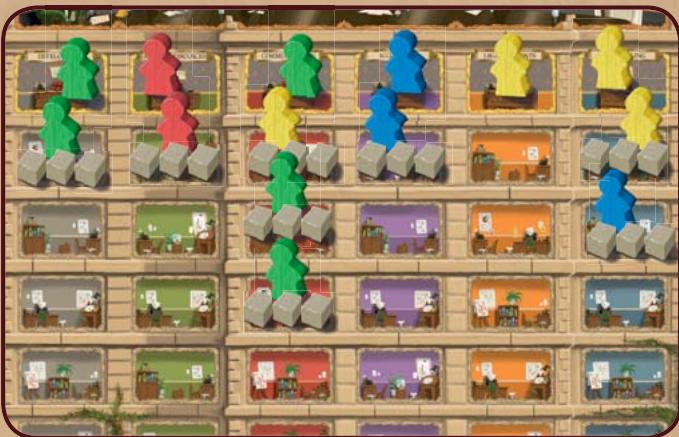
Example: From left to right, Green, having the most Department Heads in the Development Division, takes a Manager from his supply and places it in the Divisional Head's Office. Red does the same for the Human Resources Division. Green has two Department Heads compared to Yellow's one so Green provides the Divisional Head in Communications. Blue provides the Divisional Head in Accounting. Legal & Patents has no Department Heads, but Yellow has the corresponding Privilege Card and therefore provides the Divisional Head for this division. Blue and Yellow are tied in the Controlling Division (for both Department Heads and Employees) but Yellow is in the Department Office closest to the top, so Yellow provides the Divisional Head.
4. Hand out Privilege Cards
After all Divisional Heads have been appointed, hand out the appropriate Privilege cards to the player who has the Divisional Head for each Division. The Chairman Privilege card goes to the player whose Manager is in the Chairman's Office. Players should lay the Privilege cards face-up in front of them with the Division half (gray background) facing them. There is a detailed description of the Privilege cards starting on p. 12 under“Privilege Cards”.

Example: In the above example Red receives the Chairman and Human Resources Privilege Cards, Green receives the Development and Communications Privilege Cards, Blue gets the Accounting Privilege Card, and Yellow the Legal & Patents and Controlling Privilege Cards. They all lay the Privilege Cards face up in front of them with the gray Division half facing them.
5. Score Influence Points
The Chairman now earns 2 points and each Manager on the Board of Directors earns 1 point on the Influence track. Adjust the players' point markers on the Influence track as appropriate.

Example: In the above example on p. 5, Red receives 3 points on the Influence track, Blue and Yellow get 1 point each on the Influence track.
6. Adjust the Motivation Marker
Place the Motivation Marker on space 6 of the Motivation track
7. Sort Event Cards
The Divisional Head of Communications uses his Privilege card. First, he takes all Event cards and removes the “Standard Event Directors'Meeting” card and the “Standard Event Bonus Payment card from the stack. He then shuffles the remaining Event cards face down, draws 6 from the top without showing them to the other players and sorts them with the “Standard Event Directors'Meeting” card and the “Standard Event Bonus Payment card arranging them in any order of his choice following the two rules below. This determines the sequence in which the Event cards will appear during Stage Il: Department Turns.
The following two rules apply to the order of these 8 cards:
1.the“Standard Event Bonus Payment” card must appear before the“Standard Events Directors'Meeting" card and
- the“Standard Event Directors'Meeting" card must appear as the 5th or later Event card.
The number of Event cards before the “Standard Event Directors'Meeting” card determines the number of Department Turns that will be played this Round – as few as 4 and as many as 7. Place the 8 sorted cards in a face-down Event Stack. During the Department Turns Stage, the player who set the sequence of the Event cards may look at the stack at any time, but the sequence may not be changed once initially set. A detailed description of the Event cards starts on p. 7 under“Event Step"
Tip: While sorting the Event cards, place the Event card that is to be turned up first to the back of the stack so it will e on the top of the Event Stack when placed face down.

Example: Green, as Divisional Head of Communications, takes the two Standard Event Cards and, after shuffling all other Event Cards, 6 additional Event Cards.
Following the rules above, Green sorts the cards in the sequence illustrated above. The first event is the summer party. The directors'meeting card is in the 5th position.
It could have been placed farther to the right, but not to the left. The bonus card is in the 3d position and will therefore appear before the directors'meeting card.
Stage I: Directors' Meeting is now over and Stage II: Department Turns begins.
II: Department Turns
The number of Department Turns to be played in one Round depends on the position of the Event card “Standard Event Directors'Meeting" in the Event Stack. There will be at least 4 and at most 7 Department Turns each Round. Only the Divisional Head of Communications will know the precise number of Department Turns, as well as the nature and sequence of the events. Each Department Turn consists of 2 steps: the Event Step followed by the Action Step.
1. Event Step
The Divisional Head of Communications turns the top card of the Event Stack face up. This event happens immediately.
Below is a description of some of the different types of Event cards.
Tip: Fan out the Event cards that have already been turned face up so each player can always tell how many events have taken place.
Standard Event Bonus Payment Event Card:
This card will come up once each Round (as it must appear prior to the “Directors'Meeting” card) and results in money being paid to the players as follows:
100,000 Pinats for each Block of Shares (Attention: not for each Share!)
100,000 Pinats for each Department
200,000 Pinats for each Main Department
150,000 Pinats for each Manager on the Board of Directors
300,000 Pinats for the Chairman
During this event, the player with the Controlling Privilege card may receive a higher bonus for Departments and Main Departments, depending on the current Motivation Value (see p. 13,"Controlling Privilege Card“).
Note: This Event card must always precede the Event card Standard Events Directors'Meeting in the Event Stack (see p. 6,“Sort Event Cards“).

Example: Red owns 2 Blocks of Shares: 1 Block of 1 Share and 1 Block of 4 Shares. He gets 200,000 Pinats for them. His 3 Departments earn 300,000 Pinats and his 1 Main Department an additional 200,00 Pinats. For 1 Manager on the Board of Directors and the Chairman he receives 150,000 + 300,000 Pinats. Altogether, Red receives a total bonus payment of 1,150,000 Pinats.
Standard Event Directors'Meeting Event Card:
When this Event card appears, the Round ends immediately. No further Action Steps take place and a new Round begins with another Directors' Meeting. The Chairman Privilege card and, if applicable, the Bribed Communications Privilege card should be used at the beginning of the Directors' Meeting if stll face up.
Note: This Event card must not be earlier than the 5th card of the Event Stack. (see p. 6,“Sort Event Cards“).
Various Motivation Event Cards:
Many Event cards impact the Motivation Marker on the Motivation track. Move the Motivation Marker on the Motivation track according to the value given on the Event card: up in case of a, down in case of a.
Note: Most events decrease the Motivation Value. The Motivation Value influences the effects of certain Privilege cards. (see p. 12,“Privilege Cards“).
Moron Event Cards:
Since this event is a disadvantage for the Divisional Head of Communications, he is likely to place it after the “Standard Event Directors'Meeting” Event card so it does not get played. The Moron Event card is designed to prevent all Rounds from being made up of 7 Department Turns. If this card does get played but the Divisional Head of Communications has already resigned, it has no affect. During this event only, if the Divisional Head of Communications has insufficient money to pay the other players, the other players receive the shortfall from the Bank.
Other Event Cards
All further Event cards are self-explanatory. Simply follow the text on the Event cards.
Note: During an event, any player who has insufficient funds to make a required payment pays only as much as he has.
2. Action Step
Starting with the player who controls the Divisional Head of Communications and proceeding in clockwise turn order, all players take turns carrying out 1 Action.
The player who is currently carrying out an action is called the current player.
Note: The player who controls the Divisional Head of Communications at the beginning of the first Department Turn remains the starting player for all Action Steps of the Round, even if he resigns as Divisional Head of Communications (see p. 9, “Resigning as Divisional Head“) or if he is bribed for his Privilege card.
Below are the 7 possible Actions for a player to perform:
A) Hiring Employees
B) Creating New Departments
C) Restructuring Existing Departments
D) Resigning as Divisional Head
E) Bribing Other Players for Privilege Cards
F) Gaining Points on certain Competence tracks
G) Using certain Privilege Cards
General Rules for all Actions
• A Manager placed in a Department Office is a Department Head.
• There are 6 Department Offices located in each of the 6 Divisions.
• A Manager placed in one of the 6 Divisional Heads' offices (located above the Department Offices) is a Divisional Head.
• There is 1 Department Head to a Department and 2 Department Heads to a Main Department.
• No more than 6 Employees can be in a Department or Main Department. Any excess should be returned to the supply.
• A Department must have at least 1 Employee. In the event that a Department has no Employees, the Department is closed immediately and the Manager is returned to the player's supply.
· A Main Department can exist with no Employees.
• When creating a new Department or moving a Department or Main Department, always occupy the topmost vacant office of the Division. As soon as a Department Office becomes vacant, any existing Departments or Main Departments in the same Division that are below it should be moved up.
Actions During the Action Step
A) Hiring Employees
The current player can use 1 Action to take 2 Employees from the supply and place each of them in any Department Office(s) (same or different) where he has a Department or a Main Department. The Human Resources Privilege card may provide additional Employees from the supply, depending on the current Motivation Value (see p. 15,“Human Resources Privilege Card“).
Note: Remember to always follow the “General Rules for all Actions” listed above including a maximum of 6 Employees per Department or Main Department.

Example: Green hires 2 new Employees by moving them from the supply to two of his existing Departments on the game board.
B) Creating New Department(s)
The current player can use 1 action to either (1) create 2 new Departments with his existing Employees or (2) create 1 new Department with new Employees:
- Create 2 new Departments with Employees already on the game board:
The current player can use 1 Action to create 2 new Departments by taking any number of Employees from any of his existing Departments and/or Main Departments and placing them in 2 vacant Department Offices. He must place at least 2 Employees in each of the newly created Departments.
The current player then replaces 1 Employee with 1 Manager from his supply in each of the newly created Departments and returns the replaced Employees to the supply.
Note: Remember to always follow the “General Rules for all Actions” listed above including a minimum of 1 Employees per Department and a maximum of 6 Employees per Department or Main Department.

Example: Green takes a total of7 Employees from his existing Departments and places 5 of them in the topmost vacant Accounting Department Office and 2 in the topmost vacant Legal & Patents Department Office. He then replaces 1 Employee from each of these newly created Departments (returning them to the supply) with 1 Manager from his supply. Since Green's Department Office in Development has no Employees, it needs to be closed and the Manager in that office is returned to Green's supply.
2. Create 1 new Department with new Employees:
The current player can use 1 Action to create 1 new Department by taking 1 Manager and 1 Employee from the supply and placing them both in 1 vacant Department Office of his choice. He may then take any number of Employees from his existing Departments and/or Main Departments and place them in the newly created Department. The Human Resources Privilege card may provide additional Employees from the supply, depending on the current Motivation Value (see p.15,"Human Resources Privilege Card“).
Note: Remember to always follow the “General Rules for all Actions” listed above.
C) Restructuring Departments
The current player can use 1 action to either (1) move 1 or 2 Departments or 1 Main Department to another Division or (2) create 1 new Main Department.
1. Moving Departments or a Main Department to another Division:
The current player can use 1 action to move 1 or 2 existing Departments or 1 Main Department under his control by taking all Managers and Employees from the selected Department Office(s) and placing them in vacant Department Office(s) in another Division of his choice. The number of Employees in any Departments or Main Departments must remain the same before and after the movement.
Note: Remember to always follow the “General Rules for all Actions" listed above.
2. Creating 1 new Main Department:
The current player can use 1 action to create 1 Main Department by merging 2 of his existing Departments from the same or two different Divisions. He can either move 2 Departments to a new vacant Department Office or move 1 Department to a Department Office already occupied by his Department Head. When moving a Department, the Manager and all Employees from the Department must be moved together. Both Department Heads remain in the newly created Main Department and the following occurs: (a) 2 Employees from the newly founded Main Department are removed and returned to the supply, along with any additional Employees in excess of 6 and (b) the current player scores 1 point on the Main Department track for creating a Main Department. Main Departments can exist without any Employees and cannot be closed during the game.
Note: Remember to always follow the“General Rules for all Actions" listed above.
Since Main Departments can never be closed, a player can always check if the Main Department track shows his correct score. It should always correspond to the number of Main Departments each player has on the game board.
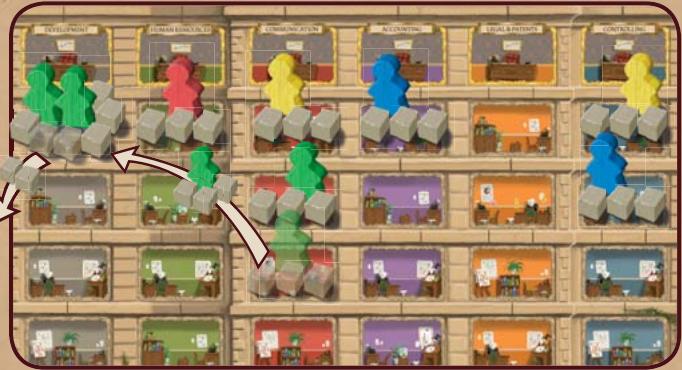

Example: Green moves his lowest CommunicationsDepartment (1 Department Head and 3 Employees) to his Development Department. Both Department Heads remain and jointly form a new Main Department. 2 Employees are fired from the Main Department and the other 4 Employees remain. Finally, Green scores 1 point on the Main Department track.
D) Resigning as Divisional Head
The current player can use 1 action to have 1 Divisional Head that he controls resign voluntarily and become either (1) a member of the Board of Directors or (2) an External Consultant on the Counsel track for the specific Division he resigned from.
In either case, the Privilege card for this Division will lose its validity until it is handed out again in step 4 of the next Directors'Meeting and should be turned face down (even if held by a different player who obtained it through a bribe).
1. Becoming a member of the Board of Directors:
The current player can use 1 Action to have 1 of his Divisional Heads resign to become a member of the Board of Directors. The Divisional Head and all of the current player's Department Heads in the same Division are moved to the Board Room. Department Heads in Main Departments remain in the Division but all Employees controlled by the current player in this Division (including those in Main Departments) are fired and returned to the supply. Any Departments or Main Departments of other players remaining in this Division should be moved up to fll any empty offices.
If at any point in the process there are no vacant chairs available in the Board Room for any new members, all current members in the Board Room are moved to the left until there are enough vacant chairs for the new members. Any "dismissed" members of the Board are returned to the players' supply.

Example: Green resigns as Divisional Head of Communications to join the Board of Directors. He moves the Divisional Head, along with both of the Department Heads in Departments of that Division, to the Board of Directors. All 6 Employees in his two Departments are returned to the supply. (Note: If Green also had a Main Department in this Division, the Department Heads there would remain in the Main Department but any Employees from there would be returned to the supply).
There is only 1 vacant chair in the Board Room. In order to fit all 3 of Green's Managers, the current members of the Board each have to move 2 chairs to the left. Blue's Manager and Red's leftmost Manager are both dismissed and returned to their respective supplies. Afterwards Green's 3 Managers occupy the 3 vacant chairs.
2. Becoming an External Consultant:
The current player can use 1 Action to have 1 of his Divisional Heads resign to become an External Consultant. Move the selected Divisional Head to the appropriate Division's space on the Counsel track. Players can have any number of Consultants on each space of the Counsel track. Department Heads of Main Departments remain in the Division but all other Department Heads and Employees belonging to the current player in this Division (including those in Main Departments) are fired and returned to the supply.


Example: Green resigns as Divisional Head of Development to become an External Consultant for Development. He moves the Divisional Head to the Development space on the Counsel track. All of Green's Employees in Development are then returned to the supply (as would any Department Heads not in Main Departments), but the Main Department remains.
E) Bribing other players for Privilege Cards:
The current player can use 1 Action to attempt a bribe to acquire a Privilege card from another player. A second attempt can be made by the current player if the first attempt is unsuccessful. The Privilege card that is the target of the bribe can be face-up or face-down and may have already been acquired through bribery during this Round. A face-up Privilege card acquired through a bribe has a stronger effect than one acquired by a Divisional Head during a Directors' Meeting.
To attempt a bribe, the current player secretly puts 50,000 Pinats or more in his Bribe Folder and hands it over to the player they wish to bribe. If the player being bribed has several Privilege cards, the current player needs to specify which Privilege card he is making an offer for. The player being bribed can either (1) accept the offer or (2) reject it. In either case, the current player scores 1 point on the Corruption track.
1. Accepting the Bribe:
The player being bribed (a) takes the money from the Bribe Folder and (b) scores 1 point on the Corruption track (both players have now scored 1 point on the Corruption track). Then the player being bribed returns the bribe folder together with the Privilege card to the current player who lays out the Privilege card in front of him with the Bribed half (golden background) facing him. Exception: If the Privilege card was face down before the bribe, the new owner places it face down as well. Once a bribe is accepted, the Action ends and the current player may not make any further bribery attempts.
2. Declining the Bribe:
The player refusing the bribe returns the Bribe Folder together with the offered money to the current player. If this was the current player's 1st bribe attempt, he may now make a 2nd bribe attempt (optional). If a 2nd bribe attempt is made, the current player does not score a 2nd point on the Corruption track (a maximum of 1 Corruption point can be obtained by any one player during this Action). The current player may attempt a bribe for the same Privilege card or try for another Privilege card held by the same or another player. This second attempt follows the same rules as the first. If the player being bribed accepts it, follow the steps above under “Accepting the Bribe.“ If the player being bribed declines this 2nd offer, he should return the Bribe Folder and money. The bribery attempt has failed.
Note: If a bribe was declined, see “Loss of Employee(s) for Declining a Bribe" below.
Loss of Employee(s) for Declining a Bribe:
Each player who declinèd a bribe attempt during this Action loses 1 Employee – unless (a) he received a 2nd bribe attempt and accepted it or (2) he has no Employees on the board, in which case, no Employee is removed. If a player declines 2 bribery attempts, he still only loses 1 Employee. The current player chooses 1 Employee from any Department or Main Department controlled by the declining player(s) and returns it to the supply.
Note: Remember to always follow the“General Rules forall Actions" listed above including the closing of any Departments without Employees.

Example: Green would like to bribe Yellow for the Controlling Privilege Card. Green places 100,000 Pinats in his bribe folder and hands it over to Yellow. Green scores 1 point on the Corruption track. Yellow, considering the amount to be too low, declines.
Green may now attempt a second bribe. Green decides not to try for the Controlling Privilege Card again, but instead bribes Red for the Chairman Privilege Card. Green hands over his bribe folder with 350,000 Pinats in it. Red agrees and takes the money. In addition, Red scores 1 point on the Corruption track. Green receives the Chairman Privilege Card and lays it out in front of himself with the bribed half of the card facing him.
Finally, Green removes 1 Employee from one of Yellow's Department Offices, since Yellow declined his bribe. If this leaves a Department without any Employees, the Department would need to be closed and the Department Head would be returned to Yellow's supply.
F) Gaining Points on certain Competence Tracks
The current player can use 1 Action to gain points (or a position) on one of the Competence tracks. Note: A player cannot gain points on the Corruption track using this Action.
The following 4 options are available:
(1) Gain 1 point on the Influence track:
The current player dismisses 3 Employees from any Departments and/or Main Departments he controls and, in exchange, gains 1 point on the Influence track.
The dismissed Émployees may come from the same or different Department Offices and Divisions. Any Departments without Employees need to be closed.
(2) Purchase 1 new Main Department:
The current player pays 1,500,000 Pinats to the Bank and then takes 2 Managers from his supply and places them in a vacant Department Office of any Division of his choice. Additionally, he scores 1 point on the Main Department track.
(3) Purchase 1 External Consultant position on the Counsel track:
The current player pays 2,000,000 Pinats to the Bank and then takes 1 Manager from his supply and places it on the Counsel track in any Division space of his choice.
(4) Purchase 1 Block of Shares:
The current player purchases 1 Block of Shares and scores 1 point on the Shares track for each Share in the Block he bought (see example below).
The Blocks come at different prices, depending on the number of Shares they represent:
1 Share: 100,000 Pinats 5 Shares: 900,000 Pinats
2 Shares: 200,000 Pinats 6 Shares: 1,200,000 Pinats
3 Shares: 400,000 Pinats 7 Shares: 1,600,000 Pinats
4 Shares: 600,000 Pinats
The Accounting Privilege card may allow the current player to acquirea larger Block of Shares than he pays for, depending on the current Motivation Value (see p.
12,“Accounting Privilege Card“).
Note. The number of Blocks of Shares is limited. Once Blocks of a certain size are out of stock, they can no longer be purchased.

G) Using certain Privilege Cards
The current player can use 1 action to use the Development or the Legal& Patents Privilege card. A detailed description of the Privilege cards is below.
End of the Game
The game can end only during Stage II: Department Turns (not during Stage I: Directors' Meeting). If, during a player's turn in Stage Il, he scores 4 or more Victory Points, he should immediately let the other players know and, if applicable, show the other players his Archenemy cards. The game continues for that turn (not Round) so that every plaver has the same number of Actions and then the game ends, Once a plaver announces that he has 4 or more Victory Points, the Archenemy Victory Point (if applicable) cannot later be lost (even if the Archenemy's position on the Competence tracks changes during the remainder of this turn). If any other player has also reached 4 or more Victory Points by the end of the turn (even if they did not announce it during their turn), they should also give notice and, if applicable, show their Archenemy cards. The player who has scored the most Victory Points wins the game. In the event of a tie, the tied player with the most money wins the game. If there is still a tie, the tied players share the victory.
Note: For a longer game, change the minimum from 4 Victory Points to 5 Victory Points.
Privilege Cards
Each Privilege card has two halves: (1) the Division half (gray background) and (2) the Bribed half (golden background). The half that can be used by a player depends on the method by which he acquired the Privilege card:
- During step 4 of a Directors'Meeting, each Divisional Head receives the Privilege card for his Division and the new Chairman receives the Chairman Privilege card. When received in this manner, the Privilege card should always be placed face-up in front of the player with the Division half (gray background) facing them. 2. During Stage Il: The Department Turns, a Privilege card can be obtained through a successful bribe. A Privilege card obtained using a bribery action should be placed in front of the player (a) with the Bribed half (golden background) facing them and (b) in the same position (face up or face down) as it was immediately prior to its acquisition by the current player.
Use of Privilege cards: A Privilege card can only be used by the current player if the card is laid out face up in front of him. A Privilege card needs to be turned face down only in the following two instances: (a) resigning as Divisional Head during Action “D) Resigning as Divisional Head" (see p. 9) or (b) an Event card requires it. Although the face-down Privilege card can still be obtained in a bribe, it remains face down (and invalid) until step 4 of the following Directors'Meeting.
Chairman
Chairman
At the beginning of the directors' meeting found 1 new department with an employee.
At the beginning of the Directors' Meeting you may create 1 new Department. Take 1 Manager and 1 Employee from the supply and place them in a vacant Department Office in a division of your choice. In addition, you may take any number of Employees from your existing Departments and/or Main Departments and place them in the newly created Department.
Note: This priviledge can not be used in the 1st Round of the Game.
Tip: To help remember to use this privilege, place 1 Employee from the supply next to your Chairman when you receive this card.
Bribed
At the beginning of the
directors' meeting found i new
main department without
an employee (and score
1 main department
point).
At the beginning of the Directors'Meeting you may create 1 new Main Department. Take 2 Managers from your supply and place them in a vacant Department Office in a division of your choice. In addition, score 1 point on the Main Department track.
Tip: To help remember to use this privilege, place 2 of your Managers from your supply next to the Chairman when you receive this card using the Bribe action.
Accounting

If you purchase a Block of Shares during the Action “F) Gaining Points on certain Competence tracks" (see p. 11), you may receive a larger Block of Shares than you pay for, depending on the current Motivation Value:
no additional Shares at Motivation Value 4-6
1 additional Share at Motivation Value 2-3
2 additional Shares at Motivation Value 0-1
Note: Only the Block of Shares you receive with this privilege must still be available. The Block of Shares you pay for does not have to be available. In addition, when using the Accounting Privilege Card, a 0 Share Block is considered to have a price of 0 Pinats and could allow the current player a Block of 1 or 2 Shares for no cost depending on the current Motivation Value.
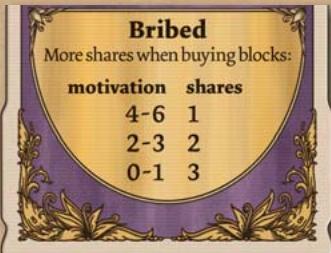
If you purchase a Block of Shares during the Action “F) Gaining Points" (see p. 11), you may receive a larger Block of Shares than you pay for, depending on the current Motivation Value:
1 additional Share at Motivation Value 4-6
2 additional Shares at Motivation Value 2-3
3 additional Shares at Motivation Value 0-1
Note: Only the Block of Shares you receive with this privilege must still be available. The Block of Shares you pay for does not have to be available. In addition, when using the Accounting Privilege Card, a 0 Share Block is considered to have a price of 0 Pinats and could allow the current player a Block of 1, 2 or 3 Shares for no cost depending on the current Motivation Value.
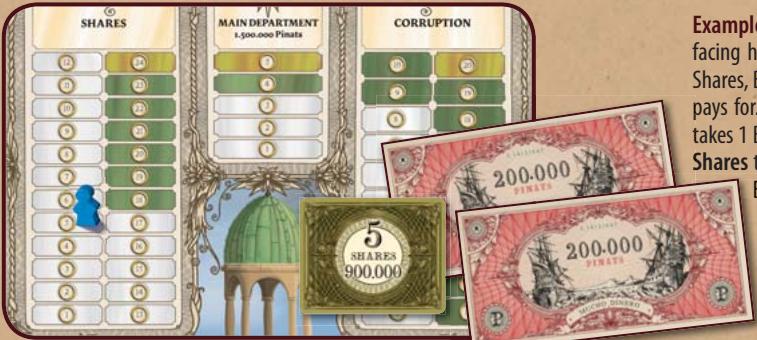
Example: Blue has the Accounting Privilege Card with the Division half facing him. The current Motivation Value is 1. When buying a Block of Shares, Blue receives a Block that is 2 Shares higher than what he actually pays for. He pays 400,000 Pinats (the price for 1 Block of 3 Shares) and takes 1 Block of 5 Shares from the supply. He then scores 5 points on the Shares track. Note: The Block of 3 Shares need not be available, but the Block of 5 Shares must be.
Controlling
Controlling
More money per department/main department upon bonus payment: motivation amount
5-6 0
3-4 50.000
0-2 100.000
Bribed
More money per department/ main
department upon bonus payment:
motivation amount
3-6 100.000
2 150.000
0-1 200.000
You may receive more money for each of your Departments and Main Departments during the Bonus Payment event (see p. 7) depending on the current Motivation Value:
no additional money at Motivation 5-6
50,000 additional Pinats per Department/Main Department at Motivation 3-4
100,000 additional Pinats per Department/Main Department at Motivation 0-2
You may receive more money for each of your Departments and Main Departments during the Bonus Payment event (see p. 7) depending on the current Motivation Value:
100,000 additional Pinats per Department/Main Department at Motivation 3-6
150,000 additional Pinats per Department/Main Department at Motivation 2
200,000 additional Pinats per Department/Main Department at Motivation 0-1
Example: In the example for the Bonus Payment event (see p. 7, "Bonus Payment'") Red receives 1,150,000 Pinats. Assuming that he had the Controlling Privilege Card with the Bribed half facing him, and the current Motivation Value had been 1, Red would have received an additional 800,000 Pinats for his 3 Departments and 1 Main Department, for a total bonus of 1,950,000 Pinats.
Development

You may use the Action “G) Using certain Privilege Cards" (see p. 12) to entice 1 Employee away from another player. Take 1 Employee from any Department or Main Department controlled by another player and place it in any of your own Departments or Main Departments. Alternatively, you may take an Employee from the supply. If you have no Departments or Main Departments that can take the Employee, you cannot carry out this Action.
Note: Remember to always follow the “General Rules for all Actions” (see p. 8). A Department may have to be closed.

You may use the Action “G) Using certain Privilege Cards” (see p. 12) to entice 3 Employees away from the other players. Take 3 Employees from any 3 Departments or Main Departments controlled by other players and place each of them in any of your own Departments or Main Departments (same of different). You may not take more than 1 Employee from a single player. Alternatively, you may take Employees from the supply to reach a total of 3 Employees—either to spare other players or in the event that less than 3 players own Employees. If there is not enough room in your Departments or Main Departments to take these Employees, you may only entice away as many Employees as you can employ.
Note: Remember to always follow the “General Rules for all Actions” (see p. 8). A Department may have to be closed.

Example: Red has the Development Privilege Card with the Bribed half facing him. He uses 1 Action to execute this Privilege. He takes 1 Employee each from Departments owned by Blue, Yellow, and Green. Those he places in his Department in Human Resources. That Department now has 6 Employees (the maximum permitted).
Communication
Communications
Sort the event cards:
directors' meeting (only
after the 4th card), bonus
payment (before the
directors' meeting)
+ 6 further cards.
At the end of the Directors' Meeting, you will sort the 8 Event cards for the current Department Turns (see p. 6, "Sorting Event Cards’.)
Bribed
At the beginning of the directors' meeting carry out 1additional action after the privilege Chairman has been used.
At the beginning of the Directors' Meeting and, if applicable, after the Chairman Privilege card has been executed, you may take 1 additional Action, as if this was your Action step (see p. 8, "action step').
Note: The game can end only during Stage Il: Department Turns (not during Stage I: Directors' Meeting) (see p. 12, “End of the Game“).
Human Resources
Human Resources
More personnel upon hiring new employees and founding of new
departments through new employees
motivation personnel
4-6 0
2-3 1
You may receive additional Employees from the supply during the Actions "A) Hiring Employees“ (see p. 8) and “B) Creating new Departments“ (with new Employees, see p. 9), depending on the current Motivation Value:
0-1 2
no additional new Employees at Motivation 4-6
1 additional new Employee at Motivation 2-3
2 additional new Employees at Motivation 0-1
Bribed
More personnel upon hiring new employees and founding of new departments through newemployees motivation personnel
4-6 1
2-3 2
0-1 3
You may receive additional Employees from the supply during the Actions "A) Hiring Employees“ (see p. 8) and “B) Creating new Departments“ (with new Employees, see p. 9), depending on the current Motivation Value:
1 additional new Employee at Motivation 4-6
2 additional new Employees at Motivation 2-3
3 additional new Employees at Motivation 0-1

Example: Green has the Human Resources Privilege card with the Bribed half facing him. He uses the action "Creating new Departments" to create 1 new Department with new Employees. The current Motivation Value is 1, so Green receives 3 additional new Employees. He moves 1 Manager and 4 Employees from the supply to the topmost vacant office in the Accounting Division.
Legal & Patents
Legal & Patents
Use 1 action to dismiss 1 employees to score 1 influence point.
You can use the Action “G) Using certain Privilege Cards"(sèe p. 12) to dismiss 1 Employee in order to score 1 point on the Influence track. Take 1 Employee from any Department or Main Department you own and return it to the supply. Then, move your marker 1 point higher on the Influence track. You may only carry out this action if you have an Employee to dismiss.
Note: Remember to always follow the “General Rules for all Actions” (see p. 8). A Department may have to be closed.
Bribed
Use 1 action to dismiss 2 employees to score 2 influence point.
You can use the Action “G) Using certain Privilege Cards" (see p. 12) to dismiss 2 Employees in order to score 2 points on the Influence track. Take 2 Employees from any Departments or Main Departments (same or different) you own and return them to the supply. Then, move your marker 2 points higher on the Influence track. You may only carry out this action to the extent that you have Employees to dismiss.
| INFLUENCE |

Example: Red has the Legal & Patents Privilege card with the Bribed half facing him. Red uses 1 Action to execute this Privilege card. He removes 2 Employees from his Department on the game board to the supply. Then he scores 2 points on the Influence track.
Frequently Asked Questions
Q: If I acquire a Division Privilege card through a successful bribe attempt and thereafter, the player controlling the Divisional Head of that Division resigns during their action, can I still use the Bribed side of the Privilege card for the remainder of the Round?
A: No. Division Privilege cards are turned face down immediately upon the resignation of the applicable Divisional Head and not turned back up until stage 4 of the following Directors' Meeting.
Q: If I have 1 Consultant in 3 different Divisions on the Counsel track, am I considered to be beating my Archenemy in the Counsel track if they have 3 Consultants in a single Division on the Counsel track?
A: No.To beat your Archenemy on the Counsel track, you need to have more total Consultants then they have. The Division(s) they are in on the Counsel track is irrelevant.
Q: When am I permitted to move Employees from one department to another during the game?
A: Employees that are already on the board are only permitted to be moved to a newly created Department when using (a) Action “B Create New Department(s)" (see p. 8) or (b) the Division half of the Chairman Privilege card (see p. 12,“Chairman Privilege Card“).
Q: The game ends at the end of the Department turn in which someone declares 4 Victory Points during their turn. What happens if I gain my 4th Victory Point after my action this turn, for example by gaining a point on the corruption track when accepting a bribe? Do I still have a chance to win at the end of this turn or do I need to wait úntil my next action on the following turn in order to declare my 4 Victory Points?
A: The only way you can win at the end of this turn is if, during their turn, another player declares 4 Victory Points in that same Department turn. If that occurs, then the game will end at the end of that turn and all players with 4 or more Victory Points (including the player who declared 4 Victory Points) have a chance to win the game (see p. 12,“End of the Game“). However, if no player declares 4 Victory Points in this game turn, then you will have to wait until your next turn to declare your 4 Victory Points and trigger the end of the game. This could be in the following Stage Il if you do not get another turn this round.
Thanks goes to.....
.... the */friends of bauldric/*, without their intercontinental experiences the game wouldn't be created.
Further: Stefan Schlößer, Robin Clemens, Martin Bickel, Nicole & Tommy Schulze, Holger Lamm, Roland Caspari, Jörg Wagner, Martina & Roman Thielemann, Daniela & Réné Seifert, Sylvia & Michael Ziegler, Muriel Hautefeuille, Torsten Richter, Sebastian Joussen, Irmi aus Starnberg, Annette & Sebastian Kirch, Natalie Hammerich & Wolfgang Hatzack, Andi Gassmann, Jens Dreiling, Sandra & Andreas Spörl, Ives Müller aka Sven Glückspilz, Gabriela & Helmut Grundei, Paula & Frank Bleckmann & Söhne, Pasquale Innominato, Simon Schutz, Uli Nigl, the Thiel-Bande, the Obermayer-Clan and my Sausemaus :-)
Thanks to all the play testers: Sabine Wendler, Steffen König, Thomas Papendieck, Jan van der Burg, Ignacio Garro, Marc Espenhain, Björn Heumann, Christian Schulze, Mirko Radowitz, Ina & Jan-Hendrik Frerichs, Alexander Mann-Wahrenberg, David Zeman, Paula & Olli Vogel, Elias Anderson, Volker Schwägerl, Detlev Beiderbeck, Irene Müller, Christa & Danyel Jaquet, Thomas Hoche, Nico Steiner, Marion & Nico & Lukas Bogatzki, Thor aus Augsburg, Martin Guddat, Sandra & Thomas Falke, Lukas Barucha, Matthias Wiendl, Michael Hilbert, Robert Müller, the Spieleclub Hoechst and many more.
Special Thanks to Helmut Fennel, Norbert Ehmer, Helge Landgraf, Roland Lehmer, Armin Vogt, Udo Judaschke, Robert Gutwein, Peter Schubert, Thomas Knapp Torsten Kerz, Martin Griesser, Bernd Schneebauer, Alexander Schlick and Cyrus Kerfekhah.
Last but not least thanks to the “Gaming-Pros“ Alexander Zbiek of Brettspielwelt, Frank Deutschendorf & Michael Matuszczak of Hippodice Spieleclub e.V., Bernadette Becker & Andreas Buhlmann of Cliquenabend.de, Klaus Ottmaier from Köln, Ralph Querfurth from Stuttgart, Heike & Michael López- Pelke from Essen, Friedemann Friese & Maura Kalusky from Bremen and of course Martina &Peter Eggert, Philipp El Alaoui, Wolf Wittenstein & Tobias Stapelfeldt of Eggertspiele.

Impressum
Author: Bauldric & Friends
Illustrations: Fréderic Bertrand
Layout: Maura Kalusky
Editors: Anthony Linforth & Kent Neumann
© eggertspiele GmbH & Co KG, Hamburg 2009
www.eggertspiele.com
下载 Markdown