inglese.md
HORSE FEVER
Way back in 1928, the greatest horse race gambler of his time, called “the Boss”, decided to build a new racetrack in the city of Horseburg to help crown his successor. The world's best gamblers came from around the globe to accept his challenge, putting their honor at stake to contend for the title of “Best Gambler Ever!”


First player card

Sandglass token

Sprint Dice

Victory Point (V.P.)

Bet tokens

Loan cards
Stable Owner cards
Horse cards
Goal cards
Assistant cards
Action cards
Character cards
Horse pawns

Movement cards
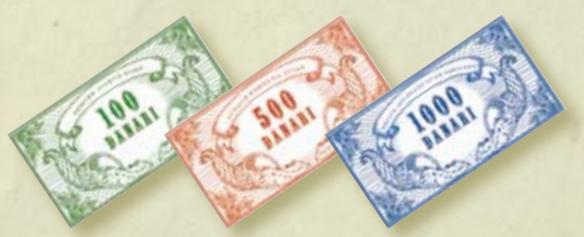
Banknotes
CONTENT
1 Track board
106 Cards
23 Movement cards
22 Action cards
13 Assistant cards
14 Goal cards
10 Horse cards
6 Stable Owner cards 6 Loan cards 12 Character cards
1 First Player card
6 Horse pawns
125 Banknotes
75 100 Danari banknotes
25 500 Danari banknotes
25 1000 Danari banknotes
63 Tokens
24 Bet tokens
32 Victory Point tokens
1 Sandglass token
6 Stable tokens
2 Sprint Dice
Rulebook
| NUMBER OFPLAYERS | NUMBEROF TURNS |
| 2 | 6 |
| 3 | 6 |
| 4 | 4 |
| 5 | 5 |
| 6 | 6 |
Turns number Table

| PLAYERSNUMBER | NUMBER OF BET TOKENSFOR COLOR |
| 2 | 1 |
| 3 | 2 |
| 4 | 3 |
| 5 | 4 |
| 6 | 4 |
Bet Tokens Table
| DIECOLOR | WINNINGPLAYER |
| Green | THE PLAYER WHOMISS MORE DIOPTERS |
| Blue | THE HEAVIESTPLAYER WINS |
| Red | THE PLAYER WITH THE MOSTPIMPLES ON HIS FACE WINS |
| Black | THE SMALLEST PLAYER WINS |
| White | THE PLAYER WHO CAN MAKETHE MOST PUSH-UPS ON ONEHAND WINS |
| Yellow |
THE GAME
OBJECT OF THE GAME
Each player is a wealthy bettor, determined to be recognized as the most skillful horse race wagerer and earn the title of “Best Gambler Ever”.
Over a pre-determined number of Rounds, the players try to guess the best bets to gain Victory Points (VP) and Danari (the money used in Horse Fever). The player with the most VP is the winner.
Horse Fever offers two different ways to play:
▲ The Family Game: designed for less experienced players, to help them become familiar with the basic game dynamics. You will manage your horse stable, fix races, bet, and collect Victory Points.
▲ The Board Game: the “complete” version of the game, for experienced players. You will manage your Stable, buy Horses, hire Assistants and compete for secret Goals. There are many winning strategies, but there is only one objective: to become the Best Gambler Ever.
THE FAMILY GAME
SET UP
▲ Place the Racetrack board in the center of the table.
▲ Put the banknotes where everyone can see them. This spot is the “Bank". The player closest to the Bank is the appointed Banker who will be in charge of managing the Danari (in short: D).
▲ Place all the VPs on the table near the Banker. This will be the "VP pool".
▲ Each player receives one starting VP from this pool.
▲ Take the Action cards, Movement cards, Stable Owner cards, and Character cards. All the other cards are not used in the Family Game.
▲ Remove all cards with a star symbolfrom these decks.
▲ Shuffle all four decks separately.
▲ Place the Movement cards face down on the Blackboard.
▲ Place the Action cards face down beside the Racetrack.
▲ Take a number of Bet tokens of each color as shown on Bet Tokens table and put them in a handy place for all players. These form the “Bet token pool”.
▲ Shuffle the 6 Stable tokens and place them randomly one at a time onto the Blackboard, in the Odds spaces starting with the lowest Odds (1:7) up to the highest (1:2).
Each player randomly draws a Character card and places it face-up in front of him. The players look up their Character's skill from the rules booklet (see page 11) and receive the initial amount of Danari. The remaining Character cards are placed back into the game box.
▲ Throw a Šprint Die and check the result on the Tie-breaker table, to determine the First Player. The First Player will then take the First Player card and both Sprint Dice.
▲ The Hourglass token is placed on the Turn Indicator's first space.
▲ Place the six Horse pawns on the Racetrack in the lane that matches their color.
GAME OVERVIEW:
The game runs clockwise starting with the First Player for a variable number of Rounds depending on the number of players (see the table).
At the end of each Round, the First Player card is passed clockwise. During a game each player will be the First Player at least once.
Each Round consists of four phases:
Deal Phase, Betting Phase, Race Phase, End of Round Phase.
1.0 DEAL PHASE
The First Player deals out two cards from the Action card deck, face down, to each player. You must not show your cards to the other players!

2.0 BETTING PHASE
In this Phase the players make their bets and “fix” the upcoming race.
2.1 FIRST BETS
Starting with the First Player and continuing in clockwise order, each player must make a bet on a Horse, honoring the value of the Minimum Bet.
THE ODDS X
At any time during the game each Stable token is given odds that can be 1:2, 1:3, 1:4, 1:5, 1:6, or 1:7 (to be read as: one to two, one to three etc.….).
The odds indicate how fast the Horse of each Stable is. The Horses of Stables with high odds will probably run faster then those with lower odds.
When we talk about “High Odds"” we refer to the three highest odds on the Blackboard (1:2, 1:3, and 1:4), i.e., those which have a higher chance of winning the races. On the contrary, “Low Odds” refer to the three lowest odds on the Blackboard (1:5, 1:6, and 1:7).
In the course of the game the odds of the Stables will change, and it is possible that more than one Stable token will have the same odds (thus empty Odds spaces on the Blackboard are possible).
THE MINIMUM BET
The minimum amount that a player may bet is called the “Minimum Bet” and is equal to the number of VPs he owns at that moment multiplied by 100.
Important: if any player does not have enough D to cover his Minimum Bet, he must lose two VPs. If he does not have those two VPs he forfeits the game.
The player decides which Horse he wishes to bet on and takes a Bet token of the same color from the pool, if there are any available. Each Bet token is two-sided showing two kinds of bet -Win or Show. Each Bet token is two-sided showing two kinds of bet -Win or Show
Then the player decides how much he wants to stake on the chosen Horse, remembering to honor the Minimum Bet.
He puts the Danari in front of him and places the Bet token right on top of them, with the side for the chosen type of bet face up.
BET TO WIN & BET TO SHOW
G
A “Bet to Win” is a Bet that will pay out only if the selected Horse finishes the race in first place. If you succeed on a Bet to Win, you will gain 3 VPs and Danari based on the Odds for the Stable you bet on.
A “Bet to Show” is a Bet that will pay out if the selected Horse finishes the race in first, second, or third place. If you succeed on a Bet to Show, you will get 1 VP and the Danari you bet will double, regardless of the odds for that Stable.
2.2 FIXING THE RACE
Starting again with the First Player and proceeding clockwise, each player must play one of his Action cards, face down.
Continue playing Action cards until all players have played all their Action cards. Important: You may not save them for the following Race!
All Action cards are always placed face down on the Horse you wish to influence.
They may be played on any Horse, and there is no limit to the number of Action cards that can be played on the same Horse.
2.3 SECOND BETS
Starting with the last player to bet (the player to the First Player's right) and going in counter-clockwise order, all players may place a second bet.
Important: During the second Bet, the First Player is the last to choose his stake.
The Minimum Bet must still be honored when placing these Bets.
You may choose not to place a second Bet, and simply pass.
It is possible that one player may bet twice on the same Horse; this is allowed, but in that case one Bet has to be “to Win”, and the other “to Show”.
HORSE STABLES O
When we refer to Stables and Horses we refer to the Stable tokens and Horse
pawns.
Each Stable token represents one of the six Stables in the game and is associated with a Horse pawn of the same color. We remind you that in Horse Fever the players are represented neither by a color nor by the pawns, but they are simply the bettors standing along the racetrack.
THE MININIMUM BET
if a player has 5 VPs, his Minimum Bet
is 500 D, i.e., each Bet he makes must be at least 500 D.

BET
James takes a red Bet token, he puts 200D in front of him and places the Bet token on them with the “to Show” side
So, he has bet 200 D on the red Horse “to Show”.

SECOND BETS
Adam's frst Bet is on Red to Win, his second Bet can be on Red to Show, but not on Red to Win.

The red and green Stables are rated 1:2, and the yellow one 1:3. The Movement card shows the number 4 next to the Odds 1:2, while the number next to the Odds 1:3 is 2. The Horse pawns of the green and red Stables each move forward 4 squares, while the yellow one moves forward 2 squares.
ORDER OF ARRIVAL
At the end of a Race round, the red, blue and green Horses have cut the Finish Line. The red Horse has run through more spaces beyond the Finish Line, so it arrived before the other two and is moved to the Ranking in the second place (the first place has already been conquered by the black Horse in a previous Race Round).
3.0 RACE PHASE
3.1 REVEAL THE ACTION CARDS
All the Action cards played on the Horses are turned face-up. You must check the effects of each card and apply any that take effect before the Race.
3.2 THE RACE
During a race the Horse pawns are moved, which represent the horse running in its particular lane.
The Race consists of a series of consecutive Race Rounds until all the Horse pawns are placed in the ranking, i.e.: until all Horses have crossed the Finish Line.
Each Race Round consists of revealing a Movement card, and then rolling the Sprint Dice.
3.3 RACE RoUNDs
The First Player reveals the top card from the Movement card deck and places it in the matching space on the Blackboard.

Each card has a string of numbers from 0 to 4, related to the different odds, which determine how far the Horses move.
The Horses can move in any order. For game purposes all movement is considered to be simultaneous.
After moving all the Horse pawns as indicated by the Movement card, the First Player rolls both Sprint Dice and applies their effect (see page 5).
The Movement
3.4 THE RANKING
At the end of each Race Round, check if there are any Horse pawns that have reached or crossed the Finish Line. If so, they are to be considered to have “finished".
Horses that have finished are moved to the Ranking on the Blackboard: The first Horse that finishes is placed on the Blackboard on the space for No. 1 in the Ranking, the second on the No. 2 square and so on. If at the end of a Race Round more than one Horse has “finished", their placement order is determined following the Finish Line and Photo Finish rules. If some of the Horses have not yet crossed the Finish Line, another Race Round is played. Only the Horses still on the track continue to move; the Horses already on the Ranking don't move any further during this race. Once all Horses have crossed the Finish Line, the race is over and it's time for the payoff! Finish Line

START& SPRINT
G
Start:The Start of a Race is the first Movement card that is revealed.
Sprint: After all horse movement dictated by the Movement card has been carried out, the First Player rolls both Sprint Dice.
The colors on the dice show which Horse pawns get to sprint. When a Horse sprints, the pawn moves forward one more square (even if the horse has just reached or crossed the Finish Line). If both dice show the same color, that color Horse pawn still only moves one square. If the dice show the color of a Horse that is already placed on the Ranking, that sprint is lost with no effect.
FINISH LINE & PHOTO FINISH
Finish Line: The Finish Line is the striped row of spaces on the Racetrack. Each Horse reaching or crossing the Finish Line is considered to have “finished”.
The Horses moving some squares beyond the Finish line are considered to have “finished earlier” than the others for ranking purposes. The squares beyond the Finish Line are to be considered infinite.

Photo Finish: Should one or more Horses cross the Finish Line by the same number of squares, check who wins this tie by means of the “Photo Finish:" If two Horses are tied, the winner is the one with the higher odds. If their Stables have the same odds, the First Player decides the ranking order for those Horses.
3.5 PAYOFFS
Starting with the First Player and proceeding clockwise, the Banker determines which Bets players won and which they lost. He takes any Danari from Bets that have been lost (and puts them in the Bank!) and gives the players their gains according to the stakes made on winning bets. The Banker then gives the related VPs and any cash prizes won by the Stable owners (600 D to the Stable ranking first, 400 D to the second, and 200 D to the third).
3.6 NEW OrDER OF Odds
Once the payoffs have been completed, the new order of odds will have to be determined by comparing the initial Odds of each Stable and the final Horse rankings from the race. The Odds of each Stable can change in three ways:
If the Horse is placed higher in the Ranking than the Stable token of the same color, the token goes up one Odds row.
If the Horse is placed lower in the Ranking than the Stable token of the same color, the token goes down one Odds row.

If the Horse is placed as high in the Ranking as the Stable token of the same color, the token remains in the same Odds row. Start from the Horseranked first to avoid any mix-ups.
4.0 END OF ROUND PHASE
New order of Odds
All the Action cards and Movement cards are shuffled back into their respective decks. The Horse pawns are placed back on the starting spaces of the Racetrack. 'The First Player hands the First Player card and the Sprint Dice to the player on his left. The Hourglass is moved on to the next space. If the last Round is now over, the game ends. Otherwise, a new Round begins with the Deal Phase.
4.1 THE END OF THE GAME
The winner is the player with the highest number of VPs.
In case of a tie, the winner is the tied player with the highest amount of Danari; if there is still a tie, roll a die and compare the result with the Tie-breaker table (see page 2 ).
PAYOFFS
James Bets 200 D on the red Horse to Win (1:4), and 300 D on the blue (1:5) Horse to Show.
At the end of the race, the red Horse is in rst place and blue Horse is in third place. James has won both the Bets. James receives from the Bank 800 D (200 x 4) and 3 VP for the Bet to Win. He also receives 600 D (300 x 2) and 1 VP for the Bet to Show.
Important: Remember that the Danari that are used for the bet count as property of the Bank and not the player! Win or lose, you don’t get those Danari back.


THE BOaRd GaME
To play the Board Game, you need to know the rules of the Family Game. All the rules of the Family Game also apply to the Board Game, except for the additional rules and small variations described below.
SET UP
Follow the same set up procedure for the Family Game, with the following changes:
▲ Place the Action, Assistant, Horse, Stable Owner, Goal, and Loan card decks, face down, beside their corresponding spaces on the Racetrack.
▲ The cards marked with a star are optional. We recommend that you remove them for your first few games.
Shuffle each deck separately.
THE GAME
Each Round consists of five phases:
• Purchase Phase
• Betting Phase
• Race Phase
• Auction Phase
• End of Round Phase
After the last Round, the End of the Game steps are completed.
1.0 PURCHASE PHASE

The Purchase Phase is played instead of the Deal Phase of the Family Game. Starting with the First Player and going clockwise, each player may make a purchase or pass. Once this first Purchase step has been completed by all players, a second Purchase step will follow in the same player order.
The players making a purchase may shuffle the cards prior to drawing, if they wish to. In each of the two Purchase steps, a player chooses one of the following options (the cards are explained in detail at the end of this rule booklet):


Purchase Two Action Cards


Action cards allow a player to influence the outcome of a horse race, as they affect the horses on which they are played in a positive or negative way. Pay the Bank 400 D, draw 2 Action cards from the stack, and take them into your hand. The other players must not look at your Action cards. This purchase can be made in both steps of the same Purchase Phase, for a maximum of four Action cards per player each Round.
Purchase a Goal Card
A Goal card, if fulfilled, will grant additional VP at the end of the game.
Pay the Bank 400 D, draw 4 Goal cards from the stack, choose one to keep, and place the remaining cards on the bottom of the Goal card deck. Goal cards must always be placed face down in front of you, so that everyone can see how many you have, but they must not be revealed to other players.
This purchase can be made in only one of the two steps of the same Purchase Phase.
Purchase an Assistant Card
An assistant grants financial benefits.
Pay the Bank 400 D, draw 4 Assistant cards from the deck, choose one to keep, and place the remaining cards on the bottom of the Assistant cards deck. Keep the selected card face up in front of you so that everyone can see its effects. Assistant cards belong to the player that has purchased them until they are sold or until the end of the game. This purchase can be made in only one of the two steps of the same Purchase Phase.
Purchase a Horse card
A Horse card grants benefits during Races.
Pay the Bank 400 D, draw 4 Horse cards, choose one to keep, and place the remaining cards on the bottom of the Horse cards deck. Keep the selected card face up in front of you so that everyone can see the Horses owned by each player.
This purchase can be made in only one of the two steps of the same Purchase Phase.
Purchase a Stable Owner card
It is possible to buy one of the Stables still available. The price of a Stable Owner card always depends on the odds of the matching Stable token on the Blackboard when making the purchase.
You can always check the price of a Stable Owner card on the Blackboard.
Once you have Purchased the Stable Owner card place it face up in front of you. From now on you are the Owner of the Stable of that color.
Each Stable card owned by a player awards 1 VP to this player.
This purchase can be made in only one of the two steps of the same Purchase Phase.
Important: players are not required to bet on a Stable they own!
Passing
Instead of making a Purchase, players can decide to pass: i.e., to not purchase any card.
The Bank gives that player 400 D.
A player may pass in both Purchase steps of the same Purchase Phase.
Taking a Loan card
You may use one of your Purchases to ask for a Loan to receive Danari.
There are two kinds of Loan cards: from the Bank or from The Mob. Both kinds have to be paid back at the end of the game (including their appropriate interest). A player may take each kind of Loan card only once during the same game.
The Loan card is placed in front of you with the chosen side facing up.
Buying from Another Player
You may buy a card from another player.
The player that sells the card has to agree, otherwise the purchase is not possible.
Any kind of card may be bought from another player, except for Action cards.
In the case of a Goal card, since these are placed face down, the seller decides which Goal card will be sold to the buyer.
The price for a card bought from a player is always twice as high as the original value of the card.
The price is paid to the former owner of the card. A card can be bought from another player in only one of the two steps of the same Purchase Phase.
Clearance Sale
you may use one of your Purchases to sell one of your cards to the Bank for half of its value, rounded down; the card is placed on the bottom of the respective deck, and the player takes the money obtained from the Clearance Sale from the Bank. A Clearance Sale can be made in only one of the two steps of the same Purchase Phase.
1.2 STARTING LINEUP
Once both Purchase steps are complete for all players, its time to create the starting lineup for the next race. Starting with the First Player, all players with Horse cards may place them face-up on a Horse space on the racetrack. You may only place a Horse on a space that matches the color of a Stable you own. If you own more than one Stable, you may decide where to place each Horse card you own. You may not place more than one Horse card on the same Stable. If you have two Horses but only one Stable, you must decide which Horse card to place.
2.0 BETTING PHASE
The Betting Phase follows the same rules of the Family Game with the following modifications:
2.2 FIXING THE RACE
If a player doesn't own any Action cards, when it is his turn to play them he simply passes.


PURCHASE A STABLE The yellow Stable token is on the Blackboard in the 1:3 Odds square (the stable is therefore rated one to three). John chooses to buy it. He pays the Bank 1900 D, takes the yellow Stable Owner card, and places it in front of him. John is now the Owner of the yellow Stable.

In the first step of the Purchase Phase, Mark buys a Horse card from Paul. In the second step of the Purchase Phase, he can decide to Purchase another Horse card from the Horse cards deck, since the rst Horse card was purchased with a “Buy from Another Player” purchase and not a regular Horse card Purchase. But, Mark cannot purchase another card from any player with his second Purchase.
| PURCHASE | PRICE |
| Action2 cards | 400 DANARI |
| Goal1 card | 400 DANARI |
| Horse1 card | 400 DANARI |
| Assistant1 card | 400 DANARI |
| StableOdds 1:2 | 2.100 DANARI |
| StableOdds 1:3 | 1.900 DANARI |
| StableOdds 1:4 | 1.700 DANARI |
| StableOdds 1:5 | 1.500 DANARI |
| StableOdds 1:6 | 1.300 DANARI |
| StableOdds 1:7 | 1.100 DANARI |
| Price list | |

DUTCH AUCTION
John is the First Player followed by Jack, James, and Jim.
The Bank offers John 1000 D in return
for his VP. John accepts, so they move on
to Jack, who decides not to sell his VP.
Jack is therefore out of the Dutch auc
tion. It's now James’ turn, who reduces
the bid to 900 D. They move on to Jim who decides to leave the Auction. It's John's turn again and he bids 800
D. Jack is out, so they move on to James
who reduces the price to 700 D. Jim is already out of the Auction and so it's John's turn again. But, he is not will
ing to give away his VP in return for a meager 600 D.
The last bidder is James, who must now
lose one Victory Point that is placed in the pool. He receives 700 D from the Bank in return.

3.0 RACE PHASE
The Race Phase follows the same rules of the Family Game, with the following modifications:
3.5 PAYOFFS
During this step, each player must pay or receive all Danari due from the effects of any Assistant or Horse cards. Important: if any player does not have enough D to cover his debts, he must lose two VPs. If he does not have those two VPs he forfeits the game.
4.0 AUCTION PHASE
In this Phase, the players may buy and sell VPs in two auctions. The first is a “Dutch" auction to sell one VP to the bank, and the second is an “English” auction to buy one VP from the Bank.
4.1 DUTCH AUCTION TO SELL 1 VP
The Bank offers the lowest acceptable amount of Danari for a VP that the players are willing to sell (i.e.: to lose). The Bank buys only one Victory Point in each Auction Phase. Starting with the First Player, the Bank offers 1000 Danari to buy one VP. If the player refuses, he is out of the Auction.
If the player accepts (meaning that he is willing to sell one VP for 1000 D), the next player is asked if he is willing to sell a VP for the last bid reduced by 100 D. The Auction continues clockwise until all players pass except for the one who last accepted the Bank's bid, who then sells one VP for the appropriate sum.
Once a player has decided not to take part in the Auction, he cannot join in again. It may happen that there are no players willing to give away one V in return for any Danari. In this case the Auction will end due to lack of bids.
4.2 ENGLISH AUCTION TO BUY 1 VP
The Bank offers a VP to the player that is willing to make the highest bid. The Bank sells only one Victory Point in each Auction Phase. Starting with the First Player, the Bank offers to sell one VP in return for 1000 D. If the player passes, they are out of the Auction and the offer goes to the next player. If the player accepts (being ready to pay the Bank 1000 D in return for one Victory Point), the next player may decide to raise the bid by 100 D or to pass. The Auction continues clockwise until all players pass except for the one who made the highest bid and who receives the Victory Point from the Bank paying this sum. If a player passes, he cannot join in again later.
It may happen there are no players willing to spend any Danari in return for a VP. In this case the Auction will end due to lack of bids.
5.0 END OF ROUND PHASE
The End of Round Phase follows the same rules of the Family Game, with the following modifications:
All Horse cards played during the race are returned to their respective owners.
6.0 THE END OF THE GAME
The End of the Game follows the same rules of the Family Game, with the following modifications:
6.1 PaY BacK LoANs
The players that have taken Loan cards must give them back to the Bank, together with the amount of Danari owed. If a player does not have enough Danari to pay off the Loan, he will automatically lose the game. Their VPs are not calculated! None of their cards are taken into account when determining which Goal cards have been completed.
6.2 VP COUNTING
The players in turn reveal the Goal cards they have completed: any unfulfilled Goal cards, and any duplicate cards have to be kept face down. Each player adds the VPs from their Goal cards and any VPs they have gained during the game.
The player with the highest number of VPs is the winner and will earn the title of Best Gambler Ever (until the next game!).
The amount of Danari each player has does not count for tie-breaking purposes. In case of a tie, roll the Sprint Dice and compare the color on the dice with the Tiebreaker table (page 2).
CARDS
ACTION CARDS
The purpose of the Action cards is to affect the outcome of the Race. They are placed face down behind the Horse to be affected. They are revealed just prior to the start of the Horse Race to see their effect.
There are three types of Action cards:
Red Negative effect: they slow down the Horse
Green Positive effect: they speed up the Horse
Grey Special effects
The effect of an Action card always overrules a Horse card. Therefore, if the same symbol is on the Action and the Horse card, only the one on the Action cards will be considered, be it positive or negative. At the bottom left is a letter indicating the effectiveness of the Action card. If two cards are placed behind a Horse, one being positive (green) and the other being negative (red), and both having the same letter, they are returned to the bottom of the deck and their effects are void.
Example: On the yellow Horse space are Magna Fortuna (positive, marked with letter C), Aqua Malefica (negative, marked with C), and Herba Magica (positive, marked with letter Å). Magna Fortuna and Aqua Maleica have the same letter (C), so they are void and returned to the Action card deck. Only the Herba Magica will have its effect on the yellow Stable's Horse.
POSITIVE ACTION CARDS
01 - Magna Velocitas
=4 : At the Start of the Race, this Horse moves forward four spaces instead of the number shown on the Movement card.
02 - Fortuna benevola
+1: At the Start of the Race, this Horse moves forward one space more than the number on the Movement card.
03 - Flagellum Fulguris
+1: When this Horse Sprints, it moves forward one extra space.
04 - Herba Magica
=2: When this Horse Sprints, it moves forward two spaces instead of one.
05 - In Igni Veritas
If this Horse is part of a Photo Finish (tied for position after crossing the Finish Line), it wins the tie even when its odds are lower.
06 - Fustis et Radix
+2: When this Horse crosses the Finish Line, it moves forward two additional spaces (before rolling the Sprint Dice).
07 - Vigor Ferreum
6° =4 : If this Horse is in last place when a Movement card is turned over (or it is tied for last), it moves forward four spaces instead of the number shown on the Movement card. This ability does not apply at the Start of the Race.
15 - Alfio Allibratore
SPECIAL ACTION CARDS
2: When this card is revealed, the odds for the Stable go up two levels (e.g., if it was rated 1:4, it increases to 1:2).
16 - Fritz Finden
All negative Action cards played on this Horse are discarded.
They have no effect on this Race.
17 - Pecunia Non Olet
+400 D: All players that have bet on this Horse, including those who lost their stakes, gain 400 D from the Bank during the Payoff step.
18 - Boss ★
+1: Any successful Bets on this Horse award an extra VP (i.e., 4 for a Bet to Win and 2 for a Bet to Show).
NEGATIVE ACTION CARDS
08 - Globus Obscurus
=0 : At the Start of the Race, the Horse stays still instead of moving forward the number of spaces shown on the Movement card.
09 - Aqua Putrida
-1 : At the Start of the Race, this Horse moves forward one space less than the number indicated on the Movement card. Important: a Horse can never move backwards.
10 - Serum Maleficum
If this Horse is rolled on the Sprint Dice it does not move forward any squares and instead stays still (the Horse is not allowed to Sprint).
11 - Venenum Veneficum
-1: When this Horse Sprints, it moves forward one space less than normal.
12 - Mala Tempora
If this Horse is part of a Photo Finish (tied for position after crossing the Finish Line), it loses the tie even when its odds are higher.
13 - XIII
When this Horse reaches the Finish Line, it stops immediately (any other movement is lost) but does not ignore any Sprint Dice results.
14 - Felix Infernalis
1° =0 : If this Horse is in first place when a Movement card is turned over (or it is tied for first), it stays still instead of moving forward the number of spaces shown on the Movement card. This ability does not apply at the Start of the Race.
19 - Steven Sting
1:X 2: When this card is revealed, the odds for the Stable go down by two levels (e.g., if it was rated 1:2, it goes down to 1:4).
20 - Rochelle Recherche
All positive Action cards played on this Horse are discarded.
They have no effect on this Race.
21 - Armand Amende
-400 D: All players that have bet on this Horse, including those who lost their stakes, have to pay the Bank 400 D during the Payoff step.
22 - Boss!!!
-1: Any successful Bets on this Horse award one less VP (i.e., 2 for a Bet to Win and 0 for a Bet to Show).
ASSISTANT CARDS
The Assistant cards provide a player with economic aid. Assistant cards must always be played face up right after their purchase.
23 - Adalbert Diplomatitsch The Diplomatic Planner
C=0D: Your cost to purchase Goal cards is reduced to 0 D.
24 - Tommy Style The Adonis
②=0D: Your cost to purchase Assistant cards is reduced to 0 D.
25 - Francisco Caballos The Poor Groom
0 = 0D: Your cost to purchase Horse cards is reduced to 0 D.
26 - Franz Galopp The Handsome Jockey
O-600 D: Your cost to purchase Stable Owner cards is reduced by 600 D. For example, purchasing a Stable rated 1:4 would normally cost 1700 D. With this Assistant, you only pay 1100 D, (1700 D – 600 D).
27 - Michele Cuorlione The Boss' Wicked Right-Hand Man
5000 D4000 D:When you take a Loan from the Mob, you only have to pay back 4000 D instead of 5000 D.
28 - Aronne Dal Banco The Generous Banker
2500 D1500 D : When you take a Loan from the Bank, you only have to pay back 1500 D instead of 2500 D.
29 - Didier Addition The Shy Accountant
+400D:When you pass your turn during the Purchase Phase, you receive an additional 400 D. Therefore, passing allows you to gain 800 D (400 D + 400 D).
30 - Justice Bros The Twins
0This card counts as two Assistant cards for purposes of completing the “Most Assistant Cards” Goal card.
31 - Brian O'Fist The Slugger
+200 : During the Payoff step, the player to your right must pay you 200 D.
32 - Pedro Pugnos The Brawny Man
+200: During the Payoff step, the player to your left must pay you 200 D.
33 - Daniel Jackson The Rough Barman
+300 D: During the Payoff step, you receive 300 D from the Bank.
34 - Cédric Copieur The Skillful Mime
0When you purchase Cèdric Copieur, immediately swap him for any other Assistant card already in play in front of another player. Place the other Assistant card face up in front of you: you are now the owner of this card. The other player cannot prevent this exchange, and must place Cèdric in front of him. He may not use Cèdric to swap for another Assistant card. However, Cèdric can be sold to another player, who may then use his skill, just like when this card was first purchased from the deck.
35 - François Riche The Danari-Making Friend
+800: When you purchase this card, you immediately take 800 D from the Bank.
Goal CaRDS
These cards are drawn and placed face down in front of you. Each card gives you a special objective that you keep secret from the other players. There are two copies of each Goal card. At the end of the game, if you are the only player that has completed the requirements for your Goal card, you receive 2 VP. If any other players have also completed the requirements, you receive only 1 VP. For example, if you have the Goal Card “Most Assistant Cards" and you have more Assistant cards in front of you than all the other players, you receive 2 VP. If one or more of your opponents tie you for the most Assistant cards, you receive only 1 VP. If you have two identical Goal cards, and complete the requirements, you only score VP for one of those Goal cards.
+O: Most Stable Owner cards.
+: Most Assistant cards.
+: Most Goal cards. It does not matter how many Goals you have completed, you only need to own the highest number of such cards.
+0: Most Horse cards.
+ D : Most Danari.
- O: Fewest Stable Owner cards.
-: Fewest VPs.
LOAN CARDS
During the game you may take both kinds of Loan cards, but you can't take the same type of Loan twice.
If all Loan cards are in use, it is not possible to get another loan.
You may not return the money prior to the Loan Payback step during the End of Game phase.
Bank Loan
2000 D2500 D: You take 2000 D from the Bank. In the Loan Payback step, you must return the Loan card along with the 2000 D taken from the Bank, plus 500 D in interest (bringing the total to 2500 D).
STABLE OWNER CARDS
Loan from the mob
4000 D5000 D: You take 4000 D from the Bank. In the Loan Payback step, you must return the Loan card along with the 4000 D taken from the Bank, plus 1000 D interest (bringing the total to 5000 D).
Each Stable Owner card is worth 1 Victory Point (which always counts also towards the Minimum Bet) and generates money when its Horse performs well in Races.
The prizes for each place are as follows:
600 D if the Horse comes in first
400 D if the Horse comes in second
200 D if the Horse comes in third

HORSE CARDS
Horse cards grant a bonus to movement during a Race. You can only play Horse cards on your own Stables. The effect of an Action card always overrules the effect of a Horse card. Therefore, if the same symbol is on the Action card and the Horse card, only the one on the Action card will be considered, whether it is positive or negative. Example: if Costantino (Sprint = 2) is placed on the red lane, but the Serum Maleficum (no Sprint) and Globus Obscurus (Start = 0) were also placed there, the Horse pawn will move 0 at the Start Line and will not be able to sprint.
36 - Costantino The Sprinter
= 2: When this Horse Sprints, it moves forward two spaces instead of one.
37 - El Guapo The Nice Little Horse
1:X 2: When this Horse is played before a Race, the odds for that Štable go up two levels (e.g., if it was rated 1:4, it increases to 1:2).
38 - La Longue Carabine nicknamed “The Long-necked”
+3: When this Horse crosses the Finish Line, it moves forward three additional spaces (before rolling the Sprint Dice).
39 - Napoleon The Unbeatable
6° =4: If this Horse is in last place when a Movement card is turned over (or it is tied for last), it moves forward four spaces instead of the number shown on the Movement card. This ability does not apply at the Start of the Race.
40 - The Fury Also known as “The Fury"
=4: At the Start of the Race, this Horse moves forward four spaces instead of the number shown on the Movement card.
41 - Varonne The legend
+2: At the Start of the Race, this Horse moves forward two spaces more than the number on the Movement card.
42 - Biscuit De Mer The Worst Horse
1:X2;+600D: When this Horse is played before a Race, the odds for that Stable go down two levels. During the Payoff step, you receive 600 D from the Bank if you played this Horse during the Race.
43 - Bosson The Boss’ Dreadful Horse
=0 ;+600: At the Start of the Race, this Horse stays still instead of moving forward the number of spaces shown on the Movement card. During the Payoff step, you receive 600 D from the Bank if you played this Horse during the Race.
44 - Giumenta The Sweet Mare
00: This card counts as two Horse cards for purposes of completing the “Most Horse Cards” Goal card. Giumenta has no effect during horse races.
45 - Troy The Scary Wooden Horse
00: When you purchase Troy, immediately swap him for any other Horse card already in play in front of another player. Place the other Horse card face up in front of you: you are now the owner of this card. The other player cannot prevent this exchange, and must place Troy in front of him. He may not use Troy to swap for another Horse card.
However, Troy can be sold to another player, who may then use his skill, just like when this card was first purchased from the deck. Troy has no effect during horse races.
CHARACTER CARDS
Character cards are drawn at the beginning of the game during setup. They are the wealthy wagerers that will be represented by the players.
Cranio Mercanti
You are the owner of the Stable rated 1:2.
Take the Stable Owner card of the corresponding color.
You start with 3400 D.
Steve McSkull
You are the owner of the Stable rated 1:3.
Take the Stable Owner card of the corresponding color.
You start with 3600 D.
Viktor von Schädel
You are the owner of the Stable rated 1:4.
Take the Stable Owner card of the corresponding color.
You start with 3800 D.
César Cràne
You are the owner of the Stable rated 1:5.
Take the Stable Owner card of the corresponding color.
You start with 4000 D.
Cranéo Cervantes
You are the owner of the Stable rated 1:6.
Take the Stable Owner card of the corresponding color.
You start with 4200 D.
Sigvard Skalle
You are the owner of the Stable rated 1:7.
Take the Stable Owner card of the corresponding color.
You start with 4400 D.
Antonio Vesuvio the Sly Dog★
During the second Betting round, you can make two bets.
This means that you can actually make three Bets per Race.
You start with 3000 D.
Eric Change the Bookmaker
Once all players have placed their first Bet during a Race, before Action cards are played, you may raise or decrease the odds of any one Stable by two levels.
You start with 5000 D.
Miss Double the Old Lady
During the second Purchase step you may buy any type of card even if you have already purchased the same type in the first Purchase step.
You start with 5000 D.
Miss Paris the Boss' Moll
You win on a Bet to Show even if the Horse you have bet on finishes in fourth place.
You start with 5000 D.
Oliver Oil the Oil Tycoon You start with 6000 D.
Otto Von Alt the Old Man★
Whenever you purchase Action cards you pay 0 D instead of 400 D.
You start with 4000 D.


Go to www.craniocreations.com to download rule summaries of the game in your language; also, you will find further notes and hints for the game.
Dedicated to our grandparents.
Special Thanks to: Alessandro Prà, Paolo Vallerga, Giuseppe Lapadula, Michael Kröhnert, Marco Braghieri, Andrea Marinetti, Mauro Marinetti, Ugo Cristofori aka Kiina Studio and Cranio Mercanti.
Our Thanks to all the play testers and keen players that have helped us out: Alessandro Prà, Andrea Marinetti, Giuseppe Lapadula, Tommaso Lavizzari, Simon Gallina Salvi, Magda Bteibet, Valentina Adduci, Valentina Sacchi, Aureliano Buonfino, Gianluigi Zanotti, Alessandro Maffezzoni, Giuliano Acquati, Marco Braghieri Braghieri, Federico Albanese, Antonio Giannino, Nicolò Trinca, Mauro Marinetti, Miriam Biscotti, Elena D'Avino, Gabriele Bellandi, Tatiana Turceninoff, Matteo Bertoli, Luca Mosca, Enrico Wizard, Paolo Vallerga, Carlo Proserpino, Giorgio Paternò, Giulia Ghigini, Lorenzo Argenziano, Manq, Il Po', Janus Design, Alessandro Fibbi, Alessia Pastore, Greg “Big Fat Tony” Buchman, Tana dei Goblin, Andrea Ligabue, Ludoteca Ideale, Green Leaf, Giorgio Sidari, Elena Giallongo, Sara Fontana, Persi, Davide Fiorentini, Luca Peccatori, Ilaria Macario, Giuliano, Elia Sforza, Paola Martinelli, Bazzu, Marco Strusani, Marina Massenz, Massimo Parizzi, Alizarina Silva, Michele Silva, Eleonora Del Bono, Lambo, Zax, Pietro Mecozzi, Fabrizio Manfredini, Carlotta Bassoli, Giuliano Visconti, Enrico Boccabianca, Bob, Java.
No Horse has been ill-treated while developing this game. We cannot say that safely for the jockeys.
All Horse Fever characters are fictional.
Design: Lorenzo Silva and Lorenzo Tucci Sorrentino
Illustrations: Giulia Ghigini
Graphic design: Noa aka Pogues Vassalli
Development: Lorenzo Silva, Lorenzo Tucci Sorrentino and Aureliano Bonfino
Packaging: Lucas Kowal
Translation: William Niebling
Horse Fever is a trademark Cranio Creations s.n.c.
Cranio Creations is a trademark Cranio Creations s.n.c.
www.craniocreations.com
SYMBOLS LIST

START (01 - 02 - 08 - 09 - 40 - 41 - 43)
- / - : Only at the start, apply the bonus or malus to the Movement of the Horse.
= 0 / 4 : Only at the start, the Horse moves forward by 0 / 4.

SPRINT (03 - 04 - 10 - 11 - 36)
- / - 1 : When the Horse Sprints, apply the bonus or malus.
= 2 : When the Horse Sprints, moves forward by two.
: The Horse can never Sprint!

FINISH LINE (06 - 13 - 38)

+ : When the Horse crosses the Finish Line, apply the bonus to the Movement. : The Horse can't cross the Finish Line with his Movement.

PHOTOFINISH (05 - 12) : The Horse wins Photo Finish. : The Horse loses Photo Finish.
FIRST (14)
his next Movement is 0.
6 =4 : Exluding the Start every time the Horse i last during the Race, eve if id his next Movement is 4.

VICTORY POINTS (18 - 22)
+/- 1 : Everyone who has bet on this Horse and succeded, receives a VP more / less than normal.

ODDS (15 - 19 - 37 - 42)
① : The Odds of the Stable go up / down by 2 rows.

ACTION CARDS (16 - 20)


: Discard all positive Action cards played on the Horse.
: Discard all negative Action cards played on the Horse.
ASSISTANT CARDS (24 - 30 - 34) ASSIS1 (24 - 30 - 34)

= 0 D : You can buy Assistant cards without spending any Danari. : Counts as 2 Assistant cards. 0: Exchange with another Assistant card.
HORSE CARDS (25 - 44 - 45)
= 0 D : You can buy Horse cards without spending any Danari. 00 : Counts as 2 Horse cards.
00: Exchange with another Horse card.

OBJECTIVE CARDS (23) = 0 D : You can buy Objective cards without spending any Danari.

STABLE OWNER CARDS (26)
-600 D : You can buy Stable Òwner cards spending 600D less than its value.

PASS (29)
+ 400 D : When you Pass you receive 400D more, for a total of 800D.

LOAN FROM THE BANK (28)
2500 D1500 D : If you asked the Bank for a Loan, you have to pay back 1500 D instead of 2500 D.

LOAN FROM THE MOB (27)
5000 D4000 D : If you asked the Mob for a Loan, you have to pay back 4000 D instead of 5000 D.

PAYOFFS PHASE (17 - 21 - 31 - 32 - 33 - 42 -43)
+ 200 D : The player to your right / left gives you 200 D.
+ 600 D : Îf you used this Horse you earn 600 D.
+ 300 D : Earn 300 D at every Payoff.
+/- 400 D : Who has bet on this Horse, receive or pay 400 D at the end of the Race. 800 D (35)
When you buy this card, earn 800D.