Jager Und Sammler English Rulebook (Unofficial) v1.1.md
Jug
Jäger SAmmier
Players: 2 - 4
Age: 10 years and older
Duration: approx. 45 mins
GONTENTS
200 tiles: 112 Summer tiles and 88 Winter tiles

Food

(30 Tiles in Summer/ 30 in Winter)
Tubers = 2 Points (18/18)

Herbs = 3 Points
(5/5)

Valuable Goods
(10/0)

Necklace
(10/0)

Pelt
(0/10)
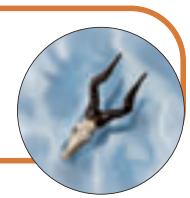
Skull (0/10)
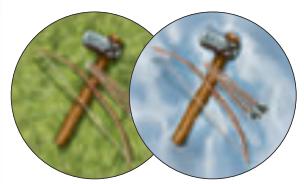

Weapon (12/3)
Mammoths = 3 ∼ 8 Points (3/12)

Path
(19/0)


Cave
(5/0)
16 Pawns (4 each in the 4 player colours)
16 Storage Boxes (4 each in the 4 player colours)

Life was not easy back in the Stone Age. People had to constantly roam the land in search of food, whether berries, tubers, or important herbs for medicinal purposes. Hunting was particularly important, as mammoths provided a lot of meat and their skins could be used to keep warm in winter. But the equipment had to be right too: sturdy weapons were made, jugs were pottered for storing precious water, and finally necklaces and decorative skulls with antlers were crafted as gifts for other tribes to maintain peace. Those who did not use the summer to gather as much food as possible, build weapons, and hoard useful goods had to suffer bitter hardship during the long, harsh winter.
GAME IDEA
Hunter and Gatherer has two phases: In Summer, players mainly gather food and stock up their winter stores. In Winter, they use their weapons to hunt mammoths and gather more food to get through the cold season.
At the end of the game, the player with the most points wins. Berries, tubers, herbs, and mammoths are worth the number of points printed on them. The more of each item a player has collected, the more points they earn. Storage boxes also earn points at the end of the game if they are placed in a camp.

Cave Tiles
The cave tiles remain on the game board throughout the entire game. When a player pawn moves onto a cave tile, it can cover large distances. The cave tiles are placed randomly on the game board.

SETUP

The game board is placed in the center of the table. It shows four Summer camps, four Winter camps, and 112 additional spaces.

Summer Camp

Winter Camp
The tiles are sorted according to their backs (Summer or Winter). All Summer tiles are shuffled and placed face up on the empty spaces on the game board, one on each space (Summer and Winter camps remain empty). The Winter tiles are initially returned to the box.

Back Summer Tiles
Each player takes game pieces and supply boxes of one color. They place one of their game pieces in each of the four Summer camps and place their supply boxes in front of them.

Back Winter Tiles
GAMEPLAY
The hairiest player starts, then the game proceeds clockwise around the table.
MOVING GAME PIECES AND TARING TILES
The player whose turn it is has two moves and must either • Move one of their own pawns two tiles forward, OR
• Move two of their own pawns one tile forward each.
Note: Player pawns may only be moved to spaces that have a tile on them or show a camp. At the end of the turn, only one pawn may remain on each tile (see special cases on page 4).
If a player pawn leaves a tile, the player takes this tile from the game board and places it face down in front of them. The tiles may not be looked at again until the end of the game. Exceptions:
• Path and cave tiles are not removed from the game board.
• Weapon and mammoth tiles are placed face up in front of the player.

SPECIAL CASES
• Player pawns may be moved to any Camp. Multiple player pawns may be placed there.
• From a Cave tile, player pawns may jump to any other Cave tile instead of to a neighboring tile. This counts as one movement step. Any number of player pawns may be placed on Cave tiles.
• A player pawn may move over an occupied tile in two movement steps, but must end the movement on an empty tile, a Cave, or a Camp. The occupied tile may not be taken.
• A player pawn may only be moved onto an unoccupied Mammoth tile if the player has a Weapon tile or receives one in the same step. The player discards the weapon tile and returns it to the game box.
• Instead of moving a player pawn on the game board, a player may also remove it from the game board. This action counts as a movement step and the player may also take the tile they have left. This usually only makes sense at the end of Summer or Winter, as player pawns cannot be returned to the game board during the respective season. If a player no longer has any player pawns on the game board, the other players continue playing without them until the end of the season.
PLACING A STORAGE BOX
When a player moves their player pawn onto or over a Winter camp, they immediately place one of their own Storage boxes there. Placing a box does not count as a move. Only one Storage box per color may be placed in each camp.

Blue Player moves their pawn over a Winter camp. They receive the "Tuber" tile and place a Storage box.
END OF SUMMER
As more and more tiles are removed from the game board, the movement of player pawns becomes increasingly restricted. Summer ends when all tiles except for the path and cave tiles have been removed from the game board or can no longer be reached by any game piece.
Unreachable tiles are removed from the game. Only the path and cave tiles remain on the board. Players take back any of their player pawns still on the game board.
The leaves are falling, the days are getting shorter, winter is coming! Good luck to those who are well prepared and have enough weapons, because there are especially many mammoths on the move in winter. And the search for berries and other treasures continues when the frst snow falls..
START OF WINTER
The 88 Winter tiles are shuffled and distributed face up on the empty spaces of the game board, one on each space. Each player places one of their playing pieces in each Winter camp that has its own Storage box. If the player did not reach all

Winter tile
four Winter camps during the Summer, they play with fewer than four playing pawns in Winter.
Each Storage box in a Winter camp is replaced by a player pawn.
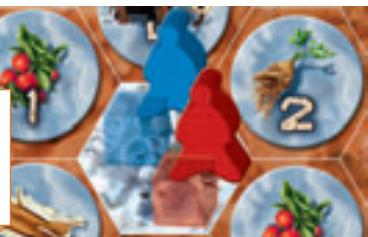

All Storage boxes are returned to the players. Unused player pawns are placed in the box.
The player who hunted the most valuable Mammoth in Summer becomes the starting player in winter.
The same rules apply as in Summer, except that the Storage boxes are now placed in the Summer camps instead of the Winter camps.

GAME END
Winter ends as soon as all tiles except for the path and cave tiles have been removed from the game board or can no longer be reached by any player.
For berries (1), tubers (2), herbs (3), and Mammoth (3-8) tiles, players score the points printed on the tiles. Weapons do not score.
The more goods (pelts, skulls, jugs, and necklaces) of one type a player has collected, the more points they are worth. Players score the following for each type of good:
| Tiles | 1 | 2 | 3 | 4 | 5 | 6+ |
| Points | 1 | 3 | 6 | 10 | 15 | 20 |
Each Storage box at a Summer camp is worth 5 points.
Now each player adds up their points. The player with the most points wins.
The author would like to thank all the test players who contributed to the development of this game, especially Iain Adams, Jonty Blackwell, Sebastian Bleasdale, Chris Bowyer, Chris Dearlowe, Martin Higham, Ross Inglis, Kevin Jacklin, Simone Kane, Richard Kemp, and Chris Lawson.
SCORING EXAMPLE
Red Player has collected the following tiles:

10 Points for Berries
10 x

10 Points for Tubers

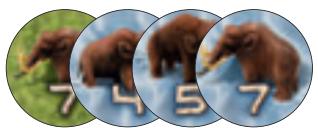
12 Points for Herbs

23 Points for Mammoths
0 Points

20 Points for Jugs

1 Point for Pelts
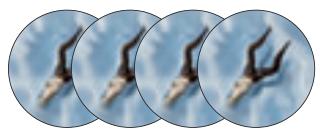
10 Points for Skulls

10 Points for 2 Storage Boxes
Red Player has scored a total of 96 points.
Note on Storing the Game
Once you have removed all the tiles from the punch sheets, please do not throw the empty punch sheets away! Simply remove the sorting insert from the box and place the empty punch sheets on the bottom of the box. Then place the sorting insert on top of the punch sheets. This will prevent the game components from getting mixed up, even if the box is stored upright.
WILLKOMMEN IN
ATLANTIS
