rules_zh_乔戈里峰_1274.md

说明
K2是世界第二高峰(仅次于珠穆朗玛峰),海拔8611米(28251ft)。它通常被认为是最难攀登的8000米级山峰。K2从未有过冬季登顶记录。
现在,你的登山队站在大山跟前,准备为了荣誉攀登。你知道等待你们的是什么-变幻莫测的气候天气,陡峭险峻的线路,缺氧更是这次危险征途的杀手。你需要小心地计划每一步,利用天气,并且和那些同样为荣誉攀登的团队竞争。


简单线路
游戏介绍
K2这款桌面游戏适合1至5名,年龄8岁及以上的玩家,游戏时间大概60分钟。
在游戏里,玩家要指挥一个拥有两名登山者的团队,在攀登K2巅峰的过程中与其他队伍竞争,并要在这18天的探险中活下来。这一切都需要你来找到合适的登山线路,阻挠其他玩家,选择理想的营地,以及密切关注天气变化对攀登的影响。
玩家每轮都要使用卡牌在面板上移动他的登山者。只要登山者到达更高的位置,便会在游戏的最后赢得更多的胜利分数。不过越高的地方更要时刻留意登山者的身体状态,因为如果状态降到1以下,登山者死亡,同时玩家也不能从遇难的登山者处获得胜利分数。
游戏配件

困难线路

12个天气面板—6个夏季和6个冬季夏季天气面板

冬季天气面板


1个天气标志
1个起始玩家标志
20个登山者标志—每组4个(2种形状各2个)共5组


5张玩家面板(5种颜色)

(2种外形分别对应2类登山者)
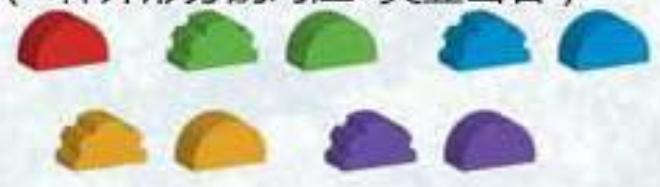
10个健康标志-每组2个标志共5组
90张卡牌-每组相同颜色18张共5组
绳索 休整

攀登
5张救援卡每位玩家1张

20个风险标志
4个数值为0
11个数值为-1
5个数值为-2


这本手册

游戏准备
在第一次游戏之前,取出游戏标志和卡片。版图的两面表示了攀登K2顶峰的简单线路和困难线路。玩家把决定将进行游戏的一面放置到桌面的中间。①
第一次游戏建议使用简单的版图。

每位玩家选择一种颜色并拿取该颜色的配件。
- 1组标志(4名登山者,2顶帐篷,2个健康标志)
- 1个玩家面板
- 18张卡片
- 1张救援卡(只在多人游戏时)
每位玩家将他们的登山者标志:
- 2个不同形状的标志放在版图的起始区 ②
- 2个不同形状的标志放在分数区的最下面③
健康标志放在玩家面板的数值“1”上④
在游戏中选择1组天气面板(夏季—简单,或者冬季—困难),其他未选择的可放置在一边的盒子里。无论版图是容易还是困难,夏季和冬季天气面板都可以使用。

在第一次游戏时,我们选择夏季天气板块。
将天气面板洗牌,然后依次取出顶部2块(6天)面朝上放在游戏版图的上方。⑤其他的放置在第二块天气面板的下面。天气标志放在第一天的位置(左边天气面板的最左边一格)。⑥
从面朝下的风险标志中随机翻出3个展示出来。⑦
每位玩家将他们的卡牌洗匀(不包括救援卡),摸取6张手牌。⑧最近刚去过山里的玩家拿取起始玩家标志。⑨游戏准备开始。
游戏顺序
游戏将进行18轮(一个18天的征程)。每一轮将划分为几个阶段,依次进行。大部分阶段由所有玩家同时进行,出了阶段3.
1.卡牌选择
2.风险标志
- 行动阶段
4.状态检查
5.本轮结束
1.卡牌选择
所有玩家从6张手牌中选出3张面朝下放置在自己跟前。当每位玩家选择好后,大家同时翻开展示卡牌。
2.风险标志
玩家将自己打出的3张卡牌的行动点相加。绳索卡(拥有上升和下降的点数),只相加上升的点数。休整卡不进行计算。数值最高的玩家在3个可见的风险标志中选取1个,放在其本轮打出的3张卡牌傍边。在行动阶段(阶段3)。该玩家必须计算风险标志的效果。
如果没有产生最高的行动点,则没有玩家拿取风险标志。
例子:布莱恩打出两张行动点分别为1的攀登卡和一张1(上)/3(下)的绳索卡。安娜打出两张值分别为1和3的攀登卡,还有一张数值1的休整卡。威廉打出一张值为2点的攀登卡和两张值分别为2和1的休整卡。布莱恩最高数值为3,安娜为4,威廉为2。这样安娜将拿取风险标志。
然后随机翻开1个风险标志,让桌面有3个翻开的风险标志。
3. 行动阶段
本阶段玩家依次进行,由拥有起始玩家标志的玩家开始,依次进行。玩家根据打出的卡牌进行行动。拿到风险标志的玩家在其回合将承受后果
根据做出的行动,玩家对山者做出相应操作。
攀登
玩家可根据攀登卡上的行动点移动登山者,向上或往下。
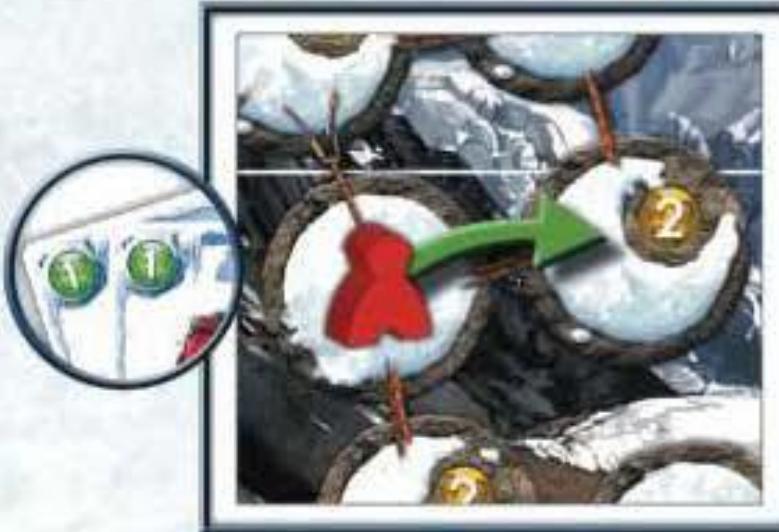
登山者只能朝相邻区域移动(显示由绳索连接)。黄色圆圈中的数字为进入该区域的成本。如果某区域没有显示成本,则成本为1。


这样做,玩家要说明行动的登山者所使用的一张或多张卡牌。能使用的行动点就是所用卡牌的行动点(卡牌绿色圆圈的数值)相加之和。
绳索卡能提供上升和下降的点数,根据玩家选择的行进方向得到不同的点数。其他攀登卡牌的点数不依赖行进的方向(点数可用于向上和向下)。在一次行动中,可以调整移动的方向,比如向上然后再往下。
一张卡牌的行动点不能分给两名登山者。不需要使用完所有的行动点,同样不移动登山者也是可以的。
例子:布莱恩打出两张行动点分别为1的攀登卡和一张1(上)/3(下)的绳索卡。这样,他使用2点移动一名登山者往上进入一个成本为2点的区域,同时使用3点移动另一名登山者向下,途径成本分别为2和1的区域。

注意!
一个区域中所能容纳的登山者数量有限,其数量由玩家的数量和所在海拔范围决定。5名玩家在海拔7000米以上时将有额外的红色数字。玩家们需在游戏前决定是否使用较大的登山者数量(更容易)或者较小的登山者数量(更困难)。

例子:3名玩家时,在海拔7000至8000米之间的每个区域最多容纳2名登山者。
登山者可以通过已经达到人数上限的区域。使用适当的行动点,不作停留通过该区域。
胜利分数标志
任何时候一名登山者到达了新的高度(拥有更多胜利分数的区域),就移动其胜利点标志到相应的分数区。当这名登山者高度下降时,其胜利分数标志不需要下降-保持在达到的最大分数。

第一个到达某高度的登山者将其胜利点数标志放置在相应分数区的顶端,其后到达的登山者的胜利点数标志依次排列在上一个标志的下方。
提高身体状态
玩家使用卡牌增加登山者的健康值。一张卡牌的健康值不能分给2名登山者,但1名登山者可以得到多张卡牌的数值。
移动玩家面板上的健康标志来提高相应登山者的身体状态。
扎营
登山者可以在目前所在区域扎营,需要支付的行动点数为进入该区域的成本。如果是绳索卡,只有上升点数能用于扎营,下降点数不行。游戏中每个登山者只能搭建一个和其相应的帐篷。帐篷不能移动,只能保持在一个区域直到游戏结束。如果有足够的行动点,登山者可以在一个回合内进入某区域并扎营。一个区域可以搭建多顶帐篷。
例子:威廉打出一张值为2点的攀登卡和两张值分别为2和1的休整卡。因为他的一个登山者在海拔6500米某区域非常疲惫,威廉使用卡牌增加该登山者3点身体状态。然后移动他的另一名登山者进入该区域(成本1点)并在此扎营,这样两名登山者都能得到庇护。

1 2 3 4 5 6 7 8 9 10
风险标志
如果玩家取得风险标志,必须使用。

如果风险标志数值为0,什么都不发生。
如果风险标志数值为1,玩家必须减去1点行动点或者健康指数。
可以使用以下三种方式之一:
减去某张卡牌的1点行动点;
减去某张卡牌的1点健康值;
减去某个本回合使用过卡牌的登山者的身体状态。
如果是绳索卡,玩家必须选择登山者将要用其进行上升还是下降,再减去风险标志的数值。如果登山者本轮没有分配攀登和休整卡牌,则不会遭受风险标志的后果。
如果风险标志数值为2,玩家将按上述减去2点。玩家可将惩罚点数分成行动点和健康值,并可由两名登山者分担。记住,只有分配过攀登或休整卡牌的登山者才能受到惩罚。
例子:安娜打出两张值分别为1和3的攀登卡,还有一张数值1的休整卡。她打出卡牌的行动点总数最高,所以她拿取风险标志,不幸的是,风险标志数值为2!感谢其卡牌(攀登1,休整1)她用1点行动点移动一名登山者并用1点健康值提高其身体状态。她决定用1点风险值来降低1点该登山者的身体状态。另1点风险值用在数值3的攀登卡上,随即移动她的另一名登山者进入一个成本为2的区域并在此停留。

天气影响
每块天气面板显示接下来3天的天气预报。每个预报提供的信息包含天气将会影响哪个海拔区域和该区域内每个登山者将受到的影响。
天气面板上的标志显示目前对于登山者的情况。

红圈的数值为在该海拔内每个登山者在第4阶段(状态检查)必须降低的身体状态。

这表示进入该海拔内每个区域增加的成本值(包含向上和向下移动)。注意!这同样适用于扎营。
这表示同时发生上述两种情况。

风和日丽。
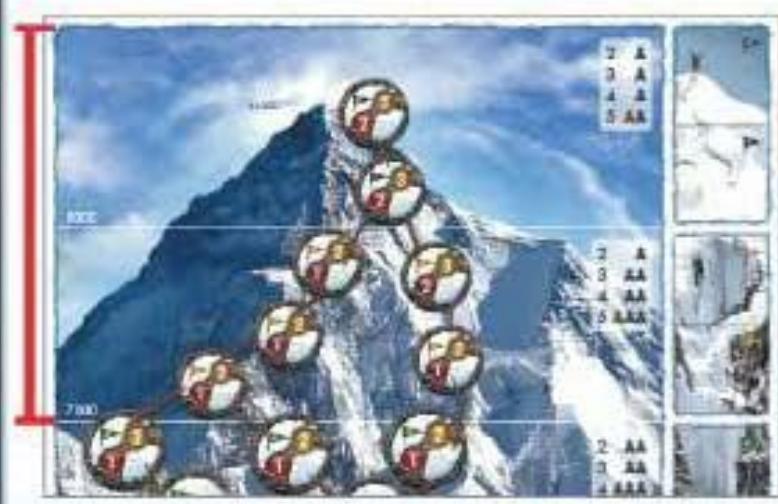

白色天气瓦状指标告诉我们哪些区域将受影响。每一部分对应版图上的海拔区域。参照旁边的插图,云量和负健康标志影响两个范围:海拔7000-8000米及8000米以上。
4.状态检查
所有玩家执行了卡牌上的行动后,要进行状态检查。每个登山者单独检查,通过调整玩家面板上的健康标志来提高或降低身体状态。
- 如果登山者所在区域比较舒适(蓝色圆圈),那么增加圈中数值的健康值。如果登山者所在区域环境恶劣(红色圆圈),那么减少圈中数值的健康值。
- 如果该区域有和登山者颜色相同的帐篷(不必是该登山者的帐篷),那该登山者得到1健康值。
- 如果登山者目前所在区域受天气影响,那么登山者失去该数值的健康值。
到阶段最后,检查登山者的身体状态是否超过6,任何超过6的都要减低到6.
如果任意登山者的身体状态低于1,该登山者死亡。该登山者的胜利分数降到1,并且将该登山者移出游戏。
例子:布莱恩的一个登山者身体状态为3。他所在的区域会降低健康值(-1)并处于海拔7000米以上,受到天气影响(-2)。幸运的是,他呆在帐篷里(+1),这样他最多会损失2点健康值。下一轮布莱恩需要有所行动来帮助这位登山者,不然他会在接下来的一天里不能幸存。

多人游戏
如果在多人游戏时发生登山者遇难,玩家可以使用救援卡来拯救该登山者,移动该登山者到海拔6000米以下的任意区域。该登山者的胜利分数标志必须后移4个区域。
救援卡只能使用一次,使用后收回游戏盒里。
战略参考:记住登山者并非一定要登顶,但是要活着坚持到游戏结束-一个死亡的登山者只能得到1分。因此,通常登山者在登顶或到达不错的高度后最好下撤到一个能抵御恶劣天气和让身体感到舒适的地方。
5.本轮结束
把起始玩家标志交给下一个玩家。这个新的起始玩家在下一轮将首先执行卡牌的行动。
将天气面板上的天气标志移到下一格。如果标志移到了右边天气面板的第一格,则将这块面板放到左边,像下图一样在右边显示出新的面板。


如果标志移到了最后一块天气面板上(你不能拿取新的面板),这最后3天将保持到游戏结束。
移动天气面板之后,所有玩家摸取3张卡牌将手牌补齐到6张。如果没有更多的卡牌,那下一轮游戏将只能使用3张卡牌。只有当玩家手牌出光后才能重新将自己牌库洗匀并摸取6张卡牌。
新一轮游戏开始(进行回合1-卡牌选择)。
游戏结束
游戏在最后第18天结束时结束-当所有的天气面板都使用过之后。其2位登山者的胜利分数之和最高的玩家获胜。如果几名玩家分数相同,那么获胜者为(几名最高分数玩家之间)最先登顶的玩家。(表现为山顶胜利分数区域谁的标志最高)如果游戏中没人登顶,胜者就是分数标志最高的玩家。

单人游戏
你也可以单独进行K2游戏。游戏规则基本相同。区域容纳最多登山者数量和2人游戏时相同。不管玩家打出的是什么牌,都需要拿取风险标志。如果一名登山者死亡,游戏立即结束,玩家得到幸存登山者的分数,以及加上从遇难登山者处得到的1分。然后玩家参考分数表找出取得的等级。
| 等级 | 简单线路 | 困难线路 | ||
| 喜马拉雅登山家 | 20 VPs | 17 - 20 VPs | 17 - 20 VPs | 16 - 20 VPs |
| 登山运动员 | 16 - 17 VPs | 15 - 16 VPs | 15 - 16 VPs | 14 - 15 VPs |
| 远足者 | 11 - 15 Vps | 10 - 14 VPs | 10 - 14 VPs | 10 - 13 VPs |
| 游客 | < 11 VPs | < 10 VPs | < 10 VPs | < 10 VPs |
A WORD FROM THE AUTHOR
I have dedicated a significant part of my life to mountains and climbing. I dedicate the game K2 to everyone who's been tied to a climbing rope with me, especially Iza, my climbing partner, who became my partner in life.
A lot of people playtested K2 at different stages of the design. I would especially like to thank the following individuals: my wife Iza, Jacek Nowak, Krzysztof Klemiński, Łukasz and Rafał Bober, Robert Buciak, Mirek Tkocz, Ilona and Adam Weister, Robert and Żaneta Podsiadło, Alek Pala, Wojtek Dziwok, Tomek Kołeczko, Wojtek and Jola Chuchla, Rafał and Dagmara Szczepkowski and Maciej Teległow.
Adam Katuża
Game rules: Adam „Folko“ Katuża
Illustrations and graphic design: Jarek Nocon
Corrections: Magdalena Jedlińska, Maciej Teległow, Artur Jedliński
English translation: Anna Skudlarska, Russ Williams
© 2010 Publisher REBEL.pl
MADE IN POLAND

ul. Matejki 6
80-232 Gdańsk
POLAND
http://wydawnictwo.rebel.pl
Distribution and wholesale: http://hurt.rebel.pl, hurt@rebel.pl


① 攀登线路
② 计分区
③ 人数上限表
④ 大本营一开始区域

⑤ 高度指示
⑥ 路线停留点
A 状态修正
B 必要行动点
C 胜利分数
D 区域连接绳
流程概括
1.卡牌选择
a.每位玩家打出3张面朝下的卡牌。
b.同时亮出打出的卡牌。
2.风险标志
a. 拥有最多行动点的玩家拿取风险标志。如果平手,则没人拿取风险标志。
b.需要的话翻开另一个风险标志。
3. 行动阶段
a.玩家使用卡牌移动登山者。
b. 扎营的成本和进入该区域所需要的相同。
c.玩家使用卡牌提高登山者的身体状态。
d. 拥有风险标志的玩家要承受后果。
e. 把每位登山者最新得到的胜利分数标注在分数区。
f.注意天气对行动的影响(只在冬季)!
4.状态检查
a.根据登山者当前的区域加/减健康值。
b. 一顶帐篷增加+1健康值。
c.如果处于受天气影响的海拔区域,减少健康值。
d.如果身体状态超过6,则回到6。
e.如果身体状态低于1,登山者死亡。
5.本轮结束
a. 把起始玩家标志交给下一位玩家。
b.移动天气标志到下一格。
c. 摸取3张卡牌让手牌6张。
下载 MarkdownK2 and Expansions Condensed Rules.md
K2
Lead your team of two climbers to K2’s peak, carefully managing your stamina and oxygen, all the while dealing with the mountains ever changing weather…
SETUP:
-
Place board, choose the Easier or Harder side.
-
Choose a stack of Weather tiles, either Summer or Winter. Shuffle and place 1, and place the stack of remaining tiles to the right of it, all face up. Place the Weather marker on the left most space.
-
Put the 20 Risk Tokens (4×0 11×-1 5×-2), facedown (or in a bag) and flip/draw 3.
-
At 5p decide whether to use the larger or smaller limit for spaces.
Each player:
-
In their colour: 4 Climbers, 2 Tents, 18 cards, Player board, with 2 Acclimatisation Markers placed on 1. For Family Variant, take a Rescue Card, placed next to player board.
-
Place 2 differently shaped Climbers on base camp, & the other two at 1 on the score track.
-
Each player shuffles their deck and draws 6 cards.
-
The last player in the mountains takes the Start Player Token.
GAME STRUCTURE:
18 Rounds (representing 18 days climbing) of 5 Phases:
• Card Selection • Risk Token • Action Phase • Acclimatisation Check • End of Turn
1. CARD SELECTION
Each player chooses the 3 cards they will use this round & places them face down on the table.
2. RISK TOKEN
- Reveal all cards, the player with the highest sum of movement points chooses one of the three Risk Tokens.
• For Up/down (Rope) cards, the upwards value is counted.
• If tied, no player takes a Risk Token.
- Draw a replacement Risk Token. (If one was taken).
3. ACTION PHASE
In turn order each player uses all of their cards to take their actions for this round.
You cannot split a card’s movement or acclimatisation across two different climbers.
Weather Influence:
The weather tiles show the weather effects for this round and some future rounds.
• Red value affects Acclimatisation, Yellow value affects Movement, Split affects both.
• The Gauge indicates which altitudes are affected.
Risk:
If a player has a Risk Token they must:
• Reduce the value of one of their cards by 1.
• Reduce the acclimatisation of a climber, who had a card applied to them this turn, by 1.
• If the Risk Token has value 2, the points can be split between different climbers and methods.
Movement Cards
Apply one or more Movement cards to a Climber.
They use the sum of these movement points to climb and/or pitch a tent.
Climb
• To move a Climber into a space costs the Movement points shown on the space’s Yellow circle, (1, if no circle), plus any weather effects.
• A Climber can move into more than one space in a turn.
• Spaces at certain altitudes can only have a certain number of climbers, shown on the table. A climber cannot end the turn on a space that doesn’t have space for it.
• If a climber enters a space with higher victory points, move their VP marker up the VP track.
• They don’t have to finish their turn there, nor do the points decrease when they go down.
• Rope Cards have up and down values, downward movement points can only be used when moving down. (As indicated by the direction of carabiner between spaces).
Pitching a tent
• To place a Tent on a space costs that space’s movement points (including any weather effects).
• A tent cannot be moved once placed, a climber may only place their own tent.
• A climber may move and then pitch a tent.
Acclimatisation
• Apply one or more Acclimatisation cards to a Climber.
• Move the Acclimatisation Marker up the sum of the cards’ values.
4. ACCLIMATISATION CHECK
For each climber:
• On a space with a Blue Circle: Add number shown
• On a space with a Tent of matching colour: Add 1
• On a space with a Red Circle: Subtract number shown.
• Weather with Red Circle, or split: Subtract number shown.
Apply the sum of the affects to the climber’s Acclimatisation track.
• If above 6, reduce back to 6.
• If below 1, climber dies, remove them and move their scoring meeple on the score track to 1. • Family Variant, if a climber dies, you may discard your Rescue Card (once per game), to save the climber. Move them to any space below 6000m, & move their VP marker back 4 spaces.
5. END OF TURN:
• Pass the Start Player Marker left.
• Move the Weather Marker to the right.
• If it moves to the next tile, move that tile to the top of the left stack.
• If it’s the last weather tile, there are only 3 rounds remaining.
• If the weather token was on the last day, the game ends.
• Each player draws 3 cards to refill their hand.
• Except, if their deck is empty, they don’t draw any cards and must use the 3 in hand.
• When their hands are empty, they shuffle their discard and draw 6 new cards.
END OF THE GAME
After 18 Rounds, the winner is the player with the highest combined score.
If tied, first tied player to the summit wins.
K2: BROAD PEAK
SCENARIO 1: RACE TO THE TOP
Inspired by Krzysztof Wielicki’s 1984 climb of Broad Peak, this is a shorter climb, with a tighter route, and instead of carrying Tents, your climbers carve out Snow Caves for shelter.
SETUP
-
Place the Race to the Top board.
-
If playing with Summer Weather Tiles, remove the tile with clear weather, if playing with Winter tiles remove one random tile.
-
Place a supply of Snow Cave Markers.
-
Each Player: Removes a 3 and a 2 acclimatisation card, and a 1 movement card from their decks.
Remove both Tents from the game.
RULES CHANGES
Snow Caves
Instead of Tents, climbers can build Snow Caves. These only last two turns, and only fit a single climber, but can be used by any players’ climbers and their cost depends on altitude, not the Movement Points of the space or the weather.
3. ACTION PHASE
• For a Climber to build a Snow Cave costs 1 Movement Point below 7000m, 2 points above 7000m. Weather has no effect on the cost.
• Place Snow Cave marker face up (yellow), and place the Climber on it.
• A space can have any number of Snow Caves.
• Each Snow Cave can take only one Climber.
• If a player has two climbers on a space with a snow cave they may choose which climber to place in the cave.
• Snow Caves don’t have player colours, any Climber may use an empty Snow Cave.
• During their turn a climber may enter an empty snow cave on their space.
• To repair a face-down (red) Snow Cave, pay normal building cost, then flip it face-up.
4. ACCLIMATISATION PHASE
For each climber:
• If they’re in a Snow Cave: Add 1
5. END OF TURN
• Remove all face-down (red) snow caves, then flip all face-up (yellow) Snow Caves face-down.
• The Climber of a snow cave may stay in it when it’s flipped
END OF THE GAME
After 15 rounds.
K2: BROAD PEAK
SCENARIO 2: BROAD PEAK TRAVERSE
Inspired by Wojciech Kurtyka and Jerzy Kukuczka’s traverse of the Broad Peak massif, the players’ climbers race to reach three peaks, earning bonus points for successfully descending from the traverse, while carrying only a single tent between them.
SETUPOn e
-
Place the Broad Peak board.tokens, according to the number of playe
-
On each peak place VP tokens as indicated.tokens.

- Place the Traverse Tokens next to the board.
- Each player returns one tent to the box.
RULES CHANGES
Tents
• Only one Climber starts the game with a tent available.
• If one of a player's climbers is on a space with a Tent of their colour, they may spend 1 of itsSEQUENCE OF PLAY Movement Points to repack the tent, placing it next to that climber’s acclimatisation track.Tent
• That climber may pitch it again, following the normal rules.the same as K2, except that only one climber has a tent available. However, after a pla
• If the climber carrying the tent dies, the tent is lost.point to repack the tent and carry it further. The player puts mat on the drawing of the climber who packed it. This climber
Traverse
• When one of your climbers enters a space marked with , take the Traverse Token matchingthe left side and then traverse to the right side, or go up on the rightside and then traverse to the left side. When a climber enters the first that climber and that end of the traverse. If not already taken.or last space of the traverse (spaces marked with a climber icon), he takes the traverse token for that climber and that end (left or right) of the traverse.
• If a climber has both traverse tokens they will earn 2 extra VP for each VP point token.of the board. The yel ow player takes the appropriate traverse token with that climber’s symbol and puts it on their player mat.
VP
• When a climber reaches a peak, take the top VP token from that peak and place it onto the Traverse Token of that climber.
• Each climber may claim only 1 token from each peak. wil earn 2 extra vi
GAME END
Scoring
Each player adds up their climbers’ scores:
• VP Track + VP of tokens + 2pts per VP token if climber has both traverse tokens.
• If a climber died, it scores only 1 point, its VP tokens and traverse tokens are lost.
• Winner is the player with the highest combined score.
• If tied, tied players whose climber reached Peak 1 first wins.
K2: LHOTSE
SCENARIO 1: THE SOUTH FACE
Choose your route to climb the South Face of Lhotse, use ropes to switch to different routes, as different routes face different weather, and there’s a new threat of landslides.
SETUP
-
Place the Lhotse board South Face side up.
-
Use the Lhotse Weather Tiles instead of the Base Game tiles.
i. Deal 2 to each player, each player chooses 1 to remove from the game.
ii. At 2/3/4 players draw 4/3/2 of the remaining tiles, (at 5 draw 1 of the removed tiles) and add them to the tiles for this game, so you have 6 tiles overall.
-
Each player takes a pair of Fixed Rope tokens in their colour.
-
Each player places a climber on each of the two starting spaces.
RULES CHANGES
3. ACTION PHASE
Fixed Rope Tokens
A Climber may place a pair of Fixed Rope tokens of its colour on its current space and an
adjacent space at a cost of 1 Movement Point.
• Both spaces must be over 6000m
• Difference between the two spaces’ VPs must be at most 1.
• The two spaces must be on two adjacent paths. A path is a series of Spaces connected by ropes of the same colour.
I.e. the fixed rope connection cannot cross a printed board connection or space, nor go off of the mountain.
• These two spaces are now considered connected. (Any climber may use this connection.)
• Cost to move into the space is the same as normal.
• For Rope Cards: Space with the higher VP is considered the higher altitude.
If spaces have the same VP, moving either direction uses the Up value.
• More than one Fixed Rope can be placed on the same space.
• Each player has only one pair of Fixed Rope tokens, they cannot be moved or removed.
4. ACCLIMATISATION PHASE
Weather
Weather effect depends on the Climber’s altitude and now also whether they are on the
Western, Central or Eastern Section of the mountain.
• The W/C/E sectors indicate which Sections are affected and what the effect is.
Landslide
After resolving the base game Acclimatisation Steps:
Starting with the lowest affected space, and then proceeding up:
• In each space affected by a Landslide:
• Climbers lose 2 Acclimatisation Points. Tents have no effect.
• Climbers and Tents move 1 space downwards.
• Along printed connections only, not along Fixed Ropes.
• Climber limits on spaces do not apply for climbers moved by the Avalanche.
• If there’s more than one option, pieces move to the Space that’s in their current section.
• If there’s still a choice, the piece’s player decides.
K2: LHOTSE
SCENARIO 2: THE SOUTH COL
Ascend Lhotse using the safer route for a shorter game, but along a narrower route.
SETUP
-
Place the Lhotse board South Col side up.
-
Use the Base Game tiles, Winter or Summer.
• $O r ,$ use the Lhotse tiles, using the C section for the entire board.
i. Discard 1 tile at random.
ii. Set-up the remaining tiles as per the base game rules.
- Each Player: Removes a 2, 1 and 0 acclimatisation card from their decks. Experienced variant: each player secretly chooses which 3 cards to discard, then reveals their chosen cards.
END OF THE GAME
After 15 rounds.
If the Experienced variant used, each player sums the acclimatisation points of the cards they discarded during setup, and earns 1 VP for each 2 acclimatisation points.
K2: AVALANCHE
SETUP
- Replace two random regular Weather Tiles with two random Avalanche Tiles.
RULES CHANGES
4. ACCLIMATISATION PHASE
After resolving the base game weather effects, starting with the lowest affected space, and then proceeding up:
• If a Climber is in a tent (or snow pit), it loses 1 Acclimatisation point, and does not move.
• If a climber is not in a tent or snow pit, it loses 1 acclimatisation point and moves one space downwards.
• If there is more than one option, the climber’s player chooses.
• Climber limits on spaces do not apply for climbers moved by the Avalanche.
下载 Markdown