rules_zh_inca-empire_1313.md
印加帝国 规则(集石文档 1313)
逐页 VLM 转写(qwen3-vl-plus),源:集石文档 1313,未翻译。
INCA EMPIRE
ALAN D. ERNSTEIN
ARTWORK: ALEXANDRE ROCHE
汉化: Lieber
⋅⋅⋅⋅ 目标 ⋅⋅⋅⋅
在皮萨罗到达印加中心库斯科时,胜利点数最多的玩家获得游戏胜利。
⋅⋅⋅⋅ 游戏配件 ⋅⋅⋅⋅
-
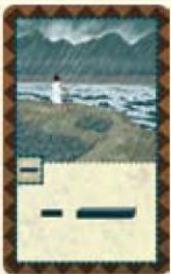
32 张太阳事件牌
[图: 6张不同图案的太阳事件牌示例] -
4 张工程造价牌
[图: 4张分别标有CHINCHAYSUYU、ANTISUYU、QOLLASUYU、KUNTISUYU的工程造价牌] -
4 个回合顺位板块
[图: 四个圆形板块,分别标有数字1、2、3、4] -
240 个木条(每种颜色 60 个)
- 蓝色
- 橙色
- 绿色
-
棕色
-
4 个印加人(棕色、橙色、绿色和蓝色)
-
1 个黑色印加人
-
45 个本土文化标记
[图: 6个圆形标记,分别标有1/1、2/2、2/2、3/3、3/3、3/3] -
73 个劳工标记
[图: 一个劳工小人图标] -
20 个城市标记
[图: 蓝色方块状城市图标] - 20 个要塞标记
[图: 棕色堆叠石块状要塞图标] - 20 个梯田标记
[图: 绿色层叠梯田图标] -
20 个印加神庙
[图: 黄色立方体神庙图标] -
1 个太阳事件版图(双面:正面用于 4 人游戏;反面用于 3 人游戏)
[图: 一个带网格与太阳符号的方形版图] -
4 个入侵标记(仅在变体规则“皮萨罗入侵”中被使用)
[图: 两个头像图标:一个戴头盔的欧洲人,一个乘船的欧洲人] -
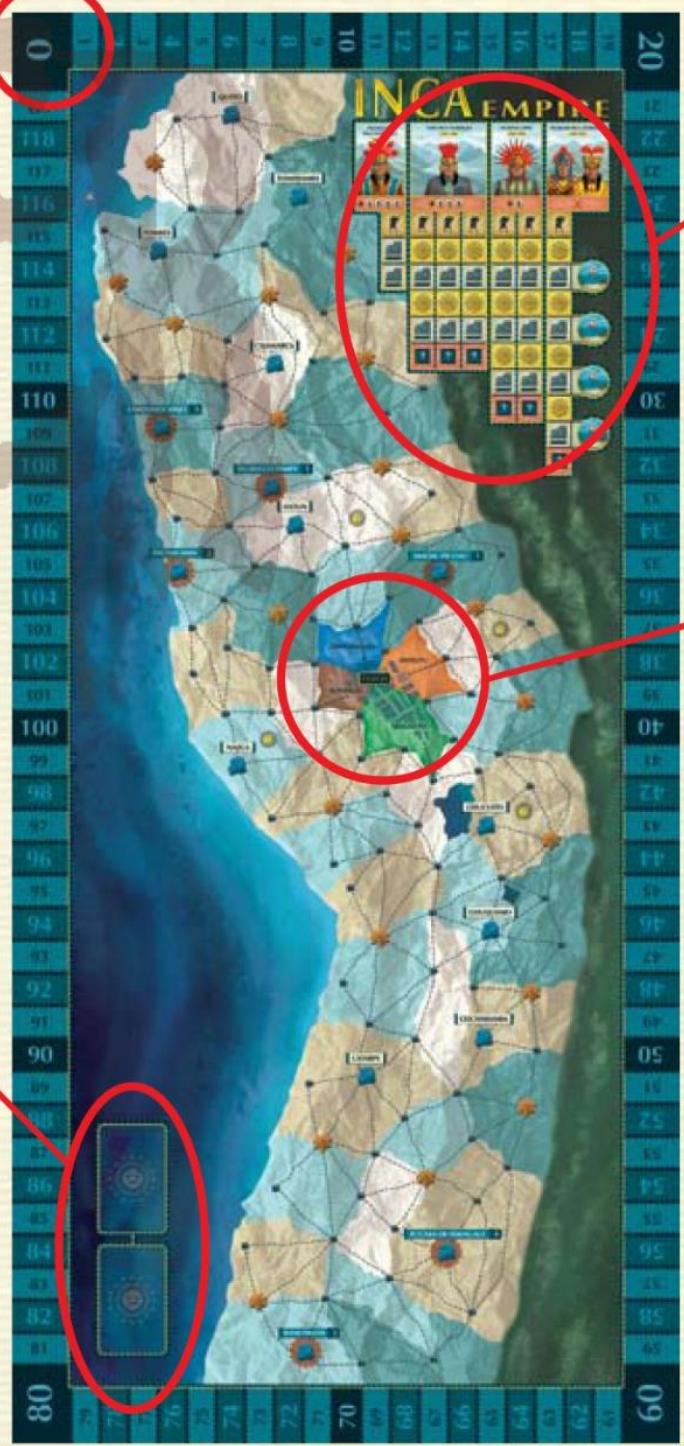
1 个游戏版图(双面:正面用于 4 人游戏;反面用于 3 人游戏)
[图: 一张南美安第斯山脉区域地图,含计分条起点、年代条、起始区域、太阳事件卡牌区域、城市名称、神庙、胜利点数等标注] -
计分条起点
- 年代条
- 起始区域
- 太阳事件卡牌区域
- 城市名称
- 神庙
-
胜利点数
-
重要城市地点
[图: RANCHILLOS 5 标记] - 城市地点
[图: CATARPE 标记] - 要塞地点
[图: 棕色要塞图标] - 地点
[图: 蓝色城市图标] - 道路虚线
[图: 两条虚线路径]
1
•••• 准备 ••••
将游戏版图对应于玩家人数的一面向上放置在桌面中央。
- 将太阳事件版图对应于玩家人数的一面向上放置在游戏版图旁。
- 将劳工标记、城市标记、要塞标记、梯田标记和木质神庙摆放在游戏版图旁,组成供应区。
[图: 四种标记图标:蓝色劳工、橙色城市、绿色要塞、黄色梯田;一个木质神庙立方体]
- 将工程造价牌洗混,每位玩家抽取一张。该牌决定了玩家的起始区域以及玩家的颜色。
[图: 起始区域示例牌“QOLLASUYU”,含玩家颜色、工程造价、萨帕·印卡阶段的胜利点数、建造时获得的胜利点数等信息]
玩家将工程造价牌摆放在各自面前。牌面印有各工程的造价以及胜利点数的概览。
-
每位玩家拿取其颜色的游戏配件(木条和印加人)。
所有玩家将印加人摆放至计分条的起点,然后分别将一个木条摆放至各自起始区域的道路(库斯科 Cuzco 和他们起始地点之间的道路)上。 -
在除库斯科 Cuzco 附近的起始区域以外的所有区域分别正面向下摆放一个本土文化标记。
现在将起始区域相邻所有区域的本土文化标记翻面至正面向上。 -
将太阳事件卡牌洗混并正面向下叠放在游戏版图上的指定位置。每位玩家抽 3 张牌加入手牌
-
将黑色印加人摆放至年代条的起点:第一年代的、最顶部的空格。
- 将回合顺位板块洗混。每位玩家随机拿取一个,正面向上摆放到各自面前。
3 人游戏时的改动:
- 使用游戏版图对应于 3 人游戏的一面
- 使用太阳事件版图对应于 3 人游戏的一面
- 仅使用印有数字 1~3 的回合顺位板块
- 移除以下太阳事件牌:1x 年度朝圣、1x 伟大朝圣、1x 本土朝圣、1x 地方动荡、1x 荒野之路。
- 移除 6 个本土文化标记(每种类型 1 个)
- 其他设置同上文所述。
[图: 三张回合顺位板块(标有1、2、3),三张太阳事件牌(标有1、2、3),三张本土文化标记(标有1、2、3)]
[图: 游戏主地图,含Cuzco、Qollasuyu等区域,标注了编号1~4的准备步骤位置]
# 游戏流程

历史上,印加人的生活分为三个方面:政府(以印加阶段表示)、宗教(以太阳阶段表示)和民众(以民众阶段表示)。萨帕・印卡是神圣的君主。萨帕・印卡阶段中,玩家将获得胜利点数。

- 游戏分为 4 个年代。
- 每个年代分为若干个回合。
- 每个回合分为若干个阶段。

黑色印加人用于指示游戏当前处于哪个回合、哪个阶段。若所有玩家均完成了某个阶段的行动,将黑色印加人下移一格。若当前黑色印加人已位于该列最底部的空格,将其移至下一列最顶部的空格,新回合开始。

> **注意**:在一个回合中,某些阶段可能被多次进行或跳过。黑色印加人所在的空格决定当前进行的阶段。

回合分为以下 4 个阶段:
- 🟨 印加阶段
- 🟨 太阳阶段
- 🟨 民众阶段
- 🟨 萨帕・印卡阶段

> **注意**:玩家将各自的印加人摆放至计分条以标记各自的分数。每格代表 1 胜利点数。当一个印加人被摆放到一个已有其他印加人的空格时,将其摆放至计分条的最外侧。出现平局的场合,印加人位于计分条最内侧的玩家获胜。

[图: 四列竖排游戏面板,每列顶部为一位印加统治者头像(Pachacuti, Topa Inca Yupanqui, Huayna Capac, Huascar Inca/Atahualpa),下方为多行格子,含人物图标、建筑图标、太阳图标、问号格、船只图标;红色圆圈标出部分区域与黑色印加人位置;顶部标注“年代”、“回合”、“阶段”]

以下为各阶段的详细说明:

## 印加阶段

印加阶段代表帝国的活动与生产。劳工标记代表个人为帝国提供的劳动力。这种强制性公共服务通常在每年的特定时间内完成。每个年代开始时,获得的劳工标记数量减少,代表着可供发展的劳动力减少的现实。在帝国历史的早期,本土劳动力被广泛用于发展。随着帝国扩张,需要更多劳动力以维系帝国运作,可供发展的劳动力减少。

### 1 玩家获得指定数量的劳工标记

每位玩家根据当前年代数从供应区获得指定数量的劳工标记。

### 2 玩家因征服的区域和梯田获得劳工标记

每位玩家根据其征服的本土文化标记获得对应数量的劳工标记。每位玩家同时获得数量等同于其修建梯田数量的劳工标记。

### 3 玩家互助

所有玩家均获得劳工标记后,在计分条上领先的玩家必须给予其他玩家劳工标记。
- 在第二年代(帝国初期,1471~1493),胜利点数最多的玩家必须给予胜利点数最少的玩家 1 个劳工标记。
- 在第三年代(帝国中期,1493~1528)和第四年代(帝国末期,1528~1533),胜利点数最多的玩家必须给予胜利点数最少的玩家 2 个劳工标记。4 人游戏时,胜利点数排名第二的玩家必须给予胜利点数排名第三的玩家 1 个劳工标记。

> **注意**:在第一年代(1438~1471)无玩家互助。

[图: 左侧为圆形标记示意图,标有“2”(抵抗值,征服区域)、“1”(胜利点数,征服区域)、两个小人图标(收入,印加阶段);右侧为三组组合图示:上方为带“+”号的劳工标记与数字组合;中间为“+”连接两组圆形标记(2人+3人)等于右侧九个劳工标记;下方为计分条局部,显示0至13数值,蓝色、棕色、绿色、橙色棋子位置,红圈标出蓝色棋子]

1. 第二年代第三回合的印加阶段。
2. 橙色玩家征服了 2 个区域并修建了 1 个梯田。其获得 3(根据当前年代)+ 5(本土文化标记)+ 1(梯田)= 9 个劳工标记。
3. 其必须给予胜利点数最少的玩家 1 个劳工标记
   1. [图: 游戏面板局部,红圈标出印加人位置及周围格子]
   2. [图: 劳工标记加法示意图:一组标记 + 另一组标记 = 九个劳工标记]
   3. [图: 计分条局部,红圈标出蓝色棋子位置]
# ⋅⋅⋅⋅ ☀ 太阳阶段 ⋅⋅⋅⋅

太阳阶段代表宗教对印加人生活的影响。印加是个极端之地。
沿海沙漠距离高山只有几英里。气候对日常生活产生巨大影响,尤其是对农业和渔业。
太阳阶段代表这些极端,包括积极和消极两个方面。

## 1 决定回合顺位

胜利点数最少的玩家拿取 1 号回合顺位板块,胜利点数排名倒数第二的玩家拿取 2 号回合顺位板块,以此类推。

> **注意**:出现平局的场合,印加人位于计分条最外侧的玩家获得平局玩家中较靠前的顺位。

> **注意**:由于第一年代没有太阳阶段,回合顺位保持不变。

回合顺位板块分配如下:蓝色玩家获得 1 号顺位因为其胜利点数最少。绿色玩家和棕色玩家胜利点数相同,但棕色玩家的印加人位于计分条最外侧,棕色玩家获得 2 号顺位,绿色玩家获得 3 号顺位。橙色玩家获得 4 号顺位。
[图: 四个带数字1–4的圆形顺位标记(蓝、棕、绿、橙),下方为计分条示意图,标有0–7,各颜色小人图标按位置排列]

## 2 打出太阳事件牌

所有玩家按回合顺位依次选择一张太阳事件牌,正面向下摆放到太阳事件版图的任意一个象限,然后立即从太阳事件牌堆抽一张牌加入手牌。

> **注意**:每个太阳阶段中,各象限均仅能摆放一张新牌。新牌被加入到先前被摆放至该象限的牌中(如果有的话)。若太阳事件牌堆耗尽,洗混弃牌堆,组成一个新牌堆。

## 3 展示并结算所有太阳事件牌

所有玩家均摆放一张牌后,展示这些牌。这些事件持续生效,直至下个萨帕・印卡阶段.
玩家颜色的线两侧的牌均对该玩家生效。这些牌可能造成正面或负面的影响。对这些牌的说明请见本规则书第 6~7 页.
游戏过程中会有多个太阳事件同时生效。若无特殊说明,事件效果可叠加。

若太阳事件牌“地方动荡”和/或“民众支持”正面向上位于太阳事件版图上,立即结算其效果,不管其何时被摆放至太阳事件版图。

> **注意**:所有牌均被摆放至两条线之间,会同时对对应颜色玩家生效!

[图: 太阳事件版图局部,含四张事件牌及红圈标注①②③;①处为“地方动荡”牌置于橙线与蓝线间;②处为另一牌;③处为“PUCARA DE ANDAGUA / RANCHILLO”牌]

1. 因为此牌被摆放至橙色线和蓝色线之间,橙色玩家和蓝色玩家每有一个抵抗值为 1 的本土文化标记,从供应区获得 1 个劳工标记。其他玩家不享有此效果。
2. 民众阶段中,棕色玩家的行动受到“恶劣天气”和“城市重建”的影响。
3. 橙色玩家和绿色玩家均可以执行“伟大朝圣”行动。

---

# ⋅⋅⋅⋅ 🏛 民众阶段 ⋅⋅⋅⋅

民众阶段代表民众为建设帝国而工作。通过印加阶段的强制性公共服务征募的劳工现在被投入修建道路、梯田、要塞、城市、神庙或征服新区域.
所有玩家根据回合顺位依次按任意顺序执行以下行动.
每位玩家可以不支付劳工修建至多两条道路.

## ▭ 修建道路

摆放规则:

- 一位玩家的所有道路必须与其起始区域构成一个相互连接的道路系统(见示例 2)。
- 玩家将其一条道路摆放至两个地点间的虚线上。

> **注意**:尽管两个行动能够以任意顺序被执行,仅当玩家执行完一个行动后才可以执行下个行动。玩家不可以在执行修建道路行动时,先修建一条道路,然后执行一个建造行动,最后再修建第二条道路。

- 每条虚线上仅能摆放一条道路。
  > **特例**:通过使用太阳事件牌“荒野之路”,玩家可以在已经摆放道路的虚线上额外摆放一条道路。

- 在一个未征服的区域内修建道路的前提条件是此道路连接的两个地点之一位于一个已征服区域的边界上。

> **注意**:若某条道路连接的地点之一在一个本土文化标记正面向下的区域的边界上,将该本土文化标记翻至正面向上(见示例 1)。

[图: 道路摆放示例1与2,含本土文化标记翻面示意及道路连接规则图解]
建造
玩家执行下列行动之一:
建造城市
[图: 三条道路连接三个蓝色城市标记,其中一条道路从一个未征服区域边界上的本土文化标记指向已征服区域内的城市,箭头指示翻转方向]
印加城市几乎总是被建造在以前存在城市的地点。这解释了为什么游戏中大部分城市的名称衍生自前印加文明。
玩家支付 6 个劳工标记,将一个城市标记摆放至游戏版图上的一个位于其道路系统内且在一个被征服区域内的城市地点(蓝色)。
建造城市使玩家立即获得 4 胜利点数。
建造神庙
[图: 一个黄色立方体图标旁标注“建造神庙”]
尽管被征服的区域被允许保留自己的神灵,但印加人要求他们将太阳神供奉为至上的神。太阳神庙被建造在城市。重要的城市遗址拥有旧帝国遗留下来的重要神庙。
玩家支付 5 个劳工标记,将一个神庙标记摆放至游戏版图上的一个位于其道路系统内的城市标记上。玩家无需亲自建造该城市。
建造神庙使玩家立即获得 4 胜利点数。若玩家在一个重要城市建造神庙,其获得游戏版图上该城市旁印有的胜利点数。
建造要塞
[图: 一叠橙色方块图标旁标注“建造要塞”]
要塞是道路系统中贮存食物和水的小型哨站,为军事活动提供补给或在粮食歉收、厄尔尼诺发生时,为民众提供支持。
玩家支付 4 个劳工标记,将一个要塞标记摆放至游戏版图上的一个位于其道路系统内且在一个被征服区域边界上的要塞地点(橙色)。
建造要塞使玩家立即获得 3 胜利点数。
建造梯田
[图: 一片绿色梯田图案图标旁标注“建造梯田”]
梯田是印加人最显赫的遗产。虽然梯田并非始于印加,但印加人完善了整个安第斯山脉的建筑。梯田使可耕地面积足足增加了 100%,为印加人的垂直经济做出了贡献,沿用至今。
玩家支付 2 个劳工标记,将一个梯田标记摆放至其一个已征服的本土文化标记旁。每个本土文化标记旁仅能摆放一个梯田标记。
建造梯田使玩家立即获得 1 胜利点数。
注意:每个梯田在印加阶段为其拥有者提供一个额外的劳工标记,并在萨帕·印卡阶段为其拥有者提供 1 胜利点数。
征服一个区域
[图: 一个红蓝相间的圆形徽章图标旁标注“征服一个区域”]
印加人在 100 年内将他们的帝国扩张到最大规模。许多人通过战争被征服。征服通常采取在多达 2 万名印加战士的视线内进行谈判的形式。
玩家支付数量等同于本土文化标记抵抗值的劳工标记,然后拿取该本土文化标记并将其摆放至面前。每当一个区域被征服,将所有相邻区域的本土文化标记翻面至正面向上。
征服一个区域使玩家立即获得等同于本土文化标记上印有的分数。
注意:为了征服一个区域,玩家必须有至少一条道路连接一个未征服的区域内的地点。
额外建造一条道路
[图: 一个深灰色长条形图标旁标注“额外建造一条道路”]
玩家支付 1 个劳工标记,将一个道路按摆放规则摆放至游戏版图上。
放弃
→ 放弃
玩家放弃,不执行行动。
注意:游戏版图上的道路均位于特定区域内,即使它们与两个区域间的边界平行。将道路摆放在游戏版图上时请谨记以上原则,玩家可以因此看清道路位于哪个区域。
[图: 顶部三张小图示,编号①②③,分别展示道路连接规则:①道路连接点在本土文化标记正面向下区域的边界上,需翻转该标记;②一位玩家的所有道路必须与其起始区域构成相互连接的道路系统,允许存在分支;③在未征服区域内修建道路的前提是此道路连接的两个地点之一位于一个已征服区域的边界上。]
若某条道路连接的地点在一个本土文化标记正面向下的区域的边界上,将该本土文化标记翻至正面向上。
一位玩家的所有道路必须与其起始区域构成一个相互连接的道路系统。道路系统中允许存在分支。
在一个未征服的区域内修建道路的前提条件是此道路连接的两个地点之一位于一个已征服区域的边界上。
5
•••• ❓ 萨帕・印卡阶段 ••••
萨帕・印卡是神圣的君主。在萨帕・印卡阶段,
玩家因建设帝国获得胜利点数作为奖励。
1 弃置太阳事件版图上的所有太阳事件牌
弃置太阳事件版图上的所有太阳事件牌。
2 玩家获得胜利点数
所有玩家根据胜利点数的多少依次获得胜利点数(从胜利点数最多的玩家开始)。
- 每个梯田 1 胜利点数
- 每个道路系统内的要塞 2 胜利点数
- 每个道路系统内的城市 3 胜利点数
- 每个道路系统内的神庙 1 胜利点数
3 将未被使用的劳工标记放回供应区
玩家可以根据当前年代数保留指定数量的劳工标记。将其余劳工标记放回供应区。
注意:玩家也会因其他玩家建造且位于其道路系统内的城市、神庙、要塞获得胜利点数。
太阳事件牌“地方动荡”可能造成玩家部分的道路系统不与库斯科 Cuzco 相互连接。这种情况下,玩家仅因与库斯科 Cuzco 相互连接的道路系统获得胜利点数。
•••• 游戏结束 ••••
游戏在帝国末期的萨帕・印卡阶段后立即结束。这标志着皮萨罗的抵达.
游戏结束时,胜利点数最多的玩家获得胜利。不会以平局告终——印加人位于计分条最内侧的玩家获得胜利。
•••• 太阳事件牌说明 ••••
- 🟣 毁坏牌
- 🟢 梯田牌
- 🟫 道路牌
- 🔵 城市牌
- 🟧 要塞牌
- 🟥 军事牌
-
🟨 神庙牌
-
☀️ 🏛️ 🏙️ ➖
太阳事件牌上的符号代表其影响的阶段和/或行动。
[图: 地方动荡 (2×):每个太阳阶段结束时,摧毁所有位于(包扩部分位于)未征服区域内的道路。]
[图: 勘测专家 (1×):若玩家在民众阶段建造梯田,其可以额外建造一个梯田(须支付额外的劳工标记)。]
[图: 工程压力 (2×):若玩家在民众阶段建造行动中建造一条道路,其可以免费额外建造一条道路。]
注意:太阳事件牌“厄尔尼诺洪水”不影响此行动。
[图: 荒野之路 (4×):玩家在民众阶段修建道路行动中修建的任意一条道路可以摆放在任意两个地点间。]
注意:建议玩家同时摆放两条平行的道路以表明这是一条荒野之路。
[图: 加派人手 (2×):玩家在民众阶段修建道路行动中可以免费额外修建一条道路。]
[图: 厄尔尼诺洪水 (2×):玩家在民众阶段修建道路行动中可以修建道路数量 -1。]
注意:玩家可以修建的道路数量不能被减少至 1 以下。
遵循以下规则:
- 荒野之路可以被平行摆放至已经摆放道路的虚线上(摆放至游戏版图上一条道路旁,视为与之相同的道路)。
- 荒野之路不能穿越虚线(无论该虚线上是否已经摆放道路)。
- 荒野之路不能连接海洋和一个地点。
- 荒野之路不能穿越超过一个边界。
6
流行病
(2×):玩家在民众阶段建造每个城市须额外支付 2 个劳工标记。
[图: 山村场景,人物在水边,下方有“+”符号与两个劳工标记图标]
重要前哨
(1×):玩家在民众阶段建造行动中可以支付 4 个劳工标记,将一个已建造的要塞建造为城市。建造此城市使玩家立即获得 4 胜利点数。
[图: 石砌要塞前聚集人群,下方有“4”与箭头指向城市图标]
注意:建造费用以及获得的胜利点数受太阳事件牌“流行病”和“城市重建”的影响。
城市重建
(1×):玩家在民众阶段每建造一个城市,立即额外获得 2 胜利点数。
[图: 木结构房屋正在搭建,下方有“2”与箭头指向城市图标]
建设项目
(1×):若玩家在民众阶段建造要塞,其可以额外建造一个要塞(须支付额外的劳工标记)。
[图: 石墙要塞,下方有“+”符号与一个要塞图标]
恶劣天气
(1×):玩家在民众阶段建造每个要塞须额外支付 1 个劳工标记。
[图: 风雨中的石墙要塞,下方有“+”符号与一个劳工标记图标]
应对饥荒
(1×):玩家在民众阶段每建造一个要塞,立即额外获得 1 胜利点数。
[图: 人群聚集于粮仓前,下方有“1”与箭头指向胜利点图标]
军事优势
(1×):玩家在民众阶段征服区域需支付的劳工标记数量 -1。因此征服抵抗值为 1 的区域无需支付劳工标记。
[图: 大量士兵列阵于山地前,下方有问号、减号与一个劳工标记图标]
民众支持
(2×):太阳阶段结束时,玩家每拥有一个抵抗值为 1 的本土文化标记,立即获得 1 个劳工标记。
[图: 人群围绕祭坛,中央有数字“1”圆圈,下方有箭头与一个劳工标记图标]
快速扩张
(2×):玩家在民众阶段建造行动中可以支付劳工标记(且须额外支付 2 个),额外征服一个区域(可以是第二个)。
[图: 人群与旗帜,下方有“+”符号、问号、两个劳工标记图标]
抵抗
(2×):玩家在民众阶段征服区域须额外支付 1 个劳工标记。
[图: 山崖上布满防御工事,下方有问号、加号与一个劳工标记图标]
宗教热情
(1×):玩家在民众阶段可以在一个要塞上建造神庙。
[图: 要塞顶部建有神庙结构,下方有箭头指向神庙图标]
日食
(1×):若玩家在民众阶段建造神庙,其必须跳过修建道路行动。
[图: 日食景象,一人立于高台,下方有红色叉号与道路图标]
注意:玩家可以不建造神庙,而是在该民众阶段进行朝圣。
以下太阳事件牌仅在 4 人游戏中被使用:
伟大朝圣
(1×):若位于 Pucara de Andagala 或 Ranchillo 的神庙在玩家的道路系统内,玩家可以在民众阶段跳过修建道路行动或建造行动以进行一次朝圣。进行朝圣使玩家立即获得 7 胜利点数。玩家在每个民众阶段仅能进行一次朝圣。
[图: 山顶神庙远景,底部标注“PUCARA DE ANDAGALA / RANCHILLO”,右侧有“7”]
年度朝圣
(1×):若位于 Chiquitoy Viejo 或 Pachacamac 的神庙在玩家的道路系统内,玩家可以在民众阶段跳过修建道路行动或建造行动以进行一次朝圣。进行朝圣的玩家立即获得 5 胜利点数。玩家在每个民众阶段仅能进行一次朝圣。
[图: 山谷中神庙,底部标注“CHIQUITOY VIEJO / PACHACAMAC”,右侧有“5”]
本土朝圣
(1×):若位于 Machu Picchu 或 Huanuco Pampa 的神庙在玩家的道路系统内,玩家可以在民众阶段跳过修建道路行动或建造行动以进行一次朝圣。进行朝圣的玩家立即获得 4 胜利点数。玩家在每个民众阶段仅能进行一次朝圣。
[图: 山顶古城遗址,底部标注“MACHU PICCHU / HUANUCO PAMPA”,右侧有“4”]
rules_zh_印加帝国_10849.md
(每种颜)
汉化: Lieber
◆ ◆ ◆ ◆
目标
在皮萨罗到达印加中心库斯科时,胜利点数最多的玩家获得游戏胜利。
◆ ◆ ◆ ◆
游戏配件


32 张太阳事件牌


计分条起点


4 张工程造价牌


4个回合顺位板块

240 个木条
4 个印加人(棕色、

色 60 个)
橙色、绿色和蓝色)
年代条

1 个黑色
印加人


45 个本土文化标记
太阳事件卡牌区域
73 个劳工标记

起始区域

20 个
城市标记
20 个

20 个
梯田标记
要塞标记

20 个
印加神庙

1 个太阳事件版图
(双面: 正面用于 4 人游戏; 反面用于 3 人游戏)


4 个入侵标记(仅在变体规则“皮萨罗入侵”中被使用)

城市 神庙
名称 胜利点数
重要城市地点
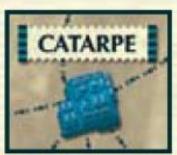
城市地点

要塞地点

地点

道路虚线
将游戏版图对应于玩家人数的一面向上放置在桌面中央。

将太阳事件版图对应于玩家人数的一面向上放置在游戏版图旁。
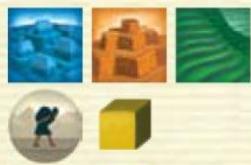
将劳工标记、城市标记、要塞标记、梯田标记和木质神庙摆放在游戏版图旁,组成供应区。

定了玩家的起始区域以及玩家的颜色。
玩家将工程造价牌摆放在各自面前。牌面印有各工程的造价以及胜利点数的概览。
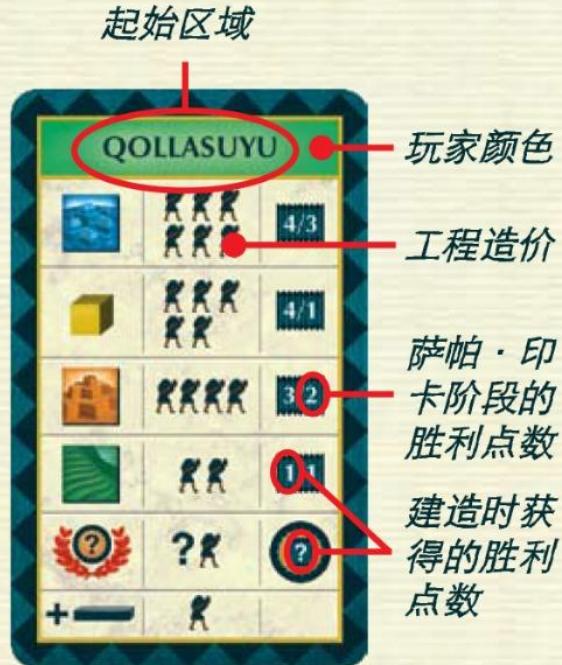
萨帕·印卡阶段的胜利点数
建造时获得的胜利点数

每位玩家拿取其颜色的游戏配件(木条和印加人)。
所有玩家将印加人摆放至计分条的起点,然后分别将一个木条摆放至各自起始区域的道路(库斯科 Cuzco 和他们起始地点之间的道路)上。

在除库斯科 Cuzco 附近的起始区域以外的所有区域分别正面向下摆放一个本土文化标记。现在将起始区域相邻所有区域的本土文化标记翻面至正面向上。

将太阳事件卡牌洗混并正面向下叠放在游戏版图上的指定位置。每位玩家抽 3 张牌加入手牌。

将黑色印加人摆放至年代条的起点:第一年代的、最顶部的空格。

将回合顺位板块洗混。每位玩家随机拿取一个,正面向上摆放至各自面前。
3 人游戏时的改动:
- 使用游戏版图对应于 3 人游戏的一面
- 使用太阳事件版图对应于 3 人游戏的一面
- 仅使用印有数字 1\~3 的回合顺位板块
- 移除以下太阳事件牌: 1x 年度朝圣、1x 伟大朝圣、1x 本土朝圣、1x 地方动荡、1x 荒野之路。
- 移除 6 个本土文化标记(每种类型 1 个)
- 其他设置同上文所述。


游戏流程
历史上,印加人的生活分为三个方面:政府(以印加阶段表示)、宗教(以太阳阶段表示)和民众(以民众阶段表示)。萨帕·印卡是神圣的君主。萨帕·印卡阶段中,玩家将获得胜利点数。
- 游戏分为 4 个年代。
- 每个年代分为若干个回合。
- 每个回合分为若干个阶段。
黑色印加人用于指示游戏当前处于哪个回合、哪个阶段。若所有玩家均完成了某个阶段的行动,将黑色印加人下移一格。若当前黑色印加人已位于该列最底部的空格,将其移至下一列最顶部的空格,新回合开始。
注意:在一个回合中,某些阶段可能被被多次进行或跳过。黑色印加人所在的空格决定当前进行的阶段。
以下为各阶段的详细说明:
回合分为以下 4 个阶段:

印加阶段

太阳阶段
民众阶段
萨帕·印卡阶段
注意:玩家将各自的印加人摆放至计分条以标记各自的分数。每格代表1胜利点数。当一个印加人被摆放至一个已有其他印加人的空格时,将其摆放至计分条的最外侧。出现平局的场合,印加人位于计分条最内侧的玩家获胜。
年代

印加阶段
印加阶段代表帝国的活动与生产。劳工标记代表个人为帝国提供的劳动力。这种强制性公共服务通常在每年的特定时间内完成。每个年代开始时,获得的劳工标记数量减少,代表着可供发展的劳动力减少的现实。在帝国历史的早期,本土劳动力被广泛用于发展。随着帝国扩张,需要更多劳动力以维系帝国运作,可供发展的劳动力减少。
1 玩家获得指定数量的劳工标记
每位玩家根据当前年代数从供应区获得指定数量的劳工标记。
②玩家因征服的区域和梯田获得劳工标记
每位玩家根据其征服的本土文化标记获得对应数量的劳工标记。每位玩家同时获得数量等同于其修建梯田数量的劳工标记。
3 玩家互助
所有玩家均获得劳工标记后,在计分条上领先的玩家必须给予其他玩家劳工标记。
- 在第二年代(帝国初期,1471\~1493),胜利点数最多的玩家必须给予胜利点数最少的玩家1个劳工标记。
- 在第三年代(帝国中期,1493\~1528)和第四年代(帝国末期,1528\~1533),胜利点数最多的玩家必须给予胜利点数最少的玩家2个劳工标记。4人游戏时,胜利点数排名第二的玩家必须给予胜利点数排名第三的玩家1个劳工标记。
注意:在第一年代(1438\~1471)无玩家互助。
① 第二年代第三回合的印
加阶段。
② 橙色玩家征服了 2 个区域并修建了 1 个梯田。其获得 3(根据当前年代)+5(本土文化标记)+1(梯田)=9 个劳工标记。
③ 其必须给予胜利点数最少的玩家 1 个劳工标记


太阳阶段
太阳阶段代表宗教对印加人生活的影响。印加是个极端之地。
沿海沙漠距离高山只有几英里。气候对日常生活产生巨大影响,尤其是对农业和渔业。太阳阶段代表这些极端,包括积极和消极两个方面。
决定回合顺位
胜利点数最少的玩家拿取 1 号回合顺位板块,胜利点数排名倒数第二的玩家拿取 2 号回合顺位板块,以此类推。
注意:出现平局的场合,印加人位于计分条最外侧的玩家获得平局玩家中较靠前的顺位。
注意:由于第一年代没有太阳阶段,回合顺位保持不变。
回合顺位板块分配如下:蓝色玩家获得1号顺位因为其胜利点数最少。绿色玩家和棕色玩家胜利点数相同,但棕色玩家的印加人位于计分条最外侧,棕色玩家获得2号顺位,绿色玩家获得3号顺位。橙色玩家获得4号顺位。

2 打出太阳事件牌
所有玩家按回合顺位依次选择一张太阳事件牌,正面向下摆放至太阳事件版图的任意一个象限,然后立即从太阳事件牌堆抽一张牌加入手牌。
注意:每个太阳阶段中,各象限均仅能摆放一张新牌。新牌被加入到先前被摆放至该象限的牌中(如果有的话)。若太阳事件牌堆耗尽,洗混弃牌堆,组成一个新牌堆。
3 展示并结算所有太阳事件牌
所有玩家均摆放一张牌后,展示这些牌。这些事件持续生效,直至下个萨帕·印卡阶段。
玩家颜色的线两侧的牌均对该玩家生效。这些牌可能造成正面或负面的影响。对这些牌的说明请见本规则书第6\~7页。
游戏过程中会有多个太阳事件同时生效。若无特殊说明,事件效果可叠加。
若太阳事件牌“地方动荡”和/或“民众支持”正面向上位于太阳事件版图上,
立即结算其效果,不管其何时被摆放至太阳事件版图。
注意:所有牌均被摆放至两条线之间,会同时对对应颜色玩家生效!

① 因为此牌被摆放至橙色线和蓝色线之间,橙色玩家和蓝色玩家每有一个抵抗值为 1 的本土文化标记,从供应区获得 1 个劳工标记。其他玩家不享有此效果。
②民众阶段中,棕色玩家的行动受到“恶劣天气”和“城市重建”的影响。
③ 橙色玩家和绿色玩家均可以执行“伟大朝圣”行动。
民众阶段
民众阶段代表民众为建设帝国而工作。通过印加阶段的强制性公共服务征募的劳工现在被投入修建道路、梯田、要塞、城市、神庙或征服新区域。
所有玩家根据回合顺位依次按任意顺序执行以下行动。
- 修建道路
每位玩家可以不支付劳工修建至多两条道路。
摆放规则:
- 一位玩家的所有道路必须与其起始区域构成一个相互连接的道路系统(见示例 2)。
- 玩家将其一条道路摆放至两个地点间的虚线上。
注意:尽管两个行动能够以任意顺序被执行,仅当玩家执行完一个行动后才可以执行下个行动。玩家不可以在执行修建道路行动时,先修建一条道路,然后执行一个建造行动,最后再修建第二条道路。
- 每条虚线上仅能摆放一条道路。
特例:通过使用太阳事件牌“荒野之路”,玩家可以在已经摆放道路的虚线上额外摆放一条道路。
- 在一个未征服的区域内修建道路的前提条件是此道路连接的两个地点之一位于一个已征服区域的边界上。
注意: 若某条道路连接的地点之一在一个本土文化标记正面向下的区域的边界上, 将该本土文化标记翻至正面向上 (见示例 1)。

若某条道路连接的地点在一个本土文化标记正面向下的区域的边界上,将该本土文化标记翻至正面向上

一位玩家的所有道路必须与其起始区域构成一个相互连接的道路系统。道路系统中允许存在分支。

在一个未征服的区域内修建道路的前提条件是此道路连接的两个地点之一位于一个已征服区域的边界上。

建造
玩家执行下列行动之一:

建造城市
印加城市几乎总是被建造在以前存在城市的地点。这解释了为什么游戏中大部分城市的名称衍生自前明。
玩家支付 6 个劳工标记,将一个城市标记摆放至游戏版图上的一个位于其道路系统内且在一个被征服区域内的城市地点(蓝色)。
建造城市使玩家立即获得 4 胜利点数。
建造要塞
要塞是道路系统中贮存食物和水的小型哨站,为军事活动提供补给或在粮食歉收、厄尔尼诺发生时,提供支持。
为民众提供支持。
玩家支付 4 个劳工标记,将一个要塞标记摆放至游戏版图上的一个位于其道路系统内且在一个被征服区域边界上的要塞地点(橙色)。
建造要塞使玩家立即获得 3 胜利点数。

征服一个区域
印加人在 100 年内将他们的帝国扩张到最大规模。许多人通过战争被征服。征服通常采取在名印加战士的视线内进行谈判的形式。
玩家支付数量等同于本土文化标记抵抗值的劳工标记,然后拿取该本土文化标记并将其摆放至面前。每当一个区域被征服,将所有相邻区域的本土文化标记翻面至正面向上。征服一个区域使玩家立即获得等同于本土文化标记上印有的分数。
注意:为了征服一个区域,玩家必须有至少一条道路连接一个未征服的区域内的地点。
建造神庙
尽管被征服的区域被允许保留自己的神灵,但印加人要求他们将太阳神供奉为至上的神。太阳神庙被建造在城市。重要的城市遗址拥有旧帝国遗留下来的重要神庙。
玩家支付 5 个劳工标记,将一个神庙标记摆放至游戏版图上的一个位于其道路系统内的城市标记上。玩家无需亲自建造该城市。
建造神庙使玩家立即获得 4 胜利点数。若玩家在一个重要城市建造神庙,其获得游戏版图上该城市旁印有的胜利点数。

建造梯田
梯田是印加人最显赫的遗产。虽然梯田并非始于印加,但印加人完善了整个安第斯山脉的建筑。梯田使可耕地面积足足增加了 100%,为印加人的垂直经济做出了贡献,沿用至今。
玩家支付 2 个劳工标记,将一个梯田标记摆放至其一个已征服的本土文化标记旁。每个本土文化标记旁仅能摆放一个梯田标记。
建造梯田使玩家立即获得 1 胜利点数。
注意:每个梯田在印加阶段为其拥有者提供一个额外的劳工标记,并在萨帕·印卡阶段为其拥有者提供1胜利点数。
额外建造一条道路
玩家支付 1 个劳工标记,将一个道路按摆放规则摆放至游戏版图上。

放弃
玩家放弃,不执行行动。
注意:游戏版图上的道路均位于特定区域内,即使它们与两个区域间的边界平行。将道路摆放在游戏版图上时请谨记以上原则,玩家可以因此看清道路位于哪个区域。
萨帕·印卡阶段
萨帕·印卡是神圣的君主。在萨帕·印卡阶段,玩家因建设帝国获得胜利点数作为奖励。
1 弃置太阳事件版图上的所有太阳事件牌
弃置太阳事件版图上的所有太阳事件牌。
2 玩家获得胜利点数
所有玩家根据胜利点数的多少依次获得胜利点数(从胜利点数最多的玩家开始)。
- 每个梯田1胜利点数
- 每个道路系统内的要塞 2 胜利点数
- 每个道路系统内的城市 3 胜利点数
- 每个道路系统内的神庙 1 胜利点数
3 将未被使用的劳工标记放回供应区
玩家可以根据当前年代数保留指定数量的劳工标记。将其余劳工标记放回供应区。
注意:玩家也会因其他玩家建造且位于其道路系统内的城市、神庙、要塞获得胜利点数。
太阳事件牌 “地方动荡” 可能造成玩家部分的道路系统不与库斯科 Cuzco 相互连接。这种情况下,玩家仅因与库斯科 Cuzco 相互连接的道路系统获得胜利点数。
游戏结束
游戏在帝国末期的萨帕·印卡阶段后立即结束。这标志着皮萨罗的抵达。
游戏结束时,胜利点数最多的玩家获得胜利。不会以平局告终——印加人位于计分条最内侧的玩家获得胜利。
太阳事件牌说明
毁坏牌
梯田牌
道路牌
城市牌
要塞牌

地方动荡
(2×): 每个太阳阶段结束时, 摧毁所有位于 (包扩部分位于) 未征服区域内的道路。

勘测专家
(1×): 若玩家在民众阶段建造梯田, 其可以额外建造一个梯田 (须支付额外的劳工标记)。
军事牌
神庙牌
图1
太阳事件牌上的符号代表其影响的阶段和/或行动。

工程压力
(2×): 若玩家在民众阶段建造行动中建造一条道路, 其可以免费额外建造一条道路。

注意:太阳事件牌“厄尔尼诺洪水”不影响此行动。
荒野之路
(4×): 玩家在民众阶段修建道路行动中修建的任意一条道路可以摆放在任意两个地点间。
注意:建议玩家同时摆放两条平行的道路以表明这是一条荒野之路。

(2×):玩家在民众阶段修建道路行动中可以免费额外修建一条道路。
加派人手

厄尔尼诺洪水
(2×): 玩家在民众阶段修建道路行动中可以修建道路数量 -1。
注意:玩家可以修建的道路数量不能被减少至1以下。
遵循以下规则:
- 荒野之路可以被平行摆放至已经摆放道路的虚线上(摆放至游戏版图上一条道路旁,视为与之相同的道路)。
- 荒野之路不能穿越虚线(无论该虚线上是否已经摆放道路)。
- 荒野之路不能连接海洋和一个地点。
- 荒野之路不能穿越超过一个边界。

流行病
(2×): 玩家在民众阶段建造每个城市须额外支付 2 个劳工标记。

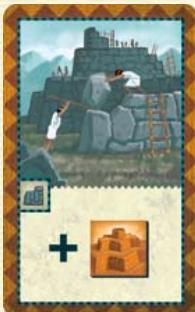
建设项目
(1×): 若玩家在民众阶段建造要塞, 其可以额外建造一个要塞 (须支付额外的劳工标记)。
军事优势

(1×): 玩家在民众阶段征服区域需支付的劳工标记数量 -1。因此征服抵抗值为 1 的区域无需支付劳工标记。
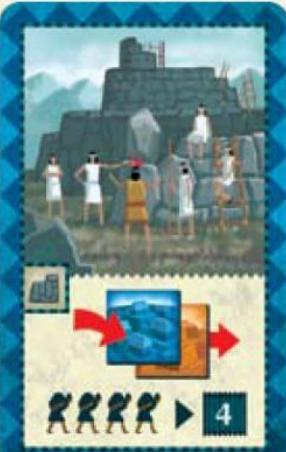
重要前哨
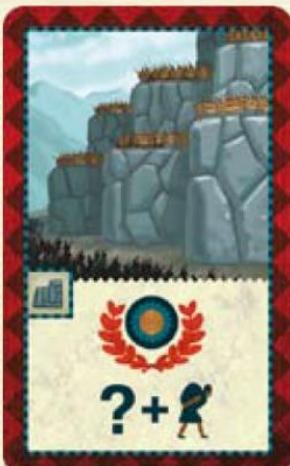
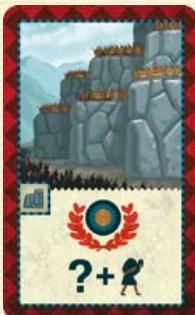
抵抗
(2×):玩家在民众阶段征服区域须额外支付1个劳工标记。
城市重建
(1×): 玩家在民众阶段建造行动中可以支付 4 个劳工标记, 将一个已建造的要塞建造为城市。建造此城市使玩家立即获得 4 胜利点数。
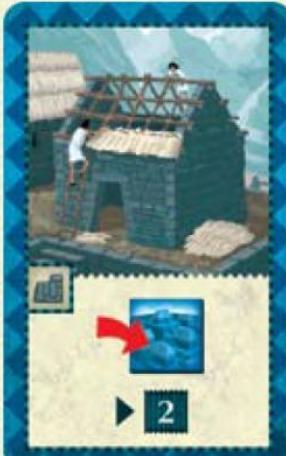
(1×): 玩家在民众阶段每建造一个城市, 立即额外获得 2 胜利点数。
注意:建造费用以及获得的胜利点数受太阳事件牌“流行病”和“城市重建”的影响。
恶劣天气

(1×): 玩家在民众阶段建造每个要塞须额外支付 1 个劳工标记。


民众支持
(2×): 太阳阶段结束时, 玩家每拥有一个抵抗值为 1 的本土文化标记, 立即获得 1 个劳工标记。
应对饥荒

宗教热情
(1×): 玩家在民众阶段可以在一个要塞上建造神庙。
(1×): 玩家在民众阶段每建造一个要塞, 立即额外获得 1 胜利点数。

快速扩张
(2×):玩家在民众阶段建造行动中可以支付劳工标记(且须额外支付2个),额外征服一个区域(可以是第二个)。

日食
(1×): 若玩家在民众阶段建造神庙, 其必须跳过修建道路行动。
注意:玩家可以不建造神庙,而是在该民众阶段进行朝圣。

进行朝圣使玩家立即获得 7 胜利点数。玩家在每个民众阶段仅能进行一次朝圣。
伟大朝圣
(1×): 若位于 Pucara de Andagala 或 Ranchillo 的神庙在玩家的道路系统内, 玩家可以在民众阶段跳过修建道路行动或建造行动以进行一次朝圣。
以下太阳事件牌仅在 4 人游戏中被使用:

年度朝圣
(1×): 若位于 Chiquitoy Viejo 或 Pachacamac 的神庙在玩家的道路系统内, 玩家可以在民众阶段跳过修建道路行动或建造行动以进行一次朝圣。进行朝圣的胜利占数, 玩家有玩家立即获得 5 胜利点数。玩家在每个民众阶段仅能进行一次朝圣。

本土朝圣
(1×): 若位于 Machu Picchu 或 Huanuco Pampa 的神庙在玩家的道路系统内, 玩家可以在民众阶段跳过修建道路行动或建造行动以进行一次朝圣。进行朝圣的玩家立即获得 4 胜利点数。玩家在每个民众阶段仅能进行一次朝圣。
下载 Markdownincaempire-rules-eng.md
rark
The Inca called their empire “Tahuantinsuyu’ which is their word for “Land of the Four Regions”. In this game, you assume the role of an “Apu” - a leader of one of the four regions (“Sapa Inca”) by doing the best job of expanding and improving the empire. Each Apu begins with the manpower of their region of the original empire. They build roads and conquer neighboring Regions increasing the manpower and resources available to them. Apus are rewarded for

or “Suyus”. Your job as an Apu is to increaseeach new Region they add to the empire and for improveyour status in the eyes of the divine emperor ments such as Terraces, Garrisons, Cities, and Temples.
GOAL
The player who has the most victory points (VP) at the moment Pizarro arrives in the Inca capital at Cuzco wins the game.
EQUIPMENT


1 Game board (double-sided: front side for 4 players; back side for 3 players)
32 Sun Event cards


Start space of the scoring track


4 Construction Cost cards


4 Turn Order tiles


(in the colors brown, orange, green and blue)
1 black Inca figure


Sun Event cards field
73 Labor Tokens
45 Local Culture markers


20 City markers
20 Garrison markers
20 Terrace markers

20 Inca temple

Starting regions
1 Sun


Event board (double-sided: front side for 4 players; back side for 3 players)

4 Invasion markers (only required for the variant "Pizzaro's Arrival")
Name of Points for the city temple

Significant city site

City site

Garisson site

Huaca site

Roads
SETUP
Place the Game board with the side that matches the number of players face up in the center of the table.

Place the Sun Event board with the side that matches the number of players face up next to the Game board.

Place the Labor tokens, City, Garrison and Terrace markers and wooden temples in a bank near the board.

Shuffle the
Construction Cost cards and deal one
to each player. The card indicates the starting region of the player and that player's color.
The players place the Construction Cost card in front of them. This card gives an overview of the cost of improvements and the number of victory points to be gained.


Each player takes the game components (wooden sticks and Inca figure) of their color.
All players place their Inca on the start space of the scoring track, and then place one of their wooden sticks on the road in their starting region (the road between Cuzco and their start location).

2 Place one Local Culture marker face down in each region except for the starting regions around Cuzco. Now reveal each Local Culture marker adjacent to a starting region.

Shuffle the Sun Event cards. Each player receives 3 cards face down and takes them in theirhand. Place the remaining cards face down in a pile on the corresponding field on the game board.

Place the black Inca figure on the first field of the Era track: the upper field of the first era.

Shuffle the Turn Order tiles. Each player gets one tile face down. The players then turn their tiles face up lace the tiles clearly visible in front of them.
Changes for a game with three players:
• Use the side of the game board that matches 3 players
• Use the side of the Sun Event board that matches 3 players
• Only use the Turn Order tiles with numbers 1-3
• Remove the following Sun Event cards from the game: 1x Annual Pilgrimage, 1x Great Pilgrimage, 1x Local Pilgrimage, 1x Rural Unrest and 1x Wilderness Road.
• Remove the 6 local cultural markers (one of each type) from the game.
• For the rest, the game is set up as described above.


PLAYINGTHEGAME
Historically, the Inca had three facets to life: Government (represented by the Inca Phase), Religion (represented by the Sun Phase), and the People (represented by the People Phase). The Sapa Inca is the divine emperor. He distributes points during the scoring phase.
• The game is divided into 4 eras.
• Each era is divided into a number of rounds.
• Each round consists of a number of phases.
The black Inca figure indicates which round and which phase is being played. If all players have completed a phase, the Inca figure moves down one field. When the bottom-most field is reached, the Inca figure is returned to the top-most field of the next column and a new round begins.
Note: It is possible that certain phases are played several times or not at all during one round. The position of the black Inca figure determines which phase is played.
A description of the individual phases:
Each round is played in the following order:
INCA PHASE
SUN PHASE
PEOPLE PHASE
SAPA INCA PHASE
Important: The players mark their VP with their Inca figure on the scoring track. Each step corresponds with 1 VP. If an Inca figure ends in a field where one or several other Inca figures are present, the Inca is placed on the outside next to the other playing pieces. The player whose Inca figure is located on the inside of the scoring track wins in case of a tie.

INCAPHASE
The Inca Phase represents the activity and production of the empire. Labor tokens represent the labor each individual provides the empire. This labor tax or “mit'a” was usually a specific amount of time each year. The diminishing supply of new labor tokens at the start of each era represents the fact that, early in the history of the empire, the local resources were made available for growth. As the empire expanded, more resources were required to maintain the empire and, consequently, fewer were available for growth.
1 Players receive Labor tokens in accordance with the current era
Each player receives a number of Labor tokens from the bank equal to the number indicated in the box of the current era.
2 Players receive Labortokens from conquered regions and terraces
Each player receives the number ofLabor tokens that is indicated on the Local Culture markers conquered by the player. Each player also receives one Labor token for every terrace he has built.
3 Players aid each other
After all players have received their Labor tokens, the leading players on the scoring track must give support to trailing players in the form of Labor tokens.
• In the Second Era (Early Empire, 1471-1493) the first place player must give the last place player one of their Labor tokens.
• In the Third (Middle Empire, 1493-1528) and Fourth Era (Late Empire, 1528-1533), the first place player must give two Labor tokens to the last
place player, and the second place player must give one Labor token to the third place player (ignore the second place support in a 3-player game).
Remark: players do not support each other during the First Era (1438-1471)
① The Inca Phase in the third round of the second era.
② Orange has conquered 2 regions and built one terrace. He receives 3 (indicated with this era) + 5 (Local Culture markers) + 1 (terrace) = 9 Labor tokens.
③ He needs to give one Labor token to Blue because the latter is in last position.



SUNPHASE
The Sun Phase represents the religious effects on Inca life. The land of the Inca was a land of extremes. There were coastal deserts only a few miles from incredibly high mountains. The climate had a great impact on everyday life, especially on the success of farming and fishing. The Sun Events represent these extremes, both positive and negative.
1 Determine the Turn Order
Distribute the Turn Order tiles among the players. Start with the player who is in last position on the scoring track and proceed towards the first place player. The player who is in last position gets number one, the player in front number 2 and so on.
Mind: in case of a tie the Turn Order is determined by the position of the Inca figures. An Inca figure on the outside comes behind an Inca figure on the inside.
Note: the Turn Order does not change in the first era (1438- 1471) because there is no Sun Phase.
The Turn Order tiles are distributed as follows: Blue gets
“1” because he is in last position. Green and Brown have the same number of points, but as
Brown is on the outside, he comes behind Green on the scoring track. Brown gets tile “2” and Green gets tile “3”. Orange gets tile “4".


2 Play Sun Event cards
In turn order, each player chooses one of his Sun Event cards and places it face down in the quadrant ofhis choice on the Sun Event board. The player then immediately draws a replacement from the Sun Event deck and takes it into his hand.
Note: During one Sun Phase only one new card can be placed in each quadrant. This card is added to cards from a previous Sun Phase, if there are any. If the Sun Event deck is exhausted, shuffle the discard pile and form a new draw pile.
3 Reveal and resolve all Sun Event cards
After all players have placed a card, the cards are revealed. The events remain in effect until the next Sapa Inca Phase.
The cards on both sides of the line in the color of a player influence this player's actions. These cards may have a positive or negative effect on actions. For an overview of the effect of these cards please refer to pages 6 and 7 of this rulebook.
During the game, there will be multiple Sun Events in play at the same time. Events are cumulative unless otherwise indicated in the rules.
If the cards "Rural Unrest" and/or “Popular Support" are face up on the Sun Event board, they are resolved
Note: Cards are always located between two lines in the color of a player. This means they influence the actions of both players!
immediately. It does not matter whether these cards were placed on the board in the current or in a previous Sun Phase.

① Orange and Blue receive one Labor token from the bank for each Local Culture marker with a resistance of "1" because this card is located between the orange and blue line. The other players do not have this advantage.
② During the People Phase the actions of Brown are influenced by the cards “Harsh Weather" and "Urban Renewal”.
3 Both Orange and Green can perform the action "Great Pilgrimage".
PEOPLEPHASE
The People Phase represents the work your people do to directly improve the empire. The mit'a collected during the Inca Phase is now put to use building Roads, Terraces, Garrisons, Cities, Temples, or conquering new Regions. In Turn Order, each player takes the following actions in any desired order. The player may build up to two Roads at no Labor cost.
Road building
Placement rules:
• All roads of a player need to be connected to his starting region and constitute one interconnected road system (see example 2).
• The player places one of his wooden sticks on a connection between two locations.
Note: While the two actions may be played in any order, you must complete one action before proceeding to the next. You may not build one Road of your Road Building i Action, interrupt that Action with a Construction Action, then build your second Road.
• Each connection can only be claimed by one player.
Exception: Using the "Wilderness Road" Sun Event, a player may connect the same two Sites as an established Road.
• It is allowed to build a road in an unconquered region provided one of the two end points border a conquered region.
Important: if a connection is made with a site bordering a region with an undisclosed Local Culture marker, the marker is revealed (see example 1).

Reveal undisclosed Local Culture Markers in regions bordering a site connecting to the road system.

All roads of a player should be connected to his starting region. Branches are allowed.

A road can't be built between two sites bordering a non conquered region.

Construction
The player takes one of the following actions.

Found a City
Inca Cities were almost always built on the sites of previously existing cities. That is why most of the City sites in the game
have names that are ultimately derived from pre-Inca civilizations.
The player turns in six Labor tokens and places a City tile on a city site (blue) on the game board that is connected to his road system and is only in a conquered Region.
Founding a city immediately scores the player 4 VP.

Build a Garrison
A Garrison was a small outpost along the Road system with stores of food and drink. These stores were kept as provisions for
military activity or to provide support to the population in case of a disaster such as crop failure or El Niño.
The player turns in four Labor tokens and places a Garrison marker on a Garrison site (orange) on the game board that is connected to his road system and borders at least one conquered region.
Building a Garrison immediately scores the player 3 VP.

Conquer a Region
The Inca expanded their empire to its greatest size within the span of 100 years. As many people were
conquered through coercion as warfare. Coercion often took the form of
negotiations brokered within sight of as many as 20,000 Inca warriors.
The player turns in Labor tokens equal to the resistance on the Local Culture marker. He then takes the Local Culture marker and places it in front of him on the table. Upon conquering a Region, all Local Culture markers in adjacent Regions are revealed.
Conquering a region immediately scores the player VP equal to the VP number listed on the Local Culture marker.
Condition: in order to conquer a Region, you must have at least one Road connected to a site adjacent to the unconquered Region.

Build a Temple
While conquered Regions were allowed to keep their own deities, the Inca required them to add the Sun god to the top of the religious hierarchy. Temples to the Sun God were raised at Cities as they were added to the empire. The Significant City Sites have important temples left from previous empires.
The player turns in five Labor tokens and places a Temple marker on a City marker on the game board that is connected to his road system. The player does not need to have founded the city himself.
Building a temple immediately scores the player 4 VP. If the player builds a temple on a Significant City Site, he receives the number of bonus points indicated on the board next to this location.

Build a Terrace
Terraces are probably the most visible legacy of the Inca. While they did not invent Terraces, they perfected their construction
throughout the Andes. The terraces increased viable farmland by as much as 100%. Terraces contributed to what is referred to as the vertical economy of the Inca and are still in use today.
The player turns in two Labor tokens and places a Terrace marker next to one of his conquered Local Culture markers. There can be only one Terrace marker next to each Local Culture marker.
Building a terrace immediately scores the player 1 VP.
Important: Each terrace produces one additional Labor token during the Inca Phase and scores 1 VP during each Sapa Inca Phase for its controller.
Build an additional Road
A player may turn in one Labor token to build one Road according to the road placement rules.

Pass
The player passes and does not take an action.
Note: The Roads on the game board are all located in specific Regions, even if they follow a border. Place the wooden sticks on the game board in such a way that it is clear to everyone in which region the road is located.
SAPAINCAPHASE
The Sapa Inca is the supreme Inca. During the Sapa Inca Phase, victory points are awarded for the maintenance of the improvements built in the empire.
1 Discard all Sun Event cards on the Sun Event board
All cards on the Sun Event board should be discarded.
2Players score victory points
Players score in order of the Inca figures on the scoring track (first place player is awarded points first).
• Each terrace built by the player 1 VP
• Each garrison connected to the player's road system 2 VP
• Each city connected to the player's road system 3 VP
• Each temple connected to the player's road system 1 VP
3Unused Labor tokens return to the bank
The players may keep Labor tokens equal to amount indicated in the box of the current Era. The players return unused Labor tokens to the bank.
Note: the players also receive VP for cities, temples and garrisons built by other players that are connected to their road system.
The card "Rural Unrest" may cause part of a player's road system to be disconnected from Cuzco. If this is the case, the player is only awarded points for improvements connected by roads to Cuzco.
END OF THE GAME
The game ends immediately after the Sapa Inca Phase of the Late Empire. It's the arrival of Pizarro. At the end of the game, the person in the lead on the Scoring track wins the game. There are no ties - the marker closest to the center of the board is ahead.
OVERVIEWOF SUNEVENT CARDS
Destruction cards
Terrace cards
Road cards
City cards

Garrison cards

At the end of each Sun Phase, destroy all Roads that have any portion built in unconquered Regions.
Expert Surveyors (1x): If you build a Terrace during the People Phase, you may build an additional one at the regular building costs.
Military cards
Rural Unrest (2x):
Temple cards
The symbols on the Sun Event cards refer to the phase and/or action the card effects.


Workers Press On
(2x): If you choose to build an Additional Road during the Construction Action of the People Phase, you may build another Additional Road at no cost.
Note: The card “El Niño Flooding:" does not affect this action.

Wilderness Road
(4x): One of the Roads you build during the People Phase may be built between any two sites.
Note: to clearly indicate a wilderness road it is recommended you use two wooden sticks.

Extra Road Crew
(2x): During the Road Building Action of your People Phase, you may build one extra Road for free.

El Niño Flooding
(2x): You must build one fewer Road during the Road Building Action of your People Phase.
Note: the number of Roads you can build cannot be reduced below one.
The following rules apply:
• this road may run parallel to an existing road (you place a wooden stick next to a stick on the game board and thus claim the same road).
• this road must not cross any existing connection (whether claimed or not) on the board.
• this road must not pass more than one border.
• this road must not run between the sea and a site

Epidemic (2x): Every City you build during the People Phase requires two additional Labor.


Key Outpost (1x): During the Construction Action of the People Phase, you may improve a previously constructed Garrison to a City by spending four Labor tokens. This city immediately scores you 4VP.
Note: the building costs and the number of points for this action are influenced by the Epidemic' and 'Urban Renewal' cards.
Military Superiority
Building Project
(1x): If you choose to build a Garrison during the People Phase, you may build two instead of one. You must provide the Labor for each Garrison.
(1x): Every Region you conquer during the People Phase requires one fewer Labor token. A Region with a resistance of one may be conquered without using any tokens.

Every Region you conquer during the People Phase requires one additional Labor token.
Resistance (2x):

Harsh Weather (1x): Every Garrison you build during the People Phase requires one additional Labor token.

Urban Renewal (1x): Every City you build during the People Phase is immediately worth two additional VP.

Popular Support Popuiar Support
(2x): All Local Culture markers you control with a resistance of «1» immediately provide you with one additional Labor token at the end of the Sun Phase.

Religious Fervor

(1x): You may build a Temple at a Garrison instead of a City during the People Phase.

Stores Stop Famine
(1x): Every Garrison you build during the People Phase is worth one additional VP.
Rapid Expansion (2x): You may choose to conquer a (second) Region in addition to any other option during the Construction Action of the People Phase. The cost to conquer this Region is increased by two Labor tokens.
Solar Eclipse (1x):
If you choose to build a Temple, you must skip the Road Building Action of the People Phase.
Note: you may not build a Temple and go on a Pilgrimage in the same People Phase.

Great Pilgrimage
(1x): If your Road system is connected to a Temple at either Pucara de Andagala or Ranchillo, you may skip either the Road Building Action or the Construction Action of the People
Phase and go on a pilgrimage. This immediately scores you 7 VP. You may only go on one Pilgrimage per People Phase.
The following cards are used in 4-player games only:

Annual Pilgrimage
(1x): If your Road system is connected to a Temple at either Chiquitoy Viejo or Pachacamac, you may skip either the Road Building Action or the Construction Action of the People Phase
and go on a pilgrimage. This immediately scores you 5 VP. You may only go on one Pilgrimage per People Phase.

Local Pilgrimage (1x): If your Road system is connected to a Temple at either Machu Picchu or Huanuco Pampa, you may skip either the Road Building Action or the Construction Action of the People
Phase and go on a pilgrimage. This immediately scores you 4 VP. You may only go on one Pilgrimage per People Phase.
INCAEMPIRE PHASE OVERVIEW

INCA PHASE
1 Receive Labor tokens equal to the Resources ofthe current Era.
2 Receive Labor tokens equal to the Labor value of conquered Regions and Terraces.
3 Leading players give support to trailing players.

SUN PHASE

Determine new Turn Order

Place Sun Event Cards.

Reveal and resolve all Sun Event cards.

PEOPLE PHASE
Each player takes the following Actions in any order:

Road Building

Construction
SAPA INCA PHASE
1 Discard all Sun Event cards on the Sun Event board
2Award victory points
3 Unused Labor tokens return to the bank.
| Inca phase | People phase | Sapa Inca phase | ||
| Income | Costs | VP | VP | |
| City | 6 Labor tokens | 4 | 3 | |
| Temple | 5 Labor tokens | 4 | ||
| Garrison | 4 Labor tokens | 3 | 2 | |
| Terrace | 1 Labor token2 | Labor tokens | ||
| Conqueringregions |  |  |  | |
Rules easy to forget:
• Building an improvement scores VP for the player building the improvement. However, with the exception of roads and terraces, improvements are not owned by the player who built them. Once an improvement has been built, it becomes part of the entire Inca Empire.
• Garrisons and cities may only be built on sites located in conquered regions or adjacent to conquered regions. It is not possible to build on sites that are completely located in an unconquered region until this region is conquered.
Note: all sites are in principle located in a region or on the border of a region. If the site is very close to a border, this means that the site is located on the border of a region.
• The roads on the game board are all located in a specific region, even if they follow a border. The Sun Event cards that affect Roads in unconquered regions only influence roads actually located in such a region and not roads following the borders of such a region.
• Local Culture markers are revealed when a player connects a site on the border to his road system and when a neighboring region is conquered.
• The number of tokens, markers and roads available in the game is unlimited.
• If an Inca figure ends on a position on the scoring track already occupied by one or several players after scoring VP, this figure is placed on the outside next to the other figures. The player whose figure is located closest to the centre of the board is always in the highest position in case of a tie.
VARIANTS
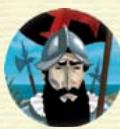
Pizarro's Arrival: There is a variable ending (the uncertainty of Pizarro's arrival). Shuffle the Invasion markers face down and place one next to each
Early Downfall: If you want a shorter, 4-player game, remove the following cards: Annual Pilgrimage, Great Pilgrimage, and Local Pilgrimage. Skip the third column of the Early Empire and the second column of the Middle Empire.
Late Empire. At the end of each People Phase in the Late Empire, turn over the Invasion marker next to that phase. When 'Pizarro's Arrival' is revealed, go directly to the Sapa Inca Phase. The game is over.

The Gods Agree: During the setup place 4 Local Culture markers that provide 3 Labor face up in de regions marked with a Hand of God symbol. Place the remaining markers according to the rules.

Game design: Alan Ernstein Artwork: alexandre-roche.com Rules development: Jeroen Hollander English translation: Alan Ernstein, Bart Hillewaert Project manager: Johan Kuipers

www.whitegoblingames.nl

www.zmangames.com
64 Prince Road, Mahopac, NY 10541