Dungeon Raiders 2018 ENG Rules.md
PHIL WALKER-HARDING DUNGEON RAiDERS

Rulebook
DUNGEON RAiDERS
3-5 players • Ages 8+ • 20 minutes
SUMMARY OF THE GAME
In Dungeon Raiders you join a brave party of adventurers exploring a dangerous dungeon. Your aim is to find the most treasure while avoiding wounds from monsters and traps.
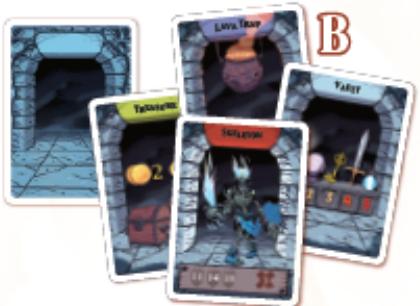
Each level of the dungeon is made up of a row of 5 room cards. Each room will contain either treasure, a monster, a trap or a vault. Some rooms are dark so they will remain face-down until entered. In each room, the players will play one of their power cards, which allow them to pick up coins, fight monsters and trigger traps. In a vault, the players can pick up items which give them a special one-use ability.
At the end of a level, the players take their power cards back into their hand to use again. After playing through all 5 levels of the dungeon, whoever has the most coins wins the game. However, the player who finishes with the most wounds collapses, and cannot win!

CONTENTS
7 level cards: 7 unique level row diagrams.
B-30 room cards: 11 monster rooms, 10 treasure rooms, 5 vaults, 4 trap rooms.
C 25 power cards: 5 sets of cards valued 1-5.
D= 24 item cards: 6 torches, 6 crystal balls, 6 keys, 6 swords.
B 10 boss cards: 10 unique boss monsters.
5 character cards: Explorer, Knight, Thief, Warrior, Wizard.
38 coin tokens: 24 value 1, 14 value 5.
26 wound tokens: 20 value 1,6 value 5.
1 map card: Only used when playing the tactical variant, to indicate the start player.



GAME SET UP
Create the room pile: Shuffle all the room cards face-down. Randomly remove 6 of them from the game without looking at them, they will not be used. Randomly choose 1 boss card without looking at it and place it face-down under these cards. Place this pile in the centre of the table.
B Create the level pile: Shuffle all the level cards face-down. Randomly remove 2 of them from the game, they will not be used. Place this pile beside the room pile.
Prepare the item supply: Sort the item cards by type. Place them in 4 face-up piles on the table above the room pile.
DPrepare the coin and wound supplies: Place the coin and wound tokens in separate piles on the table in reach of all players.
B Set up characters: Shuffle the 5 character cards face-down, deal 1 to each player and remove any remaining from the game. The players place their card face-up in front of them, showing the character they will play as. Each player takes the number of coin and wound tokens depicted on the card in front of them, and takes any depicted item cards from the supply into their hand. Each player also takes a set of power cards numbered 1-5 into their hand. Players' hands are always kept secret.

LEVEL SET UP
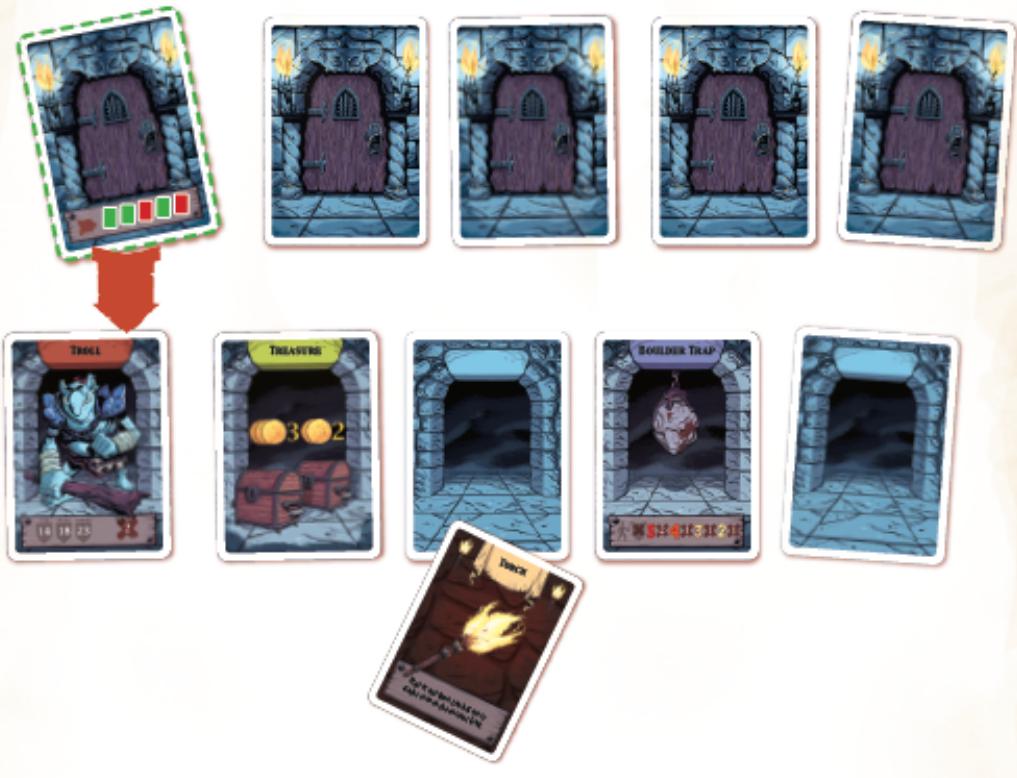
The game is played over 5 levels of the dungeon, each represented by a row of 5 room cards called the level row. To set up the level, a player reveals the top level card from the level pile. Cards are then drawn from the room pile and placed in the centre of the table matching the diagram on the level card. A green icon means the card is placed face-up and a red icon means the card is placed face-down without anyone seeing what it is. After setting up the level row, the level card is removed from the game.
Using a Torch: At any time during play, including right after the level is set up, any players may announce they are playing a torch card from their hand. This allows them to secretly look at every face-down card in the level row, returning each one to its place. Multiple players may use a torch card on the same level. Played torch cards are immediately returned to the supply.
PLAYING THE GAME
Each level is played one room card at a time, following these steps:
1. Enter the room
The players enter the next room of the dungeon, which is the left-most card in the level row. If this card is face-down, it is now flipped face-up.
2. Play cards
Each player must choose a power or item card from their hand to play face-down in front of them. Once every player has played a card, all the cards are flipped face-up simultaneously.
Using a Crystal Ball: After flipping a played crystal ball card, the player chooses another card from their hand to play face-up - now being able to see what their opponent's have played. If multiple players play a crystal ball at the same time, they reveal their next card simultaneously. Used crystal ball cards are immediately returned to the supply.
3. Resolve room
Each type of room resolves differently based on what cards have been played.
Treasure room: The highest power cards gain coins.
Monster room: The lowest power cards gain wounds unless the players defeat the monster.
Vault: Each player will gain a special benefit
Trap: The richest or healthiest player may lose coins or gain wounds.
Boss: The final room of the game is a boss, which resolves similarly to a monster.
See the full rules for resolving rooms below.
4. Discard room
After resolving the room, the room card is discarded from the game.
The players leave their played power cards face-up displayed in front of them until the end of the level. This means that everyone can see which power cards have already been played when making their decisions.
End of the level: After all the rooms in the level are resolved, the level is complete. All players return their played plower cards to their hand and the next level is set up. After all 5 levels are completed, the game is over.

RESOLVING A TREASURE ROOM
Compare the numbers on the power cards that have been played. Whoever has the highest gains coins equal to the number on the most valuable chest on the treasure room card. If multiple players tie, then they share the chest, dividing its value equally between them (rounding down with any remainder ignored). If there is less treasure in the chest than the number of players who have tied for it, they all receive nothing.
There may also be a second less-valuable chest on the treasure room card. If so, whoever played the second-highest power card gains coins equal to the number on the second chest. If multiple players tie then they share the chest, as described above. Depending on how the chests are divided, it is possible for a player to receive more coins in second place than in first.
A player may only have a maximum of 20 coins.
Example: The treasure room contains 2 chests, valued 4 and 2. Players A, B and C play a value 4 power card. Player D plays a 2, and player E plays a 1. Players A, B and C tie for the bighest power card, and so share the value 4 chest. They receive 1 coin each (the remainder of 1 coin is ignored). Player D bas the second-higbest power card, and so receives 2 coins from the second chest. Player E receives nothing.
Using a key: A key card may only be played in a treasure room and it counts as a value 5 power card. Once the room is resolved the used key is returned to the supply.


RESOLVING A MONSTER ROOM
First, the players check the monster's strength. It is listed at the bottom of the monster room card, in the shield with the dots equal to the number of players in the game. Next, the players add up the value of all the power cards played. If the total is equal to or greater than the monster's strength, the players have defeated the monster and the room has now been resolved.
If the total is less than the monster's strength, then the monster attacks. This means the player who played the lowest power card gains wounds equal to the number of wounds depicted in the bottom-right corner of the monster room card. If multiple players tie with the lowest power card, they all receive the full amount of wounds. There is no limit to the number of wounds a player can have.
Example: The current room contains a dragon. There are 4 players, so its strength is 18. Player A plays a value 5 power card, player B plays a 4 and players C and D each play a 3. The total of all the power cards is only 15, so the dragon attacks. Both players C and D gain 3 wounds, because they played the same lowest card.
Using a sword: A sword card may only be played in a monster room and it counts as a value 5 power card. Once the room is resolved the used sword is returned to the supply.

RESOLVING A VAULT
Torch, crystal ball, key, sword: The player takes a copy of the corresponding item card from the supply and adds it to their hand. If multiple players want to take the same item card and there are not enough left in the supply for everyone, then no one takes the item. There is no limit to the number of cards a player may hold.
Coins (1, 2 or 3): The player gains the corresponding number of coins. If multiple players want the same pile of coins, they all receive the full amount. A player may only have a maximum of 20 coins.
Potion (valued 1 or 2): The player discards wounds corresponding to the value of the potion. If multiple players want the same potion, they all discard the full amount of wounds. Discarded wound tokens are returned to the supply.

RESOLVING A TRAP
The highest power card played by any player is considered when resolving a trap, as follows.
Lava Trap: The player(s) with the most coins lose 3/2/1 coins if the highest card played is a 5/4/3.
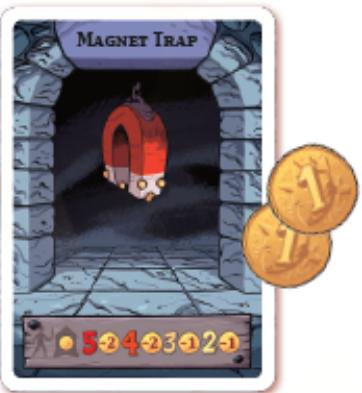
Magnet Trap: The player(s) with the most coins lose 2/2/1/1 coins if the highest card played is a 5/4/3/2.
Spike Trap: The player(s) with the least wounds gain 2/2/1 wounds if the highest card played is a 5/4/3.
Boulder Trap: The player(s) with the least wounds gain 2/1/1/1 wounds if the highest card played is a 5/4/3/2.
If multiple players tie for the most coins or least wounds, they all receive the full penalty of the trap.



RESOLVING A BOSS
A boss resolves the same way as a monster room, with the following variations.
Tax Collector: Instead of receiving wounds, any attacked players lose 3 coins.
Medusa: Instead of receiving wounds, any attacked players are eliminated from the game and cannot win. If all players are attacked, then everyone loses the game! Any remaining players proceed to the final scoring where additional players may be eliminated.
Vampire: Any attacked players gain 1 wound and also lose 2 coins.
Sphinx: Any attacked players gain 2 wounds. Additionally, the player who played the highest card gains 2 coins. If multiple players tie for the highest card, they all receive 2 coins. If all players play the same card and don't defeat the Sphinx, no one gets any coins.
Minotaur: Any attacked players gain 1 wound. Additionally, the player who played the highest card gains 1 coin. If multiple players tie for the highest card, they all receive 1 coin. If all players play the same card and don't defeat the Minotaur, no one gets any coins.

Wolf Pack: If any player plays a torch, they escape the room. This means they do not contribute to defeating the monster and are ignored when determining who is attacked.
Necromancer: If any player plays a crystal ball, they escape the room. This means they do not contribute to defeating the monster and are ignored when determining who is attacked.
Mega Dragon: This boss cannot be defeated and so will always attack. If any player plays a key, they escape the room. This means they are ignored when determining who is attacked.
Golem: This boss cannot be defeated and so will always attack. Any value 5 power cards and swords played in this room count as a value 1 power card.
Mummy: This boss cannot be defeated and so will always attack. However, the Mummy attacks the player(s) who play the highest power card rather than the lowest.

END OF THE GAME
When the fifth level is complete, the game is over and it is time for the final scoring. The player with the most wound tokens collapses from their wounds. This means they are eliminated from the game and cannot win. In a 4 or 5 player game, if multiple players tie for the most wounds, they are all eliminated. In a 3 player game, a player only collapses if they have the outright most wounds. Regardless of the number of players, if every player has the same amount of wounds when the game ends, then no one is eliminated.

Out of the remaining players, whoever has the most coins wins! If multiple players tie for the most coins, then the player with the least wounds wins. If the players are still tied they share victory.

TACTICAL VARIANT
Players looking for a more tactical game can play with the following rules variations. After set up, randomly choose someone to be the start player. They take the map card in front of them to indicate this.

When playing cards, the player with the map card goes first. They play their chosen card face-up on the table. Then moving clockwise around the table, each other player plays their chosen card face-up. Then the room is resolved as normal. If a player plays a crystal ball, play simply moves to the next player. Then, after every player has played a card, any players who played crystal balls now play a second card, again in clockwise order from the start player. Played crystal ball cards are then returned to the supply.
After resolving a room, the next start player is determined. Whoever just played the highest power card will takes the map card and will play first in the next room. Keys and swords count as a value 5 power cards. If multiple players tie for the highest card, then the next tied player in clockwise order from the current start player takes the map card. Whoever has the map card after the final room of a level will be start player for the first room of the next level.
CREDITS
Game design: Phil Walker- Harding
Illustrations: Albert Monteys
Graphic Design: Bascu
English Revisor: William Niebling
Publisher: David Esbrí
Thanks to the following play testers: Meredith Walker-Harding, Chris Morphew, David Harding, Nick Barnett and Kerryn Wilson. Special thanks to Toni Serradesanferm for the inspiration for the boss cards.


PHIL WALKER-HARDING
DUNGEON RAiDERS

Devir Americas
2735 California Ave.
SW, Suite 110A
Seattle, WA 98116
www.devirgames.com
下载 Markdown