Florenza_SE_EN_10.md


GAME SUMMARY
In Florenza, the players are the heads of the most powerful families in the city of Florenza (now known as Florence) during the Renaissance period. The goal of the game is to become the most famous patron of the arts by hiring the most renowned artists of the period and financing their works.
Each player can commission artworks in his own district, the Cathedral, or in the civic buildings of the city. Each artwork requires money and resources to complete. To earn the money and resources the artists need, the players send their workers to labor in various workshops, possibly even in their opponents' districts. Additional workers can be earned by offering charity to the church.
During the game, players will earn prestige points, primarily by completing artworks. Prestige points can be spent during the game, but at the end of the game they will be the player's primary source of victory points.
All of the characters in the game are real historical figures that lived and worked in Italy during the Renaissance. Most of them worked in Florence. All of the buildings in the game were real Renaissance workshops. The artworks the players can complete include the masterpieces of some of the most famous artists in the world.
In this second edition we made some small changes to the original rules. They are marked with this symbol:II

GAME SETUP
Follow these steps to set up and begin the game:
THE CITY OF FLORENZA
-
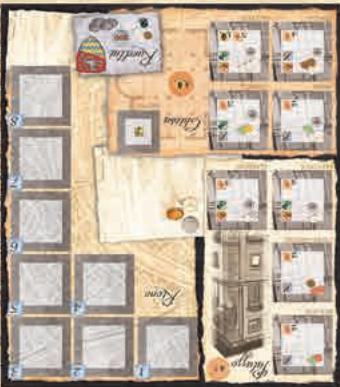
Place the Game Board in the center of the table (as shown in the picture).
-
Place all resource cubes on the matching colored spaces of the gameboard. Place the Fiorini coins on the “Banco” and the prestige point certificates near the board.

LIFE IN FLORENZA:
- Separate the eight unnamed character tiles from the rest and set them aside. Put all 40 remaining character tiles in the cloth bag.

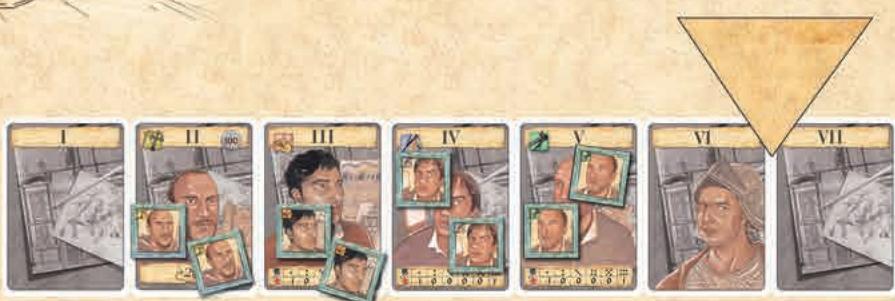
- Place the seven Life in Florenza cards in a row along the side of the
board, in order from I to VII. These cards are used to track the number of turns each character is in the game. At the end of each round, they are moved to a lower value card, until they end their time in Florenza. You can use any character under any card, regardless of the number on the card.
- Set the unnamed character tiles on cards II through V as shown. There will be 2 tiles on each card. The VI card is the Guard, and is used by the Captain of the People. Cards I and VII have no special function.

-
Mix the tiles in the bag and randomly draw out tiles based on the number of players: 2 Players 6 Tiles 3 Players 7 Tiles 4 Players 8 Tiles 5 Players 9 Tiles
-
Find the matching character card for each tile drawn (the ID numbers on each tile and card can help). Each character will remain in the game for a limited number of rounds, indicated on his card next to his name. Place the character card with the “new artist" side up beneath the Life in Florenza card with the matching number (if it is an artist—both sides of the preacher cards are identical)
-
Place the character tile on top of the card.


Cost to hire the artist, according to his skills

New Artist side

Completed Masterpiece side




Identification number to help match cards and tiles.
Life in Florenza cards

Rounds of play that character will remain in Florenza


THE DISTRICTS
Each player chooses a family and takes all of the pieces that match that family's color:
1 district board
1 Building/Artwork table
8 workers
4 on your district board
4 nearby (but not on your district board) to create a “pool" of workers
4 markers
15 family crests
300 Fiorini
1 resource cube of each type


SAMPLE CHARACTER SET UP.
These cards show how many Rounds of play characters will remain in Florenza. At the end of each Round, all the Characters will move down one space along the row of Life in Florenza cards (see page 14). As long as a character is in play, he can be chosen by a player regardless of which Life in Florenza card he is beneath.
THE GAME TRACKS:
-
In the four corners of the Game Board, you can find the tracks you will need during the game.
-
Place your marker with the Captain portrait on the "0" square of the prestige track, and place your marker with the Bishop on the “0" square of the church influence track.
During the game, all Prestige Points earned or lost by players are scored by moving the marker on the Prestige Track.
-
Take one of the family markers from each player and mix them, then randomly place them on the turn order track starting with the third box. Do not place any markers on the spaces with the Bishop or the Captain at this time. Set the last family marker to the side for now.
-
Place the turn marker on the first space of the game turn track.
-
To help players remember their turn order, there is a set of turn order cards. Give each player the card that matches his family's position on the turn order track. Turn the cards with the Captain and the Bishop face down before handing out the turn order cards.
Set aside the card showing a “2” on both sides, for now.
Important: During the first round, all turn order cards must be placed with the numbered side up, not the side showing the Captain and the Bishop.

The starting player (the player with the family marker in the front on the turn order track) also takes a game summary card in your language.

Turn order track


PRESTIGE TRACK
3 2 2 2 3 4 5 67 8 9 10 12 13 15 16 17 18 19 20 21 22 23 24 25 26 27 28 29 30 31 33 34 35 3637 38394041424344454647 4849
During the game, all prestige points gained or lost are scored by moving your marker on the prestige track.

TURN ORDER TRACK
CHURCH INFLUENCE
During the game, all church influence points gained or lost are scored by moving your marker on the church influence track.

GAME TURN TRACK
The turn marker moves forward in phase 9 each round. After the 8th round, the game ends.
RESOURCE TABLE
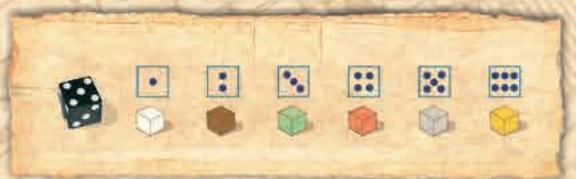
Players receive an extra resource from this table in phase 1 each round, starting in round 2.
SUGGESTED WORKSHOPS FORYO


YOUR FIRST GAME
There are many different workshops in Florenza, and choosing which to use to start the game can be difficult for new players. We recommend that you use these workshops for your first game:
The last player (who chooses first) should place a Picconiere on space “1" and a Legnaiuolo on space “2."
The second to last player should place a Boscaiuolo in space "1" and an Ottonaio on space “2."
The third to last player should place a Fabbro on space "1" and an Erbolaio on space “2."
The fourth to last player should place a Cambia valute on space "1" and an Orafo on space “2."
The final player should place a Monte di Pietà on space “1" and a Lanaiuolo on space “2."
In this example, the red player is playing 1st, yellow is 2nd, green 3rd, blue 4th, and black 5th. Black chooses workshops first.


THE WORKSHOPS
Sort the workshop tiles and place them near the gameboard, forming a supply. Each player will begin the game with two workshops, but only a limited number are available at the beginning of the game. Take one each of the following tiles from the supply and set them apart:
| Boscaiuolo (3) Monte di Pietà (18) |
| Cambiavalute (4) Orafo (19) |
| Erbolaio (11) Ottonaio (20) |
| Fabbro (12) Picconiere (22) |
| Lanaiuolo (14) Speziale (27) |
| Legnaiuolo (15) Tintore (28) |
Identification number listed in brackets


RED ID NUMBER BOX:

There is only 1 of this workshop in the game.

BROWN ID NUMBER BOX:
There is more than 1 of this workshop in the game.


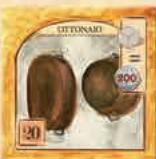


Each workshop tile has two sides. The front (dark) side shows the cost that you must pay in order to build the workshop. When you place a new workshop tile on your district board, you must always place it with this side up. After you pay the cost shown, turn the tile over to the finished side.
The back (light) side shows the finished workshop and what benefit you can receive if you place a worker there. Each player has a Building table he can read to see construction costs and benefits of all the Buildings.

Starting with the player in the last space on the turn order track, and taking turns in reverse order, each player will select one of these workshops and place it on the “1" space of his district board. Once all players have chosen a workshop each player, in the same order, chooses a second workshop from the list and places it on the “2” space. In this way, all players will begin the game with two workshops. These workshops are built for free: place them with the finished side up. Any workshop tiles that are not chosen are returned to the supply.
Strategy Hint: During the game, you can use workshops in another player's district, but you must pay him one prestige point each time. Having workshops that other players will want to use can prove to be a profitable strategy. Also, remember that workshops are resolved in order. It is not the best strategy to have a building that sells a resource come up before the workshop that produces that resource.
You are now ready to begin the game!
PLAYING THE GAME
Florenza is played over a series of eight rounds. Each round is divided into nine phases that must be played in order:
-
Collect Income
-
Captain of the People
-
Bishop
-
Market
-
Worker Placement
-
District Activities
-
Artwork
-
Turn Order

- End of the Round
Important: In the first round of the game, the first three phases are skipped. Start with Phase 4: Place Workers in this round.


A ROUND IN BRIEF
The first player can use the summary card and this list to help ease play:
PHASE 1: All players receive resources, money, prestige, church influence, and workers they can use later in the round.
PHASE 2: The Captain of the People uses his power.
PHASE 3: The Bishop uses his power.
PHASE 4: The players use their workers to: - Operate workshops - Build workshops - Hire artists - Go to the market - Give charity - Send to work II
PHASE 5: All players with a worker in the market can buy, sell, or exchange resources with the supply.
PHASE6: District workshops are operated and built, as planned in phase 4. This can cause a gain or loss of prestige points and church influence.
PHASE 7: Artworks are completed, as planned in phase 4. This can cause a gain or loss of prestige points and church influence.
PHASE8: The new Captain of the People and Bishop are chosen, and a new turn order is determined.
PHASE9: The turn marker and all characters advance. Characters under the “I" card are removed from the game and replaced by new ones.
EXAMPLES OF ARTWORKS THAT PROVIDE INCOME
Since the yellow player completed the artwork shown, he receives 1 prestige point in phase 1 each round. The other artworks shown would award 1 church influence, 1 worker, or in the case of the Atrio of the Banco, 1 gold cube or the option to sell 1 gold for 200 Fiorini.
1. COLLECT INCOME:
This phase is skipped in round 1.
At the beginning of each round, all players collect income for their family holdings. All incomes must be placed on your district board. At the bottom of your district board is a scroll
showing the resources you receive from your family each round. You must have zero workers on your district board before you collect income. You may have resources or money from earlier rounds.
- All players receive the same family income: 200 Fiorini 1 Marble 1 Wood 4 Workers
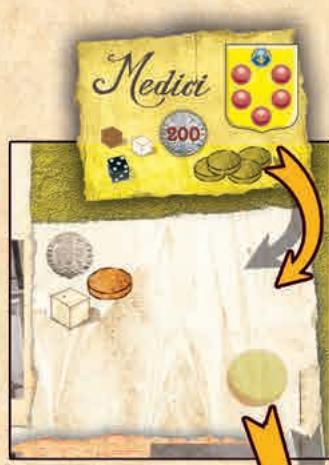
- Each round all players will also receive a random
resource, determined by the roll of the die. The first player rolls the die once, and consults the resource table on the tracking chart. All players each receive the resource shown on the chart. If there are not enough resource cubes of that type, each player instead receives 100 Fiorini.

- You may also receive additional income each round for artworks that you have completed earlier in the game. If your family crest is on an artwork that provides income, you receive that income during this phase. Some workshops also provide income every round:
Each Casa pays its owner 50 Fiorini and 1 worker.
Each Casamento pays its owner 100 Fiorini and 1 worker.
The Palagio pays its owner 1 prestige point, 100 Fiorini, and 1 worker.
Note: These workshops have a distinctive purple background color so they are easy to spot. No worker can ever be placed on these special buildings.

2. CAPTAIN OF THE PEOPLE

This phase is skipped in round 1

The player who earns the most influence will be nominated“Captain ofthe People" during Phase 8: New Turn Order. His authority gives the player two benefits, that he applies in this phase.
Every time you gain prestige points from any source, you must advance your marker on the prestige track a number of spaces equal to the
prestige earned. If your marker advances beyond the “50" space, turn the marker over so the “+50" side is showing and return it to the beginning of the track.

CAPTAIN'S AUTHORITY:
The Captain always acts first in each phase of the round.

The Captain can detain one worker or one named artist.
DETAIN A WORKER
The Captain of the People can detain one worker from any opponent's family. Take the chosen worker from your opponent's district board and place it on the “VI" Life in Florenza card (showing the guard).
A detained worker cannot be used for any purpose for the rest of the round. The worker is returned to the pool during Phase 9: End of Round.
DETAIN AN ARTIST
The Captain of the People can detain one artist. Take the chosen artist's tile from his card and place it on the “VI" Life in Florenza card. Only named artists can be detained.
Only the Captain of the People can hire a detained artist. The artist returns to his card during Phase 9: End of Round.
Note: The Captain ofthe People cannot detain a preacher!

3. BISHOP
This phase is skipped in round 1
If a player can gather enough influence in the church, he will become the “Bishop" during Phase 8: New Turn Order. His authority gives the player two benefits, that he applies in this phase.
When you gain or lose church influence, you must record those changes on the church influence
track. There are no certificates or markers for church influence, however. This status is tracked only on the church influence

track. If your church influence increases beyond 10, turn your marker over so the “+10" side is showing and return it to the beginning of the track.
BISHOP'S AUTHORITY:
The Bishop always acts second in each phase of the round, unless there is no Captain. If there is no Captain, the Bishop acts first in each phase.
The Bishop can convert one worker or expel one preacher.
CONVERT A WORKER
The Bishop can convert a worker from another family, causing him to join the Bishop's family instead. Take one worker from your opponent's district board and return it to the pool. Then take one of your workers from the pool (if there is one) and place it on your district board.
Note: You can convert a worker (moving it to the pool) even if you have no workers of your own in the pool to take.

EXPEL A PREACHER
TheBishop canexpelapreacherfrom the city. Take the chosen preacher's tile from his card and place it on your turn order card (showing the picture of the Bishop). Only named preachers can be expelled.
No player can give charity or use this preacher in any way for the rest of the round. The preacher is returned to his card during Phase 9: End of Round.
Note: The Bishop cannot expel an artist!
4. WORKER PLACEMENT
During this phase, players will take turns placing workers and giving charity to preachers. The players take turns in the order shown on the turn order chart, beginning with the Captain of the People (if he is in play).
The workers available for each player, are those determined in phase 1: Collect Income.
Each player places a worker until the last placed his first one. Then the first player places his second worker and so on, until all the workers of all players have been used.
WORKER ASSIGNMENTS:
You can place a worker in six ways:
A. OPERATE A WORKSHOP
B. BUILD A WORKSHOP
C. HIRE AN ARTIST
D. GO TO MARKET
E. GIVE CHARITY
F. SEND TO WORKII

FLORENZA 9 FLORENZA
A. OPERATE A WORKSHOP
You can place your worker on a finished workshop to produce resources, money, or other benefits. Choose the workshop you wish to use and place your worker on the tile. There is no cost for placing a worker in one of the workshops on your own district board.
You can use a workshop on another player's district board by placing one of your workers on that workshop. But, you must pay that player 1 prestige point when you place your worker there. Remember to move the markers on the prestige track. You cannot place a worker on a workshop in an opponent's district if your marker on the prestige track is already on the “-3" space. You do not receive the benefit of the workshop until Phase 6: Workshops.
Important: Each workshop can be used only once per round! You cannot place a worker on a workshop that is already occupied by another worker.
Note: The Casa, Casamento, and Palagio cannot be used by workers. These buildings automatically provide an income to their owner during Phase 1. These workshops have a special purple background color to distinguish them from the other workshops.


PRESTIGE POINTS
earned when you build the
workshop
B. BUILD A WORKSHOP
You can assign a worker to build a new workshop in your district. Take the workshop tile you wish to build and place it on your district board with the building side up. You must place it in the lowest-numbered space on your district board. Then, place your worker on top of the workshop tile.

The workshop is not built until Phase 6: Workshops.
Note: You do not have to have the resources required to build a workshop when you place the tile on your district board. But, you should plan carefully so that you will have the right resources when you need them.
Hint: Each player has a building table that lists every workshop in the game and shows both the building costs and the effects of each workshop. If a workshop has a darkened background on the building table, there
is only one copy of that workshop in the game. Once built,workshops remain for the rest of the game and cannot be removed or changed. You must plan your building carefully, as you can only build a maximum of 8 workshops!

C. HIRE AN ARTIST
In order to complete an artwork, you must send a worker to hire an artist. Place your worker on the artwork you want to complete. The artwork box must not have any player's family crest token, and it cannot already have a worker. The artwork you choose can be on your own district board or on the main gameboard.
Hint: each player has an artwork table that shows needed resources and artist kinds per each artwork, and the income they give.
Cathedral

The artist must have the ability required for the artwork (painter, sculptor, or architect).
When you place a worker on an artwork, you must also immediately choose which artist you will hire. Take the chosen artist's tile from his card and place it on top of your worker (leave his card by the Life in Florenza cards). You
cannot hire an artist if his tile is not on his card beneath a Life in Florenza card.

Note: You may instead hire one of the six unnamed artists directly from his Life in Florenza card.
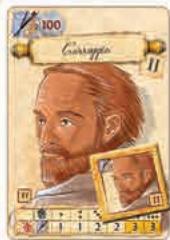
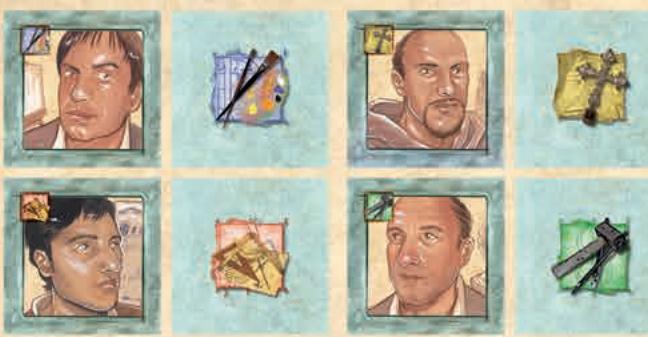
Important: There are three artist skills in Florenza: painting, sculpting, and architecture. Each artist has one or more of these skills, which is shown on his tile and his card. Each artwork also shows one or more skills. You can only hire an artist if one of his skills matches one of the skills shown on the artwork you are attempting to complete.

Each artist has a cost that you must pay when he completes the artwork. Artists with more than one skill will have a different cost for each skill. You must pay the cost for the skill
you choose to use (which must fill the requirements for the artwork). Also, each artwork has a cost (in resources and coins) that you must pay. Both of these costs are not paid at this time. You must pay these costs in Phase 7: Artwork.
There are two unnamed artists showing each type of skill. They are available every round. These artists do not produce work that is as valuable as named artists, but they can be hired for free (pay only the costs shown in the artwork box).
Note: You do not have to have the resources and coins required to pay the artist or the costs of the artwork when you place your worker in the artwork box. But, you should plan carefully so that you will have the right resources when you need them.


D. GO TO MARKET:

You can send one worker each round to the Market. Unlike workshops, all players can use the Market each round, so each player can place one (and only one) worker here. Each player with a worker in the Market can buy, sell, and trade resources during Phase 5: Market.
E. GIVE CHARITYII
To get more workers, you can give charity to a preacher. The workers you gain will be available to be used during the current round. When you decide to give charity, you must place one of your workers on an empty Pulpit space. Youcan choose the Pulpit in your own family church (on your district board) or the Pulpit in the Cathedral. But you can choose the Cathedral Pulpit only after an artist has completed it (in other words, when there is already a family crest token on the Pulpit artwork box).
Choose a preacher that has not received charity this round yet (i.e., one whose tile is still on his card in the Life in Florenza area). Take the tile and place it with your worker (leave his card in the Life in Florenza area). You must pay the cost shown on the top of the preacher's card as soon as you place his tile on a Pulpit. Then immediately take the workers shown on the bottom of the card, placing them on your district board to use later in the round. Also take the resource shown on the bottom right of the card from the supply.
The Cathedral Pulpit can be used to hire a preacher, if it has been already built. It can be used by any player, so it's possible that a player hires 2 preachers in a round.
There are two unnamed preachers available every round. If you give charity to an unnamed preacher, you must pay 100 Fiorini. Unnamed preachers always provide 2 workers. Hiring a preacher is an action, so the new workers can be used when the turn returns to the player, later in the round.

Note: Some preachers can cause a player to gain or lose prestige points or church influence. These awards or penalties are shown on the preacher's card.

F. SEND TO WORKII
You can place one worker on the space near the Atrio in the Banco zone. This allows you to take immediately 50
Fiorini from the supply. On this space, every player can place as many workers as he wants, following the normal turn order (1 worker per action).

5. MARKET
During this phase, all players who sent a worker to the Market can buy, sell, and trade resource cubes with the supply. In turn order, each player with a worker at the Market can do any or all of the following:
-
Sell one resource cube to the supply for 100 Fiorini.
-
Buy one resource cube from the supply for 200 Fiorini.
-
Trade any two resource cubes to the supply for one different resource cube.
Each of the three actions can be taken only once, but you can take them in any order you choose. You may choose to take none, one, two, or all three of the actions.
Important: Trades between players are not allowed!
Example: Paul sent a worker to the market so he can make some trades with the supply. First he sells one marble (white cube) for 100 Fiorini. Then he buys one wood (brown cube) for 200 Fiorini. Finally, he trades one spice (green) and one marble (white) to get another wood cube.

6. DISTRICT ACTIVITIES
During this phase, all workers on a workshop tile will perform an action. The order that these actions are taken is determined by the turn order and the location of each workshop tile. Starting with the first player, and going in turn order, each player looks at the workshop in the “1" space of his district board. If there is a worker on that workshop, he takes an action. If there is no worker there, that workshop is skipped for the round. When all workshops on “1" spaces have finished, each player in turn order then checks any workshop on his “2" space, and so on until all workshops on all district boards have resolved.
There are two possible actions that a worker can take on a workshop tile:
Production
Construction
WORKSHOP PRODUCTION
If a worker is on a workshop with the finished side up when he takes an action, he will use the ability of that workshop to produce.
The workshop tile shows what benefit you receive when your worker produces at that workshop. If the tile shows resource cubes, coins, prestige points, or church influence, you receive what is shown. If the tile shows a formula, you may pay what is shown to receive the benefit listed after the equal sign.
Resource cubes, prestige points, and coins are taken from the supply and placed on your district board.
Important: resources cubes are not a limit for the game. They can be taken even if there are no more available cubes of that kind.II

Remember to also move your marker on the prestige track forward every time you receive prestige points. Any church influence you receive is recorded on the church influence track.
Return your worker to the pool after resolving the workshop action.
WORKSHOP CONSTRUCTION
If a worker is on a workshop with the building side up when he takes an action, he will attempt to build that workshop.
You must pay the resources and coins shown on the workshop tile to the supply. Then turn the workshop tile over to the finished side. If the workshop shows a prestige point award, you immediately receive the prestige points shown. Remember to advance your marker on the prestige track. Then return your worker to the pool. If you cannot pay the required resources, return your worker and the workshop tile to the supply and lose 1 prestige point. If this happens it is possible that an empty space can be created between two occupied ones. In this case, the next workshop to be built must be placed in such space.
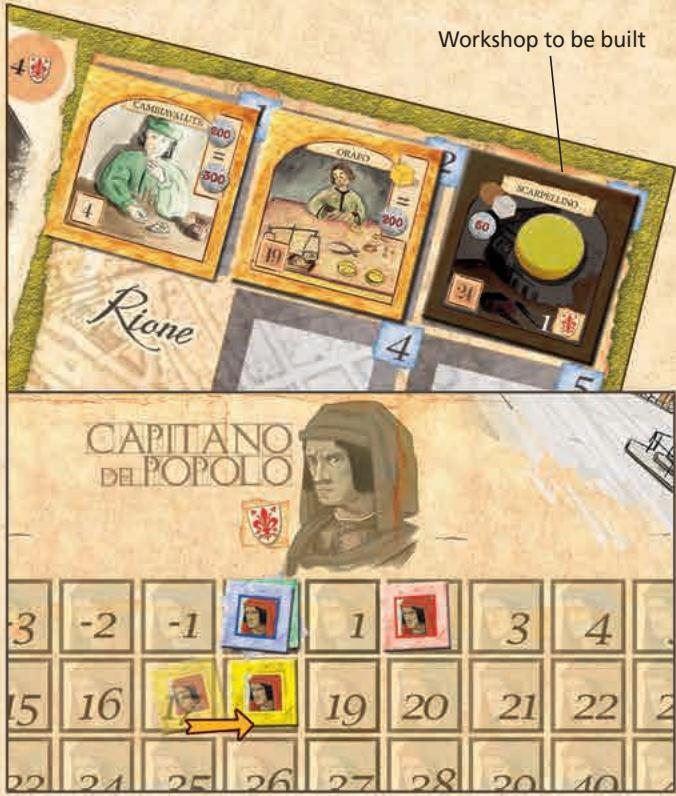
7. ARTWORK
Your primary goal in the game is to earn prestige points, and most of these points will come from completing artworks.
Starting with the first player and going in turn order, each player attempts to complete all artworks he has assigned workers to. Complete any artworks you are attempting in your home district first, then any on civic buildings, and finally any artwork in the Cathedral.
To successfully complete an artwork, you must pay the Fiorini cost shown on the artist you have hired. If the artist has more than one skill, you must choose which one to use, which must fill the requirements for the artwork you are attempting. You must pay the cost for the skill you have chosen.
You must also pay all resources and coins shown in the artwork box you are attempting.
After paying the costs of the artwork, you receive all prestige points and church influence shown in the lower right corner of the artwork box. Then place one of your family crest tokens on the artwork box. Each

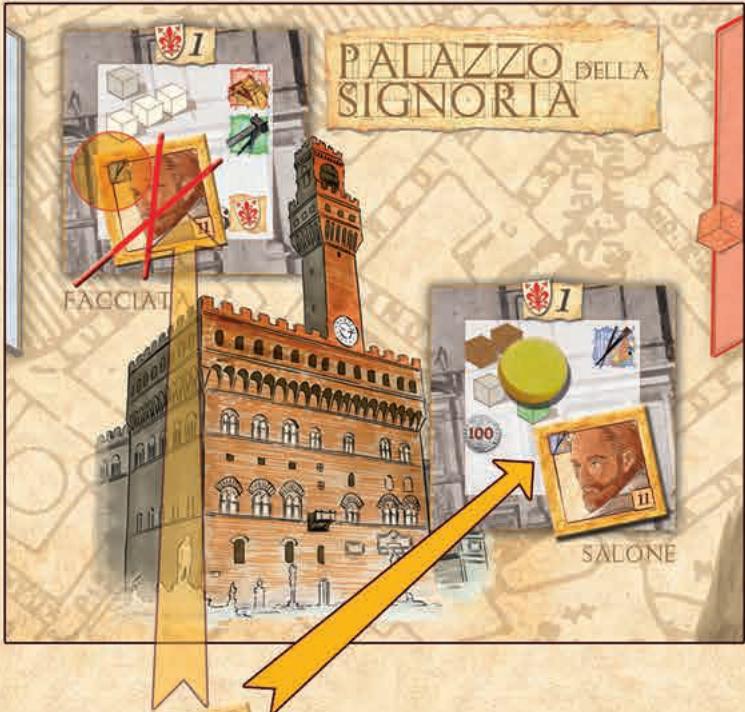
To complete the Salone, the player must spend the indicated resources and 200 Fiorini (100 for the artwork + 100 for the artist)

artwork can only be completed once. Any box with a family crest cannot be attempted again.
Return the artist tile to his matching card. Return your worker to the pool.
ARTIST PRESTIGE
The skill of the artist is often just as important as the complexity of the artwork. Each artist will award you bonus prestige points when he completes an artwork for you.

At the bottom of each artist card (or the matching Life in Florenza card for the unnamed artists) is a table showing the prestige points you can earn when you use that artist. Roll the die and find the result on the chart to see how many bonus prestige points you earn.
If the artist has more than one skill, the table will have one line for each skill. You must roll on the line that matches the skill you chose to use (and paid for) when you completed the artwork.
Remember to advance your marker on the prestige track when you receive bonus prestige points.
Important: If the artwork is in the Cathedral, roll the die twice and choose which result to use.
Note: On an unlucky die roll, it is possible that you will lose prestige points when you use an unnamed artist!

If you want to determine the Artist's prestige without using the die, please read the official variant, page 17. II
MASTERPIECES
All named artists have the ability to create one “masterpiece." A masterpiece is usually worth more prestige points (as shown on the artist's card).

When you roll the die and the result shows a gold colored box on the artist's table, he has completed his masterpiece. After you receive the prestige points shown, turn the artist's card over to the completed

masterpiece side (purple). Each named artist can complete only one masterpiece in the game. He remains turned over for as long as he remains in the city.
Note: this happens also to artists who have more than one skill. Achieving the masterpiece on a skill would prevent him from achieving it in the other(s)
The yellow player completed the Salone at the Palazzo della Signoria, so he placed his family crest on the artwork box. Now he will receive 1 prestige point during phase 1 of each round.
FAILURE
If you cannot pay all of the costs for the artwork and the artist, you must lose prestige points:
| IF THE ARTWORK IS IN: | YOU MUST LOSE: |
| Your district | 1 prestige point |
| A civic building The Cathedral | 2 prestige points 3 prestige points |
If you hired a named artist and cannot pay the costs, you lose 1 additional prestige point.
Example: Mary has hired Correggio to paint the Salone of the Palazzo della Signoria. She must pay him 100 Fiorini. She also pays 2 wood (brown cubes), 1 metal (grey), 1 textile (red), 1 gold (yellow), 1 spice (green), and 100 Fiorini to pay the costs of the painting. She returns her worker to the pool, places one of her family crest tokens on the Salone, and earns 7 prestige points.
Nowshe rolls the die for Correggio. She gets a "6!" Correggio has realized his masterpiece. Mary earns 3 more prestige points. She turns Correggio's card over to the purple side, and places his tile on the card.
DISTRICT ARTWORKS
If you complete all four artworks in the Palazzo of your district board, you receive 4 prestige points.
If you complete all four artworks in the Chiesa of your district board, you receive 4 church influence.
You can complete the artworks on your district board in any order you choose.
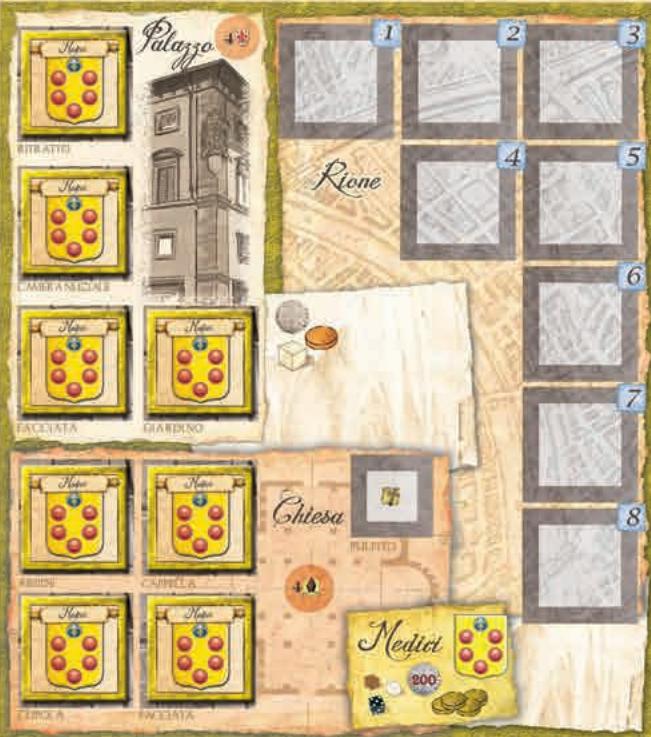
In the illustration above, the yellow player has completed all of his Palazzo and Chiesa artworks (they are marked with his family crest), so he gains 4 prestige points (for the Palazzo) and 4 church influence points (for the Chiesa).
8. TURN ORDER
During this phase, the turn order may change for the next round. A Captain of the People and a Bishop may be chosen. First determine who becomes the Captain of the People. Then check to see if a new Bishop is chosen. Finally, finish the turn order for the other players.
CAPTAIN OF THE PEOPLE
Since the Captain of the People is not chosen until Phase 8, there will be no Captain of the People for the first seven phases of round 1.
During the round, you recorded all prestige point gains and losses on the prestige track. In this phase, the player whose marker is highest on the prestige track becomes the Captain of the People for the next round. If there is a tie, then no player will be Captain of the People for the next round.
If you become the Captain of the People, you immediately receive the Captain card, and prestige certificates equal to your position on the prestige track. Then, move your marker on the prestige track back to the "0" space, and place your marker on the turn order track in the Captain space. If another player's marker is already there, shift it back to the third space (pushing any other player's tokens back one space each to make room).
BISHOP
Players earn church influence from various workshops and artworks during the game. These points are recorded on the influence track.
If a single player has at least 3 church influence and more influence than each of the other players, he becomes the Bishop for the next round. If there is a tie for the most church influence, or if no player has at least 3 church influence on the track, then there is no Bishop in the next round.
When you become the Bishop, place your marker on the turn order track in the Bishop space. Exception: If your marker is already on the Captain space, do not move it to the Bishop space. Instead, take your fourth marker and place it in the Bishop space.
Note: Do not reduce your church influence marker to the “0" space when you become the Bishop (like you do when you become the Captain of the People).
CARDINAL
It is possible for a player who is the Bishop to become a Cardinal. The Cardinal has no powers in the game, but he can earn a lot of prestige points. There are two ways to become Cardinal:
-
If you are named Bishop two rounds in a row; or
-
If your marker reaches the “10" space on the influence track.
Both of these conditions are checked only during Phase 8: Turn Order.
If you become the Cardinal, you immediately receive 5 prestige points (remember to move your marker on the prestige track) and you must return your marker on the influence track to the “0” space.
Important: You can only become Cardinal once per round. If you fulfill both requirements at the same time, you only receive 5 prestige points (not 10).
THE OTHER PLAYERS
The turn order for all players that did not gain an office (Captain or Bishop) remains unchanged. If necessary, shift the markers up or down on the track so there are no empty spaces between them.
If you are using the turn order cards, turn the Captain and Bishop cards face up and give them to the player whose marker is on the matching space. You will only need the extra “2” card when there is no Captain but there's the Bishop playing first, or when a single player holds both offices. If no one holds one of the offices, then turn that card back over to show the numbered side.

The yellow player's marker is highest on the prestige track. The red player's marker is highest on the church influence track, and she has at least 3 points.

The yellow player becomes the new Captain, and he will play first in the next round. Red becomes the Bishop, and will play second. The other players will play third, fourth, and fifth, and remain in the same order on the track.
SPECIAL CASES
If no player becomes Captain of the People or Bishop, simply leave those spaces of the turn order track empty. Shift all markers down to make space without changing their order.
If only one office is filled, leave the other office space empty and shift the markers as needed.
If one player is elected to both offices (Captain of the People and Bishop), leave his marker on the Captain's space. Place his fourth marker (unused at the start of the game) on the Bishop space, and shift the other players' markers as needed. He will receive all benefits for both offices, and he must take both the first and second turn during phase 4 of the next round.
Example: Peter has become both the Captain of the People and the Bishop. During Phase 2, he will use the powers of the Captain. During Phase 3, he will use the powers of the Bishop. During Phase 4, he will place two of his workers before the other players place their first worker. Each time his turn comes around in Phase 4, he will place two more workers.

If there is no Captain and/or Bishop, turn the corresponding card over to the numbered side.

9. END OF THE ROUND
During this phase, you will prepare the game for the next round. Follow these steps in order:
-
Any artist or worker detained by the Captain returns to play. Place the artist tile on his card, or the worker in the pool.
-
All preachers on the pulpits or expelled by the Bishop return to their cards.
-
All workers still on players'district boards (or anywhere else) are returned to the pool.
-
Any character cards beneath the "I" Life in Florenza card are removed from the game, along with the matching tiles.

-
All character cards still in play move down one space along the row of Life in Florenza cards.
-
If any character cards left play this round, an equal number of replacement tiles are drawn from the bag, matched to character cards, and placed below the appropriate Life in Florenza card.
-
The turn marker advances one space on the round track. If it was already on the 8th space, the game ends! Otherwise, a new round now begins.

THE END OF THE GAME
After the 8th round of play is complete, the game ends. All players now total their victory points for the game. You receive:
Victory points equal to the value of all prestige certificates you hold.
Victory points equal to the position of your marker on the prestige track.
1 Victory point if you end the game as the Captain of the People.
1 Victory point if you end the game as the Bishop.
1 Victory point for each set of 3 resource cubes (of any type) you hold.
1 Victory point for each set of 300 Fiorini you hold.
You also lose victory points if you fail to complete certain tasks. You lose:
1 Victory point for each empty workshop space on your district board.
1 Victory Point for each artwork on your district board that you did not complete.
4 Victory Points if you did not complete at least one artwork in the Palazzo of your district board.
4 Victory Points if you did not complete at least one artwork in the Chiesa of your district board
The player with the highest final total of victory points is the winner. If there is a tie, the tied player with the most resources wins, with the most money acting as the second tie breaker.

CHARACTERS
WORKSHOPS
Characters are very important in this game, and are one of your most important sources of prestige points. There are two types:
ARTISTS
PREACHERS
ARTISTS
Artist cards have two sides, to show if he has completed his Masterpiece. Most artists are specialized in only one skill (painting, sculpting, or architecture). Some have two skills, and Michelangelo has all three.
When you hire an artist, you must first check that the artist has at least one of the skills required for the artwork you are attempting. If so, you can take the artist's tile and place it with your worker on the artwork box.


You do not pay the artist at this time, but it would be wise to plan everything carefully so you will have the money and resources when required (in phase 7). If the artist has more than 1 skill, you must pay the cost for the skill you choose to use. You must choose the skill and pay the artist before rolling the die.
PREACHERS
Preachers are different from artists in three ways:
Both sides of the preacher card are the same, because they don't create Masterpieces.
Preachers must be paid immediately when you use them.
Some preachers give a bonus or penalty to your prestige or church influence. Apply them immediately when the preacher is used.
UNNAMED CHARACTERS
There are two character tiles of each type (painter, sculptor, architect, and preacher) that represent little known characters in Florenza. These tiles are available every round, and are placed on the matching Life in Florenza cards. They are not moved in phase 9. They can be hired cheaply, but they provide a lower benefit.
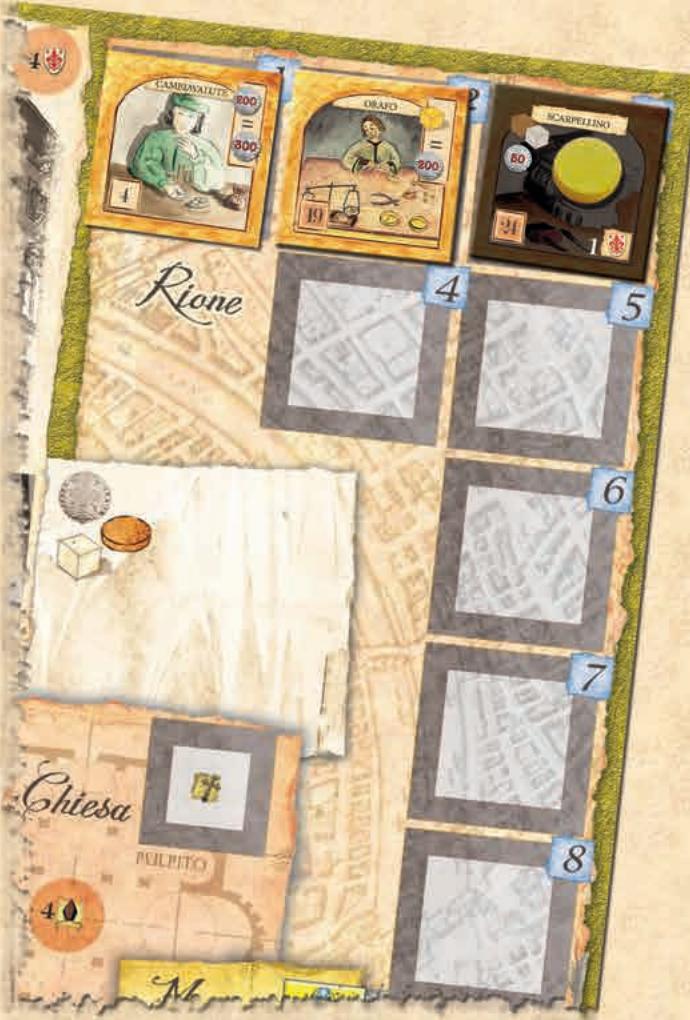
Using workshops is the basic part of this game. You need them to produce resources, money, workers, prestige, and church influence.
You can build workshops in your home district only, and they must always be built in the lowest numbered empty space on your district tile. Workshops activate in number order during phase 6.
To activate a workshop in phase 6, you must occupy it with a worker in phase 4. It is possible to occupy workshops in an opponent's district as well as your own, but you must pay that player 1 prestige point to do so. Each workshop can be occupied by only 1 worker at a time.
ARTWORKS
You can complete artworks on your district tile, in buildings around Florenza, or in the Cathedral. The top left corner of each artwork box shows the resources and/or Fiorini you must spend to complete it. In the lower right it shows any prestige or church influence you earn by completing it.
At the top of the artwork box there may be an income that you can earn in phase 1 each round if you complete that artwork.
When you complete an artwork, you cover the artwork box with one of your family crests, so it hides the costs and awards (they are no longer needed). Only the income remains visible. The possible incomes are:

1 prestige point
1 worker
1 church influence
The Atrio of the Banco gives an income of 1 gold cube, or the option to sell 1 gold cube for 200 Fiorini. You choose which benefit to use each round.
Artworks on your district tile can be completed in any order (unlike workshops).
Artworks in your home district never pay incomes (so they are completely hidden by your family crest), but if you complete all 4 artworks in your Palazzo (palace), you immediately receive 4 prestige points.
If you complete all 4 artworks in your Chiesa (family church), you immediately receive 4 church influence.


COMPLETING AN ARTWORK
STRATEGY HINTS FOR NEW PLAYERS
Florenza offers many strategic options and challenges. No strategy guide could hope to cover all of them, but here are some things to think about the first time you play:
Try to develop the best of everything: artworks in civic buildings, the cathedral, and your district have different costs, but grant different rewards as well. Taking a look at these rewards may help you develop a strategy. Try to construct workshops in your district that will help you complete the artworks you want to create.
Try to build some workshops that can make you money. You will often be short of funds, especially early in the game.
Don't forget the order in which workshops are activated!
Workers are most valuable in the middle game. Having too few means you can't do enough things. But make sure you can use workers before you pay a preacher to get more.
Don't underestimate the value of the single prestige point that you must spend to use an opponent's workshop. It could be the difference between who gets to be Captain of the People, and scores at the end of the game are often very close.
Try to complete at least one artwork in your Palazzo and Chiesa. The -4 victory point penalty is very high.
Make sure you will have the resources you need before planning to build a workshop or attempt an artwork. Yes, another player could come along and claim it before you can, but it's better to have the resources for something else than to lose prestige points.
If the price and skills are the same, it's usually better to hire an artist that can still complete his masterpiece.
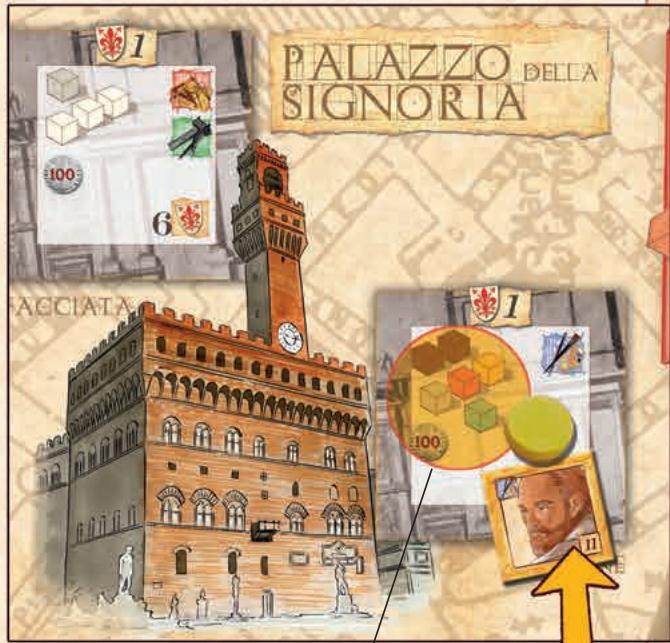
EMBELLISH THE SALONE(MAIN ROOM) OF THEPALAZZO DELLA SIGNORIA(LORDSHIP'S PALACE):
The yellow player must pay 2 wood, 1 metal, 1 fabric, 1 gold, 1 spice, and 200 Fiorini (100 for the artwork and 100 more for the artist).
After paying those resources, he places his family crest on the artwork box. He gains 6 prestige points immediately and an additional
1 prestige point during phase
1 of every round.


- ARMORY
- LIBRARY
- FORESTER
- MONEY CHANGER
- CARPENTER
- WORKER'S HOUSE
- APARTMENTS
- QUARRY
- PHYSICIAN
- CONVENT
- HERBALIST
- SMITH
- FOUNDRY
- WEAVER
- WOODCARVER
- MERCHANT
- MINE
- PAWNBROKER
- GOLDSMITH
- BRASS WORKER
- PALACE
- STONECUTTER
- TAILOR
- STONE CARVER
- SAWMILL
- SILK MERCHANT
- SPICE MERCHANT
- DYE WORKS
- MINT
Roollow
ARMAIUOLO
2 BIBLIOTECA
3 BOSCAIUOLO
4 CAMBIAVALUTE
5 CARPENTIERE
6 CASA
7 CASAMENTO
8 CAVA
9 CERUSICO
10 CONVENTO
11 ERBOLAIO
12 FABBRO
13 FONDERIA
14 LANAIUOLO
15 LEGNAIUOLO
16 MERCATANTE
17 MINIERA
18 MONTE DI PIETÀ
19 ORAFO
20 OTTONAIO
21 PALAGIO
22 PICCONIERE
23 SARTORE
24 SCARPELLINO
25 SEGHERIA
26 SETAIUOLO
27 SPEZIALE
28 TINTORE
29 ZECCA
FLORENZA forenz ffcia no ie variant
Here at Placentia Games, we think it's more exciting not to know in advance if the work of an artist will be a masterpiece or not, but we have published this variant for those players who prefer to reduce the randomness to a minimum. Enjoy!
History teaches us that the most important masterpieces of the greatest Renaissance artists can be found in the most prestigious cathedrals or buildings. So, it's clear that artists had some more creative ecstasy when they were working in those great buildings, where they tried to improve themselves, to have their names written in history books. Beside this, of course, another good way to incentivize an artist is to give him a better salary.
HOW TO DETERMINE
THE PRESTIGE OF AN ARTIST:
Whenever you need to evaluate a work of art, instead of throwing the die, proceed as follows:
Work prestige = base value + incentive
BASE VALUE
Base value is assigned depending on the area of Florence in which the work has been commissioned:
In the player's own district the base value is 1 (as if he obtained 1 rolling the die)
In the Florence civic buildings the base value is 2 (as if he obtained 2 rolling the die)
In the cathedral the base value is 3 (as if he obtained 3 rolling the die).
INCENTIVE
It is possible to encourage the artists with money, so you can add 1 point to the base value every 50 Fiorini you spent, to be added to the money spent to hire the artist. It is possible to spend up to 150 Fiorini, to obtain a maximum of 3 points of incentive.
Now look on the artist card to obtain the prestige points which are indicated on the card, and which are related to the value obtained.
The masterpiece rule does not change, so flip the card after creating a masterpiece.
Example: The Strozzi player hires Raffaello to create the Cappella of the Ospedale. This is a Florence civic builing, so the base value is 2. Strozzi decides to boost Raffaello with 100 Fiorini so the value of the work is now 4. For Raffaello a 4 point work is worth 5 prestige point (as if you obtained 4 with the die). It would have been worthless giving Raffaello an extra 50 Fiorini rising the value of the work to 5 as the number of prestige point does not change. To have Raffaello's masterpiece you need to hire him for the cathedral and incetivate him with 150 Fiorini to have a work whose value is 6.
Note: You can also incentivate anonymous artists to avoid a penalty on your district or to gain a bonus in the cathedral.

Official variant II for two player game

In the (not rare) event of a single player holding both the Captain of the People and Bishop titles, the Captain of the People may only choose the reserve an artist, just to avoid to reduce other player workers by two.


DISTRICT WORKSHOPS IN DETAIL

1. ARMAIUOLO (ARMORY)
Quantity in Game: 1
Construction Costs: 2 Wood + 1 Marble
Construction Benefit: 2 Prestige Points
Production Benefit: Spend 2 Metal to take 500
Fiorini from the Banco

2. BIBLIOTECA (LIBRARY)
Quantity in Game: 1 Construction Costs: 2 Wood + 1 Marble + 200 Fiorini Construction Benefit: 5 Prestige Points Production Benefit: 2 Prestige Points

3. BOSCAIUOLO (FORESTER)
Quantity in Game: 3 Construction Costs: 1 Textile + 1 Metal Construction Benefit: None Production Benefit: 1 Wood
4. CAMBIAVALUTE (MONEY CHANGER)

Quantity in Game: 2
Construction Costs: 1 Wood + 1 Gold + 100 Fiorini
Construction Benefit: 1 Prestige Point
Production Benefit: Spend 200 Fiorini to take 300
Fiorini from the Banco

5. CARPENTIERE (CARPENTER)
Quantity in Game: 1
Construction Costs: 2 Wood + 1 Metal + 100 Fiorini
Construction Benefit: 2 Prestige Points
Production Benefit: Spend 2 Wood to take 500
Fiorini from the Banco

6. CASA (WORKER'S HOUSE)


Quantity in Game: 4 Construction Costs: 2 Wood Construction Benefit: None Production Benefit: None

This workshop cannot be occupied by a worker. During phase 1, it automatically gives an income of 50 Fiorini and 1 worker to the player who built it in his district.


7. CASAMENTO (APARTMENTS)
Quantity in Game: 2
Construction Costs: 2 Wood + 1 Marble + 50 Fiorini
Construction Benefit: None
Production Benefit: None
This workshop cannot be occupied by a worker. During phase 1, it automatically gives an income of 100 Fiorini and 1 worker to the player who built it in his district.


8. CAVA (QUARRY)
Quantity in Game: 2
Construction Costs: 2 Metal + 1 Wood + 100
Fiorini
Construction Benefit: 1 Prestige point
Production Benefit: 2 Marble
9. CERUSICO (PHYSICIAN)
Quantity in Game: 1
Construction Costs: 1 Gold + 1 Textile +1 Metal
+ 50 Fiorini
Construction Benefit: 2 Prestige Points
Production Benefit: Spend 2 Spice to take 500
Fiorini from the Banco
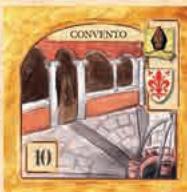
10. CONVENTO (CONVENT)
Quantity in Game: 2
Construction Costs: 2 Wood + 1 Marble +1
Textile + 100 Fiorini
Construction Benefit: 5 Prestige Points
Production Benefit: 1 Prestige point + 1 church
influence

11. ERBOLAIO (HERBALIST)
Quantity in Game: 2 Construction Costs: 1 Textile + 1 Wood Construction Benefit: 1 Prestige point Production Benefit: 1 Spice

12. FABBRO (SMITH)
Quantity in Game: 2 Construction Costs: 1 Marble + 1 Wood Construction Benefit: None Production Benefit: 1 Metal

13. FONDERIA (FOUNDRY)
Quantity in Game: 1
Construction Costs: 2 Marble + 1 Wood + 100
Fiorini
Construction Benefit: 2 Prestige Points
Production Benefit: 2 Metal

14. LANAIUOLO (WEAVER)
Quantity in Game: 2 Construction Costs: 1 Wood + 50 Fiorini Construction Benefit: None Production Benefit: 1 Textile

15. LEGNAIUOLO (WOODCARVER)
Quantity in Game: 1
Construction Costs: 1 Metal + 1 Wood
Construction Benefit: None
Production Benefit: Spend 1 Wood to take 200
Fiorini from the Banco





16. MERCATANTE (MERCHANT)
Quantity in Game: 2
Construction Costs: 2 Textiles + 1 Gold + 200 Fiorini
Construction Benefit: 2 Prestige Points
Production Benefit: 2 Spice


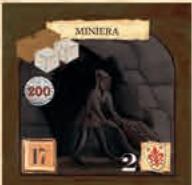
17. MINIERA (MINE)
Quantity in Game: 1
Construction Costs: 2 Metal + 2 Wood + 200 Fiorini
Construction Benefit: 2 Prestige Points
Production Benefit: 2 Gold


18. MONTE DI PIETA (PAWNBROKER)
Quantity in Game: 2
Construction Costs: 1 Wood + 1 Marble + 1 Metal
Construction Benefit: None
Production Benefit: 1 Gold


19. ORAFO (GOLDSMITH)
Quantity in Game: 1
Construction Costs: 1 Wood + 1 Metal
Construction Benefit: 1 Prestige point
Production Benefit: Spend 1 Gold to take 200
Fiorini from the Banco


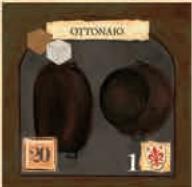
20. OTTONAIO (BRASS WORKER)
Quantity in Game: 1
Construction Costs: 1 Wood + 1 Metal
Construction Benefit: 1 Prestige point
Production Benefit: Spend 1 Metal to take 200
Fiorini from the Banco


21. PALAGIO (PALACE)
Quantity in Game: 1
Construction Costs: 2 Marble + 1 Wood + 2 Textiles
+ 100 Fiorini
Construction Benefit: None
Production Benefit: None
This workshop cannot be occupied by a worker. During phase 1, it automatically gives an income of 100 Fiorini, 1 worker, and 1 prestige point to the player who built it in his district.


22. PICCONIERE (STONECUTTER)
Quantity in Game: 2 Construction Costs: 1 Metal + 50 Fiorini Construction Benefit: None Production Benefit: 1 Marble


23. SARTORE (TAILOR)
Quantity in Game: 1
Construction Costs: 2 Wood + 1 Spice + 100 Fiorini
Construction Benefit: 1 Prestige point
Production Benefit: Spend 2 Textiles to take 500
Fiorini from the Banco

24. SCARPELLINO (STONE CARVER)
Quantity in Game: 1
Construction Costs: 1 Wood + 1 Metal + 50 Fiorini
Construction Benefit: 1 Prestige point
Production Benefit: Spend 1 Marble to take 200
Fiorini from the Banco

25. SEGHERIA (SAWMILL)
Quantity in Game: 1 Construction Costs: 2 Metal + 1 Marble Construction Benefit: 1 Prestige point Production Benefit: 2 Wood

26. SETAIUOLO (SILK MERCHANT)
Quantity in Game: 2
Construction Costs: 1 Wood + 1 Spice + 100 Fiorini
Construction Benefit: 1 Prestige point
Production Benefit: 2 Textiles
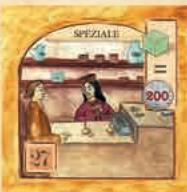
27. SPEZIALE (SPICE MERCHANT)
Quantity in Game: 1
Construction Costs: 1 Wood + 1 Textile + 100
Fiorini
Construction Benefit: 1 Prestige point
Production Benefit: Spend 1 Spice to take 200
Fiorini from the Banco
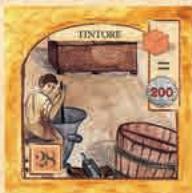
28. TINTORE (DYE WORKS)
Quantity in Game: 1
Construction Costs: 2 Spices + 1 Wood
Construction Benefit: None
Production Benefit: Spend 1 Textile to take 200
Fiorini from the Banco

29. ZECCA (MINT)
Quantity in Game: 1
Construction Costs: 2 Metal + 1 Wood + 1 Marble
Construction Benefit: 3 Prestige Points
Production Benefit: Spend 2 Gold to take 500
Fiorini from the Banco
Florenza refers to a real historical background, though it has been simplified to aid game play. For example, the characters have been chosen arbitrarily, based on the history of art, but not without some subjective choices. Some characters belong to different time periods, though well-known contemporaries have been chosen whenever possible—even if some of them never worked in Florence.
We must make one comment about the preachers: apart from Girolamo Savonarola, they are all outside of the time and location of the game. Giordano Bruno has been chosen as a charismatic thinker, even though he never preached in Élorence, whereas Francis of Assisi, Anthony of Padua, Bernardo of Chiaravalle, and Thomas Aquinas all lived before the Renaissance. Imagine that these characters do not represent the actual historical figures themselves, but rather preachers who follow their thoughts and works. They are friars or monks from orders founded by these thinkers. The payment for a preacher should be understood as an offering to their order.
Here are some short biographical notes about every character in the game:

1.Andrea di Francesco di Cione known as Verrocchio Florence, 1437 - Venice, 1488
A sculptor, goldsmith, and painter, he worked at the court of Lorenzo the Magnificent. Highly esteemed, he was the master of a number of young painters including Leonardo, Ghirlandaio, and Perugino.
2. Andrea Mantegna
Isola di Carturo, 1431 - Mantua, September 13, 1506
A Venetian painter who mainly worked at the court of
the Gonzaga family in Mantua, he was influenced by Tuscan artists, especially Donatello. Among his most
famous works are the Wedding Chamber in the Ducal Palace of Mantua and the Dead Christ kept in the Brera Academy in Milan.


3. Andrea Palladio (born Andrea di Pietro dalla Gondola)
Padua, November 30, 1508 - Maser, August 19, 1580 The most important architect of the Venetian area, and the author of architectural treatises that would be followed for centuries. He was inspired by classical and Roman architecture. He mainly worked in Vicenza where he planned several churches, villas, and palaces.
4. Antonello da Messina
Messina, 1430 - Messina February, 1479
After his young years in the south of Italy, he moved to
Venice. His peculiarity is the attention given to details. He loved painting on wooden boards.


5. St. Anthony of Padua
(in the world: Fernando Martim de Bulhoes e Taveira Azevedo) Lisbon, August 15, 1195 - Padua, June 13, 1231
A Franciscan friar, he is venerated as a saint by the Catholic Church. Born in Portugal, he traveled very widely and met Francis ofAssisi. He moved to Padua where he died, still young, but already very famous. During his life, many miracles were ascribed to him. A scholar, he had both strictness and kindness, getting a hold over people belonging to all social classes.
6. Antonio da Sangallo
(born Antonio Cordini)

Florence, April 12, 1484 - Terni, August 3, 1546 He came from a family of architects (his uncle, also fa
mous, had the same name), and he is a representative of
the architecture of the Renaissance-especially in Rome, where he was apprenticed to Bramante.

7. Beato Angelico
(Brother Giovanni da Fiesole, in the world: Guido di Pietro Trosini) Vicchio, 1395 - Rome, 1455 He was a Dominican and a painter. He was beatified by John Paul II in 1984. He merges the principles of Renaissance paintings with theological teaching through images inspiring to the Medieval Age.
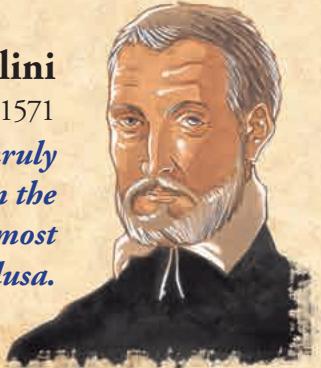
8. Benvenuto Cellini
Florence, November 3, 1500 - Florence, February 13, 1571
He was a Florentine sculptor. Notorious for his unruly
temper, he took part in a number of brawls, and in the
defence of Rome during the infamous sacking. His most renowned work is Perseus with the head ofMedusa.

9. Bernardo di Chiaravalle
Fontaine-lès-Dijon, 1090 - Ville-sous-la-Ferté, August 20, 1153 A French reformer, he founded the very strict Cistercian Order in opposition to the rich Benedictine monks of Cluny. A talented preacher, he was entrusted by Pope Eugene II with preaching the call for the Second Crusade.
10. Caravaggio (born Michelangelo Merisi)
Milan, September 29,1571 - Porto Ercole, July 18, 1610 Known as the "Pittore Maledetto" (the Cursed
Painter) because of his many troubles with justice, owing to his restless disposition. He mastered the
use of colors, and especially of lighting. He worked
in Rome, Sicily, and Naples. Among his works, the
Vocation of St. Matthew and St. Jerome are worth remembering.


11. Correggio (born Antonio Allegri)
Correggio, August, 1489 - Correggio, March 5, 1534 An Italian painter appreciated for the importance of the lighting in his paintings, he worked mainly in the Plain of the Po, especially in Parma.
12. Domenico Ghirlandaio
Florence, 1449 - Florence, January 11, 1494 A very skilled painter, mainly a portraitist. He influenced many artists of his age. For a short time, he was the master of Michelangelo. The reason for his pseudonym is still unknown.

13. Donatello

(Donato di Niccolò di Betto Bardi)
Florence, 1386 - Florence, December 13, 1466) A master of sculpture, he did not only work in Florence, but in Padua, too. He was a skillful user of sculptural techniques such as "tondo", "stiacciato, and "basso-rilievo."Some ofhis numerous works are kept in the Bargello museum in Florence.
14. Donato Bramante
011 Fermignano, 1444 - Rome, March 11, 1514 A very famous architect, he was one of the first who could re-create buildings with all the details of the classical Roman world. He worked in Milan, and mainly in Rome, where he was commissioned the planning of St. Peter's.

15. Filippo Brunelleschi

Florence, 1377 - Florence 1446
Well-known mainly as an architect, after studying ancient Roman buildings he re-created their techniques, and used new machines which allowed him to execute his masterpiece: the dome of the Florence Cathedral, which consists of two domes: inside and outside, both selfbearing.
16. Filippo Lippi Brother Filippo di Tommaso Lippi
(Florence, 1406 - Spoleto, 1469
A Carmelite, he left the monastery when he was
dispensed from his vows by the Pope for marrying his
favorite model. A skillful painter, he worked almost exclusively in Florence.


17. Francesco Borromini
Bissone, September 25, 1599 - Rome, August 3, 1667 The son of a stonecutter, he moved to Rome, where he started working as an architect. Of practical and positive mind, he soon clashed with the other outstanding character of the artistic background of his age: Bernini, his rival.
18. Francesco d'Assisi (Giovanni di Pietro Bernardone)
Assisi, 1182 - Assisi, October 3, 1226
The son of a rich merchant, Francis had his life upset after his encounter with Christ. He gets rid of his possessions, and starts a life of poverty, which soon attracts many followers, thus originating the mendicant order which was named after him. A number of anecdotes and miracles are associated to him. A very important
character in the history of the Church, he is venerated as a saint, and is the patron saint of Italy.


19. Francesco Mochi
Montevarchi, July 29, 1580 - Roma, February 6,1654 A sculptor, one of the first to start Baroque. He traveled widely, and his wanderings deeply influenced his works. He left his masterpieces in Piacenza: the equestrian monuments to Alessandro and Ranuccio. While in Rome, he clashed with the outstanding Bernini, and he missed several opportunities because of him. In spite of our research, no portrait of the artist has been found, so one of the game's illustrator Ivan Zoni has been used instead.
- Giambologna (the Italian form of Jean de Boulogne) Douai, 1529 - Florence, 1608 A Flemish sculptor who moved to Italy to study classical and modern sculptures, such as those of Michelangelo. He worked in Florence and in Bologna, where he carried out the Neptune's fountain in Maggiore Square.
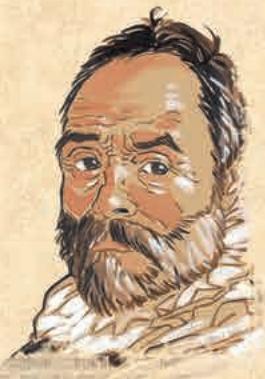

21. Gian Lorenzo Bernini
Naples, December 7, 1598 - Rome, November 28, 1680 An outright artist, he is mainly remembered for his architectural works and his sculptures. A precocious and great observer, he quickly drew attention to himself in Rome, where he had the Cardinal Scipione Borghese as his patron. He was the most outstanding character of the artistic background under at least three popes, and he enriched the city with several masterpieces.

- Giordano Bruno Nola, 1548 - Rome, February 17, 1600 A Dominican, he was a thinker and a Neoplatonic philosopher. He had a troubled life: he made a number of breaks in his monastic life, and he travelled widely through Italy, France, England, and Germany, where he was put on trial for heresy and sorcery. He taught physics and astronomy.
23. Giorgio Vasari
Arezzo, July 30, 1511 - Florence, June 27, 1574 A painter, sculptor, and architect, he is wellknown as the author of"The lives of the most outstanding Italian architects, painters, and sculptors from Cimabue to our times," about the lives of the greatest Italian artists. He was a successful architect. The Uffizi Palace, seat of the famous museum, is one of his masterpieces.
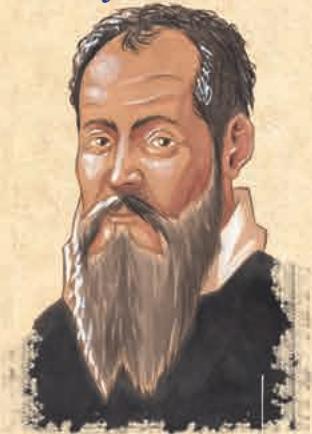
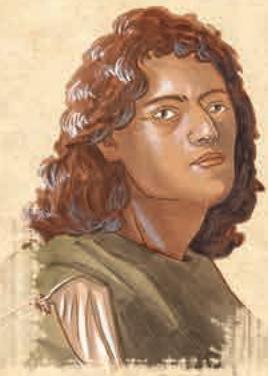
- Giorgione (born Giorgio da Castelfranco) Castelfranco Veneto, 1478 - Venice, 1510 A painter whose works are colorful and rich in landscapes and figures, he spent most of his short life in the Venetian area, where he influenced Titian's works of art.
25. Giotto
Vespignano, 1267 - Florence, January 8, 1337 A pupil of Cimabue who, according to legend, had noticed him as a young shepherd drawing a
sheep on a slab of marble. He was of fundamental importance to the development of painting. He travelled widely and worked in several Italian towns. He was often in Florence, and there he designed the bell tower of the cathedral and
superintended the initial works of its construction.


26. Girolamo Savonarola
Ferrara, September 21, 1452 - Florence, May 23, 1498 A Dominican and a very strict preacher, he hoped for a reformation of the Church, against which he railed, finding favor with the people. He suffered at the stake. During the Florentine Republic, he was an outstanding member of the party opposing the Medici family.

28. Leon Battista Alberti Genoa, February 18, 1404 - Rome, April 25, 1472 One of the most polyhedric minds of the Renaissance, he was an architect but also a mathematician, cryptographer, philosopher, humanist, and poet. He planned the completion of Santa Maria Novella on commission of the Rucellai family, for whom he erected the palace.
27. Giulio Romano
His real surname was Pippi. An architect and painter, he worked together with Raffaello. He was greatly successful in Mantua at the court of the Gonzaga Family, for whom he designed the Palazzo Te, where the fresco of the Giants chamber is one of his masterpieces.


29. Leonardo da Vinci
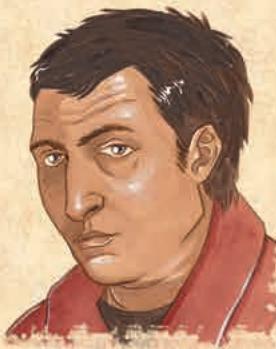
30. Lorenzo Ghiberti Pelago, 1378 - Florence, 1455 A sculptor, goldsmith, and architect, he tied his name to the creation of the portals of Baptistery in Florence, his masterpieces. Perhaps he had a disposition towards Gothic art rather than the Renaissance art peculiar to Brunelleschi or Alberti.
Vinci, April 15, 1452 - Amboise, May 2, 1519 An artist and scientist, he is regarded as one of the most ingenious minds of history. He worked in Florence in two different periods, in Milan, Rome, and in France. Very famous as a painter, he left many unfinished works because his interests were so wide that he had little time for everything. An experimenter and inventor, we owe him for inventions and objects still used today.
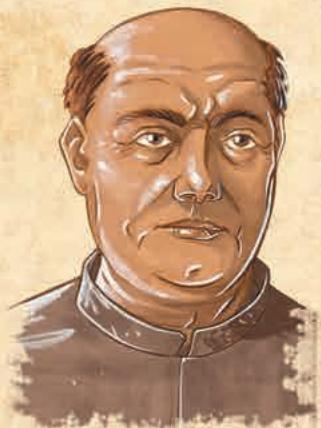
31. Masaccio
(born Tommaso di Giovanni di Mone Cassai) Castel San Giovanni, December 21, 1401 - Roma, 1428 A skilled painter, a master in the usage of lighting and shades, he is especially worth remembering for the Brancacci Chapel with the Expulsion of Adam and Eve from the Garden of Eden.
- Tintoretto (real name Jacopo Comin)
32. Michelangelo Buonarroti
Caprese Michelangelo, March 6, 1475 Rome, February 18, 1564 A painter, sculptor, and architect, he is one of the most important artists of the
Renaissance. His works both in Florence and in Rome are universally known and regarded as the most remarkable
masterpieces of the age. A proud strongwilled character, he also expressed a
profound religious feeling in his works.


33. Piero della Francesca Sansepolcro, c. 1420 - Sansepolcro, October 12, 1492 A painter and mathematician, he was a master of perspective and composition of volumes, and he influenced the artists of his own age and after. Although the majority of his subjects were religious, his portraitsalways in profile-are well known.
34. Pietro Perugino (son of Cristoforo Vannucci) Città della Pieve, c. 1450 - Fontignano, 1523 A painter who, in spite of being a pupil of Verrocchio, was deeply influenced by Piero della Francesca. From the latter he took perspective and geometric quality, and merged them with naturalistic elements.
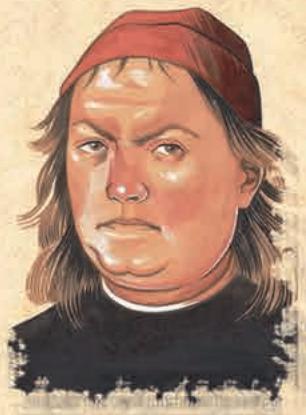
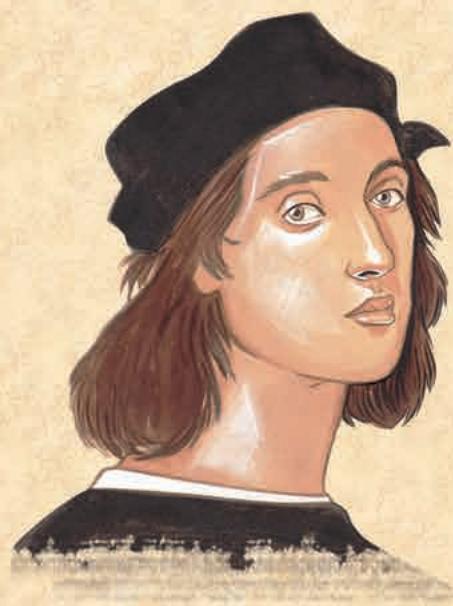
35. Raffaello Sanzio
Urbino, April 6, 1483 - Rome, April 6, 1520 A pupil of Perugino, he was not only a great painter, but an architect, too. He worked in Florence he worked in Florence and Rome where he superintended the work of St. Peter's, and where he frescoed the papal chambers. His works are numberless, and many of them are very famous.

Venice, September 29, 1518 - Venice, May 31, 1594 Perhaps the last great representative of Renaissance painting, he knew very well how to use colors to give his works depth and perspective. He never worked in Florence.
- Sandro Botticelli
(born Alessandro di Mariano di Vanni Filipepi) Florence, March 1, 1445 - Florence, May 17, 1510
Although the true origin of the pseudonym is unknown, he is undoubtedly one of the most important painters of his age. He was very
productive. His works, many of which are kept in the Uffizi Museum in Florence, are wellknown all over the world, especially Spring and the Birth of Venus.


38. Tiziano Vecellio
Pieve di Cadore, c. 1490 - Venice, August 27, 1576 A precocious painter, influenced by Giorgione, he was a master in the usage of colors, which he laid on canvas without any preparatory drawings. His skill in painting portraits made him the official portraitist of the emperor Charles V. He left a huge number of paintings.
39. Thomas Aquinas
Roccasecca (FR), c. 1225 - Fossanova, March 7, 1274 A Dominican, venerated as a saint. He was a theological and philosophical master, an outstanding representative ofscholasticism. He started the flourishing Thomist school, which would influence catholic thought for a long time. Although he was not a real preacher, many generations of priests were inspired by him.


40. Vignola
(Jacopo Barozzi da Vignola)
Vignola, October, 1507 - Roma, July 7, 1573
He was a skilled architect. Once in Rome he became the architect of the Farnese family, who commissioned several works to him, and he superintended work for the Construction of St. Peter's in the Vatican.
PUBLISHERS'NOTES
Four years after the publication of "Florenza", Placentia games has continued its activity publishing “Ark & Noah" (about the building of the Ark) – which unfortunately got less appreciation than it deserved, probably because we were not able to communicate the idea that the game is less banal than it seems at a irst glance - and “Florenza: the card game, a card game with renewed graphics and some of the mechanics of “Florenza, but also a completely different game, which is more indicated for one- hour matches.

Placentia Games has kept on carrying on its activity and its philosophy, creating “new" games, with a particular attention to graphics, material and rules; personally we do not like board games conceived as mass products, which get one season success and then are forgotten; so we tried to create games that stay through the years, with settings which are more particular than fashionable. This is the kind of game we try to produce.
Why a second edition of “Florenza"? Because after four years it is mostly sold out, and many players asked us if we could publish it again. And also because we think that “Florenza" is a game which completely mirrors our idea of board game and so it deserves to be available for people who love to play board games.
We tried to improve some characteristics. First of all, knowing that “Florenza" was a high price product, we changed, honestly with some regret, the shape of the board, which lost its “modular flower" shape in favour of a traditional square board: it allowed us to decrese price. We also modified the rules for using the preachers and we allowed the players to employ their spare workers to make some profit. The points granted by the artists can now be given by default: it is now possible to play without dice.
Personally, we like the use of the dice because it gives a little bit of suspense; moreover, art is imponderable and no artist can guarantee he will create a masterpiece; according to some players instead the result of the artist was too uncertain and so it wasn't appreciated: now the choice is up to you!
Just a last thing, not strictly linked to “Florenza”, but to our Company "Placentia Games": a lot of people, especially the non- Italian ones, asked us about the origin of the name “Placentia", since it sounds strange or unfriendly to someone. It is a name born a long time ago: during the III century B.C., after defeating other Latin-Etruscan cities and the ones of Magna Graecia, Rome became the central power of Middle and Southern Italy and started to aim at the Po Plain. The Romans started their expansion founding two colonies along the river Po: the colony on the right riverside was named Placentia (in 218 B.C.), now Piacenza, that is the town we live in.
The name Placentia Games tells where we come from and what we like, joining two international Languages: contemporary English and the Latin spoken 20 centuries ago.
Thanks,
— the publishers, Franco Arcelloni & Sandro Zurla
FLORENZA
SECOND EDITION

Author: Stefano Groppi Illustrations: Ivan Zoni, Valeria Gobbi, Daniele Zurla
Published by: Placentia Games Piazza Paolo 36, - 29029 Rivergaro (PC) - Italy info@placentiagames.it - www.placentiagames.it

Developed by: Post Scriptum - www.postscriptum-games.it Artwork: Scribabs - www.scribabs.it
© Copyright 2014 PLACENTIA GAMES
Florenza is a trademark of PLACENTIA GAMES - All Rights Reserved
MADE IN NEDERLANDS
