
Roll for the Galaxy
At a glance
Rules, cards and Q&A (Chinese)
The rules, card data and player questions for this game are written in Chinese. Open the Chinese page to read them.
Where to find full rules
Full rules and card lookup are available in the cunlema app at cunlema.cn — pick this game and ask about any rule, card or turn you are unsure about.
Related games
Rulebook text (Markdown)
This game has 4 rulebook Markdown file(s) in our library; 3 rendered inline below — expand to read or download.
rules_zh_银河竞骰_650.md39.8 KB

银河竞逐骰子版
骰越银河是一款以建立太空帝国为背景的的2-5人骰子游戏。你的骰子代表了你可以用来发展科技,建立殖民地,运输货物的工人们。最善于使用自己的工人,建立最繁荣的太空帝国的玩家将获得游戏最后的胜利!
概述
在骰越银河这款游戏中,每位玩家在游戏过程中,通过招募工人(用特制的骰子代表)来建立殖民地,发展科技和经济(用游戏板块代表),最终建立一支属于自己的银河文明。
每一轮开始前,玩家先要秘密的投掷自己的骰子,来了解自己的工人这一轮可以执行哪些行动。每位玩家都可以派出自己的工人去完成五种行动中的一种,然后所有玩家展示自己的工人。最后,所有玩家分别执行各自选择的行动。
完成任务的工人将会回到各自玩家的工人区。
在执行过行动之后,玩家可以管理自己的帝国,或者支付太空货币来将自己工人区中的工人重新招募到自己的掷骰杯中,从而在下一轮中使用。
那些最善于使用自己的工人,同时建造出银河中最伟大的太空帝国的玩家,将会获得最多的分数标记,并取得游戏的胜利。
游戏配件
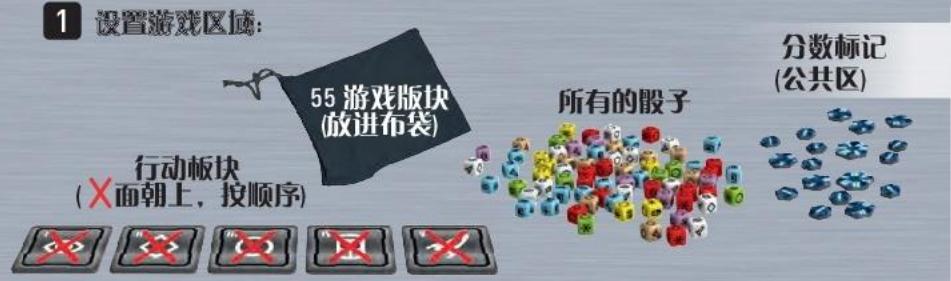
5 掷骰杯
5 货币指示物
5 玩家卡板
5 玩家屏风
5 行动条
9 派系板块(宽型,在深灰色边角标有数字1-9)
111 特制骰子(见右图)
55 游戏板块(双面)
1 布袋(存放游戏板块)
33 分数标记:
20小号1分标记,
8中号5分标记,
5大号10分标记
5 行动板块(标有大的行动符号)规则书
在首次游戏开始前,需要先认真的将游戏屏风,玩家卡板,行动条,游戏板块以及各种标记从它们的框架上取下。

探素可以让你获得新的游戏板块或者太空货币。

发展可以让你提升科技从而在游戏中获得不同的能力。

殖民可以让你获得更多的人口以及更多的储存货物的空间。
生产可以让你的星球出产用来运输的货物。

运输可以让你用货物来换取货币或者分数。
骰越银河的5种行动
家园骰子
(白色,25)
军事骰子
(红色,22)
消耗骰子
(紫色,9)
珍奇物品骰子
(蓝绿色,20)
稀有元素骰子
(棕色,14)
基因骰子
外星科技骰子

这个图形代表任何一种以上的骰子
骰子的颜色和数量

游戏设置
2 设置玩家区域:
· 一个掷骰杯
• 一个货币指示物
初始帝国
· 一个玩家卡板(将标记放在卡板1的位置 玩家卡板
• 一个屏风
• 一个行动条
• 初始帝国(见右图)

将所有没用到的配件放回游戏盒子。

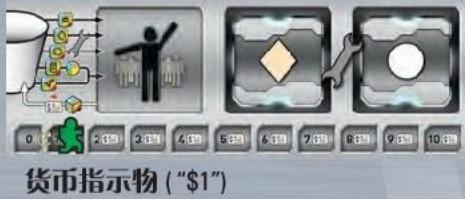
行动条 (放在屏风后面)
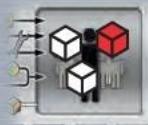
工人区(放置骰子)
建设区域(发展板块在左,星球板块在右
4 每位玩家拿取股子:
a. 将3枚家园骰子(白)放进你的杯子().
b. 将2枚家园骰子放到你的工人区().
c. 按照你初始帝国中家园板块的要求拿取相应的骰子,将其按照图示放到相应的位置工人区(),或掷骰杯(,或者将相应货物(放到该家园板块上。
你不能通过建设区域的星球板块拿取骰子;只有当这些星球板块被殖民或者进入你的太空帝国时才会提供骰子。

Gain a Rare Elements (bron) good an this werld at the sart of the game
家园板块
每有1名玩家参与游戏就将12分放入公共区(使用1分和5分的标记):
| 玩家 2 3 |
将剩余的10分标记放在一旁,这些将在游戏的最后一轮使用。最后将其他的分数标记放回盒子。
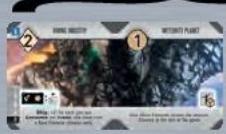
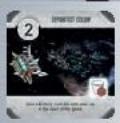
每位玩家获得1个派系板块和1个家园板块(随机拿取)。然后,将剩余的派系板块和家园板块放回盒子。
每位玩家将这些板块面朝上放在自己的卡板前面;这些板块组成了玩家的初始帝国设置。
3 每位玩家拿取游戏板块:
从布袋中拿取2个游戏板块将它们放在玩家卡板的建设区域。将其中一个板块的发展面朝上放在左边标记处,另一板块星球面朝上放在标记处(右侧).
在你第一次进行游戏时,我们建议你选择将这些双面板块中各自发展面和星球面中费用更低的一面,面朝上放在相应的区域。在以后的游戏中,你可以由自己来选择板块的放置方式。
需要注意的几点:
•通过派系板块和家园板块拿取的骰子只能在游戏设置时获得一次。
·家园板块“末日世界”不会让你获得骰子;但是,玩家在游戏开始时可以获得8个货币。
·派系板块“毁灭之地”可以提供2个家园;这两个家园都可以让你获得骰子。
游戏轮次
骰越银河一般会进行11-14轮。每一轮包括5个阶段:
·掷骰
·指派工人
·展示
·执行行动--按照固定的顺序
· 管理帝国
每一步所有玩家都可以同时进行。
每一轮都重复执行以上的5个阶段直到满足以下游戏结束条件之一:所有剩余的分数标记都被拿取,至少有一名玩家的太空帝国中包含12个或12个以上的游戏板块。在触发游戏结束的那轮游戏结束后,游戏结束,所有玩家进行计分。
掷骰
所有玩家在自己的屏风后同时投掷自己的工人(掷骰杯中的骰子)。
指派工人
首先,根据自己的工人骰子朝上一面的结果和行动条上的标记,将相应的工人放到相应的标记后方形成一列。
根据规则在游戏板块上有该标记的?表示可以指派到任何一个行动。
该图标为万能图标.这些工人可以被指派到任何一个行动(多个万能图标的骰子,可以放到同一列或者不同列)。
行动选择:每位玩家通过将自己的1个工人骰子放置到行动条上任意1个行动空位。来选择执行1个行动。只有被选择的行动才会被执行(见第4页行动阶段)。
在这样放置工人时,无视工人骰子朝上的一面,而是将骰子的结果看作和所选的行动图标相同。
重新指派:一些发展板块的能力允许玩家重新指派自己的工人骰子到另一个行动空位上,你可以将这些骰子放在行动条其他行动标记列的后方。(②).
所有玩家都有一个特定的重新指派工人的能力,也就是行动条上所指示的命令能力。
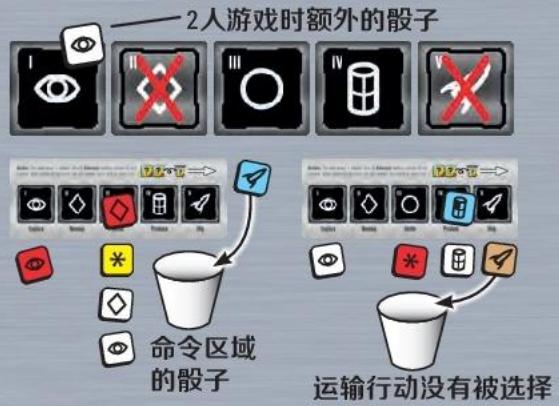
执行命令能力时,将任意一个工人骰子放在行动条的右侧(命令区域),然后,重新指派任意1个工人骰子,将其放到另外一个行动标记列后方。命令区域的工人将会回到掷骰杯。
每个板块的重新指派能力玩家每轮最多只能使用一次。许多的板块能力都是可选发动的,我们会在描述中用“可以”这样的词汇来说明。
当所有玩家都指派完自己的工人并执行完所有重新指派能力后,游戏进入下一步骤。
在这个阶段,先执行完行动的玩家要等待其他玩家都执行过自己的行动之后再进行下面的游戏。玩家可以采用按照特定方式来摆放自己的掷骰杯来表示自己已经完成了行动,做好准备进入下一个阶段了。

行动1:探索

行动ⅡI:发展

行动Ⅲ:殖民
国
行动IV:生产

行动V:运输

行动条
万能图标:可以放到任何一列行动后
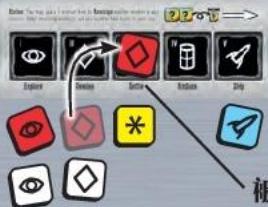
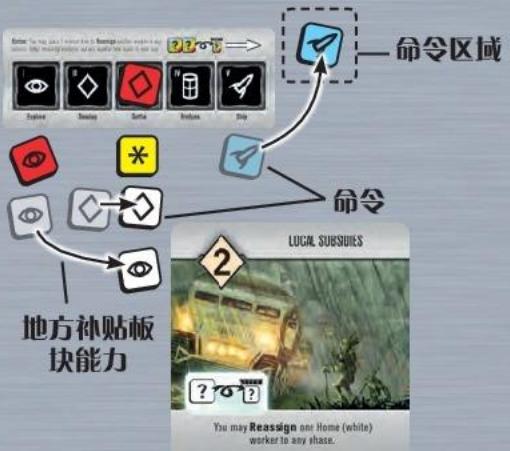
具有重新指派能力的发展板块
注意:玩家在使用重新指派能力时,不能将用于重新指派的骰子重掷。在拿起屏风之前,这样有助于那些具有“撤销”能力的板块的使用。

展示
每位玩家拿起各自的屏风展示他们指派的工人,并声明自己所选择要执行的一个行动。然后将场上相应的行动板块从面翻至其黑色一面。
2人游戏时,额外投掷1颗家园骰子(白色)。如果投掷结果为两位玩家都未选择的行动,则也将其相应的行动板块翻面。在这一轮,这个行动也可以执行。
将所有被指派到面和命令区域的骰子放回掷骰杯。
执行行动
此时,所有玩家同时按照各自所选择的行动编号,顺序执行各自的行动流程。在执行1个行动时,玩家可以使用被指派到该行动标记列的所有工人,包括用来选择该行动的那个工人。玩家不能执行该轮没有选择的行动。

从布袋拿取1个新的板块并选择将其中的一面朝上放在建设区域()
或者,备货从而获得2个货币 $( \frac { 2 0 } { \sqrt { 5 } } )$

建造建设区最上面1个发展板块()(将这个完成的发展板块移动至你的帝国)

殖民建设区的1个星球()(将这个完成的星球板块移动至你的帝国)

在你帝国中()的一个非灰色星球()上生产一个货物

交易自己的1个货物,获得3-6个货币()消耗你的1个货物,来获得1-3分

工人根据其被指派到的行动来执行任务:
在每个行动中,玩家的所有工人都必须被使用(如果可能)。他们可以按照任意顺序一个接一个的被使用。执行探索和运输行动时,由你来决定要执行其中的哪一个选择。
当工人完成自己的行动时将使用过的工人放到工人区().
在管理帝国阶段(见第8页),你可以支付货币(\$)来从工人区招募工人骰子到自己的掷骰杯中来为下一轮做准备。
我们可以通过\$)许多方式来获得货币,如使用有\$标记的能力(比如,+2\$)。玩家通过移动玩家卡板上货币轨的货币指示物来指示当前的货币数量。玩家持有的货币数不能超过10\$;多余的部分会被弃掉。
玩家在执行了所有可能的行动之后,如果还有多余的工人可用,要将其放回自己的掷骰杯。
大多数发展板块都有各自的能力,有的会影响某一个行动,有的会影响工人执行行动的方式。

工人使用循环

使用每个工人骰子执行拿板块或拿货币\$).在使用之后把它放到(工人区(1)。
探索(拿板块):在从你玩家卡板的建设区域弃置了一些游戏板块之后,你可以从布袋中抽取1个或者多个板块,并查看它们。然后,为你摸取的每一个游戏板块决定是将其发展面()或星球()面朝上并放到建设区域相应的位置上。
你摸取的板块数量总要比你的弃置的板块数量多1个。
你可以选择摸取1个板块而不弃置你的任何板块。
如果布袋中的板块被摸空了,见第10页,关于探索行动的注意事项。

你可以选择从你建设区域中的发展区或星球区任意弃置板块。将你弃置的板块放到探索行动板块的下面。
当你因为执行探索行动而弃置板块时,你可以弃置刚刚通过之前的探索行动所拿取的板块(具体见下文)。
探索行动阶段结束后,将所有被弃置的游戏板块放回布袋。
探索后
在探索行动阶段,即使你弃置板块导致发展或星球区中的板块被弃空,相应区域中的工人(开发者或殖民者)仍要放在该区域的最顶端。
规则说明在游戏设置时要求玩家的建设区域下的发展区和星球区必须要各有一个板块,在游戏过程中则没有要求。
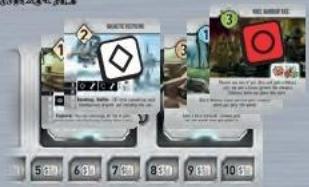

被弃置的板块

\$备货(拿货币),你可以获得()2个货币。

探索前的建设
第一次探索
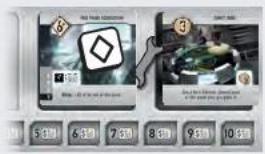
第二次探索

第三次探索
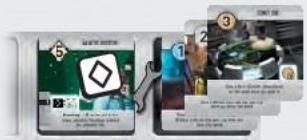


(无)
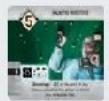
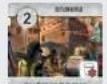
新摸取的板块,先摸取的在左边(双面显示)
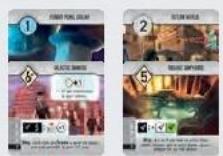

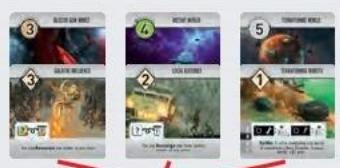
探索后的建设
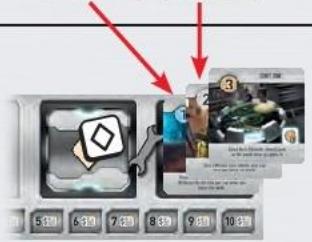

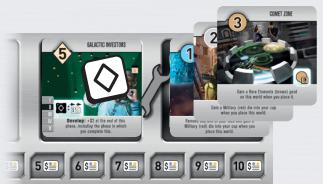
举例:3次连续的探索行动
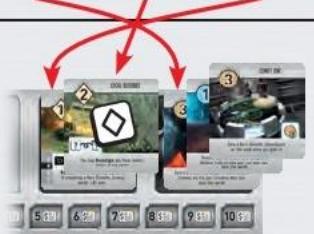
发展
将每一个开发者,一个接一个的放到你玩家卡板发展区最顶端的游戏板块上。()
如果你所放置的开发者的数量,等于你玩家卡板发展区中最顶端的发展板块上()的数字,发展行动被执行。然后,将相应的发展板块拼入你的帝国,并将执行行动的开发者们放进工人区。
玩家可以使用剩下的开发者来继续建造发展板块。在发展行动阶段,玩家可以建造多个发展板块。
如果在建造了发展区的所有发展板块之后还留有开发者,你可以将他们放回你的掷骰杯。
有些时候,由于你的板块能力帮助你在探索行动阶段就完成了发展区最顶端的板块建造时,你必须在发展行动阶段开始时才能将该发展板块放进帝国并由你选择将相应的开发者放回工人区。
大多数的发展板块都会在你建造好它之后给你提供一项能力,你可以在指派工人或者执行某个行动时来使用这个能力,这种能力一般是强制执行的,除非在描述板块能力时用到了“可以”这样的词语。
3个发展板块拥有“即时效果”,这点与星球板块类似(具体见下文)。
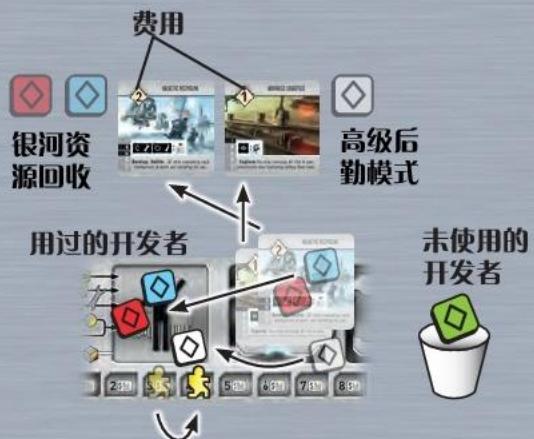
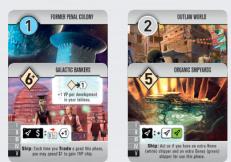
你可以通过②银河资源回收多获得1块钱(因为你建造了①高级后勤模式)
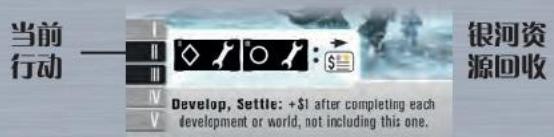
当前完成的发展板块
殖民
将每一个殖民者一个接一个的放到你玩家卡板星球区最顶端的板块上。
如果你所放置的殖民者数量等于你星球区中最顶端的星球板块上()的数字,殖民行动被执行。然后,将相应的星球板块拼入你的帝国,并将执行行动的殖民者们放进工人区。
玩家可以使用剩下的殖民者来继续殖民星球板块。在殖民行动阶段,玩家可以殖民多个星球板块。

如果在殖民了星球区的所有的星球板块之后还留有殖民者,你可以将他们放回你的掷骰杯。
有些时候,由于你的板块能力帮助你在探索行动阶段就完成了星球区最顶端的板块的殖民时,你必须在殖民行动阶段开始时才能将该星球板块放进帝国并由你选择将相应的殖民者放回工人区。
每个星球板块上都指示有一个即时效果。这个效果只能在其拼入你的帝国时执行一次。所有的星球板块都会让你获得新的骰子。其中的一些星球还会让你获得太空货币。而有些即时效果需要你移除自己的1个骰子,这时你可以将自己任意一处区域的1枚骰子放回桌子中间。
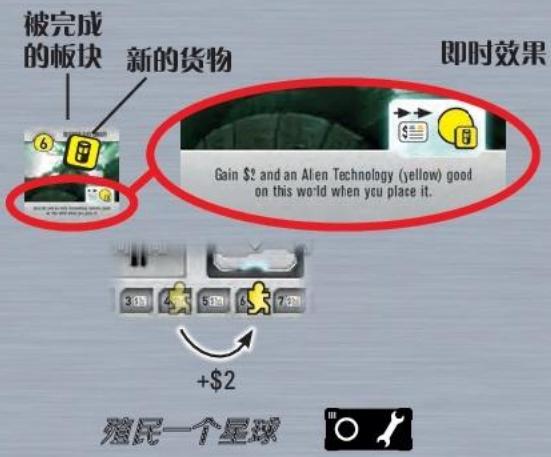
注意:为了获得更多的骰子,你要殖民更多的星球。避免因为想要殖民费用太高的星球而让你的骰子殖民者被卡在那些星球上。
“国生产
每个生产者可以生产1个货物()在玩家帝国的非灰()色星球上。
玩家的生产者骰子()变为货物;并放到该星球上。
货物的颜色和星球的颜色是否匹配会影响到将来该货物的消耗,但是不会影响到该货物的交易。(见下文)
每个星球板块上最多只能有1个货物(除非玩家拥有银河储备这张板块)。
最后,将所有剩余未使用的骰子放回掷骰杯。
运输
每个运输者可以从玩家帝国的星球板块上运输1个货物,无论你是选 择交易(\$或者是消耗(它。将2枚骰子(运输者和货物)放 回工人区。
\$每次交易时玩家会根据货物所在的星球\$)颜色获得相应数量的太空货币(与货物骰子本身的颜色无关):
珍奇物品:3
稀有元素:4\$
基因○:5
外星科技:6
一些板块能力会增加你获得的太空货币数量。

每次消耗时,执行该运输行动的玩家可以获得1-3分:
1分(总是);
+1分如果货物的颜色与所在星球的颜色匹配;
+1分 如果运输者的颜色与货物所在星球的颜色匹配。
一个消耗骰子(紫色),无论是当做货物使用还是当做运输者使用,都视作和所有颜色匹配并获得相应加分。.
如果使用2个消耗骰子,既当做货物也当做运输者,你可以同时获得它们各自的加分。
一些板块能力可以帮你获得更多的分数或者帮你获得额外的太空货币。
如果分数标记供给区被拿空时,将游戏开始时放在一旁的10分标记加入供给区中,继续使用。
拿光分数标记供给区是触发游戏结束的情况之一,在当轮游戏结束之后,整个游戏结束。
最后,将所有剩余未使用的骰子放回掷骰杯。
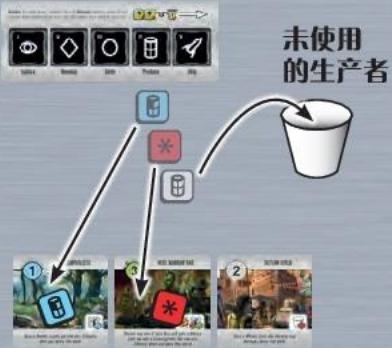
生产的货物

注意:早做交易,从而为之后重新招募更多的工人做准备。

注意:当你执行消耗行动时,可以用消耗骰子来获得额外的分数。
管理帝国
重新招摹,重新招募工人时,你需要从工人区选择需要的骰子并将它们放回掷骰杯,同时你每重新招募1个骰子(5)就要减少自己的1个太空货币。直到你的工人区清空或者太空货币花光为止。在重新招募之后,如果你的货币位于“0”的位置,要将货币标记移动到“1”(按照玩家卡板的标注)。
如果你拥有的太空货币少于工人区的骰子,由你来自由选择将哪些骰子重新招募回来。
召回你可以召回自己任何的开发者,殖民者(从他们各自的建设区域)以及货物(从星球板块)。将它们放回自己的掷骰杯。
召回骰子,与重新招募不同,不需要消耗太空货币。
重置将所有的行动板块翻到“X”面。
检定游戏结束.如果分数标记区之前被拿光(见运输行动)或者任意一位玩家的帝国中拥有12个或以上的游戏板块时(派系板块视作2个游戏板块),游戏结束(见下文,获得胜利)。
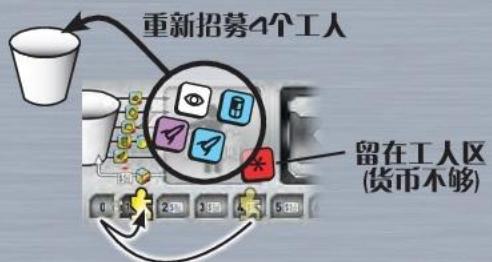
减少\$4,然后获得\$1
注意:当你的建设区域有太多的工人骰子或者你有一些不想运输的货物时,你可以召回它们。

13个游戏板块,触发游戏结束。
获得胜利
加总每位玩家的分数:
·所有的分数标记。
·将帝国中所有发展板块和星球板块的费用相加,并计作分数(和)上的数字。同时也包括派系板块上的数字。但是,不包括建设区域的任何板块。
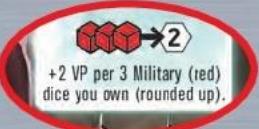
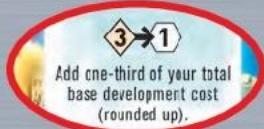
·根据板块上的说明,获得6费发展板块上的额外加分,当计算这些加分时,将获得的小数部分向上取整。
最后,分数最高的玩家获胜!
如果有多位玩家平手时,每位平手的玩家再将下列部分加总:
·玩家掷骰杯中的骰子数量
·他持有的太空货币
如果再平手时,所有平手玩家分享胜利。



Sae s oally upoe) de anl a Miory (ed) de iwe yse Citussry at te start ol the geme
13分=发展板块分数收收成成分分 3分=星球板块分数25分=总分
关于时点
大多数情况下,玩家的行动可以同时进行。但是,在某些时候,玩家需要按照顺位行动,例如:
·当有玩家可能会建造12个或以上的游戏板块时(触发游戏结束),或者
·当分数标记供给区可能要被拿光时(触发游戏结束)。
当玩家需要精确时间顺序时,我们要从持有的派系板块上编号最小的玩家开始,按照顺时针的顺序来执行这一轮的行动。
关于礼仪
在玩家的建设区域中,只有两个板块堆最顶端的两个游戏板块是公开的。玩家可以随时查看自己的板块堆。当被其他玩家问及时,他必须告诉其他玩家自己每个板块堆中的板块数量。
在探索阶段所有被弃置的游戏板块 需要被放在探索行动板的下面——对所有玩家保密。
最后一项保密信息是玩家在投掷骰子和指派阶段时,在玩家屏风后所投掷的工人骰子。
因为我们无法监视玩家在屏风后的行动,所以游戏的公平进行完全依赖于玩家认真的游戏态度。
讲给银河竞逐的玩家们
·行动顺序的不同,运输行动(也就是消耗行动)发生在生产行动之后,而不是之前。
以下有一些骰越银河和银河竞逐规则之间的区别:
·选择行动时,没有“奖励”。(虽然你能保证你一定会执行这个行动)。
·在每个玩家的建造阶段,玩家可以建造多个游戏板块,而不限于一个。
派系编号
·所有的发展板块都是独一无二的。
·板块的计分等于它们各自的费用(除了那些费用“6+”的发展板块)。

·没有直接的互车方式,取而代之的是“军事骰子”的使用。通过发展和殖民,可以体现出军事骰子的扩张效果。
·交易的价格多了1块钱。比如,1个基因货物可以换取5个太空货币,而不是4张牌。
·玩家可以在自己的运输阶段交易多个货物(你的每一对运输者和货物骰子)。
注意事项
问:关于骰子的术语之间有什么不同,比如:工人骰子,运输者和货物?
答:工人是玩家掷骰杯中的骰子,你可以把它们放在行动条后面或者用于选择一个行动。不属于任何玩家的骰子,比如玩家工人区中或者是命令区域中的骰子不算工人。玩家在给工人指派了各种行动后,工人会变成探索者,发展者,殖民者,生产者或者运输者。被放到星球板块上的生产者会变成货物。
问:为什么生产标记会有各种不同 国0国00的颜色?
答:这是为了便于那些色盲玩家。
问:为什么绿色的星球板块的左上角会有个小点。

答:只有基因(绿色)的星球板块上有小点,是为了便于那些色盲玩家区分基因(绿色)星球和稀有元素(棕色)星球。
关于游戏设置
问:我选择的两个起始板块一定要选择费用更低的那面 吗?
答:不需要(这只是为了便于初次游戏)。
问:我可以把两个起始板块放在同一个建设区域的板块堆中吗?
答:不可以。
问:在游戏开始时,我可以从我的初始帝国中召回货物吗?
答:不可以,你只能在自己的管理帝国阶段召回自己的骰子。
关于指派
问:当骰子被指派时,骰子面必须要和行动匹配吗?
答:不需要。由于骰子要被用于重新指派或者是用于选择一个行动,所以不一定要和行动条上的行动匹配。
问:我可以在展示后将骰面为的骰子指派出去吗?
答:不可以。所有的指派行动必须要在展示之前进行。
问:我必须要在使用重新指派能力之前,就选择好要执行的行动吗?
答:是的。

关于探索
问:在探索行动阶段,我必须使用我所有的探索者吗?
答:是的(每个探索者必须执行探索或者备货行动)
问:我必须在使用所有探索者前声明自己的行动选择吗?
答:不需要,你在使用每个探索者时由你自己决定是探索或是备货就好了,不需要声明。
问:如果一个玩家在执行探索行动时,所摸取的板块比袋子中剩余的板块多时会怎么样?
答:从袋中摸取余下的所有板块之后,他需要将放在探索行动板下面被弃置的所有游戏板块放回袋中,再根据行动需要摸取剩下该摸取的板块。
问(极少发生):如果按照上述的方法,仍然没有足够的板块可以摸取时怎么办?
答:执行探索行动的玩家需要将他迄今摸取的所有板块都放在建设区域,然后场上所有玩家中(包括执行探索行动的玩家本人)建设区域至少有3个游戏板块的玩家,必须弃置1个游戏板块到袋子中。然后,执行探索行动的玩家继续执行探索行动。
当袋子中的板块很少时,玩家可以按照自己意愿根据规则第9页提到的时点规则,按照玩家顺位执行自己的探索行动。


关于发展和殖民
间:我必须使用自己所有的发展者(或殖民者)吗?答:是的。如果你的建设区域有任何的发展(或星球)板块时,你必须一个接一个的将发展者(或殖民者)放到这些板块上。
间:我必须使用自己所有可用的减费效果吗(例如人造机器人)?
答:是的。
问:我的帝国中可以拥有多于12个游戏板块么?
答:是的。玩家可以在最后一轮建造多个游戏板块从而可能拥有超过12个游戏板块的帝国。

关于生产和运输
问:玩家所用的生产者必须要和星球板块的颜色一样吗?
答:不需要。任何颜色的生产者都可以在任何一个非灰色星球上变成货物。
问:货物的交易价格是由它所在的星球颜色(非货物颜色)决定的吗?
答:是的。
间:我必须在我使用所有的运输者执行行动前进行声明吗?
答:不需要,你在使用每个运输者时由你自己决定是交易或是消耗就好了,不需要声明。
问:骰子的万能图标面会在消耗时提供额外的分数吗?
答:不会(在消耗时获得的分数只与骰子的颜色有关与骰子的图标无关)。
问:我可以故意让货物的颜色与运输者不匹配,从而获得更少的分数吗?
答:可以(有时候,这也是一种策略的选择)。
关于管理帝国
问:我必须根据自己能支付的费用尽可能的重新
招募更多的工人吗?
答:是的。
问:有些玩家在游戏的最后一轮召回自己的工人是为什么?答:(见第8页,游戏胜利)当最后出现平局时,掷骰杯(非建设区的工人和货物)中的工人更多的玩家更有优势。
关于即时效果
问:当我因为使用即时效果需要移除一颗骰子时,我可以移除我的任意一颗骰子吗?
答:是的。
问:从我的掷骰杯,行动条,建设区域或是任何的星球上移除一颗骰子效果有什么不同吗(除了移除骰子本身)?答:没有。(如果你移除的骰子是用来选择行动的,那个行动也一样会执行)。
关于发展板块的能力
间:我什么时候可以使用发展板块的能力?
答:重新指派能力只能在指派行动阶段使用。其他的能力都在其描述中指定的行动阶段使用。(板块GalaticReserves除外,见下表)。
问:每个行动过程可以使用发展板块的能力多少次?
答:被“触发”多少次就可以使用多少次。
举例:Public Works可以让它的拥有者每建造一个发展板块就可以获得1块钱。一位玩家建造它的同时又建造了两个发展板块,他可以通过Public Works的效果获得2块钱。
问:当某项板块能力通过你的行动触发时,你需要向相应的行动条上指派工人吗?
答:不需要。
间:我可以在建造发展板块的当轮就使用该板块的能力吗?答:可以(如上文的举例)。
问:我可以使用重新指派能力把一个骰子放进命令区域吗?答:不可以。
问:重新指派能力可以指派多个工人去不同的行动列吗?
答:可以。
个别板块能力说明
Advanced Logistics:你可以在探索行动阶段多次使用这个板块的能力,但是当你通过Alien Research Team摸取板块后不能使用这个能力。在执行顺位行动规则时,只有在你自己的回合,你才能使用这个能力。
Alien Archaeology:请看发展板块说明中关于外星探索者的部分。
Alien Research Team:在探索阶段,你需要在所有玩家弃置自己的游戏板块之前,摸取自己的额外板块。同时,也请查看发展板块说明中关于外星探索者的部分。
Biological Adaptation:这不是一项重新指派能力(即使卡牌描述中用到了“重新指派”这个词)。
Conscription: 请看即时效果说明部分。
Executive Power: 请看发展板块说明下面的关于重新指派的相关问题。
Former Penal Colony: 请看即时效果说明部分。
Free Trade Zone:举例,一个3费或4费的灰色星球,你只需要2费(除非你的帝国中还有Replicant Robots时,那么你只需要1费)。
Galactic Mandate: 请看发展板块说明下面的关于重新指派的相关问题。
Galactic Reserves: 银河储备这项能力拥有持续效果,当你建造之后,你可以无视每个星球(非灰色)只能放置1问:我可以使用重新指派能力去指派一颗万能骰子吗?
答:是的(虽然有时这样做没有什么意义)。
问:重新指派能力可以将骰子放到与其骰面不匹配的行动列吗?
答:可以(决定选择要执行的行动与使用的骰子的骰面无关)。
间:一些板块能力提及了Alien explorer,当外星科技骰子骰面没有探索行动时,我如何获得Alien explorer呢?答:使用重新指派能力将外星骰子放到探索行动列,或使用一个外星骰子去选择探索行动,或指派一个外星万能骰*子去执行探索行动。
问:板块能力可以将骰子放到与其骰面不匹配的行动列吗?
答:可以(决定选择要执行的行动与使用的骰子的骰面无关)。
问:在使用板块能力或游戏结束计分时,消耗(紫色)骰子与其他颜色的骰子有什么不同吗?答:没有。它们只有在被消耗时用来搭配颜色获得更多的分数。
问:“向上取整”是什么意思(某些发展板块的能力)?答:就是把任意数量的部分单位当做“一整个”单位。
例1:Space Piracy让它的拥有者在其运输行动阶段结束时,工人区每有2个军事骰子就可以获得1块钱。一位玩家的帝国持有Space Piracy,同时他的工人区有3个军事骰子,那么他应该获得1.5块钱,向上取整后获得2块钱。
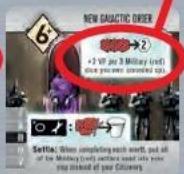
例2:New Galactic Order让它的拥有者在游戏结束时,每有一套3个军事骰子就可以获得2分。一位玩家当时拥有4个军事骰子,相当于一又三分之一套,向上取整后相当于2套,所以他一共可以获得4分。
个货物的限制。取而代之的是,你的星球(非灰色)可以放置最多2个货物(同色或者不同色)。每个货物仍然需要1个运输者进行运输。
GeneticsLab:这项能力计算的只是星球上作为货物的基因骰子的数量,而不是基因星球上货物的数量。
Information Tech: 请看即时效果说明部分。
Isolation Policy: 请看发展板块说明下面的关于重新指派的相关问题。
Mad Scientists: 如果所有人都没有珍奇物品星球,这项能力可以看作被发动,你可以重新指派1个骰子。
Nanotechnology:请看发展板块说明下面的关于重新指派的相关问题。
Organic Shipyards: 只有当你使用它在一个基因星球上运输货物时,它可以被看作是一个基因骰子的额外运输者。
Rebel Miners: 请看即时效果说明部分。
Rebel Warrior Race: 请看即时效果说明部分。
Space Marines: 请看即时效果说明部分。
SpaceTourism:当你同时拥有多个最高费用的星球时,你也只能通过这项能力额外获得1块钱。检视星球费用时,以原值为准,不计算折扣或者减费效果。
经常被忽视的规则
·游戏是同时进行的(一般没有独立的玩家回合)。
·被放在行动条上的骰子(用来选择一个行动)同时也算作是一个工人。
·每位玩家只能选择一个行动。每个被重新指派的工人(包括命令能力)都要移动到行动条相应的一列后面。
·所有的工人一个接一个连续的执行它们的行动。玩家不需要在工人执行行动之前声明它们将要执行的行动。
·执行过行动的工人要回到工人区(而不是掷骰杯)。
·未被使用的工人要回到掷骰杯(而不是工人区)。
·被弃置的游戏板块要被放到探索板块的下面。
·每个消耗(紫色)骰子,在被当做货物或者运输者消耗时,都可以额外获得1分。
·在触发12个或以上的游戏板块结束条件时,每位玩家起始的派系和家园板块算作3个游戏板块。
般面和游戏板块分布
相同颜色的骰子骰面分布一致。每种骰子的主要行动如下:
家园:探索
军事:发展,殖民
消耗:运输(×3)
珍奇物品:生产,运输
稀有元素:发展
基因:万能
外星科技:万能(×3)
55张游戏板块,每一张板块都分为费用1-6的星球面和发展面。下面的表格展示了板块的类型和费用的分布:
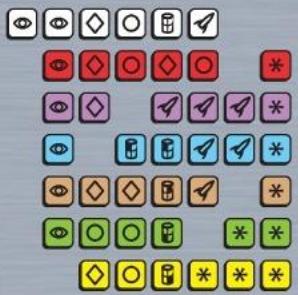
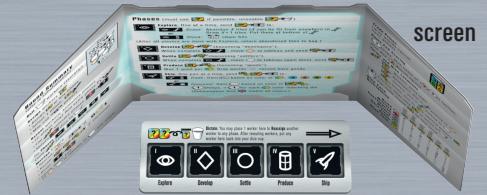
以上的提示信息也被印在了玩家屏风的右侧。
| 5 | 6 | 4 | |||||
| 5 | 6 | 2 | |||||
| 3 | 4 | 2 | |||||
| 2 | 2 | 3 | |||||
| 2 | 3 | 2 | 2 | 1 | 1 | ||
| 1 | 1 | 1 | 6 | 5 | 4 | ||
| 9 | 4 | 3 | 8 | 5 | 5 | ||
| 2 | 1 | ||||||
15 珍奇物品星球
13 稀有元素星球
9 基因星球
7 外星科技星球
11 其他星球
18 重新指派能力的发展板块
34 其他能力的发展板块

3 即时效果的发展板块
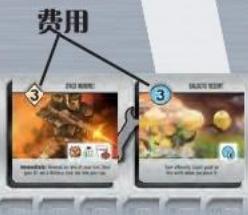
费用
CREDITS
Playtesting and advice: Corin Anderson, William Attia, Joe Black, Paul Blake, Dan Blum, Eric Burgess, Joe Casadonte, Ken Chaney, Bay Chang, Dave Cortwright, David desJardins, Sandra Emerson, Jeff Goldsmith, Ted Griggs, Dave Helmbold, Heydon Hensley, Jay Heyman, Trisha Huang, Rich Irving, Ron Krantz, Mike Linsc, Chris Lopez, Terry Lyzen, Paul Makarian, Alex Power, Bahman Rabii, Dan Rosart, Larry Rosenberg, Anthony Rubbo, Ron Sapolsky, Craig Silverstein, Greg Snyder, Jeffrey Stern, Mik Svellov, Steve Thomas, Andreas Walsh, Dayton Williams, Don Woods, Maciej Zenczykowski, Doug Zongker
If you have any comments, questions, or suggestions, please write to us at:
Rio Grande Games
PO Box 1033, Placitas, NM 87043, USA
RioGames@aol.com www.riograndegames.com
© 2014 Wei-Hwa Huang, Tom Lehmann © 2014 Rio Grande Games
Download MarkdownRoll-for-the-Galaxy-Rules.md37.1 KB

The Race for the Galaxy Dice Game
Roll for the Galaxy is a dice game of building space empires for 2-5 players. Your dice represent workers who develop new technologies, settle worlds, and ship goods. The player who best manages his workers and builds the most prosperous empire wins!
OVERVIEW
In Roll for the Galaxy, each player creates a galactic civilization by recruiting workers (represented by custom dice) to settle worlds and build developments (represented by game tiles), over several game rounds.
Players start each round by secretly rolling their workers to see what their workers wish to do this round. Each player uses one worker to select one of the five possible phases, and then all players reveal their workers. All player-selected phases occur in numerical order.
Workers that complete tasks go to their player's Citizenry.
After the phases, players manage their empires, spending Galactic Credits to recruit workers from their Citizenries back to their cups, to be rolled next round.
The player who best manages his workers to create the greatest space empire of worlds, developments, and victory point chips, wins.


Explore for new tiles or
Develop technologies for

powers that modify play
Galactic Credits
Settle worlds for more population and places to hold goods


Produce goods on worlds, in preparation for shipping
Ship goods for Galactic Credits or victory points
9 faction tiles (wide, numbered 1-9, with dark grey corners)
The 5 Phases of Roll for the Galaxy
CONTENTS
9 home world tiles (with dark grey corners)
111 custom dice (see chart at right)
55 game tiles (double-sided)
1 cloth bag (to hold game tiles)
33 victory point (VP) chips: 20 small 1 VP chips, 8 medium 5 VP chips, 5 large 10 VP chips
5 phase tiles (with large phase symbols) this rulebook
Home die (white, 25)
Military die (red, 22)
Consumption die (purple, 9)
Novelty die (cyan, 20)
Rare Elements die(brown, 14)
Genes die (green, 12)
Alien technology die (yellow, 9)

this shade means any of the above
Dice Colors and Distribution
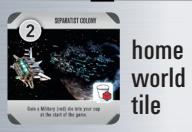

starting tableau
2 Give Each Player:
• a dice cup
• a credit marker
faction tile
• a mat (put the marker on its 1\$ space)
• a screen
• a phase strip
• initial tiles (see right)
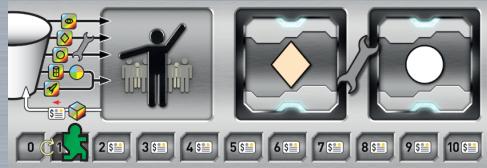

Put any unused player components in the box.
credit marker (on “\$1")
phase strip (behind screen)
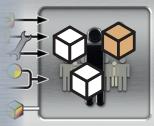
Citizenry (with dice)
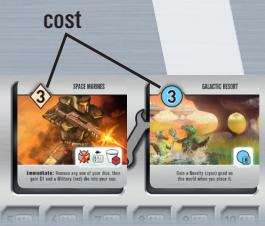
construction zone (developments on left, worlds on right)
4 Each Player Takes Dice:
a. Put 3 Home (white) dice in your cup ().
b. Put 2 Home dice in your Citizenry ().
c. Take all dice granted by worlds (O) in your empire. Put them, as indicated, in the Citizenry (1), the dice cup (), or as a good() placed on that world.
Do not take dice for the world in your construction zone; it will grant dice only when it is settled and moved into your tableau.
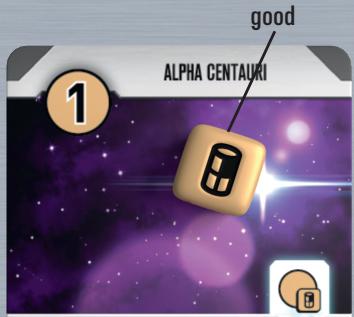
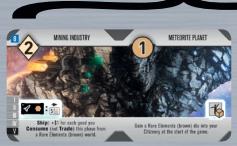
Gain a Rare Elements (brown) good on this world at the start of the game.
home world
Use 12 VPs per player (in 1VP and 5VP chips):
| Players | VPs |
| 2 | 24 |
| 3 | 36 |
| 4 | 48 |
| 5 | 60 |
Set all the 10VP chips aside for use only in the final round. Put the other VP chips away.
Give one faction tile and one home world tile (each chosen at random) to each player. Return the rest to the box.
Each player puts these tiles face-up in front of his mat; these form the player's initial empire, represented by a tableau of tiles.
3 Each Player Draws Game Tiles:
Draw two tiles from the bag and place them in the construction zone on the mat. Put one tile development-side-up on the left and one tile world-side-up on the right.
For your first game, place these double-sided tiles so that the lowest-cost development and the lowest-cost world are face up. In later games, choose which of the two different ways you want to place your tiles.
Fine Points
• Dice from your faction and home world are taken only during Setup.
• The home world Doomed World grants no dice; instead, its player starts with 8 Galactic Credits.
• The faction Destroyed Colony has two worlds; both of them grant dice.
ROUNDS
Roll for the Galaxy is played in rounds (usually 11-14). Each round consists of 5 steps:
·Roll
•Assign
•Reveal
• Do Phases — resolve the selected phases in order
• Manage Empire
Each step is done simultaneously by all players.
Repeat rounds until one or both game end conditions are met: all initial VP chips have been earned, or at least one player has 12 or more tile squares in his tableau. Finish that round and then total each player's VPs.
ROLL
Players simultaneously roll all workers (dice in their cups) behind their screens.
ASSIGN
Initially, assign workers to phases by placing them below the phase strip in columns, matching each die face rolled with the phase symbol.
In these rules and the tiles' power icons,?refers to any worker assigned to a phase.
All *faces are wild. These workers can be assigned to any phase (multiple wild dice can go under the same or different columns).
Phase Selection. Each player selects a phase by taking one worker and placing it on any space on the phase strip. Only selected phases occur (see Phases, page 4).
This assigns this worker to the selected phase. The player now ignores this die's face and instead treats it as if its face was the selected phase.
Reassign. Some developments have powers that allow a player to Reassign workers to other phases, placing those dice in other columns below the phase strip (②).
All players have one "built-in" Reassign power, Dictate, shown on the phase strip.
To Dictate, place any worker to the right of the phase strip (the Dictate area) and then Reassign another worker to a different column. The worker in the Dictate area will be returned to the cup (see Reveal, page 4).
Each Reassign power can be used at most once per round. Many powers are optional, as indicated by "may" in their descriptions.
When all players are done assigning their workers and using any Reassign powers, proceed to the next step.
Players who do the phases at different speeds should pause at this point until all players are ready. Adopting a house rule to show when players are ready, such as turning dice cups a certain way, may be useful

Phase I: Explore

Phase II: Develop

Phase III: Settle

Phase IV: Produce

Phase V: Ship


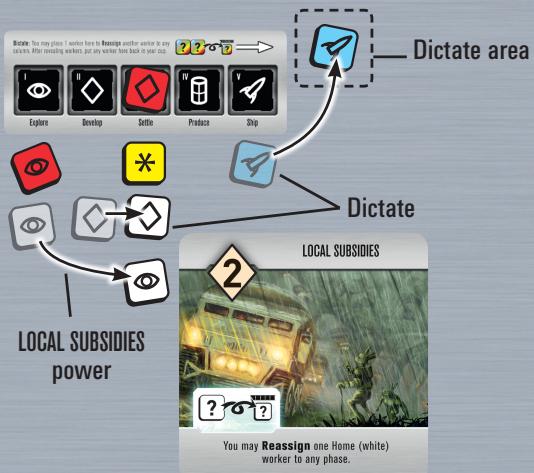
development with Reassign power
Tip: Move a Reassigned worker to its new column without rotating it to show a new face. This makes it easier to "undo" a power's use before screens are lifted.
REVEAL
Each player lifts his screen to reveal his assigned workers, announcing the phase he has selected. Flip the matching phase tile from its“X" side to its black side.
2-Player Game: roll a spare Home (white) die. If the rolled face is a phase that wasn't selected by either player, flip that phase tile over as well. This phase will also occur this round.
Return to players' cups any workers assigned to “X" phases and any workers next to the Dictate area.
PHASES O
Simultaneously, players do all selected phases in numeric order. To do a phase, use all workers assigned to it, including any worker that selected it.
Do not perform any phase not selected this round.
A worker does a task, depending on which phase it is assigned to:
scout for a new tile and, optionally, replace tiles in the construction zone ( stock to gain 2 Galactic Credits ()

develop the topmost development () on the construction zone stack (move a completed development into your tableau)
settle the topmost world () on the construction zone stack (move a completed world into your tableau)
produce a good () on a non-gray world () in your tableau
trade a good to gain 3-6 Galactic Credits consume a good, earning 1-3 VP chips
In each phase, all workers must be used (if possible). They are used one at a time and may be used in any order. For Explore and Ship, complete one worker's task before deciding which task the next worker will do.
As they complete tasks, return used workers to the Citizenry (1).
During Manage Empire (see page 8), Galactic Credits (\$) are spent to recruit dice from the Citizenry into the cup to become workers for the next round.
Galactic Credits (\$) are gained in various phases. Powers use the \$ symbol to indicate credits (e.g., “+\$2"). Track credits on the mat by shifting the Galactic Credit marker. A player may never have more than \$10 at a time; any excess credits are lost.
If, after completing all possible tasks, a player has spare workers for a phase, return them to the cup.
Most developments have a power. Powers can affect a phase or how a worker does a task.


Worker Economic Cycle

Use each explorer to either Scout () or Stock (\$). Put it in the Citizenry (一) after using it.

To Scout —after possibly abandoning some tiles from your
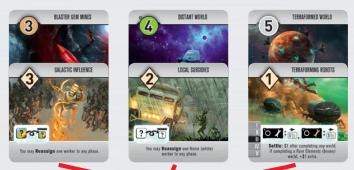
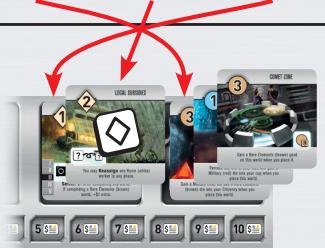
construction zone — draw 1 or more tiles from the bag and examine them. Then, in any order, choose whether each tile will be a development () or world () and put it under its construction zone stack.
Draw 1 more tile than the number of tiles abandoned.
You may simply draw 1 tile; you need not abandon tiles.
If the bag ever runs out of tiles, see page 10, Fine Points: Explore.
Tiles can be abandoned from any position in your construction zone stacks.
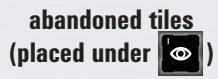
Put abandoned tiles under the Explore phase tile.
You may abandon tiles every time you Scout, including tiles that you drew in earlier Scout tasks (see diagram below).
At the end of the Explore phase, return all abandoned tiles to the bag.
During Explore, developers and settlers on construction zone stacks stay on top of their stacks, even if a stack is emptied due to abandoning tiles.
The rule that both construction zone stacks must have one tile applies only during setup, not during play.

\$To Stock, add 2 Galactic Credits () to your total.

construction zone stacks before Scout
first Scout

second Scout
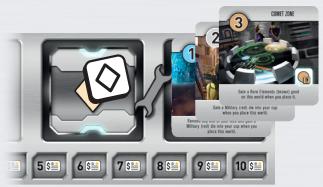

(none)
newly drawn tiles, first drawn on left (both faces)
Example: 3 Consecutive Scout Tasks

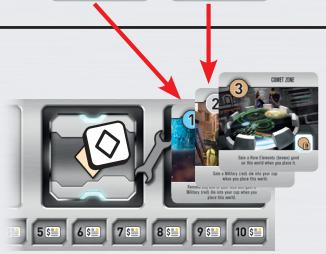
construction zone stacks after Scout

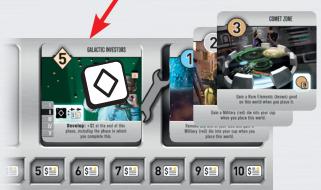
third Scout
after Scout
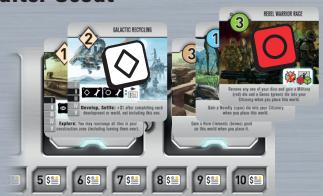
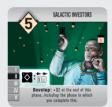


abandoned tiles
Develop
Put each developer, one at a time, on the top-most tile in the development construction zone () stack.
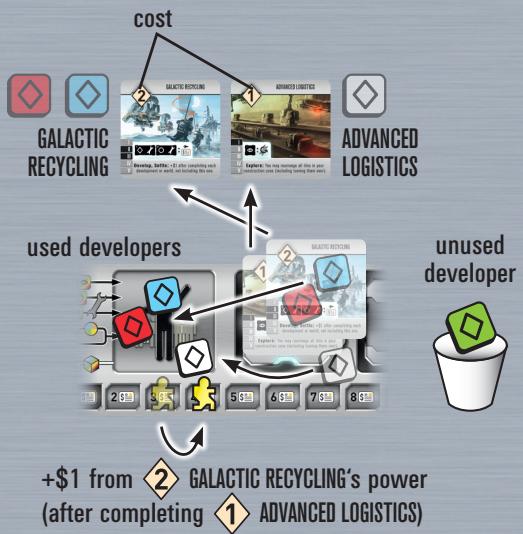
Once the number of developers equals the top-most development's cost (the number in the ), the development is complete. Move its tile to the tableau and put the developers who completed it in the Citizenry
Use any remaining developers to build the next tile in the stack. A player may complete more than one development in a Develop phase.
If any developers are left after completing all developments in the construction zone — the stack is empty — return them to the cup.
Occasionally, due to Explore powers or Scouting, the topmost development might be complete during an Explore phase. Do not move its tile to the tableau or return its developers until a Develop phase occurs. At the start of the next Develop phase, resolve completed developments, choosing which developers to return to the Citizenry.
Most developments grant a power once built, usable either during the Assign step, or in the phase(s) shown. Powers are mandatory, unless their text includes "may", and are used, if applicable, in a phase that occurs even if you have no workers assigned to it.
3 developments have “immediate effects” instead, similar to worlds (see below).
Put each settler, one at a time, on the top-most tile in the world construction zone $\textcircled { 1 9 }$ stack.
Settle
Once the number of settlers equals the top-most world's cost (the number in the ), the world is complete. Move its tile to the tableau and put the settlers who completed it in the Citizenry.
Use any remaining settlers to build the next tile in the stack. A player may complete more than one world in a Settle phase.
If any settlers are left after completing all worlds in the construction zone — the stack is empty — return them to the cup.
Occasionally, due to Scouting or development powers, the topmost world might be complete during an Explore phase. Do not move its tile to the tableau or return its settlers until a Settle phase occurs. At the start of the next Settle phase, resolve completed worlds, choosing which settlers to return to the Citizenry.
Each world has an immediate effect, shown on its tile. It occurs once, upon placing the tile. All worlds grant dice. Some worlds also give Galactic Credits. For immediate effects that involve removing one of your dice, return it from any location to the center.

Completing Developments


Tip: To get more dice, settle more worlds. Avoid "locking up" too many workers trying to build expensive tiles.
“ Produce
Each producer creates a good () on a non-gray world () in the player's tableau.
The producer die () becomes the good; put it on the world.
Any producer die (of any color) can become a good on any non-gray world. Matching a good's color with the world's color matters only if the good will be Consumed, not if it will be Traded (see below).
Each world can have at most 1 good (unless the player owns the Galactic Reserves development).
Return any excess producers to the cup.
Ship
Each shipper takes a good () from a world in the player's tableau and either Trades (\$) or Consumes () it. Put both dice (the shipper and the good) in the Citizenry.
\$Each Trade earns a player Galactic Credits (\$) according to the color of the good's world (not the color of the dice):
Novelty : 3 \$
Rare Elements :4 \$
Genes:5
Alien Technology:6 \$
Some powers further increase these amounts.

Each Consume earns the shipping player 1 to 3 VP chips:
1 VP chip (always);
+1 VP chip if the good's color matches the world it is on;
+1 VP chip if the shipper's color matches the color of the good's world.
A Consumption (purple) die, used as either the good or the shipper, matches all colors and always earns +1 VP.
Using 2 Consumption dice, for both the good and the shipper, will always earn both VP bonuses.
Some powers further increase the number of VP chips earned or even earn the player Galactic Credits.
If the initial pool of VP chips runs out, add the set-aside 10 VP chips to the VP pool. Use them to continue earning VP chips for Consume tasks.
Emptying the initial pool of VP chips is one of two ways to trigger game end, ending the game after completing the entire round.
End of Phase. Return any excess shippers to the cup.
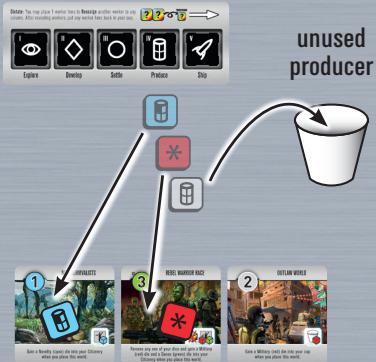
produced goods

Tip: Do early Trades to recruit more workers for future rounds.
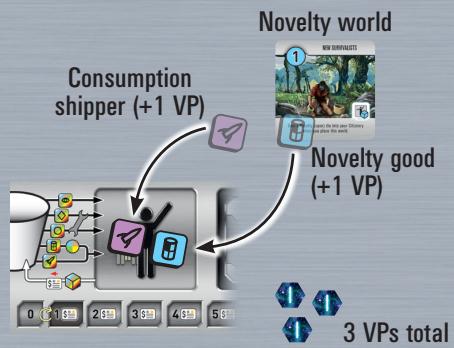
Tip: Use Consumption dice to gain extra VPs when you consume.
MANAGE EMPIRE
Recruit. Recruit workers by selecting dice from the Citizenry, putting them in your cup, and decreasing your Galactic Credits by 1 () for each die recruited. Do this until either your Citizenry is empty or your credits run out. After recruiting, if your credits are at "0", shift the token to "1" (as shown on the player mat).
If you have fewer credits than dice in Citizenry, you freely choose which dice to recruit.
Recall. You may recall any developers, settlers (from their construction zone stacks) and goods (from their worlds). Put them in your cup.
Recalling dice, unlike recruiting, does not cost Galactic Credits.
If you have no dice in your cup (after recruiting), you must recall at least one die.
Reset. Flip all phase tiles to their “X”" sides.
Check Game End. If either the VP chip pool was exhausted (see Ship, page 7) or any player has 12 or more tile squares in his tableau (counting his double-sized faction tile as 2 tile squares), the game is over (see Winning, below).
WINNING
Total each player's score:
· VP chips.
• VPs equal to the costs of all developments and worlds (the numbers in and O). Do include both numbers from a faction tile. Do not include any tiles in the construction zone.
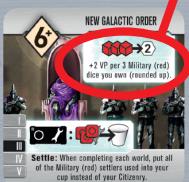
bonus VPs for 6-cost developments (beyond the 6 VPs for the development itself), as indicated on those tiles. When figuring these bonuses, round any fraction up to the next whole number.
Some 6-cost developments count towards their own bonuses; such as Galactic Federation (see scoring example at right).
The player with the most VPs wins!
If two or more players tie, each tied player adds:
• the number of dice in his cup.
• his Galactic Credits.
The player with the highest total among the tied players wins. If there is still a tie, all the tied players win.
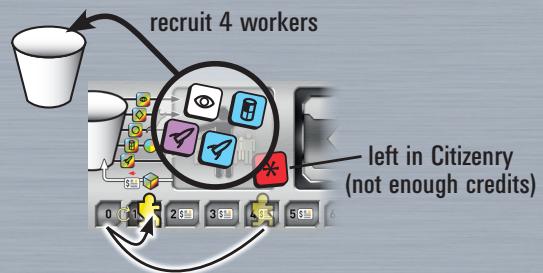
lose \$4, then gain \$1
Tip: Recall dice when you have too many dice tied up in construction stacks or more goods than you expect to ship.
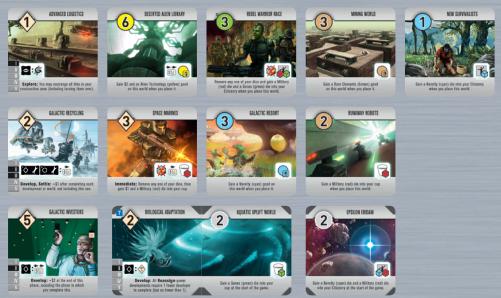
13 tile squares, triggering Game End



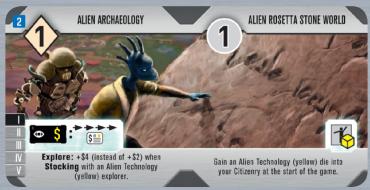
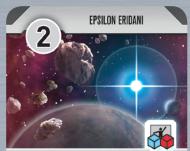
Gain a Novelty (cyan) die and a Military (red) die into your Citizenry at the start of the game.
13 VP = base development value
3 VP = base world value
5 VP = Galactic Federation bonus
4 VP = New Galactic Order bonus
25 VP = Total score

TIMING
Most play can and should be done simultaneously. However, there are a few cases where player order can matter, such as:
• when a player might build to 12 or more tile squares (triggering game end), or
• when the VP chip pool might be exhausted (triggering game end).
When a need for strict timing occurs, do the phase in clockwise player order, starting with the player with the lowest numbered faction tile.
ETIQUETTE
Existing and newly drawn tiles beneath the top tile of each construction zone stack are secret. A player may look at tiles in his own stacks at any time. When asked, he must tell other players the size of each stack.
Tiles abandoned during the Explore phase — under the Explore phase tile — are secret.
The only other secret information in the game is the workers rolled behind screens during a round's Roll and Assign steps.
As there is no way to verify players' actions behind screens, this game relies on players taking care to not make mistakes.
FOR RACE FOR THE GALAXY PLAYERS
Here are some Roll for the Galaxy rules that differ from Race for the Galaxy:
• The phase order is different; Ship (this game's version of Consume) occurs after, not before, Produce.
• There is no "bonus" for selecting a phase (though you do guarantee that it will occur).
• Players are not limited to one tile constructed per "build" phase.
• All developments are unique.
• The minimum number of workers to place a tile is 1, not 0, even if discounts would reduce it below 1.
• Tiles' VPs are equal to their cost (except “6+” developments).
• There is no direct military conquest. Instead, "Military" dice are biased towards Develop and Settle, representing the military preference for expansion.
• Trade prices are \$1 higher. For example, a Genes good trades for \$5, not 4 cards.
• A player may Trade multiple goods in a Ship phase (as many as you have shipper-good pairs).
FINE POINTS
Q: What is the difference between dice terms such as: workers, shippers, and goods?
A: Workers are dice in a player's cup, below a player's phase strip, or being used to select a phase. Dice that are unowned, in a player's Citizenry, or in Dictate areas are not workers. Based on the phase they are assigned to, workers become explorers, developers, settlers, producers, or shippers. Producers put onto worlds become goods.
Q: Why do the Produce icons vary on differently colored dice?
A: This is an aid for color-blind players.
Q: Why do green world tiles have a small dot in their upper-left corners? A: Only Genes (green) worlds have them, as an aid to help color-blind players distinguish between Genes (green) and Rare elements (brown) worlds.

Setup
Q: Must I choose my two start tiles so that their lower costs are face-up?
A: No (this is just for your first game).
Q: Can I put both start tiles in the same construction zone stack?
A: No.
Q: Can I recall goods from my starting tableau at the beginning of the game?
A: No. You may only recall dice during the Manage Empire step.
Assign
Q: Must die faces match the phases they are assigned to? A: No. A die might not match its phase due to Reassign powers, or by it being used to select a phase.
Q: Can I assign workers that show *wild faces after phase selections are revealed?
A: No. All workers should be assigned to phases before Reveal.
Q: Must I select a phase before using Reassign powers? A: Yes.
Explore
Q: Must I use all my explorers during an Explore phase? A: Yes (each explorer must either Scout or Stock).
Q: Must I declare in advance what all my explorers will do? A: No; you do each task one after the other, deciding which task — Scout or Stock — each explorer does as you do it.
Q: What happens if a player doing a Scout task needs to draw more tiles than are in the bag?
A: After drawing all the tiles in the bag, he finishes this Scout task by taking all the abandoned tiles under the Explore phase tile, putting them in the bag, and drawing the rest of the needed tiles.
Q (very rare): What happens if there are still not enough tiles after doing the above?
A: The Scouting player places all the tiles he has drawn so far in his construction zone. Then, each player with at least 3 tiles in his construction zone, which can include the Scouting player, must abandon 1 tile into the bag. The Scouting player then draws tiles to finish the task.
When the bag is low on tiles, players may wish to do the entire Explore phase in player order, using the timing rules on page 9.
Develop and Settle
Q: Must I use all my developers (or settlers)? A: Yes. Developers (or settlers) must be put, one at a time, on the top tile of your construction zone if you have any developments (or worlds) there.
Q: Must I use all applicable discounts I have (such as Replicant Robots)?
A: Yes.
Q: Can I have more than 12 tile squares in my tableau? A: Yes. A player can end with more than 12 tile squares by building several tiles during the final round.
Produce and Ship
Q: Must producers match the color of a world in order to produce there?
A: No. Any color producer can produce on any non-gray world, becoming a good there.
Q: Is a good's Trade value determined by its world's color (instead of the good's color)?
A: Yes.
Q: Must I declare in advance what all my shippers will do? A: No; you do each task one after the other, deciding which task — Trade or Consume — each shipper does as you do it.
Q: Do * wild faces provide extra VP chips when used in Consume?
A: No (only the colors of the dice involved — not their symbols — matter for Consume).
Q: Can I deliberately mismatch goods and shippers to earn fewer VP chips when I Consume?
A: Yes (occasionally, this can make strategic sense).
Manage Empire
Q: Must I recruit as many dice as I can afford from my Citizenry?
A: Yes.
Q: Is there any reason to recall workers on the final round? A: Yes; the tie-breaking rule (see Winning, page 8) includes dice in the cup, but not workers in the construction zone or goods.
Immediate Effects
Q: When removing a die as part of an immediate effect, can I remove any of my dice?
Q: Does removing a die from my cup, phase strip, construction zone, or any of my worlds have any effects (beyond its removal)? A: No. (If you remove the only die used to select a phase, that phase still occurs.)
Development Powers
Q: When can I use a development's power? A: Reassign powers can be used only during the Assign step. All other powers specify the phase(s) in which they can be used (exception: Galactic Reserves, see boxed section below).
Q: How many times per phase can a power be used? A: As many times as it is "triggered."
Example: Public Works provides \$1 after its owner completes a development. A player who builds it and then 2 more developments would gain \$2 from Public Works that phase.
Q: Do I need workers assigned to a phase to trigger powers that occur in it?
A: No.
Q: Can I use a development's power in the phase I build it? A: Yes (see example above).
Q: Can I Reassign a die in the Dictate area? A: No.
Q: Can a Reassign power that assigns multiple workers assign them to different columns?
A: Yes.
Individual Power Clarifications
Advanced Logistics: Use this power as many times as you wish during Explore, but not after a tile draw by Alien Research Team. When doing Explore with strict timing, you may only use this power during your turn to Explore.
Alien Archaeology: See the Alien explorer and symbols questions in the Development Powers section.
Alien Research Ship: One of its extra Explorers being a Alien die matters only for a few Explore powers.
Alien Research Team: Draw its extra tile(s) after all players have done their tasks, before returning any abandoned tiles to end the phase. Also see the Alien explorer and symbols questions in the Development Powers section.
Biological Adaptation: This is not a Reassign power (even though it contains the "Reassign" keyword).
Conscription: See the Immediate Effects section.
Executive Power: See the Reassign questions under Development Powers.
Former Penal Colony: See the Immediate Effects section.
Free Trade Zone: For example, a 3-cost or 4-cost gray world would cost 2 (unless you also had Replicant Robots in tableau, in which case either of these would cost 1).
Galactic Mandate: See the Reassign questions under Development Powers.
Q: Can I use Reassign powers to affect workers that show * wild faces?
A: Yes (though it rarely makes sense to do so).
Q: Can a Reassign power assign a die without a given phase symbol (on any of its faces) to that phase? A: Yes (only a die's column, not its faces, determines which of the five possible workers it is).
Q: Some powers refer to an Alien explorer – how can I have an Alien explorer when Alien dice have no Explore faces? A: Use a Reassign power to put an Alien die in the Explore column, or use an Alien die to select Explore, or assign a wild *Alien die to Explore.
Q: Can powers affect dice assigned to a phase whose faces don't match the symbols shown on the dice in the power's icon? A: Yes (only a die's column, not its faces, determines which of the five possible workers it is).
Q: Do Consumption (purple) dice count as other die colors when evaluating powers or during Game End scoring? A: No. They match colors only for earning VP chips during Consume.
Q: What does "round up" mean (for development powers)? A: Treat any partial amount as “one full unit."
Example 1: Space Piracy gives its owner 1 Credit for every 2 Military dice in its owner's Citizenry at the end of each Ship phase. If a player with Space Piracy in tableau has 3 Military dice, this provides 1½ Credits, which rounds up to 2 Credits.
Example 2: New Galactic Order provides 2 bonus VPs at game end for each set of 3 Military dice that its owner has. A player with 4 Military dice has 113 sets of Military dice, which rounds up to 2 sets of Military dice, each worth 2 VPs, for a total of 4 bonus VPs.
Galactic Reserves: This power has a continuing effect; once built, you may ignore the restriction that each (non-gray) world can have at most one good. Instead, each of your (non-gray) worlds can have up to two goods (of either the same or different colors). Each good still requires 1 shipper to Ship.
Genetics Lab: This power counts only the number of your Genes dice used as goods, not the number of goods on your Genes worlds.
Information Tech: See the Immediate Effects section.
Isolation Policy: See the Reassign questions under Development Powers.
Mad Scientists: If no one has any Novelty worlds, this does count as “tying for most," so you may use this power to Reassign 1 die.
Nanotechnology: See the Reassign questions under Development Powers.
Organic Shipyards: One of its extra shippers being a Genes die matters only if you use it to Consume a good from a Genes world.
Rebel Miners: See the Immediate Effects section.
Rebel Warrior Race: See the Immediate Effects section.
Space Marines: See the Immediate Effects section.
Space Tourism: If there are multiple worlds tied for highest cost, you get the extra \$1 only if you own all of them. Use only the printed, not discounted, costs when determining the highest-cost world.
FREQUENTLY OVERLOOKED RULES
• Play is simultaneous (there are no separate player turns).
• The die placed on the phase strip (to select a phase) is still a worker.
• Each player may select only one phase. Each Reassigned worker — including one assigned by Dictate — goes below the phase strip.
• All workers perform their tasks sequentially, one-at-a-time. Players do not have to declare in advance what tasks their workers will do.
• Workers that complete tasks go to the Citizenry (not the cup).
• Unused workers return to the cup (not the Citizenry).
• Abandoned tiles go under the Explore phase tile.
• Each Consumption (purple) die, as either a good or shipper during Consume, earns +1 VP.
• Each player's faction and home world tiles together count as 3 tile squares towards the 12 needed to trigger game end.
DICE FACE AND TILE DISTRIBUTIONS
Same color dice have identical face distributions. Each type specializes in different phases(s):
Home: Explore
Each of the 55 game tiles has a world on one side and a development on the other with costs ranging from 1 to 6. This table shows the distribution of tile types by cost:
Military: Develop, Settle
Consumption: Ship (×3)
Novelty: Produce, Ship
Rare Elements: Develop
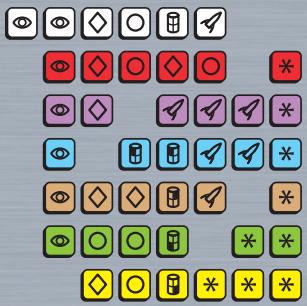
Genes: Settle, Wild
15 Novelty Worlds
| 5 | 6 | 4 | |||||
| 5 | 6 | 2 | |||||
| 3 | 4 | 2 | |||||
| 2 | 2 | 3 | |||||
| 2 | 3 | 2 | 2 | 1 | 1 | ||
| 1 | 1 | 1 | 6 | 5 | 4 | ||
| 9 | 4 | 3 | 8 | 5 | 5 | ||
| 2 | 1 | ||||||
13 Rare Elements Worlds
Alien: Wild (×3)
9 Genes Worlds
7 Alien Tech. Worlds
11 Other Worlds
18 Dev. with Reassign powers
This information is also presented (in a different form) on the right side of the player screens.
34 Dev. with other powers

3 Dev. with Immediate Effects
CREDITS
Game design, development, and rules: Wei-Hwa Huang & Tom Lehmann
Original Graphics: Wei-Hwa Huang
Tile Illustrations: Martin Hoffmann, Claus Stephan
Graphics: Mirko Suzuki
Playtesting and advice: Corin Anderson, William Attia, Joe Black, Paul Blake, Dan Blum, Eric Burgess, Joe Casadonte, Ken Chaney, Bay Chang, Dave Cortwright, David desJardins, Sandra Emerson, Jeff Goldsmith, Ted Griggs, Dave Helmbold, Heydon Hensley, Jay Heyman, Trisha Huang, Rich Irving, Ron Krantz, Mike Linsc, Chris Lopez, Terry Lyzen, Paul Makarian, Alex Power, Bahman Rabii, Dan Rosart, Larry Rosenberg, Anthony Rubbo, Ron Sapolsky, Craig Silverstein, Greg Snyder, Jeffrey Stern, Mik Svellov, Steve Thomas, Andreas Walsh, Dayton Williams, Don Woods, Maciej Zenczykowski Doug Zongker
Galactic Credit: Jesse McGatha
If you have any comments, questions, or suggestions, please write to us at:
Rio Grande Games
PO Box 1033, Placitas, NM 87043, USA
RioGames@aol.com www.riograndegames.com
© 2014 Wei-Hwa Huang, Tom Lehmann © 2014, 2020 Rio Grande Games
Download Markdownroll-for-the-galaxy-ambition-rulebook-french.md14.8 KB
原文本层提取版本已由本版替换(2026-10-31),正文相似度 0.91
WEI-HWA HUANG & TOM LEHMANN
〔图:images/11bc579afd90037e82718b054788114a5ab8376c34759f9cb728a0fe0cc321b6.jpg〕
AMBITION
Alors que la technologie des vols supraluminiques se répand à travers la galaxie, de nouvelles factions émergent. De nouveaux entrepreneurs et de charismatiques leaders luttent pour atteindre leurs objectifs et recruter les plus brillants esprits. Serez-vous capable d'élever votre faction au rang de plus glorieuse puissance galactique ?
PRÉSENTATION
Ambition est la première extension pour Roll for the Galaxy. Elle ajoute au jeu de base de nouvelles factions, des mondes de départ, des tuiles de jeu, deux nouveaux types de dés ainsi que des objectifs. Nous invitons les nouveaux joueurs à jouer leurs premières parties sans les objectifs.
CONTENU
14 tuiles de Faction (doubles, numérotées de 10 à 23)
7 tuiles Monde de départ
5 tuiles de jeu
20 tuiles Objectif
80 jetons Talent
38 dés (voir tableau ci-contre)
1 planche d'autocollants
Règle du jeu
Retirez précautionneusement les tuiles et jetons de leur logement avant votre première partie. Collez les autocollants d'aide de jeu de remplacement sur les paravents.
MISE EN PLACE
Ajoutez les nouveaux dés ainsi que les tuiles de Faction et Monde de départ au jeu de base. Ajoutez les 5 nouvelles tuiles de jeu dans le sac. Effectuez la mise en place normalement à l'exception de l'étape 4a : chaque joueur met 2 dés de départ (blancs) et 1 dé Leader (noir) dans son gobelet (et non 3 dés de départ).
Les tuiles de cette extension sont marquées d'un 🔒.
Dé Leader (noir, 5)
Dé Entrepreneur (orange, 9)
Dé Militaire (rouge, 10)
Dé Consommation (violet, 2)
Dé Nouveautés (bleu, 3)
Dé Éléments rares (marron, 3)
Dé Génétique (vert, 3)
Dé Alien (jaune, 3)
DÉROULEMENT DU JEU
La partie se déroule, comme pour le jeu de base, en prenant en compte ces nouvelles règles :
Retrait d'un dé. Si une faction ou un Monde de départ vous demande de retirer un dé, vous pouvez choisir n'importe lequel de vos dés attribués au départ ou dés octroyés par l'une de vos autres tuiles de départ (généralement, vous choisirez de retirer un dé de départ (blanc) de votre Population).
Faces « deux phases ». Lors de l'étape Affecter, si un dé présente deux icônes phase (par exemple, Explorer et Produire 📄), affectez-le à une des deux colonnes. Les pouvoirs Réaffecter peuvent ensuite être appliqués à cet ouvrier, selon la colonne à laquelle il est affecté. Lors de l'étape Révéler, si cet ouvrier est affecté à une des deux phases indiquées sur le dé et que cette phase n'a pas lieu, déplacez-le immédiatement sur l'autre phase indiquée - si elle a lieu - au lieu de le mettre dans votre gobelet (voir exemple en bas de page 3). Si cet ouvrier a été réaffecté à une phase qui n'a pas lieu, il n'est pas déplacé car il n'est plus considéré comme présentant une face « deux phases ».
Faces \$. Lors des étapes Affecter et Révéler, le symbole \$ sur la face d'un ouvrier n'a pas d'effet. Lors de l'étape Phases, si un dé comporte un symbole \ (par exemple, Produire et \ ☐\$ ) et termine une action correspondant à sa face, remettez-le dans votre gobelet, et non dans votre Population.
L'action d'un dé est considérée « terminée » au moment où celui-ci doit normalement retourner dans sa population. Ainsi, une action Explorer ou Expédier est terminée dès que le dé est utilisé. Une action Développer ou Coloniser n'est terminée que lorsque la tuile sur laquelle le dé a été placé est complétée et déplacée vers le tableau du joueur. Une action Produire est terminée une fois la ressource expédiée.
Nouvelles couleurs de dés. Les dés Leader (noirs) sont considérés comme appartenant à une nouvelle couleur à part entière, sauf en ce qui concerne l'objectif Main d'œuvre diversifiée ou le décompte des points de la tuile Bourse galactique, où ils sont traités comme des dés de départ (blancs). De plus, lors d'une action Consommer, un dé Leader (noir) est, à l'instar d'un dé Consommation (violet), toujours considéré comme étant de la couleur du monde, qu'il soit la ressource ou l'expéditeur (y compris pour l'objectif Biens de consommation).
Les dés Entrepreneur (orange) sont considérés comme appartenant à une nouvelle couleur à part entière, sans exception. Ainsi, un dé Entrepreneur (orange) n'est jamais de la couleur du monde lors d'une action Consommer, mais avoir au moins un dé Entrepreneur (orange) rapporte +1 PV en fin de partie avec la tuile Bourse galactique, bien que sa couleur ne soit pas représentée.
Un dé Leader (noir) est traité comme un dé de départ (blanc) en ce qui concerne l'objectif Main d'oeuvre diversifiée ou le décompte des points de la tuile Bourse galactique. Au contraire, avoir au moins un dé Entrepreneur (orange) rapporte +1 PV en fin de partie avec la tuile Bourse galactique, bien que sa couleur ne soit pas représentée.
Atteindre zéro crédit (changement de règle). Si un effet fait tomber le nombre de crédits d'un joueur à 0 lors d'une phase, une fois cet effet résolu, remontez immédiatement son nombre de crédits à 1 (au lieu d'attendre la fin de l'étape Recruter pour le faire).
Si un tel effet est déclenché plusieurs fois lors d'une phase, comme en complétant plusieurs tuiles grâce à la tuile Experts Terraformeurs, les crédits d'un joueur peuvent être remontés plusieurs fois. Ceci peut survenir entre plusieurs utilisations d'un pouvoir ou entre différents pouvoirs.
〔图:images/1fe532ff223cb64274e47fa825ccd8a4bde433776624f60fbc1d5869dd9894dc.jpg〕
〔图:images/3a8e24094a2688a06c9bbd7c56e8f54e289c7b1e915aa1a0961e40936a913144.jpg〕
Leader
〔图:images/5987e6be8a8a2c1c74b8425f786f37346948b8b151d085b7703cfaf73dfbdd95.jpg〕
Entrepreneur
〔图:images/89c1fcdce18c979a9dbe8636b062634620a5659946105dbaec9c0f2b294ee501.jpg〕
Note des traducteurs : certaines tuiles (l'objectif Expansion militaire ou le Diplomate par exemple) font référence à « coloniser un monde ». Il ne s'agit pas seulement de placer des colons sur un monde dans la zone de construction, mais bel et bien de compléter un monde et de déplacer la tuile dans son tableau.
Remonter les crédits d'un joueur à 1 a lieu avant n'importe quel effet déclenché par l'achèvement d'une tuile (comme Recyclage galactique).
Décompte des points. Un monde, Forteresse rebelle, reçoit désormais des PV bonus de fin de partie (comme les développements de valeur 6).
OBJECTIFS (FACULTATIF)
Mise en place. Lors de l'étape 1, mélangez les tuiles Objectif face cachée. Sélectionnez-en 6 et retournez-les. Remettez les autres dans la boite. Placez les jetons Talent de manière à former une réserve à portée de tous.
Revendiquer des objectifs. Chaque objectif indique une condition que l'empire d'un joueur doit satisfaire et la phase ou l'étape du tour lors de laquelle il peut être revendiqué. Vérifiez chaque objectif à la fin de la phase indiquée sur sa tuile (ou durant une étape spécifique). Si sa condition d'attribution est satisfaite, prenez de la réserve et donnez à chaque joueur qui remplit l'objectif le nombre de jetons Talent indiqué, face ouvrier visible, et retournez face cachée la tuile objectif afin de signaler qu'elle a été revendiquée et qu'elle n'est plus disponible.
Pour certaines tuiles, l'illustration représente un exemple qui satisfait la condition. Vous n'êtes pas obligé de reproduire exactement l'exemple illustré, il suffit de remplir la condition. Certaines d'entre elles (comme Systèmes cosmopolites) sont formulées pour permettre l'utilisation de futures extensions. Pour les conditions portant sur les dés d'un joueur, décomptez tous les dés présents dans l'ensemble de son empire, qu'ils soient sur son tableau, sa zone de construction, son plateau de Programmation, son gobelet, sa Population, etc.
Utiliser les jetons Talent. Lors de l'étape Affecter, les joueurs placent leurs jetons Talent derrière leur paravent. Un jeton Talent est considéré comme un dé, il peut être « retiré » et remis dans la réserve pour répondre à un effet immédiat. Un joueur peut affecter des jetons Talent à n'importe quelle(s) phase(s). Ils deviennent alors des ouvriers. Ces ouvriers peuvent être réaffectés (dans les rares cas où cela peut être utile). Ils ne peuvent pas être utilisés pour Imposer. Vous n'êtes pas obligé d'affecter les jetons Talent. Gardez les jetons non affectés à l'écart de ceux utilisés comme ouvriers.
Lors de l'étape Révéler, les jetons Talent utilisés comme ouvriers affectés à des phases qui n'ont pas eu lieu retournent avec les jetons non affectés du joueur.
Lors de l'étape des Phases, chaque jeton Talent utilisé comme ouvrier affecté à une phase fonctionne comme la face * d'un dé Leader. Ainsi, un jeton Talent utilisé comme ressource ou expéditeur lors de la phase Consommer est toujours considéré comme étant de la couleur du monde d'où la ressource est expédiée. Lorsqu'un jeton Talent termine une action, retirez-le (remettez-le dans la réserve générale). S'il n'a pas effectué d'action, remettez-le avec les jetons non affectés du joueur.
Lors de l'étape Administrer l'empire, les jetons Talent utilisés comme ouvriers peuvent être rappelés normalement. Dans ce cas, remettez-les avec les jetons non affectés du joueur.
Décompte des points. En fin de partie, chaque jeton Talent que possède un joueur lui rapporte 1 PV. Le bonus de la tuile Renaissance Galactique ne s'applique pas aux PV des jetons Talent.
〔图:images/11f1b66c36cebb7cb8858867c09cd04abbaf183e35838de5860c164c94c6f573.jpg〕
Après l'étape Révéler,
seules les phases Développer
et Coloniser ont été sélectionnées
(le dé Entrepreneur (orange)
est déplacé de Explorer à Coloniser
car Explorer n'a pas été sélectionnée)
POINTS PARTICULIERS
Diplomate : le dé militaire retiré peut provenir de n'importe où dans votre empire. S'il est retiré du monde que vous colonisez, il ne compte alors plus comme un colon pour la colonisation de ce monde.
Dépassement de budget : contrairement aux autres, ce pouvoir ne peut être utilisé qu'une seule fois par phase Expédier.
Si vous n'avez que 1\, vous ne pouvez pas dépenser 1\ à deux reprises pour gagner 2PV.
Si vous possédez la tuile Association de libre-échange, vous pouvez choisir l'ordre d'application de ces pouvoirs.
Pionniers marchands : ces dés n'ont pas besoin d'être par « paires ». Arrondissez au supérieur un total impair. Par exemple, vous recevriez 3\$ si vous possédez un dé Entrepreneur et quatre dés Consommation dans votre Population.
Précognition psi-cristallienne : lors de l'étape Affecter, vous devez toujours placer un dé sur votre plateau de Programmation. Lors de l'étape Révéler, vous pouvez déplacer votre dé avant que n'importe quelle tuile phase ne soit retournée et changer ainsi la phase que vous sélectionnez, comme si vous aviez sélectionné cette phase avant l'étape Révéler.
Partie à 2 joueurs (changement de règle) : lancez un dé de départ (blanc) inutilisé avant que le possesseur de la tuile Précognition psicristallienne ne décide d'utiliser son pouvoir.
Conseil : une fois cette tuile construite, tous les joueurs devraient prendre garde à ne pas remettre immédiatement dans leur gobelet les dés des phases non sélectionnées.
Ce pouvoir n'est ni un pouvoir Réaffecter ni un pouvoir de phase.
Force mercenaire élevée : pour gagner ce bonus, chaque paire de dés militaires et génétiques doit être utilisée pour coloniser un même monde. Plusieurs de ces paires peuvent coloniser le même monde ou des mondes différents.
CRÉDITS
Auteurs et règles : Wei-Hwa Huang et Tom Lehmann
Graphisme original : Wei-Hwa Huang
Illustrations : Martin Hoffmann et Claus Stephan
Graphisme : Mirko Suzuki
Traduction française : Maël Brustlein, Bruno Larochette, Thomas Million.
Testeurs et conseils : Matt Anderson, Ralph Anderson, Richard Aronson, Sterling Babcock, Dan Blum, Eric Brosius, Guy Builta, Hal Burch, Ting Chow, Chris Cieslik, Dominic Crapchuettes, Jacob Davenport, Jeroen Doumen, Bianca van Duijl, Barry Enyon, Ambrose Feinstein, Mike Fitzgerald, Chris George, Jennifer Geske, Jay and Katrina Gischer, Jeff Goldsmith, David Grainger, Eddie Hagiwara, John Hart, Ryan Hatch, David Helmbold, Jay Heyman, Gil Hova, Beth, Bryan, and Tommy Howard, David Hu, Trisha Huang, Walter Hunt, Laurie Jones, David Klempner, Dave Kohr, Ron Krantz, Adam Kunsemiller, Dee Lee, Herb Levy, Larry Levy, Chris Lopez, Terry Lyzen, Ian Mackey, Paul Markarian, Kristin Matherly, Art Maurice, Elliott Mitchell, James Nelli, Janna Nelson, Peter Okina, Jon Perkins, Mary and Ravindra Prasad, Jeff Rawlings, Dan Rosart, Adam Ruprecht, Scott Russell, Ron Sapolsky, Andy Scheffler, Jeffrey Shih, Alex Simmons, Rob Smolka, Derek Snyder, Steven Szymanski, Tucker Taylor, Steve Thomas, Randall Tice, Jay Tummelson, Ana Ulin, Julia Urquhart, Luke Warren, Rob Watkins, Dayton Williams, Joanna Winter, Don Woods, et Michelle Zentis
Remerciements particuliers : Ken Chaney
〔图:images/4d1c699efd94eb29f2f087e58391005a7b36f7b38ae6aabe045e2c363413c6eb.jpg〕
Diplomate
〔图:images/37be84824f4089b95960fe1043f34b742e21bd3d44238142d36a5e66d7197b5f.jpg〕
Dépassement de budget
〔图:images/717bee6917d15fa1993ed23c712c9210c8b193bb40c3cee76e70ff2b3247ec30.jpg〕
Pionniers marchands
〔图:images/f8e6834fe9055972e777d4f87def7ca02e365ec242f391c511481018997a42a9.jpg〕
Précognition psi-cristallienne
〔图:images/0561771db470b0ac115fafc9905107591e985b37e645d7b407070745c9e4c3da.jpg〕
Force mercenaire élevée
Adaptation et distribution pour la France et la Belgique :
〔图:images/9ee948e4a1877e8f9e11f9d2b6be3e2d321629fc371ff5979cfe5396c1893de0.jpg〕
Gigamic
ZAL Les Garennes
F62930 WIMEREUX
France
www.gigamic.com
© 2014 Wei-Hwa Huang, Tom Lehmann
© 2014 Rio Grande Games
〔图:images/b15aec12c9ce0e9df3eebdaad41f6fc1ce11589b2498153fcde8afba62b79038.jpg〕
〔图:images/668fb7d32aa4578cf07769fbd95896606bef372bcc7e9ce0f6fef91ebf3feb14.jpg〕
〔图:images/530de32c02fa729f1aafa1b968516ca4bc981d7379889b92adc9839a5d0b63cd.jpg〕
ATTENTION ! Ne convient pas à un enfant de moins de 3 ans. Présence de petits éléments susceptibles d'être ingérés. Données et adresse à conserver. 08-2016
〔图:images/539185cb9422c6911311a120ffb3085a2dfa62b3946d856c82124fe71b83840f.jpg〕
Download MarkdownTexts are community-compiled or publicly released by publishers; copyright remains with the original authors. For personal reference only.