스플렌더: Pokémon (Splendor: Pokémon)
At a glance
Rules overview
English version of our rules overview, translated from the Chinese original (cunlema). The Chinese page is the source of record.
Game Overview
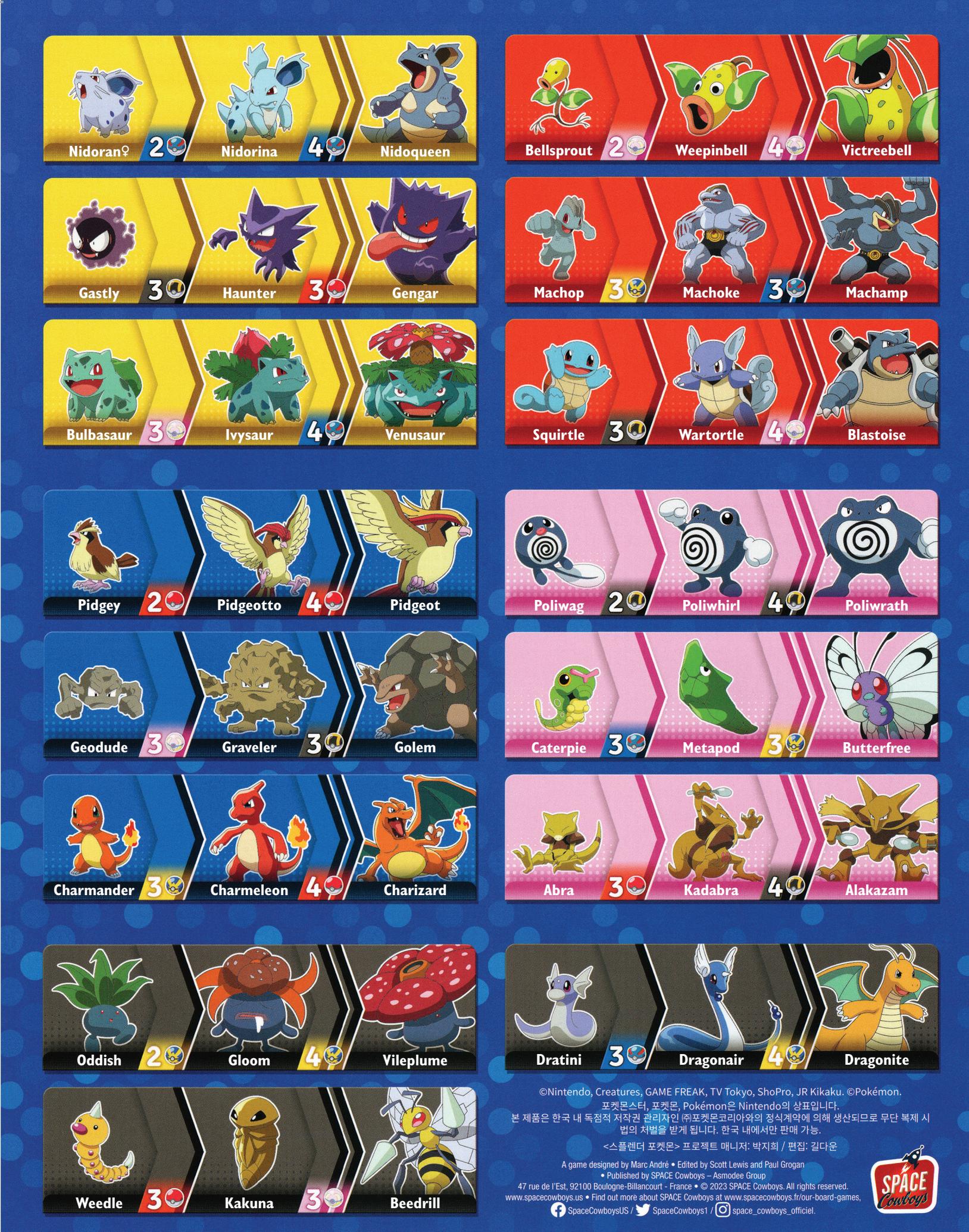
The adventure to become the best Pokémon trainer begins! Use the Pokéballs to catch Pokémon, evolve captured Pokémon, and earn victory points. During the game, players take ball tokens and use them to catch Pokémon, which award victory points and provide bonuses. Bonuses reduce the number of ball tokens players need to catch Pokémon in the future, and some Pokémon can evolve if they meet certain conditions, providing more victory points.
Core Mechanisms: Set collection of colored ball tokens, engine-building via permanent bonuses from captured cards, card drafting/reservation, and a free once-per-turn evolution mechanic.
1. Game Components
| Component | Quantity/Description |
|---|---|
| Pokémon Cards (Level 1) | Shuffled into a Level 1 deck |
| Pokémon Cards (Level 2) | Shuffled into a Level 2 deck |
| Pokémon Cards (Level 3) | Shuffled into a Level 3 deck |
| Rare Cards | Shuffled into a separate deck |
| Legendary Cards | Shuffled into a separate deck |
| Ball Tokens | Various colors (including purple Master Ball tokens) |
| Trainer Tiles | One per player, chosen by the player |
| Starting Player Marker | 1 marker |
| Pokédex Sheets | Used to track Pokémon caught across games |
2. Game Setup
- Shuffle each level deck separately. Place each deck in a column in the center of the table in ascending order (Level 1, Level 2, Level 3) from the bottom to top.
- Reveal four cards for each level and place them in a row to the right of the corresponding deck.
- Shuffle the rare cards and place them above the level 3 deck. Similarly, shuffle the legendary cards and place them to the right of the rare deck (leave space for a card between the two decks). Then, reveal the top card of the rare and legendary decks and place it to the right of their decks.
- Sort and stack ball tokens by type and place them within easy reach of all players. This pool of tokens is called the supply.
- For 3 player games, remove 2 tokens of each color.
- For 2 player games, remove 3 tokens of each color.
- There are always 5 master ball tokens (purple) regardless of the number of players. - The youngest player takes the starting player marker. Then, each player takes the trainer tile of their choice and places it in front of them.
3. Game Flow
The game proceeds clockwise from the player with the starting player marker. On their turn, a player must choose to perform one of the four actions listed in Section 4.
After taking an action, a player may replace a captured or reserved card from the center of the table. At the end of their turn, they must check their token limit (returning tokens if they have more than 10) and may then evolve one of their captured Pokémon if they choose to and meet the requirements.
When a player reaches 18 victory points, the game ends after the last player's turn in that round so that each player has played the same number of turns.
4. Player Actions
On their turn, players must choose to perform one of the following four actions:
• Take 3 ball tokens of different types
- Cost: None.
- Effect: Take 3 ball tokens of different colors from the supply. If not enough ball tokens are available to take 3 tokens of different types, you may take 2 tokens (or even one). You cannot take the master ball token with this action.
• Take 2 ball tokens of the same color
- Cost: None.
- Effect: Take 2 ball tokens of the same color. This action is only possible if at least 4 ball tokens of that type are available in the supply before the player takes 2 tokens. You cannot take master ball tokens with this action.
• Reserve a Card
- Cost: None.
- Effect: Take a face-up card from the center of the table or draw the top card from one of the three decks (Level 1, Level 2, Level 3) without showing it to other players. Reserving a card is the only way to get a master ball token (wild). If there are no master ball tokens left in the supply, you can still reserve a card, but you won't receive a master ball token. You cannot reserve rare or legendary cards. Players may not have more than 3 reserved cards in their hand.
• Catch a Pokémon (take a card)
- Cost: Spend the number of ball tokens indicated on the card.
- Effect: Capture one of the face-up Pokémon cards in the center of the table or a reserved Pokémon card from your hand. The master ball token (purple) can replace any color, and players may use multiple master balls for a capture. Rare and legendary cards are captured the same way but require a master ball token to catch. Once you have spent all the tokens needed, take the Pokémon card and place it in front of you.
Bonuses: The bonuses from previously captured Pokémon provide discounts when capturing new cards. Each bonus of a given color equals a ball token of that color. Rare and legendary cards have two bonuses. Bonuses are not spent; they can reduce the cost of a capture and count toward an evolution on the same turn. Players do not receive any additional tokens if their bonuses exceed the capture cost.
Add a Card: When a Pokémon card from the center of the table is captured or reserved, replace it immediately with a card of the same level. During the game, there should always be 4 cards available for each level (if the deck runs out, leave the space empty). Rare and legendary cards are played the same way, but only 1 card is available for each.
Evolving (Free Action):
- Cost: None (does not count as an action).
- Effect: At the end of your turn, after checking the token limit, you can evolve one of your captured Pokémon that meets the evolution requirements. Level 1 Pokémon evolve to level 2, and level 2 Pokémon evolve to level 3. Level 3, rare, and legendary Pokémon do not evolve.
- Requirements: You must have enough bonuses (from captured cards only, not ball tokens) to meet the evolution conditions shown on the card, and the next level card must be in the center of the table or reserved in your hand. When a Pokémon evolves, replace it with the next level Pokémon. Place the previous level card face down under your trainer tile. Players can only evolve one Pokémon per turn.
5. Scoring and Game End
The sum of the victory points shown on the cards in front of you (excluding face-down cards and cards in your hand) is your current victory point total.
When a player reaches 18 victory points, complete the current round so that each player has played the same number of turns. After the last player's turn (player to the right of starting player marker), end the game and calculate the victory points.
Tie-breakers:
1. The player with the most victory points wins.
2. In the event of a tie, the player with the most cards under their trainer tile (i.e., the player who evolved more) wins.
3. If that's still a tie, the player with more Pokémon in front of them wins.
Pokédex Sheets: Catch all the Pokémon that appear in the game! The first time you play, take a Pokédex sheet. At the end of the game, mark all the Pokémon you've caught (including the cards under your trainer tile). Keep your marked sheet for future games.
Key Rules and Common Questions
Easy-to-miss Rules:
- Token Limit: Players can have more than 10 tokens during their turn, but before ending their turn, they must return tokens to the supply until they have only 10 ball tokens (including master ball tokens).
- Evolution Timing: Evolving does not count as an action. It happens at the end of your turn, after checking the token limit. You can only evolve one Pokémon per turn.
- Evolution Bonuses: When checking evolutionary conditions, only look at the bonuses from captured cards, not the ball tokens you are holding. Bonuses can still count toward an evolution even if they reduced a capture cost earlier this turn.
- Reserved Cards: Reserved cards are kept in your hand and cannot be discarded. Players are not penalized for having reserved cards left in their hands at the end of the game.
- Taking 2 of a Color: You can only take 2 ball tokens of the same color if there are at least 4 of that type available in the supply before you take them.
- Master Balls: You cannot take master ball tokens via the "take 3 different" or "take 2 same" actions. The only way to gain a master ball token is by reserving a card.
FAQ:
Q: Can I reserve a Rare or Legendary card?
A: No. You cannot reserve rare or legendary cards.
Q: Do I get change if my bonuses exceed the cost of a Pokémon card?
A: No. Players do not receive any additional tokens if their bonuses exceed the capture cost of the Pokémon card.
Q: Do I have to evolve a Pokémon if I meet the requirements?
A: No. Evolving is not mandatory; you can choose not to evolve a Pokémon even if it meets the requirements.
Q: Do I consume or discard cards with bonuses when I use them for an evolution?
A: No. You do not consume or discard cards with bonuses for evolutions.
Q: What happens to the previous level card when a Pokémon evolves?
A: Place the Pokémon of the previous level face down under your trainer tile. Players don't get bonuses or victory points from the cards under their trainer tile.
Q: What happens if the Level 1, 2, or 3 deck runs out of cards?
A: Leave the space empty. During the game, there should always be 4 cards available for each level if the deck has cards remaining.
Rules Q&A
Questions below are real questions players asked cunlema about this game; answers are ours, translated into English.
两人游戏规则的变体有哪些?
Conclusion: In the base rules, a two-player game does not have a full set of "variant rules" — there is only one adjustment in the setup phase: remove 3 Poké Ball markers of each color (1 more than the 2 removed in a 3-player game). Everything else follows the standard rules.
Specific procedure:
- Remove markers during setup: In a 2-player game, remove 3 Poké Ball markers of each color from the supply.
- Master Ball exception: The purple Master Ball is not affected by player count — always keep 5, with no increase or decrease in a 2-player game.
- All other setup is unchanged: The layout of the level deck and face-up cards, revealing 1 Rare card and 1 Legendary card each, the youngest player taking the first player marker, and each player taking 1 Trainer tile — all follow the standard procedure.
Conditions and exceptions in gameplay (these also apply in a 2-player game, but they are general rules, not exclusive to 2 players):
- The four actions (take 3 markers of different colors, take 2 markers of the same color, reserve a card and take a Master Ball, capture a Pokémon) are unchanged; for "take 2 of the same color," that color's supply must have at least 4 markers before taking.
- At the end of a turn, each player may hold at most 10 markers (including Master Balls).
- Each player may hold at most 3 reserved cards in hand; reserving is the only way to obtain a Master Ball, and Rare and Legendary cards cannot be reserved.
- Capturing a Rare/Legendary card requires at least 1 Master Ball.
- After reaching 18 points, finish the current round, ensure all players have the same number of turns, then resolve scoring; in a tie, first compare the number of cards below the Trainer tiles (number of evolutions), then compare the total number of cards in front of each player.
Regarding "two-player exclusive variants": No two-player-specific rules, special actions, or exclusive scoring methods were found in the rulebook other than "remove 3 markers of each color."
This content is for reference only; in case of any conflict, the rulebook and experienced players take precedence.
**Setup** **12** cards are laid out on the table: **4** blue, **4** green, and **4** red.
According to the Setup section of the rulebook, the number of display cards on the table is as follows:
- Level 1, Level 2, Level 3: 4 cards face up to the right of each level deck, for a total of 12 cards.
- Rare: flip the top card, 1 card.
- Legendary: flip the top card, 1 card.
So the total number of face-up display cards available for players to view/obtain on the table is:
> 12 + 1 + 1 = 14 cards
However, these cards are not categorized by "color" in the rulebook, but by level/rarity: Level 1, Level 2, Level 3, Rare, Legendary. The rulebook text does not specifically describe the border/background colors of these cards; if you are asking about the color of the Pokémon or Poké Ball on the cards, you would need to look at the specific card images directly.
For reference on placement, see the rulebook images:

Additionally: if the decks themselves are also counted as "cards placed on the table," then you would also need to add the Level 1/2/3 decks and the Rare/Legendary decks; however, the specific number of cards in each deck is not stated in the rulebook.
This content is for reference only; in case of any conflict, defer to the rulebook and experienced players nearby.
**Rulebook Text** Legendary Pokémon do not respawn.
Conclusion: Yes, it refreshes. When a Legendary Pokémon on the table is caught, immediately draw 1 new card from the Legendary deck to refill the slot, so there is always exactly 1 face-up Legendary card.
Specific Procedure:
- Legendary cards are handled the same way as regular level cards, with the only difference being that there is always exactly 1 Legendary card face up (regular levels have 4 cards each).
- When the central Legendary card is taken, immediately refill it with the next card from the Legendary deck, maintaining a display of 1 face-up card.
- Legendary cards cannot be reserved, so in practice only the "being caught" case will trigger a refresh.
Conditions & Exceptions:
- If the Legendary deck is already exhausted, that slot is left empty and no further cards are drawn (consistent with how an exhausted regular level deck is handled).
- Legendary cards cannot evolve.
- Catching a Legendary card requires using at least 1 Master Ball marker.
- Legendary cards have 2 rewards, counted as 2 when calculating.
This content is for reference only; in case of any conflict, the rulebook and experienced players take precedence.
两个人玩用多少精灵球?
According to the setup instructions in the rulebook, the Poké Balls should be adjusted as follows for a 2-player game:
- Regular-colored Poké Balls (non-purple Master Balls): Remove 3 of each color, and place the remaining ones in the common supply area.
- Purple Master Balls: Always keep 5, regardless of the number of players.
> The rulebook text only states: "In a 2-player game, remove 3 of each color; regardless of the number of players, there are always 5 Master Balls."
Regarding the initial total number of regular balls of each color, the rulebook does not state this directly. However, if we follow the common configuration of the Splendor series—7 of each regular color in total—then in a 2-player game, there would be 4 of each color remaining on the table for use. This is provided as supplementary information for your reference:
(Supplementary note: 2-player game → 4 of each regular color remaining; 3-player game → 5 of each regular color remaining; 4-player game → the initial 7 of each regular color.)
This content is for reference only. In case of any conflict, please refer to the rulebook and experienced players nearby.
# Setup ## Token Setup (2 Players) In a 2-player game, the tokens are set up as follows: - **Gold tokens**: Remove **4** gold tokens, leaving only **5**. - **Resource tokens** (ruby, sapphire, emerald, diamond, coal): remove **4** tokens of each resource. ### Setup Steps 1. Shuffle all tokens and place them in the corresponding supply stacks on the board by category. 2. Adjust the number of tokens based on player count (remove the above tokens for a 2-player game). 3. Once the number of tokens in each supply stack is correct, the game can begin.
Token Setup for 2-Player Games
The rulebook's "Setup" section states:
> For 2 player games, remove 3 tokens of each color. There are always 5 master ball tokens (purple) regardless of the number of players.
So for a 2-player game, prepare as follows:
- Standard colored ball tokens: Remove 3 of each color; keep the remaining quantity as the common Supply.
- Purple master ball tokens: Do not remove any; always keep 5.
- Stack all ball tokens by color and place them within easy reach of all players.
For comparison:
- 3-player games: Remove 2 tokens of each color.
- Master ball tokens: Always 5, regardless of whether there are 2 or 3 players; the quantity does not decrease with player count.
This content is for reference only. In case of any conflict, the rulebook and experienced players take precedence.
Rules, cards and Q&A (Chinese)
The rules, card data and player questions for this game are written in Chinese. Open the Chinese page to read them.
Where to find full rules
Full rules and card lookup are available in the cunlema app at cunlema.cn — pick this game and ask about any rule, card or turn you are unsure about.