
The Crew: Mission Deep Sea
At a glance
Rules, cards and Q&A (Chinese)
The rules, card data and player questions for this game are written in Chinese. Open the Chinese page to read them.
Where to find full rules
Full rules and card lookup are available in the cunlema app at cunlema.cn — pick this game and ask about any rule, card or turn you are unsure about.
Related games
Rulebook text (Markdown)
This game has 1 rulebook Markdown file(s) in our library; 1 rendered inline below — expand to read or download.
691869_Crew_Deep Sea_Manual.md42.0 KB
THE CREW MISSION DEEP SEA
Game Materials
Trick-Taking Game
Communication
Mission Preparation (Setup)
Mission Sequence (Game Play).
Let's Go!
Feasibility
Help Mechanic: Distress Signals ..
Task Cards
Symbols in Logbook.. 19
Playing with Two Players
Tips, Author, and Imprint. 23
Quick Reference 24
Only a surprisingly small percentage of our planet's oceans have ever been explored. Now you have the opportunity to change that. It's time for you and your crew to jump into uncharted waters! The financial backers of your expedition seem to know what awaits you down there, but they're not exactly talking about it. So are you ready to dive in deep and get to the bottom of it all?
The Crew: Mission Deep Sea is the stand-alone successor to The Crew, winner of the Kennerspiel des Jahres 2020. Ninety-six diverse task cards present you with a variety of challenges and make for a multifaceted and unique game experience. Good communication is essential here — but underwater, this can be harder than you might think ..
GAME MATERIALS

The Crew: Mission Deep Sea is a cooperative, missionbased trick-taking game. What does that mean?
Cooperative
You win together, or you lose together — only if each of you is successful, and you help each other, will you be able to complete the missions and win the game.
Mission-based
Your voyage extends across many different missions, each with a unique win condition, which you play through consecutively as a cohesive story. But you can also play the missions out of order if that is your preference. The missions can be found in the logbook at the end of this rulebook.
You will probably not be able to play through this adventure all at once. Therefore, it is best to get together on several different occasions to play through all of the missions. The first few missions rarely take more than five minutes to complete. However, later on, you will need more time for each individual mission, as they get progressively harder.
Trick-taking game
In this game, all of the cards are distributed to “The Crew” (the players), and then, in turn order each player plays one of his or her own cards face up in the middle of the table. This playing of one card by each is called the “trick.” The player who places the card with the highest value wins the trick, but only if that player has followed suit.
There are five card suits: pink, blue, green, yellow, and submarine cards. Following suit means that each player must “follow” the suit choice of the first player; i.e., you have to play a card of the same type (color). Only if you do not have a card of this suit may you play a card of a different
NOTE
If you have a hard time telling the colors of the cards apart, you can use the following four symbols to help orient yourselves:

Each color of the colorsuited cards has a symbol assigned to it.
The Crew: Mission Deep Sea does follow a storyline, but you can also play certain missions over and over again if they are particularly appealing to you. No two attempts will play out in exactly the same way. Feel free to play in whatever way is most fun for you.
In this column on each page you will find the most important rules presented clearly and briefly. That way, you can quickly pick up the game again even after a long break.
In each round, each crew member plays one card in turn. These cards form the trick. The highest card wins the trick.
The card played first in each trick has to be followed.This applies to color and submarine cards.
If a player doesn't have the opening suit, they can play any card.
Only cards of the opening color can win the trick, with the exception of submarines. But there is no obligation to win the trick.
Submarinesare trump cards and will win any trick. If there is more than one submarine card in the trick, the one with the highest value wins.
Tricks that have been won are set aside face down; only the most recently played trick can be looked at again.
suit. However, the trick can only be won with cards that have followed suit. The card with the highest numeric value in the designated suit wins the trick. A trick that has been won is set aside face down. You may only take a look at the cards from the trick won most recently.
During a trick, there is no mandate to play a specific card. If you have multiple cards that you can play, you may play a low card, even though you would have been able to win the trick with a higher card. In other words, you are not forced to win the trick.
The submarine cards are trump cards. This means that they always win the trick, no matter which other cards are in play. During a color-suited trick, a submarine may only be played if a card in the color suit cannot be played. If a submarine card is played first, this will establish the suit, and like a color suit must be followed if possible. If several submarines are in contention, the one with the highest value wins.
In the following examples, the card type (or suit) that has to be followed – in other words, the card that was the first to be played in the trick – is outlined in red:
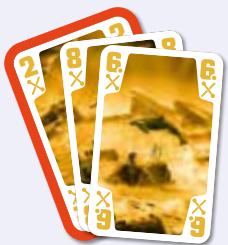
8and6both follow the color yellow.8is the highest, so it wins the trick.

3 follows the color green. 5is higher, so it wins the trick.9has the highest value, but it doesn't follow the color green, so it cannot win.
In this game, the goal is always to have the right players win the right tricks. To do that, you will really need to coordinate.
Communication
An important rule in the game is that you cannot share information about the cards in your hand. You are not allowed to show, tell, or indicate to the other crew members what cards you have. There is, however, another way to communicate — in the form of sonar tokens. Each player has one sonar token, which can be deployed exactly once per mission. It may only be used before a trick, and never during it. If you fail in one of your mission attempts, of course, you may use it again in your next attempt.


If there are task cards in the game, you must first divide these among yourselves before you are allowed to communicate. Task cards will be explained on page 16.

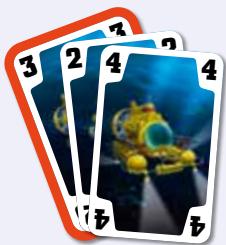
2 and 4 both follow the 3submarine. The highest submarine in the trick is the , which therefore wins.
3follows the color blue.7is higher and would win the trick. The submarine card is a trump card, however, and therefore wins the trick.
Rules of thumb for communication:
If there is something you only know because you know it from the cards in your own hand, you may not talk about it.
Only one communication per crew member per mission attempt
No communication until after task distribution, and always before a trick — never during it
Communication:
- Display one color card (no submarines) 2. Place sonar token > Top = Highest Middle = Only > Bottom = Lowest 3. Take a reminder card
If you want to communicate, take a color card from your hand and place it face up in front of you so everyone can see it. This card remains part of your hand, so it can still be played as you normally would. The only difference is every other crew member now also knows what the card is. Then, place your sonar token green-side-up on the card in accordance with the instructions below in order to convey important information to your crew members:
At the top, if it is your highest card of this color.
In the middle, if it is your only card of this color.
At the bottom, if it is your lowest card of this color.
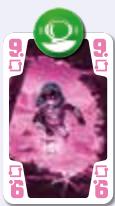
highest pink card
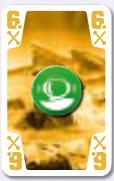
only yellow

lowest, green card
Submarine cards can never be used for communication.
One of these conditions must be met, otherwise you can't choose the card for the purpose of communicating anything. Submarine cards can never be used for communication!
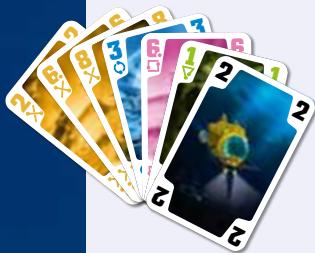
6cannot communicate anything, since it is neither the highest, nor the lowest, nor the only yellow card in the hand. The submarine card cannot be used for communication. Any of the other cards in the hand may be used for communication.
The placement of the sonar tokens cannot be changed if the message you conveyed with it no longer applies. For example, the “highest” card might become the “only” card in a color during the course of play. Nevertheless, the sonar token may not be repositioned.
After placing the card and token, pick up one of the reminder cards and add it to your hand. Its purpose is to remind you that your communication card is still on the table. When you play that card, you can discard the reminder card. Then, turn the sonar token onto its red side to show that you have already communicated during this mission.

Reminder cards look different from all other cards on both the front and back sides, so your crew members can also see if you have one in your hand.
MISSION PREPARATION
Before each mission, carry out the following steps:
-
Shuffle the 40 large playing cards and deal them out face down and equally to all crew members. If it is a three-person game, one player will get one more card than the others. After the final trick, therefore, there will be one card left over, which will not be played.
-
Each player places a sonar token green-side-up in front of himself or herself. Have a reminder card ready for each one.
-
Place the distress signal token face down.
-
Shuffle the 96 small task cards and keep them ready in a face-down pile.
The placement of the sonar tokens cannot be changed once the message conveyed by them no longer applies.
Reminder cards are discarded as soon as the communicated card is played.
Playing cards are dealt out to the crew members — those are what you play with.
Task cards indicate what has to be done in order to successfully complete the mission.

This symbol means that you have to draw tasks with a total value of four.
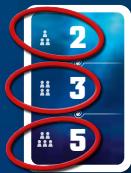
Keep drawing task cards until you have exactly reached the overall degree of difficulty of the mission.


MISSION SEQUENCE
In most missions, you will have to complete tasks representing various degrees of difficulty, as indicated by the task cards. Unless a mission specifies different rules, the crew members divide the tasks among themselves. The number of tasks is determined by the overall degree of difficulty of the mission, which can be recognized by this symbol:4

On its back side, each task card indicates three degrees of difficulty — depending on whether there are three, four, or five crew members. For example if there are four of you playing, only the degree of difficulty indicated in the middle of the card matters. The others can be ignored.
To prepare for the mission, keep drawing cards from the face-down task card deck until the sum total of their degrees of difficulty matches the overall degree of difficulty for the mission. You have to reach this value exactly. That means that you may have to skip some cards in the deck.
We suggest that you avoid shuffling the played task cards back in the deck right away, so the tasks you get will always be new ones. Once they start to run out, simply shuffle the used ones together to create a new deck.

There are four of you playing mission five, which has a degree of difficulty of 5. You have already drawn two cards with degrees of difficulty of 2 and 1. The next card has a degree of difficulty of 3. This would bring you to 6
(2 + 1 + 3), which is too high. So you keep skipping cards in the deck until you get one with a degree of difficulty of 2. If you draw one with a degree of difficulty of 1, you will then have to draw another one with a degree of difficulty of 1.
Once that is done, place the drawn task cards in the middle of the table and turn them face up one by one. None of the remaining task cards will be needed for this round of the current mission. Now take a look at the cards in your hand. Whoever has the submarine card with a value of four announces that out loud and is your captain for the current mission. As a reminder, that crew member gets the captain token.
It may sometimes happen that a mission cannot be completed due to a specific alignment of tasks. You can read more about this on page 13.
Your captain is always the one who starts by selecting a task from the middle of the table and placing it face up in front of himself or herself. Then, proceeding in a clockwise direction, the other crew members each select a task card of their choice until all the tasks have been distributed. So each one of you can get more than one task and not everyone will necessarily have the same number of them.
In the first missions, there are only a few tasks. It will not necessarily be the case that each one of you has one, and these missions are often completed quickly.
If, at the beginning of the task selection process, there are fewer task cards than crew members, e.g. three task cards for four crew members, a member may pass during the selection process. So someone who would normally have to take a task is allowed to forgo it (this applies to the captain as well). After each crew member has had a turn selecting, however, all the tasks have to have been allocated. If the number of task cards is equal to or greater than the number of crew members, no passing is allowed.
Whoever has the four submarine card gets the captain token for the current mission attempt, but still counts as a crew member.
Task cards are selected by the crew members in a clockwise direction, beginning with the Captain.
Passing is only allowed if there are fewer task cards than crew members. After a selection round, however, all the tasks must have been assigned.
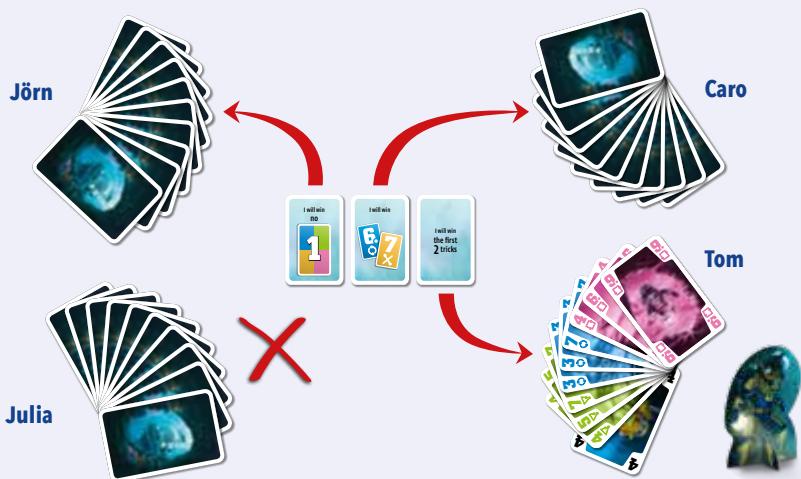
Possible setup and card allocation for mission 5 in the logbook: Tom has the4 submarine card. That makes him the captain of this mission and he makes the first task card selection. He opts for “I win the first two tricks," since he has the4submarine card and the pink9in his hand and should therefore easily win the first two tricks. Julia doesn't want any of the tasks and passes. Jörn and Caro each have to take one of the remaining task cards. Neither is allowed to pass, because all the tasks have to be assigned once each crew member has had a turn. If there had been five task cards in the middle instead, nobody would have been allowed to pass. In that scenario, after each player had chosen a task, it would have been Tom's turn again and he would have to have taken the last one as an additional task.
A task is completed when its conditions have been met and can no longer fail.
Once all tasks have been completed for that mission, you have successfully completed the mission.
A task is completed when its conditions have been met and can no longer fail. In that case, turn the corresponding task card face down. A crew member can complete several tasks with the same trick. As soon as each of you has completed all your own tasks, you have successfully completed the mission and are ready to begin the next one. Make an entry in the logbook stating the number of attempts you needed for the mission.
Even if there is only one task that you cannot complete, you immediately lose and have to start the mission over from the beginning. For your next attempt, you first have to shuffle the playing cards and deal them out again. For the task cards, you can choose whether to you want to try the same tasks again or discard the task cards and draw new ones.
Once all the tasks have been allocated, the captain opens the first trick. After that, each trick is opened by the player who won the previous one. Not all missions use task cards. In those ones as well, the captain always opens the first trick.
If a mission fails, you can either try the same tasks again or draw new cards from the deck.
The captain always opens the first trick. All subsequent tricks are started by the player who won the previous trick.

As Captain, Tom plays first. He opens the first trick with his pink 9. Julia plays a pink 7. Jörn has no pink cards in his hand, so he plays a card of his choice: the yellow2. He also could have played a submarine card. That would have resulted in the immediate failure of the mission, however, since Tom has to win the first two tricks. Caro plays a pink8. Tom has the highest value of the pink cards that have been played, so he wins the trick and starts the next one.
LET'S GO!
Now you know enough to dive into the story of The Crew: Mission Deep Sea. Start with the mission described here — 40 years before our adventure:
Diary of Meg Diver, September 17, 1981
Dear Diary, Today is my tenth birthday and the best day ever! Mama promised that we could take a big sailing trip for my birthday. Which is today! And Christine, James, and Naomi are allowed to come along. I'm so excited I can't sleep any longer, even though it's still soooo early and everything is dark outside. I have packed all my things. All I'm missing is my jacket, and lI'll get that too in a minute.

And this is how it works:
• Prepare the mission. (Page 7 for three to five players, or page 21 for two players.)
• Now take cards from the task card deck until you find one showing a difficulty level of one next to the symbol corresponding to the number of crew members in your crew. Place this task card face up in the middle of the table. (See page 8 of the rulebook.)
• The player with the submarine card with a value of four gets the captain token and decides whether he or she wants to take the task. If not, he or she passes. Then you continue in a clockwise direction until somebody takes the task. Before it gets back to the captain, however, it has to have been assigned. (See page 9 of the rulebook.)
• The round begins when your captain plays the first card. Don't forget that you are also allowed to communicate with the sonar tokens. Try it! (See pages 5–7 of the rulebook.)
• If the game ends without the task owner completing the task, you have to play the mission again. If you do complete it, you are ready for the logbook! (See page 10 of the rulebook.)
Now enter your crew on page two of the logbook, read the prologue, and start your voyage with mission 1. If you come across new symbols as you travel, look them up in the rulebook.
FEASIBILITY
Here's a friendly piece of advice: Do not assume that the tasks will be easy. You will find out that you get better with each game and each setback teaches you something that will improve your understanding and ability. But the missions will tend to get steadily more difficult. Therefore we strongly recommend that you play them in the specified order. There are numerous different ways that the cards can be allocated. So it's always possible that a mission turns out to be surprisingly easy or unexpectedly difficult simply due to the way the cards are distributed.
You will also certainly encounter a situation in which you look at the (remaining) cards in your hand and feel convinced that you cannot complete the mission. Resist the temptation to communicate this insight to your crew members or to reveal your cards. All too often a detail is overlooked, forgotten, or too hastily judged. In such a situation simply play out the remaining tricks — it won't take long, and might even result in a victory.
It may nevertheless also happen that a mission cannot be successfully completed with the displayed tasks. In that case, think about how you arrived at this situation and if you could have avoided it. If, for example, you left the last crew member the task “I win the trick with any two” while that member didn't have a two in his or her hand, either you were not paying attention or you accepted too great a risk. That means you have failed the mission.
Rule of thumb for failed attempts:
If a mission fails after the task cards have been assigned, it is only a failed attempt if you could have avoided the situation. Otherwise, exchange task cards in accordance with the situation or shuffle and assign the playing cards over again.
Watch out for impossible task combinations. If, for example, both “I win the first trick” and “I win the first two tricks” are displayed and they have to be assigned to two different crew members, it's obviously an impossible combination. In that case, mix the most recently uncovered task card back into the deck and replace it with a different task with the same level of difficulty. If, however, there are enough tasks displayed that both can go to a single crew member, the situation is doable. In that case, you cannot replace a task.
Finally, for a few of the submarine tasks, there are one or two alignments that make the success of the mission impossible, no matter who takes the task. These are mentioned on the cards and/or in the rulebook. In that case, simply shuffle all the playing cards and re-distribute them. You do not have to record an additional attempt if that happens.
So you see that you have to weigh the opportunities and risks, and assess the feasibility of the mission when assigning the tasks!
Before the first trick of each mission attempt, a distress signal can be sent out. The distress signal token is turned to its active side and the distress signal space for the current mission is circled.
HELP MECHANIC: DISTRESS SIGNALS
At the start of each mission, after all the playing cards and task cards have been assigned but before any crew member has communicated anything, you can send a distress signal to the research vessel. To do that, turn the distress signal token to its active (buoy) side. Decide together whether you want to take advantage of this optional form of assistance.
active
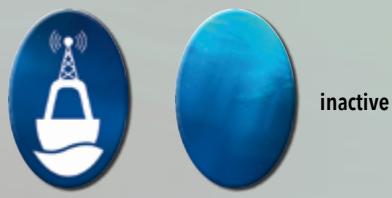
Immediately after that, circle your distress signal space for the current mission in the logbook. Each crew member must now pass a card from his or her hand to his or her neighbor. However, no submarine cards may be passed on! Decide together whether you want to pass the cards to the left or the right. Everyone has to pass in the same direction! You can even use this to change impossible tasks to feasible ones ahead of time. Then the mission begins and follows the usual rules.
The distress signal token remains active until you have completed the current mission. Regardless of how many attempts you need, at the start of each attempt you are allowed to pass a card to the crew member to your immediate left or right. Even if you decide not to do that, the token remains active. You do not turn the token back over until you start a new mission.
After each successful mission, you will enter into the ship's log the number of attempts that you needed to succeed. If your distress signal space for the mission is circled, you will have to raise this number by one.
Use this assistance at your own discretion. If you want your adventure as a whole to be somewhat easier, you can use it right away starting with your first attempt. However, each mission can also be completed without use of the distress signal!
If the distress signal has been activated, each crew member is allowed to pass a card from his or her hand to his or her neighbor. Submarine cards may not be passed on!
Either all of the crew members must pass on a card, or none of them may. All must pass in the same direction.
The distress signal token remains active until the current mission has been completed successfully. It imposes a one-time increase in the number of attempts for that mission by one.
ALL the missions can be completed without the distress signal token. Are you up to the challenge?
A task card only applies to the crew member who selected it.
Each crew member places the tricks they have won face-down in front of them.
TASK CARDS
Written on each task card is a task to complete. A task card only applies to the crew member who selected it. Tasks are completed by winning the correct tricks. A trick, and therefore all the cards in that trick, is won by the crew member who played the highest card of the color in play or the highest submarine card. Each crew member places the tricks he or she has won face down in front of himself or herself.
Playing cards that are won for a task may be placed face up beneath the task card.
When you win a trick with the playing cards that are needed for completing a task, you may place these face up beneath the corresponding task card. That way, you do not have to remember which part of a task you have already completed. Once the task is completed, you should also turn these playing cards face down.

blue 4
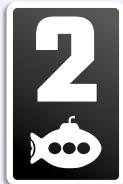
2submarine

any pink card
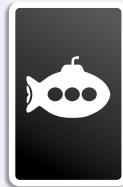
any submarine card

any 7
The playing cards are shown in simplified form on the task cards. Multi-colored illustrations always only relate to blue, green, yellow and pink playing cards, never to submarine cards.

These task cards show playing cards that have to be won. If several playing cards are shown, they do not all have to be won in the same trick. Some of these tasks also have an extra condition that has to be met.
With these tasks, you have to win several specified values or types of cards. “Exactly” means that at the end of the mission you have to have won exactly the specified number of playing cards. “At least” means that you may win a greater number of playing cards, but not fewer.
With these tasks, you have to use certain playing cards to win either a trick or specified playing cards. Note that the submarine task can't be completed if a crew member has all the submarine cards as well as the playing cards to be won in his or her hand. In that case, shuffle all the playing cards and deal them out again. This does not count as a failed mission.
With these tasks, at the end of the mission you are not allowed to have any of the depicted values or types of cards among the playing cards that you won.
These tasks specify which of the first and/or last tricks during the mission you have to win, or are not allowed to win. “Only” means that you are not allowed to win any tricks other than the specified ones.
These tasks specify how many tricks you have to win. “Exactly” means that you have to have won exactly the indicated number of tricks at the end of the mission. It makes no difference which tricks they are or when they are won. “In a row” means that you have to win the indicated number of tricks immediately one after the other. It makes no difference whether you have more tricks overall or if you win them in the same sequence.
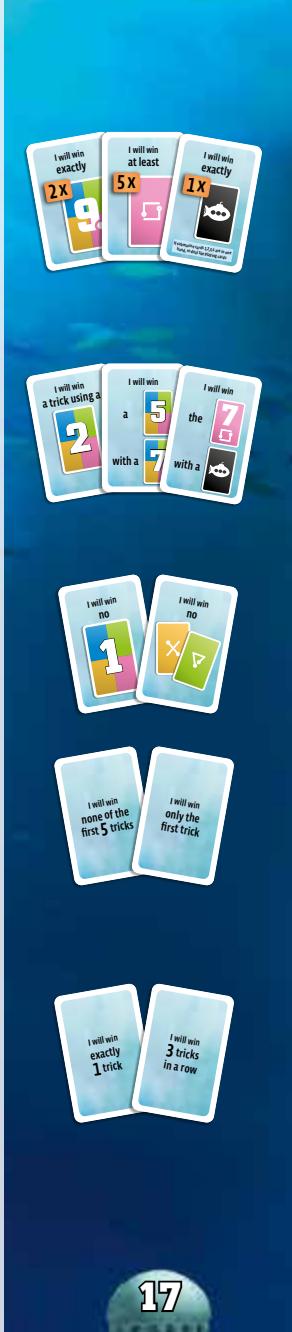
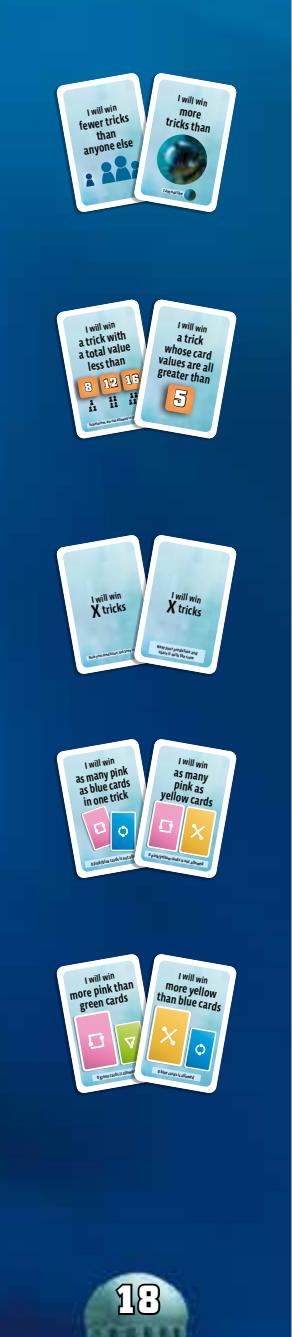
With these tasks, what matters is the number of tricks you win compared to those of the other crew members. The captain is never allowed to choose the captain comparison task for himself or herself.
With these tasks, what matters are the values of the color cards in the trick. The total trick value must be equal to, greater than, or less than a specified total value. The specified values may vary depending on the number of crew members. There are also tasks for which the individual values in the trick have to be greater or less than a certain number. To complete these tasks, there are not allowed to be any submarines in the trick.
For these tasks, you take a look at the cards in your hands and think about how many tricks you can win with them by the end of the mission. Make a note of this number, either openly or secretly depending on the task. The task is only fulfilled if your prediction is correct at the end of the mission.
For these tasks, an equal number of playing cards in two specified colors must be won — either all at once within a trick of your choice or overall by the end of the mission. In either case, at least one playing card of each specified color must be won.
For these tasks, you have to have more playing cards in a specified color in your hand at the end of the mission than ones in some other specified color. Zero playing cards of the smaller color is allowed, in which case having just one playing card of the larger color is enough.
For these tasks, either all playing cards of a given color or at least one playing card from every color must be won. Submarine cards play no role in these tasks.
These tasks require you to win a trick whose playing cards only have even- or odd-numbered values. To win these tasks, no submarine cards are permitted to be in the trick.
These tasks are completed if the corresponding crew member has not started a trick with the specified colors by the end of the mission. All of the specified colors are crucial. Opening always just refers to the first card played in a trick.
SYMBOLS IN THE LOGBOOK
Currents
If a mission displays this symbol, your communication is disrupted and you can only understand one another to a limited extent. If you do want to communicate, you take a card from your hand and place it in front of you as usual. It still has to meet one of the three conditions (highest, only or lowest card of that color in your hand). You may not, however, place your sonar token on the card. Turn it over to its red side and place it next to the card. The other crew members have to try to deduce the information that needs to be conveyed.
Rapture of the Deep
If a mission displays this symbol, place two fewer sonar tokens in the middle of the table than there are crew members playing. In other words, no crew member has his or her own token. Whoever wants to communicate takes one of these sonar tokens, without any discussion or

Remove two sonar tokens. The rest are available to the entire crew.

Draw a color card at random to determine the communication rules.

Determine one to two crew members who will immediately get all the tasks. All the tasks must be allocated after one round of questions.
With two crew members, each one has to take at least one task, with the remainder divided up however they like.
announcement, and immediately communicates according to the usual rules. If there are two or more sonar tokens in the middle of the table, a crew member can also communicate multiple times (or simultaneously). Once all the sonar tokens have been used, no more communication can be performed.
Unfamiliar terrain
If a mission displays this symbol, take a color (playing) card at random before dealing the cards. Its value determines the form of communication that applies to this mission attempt: 1,2,3 means normal communication. 4,5,6 means currents and 7,8,9 means rapture of the deep. If you draw a submarine card, draw another card. Mix the drawn cards back in the deck before dealing.
Real-time missions
This lets you play the mission in real time. The number in the symbol represents the overall level of difficulty. Once the tasks are assigned, set the time on a device of your choosing. You have to wait for the timer to start before playing any cards or communicating. If the time runs out before the mission is completed, you have failed.
You do not have to play in real time if you do not want to. In that case, simply perform the task allocation in the same way, but there will be communication restrictions or a higher degree of difficulty depending on the mission.
Mission 14/15/16 requires just one crew member. Your captain asks each player in a clockwise direction if they are prepared to volunteer. Each crew member is asked only once, and any response other than “Yes” or “No” is strictly forbidden. The one who agrees will immediately get all the tasks. Mission 26 requires two crew members, so the captain keeps asking until the second “Yes." Once both crew members have been decided on, they may divide the tasks between themselves however they like. Each member must, however, take at least one task. As always, nothing concrete is allowed to be revealed about the cards in either player's own hand.
In each of the four missions, the tasks must be allocated after one round of questions. If there are four players and the first two answer “No” in mission 26, crew member three and the captain will have to take the tasks.
Free selection of tasks
If a mission displays this symbol, you are allowed to talk freely among yourselves about how to distribute the task cards, but you are not allowed to disclose which playing cards you have. Discuss who wants to take which tasks and allocate them accordingly. The tasks do not have to be allocated evenly. One crew member is even allowed to grab all the tasks like an octopus.
TWO-PERSON GAME
Even if there are only two of you, you can still dive into the Deep Sea without any problems. Just follow these special rules for the missions:
-
Set aside the submarine card with a value of four.
-
Of the remaining 39 large playing cards, place seven face down next to each other in a single row. Then place seven face up in a row on top of the face down cards.
-
Mix the submarine card with a value of four back into the remaining cards and deal them out face down and equally between both crew members, so each ends up with 13 cards.
-
Each player places one reminder card and one sonar token with the green side up in front of him or her.
-
Display the distress signal token face down.
-
Shuffle the 96 small task cards and have them ready face down in a pile.
Start the timer after assigning the tasks.

Discuss your preferred task allocation and carry them out accordingly.

In a two-person game, a double row of 14 cards is used to represent Tonoja as a third crew member.
In a two-person game, the role of the captain is still taken by the player who has the submarine card with a value of four. The duties of the captain remain unchanged (start the task selection, open the first trick, and follow any special rules for the missions, if applicable)
Your Captain selects the tasks for Tonoja and plays her cards for her. in all cases, these decisions are made without any discussion.
In addition, though, your captain assumes the job of managing Tonoja. Tonoja is a kind of artificial intelligence that will always be accompanying you on your adventure. She is represented as a double row of 14 cards, and provides approaches to solving any situation that may arise. Since Tonoja is a disembodied entity, your captain will have to make decisions on her behalf. Treat Tonoja like a third crew member, and decide where she should “sit." So as far as the task cards go, the rules for three crew members will always apply. However, during Tonoja's turn it is always your captain who decides which of the face-up cards are to be played in a trick. The second crew member is not allowed to discuss the matter. In the selection of task cards, too, your captain decides which tasks Tonoja will take, or whether she passes as the case may be.
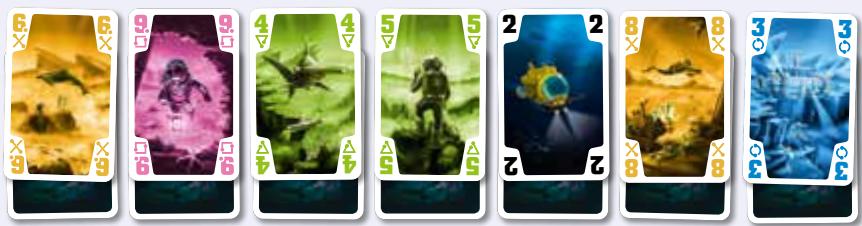
Sample setup of Tonoja's playing area at the start of a mission
Only face-up cards may be played by Tonoja.
Tonoja can only play face-up cards. A face-down card may only be turned over once the face-up card on top of it is played — but only after a trick and never during one.
TIPS
• Abstaining from communication is also a kind of communication. That often means that you can immediately try to complete your tasks if nobody communicates.
• It's usually easier to win a card that you do not yourself have in your hand. This applies in particular to low cards.
• With submarine cards it is easier to win cards whose color is not in your hand.
• Don't forget that the submarine card with a value of four always wins the trick, because it is the highest-ranking card in the game. Exception: If it is the card that is left over and not played in a three-person game.
• Being able to complete several tasks in one trick is worth a lot. Keep that in mind during the task selection step.
• If you only have the eight and nine of one color in your hand, it is better to communicate the eight as the lowest card rather than the nine as the highest.

Thomas Sing lives in the Southern German university town of Constance. Educated as an economist, several years ago he got together with some friends to purchase a large corner store, which left him with plenty of time for his hobbies: mathematics, Miss Lupun, and of course, inventing games. As a student, Thomas Sing was the world record holder in the Ludo board game, and thus made his way into the Guinness Book of World Records.
With The Crew and The Crew: Deep Sea Mission, he has succeeded in combining the popular worlds of trick-taking games and cooperative games in
a unique and fascinating manner.
The author and publisher thank all those who took part in the creation of this game, and whose creativity helped to make The Crew: Deep Sea Mission what you now hold in your hands. This applies above all to Marco Armbruster Wolfgang Schmidts, Christian Sachseneder, Alexandra Kunz, and the Kosmos games team.
Special thanks go to Klaus, Ralf, and Volker, who were always ready to immerse themselves in unknown worlds.
Author: Thomas Sing
Illustration: Marco Armbruster
Graphics: Sensit Communication
Editing: Kilian Vosse
Technical Product Development: Monika Schall
English Text Editing: Ed Gartin, Ted McGuire © 2021 Thames & Kosmos, LLC,
Providence, RI, USA
Thames & Kosmos® is a registered trademark of Thames & Kosmos, LLC. All rights reserved.
Distributed in North America by Thames & Kosmos, LLC.
Providence, RI 02903.
Phone: 800-587-2872
Web: thamesandkosmos.com
Distributed in United Kingdom by Thames & Kosmos UK LP. Cranbrook, Kent TN17 3HE. Phone: 01580 713000 Web: www.thamesandkosmos.co.uk
© 2021 Franckh-Kosmos
Verlags-GmbH & Co. KG
Pfizerstr. 5-7
70184 Stuttgart
Telephone: +49 711 2191-0
info@kosmos.de
kosmos.de
Printed in Poland
QUIGK OVERVIEW
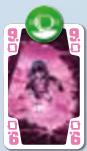
highest pink card
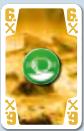
only yellow

lowest green
Communication:
Communication via sonar token is allowed, only after the task card assignment, only one communication per crew member per mission attempt, but never during a trick. Submarine cards may never be communicated. The placement of sonar tokens may not be changed even if their message is no longer true.
Currents:
Use a card to communicate in the normal method, but do not place a sonar token on it.

Rapture of the Deep:
Remove two sonar tokens. The rest is available to the entire crew.

Free Choice of Tasks:
Talk freely among yourselves about how to distribute the task cards.

Real-Time Missions:
The captain's question may only be answered “Yes” or “No”. The one who agrees will get all the tasks. Nothing is allowed to
Unfamiliar Terrain: Draw a random color card:

be revealed about their own hand. If the time runs out before the mission is completed, you lose.



Don't Forget:
• Opening submarine cards must be followed whenever possible.
• The captain always chooses the first task and opens the first trick.
• Only if there are fewer task cards than crew members may a player pass on a task.
• You are only allowed to look at the most recently taken trick.
• Cards won during a trick to complete a task may be placed face up under the task card.
• If a mission fails, try the same tasks again or draw new ones from the deck.
Download MarkdownTexts are community-compiled or publicly released by publishers; copyright remains with the original authors. For personal reference only.