
南北战线Battle Line
一句话概览
南北战线 是一款已收录于村了吗规则库的桌游,支持 2 人,原名 Battle Line。
本页内容:一句话概览 · 常见问题
这游戏怎么玩
- 本站已收录这款游戏的规则资料,可以在对话里直接提问规则细节。
常见问题(FAQ)
以下 1 条问答中 0 条来自站内玩家的真实提问,其余 1 条为本站整理的常见疑问;答复内容保持原样。
南北战线支持几个人玩?
2 人。
去哪查完整规则
想核对具体规则细节、卡牌效果或某个回合的结算方式,可以在村了吗里选中这款游戏后直接提问。
同类桌游
规则原文(Markdown)
本站收录这款游戏的规则原文 1 个文件,此处内联渲染 1 个,可直接展开阅读或下载。
battle-line-rulebook-v2.md9.1 KB
BATTLE LINE

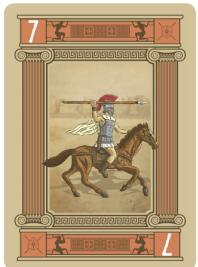
60 Troop Cards

10 Tactic Cards

9 Flags
PREPARATION
Layout the nine Flags in a line between the two players. Cut the Troop deck until one player has the higher number—that player shuffles and deals seven Troop cards to each player's hand. Place the remaining Troop cards as a facedown deck at one end of the battle line. Shuffle the ten Tactics cards and place them as a facedown deck at the other end of the battle line.

Troop Deck
Flags
Tactic Deck
OBJE<TIVE
The players aim to create powerful formations on their side of the Flags to beat the formations on the opponent's side of the respective Flags. The first player to win three adjacent Flags (a Breakthrough) or any five Flags (an Envelopment) achieves victory. The non-dealer plays first; play alternates thereafter. On his turn, a player selects either one Troop card or one Tactics card from his hand and places it face up on his side of the battle line. At the end of his turn, the player draws one card from either deck to refresh his hand to seven. When both decks run out, no further cards can be drawn, but play continues.
The Flags are won by formations of Troop cards played adjacent to the Flags.
The Tactics cards are used to influence the formations.
TROOP<ARDS
A player selects one of his Troop cards and places it face up on his side of the line adjacent to one Flag. There are three imaginary card "slots" on each side of the flag. In the course of the game each player may place a maximum of three Troop cards adjacent to each Flag, in order to create formations. The order in which the cards are played is irrelevant. To save space, later cards are placed partially covering former cards at the same flag.
When a player is unable to play any Troop card, he may pass or play a Tactics card on his turn, but his opponent still continues to play until the game is decided. Such situations may occur in two ways: a player may have filled all his available slots on his side of the battle line, or a player may have only Tactics cards in his hand.

FORMATIONS
The different formations from highest to lowest are:
Wedge: Three cards of the same color with consecutive values.

Phalanx: Three cards of the same value.
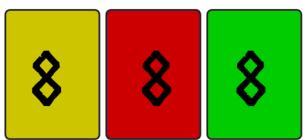
Battalion Order: Three cards of the same color.
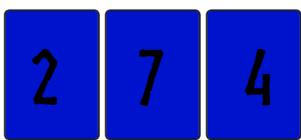
Skirmish Line: Three cards with consecutive values.

Host: Any other formation.

When comparing two formations in the same category, the formation with the higher sum of all three card values is higher than the opposing formation.
This Red Battahon

beats this
Yellow Battalion
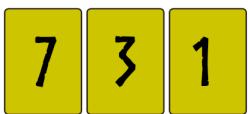
If the two involved sums are equal, the formations are tied (see the Flags section below for resolution of ties).
This Host [Y7][B2][G1] is tied with this Host [Y3][B3][G4]
FLAGS
On his turn and before drawing his card from the deck, a player may claim one or more Flags. In order to do so, he must have a completed formation of three cards on his side of the Flag, and he must be able to prove that Troop cards on the opponent's side of the Flag cannot beat this formation.
If the opponent's side also contains three cards, the situation is obvious. If the opponent's side contains less than three cards, the claiming player must prove that the opponent will not be able to create a winning formation, regardless of what Troop cards the opponent might play. For this purpose, the player may use the open information from the layout to show that certain cards are no longer available. The player may not use any information from his own hand. Unplayed Tactics cannot prevent a Flag claim.
If the formations on either side of a Flag arc tied or at best could be tied, then the player who played (or would play) the last card into the formations loses the Flag. His opponent may claim it on his next turn.
This Wedge

beats this Phalanx

to claim Flag.
This Phalanx
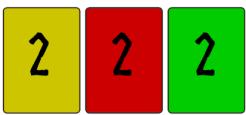
beats

to claim Flag.
This Wedge

Yellow 10 have been played.
beats this
to claim Flag, if the Yellow 7 and
0222222222222222222
When a player successfully claims a Flag, he takes the Flag and moves it to his side, beyond the cards that he played. Then neither player may place further cards adjacent to that Flag, nor may any Tactics card affect those cards.

TA<TIKS <ARDS
There are ten Tactics cards. Tactics cards are played instead of Troop cards to influence the formations. A player may hold as many Tactics cards as he wishes within his hand size of seven, but may never play more than one more than his opponent has played. That means, a player can always play a Tactics card unless he has already played more than his opponent. Each Tactics card has a special function and belongs to one of the following three categories.
1. MORALE TA<TKS
These cards are played into the player's layout in place of, and in a similar way to, Troop cards:
Leader (Alexander, Darius): The Leaders are wild cards. Play a Leader like any Troop card, but define the color and value when the Flag is resolved.
For example, you have a Blue 8 in your layout. If you add a Leader, it gives you the option of adding a Blue 6, 7, 9 or 10 to make a Wedge, or an 8 to form a Phalanx. Each player may only have one Leader on his side of the battle line. If drawn, a second Leader remains unplayable in the player's hand until the end of the game.
Companion Cavalry: Play this card like any Troop card of value 8, but define its color when the Flag is resolved.
Shield Bearers: Play this card like any Troop card, but define its color and its value not larger than 3 when the Flag is resolved.
2. ENVIRONMENT TA<TIKS
These cards are played face up on the player's near side of an unclaimed Flag, so that there is enough space for the Troop cards to be placed next to the Flag. Once played, the Tactics cards stay in their position until the end of the game. Fog: The fog card disables all formations, and the Flag is merely decided on the basis of the total value of cards on each side.
Mud: The claim for this Flag is now based on four cards on either side, so the formations need to be expanded. This makes it particularly difficult to achieve a Wedge or Phalanx.
3. GUILE TA<TKS
These cards are played face up on the player's own side next to the Tactics card deck. All cards played there must be clearly visible and remain there until the end of the game.
Scout: The player draws a total of three cards from one or both decks. Then he chooses any two cards from his hand and places them face down on top of their respective deck or decks.
Redeploy: The player chooses anyone Troop or Tactics card from his side next to an unclaimed Flag, and places it face up into another of his available slots,
or discards it face up on his side next to the Tactics card deck. Do not cover any other discard.
opponent's side next to the Tactics card deck. Do not cover any other discard.
Traitor: The player may choose anyone Troop card (but not a Tactics card)
from the opponent's side next to an unclaimed Flag, and places it into an empty slot on his own side.
GAME END
When one player has successfully claimed three adjacent Flags or any five Flags, the game ends immediately with this player winning. Play halts; no other Flags may be claimed after that.
If several games are played, the winner always scores five points, and the loser scores as many points as Flags he has claimed. The winner then starts the next game.
ADVAN<ED RULE
Once you have played the standard game a few times you may wish to try this variant. A player may only claim Flags at the beginning of his turn.
This effectively delays claiming a Flag by one turn, enabling the opponent to modify the situation with his Tactics cards.
下载 Markdown原文为社区整理/出版社公开资料,版权归原作者,仅供个人学习查阅。