
皇舆争霸(第二版)Dominion: Second Edition
一句话概览
皇舆争霸(第二版) 是一款已收录于村了吗规则库的桌游,支持 2–4 人,原名 Dominion: Second Edition。
本页内容:一句话概览 · 游戏概述 · 1. 游戏组件 · 2. 游戏设置 · 3. 游戏流程 · 4. 牌库管理 · 5. 行动牌常见效果术语 · 6. 王国牌详细说明 · 7. 费用参考表 · 8. 推荐牌组 · 关键规则与常见问题 · 常见问题
皇舆争霸(第二版) 规则速览
以下规则速览由本站整理,与官方规则书表述不同,仅供快速上手参考。
游戏概述
你是一位君主,梦想将自己小小的河流与常绿树王国扩张为更广阔的领地。在与其他君主的竞争中,你需要招募随从、建造建筑、装饰城堡、充实国库,尽可能多地占领无主之地。这是一款纯牌库构筑(Deck Building)游戏——牌库就是你的领地,包含资源、胜利点数和你能做的一切行动。游戏开始时只有一小叠庄园和铜币,目标是结束时拥有最多的胜利点数(VP)。
核心机制: 牌库构筑、手牌管理、引擎搭建、资源转换
1. 游戏组件
| 组件 | 数量 |
|---|---|
| 宝藏牌 | 130张:铜币(Copper)60张、银币(Silver)40张、金币(Gold)30张 |
| 胜利点数牌 | 48张:庄园(Estate)24张、公国(Duchy)12张、行省(Province)12张 |
| 诅咒牌(Curse) | 30张 |
| 空白牌 | 7张 |
| 随机指示牌(Randomizer) | 32张 |
| 废弃牌标记 | 1张 |
| 王国牌(Kingdom) | 252张(24种行动牌各10张 + 1种胜利牌12张) |
| 合计 | 500张 |
2. 游戏设置
2.1 基础牌堆设置
- 将宝藏牌、胜利点数牌、诅咒牌和废弃牌标记放在桌面中央(即供应堆)
- 宝藏牌和胜利牌在每局游戏中都使用
2.2 宝藏牌
- 每位玩家获得7张铜币,剩余铜币与所有银币、金币面朝上放在供应堆中
2.3 胜利牌
- 每位玩家获得3张庄园
- 供应堆中放置胜利牌:
- 2人游戏: 庄园、公国、行省各8张
- 3-4人游戏: 庄园、公国、行省各12张
- 多余的胜利牌放回盒子
2.4 诅咒牌
- 供应堆中放置诅咒牌:
- 2人游戏: 10张
- 3人游戏: 20张
- 4人游戏: 30张**
- 多余的诅咒牌放回盒子
2.5 王国牌
- 选择10种王国牌,每种放置10张面朝上在供应堆中
- 例外: 王国胜利牌堆(如花园 Gardens)数量与胜利牌堆相同(2人8张,3-4人12张)
- 未选中的王国牌放回盒子
2.6 玩家个人设置
每位玩家:
- 将获得的7张铜币和3张庄园(共10张)洗牌,面朝下形成牌库(Deck)
- 从牌库顶抽5张作为手牌
2.7 起始玩家
- 随机确定起始玩家
- 多局游戏时,由上一局获胜者左侧的玩家先手;若上一局平局,则从未获胜的玩家中随机选择
3. 游戏流程
游戏按顺时针顺序轮流进行。每位玩家的回合包含三个阶段,按顺序执行:
3.1 行动阶段(Action Phase)
- 可打出1张行动牌(标记为"Action"的王国牌)
- 将行动牌面朝上放在自己面前,宣布并执行其效果
- 可选择不打出行动牌(即使手中有行动牌)
- 行动牌的效果必须完整结算后才能打出下一张
- 若行动牌无法完全执行,仍可打出,但必须尽可能完成
- 某些行动牌可提供额外行动次数,允许在同一回合打出多张行动牌
- 行动阶段在玩家无法或选择不再打出行动牌时结束
3.2 购买阶段(Buy Phase)
- 从手牌中打出部分或全部宝藏牌,将其面值与行动牌提供的金币相加
- 可用总金币购买供应堆中1张费用≤总金币的牌
- 购买的牌面朝上放入弃牌堆
- 获得的牌不能在当回合使用
- 若有额外购买次数(+1 Buy),可继续购买第二张牌
- 不必使用所有购买次数
3.3 清理阶段(Clean-up Phase)
- 将自己面前所有打出的牌(行动牌和宝藏牌)和手牌中剩余的牌全部面朝上放入弃牌堆
- 从牌库顶抽5张新手牌
- 回合结束,轮到下一位玩家
4. 牌库管理
4.1 抽牌与洗牌
- 当需要从牌库抽牌但牌库不足时,先抽完剩余的牌,然后将弃牌堆洗牌形成新牌库,再继续抽剩余数量
- 只有在需要抽牌或揭示牌但牌库不足时才洗弃牌堆
4.2 区域说明
- 牌库(Deck): 始终面朝下,只能数张数,不能查看
- 手牌: 只有自己能看
- 弃牌堆: 始终面朝上,顶部牌可见
- 废弃堆(Trash): 被废弃的牌放在此处,不属于任何玩家,不能购买
5. 行动牌常见效果术语
| 术语 | 效果 |
|---|---|
| +X 张牌 | 立即从牌库顶抽X张牌加入手牌 |
| +X 个行动 | 本回合行动阶段可额外打出X张行动牌(非立即打出) |
| +X 金币 | 购买阶段可额外获得X金币(非打出宝藏牌) |
| +1 购买 | 购买阶段可额外购买1张牌 |
| 弃牌(Discard) | 从手牌中选择牌面朝上放入弃牌堆 |
| 废弃(Trash) | 将牌放入废弃堆(非弃牌堆),被废弃的牌不归还供应堆 |
| 获得(Gain) | 从供应堆拿取1张牌放入弃牌堆(除非另有说明) |
| 揭示(Reveal) | 向所有玩家展示牌,然后放回原处 |
| 放置一旁(Set Aside) | 将牌面朝上放在桌上,按后续指示处理 |
6. 王国牌详细说明
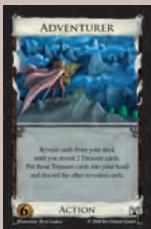
6.1 冒险者(Adventurer)
- 翻开牌库顶的牌直到翻出2张宝藏牌,将这2张宝藏牌加入手牌,其余翻开的牌按顺序放回牌库顶
- 若中途需要洗牌则洗牌(翻开的牌不洗入新牌库)
- 若洗牌后仍只翻出1张宝藏牌,就只获得那1张
6.2 官僚(Bureaucrat)
- 从供应堆获得1张银币放在牌库顶
- 每位其他玩家从手牌中选择1张胜利牌放在自己牌库顶(若无胜利牌则展示手牌)
6.3 地窖(Cellar)
- +1 行动
- 从手牌中弃任意数量的牌,然后抽等量的牌
- 不能弃地窖本身(打出后不在手中)
- 先弃牌,后抽牌;若弃牌时需要洗牌,弃掉的牌会洗入新牌库
6.4 礼堂(Chancellor)
- +2 金币
- 可选择将牌库全部放入弃牌堆(不能只看牌库)
6.5 教堂(Chapel)
- 可废弃手中最多4张牌
- 不能废弃教堂本身(打出后不在手中)
6.6 议会厅(Council Room)
- +4 张牌
- +1 购买
- 每位其他玩家必须抽1张牌(无论是否愿意)
6.7 盛宴(Feast)
- 获得后将自身废弃(非弃牌)
- 获得1张费用≤5的牌(来自供应堆,放入弃牌堆)
- 不能使用宝藏牌或之前行动牌的金币来增加获得牌的费用上限
- 若用王座室打出盛宴,可获得2张牌(即使只能废弃1次)
6.8 节庆(Festival)
- +2 行动
- +1 购买
- +2 金币
6.9 花园(Gardens)
- 王国胜利牌(非行动牌),游戏结束时计分
- 每拥有10张牌(牌库+弃牌堆+手牌总数)得1个胜利点数,向下取整
- 例:39张牌 = 3个胜利点数
- 供应堆数量:2人8张,3-4人12张
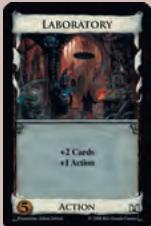
6.10 实验室(Laboratory)
- +2 张牌
- +1 行动
6.11 图书馆(Library)
- 从牌库抽牌直到手中有7张
- 若抽到行动牌,可选择放置一旁而非加入手牌
- 放置一旁的行动牌在抽牌结束后弃掉
- 若中途洗牌,放置一旁的牌不洗入新牌库
- 若牌库耗尽仍不足7张,有多少算多少
6.12 市场(Market)
- +1 张牌
- +1 行动
- +1 购买
- +1 金币
6.13 民兵(Militia)
- +2 金币
- 攻击效果: 每位其他玩家将手牌弃至3张
- 已有3张或更少手牌的玩家不弃牌
6.14 矿场(Mine)
- 从手中废弃1张宝藏牌,获得1张费用比废弃的宝藏牌高≤3的宝藏牌放入手牌(非弃牌堆)
- 例:废弃铜币(0)→ 获得银币(3);废弃银币(3)→ 获得金币(6)
- 也可废弃宝藏牌获得同价或更便宜的宝藏牌
- 若手中无宝藏牌,则无法获得任何牌
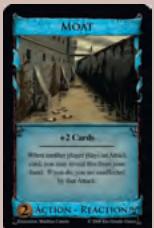
6.15 护城河(Moat)
- +2 张牌
- 反应效果: 当其他玩家打出攻击牌时,可从手中揭示护城河,使自己不受该攻击影响
- 揭示后护城河回到手中,不消耗
- 护城河不影响攻击牌对其他玩家的效果
- 护城河也可在自己回合作为行动牌打出抽2张牌
6.16 放债人(Moneylender)
- 从手中废弃1张铜币,获得+3 金币购买阶段使用
- 若手中无铜币,则不获得金币
6.17 改造(Remodel)
- 从手中废弃1张牌,获得1张费用比废弃的牌高≤2的牌(放入弃牌堆)
- 获得的牌不必恰好贵2,可以更便宜
- 不能用宝藏牌或之前行动牌的金币来增加费用上限
- 可废弃1张牌获得同名牌
- 若无牌可废弃,则无法获得任何牌
- 不能废弃改造本身(打出后不在手中)
6.18 铁匠铺(Smithy)
- +3 张牌
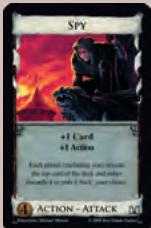
6.19 间谍(Spy)
- +1 张牌
- +1 行动
- 效果: 所有玩家(包括自己)各揭示牌库顶1张牌,由打出间谍的玩家决定是否弃掉该牌
- 先处理自己,再按顺时针顺序处理其他玩家
- 未被弃掉的牌放回牌库顶
6.20 小偷(Thief)
- 每位其他玩家揭示牌库顶2张牌
- 若只有1张牌则揭示那1张,然后洗牌再揭示1张;若无牌则洗牌后揭示2张
- 从揭示的2张牌中,由打出小偷的玩家选择至多1张宝藏牌废弃
- 打出小偷的玩家可获得被废弃的宝藏牌(放入弃牌堆)
- 可选择不获得任何被废弃的宝藏牌
6.21 王座室(Throne Room)
- 从手中选择1张行动牌,打出并执行其效果两次
- 第二次执行不消耗额外行动次数
- 第一次效果完全结算后再执行第二次
- 若用王座室打出王座室:打出1张行动牌执行两次,再打出另1张行动牌执行两次(不是执行4次)
- 两次执行之间不能插入其他行动牌
6.22 村庄(Village)
- +1 张牌
- +2 行动
6.23 女巫(Witch)
- +2 张牌
- 攻击效果: 每位其他玩家各获得1张诅咒牌(放入弃牌堆)
- 若诅咒牌不足,按顺时针从打出女巫的玩家下一位开始分发
- 即使诅咒牌已耗尽,仍可打出女巫抽2张牌
6.24 樵夫(Woodcutter)
- +1 购买
- +2 金币
6.25 工坊(Workshop)
- 获得1张费用≤4的牌(来自供应堆,放入弃牌堆)
- 不能使用宝藏牌或之前行动牌的金币来增加费用上限
7. 费用参考表
| 费用 | 宝藏牌 | 胜利牌 | 诅咒牌 |
|---|---|---|---|
| 0 | 铜币(价值1) | — | 诅咒(-1 VP) |
| 2 | — | — | — |
| 3 | 银币(价值2) | 庄园(1 VP) | — |
| 4 | — | — | — |
| 5 | — | — | — |
| 6 | 金币(价值3) | 公国(3 VP) | — |
| 8 | — | 行省(6 VP) | — |
8. 推荐牌组
初学者推荐
地窖、市场、民兵、矿场、护城河、改造、铁匠铺、村庄、樵夫、工坊
大钱流(Big Money)
冒险者、官僚、礼堂、教堂、盛宴、实验室、市场、矿场、放债人、王座室
互动流(Interaction)
官僚、礼堂、议会厅、节庆、图书馆、民兵、护城河、间谍、小偷、村庄
规模扭曲(Size Distortion)
地窖、教堂、盛宴、花园、实验室、小偷、村庄、女巫、樵夫、工坊
村庄广场(Village Square)
官僚、地窖、节庆、图书馆、市场、改造、铁匠铺、王座室、村庄、樵夫
关键规则与常见问题
易错规则
- 起始牌库固定: 每位玩家开始时都是7张铜币+3张庄园,共10张
- 行动阶段可跳过: 即使手中有行动牌,也可选择不打出
- 购买阶段必须先打宝藏牌: 宝藏牌在购买阶段打出,非自动计算
- 每回合只能买1张牌(除非有+1 Buy效果)
- 获得的牌放入弃牌堆(矿场获得的宝藏牌放入手牌是例外)
- 废弃≠弃牌: 废弃的牌放入废弃堆,不归还供应堆,不能购买
- 弃牌堆只在需要抽牌且牌库不足时才洗牌
- 牌库只能数张数,不能查看内容
- 弃牌堆顶部牌可见
- 攻击牌效果对所有其他玩家生效,但护城河可使自己免疫
- 王座室+王座室: 打出2张行动牌各执行两次,不是1张执行4次
- 花园计分: 计算牌库+弃牌堆+手牌总数,每10张得1 VP,向下取整
常见问题
-
Q:何时洗弃牌堆?
A:只有在需要从牌库抽牌或揭示牌但牌库不足时才洗 -
Q:宝藏牌什么时候打出?
A:在购买阶段,玩家选择打出部分或全部手牌中的宝藏牌 -
Q:获得的牌能当回合使用吗?
A:不能,获得的牌放入弃牌堆(矿场放入手牌是例外,但也不能当回合使用) -
Q:护城河能阻止所有攻击吗?
A:只能阻止对自己生效的攻击,不影响对其他玩家的效果 -
Q:用王座室打出的行动牌,额外行动怎么算?
A:第二次执行不消耗额外行动次数。若行动牌本身+1行动,用王座室执行两次后仍剩余2个行动 -
Q:诅咒牌用完了怎么办?
A:按顺时针顺序从打出攻击牌的玩家下一位开始分发,无诅咒可发的玩家不受影响 -
Q:花园怎么计分?
A:游戏结束时,计算手中+牌库+弃牌堆的总牌数,每10张牌得1个胜利点数(向下取整) -
Q:教堂能废弃自己吗?
A:不能,打出教堂后它不在手中,无法废弃自己(但可废弃其他教堂牌) -
Q:间谍效果中,被弃掉的牌去哪?
A:放入该玩家的弃牌堆,未被弃掉的牌放回牌库顶 -
Q:小偷能拿走对手之前回合废弃的宝藏牌吗?
A:不能,只能获得当回合被废弃的宝藏牌
常见问题(FAQ)
以下 1 条问答中 0 条来自站内玩家的真实提问,其余 1 条为本站整理的常见疑问;答复内容保持原样。
皇舆争霸(第二版)支持几个人玩?
2–4 人。
去哪查完整规则
想核对具体规则细节、卡牌效果或某个回合的结算方式,可以在村了吗里选中这款游戏后直接提问。
同类桌游
规则原文(Markdown)
本站收录这款游戏的规则原文 1 个文件,此处内联渲染 1 个,可直接展开阅读或下载。
c2-dominion-rulebook.md37.8 KB

Donald X, Vaccarino
You are a monarch, like your parents before you, a ruler of a small pleasant kingdom of rivers and evergreens, Unlike your parents, however, you have hopes and dreams! You want a bigger and more pleasant kingdom, with more rivers and a wider variety of trees, You want a Dominion! In all directions lie fiefs, freeholds, and feodums, All are small bits of land, controlled by petty lords and verging on anarchy. You will bring civilization to these people, uniting them under your banner,
But wait! It must be something in the air; several other monarchs have had the exact same idea, You must race to get as much of the unclaimed land as possible, fending them off along the way. To do this you will hire minions, construct buildings, spruce up your castle, and fill your treasury. Your parents wouldn't be proud, but your grandparents, on your mother's side, would be delighted,
GOAL
This is a game of building a deck of cards. The deck is your Dominion. lt contains your resources, victory points, and the things you can do. lt starts out a small sad collection of Estates and Coppers, but you hope by the end of the game it will be brimming with Gold, Provinces, and the inhabitants and structures of your castle and kingdom.
The player with the most victory points in his Deck at game end wins.
CLONTENTS
Before the first game, remove the five sets of cards from their wrappings and place them in the card tray. One side of the included inlay suggests a way to organize the cards. The opposite side allows players to create an organization that fits their needs.
500 cards
130 Treasure cards

60 Copper

40 Silver

30 Gold
name
value (3 coins)
card type (treasure, yellow)
cost (6 coins)
48 Victory cards

24 Estates
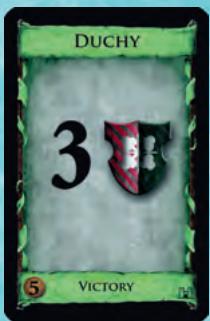
12 Duchies
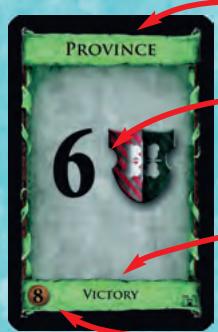
12 Provinces
name
value (6 victory points)
card type (victory, green)
cost (8 coins)
30 Curse cards

7 blank cards
name
value (-1 victory points)
card type (curse, purple)
cost (0 coins)
32 Randomizer cards

1 Trash card

252 Kingdom cards 24 Action cards (10 of each)


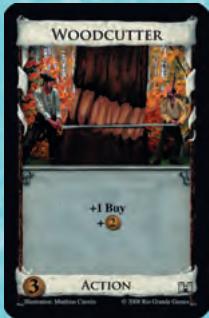
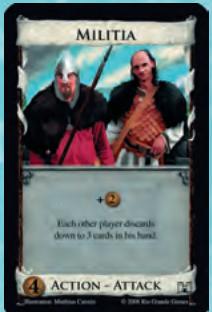


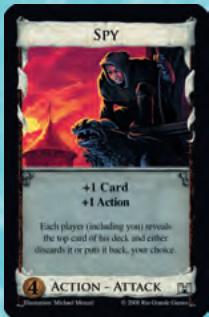
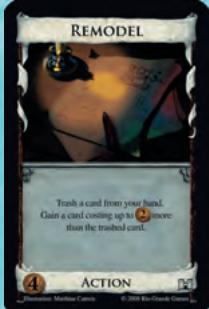


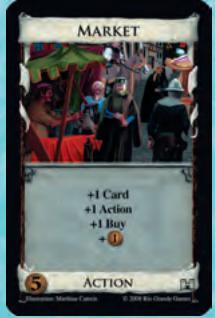


name
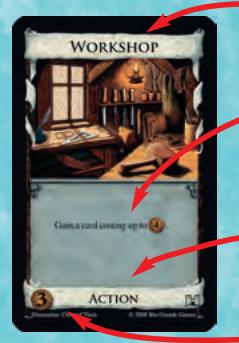
card ability
card type (action, white)
cost (3 coins)
Most kingdom cards are action cards, but there are other kinds.
action-attack
name

card ability
card type (action-attack, , white)
cost (4 coins)
action-reaction
name
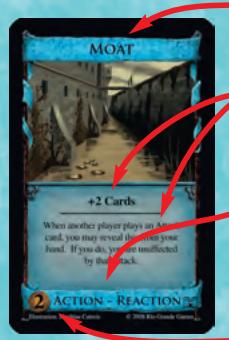
card abilities
card type
(action-reaction,
, blue)
cost (2 coins)
1 Victory card (12)
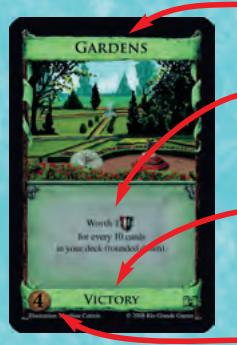
card ability
card type (victory, green)
cost (4 coins)
REPARATION
Place the Treasure cards, Victory cards, Curse cards, and the Trash card in every game (players may place them as shown or in any other arrangement that is convenient for them.
TREASURE CARDS
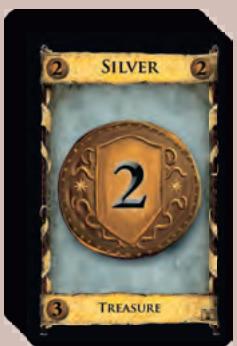
Copper, Silver, and Gold cards are the basic Treasure cards, and they are available in every game. After each player takes 7 Copper cards, place the remaining Copper cards and all of the Silver cards and Gold cards in face-up piles in the Supply.
VICTORY CARDS
Estate, Duchy, and Province cards are the basic Victory cards, and they are available in every game. After each player takes 3 Estate cards, place 12 each of the Estate, Duchy, and Province cards in face-up piles in the Supply in a 3 or 4 player game. ln a 2 player game, place only 8 of each of these Victory cards in the Supply. Place unused Victory cards back in the box.
CURSE CARDS & TRASH CARD
Place 10 Curse cards in the Supply for a 2 player game, 20 Curse cards for 3 players, and 30 Curse cards for 4 players. Return unused Curse cards to the box. Curse cards are used most often with specific Action cards (e.g. Witch). lf a player buys a Curse card (0 cost), it goes in his own discard pile, like any other gained card. This, of course, will not often occur. The Trash card marks the place where players place cards trashed in the game.



the Supply
Treasure cards


Curse cards
Victory cards

Note: Curse cards are present in every game, however, they are rarely used in the basič game other than with the Witch card.

Trash pile
each player starts with 10 cards;
Each player starts the
game with the same
cards:
7 coppers &
3 estates.

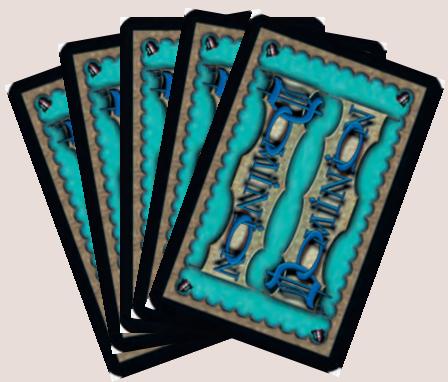
Each player shuffles these cards and places them (his Deck) face-down in his play area (the area near him on the table).

Now, each
player draws
5 cards from
his Deck. These cards are the
player's
hand.
Place 10 sets of the 25 different Kingdom cards next to the Treasure, Victory, Curse, and Trash cards to start each game. Thus, each game can have a different set of 10 cards.
kin cndds

KINGDOM CARDS
In addition to the Trash, Treasure, Victory, and Curse cards that are used in every game, the players also select 10 Kingdom cards and place 10 of each in face-up piles on the table.
Exception: Kingdom Victory card piles (e.g. Gardens) have the same number as the Victory card piles (12 for a 3 or 4 player game and 8 for a 2 player game).
For the first game, we recommend using the following 10 Kingdom cards: Cellar, Market, Militia, Mine, Moat, Remodel, Smithy, Village, Woodcutter, and Workshop. At the end of the rules, we list more suggestions for sets of 10 Kingdom cards. Return Kingdom cards not chosen for the game to the box.
In later games, players can choose the 10 Kingdom cards using any method they agree on.
For example, the players can shuffle the Randomizer cards for all Kingdom cards and draw 10 to select the cards for the game. Or, players can take turns selecting cards.
Players may also use the Randomizer cards as Placeholders to mark the card piles so empty piles are easily seen.
example of a player's play area during the game;

Deck (always face-down)


cards played this turn
Discard pile(always face-up)
STARTING PLAYER
Randomly determine the starting player. When playing multiple games, the starting player is the player to the left of the winner of the last game. If there was a tie in the previous game, randomly choose the starting player from the players that didn't win. Players take turns in clockwise order.
TURN OVERVIEW
Each turn has three phases (A, B, and C) in the order shown: A) Action phase - the player may play an Action. B) Buy phase - the player may buy a card.
C) Clean-up phase - the player must discard both played and unplayed cards and draws five new cards. After a player completes all three phases, his turn ends.
ACTION PHASE
In the Action phase, the player may play one Action card. Action cards are the Kingdom cards that say “Action" at the bottom of the card. Since players do not start the game with any Action cards in their initial Decks of 10 cards, a player will not have any Actions to play during his first 2 turns. Normally, a player may play only one Action card, but this number may be modified by the Action cards that the player plays.
To play an Action, the player takes an Action card from his hand and lays it face-up in his play area. He announces which card he is playing and follows the instructions written on that card from top to bottom. The player may still play an Action card even if he is not able to do everything the Action card tells him to do; but the player must do as much as he can. Furthermore, the player must fully resolve an Action card before playing another one (if he is able to play another Action card). Detailed information about card abilities can be found in the card descriptions at the end of these rules. Any Action cards played remain in the player's play area until the Clean-up phase of the turn unless otherwise indicated on the card.
The Action phase ends when the player cannot or chooses not to play any more Action cards. Generally, a player can only play Action cards during the Action phase of his turn. However, Reaction cards are an exception to this rule as they can be used at other times.
Common terms used on the Action cards;
"+X Card(s)" – the player immediately draws X number of cards from his Deck. lf there are not enough cards in his Deck, he draws as many as he can, shuffles the Discard pile to form a new Deck, and then draws the rest. lf he still does not have enough cards left after forming a new Deck, he just draws as many as he can.
Players choose starting player randomly or based on previous game. Players take turns in clockwise order.
Each turn, the player does the
A, B, and C phases in order:
A) Action phase
B) Buy phase
C) Clean-up phase
The player may play one action card if he has one. This is optional, even if the player has an action card, he need not play it. Action cards will allow players to do extra things during their turns.
As some action cards offer a player additional actions, a player may be able and choose to play several action cards in a turn. Players can play their action cards left to right in their play areas. In this way, they can easily keep track of what and how many extra things they may do. The player will discard these cards in the clean-up phase (see below), and should not be discarded prior to this.
Note; as the players begin the game with no action cards, they will be unable to play action cards for at least the first two turns.
+ X Card(s): must draw X more Cards immediately
"+X Action(s)" – the player may play X number of additional Actions this turn. +X Action(s) adds to the number of Actions that can be played in the Action phase. It does not mean play another Action immediately. The instructions on the current Action card must be completed before playing any additional Actions. The player must complete all of his Actions before he moves on to the Buy phase of his turn. lf a card gives the player more than one additional Action, he may keep track of the number of Actions he has remaining out loud.
"+X" – the player has X number of additional coins to spend in the Buy phase. The player does not take additional Treasure cards for these coins.
"+1 Buy" – the player may buy an additional card from the Supply during the Buy phase of his turn. +1 Buy adds to a player's potential Buys, it does not allow the player to buy a card during the Action phase.
"Discard" – unless otherwise specified, discarded cards are from the player's hand. When a player discards a card, he places the discarded card face-up onto his Discard pile. When discarding several cards at once, the player need not show ali cards he is discarding to his opponents, but player may need to show how many cards he is discarding (for example, when playing the Cellar). The top card of a player's Discard pile is always visible.
"Trash" – when a player trashes a card, he places it in the Trash pile, not his Discard pile. Trashed cards are not returned to the Supply and are not available for purchase.
"Gain” – when a player gains a card, he takes the gained card (usually from the Supply) and puts it onto his Discard pile (unless the card says to put it elsewhere). The player does not get to use the card when he gains it.
“Reveal” – when a player reveals a card, he shows a card to all players and then returns it to wherever it came from (unless instructed specifically to put it elsewhere). lf the player is required to reveal cards from the top of his Deck, and he does not have enough cards, he shuffles in order to reveal the required number of cards.
“Set Aside” – when a player sets aside a card, he places it face-up on the table (unless otherwise indicated) without following any instructions on the card. An Action that requires a player to set aside cards will instruct him on what to do with these cards.
BUY PHASE
In the Buy phase, the player can gain one card from the Supply by paying its cost. Any card that is in the Supply may be purchased (Treasure, Victory, Kingdom, and even Curse cards). The player may not purchase cards from the Trash pile. Normally, a player may buy only one card, but he may buy more if he played certain cards earlier in his Action phase.
The cost of a card is in its lower left corner. The player may play some or all of the Treasure cards from his hand to his play area and add to their value the coins provided by Action cards played this turn. The player may then gain any card in the Supply of equal or lesser value. He takes the purchased card from its Supply pile and places it face-up on his Discard pile. He my not use the ability of the card when it is gained.
+ X Action(s): can play X more Actions in Action phase if a card gives the player more than one additional Action, it is helpful to keep track of the number of Actions he has remaining out loud.
+X: can spend X more coins this turn
+1 Buy: can buy 1 more card in Buy phase
Discard: put cards face-up in your Discard pile
Trash: put card(s) in the Trash pile
Gain: take a card and put it in your Discard pile
Reveal: show card(s) and return them to where they came from
Set Aside: put cards aside until the instructions indicate where they go
The player can gain one card from' the Supply by buying it - paying the cost shown on the card. The player pays in coins from Treasure 'cards (the number on the coin) and from previously paid Action cards.
The player may use any combination of Treasure cards from his hand and coins shown on Action cards played this turn.
| If the player has multiple Buys, he combines Treasure cards and any coins available from Action cards to pay for all of the purchases. For example, if Tyler has +1 Buy and 6 coins provided by two Gold cards, he can buy a Cellar costing 2, placing it face-up in his Discard pile. Then, he can buy a Smithy with the remaining 4 coins and place that face-up in his Discard pile. lf he wants to use all 6 coins to buy one card, he can buy a Copper (for free) with his second Buy or not buy a second card. Players do not have to | Any Treasure cards played can be placed in his player area from left to right, addng them to any cards previously played this turn. |
| use any or all of their Buys. The Treasure cards remain in the play area until the Clean-up phase. Treasure cards will be used multiple times during the game. Although they are discarded during the Clean-up phase, the player will draw them again as his Discard pile is shuffled into a new Deck. Thus, Treasure cards are a source of income, not a resource that is used up when played. When played, Coppers are worth 1 coin, Silvers are worth 2 coins, and Golds are worth 3 coins. | All these cards will be discarded at the end of the turn, and should not be discarded prior to the Clean-up phase'(see below). |
| CLEAN-UP PHASE All cards gained this turn should already be in the player's Discard pile. The player places any cards that are in his play area (Action cards that have been played in the Action phase as well as Treasure cards that have been played in the Buy phase) and any cards remaining in his hand onto his Discard pile. Although the player need not show the cards remaining in his hand to his opponents, since he places the cards in the Discard pile face-up, his opponents | The player places all cards in his play' area onto his Discard pile. Thís will include all Action cards and Treasure cards he played during this turn. He alsoplăces all cards left in his hand onto his Discard pile. |
| will always be able to see the top-most card of his Discard pile. Then, the player draws a new hand of 5 cards from his Deck. lf there are not enough cards in his Deck, he draws as many as he can, shuffles his Discard pile to form a new face-down Deck, and then draws the rest of his new hand. | Draw 5 cards from his Deck. |
| Once the player has drawn a new hand of 5 cards, the next player starts his turn. To speed play, players may begin their turns while previous players are completing their Clean-up phases. When someone plays an Attack card, the players must complete their | The player's turn is over. Play passés člockwise. |
| Clean-up phases in order to properly resolve the Attack. 6AME END | Game end |
| The game ends at the end of any player's turn when either: 1) the Supply pile of Province cards is empty or 2) any 3 Šupply piles are empty. | 1) Province card pile is empty or 2) any 3 Supply piles are empty |
| Each player puts all of his cards into his Deck and counts the victory pointson all the cards he has. | Players count their victory points. |
| The player with the most victory points wins. If the highest scores are tied at the end of the game, the tied player who has had the fewest turns wins the game. lf the tied players have had the same number of turns, they rejoice in their shared victory. | Most victory points wins. Ties go to the player with the fewest turns |
The first few turns - how your first game might go
Shuffle your starting 10 cards (7 Coppers & 3 Estates) and place them face-down as your Deck, Draw the top 5 cārds ’as your starting hand, 1n this example, you have 1 Éstate & 4 Coppers, The rest remain as your Deck,
before e oone
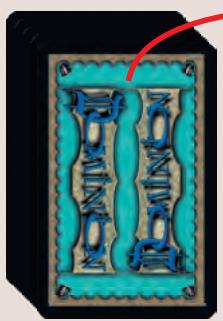
Deck

hand cards

card-playing area
Discard pile
1st turn
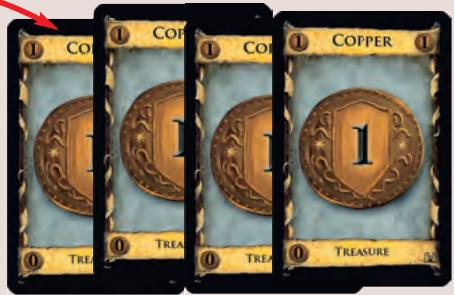
As you have no action cards to start the game, you skip the action phase and go directly to the buy phase, where you will buy most of your cards, Ýou play 4 Copper cards from your hand to buy a Remodel card (cost = 4 Coins) from the supply, placing it in your Discard pile, from the supply from the
Bu pase


hand cards
cards played

Discard pile
After completing your Buy, you go to the Clean-up phase, Here you place the cards you played on the discard pile and the cards left in your hand there as well.
Cle -ase

Deck
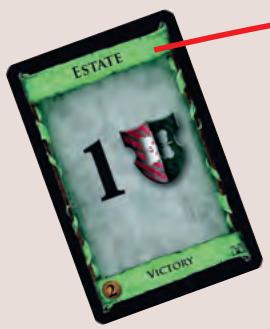
hand cards

cards played
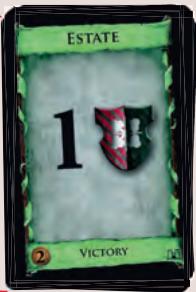
Discard pile
Finally, you draw 5 cards from your Deck for your next turn, This time, you get 2 Estates and 3 Coppers, Your 1st turn is over and the opponent on your left begins his turn,

Deck
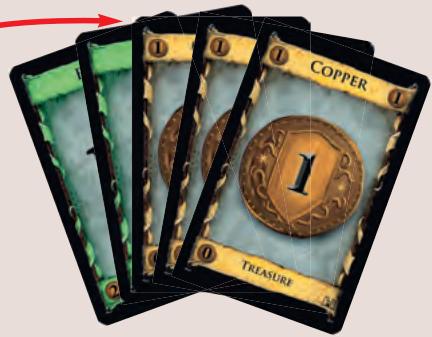
hand cards
card-playing area

Discard pile
2nd turn

3rd turn; continued on the next page

3rd turn (continued)
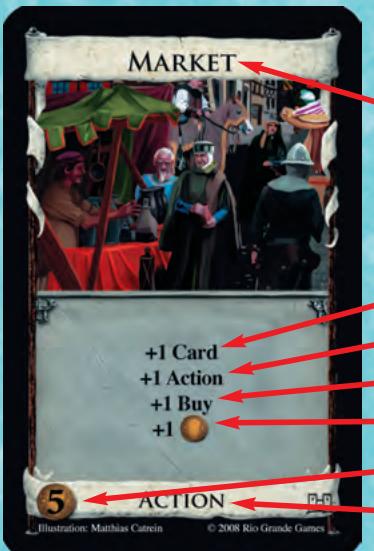
SAMPLE ACTION CARD
Name of card
Draw another card immediately
Lets you play another Action during your Action phase Lets you buy an additional card in the Buy Phase
Gives you an additional coin to spend in the Buy phase. Cost to buy the card.
Card type (both name and color of banner)
ADDITIONAL RULES
| Each player has his own Dominion, which he builds from cards in the supply. During the game, a player's cards are usually in three parts: his Deck (which he draws cards from), his hand, and his Discard pile. The player draws cards from his own Deck and discards cards to his own Discard pile. When his Deck is exhausted and the player needs to draw or reveal cards from his Deck, he shuffles his Discard pile to reform his Deck. He does not shuffle his Discard pile until he needs to reveal or draw a card from his Deck and cannot. At any point in the game, if a player has to draw | Each player has his own Dominion, built from the cards in the supply. Shuffle only when new cards needed. |
| or reveal more cards than are remaining in his Deck, he must draw or reveal as many as he can and then shuffle his face-up Discard pile to form a new face-down Deck. Then, he draws or reveals the remaining number of cards from his newly shuffled Deck. | A player does not shuffle his discard pile until all cards in his Deck have been drawn or revealed. |
| A player places cards he Buys or otherwise acquires during the game on his Discard pile unless he is specifically directed to place them elsewhere. | Gained cards go on the player's discard pile. |
| At the end of a player's turn, he places all the cards he played and those still in his hand on his Discard pile. | All hand and played cards are discarded at the end of a turn. |
| A player is allowed to count how many cards are left in his Deck, but not in his Discard pile. A player may not look through his Deck or his Discard pile. A player may look through the Trash pile, and players may count the number of cards left in any pile in the Supply. | Players may count cards in Decks and Supply piles and may look at cards in Trash. |
| lf an ability of a card affects multiple players, and the order matters, resolve that ability for each affected player in turn order, starting with the player whose turn it is. | Use turn order to resolve card affects. |
| During each turn, a player is allowed 1 Action and 1 Buy, but may be entitled to more based on Action cards played. The instructions written on all the action cards alter the rules of the game by, for | Player allowed at least 1 Action and 1 Buy. |
| example, allowing the player to draw more cards from his Deck, play more Action cards in the Action phase, use more coins for the Buy phase, Buy extra cards in the Buy phase, and so on. When an Action card allows a player to gain a card costing up to | All Action cards alter the rules in some way. |
| a certain value, he may not add coins from his hand or other action cards to gain a higher-valued card. | Players may not add coins to increase the affect of an Action beyond the instructions. |
KINGDOM CARD DESCRIPTION
Adventurer - If you have to shuffle in the middle, shuffle. Don't shuffle in the revealed cards as these cards do not go to the Discard pile until you have finished revealing cards. lf you run out of cards after shuffling and still only have one Treasure, you get just that one Treasure.
Bureaucrat – lf you have no cards left in your Deck when you play this card, the Silver you gain will become the only card in your Deck. Similarly, if another player has no cards in his Deck, the Victory card he puts on top will become the only card in his Deck.
Cellar - You can't discard Cellar to itself, since it isn't in your hand any longer when you resolve it. You choose what cards to discard and discard them all at once. You only draw cards after you have discarded. lf you have to shuffle to do the drawing, the discarded cards will end up shuffled into your new Deck.
Chancellor - You must resolve the Chancellor (decide whether or not to discard your Deck by flipping it into your Discard pile) before doing other things on your turn, like deciding what to buy or playing another Action card. You may not look through your Deck as you discard it.
Chapel - You can't trash the Chapel itself since it isn't in your hand when you resolve it. You could trash a different Chapel card if that card were in your hand.
Council Room – The other players must draw a card whether they want to or not. All players should shuffle as necessary.
Feast - The gained card goes into your Discard pile. lt has to be a card from the Supply. You cannot use coins from Treasures or previous Actions (like the Market) to increase the cost of the card that you gain. lf you use Throne Room on Feast, you will gain two cards, even though you can only trash Feast once. Gaining the card isn't contingent on trashing Feast; they're just two things that the card tries to make you do.
Festival - If you are playing multiple Festivals, keep a careful count of your Actions. Say how many you have left out loud; this trick works every time (i.e. "l'm playing the Festival and now have two Actions remaining. 1 play a Market and have two Actions remaining. 1 play another Festival and now have three Actions remaining...").


Gardens - This Kingdom card is a Victory card, not an Action card. lt does nothing until the end of the game, when it is worth 1 victory point per 10 cards in your Deck (counting all of your cards - your Discard pile and hand are combined with your Deck before scoring). Round down; if you have 39 cards, Gardens is worth 3 victory points. During set-up, place 12 Gardens in the Supply for a 3 or 4 player game and 8 in the Supply for a 2 player game.
Laboratory – Draw two cards. You may play another Action card during your Action phase.
Library - lf you have to shuffle in the middle, the set-aside cards are not shuffled into the new Deck. They will be discarded when you have finished drawing cards. lf you run out of cards even after shuffling, you just get however many there were. You are not obligated to set aside Actions - you just have the option to do so. lf you have 7 or more cards in hand after you play the Library, you don't draw any cards.
Market – Draw a card. You may play another Action card during your Action phase. During your Buy phase, you may buy an additional card from the supply, and add one coin to the total value of the Treasure cards played.
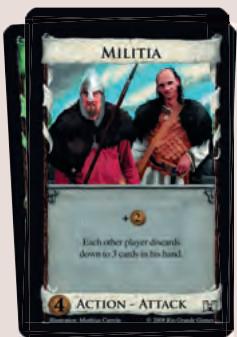
Militia - The attacked players discard cards until they have only 3 cards in hand. Players who had 3 or fewer cards in hand when Militia was played do not discard any cards.
Mine - Generally, you can trash a Copper card and gain a Silver, or trash a Silver card and gain a Gold. However, you could also trash a Treasure to gain the same Treasure or a cheaper one. The gained card goes in your hand; thus, you can spend it the same turn. If you don't have a Treasure card in your hand to trash, you can't gain anything.
Moat - An Attack card is one that says "Attack" on the bottom line (usually, "Action - Attack"). When someone else plays an Attack card, you may reveal the Moat by showing it from your hand to the other players and then returning it to your hand (before the Attack card resolves). You are then unaffected by that Attack card. You won't gain a Curse because of a Witch or reveal a card to a Spy, and so on. lt's just like you aren't in the game for purposes of resolving that Attack. Moat doesn't stop anything an Attack does to other players or to the player of the Attack; for example, if everyone else Moats a Witch, the person who played it still gets to draw 2 cards. Moat can also be played on your turn as an Action to draw 2 cards.



Moneylender - lf you do not have a Copper in your hand to trash, you don't get the +3 coins to spend in the Buy phase.
Remodel - You cannot trash the Remodel as it isn't in your hand when you resolve it (you can trash a different Remodel card from your hand). lf you do not have a card to trash, you cannot gain a card from the Remodel. The gained card goes in your Discard pile. You can only gain cards from the Supply. The gained card need not cost exactly 2 coins more than the trashed card; it can cost that much or any amount less. You cannot use coins from Treasures or previous Actions (like the Market) to increase the cost of the card you gain. You can trash a card to gain a copy of the same card.
Smithy - Draw three cards.
Spy – Spy causes all players, including the one who played it, to reveal the top card of their Deck. Note that you draw your card for playing Spy before any cards are revealed. Anyone who does not have any cards left in their Deck shuffles in order to have something to reveal. Anyone who still has no cards to reveal doesn't reveal one. lf players care about the order in which things happen for this, you do yourself first, then each other player in turn order. Revealed cards that aren't discarded are returned to the top of their players' Decks.
Thief – A player with just one card left reveals that last card and then shuffles to get the other card to reveal (without including the revealed card); a player with no cards left shuffles to get both of them. A player who still doesn't have two cards to reveal after shuffling just reveals what he can. Each player trashes one Treasure card at most, of the attacker's choice from the two revealed cards, and then you gain any of the trashed cards that you want. You can only take Treasures just trashed—not ones trashed on previous turns. You can take none of them, all of them, or anything in between. Put the Treasures you decided to gain into your Discard pile. The ones you choose not to gain stay in the Trash pile.
Throne Room - You pick another Action card in your hand, play it, and play it again. The second use of the Action card doesn't use up any extra Actions you have. You completely resolve playing the Action the first time before playing it the second time. If you Throne Room a Throne Room, you play an Action, doing it twice, and then play another Action and do it twice; you do not resolve an Action four times. lf you Throne Room a card that gives you +1 Action, such as Market, you will end up with 2




Actions left afterwards, which is tricky, because if you'd just played Market twice you'd only have 1 Action left afterwards. Remember to count the number of Actions you have remaining out loud to keep from getting confused! You cannot play any other Actions in between playing the Throne Roomed Action twice.
Village - If you're playing multiple Villages, keep a careful count of your Actions. Say how many you have left out loud; this trick works every time.
Witch - If there aren't enough Curses left to go around when you play the Witch, you deal them out in turn order - starting with the player after you. If you play Witch with no Curses remaining, you will still draw 2 cards. A player gaining a Curse puts it face-up into his Discard pile.
Woodcutter - During your Buy phase, you add two coins to the total value of the Treasure cards played, and you may buy an additional card from the Supply.
Workshop - The card you gain is put into your Discard pile. lt has to be a card from the Supply. You cannot use coins from Treasures or previous Actions (like the Market) to increase the cost of the card you may gain.
XECOMMENDED SETS OF 10
You can play Dominion with any set of 10 Kingdom cards, but these sets are intended to highlight some interesting card interactions and game strategies.
First Game; Cellar, Market, Militia, Mine, Moat, Remodel, Smithy, Village, Woodcutter, Workshop.
Big Money; Adventurer, Bureaucrat, Chancellor, Chapel, Feast, Laboratory, Market, Mine, Moneylender, Throne Room
Interaction; Bureaucrat, Chancellor, Council Room, Festival, Library, Militia, Moat, Spy, Thief, Village
Size Distortion; Cellar, Chapel, Feast, Gardens, Laboratory, Thief, Village, Witch, Woodcutter, Workshop
Village Square; Bureaucrat, Cellar, Festival, Library, Market, Remodel, Smithy, Throne Room, Village, Woodcutter


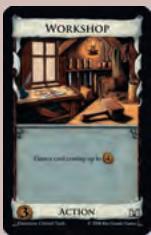
Illustration: Matthias Catrein
Developers: Valerie Putman & Dale Yu
Our thanks to our playtesters: Kelly Bailey, Dan Brees, Josephine Burns, Máx Crowe, Ray Dennis, David Fair, Lucas Hedgren, Michael M. Landers, W. Eric Martin, Destry Miller, Miikka Notkola, Molly Sherwin, Sir Shufflesalot, P. Colin Street, Chris West, the 6am Gamers, the Cincygamers and the Columbus Area Boardgaming Society.

原文为社区整理/出版社公开资料,版权归原作者,仅供个人学习查阅。