
星际探险队:第九行星任务The Crew: The Quest for Planet Nine
一句话概览
星际探险队:第九行星任务 是一款已收录于村了吗规则库的桌游,支持 2–5 人,原名 The Crew: The Quest for Planet Nine。
本页内容:一句话概览 · 游戏概述 · 1. 游戏组件 · 2. 游戏设置 · 3. 游戏流程 · 4. 求救信号 · 5. 任务标记 · 6. 特殊通信模式 · 7. 特殊任务模式 · 8. 多人变体 · 9. 游戏建议 · 关键规则与常见问题 · 常见问题
星际探险队:第九行星任务 规则速览
以下规则速览由本站整理,与官方规则书表述不同,仅供快速上手参考。
游戏概述
在这款合作式吃墩游戏(Trick-taking Game)中,2-5名玩家组成太空探险队,共同完成50个逐步升级的任务,寻找太阳系边缘的神秘第九行星。每位玩家手持一把牌,通过出牌赢得"墩"(Trick)来完成各自分配到的任务牌——只有当所有人的任务全部正确完成时,团队才算胜利。游戏的核心挑战在于:你不能用手牌信息互相交流,只能依赖极其有限的无线电通信手段来协调配合。全部50个任务构成一个连贯故事线,建议按顺序体验。
核心机制: 合作吃墩、任务分配、受限通信
1. 游戏组件
| 组件 | 数量/说明 |
|---|---|
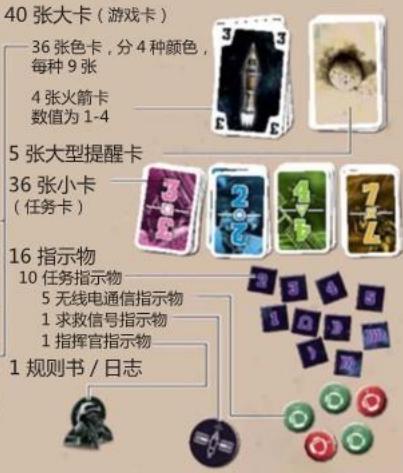
| 大型游戏牌 | 40张:粉色、蓝色、绿色、黄色各9张(编号1-9)+ 火箭牌4张(编号1-4) |
| 小型任务牌 | 36张,与大型游戏牌花色和编号对应的缩小版本 |
| 任务标记 | 数字标记和箭头标记,指定任务完成的顺序条件 |
| 无线电通信标记 | 每人1个,正面绿色/反面红色 |
| 提示卡 | 每人1张,双面独特样式 |
| 求救信号标记 | 1个,正面为卫星图案/反面 |
| 指挥官标记 | 1个 |
| 飞行日志 | 1本,含50个任务说明与记录表 |
2. 游戏设置
2.1 基本设置(每局任务前执行)
- 将40张大型游戏牌洗匀,面朝下均分给所有队员。3人游戏时有1人多拿1张,牌堆末尾剩余的1张不使用
- 每人将无线电通信标记绿色面朝上放在面前,准备好各自的提示卡
- 将求救信号标记面朝下放置
- 将36张小型任务牌洗匀面朝下形成抽牌堆,任务标记放在旁边备用
2.2 任务分配
- 按任务说明抽取指定数量的任务牌,面朝上放在桌子中央
- 所有人查看手牌,持有火箭4的玩家宣布并成为本局指挥官,领取指挥官标记
- 从指挥官开始,顺时针每人依次选取1张任务牌放在面前(附带的任务标记一起拿走),直到所有任务牌分配完毕
- 每人分到的任务数量可以不同
3. 游戏流程
3.1 基本吃墩规则
- 出牌顺序: 每墩从领牌者开始,顺时针每人打出1张牌,所有打出的牌组成一"墩"
- 跟牌要求: 必须打出与领牌花色相同的牌。只有手中没有该花色时,才可打出任意其他花色的牌
- 获胜判定: 只有跟了花色的牌才能赢墩,数值最大的牌赢得该墩
- 火箭牌(王牌): 火箭牌永远赢墩。当花色牌领牌时,手中没有该花色才能出火箭;用火箭领牌时,其他人必须跟火箭(没有则可自由出牌)。多张火箭同时出现时,数值最大的火箭赢
- 领牌权: 赢得上一墩的人领出下一墩。第一墩由指挥官领出
- 不强制赢墩: 手中有能赢的牌也可以选择打出低牌
- 已赢墩的处理: 赢得的牌面朝下放在自己面前,只可查看最近赢得的那一墩
3.2 任务完成与失败
- 当某队员赢得的墩中包含与其任务牌对应的大型游戏牌时,该任务完成,将任务牌面朝下翻转
- 一名队员可以在同一墩中完成多个任务
- 所有人的任务都完成后,本局任务成功
- 立即失败条件: 若某队员赢到了不属于自己的任务牌(其他队员任务对应的牌),或违反任务标记的顺序要求,全队立即失败
- 失败后重新洗牌、发牌、分配任务,从头开始尝试
3.3 无线电通信规则
游戏过程中禁止谈论、展示或暗示自己的手牌内容。唯一允许的通信方式:
通信步骤:
1. 从手中选1张花色牌(火箭牌不可通信),面朝上放在自己面前所有人可见
2. 将通信标记绿色面朝上放在该牌上,位置传达信息:
- 放在牌上方: 这是该花色中你手里的最高牌
- 放在牌中间: 这是该花色中你手里唯一的牌
- 放在牌下方: 这是该花色中你手里的最低牌
3. 三个条件必须至少满足一个,否则不允许选择该牌通信
4. 拿起1张提示卡放入手中作为提醒
通信限制:
- 每次任务尝试中,每人最多通信1次
- 只能在任务分配完成后、每墩开始前执行,墩进行中不可通信
- 通信标记位置一旦放置不可更改,即使之后情况变化也不得移动
- 当打出已通信的牌时,丢弃提示卡,将通信标记翻到红色面
- 任务失败重试时,标记重置为绿色面,可再次使用
经验提示: 没有人通信也是一种信息——往往说明该队员可以直接尝试赢取自己的任务牌。
4. 求救信号
在每局任务开始时(发牌和分配任务后,任何人通信之前),集体决定是否发送求救信号:
- 将求救信号标记翻到正面(卫星面)
- 在飞行日志当前任务的求救信号栏画圈
- 每位队员将1张手牌交给相邻队友(火箭牌不可传递)
- 集体决定向左或向右传递,所有人必须同方向
- 求救信号在当前任务完成前保持激活,每次重新尝试时都可传递1张牌
- 代价: 记录尝试次数时需额外加1
- 所有任务均可在不使用求救信号的情况下完成
5. 任务标记
部分任务需使用任务标记指定完成的顺序或条件。
5.1 数字标记(严格顺序)
标记①②③④Ⓛ分别表示该任务必须在所有待完成任务中第1、第2、第3、第4、第5、最后一个完成。
- 注意: ①不等于"第一墩完成",只需在所有带标记的任务中第一个完成即可
- 一人在同一墩中赢得带连续数字标记的任务(如①和②),视为均正确完成
- 违反顺序条件立即失败
5.2 箭头标记(相对顺序)
箭头标记给出更灵活的条件:只需满足两个任务之间的相对先后关系,其余任务可在任意时间完成。例如"A在B之前"只需A先于B,其他任务插入其间不受限制。
5.3 标记分配
任务标记按从左到右的顺序与抽出的任务牌依次对应。分配任务时,标记随任务牌一起分配。每张任务牌最多对应1个标记。
6. 特殊通信模式
6.1 通信盲区(Dead Zone)
- 仍可按正常方式选牌并展示(需满足最高/唯一/最低条件)
- 不能放置通信标记,而是将其翻到红色面放在牌旁边
- 其他队员必须自行推测传达的具体信息
6.2 通信中断(Disruption)
- 附带一个数字N,表示前N墩期间完全不能通信
- 从第N+1墩起(即第N+1墩开始前),恢复正常通信规则
7. 特殊任务模式
7.1 指挥官指定(Commander's Decision)
- 将指定数量的任务牌面朝下放在中央
- 指挥官逐一询问每位队员是否愿意承担全部任务(只能回答"是"或"否")
- 指挥官选择一人承担所有翻开的任务牌
- 指挥官不能选择自己
7.2 指挥官分配(Commander's Distribution)
- 不预先翻开任务牌
- 指挥官逐张翻开任务牌,每次逐一询问队员是否接受(只能回答"是"或"否"),然后决定分配给谁(可包括自己)
- 重复直到所有任务分配完毕
- 分配结束时,任何人之间的任务数差距不得超过1张
- 任务标记随任务牌按顺序依次分配
8. 多人变体
8.1 二人游戏——JARVIS系统
用14张双层牌阵(7张面朝下+7张面朝上)模拟第三名队员JARVIS:
1. 将火箭4放在一旁
2. 剩余39张牌中取7张面朝下排一行,每张上面再放1张面朝上的牌
3. 将火箭4混入剩余牌中,两人各分13张
4. 指挥官负责选择JARVIS的任务和出牌(不与另一人讨论)
5. JARVIS只能打出面朝上的牌;打出后,该位置下方的牌在该墩结束后才翻开
8.2 三人挑战变体
移除所有绿色游戏牌、绿色任务牌以及火箭1。常规规则照常适用,仅任务13和44受影响(无需赢得火箭1)。
8.3 五人游戏
基本规则不变。从任务25起(任务编号带金色边框),发牌和分配任务后、第一墩开始前,可由一名队员将自己1张任务牌交给另一名队员。转交不增加尝试次数记录。
9. 游戏建议
- 通信低值牌通常比通信高值牌更有用——因为低值牌更容易被他人赢到
- 一次赢到多个任务是极大的优势,选择任务时优先考虑
- 手中只有某花色的8和9时,通信8(作为最低牌)比通信9(作为最高牌)更好,因为同时暗示了你也有9
- 火箭牌可轻松赢取你手中没有的花色的任务牌
- 火箭4永远是全场最高牌,任何墩都能赢
关键规则与常见问题
易错规则
- 火箭牌不可通信: 任何情况下都不能用火箭牌进行无线电通信
- 每人每次尝试只能通信1次: 且必须在墩开始前完成
- 通信标记不可更改: 即使后续牌面变化也不得移动标记位置
- 赢到别人的任务牌=全队立即失败: 哪怕只赢到1张
- 违反任务标记顺序=全队立即失败
- 火箭4是全场最高牌: 任何情况下都能赢墩
- 跟花色的牌才能赢墩: 没跟花色的牌即使数值更大也不能赢
- 不强制赢墩: 可以选择打出低牌放弃获胜
- 求救信号火箭不可传递
- 求救信号代价是尝试次数+1: 即使只尝试了1次,也要记为2次
常见问题
-
Q:通信时打出的牌还能在后续出牌时使用吗?
A:可以。通信展示的牌仍然是手牌的一部分,可以在后续任何墩中正常打出。 -
Q:某花色牌领牌时,手中有该花色但想出火箭牌,可以吗?
A:不可以。必须跟花色,只有手中没有该花色时才能出火箭或其他花色。 -
Q:通信盲区和通信中断有什么区别?
A:盲区下仍可展示牌,但不能放通信标记(队友只能猜信息);中断下完全不能执行任何通信,直到指定墩数后才恢复。 -
Q:五人游戏中任务牌转交给队友,需要额外记录尝试次数吗?
A:不需要。 -
Q:每次任务尝试之间有什么重置?
A:失败后重新洗牌、发牌、重新分配任务。通信标记重置为绿色面,求救信号标记保持当前状态直到开启新任务。
常见问题(FAQ)
以下 1 条问答中 0 条来自站内玩家的真实提问,其余 1 条为本站整理的常见疑问;答复内容保持原样。
星际探险队:第九行星任务支持几个人玩?
2–5 人。
去哪查完整规则
想核对具体规则细节、卡牌效果或某个回合的结算方式,可以在村了吗里选中这款游戏后直接提问。
同类桌游
规则原文(Markdown)
本站收录这款游戏的规则原文 2 个文件,此处内联渲染 2 个,可直接展开阅读或下载。
rules_zh_星际探险队_第九行星任务_3189.md29.7 KB
翻译&排版:陈斌华
从这里开始游戏进行方式从第11页开始介绍
游戏配件.
游戏交流
任务准备和顺序
困难程度和求救信号.
图标和指示物 14
5 人游戏规则18
2 人游戏规则 19
提示和变体21
作者和出版信息…22
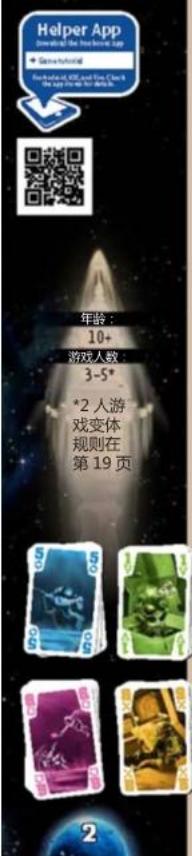
征集宇航员!科学家说在我们太阳系的边缘有一颗神秘的第九颗行星。尽管他们作出了种种努力,迄今为止,他们仍无法提供其存在的实质性证据。快来参加这次令人兴奋的太空探险,看看这些理论是否只是科幻小说看看你是否会发现第九行星。
在这个合作的把戏,你需要完成50个不同的关卡。但是,只有当你们能作为一个团队一起工作时,你才会成功。要完成挑战和你的使命,沟通是必不可少的 但在太空中事情可能比你想象的要困难。
游戏配件
《宇航员》是一个合作,以任务为基础的吃墩游戏。这是什么意思呢?
合作
你们一起赢,或者一起输——只有你们每个人都成功了,你们互相帮助,你们才能完成任务,赢得比赛。
基于任务
你的旅程跨越了50个不同的关卡,每个关卡都有一个独特的胜利条件,你可以将这些关卡视为一个连贯的故事连续进行游戏。但如果你喜欢的话,你也可以不按顺序通关。关卡可在本手册末尾的日志中找到。
你很可能不能一下子玩完这次冒险。因此,最好在几个在不同的场合完成所有关卡。最初的几个关卡很少需要超过5分钟才能完成。然而,以后,你将需要更多的时间来完成每个单独的关卡,因为他们越来越难。
所有的牌都被分发给“宇航员”(玩家),然后,按游戏先后顺序,每个玩家将自己的一张牌面朝上打出放在桌子中间。每人打出一张牌的玩法称为“墩”。打出最高价值的牌的玩家赢下这墩,但前提是该玩家已经追随第一张牌的套牌。
一共有五种套牌:粉色,蓝色,绿色,黄色和火箭卡。追随套牌意味着每个玩家都必须“遵循”第一位玩家的套牌选择;即你必须打出相同类型的卡牌。仅当你没有该套牌的卡时,你才可以打出另一套牌的卡牌。
如果你无法轻松颜 区分卡牌的色,可以使用以下四种符号
本专栏简要概述了最重要的规则,这样你可以在长时间休息后快速找到重返游戏的方法。
在每一轮游戏中每名玩家按顺时针顺序打一张牌。这些卡牌构成了墩。打出的最高牌赢得这一墩。
最初打出的那一张牌的颜色设定了每一个墩必须打出的套牌。
这个规则同样适用于颜色和火箭卡牌。
如果不能追随套牌,则你可以选择打出任意一张牌。
只有追随指定的套牌可以赢下这一墩,除非这些牌是火箭牌,你不需要用数值来赢下一墩
火箭牌是王牌卡并且能赢下任意一墩。如果有多张火箭卡在一墩内,则这些火箭卡之中数值最高的牌赢下这一墩。
将被赢下的一墩牌正面朝下放置在一旁;只有最后一墩牌能被查看。
不过,只有追随套牌的牌才能赢得这一墩。在指定套牌中数值最高的卡牌获胜。赢了的把这一墩的牌正面朝下放在一边。你只能查看最近赢取的那一墩的卡牌。
在一墩中,没有强制要打出特定的卡牌。如果你能选择打出很多类型的牌,你可以选择打出一个较低数值的牌,这样你在将来能用较高数值的牌来赢下某一墩。换句话说,你不会被强迫赢下一墩牌。
火箭牌是王者牌,这意味着不管其他打出的牌是什么,这类牌总能赢下一墩。在一个颜色套牌墩里,只有当玩家无法打出套牌颜色的卡牌时才能打出火箭牌。如果第一张牌是火箭牌,则这张牌会建立套牌规则并且后面打出的牌要尽可能追随。如果多张火箭牌都在争夺一墩,则数值最高的牌获胜。
接下来的例子展示了哪些卡牌类型(或套牌)必须被打出,也就是哪张牌是这一墩里优先打出的牌:
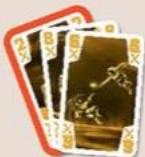
黄色的8和6由于第一张打出的黄色2而被强制追随打出,黄色8数值最高并赢下这一墩。
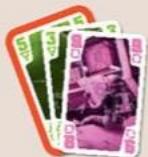
绿色3强制追随套牌。由于5更高所以赢下这一墩。虽然粉色9数值最高但由于没有追随套牌而无法赢下。
在宇航员里,总是需要适当的玩家赢下合适的墩。你真的需要协调合作才能完成任务。
游戏交流
这个游戏的一个重要规则是你不能谈论手中的牌。你不能向其他宇航员展示、说或建议你有哪些牌。但有可能以无线电通信指示物的形式进行通信。你们每个人都有一个无线电通信指示物,每次任务可以使用一次。它可以在一墩之前的任何时候使用,但绝不能在打这一墩牌期间使用。如果你在一次任务尝试中失败,你当然可以在下一次尝试中再次使用它。


如果游戏中有任务卡,你必须先把它们分开,然后才能交流。我们将在第8页解释任务卡。


蓝色3被打了出来。7数值更高所以赢下这一墩。然而①卡是火箭卡王者卡,所以该牌赢下这墩。
第一张牌是③火箭卡,②和④也是被打出来的火箭卡。这墩最高的是④,因此该牌赢下这墩。
信息交流的经验法则:
如果你只因为知道自己的卡牌而懂得些事情,你就不能谈论这些信息。
每次任务尝试,每个宇航员成员最多只能进行一次通
沟通只能发生在任务分配阶段之后,然后每次在一墩开始之前,但决不能发生在一墩期间。
游戏交流
- 放置一张色卡(不能放火箭卡)2. 将无线通信指示物放在卡牌上>顶部 = 最高中间=单张> 底部 = 最低3. 拿1张提醒卡放到你手里
如果你想交流,拿一张你的色卡,正面朝上放在你面前,这样每个人都能看到它。这张牌仍然是你的一套牌的一部分,所以它可以用正常的方式玩。唯一的区别是其他宇航员也都知道你有这张卡。然后将你的无线电通信指示物绿色面朝上放在卡牌上,以便向你的宇航员成员提供更多信息:
〉在顶部代表此牌是你这类色卡最高数值的牌。
〉在中间代表此牌是你这类色卡唯——张牌。
〉在底部代表此牌是你这类色卡最低数值的牌。



你最高的你唯一的你最低的粉色卡黄色卡绿色卡
火箭卡永远无法拿来交流
其中一个条件必须适用;否则,不允许你选择要与之通信的卡。火箭卡永远不允许用来交流!
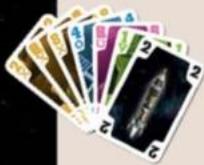
6不能用来交流,因为这张牌既不是最高也不是最低的黄色手牌。火箭卡绝不能用来交流。所有其他卡都可以拿来交流。
如果放置指示物的条件不再正确,则无线电通信指示物的位置可能不会更改。例如,一张交流中的“最高”牌可能成为游戏中的“唯一”牌。然而,无线电通信指示物不能被移动。
放置卡牌和无线电通信指示物后,将其中一张提醒卡放入你的手中。其目的是提醒你,你的通信卡仍在桌面上。如果你打出它,你可以把提醒卡再次放下。执行此操

作时,请将无线电通信指示物翻转到红色那一面,以指示你已在此任务中进行了通信交流。
提醒卡看起来与卡牌两侧的所有其他卡都不同,因此你的宇航员成员可以看到你手里有一张提醒卡。

即使放置无线电通信的条件不再正确,放置这个指示物的位置也不能随意改变。
只要通信卡被打 出,就将提醒卡弃 掉
任务准备
游戏色卡分发给宇航员成员——这是他们用来打出的卡牌。
特定任务卡是指必须在特定墩中赢取的游戏卡。
每次任务前执行以下步骤:
1。把40张大型色卡洗混,正面朝下平均分配给全体宇航员。如果是3人游戏,其中一个人会比其他人多得到一张卡牌。在最后一墩之后,剩下的牌将保持未打出状态。
2。每名玩家将一个无线通信指示物放在自己面前,绿色面朝上放置。给每名玩家派发一张提醒卡作为准备。
3。将求救信号指示物正面朝上放置。
4。洗混36张小卡并将其正面朝下放置作为个隐藏牌堆。将任务指示物放在容易拿取的地方。
拥有4号火箭卡的人获得当前任务的指挥官指示物。指挥官依旧是宇航员的一员。
任务顺序
在大多数情况中你将必须完成某些特定数字的任务。这些任务用任务卡来表示,这些任务卡就是缩小版的色卡。除非一个任务有特别说明,否则宇航员成员会分配这些任务。你可以通过此符号来识别有多少个任务:
日
从任务牌库拿取拿取特定数量的任务卡后,将这些牌正面朝上放在桌子中央。所有与当前任务无关的其他任务卡无需使用。现在查看你的手牌。拥有4号火箭卡的玩家是当前任务的指挥官。这个宇航员成员获得指挥官指示物作为标记。
你们的指挥官通常是从桌子中央第一个选取任务卡并正面朝上放在自己面前的人。然后其他玩家再轮流拿取一张任务卡。

每个宇航员成员同时选取一张任务卡直到所有指定的任务卡都被拿取完为止。每位玩家可能会拿取多张任务卡并且不是所有玩家都会拿到相同数量的任务卡。
在第一个任务中只有一些任务卡。所以不是所有人都会有任务卡并且这些任务往往很快就完成了。

举例:上图的设置和卡牌分配是日志里的第18号任务:Tom拥有④火箭卡。这意味着他是这个任务的指挥官并且第一个选取一张任务卡。他选取了粉色1,因为他手牌有9所以比较容易赢下含有1的墩。Julia和Daniel分别选取了一张蓝色任务卡。Caro只能在绿色和黄色选择,然后他选取了绿色任务卡。因为还有一张任务卡在桌子中央,Tom必须拿取那张剩余的黄色任务卡。这可能不容易完成这张任务,因为他手牌没有任何黄色色卡。

每个任务指定一张必须赢得的色卡。当一个任务的拥有者在一个墩中赢得了相应的色卡时,这个任务就完成了。
当各自任务的所有任务卡都完成时,你们就完成了这关。
如果一个任务不是由对应的任务接受者来完成的,或者一个宇航员成员违反了一条特殊规则,则你们都输了。
指挥官通常开始第1 墩。之后所有的墩都由上一墩获胜的玩家开始。
当宇航员成员赢下匹配自己的一张任务卡的色卡的那一墩时视为完成一张任务卡。他或她将对应任务卡翻面,正面朝下放在自己面前。一个宇航员也可以在同一墩中完成多个任务。只要每个任务都是你拥有的任务就行你成功完成任务后就立即开始下一个任务。成功完成关卡后,你应在日志中输入完成任务所需的尝试次数。
如果一名玩家打出的色卡赢下了另一名玩家对应的任务卡,则游戏立即失败并且从头开始任务。对于每次新尝试来说,你需要重洗所有卡牌,派发给每名成员新的卡牌并分别拿取新的任务卡。
一旦所有任务都被派发完毕,指挥官开始第一墩。接下来的任务中,赢下上一墩的玩家通常开始新的一墩。
某些任务不会使用到任务卡。在这些任务中,指挥官将开始第一墩。


作为指挥官,Tom开始游戏。他用粉色9开始第一墩并希望赢下粉色1。Julia在这墩里打出粉色5。Daniel的手牌没有粉色卡,因此他选择打出一张黄色2。Caro拥有1并在这一墩中打出该牌。Tom打出的牌是这一墩最高数值的卡牌,因此赢下这一墩。他的任务是赢下含有1的一墩,因此他完成这一任务并翻面他的这张任务卡。
让我们开始吧!
你现在知道所有基础规则了并能开始你的第一关了。为此,把这本书翻过来并阅读日志。在第12和第13页,你会找到关于困难程度和帮助系统的信息,此时你需要一些支援。从第14页开始,会有关于新的规则和图标的解释说明。你将在你的日志里遇见它们。从第19页开始会有2人游戏的解释说明。
指挥官通常是拥有4号火箭卡的玩家。指挥官的职责是:1.开始任务卡的选取。
2。开始第1墩。3.执行实施个别特派关卡的特别规

一条善意的建议:不要幻想前面的任务总是容易的。你会发现每一局游戏你都会变得更好,每一次挫折都会提高你对游戏过程的理解和游戏能力。一般来说,随着你的进步,50个关卡变得越来越困难。因此,我们建议你按顺序进行这些关卡。在4人游戏时,仅在第一次任务中,就有超过42万亿种可能的分发色卡方法,在以后的任务中,这个数字甚至更大。因此,由于卡牌的分发,任务可能会变得异常简单或异常困难。请接受这一点-宇宙是无法合作的。宇航员这个游戏的游戏性将根据玩家的数量而有所不同。3名玩家一起玩比和4名甚至5名玩家一起玩的挑战要小一些(见第18页和第21页)。
当你看到你的(剩余的)卡牌时,你也可能会经历这样一种情况:你确信你不能完成任务。别急着和你的宇航员成员交流,或是透露你的手牌。一个细节常常被忽视、遗忘或过于草率地判断。在这样的情况下,简单地进行一轮-这不会花很长时间,你可能仍然会取得胜利。
救援方式:求救信号
当事情变得艰难时,即使在太空中,你也可以指望获得地面团队的支持。在每一关卡开始时,并在分发所有色卡和任务卡(如适用)之后,但在任何宇航员成员通信之前,你可以向地球上的控制中心发送求救信号。为了做到这一点,共同商议决定是否要利用这一援助,然后将求救信号标记转到其激活面(卫星)。
求救信号指示物

然后立即在航海日志中圈出当前任务的求救信号区域。现在每个宇航员成员都要把一张卡牌交给他自己相邻的宇航员成员。火箭卡不能被传递!大家一起商议决定把牌传给左边还是右边。每个人都必须朝同一个方向传递!然后任务开始并遵循标准规则。
在你完成当前关卡之前,求救信号指示物将保持激活状态。无论你需要多少次尝试,在每次尝试开始时,你都可以将一张卡牌向左或向右传递给你旁边的一名宇航员成员。即使你不使用它,指示物也会保持激活状态。只有当你开始一个新的关卡时,你才会将指示物再次转为非激活状态。
求救信号指示物的使用将在你的分数中记录。每次成功通过一个关卡后,你将在日志中输入完成关卡所需的尝试次数。如果你的求救信号区域被圈起来了,你必须把这个数字增加一个。
请自行决定使用此帮助。如果你希望你的冒险总的来说容易一点,你可以在第一次尝试时立即使用帮助。每个任务也可以是不用求救信号指示物就完成了!


日志中的图标解释说明
任务指示物
在报很务关卡中用到任务指示物。每个指
它们指定了各张卡的条件,在完成任务时必须遵守这些条件。
以下是任务指示物:
1
此任务必须第一个完成
此任务必须第
二个完成
3


三个完成
此任务必须第


此任务必须第四个完成

此任务必须第五个完成此任务必须最后完成


这个任务必须在》之前完成
这个任务必须在》之后完成
这个任务必须在》之后完成
这个任务必须在》之前完成
违反任务顺序的条件会立即导致关卡失败。
任务指示物的意思不是该任务必须在第一墩完成——这个任务只需要在所有待完成的任务里第一个完成就行。
这可能会出现在多个含有任务指示物的任务被一名宇航员成员在同一墩里赢下的局面。如果这些任务指示物都是连续的,举例:和,或和,两者都被认为正确完成,不管哪一个先完成。
任务描述显示了要使用多少任务卡和哪些任务指示物。如果你正在使用任务指示物,请首先将指定的任务指示物正面朝上放置在桌子中央。然后抓取任务卡并从左到右放置,然后从第一个任务标记开始轮流放置所有指示物到任务卡上。此时不能将指示物分配给多张卡。

这一关需要用到3张任务卡,并且需要使用指示物1和2。


初始指示物必须彼此相邻放置。


2


然后任务卡会被抓取并彼此相邻正面朝上从左到右排列放置,之后开始放置第一个指示物。
如果指示物是连续的,则可能用同一墩赢得多个含有任务指示物的任务。
设置
- 铺放指示物。2. 从左到右铺开,并从第一个任务指示物开始放置到任务卡上。


任务卡的分发如前所述。如果你带了任务卡,你还必须带上相应的任务指示物。
数字和箭头指示物都指定顺序。与数字标记相比,箭头指示物在完成任务时提供了更大的灵活性:
日红
这个关卡两 卡并且需要指示物1和2。



在这个例子中,首先要赢下蓝色6,然后是绿色3,最后才是粉色①。
日DD
卡张并前头关3卡要箭个要务需个




这里的蓝色6必须在绿色3之前被赢下。无论粉色1是在蓝色6之前,还是在蓝色6与绿色3之间,或者在绿色3之后,都没关系。
通信死角
如果你的关卡有这个图标,你的通讯被中断了,你的通讯也很有限。当你想交流时,把你的色卡放在你面前,就像平常

?
通信死角需要运用直觉,交流卡牌信息,但不要在卡牌上放置无线电通信指示物。
一样。它必须满足三个条件之一(手上的牌中最高的,单张的,或最低的,在色卡套牌中)。但是,不允许你在卡上放置无线电通信指示物。取而代之的是把它翻到红色的一面,放在卡牌旁边。其他宇航员成员现在必须用他们的直觉来决定传递什么信息。
中断
如果关卡显示此符号,你的通信将在短时间内完全中断。这个号码会告诉你在哪一个墩可以再次开始交流。在那之前,没有一个宇航员成员可以拿一张卡进行沟通交流。从命名墩开始,应用常规通信规则。
在这个例子中你无法在这个关卡的前2墩中交流通信。从第3墩开始—换句话说,在第3墩时你们可以再交流。

指挥官的决策
如果某个关卡有这个图标,将特定数量的任务卡正面朝下放在桌子中央。在每位玩家都查看自己手牌后,你的指挥官会问询每位宇航员成员,他们是否认为自己适合承担所有的任务?这个问题只能回答“能”或“不能”。之后你的指挥官

中断只允许从指定的墩开始通信。
如果是指挥官决定,特定宇航员成员必须完成所有任务
在指挥官的分配时,任务卡会平均分配给全体宇航员成员。
当5人游戏时,会有一个额外规则在第25关描述,此时该关卡会有一个黄金边框围绕着这个关卡编号。

会决定某个人实际分配获得的任务卡并翻开任务卡。当宇航员成员都完成了这一关卡的所有任务时视为完成。你的指挥官不能选择他或她自己。
指挥官分配
如果这一关卡有这个图标,你的指挥官会接管任务卡的分发。跟往常一样准备关卡,但不要放置任何任务卡到桌面中央。你的指挥官现在打开一张任务卡,依次询问每个宇航员是否愿意承担任务。这个回答只能是“能”或“不能”。之后你的指挥官决定谁来获得任务卡的分配。他或她也可以选择他或她自己来获得任务卡。然而任务必须平均分配。在分配结束时,不能有任何一人拥有比另一人多于2张以上的任务卡。如果用到了任务指示物,则指示物必须按顺序依附在任务上,换句话说,第一个指示物必须依附第一张任务卡等等。

5人游戏
游戏的基本顺序在五个宇航员的情况下不会改变。但你必须意识到,有了五名玩家这场游戏将面临一个特殊的挑战。最重要的是,在你冒险的后期,它会带来极大的难度增加。但如果你们五个玩家一起玩,肯定能获得永恒的名声。
如前所述,所有规则都适用,对于添加了任务卡的关卡,只有一个附加规则。这些可以从第25关开始使用。作为提醒,所有关卡从25关开始,会在这些关卡编号周围有一个金边作为额外规则。
在你分发了卡牌和任务卡之后,在第一墩开始之前,一个宇航员成员可以将他或她自己的任务卡交给另一个宇航员成员。大家一起商议决定谁交出一张任务卡,谁应该在不透露任何关于你的卡牌信息的情况下接受它。你也可以在关卡27和37中使用此附加规则。
移交任务卡后,其中一名宇航员成员有一个以上的任务,而另一名宇航员成员有一个以下的任务。任务总数不会更改,因此你不能将任务放回牌堆中。使用此附加规则时,不必将日志中的尝试次数增加一次。
2人游戏
宇航员这个游戏最适合的是3名或更多宇航员一起进行游戏。不过,你也可以通过以下关卡结构探索无限广阔的外层空间:
- 将4 张火箭卡放在一旁。
2.使用剩下的39张大型游戏卡,将其中7张牌正面朝下紧密排成一行。然后将另外7张牌正面朝上排成一行放在之前7张盖着的牌的上方。
3.将4张火箭卡与剩余的卡牌洗混在一起,然后正面朝下随机分发给每名宇航员成员,这样每人能获得13张牌。
4.每名宇航员成员分别将一个无线电通信指示物绿色面朝上放在他或她自己面前,提醒卡也分别拿取一张。
5.将求救信号指示物正面朝下放置。
6.洗混36张小型任务卡并正面朝下放置。
将任务指示物放到方便拿取的位置。

当两个玩家进行游戏时,第三个宇航员由贾维斯用14张牌的双排的方式来模拟。
你的指挥官为贾维斯选择任务,为贾维斯打牌。这两件事都是不经讨论就决定的。
当进行2游戏时,指挥官角色也会由拿到4号火箭卡的玩家担任。指挥官的任务依旧不变(最先开始选任务,最先开始第一墩,如果有需要的话,执行某些关卡的特殊规则)。
此外,你的指挥官会扮演贾维斯的角色。贾维斯是一个人工智能系统,它将陪伴你进行冒险。它由两排14张卡牌组成,为每种情况提供解决方案。既然贾维斯是一个没有身体的实体,你的指挥官必须为它做出决定。贾维斯被视为第三名宇航员。然而,在贾维斯的回合,你的指挥官总是决定在这一墩中应该打哪张牌。因此,第二名宇航员不能讨论这个问题。即使在选择任务卡时,你的指挥官也会决定贾维斯将拿取哪些任务。像对待其他船员一样对待贾维斯,决定贾维斯应该“坐”在哪里。

关卡开始时贾维斯游戏区的示例。

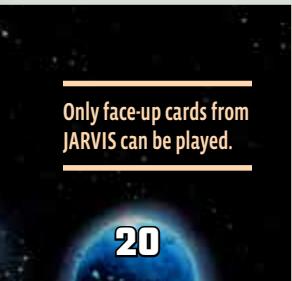
贾维斯只能打出正面朝上的卡牌。当一张正面朝上的卡牌被打出来时,地下的卡牌将被翻开,但只能在这一墩之后翻开,而不是之前。
提示和变体
没有沟通交流其实也是一种沟通方式。这意味着你常常能在毫无沟通的情况下直接尝试赢下你的任务。
大多数情况下很容易赢下一张你手里没有的牌。低值卡尤其如此。
有了火箭,你很容易就能赢得你未拥有颜色的手牌。
别忘了四火箭总是赢一墩,因为这是游戏中最高价值的一张牌。
·能够一次性完成多项任务的机会沙里淘金,请在在选择任务时多多考虑一下。
如果你手里只有一种颜色的八和九,最好把八作为最低的卡牌,而不是九作为最高的卡牌。所以你可以提示的非常清楚-你也有九。
三人挑战
当你在进行3人游戏时想要更高的挑战,可以尝试以下变体:
当设置游戏时,将所有绿色色卡和任务卡以及1号火箭卡放回盒子里。然后如常开始游戏。
使用日志书里的所有特殊规则。
只有第13和第44关受到这种变化的影响,你不会用1号火箭卡赢下1墩。
创建你自己的关卡
如果50关对你来说还不够玩,你也可以自己使用一些配件来设计你自己的关卡。
只需将任意数量的任务和任务指示物与你选择的合起来。
如果你围绕它想一个小故事,你现在就创造了自己的个人冒险!
作者

汤玛斯·辛,1961年出生,住在康斯坦斯湖畔的康斯坦斯镇。几年前,这位研究生经济学家和他的朋友们买了一家大的街角商店。这给了他足够的时间做他的业余爱好:数学,卢普小姐,当然还有发明游戏。
在他的学生时代,汤玛斯辛是卢多(飞行棋前身)的世界纪录保持者,因此进入了吉尼斯世界纪录。
《宇航员》是他为Kosmos设计的第一款游戏。这是一款引人入胜的、完全原创的方式,将受欢迎的吃墩游戏和合作游戏结合在一起的游戏。

Crew_Manual_TK.md35.4 KB
THE CREW THE QUEST FOR PLANET NINE
RULEBOOK
Game Materials..
Game Overview
Communication
Mission Preparation & Sequence...
Degree of Difficulty & Distress Signals 12
Symbols & Tokens.
Playing with Five Players 18
Playing with Two Players 19
Tips & Variants. 21
Author & Imprint.. 22

Astronauts wanted! Scientists say there is a mysterious ninth planet located at the edge of our solar system. But despite all of their efforts, so far they have been unable to provide substantial evidence of its existence. Join this exciting space adventure to find out if the theories are just science fiction or if you will discover Planet Nine.
In this cooperative trick-taking game you need to complete 50 different missions. But you will only succeed if you can work together as a team. To master the challenges and achieve your mission, communication will be essential — but in space, things can be more difficult than you expect .
GAME MATERIALS
The Crew is a cooperative, mission-based trick-taking game. What does this mean?
Cooperative
You win together, or you lose together — only if each of you is successful, and you help each other, will you be able to complete the missions and win the game.
Mission-based
Your journey spans 50 different missions, each with a unique win condition, which you play through consecutively as a cohesive story. But you can also play the missions out of order if that is your preference. The missions can be found in the logbook at the end of this rulebook.
You will probably not be able to play through this adventure all at once. Therefore, it is best to get together on several different occasions to play through all of the missions. The first few missions rarely take more than five minutes to complete. However, later on, you will need more time for each individual mission, as they get progressively harder.
Trick-taking game
All of the cards are distributed to “The Crew” (the players), and then, in turn order each player plays one of his or her own cards face up in the middle of the table. This playing of one card by each is called the “trick." The player who places the card with the highest value wins the trick, but only if that player has followed suit.
There are five card suits: pink, blue, green, yellow, and rocket cards. Following suit means that each player must “follow” the suit choice of the first player; i.e., you have to play a card of the same type. Only if you do not have a card of this suit may you play a card of a different suit.
ATTENTION
If you cannot easily distinguish between the colors of the cards, you can use these four symbols instead:

Each color of the eards has also been assigned a symbol.
The Crew offers you a story, but you can just as easily play missions of your choice, because no two attempts will work out the same way. Play the way you enjoy the most.
This column contains a brief and concise overview of the most important rules — so you can quickly find your way back into the game after a long break.
In éach round, each crew member plays a card in a clockwise order. These cards make up the trick. The highest card played wins the trick.
The initial card played sets the suit that must be played for each trick. This is applicable for both color cards and rocket cards.
If a suit cannot be followed, then any card of your choice can be played.
Only cards of the designated suit can win the trick, unless they are rockets. You are not required to win a trick.
Rocketsare trump cards and win in any trick. If there are several rockets in a trick, the rocket card with the highest value wins the trick.
Tricks that are won are set aside face down; only the last trick can be looked at.
However, the trick can only be won with cards that have followed suit. The card with the highest numeric value in the designated suit wins the trick. A trick that has been won is set aside face down. You may only take a look at the cards from the trick won most recently.
During a trick, there is no mandate to play a specific card. If you have multiple cards that you can play, you may play a low card, even though you would have been able to win the trick with a higher card. In other words, you are not forced to win the trick.
The rocket cards are trump cards. This means that they always win the trick, no matter which other cards are in play. During a color-suited trick, a rocket may only be played if a card in the color suit cannot be played. If a rocket card is played first, this will establish the suit and must be followed if possible. If several rockets are in contention, the one with the highest value wins.
The following examples show which card type (or suit) has to be played – i.e., which card was first played in the trick:

The yellow 8 and 6 were played following the suit established by the first card played, the yellow 2. 8 is higher and thus wins the trick.
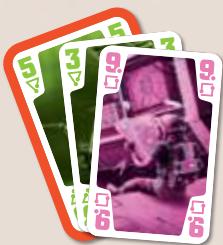
The green 3 establishes the suit. 5 is higher and thus wins the trick. Because even though 9 had the highest value it did not follow suit and thus cannot win.
In The Crew, it's always about the right players winning the right tricks. You're really going to need to coordinate to accomplish the mission.
Communication
An important rule in this game is that you cannot talk about the cards in your hand. You are not allowed to show, say or suggest to other crew members which cards you have. But there is a possibility of communication in the form of radio communication tokens. Each of you has one radio communication token, which can be


used exactly once per mission. It may be used at any time before a trick, but never during it. If you fail in a mission attempt, you may of course use it again during the next attempt.
If there are task cards in the game, you must first divide them among you, before you can communicate. We will explain task cards on page 8.

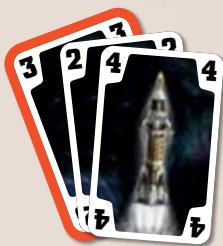
The blue 3 was played.7 is higher and would win the trick. However the card is a rocket card, and rocket cards are trump cards, so it wins the trick.
The first card played was the ③ of rockets. As such ② and both played rockets as well. The highest rocket in the trick is the ; therefore it wins the trick.
Rule of thumb for the exchange of information:
If you know something only because you know your own cards, you are not allowed to talk about this information.
The maximum is one communication per crew member per mission attempt.
Communication can only happen after the task distribution phase and then every time before a trick begins, but never during the trick.

Communication:
-
Lay out one color card (no rocket cards)
-
Place the radio communication token > Top = highest > middle = single > bottom = lowest
-
Take a reminder card into your hand

Rocket cards can never be communicated.
If you want to communicate, take one of your color cards and put it face up in front of you so everyone can see it. This card remains part of your set of cards, so it can be played in the normal way. The only difference is that every other crew member now knows you have this card as well. Then place your radio communication token with the green side up on the card to give your crew members even more information:
At the top, if it is your highest card of this color.
In the middle, if it is your only card of this color.
At the bottom, if it is your lowest card of this color.
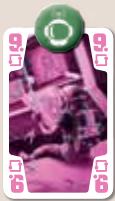
Your highest pink čard

Your only, yellow card

Your lowest green card
One of these conditions must apply; Otherwise, you are not allowed to choose that card to communicate with. Rocket cards may never be communicated!

6cannot be communicated, as it is neither the highest nor the lowest, nor is it the only yellow card in the hand. The rocket may never be communicated. All of the other cards can be communicated.
The placement of the radio communication tokens may not be changed if the statement is no longer correct. For example, a communicated “highest” card may become the “only” card during the game. Nevertheless, the radio communication token may not be moved.
After placing a card and radio communication token, take one of the reminder cards into your hand. Its purpose is to remind you that your communicated card is still on the table. If you play it, you can put down the reminder

card again. When you do this, flip the radio communication token to the red side to indicate that you have already communicated in this mission.
Reminder cards look different from all other cards on both sides of the card, so your crew members can see that you have a reminder card in your hand.

The placement of the radio communication tokens must not be changed, even if the statement is no longer accurate.
Reminder cards are discarded as soon as the communicated card is played.

Playing cards are distributed to the crew members — these are used to play with.
Task cards specify which playing card must be won in a specific trick.
Whoever has the four rocket gets the commander token for the current mission attempt. The commander is still a member of the crew.
MISSION PREPARATION
Carry out the following steps before each mission:
-
Shuffle the 40 large playing cards and distribute them face down and equally to all crew members. If there are three of you playing, one person will get one more card than the rest. After the last trick, the card that is left remains unplayed.
-
Each person puts a radio communication token with the green side up in front of himself or herself. Put a reminder card for everyone at the ready.
-
Place the distress signal token face down.
-
Shuffle the 36 small task cards and put them down as a concealed pile. Keep the task tokens handy.
MISSION SEQUENCE
In most missions you will have to fulfill a certain number of tasks. These tasks are indicated with task cards, which are smaller versions of the color cards. Unless a mission dictates otherwise, crew members divide mission tasks among themselves. You can discern how many tasks there are by means of this symbol: 4
Take the specified number of task cards from the task card deck and place them face up in the center of the table. All other task cards are not required for carrying out the current mission. Now look at the cards in your hands. Whoever has the four rocket announces this and is the commander for the current mission. This crew member receives the commander token as a reminder.
Your commander will always be the first to choose a task card from the center of the table and place it face up in front of himself or herself. Then everyone else will take a task card.
Each crew member selects a task card one at a time until all the tasks have been distributed. Each player could get several tasks and not all players will necessarily have the same number of tasks.
Task cards are divided clockwise among the crew members, starting with the commander.
In the first missions there are only a few tasks. Not everyone will have a task and the tasks are often played out quickly.
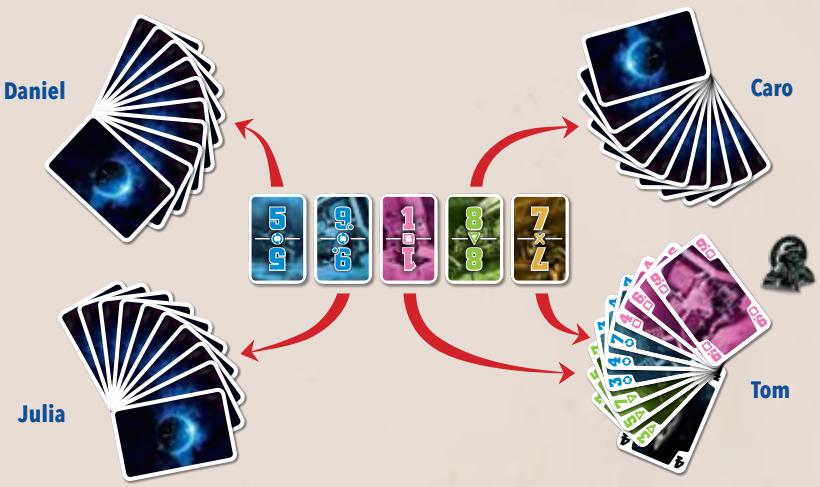
Example setup and card distribution for mission 18 in the logbook: Tom has the rocket. This means he is the commander for this mission and will be the first to choose one of the task cards. He chooses the pink 1, since he has the pink 9 in his hand and the pink 1 should be easy to win. Julia and Daniel each choose a blue task. Caro only has the choice between green and yellow and decides to play green. Since there is still a task in the middle, Tom has to take the remaining yellow task card. It won't be easy to fulfill this task since his hand does not contain any yellow cards.

Each task specifies a playing card that must be won. A task is fulfilled when its owner wins the corresponding playing card in a trick.
When all the tasks of the respective mission are fulfilled, you have completed the mission.
If a task is fulfilled by a crew member who does not possess the appropriate task card or if a crew member violates a special rule, you have lost.
The commander always starts the first trick. All further tricks are started by the person who won the previous trick.
A task is fulfilled when a crew member wins a trick containing the playing card matching one of his or her task cards. He or she then turns the corresponding task card over, face down in front of himself or herself. A crew member can also fulfill several tasks with the same trick. As soon as each one of you has completed your own tasks, you have completed the mission successfully and can start the next mission immediately. Upon the successful completion of a mission you should enter in the logbook how many attempts you needed to complete that mission.
If a player wins even a single playing card for which another player has the corresponding task card, you lose immediately and have to restart the mission from the beginning. For each new attempt, you reshuffle all the cards, deal each crew member new cards, and receive new tasks.
Once all the tasks have been distributed, the commander starts the first trick. And then for the remainder of the mission attempt, the person who won the previous trick always starts the next trick.
Some missions do not use task cards. During these missions, the commander will start the first trick.


As commander, Tom starts the game. He opens the first trick with his pink 9 and hopes to win the pink 1. Julia plays a pink 5 in the trick. Daniel does not have any pink cards in his hand and therefore plays a card of his choice: the yellow 2. Caro has a pink 1 and plays it in the trick. Tom has the highest value of the pink cards played and thus wins the trick. His task, to win the pink 1, is thereby fulfilled and he turns over his task card.
LET'S GO!
You now know all the basic rules and can start with your first mission. To do so, flip this book over and read the logbook.
On pages 12 and 13, you will find information about the degree of difficulty and a help system, in case you need some support. Starting from page 14, new rules and symbols are explained. You will come across them in your logbook. Starting on page 19, the game is explained for playing with two players.
The commander is always the player with the four rocket. The duties of the commander are: 1. start the selection of the tasks
-
start the first trick
-
implement the special rules of individual missions
A distress signal can be sent out before the first trick of a mission. The distress signal token is turned to its active side and the distress signal field is circled in the logbook.
If the distress signal is activated, each crew member may pass one card to his neighbor. Rockets may not be passed on!
DEGREE OF DIFFICULTY
A well-intentioned piece of advice: Do not be under the illusion that the tasks ahead are always easy. You will find that with every game you get better and every setback improves your understanding of the processes and your ability to play the game. In general, the 50 missions get increasingly more difficult as you progress. We therefore recommend that you play them in order. With four players, in the first mission alone there are over 42 trillion possible ways that the cards can be distributed and in later missions the number is even greater. It can therefore happen that a mission proves to be surprisingly simple or unexpectedly difficult due to the card distribution. Accept that — the universe does not cooperate. The gameplay of The Crew will vary depending on the number of players. Playing with three players will be a smaller challenge than playing with four or even five players (see pages 18 and 21).
You may also experience a situation when looking at your (remaining) cards where you become convinced that you cannot accomplish the mission. Withhold the urge to communicate this to your crew members or to reveal your cards. Far too often a detail is overlooked, forgotten, or too hastily judged. In such a situation, simply play out the round — it won't take long, and you may still emerge victorious.
HELP MECHANIC: DISTRESS SIGNALS
When the going gets tough, you can count on the support of your ground team even when you're in space. At the beginning of each mission, after distributing all of the playing cards and, if applicable, task cards, but before any crew member communicates, you can send a distress signal to the control center on Earth. In order to do so, decide together whether you want to make use of this assistance, then turn the distress signal token to its active side (satellite).
Distress signal token


Then immediately circle the distress signal field of the current mission in the logbook. Each crew member now has to hand over one of his or her cards to his or her neighbor. Rocket cards cannot be passed on! Decide together if you will pass the cards to the left or the right. Everyone has to pass in the same direction! Then the mission starts and follows the standard rules.
The distress signal token will remain active until you complete the current mission. No matter how many tries you need, at the beginning of each attempt you can pass a card to the left or to the right to a crew member next to you. Even if you don't use it, the token remains active. Only when you start a new mission do you turn the token over again to inactive.
The use of the distress signal token will be noted in your score. After each successful mission, you will enter in the logbook the number of attempts that you needed to complete the mission. If your distress signal field is circled, you must increase this number by one.
Use this help at your own discretion. If you want your adventure to be a bit easier overall, you can use the help immediately on your first attempt. Each mission can also be completed without the use of the distress signal token!
Either all crew members have to pass on a card or none, and all have to choose the same direction.
Rockets are never passed on.
The distress signal token remains active until the current mission is completed and increases the number of attempts for this mission by one.
ALL missions can be completed without the distress signal. Are you up to the challenge?

EXPLANATION OF SYMBOLS IN THE LOGBOOK
Task tokens
In many of the missions, task tokens are used. Each token is then assigned to a task card. These specify the conditions for the respective card, that must be observed while fulfilling the task.
There are the following task tokens:

The task must be fulfilled first.


The task must be fulfilled second.


The task must be fulfilled third.

The task must be fulfilled fourth.

The task must be fulfilled fifth.


The task must be fulfilled last.
The task must be fulfilled anytime before 》>.

The task must be fulfilled anytime after .
The task must be fulfilled anytime after 》.
The task must be fulfilled anytime after》》>.
Violating the task order condition will immediately cause the mission to fail.
The task token1does not mean that the task must be fulfilled in the first trick — it only has to be fulfilled first out of all the pending tasks.


It can happen that several tasks with task tokens are won by a single crew member in the samę trick. If these taşk tokens are consecutive, for example,1and2,orand , both are considered to have been correctly fulfilled, regardless of which was played first.
The mission description shows how many task cards and which task tokens are to be used. If you are playing with task tokens, first place the indicated task tokens face up in the center of the table. Then draw the task cards and place them from left to right, starting with the first task token. No token may be assigned to more than one card.
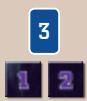
The mission specifies to use three task cards as well as task tokens one and two.
2
Initially the tokens have to be placed next to each other.

2


Then the task cards are drawn and are placed next to each other, face up from left to right, starting with the first token.
It is possible to win multiple tasks with task tokens in the same trick if the tokens are consecutive.
Set up:
- Lay out the tokens 2. Lay out the tasks from left to right starting with the first task token



The distribution of the task cards happens as previously described. If you take a task card, you must also take any corresponding task token.
Number and arrow tokens both specify an order. Arrow tokens give you more flexibility in fulfilling your tasks than the number tokens:

This mission requires three task cards and task tokens one and two.



In this case, first the blue ⑥, then the green ③, and finally the pink 1 must be won.


This mission requires three task cards and the first two arrow tokens.


Here the blue 6 must be won before the green 3. Whether the pink 1 is won before the blue6, between the blue 6 and the green 3, or is won after the green 3, does not matter.
Dead zone
If your mission shows this symbol, your communications have been disrupted and you only have limited communication. When you want to communicate, place your card in front of you as you normally

would. It must meet one of the three conditions (highest, single, or lowest of the cards in your hand, in the color suit). You are not however, allowed to place your radio communication token on the card. Instead flip it over to the red side and put it next to the card. The other crew members must now use their intuition to decide what information is being transmitted.
Disruption
If a mission shows this symbol, your communication is completely interrupted for a short period of time. The number will tell you during which trick communication can begin once again. Until then, no crew member can communicate about a card. Starting from the named trick, regular communication rules apply.
In this case you cannot communicate during the first two tricks of the mission. Starting with the third trick – in other words, directly before the third trick – you may start communicating again.

Commander's decision
If a mission displays this symbol, place the specified number of task cards face down in the middle of the table. After each player has reviewed their cards, your commander asks each crew member, whether they see themselves fit to take on all of the tasks. It may only be answered with “yes” or “no.” Afterwards, your commander decides who

The dead zone requires the use of intuition. Communicate a card, but do not place a rádio communication token on it.

The disruption only permits communication starting from the specified trick.

In case of the
commander's decision, the crew member
specified must fulfill all tasks.


actually receives the assignment and reveals the task cards. The mission is fulfilled when the crew member has completed all the tasks. Your commander may not choose himself or herself.
Commander's distribution
If a mission displays this symbol, your commander takes over the distribution of the task cards. Prepare the mission as usual, but do not place any task cards open in the middle of the table. Your commander now uncovers a task card and asks each crew member in turn whether he or she wants to take

on the task. It may only be answered with “yes” or “no.” Afterwards, your commander decides who actually receives the assignment. He or she can also choose himself or herself. Repeat the process until all of the tasks are distributed. Note, however, that the tasks must be evenly distributed: At the end of the distribution, no one may have two tasks more than another crew member. If task tokens are in use, they must be distributed with the task cards; i.e., the first task token with the first task card, etc.
PLAYING WITH FIVE PLAYERS
The basic sequence of the game does not change with five crew members. But you must be aware that with five players, the game presents a special challenge. Above all, in the later stages of your adventure, it brings an enormous increase in the degree of difficulty. But if you are playing with five players, eternal fame is certain.
All rules apply as previously described, there is only one additional rule for missions with task cards added. These may be used from mission 25 onwards. As a reminder, all missions from 25 on, where this additional rule applies, have a golden border around their mission numbers. After you have distributed the playing cards and the task cards and before the first trick starts, one crew member can hand over his or her own task card to another crew member. Decide together who hands over a task card and who should take it on without revealing anything about your cards. You may also use this additional rule in missions 27 and 37.
After handing over the task card, one crew member has one more task and one member has one less than before. The total number of tasks does not change, so you may not place a task back on the stack. You do not have to increase the number of attempts in the logbook by one when you use this additional rule.
PLAYING WITH TWO PLAYERS
The Crew is best when played with a crew of three or more. Nevertheless, you can also explore the infinite vastness of outer space with the following mission structure:
-
Put the four rocket card aside.
-
With the rest of the 39 large playing cards, put seven face down in a row, one next to another. Then put an additional seven cards face up in a row on the first seven covered cards.
-
Shuffle the four rocket in with the remaining cards and distribute these face down and evenly among both of the crew members, so that each has 13 cards.
-
Each crew member puts a radio communication token with its green side up in front of himself or herself, as well as a reminder card
-
Place the distress signal tokens face down.
-
Shuffle the 36 small task cards and display them as a face-down stack. Keep the task tokens handy.
When playing with two players, a third crew member is simulated by JARVIS, by means of a double row of 14 cards.
When playing with two players, the commander role is also carried out by the player with the four rocket. The tasks of the commander remain unchanged (starts the task selection, starts the first trick, and, if necessary, follows any special rules of the missions).
Your commander chooses the tasks for JARVIS and plays the cards for JARVIS. Both of these things are decided without any discussion.
Additionally, your commander takes over the administration of JARVIS. JARVIS is an artificial intelligence system that will accompany you on your adventure. It is represented by the double row of 14 cards that offer solutions to each situation. Since JARVIS is an entity without a body, your commander must make decisions for it. JARVIS is treated as a third crew member. However, during JARVIS' turn to play, your commander always decides which of the open cards should be played in the trick. The second crew member cannot thereby discuss it. Even when choosing the task cards, your commander will decide which tasks JARVIS will take. Treat JARVIS just like any other crew member and decide where JARVIS should “sit.”

Example of JARVIS' play area at the beginning of a mission.
Only the face-up cards from JARVIS can be played. when a face-up card has been played, the card below will be revealed, but only after the completion of the trick and not before.

TIPS AND VARIANTS
• No communication is also communication. This means that often, you can directly attempt to win your tasks, when no one communicates.
Most of the time it is easier to win a card that you don't have in your hand. This is especially true for the low-value cards.
• With rockets, you can easily win cards of a color you do not have in hand.
• Don't forget that the four rocket always wins a trick, as it is the highest card in the game.
• Being able to fulfill multiple tasks in one go is worth gold. Consider this when choosing your tasks.
• If you only have the eight and the nine of one color in your hand, it is preferable to communicate the eight as the lowest card instead of the nine as the highest. So you can make it clear that you also have the nine.
Challenge for Three
If you want a greater challenge for three players, try the following variant:
• When setting up the game, return all green playing cards and task cards as well as the rocket card with the value of one to the box. Then start playing with the usual rules.
All special rules for the missions in the logbook apply.
• Only missions 13 and 44 are affected by this change. You do not have to win a trick with the rocket card with the value one.
CREATE YOUR OWN MISSIONS
Jn case 50 missions are not enough for you, you can also design your own missions with the material.
Simply combine any number of tasks and task tokens with any special rules of your choosing.
If you then think up a little story around it, you have now created your own personal adventure!
THE AUTHOR

Thomas Sing, born in 1961, lives in the town of Constance on Lake Constance. Some years ago, the graduate economist bought a large corner store with his friends. This gave him enough time for his hobbies: mathematics, Miss Lupun, and of course, inventing games.
During his schooldays, Thomas Sing was a world record holder in Ludo and thus made his way into the Guinness Book of Records.
His first game for Kosmos, The Crew, has brought together the popular worlds of trick-taking games and cooperative games in a fascinating and entirely original way.
The author and publisher would like to thank all the play testers and rüles reviewers who were there in the beginning for the contributions that made The Crew what it is today. This applies in particular to Marco Armbrustér, Wolfgang Schmidts, and the Kosmos editorial team.
A special thank you goes to Klaus; Ralf, and Volker, who were always ready to explore the depths of the universe.
Author: Thomas Sing Illustration: Marco Armbruster Graphics: Sensit Communication Editing: Kilian Vosse, Wolfgang Lüdtke English edition editing: Ed Gartin, Tom Wetzel, and Ted McGuire
© 2019 Franckh-Kosmos
Verlags-GmbH & Co. KG
Pfizer Street 5-7, 70184 Stuttgart
Telephone: +49 711 2191-0
Fax: +49 711 2191-199
info@kosmos.de
kosmos.de
Art. No.: 691868 © 201g Thames & Kosmos, LLC,
Providence, RI, USA
Thames & Kosmos® is a registered trademark of Thames & Kosmoš, LLC. All rights reserved.
Distributed in North America by Thames & Kosmos, LLC.
Providence, RI 02903.
Phone: 800-587-2872
Web: thamesandkosmos.com
Distributed in United Kingdom by Thames & Kosmos UK LP. Cranbrook, Kent TN17 3HE. Phone: 01580 713000 Web: www.thamesandkosmos.co.uk
All rights reserved Made in Poland
下载 Markdown原文为社区整理/出版社公开资料,版权归原作者,仅供个人学习查阅。