
1860
At a glance
Rules, cards and Q&A (Chinese)
The rules, card data and player questions for this game are written in Chinese. Open the Chinese page to read them.
Where to find full rules
Full rules and card lookup are available in the cunlema app at cunlema.cn — pick this game and ask about any rule, card or turn you are unsure about.
Related games
Rulebook text (Markdown)
This game has 1 rulebook Markdown file(s) in our library; 1 rendered inline below — expand to read or download.
1860 Rules.md73.9 KB
introduction
Railways on the Isle of Wight were always a triumph of public service over pro!tability. "e !rst railways on the Island were partly built in response to Queen Victoria’s love of Osborne House, and ran from Cowes to Newport, and from Ryde to Ventnor down the east coast. Work started in 1860, as an odd collaboration of the South of England’s bitter rivals, the LSWR and LBSC. Further lines were built by local companies, o#en with high hopes. Eventually trains ran from Ryde to Ventnor, Freshwater to Newport, Cowes to Ryde via Newport, Newport to Sandown, and Merstone to Ventnor (the most picturesque line on the Island). A branch line from Brading to Bembridge was added to the main East Coast line. "e Southwest of the Island was never connected to the network, as the terrain and lack of prospective tra\$c made this region unviable. A proposal to build a line down the southwest coast was forwarded in the 1880s, but the line was never built.
Life was always going to be di\$cult for the companies on the Island. "e majority of materials required had to be imported from the mainland, using one of the three main ferry routes. "e island was (and is) dotted with di\$cult geology. Tra\$c was also sporadic, as the majority of the population lived on the east coast or in Newport, and the winter months rarely provided enough revenue for the companies to survive. "ree of the island’s railways foundered before the First World War. One of them (the Freshwater, Yarmouth & Newport) even went bankrupt twice, and yet still managed to survive. When the massive Southern Railway conglomerate swallowed the LSWR and LBSC in the 1920’s, much of the island’s network survived, only to be shut down in the face of burgeoning maintenance costs, and competition from the Bus companies a#er nationalisation. Today only the old Eastern line is still run commercially; the Cowes - Newport - Ryde line survived until the 1960’s, but the western, central and southern lines were closed down much earlier. Part of the Newport - Ryde line has now re-opened as a working museum, with the main station in Havenstreet.
historical note
"e game does not re%ect history. "e network of railways that are likely to be built in the game far outstrip those that were built in real life. However, all of the stations that featured on the island’s railways are represented in the game, as are some villages that were never connected to the network: Shalcombe, Shorwell, Chale, Chale Green, and Norton Green on the new map. East Cowes is included, although it never had a station, Totland has been added to the new map, which inexplicably missed out on an extension line from Freshwater, despite having the largest population on the western side of the island.
All but two of the companies are historical. "e Cowes & Newport railway quickly merged with the Ryde & Newport railway to form the Isle of Wight Central railway, and these form one company in the game. "e two non-historical companies are the S&C and VY&SC. "e Ventnor, Yarmouth & South Coast is meant to represent the company planned to run along the south-west coast mentioned above. "e Shanklin and Chale was planned as the fourth company to service the island, the previous three being the Isle of Wight (Eastern), the Cowes & Newport, and the Ryde & Newport. A#er major !nancial di\$culties the plans were shelved, and the Isle of Wight (Newport Junction) was built instead, ostensibly in competition with the east coast railway for holiday tra\$c. Unfortunately the resulting company was so beset by !nancial di\$culties and technical incompetence that it took ages to complete, and failed a#er only a year of opening. It merged with the Isle of Wight Central. A similar fate awaited the Newport, Godshill & St. Lawrence Railway.
components
• Double-sided game board.
• Hexagonal track tiles in three colours - Yellow, Green, & Russet.
• 5 Private company certi!cates (Brading, Yarmouth, Cowes, Ryde Pier, Fishbourne Ferry).
• Certi!cates, company charters, and tokens for 8 railway companies.
• Train cards, representing trains of di&erent sizes (2+1 up to 9+5 trains).
• Insolvency, Bankruptcy, and “No Director” cards.
• Money: £10,000 in denominations: £1, £2, £5, £10, £20, £50, £100, £500.
• Company Credits: 5,000 in denominations: 10cc, 20cc, 50cc, 100cc. Treat the number of credits as unlimited – if you run out, use a suitable alternative.
• "ese Rules.
• 6 black cubes are also provided for use with the separate expansion 1860: Locomotives of the Isle of Wight.
the ‘18xx’ series
1860 is part of a series of games, all based on an original game, called 1829, by Francis Tresham. "ere are many games in this series which have been published over the years, including 1830, 1853, 1835, 1856, 1870, 1825, and 1861. "e object of the game is to gain wealth by investing in railway companies, which then build railway networks to gain revenues for their shareholders.
As with all the games in the series, it is important for players to avoid slow play and so detract from the enjoyment of other players.
the second edition
A few changes were made in the second edition of this game. "ese are a result of feedback from players, and more extensive playing than was previously available before the !rst edition was printed. Notes on how to play the original game are included at the end of these rules.
"e purpose of the changes is to simplify game play and provide greater opportunities to develop the western half of the board. "ey consist of an alternative board with three additional hexes, two additional russet tiles for use with this board only, and one rule change.
the third edition
"is third edition of the game should functionally be no di&erent from the second edition. "ese rules do now include some additional rule clari!cations which have been kindly highlighted by player feedback. Note that the stickers in this edition include one white-background sticker per company. "ese are intended to be used for the company home station, to di&erentiate this from other tokens and ease play.
the map
"ere are two sides to the map. One side contains three extra hexes, including Totland on the east of the island. "is map is recommended for 3-4 players. "e other side is the original map, and is better for 2-3 players.
Original map (best with 2-3 players)

Extended map (best with 3-4 players)
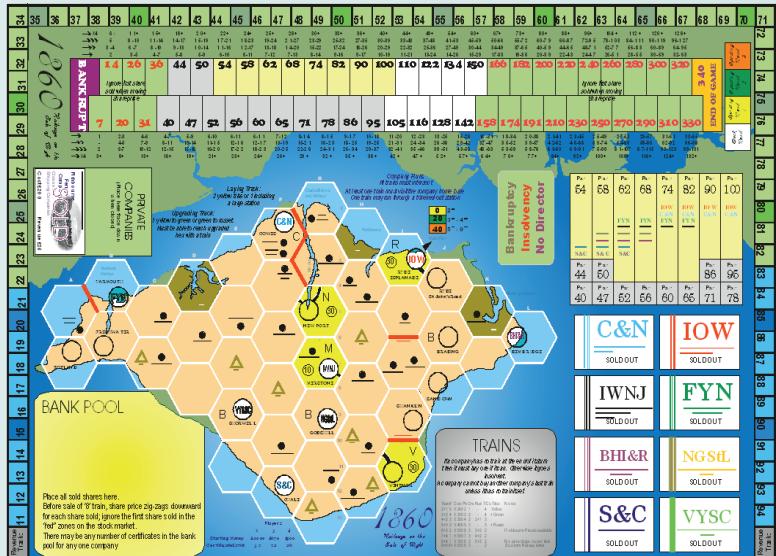

When using the original map, remove one #776 tile, and one #770 tile.

In this way, you should use two #776s with the original map and three with the extended map. Similarly you should use one #770 tile with the original map, and two with the extended map.
"e map depicts the Isle of Wight, in the English Channel. "e map is divided into a number of hexes on which railway track tiles may be placed.
"e region outside these hexes is either sea or non-buildable land.
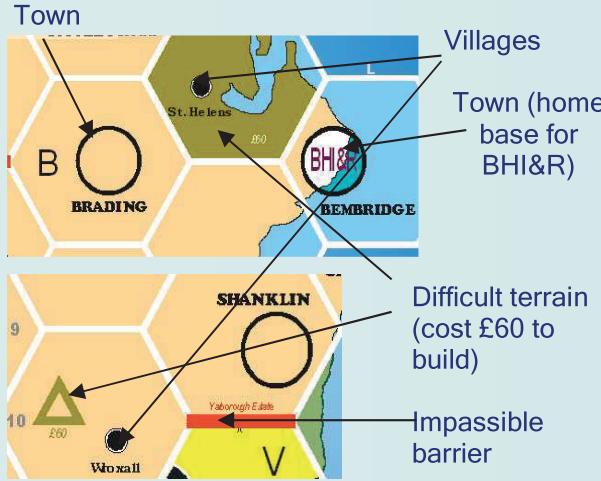
Towns are marked with a large circle. Each town which is also the home base for a company has the initials of the company marked within the circle. Villages are marked with a black dot.
"ere are three/four thick red border areas on the board, which form impassible barriers. "e northern one is the river Medina. Ok, it wouldn’t have cost too much to build a bridge across it, but no one bothered so you can’t in this game. "e second is just south of Ashey village, and represents Arreton Down - a high ridge which is much easier to build round than through. "e third border is a little more obscure. It represents land belonging to the Earl of Yarborough, who forced the IOW (Eastern) railway to run a tunnel south-westward in order to connect to Ventnor. Obviously he didn’t want trains in his back yard... "e last appears in the larger board only, representing the river Yar next to Yarmouth
Hilly areas are marked with a triangle. One can’t really call them mountains. "ese represent areas where the geology is di\$cult, and where the tunnel was required to connect to Ventnor via Wroxall. "ere are also three other areas which also count as di\$cult terrain, at St. Helens, Fishbourne, and north of Calbourne around the Newtown river.
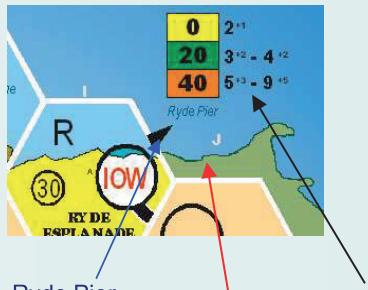
Ryde Pier trains run to here
Non-buildable land
Ryde Pier is a special stretch of railway which runs seawards from the north coast. "e pier houses a railway which runs from one end (the ferry terminal) to the other (Ryde Esplanade). At the start of the game this railway is not connected to the network. Once Ryde Esplanade has been upgraded, trains may run to Ryde Pier as though it were a large station. "e value of the station shown on the board (0, 20, or 40) changes when new colour tiles become available.
Payout chart for Ryde Pier: initially zero, then 20, then 40
setting up the game
First choose which side of the board you wish to use. "en place the board in the centre of the playing area. Put the company shares in 8 piles on the Initial Purchase O&er (IPO) chart, one per company, with the director’s share at the top. One share of four of the companies (IOW , C&N , FYN , BHI&R) is reserved for use by the owners of the four initial private companies. "e names of the companies are printed on the certi!cates. "ese certi!cates should be placed at the bottom of the corresponding pile of shares.
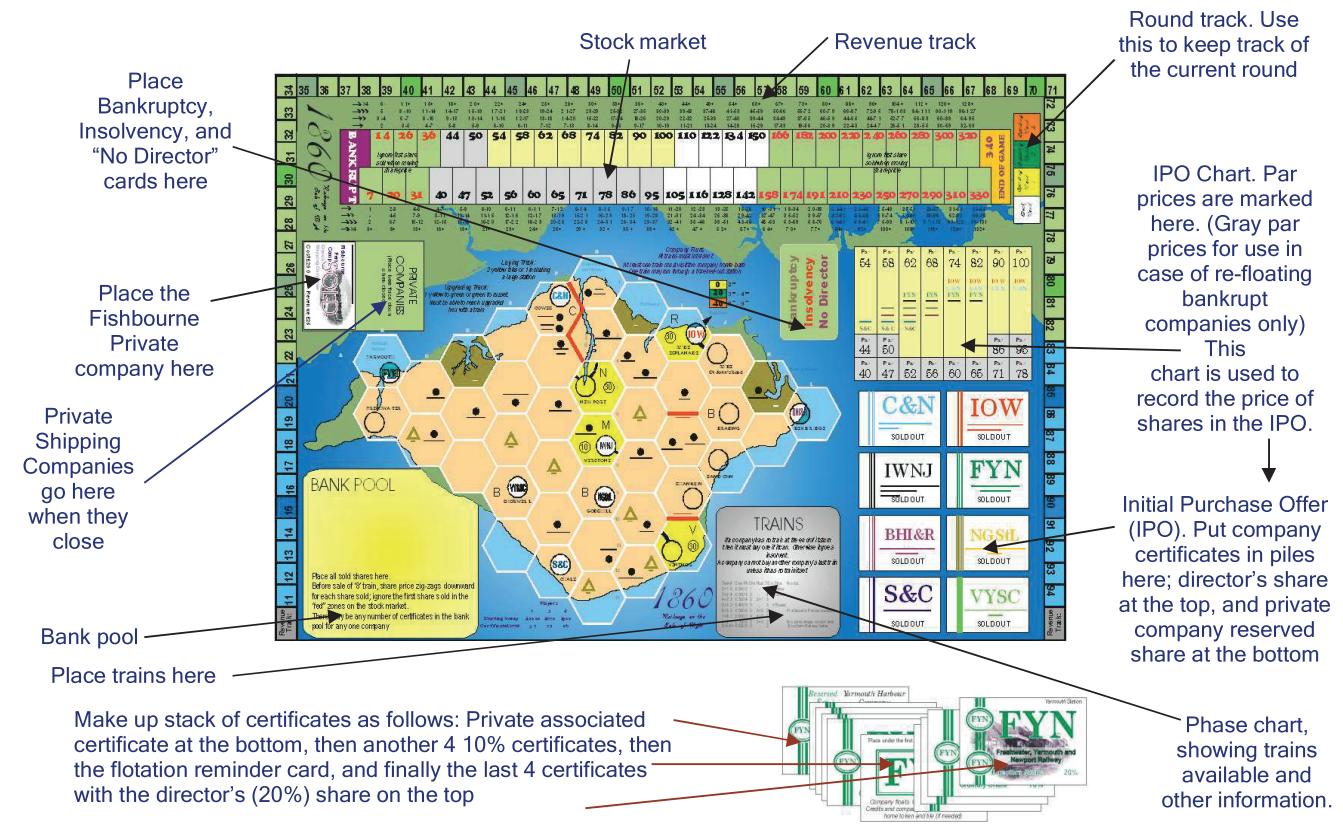
Place the Fishbourne Ferry private company certi!cate on the marked space on the board. "e remaining private companies, and the director’s shares of the IOW and C&N companies can be placed in the middle of the table, ready for the initial auction which will start the game.
Stack the trains in a single pile in order (2+1 at the top, 9+5 at the bottom), and place on the board:
"e bank pool is used to hold shares that have been sold by players. It will initially be empty. Along the edge of the board is a revenue track which will be used at the end of the game. One token from each company should be placed at the start of this track at the start of the game.
"e stock market is used to track share prices. More details on this are given later.
Nominate a player as the banker. "e banker takes all the cash and company credits, and orders them by denomination so he/she has easy access to them.
starting money
At the start of the game each player receives money from the bank as follows:
• 2 players: £1000
• 3 players: £670
• 4 players: £500
"e game then continues with the initial auction of private companies.
private companies and the initial auction
"ere are four ‘Private’ ferry companies in play at the start of the game:
• Ryde Pier & Ferry Company
• Cowes Marina & Ferry Company
• Yarmouth Port & Shipping Company
• Brading Harbour Company
"e banker takes these four certi!cates, and also the director’s shares of the IOW and C&N railway companies, and places them all in the middle of the board. "ese six certi!cates are now auctioned o& amongst the players, one at a time. "ere will be six auctions, one for each certi!cate on o&er.
"e player to the le# of the banker starts the bidding in the !rst auction. Bidding then continues clockwise. "e minimum bid is £5. On his/ her turn, a player must either raise the current highest bid by at least £5, or must pass. If a player passes, he/she then sits out the remainder of the current auction, but may participate in subsequent auctions. A player may only bid money he/she has in hand, and may not bid if, by winning the auction, he/she would be unable to pay for the cheapest of the certi!cates on o&er.

A bidder wins an auction if all other players have passed in the auction. "e winning player then pays the money he/she bid to the bank, and chooses a certi!cate from those le# in the middle of the board. "e player must then pay the value of the certi!cate to the bank in addition to the bid made. "e winning bidder may only choose a certi!cate if he/she can a&ord to pay for it a#er paying the amount he/she bid.
In subsequent auctions, the !rst bidder will be the player to the le# of the player who won the preceding auction.
If the winning bidder chooses the IOW or C&N director’s share, he/ she must immediately choose a valid par price from those on the stock market (74-100), place the corresponding marker to show the par chosen on the IPO chart, and pay twice the par price to the bank.
If all players fail to bid in an auction, the !rst player to pass is deemed to have won the auction, and chooses a certi!cate from those remaining. "is player pays the value of the certi!cate, as above, but nothing extra as no bid was made. If the player has insu\$cient funds to pay for a certi!cate, then he pays what he can out of hand for the cheapest available certi!cate. If this certi!cate is one of the director’s shares, then the company is set at the lowest allowed par price (74).
Once all six certi!cates have been auctioned and paid for, the priority deal card is given to the player holding the most remaining money, and the !rst stock round begins. If there is a tie for the amount of money held, all players add up the face value of the private companies they hold. Of those who have at least one private company, the player with the lowest total face value in private companies is given the priority deal card.
exchanging private companies
exchanged for associated shares (see below). A private company, which has been sold to the bank, is available for repurchase from the bank for face value, provided it has not been closed.
Company is bought, all the other Private companies immediately close and are out of the game. Companies closed in this way are returned to the bank, are not available for repurchase, and are worthless at the end of the game.
selling private companies
"e four initial private companies may be exchanged by their owners for shares in associated companies as soon as the director’s share in the corresponding company has been sold, and a par price set. Exchanges must occur during the owning player’s turn in a stock round (including the !rst one), and do not count as an action in the round. So if a player performs an exchange on his/her turn but does not sell or buy shares, he/she has passed.
A#er the !rst stock round, private companies may be sold to the bank for face value minus £30 during the owning player’s turn in a stock round. Players may not arbitrarily close private companies; if a player does not wish to hold them they must be sold to the bank, or
Four of the major companies in the game have one certi!cate with the name of an associated private company printed in the le#-hand margin. "e four companies are the IOW, the C&N, the FYN, and the BHI&R. "e marked certi!cates should be put at the bottom of the corresponding pile of company certi!cates in the IPO at the start of the game.
the fishbourne ferry company
"ese certi!cates may not be bought from the IPO unless the corresponding private shipping company has been closed, either by the exchange of the company for a share, or as a result of someone buying the Fishbourne Ferry company certi!cate.
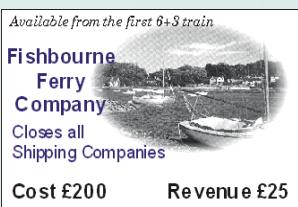
One further shipping company (the Fishbourne Ferry Company) appears later in the game. It may not be bought until the purchase of the !rst ‘6+3’ train (see below). A#er this it may be bought on a player’s turn in a Stock Round in lieu of buying a company share. See the certi!cate for its value and revenue. When the Fishbourne
When an exchange occurs, the player swaps the share for a share in the corresponding company:
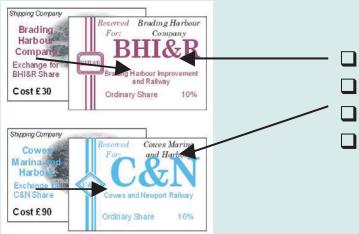
Brading private is swapped for BHI&R share Ryde private is swapped for IOW share Cowes private is swapped for C&N share Yarmouth private is swapped for FYN share
"e player making the exchange takes the reserved certi!cate from the appropriate pile of certi!cates in the IPO. He/she then places the top share in that pile at the bottom of the pile if the company has not %oated yet. It is possible that this action causes the company to %oat.
If a private company is swapped for a share, it closes and is out of the game. It is therefore not available for repurchase. "e private company certi!cate is placed face down in the area marked on the IPO chart to signify this.
A private company may not be exchanged for the associated share if the company in question is bankrupt and has not been re%oated (see section on Bankruptcy for more details).
major companies
"ere are 8 major companies, as follows:
| Layer | Name | Full Name | Bases | Par Range | Home base | Destinations * |
| 1 | C&N | Cowes & Newport | 4 | 74-100 | Cowes | Newport (50)Ryde Esplanade (50) |
| 1 | IOW | Isle of Wight (Eastern Section) | 4 | 74-100 | Ryde Esplanade | Ventnor (100) |
| 2 | IWNJ | Isle of Wight, Newport Junction | 3 | 62-82 | Merstone | Shide **(100)Sandown (100) |
| 2 | FYN | Freshwater, Yarmouth & Newport | 3 | 62-82 | Yarmouth | Newport (200) |
| 3 | NGStL | Newport, Godshill & St. Lawrence | 2 | 58-68 | Godshill | Newport (100)Ventnor (100) |
| 3 | BHI&R | Brading Harbour Improvement &Railway | 2 | 58-68 | Bembridge | Brading (100)Ryde Esplanade (100) |
| 4 | S&C | Shanklin & Chale | 2 | 54-62 | Chale | Shanklin (200) |
| 4 | VY&SC | Ventnor, Yarmouth & South Coast | 2 | 54-62 | Shorwell | Ventnor (100)Freshwater (100) |
Players may initially only buy shares for companies in layer one. Once a company within a layer has sold out or operated, shares in companies in the next layer down become available for purchase.
* Destinations are for optional use only. See details later.
** Shide is the station which appears on the green and russet “N” track tile to the south of the main Newport station.
company tokens
Each company has a number of tokens. "e tokens are as follows:
• A token to mark the par price for the company on the IPO chart.
• A token to mark the current price of the company’s shares on the stock market (“Quote” price).
• A token to mark the current revenue level the company earns
• A token to mark the home base of the company on the map board
• Between one and three tokens to mark other bases owned by the company on the map board.
"erefore each company will have between !ve and seven tokens.
company charters
Each company also has a charter. "is is a mat, held by the director, where the company’s assets are placed:
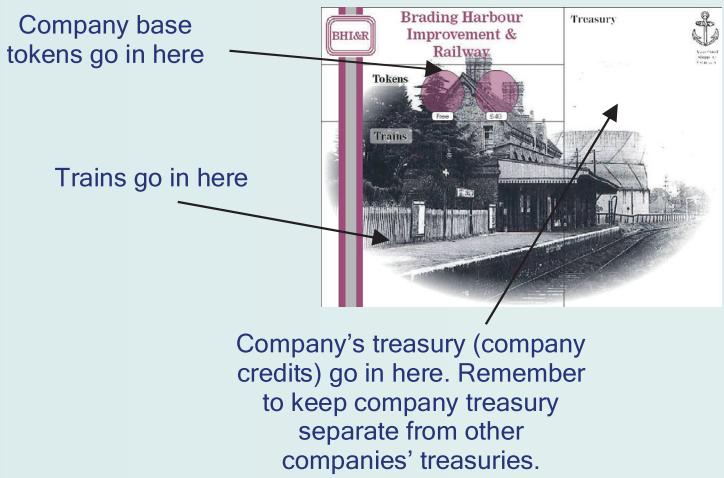
game overview
1860 plays in the same way as other titles in the 18xx series, in that play is divided between Share dealing or Stock rounds (SRs), and Operating rounds (ORs). At the start of the game each SR is followed by one OR, and then another SR occurs (and so on). As the game progresses, the number of ORs between each SR changes.
In stock rounds players buy and sell shares in the companies in the game. In operating rounds all the directors of those companies develop the company, raise revenue, and either retain that revenue or pay out a dividend. "is may a&ect the share price of the operating company, which is recorded on the Stock Market chart.
Each company raises revenue by building railway routes on the Island and then running trains on those routes. Over time, the revenue from these routes will increase, but so will the cost of trains; companies need to replenish their stock of trains over the course of the game, and this will cause !nancial di\$culties for some of the companies.
Towards the end of the game, the First World War and the Depression take their toll on the British railway industry, culminating in the creation of the Southern railway in 1923. "e Southern railway consolidates the existing lines on the island and upgrades the engines and rolling-stock, but no new routes are built. A#er the Second World War the railways on the Island, maintained during the war, become threatened by the 1948 nationalisation of the railways, declining holiday tra\$c, and !erce competition from road transport. "e lines on the Island are then progressively closed down, with only the most lucrative surviving. Players who have invested in the most productive lines will receive additional bonuses at the end of the game; it pays to build a company that will last!
phases
"e game starts in phase 2. Each further phase starts when a company buys the !rst train of a new type/size. E.g. phase 3 starts as soon as the !rst 3+2 train is bought. "e full list of trains is as follows:
| Train | No | Price | Phase | ORs per SR | Trains/Co. | Rust | Tiles | Notes |
| 2+1 | 5 | £250 | 2 | 1 | 4* | Yellow | ||
| 3+2 | 4 | £300 | 3 | 2 | +Green | |||
| 4+2 | 3 | £350 | 4 | 2 | 3* | 2+1 | ||
| 5+3 | 2 | £400 | 5 | 3 | +Russet | |||
| 6+3 | 2 | £500 | 6 | 3 | 2* | 3+2 | Fishbourne private available; Purchase of Fishbourne closesshipping companies. | |
| 7+4 | 1** | £600 | 7 | 3 | 4+2 | |||
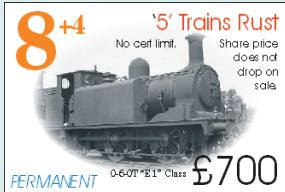
| 8+4 | 1 | £700 | 8 | 3 | 5+3 | Selling doesn't reduce share price; no limit on certificates perplayer | ||
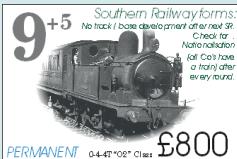
| 9+5 | 6+ | £800 | 9 | 3 | Southern Railway forms; no more track or base building afterthe next SR. | |||
| All players’companies have atleast one train | EndGame | Special | None | British Rail is formed; End-game starts – 4 operating roundsbetween which companies are closed.The bank is now infinite in size. |
* - it is possible to play the game with no limit on the number of trains per company.
** - players new to the game may choose to play with two ‘7+4’ trains instead of one.
"ere is, in theory, an unlimited number of 9+5 trains. Use obsolete 2+1 trains to indicate additional 9+5 trains if necessary.
"e change in the number of operating rounds happens at the end of the stock round following the start of the new phase. As soon as the new phase starts, the nature of tiles available changes. So as soon as the !rst 3+2 train is sold, Green tiles may be used.
Trains become obsolete (‘rust’) as soon as the phase change occurs. Obsolete trains are immediately removed from the game and may not be used again. For example, as soon as the !rst 4+2 train is bought, all the 2+1 trains rust and are discarded, out of the game. Note that phase changes occur when a train is purchased. Leasing of trains by insolvent companies do not trigger phase changes (see later).
Start of the game (Phase 2): "is signals the start of the rail building process, in 1860. "e IOW and C&N railways will start operating at this point. Only Yellow track tiles are available for use at the start, and there is one OR between SRs.
Phase 3: "is signals the further development of the rail network, circa 1866-1870. More railway companies are now operating, and develop the rail network to other parts of the Island. "is phase is started by the sale of the !rst 3+2 train. From this point on both Yellow and Green tiles are available. Starting with the next SR, there are two ORs per SR.
Phase 5: "is signals a period of consolidation and growth in revenues, which occurred in the mid-to-late 19th Century. "is phase starts with the sale of the !rst 5+3 train. Yellow, Green and Russet tiles are available. Starting with the next SR, there are three ORs per SR.
Phase 6: "is marks the high point in the fortunes of the railway on the island at the end of the century, with some indications of the trouble that lies ahead. "is phase starts with the sale of the !rst 6+3 train. "e phase is mainly an extension of the previous ones. "e Fishbourne Ferry Company is available as an additional certi!cate.
Phase 8: "is represents the start of economic downturn and turmoil in the early 20th century, leading up to the First World War (1914 - 1918). "is phase starts with the sale of the !rst 8+4 train. "ere are now no restrictions on the number of shares a player may own, and the sale of shares ceases to a&ect the share price.
Phase 9: "e Southern Railway conglomerate takes over the running of the Island’s railways at the start of this phase, triggered by the sale of the !rst 9+5 train. Starting with the next stock round, railway production ceases, and no more track may be laid or upgraded. Play continues until all companies with directors have a train. When this occurs, the railways are nationalised, triggering the progressive shutting down of the majority of the Island’s railway network.
the end of the game
"e game ends when one of the following happens:
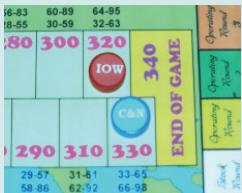
• A railway company’s marker reaches the top value on the
stock market (340). In this case, the game ends at the end of the current operating round.
"e bank (£10,000) runs out of money. Note that this does not include company credits. A#er this, the game !nishes at
the end of the current operating round. If the bank runs out of money during a SR, the game ends at the end of the next operating round.
When the railway is nationalised. "is happens a#er the sale of the !rst 9+5 train. Once all the operating companies under players’ direction have at least one train, the railways are nationalised. A#er
nationalisation, all companies run and pay dividends; a#er each round two (or possibly more) companies are closed by the directors of British Rail. "is continues until all but two companies have closed, and then the game is over. See the rules section on the Southern Railway for more details.
Each player adds up his/her total assets, including:
• Personal money; this does not include company credits in company treasuries.
• Private companies, if not closed. "ese are valued at the price on the certi!cate.
• Company shares. "ese are valued at the price on the stock market, provided the company has a train. If the company does not have a train, each of its shares are valued at half the stock market price, rounding any fractions down. Round any fractions down.
"e player with the highest personal wealth (total assets) wins the game.
Remember that Director’s share certi!cates represent two shares, and are worth double the corresponding ordinary share certi!cate.
stock rounds
In each SR, the !rst player to deal is the one to the le# of the last player who bought or sold shares in the previous SR. "is person will have the “Priority Deal” card. Players deal - that is, take buy or sell shares in their turn - in clockwise order. "e Stock round ends when all players pass consecutively. "e “Priority Deal” card is given to the player to the le# of the last trading player at the end of each SR to remind players who gets the !rst deal next time.
buying and selling shares
When it is a player’s turn to deal, he/she may sell any number of shares (including none), and then may buy one share or private company certi!cate. A player who neither sells nor buys shares on his/her turn must “pass”. A player who passes may deal later in the stock round if the turn comes back round to him/her. Shares may be bought from the initial o&ering or IPO at par price, or from the Bank pool at the current price marked on the stock market (the market price) for the company.
Shares sold to the Bank are sold at current market price if the company has a train. If a company does not have a train, each share in that company is sold at HALF the current market price (round fractions down). Shares may be sold even if the company has not %oated yet.
If a player is the !rst person to buy shares in a company, he/she must buy the director’s share !rst. At that point the player must choose the par price for the company, and place one of the company tokens on the IPO chart to show this. "e par must be a valid place on the stock market, and be in the range speci!ed for the company. A director’s certi!cate costs, and is worth, twice as much as an ordinary share certi!cate.
Shares in the !rst two railway companies (the C&N and IOW) are available for purchase at the start of the game. "e other companies become available in layers. "e shares for both companies in a layer become available from the !rst SR a#er one the companies in the previous layer has operated,. Alternatively, this happens immediately if all the shares in one of the companies in the previous layer have been bought from the IPO, or exchanged for the associated private company during an OR.
A player may only buy one share on his/her turn, but may buy more than one during a SR. Note that a player may buy up to 100% of a company’s shares.
If a player has sold a company share in a SR, he/she may not buy any shares in this company until the following SR.
If a director sells shares, so that he/she has fewer shares in the company than another player, he/she immediately swaps the Director’s share for two of the majority shareholder’s shares in that company. "e new majority shareholder, i.e. the player who has the most shares in the company, then becomes the new director. If there is a tie for the majority shareholder when this occurs, the new director is the closest, counting clockwise, from the player who was the previous director. Similarly, if a player buys shares so that he/she becomes the majority shareholder (i.e. he/she has more shares than the current director), he/she takes the Director’s share from the old director in exchange for two of his/her own shares in the company.
"e director’s certi!cate may be sold to the bank. A player with the director’s certi!cate may sell one of the shares it represents to the bank by exchanging it for a single share in the bank pool, provided there is an appropriate share in the bank, and no other player has two or more shares in the company. If another player does have two shares, then the player selling the director’s share to the bank swaps the director’s certi!cate for two of the shares held by the player who will now become the new director according to the rule above. A#er this the shares sold by the ex-Director will be placed in the bank as part of the sale.
share price movement
"e stock market shows share prices from 0 to 340. It is in two tiers. All companies which have %oated have a token on the stock market to show the current market price for their shares. Companies’ tokens will start on the top tier of the stock market. As shares are sold, some may move to the bottom tier, and possibly move back up again later as well.
If a company has not operated yet, its share price is not a&ected by the selling of shares.
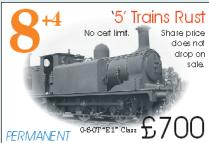
A#er the sale of the 8+4 train, share prices are not a&ected by the selling of shares.
If a company has operated, its share price falls by one place for every share sold. I.e., if a share price token is on the top tier of the stock market it moves down and to the le#, and if on the bottom tier it moves one place upwards and to the le#.
If multiple shares in the same company are sold in a single action, the seller receives money for all the shares sold before the share price is adjusted.
When a company’s share price token moves on the stock market onto a space occupied by other tokens, it is placed below those tokens already there. When operating, companies occupying the same space on the stock market will operate in descending order, i.e. starting with the !rst company to arrive at that space on the stock market, and ending with the last.
Shares start in this row of the stockmarket. The par price allowed for each company's shares is shown on the initial price chart
The payment or nonpayment of dividends causes the share price to move horizontally left or right. See Dividends and the Share Price, below.
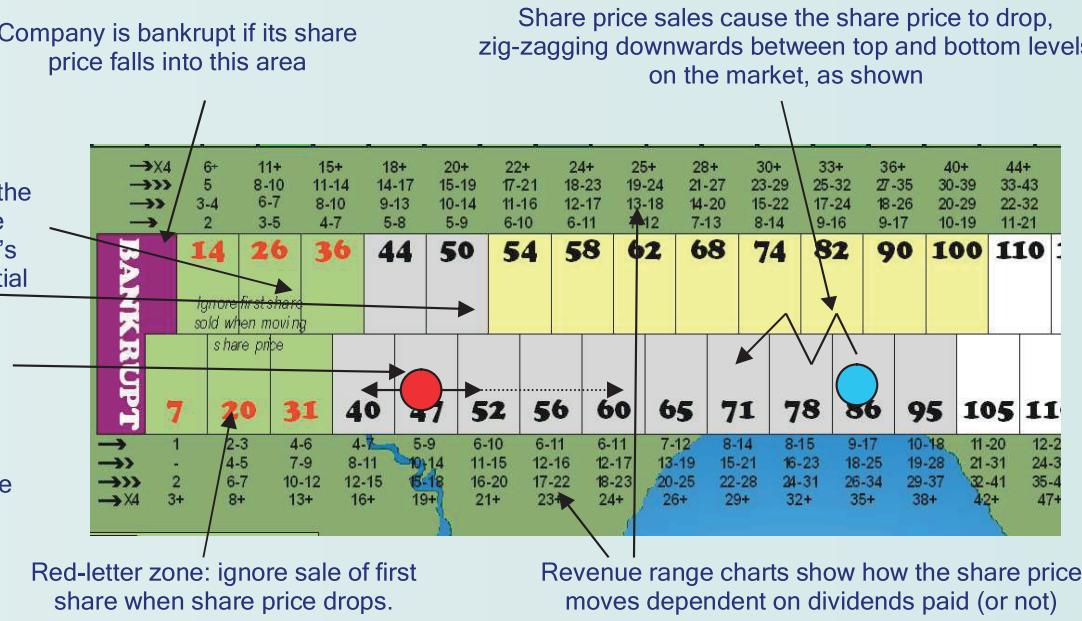
Shares worth less than 40, or more than 150, are in “red letter” zones. When shares of a company with a share price in these zones are sold, the !rst share sold has no e&ect on the share price. For example, if Bill sells three shares that are worth £182, the share price drops two places (instead of three), to £166. When a player sells more than one share in a single company on a single turn, these shares are always counted as being sold at the same time in a single transaction. In this way, Bill may not sell his three shares as three separate sales and so avoid causing the share price to drop.
If a company’s share price falls to zero as a result of selling shares, it goes bankrupt and ceases operating. "e bankrupt company may be re%oated later. See the section on Bankruptcy for further details.
certificate limit
"ere is a limit on the number of share certi!cates a player may hold. Director’s certi!cates and Private companies both count as one certi!cate each. "e limit depends on the number of players in the game:
• 2 players: limit is 32
• 3 players: limit is 21
• 4 players: limit is 16
A player may not buy shares if this would mean he/she holds more than the certi!cate limit. Speci!cally, if a player has the same number of certi!cates as the current limit he/she may not buy another share until his/her holding falls below the limit. A player at the certi!cate limit may not, for example, buy a share to gain a directorship from another player, as doing so temporarily puts the buying player above the certi!cate limit prior to gaining the director’s share, even though at the end of the transaction he/she would hold the same number of certi!cates as before.
If a player has more certi!cates than the certi!cate limit, then the player must sell shares in excess of the limit at the !rst available opportunity. "is will be at the start of the player’s next turn in a SR. "e player must sell shares until he/she no longer has more shares than the limit.
From the sale of the ‘8+4’ train onwards, the restriction on the number of certi!cates a player may hold is li#ed, and players may hold any number of certi!cates.
flotation and capitalisation
Companies %oat in a stock round, when 50% or more of their shares have been bought from the IPO and are currently held by players. Shares in the bank pool do not count towards this total. When a company %oats, the director immediately receives all the company’s tokens, the company charter, and the company’s capital in Company Credits. "e company’s home base token is placed on the company’s home base, and the share price token on the stock market at the company’s par price.
A#er %otation, the company will begin to operate in operating rounds (see later), and is called an operating company.
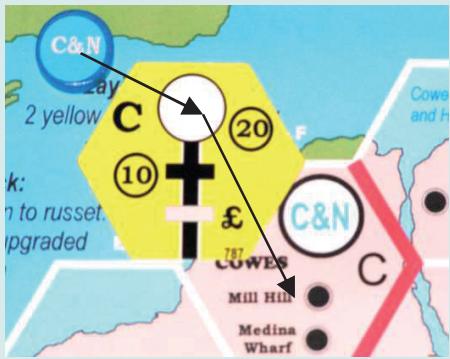
If a company’s start hex does not have any track on it (i.e., the C&N, FYN, NGStL, BHI&R, S&C and VY&SC), and no track tiles have been placed there, the director places an appropriate track tile on the start hex, should a legal one be available, along with the company’s home base token when the company %oats in the stock round. Placement of the
tile must satisfy the standard rules for playing tiles on the board, but treat the tile to be placed as being connected to existing track connected to one of the company’s bases. Such placement does NOT count as the company’s tile placement for its !rst operating turn.
flotation capital
Railway companies all receive 100% capitalisation when they %oat. I.e., they receive 10 × the par price in company credits when they %oat. Company credits are the currency used by the railway companies when they gain revenue and make payments for building and train costs. Each company’s treasury must be kept separate from all other companies’. Company credits are never given to players, and do not count towards a player’s total worth at the end of the game. Company credits may only
operating rounds
private companies
At the start of each operating round (OR), each player receives revenue from their private companies as shown on the individual certi!cates. Private companies not in players’ hands, i.e. those that have been closed or are in the bank pool, do not pay anything.

operating public companies
A#er private companies have paid out, all companies that have %oated, excepting those which are currently bankrupt, now operate in descending order of share price. Where more than one company has the same share price, the company that has been at that share price the longest takes precedence. So, when a company’s share price marker moves on the stock market to a space where other share price markers are already, the marker just moved should be placed below all the others on that space.
For example, if the C&N, NGStL and S&C are all on the same space on the stock market, and the NGStL is above the C&N, which is in turn above the S&C, then the operating order of these companies will be:
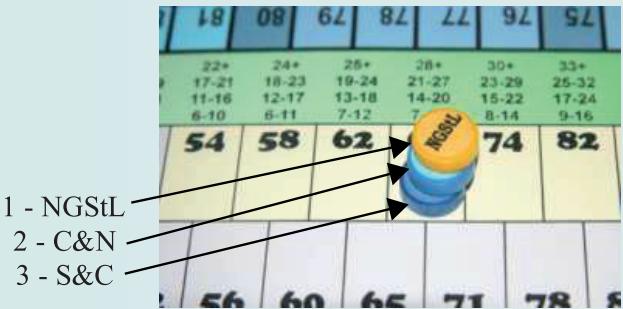
"e company director (the holder of the director’s certi!cate) determines a company’s actions. If no one holds the director’s certi!cate, the company is in receivership. See the section on receivership for details.

On its turn, a company may do the following (and only in this order):
• Lay or upgrade track tiles on the board.
• Buy an additional base.
• Run its train(s) to produce revenue.
• Retain the revenue in the company treasury as company credits (cc), or pay it out as dividends to shareholders.
be used by a company in order to buy trains, build company bases, or pay for other building costs.
If no legal tile is available, the director just places the company’s home base token on the hex, and it will move onto the !rst tile placed in that hex. If this does not happen before the company’s next operating turn, the company places a tile on the hex as its track build at the !rst opportunity it has.
• Buy one or more trains from the bank and/or from other companies.
• "e company may be declared insolvent at the end of its turn.
track tiles
Track is built using the yellow, green, and russet hex tiles. Yellow tiles are available from the outset, and must be played on an empty hex on the board; later in the game green tiles replace yellow ones, and russet tiles replace green ones. Any tile placed on a hex must be appropriate for the hex it is played on:
• Plain hex - tile played must be plain track (no stations)
• Single village (black dot) - tile played must have one halt or small station on it.
• Two villages - tile played must have two halts or two small stations on it (or one of each).
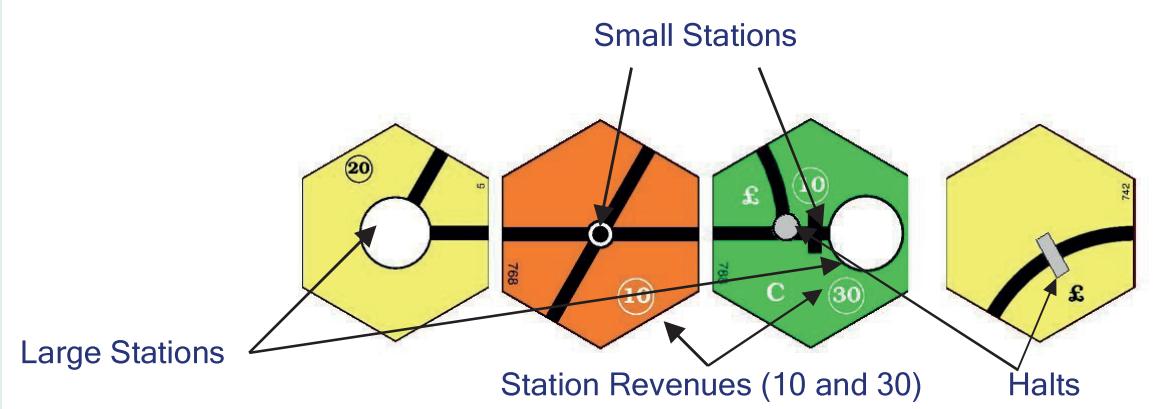
• Town (empty black circle) - tile played must have one large station on it.
Large station tiles have one or more large circles on them.
Small stations are marked either by a black bar across a length of track with a value marker (10) nearby, or by a small black circle in the middle of a length of track with a value marker (10).
Halts are marked in the same way as small stations, but are value 0 and are gray instead of black. "ey have a ‘£’ sign marked on them. "ese are small stations that e&ectively earn no revenue, as the tra\$c derived from them is so small. "ey provide no regular income, but generate subsidy revenue for a company that runs trains through the halt.
Some towns on the map (Ryde, Newport, Ventnor, and Merstone) are marked in yellow. "ese may be upgraded from the sale of the !rst 3+2 train, using the appropriate green tiles.
Some towns have a letter on their hex. "ese are Ryde (R), Cowes (C), Newport (N), Ventnor (V), Brading/ Godshill/Shorwell (B) and Merstone (M). Only tiles bearing the relevant letter may be placed on these hexes, "ese tiles may only be used on hexes with the same letter.
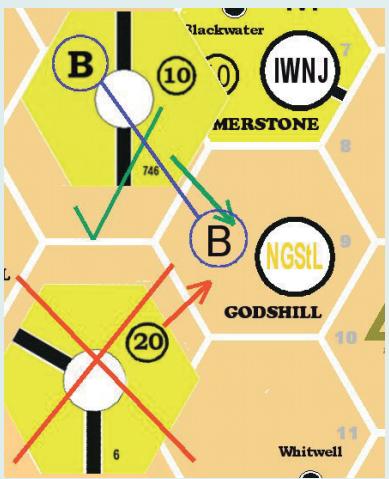
special rules for tile placement
"e Newport upgrade tiles must be placed so that the southern, lower value station (Shide) is connected to the south hexside.
"e green Merstone tile must be placed so that the halt (Blackwater) connects to the north side of the hex (connecting directly to the Newport hex)
"e Ryde upgrade tiles must be used to connect Ryde Esplanade with the “o&-board” Ryde Pierhead.
If a company wishes to places a tile on a hex which is marked as being di\$cult terrain, the company must pay 60 company credits to the bank beforehand. Di\$cult terrain is marked either by a triangle or darker (olive) shading. Upgrading tiles on di\$cult terrain does not cost anything.
laying track
On its turn, a company may lay up to two yellow tiles, or upgrade one tile from yellow to green or green to russet. "e following rules apply with laying yellow tiles:
• Track must connect with existing track which may be accessed from any of the company’s bases. "is connection may be of any length, but it may not pass through any station that is completely !lled with bases belonging to other companies; such a station is called a “tokened-out station”.
• None of the track on the tile may run into a impassable green hexside (i.e. o& the hex grid on the map), a red barrier, or into the sea. "e track may, however, run into the blank hexside of adjacent track tiles.
If the company lays two yellow tiles on its turn, it does so one tile at a time and neither may contain a large station; only tiles containing plain track and halts are allowed. "e two tiles so placed may be connected to each other, or not. If the company lays a large station tile, it may not lay a second tile.
upgrading track
When the !rst 3+2 train is sold, phase 3 starts and green tiles become available. On a company’s turn it may, instead of laying track, upgrade a yellow tile on the board with a suitable green tile. "e green tile must contain all the existing track on the tile it replaces, and must be placed so that all such track is connected to the same hex sides as before.
In other respects, the upgrading of tiles is bound by the same rules as for laying tiles.
In order to upgrade a tile, the company must be able to trace a route, with one of the trains it currently owns, from any of its bases on the board to the tile in question, WITHOUT passing through tokened-out stations. "e assessment of this route is made considering any stations that might appear on the tile to be placed, rather than the tile already on the next. "e length of the train restricts the distance of the route used to decide this. For example, if the IOW has not built an additional base, it will be unable to upgrade Brading station unless it has a 3+2 train or better, as a 2+1 train will not reach Brading from Ryde Esplanade.
In addition, the upgrade of the tile must contain some additional track which the company would be able to run one of its trains, or upgrade a halt to a small station, or increase the revenue of a station on the tile to which the company may run one of its trains.
A company without a train cannot upgrade track.
When the !rst 5+3 train is bought, russet tiles become available and may be used to upgrade green tiles. "e same principles apply to upgrading from green to russet as for yellow to green.
When upgrading a tile, company bases on a tile must be placed on the new tile in the same equivalent position as before.
building bases
Only one base may be built by a company per OR. "e home base is free, and is placed on the board as soon as a company %oats. Building a second base costs a company 40 company credits. Each subsequent base therea#er costs 100cc.
Bases may only be built on empty station circles which may be reached from any of the company’s existing bases by following any length of connected track, but not past tokened-out stations.
Once a base token has been built it remains on the map until the end of the game. Bases remain on the board when hexes are upgraded, in the relative positions on their tiles.
Bases may not be placed on another company’s home base hex, unless the tile on the hex currently has a spare space available in addition to the space which would be occupied by the other company’s home base token.
A company may not have more than one base on the same hex.
running trains
Trains run on routes between towns and villages, along the tracks shown on the hex tiles placed on the board. Each train must run a route between at least two stations connected by track to gain revenue. "e company director chooses which route each train will take.
• Runs must begin and end in large stations or small stations. "ey may not end in halts. Ryde pier counts as a large station.
• Every run must include a large station which has one of the company’s base tokens on it.
• At least one run for a company must include the town occupied by the company’s home base token. "e next run must intersect, i.e. the track must meet or cross, with the !rst run at a large station or small station. Each further run must intersect with a previous run in a similar way.
• A route run by a train must follow a continuous line of track shown on the tiles / board.
• A route run by a train which enters a hex may not exit it from the same hexside. Once a train leaves a hex it may not reenter it as part of its route.
• Trains must call at all large stations on the route.
One (and only one) of the trains run by a company on its operating turn may pass through ONE tokened-out station. Tokened-out stations are large stations which have all their station circles !lled by tokens belonging to other companies. Apart from this single tokened-out station, no other tokened-out stations may be travelled through by any train on a company’s turn, although they may be included as the terminus of a train’s run. Stations with at least one empty station space do not inhibit the running of trains in this way.
Trains may ‘bypass’ halts and small stations (and not include them in a route). A company which includes halts in a route it runs receives no regular revenue for them, but instead receives 10 company credits subsidy for each halt visited, paid into the company’s treasury. "ese payments do not count as part of the revenue earned in a run.
"e !rst number (before the ‘+’) on the train card shows the maximum number of large stations the train may visit on its route. If the train runs to fewer large stations than this number, then the train may stop at one additional small station or halt for each unused station allowance. "e second number (a#er the ‘+’) on the train card shows the maximum number of small stations or halts the train may visit in addition to those covered by the !rst number.

All trains may run to more than one station on a hex.
E.g: A 2+1 train may call at two large stations and a small station, or two large stations and a halt, or one large station and two small stations, or one large station, one small station, and a halt. Note the train can’t run to one large station & two halts as it can’t terminate in a halt. In addition, it has to run to at least one large station to ensure it visits a station occupied by one of the company’s base tokens.
When a company is running more than one train, each train may not be run over the same section of track as any other train in the company’s turn. Routes may not double-back over a junction or enter the same hex twice. Two trains running for the same company may visit the same station, provided they enter (and/or leave) the station by di&erent routes from each other.
A company’s revenue is the sum of all the station values for all stations included in each run made by its trains. For example, if a company runs a 3+2 train from a 20-station to a 30-station via a 20-station, a small 10-station and a halt, the revenue is £80 plus 10 company credits subsidy. Note that if a station is included in more than one train’s run, its value is counted multiple times – once for each run that includes the station.
IMPORTANT NOTE: Before Nationalisation occurs, the company director is not duty bound to run trains to generate the highest possible revenue! Indeed, the director may choose to generate a less than maximum dividend and instead generate more company subsidy by visiting more halts.
dividends and the share price
If the company produces revenue from running trains, the director decides whether dividends are paid out or retained by the company:
If the company retains revenue, it receives company credits equal to the company revenue for the turn. If the bank runs out of company credits, use any suitable alternative; the number of credits provided is not intended to limit play.
If the company pays dividends, dividend payments are made out to players that hold shares in the company. Shares in the IPO or bank pool do not generate any revenue. Players receive 10% of the run’s revenue in cash for every 10% stake they hold in shares in the company. If the bank runs out of money during this process, issue IOUs to the players in lieu of the dividend payments to players. "ese IOUs count towards a player’s !nal score.
"e payment or non-payment of dividends may a&ect the company share price, as follows:
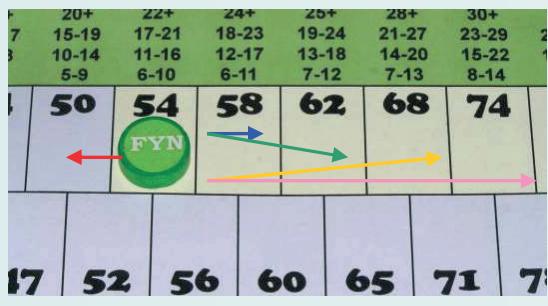
If no dividend is paid, the share price drops two places on the share price chart (one space le# on the same level – red arrow). If the share
price falls to zero, the company is bankrupt. See the section later on bankruptcy for details.
If a dividend is paid but it is less than the current share price of the company, the
share price does not move.
If a dividend is paid which is equal to or greater than the current share price of the company, the share price rises two places (one space right on the same level – blue arrow).
If a dividend is paid which is at least twice the current share price then the price rises a further two places as a bonus (= two spaces on the same level – green arrow).
If a dividend is paid which is at least three times the current share price then the price rises a further two places as a bonus (= three spaces on the same level – yellow arrow).
If a dividend is paid which is at least four times the current share price then the price rises a further two places as a bonus (= four spaces on the same level – pink arrow).
"e company share price can never rise more than four spaces on the same level as the result of the payment of a single dividend, and may never exceed the top price on the stock market. 15-19 17-21 18-23 19.24 21-27
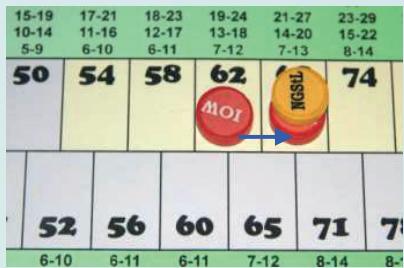
When a company’s share price moves to a space already occupied by another company’s share price marker, the moving marker is placed underneath the markers already there, showing that the company will operate a#er those companies which were there before. If a company pays a dividend, but the price fails to change, then the share price token for the company remains in the same space, but is placed under other markers with the same share price, as though the share price had changed.
buying trains
As the last action of a company’s turn, it may buy a train or trains using company credits from its treasury. "e price of each train bought from the IPO is shown on its card. Trains may be bought from other railway companies at a price agreed by both company directors. "e agreed price must be a multiple of 10cc, and at least 10cc.
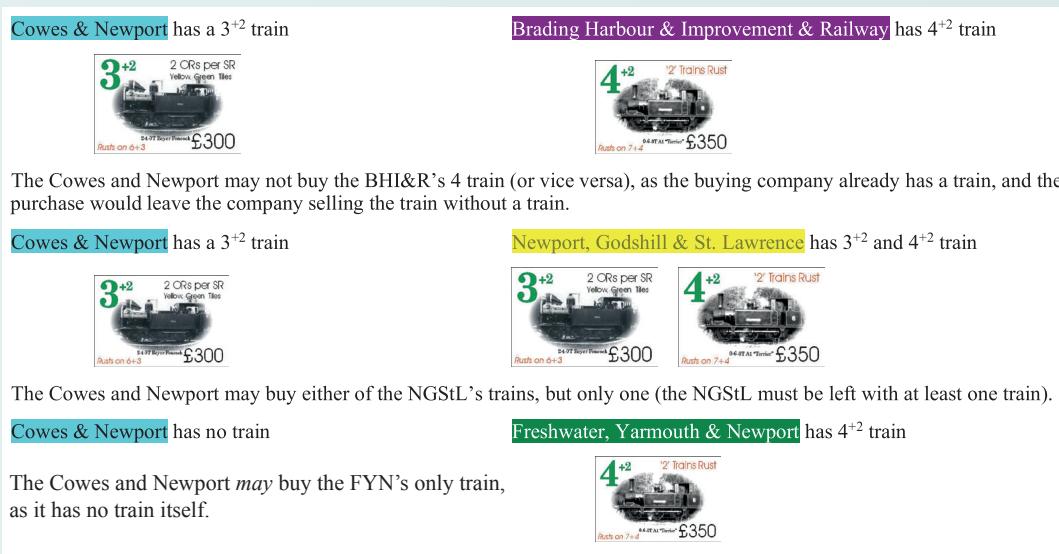
Buying a train from another company is not allowed if the buying company already has a train, and the selling company has only one train (i.e.
you can’t sell a company’s only train unless the buying company doesn’t have a train). !is is an important rule.
Trains bought from the IPO must be bought in ascending numerical order (2+1 !rst, 9+5 last). Each train of a particular type in the IPO must be sold to a company before the next type of trains become available for purchase. E.g. all the 3+2 trains must have been sold before the 4+2 trains are available for purchase.
"e purchase of trains from the IPO may trigger the start of a new phase. "is may trigger the “rusting” of trains, or that the next set of tiles (green and then russet) become available immediately. A phase change may also reduce the maximum number of trains a company may possess (see the phase chart for more details). If so, the restriction on the number of trains a company may hold comes into force immediately. Excess trains must be returned
to the bank at the start of the owning company’s next operating turn, with no compensation, and are available for re-sale at face value in addition to those in the current band.
Trains which “rust” are discarded by their owning companies and are out of the game. Trains may not be sold back to the bank.
When a new phase starts, the number of ORs does not change until the end of the next SR. For example, when the !rst 5+3 train is bought, russet tiles become available immediately, but operations remain at two ORs between SRs until the end of the next stock round. A#er this there will be three ORs between SRs.
insolvency
If a company doesn’t have any trains at the end of its turn, then it must buy one from the bank, initial o&ering, or another company (by mutual consent of the director(s) of both companies), if it can a&ord one.
Company must retain revenue to pay for next train. Revenues are reduced.
A company which ends its turn without a train, but which would have a valid route available if it did have a train, becomes INSOLVENT. An insolvency marker is placed on the company’s charter to indicate this. It is only removed when the company becomes solvent again by buying a train. Companies are not declared insolvent until the end of their operating turn..
INSOLVENT
Stations Visited = Income (Ige allowance only): 4 = 120, 5 = 140, 6 = 160, 7 = 180 8 = 200, 9 = 220. (Or use ½ revenue)
An insolvent company must retain revenue, may not place base tokens, and may not upgrade track or build track that would incur a cost. An insolvent company must buy a train from the bank as soon as it is able to, unless it buys a train from another company !rst.
If an insolvent company has insu\$cient funds to buy a train from the bank, the company must lease a train (i.e. contract out the running of trains on its lines). "e company leases the smallest train available in the bank pool or initial o&ering. "e train leased is not bought by the company, does not a&ect the current phase of the game, and is not the property of the company running it. "e company runs this train as per the normal rules for valid runs, using only its large station allowance (before the ‘+’). It receives leasing revenue equal to 40cc plus 20cc for every large or small station the company runs to, including its home base and halts. I.e:
Leasing Revenue = 40cc + (20cc per small/large station/halt)
In th
Content is long; only the first part is inlined. Download the file or open the rules page for the full text.
Download MarkdownTexts are community-compiled or publicly released by publishers; copyright remains with the original authors. For personal reference only.