
1923 Cotton Club
At a glance
Rules, cards and Q&A (Chinese)
The rules, card data and player questions for this game are written in Chinese. Open the Chinese page to read them.
Where to find full rules
Full rules and card lookup are available in the cunlema app at cunlema.cn — pick this game and ask about any rule, card or turn you are unsure about.
Related games
Rulebook text (Markdown)
This game has 1 rulebook Markdown file(s) in our library; 1 rendered inline below — expand to read or download.
1923-EnglishRules.md37.0 KB
1923
Cotton Club

2-4 Players 60 minutes From 12 years old
In 1923 the bootlegger Owney Madden acquired an establishment in Harlem,
New York, and named it the “Cotton Club”. His idea was to use it as a cover to sell
alcohol during Prohibition, but the place grew in popularity, and talented artists such as Duke Ellington, Louis Armstrong, Ethel Waters and Cab Calloway turned it into a jazz mecca.
In 1923 Cotton Club you will oversee a club during the complex times of Prohibition. To smuggle in alcohol, you will have to look for partners in the criminal world and invest money to hire artists and improve your club. All to attract the most important and influential celebrities of the era..
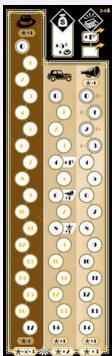



COMPONENTS
● 2 boards (tracks and actions).
● 4 club boards.
● 12 wooden pawns in 4 colours.
● 20 wooden discs in 4 colours.

●114 cards:





- 17 improvements.
- 17 gangsters.
- 17 smuggling.
- 17 artists.
- 17 celebrities.
- 25 events.
- 4 turn order
Acquisition cost
Influence, initiative, and criminality track modifiers
Reputation points for the end of the game.
THE CARDS
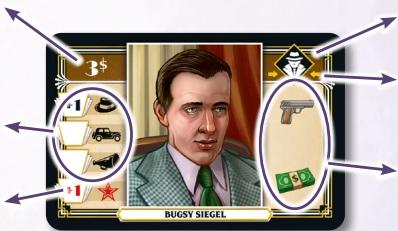
Card type
Initial card icon
Supplied resources box (weapons, income, drink types, artist types...)
SETUP
Place the track board on the left of the action board. Make sure they are flipped to the correct side, according to the 3-48 number of players.
Prepare one stack of cards per card type (events, improvements, gangsters, smuggling, artists and celebrities) and set aside the event cards.

For each card type, separately shuffle the initial cards (marked with two arrows) and then shuffle the rest of the cards. Place the initial cards on top of the rest of the cards. This will create a single face down stack of cards for every type, with the initial cards on top.
Draw and place a row of four cards of every type to the right of the corresponding action on the action board. Place the stack of remaining cards face down at the end of the row.
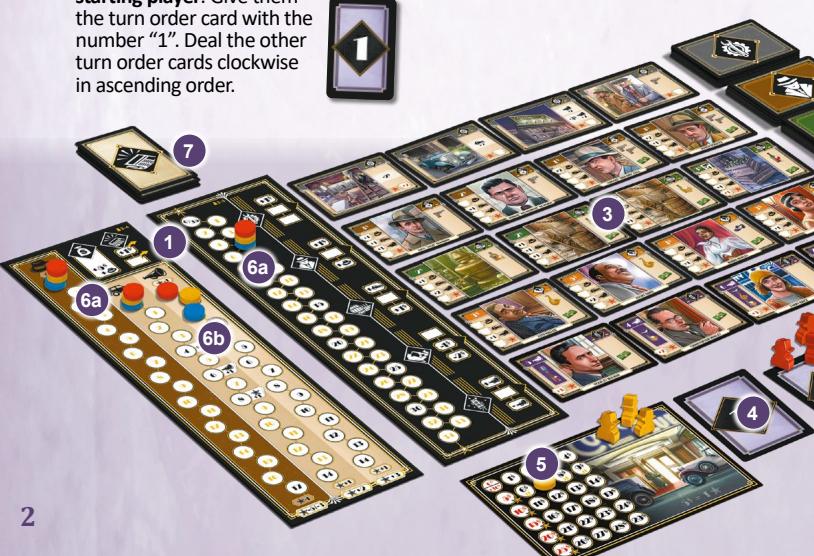
The player who listened to jazz music most recently will be the starting player. Give them the turn order card with the number “1". Deal the other turn order cards clockwise in ascending order.
Give each player a club board, as well as 5 wooden discs and 3 pawns in the same colour.
6a The last player (according to the turn order cards) places a disc on the “0” value of the initiative and criminality tracks, and on the “5” value of the reputation track. The rest of the players, in reverse turn order (from the highest to the lowest turn order card), place their discs on top of the previous player's discs.
⑥b For the influence track, the first player (turn order card 1) places a disc on “0”, the second player places theirs on “1”, the third player on “2” and the fourth player on“3”.
6c The players place their fifth and last disc on the money track on their club board: the first player will start with \$6, the second with \$7, the third with \$8 and the fourth with \$9.
Shuffle the event cards previously set aside and prepare a stack of five facedown cards to form the event draw pile.
Deal another five face down event cards to each player. They will secretly select three to keep and discard the other two face down. Place the rest of the events cards with the discarded ones back into the box, they will not be used during this game.
Everything is now ready to start the game!
THE ICONS

Influence. You will use it to get celebrity cards.

Initiative. It will establish the new turn order at the end of each round.

Criminality. It will be increased when obtaining gangsters and smuggling. Some events, and the final scoring, will penalise whoever has the most.

Reputation. Represents how famous your club is. The player with the highest reputation at the end of the game wins.
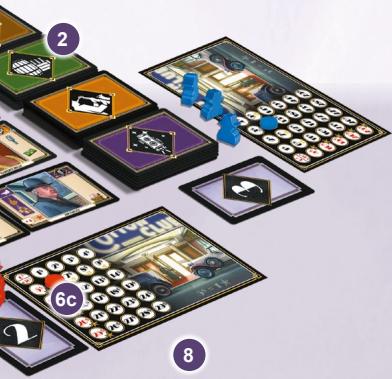
Setup for a three player game.
HOW TO PLAY
The game is played over a maximum of six rounds. Each round has four phases:
PHASE 1: EVENTS
Don't play this phase during the first round of the game.
Take the top card of the event draw pile and place it face down to start the row of round events. In turn order, each player, can add one of their event cards to the right side of the row, also face down.

PHASE 2: ACTIONS
Each action, except the loan, has several spaces depending on the number of players. Only one pawn can occupy each space. The top spaces are more beneficial than the lower ones.
Following the turn order cards, each player, must:
1.- Place one of their pawns in the first available uppermost space of the desired action. When all spaces are full that action cannot be used.
2.- If there is one, receive the bonus or penalty in the chosen space.
3.- Perform the action for the chosen space: improve your club, associate with a gangster, smuggle alcohol, hire an artist, attract a celebrity, ask for a loan, or get a tip-off.
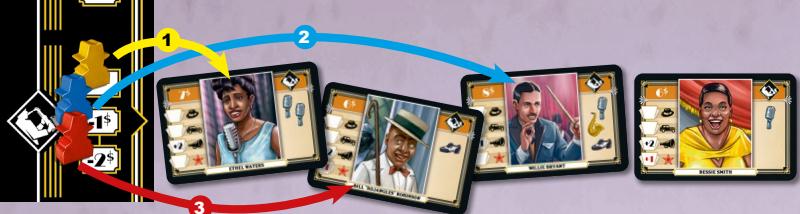
Example: Carla (yellow) is the first to place a pawn on the artist action and doesn’t get any penalty. She hires Ethel Waters for \$7. Rafa (blue) places second and pays the penalty of \$1 to hire Willie Bryant for \$8. Jesus (red) is the last placing and must pay \$2 as penalty. He chooses to hire Bill “Bojangles” Robinson for \$6 out of the two remaining artists.
When every player has placed one pawn and performed the associated action, the players repeat the previous steps in the same order until they have placed all three of their pawns.
Finally, if one or more players have placed pawns on the tip-off action space, they now reposition them in another available action space. The pawn in the uppermost tip-off space choses their action first and performs that action. These pawns will therefore perform two actions this round (the tip-off and the and the action associated with the new position).
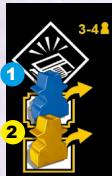
Example: after all the players have placed their pawns, Rafa (1) will reposition his pawn from the tip-off action to a different one. Then Carla (2) will do the same.
RESOLVING TIES
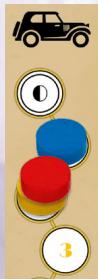
If several discs are on the same influence, initiative or criminality track space, the player with the disc on top of the others is considered first on that track.
Example: the first player in the initiative track is Jesús (red), the second Carla (yellow) and the third Rafa (blue).
IMPORTANT: the players must complete the action where they place their pawn. You cannot place a pawn just to occupy a space and slow down a rival.

IMPROVEMENTS There are five different improvement card types:
● Logistics: improves your initiative, sometimes by paying dollars, sometimes raising your criminality.

● Club reforms: increases your club reputation by spending dollars.
●Bribery: decreases your criminality by paying dollars, or increases your influence by getting criminality.

Advertising: increases your influence by paying dollars
Security: supplies extra weapons in addition to those from your gangsters (see below).
Select one of the available improvements and perform its action. Leave the card in a face down stack close to your club board. However, "Security"improvements will be placed like other cards, tucked in your club. Some improvement cards give reputation points at the end of the game.
NOTE: Some cards present two improvement options. You must choose one.

GANGSTERS, SMUGGLING, ARTISTS AND CELEBRITIES
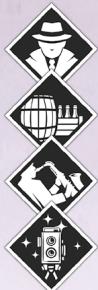
Choose one of the available cards in the row corresponding with the action and pay the cost in dollars (or influence for celebrities). Then, adjust your tracks. The reputation points will only be taken into account at the end of the game.
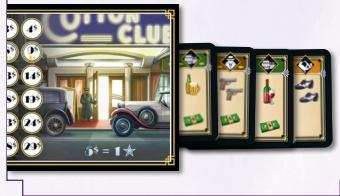
IMPORTANT: by raising levels above the maximum or lowering them below the minimum, you gain or lose reputation points as indicated on the board.
PLACING CARDS
Tuck any acquired cards under your club board so the illustration is covered and the icons on the right are visible. This way the icons used during the game can be seen by every player but the reputation points are hidden.
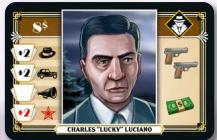
Example: if you associate with Charles “Lucky” Luciano you pay \$8 and increase your criminality and initiative tracks by two. It will give you two reputation points at the end of the game.
Some smuggling cards require you to have a certain number of weapons to acquire them.
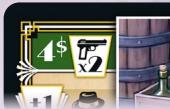
NOTE: the weapons are not discarded when they are used, you just need to have them.
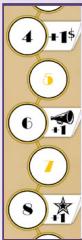
The initiative track awards an immediate bonus when you reach the following marked level:
• Level 4. You gain 1\$.
● Level 6. You gain one influence point.
● Level 8. You gain one reputation point.
To attract a celebrity, you will need to pay with influence. Each celebrity has their own preferences about drinks and artists, so they can be attracted more easily by certains clubs. Each icon in your club matching the icons on the left of the celebrity card will equal a discount of one influence point.
If the icon appears two times, it will give double the discount.
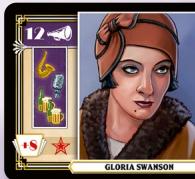
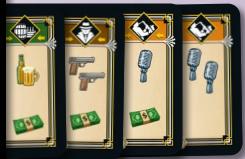
Example: to attract Gloria Swanson to your club will cost 12 influence points. Every singer and musician icon you already have in your club will discount one point, and every beer icon will discount two influence points. You have one beer and three singer icons in your club, therefore you attract Gloria Swanson by spending 12-5=7 influence points.

LOAN
This action space can hold any number of pawns. When you take out a loan increase your money track by \$5 and increase your criminality track by one.

TIP-OFF
Secretly look at the cards in the row of round events. Don't change their position. At the end of phase 2 you will reposition this pawn to another available action (see page 4).
PHASE 3: EVENTS RESOLUTION
Don't play this phase during the first round of the game.
The first player reveals the event card on the left and all players carry out the action on the card. Repeating this process for each card, one by one, from left to right.


IMPORTANT: If you must pay dollars because of an event and you don't have enough, you will have to pay with one reputation point for every 2 dollars you are lacking (rounding down).
PHASE 4: INCOME AND MAINTENANCE
All players recover their pawns from the boards. Each player then receives the following income and adds it to their money track:
as many dollars as there are income icons displayed on the cards tucked in their club.

and as many dollars as cards remaining in the event stack.
Fill-up the empty spaces for every row by drawing cards from the corresponding stack.
Distribute the turn order cards among the players by giving card 1 to the player with the most points on the initiative track, card 2 to the second and so on.
END OF THE GAME
The game can finish in two different ways: when finishing the sixth round (and the event stack with it).
• or, if any draw pile is empty when filling-up the rows, the next round will be the last one.
POLITICIANS
When the game is over, before scoring, each player in reverse turn order (from higher to lower turn order card) decides if they want to bribe the politicians they have among their celebrities.
Players can choose to pay \$3 for each politician icon to drop one level of criminality.

EVENTS
Events affect all players.
SECRET STASH
Gain one reputation point for every icon of the indicated type (wine, beer or whisky) displayed on your club cards.

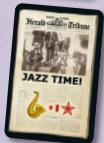
• JAZZ TIME!
Gain one reputation point for every icon of the indicated type (dancer, musician, or singer) displayed on your club cards.
PROHIBITION
Gain \$2 for every icon of the indicated type (wine, beer, whisky) displayed on your club cards.

• LIVE MUSIC!
Gain \$2 for every icon of the indicated type (dancer, musician,'or singer) displayed on your club cards.

FINAL SCORING
Starting with the points the players have already achieved on the reputation tracker, they add or subtract points based on the following conditions:
Add reputation points on their club cards, including the improvements cards.
Add one reputation point for every five remaining dollars on their money track.
● The player with the highest influence level wins three additional reputation points.
The player with the highest initiative level wins two additional reputation points.
● The player with the highest criminality loses five reputation points, the second highest loses three.
The player with the highest reputation is the winner. In the event of a tie, the player among them with the most weapons is the winner. If there is still a tie, the victory is shared.
The Cotton Club opened in 1923. Initially, it did not allow black people to enter, although it did
host the largest ensemble of black
music, dance and singing talents.
In 1935, due to social pressure, it opened its doors to everyone and remained that way until 1940.
Changes in fashions, high rents and pressure from the
federal government (who were
pursuing tax evasion from nightclub owners) led to its closure.
Many replica clubs emerged over the following decades. Despite
its relationships with the criminal world, and its racial problems, the Cotton Club left a musical
and artistic legacy that has been influential around the world.
SECOND AMENDMENT Gain \$2 for every weapon displayed on your club cards.
HARLEM FEVER
The player(s) with the most artist cards displayed on their club gains three reputation points.
LAST DRINK
The player(s) with the most smuggling cards displayed on their club gains three reputation points.
GLAMOUR NIGHT
The player(s) with the most celebrity cards displayed on their club gains three reputation points.
COSA NOSTRA
The player(s) with the most gangster cards displayed on their club gains \$5.

MORE RAIDS!
The player with the most criminality level loses two reputation points. The player with the least, gains two reputation points. (In case of a tie, see page 4).
POLICE TRIBUTE
The player with the most criminality level loses two influence points. The player with the least, gains two influence points.
(In case of a tie, see page 4).
MOB SHOOTING
The player(s) with the most weapon icons in their club gains two reputation points. The player(s) with the least, loses one reputation point.
NIGHT THEFT
Each player pays \$8. Reduce this cost by \$2 for every weapon you have displayed on N your club cards. Remember, that you will have to pay with one reputation point for every \$2 you are lacking (rounding down).

TWO PLAYER GAME
The rules are the same, but a third fictitious player named Salvatore will also play. Apply the following changes to the normal rules:
SETUP
Allocate Salvatore three pawns of an unused colour. Place one on the tip-off action at the beginning of the game and give another one to each player.
PHASE 2: ACTIONS
The turn order will be the same as described before (by using the turn order cards), but the players will also place their Salvatore pawn, just before the rival player will place their second pawn.
Example: Carla (yellow) starts the round with more initiative than Jesús (red). Salvatore is the blue colour. The order to place their pawns will be:
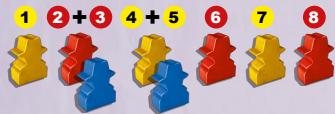
Jesús places his blue pawn3just before Carla places her second pawn4 . Carla will place her blue pawn5 just before Jesús places his second pawn6
Players do not receive any bonus/penalty nor perform any action when placing the Salvatore pawn. Try to guess which actions are best for your rival and place your Salvatore pawn accordingly. But be careful! If you place it on an action space you are also interested in, Salvatore could hinder you too.
All photographs used in event cards are royalty free and public domain. The copyright belongs to their respective authors.
PHASE 4: INCOME AND MAINTENANCE
Discard the left most card for every Salvatore pawn in each row. Next slide to the left the remaining cards and fill-up each row with new cards from the corresponding stack.
As well as their own pawns, each player also recovers one Salvatore pawn.
NEW ROUND
Each round, the first Salvatore pawn will be placed in the top space of a different action:
Round 1. Tip-off.
● Round 2. Improvements.
Round 3. Gangsters.
Round 4. Smuggling.
Round 5. Artists.

Round 6. Celebrities.
SCORING
Salvatore does not score. Count the final reputation points as per the normal game. The only change is that the player with the highest criminality level will lose three reputation points and the other player will lose no points.

1923 COTTON CLUB
Game Design: Pau Carles Ilustration & Design: Pedro Soto Development and rules: Perepau Llistosella and Pako Cantarero
Translation: Pako Cantarero and Board Game Review UK
Designer's thanks: To all those that encouraged me to design games. It was probably not the best advice, but I thank you anyway!
Published by: Looping Games S.L. (www.loopinggames.com)

Artists
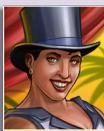
Adelaide Hall (1901-1993)
Jazz singer, she made her debut at a very young age. Duke Ellington saw her talent and incorporated her into his band. She achieved great success with her soprano voice and a dense timbre.

Aida Ward (1903-1984)
Jazz singer, rose to fame during the 1920s and 1930s in New York, on Broadway and at the Cotton Club, where she regularly performed with Duke Ellington and Cab Calloway.

Bessie Dudley (1904-1999)
Authentic Jazz dancer, worked closely with Earl Tucker and adopted his signature “Snakehips” moves combining them with tap.

Bessie Smith (1894-1937)
She was known as the “Empress of the Blues" and was one of the most influential singers of the era. A tireless worker, she became the highest paid black artist of her time.

Bill “Bojangles"Robinson (1878-1949)
Remembered for his signature staircase number, this tap dancer had a long career that spanned vaudeville, Broadway, film, radio and television.

Cab Calloway (1907-1994)
Singer, musician, orchestra director, actor, dancer, and composer. His signature style helped promote the zoot suit to become the peak of pre-war fashion.

Chick Webb (1905-1939)
Jazz and swing percussionist from the age of 17. In 1935, he began promoting a still teenage Ella Fitzgerald as a vocalist in his band.
Count Basie (1904-1984)
Was a pianist and big-band leader. His musical innovations ensured that his modest band possessed the most influential swing style of the era.

Duke Ellington (1899-1974)
Composer, bandleader and pianist. In 1923 he settled in New York with his quintet The Washingtonians. His time at the Cotton Club brought him fame and allowed him to make films and tour the world.
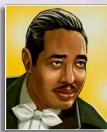
Earl “Snakehips” Tucker (1906-1937)
By exploiting his great flexibility, he created a particular style of dance, similar to the snakes. This signature style and gave him his stage names “Snakehips” and “Human Boa Constrictor".

Ethel Waters (1896-1977)
She was the highest paid New York singer of her day. She was the first black actress in a white Broadway show and was nomi
nated for an Oscar as supporting
actress at the 1949 Oscars for Elia Kazan's Pinky.

“Fats" Waller (1904-1943)
Born in Harlem, Thomas Wright Waller was a great pianist, organist, singer, and jazz bandleader, as well as a consistently good-humoured musician.
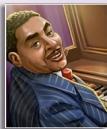
Florence Mills (1896-1927)
Singer, dancer, and actress. She shone on Broadway in 1921 with
the show Shuffle Along, which con
tributed to the Harlem revival. She died young and is remembered as "The Queen of Happiness".

Katherine Dunham (1909-2006)
Dancer and choreographer with a background in anthropology. She founded her own school where she was a teacher and director, and between 1965 and 1966 she was an advisor to the Senegalese Ministry of Culture.

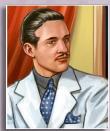
Leonard Reed (1907-2004)
As a young man he entered and won a Charleston contest for white men. That victory changed his career path and, together with Willie Bryant, he created the routine known as Shim Sham.

Louis Armstrong (1901-1971)
Master of the trumpet, he is renowned for his virtuosity in improvisation. He began to be a great influence on New York jazz musicians with his own group, until he became world famous.
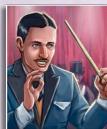
Willie Bryant (1908-1964)
He started out as a dancer and trumpeter before setting up his first big band where he performed as a soloist. He was the master of ceremonies at the Apollo Theatre in Harlem in the 1950s.

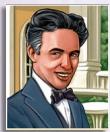
Celebrities
Charles Chaplin (1889-1977)
English actor, comedian, screenwriter, producer, director... a cinema legend. He made his debut in silent films with his character Charlot in 1914, and his films The Gold Rush, City Lights, Modern Times and The Great Dictator were all notable.
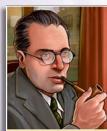
Christopher Morley (1890-1957) Intelligent, lucid, and sophisticated, he travelled throughout the United States as a columnist and reporter. He was one of the most prestigious writers of his time, with his refined style and subtle humour.
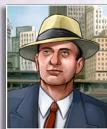
Edward J. Flynn (1891-1953)
Sheriff of Bronx County, he pursued a political career with the Democratic Party. He went on to accompany Roosevelt to the Yalta conference and later had a key role in Truman's election.
Fanny Brice (1891-1951) Jewish singer, stage, and film
actress. For more than 20 years
she performed on radio playing an irritating little girl named “Snooks”. Gloria Swanson (1899-1983) Actress, best known for her roles
in the silent films of the 1920s and 1930s. The advent of talkies, and
poor scripts, stalled her career, but she regained her success in 1950 with “Sunset Boulevard”.

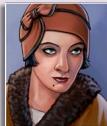
Irving Berlin (1888-1989)
One of the most prolific compos
ers in history. He scored over 1500 songs, including 20 scores for Broadway shows and 15 Hollywood films.
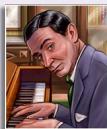
James Cagney (1899-1986)
The most important film star of the 1930s. His success in Public Enemy (1931) will be remembered for his role as a gangster, but he had a flair for dance, drama, and comedy.
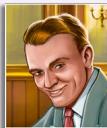
James Farley (1888-1976)
One of the first politicians of Irish
Catholic origin. He was Roosevelt's campaign manager and was responsible for his victory. For over 30 years he was head of Coca-Cola.
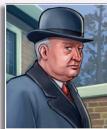
James John Walker (1881-1946) After serving in the US Senate, he was elected mayor of New York from 1926 to 1932. During
his term of office, he discouraged
prosecution of Prohibition viola
tions. Corruption cases led to his resignation.

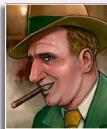
Jimmy Durante (1893-1980)
Actor, singer, pianist and come
dian, who became a star of show
business and radio. His large nose and his constant jokes about it earned him the nickname "Schnozzola".
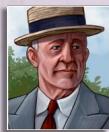
One of Tammany Hall's most powerful leaders. He had access to many Mafia-related businesses. His power waned with the resignation of James J. Walker as Mayor of New York.
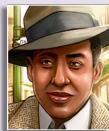
Langston Hughes (1901-1967)
Poet, novelist and playwright who began as a journalist for the NAACP (National Association for the Advancement of Colored People) and participated in the Harlem Renaissance cultural movement of the 1920s.
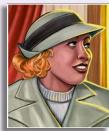
Mae West (1893-1980)
One of the first actresses to become a sex symbol. She battled censorship throughout her career, with her unique brand of wit and risqué references causing upset among the conservative ideals held by many.
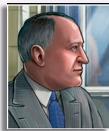
Robert F. Wagner (1877-1953)
Long career politician and New York state election winner, Democratic state senate leader, Supreme Court justice, senator and close associate and strong supporter of President Roosevelt.

Stanley Walker (1898-1962)
Editor of the New York Herald Tribune during the first half of the 20th century. His first book, The Night Club Era, published in 1933, chronicled the colourful nightlife in the outlaw clubs of NY.

Sophie Tucker (1886-1966)
Sonya Kalish was a Russian-born American singer, comedian, actress and radio personality. Her fame spread across Europe and in 1926 she performed for King George V and Queen Mary at the London Palladium.

Thomas E. Dewey (1902-1971)
Relentless prosecutor fighting corruption and organised crime in New York. He achieved great success against Lucky Luciano.
Al “Scarface" Capone (1899-1947) His nickname was because he had several slashes to his face. He was the mob boss in Chicago and, as a jazz lover, opened his own “Cotton Club" there, putting his brother Ralph in charge. Eliot Ness sent him to Alcatraz prison
for tax evasion, from which he was released ruined and ill.
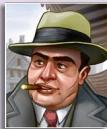
Albert “Mad Hatter" Anastasia (1902-1957)
Crime boss and hitman who was charged for murder on
several occasions, but was always acquitted because witnesses
disappeared. Became a US citizen
for his assistance in World War II and lived in a 25-room mansion on a hill.
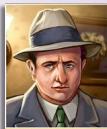
Bugsy Siegel (1906-1947)
Ukrainian Jew and one of the founders of “Murder, Inc.", a national hitman organisation.
Founder of Las Vegas, he directed
the construction of the Flamingo
Hotel and was a friend of cinema stars such as Clark Gable, Cary Grant and Gary Cooper.
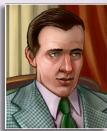
Carlo Gambino (1902-1976)
Albert Anastasia's right-hand man,
until he had him killed so that he
could succeed him as head of the Gambino family. He hated drugs and was involved in trucking,
construction, unions, and rubbish collection.

Charles “Lucky” Luciano (1897-1962)
Considered the most important gangster of his time and one of the creators of the Cosa Nostra. He survived a big beating,
hence the nickname "Lucky". He
betrayed two bosses in one year to be the family leader.
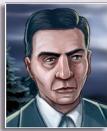

Dutch Schultz (1901-1935) Bloodthirsty and impulsive, he engaged in bootlegging, racketeering, and swindling. He was persecuted by prosecutor Thomas E. Dewey (a candidate for the White House) and Schultz wanted to kill him, but the Crime Syndicate didn't let him do it and solved it by murdering him to avoid trouble.
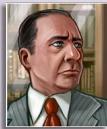
Frank Costello (1891-1973)
Head of Luciano's family while Luciano was in prison, he never carried a gun because as a young man he was imprisoned for it. Called "The Prime Minister of the Underworld" for his political influence.
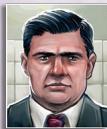
George “Big Frenchy” De Mange (1896-1939)
He was Owney Madden's righthand man, and with him, owner of the Cotton Club and other New York clubs. He would later become a boxing promoter and manager of champions such as Max Baer and Primo Carnera.
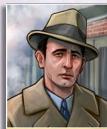
Jack "Legs" Diamond (1897-1931) Bootlegger and gangster famed for his ability to dodge assassination attempts for 15 years. He travelled to Europe to buy whisky on the pretext of getting a cure, but he was unsuccessful and deported.
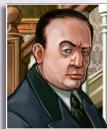
Jacob Shapiro (1899-1947)
Russian-born mobster, he infiltrated labour unions and assassinated their leaders to control industrial workers for two decades, extorting money from unions and companies. Jailed for conspiracy in 1944, he died in prison of a heart attack.
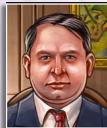
Joe Masseria (1886-1931)
Head of one of the two Italian families that fought for control of New York. He was nicknamed "the man who can dodge bullets" because he survived two attacks.
Joseph Bonnano (1905-2002)
As a child, he left Italy on a fishing
boat and, years later, became one of the youngest Mafia bosses at
the age of 26. He was a millionaire thanks to his many business ventures but led a very austere life. Owney Madden (1891-1965)
Nicknamed "The Killer", he was the
owner of the "Cotton Club", which acquired the heavyweight boxing champion Jack Johnson after his
release from prison. He was one of
those responsible for the murder of
Mad Dog Coll when the latter tried to extort money from him.
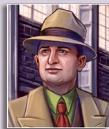

Salvatore Maranzano (1886-1931)
He was sent to New York from Sicily
by Don Vito. A highly educated and well-read person, he organised the Mafia in the image of the
Roman Empire, creating the 5 great families, and proclaimed himself "capo di tutti I capi” (Boss of all
bosses). Shortly afterwards he was assassinated in his office.
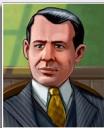
Tommy Lucchese (1899-1967) Smuggler and head of the “Lucchese" family. He managed the textile and trucking industry thanks to the control of trade unions and trade associations. As a young man he lost two fingers in a workshop and was nicknamed “Three Fingers".
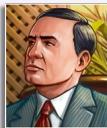
Vincent "Mad Dog" Coll (1908-1932)
Irish hitman nicknamed "Mad Dog" for allegedly accidentally
wounding four children and killing
one. He was acquitted in a media
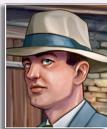
trial but died at the age of 23, shot in a pharmacy phone box. Vito Genovese (1891-1969) He worked for Joe Masseria and would later be one of his assassins on Lucky Luciano's orders. When Luciano went to prison, he
remained in charge of the family. He
died in prison for heroin trafficking.
Texts are community-compiled or publicly released by publishers; copyright remains with the original authors. For personal reference only.