
5 Minute Chase
At a glance
Rules, cards and Q&A (Chinese)
The rules, card data and player questions for this game are written in Chinese. Open the Chinese page to read them.
Where to find full rules
Full rules and card lookup are available in the cunlema app at cunlema.cn — pick this game and ask about any rule, card or turn you are unsure about.
Related games
Rulebook text (Markdown)
This game has 1 rulebook Markdown file(s) in our library; 1 rendered inline below — expand to read or download.
5minuteChase WWW.md21.2 KB
INTRODUCTION
Your plan to break out of the jail was perfect, but isn't it always... And as usual, something went terribly wrong. The alarm went off way sooner than it was supposed to and the streets were quickly filled with police roadblocks. On top of that, prison officers started chasing after you as soon as you got out of the gate. What was supposed to be a walk in the park turned out to be a real chase!
5 Minute Chase is a fast-paced, dynamic, real-time game for 2 to 4 players. Runners and Chasers must compete against each other using their observational skills under the pressure of time. The goal of each team is different and Victory markers are awarded to whoever wins each round of play. Once a player has enough Victory markers, they win the game!
COMPONENTS
31 ROUTE TILES
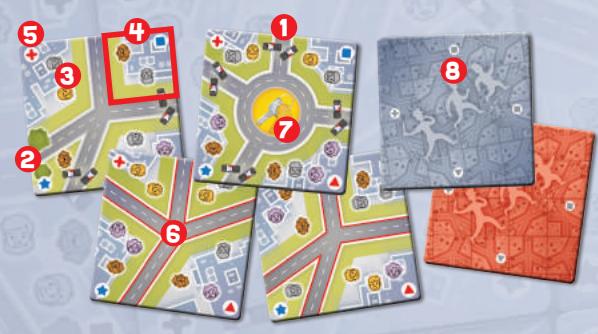
(including 6 Starting Route tiles with red backs) - These tiles represent the escape route of the Runners and will be placed by Runners during the game one by one, forming a path.
① Police roadblock
② Trees Witnesses
4 Sector
⑤ Sector symbols
Streets
⑦ Item
8 Correct symbol choices
1 PRISON TILE
Placed in the center of the table at the start of the game.

30 CHASE MARKERS
(15 red and 15 blue, each having a different symbol on either side) - These markers are placed on tiles to track the pursuit.

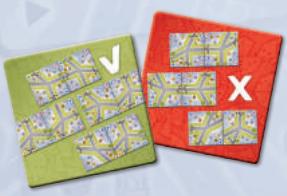
1HELP TILE
A double-sided tile showing the correct way to place tiles during a game on the one side and the incorrect way on the other.

3 HIDEOUT TILES
Where the Runners are trying to reach, but on their way there, they also need to collect three different items.

14 VICTORY MARKERS
(5 Perfect Victory (Gold) and 9 Small Victory (Silver) - These are awarded at the end of each round to the players who win that round.
GAME OVERVIEW
A game of 5 Minute Chase is divided into a number of rounds. In each round, the players are divided into two teams, Runners and Chasers, each of which has their own objective:
The Runners are trying to reach their hideout, but to do that they have to pick up a few things along the way.
The Chasers are trying to prevent the Runners from reaching their hideout. Prisoners cannot be allowed to run around freely!
At the end of each round, Victory markers will be awarded to the players who succeed in their objective. However, since the game is played in real-time, it is possible that a team makes an incorrect placement. Once the round is over, all placements are checked, and if any mistakes were made, victory is given to the opposite team! A new round then begins, with players switching roles between Runners and Chasers.
Get enough Victory markers and you win the game!
The player who most recently ran more than a mile takes on the role of the Chaser, while the other player takes on the role of the Runner. Alternatively, use any other method to determine who will be the first Chaser.
The rules that follow are for a 2-player game, and you should learn these first. It is recommended you play at least a couple of rounds of the 2-player game before proceeding to the 3- or 4-player game. The changes for 3- and 4-player games can be found on page 7.
ROUND SETUP
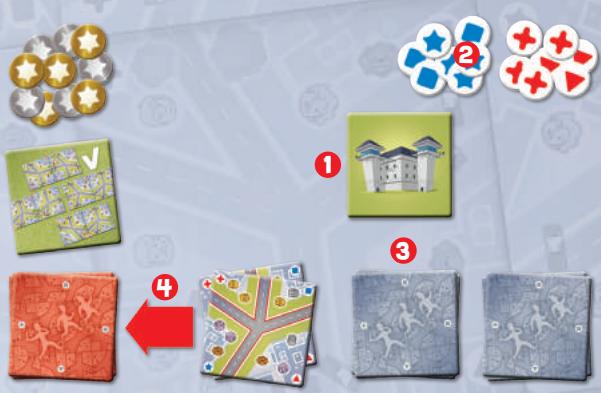
Place the Prison tile in the very middle of the play area. It is important that there is enough space around this tile in all directions.
② The Chaser takes all Chase markers and places them nearby.
Separate out the 6 Starting Route tiles, shuffle them and place them in a face-down pile in front of the Runner. The remaining
25 Route tiles along with 3 Hideout tiles should be shuffled together and then split into two piles with 14 tiles each. These must also be placed in a face-down pile in front of the Runner.
The Runner takes the top 2 tiles from the Starting route pile, placing the rest of the Starting Route tiles aside; they will no longer be needed this round.
You are now ready to start.
RUNNER RULES AND OBJECTIVES
The Runner will be placing new tiles onto the play area which represent the direction of their escape.
After setup, the Runner will be holding 2 Starting Route tiles in secret and can plan the best way to place them. This should be done without showing the front of the tiles to the Chaser. Once planned, both tiles are then placed into the play area (at the same time), one adjacent to the Prison tile, and then the second tile adjacent to the first.
There are certain rules that determine whether a tile is placed legally or not, but this is not checked until the end of the round. However, since the Runner can take as long as they want to plan, they should ensure that the placement of their Starting Route tiles is legal (see next page).
As soon as the two Starting Route tiles are placed, the round starts and the Runner and Chaser start to play simultaneously!
Quickly, the Runner picks up one of the piles of Route tiles and begins placing new tiles one by one trying to fulfill their goal as fast as possible without making any mistakes. Any tiles placed at this point do not need to follow the placement rules, but if any of them are found to have been placed illegally at the end of the round, the Runner will lose.
TILE PLACEMENT RULES
① Tiles may only be placed within the physical play area. i.e. if you are playing the game on a table, tiles cannot be placed unless they are fully on the table itself.
②When placing a new Route tile, it must be placed adjacent to only one other tile, the one that was most recently placed.
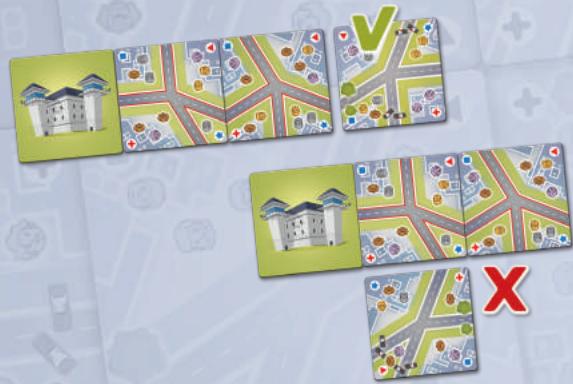
The streets on adjacent Route tiles must connect.
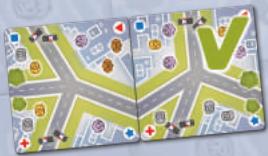

The streets connecting two tiles cannot be placed next to each other if either of the following is true:
● A Police roadblock is next to another police roadblock
● A Police roadblock is next to an empty street i.e. A street exit with a roadblock can only be placed next to a street exit containing trees, it doesn't matter if the trees or the roadblock comes first as long as they are next to each other.
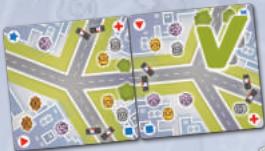
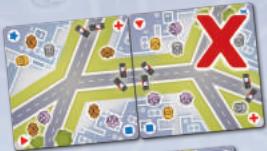
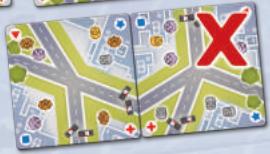
⑤Once placed, a tile cannot be picked up again or rotated.
There might be a situation where the Runner gets stuck, without any possible options to place new tiles. If this happens, the Runner will get caught very quickly.
Remember: During the game, tiles will be placed quickly onto the playing area. The Runner should try to make sure they are placed legally but this is only checked at the end of the round.
SWITCHING BETWEEN PILES
The Runner can hold only a single pile of Route tiles at a time and can look through them and choose which one to place next. They can also switch piles at any time. To do that, they place the entire pile of the tiles they currently have face down in front of them and pick up the other pile. This is often useful when a player is looking for a particular tile.
THE HIDEOUT
The Runner must keep on placing tiles until they reach their final destination, the hideout. But, it isn't that simple. Before placing the hideout, three unique items must have been collected first: map, money, and keys. An item is considered collected if a tile depicting that item has been placed.
There are six tiles in the game depicting items (2 tiles for each item). These tiles are more difficult to place than regular tiles, as many (or even all) of the street exits contain roadblocks. Once at least one of each item has been placed, the Runner has all the necessary items and can then place one of 3 possible hideout tiles. Once the hideout tile is placed, the round ends immediately, proceed to End of Round (see page 6).
CHASER RULES AND OBJECTIVES
At the start of the round, the Chaser needs to wait until the Runner places their Starting route tiles in the play area. As soon as that has been done, they can start playing. The chase is on! The Chaser will be placing Chase markers onto the tiles placed by the Runner, starting from the tile next to the Prison tile, and continuing in the direction that the new tiles are placed. Chase markers must be placed on all tiles in order (i.e. the same order the tiles were put down). If a Chase marker is placed on the most recently placed tile, the Chaser has caught the Runner and the round ends.
Each Route tile contains four different sections, separated by streets. Each section has a different symbol in it and also contains a number of witnesses. The number of witnesses and the direction they're looking determines which Chase marker the Chaser needs to place.
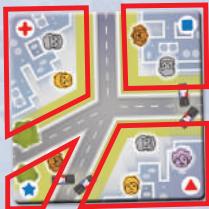
CHASE MARKERS
In a similar way to the rules for tile placement for the Runner, the Chaser should try to follow certain rules for placing Chase markers because at the end of the round, if any of the Chase markers are found to have been placed illegally, the Chaser will lose that round.
MARKER PLACEMENT RULES
The section containing the most (or joint most) witnesses facing the direction of the chase indicates the colour and symbol of the Chase marker that should be placed. The direction of the chase is determined by the position of the adjacent Route tile which does not contain a Chase marker (i.e. the direction the Runner is moving). If more than one section has the most witnesses facing in the direction of the chase, either of those markers is legal.
EXCEPTION: FINAL TILE RULE
The rules for placing a Chase marker on the most recently placed tile are different. This occurs when Chase markers have been placed on all other Route tiles and the Runner has not yet placed another tile. This is the chance for the Chaser to catch them!
The Chase marker which is placed on the final tile should correspond to the section on that tile that contains the most (or joint most) witnesses facing the direction the Runner came from, i.e. facing the direction of the only adjacent Route tile. As before, if more than one section has the most witnesses facing that direction, either of those markers is legal.
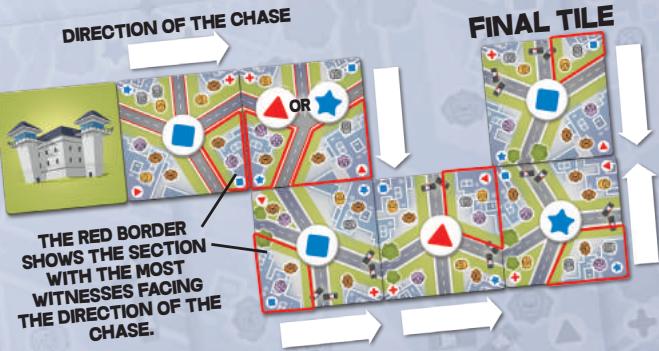
Note that while the Chaser is figuring out the correct symbol to cover the final tile, the Runner might place a new tile. If they do, the Chaser needs to re-evaluate the tile again as this is no longer the final tile, so the placement rules revert back to normal.
CHASER'S GOAL AND ENDING THE ROUND
When a Chase marker is placed on the final tile, the Chaser should place their hand over the final tile to prevent the Runner from adding any more tiles. The round ends immediately, proceed to End of Round (see below). In the rare situation that the Chaser runs out of a specific color of Chase markers and needs to place one of that color, it means that the Chaser has lost track of the Runner and cannot follow the trail any more, proceed to End of Round.
END OF A ROUND
Since both sides will be placing tiles and markers as quick as they can, there is no time to check that those placements are correct during the round. However, at the end of the round, all placements are checked to see if they are legal.
First, check that every Route tile placed by the Runner has been placed correctly. Starting from the tile adjacent to the Prison tile and continuing in the direction of the chase, the streets on all Route tiles must connect, and all exits with police roadblocks must be adjacent to an exit with trees. If there were any mistakes, mark the tile where the first mistake was made (by rotating the tile slightly or in any other suitable way).
If, during this round, the Runner reached their hideout and made no mistakes, you can skip straight to Scoring. The Runner will gain 1 Perfect Victory marker, there is no need to check the Chase markers.
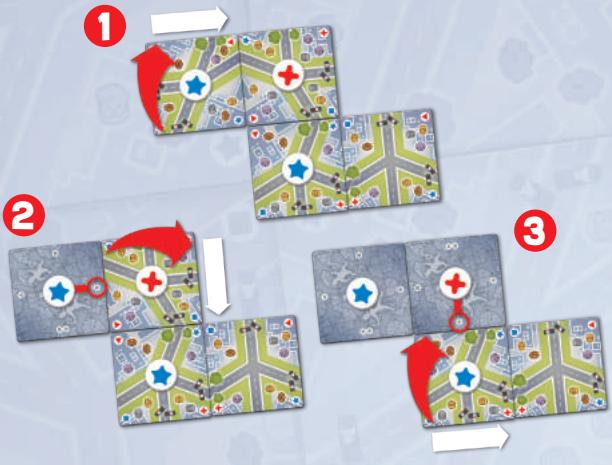
Otherwise, the next step is to check if all Chase markers on Route tiles were placed correctly. Once again, starting from the tile adjacent to the Prison tile and continuing in the direction of the chase, check that each Chase marker is legal. To do this, rather than checking the number of witnesses facing the correct direction, simply flip the Route tiles over, as follows:
If, from your perspective, the direction of the chase is left or right, flip this tile vertically. If the direction of the chase is up or down, flip this tile horizontally. In other words, when the tile is flipped, the same side of the tile must be pointing to the exit you are checking (just flipped over).
The reverse of the tile shows the symbol or symbols of the Chase markers which are legal for that tile in that direction. Remember for the final tile, check against the opposite direction (where the Runners came from). If the symbol on the Chase marker does not match any of the symbols printed on the appropriate side of the reverse side of the tile, the Chase marker is not legal. To indicate this, move it to the edge of the tile. Always double check on the front side again to check you have flipped the tile correctly.
SCORING
If neither side made any mistakes (all tiles and markers were placed legally):
If the Runner reached their hideout, the Runner wins that round.
If the Chaser caught them, the Chaser wins that round.
If the Runner made any mistakes, and the Chaser did not, the Chaser wins that round.
If the Chaser made any mistakes, and the Runner did not, the Runner wins that round.
If both sides made a mistake, look to see who made the mistake first. That side loses the round and the other side wins. If both sides made their first mistake at the same tile, nobody wins that round.
If the Chaser lost the trail (because they had run out of a particular color of Chase marker they wanted to place), check to see if the Runner made any mistakes. If they did not, the Runner wins. If they did, the Chaser wins.
If the Runner wins the round, they gain 1 Perfect Victory marker If the Chaser wins the round, they gain 1 Small Victory marker
END OF THE GAME
After the end of each round, check to see if any player has enough Victory markers to win the game:
2 Perfect Victory markers
1 Perfect Victory marker and at least 1 Small Victory marker
●3 Small Victory markers
If nobody has enough Victory markers to win the game, another round begins. Between rounds, players must change sides and take on different roles in the next round. The play area must be cleared entirely, and then a new round starts just like the first one, but with players keeping any Victory markers they gained in previous rounds.
3-PLAYER GAME
In a 3-player game, determine the first Chaser normally. The other two players are the Runners.
During the game, the rules for the Chaser are the same as for the 2-player game. The Runners, however, follow slightly different rules:
Each of the Runners will have a single pile of Route tiles assigned to them during setup, after they have been shuffled and split.
They must decide between themselves who will begin the current round. That player takes the 2 Starting Route tiles, plans how to place them without discussing it with the other Runner, and then places them as usual.
Once the game starts, the Runners must alternate in the placing of Route tiles, starting with the Runner who did not place the Starting Route tiles but otherwise following all the normal rules, i.e. they are trying to escape together by building a single route to their hideout.
Both Runners can hold their own pile of Route tiles in their hand, but should not look at the other Runner's tiles.
Runners may exchange piles between themselves, but this must be performed in a specific way: Only the Runner whose turn it is to place the next tile can initiate an exchange by placing all tiles from their hand face down in a pile in front of them and saying EXCHANGE!’. The other Runner then places their tiles face down as a pile in front of them. Then both Runners pick up the pile from the other player and play continues.
If the Runners win the game, both players playing as Runners gain 1 Perfect Victory marker each.
Before the next round, players switch roles: The Chaser role goes to the player on the left of the one who was playing as the Chaser, while the other two are Runners.
In games with more than two players, it might happen that more than one player has enough Victory markers to win the game at the same time. In this case, the player who has the most Perfect Victory markers wins - if there is still a tie, another round should be played to break that tie.
4-PLAYER GAME
In a 4-player game, two players will play as Runners and the other two will be playing as Chasers. The first Chaser is determined as normal and the player to their left will also be a Chaser. The other two players become Runners.
The following additional rules apply to 4-player games:
Each of the Runners will have a single pile of Route tiles assigned to them during setup, after they have been shuffled and split.
Each of the Runners takes two Starting Route tiles at random during setup. They can consult each other about where to place them when planning, keeping the tiles secret from the Chasers. They will be creating two paths from opposite sides of the Prison tile, they must decide together who will start from which side.
The Runners place their two Starting Route tiles at the same time, starting on opposite sides of the Prison tile.
The Chasers will go after one Runner each and should decide beforehand who will chase whom.
The Chase markers are split between the two Chasers, although they can always pass them between each other when one of them runs out of a particular color.
Each Chaser can only place Chase markers on the path of the Runner that they are chasing.
All players play simultaneously, with the Runners building their escape routes, and each Chaser pursuing one Runner. Items collected by both Runners count for both Runners, it doesn't matter which Runner collected which item and where, they just need to have all three items collectively. But there is a small twist: Only one hideout is placed and it must connect to both paths. Therefore, the Runners should try to keep their paths close by.
Both Runners can hold their own pile of Route tiles in their hand, but should not look at the other Runner's tiles.
Runners can exchange piles between themselves. See the rules for the 3-player game on how this is done.
If a single Runner is caught, the other Runner may continue, and all items collected by the caught Runner are still usable by the other. The remaining Runner no longer has to place the hideout so that it connects both paths. However, they will gain only a Small Victory marker for escaping alone, unless either Chaser made a mistake, in which case both Runners still gain a Perfect Victory marker (even the one who was caught).
Any mistakes made by either player on a team affect the whole team. For example, if one Runner gets caught, but the other Runner reaches the hideout, but then it turns out that one of the Runners made a mistake, they both lose the round.
Before the next round, players switch roles: Each player takes on the role of the player to their right from the previous round. l.e. two of the players retain their role for the next round, but with a different teammate.
In games with more than two players, it might happen that more than one player has enough Victory markers to win the game at the same time. In this case, the player who has the most Perfect Victory markers wins - if this is still a tie, another round should be played to break that tie.
GAME VARIANTS
The variants presented here change some of the rules of the game, making the game play differently, and sometimes making one role easier. The variants can be used all at once or in any combination.
HEAD START
Recommended for players who are struggling when playing the Runners.
The Runners take 3 Starting Route tiles instead of 2, and place all 3 tiles (following normal rules) before the round starts.
THE PERFECT PLAN
During setup, before shuffling the Route tiles, all tiles with items are set aside into two piles (each pile having one of each item). Then after splitting the remaining Route tiles, add one pile of items into each pile. This will help the Runners as it helps them remember to place all three items.
IT'S NOT A SPRINT, IT'S A MARATHON
You can play a longer game by changing the number of Victory markers required to win. You may need to use alternative markers.
Game Designers: Antony Proietti, Dave Neale Graphic Designer: Paweł Niziołek Rule book: Matt Dembek, Paul Grogan
Download MarkdownTexts are community-compiled or publicly released by publishers; copyright remains with the original authors. For personal reference only.