
A Handful Of Stars
At a glance
Rules, cards and Q&A (Chinese)
The rules, card data and player questions for this game are written in Chinese. Open the Chinese page to read them.
Where to find full rules
Full rules and card lookup are available in the cunlema app at cunlema.cn — pick this game and ask about any rule, card or turn you are unsure about.
Related games
Rulebook text (Markdown)
This game has 1 rulebook Markdown file(s) in our library; 1 rendered inline below — expand to read or download.
TFG_aHoS_Rules_A4_v5_web.md63.5 KB
AHHAndFuL AGAMEBY OF STARS MARTIN WALLACE
A HANDFUL OF STARS USEFUL INDEX
The following is not a detailed list of contents but is intended as an aid to help you locate useful information quickly.
Introduction and overview, Pages 3 to 6
Components Pages 7 to 8
Card details Pages 10, 11, 24, 25, 26, 27
Counter and tile details Page 11
Resource descriptions . Page 10
Race descriptions . Page 9
Development counters Pages 10, 13 and 15
Starting the game Page 12, 13 and 14
Playing the game general description Page 15
Moving the Shuffle marker Page 15
Building Military Units Page 16
Moving Fleets Pages 16 and 17
Initiating combat Page 17
Attacking a neutral system Page 17
Resolving combat . Page 18
Casualties of combat Pages 18 and 19
Retreating from combat Pages 18 and 19
Colonising a system Pages 20 and 21
Drafting Technology cards Page 21
Reserving cards Page 21 and 22
Discarding cards Page 22
Permanently removing cards from play Page 22
Ending the game Page 23
Victory Points Pages 13, 20
Black holes Pages 12 and 16
Wormholes .Page 21 and 22
INTRODUCTION
It was the aftermath of the time known as the ‘Great Cosmic Ripple'. For reasons not fully understood by the scientists of the time the empires of the Arm had been ripped apart and spread randomly among the stars, as if shaken around in a large box!
It is now time for the space faring races of the Voltare Arm to reunite with their own and put back together what had been so
terribly disrupted. Great space fleets are now embarking on missions
to re-establish their empires while conquering those star systems that happen to be in the way.
Your challenge is to lead one of the seven races of the Arm in consolidating your empire and invading new worlds. You will need to build fleets of ships, research new technologies, plan long-term strategies and ride the waves left from the‘Great Cosmic Ripple'.
'A Handful of Stars' is an epic game of exploration and conquest for two to four players and should take around 120 minutes to complete.
A HAndFuL MARTIN W OF StARS
OVERVIEW
'A Handful of Stars' is the final game in the deck-building trilogy that started with 'A Few Acres of Snow'. As such it shares a number of mechanisms with that game and Mythotopia'. Therefore, if you have played either of these games then you will find much that is familiar in 'A Handful of Stars'.
The game starts with the board being randomly seeded with star systems, including a sub-system that sees black holes being placed on some connections. You will then be allocated your starting systems, via the deal of the cards.
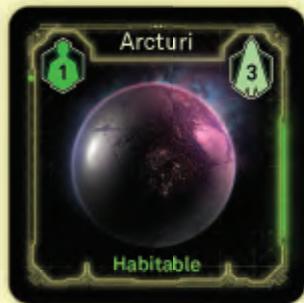
Systems come in two flavours - habitable and uninhabitable. Habitable systems will earn you more points and allow for the building of ships. Uninhabitable systems tend to be more resource rich.
You will also be given an alien race with their own unique powers and abilities. The Race Ability cards are shuffled in with the System cards you were dealt, along with some starting cards and two cards drawn at random from the Technology deck. This will form your starting deck. From this you will draw a hand of six cards. What you can do will be determined by the cards you draw. If you have not played a deckbuilding game before then the key concept to understand here is that during the course of the game you will add cards to your discard pile which will then eventually work their way into your hand. Your deck cycles, so when you have played all of your cards on to your discard pile you shuffle those cards to make a new deck. You will be able to shape your strategy through the cards that you draft and add to your deck cycle.
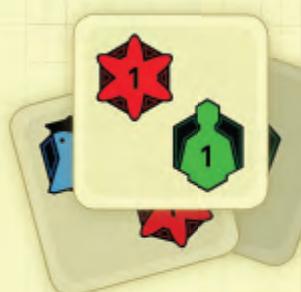
There are four resources in the game, which are Energy, Matter, Population and Research. Energy is used to move space fleets – one Energy moves one fleet along one connection. Matter has two uses, the first is combat, where one point of Matter will become one Combat Strength point (you can think of the matter as being turned into bombs and bullets). The second is when you build fleets and star bases, each requiring you to expend one Matter and one Population. Population also has two uses, it is required to build fleets and star bases, as just mentioned. You also need population to colonise systems. To place an outpost (cube) on a system requires one Population, while to place a colony (disc) requires three points of Population. Research is used to pay for Technology cards and move through wormholes (of course!). When you need to expend resources you will discard cards and counters with the correct resource symbols on. In all cases a card or counter can only ever be used for one resource type, or for its effect.

ENERGY

MATTER

POPULATION

RESEARCH
Your objective is to end the game with more victory points than any other player. There are two ways of gaining victory points. The first is by expanding into new systems. Each outpost you place will gain you three victory points, while each colony you establish will gain you five victory points. The other way is by acquiring Technology cards and Development counters with victory points marked on them.
The turn structure is simple. Players take it in turns to be the active player. When you are the active player you are allowed to perform two actions. Once you have completed your two actions you refill your hand to six cards and play progresses to the next player. Whenever your draw deck is exhausted you shuffle your discard pile to make a new deck. At the same time you flip face-up all of your Development counters and you move the Shuffle marker one space up the Shuffle track. The game will be close to ending when the Shuffle marker reaches a certain space, which depends on the number of players. Once it does reach that space you complete the present round of play, so that all players have had an equal number of turns and then you carry out one more round of player actions.
You have a menu of actions that you can choose from.
You can build fleets and star bases. The cost for each is the same, one Matter and one Population each. You can build a maximum of two such units in a single action. The key rule to remember is that you can only build them on colonies or your home world, i.e. anywhere you have a disc or cylinder. You cannot build on outposts – they lack the necessary infrastructure.

FLEET

STAR BASE
You can move fleets (not star bases). It costs one Energy to move one fleet one connection. You can move as many fleets as you wish, as far as you wish.There are two limitations. Firstly, you cannot move along a connection marked with a black hole (these are placed randomly at the start of the game). Secondly, you can only move to one neutral or enemy occupied system in a single action, i.e. move as much as you want but you can only invade one system. Combat occurs if you invade a system occupied by another player or a habitable neutral system. The combat system is best imagined as a tug-of-war where each player takes it in turn to commit forces and resources to the battle. Energy can be used to move other fleets into combat, while matter can be played to add directly to your combat strength. Each fleet has a combat strength of three, each star base has a strength of five and each point of matter converts to one Combat Strength point. This tug-of-war continues until one player decides, or is unable, to continue adding to his strength.
You can place an outpost or colony in a system that you have fleets in. This will allow you to take the corresponding System card. When you place a colony you take it from your Player Display, which will leave a vacant space. You select one of the Development counters on display to fill this space.
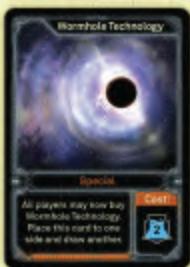
There will be eight Technology cards on display that you can acquire by expending Research points. When you draft a card it goes on your discard pile. As cards are purchased new cards are drawn. If the 'Wormhole Technology' card is drawn then it is placed to one side. From now on all players can acquire wormhole technology. This allows you to move fleets from one wormhole to another wormhole (these are marked on the system tiles). To move one fleet through one wormhole requires the expenditure of one Research point.
It may be that you wish to hold cards back for a later turn. On your Player Display you have two Reserve slots. Any card can be placed in Reserve One. Only cards marked Reserve' can be placed in Reserve Two. As an action you can place as many cards as you wish in your reserves, however, each slot can only hold up to two cards. This limit can be increased if you have the Development counter that increases your reserve capacity. Cards in your reserve can be used at any time, as if they are part of your hand. Certain cards have a persistent effect if they are in your reserve, such as ‘Space Mines'.
Many of the cards have specific effects. The play of some of these cards will use up one of your actions, as indicated on the card.
The other actions you can perform are of less significance. You can discard cards, which is really not something you would prefer to do. You can also thin your deck by permanently removing one card from your hand. Finally, if you have nothing better to do, you can pass.
As has already been mentioned, the end of the game is triggered when the Shuffle marker reaches a certain point on the Shuffle track. It is good practice for players to record their present victory point totals on the Victory Point track during the course of the game. However, at the end of the game it is best to double-check that these point totals are correct. As you would expect, the player with the most victory points is the winner.
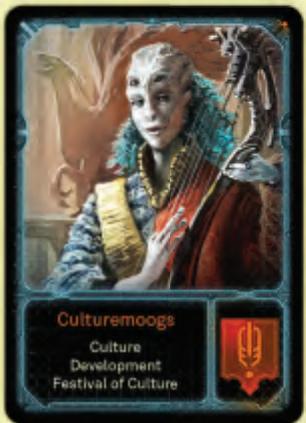
As far as strategic advice goes, it is good to play to the strength of the race you have been dealt. Thus, if you are the Aggroloids then an aggressive expansionist policy will tend to work well. On the other hand, if you are the Culturemoogs then you will want to focus on expanding your ability to place Culture cards in your reserve and those Development counters that grant victory points on your Colony track. I would strongly recommend that at the start of the game you analyse your position and that of your opponents. You should then formulate a strategy based on your situation. In all circumstances it is good to have your systems connected with each other, so look to see how quickly you can bring together the disparate parts of your empire. Once you have a strategy then try to stick to it, do not become distracted.
This is the very last Treefrog game. I would like to think it is one of the better ones that we have put out. Hopefully you will share this opinion.
I would like to thank the many friends, associates, lawyers and gamers that have helped, supported and encouraged myself and Julia over the years.
Martin Wallace
COMPONENTS
PLAYER PIECES - Four sets of player pieces, each consisting of:

21 FLEET COUNTERS

6 STAR BASE COUNTERS
12 COLONY DISCS

1 HOME WORLD MARKER

16 OUTPOST CUBES
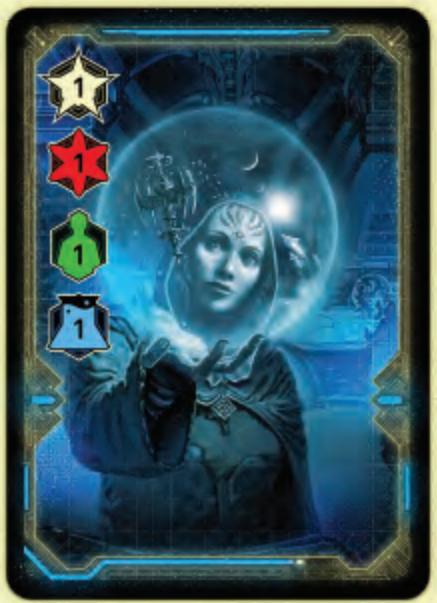
4 STARTING CARDS
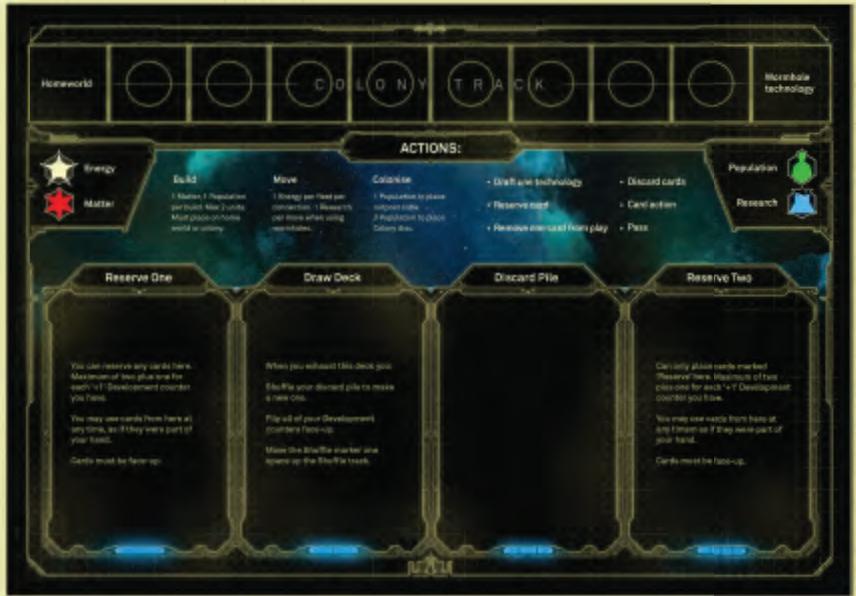
1 PLAYER DISPLAY
OTHER COMPONENTS:
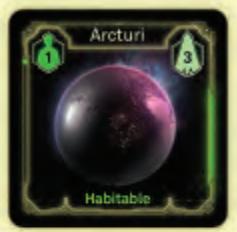
19 HABITABLE SYSTEM TILES
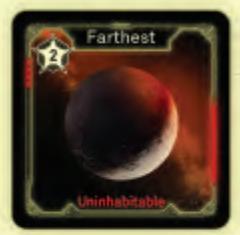
19 UNINHABITABLE SYSTEM TILES

18 ALIEN COUNTERS
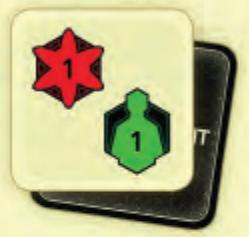
33 DEVELOPMENT COUNTERS
Wormhole Tech
4 WORMHOLE COUNTERS

3 GAME MARKERS
16 BLACK HOLE DISCS
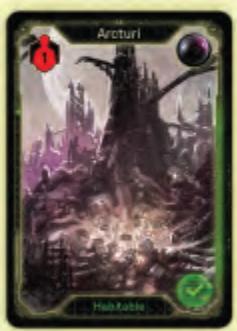
19 HABITABLE SYSTEM CARDS
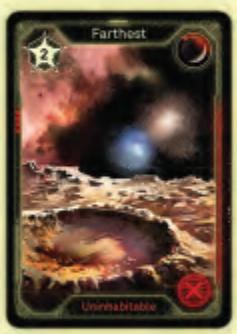
17 UNINHABITABLE SYSTEM CARDS
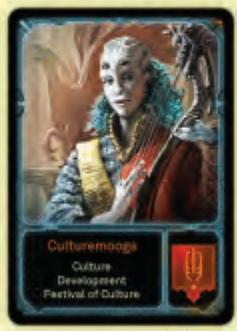
7 RACE IDENTITY CARDS

21 RACE ABILITY CARDS

41 TECHNOLOGY CARDS
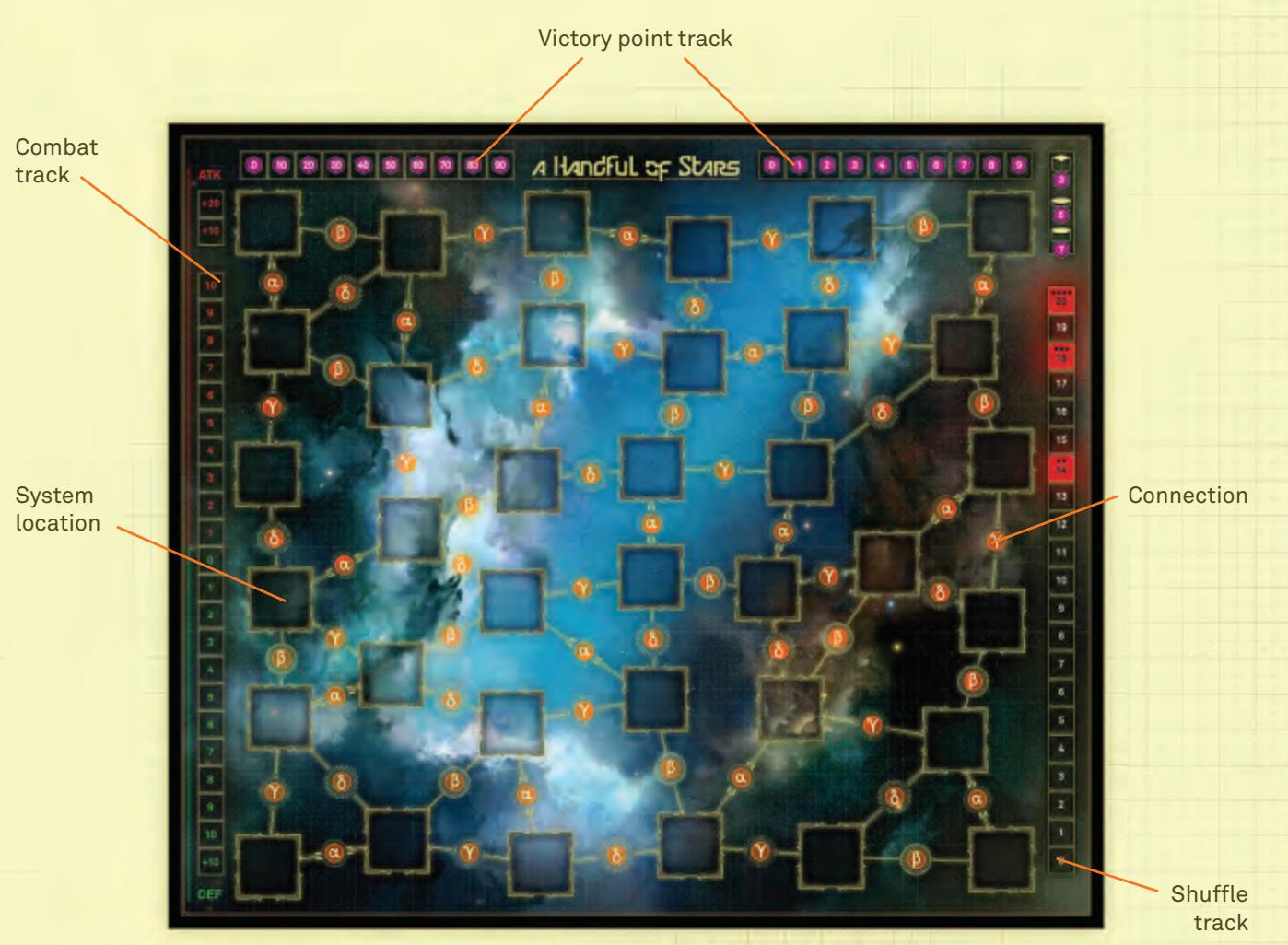
1 GAME BOARD
THE RACES




AGGROLOIDS
The Aggroloids have anger-management issues, combined with a fearsome arsenal of weapons.
BILDEROIDS
The Bilderoids are never happier than when building things, even when what they create can deal death and destruction to those who get in their way.
CULTUREMOOGS
The Culturemoogs are in to all the latest music and arty stuff, whether it was created by another Culturemoog or some mutated creature fed a strict diet of pineapples.
EXPLOREMORDS

The Exploremords are very inquisitive. They love to discover new worlds and colonise them, whether already occupied or not.
PEACENIMS
The Peacenims are a gentle race who others would love to hurt, but for some reason diplomacy and space mines seem to get in the way.

STORBOTS
The Storbots are genetically incapable of throwing things away. Everything goes in a box, just in case it can be used next religion of your choice' celebration day.

TECHNOIDS
The Technoids love shiny new technology. It does not matter whether it goes ‘bang' or not, it's all good.
RESOURCES
There are four resources in the game, which are: Energy, Matter, Population, and Research. Each has a symbol representing it, as shown below. Resource symbols appear on cards and Development counters. The number in the symbol tells you how many points of that resource are available to you. Whenever you are required to expend a resource you can play a card with the necessary symbol on or flip a Development counter face-down. You can mix and match the way you expend resources, using cards and counters in any manner you wish. All cards that you play for this purpose are placed on your discard pile. You can only use one type of resource on a card/counter. You never receive back resources if you spend more than necessary.

ENERGY
Energy is used to move Fleets - one Energy moves one Fleet one connection.

MATTER
Matter is used to build Fleets and Star Bases. Matter is also used when fighting a war, one point of Matter is worth one Combat Point.


POPULATION
Population is used to settle systems with outposts and colonies, and to build Fleets and Star Bases.
RESEARCH
Research is used to acquire Technology cards and navigate Wormholes.
CARD TYPES
Cards play a central role in this game, so it will help to look at the different types you will encounter.
There are seven races in the game, each of which has a set of four cards. One of these is the Race Identity card. This will sit in front of a player to indicate which race they are. The card also has information about the remaining three cards. These are the Race Ability cards, and will go into your starting deck. These cards reflect the characteristics of that race.

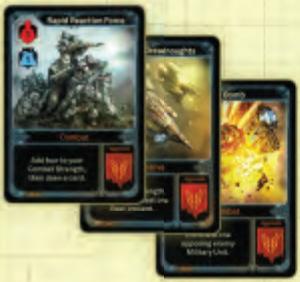
You will also start with four standard Starting Cards, each set of which is identical to the other player's cards.
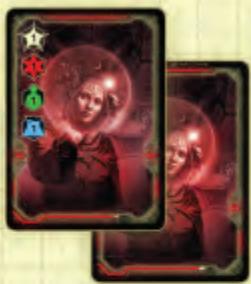
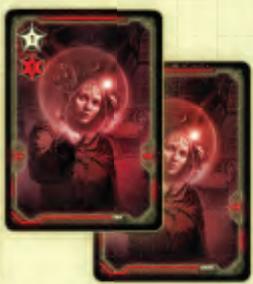
Each system has a corresponding System Card. These are used to randomly determine where you start. The cards for the systems you control will go into your Starting Deck. The neutral Habitable and Uninhabitable System cards will be kept near the board, face-up, so that a card can be retrieved as necessary.
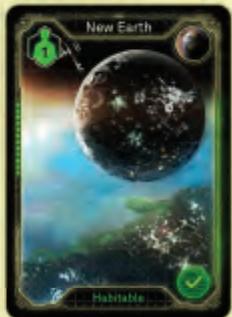
HABITABLE SYSTEM

UNINHABITABLE SYSTEM
The Technology cards allow you to augment your race, granting you specific abilities and powers. These will be placed in a display of eight cards, from where you are allowed to draft them for the cost indicated on the card. You start the game with two of these cards, which will be drawn randomly.
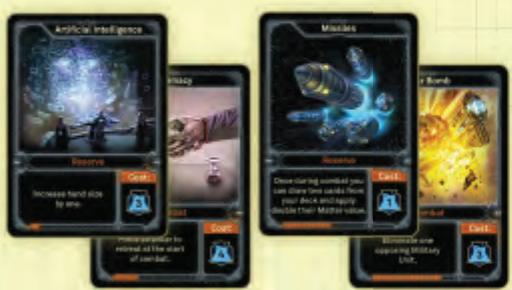
Cards generally have more than one potential function, in most cases having multiple resource symbols and/or an effect. In ALL cases a card can only ever be used for ONE purpose, which is either for ONE TYPE of resource symbol or the TEXT EFFECT on the card.
ACTION
Counts as one of your two actions.
FREE ACTION
Does not count as an action to play. You may play as many such cards as you wish during your turn.
ONE-USE
After playing the card it must be removed from play, place back in the game box.
COMBAT
This card can be played during combat, by either the attacker or defender.
RESERVE
The card will have a persistent effect while it is in your Reserve.
COUNTERS AND TILES
PLAYER COUNTERS

Fleet counters have a Combat Strength of three.

Star Base counters have a Combat Strength of five.
SYSTEM TILES

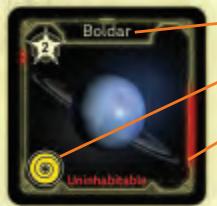
System name
Combat strength
Indicates that a Black Hole should be placed on the corresponding connection.
A green border and the Population symbol show this is a Habitable system, which means it can be colonised.
System name
Wormhole
A red border and the lack of a Population symbol show this is an uninhabitable system, which means it can only have an Outpost placed on it
OTHER COUNTERS

ALIEN COUNTER
Alien defense strength
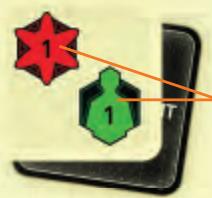
DEVELOPMENT COUNTER
Resources
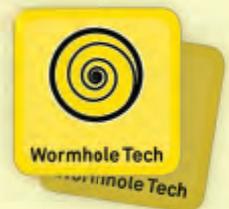
WORMHOLE COUNTER
STARTING THE GAME

Each player selects a colour and takes the
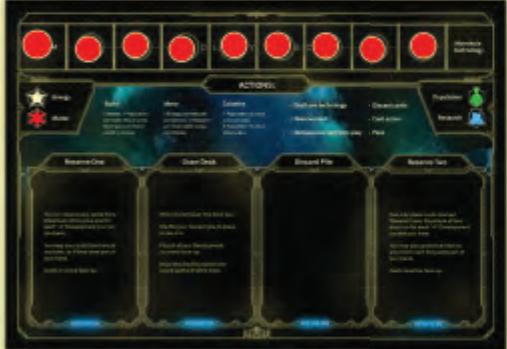
corresponding set of counters, wooden pieces, cards and a Player Display. You place your display in front of your
position. Place your Home World marker in the first space on your Colony track. Place one Colony disc on every other space on the track, as shown here. Note that there will be some discs left over.
You place your remaining Colony discs, Outpost cubes, Fleet and Star Base counters next to your display, to form an available stock.

Place the game board in the centre of the table.
Shuffle all of the System tiles together, face-down. Draw and place one on each system space on the game board. After you have placed all of the tiles they should then be turned face-up.
Place one Black Hole disc on each system with the Black Hole symbol on. Now move each Black Hole disc to the connection indicated by the letter in the Black Hole symbol on the System tile. If there is no such connection or there is already a Black Hole on the connection then do not place the Black Hole disc, instead place it to one side. There is the potential for fifteen Black Holes, so you will have one left over after the initial placement on System tiles.
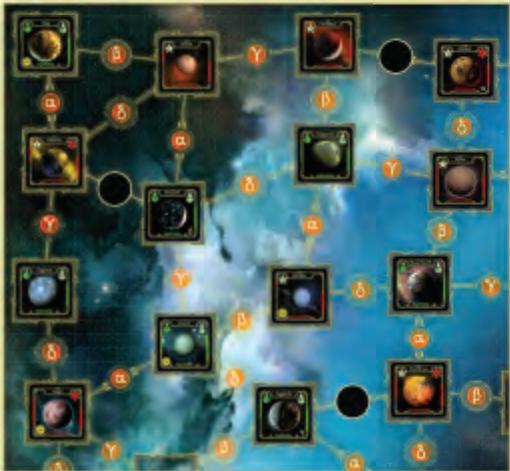

Shuffle the Habitable system cards and deal out a number to each player, depending on how many players there are, as below:
Two players
- five cards per player
- four cards per player
Three players
Four players
- three cards per player
Shuffle the Uninhabitable system cards and deal out the same number as Habitable cards.
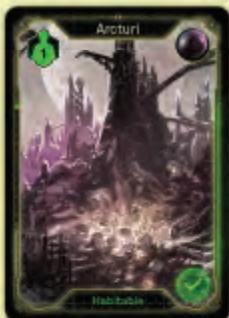

All players now place one of their Outpost cubes on each System tile for which they have a System card.
The remaining System cards should be placed close to the side of the board, face-up, from where players will be able to take them as they acquire control of the corresponding system.
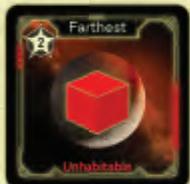

Shuffle the Technology cards and deal out two to each player.
Players do not reveal these cards to other players.
Shuffle the seven Race Identity cards and deal out one to each player. You then reveal your Race Identity and take the corresponding three Race Ability cards.
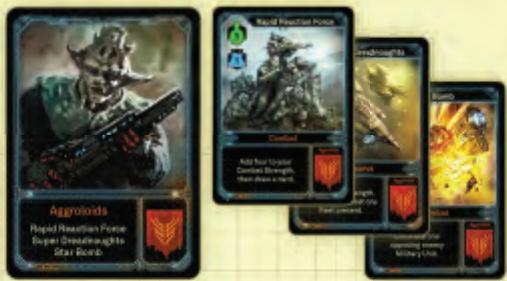

done simultaneously, so that no player is aware of which systems other players are selecting to be their home worlds. Players reveal the card they chose and take their Home World marker from the display and place it on the System tile in question, removing the Outpost cube at the same time.
In the same manner each player chooses one of their Habitable Systems to colonise. This means replacing the Outpost cube with one of their Colony discs from their Player Display.

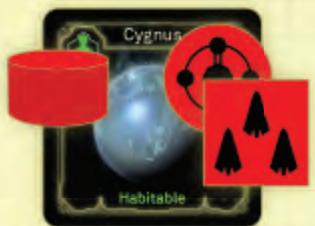
Your Home World starts with one Star Base and two Fleets on it. Your Colonised system starts with one Star Base and one Fleet on it. Each of your remaining Outpost systems starts with one Fleet on them.


Randomly determine who will become the first player.
Shuffle the Development counters face-down. Form them into a number of stacks. Draw six of these tiles and place them face-up on display near the edge of the board.
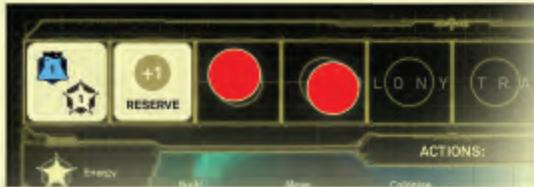
Going clockwise from the first player each player selects one Development counter and places in the space vacated by his Home World marker. As a player takes a counter a new one is drawn and placed on display. Repeat this process a second time, with the second tile being placed in the space vacated by the Colony disc.

All players calculate the number of Victory Points they presently have and place two of their unused discs on the Victory Point tracks to mark this, one on the ‘10s' track and one on the1s' track. The type of piece on a system determines the number of victory points, as below:
Home World - 7VPs.
Colony - 5VPs.
Outpost - 3 VPs.
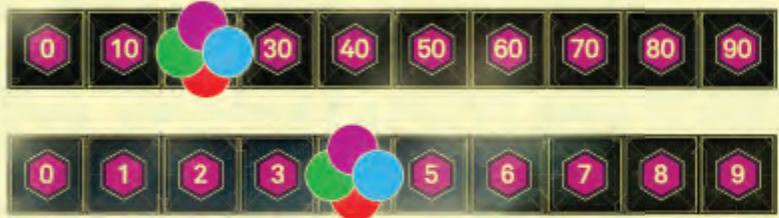
With two players you will start the game with thirty-six VPs, with three players you will have thirty VPs, and with four players you will have twenty-four VPs.

Draw and place eight Technology cards on display close to the edge of the game board.
Shuffle the Alien counters face-down. Draw and place one on each neutral habitable system. These remain face-down.
Place one Game marker on the zero space of the Shuffle Track.
Place one Game marker on the zero space of the Combat Track.


Shuffle your four Starting cards, three Race Ability cards, 9 two Technology cards and Habitable and Uninhabitable System cards together and place on your display to form your draw deck.
Draw six cards to form your hand.

PLAYING THE GAME
In player order, starting with the first player and going clockwise around the table, each player performs two actions. After you have completed your two actions you draw cards from your Draw deck to bring your hand size back up to your normal hand size of six cards. You retain any un-played cards in your hand.
NOTE: If you are unable to draw your hand back to its normal size due to an exceptionally thin deck then you must draw additional cards from your Reserves to make up the short-fall. If there is still a short-fall then you play with a reduced hand size.
The two actions you perform are independent of each other. You must resolve your first action before moving on to your second action. You can perform the same action twice if you so wish.
If at any time you have to draw a card and your draw pile is exhausted then you shuffle your discard pile to make a new draw deck. At the same time you flip all of your Development counters back to their front side. You also move the Shuffle marker up one space on the Shuffle track. You do this no matter what the circumstances are that caused you to shuffle your discard pile.
Note that an action may involve the play of more than one card.
The actions available to you are:
Build Military Units
Move and carry out combat
Colonise a system
Draft one Technology card
Reserve cards
Discard cards
Remove one card from play
Card action
Pass
The order in which these actions are listed is incidental, it does not dictate the order in which actions must be performed.
These actions will now be described in more detail.
ACTION: BUILD MILITARY UNITS
This action allows you to build Fleets and Star Bases. These rules will use the term Military Units' to refer to these unit types.

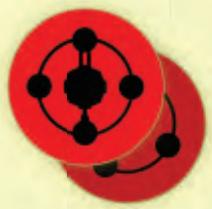
You can build one or two Military Units in a single action. You can choose to build Fleets and/or Star Bases, as you wish. To build one Military Unit requires you to expend one point of Population and one point of Matter. To build two units you would have to expend two points of Population and two points of Matter.


You can only build units on your Home World or a Colonised System.


You CANNOT build in a system with only an Outpost.
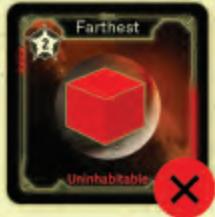
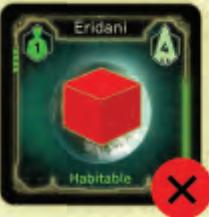
You take the units you have chosen to build and place them on the board, according to the above restrictions.
The number of Military Unit counters you have is a limit on the number you can build. If you have no more units left in your available stock then you can no longer build that type of unit. You cannot remove a unit from the board to build it somewhere else.
ACTION: MOVE AND CARRY OUT COMBAT
You can move as many of your Fleets as you wish during a single action. You expend one Energy to move one Fleet along one connection. There is no limit to the number of Military Units that can be in a system.
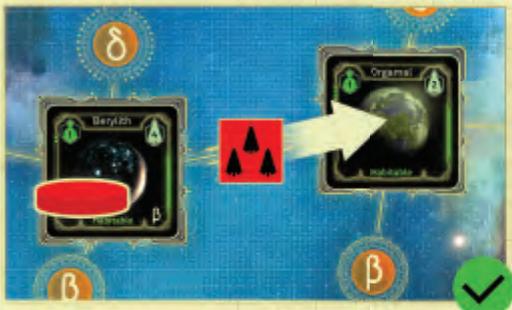
You CANNOT move Star Bases unless you have the ‘Star Base Movement' technology.
You CANNOT move along a connection that has a Black Hole on it.

A unit must cease movement if it is moved to a Neutral System or one controlled by another player. You can only move to one such system during the course of your action, i.e. you cannot invade multiple neutral and/or playercontrolled systems in a single action.
If you have moved to a Neutral Habitable System or one controlled by another player then combat will occur once you have completed all the movement you wish to carry out.
NOTE: A system is controlled by a player if he has one of more of his pieces there, of any type (which are Home World cylinder, Colony disc, Outpost cube, Military Units).
COMBAT
As you can only move to one system that you do not control during your action it is only possible to resolve one combat situation as part of your movement action.
The attacker and defender calculate their Combat Strengths.
Your total Combat Strength is calculated as follows: Each Fleet has a Combat Strength of three Each Star Base has a Combat Strength of five
Any cards that modify Combat Strengths (which are Space Mines, Dreadnoughts and Super Dreadnoughts).
If you move to a neutral Habitable system then you flip the Alien counter on it. The Combat Strength of a neutral Habitable system is the total of the value on the System tile and the Alien counter.
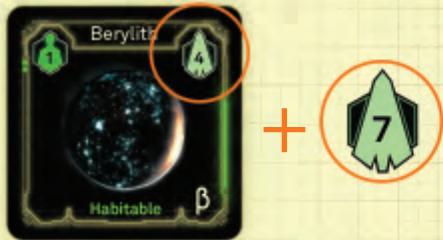
If there is no Alien counter on the System tile (this can occur if a player defeats the Alien counter and then moves off before colonising the system) then the Combat Strength is equal to the value indicated on the System tile.
You now calculate the difference between these two totals and place the Game marker on the Combat Track to show this difference and whose favour it is in, i.e. who's ahead on combat points. If this difference is greater than ten then use the second marker to record the 10's and 20's while the first one records the units.
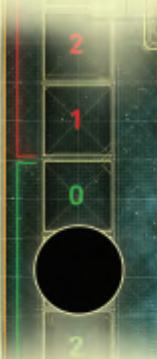
The attacker now has the option to retreat and suffer no losses. If the attacker chooses to remain in the system then the defender has the option to retreat, again, with no losses. If both sides decide to stay and fight then the combat continues. The rules for retreating are dealt with later.
The player who is presently losing the war must now increase his combat strength such that he is in a winning situation. Note that the defender is regarded as winning if the war marker is on zero, i.e. Combat Strengths are tied. Thus, the attacker must always achieve a result of at least +1 in his favour while for the defender a result of zero is sufficient.
You can increase your Combat Strength in the following ways:
Move one or more Fleets to the system where the combat is in progress. To do so you must expend Energy - one Energy moves one Fleet along one connection. Each Fleet you move to the system will increase your Combat Strength by three.

Expend Matter - each point of Matter you expend increases your Combat Strength by one.
Play/utilise cards that have an effect in combat. This very much depends what cards you have in your hand and/or reserve.

You can also choose to reduce your Combat Strength by moving Fleets away from the system, but only if by doing so you remain in a winning position. Those units that you move cannot move into a Neutral System or one controlled by another player.
You cannot play cards that do not directly contribute to your Combat Strength, even if they are marked Free Action', e.g. you could not play a card that allowed you to draw more cards.
The combat continues in this manner, with players responding to each other's commitment of forces, until one player chooses not to or is unable to increase his Combat Strength sufficiently.
If at any point in the combat one side has no pieces (either Military Units or cylinder/disc/cube) of any kind on the system in question then they immediately lose. The opponent does not suffer any casualties. This rule does not apply when you are attacking a neutral system.
FIRST ROUND OF COMBAT SPECIAL RULES – At the start of the combat if the player who is required to move the marker on the Combat Track is unable to move it to a winning position then they automatically lose and suffer losses as described below. The other player will not suffer any losses. Thus, the Game marker must cross the boundary between the two parts of the Combat Track to lead to a situation where both sides will be liable for casualties.
THE EFFECTS OF COMBAT
The winning player loses Military Units equal to half the number of units he has in the system, rounding down.
E.g. with five units present he would lose two. You choose which type of units you wish to lose. The losing player loses Military Units equal to half the number of units he has in the system, rounding up.
E.g. with five units he would lose three.
The losing player must then retreat all of his remaining Fleets to connected systems. A Fleet ceases retreating as soon as it reaches a friendly system. You may retreat your units to different systems, which must be one they control and can legally reach (which may be by Wormhole). No Energy or Research Points are required for this move.
Any Military Units that cannot retreat are eliminated. All eliminated units are returned to the owning player's available stock. Note that Star Bases cannot usually retreat so will normally be eliminated. Note that the defender will lose units that cannot retreat even if he would not normally suffer casualties.
The defender ALWAYS refills his hand to its normal size at the end of the combat.
If the attacker is victorious against another player then the defending player must find the System card for the system in question and return it to the corresponding deck of Neutral Systems. If he had to remove the card from his draw deck then he shuffles it before returning it to his display. He removes his Home World cylinder/Colony disc/ Outpost cube. He does not lose any Development counters, these are permanent. He then adjusts his Victory Point score accordingly, losing 7VPs if he lost his Home World, 5VPs if he lost a Colonised System, and 3 VPs if he lost an Outpost.
Note that a player can lose his Home World and remain in the game.
If the attacker is victorious against a neutral Habitable system then the Alien counter on the System tile is removed and placed to one side.
The attacker now has control of the system as he has Military Units present but he does not take the System card yet. To do so he has to perform the Colonise action, described in the next section.
EXAMPLE OF COMBAT
Red expends two energy to move two Fleets to Berylith, which is controlled by Blue. This starts a combat. Blue has a Combat Strength of five (one Star Base) while Red has a Combat Strength of six (two Fleets). The difference is one in favour of Red. The Game marker is placed on the ‘one' space in the attacker's favour.
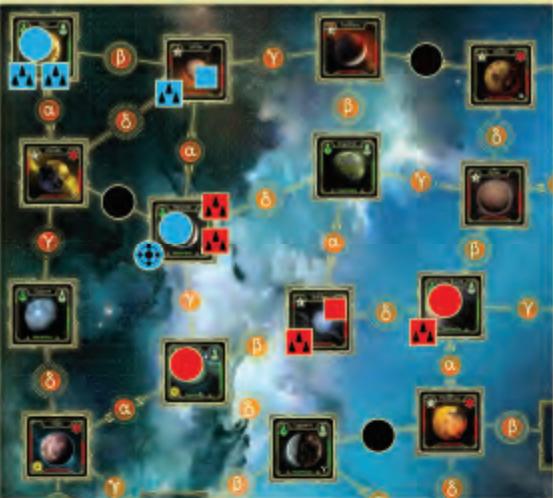
Blue cannot retreat as he only has a Star Base present. He responds by expending three Energy to move two Fleets to Berylith, one from Ishtar and one from Hap. This shifts the marker six spaces, to become five in his favour.
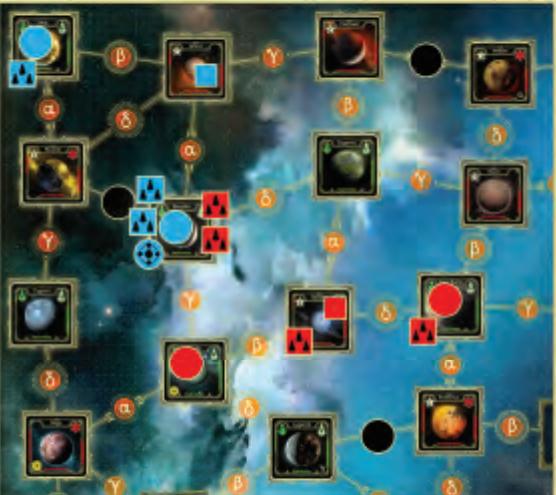
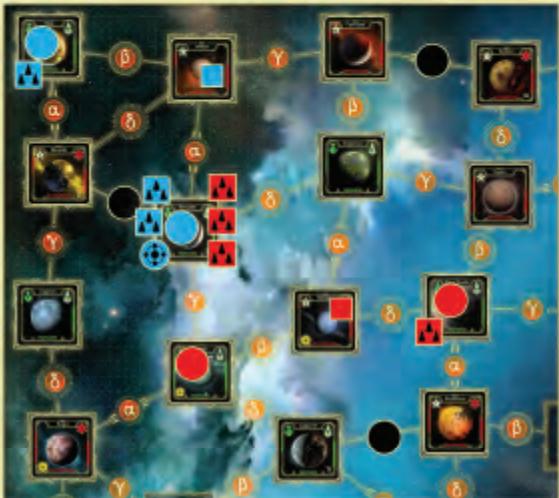
Red replies by expending two Energy to move a Fleet from Boldar. He also expends three Matter. This moves the marker back to one in his favour.
Blue is unable to move any more Fleets to the war, nor has he any Matter to expend, so loses the combat. As he has three units present he must lose two. He chooses to eliminate his Star Base (which was going to be destroyed anyway) and one Fleet to satisfy these losses. The remaining Fleet retreats to Ishtar. The red player must lose one Military Unit.
Blue now finds the Berylith System card and returns it to the deck of neutral System cards and reduces his Victory Point score by five.
ACTION: COLONISE A SYSTEM
This action allows you to place a Colony disc or an Outpost cube on a System where you have Military Units but no disc or cube, or upgrade an Outpost cube to a Colony disc.
Colony discs can only be placed on Habitable Systems. Outpost cubes can be placed on both types of systems.
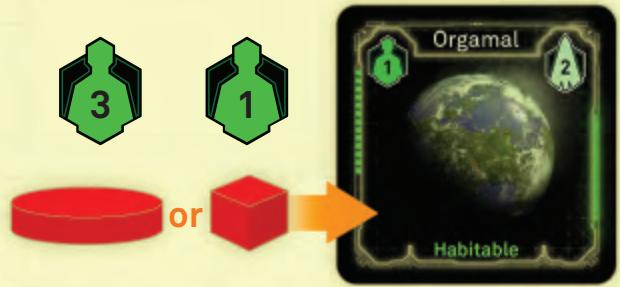
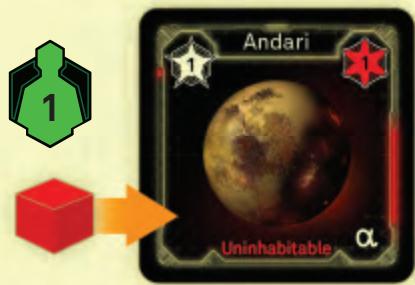
To place an Outpost you expend one Population point. You then place a cube on the System tile. You find the corresponding System card and place it on your discard pile. You increase your Victory Point score by three points.
To place a Colony disc on a Habitable system you expend three Population points and take one of your Colony discs from your display and place it on the system. You then find the System card for this system and place it on your discard pile. You increase your Victory Point score by five points.
If you already have an Outpost cube on a Habitable system then you will already have the System card. You can still replace an Outpost cube with a Colony disc, but you then only increase your Victory Point score by two points. Note that you still have to expend three Population to replace a cube with a disc.
If you place a Colony disc from your Colony track then you select a Development counter from those on display and place it in the vacated space. Draw a replacement Development counter to refill the display to six.
It may be that you have used all of your discs from your Colony track in which case you can use one of the spare Colony discs you have. However, in this case you will not gain a Development counter. If you have no more Colony discs available then you cannot perform this action.
If you have lost your Home World you cannot place your Home World cylinder as if it was a Colony disc.
ACTION: DRAFT ONE TECHNOLOGY CARD
This action allows you to take one of the Technology cards from the display.
You select one card you wish to take and pay the cost indicated, which is the same as expending those resources.
You then take the card from the display and place it on your discard pile.
A card is drawn from the Technology card deck to refill the display to eight cards. If the deck is exhausted then no card is drawn, so the display will then dwindle in size.
If the new card is marked 'Wormhole Technology' then place it to one side and draw another card. The rules on Wormholes are explained later.
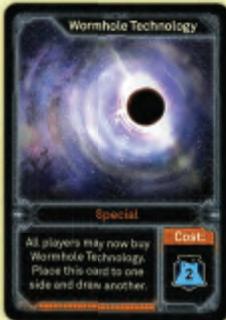
If the ‘Wormhole Technology' card is on show then you can choose to take a Wormhole counter instead of a Technology card. You pay the cost indicated on the ‘Wormhole Technology' card (two Research points) and take one of the Wormhole counters and place it in the space indicated on your display. You can never have more than one such counter, thus a player can never be denied this technology.
ACTION: RESERVE CARDS
This action allows you to place as many cards as you wish in your Reserves, from where you can use them in later actions. Also, some cards only become effective if in your Reserve.
When you take this action you can choose one or more cards from your hand to place in your Reserves. You have two Reserve spaces on your display, marked ‘Reserve One' and ‘Reserve Two'. You can place ANY card in Reserve One. You can ONLY place cards marked Reserve' in Reserve Two. You can place in one or both reserves within a single action.
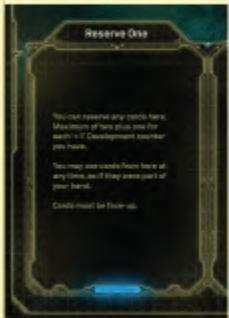

Normally you are limited to two cards in each Reserve. This limit may be increased if you have‘+1 Reserve' Development counters on your display. Each such counter will increase the number of cards you can place in BOTH of your Reserves.

The Mass Armies' Technology card does not count towards your Reserve limits.
Any cards in your Reserve can be used in later actions as if they were part of your hand. What you cannot do is take a card from your Reserve and place it back in your hand. You can only take cards from your Reserves if you play them immediately.
When you place cards in your Reserves you can also switch cards between Reserve One and Reserve Two.
ACTION: DISCARD CARDS
As an action you can discard one or more cards from your hand and/or Reserve and place them on your discard pile.
Remember, you do not draw back to your hand size until the end of your turn.
ACTION: REMOVE ONE CARD FROM PLAY
This action allows you to thin your deck, which will make it more efficient.
As an action you can select one card from your hand or your Reserves and remove it from play. If it is a System card then it goes with the other Neutral System cards. If it is a Technology card or one of your Starting cards then place it back in the game box. The only card that you can retrieve after removal in this manner is a System card, and only then if you lose and regain control of it. Note that if another player gains control of a system where you had removed the corresponding card from your deck then they simply take the card from the pile of Neutral System cards.
ACTION: CARD ACTION
If a card's effect is sub-titled ‘Action' then you must use on of your actions to play the card (assuming you wish to carry out the text effect on the card).
ACTION: PASS
If you have nothing better to do then you can choose to pass.
WORMHOLES
If you gain Wormhole technology then you are regarded as having access to Wormhole movement. Wormholes allow you to move from any one Wormhole to any other Wormhole on the board
A number of systems will be marked with the Wormhole symbol.


To move one Fleet from a system with a Wormhole to another system with a Wormhole requires you to expend one Research Point. If you have ‘Star Base Movement' then you would have to expend two Research Points to move one Star Base.
This form of movement should be regarded as the same as standard movement, with the exception of requiring the expenditure of Research rather than Energy, and both forms of movement can be freely combined in any way you wish. You can use Wormhole movement for the purposes of movement, committing forces to a combat, and retreating. You do not expend Research points if you use a Wormhole to retreat.
ENDING THE GAME
The game is close to ending when the Game marker has reached a certain point on the Shuffle track. When the Game marker reaches the point indicated on the Shuffle track, which depends on the number of players, then you continue play until all players have had an equal number of turns. Then, one final round of turns is completed. Once this final round of turns has been completed the game is at an end.
The trigger point on the Shuffle track varies depending on the number of players, as below:
Two players fourteen shuffles
Three players - eighteen shuffles
Four players - twenty shuffles
It is a good idea to now double-check each player's Victory Point total. The player with the highest Victory Point score is the winner. In the case of a tie the tied player who controls the most systems is the winner. If there is still a tie then it remains a tie.
FULL DESCRIPTION OFTHE CARDS
To help you determine whether you have any missing Technology cards the number in parenthesis indicates how many copies of that card should be in the deck. Please note that this number only applies to Technology cards, not the Race Ability cards.

ADVANCED CYBERNETICS
Draw two cards from your deck. If this results in you exhausting your draw deck then you shuffle your discard to form a new one, flip your Development counters to their fronts and move the marker one space up the Shuffle track. You do not discard this card until AFTER you have shuffled your discard pile. Thus you cannot end up drawing it twice during your turn.
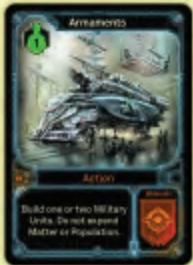
ARMAMENTS
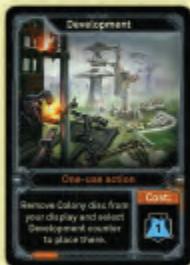
As an action you can build one or two Military Units. You do not expend any Matter or Population. You may build the units in the same or different systems, as long as you would normally be allowed to build in those systems.
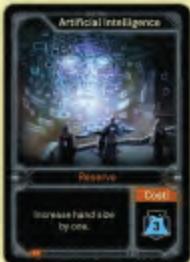
ARTIFICIAL INTELLIGENCE
DEVELOPMENT (3)
If this card is in your Reserve then your hand size is increased to seven cards. If you discard this card from your Reserve your hand size limit is reduced the next time you have to draw cards.
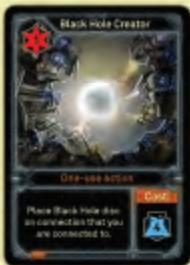
BLACK-HOLE CREATOR
Take one of the spare Black Hole discs and place it on one connection that connects with a system that you control. You control a system if you have one or more of your pieces there, of any type.
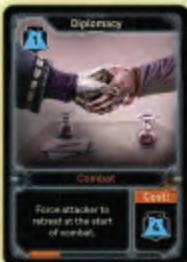
DIPLOMACY
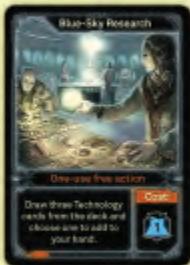
BLUE-SKY RESEARCH

Draw three Technology cards from the deck. Select one and add it to your hand. Place the remaining two cards face-down under the deck. If you draw the Wormhole Technology' card then place it face-up on display to one side and draw a replacement card. Wormhole Technology is now available.
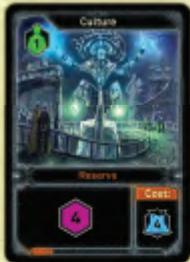
CULTURE (4)
As soon as you place this card in the Reserve you gain the Victory Points marked on it. If at a later point in the game you remove the card from your reserve then you also lose the Victory Points.
If you are attacked by another player you can play this card to end the combat immediately, forcing the attacker to retreat. You cannot play this card after you have added to your Combat Strength. If the attacker used a Temporary Wormhole to attack you then he is allowed to retreat his units to the system they moved from.
You remove one Colony disc from your display and place it to one side. You then select one Development counter from those on display to place in the space previously occupied by the disc. The removed disc is still available for use if you do not have any left on your display.
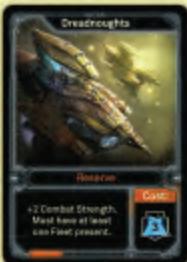
DREADNOUGHTS (2)
If this card is in your reserve then you automatically increase your Combat Strength by two, both as the attacker and defender. If you have more than one such card the modifier is cumulative. You must have a Fleet (not Star Base) present in the system in question to gain this modifier.
FAST SHIPS
If this card is in your reserve then all of your Military Units move twice as fast as normal, so one Energy would move a Fleet one or two connections. You may use this power in conjunction with Wormhole movement, which would allow you to move one connection to the Wormhole and then one connection from the Wormhole you moved to.Fast Ships' can also be used with 'Stealth Movement'. If you have Fast Ship's and ‘Star Base Movement' then your Star Bases can be moved up to two connections with two Energy. However, you must always pay at least two Energy to move a Star Base. You cannot useFast Ships' to retreat further than you would normally do so.
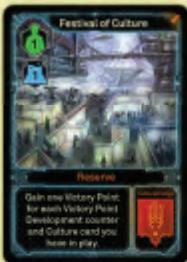
FESTIVAL OF CULTURE
If this card is in your Reserve then you gain one Victory Point for each ‘Culture' card you have in your Reserve and each Development counter that has Victory Points marked on it.

FORCE SHIELDS (2)
You can play this card at the end of a war and ignore any losses you have suffered. However, you cannot use this card to save a Star Base that was forced to retreat.
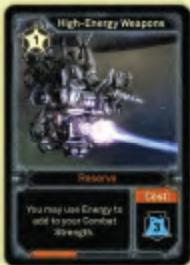
HIGH-ENERGY WEAPONS (2)
You may use Energy to add to your Combat Strength as if it were Matter. However, this does not count as converting Energy to Matter (just in case you were thinking that you could use Energy withMissiles’).
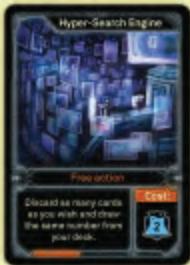
HYPER-SEARCH ENGINE
As a free action you can discard one or more cards from your hand. You then pick up a number of cards equal to the number you discarded. Note that you do not draw a replacement card for the Hyper-Search Engine card. If you need to shuffle your discard pile then you discard this card after shuffling your cards. All other rules concerning shuffling apply. You cannot discard cards from your reserve.
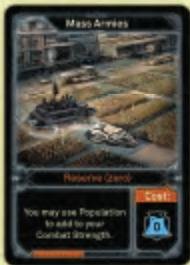
MASS ARMIES (2)
You may use Population to add to your Combat Strength as if it were Matter. This does not count as converting Population to Matter. Note that this card does not count as taking up space in your Reserve.
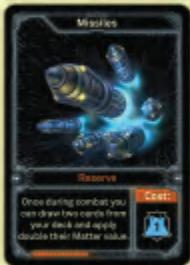
MISSILES (2)
Once during a combat, whether you are the attacker or defender, you can draw two cards from your deck and apply double the Matter value on them to the combat, i.e. each point of Matter you draw adds two to your Combat Strength. This power cannot be used in conjunction with ‘High-Energy Weapons'. Both cards that you draw are discarded. This interrupt may result in you shuffling your discard pile, in which case all standard rules apply.

MOBILE FACTORIES (2)
You may build Military Units in a System you control that only has an Outpost cube in it. You must still expend one Population and one Matter for each unit you build. You can build the units in different systems if you wish.

OUT OF STORAGE
Select one Development counter from those on display and exchange it with one you have on your display. The replaced tile goes on to the display. You can exchange a face-down counter if you wish. The counter you gain is always placed face-up.
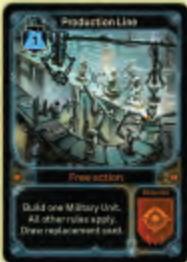
PRODUCTION LINE
As a free action you can build one Military Unit. You must still expend one Matter and one Population.
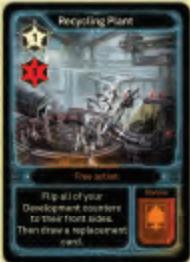
RECYCLING PLANT
Flip one or two of your Development counters to their front side. This card CANNOT be played during a combat.
RAPID-REACTION FORCE (2)

The card adds four to your Combat Strength. You then draw a replacement card from your deck.
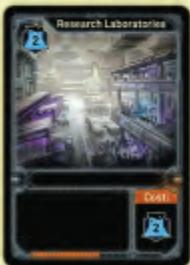
RESEARCH LABORATORIES (4)
Card has a Research Points value of two.

RETREAT
Immediately end one combat, whether you are the attacker or defender. You must retreat all of your Military Units. Neither side suffers any losses. All other retreat rules apply.
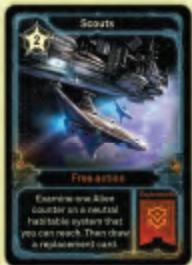
SCOUTS
As a free action you select a Neutral Habitable system that you can legally reach, either by standard movement or Wormhole, and examine the Alien tile on it, without having to reveal this information to the other players. You then draw a replacement card. The power of this card can be combined with that of 'Stealth Movement'.
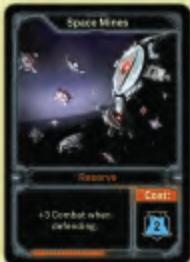
SPACE MINES (2)
Add three to your Combat Strength when defending in a combat. If you have more than one such card then the modifier is cumulative. You do not have to have a Fleet or Star Base to gain this modifier BUT you must have some presence in the system, i.e. a Colony or Outpost.
STAR BASE MOVEMENT
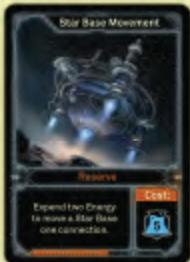
You can move Star Bases in a similar way to Fleets. The only difference is that it costs you two Energy to move one Star Base along one connection, so the energy requirement is doubled. All standard movement and combat rules apply. You can use this power to retreat Star Bases without having to expend energy. If you have Fast Ships' then you can move your Star Bases up to two connections for the cost of two Energy. However, you must always pay at least two Energy to move a Star Base. If you wish to use Wormhole movement then you would expend two Research points to move one Star Base.
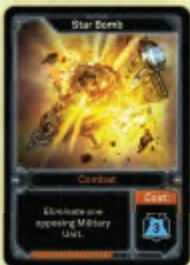
STAR BOMB (2)
Max's Star Bomb hit and run tactic - it is perfectly legal for a player to make an attack against another player where he does not intend to win the combat but merely use his Star Bomb cards to destroy opposing units. In this case the Star Bomb would be effective but the attacker would have to then retreat and take casualties accordingly. The defender would not take any further casualties as the attacker has not move the combat marker to a winning position for him. This tactic would also work in reverse, with a defender using such bombs to destroy attacking fleets before being forced to retreat and take casualties. Again, the attacker would not suffer further casualties.
You immediately remove one opposing enemy Military Unit of your choice from the system where combat is taking and return to the owning player. This will reduce your opponent's combat strength by an amount depending on what unit you eliminated. You cannot use this power against an Alien tile.
STEALTH TECHNOLOGY
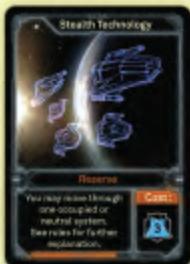
If this card is in your reserve then you can move your Fleets through one neutral system or one controlled by another player. You must still pay the full Energy requirement to do so, which will be at least two Energy per unit moved. The effect also counts for Star Bases if you have ‘Star base movement'. You can also use this power to retreat your units through a neutral or enemy controlled system, at no Energy cost. If you had Fast Ships' as well then it would only cost you one Energy to move a Fleet along the two connections.
SUPER-DREADNOUGHTS
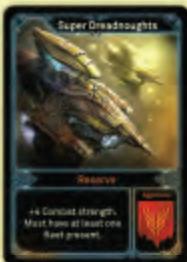
If this card is in your reserve then you automatically increase your Combat Strength by four, both as the attacker and defender. If you had ‘Dreadnoughts'then the modifiers are cumulative. You must have a Fleet (not Star Base) present in the system in question to gain this modifier.
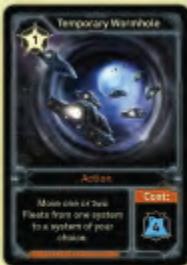
TEMPORARY WORMHOLE
You can move one or two Fleets from one system to any other system on the board. These units must move to the same system. You do not pay any Energy or Research to perform this move. You CANNOT use this card during a combat, although it could still be used to instigate combat. If you are forced to retreat due to the play of a Diplomacy card then the units are retreated to the system they moved from. You can use this power to move Star Bases if you have 'Star Base Movement'.
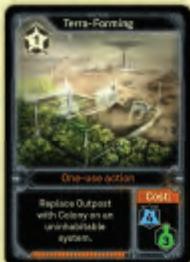
TERRA-FORMING (2)
You may replace one of your Outposts with a Colony in an Uninhabitable System. You should take the disc from your display if possible, which means you can also take a Development counter.
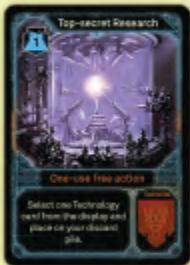
TOP-SECRET RESEARCH
Select one card from the Technology card display and place it on your discard pile. There is no additional cost for the card you have taken, even Terra-forming.

WAREHOUSE
As a free action you can play one card from your hand in to your Reserve. It does not matter if you are already up to or have exceeded your Reserve limit. You can add a card to either of your two Reserve spaces. You then draw a card from your deck.
WORMHOLE
Place to one side and draw a replacement card. From now on Wormhole te
Content is long; only the first part is inlined. Download the file or open the rules page for the full text.
Download MarkdownTexts are community-compiled or publicly released by publishers; copyright remains with the original authors. For personal reference only.