
Adventure Tactics Domiannes Tower
At a glance
Rules, cards and Q&A (Chinese)
The rules, card data and player questions for this game are written in Chinese. Open the Chinese page to read them.
Where to find full rules
Full rules and card lookup are available in the cunlema app at cunlema.cn — pick this game and ask about any rule, card or turn you are unsure about.
Related games
Rulebook text (Markdown)
This game has 1 rulebook Markdown file(s) in our library; 1 rendered inline below — expand to read or download.
Rules.md56.2 KB
DOMIANNE'S TOWER
RULEBOOK
ADVENTURE ACTICS DOMIANNES TOWER!
Adventure Tactics: Domianne's Toweris a campaign-driven, tactical board game that is played over a series of chapters. As a brave hero, you and your party will level-up between chapters, unlocking new classes, powers, and equipment as you advance through your quest to free the kingdoms from the tyranny of Queen Domianne.
Adventure Tactics features two manuals for you to use: this Rulebook, and the Campaign Guide. The Rulebook outlines the universal rules of play, while the Campaign Guide includes 50+ individual chapters that are linked together into the overall campaign. You should read the Rulebook before play, and read the Campaign Guide only for the individual chapter you are going to play next (as it is filled with spoilers!)
The Campaign Guide provides a series of chapters that you proceed through
in a non-linear way based upon your choices as well as the outcomes of previous encounters. Some chapters are story-based, giving you choices to make about how the story will proceed. Others are encounters with enemies. These will pit you against a specific boss or group of enemies. Such an encounter will include multiple rounds of play, continuing until the encounter's objective is achieved
or you are defeated.
Each encounter in the Guide will describe how to set up its specific features, including any special rules to be used when playing through it.
A campaign of Adventure Tactics is a full playthrough of the Campaign Guide, starting from Chapter 1 and proceeding through to the conclusion of the story. As your choices determine the path of the campaign, different choices will lead to different stories. After completing the campaign you can reset it back to the beginning and start over, exploring new paths, new encounters, and new class combinations.
What's in the Box?...........4
Creating Your Hero ..........6
Levels and Classes...6
Elite Classes7
Party Size ………………8
Encounter Setup..........8
Player Setup 9
Succeeding and Failing.10
Rules of Play11
Round Sequence.11
Draw Cards .11
Initiative 11
Player/Boss Turns .. 12
Cleanup14
Details of Actions .... 14
Movement 14
Large Boss
Moyement 14
Obstacles.15
Spawning Walls...... 15
Spawning Minions.. 16
Line of Sight 16
Targeting
and Range 16
Area of Effect ..17
Details of Action Cards ... 18
Specific > General .. 18
Attacks…18
Healing and
Other Abilities 18
Conditions18
Knocked Out 19
Other Keywords . 19
Things You Need to Know
Before Playing ..... 20
Equipment…. …20
Summoned Creatures ..20
Revive Potions 20
Perks …21
Ability Cards 21
Shopping at the Market 21
Random Encounters..... 22
Loot Items .. …22
Class Features.. 22
Leveling Up and
Changing Classes . 22
Elite Class
Requirements . 23
Elite Class Table 24
SORTING THE CARDS
When you first open your copy of Adventure Tactics, or when you wish to reset the game in order to start a new campaign, you'll need to sort the cards and place them behind their respective dividers.
Many cards have a banner at the top, like Market, Party ▶ Random Encounters, or Supply ▶ Perks; place those cards behind the matching divider.
Other cards do not have banners and need to be sorted differently:
Action cards without a banner go behind the Action Cards divider, sorted alphabetically.
Basic Attacks, Basic Moves, Class Features, Level Ups (including Starter), Character Classes, and Marks of Death go behind their matching dividers.
Boss cards go behind the Boss Decks divider, grouped by the particular boss (keep the Blob King's cards together, for example).
Equipment cards without a banner go behind Supply Loot. Note that these cards say at the top which encounter they can be found in, and you should sort them alphabetically by encounter.
¤ Passive and Dice Abilities that say Story go behind the Story ▶ Perks divider, while the rest are returned to the box.
Summon cards (Imp, Beast Companion, and 3 Skeletons) go behind the Character Class divider with their corresponding classes (Warlock, Beast Trainer, and Necromancer respectively).
Revive Potions: Start with a number of these behind Party Items based on the difficulty level you have chosen for this campaign:
Normal: 3 potions, using only 2 for a game with 3 heroes
Easy: 4 potions, using only 3 for a game with 3 heroes
Hard: 2 potions, using only 1 for a game with 3 heroes
Once everything is sorted, you're ready to begin your campaign! You'll notice that there are often two versions of a similar card type such as Supply ▶ Random Encounters and Party Random Encounters. The Supply cards are those that are available to acquire over the course of the campaign, while the Party cards are those that you have acquired so far. Through the course of the campaign cards will move between these two dividers as you gain and lose them.
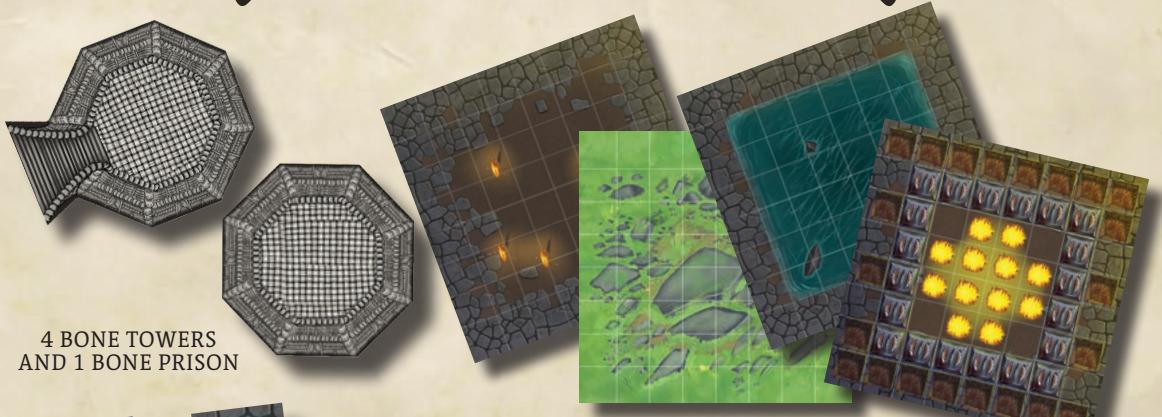
WHAT'S IN THE BOX? 5HEROES
3 BOOKS

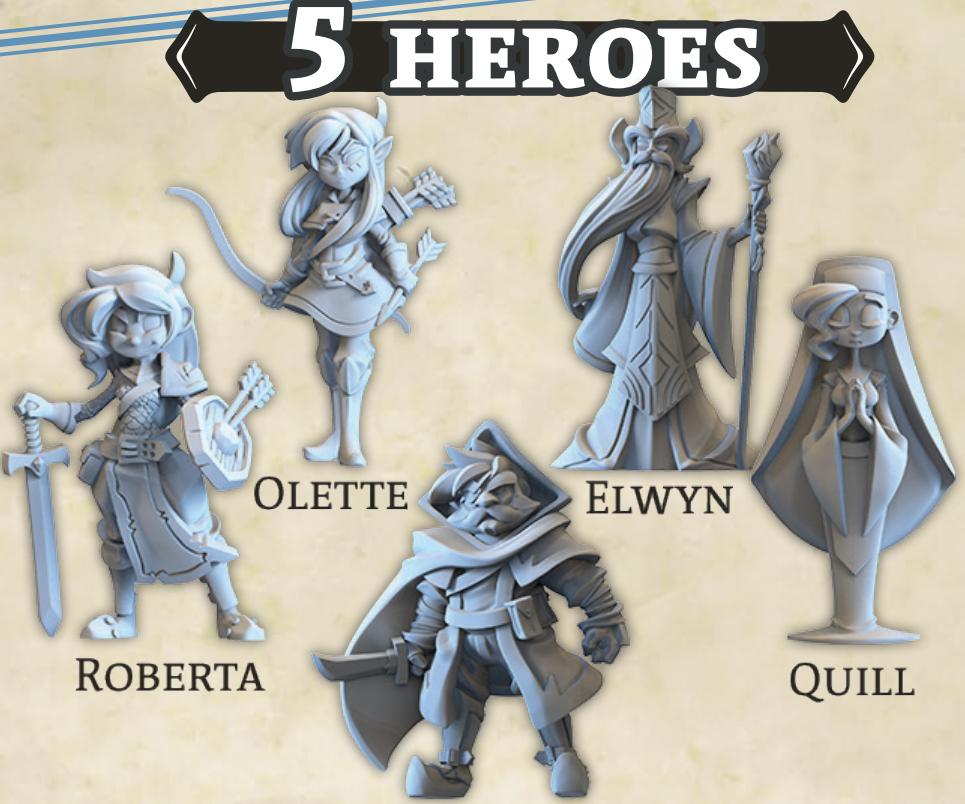
5 PLAYER BOARDS

TOLBEN
GAME BOARDS
HERO DECK BOXES

40 BONE WALL 5 WRAITHFRAGMENTS SPAWN TILES

8 OBSTACLE TILES
7 DOUBLE-SIDED BOARD TILES: GRASS, STONE, WATER, AND TRAPS
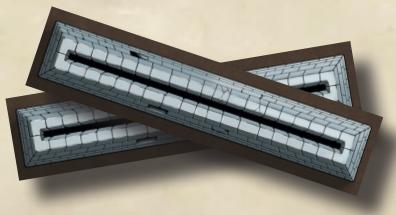
4 LARGE STONE WALLS
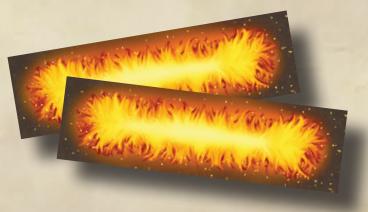
4 FIRE WALLS
OVER 800 CARDS
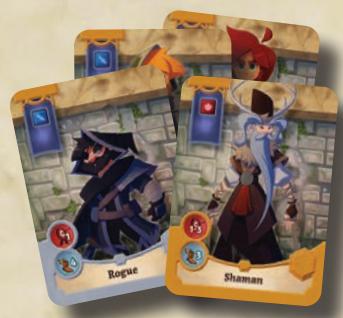
23 CLASS CARDS
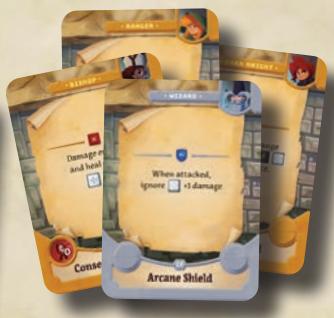
47 CLASS FEATURE CARDS
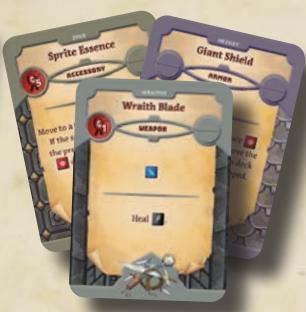
55 EQUIPMENT CARDS
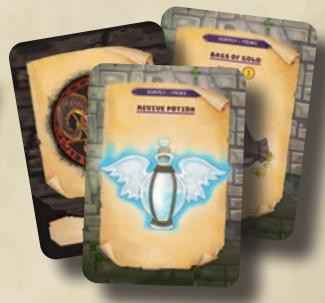
3 MARKET CARDS, 4 REVIVE POTIONS, 1O MÁRKS OF DEATH, 37 SUPPLY ITEMS
15 PERK CARDS
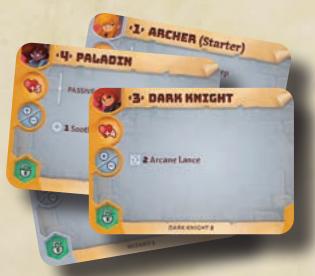
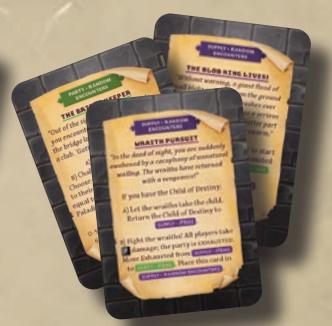
17 RANDOM ENCOUNTER CARDS

140 LEVEL-UP CARDS

164 ACTION CARDS
71 PASSIVE ABILITY CARDS
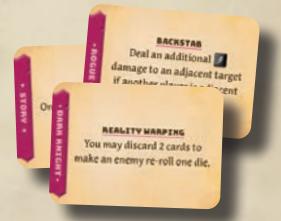
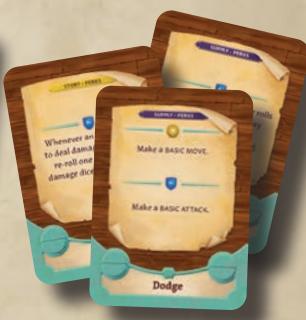
32 DICE ABILITY CARDS
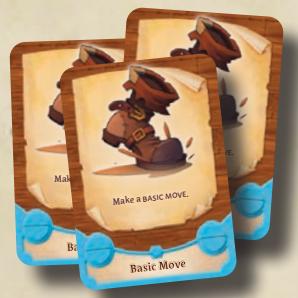
50 BASIC MOVE CARDS
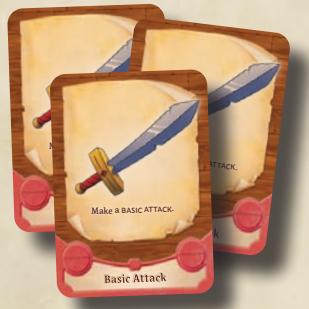
50 BASIC ATTACK CARDS

5 SUMMONS CARDS

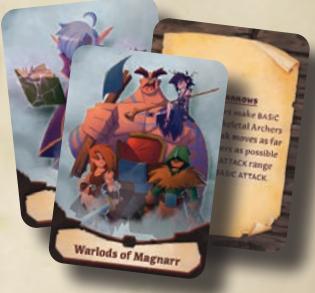
150 BOSS DECK CARDS
17 DIVIDER CARDS
STANDEES
11 HERO AND SUMMON STANDEES
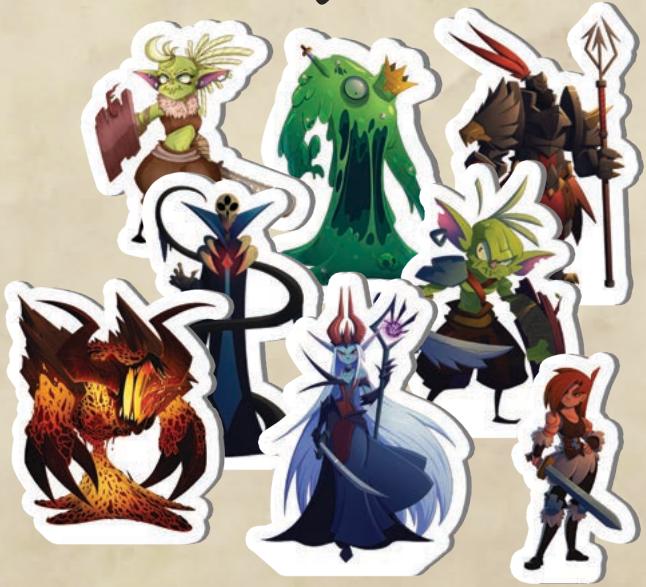

52 ENEMY STANDEES
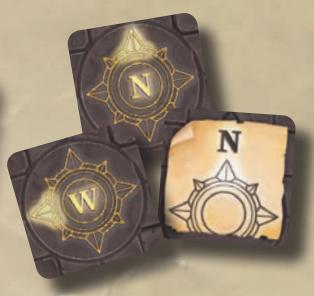
8 DIRECTION CARDS AND 1 COMPASS
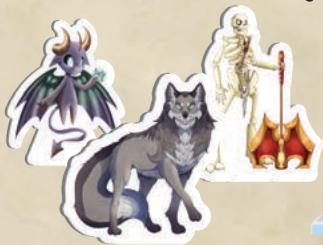
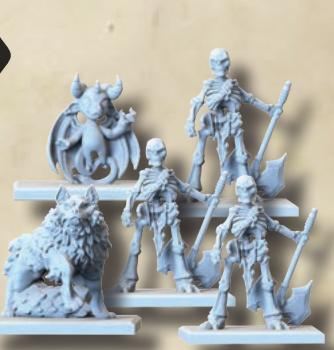
5 SUMMON MINIATURES

25 ALLY AND ENEMY TOKENS

10 DICE TOKENS
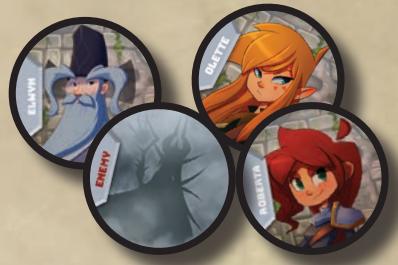

12 CUSTOM DICE (3 OF EACH COLOR)
8 INITIATIVE TOKENS
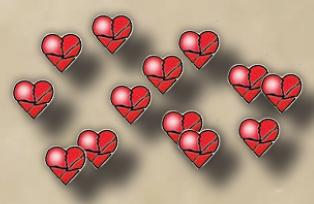
49 DAMAGE TOKENS(28 TOKENS 1/3 DAMAGE21 TOKENS 5/10 DAMAGE)

10 HIT POINT TRACKER CUBES

24 STATUS TOKENS (6 OF EACH OF THE STATUSES)
CREATING YOUR HERO
The hero you play in Adventure Tactics is unique, and belongs to you. Your hero will begin with a set of basic cards, but as you progress through the adventure you will acquire new skills, new equipment, and even level up into new classes.
To create your hero, choose one of the five basic classes: Fighter, Rogue, Cleric, Wizard, or Archer. Take the level up card that is marked "Starter," and the class card for your chosen class.

The level up card specifies your starting HP () and the starting cards for that class, including its class feature cards. This card also tells you the requirements and rewards for leveling up in that class (see LEVELING UP AND CHANGING CLASSES, page 22).
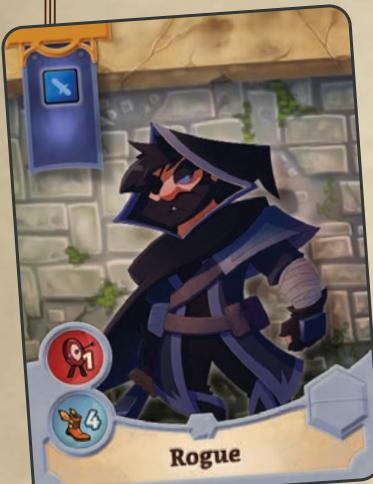
The class card specifies your basic movement value (), your basic attack, including the die used ( , or ), and the range ().
Example: As shown on the class card, Rogue's basic movement value () is 4. Rogue's basic attack uses one blue die 网) and has a range () of 1.
Your hero's actions are driven by a set of action cards. These include Basic Move and Basic Attack cards, as well as Actions and Class Features earned, and Equipment acquired, throughout the Campaign. To begin, take the 5 classspecific starting cards for that class and add to them 3 Basic Move and 3 Basic Attack cards. These 11 cards form your action deck. When not in use, these cards can be stored in the tuck box for your chosen hero. This tuck box will contain your action deck throughout the campaign As you acquire new cards, they will be added to this tuck box.

You will need the player board and the miniature for that hero. You will use these as you play each encounter. Each class also begins with one passive ability card (see ABILITY CARDS, page 21) and one class feature card (see CLASS FEATURES, page 22). Any passive abilities you use will be placed on your player board at the start of an encounter. These grant ongoing abilities to your hero which, unlike other abilities, are not discarded when used.
LEVELS AND CLASSES

Your hero's level is defined by
the number of level up cards
you've acquired over the course
of the game and have stored
in your tuck box. As such, your first hero begins at level 1. You'll acquire a new level up card, and hence go up one level, after certain encounters (see LEVELING UP AND CHANGING CLASSES, page 22).
Your hero's class, with the exception of elite classes, is defined by the very first class you choose. No matter which other level up cards you choose over the course of your adventure, you will still remain as your starting class. However, when choosing to level up to an elite class, you become that new class instead of your current class. When doing so, you will also take on the basic movement and basic attack of the new elite class.
Example: Taliyah begins the game as a Level 1 Cleric. The next time she levels up, she chooses another Cleric level up card, making her a Level 2 Cleric. At her next opportunity to level up, she chooses an Archer 1 level up card. She is still a Level 3 Cleric, even though she has an Archer level up card.
ELITE CLASSES
In addition to the five basic classes (Fighter, Rogue, Cleric, Wizard, and Archer), you can eventually level up into one of eighteen elite classes. These classes have certain basic class requirements that you must meet before you can level up into an elite class. These requirements can be found on the level up card for that elite class. A comprehensive list of elite class requirements can also be found on page 24.
For example, the War Mage lists Fighter (1), Wizard (1), Rogue (1) as its prerequisites. In order to become a War Mage, you must first have achieved at least one level in each of Fighter, Wizard, and Rogue. After that, you may choose to become a War Mage the next time you level up.
When you choose a level up card from an elite class deck, you are now considered to be that class instead of your previous class. You gain the basic movement and attack of your new elite class. You will also gain the amount of HP stated on the elite class level up card. If you later become another elite class, you keep the HP gain from your current elite class(es) on top of your new HP gain. You must give up the movement of the previous elite class, however.
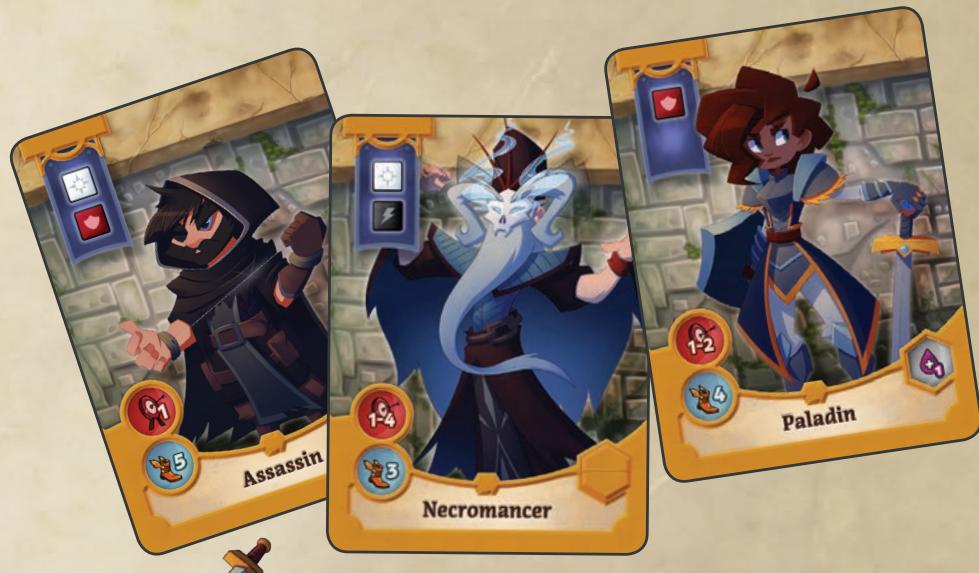
The maximum level you can reach is 10. The maximum level you can reach in any particular class is 5.
Example: Taliyah is a Level 3 Cleric, with two Cleric level up cards and one Archer level up card. She is interested in becoming a Demon Hunter, which has as prerequisites Cleric (1), Rogue (1), Archer (1). She does not yet meet the prerequisites for becoming a Demon Hunter. The next time she levels up, she chooses a Rogue 1 level up card when becoming Level 4 (her class is still Cleric). Now she meets the prerequisites for Demon Hunter,
hen she levels up the next time, she can
ose to become a Demon Hunter. After selecting that class, she is now a level 5 Demon Hunter.
PARTY SIZE
A party in Adventure Tactics is a group of 3—5 heroes. If you need, or want, to have more heroes than there are players, then someone will have to control more than one hero. The choice of party size is locked-in at the start of a campaign. It determines the number of minions that you will face in each encounter. In this way, the challenge scales to the number of characters.
The 3—5 heroes you choose can be divided up amongst the players as you see fit, at the beginning of any encounter.
Example
Sam and Aimie are beginning a 2 player campaign. Sam elects to play Roberta and Olette, while Aimie brings Elwyn and Quill. Tolben, the one hero not selected, cannot be used in this campaign. Since there are 4 heroes in the campaign, Sam and setup. the CampaignGuide forahero C

ENCOUNTER SETUP
Encounters are where all of the action takes place in Adventure Tactics. In an encounter, you and your fellow heroes will take on a boss and their minions, fighting to complete various objectives to advance through the campaign.
To set up an encounter, first refer to the Campaign Guide for specific board setup. These instructions will explain which boards to use and how to set them up. There will also be a highlighted yellow area on the map – you may place your hero anywhere within this yellow area.
Next, take the compass and place it parallel to the board in any orientation. The compass determines which direction is North for this encounter. Place the direction deck nearby as well. Certain abilities use random directions in their effects, and these cards, along with the compass, determine that direction on the board.
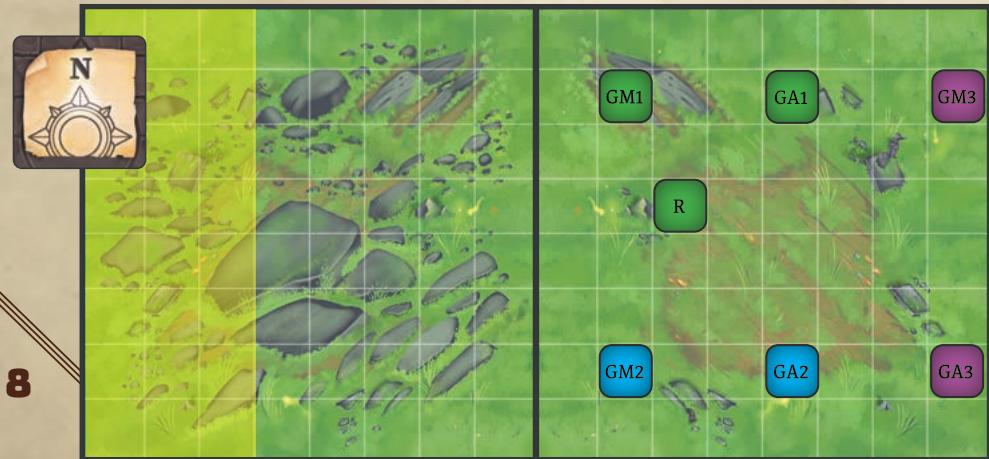
Bosses and minions must be placed on the specific spots marked on the map. Each of these enemies will have an image in the Campaign Guide. These images include a unique identifier, like GM3, that tells you which enemy this is and where they begin on the map. They will also tell you that enemy's hit points, basic movement, attack value and range
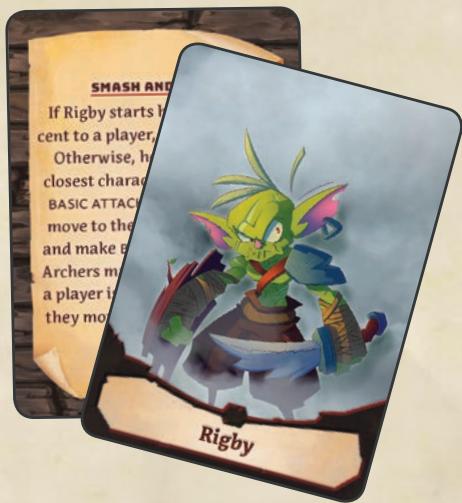
Note: these values may vary based on how many heroes are in your party, which will be noted in the Campaign Guide.
As you fight enemies, you will place damage tokens onto the picture of that specific enemy in the Campaign Guide itself in order to track damage done to it.
Gather all required enemy standees and place them on the board as directed (this too may vary based on how many heroes are in your party).
Take the boss deck for that encounter's boss and set it nearby. You will also need 2 initiative tokens for that boss, unless otherwise specified in the Campaign Guide, as well as the initiative tokens for all heroes in the encounter.
PLAYER SETUP
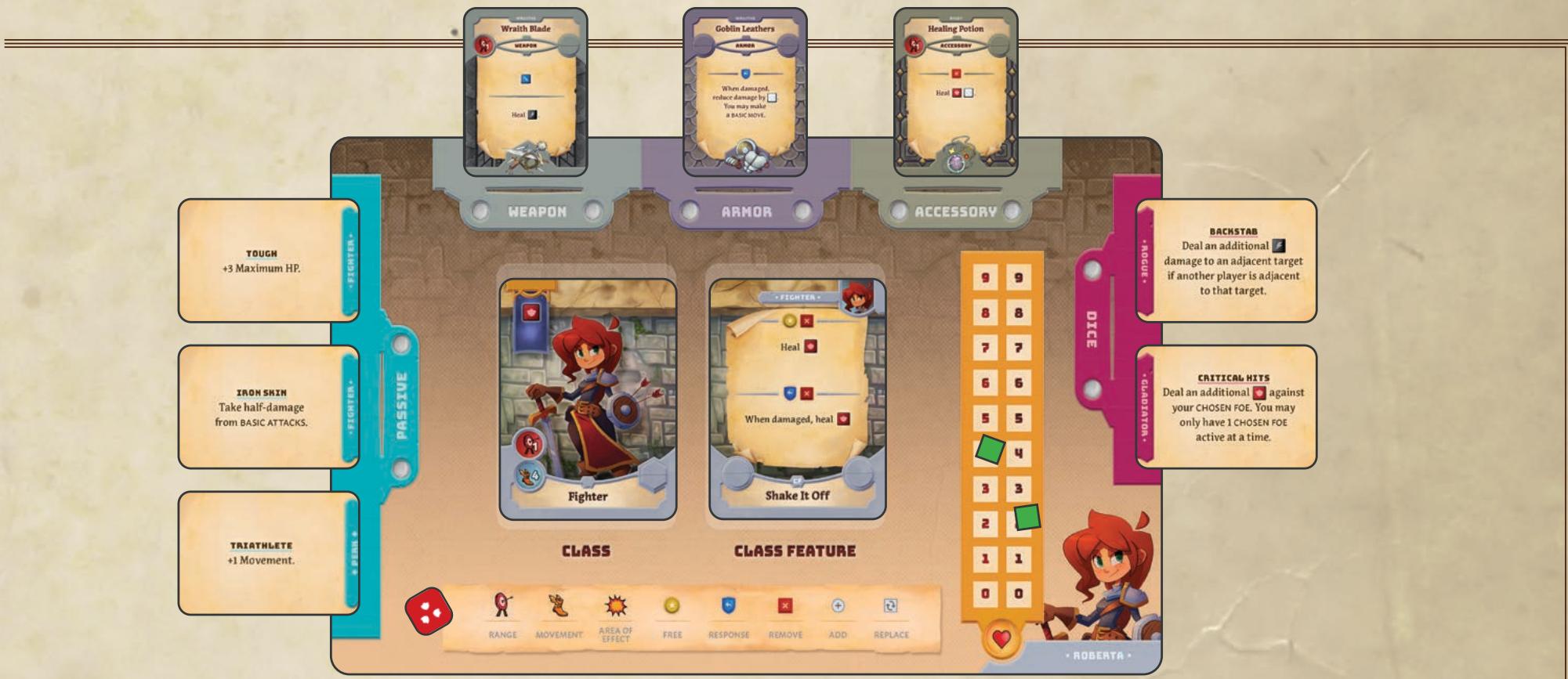
At the beginning of each encounter, you may choose one of your class feature cards and place it on your player board. You may also choose one weapon, one armor, and one accessory card to place on your player board. You can then choose any of your remaining class feature,
weapon, armor, or accessory cards to shuffle into your action deck; the rest are stored in your tuck box and cannot be used in that encounter.
You may also select up to 3 passive abilities and 2 dice abilities to begin with on your player board. Passive and dice abilities are different from other abilities (including equipment and class features) in that they are never
discarded when used. Their ability persists throughout the encounter, unless they are discarded by another game effect. All other ability cards are placed into your
tuck box and cannot be used in that encounter (see ABILITY CARDS, page 21).
At the start of an encounter, set your HP Marker to your maximum
HP value. This value is
determined by adding
up all of the hearts
on your level up cards,
including your starting class
card and any HP bonuses
from elite classes. As you take
damage, heal, and experience other effects, your HP will rise and fall, but it can never get higher than your
maximum HP value (some effects
in game may temporarily raise that value, however).
At the top of this page is an example of a fully populated player board.


Your party will also have a collection of shared items to take into the encounter. Take the Party Items deck and place it nearby for all party members to access. When you begin your campaign, this deck will start with 3 revive potions (2 revive potions for a 3 hero game), but as you progress through the campaign you may receive new cards to add to this deck. These items can be used by anyone in the party.
Easy Mode: To make an encounter more forgiving, you can choose to bring an additional revive potion at the beginning (4 total, or 3 in a 3 hero game).
Hard Mode: To make an encounter more challenging, you can choose to bring one less revive potion at the beginning (2 total, or 1 in a 3 hero game).
SUCCEEDING AND FAILING
Each encounter has a main objective and a bonus objective. To succeed at an encounter your party needs to complete the main objective – the bonus objective is optional, but completing it will yield more rewards and could even open up new branches in the campaign. Once the main objective is met, the encounter immediately ends.
There are two ways to succeed at an encounter: complete the main objective alone, or complete the main objective and the bonus objective.
SUCCESS
If you completed the objective, but not the bonus objective, read the purple Success section. It will tell you the various rewards that your party receives, which could include new items as well as the opportunity to level up. It will also present you with the next step in your campaign, which could include a choice of options to pursue.
+SUCCESS
If you completed the bonus objective as well as the main objective, read the blue +Success section. It will tell you the various rewards, and the next steps for your party, after completing both objectives.
Whenever new items are acquired, this section will tell you from which decks those items come from, and which deck they are placed into. Any Loot you acquire is placed directly into a hero's action deck; any unacquired loot is added to the Market deck.
A purple box like this will tell you where to take the cards from:
Supply Loot
Some encounters will add new cards to various other decks. For example, it may add new items from the Supply Items deck into your Party ▶ Items deck, which will look like this:
SupplyItems
Party Items
This symbol, LEVEL UP, means that all heroes level up (see LEVELING UP AND CHANGING CLASSES, page 22).
FAILURE
Failure: If your party has used all of its revive potions, the encounter ends as soon as the next hero is
knocked out (see CONDITIONS, page 18, and REVIVE POTIONS, page 2O). If all heroes are knocked out
simultaneously, the encounter also ends. In
either case, you have failed the encounter. Some
encounters will have additional failure conditions, outlined under their Failure heading. Read the red Failure column in the Resolution section for
that encounter to find out what to
do next.
RULES OF PLAY
Note: In the rules below, Character'means both heroes and enemies (bosses and minions).
ROUND SEQUENCE
Play within an encounter takes place over a series of Rounds, continuing until you meet the objective or are defeated. Each Round consists of four phases:
-
Draw Cards
-
Determine Initiative
-
Player / Boss Turns
1. Draw Cards
Start your turn by drawing cards from your action deck until you reach your maximum hand size. Unless it is changed by a game effect, your maximum hand size is 4. If you ever need to draw a card and your action deck is empty, reshuffle your discard pile to reform your action deck.
Mulligan: After you draw your initial hand of cards you may choose to reshuffle this hand into your action deck and draw a new hand of cards. This can only be done one time, and only at the beginning of an encounter.
2. Initiative
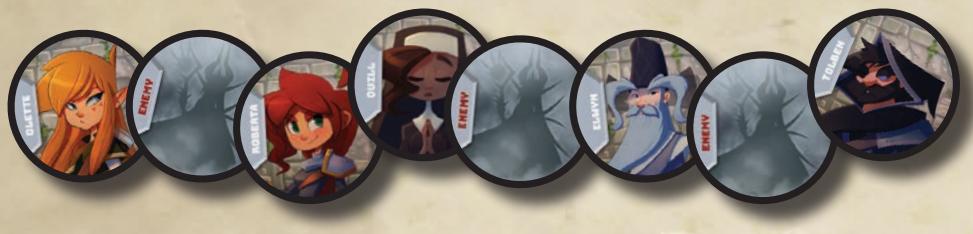
Initiative determines the order in which all characters will take their turns during this round. Each hero has one initiative token, while bosses have two, unless noted otherwise. At the beginning of this step each round, initiative tokens for all characters are shuffled face-down together, arranged in a line, and then flipped face-up. After initiative order has been revealed, players may agree to spend an unused Revive potion to reshuffle and rearrange the initiative tokens (see Revive Potions on page 20).
This line determines the initiative order for this round: the character represented by the frst token will act first followed by the character represented by the second token, and so on until the character represented by the last token in line takes their turn.
Note: Some hero abilities may allow changes to the initiative order. Your party, as a group, must decide which
of these abilities to use, and in which order. If
you are unable to agree, the first player
in initiative order may use their
abilities first, followed by the player
seated to their left and proceeding
clockwise around the table.
3. Player / Boss Turns
If you begin your turn in the knocked out status, you may choose to use a revive potion (if your party has one). If you do, you then take a normal turn but with a revival penalty (see the REVIVE POTIONS section on page 20). If you
do not use a revive potion, you skip your turn. This is not considered passing, so you will not discard your hand at the end of your turn.
On your turn, you may take up to 2 actions or pass. You can choose the same action multiple times.
Player Actions
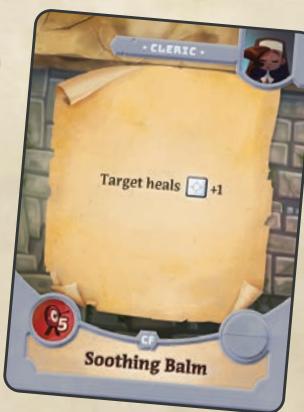
¤ Play an action card from your hand, or use an accessory, armor, weapon, or class feature from either your hand or your player board. After playing any of these card types this way, place them in your discard pile. For more information on equipment and class features, see pages 20 and 22.
¤ Discard any card from your hand to move a number of squares equal to half of your basic movement value, rounded down.
Equip an accessory, armor, or weapon card from your hand, adding it to your player board in the matching slot. You can replace a previously equipped card; place the old equipment card in your discard pile.
Prepare a class feature card from your hand, adding it to your player board if the class feature slot on your board is empty.
Note: Many actions or abilities will use half of a certain value (for example, move half of your basic movement value). In all such cases, the numbers are rounded down.
Boss Actions
When it is the boss' turn in initiative order, reveal the top card of the boss deck. This card will specify which enemies will activate (either the boss, the minions, or both), and which actions they will take. Only those characters mentioned on the specific boss card are activated on this turn; characters that are not mentioned do not act this turn. If you ever need to draw a boss card and the boss deck is empty, reshuffle the boss discard pile to reform the boss deck.
Unless otherwise directed, each enemy will make a basic move up to their maximum movement points (specified in the Campaign Guide). They will move towards the closest hero, counting movement squares as usual (see
MovEMENT, page 14), stopping when they are in range of that hero (or when they reach their maximum movement, if no hero is within range). If two or more heroes are the same distance away from an enemy, the players will decide which one the enemy will move towards. If you cannot agree, whoever who is earliest in the initiative order will choose where the enemy will move.
After moving, each enemy will attack the hero it moved toward, using their basic attack value (also denoted in the Campaign Guide) unless otherwise directed by a card or effect.
Some enemies will have specific types of targets outlined in the Campaign Guide. If possible, they will move towards, and attack, the closest hero that matches that type. If the enemy isn't able to move or attack its specified target, it will move toward and attack the closest hero.
Sometimes, enemy movement or attacks are random. To determine a direction, draw the top card of the
direction deck and move or attack in
that direction. Always reshuffle the
direction deck at the end of any
turn in which it
was used.
Boss Abilities
Some bosses will
have certain special
abilities; these will
be stated in the
corresponding page of the Campaign Guide.
Boss abilities can either be passive
or active.
Passive abilities
introduce new rules for the encounter that are in effect as long as the boss is in play. Some of these abilities introduce new, ongoing rules for characters, while others are triggered when a certain condition is met. These triggered abilities will say "Whenever this condition happens, do this effect."
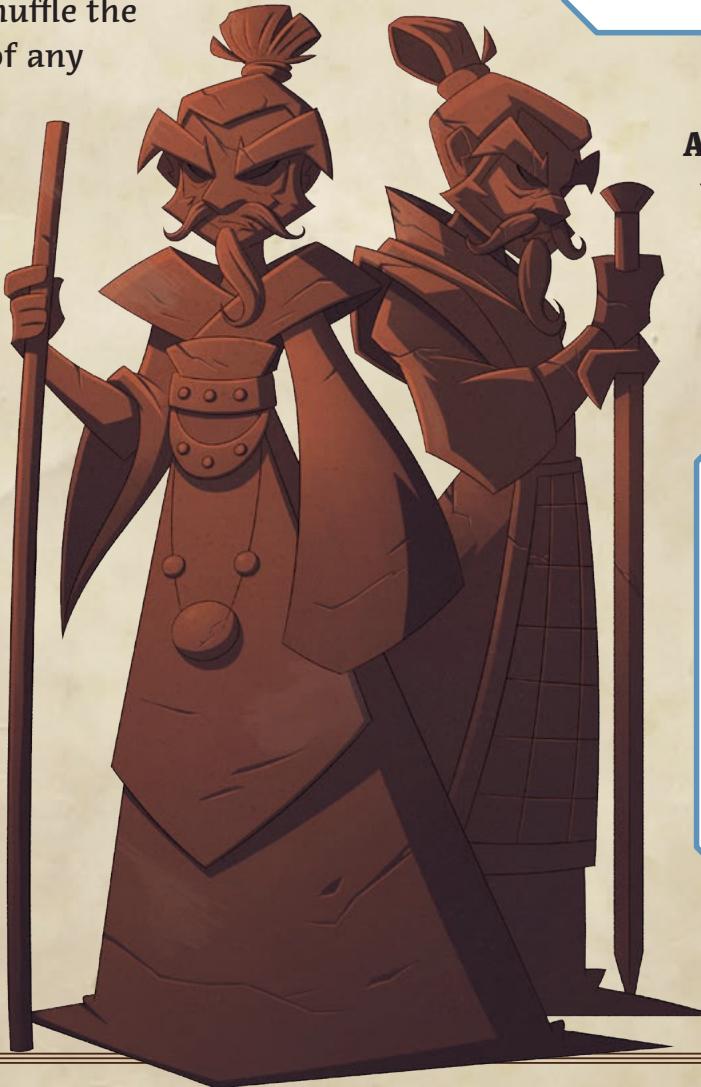
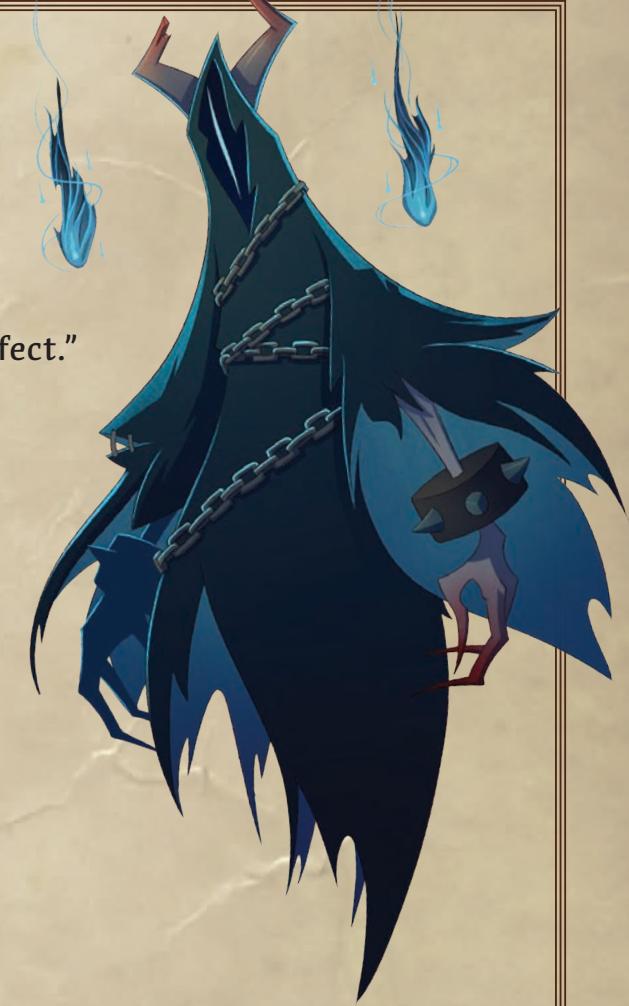
Example
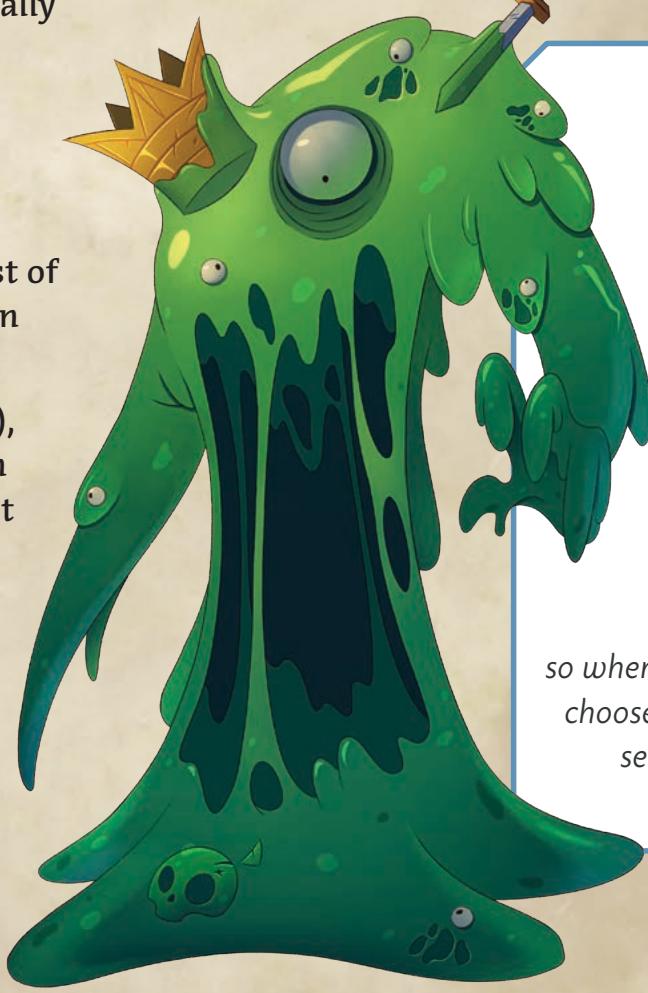
Wraiths have two passive abilities:
SHAPELESS VOID: Wraiths may move through heroes and enemies. BOUND TO SERVE: Whenever a Wraith is defeated, it Heals to its maximum HP and is immediately re-spawned in its starting position.
Active abilities introduce new attacks or abilities that a boss can use in that encounter. These abilities will be referenced by cards in the boss deck: whenever a card is drawn that mentions this ability, refer to the Campaign Guide for its effect.
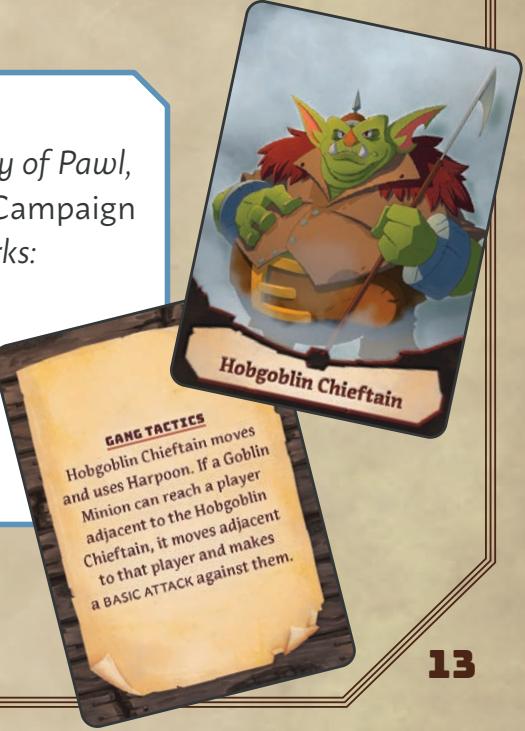
Example
Harpoon is an active ability of Pawl Hobgoblin Chieftain. The Campaign Guide specifies how it works:
ACTIVE ABILITIES: HARPOON: Target is moved to the closest square adjacent to Pawl.

4. Cleanup
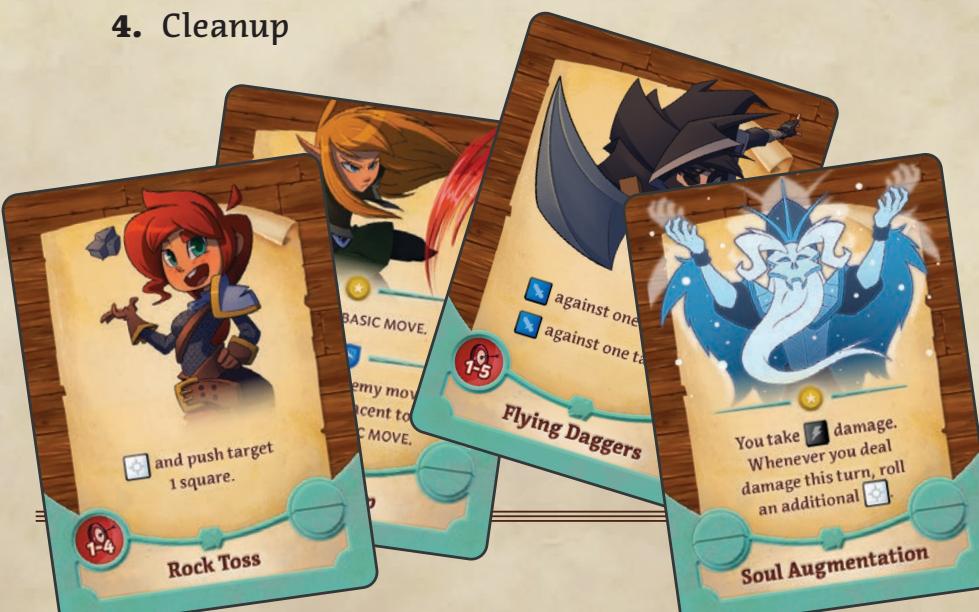
During this phase, you may choose and discard one card from your hand. If you passed, you may discard your entire hand instead.
Also, unless otherwise specified, all conditions are removed during this phase. Remove all condition tokens from any character that has one.
DETAILS OF ACTIONS
By playing cards from your hand, or by using your equipment and class features, you can move around the board, attack enemies and use special abilities from your class(es). Enemies will move and/or attack based on the card that is revealed on their turn.
Movement
You move about the grid-based map by spending movement points. Your hero's class card shows its basic movement value. When performing a basic move, each point allows you to move one square up, down, left or right from your current position. You cannot move diagonally. Any non-basic move action will specify the number of movement points that you can use to move in this way. You do not need to use all of the movement points provided by an action; you can choose to use fewer.

Note: You cannot move through other characters unless an ability allows you to.
Bosses and minions follow the same rules for movement as you do.
Large Boss Movement
Some bosses are larger than normal, taking up four squares on the map instead of one (these are denoted by 2" base). When a boss like this needs to move, choose one of the four squares that the boss occupies and act as if the boss was a regular-sized character which only occupies that square. You can think of the boss as “shrinking" down to that single square.
Count the boss's movement from that one square. When the boss ends its movement, it “expands" back to its normal size. You do this by placing the full-size boss back onto the board, making sure that it covers the square where its movement ended. If the full base cannot be placed in this way then the boss cannot end its movement at the chosen square.
Obstacles
Some squares can have obstacles placed in them by certain enemy abilities, such as a boss that can generate a wall of fire. Squares with obstacles take two movement points to enter. If you do not have enough movement points, you cannot enter a square with an obstacle (and the same is true for bosses). A large boss only needs to pay two movement points when it moves through an obstacle, and not if it is merely placed on top of an obstacle at the end of its movement.

OBSTACLE
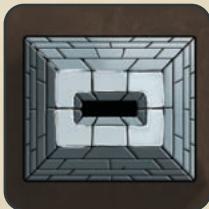
WALL
Other abilities can create walls on the board. Unless otherwise specified, characters cannot move through walls or end their turn on walls. A large boss cannot be placed on top of a wall. If this prevents a boss from being placed at the end of its movement, it cannot end its movement at the chosen square.
Spawning Walls
Some bosses have the ability to spawn walls. Although different types of walls will have different effects, all walls follow the same general rules for how they appear on the board.
The wall must begin on a square whose side is touching the boss's square (it cannot be placed diagonally to the boss). Then, place the wall along side the boss in either cardinal direction: Up-Down or Left-Right.
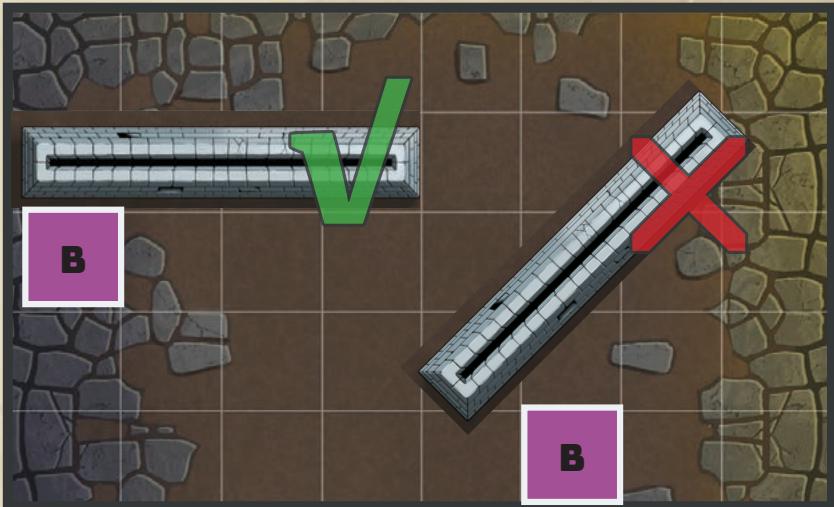
Whenever a boss (B) spawns a new wall, that wall may overlap an existing wall of that type. It does not need to go in the same direction as the previous wall, but it cannot go diagonally.
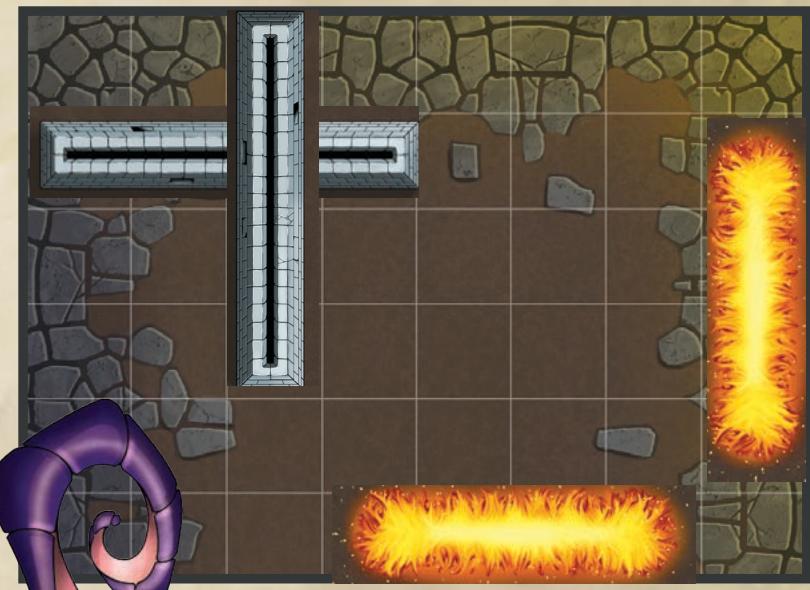
If there is a limit to the number of walls that can be spawned (for example, a certain boss may be able to spawn a maximum of two fire walls), then the oldest wall on the board of that type is removed before the new one is placed.
Spawning Minions
Some bosses have the ability to spawn minions, whether it be from an ability they have, or a special setup rule for the scenario. When spawning minions, first check if the scenario has any restrictions on the number of minions of that type. If there already are that many minions on the board, look to the effect to see what to do (some effects prevent new minions from being spawned, while others replace existing minions with new ones).
To spawn a minion, take the appropriate standee and place it on the indicated square. Some effects will specify where the minion spawns (for example, adjacent to a hero), but some scenarios will have dedicated squares for spawning shown in the board setup. If a minion spawns on a square that is occupied by another character, players choose an unoccupied square adjacent to the occupied square to place the new minion.
Line of Sight
Some actions and abilities
rely on determining
line of sight between
two squares. Line of
sight is determined by
counting the number of
squares away, but unlike
movement this counting
can be done diagonally. Two
squares are in line of sight of
each other if you can draw a
straight line from one corner
of a square to one corner of
the other square. This line
cannot be interrupted by walls or opposing characters: enemies block line of sight for heroes but not
other enemies, and heroes block line of sight for enemies but not other heroes.
Targeting and Range
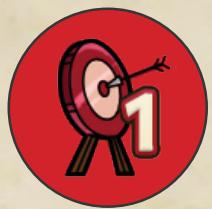
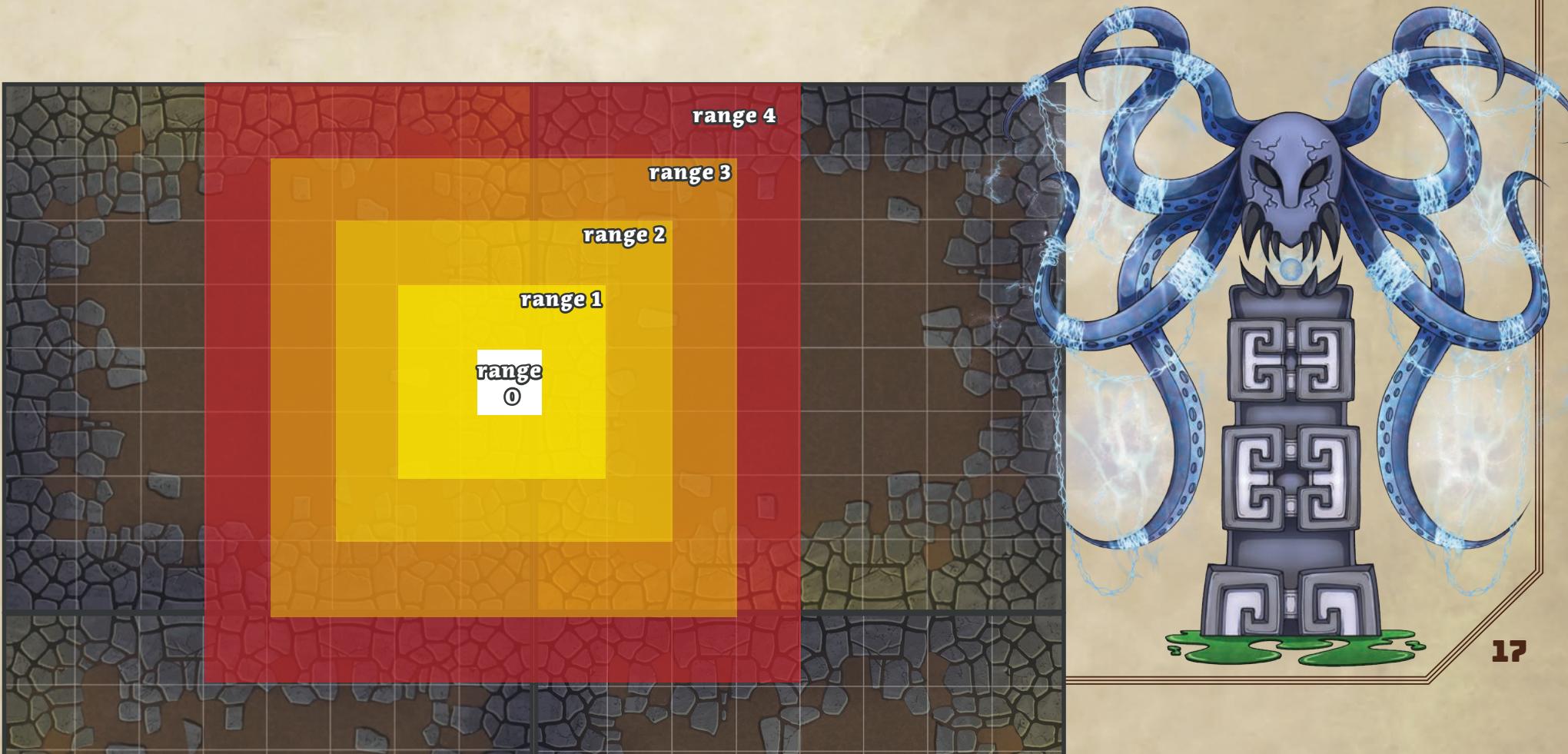
Some abilities, including ranged attacks, rely on line of sight to determine their targets. Each such attack will specify a number – that is its range. A square is
in range of you if it is in your line of sight, and the distance between you and that square is not greater than this range (see the diagram on the next page). The distance between you and your target is always the shortest number of squares between you and that target.
Any square in range is a valid target for that ability, so an ability with range 1—4 can apply to characters who are up to 4 squares away from you.
Some abilities have a more restricted range, such as range 2—3. These abilities can only affect characters who are within this range band. In this example, the ability could only affect characters that are either at range 2 or range 3; it could not affect characters at range 1.

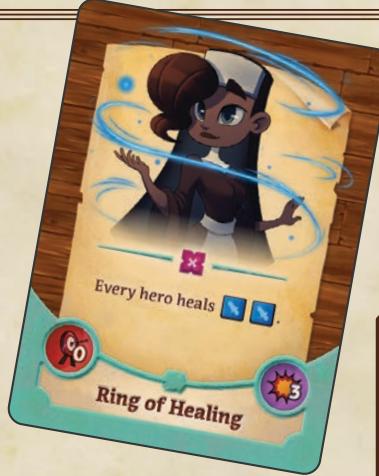
Any action with no range, or with a range of O, applies only to the character using the action. Example: Ring of Healing.
Some cards may have restrictions on what they can target. For
example, they may not be able to target adjacent squares, or squares within a certain range. A character is adjacent to you if it is within one square of you in any direction including diagonally (so, at range 1).
Area of Effect
Effects that specify an Area of Effect (AoE) apply to all characters that are within a certain distance from the target of that card. The AoE of an effect is specified on the
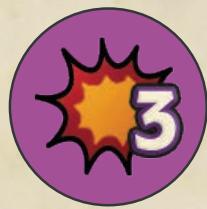
card itself (an effect with no AoE will not have a value, such as Healing Prayer). Note that an AoE attack can target
an empty square. The size of an AoE is determined is determined by counting the specified number of squares in any direction (including diagonally) from the target. The effect is applied to any character within this area.
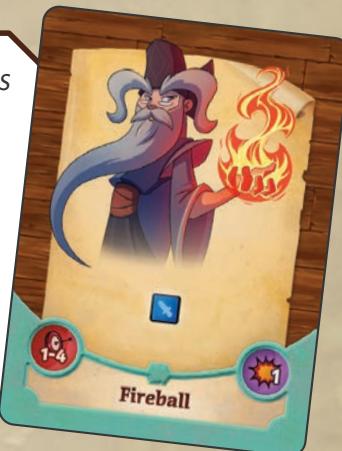
Note: The range of an effect, and the size of its area of effect do not have to be the same. For example, the Wizard's fireball has a range of 4, and an area of effect of 1. The initial target must be within range 4 of the Wizard, and then any other character within range 1 of this target will also be affected by fireball.
If there is more than one character in the area of effect, the player who played the card decides the order in which the targets are affected. If the card requires rolling dice, a single roll is made regardless of how many targets are affected.
Walls block AoE effects: if there is a wall between a character and the target square of an AoE effect, that character is not affected by that AoE even if they would normally be within the AoE.
DETAILS OF ACTION CARDS
Action cards in Adventure Tactics have a text box that describe what you can do by playing that card as one of your actions for your turn. When played, you must follow as much of the card text as possible. If an action card has a blue line separating two abilities, you must choose one or the other ability to use, not both.
Specific > General
There are so many different cards in Adventure Tactics and many of them do something completely unique. Whenever a card or effect contradicts these general rules, always follow the wording of the card or effect.
Attacks
To perform a basic attack, look at your hero's current class card to find both its range and the dice used for the attack. Choose a target within the specified range and roll the specified dice. Add up the results; that is the amount of damage done to the chosen target.
Any non-basic attack card will specify its range and the dice used on the card itself – you do not use the values from your hero's class card. Perform the attack as usual.
If an attack card has a second set of dice and range (e.g. and ), the card allows you to perform a second attack. This attack can be against the same target, or a different one. Resolve the first attack before making the second attack. If the target dies due to the first attack, you must choose a second target for the second attack.
Some attacks may also apply certain conditions, or other effects, to their targets. Apply the condition after dealing the attack's damage, as long as the target is still alive.
Some abilities allow you, or other characters, to ignore an attack. When ignoring an attack, the attack's dice are still rolled, but you do not take the damage.
Healing and Other Abilities
Many non-attack cards will also specify a range and an effect as part of their card text. Their range value is used to determine valid targets, and the effect of the card are applied to the chosen target(s). Many of these effects will specify a set of dice; roll these dice and use the result when processing the effect.
Example
Healing Prayer has a range of 3, and says "Target heals."When you play this card, choose a hero within range 3 (which can include your own hero), roll the two dice, and heal that many HP from the target.

Conditions
Some cards can apply various conditions to characters, which are described below. Unless otherwise specified, conditions are removed during the cleanup phase.
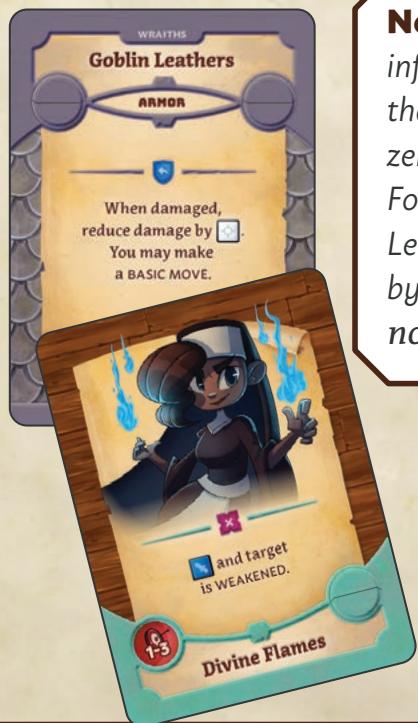
Note: If an attack would normally inflict a condition on a character, but that attack's damage is reduced to zero, that condition is not applied. For example, if a hero wearing Goblin Leathers reduces the damage dealt by Divine Flames to zero, the hero is not weakened.
LIST OF CONDITIONS
Slowed characters can only ever use a maximum of 1 movement point anytime they move.
¤ Weakened characters deal half as much damage (rounded down).
α Stunned characters skip their next turn in initiative order. Note that bosses have more than one initiative cards, so a stunned boss would only skip their next turn in the round.
¤ Invisible characters cannot be targeted by any actions, though they are still affected by area of effect attacks and abilities. Note that this also includes benefcial actions, such as healing.
Knocked Out
You are knocked out if you are reduced to O or fewer HP (if you would be reduced to lower than O HP, you are set to O HP instead). If you are knocked out, you:
Cannot play any cards or use any abilities until you are healed to more than O HP.
Cannot be targeted by enemy attacks and abilities, and cannot take damage from their attacks
Do not count as occupying the square that you were last in.
If you are healed above O HP, you are returned to the board on the square that you were last in. If that square is now occupied, you determine which adjacent square you will reappear on by drawing the top card of the direction deck. If that square is empty, that is where you reappear. If it is not empty, repeat this process. Always reshuffle the direction deck at the end of any turn in which it was used.
Note: Enemies are never knocked out. An enemy that is reduced to o HP or below is instead removed from play.
Other Keywords
Some cards have the other keywords on them that affect when and how they are played:

Remove: After this card has been played, set it aside for the remainder of the encounter.

on a turn that you pass. that you pass.
Free: Playing this card does not count as an action. Note that these cards cannot be played

Response: This card may be played outside of your turn, after a certain event happens. This condition will be
outlined on the card. Only one Response can be played for each event.
THINGS YOU NEED TO KNOW BEFORE PLAYING AN ENCOUNTER
Encounters in Adventure Tactics contain many different elements of peril, adventure, and reward. There is a common set of rules for all encounters that you should be aware of before embarking on your adventure.
EQUIPMENT
After successfully completing an encounter, the party may receive equipment cards as loot. Equipment falls into three different kinds: weapon, armor and accessory. At any given time, you may only have one of each kind of equipment on your player board. These equipment cards can be played as one of your actions on you turn.
When your party earns equipment cards as loot after finishing an encounter, you must decide as a group who receives which cards. If you cannot agree, each player rolls, and whoever gets the highest total decides who receives which equipment.
At the end of an encounter, you may add or remove equipment cards from your action deck. You may also trade equipment cards with other members of your party. Any equipment card that is not included in your action deck at the beginning of an encounter is still owned by you, but cannot be used in that encounter. Place it in your tuck box – you can always use it next time.
SUMMONED CREATURES
Certain cards or abilities may allow you to summon creatures to fight alongside you. These creatures have their own character cards, and count as heroes for the purposes of targeting and attacks, but their turns are controlled by you.
The summoned creature's card will tell you how it takes its turn. Some summoned creatures make their moves and attacks at the same time as you, while others take their own individual turns.
The Imp cannot be damaged or knocked out. If a skeleton would be knocked out, remove it from the board instead - you must summon it again to return it to play. The beast companion can be knocked out just like a hero, and can be healed as well. Revive potions can never be used on summoned creatures.
REVIVE POTIONS
Revive potions are used to bring knocked out heroes back into the game or redo the initiative order, and are a key resource in an encounter. If ever a hero is knocked out and your party has no more revive potions, you lose the encounter (you also lose if all heroes are knocked out simultaneously).
If you begin your turn at 0 HP, you may choose to use a revive potion to heal half of your maximum HP (rounded down).
¤ When you are revived in this way, you also shuffle your discard pile into your action deck.
Rolland set aside that many cards from the top of your action deck until the end of the encounter.
Draw up to your maximum hand size and take your turn as usual.
Note: If you have fewer than 4 cards in your deck, you may not use a revive potion. B
Once used, flip the revive potion over to indicate that it has been used during this encounter.
Once the encounter is complete, revive potions are refreshed and returned to to the Party Items deck.
PERKS
After successfully completing an encounter, you may receive perk cards as a reward. These are generally earned by completing the bonus objective(s) of an encounter, which will name a specific perk card. You decide as a group who receives which perk. If you cannot agree, each player rolls 2 red dice, and the player with the highest total decides who receives which perk.

You may also receive perks as a result of leveling up in certain classes. The level up cards will say which perk you receive, and when you receive it.
Certain perks may grant you new cards for your deck. If the card is marked with ADD, then that card is simply added to your action deck. If the card is marked with REPLACE, then you may choose to remove a card from your deck as well, returning it to the box.
ABILITY CARDS
Through the course of your adventure, you will acquire class ability cards. These features improve your character by, for example, increasing your stats, improving your abilities, or adding additional dice to your attacks.
When you begin an encounter you can select up to 3 passive abilities and 2 dice abilities to begin with on your player board. All other ability cards are placed into your tuck box and cannot be used in that encounter.
Passive Abilities are always in effect as long as they are on your player board (they are not discarded when used). These can change the basic features of your character, or give you new abilities that you can use during your turn (see PLAYER ACTIONS, page 12).
Dice Abilities change how you use dice for certain actions. They may give you more dice to use on attacks or other abilities, or modifiers and rerolls for using those abilities. Like passive abilities, dice abilities are always in effect and are not discarded when used.
SHOPPING AT THE MARKET
There are certain points during the campaign where you will be able to spend your hard-earned gold on new equipment, including rare items that are only available in certain markets. These shopping opportunities will be noted in the Campaign Guide.
The items for sale in the market are all of the unclaimed or lost equipment cards from previous chapters of your campaign, as well as some new items made available from the market itself.
Unless otherwise specified, each item costs 2x Bag of gold (which you can acquire as loot after an encounter, for example). When spending bags of gold, move them from the Party Items deck to the Supply
Items deck. After buying an item, add it to your tuck box. You can use it in the next encounter, following the usual setup rules.
All of the gold you acquire is shared amongst your entire party, no matter who acquired it. Your party's gold can be used to buy equipment for any member of the party. Any equipment that you do not want can be sold to the market for 1x Bag of Gold, which then gets added into the Party Items deck from the SupplyItems deck.
RANDOM ENCOUNTERS
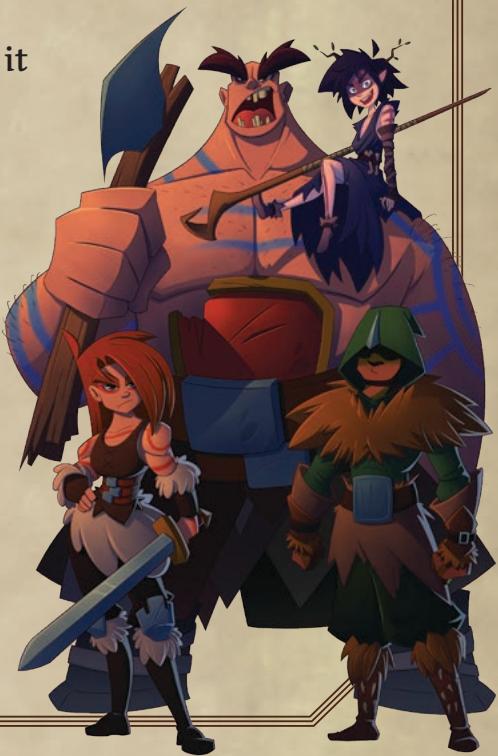
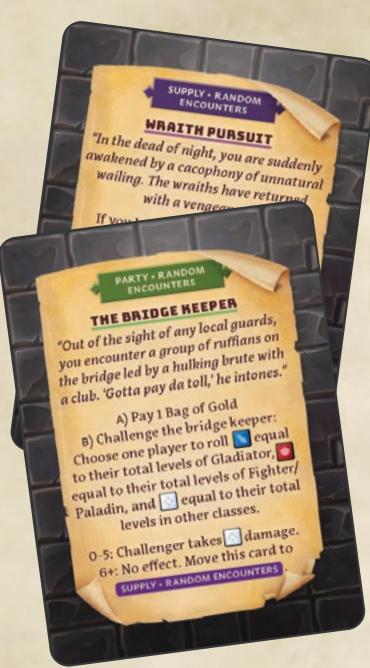
As your party moves through the world of Adventure Tactics, you will occasionally have random encounters. Certain choices in the Campaign Guide, usually involving traveling to different parts of Caiveil, will ask you to draw a card from the Party Random Encounters deck.
Follow the instructions on the card. If those instructions direct you to remove it from the Party Random Encounters deck then do so; otherwise return that card to the deck (so you could have the same encounter again).
At certain points in the campaign you may be prompted to add new cards to the random encounter deck. The choices you make can come back to affect you later on in your campaign!
LOOT ITEMS
After completing an encounter, your party may be rewarded with loot. The Campaign Guide will tell you what you receive based on how you fared in that encounter (see SUCCEEDING AND FAILING, page 9). The loot you receive may vary by hero count. Any unacquired loot is added to the Market deck.
Depending on the outcome, certain random encounters may also reward you with loot.
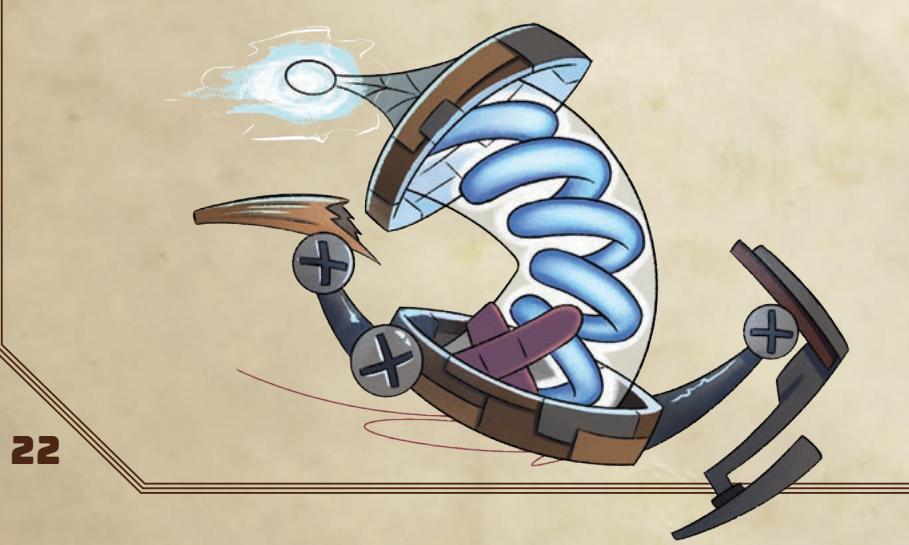
Loot can include equipment cards (weapons, armor, and accessories), bags of gold, new party items, and even character perks. Some encounters may even award you with items that are essential for advancing the plot of your campaign.
CLASS FEATURES
Class feature cards represent defining abilities of your hero's class(es). They provide your hero with new powers to use during encounters, which could include ongoing bonuses, new actions or responses to enemy attacks and abilities.
As mentioned in the PLAYER ACTIONS section on page 12, you may use a class feature card as one of your actions (placing it in your discard pile afterwards).
Whenever you level up into a new class, you will get a new class feature card (noted on the level up card for your chosen class). At the beginning of any encounter, you can choose one class feature card to begin with on your player board. Any other class feature cards you have can either be shuffled into your action deck, or set aside for the duration of that encounter.
LEVELING UP, AND CHANGING CLASSES
After concluding certain encounters, you and your party will be able to level up. Those encounters will say "All Heroes Advance 1 Level." When leveling up, you must choose one level up card. The chosen card can be the first card of a new basic class deck, or it can come from any basic or elite class deck for which you meet the class
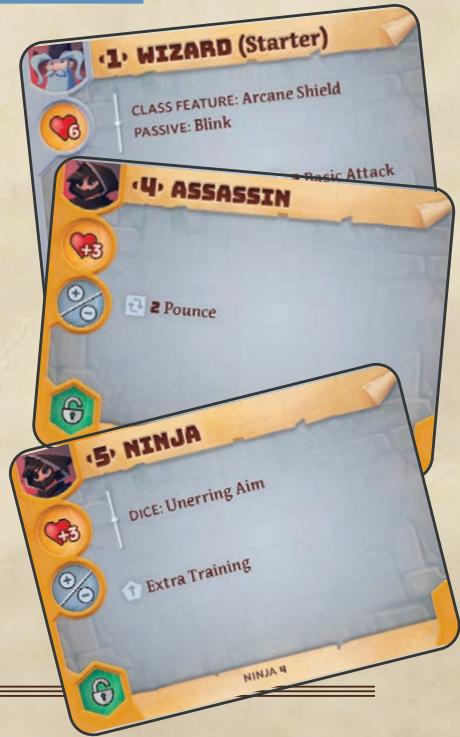
requirements (found on the level up cards, and in the Class Guide). In this way, you get to choose to develop your current class(es), or pursue new classes to obtain new action cards.
Some level up cards will instruct you to either ADD or REPLACE new action cards to your deck. If it says ADD, then the specified cards are simply added to your action deck. If it says REPLACE, then you may also choose to remove a card from your deck for each card you add.
The first time a card is chosen out of a new class deck, that class is considered unlocked. Elite classes can only be unlocked for one player: if one hero has chosen a card from an elite class deck, no other hero can choose cards from that deck.
Note: Since only one hero can be a given elite class, you and your party will need to work together when deciding how to level up your characters. Make a plan early on for how you will level up, so that you don't end up taking an elite class that someone else had their eye on!
You can always choose cards from a basic class deck when leveling up, but keep in mind that there are class limits here too: no more than two heroes may be at level 2 or higher in any basic class, and no more than one hero may be at level 3 or higher in any basic class. No more than 1 hero may be a given elite class.
You can have level up cards from multiple classes, including multiple elite classes (though every elite class you select will prevent other heroes from choosing that elite class).
When choosing level up cards, you may also choose to add a basic move or a basic attack to your deck, and remove any one card from your deck.
ELITE CLASS REQUIREMENTS
In order to level up to an elite class, you must meet that class' requirements. To become a Dark Knight, for example, you must have at least one level up card in the Fighter class, and one in the Wizard class.
Note: While each of the Elite Class cards has a specific hero on it (Quill as the Bishop, for example), you do not need to be playing as that hero in order to choose that class (Tolben makes a fine Bishop).
The table on the next page shows the class requirements for all eighteen elite classes.

| ELITE CLASS | PREREQUISITES | MOVEMENT | HP GAIN |
| ASSASSIN | Rogue (2) | 5 | +3 |
| BARBARIAN | Fighter (2) | 4 | +4 |
| BARD | Archer (1), Rogue (2), Cleric (1) | 4 | +3 |
| BEAST TRAINER | Fighter (1), Archer (2) | 5 | +4 |
| BISHOP | Cleric (2) | 3 | +3 |
| CHAMPION | Fighter (1), Archer (1), Wizard (1), Rogue (1), Cleric (1) | 5 | +7 |
| DARK KNIGHT | Fighter (1), Wizard (1) | 4 | +4 |
| DEMON HUNTER | Cleric (1), Rogue (1), Archer (1) | 4 | +4 |
| GLADIATOR | Fighter (1), Archer (1) | 5 | +4 |
| MONK | Cleric (1), Rogue (1) | 5 | +4 |
| NECROMANCER | Wizard (2) | 3 | +2 |
| NINJA | Rogue (1), Wizard (1), Archer (1) | 5 | +3 |
| PALADIN | Fighter (1), Cleric (1) | 4 | +5 |
| RANGER | Archer (2) | 4 | +3 |
| SHAMAN | Cleric (2), Wizard (1) | 3 | +4 |
| SKIRMISHER | Rogue (1), Archer (1) | 4 | +3 |
| WAR MAGE | Fighter (1), Wizard (1), Rogue (1) | 4 | +3 |
| WARLOCK | Cleric (1), Wizard (2) | 4 | +3 |
SPECIAL
Some elite classes have a modifier for their basic attack; this will appear as a unique symbol on their class cards.
These modifiers are:
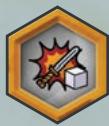
Demon Hunter: roll an extra ( when attacking an adjacent target.

Paladin: heal 1 HP.
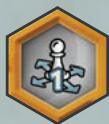
Warlock: after your attack, move the target one square in any direction.
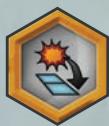
War Mage: deal 1 damage to another target at range 2.

Game Designer: Nicholas Yu
Artists: Jacob Croft, Calico Maher, Alisha Volkman
Graphic Designers:

Jason Kingsley, Anna Urbanek, Adrienne Ezell,
Michael Cofer, Dawson Cowals
Mobile Dev Team: Aesthetician Labs
Miniatures Modeller: Heriberto Valle Martinez
Editor: Sam Hillier
Adventure Tactics: Domianne's Tower is published by Letiman Games, LLC. www.letimangames.com
Copyright information: ©2020 Zucchini People Games, LLC
Adventure Tactics ™ is a trademark of Zucchini People Games, LLC.
No reproductions or recreations without the author's permission.
Download MarkdownTexts are community-compiled or publicly released by publishers; copyright remains with the original authors. For personal reference only.