
Amun Re
At a glance
Rules, cards and Q&A (Chinese)
The rules, card data and player questions for this game are written in Chinese. Open the Chinese page to read them.
Where to find full rules
Full rules and card lookup are available in the cunlema app at cunlema.cn — pick this game and ask about any rule, card or turn you are unsure about.
Related games
Rulebook text (Markdown)
This game has 3 rulebook Markdown file(s) in our library; 3 rendered inline below — expand to read or download.
rules_zh_亚蒙拉_869.md34.8 KB
- 宗水 可游水 1. 宗水 可游水 1. 宗水
亞蒙拉
遊戲設計:REINER KNIZIA 美術設計:KEVIN LE MOIGNE 遊戲背景介紹
亞蒙拉注視著古埃及世世代代的潮起潮落。你需要帶領你的皇室家族,與其他皇室家族競逐:獲得行省的支配權,大型神廟和金字塔的修建以及當喜怒無常的尼羅河神允許的時候灌溉你的田地。在埃及古典時代結束的時候,歷史會給予脫穎而出的勝者一個高度評價。亞蒙拉是一款拍賣和發展相結合的遊戲。隨著時間的推移,每位玩家帶領的家族也會逐步發展,最終向世人宣告你是有史以來最偉大的法老。

將獻祭板塊面朝上放在版圖邊上。
遊戲版圖
5 獻祭板塊
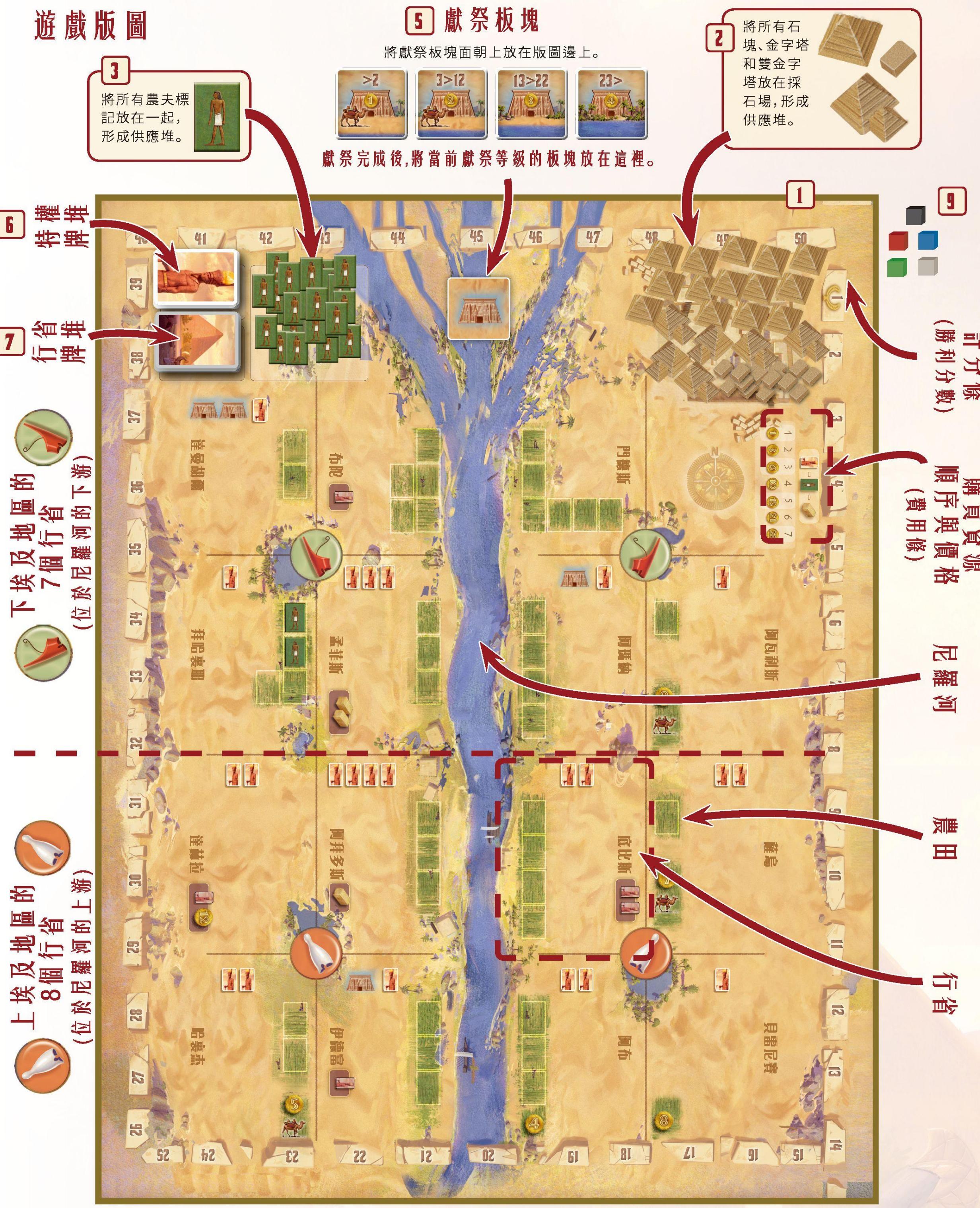
黃金儲備區
遊戲設置
-
將遊戲版圖面朝上放在桌子中間。
-
將所有石塊、金字塔和雙金字塔放在採石場,形成供應堆。
-
將所有農夫標記放在一起,形成供應堆。
-
按照面額將金幣牌分類, 面朝上放在版圖邊上。
-
將獻祭板塊面朝上放置在遊戲版圖邊上。
-
向每位玩家分發1張建築師特權牌,再將剩餘的特權牌洗勻。將特權牌堆(雕像牌背)面朝上,放置在遊戲版圖邊上。
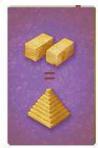
- 根據玩家人數準備行省牌堆(金字塔牌背朝上)。每有1位玩家,就抽取3張行省牌,構成行省牌堆。5位玩家遊戲時,所有的行省牌都會被使用。將未使用的

行省牌放回遊戲盒里,它們在本局遊戲中不會被使用。

的 3 枚書吏標記。將未使用的玩家顏色的配件放回遊戲盒中。
-
所有玩家將自己顏色的勝利分數標記放在遊戲版圖的計分條上, 其餘未使用的玩家顏色的配件放回遊戲盒中。
-
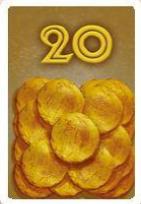
分發給每位玩家總值20金幣的金幣牌, 金幣牌遵循以下規則:

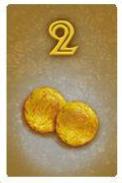
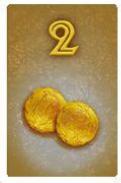
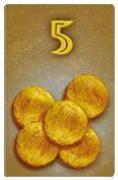

你可以在任何時候將手上的金幣牌與供應堆進行找零/換整。遊戲中任何時候提到金幣,都是指可用任何金幣牌組合構成的等額的金幣牌。每當你使用金幣來進行競拍或者購買時,將使用的金幣牌返回供應堆。
-
分發給每位玩家1張盜竊牌,其餘未使用的盜竊牌放回遊戲盒中。
-
隨機決定一位起始玩家,將起始玩家標記給該玩家。

起始玩家標記
遊戲中,起始玩家會根據向亞蒙拉神獻祭情況,每回合做出改變。拍賣、市場與收穫階段的行動順位都從起始玩家開始,順時針進行直到所有玩家都完成自己的回合動作。

遊戲配件
1塊遊戲版圖(第2頁對頁位置)


15枚書吏標記
(3枚×5種顏色)
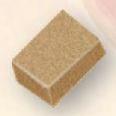
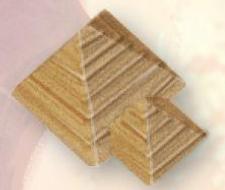

5枚勝利分數標記
15塊石塊
15座金字塔
15座雙金字塔


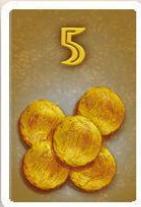

61張金幣牌(18張一塊, 12張兩塊, 12張五塊, 9張十塊, 10張二十塊)
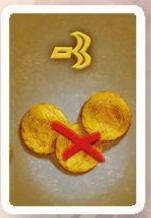

5張盜竊牌 (-3金幣)

39張
特權牌
15張
行省牌

4塊獻祭板塊

48個
農夫標記

1枚
起始玩家標記
遊戲概覽與目標
作為一名古埃及皇族的領袖,你必須和其他人競爭,成為歷史上最偉大的法老,被歷史所銘記。亞蒙拉經歷兩個时代:古王國時代與新王國時代。每個時代進行3個回合(每回合分成四個階段)。每個時代結束的時候進行一次計分。總分最高的玩家獲得勝利。
回合流程
每個回合由4個階段構成, 按順序依次執行:
- 競拍階段
在競拍階段中,遊戲版圖上會展示一定數量的行省牌。本回合競拍這些行省。
2. 市場階段
在市場階段中, 玩家可從市場購買資源與卡牌, 並將石塊與農夫放置到遊戲版圖上。
3. 獻祭階段
在獻祭階段中,玩家花費金幣向亞蒙拉神進行獻祭。
4. 收獲階段
在收穫階段中, 玩家從行省與農夫處獲得收入。
這些階段的細節將在接下來的2頁詳細介紹。在每個階段以及計分過程中,玩家可以打出特定種類的特權牌。
注意:你不能在同一個階段或者計分過程中打出2張相同的特權牌。
你可以在任何時候棄除手上的特權牌來兌換金幣,每張特權牌兌換1金幣。
1. 競拍階段
競拍階段開始時,抓取與玩家數量相等的行省牌。然後將這些行省牌面朝上放置到遊戲版圖上對應的位置。這些行省將會在本回合中進行競拍。
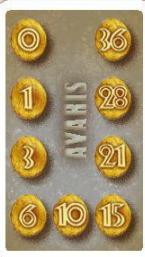
如將要競拍的行省上棕色方框“即刻獎勵”所示,放置石塊、特權牌(面朝下)、金幣牌等獎勵。
即刻獎勵
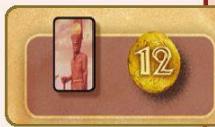
即刻獎勵印在棕色方框中。當你獲得對應行省的控制權時,便立即獲得這些獎勵。
舉例:
- 立即抽取1張特權牌。

- 立即在該行省放置1塊石塊。
- 立即抽取1張特權牌並獲得12金幣。

持續獎勵
持續獎勵印在行省邊沿。只要你持續控制該行省,你就享有持續獎勵的效果。
- 特權符號: 表示你在市場階段可以購買的特權牌上限(每有1個符號,則可以購買1張特權牌)。只計算你控制的行省中特權符號最多的一個行省,而不是將所有行省上的符號相加。

- 金礦:在每個收穫階段提供固定數量的金幣收入。

- 商隊:在每個收穫階段提供固定數量的金幣收入,前提是獻祭板塊上有駱駝圖案。
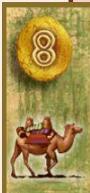
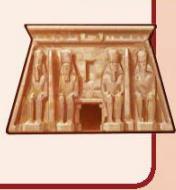
- 神廟:在每個收穫階段可獲得分數,分數為最新的獻祭板塊所示。
農田:每塊農田區域可以容納1個農夫。農夫需在市場階段放置,每個農夫在收穫階段的收入由最新獻祭板塊上的金幣決定。農夫不可放置在沒有農田的行省。
接下來,由起始玩家開始,順時針依次行動。每位玩家必須對未被佔領的行省競拍報價;若已競拍到行省的玩家必須跳過。使用一個書吏標記放在出價位上,表示你的報價。
若某行省已有玩家做出報價,則你的報價必須大於當前報價。只要你願意,你的報價可以更高於下一個可以報價的區域。

如果你競拍某行省的競價失敗,再輪到你時就不可以在同一行省再次報價。若在之後的競價仍然失敗,你可以向之前競價失敗的行省報價。
賄賂:在競拍階段,如果你在某行省的報價已落後,你可以打出賄賂特權牌對該行省重新報一個更高的價格。
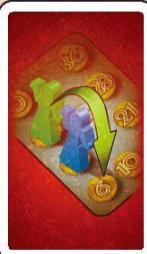
競價保護:在競拍階段,你可以在你已報價的行省上打出競價保護特權牌,以此封鎖你所在出價位的下一個出價位。這意味著其他玩家至少要比你多2個出價位才能高於你的報價。如果之後你將你的書吏標記移至其他行省競價,你的競價保護特權牌仍然對你有效。

你的報價不可高於你現有金幣總額。
當每張行省牌上僅有1名書吏標記時,競拍階段結束。玩家們必須支付他們的報價至金幣牌堆,且把書吏標記留在遊戲版圖上相應的行省中,以示對行省的控制。最後,玩家從競拍到的行省中獲取“即刻獎勵”方框里顯示的相應石頭、特權牌、金幣等資源。行省牌從版圖上移除并放入棄牌堆。
舉例:底比斯、達赫拉、阿拜多斯這3張行省牌被抽取且進行競拍。
A是起始玩家。她將書吏標記放在達赫拉行省牌上,出價10金幣。B放置他的書吏標記在底比斯行省牌上,出價3金幣。C放置他的書吏標記在底比斯行省牌上,出價高於B為6金幣。
現在,又到了A的回合,但沒有人高於她在達赫拉的出價,她必須跳過。B在底比斯的出價被超過,所以他必須變換他的出價。他放他的書吏標記在阿拜多斯的0金幣處。
至此,每個省份均無競爭出價,所以競拍結束。玩家向金幣堆支付相應出價,放置書吏標記至所拍獲的行省,且取得該行省的“即刻獎勵”。
A支付了10金幣,然後從達赫拉行省的”即刻獎勵“中獲得12金幣、1特權牌。
B不出分文的獲得了阿拜多斯的控制權,以及那裡的石塊。
C 支付了 6 金幣,控制了底比斯行省,且獲得 2 張特權牌的“即刻獎勵”。
2. 市場階段
從起始玩家開始,可以從供應堆中購買特權、農民或者石頭,按照版圖上顯示的順序來購買。

當需要購買物品的時候,你需要支付金幣到供應堆,金幣數量參照購買順序下方的費用表。每次購買都是單獨分開的,所以你3種資源各買1個也只需花費3金幣。一旦你已經按順序購買了某一種資源或者跳過這次機會,你在這回合將不能再買這個資源。
你可購買以下資源:
- 0-4張特權牌,從特權牌堆抽出。你控制的行省上顯示的特權符號(數量最多的行省),則是你能買特權牌的最大數量。如果你沒有控制擁有特權符號的行省,則不可以購買特權牌。

- 農夫需立刻放置到你控制的行省的農田當中。如果農田沒有空位放置農夫,則無法購買農夫。沒有農田的行省不可以放置農夫。

免費農夫:在市場階段打出1張免費農夫特權牌則可放置1個農夫——不需要支付任何金幣,且可放置到你控制的任何一個行省中。不同於農夫的是:免費農夫並
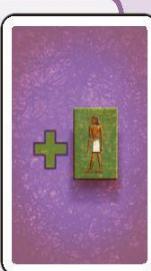
不需要放置在農田里。免費農夫可以放到任何一個你控制的行省中,即便該行省沒有農田。拿取免費農夫並不影響購買農夫,如果你要另外買3個農夫,你依然只花6金幣。
- 石塊需馬上放置到你控制的行省中,可分開放置。購買農夫和石塊
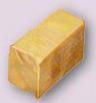
不同於特權牌,只要你有位置放置這些資源,你便可以盡情購買,甚至超出費用條所示數量。
如果你的購買數量超過7個,請參考以下計算公式:
購買8個的費用=購買7個的費用(28)+8=36金幣;購買9個的費用=購買8個的費用(36)+9=45金幣;以此類推。
任何購買行動都不是強制的;如果你選擇執行購買行動,確保在跳過前購買好資源。
建造: 當3塊石塊同時放置在一個行省時, 立即建成1座金字塔。如果該行省已有1座金字塔, 立刻建成1座雙金字塔。
只要建造金字塔的石塊滿足數量要求,同一回合内可以完成任意多座金字塔。。
建築師:建築師特權牌可在市場階段打出1張。如此一來,你建造1座金字塔只需要花費2塊石塊。建築師特權牌只能在市場階段打出,若在其他階段你在控制的行省上放置

了2塊石塊且馬上使用了建築師特權牌,也不會起作用;但此時如果你放置了3塊石塊,還是會立即建成1座金字塔。
舉例: C 控制了底比斯和伊德富。
他至多可以購買2張特權牌,但他選擇了購買1張特權牌,支付1金幣。
他接著購買了4個農夫支付了10金幣,且立刻放置在空餘的農田上。
最後他又買了3塊石塊支付6金幣,且均放置在底比斯行省。現在底比斯已擁有3塊石塊,那麼立即建成1座金字塔,且把3個石塊歸還至採石場。
3. 獻祭階段
在獻祭階段,玩家們選擇好祭品(金幣牌或盜竊牌)同時展出,以此祭品祈求亞蒙拉神讓尼羅河水位升高、洪水爆發,帶來尼羅河沿岸豐沃的土壤。獻祭總額決定了神廟的分值,以及農夫和商隊在收穫階段的收入。
準備個人祭品:
私下選擇1張或更多卡牌,且用手遮蓋好,不要被發現。一旦所有玩家選擇好了祭品,同時翻開祭品卡牌。
- 如果你獻祭了1金幣或者更多,你的獻祭值等於你所献祭的金幣總額。
- 如果你獻祭了盜竊牌,則從金幣堆中偷取3金幣。
以上兩種情況,你都可以使用一張藍色特權牌去調整獻祭總額,其他的特權牌則無效。
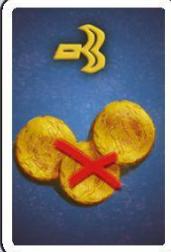
計算獻祭總額:
- 將所有玩家的個人獻祭值相加,別忘了扣除盜竊牌——每張牌扣3點。
- 從起始玩家開始,依次進行結算。使用了藍色獻祭調整特權牌的玩家,現在可以宣佈是提高還是減少獻祭值。調整只會影響獻祭總額,並不會影響個人獻祭值。
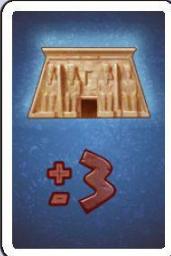
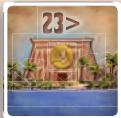
- 一旦獻祭總額計算工作完成, 立即將對應的獻祭板塊放在尼羅河分流處。(例如: 如果獻祭總額為10, 則使用3>12板塊作為標記; 如果獻祭總額為25, 則使用23>板塊作為標記。)
- 如果你使用了盜竊牌, 此時可收回手中。千萬別忘了從金幣堆拿取3個金幣!
獻祭效果:
- 獲得獎勵:獻祭第一的玩家可獲得3個獎勵。這些獎勵可以是特權牌、石塊、農夫的組合或者單品。獻祭排名第二的玩家可以
4. 收獲階段
洪水在尼羅河爆發了,從起始玩家開始,順時針依次執行,玩家們將從他們控制的行省獲得收入。
每位玩家可收穫與自己行省所示金幣額。
從行省收穫遵循以下規則:
a)
金礦 - 取得與所示數額相等的金幣。

商隊 - 必須在當前獻祭板塊有駱駝圖標時,才能取得與駱駝上所示數額的金幣。
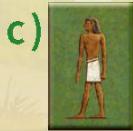
行省上的每個農夫 - 取得與當前獻祭板塊所示的相等金幣數額。
獲得2個獎勵,其他玩家獲得1個獎勵,按順序執行分發獎勵。但是,使用盜竊牌的玩家不能獲得獎勵。
如果出現獻祭數量相等的情況, 按照當前順位排名。
(不同於市場階段的是)你所獲得的特權牌數量不受已控制的行省特權牌符號限制,只要符合獎勵要求即可。農夫需立即放置到空餘的農田中,石塊也必須馬上放置到你的行省內。如果行省內石頭數量到達3塊,則替換為相應的金字塔。
提示: 建築師和免費農夫特權牌不能在獻祭階段使用。
- 起始玩家變更: 獻祭金幣第一的玩家成為下一回合的起始玩家。如果出現平局, 按照當前順位排名。

舉例:B是起始玩家。B貢獻了6金幣,C貢獻了6金幣,A使用了1張盜竊牌,則獻祭總額為9金幣(6+6-3=9)。於是,他們放置了相應的獻祭板塊“3>12”。A收回了盜竊牌,且從金幣堆里偷取3金幣。C和B獻祭的金幣數額相等,但在該回合中,B順位在C之前。因此,B繼續作為起始玩家,且選擇了3張特權牌作為他的3個獎勵。C選擇了1塊石板和1個農夫作為他的2個獎勵,且馬上放置到自己的行省。A什麼獎勵也沒有。
國庫牌:該特權牌必須在收穫階段打出,且在你計算收入前使用。接著選一個你控制的行省,該行省本回合不會從農夫、商隊、金礦中取得金幣,取而代之的是直接從金幣堆拿取8金幣。

大豐收:該特權牌必須在收穫階段打出,且在你計算收入前使用。接著選擇一個你控制的行省,該行省每有1個農夫則收取1額外的金幣。
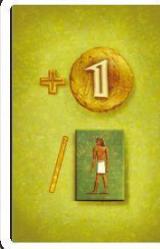
回合、時代、遊戲結束
當所有玩家完成收穫階段,回合結束,新的一回合開始。
- 如果進行到當前時代的第3回合,行省牌將會抽空。代表這時代結束,且立即進行中段計分。
- 在第二時代(新王國時代)的中段計分之後,立即進行最終分數結算,遊戲結束!
中段計分
中段計分發生在每個時代結束之時。以下為中段分數結算的規則:
- 你控制的行省內的每個神廟+1,+2,+3,或是+4分,每個神廟的分數取決於當前獻祭板塊上所示金幣數額。
- 在你控制的行省內每有一個金字塔+1分, 雙金字塔視為2個金字塔(+2分)。
- 在你控制的行省裡, 金字塔最少的那一個行省裏每個金字塔+3分。如果你有一個行省沒有金字塔, 則此項不得分。
- 對於尼羅河每一側的所有行省,金字塔最多的行省+5分(東河岸結算一次,西河岸結算一次)。若出現平局,行省內石塊數量多者計分。若再平局,所有平局玩家都參與計分。
- 滿足黃色特權牌上的條件, 每張牌+3分。
提示:你不可以在同一階段以及計分時打出2張一樣的特權牌。
當第一時代(古王國時代)結束時,將所有的書吏標記和農夫從遊戲版圖上移除,農夫放回供應堆。將遊戲版圖上的所有行省牌回收洗勻放入行省牌堆。
金字塔和石塊將不會從行省移除,全部保留在遊戲版圖上。它們不再被任何玩家所有,直到下個時代行省的控制權被玩家競拍所得。
當第二時代(新王國時代)中段計分結束,立即進行終盤計分。
終盤計分
為了終盤計分,玩家們需翻開所有金幣牌,計分規則如下:
- 金幣第一的玩家+6分,
- 金幣第二的玩家+4分,
- 金幣第三的玩家+2分,
如果出現平局,玩家們獲得相同分數,隨後玩家排名下移。舉例:如果有2名玩家金幣最多,他們均+6分,則金幣第二多的玩家只能+2分。
當所有計分完畢,分數最高者贏得遊戲。
如果平局,則控制的行省里的金字塔總數最多的玩家獲勝。如果仍然平局,則控制的行省里的石塊總數最多的玩家獲勝。如果還是平局,則平分勝利。
專家規則
專家規則允許玩家更富策略地控制行省。

遊戲開始,混洗行省牌,形成牌堆,每位玩家抽取3張行省牌。將剩餘的行省牌放回遊戲盒子中,且不許查看。
請確保你的行省牌不被其他玩家看到。在每個拍賣階段開始前,玩家們私下選擇1張行省牌,同時翻開。翻開的行省牌将在該回合進行競拍。
在新王國時代開始前,混洗舊王國時代的所有行省牌,然後平均分發給每位玩家。
遊戲流程範例
這是一次4人遊戲,抽出12張行省牌(3張×4人)。A為起始玩家。
1. 競拍階段
A從牌堆抽了4張行省牌,且面朝上放在桌上,這四張分別是:底比斯、阿瓦利斯、布陀、門德斯。如行省“即刻獎勵”所示,A將2張特權牌面朝下放在底比斯、1張特權牌在布陀上。
A將書吏標記放在底比斯行省牌上,出價6金幣。C將書吏標記放在布陀行省牌上,出價0金幣。B將書吏標誌放在布陀行省牌上,出價3金幣。D將書吏標記放在門德斯行省牌上,出價3金幣。C在布陀行省競拍中落後,於是將他的書吏標記移至門德斯,出價6金幣。D此時必須重新出價,他決定將書吏標記移至阿瓦利斯,出價0金幣。
當每張行省牌上僅有1名書吏標記時,競拍階段結束。玩家們支付相應報價,且將書吏標記移至版圖對應的行省上,以示行省的控制主權。
A從底比斯獲得2張特權牌,C從布陀行省獲得1張特權牌。最後將這些行省牌放至棄牌堆。
2. 市場階段
A控制的底比斯允許購買2張特權牌,所以A花了3金幣買了2張。A還買了3個農夫,花費6金幣,然後放置在底比斯的農田上。
最後,A花了1金幣買了1石頭,也放置在底比斯。A總共花費10金幣,然後支付到了金幣堆。
C控制的行省並沒有特權牌符號,所以C無法購買行省牌。C花10金幣買了4個農夫,3金幣買了2塊石塊。然
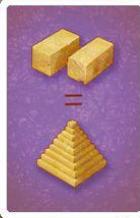
後,C打出了建築師特權牌,因此他只花了2塊石板便建成了1座金字塔。如此一來,C總共花了13金幣。
B控制的行省也沒有特權牌符號。B花6金幣買了3個農夫,6金幣買了3塊石塊,一共付了12金幣。B將3塊石塊放在同一行省內,建成了1座金字塔。
D花1金幣買了1張特權牌,1金幣買了農夫,15金幣買了5塊石塊,一共付了17金幣。使用了3塊石塊建成1座金字塔,另外使用了建築師特權牌——花2塊石塊建成1座金字塔。此時,他的行省中有2座金字塔,即刻換成了1座雙金字塔。
3. 獻祭階段
A翻開了1張金幣牌(5金幣); C翻開了2張金幣牌(1+1=2金幣); B翻開了2張金幣牌(5+1=6金幣), 且使用了1張獻祭調整特權牌; D使用了1張盜竊牌。

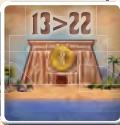
獻祭總額則為 $10(5 + 2 + 6 - 3)$ 。但B使用了獻祭調整特權牌,所以獻祭總額 $+3$ ,即為13。所以將 $13 > 2$ 2獻祭板塊放置在尼羅河分流處。
B在玩家中獻祭值第一,所以成為下一回合起始玩家
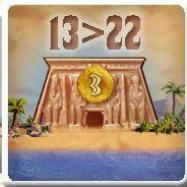
且獲得3個獎勵。B分別選擇1張特權牌和2個農夫作為獎勵,2個農夫放置在布陀。A獻祭值第二,選擇了1張特權牌和1個農夫作為2個獎勵,且把農夫放在了底比斯。C選擇1張特權牌。D收回了他的盜竊牌,且從金幣堆中偷取3金幣。
4. 收獲階段
根據現在的獻祭板塊顯示,每個農夫可收入3金幣。因為板塊上沒有駱駝標記,所以商隊該回合無收入。
B有5個農夫,一共收入15金幣。D使用了國庫特權牌,則不從行省中取得收入,而是直接從金幣堆取得8金幣。
A有3個農夫,共收入9金幣。
C有4個農夫,共收入12金幣。
如此一來,第一回合結束了。B成為了新一輪的起始玩家,且從牌堆抽出了4張新的行省牌。

特權牌參考
注意:任何時候都可以棄掉特權牌來換取1金幣。 1. 競拍階段

競價保護(x2)
在競拍階段中你的回合時打出。在競拍階段結束前,其他玩家如果要競拍你所在的行省,至少在領先你的書吏標記2格的出價位報價。
賄賂(x2)
在競拍階段里你的回合中有其他玩家在行省牌上出價比你高,你可以打出此牌。你可以繼續對該行省重新報價競拍。

2. 市場階段
建築師(x8)

你可以使用2個石塊建造1座金字塔。
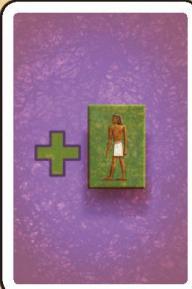
免費農夫(x5)
免費從供應堆中拿取1個農夫,放到一個你控制的行省中。免費農夫不放在農田里。免費農夫可以放在你沒有農田的行省中。
3. 獻祭階段

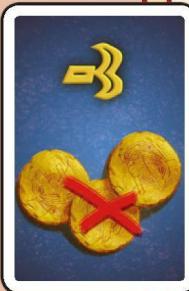
獻祭調整(x4)
將這張牌與其他用於獻祭的牌一起打出。在所有的獻祭金額都展示出後,根據回合順位使用,你可以選擇在獻祭總額上加上或者減去3。這張牌的效果不影響你個人的獻祭值。
盜竊牌(x5): 盗竊牌不算做特權牌, 且不能將其棄除換取1金幣。在獻祭階段, 你可以用盜竊牌作為你的獻祭來從供應堆偷取3金幣。開始遊戲時, 你有1張盜竊牌。獻祭階段結束時, 將使用過的盜竊牌返回你的手中。
4. 收獲階段

大豐收(x5)
選擇一個由你控制的行省。該行省中的每個農夫在收穫階段可以額外產出1金幣。
國庫(x3)
選擇一個由你控制的行省。該行省本回合無產出,但是你可從金幣堆獲得8金幣。


中段計分
- 你控制的行省中每有1個神廟,+1、2、3或4分,具體分數由當前的獻祭板塊所示數值決定。
- 你控制的行省中每有1個金字塔,+1分。
- 你控制的金字塔最少的行省中,每有1個金字塔,+3分。
- 你控制的某個行省在尼羅河一側的所有行省中金字塔數量最多,+5分。平局情況下,由行省中的石塊數量決定。尼羅河的東西兩側分別計分。
- 你達成條件的每張黃色特權牌,+3分。
中段計分的特權牌
書吏長官(x2)
你的行省內特權符號總和(包括即刻和持續)≥7,則+3分。
農業領袖 (x2)
你的行省內農夫數量總和≥9,則
+3分。

支配東河岸/西河岸(x2)
如果你的行省全在河岸的東邊或西邊,則+3分。

支配尼羅河/邊境(x2)
如果你的行省都在尼羅河邊,或都不在尼羅河邊,則+3分。
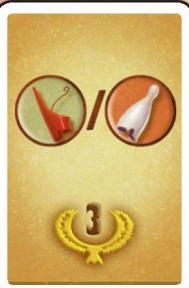
支配上埃及/下埃及(x2)
如果你的行省全在上埃及或下埃及, 則 +3 分。
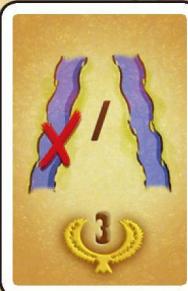
當特權牌計分完畢,請將這些卡牌棄除。在中段計分階段,你可以同時結算多種特權牌,但同效用的特權牌不可2次計分。
終盤計分
- 擁有金幣第一的玩家 + 6 分;
- 擁有金幣第二的玩家 +4 分;
- 擁有金幣第三的玩家 + 2 分。
為了避免出現平局的情況, 平局的玩家皆可計分, 隨後的玩家排名下移計分。
規則綜述
- 將版圖、配件擺放在桌面上。
- 每位玩家選擇一種顏色,將勝利分數標記放置在計分條邊,同時拿取3個相同顏色的書吏標誌。
- 每位玩家分發20金幣、1張盜竊牌、1張建築師特權牌。剩餘的盜竊牌、書吏標記、勝利分數標記放回遊戲盒中。
- 分別混洗好行省牌、特權牌後,將它們面朝下放在遊戲版圖邊上。使用的行省牌數量 = 3x 玩家人數,剩餘的行省牌則放回遊戲盒中,且不可查看。
- 隨機決定一名起始玩家,該玩家獲得起始玩家標記。競拍階段則由起始玩家開始順時針進行競拍。
1 局遊戲 = 2 個時代: 古王國時代和新王國時代
1個時代 = 3個回合 + 中段計分
1個回合 = 4個階段: 競拍, 市場, 獻祭, 收穫
時代結構
1個時代由3個回合組成。當3個回合結束時,立即進行中段計分。
每個回合分為4個階段, 它們分別是:
1. 競拍階段
每位玩家抽1張行省牌放置在遊戲版圖上。
- 由起始玩家先行競拍——將書吏標誌放置在行省牌中空餘的出價位上。若所要競拍的行省牌上已有書吏標記,則必須放置在更高的出價位上。當再次輪到你競拍時:如果你競拍的行省仍處於領先位置,你必須跳過;如果你競拍的行省報價落後,你則需移動書吏標記至其他行省競拍。
- 當每張行省牌都被競拍完畢時,競拍結束。支付金額為你書吏標記所在出價位上的金幣數額,且移動書吏標記至版圖上對應行省中以示控制主權。接下來,你可獲得剛剛控制的行省下邊棕色方框里的“即刻獎勵”。
2. 市場階段
- 特權牌購買限額為0-4張,你可購買的特權牌數量由你控制的行省中特權牌符號最多的行省決定。
由起始玩家先行購買,購買資源順序、費用必須遵從供應堆指示條。
- 農夫標記購買限額:你控制的行省有多少個農田空位就可以購買多少個農民。
- 石塊購買不受限制。
當一個行省內有3塊或以上石塊時,則3塊石頭轉換成1座金字塔——若已有1座金字塔則建成1座雙金字塔。

3. 獻祭階段
玩家們同時翻開他們獻祭的金幣牌。
- 獻祭金幣第一的玩家為新的起始玩家。
- 根據玩家們獻祭的金幣總額,取相應的獻祭板塊放在尼羅河分流處。
- 根據獻祭排名可獲得不同個數的獎勵:第一名獲3個獎勵,第二名獲2個獎勵,其餘玩家獲1個獎勵,可從特權牌、農夫、石塊中任意挑選單品或組合。
提示:如果使用了盜竊牌則無法獲得獎勵,但可從金幣堆中拿取3金幣。
4. 收獲與收入
- 每個農夫收入=目前獻祭板塊上的金幣數額。
- 商隊收入 = 行省中駱駝下方所示數額。如果目前的獻祭板塊上無駱駝標記,則商隊無收入。
- 金礦=行省中金幣所示數額。
回合、時代、遊戲結束
每1個時代由3回合組成,3回合後,1個時代終結,中段計分開始。
古王國時代的計分結束後,從遊戲版圖上移除所有的書吏標記、農夫,且將行省牌堆混洗均勻。金字塔和石塊依然留在遊戲版圖上,但玩家們不再擁有所有行省的控制權。
在新王國時代的中段計分完畢之後,進行終盤計分。當最終盤分完畢之後,遊戲結束,擁有最高分數的玩家獲勝。

特別鳴謝
美術設計: Kevin Le Moigne
美術指導: Igor Polouchine
遊戲設計:Reiner Knizia
本遊戲版權歸 Dr. Reiner Knizia 所有。
平面設計:©2016 SUPERMEEPLE.
規則編寫:Guillaume Gille-Naves and Bernard Philippon
中文翻译: 何冬妮
中文排版:冰山
中文校对: 陳嘉倫
台灣地區中文出版:Gokids玩樂小子


www.Gokids.com.tw
產品企劃:ORIGAMES
© 2017 Kids Power International Ltd. All Rights
感謝每位參與到遊戲測試中的朋友,感謝你們像家人、朋友一般的支持我們!特別感謝 Origames的William和Igor為我們做指導。感謝作者們和出版商們——Iain Adams、Sebastian Bleasdale、Chris Bowyer、Chris Dearlove、Martin Higham、Ross Inglis、Kevin Jacklin、Chris Lawson、Karl-Heinz Schmiel、Hannes Wildner、Schorsch幫助我們測試遊戲、編寫規則!特別感謝Markus Welbourne促成了這個遊戲項目,還有Dieter Hornung對遊戲優化做出了巨大貢獻!

SUPERMEEPLE標誌和註冊商標為SUPER MEEPLE。
中國製造
大中華地區總經銷&製造商:上海悅決德芳文化傳播有限公司
米寶海豚桌遊工作室
上海市長寧區昭化路505號103室
電話: 021-5299 5972
郵箱: surfinmeeple@gmail.com
網址: www.surfinmeeple.com
Download MarkdownTMG - Amun Re - TTT2010 - US LowRes - A4 4.5 AM.md38.2 KB
41品一A1N41品一A1MN44品一A1MAN0
AMUN-RE
A GAME BY REINER KNIZIA ILLUSTRATIONS BY KEVIN LE MOIGNE INTRODUCTION
In ancient Egypt, ages and generations rise and fall under the watchful eyes of Amun-Re. Leading a royal family, you will contend with the other families to acquire provinces, build grand temples and pyramids, and cultivate your fields as the capricious Nile permits. At the end of Egypt's classical era, history will revere only one name above all others.
Amun-Re is an auctioning and development game that evolves as ages go by. Claim your place as the greatest pharaoh of all time to win!
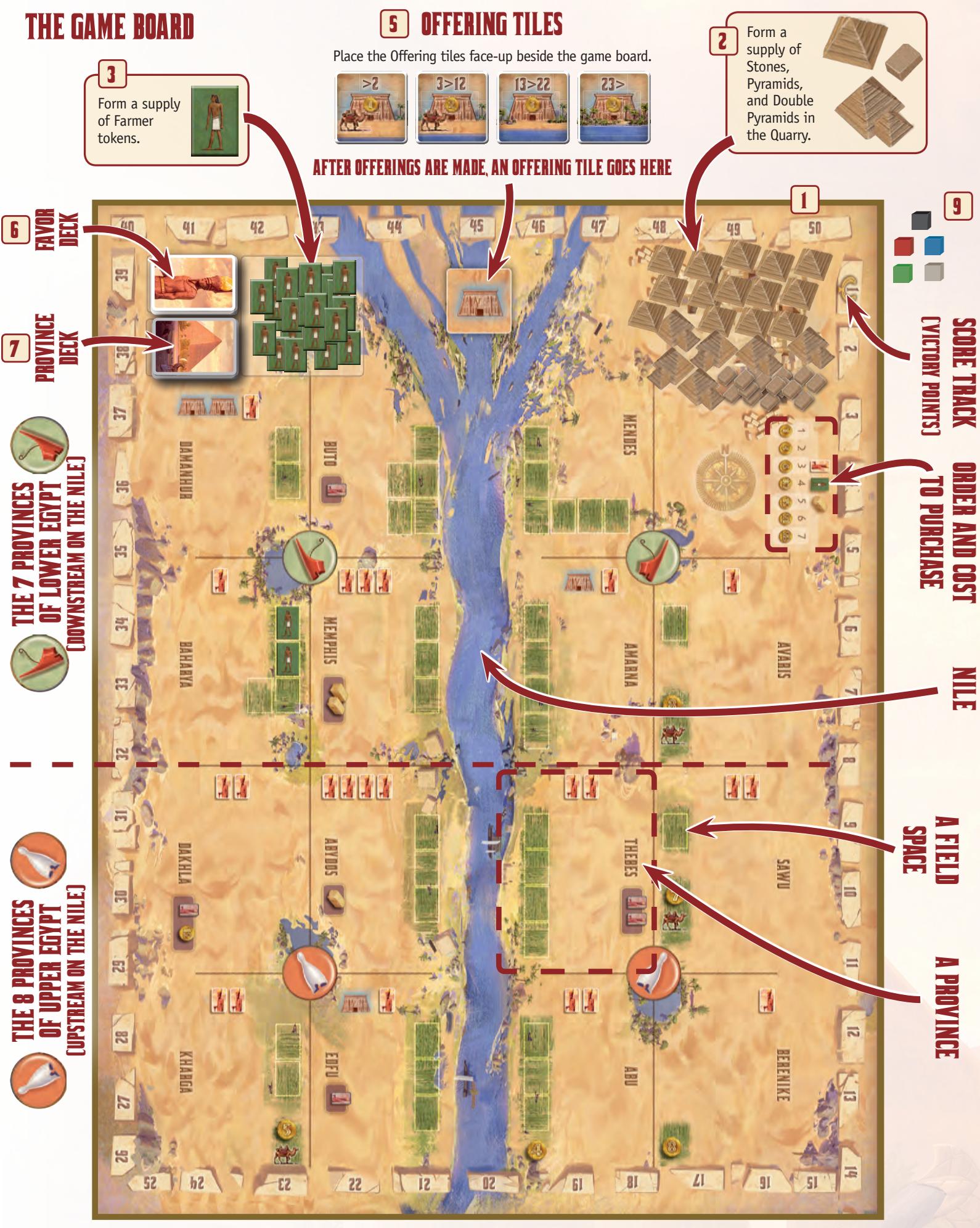
Form the Gold Reserve by sorting the Gold cards by value, placing the resulting stacks face-up next to the board.
SET-UP
-
Lay the game board face-up in the center of the table.
-
Form a supply of Stones, Pyramids, and Double Pyramids in the Quarry.
-
Form a supply of Farmer tokens.
-
Form the Gold Reserve by sorting the Gold cards by value, placing the resulting stacks face-up beside the game board.
-
Place the Offering tiles face-up beside the game board.
-
Deal 1 Architect Favor card to each player, then shuffle the remaining Favor cards (with statue backs) together. Place this Favor deck beside the game board.

- Build the Province deck (with pyramid backs) based on the number of players. The Province deck should include 3 Province cards per player. With 5 players, all Province cards will be used. Return any unused Province cards to the game box--they will not be this game.


that color. Retur the components of any unused colors to the game box.
- Place a Victory Point marker of each player's color beside the game board's score track, and return any unused markers to the game box.

10.Deal a combined value of 20 Gold to each player, using Gold cards of the following denominations:




You can and should make change with the stacks of Gold cards at any time. Whenever an amount of Gold is referenced, it is referring to total value in Gold cards, which can be formed by any combination of appropriate Gold cards. When you pay Gold for bids and purchases, return the Gold cards to the Reserve.
- Deal 1 Theft card to each player, and return any unused Theft cards to the game box.
12.Randomly determine a Start Player, give that player the Start Player token.

and
START PLAYER TOKEN
During the game, the Start Player may change based on the Offering to Amun-Re.Actions during the Auction, Market, and Harvest Phases always begin with the current Start Player, and proceed clockwise around the table until each player has taken his or her turn.

COMPONENTS
1 Game board (shown on page 2, opposite)


15 Scribe pawns (3 x 5 colors)

5 Victory Point markers

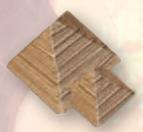
15 Stones
15 Pyramids
15 Double Pyramids




61 Gold cards (18 ones, 12 twos, 12 fives, 9 tens, 10 twenties)

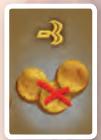

5 Theft cards (-3 Gold)
39 Favor cards

15 Province cards

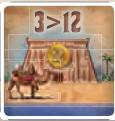
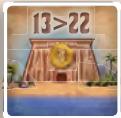
4 0ffering tiles

48 Farmer tokens

1 Start Player token
OVERVIEW AND OBJECTIVE
As the leader of a royal Egyptian family, you must compete against the others to ensure history remembers you as the greatest pharaoh of all time!
Amun-Re is played over the course of 2 ages, called the Old Kingdom and the New Kingdom. Each age consists of 3 identical rounds of play (sub-divided into 4 phases). Scoring is done at the end of each age. Finish the game with the most victory points to win.
ROUND STRUCTURE
Each round takes place over 4 phases, in order:
1. THE AUCTION PHASE
Where Province cards are dealt to the game board, and players bid against one another to acquire these Provinces.
2. THE MARKET PHASE
Where players may purchase items and cards from the market, and place Stones and Farmer tokens on the game board.
3. THE OFFERING PHASE
Where players may sacrifice Gold to Amun-Re.
4. THE HARVEST PHASE
Where players collect income from their Provinces and Farmer tokens.
These phases are described in full over the next 2 pages. For each phase and during Scoring, there are specific Favor cards that can be played.
Note: You cannot play 2 identical Favor cards in the same phase or during Scoring.
At any time during the game, players may discard any number of their Favor cards for 1 Gold each.
1. THE AUCTION PHASE
At the beginning of the Auction Phase, draw 1 card from the Province deck for each player, and then place them face-up on the game board over their matching Provinces. These Provinces are available for auction during this round.

For each Province card you place on the game board, also place any Stones, Favor cards (facedown), and Gold cards indicated in the brown “Immediate Bonuses" box in the Province.
Immediale Bonuses
Immediate Bonuses are shown in brown boxes. They are awarded as soon as you gain control of a Province.
Examples:
• Immediately draw 1 Favor card

Immediately place 1 Stone in the Province.

Immediately draw 1 Favor card and gain 12 Gold.

Permanent Bonuses
Permanent Bonuses are displayed in the sand along the side of a Province's border. They provide an ongoing benefit for as long as you control the Province.
• Favor: Indicates the maximum number of Favor cards you may purchase during the Market Phase (1 per symbol). Only your Province with the most Favor symbols counts--they not added together.

are
• Gold Mine: Provides a regular Gold income during each Harvest Phase.

Caravan: Provides a Gold income during each Harvest Phase, but only if the Offering tile features a Camel in its illustration.
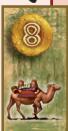
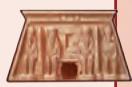
• Temple: During each Harvest Phase, scores Victory Points featured on the most recent Offering tile.
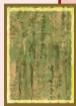
Fields: Each Field space may house up to 1 Farmer token. Farmer tokens are acquired during the Market Phase, and provide an income of Gold based on the most recent Offering tile. You may not place Farmer tokens in Provinces that do not feature Field spaces.
Next, beginning with the Start Player and proceeding clockwise in order, each player must place a bid on a Province's unoccupied bidding space, or pass if he or she already has a winning bid on a Province. Use one of your Scribe pawns to represent your bid.
When bidding on a Province that another player has already bid on, your bid must be greater than the current bid. However, you may make a bid that is greater than the next bidding space available on the Province if you wish.

If you are outbid on a Province, your next bid cannot be placed on the same Province. If you are outbid again in a future turn, you may return to bid on a different Province where you were previously outbid.
Bribery: During your turn in the Auction Phase, if you have been outbid on a Province card, you may play the Bribery Favor card to make a higher bid on the same Province card.

Protection: When you place a bid during the Auction Phase, you may play the Protection Favor card to block the next-highest bidding space on that Province card. This means that another player would have to place his or her Scribe pawn at least 2 bidding spaces higher to outbid

you. If you later move your Scribe pawn to another Province card, your Protection Favor card applies there, too.
You cannot bid more Gold on a Province than you currently possess.
The auction ends when exactly 1 player's Scribe pawn is present on each Province. Players must then pay Gold to the Reserve in the amount of their bids and leave behind their Scribe pawns on the game board to indicate control over the appropriate Provinces. Finally, players collect any Stones, Favor cards, and Gold indicated on their newly-acquired Provinces' brown “Immediate Bonuses" boxes. The Province cards are removed from the board and placed onto a discard pile.
Example: Thebes, Dakhla and Abydos are drawn and auctioned.
Seb is the Start Player. She places her Scribe pawn on Dakhla, bidding 10 Gold. Arnaud places his Scribe pawn on Thebes, bidding 3 Gold. Charles places his Scribe pawn on Thebes, outbidding Arnaud with 6 Gold.
It is now Seb's turn again, but nobody has outbid her, so she must pass. Arnaud was outbid on Thebes, so he must change his bid. He places his Scribe pawn on the '0' Gold space of Abydos.
At this point, no Province is contested, so the auction ends immediately. Players pay their bids to the Reserve, place their Scribe pawns in the Provinces they have acquired, and claim their Immediate Bonuses:
Seb pays 10 Gold, then receives 12 Gold and 1 Favor card from Immediate Bonuses in Dakhla.
Arnaud pays nothing and gains control of Abydos, as well as the free Stone it contains. Charles pays 6 Gold, acquires Thebes, and receives its 2 Favor cards.
2. THE MARKET PHASE
Starting with the Start Player, you may make purchases from the supply in the buying order indicated on the game board-

-Favor cards, then Farmers, then Stones.
When purchasing from the supply, pay Gold to the Reserve according to the scale printed below the buying order, depending on how many of that item you purchase. Each purchase is made separately, so buying 1 of each item would only cost a total of 3 Gold. Once you have already purchased an item, or passed on an opportunity to do so in the order, you will not have another chance to buy that item during your turn.
You may purchase:
0-4 Favor cards, which are drawn from the Favor deck. The maximum number of cards you may purchase is determined by the highest number of Favor symbols present in a single Province you control. If you do not control a Province with 1 or more Favor symbols, you cannot purchase Favor cards.

Farmer tokens, which must each be placed immediately in an open Field space in a Province you control. You cannot purchase Farmer tokens that you are unable to place. Farmer tokens cannot be placed in Provinces that have no Field spaces.
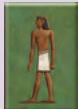
Free Farmer: Play a Free Farmer Favor card during your turn in the Market Phase. When you do, acquire 1 Farmer token from the supply at no cost, and place it in any Province you control. Unlike other

Farmer tokens, a Free Farmer is not placed in a Field space. It may be placed in any Province you control, even if that Province does not feature any Field spaces. Acquiring a Free Farmer is separate from your normal purchase of Farmer tokens--if you decide to buy 3 other Farmers, for example, you will still only pay 6 Gold.
Stones, which must be placed immediately in one or more Provinces you control.

Unlike Favor cards, it is possible to purchase more Farmer tokens or Stones than is shown by the cost scale on the board, as long as you have space for them. If you want to purchase more than 7, calculate the cost by following the formula below: The cost to purchase 8 = the cost to purchase 7 (28) + 8 = 36 Gold; the cost to purchase 9 = the cost to purchase 8 (36) + 9 = 45 Gold; etc.
You are not obligated to make any purchases. However, if you do, you must make all of your purchases before passing the turn to the next player.
Construction: As soon as a third Stone is placed in a single Province, immediately replace those Stones with a single Pyramid. If a single Pyramid was already present in that Province, then replace it with a Double Pyramid.
Multiple Pyramids may be built in the same turn, as long as each Pyramid's Stone requirements are met.
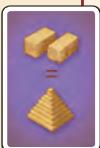
Architect: Play an Architect Favor card during your turn in the Market Phase. When you do, you may build 1 Pyramid in a Province you control using only 2 Stones. You may not play an Architect Favor card during
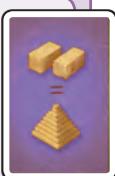
any other Phase, even if you have just placed a second Stone in a Province you control, and if you have placed a third Stone, all 3 Stones are immediately replaced with a Pyramid even if you possess an Architect Favor card.
Example: Charles controls Thebes and Edfu.
He can purchase a maximum of 2 Favor cards.
He purchases only 1, paying 1 Gold.
He then purchases 4 Farmer tokens for 10 Gold, which he must immediately place in his empty Field spaces.
Finally, he purchases 3 Stones for 6 Gold and places them in the Province of Thebes. Since Thebes now has 3 Stones in it, he places a Pyramid in Thebes and returns those 3 Stones to the quarry.
3. THE OFFERING PHASE
During the Offering Phase, players choose and simultaneously reveal Gold cards or a Theft card, representing a joint offering to Amun-Re to convince him to flood the Nile. The sum of the offered Gold dictates the scoring value of Temples, as well as the incomes offered by Farmers and Caravans during the Harvest Phase.
Preparing Individual Offerings:
Secretly select 1 or more of your cards and, covering them with your hand, hold them out to show that you have finalized your Offering. Once all players have finalized their Offerings, reveal them simultaneously.
If you offer 1 or more Gold cards, your Offering's value is equal to the sum of all Gold cards you contributed.
If you offer your Theft card, you instead steal 3 Gold from the Reserve.

In either case, you may include a blue Favor card to adjust the Offering. Other Favor cards may not be included in the Offering.
Calculate the Collective Offering:
Add the individual Offerings together, remembering to reduce that total by 3 for each Theft card that was played.
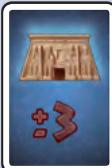
Beginning with the Start Player and proceeding clockwise in order, players that included a blue Offering Adjustment Favor card in their Offering must now declare whether they would like to increase or decrease the Offering. These adjustments only affect the value of the collective Offering--the value of your individual Offering is unaffected.
Once the collective Offering has been calculated, place the corresponding Offering tile in the Nile Delta space. (For example, if the total Offering is 10, use the tile marked 3>12. If the Offering is 25, use the tile marked 23>).
If you played your Theft card, return it to your hand. Remember to steal your 3 Gold from the supply!
4. THE HARVEST PHASE
The Nile has flooded. Beginning with the Start Player and proceeding clockwise in order, players will now receive income from the Provinces that they control.
Each of your Provinces may allow you to collect Gold from the supply as indicated by its icons. You may earn from your Provinces in the following ways:

For Gold Mines - Gain Gold equal to the indicated number.

For Caravans - Gain Gold equal to the number indicated above the camel, but only if a camel is depicted on the current Offering tile.

For each Farmer Token in the Provinces you control - Gain Gold equal to the amount shown on the current Offering tile.
Effects of the Offering:
Collect rewards - The player that contributed the most to the Offering may now collect 3 Rewards. These Rewards may be any combination of Favor cards, Stones, and/or Farmer tokens. The player that contributed the second highest Offering collects 2 Rewards, and all other players collect 1 Reward in turn order. However, players that played a Theft card cannot collect a Reward. In a tie, the player earliest in turn order wins.
The number of Favor cards you can acquire from a Reward is not limited by the Permanent Bonus Favor card symbols in your Provinces (unlike in the Market Phase). Farmer tokens must be placed in open Field spaces and Stones must be placed immediately in your Provinces. If there are ever 3 Stones in the same Province, replace them with the appropriate Pyramid.
Reminder: Architect and Free Farmer Favor cards cannot be played during the Offering Phase.
Determine the new Start Player - The player who offered the most Gold collects the Start Player token, and will be the new Start Player for the next round. If there is a tie, the player earliest in the current turn order becomes the new Start Player.

Example: Arnaud is the Start Player. He offered 6 Gold, Charles offered 6 Gold, and Seb played the Theft card. The sum of all Offerings is 9 Gold (6 + 6 - 3 = 9). Players place the corresponding tile on the board: “3 > 12". Seb takes back her Theft card, and collects 3 Gold from the Reserve. Charles and Arnaud have offered the same amount, but Arnaud is earlier in turn order. Therefore, Arnaud retains the Start Player token and collects 3 Favor cards as his 3 Rewards. Charles collects a Stone and a Farmer token as his 2 Rewards, and immediately places them in Provinces he controls. Seb does not collect any Rewards.
Treasury: Play this Favor card during the Harvest Phase, before calculating your income. When you do, select a single Province you control. Do not collect income from that Province this turn - not from Farmers, Caravans, or Gold Mines. Instead, collect 8 Gold from the Reserve.

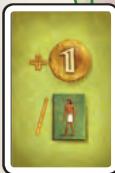
Big Harvest: Play this Favor card during the Harvest Phase, before calculating your income. When you do, select a single Province you control. Each Farmer token in that Province provides 1 additional Gold this turn.
END OF THE ROUND, AGE, AND GAME
After all players are finished with the Harvest Phase, the round ends, and a new round begins.
• If this was the third round of an age, the Province deck will e empty. When this occurs, the age ends, and Intermediate Scoring occurs.
After Intermediate Scoring, if that was the end of the second age (New Kingdom), then proceed to Final Scoring and the game's end!
INTERMEDIATE SCORING
Intermediate Scoring occurs at the end of each age. To perform Intermediate Scoring, award Victory Points (VP) for the following:
• +1, +2, +3, or +4 VP for each Temple depicted among Provinces you control. The scoring value of each Temple is determined by the Gold shown on the current Offering tile.
• +1 VP for each Pyramid in a Province you control. Double Pyramids count as 2 Pyramids.
• +3 VP for each Pyramid in your single Province with the fewest Pyramids. If you control a Province with no Pyramids, then you do not score any VP for this item.
• +5 VP for the Province that contains the most Pyramids on each side of the Nile (+5 VP for the west, and +5 for the east). In case of a tie, the player whose Province contains more Stones scores the VP. In case of a further tie, all tied players score the VP.
• +3 VP for each yellow Favor card whose conditions are satisfied.
Reminder: You cannot play 2 identical Favor cards during the same phase or during Scoring.
If this is the end of the first age (Old Kingdom), remove all Scribe pawns and Farmer tokens from the game board, returning the Farmer tokens to the supply. Collect all of the Province cards from the game board and shuffle them into the Province deck.
Pyramids and Stones are not removed from their Provinces, and remain on the game board. They are no longer considered controlled by any player until that Province is claimed in a future Auction Phase.
If this is the end of the second age (New Kingdom), immediately proceed to Final Scoring.
FINAL SCORING
To perform Final Scoring, players reveal their Gold cards. Award Victory Points (VP) for the following:
• +6 VP to the player with the highest combined value of Gold cards,
• +4 VP to the player with the second highest value,
• +2 VP to the player with the third highest value.
In case of a tie, all tied players score the appropriate VP, but subsequent players are moved down. For example, if 2 players are tied for highest value, they both score +6 VP, the player with the second highest value then only scores +2 VP.
After all VP has been awarded, the player with the most VP wins! In the event of a tie, the tied player with the most Pyramids among his or her Provinces wins. If there is still a tie, the player with the most Stones among his or her Provinces wins. If still tied, the victory is shared.
EXPERT RULES
Expert rules allow tactical control of when Provinces are available.

At the start of the game, after shuffling the Province deck, deal 3 Province cards to each player. Return any remaining Province cards to the game box without looking at them. Keep these cards secret from other players.
At the beginning of each Auction Phase, each player selects 1 Province card, and the chosen cards are revealed simultaneously. These Province cards are available during this turn's auction.
At the beginning of the New Kingdom, shuffle all Province cards that were played during the Old Kingdom, and deal them out evenly to each player.
EXAMPLE OF THE BEGINNING OF A GAME
In this example of a 4-player game the Province deck consists of 12 cards (3 x 4 players). Bernārd is the Start Player.
1. THE AUCTION PHASE
Bernard draws 4 cards from the Province deck, and places them faceup on the board: Thebes, Avaris, Buto, and Mendes. He places 2 facedown Favor cards in Thebes and 1 in Buto, as indicated under those Provinces' Immediate Bonuses.
Bernard puts his Scribe pawn on the Thebes card, bidding 6 Gold. Charles places his Scribe pawn on Buto and bids 0 Gold. Arnaud places his Scribe pawn on Buto and bids 3 Gold. Alexandre puts his Scribe pawn on Mendes, bidding 3 Gold. Charles, having been outbid on Buto, moves his Scribe pawn to Mendes and bids 6 Gold. Alexandre must make a new bid, and moves his Scribe pawn to Avaris, bidding 0 Gold.
The auction ends, since exactly 1 Scribe pawn is present on each Province card. Each player pays the amount of their bid and leaves their Scribe pawns behind to mark control of their new Provinces. Bernard acquires the 2 Favor cards in Thebes, and Arnaud takes the Favor card in Buto. The Province cards are placed onto a discard pile.
2. THE MARKET PHASE
Thebes allows Bernard to purchase up to 2 Favor cards, and he does so by spending 3 Gold. He also purchases 3 Farmer tokens for 6 Gold, which he places on the Field spaces in Thebes. Finally, he purchases 1 Stone for 1 Gold, which he also places in Thebes. Bernard pays his total--10 Gold--to the Reserve.
Charles has no Favor symbols in his Province, and therefore cannot purchase any Favor cards. He buys 4 Farmer tokens for 10 Gold, and 2 Stones for 3 Gold. He then uses his Architect Favor card to replace the 2 Stones in his Province with 1 Pyramid. He pays 13 Gold in total.
Arnaud has no Favor symbols in his Province either. He purchases 3 Farmer tokens for 6 Gold, and 3 Stones for 6 Gold. He pays 12 Gold in total, and replaces his 3 Stones with 1 Pyramid in his Province.
Alexandre purchases 1 Favor card for 1 Gold, 1 Farmer token for 1 Gold, and 5 Stones for 15 Gold. He pays 17 Gold in total, turns 3 Stones into 1 Pyramid, and uses his Architect Favor card to replace the remaining 2 Stones with another Pyramid. The 2 Pyramids in his Province are then replaced by 1 Double Pyramid.
3. THE OFFERING PHASE
Bernard reveals 1 Gold card (5 Gold). Charles reveals 2 Gold cards (1+1 = 2 Gold). Arnaud reveals 2 Gold cards (5 + 1 = 6 Gold), and an Offering Adjustment Favor card. Alexandre reveals his Theft card.
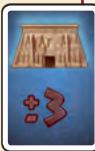
The value of the collective Offering is 10 (5 + 2 + 6 - 3). Charles uses his Offering Adjustment card to increase the value of collective Offering by 3, raising it to 13. The 13 > 22 Offering tile is placed on the Nile Delta.
Arnaud, who contributed the most Gold to the Offering, collects the Start Player token and 3 Rewards. For those Rewards, he chooses to take 1 Favor card and 2 Farmer tokens, which he places in the Field spaces of Buto. Bernard contributed the second best Offering, and collects 1 Favor card and 1 Stone, which he places on Thebes. Finally Charles acquires 1 Favor card. Alexandre returns his Theft card to his hand, and steals 3 Gold from the Reserve.
4. THE HARVEST PHASE
The current Offering tile indicates that Farmer tokens provide 3 Gold each this turn. Since this tile does not depict a Camel, Caravans do not provide income.
Arnaud's 5 Farmer tokens provide 3 Gold each, for a total of 15 Gold. Alexandre plays the Treasury Favor card. He chooses not to take any income from his Province, and instead receives 8 Gold.
Bernard's 3 Farmer tokens provide a total of 9 Gold.
Charles's 4 Farmer tokens provide a total of 12 Gold.
This marks the end of the first round. As the new Start Player, Arnaud begins the next round by drawing 4 new Provinces.

FAVOR CARD REFERENCE
Note: Any Favor card can always be discarded for 1 Gold.
1. THE AUCTION PHASE

Protection (x2)
Play during your turn in the Auction Phase. Until the end of the Phase, players cannot outbid you at any Province unless they place their Scribe pawn at least 2 bidding spaces ahead of yours.
Bribery (x2)
Play during your turn in the Auction Phase, if you have been outbid on a Province card. You may make a new bid on the same Province card.


2. THE MARKET PHASE
Architect (x8) You may construct a Pyramid using 2 Stones instead of 3.
Free Farmer (x5)
Place a Farmer token from the supply into a Province you control at no cost. The Free Farmer token is not placed in a Field space. It may be placed in a Province that does not feature any Field spaces.

3. THE OFFERING PHASE
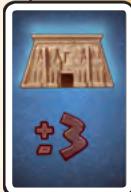
Offering Adjustment (x4)
Play this card as part of your Offering. After all Offerings have been revealed, in turn order, you may choose to add or subtract 3 from the value of the collective Offering. This adjustment does not affect the value of your individual Offering.
Theft (x5): The Theft card is not a Favor card and may not be exchanged for 1 Gold. You may play it as your Offering in order to steal 3 Gold from the Reserve. You begin the game with 1 Theft card,and it returns to your hand at the end of the Offering Phase whenever you play it.

4. THE HARVEST PHASE
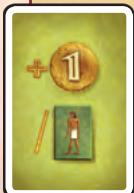
Big Harvest (x5)
Choose a Province you control. Each Farmer token in that Province provides 1 additional Gold during this Harvest Phase.
Treasury (x3)
Choose a Province you control. That Province provides no income this round, and you instead collect 8 Gold from the Reserve.

INTERMEDIATE SCORING
• +1, +2, +3, or +4 VP for each Temple in a Province you control, based on the Gold value features on the current Offering tile.
• +1 VP for each Pyramid in a Province you control.
+3 VP for each Pyramid in the Province you control with the fewest Pyramids.
+5 VP if you have the Province with the most Pyramids on any single side of the Nile. Ties are broken by Stones. Each side of the river--east and west--score separately.
• +3 VP for each yellow Favor card whose conditions you have satisfied (see below).
FAVOR CARDS THAT GRANT VICTORY POINTS DURING INTERMEDIATE SCORING
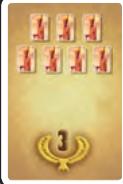
Master of Scribes(x2) +3 VP if your Provinces feature a total of at least 7 Favor symbols (Immediate and/or Permanent).
Master of Farmers (x2) +3 VP if your Provinces contain at least 9 Farmer tokens.


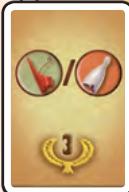
West Side or East Side (x2) +3 VP if all of your Provinces are on the same side of the Nile.
Nile or Frontier (x2) +3 VP if all of your Provinces are next to the Nile, or if none of them are next to the Nile.
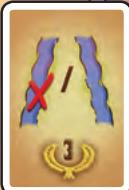
Upper or Lower Egypt (x2) +3 VP if all of your Provinces are in Upper Egypt, or if they are all in Lower Egypt.
Discard these cards after using them to score. You may score multiple Favor cards during each Intermediate Scoring, but you may not score multiple copies of the same card.
FINAL SCORING
• +6 VP to the player with the highest total value of Gold cards,
+4 VP to the player with the second most Gold,
• +2 VP to the player with the third most Gold.
In case of a tie for any of these rewards, all tied players score, but subsequent rewards are pushed down.
RULES SUMMARY
• Arrange the board and components on the table.
Each player chooses a color, places a Victory Point marker of that color beside the score track, then collects the 3 Scribe pawns of that color.
Give each player 20 Gold, 1 Theft card, and 1 Architect Favor card. Remaining Theft cards, Ścribe pawns, and Victory Point markers are returned to the game box.
Build the Province and Favor decks, shuffle them separately, and then place them face-down on the game board. The Province deck should consist of 3 Province cards per player--all leftover Province cards should be returned, unseen, to the game box.
Determine a Start Player at random, and give that player the Start Player token. Actions begin with the Start Player and proceed clockwise around the table.
1 game = 2 ages: the Old Kingdom and New Kingdom
1 age = 3 rounds + Intermediate scoring
1 round = 4 phases: Auction, Market, Offering, and Harvest
STRUCTURE OF AN AGE
An age consists of 3 rounds. At the end of the 3rd round, proceed to Intermediate Scoring.
Each round is divided into 4 phases, which take place in the following order:
1. THE AUCTION PHASE
Draw and place 1 Province card on the game board for each player.
Beginning with the Start Player, make a bid by placing your Scribe pawn on an empty bidding space on any Province card. When bidding on a Province where a bid is already present, you must place your bid on a higher bidding space. When it is your turn again, you must pass (if your bid is still the highest in a Province), or move your Scribe pawn to bid on a different Province if you have been outbid.
• As soon as each Province card has exactly 1 Scribe pawn on it, the auction ends. Pay Gold to the Reserve equal to the number on your pawn's bidding space, and leave your Scribe pawn behind to indicate you now control that Province. Next, collect any Immediate Bonuses shown in the brown box in your newly acquired Province.
2. THE MARKET PHASE
Beginning with the Start Player, you may purchase the following items from the supply for the Gold value indicated on the game board's cost scale:
• 0-4 Favor cards, limited by the highest number of Favor symbols present in a single Province you control
• Farmer tokens, limited by the open Field spaces among Provinces you control
• Any number of Stones
Whenever a single Province holds 3 or more Stones, replace 3 of those Stones with 1 Pyramid (or a Double Pyramid if that Province already contains a single Pyramid).
3. THE OFFERING PHASE
Players simultaneously present their Offering of Gold to Amun-Re.
The player that contributes the most becomes the new Start Player.
• Place the appropriate Offering tile on the Nile Delta space (based on the combined value of all players' Offerings).

• Players receive Rewards from the supply based on their individual offerings: 3, 2, and 1 Favor cards, Farmer tokens, and/or Stones (in any combination) for 1st, 2nd, and all further players.
Reminder: If you played a Theft card as your Offering, you cannot collect any Reward, but you do steal 3 Gold from the Reserve.
4. HARVEST AND INCOME
Each Farmer token = Gold indicated on the current Offering tile
• Caravans = Gold indicated on the Province above the Camel, but only if the current Offering tile features a Camel
Gold Mines = Gold as indicated on the Province
END OF THE ROUND, AGE, AND GAME
Each age lasts 3 rounds, then you have reached the end of an age, and should proceed to Intermediate Scoring.
After Intermediate Scoring at the end of the Old Kingdom, remove Scribe pawns and Farmer tokens from the game board, and reshuffle the Province deck. Pyramids and Stones remain on the game board, but the Provinces are no longer considered to be controlled.
After Intermediate Scoring at the end of the New Kingdom, proceed to Final Scoring. After Final Scoring, the game ends, and the player with the most Victory Points wins.
CREDITS

Game Designer: Reiner Knizia
© Dr. Reiner Knizia, 2016. All rights Reserved.
Graphic Design & Artwork: ©2016 SUPERMEEPLE.
Artist: Kevin Le Moigne
Writing and editing the rules: Guillaume Gille-Naves and Bernard Philippon

Art Direction: Igor Polouchine
Development & Layout: ORIGAMES
Thanks to all the testers that helped us on this project, as well as our family and friends for their support. A special thank-you to William and Igor from Origames for their valuable assistance.

For their help in testing and rule writing, the author and publisher thank Iain Adams, Sebastian Bleasdale, Chris Bowyer, Chris Dearlove, Martin Higham, Ross Inglis, Kevin Jacklin, Chris Lawson, Karl-Heinz Schmiel, Hannes Wildner, and Schorsch. We offer special thanks to Markus Welbourne for his cooperation in the development of the game and to Dieter Hornung for his efforts to optimize the game.
Used under license by Tasty Minstrel Games LLC
Jeu en anglais. Importé au Canada par TMG.
SUPERMEEPLE and its logo are registered trademarks of SUPER MEEPLE.
TMG logo is a trademark of Tasty Minstrel Games LLC
Manufactured in China.
Download Markdown简繁检索对照.md1.6 KB
6404_5404_amun-re — 简体/繁体检索对照
本游戏的规则书是繁体中文原文。用户用简体提问时,把关键词按下面这张表转成繁体再去 grep 原文,命中率最高。
回答时用简体或繁体都可以,但引用的原文保持繁体。
简体 → 繁体 对照(按该游戏原文出现频率排序,共 60 字)
| 简体 | 繁体 | 原文出现次数 |
|---|---|---|
| 币 | 幣 | 123 |
| 个 | 個 | 107 |
| 权 | 權 | 86 |
| 块 | 塊 | 81 |
| 献 | 獻 | 73 |
| 时 | 時 | 72 |
| 农 | 農 | 72 |
| 阶 | 階 | 69 |
| 张 | 張 | 64 |
| 游 | 遊 | 53 |
| 戏 | 戲 | 52 |
| 竞 | 競 | 52 |
| 价 | 價 | 52 |
| 将 | 將 | 51 |
| 买 | 買 | 51 |
| 标 | 標 | 49 |
| 数 | 數 | 47 |
| 计 | 計 | 44 |
| 记 | 記 | 42 |
| 则 | 則 | 42 |
| 获 | 獲 | 40 |
| 购 | 購 | 36 |
| 奖 | 獎 | 35 |
| 励 | 勵 | 35 |
| 从 | 從 | 34 |
| 为 | 為 | 33 |
| 额 | 額 | 32 |
| 书 | 書 | 30 |
| 结 | 結 | 29 |
| 当 | 當 | 26 |
| 图 | 圖 | 26 |
| 们 | 們 | 25 |
| 后 | 後 | 24 |
| 总 | 總 | 23 |
| 开 | 開 | 23 |
| 应 | 應 | 22 |
| 费 | 費 | 22 |
| 窃 | 竊 | 20 |
| 这 | 這 | 20 |
| 场 | 場 | 19 |
| 盗 | 盜 | 19 |
| 报 | 報 | 19 |
| 与 | 與 | 18 |
| 该 | 該 | 18 |
| 选 | 選 | 18 |
| 进 | 進 | 17 |
| 于 | 於 | 16 |
| 择 | 擇 | 16 |
| 会 | 會 | 15 |
| 顺 | 順 | 15 |
| 须 | 須 | 15 |
| 国 | 國 | 15 |
| 获 | 穫 | 14 |
| 罗 | 羅 | 13 |
| 来 | 來 | 13 |
| 边 | 邊 | 13 |
| 对 | 對 | 13 |
| 发 | 發 | 12 |
| 号 | 號 | 12 |
| 没 | 沒 | 12 |
Texts are community-compiled or publicly released by publishers; copyright remains with the original authors. For personal reference only.